EP0301688A2 - Verfahren zum kontrollierbaren Einbringen eines Parameter ändernden Elements in einer Oxidkeramik, die wenigstens eine supraleitende Phase enthält - Google Patents
Verfahren zum kontrollierbaren Einbringen eines Parameter ändernden Elements in einer Oxidkeramik, die wenigstens eine supraleitende Phase enthält Download PDFInfo
- Publication number
- EP0301688A2 EP0301688A2 EP88304683A EP88304683A EP0301688A2 EP 0301688 A2 EP0301688 A2 EP 0301688A2 EP 88304683 A EP88304683 A EP 88304683A EP 88304683 A EP88304683 A EP 88304683A EP 0301688 A2 EP0301688 A2 EP 0301688A2
- Authority
- EP
- European Patent Office
- Prior art keywords
- atoms
- superconducting
- further step
- labile
- iia
- Prior art date
- Legal status (The legal status is an assumption and is not a legal conclusion. Google has not performed a legal analysis and makes no representation as to the accuracy of the status listed.)
- Granted
Links
Images


Classifications
-
- C—CHEMISTRY; METALLURGY
- C04—CEMENTS; CONCRETE; ARTIFICIAL STONE; CERAMICS; REFRACTORIES
- C04B—LIME, MAGNESIA; SLAG; CEMENTS; COMPOSITIONS THEREOF, e.g. MORTARS, CONCRETE OR LIKE BUILDING MATERIALS; ARTIFICIAL STONE; CERAMICS; REFRACTORIES; TREATMENT OF NATURAL STONE
- C04B35/00—Shaped ceramic products characterised by their composition; Ceramics compositions; Processing powders of inorganic compounds preparatory to the manufacturing of ceramic products
- C04B35/01—Shaped ceramic products characterised by their composition; Ceramics compositions; Processing powders of inorganic compounds preparatory to the manufacturing of ceramic products based on oxide ceramics
- C04B35/45—Shaped ceramic products characterised by their composition; Ceramics compositions; Processing powders of inorganic compounds preparatory to the manufacturing of ceramic products based on oxide ceramics based on copper oxide or solid solutions thereof with other oxides
- C04B35/4504—Shaped ceramic products characterised by their composition; Ceramics compositions; Processing powders of inorganic compounds preparatory to the manufacturing of ceramic products based on oxide ceramics based on copper oxide or solid solutions thereof with other oxides containing rare earth oxides
-
- H—ELECTRICITY
- H10—SEMICONDUCTOR DEVICES; ELECTRIC SOLID-STATE DEVICES NOT OTHERWISE PROVIDED FOR
- H10N—ELECTRIC SOLID-STATE DEVICES NOT OTHERWISE PROVIDED FOR
- H10N60/00—Superconducting devices
- H10N60/01—Manufacture or treatment
- H10N60/0268—Manufacture or treatment of devices comprising copper oxide
-
- H—ELECTRICITY
- H10—SEMICONDUCTOR DEVICES; ELECTRIC SOLID-STATE DEVICES NOT OTHERWISE PROVIDED FOR
- H10N—ELECTRIC SOLID-STATE DEVICES NOT OTHERWISE PROVIDED FOR
- H10N60/00—Superconducting devices
- H10N60/01—Manufacture or treatment
- H10N60/0268—Manufacture or treatment of devices comprising copper oxide
- H10N60/0661—Processes performed after copper oxide formation, e.g. patterning
-
- H—ELECTRICITY
- H10—SEMICONDUCTOR DEVICES; ELECTRIC SOLID-STATE DEVICES NOT OTHERWISE PROVIDED FOR
- H10N—ELECTRIC SOLID-STATE DEVICES NOT OTHERWISE PROVIDED FOR
- H10N60/00—Superconducting devices
- H10N60/80—Constructional details
- H10N60/85—Superconducting active materials
- H10N60/855—Ceramic superconductors
- H10N60/857—Ceramic superconductors comprising copper oxide
-
- Y—GENERAL TAGGING OF NEW TECHNOLOGICAL DEVELOPMENTS; GENERAL TAGGING OF CROSS-SECTIONAL TECHNOLOGIES SPANNING OVER SEVERAL SECTIONS OF THE IPC; TECHNICAL SUBJECTS COVERED BY FORMER USPC CROSS-REFERENCE ART COLLECTIONS [XRACs] AND DIGESTS
- Y10—TECHNICAL SUBJECTS COVERED BY FORMER USPC
- Y10S—TECHNICAL SUBJECTS COVERED BY FORMER USPC CROSS-REFERENCE ART COLLECTIONS [XRACs] AND DIGESTS
- Y10S505/00—Superconductor technology: apparatus, material, process
- Y10S505/725—Process of making or treating high tc, above 30 k, superconducting shaped material, article, or device
- Y10S505/742—Annealing
-
- Y—GENERAL TAGGING OF NEW TECHNOLOGICAL DEVELOPMENTS; GENERAL TAGGING OF CROSS-SECTIONAL TECHNOLOGIES SPANNING OVER SEVERAL SECTIONS OF THE IPC; TECHNICAL SUBJECTS COVERED BY FORMER USPC CROSS-REFERENCE ART COLLECTIONS [XRACs] AND DIGESTS
- Y10—TECHNICAL SUBJECTS COVERED BY FORMER USPC
- Y10S—TECHNICAL SUBJECTS COVERED BY FORMER USPC CROSS-REFERENCE ART COLLECTIONS [XRACs] AND DIGESTS
- Y10S505/00—Superconductor technology: apparatus, material, process
- Y10S505/775—High tc, above 30 k, superconducting material
- Y10S505/776—Containing transition metal oxide with rare earth or alkaline earth
- Y10S505/779—Other rare earth, i.e. Sc,Y,Ce,Pr,Nd,Pm,Sm,Eu,Gd,Tb,Dy,Ho,Er,Tm,Yb,Lu and alkaline earth, i.e. Ca,Sr,Ba,Ra
- Y10S505/78—Yttrium and barium-, e.g. YBa2Cu307
Definitions
- the instant invention relates generally to the newly discovered class of ceramic defect oxide type of superconducting materials and more specifically to the newly discovered high transition temperature class of superconducting materials fabricated so as to have the general composition M IIA M IIIA M IB O; where M IIA is a Group IIA metal, M IIIA is a Group IIIA metal, and M IB and is a Group IB metal.
- the instant inventors disclose herein a method of exchanging, in controllable percentages, labile atoms of a parametric modifier for atoms present in said superconducting material, so as to raise the transition temperature, alter the oxidation state of the Group IB metal, increase the stability, and/or beneficially effect the superconducting phases of the ceramic defect oxide type material in which it is incorporated.
- the superconducting composition was found to be a perovskite defect oxide of the Y1Ba2Cu3O y type, possibly an orthorhombically distorted perovskite.
- This composition has also been referred to as a tetragonal, square-planar structure with the Y1Ba2Cu3O y defect oxide perovskite phase being responsible for the superconducting properties. Further work with this high T c phase effectively raised the critical temperature thereof to a few degrees above 90 degrees Kelvin (a temperature above the atmospheric boiling point of liquid nitrogen).
- the defect oxide perovskite phase having the general composition M I 1 IIA M I 2 IA M I 3 B O y , was identified by several groups utilizing electron microprobe analysis, x-ray diffraction, scanning electron microscopy, neutron scanning and transmission electron microscopy. These groups have independentally characterized this defect oxide perovskite, M I 1 IIA M I 2 IA M I 3 B O y phase as having the crystallographic unit cell structure shown in FIGURE 1.
- the perovskite structure is similar to the naturally occurring calcium titanate structure, CaTiO3, also shown by other AB2O3 -type oxides having at least one cation much larger then the other cation or cations, including the tungsten bronzes, NaWO3, strontium titanate, barium titanate, YAlO3, LaGaO3, NaNbO3, KNbO3, KMgF3, KNiF3, and KZnF3, among others.
- the superconducting perovskite type materials are ceramic defect oxides. That is, the superconducting phases of the perovskite type materials are solids in which different kinds of atoms occupy structurally equivalent sites; where, in order to preserve electrical neutrality, some sites are unoccupied or vacant. Since these vacancies can be filled with mobile oxygen atoms, local order is prevalant. It is also clear that these vacant atoms form lattice defects, which defects have, generally, profound affects on the electrical parameters of the material and, more particularly profound affects on the oxidation states of the copper atoms.
- the structure shown in FIGURE 1 has a recurring structure of (1) a M IB -O plane of a first type with vacant O sites, (2) a M IIA -O plane, (3) a M IB -O plane of a second type with fully occupied O sites, (4) a M IIIA plane with O sites, (5), another M IB -O plane of the first type with fully occupied O sites, (6) another plane of the M IIA -O type, and a (7) a second M IB -O plane of the first type, with O site vacancies.
- the unit cell (of the superconducting material) so formed has seven planes spacedly disposed along the c axis thereof.
- the central plane is a plane of the M IIIA -O type, as a Y-O or La-O plane, with the Group IIIA metal being surrounded at its four coplanar corners by oxygen sites, which may be occupied or vacant.
- M IIIA -O planes Immediately above and below this M IIIA -O plane are equivalent M IB -O planes of the second type, i.e., Cu-O planes, with the Group IB metal ions being at the four corners of the plane, and occupied oxygen sites being along each edge of the planes.
- a pair of M IIA -O planes, as Ba-O planes lie atop and below these fully occupied first type M IB -O planes.
- the M IIA -O planes, formed with the Group IIA metal, as barium, at the center have fully occupied oxygen sites, with the oxygens disposed directly above and below the Group IB metal sites of the adjacent planes.
- the M IIA -O planes are disposed between M IB -O planes, as shown in FIGURE 1, with the first type M IB -O planes disposed on opposite sides thereof relative to the second type M IB -O planes.
- the deficiencies that is, the vacancies (unoccupied sites) reported to reside in the first type M IB -O planes are the result of the requirement of electrical neutrality. While the vacancies are generally reported to be in the M IB -O planes, they may also be in the other planes, as in the M IIA -O planes and/or in the M IIIA -O planes.
- the inventors of the instant invention while working with the perovskite, ceramic defect oxide class of superconducting materials, have previously been successful in introducing at least one "parametric modifier" into the unit cell thereof so as to improve the superconducting properties of that class of superconducting materials.
- the incorporation of the parametric modifier into the superconducting phases resulted in overcoming what had appeared to be a barrier to raising the critical temperatures of superconducting material to additional heights. It was in this way that the instant inventors provided a new mechanism for affecting fundamental parameters of said superconducting materials, which parameters determine the critical temperature thereof. It was also in this manner that the door was opened for further increases in critical temperatures of superconducting materials, even beyond the 155-168 degree Kelvin temperatures.
- the addition of the parametric modifier, fluorine, to the superconducting material resulted in the identification of a superconducting phase of said defect oxide type superconducting material which has recently been shown to achieve a critical temperature at about 90°F (a temperature well above room temperature) with indications of the presence of yet higher temperature superconducting phases.
- a critical temperature at about 90°F (a temperature well above room temperature)
- room temperature critical temperature makes possible a host of new applications which were heretofore unattainable.
- a parametric modifier such as fluorine
- a superconducting material successfully raised the critical temperature thereof to at least above about 90 degrees F, which "room” temperature superconductivity represented the ultimate goal long sought after by workers in the field; said introduction of the parametric modifier element was accomplished by a mixing and baking powder metallurgical process (see Example I of the instant specification) wherein at least one fluorinated precursor compound was substituted for at least one oxygenated precursor compound.
- This mechanism is rendered possible by first forming a conventional superconducting material characterized by a relatively high atomic percentage of superconducting phases (such as Y1Ba2Cu3O7) and then exchanging a controllable percentage of labile atoms of a parametric modifier element, such as fluorine, for a controllable percentage of the oxygen atoms thereof.
- a parametric modifier element such as fluorine
- the phrase "parametric modifier” refers to the modification of the local environment and/or the local chemistry of the superconducting material in such a manner as to affect one or more parameters which control or impact upon the level of the critical temperature of the superconducting phase.
- control parameters are those related to the BCS model, such as Debye Temperature, number of charge carriers above the Fermi sea, coupling constants and parameters related thereto.
- the Debye temperature stated in simplified form, is a function of the stiffness of the lattice; however, it is possible that in a superconductive structure of this complexity, an equivalent structural or other mechanism may be operative in affecting the critical temperature.
- the term “effective Debye Temperature” will be used hereinafter to refer to a parameter of this general type.
- the parametric modifier thus acts to modify the local chemistry or local environment of the unit cells and/or other structural and chemical configurations from which the superconducting material is fabricated so as to realize changes in the parameters (particularly parameters relative to the oxidation states of the copper atoms or the local electronic environment) affecting the critical temperature.
- the parametric modifier may also act to affect the interaction between the otherwise shielded orbitals of adjacent atoms of the unit cell, in particular the d orbitals and in some cases the f orbitals as well.
- the parametric modifier can additionally act to produce changes in certain parameters which are positive in their effects on the critical temperature while at the same time avoiding otherwise related adverse changes in other parameters which would negatively affect the critical temperature. Thus, normally dependent parameters are uncoupled from one another.
- the parametric modifier may act to modify the local electrical environment of the superconducting material so as to provide control of the oxidation states. In this manner, a particular preferred oxidation state for higher critical temperatures of superconducting material may be locked in and/or stabilized.
- the local environments in such materials generally include oxygen vacancies which may be viewed as deviations from periodicity or in local order which affect the total interactive environment (TIE).
- TIE total interactive environment
- the instant invention provides a method of controllably exchanging a given preselected percentage of the labile atoms of said parametric modifier for other constituent atoms of a ceramic defect oxide type superconducting material.
- Evidence is further provided that this exchange can occur without simultaneously introducing non-superconducting phases thereinto.
- the subject invention discloses a method of exchanging the labile atoms of said parametric modifier for the oxygen atoms of the ceramic oxide type superconducting material in such a manner that the percentage incorporation of labile atoms increases in proportion to the percentage decrease of oxygen atoms released from said material; and conversely the percentage incorporation of labile atoms decrease in proportion to the percentage increase of fluorine atoms from said material.
- This labile exchange of fluorine atoms for oxygen atoms can result in increased stability, a higher critical temperature and a higher volume fraction of high T c superconducting phases. It should be noted that fluorine was selected as the labile exchange atom because of its small size and high electronegativity so as to form stronger bonds which lock in desired oxidation states.
- the invention described herein provides a method for exchanging the labile atoms of a parametric modifier for constituent atoms of the unit cell of a perovskite ceramic defect oxide type superconducting material.
- the labile atoms of the parametric modifier are preferably substituted into the superconducting unit cell through an exchange reaction with the oxygen atoms thereof.
- the labile atom is typically introduced in activated form by exciting a precursor source, as in a glow discharge plasma, e.g., a microwave glow discharge plasma.
- the method includes the steps of providing a ceramic defect oxide type material which includes at least one superconducting phase, subjecting the ceramic defect oxide type material to a source of labile atoms of a parametric modifier so as to exchange said labile atoms for atoms already present in the superconducting material, and controllably diffusing the labile atoms of the parametric modifier into the bulk of the material, preferably without the formation of new non-superconducting phases.
- the method further includes the step of forming the superconducting phase of the material as M IIA M IIIA M IB O where M IIA is a Group IIA metal, and M IIIA is a Group IIIA metal and M IV is a Group IV metal.
- fluorine atoms are introduced from a precursor source of labile atoms of the parametric modifier element.
- the preferred single-phase superconductor has the formula M IIA M IIIA M IB O y Z2; where M IIA is a Group IIA metal, M IIIA is a Group IIIA metal, M IB is a Group IB metal, Z is a parametric modifier, v is approximately 2, w is approximately 1, x is approximately 3, y is from approximately 5.5 to 9.0, and z is from approximately 0.1 to 2.5.
- the coefficients on the oxygen, x, and on the fluorine, y, are such as to simultaneously maintain charge neutrality and to provide superconductivity.
- the mixed precursor compounds from which the M IIA , M IIIA , and M IB compound is fabricated are brought into contact with an oxidizing atmosphere under conditions selected to form the ceramic defect oxide type material characterized by said at least one superconducting phase. Thereafter, the ceramic oxide type superconducting phase is exposed to the source of highly reactive labile atoms, such as fluorine atoms.
- the labile fluorine atoms may be provided by decomposing a fluorine compound in a glow discharge or microwave plasma. In this manner, the fluorine atoms may be introduced into the superconducting material in volatile form. In the most preferred embodiment, the fluorine is introduced into the plasma as an NF3 precursor compound.
- a catalyst such as platinum, may be utilized to decompose the fluorinated precursor compound. Regardless of the manner in which the fluorinated precursor is formed, it is important to provide said labile atoms in a highly reactive state, such as in free radical form.
- the method may include the further steps of controllably grading the concentration of incorporated labile atoms of said parametric modifier from a maximum at the peripheral surface of ceramic defect oxide type superconducting material to a preselected minimum internally thereof.
- concentration of incorporated atoms of said parametric modifier may be controllably graded so as to be constant throughout at least a portion of the bulk of the superconducting phase of said ceramic oxide material.
- the superconducting phase of said material may be harvested from a portion of the thickness of the bulk of the superconducting phase of the material.
- a method of fabricating ceramic defect oxide type superconducting material which material includes a plurality of metal species, oxygen, and labile atoms of a parametric modifier in combined form.
- the method is characterized by the improvement of controllably substituting labile atoms of the parametric modifier for oxygen atoms of the unit cell of the material at a substantially low temperature and from a precursor, preferably gaseous, highly reactive source thereof.
- the instant inventors have made it possible to introduce large atomic percentages of said parametric modifier element into the high T c superconducting phase of superconducting material through an exchange reaction with the oxygen atoms of said phase.
- the instant inventors further present herewith evidence that the exchange can occur without the formation of non-superconducting phases (such as BaF2 phases in the case wherein the parametric modifier is fluorine).
- labile atoms of the parametric modifier are exchanged with oxygen atoms of the unit cell of the ceramic defect oxide type superconducting material from a precursor source of the parametric modifier.
- labile atoms means atoms, e.g., fluorine atoms, having the ability to engage in reactions which result in readily and rapidly replacing one or more atoms already present in the structure e.g., oxygen, or in readily adding to the structure.
- Lability refers specifically to the high kinetic rate of incorporation of the labile atom in the superconducting material, i.e., to the high kinetic rate of the exchange of a labile atom of the parametric modifier for an atom already present in the unit cell of a superconducting phase of the defect oxide type material.
- the labile atom is an atom of a parametric modifier element, which parametric modifier elements have been defined hereinabove as materially affecting the superconducting properties of a ceramic defect oxide type material in a beneficial manner.
- the incorporation of labile atoms must be accomplished in such a manner that the structure of the unit cell of the superconducting phases thereof is not deleteriously distorted and that said introduction does not result in the formation of substantial new non-superconducting phases or of substantially lower T c superconducting phases which would substantially reduce the atomic percentage of high T c superconducting phases of the superconducting material.
- the labile atoms of the parametric modifier element must be controllably introduced into the unit cell of the superconducting phases of the ceramic defect oxide superconducting material. This is done both to substantially limit the formation of deleterious, non-superconducting or substantially lower T c superconducting phases, such as BaF2, (in cases wherein fluorine is incorporated as the parametric modifier element).
- T c superconducting phases such as BaF2
- fluorine is incorporated as the parametric modifier element.
- the parametric modifier is preferably fluorine.
- the parametric modifier is introduced as a decomposable gaseous precursor compound, the decomposition of the precursor compound is adapted to yield the activated labile fluorine atoms.
- Preferred fluorine precursors are covalent, gaseous fluorides. Examples of such covalent gaseous fluoride include, without limitation, F2, HF, SF4, SF6, NF3, NF5, PF3, PF5, and BF3.
- the method of decomposition may vary and will be further described hereinafter; however, the method must be one which will provide activated atoms of the parametric modifier at temperatures below the temperature at which solid state reactions between the metals of the perovskite ceramic defect oxide type superconducting material will occur.
- the superconducting material is a multi-phase ceramic defect oxide type of compound, e.g., having the composition represented by M IIA M IIIA M IB OZ, where M IIA is a group IIA metal, M IIIA is a group IIIA metal, M IB is a group IB metal and Z is the parametric modifier.
- the aforenoted composition is present in the following proportions: M I v IA M I w IIA M I x B O y Z z ; where M IIA is a Group IIA metal, M IIIA is a Group IIIA metal, M IB is a Group IB metal, Z is a parametric modifier, and wherein v is approximately 2, w is approximately 1, x is approximately 3, y is from approximately 5.5 to 9.0, and generally from 6.0 to 8.0, and z is from approximately 0.1 to 5.0, and in the range of approximately 0.1 to 2.5 or higher.
- the coefficients on oxygen (x) and fluorine (y) are such as to simultaneously maintain charge neutrality and to provide superconductivity.
- superconducting materials can be synthesized in a powder metallurgical process which has now been fully described in the art, and subsequent to that process, can be contacted by the activated labile atoms of the parametric modifier element.
- a source of labile atoms e.g., a covalent, gaseous fluorine compound
- This may be accomplished through the use of a glow discharge plasma, for example a microwave plasma, or through the use of a catalyst, such as a platinum wire.
- superconducting materials multi-chemical element superconducting materials, including the multi-element, multi-phase superconducting materials of the perovskite defect oxide type
- superconducting materials may be formed at low temperatures and in a manner adapted to incorporate a greater concentration of atoms of the parametric modifier element than was previously possible utilizing techniques wherein those atoms were introduced as a precursor powdered compound which was then fired to very high temperatures for initiating a solid state reaction between said precursor mixture of powdered compounds.
- a sample pellet measuring about one centimeter in diameter by about three millimeters in thickness was determined to exchange from 30 atomic percent or more of the labile atoms of the parametric modifier element at the exposed surface for oxygen atoms already present in the superconducting material. This 30 atomic percent was graded to less than 3 atomic percent of the labile atoms of the parametric modifier at a depth of 40 microns into the bulk.
- the instant inventors have also been able to achieve preselected profiles of those atoms by controlling reaction parameters, such as, time, temperature, pressure, flow rate of the volative precursor fluorinated compound and plasma composition.
- the resulting parametrically modified high critical temperature superconducting material may then be harvested. That is, the parametrically modified high critical temperature superconducting material may be separated from the unmodified, subjacent low T c material. This separation may be accomplished by the use of ultrasound, abrasion, laser milling, or like technologies.
- Samples of the defect oxide type of parametrically modified superconducting materials comprising metal species, oxygen, and fluorine in combined form were prepared to determine the effects of the method of incorporating the parametric modifier on the final electrical and structural properties of the superconducting material.
- fluorine containing precursors compounds were prepared by blending fluorine containing precursors compounds with non-fluorinated precursor compounds. Specifically, the fluorinated and non-fluorinated precursor compounds were prepared by thoroughly mixing the following powders:
- the two precursor (fluorinated and non-fluorinated) materials were weighed and the following weight losses were observed.
- the 9.415 gram fluorine-containing precursor material lost 0.2233 grams (the loss believed to be primarily due to the evolution of O2 and possibly fluorine gas), and the ten gram, fluorine-free precursor material lost 1.1204 grams (the large weight loss believed to be primarily due to the evolution of CO2 and secondarily due to the evolution of O2).
- each of the five samples were then pressed into a pellet-like configuration measuring approximately 1 centimeter in diameter by approximately 3 millimeters in thickness.
- the five pellets were spacedly placed into a commercial grade alumina crucible in a such a manner that only opposed side wall edges of the pellets contacted the alumina walls of the crucible.
- the pellets were then fired in an oxygen furnace at standard pressure according to the following time-temperature program :
- the five pellets were then removed from the alumina crucible, cut into a plurality of slices and the electrical properties thereof were measured. More particularly, each of the pellets was cut in a plane parallel to the upper and lower surfaces thereof and then multiple cuts were made in a direction perpendicular to that plane.
- the slices so formed were subjected to the aforementioned electrical measurements by affixing a single one of said slices to the end of an elongated four point contact probe, of the type well known to workers in the field of superconductivity, with the two intermediate contacts used for voltage measurement and the two remote contacts used for supplying current to the sample. The probe was lowered into a tank, the lower portion of which is filled with liquid helium.
- the temperature of the pellet slice is moved closer to that of said helium, the temperature of the probe and sample being a function of both the vertical separation from the liquid helium and the residence time thereof in the tank.
- changes in the potential placed across said slice as the temperature of the sample changes are measured.
- the zero resistance (superconducting) temperature of the sample can be accurately determined. Below the critical temperature, the critical currents are above 100 amperes per square centimeter.
- Electron microprobe and x-ray diffraction analyses of the pellets showed the presence of detectable amounts of an additional (newly formed) non-superconducting phase, namely BaF2, of the superconducting material.
- This additional phase was present because of the solid state reaction of the precursor compounds which were utilized to fabricate the superconducting material.
- the barium being a getter of fluorine, formed the barium fluoride phase preferentially to other of the high T c superconducting phases at the elevated temperatures being employed.
- a second group of samples was prepared to determine the effects of microwave plasma exchange of the labile atoms of the parametric modifier element, fluorine, for the constituent oxygen atom of the high T c phases of the superconducting material.
- the subject inventors further surmised that since the microwave plasma incorporation could be conducted at temperatures of about 450°C, no inter-metallic solid state reaction would occur and if the kinetics did not favor an inter-metallic solid state reaction, the BaF2 phase (or other new non-superconducting phases) would not be formed.
- the samples were prepared by blending the following non-fluorinated precursor materials in the following proportions:
- the precursor (non-fluorinated) materials were weighed and the following weight losses were observed.
- the fluorine-free precursor material lost 1.1204 grams (the large weight loss believed to be primarily due to the evolution of CO2 and secondarily due to the evolution of O2).
- each of the samples were then pressed into a pellet-like configuration measuring approximately 1 centimeter in diameter by approximately 3 millimeters in thickness.
- the pellets were spacedly positioned into a commercial grade alumina crucible in a such a manner that only opposed side wall edges of the pellets contacted the alumina walls of the crucible.
- the pellets were then fired in an oxygen furnace at standard pressure according to the following time-temperature program :
- the pellets were placed in a dielectric carrier, face down.
- the carrier was then placed into a vacuum chamber operatively connected to have microwave radiation fed from a source into the interior thereof.
- the carrier was heated to 450° centigrade in an atmosphere of 14.7 psia oxygen for a time period of 30 minutes and then held at a constant temperature of 450° centigrade for an additional time period of 30 minutes.
- the oxygen flow was then cut off, and a vacuum of 250 microns was pulled.
- NF3 a gaseous precursor form of the parametric modifier
- the plasma was extinguished and the vacuum chamber was flooded with argon at 14.7 psia while the pellet were slowly cooled down to a temperature of less than 150°C prior to removal from said chamber.
- the peripheral surface area of the pellets exposed to the microwave plasma exhibited a fluorine concentration profile of about 30 atomic percent at the surface; which concentration was reduced to about 3 atomic percent at a 40 micron depth below the surface. Note that the concentration was less then one atomic percent of fluorine further into the bulk of the sample as measured from the exposed surface.
- the instant inventors conducted an electron microprobe analysis of the sample material so fabricated; which analysis clearly showed the replacement of oxygen by fluorine. Specifically, said analysis revealed that as the concentration of fluorine in the material increased, the concentration of oxygen decreased; and as the concentration of oxygen increased, the concentration of fluorine decreased.
- FIG. 3 there is illustrated a microphotograph of an approximately one hundred ten micron wide by eighty micron deep section of the sample of superconducting material fabricated by the aforementioned exchange technique of the subject invention.
- about at least 30 atomic percent of fluorine was exchanged for oxygen at the surface of the sample, which percentage was graded down to about 3 atomic percent of fluorine at a depth of about 60 microns below that surface.
- the fact that an exchange of labile fluorine atoms for constituent oxygen atoms had indeed occurred can be determined by noting the change in color (from a dark shade at the surface of the material to a relatively lighter and substantially white shade at the 60 micron depth below the surface).
- substantially white color is indicative of increasing oxygen content; and therefore, the lightening of the color relative to the diffusion of lesser percentages of fluorine with respect to depth clearly indicates progressively lesser ratios of fluorine relative to oxygen as the depth below the surface increases.
- the superconducting material so produced did not indicate the formation of a BaF2 phase or the formation of any additional non-superconducting phases.
- the instant inventors believe this result demonstrates, up to the limits of the analytical equipment, that by employing a low temperature process for the introduction of labile atoms of the parametric modifier element, below the temperature at which a solid state reaction of the constituent metallic elements is thermodynamically favorable, it is possible to controllably exchange, large atomic percentages of labile atoms of the parametric modifier element for constituent oxygen elements without forming new non-superconducting phases of the superconducting material.
- the only other identifiable non-superconducting phase illustrated in said microphotograph is found at the upper right-hand corner thereof and has been determined to represent a barium oxide phase, which barium oxide phase is preferentially formed during the solid state fabrication of the conventionally prepared "1,2,3" material; said preferential formation being due to the gettering capability of the barium which is released during the high temperature powder metallurgical processing.
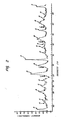
- Figure 2 is a graphical representation of the crystal structure of a sample prepared pursuant to the technique set forth in Example I, in which Intensity is plotted on the ordinate and Degrees Two Theta is plotted on the abscissa. The technique of x-ray diffraction is used to obtain the data plotted therein.
- This angular position of the BaF2 phase was determined by reference cards supplied by the manufacturer of the x-ray diffractometer as well as by the previous experience gained by the laboratory personnel at Energy Conversion Devices, Inc. in examining samples of ceramic defect oxide materials prepared by conventional powder metallurgical techniques.
- the instant inventors have discovered that the volume percentage of the "2,1,1" non-superconducting phase of the superconducting material may be controlled during the course of the plasma exchange process previously described. More particularly, and referring to Example II described hereinabove, the instant inventors have introduced the volatile source of fluorinated feedstock gas, NF3, at three different flow rates (1,10, and 25 SCCM) so as to determine the affect of pressure on the diffusion and percent incorporation of labile fluorine atoms in the bulk of the "1,2,3" phase material. From these experiments, it was determined that an increase in the flow rate of NF3 gas resulted in a substantially proportional increase in the volume percentage of the "2,1,1" phase present in the material.
Landscapes
- Engineering & Computer Science (AREA)
- Chemical & Material Sciences (AREA)
- Manufacturing & Machinery (AREA)
- Ceramic Engineering (AREA)
- Organic Chemistry (AREA)
- Structural Engineering (AREA)
- Materials Engineering (AREA)
- Compositions Of Oxide Ceramics (AREA)
- Inorganic Compounds Of Heavy Metals (AREA)
- Thermistors And Varistors (AREA)
- Superconductors And Manufacturing Methods Therefor (AREA)
- Oxygen, Ozone, And Oxides In General (AREA)
- Superconductor Devices And Manufacturing Methods Thereof (AREA)
Priority Applications (1)
| Application Number | Priority Date | Filing Date | Title |
|---|---|---|---|
| AT88304683T ATE87401T1 (de) | 1987-07-27 | 1988-05-24 | Verfahren zum kontrollierbaren einbringen eines parameter aendernden elements in einer oxidkeramik, die wenigstens eine supraleitende phase enthaelt. |
Applications Claiming Priority (2)
| Application Number | Priority Date | Filing Date | Title |
|---|---|---|---|
| US07/077,840 US5102860A (en) | 1987-07-27 | 1987-07-27 | Method of fluorinating a ceramic oxide which includes at least one superconducting phase |
| US77840 | 1993-06-15 |
Publications (3)
| Publication Number | Publication Date |
|---|---|
| EP0301688A2 true EP0301688A2 (de) | 1989-02-01 |
| EP0301688A3 EP0301688A3 (en) | 1989-08-30 |
| EP0301688B1 EP0301688B1 (de) | 1993-03-24 |
Family
ID=22140359
Family Applications (1)
| Application Number | Title | Priority Date | Filing Date |
|---|---|---|---|
| EP88304683A Expired - Lifetime EP0301688B1 (de) | 1987-07-27 | 1988-05-24 | Verfahren zum kontrollierbaren Einbringen eines Parameter ändernden Elements in einer Oxidkeramik, die wenigstens eine supraleitende Phase enthält |
Country Status (6)
| Country | Link |
|---|---|
| US (1) | US5102860A (de) |
| EP (1) | EP0301688B1 (de) |
| JP (1) | JPH01212288A (de) |
| AT (1) | ATE87401T1 (de) |
| CA (1) | CA1332279C (de) |
| DE (1) | DE3879572T2 (de) |
Families Citing this family (2)
| Publication number | Priority date | Publication date | Assignee | Title |
|---|---|---|---|---|
| DE69312199T2 (de) * | 1992-09-29 | 1997-10-30 | Canon Kk | Verfahren zur Herstellung von Metall-Oxid und so erhaltenes Metal-Oxid |
| US6110861A (en) * | 1997-06-02 | 2000-08-29 | The University Of Chicago | Partial oxidation catalyst |
Family Cites Families (1)
| Publication number | Priority date | Publication date | Assignee | Title |
|---|---|---|---|---|
| DE3786915T2 (de) * | 1987-04-27 | 1993-11-11 | Ovonic Synthetic Materials | Parametrisch geändertes supraleitendes Material. |
-
1987
- 1987-07-27 US US07/077,840 patent/US5102860A/en not_active Expired - Lifetime
-
1988
- 1988-05-19 CA CA000567280A patent/CA1332279C/en not_active Expired - Fee Related
- 1988-05-24 EP EP88304683A patent/EP0301688B1/de not_active Expired - Lifetime
- 1988-05-24 DE DE8888304683T patent/DE3879572T2/de not_active Expired - Fee Related
- 1988-05-24 AT AT88304683T patent/ATE87401T1/de not_active IP Right Cessation
- 1988-07-15 JP JP63176890A patent/JPH01212288A/ja active Pending
Also Published As
| Publication number | Publication date |
|---|---|
| US5102860A (en) | 1992-04-07 |
| DE3879572T2 (de) | 1993-07-01 |
| EP0301688A3 (en) | 1989-08-30 |
| EP0301688B1 (de) | 1993-03-24 |
| JPH01212288A (ja) | 1989-08-25 |
| DE3879572D1 (de) | 1993-04-29 |
| CA1332279C (en) | 1994-10-11 |
| ATE87401T1 (de) | 1993-04-15 |
Similar Documents
| Publication | Publication Date | Title |
|---|---|---|
| EP0280812B1 (de) | Supraleitende Verbindungen mit quadratisch planarer Struktur | |
| Sleight | Chemistry of high-temperature superconductors | |
| Tretyakov et al. | Chemical principles of preparation of metal-oxide superconductors | |
| US5024992A (en) | Preparation of highly oxidized RBa2 Cu4 O8 superconductors | |
| EP0274407B1 (de) | Auf neuen supraleitenden Materialien basierende Anordnungen und Systeme | |
| US5002927A (en) | Fluorine-stabilized superconductor materials | |
| Yamaura et al. | High-pressure synthesis and superconductivity of a Ba free mercury-based superconductor (Hg0. 75Re0. 25) Sr2Ca2Cu3Oy | |
| Choisnet et al. | A re-investigation of the crystal structure of La2NiO4: Non stoichiometry and “LaO” layers | |
| CA1340168C (en) | Method of aligning grains of a multi-grained superconducting material | |
| EP0336450B1 (de) | Metalloxid-Materialien | |
| EP0301688B1 (de) | Verfahren zum kontrollierbaren Einbringen eines Parameter ändernden Elements in einer Oxidkeramik, die wenigstens eine supraleitende Phase enthält | |
| DE3790872C2 (de) | Verwendung gesinterter Metalloxidkomplexe als Supraleiter sowie supraleitender Metalloxidkomplex der Formel LM¶2¶CU¶3¶O¶6¶+¶delta¶ | |
| US6635603B1 (en) | Devices and systems based on novel superconducting material | |
| Changkang | Phase diagram and its application to the crystal growth of high Tc oxide superconductors | |
| US5004725A (en) | Parametrically modified superconductor material | |
| US5492886A (en) | Method of producing highly oxidized superconductors containing barium, copper, and a third metal | |
| EP0288641B1 (de) | Parametrisch geändertes supraleitendes Material | |
| EP0301689B1 (de) | Verfahren zum Stabilisieren eines hoch-Tc-supraleitenden Materials und so stabilisiertes Material | |
| CA1338486C (en) | Superconducting material and a process for preparing the same | |
| US5227362A (en) | Parametrically modified superconductor material | |
| EP0659704A1 (de) | Verfahren zur Herstellung eines Oxid-Supraleiters | |
| Sauer et al. | Fluorination of the high-Tc superconductors YBa2Cu3O7− δ and GdBa2Cu3O7− δ | |
| Chen et al. | Characterization and properties of antimony doped Bi1. 6Pb0. 3Sr2Ca3Cu4O x ceramics | |
| US5145834A (en) | Processes for making Tl-Ca-Ba-Cu-O, Tl-Sr-Ba-Cu-O and Tl-Sr-Cu-O superconductors by solid state synthesis | |
| US7135438B1 (en) | Method of making cuprate superconducting material |
Legal Events
| Date | Code | Title | Description |
|---|---|---|---|
| PUAI | Public reference made under article 153(3) epc to a published international application that has entered the european phase |
Free format text: ORIGINAL CODE: 0009012 |
|
| AK | Designated contracting states |
Kind code of ref document: A2 Designated state(s): AT BE CH DE ES FR GB GR IT LI LU NL SE |
|
| PUAL | Search report despatched |
Free format text: ORIGINAL CODE: 0009013 |
|
| AK | Designated contracting states |
Kind code of ref document: A3 Designated state(s): AT BE CH DE ES FR GB GR IT LI LU NL SE |
|
| 17P | Request for examination filed |
Effective date: 19900223 |
|
| 17Q | First examination report despatched |
Effective date: 19920401 |
|
| GRAA | (expected) grant |
Free format text: ORIGINAL CODE: 0009210 |
|
| AK | Designated contracting states |
Kind code of ref document: B1 Designated state(s): AT BE CH DE ES FR GB GR IT LI LU NL SE |
|
| PG25 | Lapsed in a contracting state [announced via postgrant information from national office to epo] |
Ref country code: IT Free format text: LAPSE BECAUSE OF FAILURE TO SUBMIT A TRANSLATION OF THE DESCRIPTION OR TO PAY THE FEE WITHIN THE PRESCRIBED TIME-LIMIT;WARNING: LAPSES OF ITALIAN PATENTS WITH EFFECTIVE DATE BEFORE 2007 MAY HAVE OCCURRED AT ANY TIME BEFORE 2007. THE CORRECT EFFECTIVE DATE MAY BE DIFFERENT FROM THE ONE RECORDED. Effective date: 19930324 Ref country code: LI Effective date: 19930324 Ref country code: GR Free format text: LAPSE BECAUSE OF FAILURE TO SUBMIT A TRANSLATION OF THE DESCRIPTION OR TO PAY THE FEE WITHIN THE PRESCRIBED TIME-LIMIT Effective date: 19930324 Ref country code: ES Free format text: THE PATENT HAS BEEN ANNULLED BY A DECISION OF A NATIONAL AUTHORITY Effective date: 19930324 Ref country code: AT Effective date: 19930324 Ref country code: BE Effective date: 19930324 Ref country code: SE Effective date: 19930324 Ref country code: CH Effective date: 19930324 Ref country code: NL Effective date: 19930324 |
|
| REF | Corresponds to: |
Ref document number: 87401 Country of ref document: AT Date of ref document: 19930415 Kind code of ref document: T |
|
| REF | Corresponds to: |
Ref document number: 3879572 Country of ref document: DE Date of ref document: 19930429 |
|
| ET | Fr: translation filed | ||
| PG25 | Lapsed in a contracting state [announced via postgrant information from national office to epo] |
Ref country code: LU Free format text: LAPSE BECAUSE OF NON-PAYMENT OF DUE FEES Effective date: 19930531 |
|
| REG | Reference to a national code |
Ref country code: CH Ref legal event code: PL |
|
| NLV1 | Nl: lapsed or annulled due to failure to fulfill the requirements of art. 29p and 29m of the patents act | ||
| PLBE | No opposition filed within time limit |
Free format text: ORIGINAL CODE: 0009261 |
|
| STAA | Information on the status of an ep patent application or granted ep patent |
Free format text: STATUS: NO OPPOSITION FILED WITHIN TIME LIMIT |
|
| 26N | No opposition filed | ||
| PGFP | Annual fee paid to national office [announced via postgrant information from national office to epo] |
Ref country code: DE Payment date: 19960531 Year of fee payment: 9 |
|
| PG25 | Lapsed in a contracting state [announced via postgrant information from national office to epo] |
Ref country code: DE Free format text: LAPSE BECAUSE OF NON-PAYMENT OF DUE FEES Effective date: 19980303 |
|
| REG | Reference to a national code |
Ref country code: GB Ref legal event code: IF02 |
|
| PGFP | Annual fee paid to national office [announced via postgrant information from national office to epo] |
Ref country code: GB Payment date: 20030401 Year of fee payment: 16 |
|
| PGFP | Annual fee paid to national office [announced via postgrant information from national office to epo] |
Ref country code: FR Payment date: 20030505 Year of fee payment: 16 |
|
| PG25 | Lapsed in a contracting state [announced via postgrant information from national office to epo] |
Ref country code: GB Free format text: LAPSE BECAUSE OF NON-PAYMENT OF DUE FEES Effective date: 20040524 |
|
| GBPC | Gb: european patent ceased through non-payment of renewal fee |
Effective date: 20040524 |
|
| PG25 | Lapsed in a contracting state [announced via postgrant information from national office to epo] |
Ref country code: FR Free format text: LAPSE BECAUSE OF NON-PAYMENT OF DUE FEES Effective date: 20050131 |
|
| REG | Reference to a national code |
Ref country code: FR Ref legal event code: ST |