EP0301714A2 - Désulfuration par injection d'adsorbant dans les zones de combustion secondaire - Google Patents
Désulfuration par injection d'adsorbant dans les zones de combustion secondaire Download PDFInfo
- Publication number
- EP0301714A2 EP0301714A2 EP88306124A EP88306124A EP0301714A2 EP 0301714 A2 EP0301714 A2 EP 0301714A2 EP 88306124 A EP88306124 A EP 88306124A EP 88306124 A EP88306124 A EP 88306124A EP 0301714 A2 EP0301714 A2 EP 0301714A2
- Authority
- EP
- European Patent Office
- Prior art keywords
- sulfur
- sorbent
- gaseous products
- products
- combustion
- Prior art date
- Legal status (The legal status is an assumption and is not a legal conclusion. Google has not performed a legal analysis and makes no representation as to the accuracy of the status listed.)
- Withdrawn
Links
Images


Classifications
-
- F—MECHANICAL ENGINEERING; LIGHTING; HEATING; WEAPONS; BLASTING
- F23—COMBUSTION APPARATUS; COMBUSTION PROCESSES
- F23C—METHODS OR APPARATUS FOR COMBUSTION USING FLUID FUEL OR SOLID FUEL SUSPENDED IN A CARRIER GAS OR AIR
- F23C6/00—Combustion apparatus characterised by the combination of two or more combustion chambers or combustion zones, e.g. for staged combustion
- F23C6/04—Combustion apparatus characterised by the combination of two or more combustion chambers or combustion zones, e.g. for staged combustion in series connection
-
- F—MECHANICAL ENGINEERING; LIGHTING; HEATING; WEAPONS; BLASTING
- F23—COMBUSTION APPARATUS; COMBUSTION PROCESSES
- F23C—METHODS OR APPARATUS FOR COMBUSTION USING FLUID FUEL OR SOLID FUEL SUSPENDED IN A CARRIER GAS OR AIR
- F23C3/00—Combustion apparatus characterised by the shape of the combustion chamber
- F23C3/006—Combustion apparatus characterised by the shape of the combustion chamber the chamber being arranged for cyclonic combustion
- F23C3/008—Combustion apparatus characterised by the shape of the combustion chamber the chamber being arranged for cyclonic combustion for pulverulent fuel
-
- F—MECHANICAL ENGINEERING; LIGHTING; HEATING; WEAPONS; BLASTING
- F23—COMBUSTION APPARATUS; COMBUSTION PROCESSES
- F23J—REMOVAL OR TREATMENT OF COMBUSTION PRODUCTS OR COMBUSTION RESIDUES; FLUES
- F23J7/00—Arrangement of devices for supplying chemicals to fire
-
- Y—GENERAL TAGGING OF NEW TECHNOLOGICAL DEVELOPMENTS; GENERAL TAGGING OF CROSS-SECTIONAL TECHNOLOGIES SPANNING OVER SEVERAL SECTIONS OF THE IPC; TECHNICAL SUBJECTS COVERED BY FORMER USPC CROSS-REFERENCE ART COLLECTIONS [XRACs] AND DIGESTS
- Y02—TECHNOLOGIES OR APPLICATIONS FOR MITIGATION OR ADAPTATION AGAINST CLIMATE CHANGE
- Y02E—REDUCTION OF GREENHOUSE GAS [GHG] EMISSIONS, RELATED TO ENERGY GENERATION, TRANSMISSION OR DISTRIBUTION
- Y02E20/00—Combustion technologies with mitigation potential
- Y02E20/34—Indirect CO2mitigation, i.e. by acting on non CO2directly related matters of the process, e.g. pre-heating or heat recovery
Definitions
- a gaseous-products stream having about 85 to 90 percent of the chemical potential energy of the carbonaceous fuel.
- this energy is delivered partly as sensible heat and partly in the form of carbon monoxide and hydrogen contained in the gaseous products and readily combustible, to completion, in the end-use equipment.
- the apparatus described in Serial No. 788,929 relates to improvements in slagging combustors, resulting from extensive study and development including recognition of requirements peculiar to adapting slagging combustors to industrial furnaces and electric-utility boilers originally designed and constructed to use oil and/or natural gas.
- Our invention is directed to further improvements in slagging combustion systems belonging to the same general class as that disclosed by Burge et al. and copending application Serial No. 788,929 and, more particularly, to reduction of SO x and NO x emissions while simultaneously meeting the other desiderata described above.
- a stream of hot, fuel-rich gaseous products (preferably flowing from a system such as that described in copending application Serial No. 788,929) is fed as a thermal-energy carrying fuel gas input to a conventional boiler or furnace.
- These gaseous products have a temperature equal to or higher than the ash-fusion temperature of the fuel's noncombustible constituents, preferably within the range from about 2600°F to about 3200°F.
- an alkaline earth metal-containing sorbent for sulfur such as pulverized limestone
- enough supplementary oxidizer to increase the overall stoichiometry of the facility to about 1.1 to about 1.3.
- the sulfur sorbent is intimately contacted with the high-temperature gaseous products and rapidly intermixed therewith, the sulfur sorbent is flash-calcined within times of the order of a few milliseconds to form high-porosity solid particles suitable for promoting reaction of the sorbent's alkaline earth metal with sulfur constituents contained in the gaseous products. Consequently, most of the sulfur content of the fuel is converted to alkaline earth metal sulfates and may be removed from the gaseous products before the same pass from the boiler or furnace facility into the atmosphere. By using this process and apparatus we have repeatedly and consistently reduced, by 80% to 90%, the concentration of SO x in the flue gasses. To our knowledge, no other coal combustion process or apparatus suitable for conventional electric-utility boilers and industrial furnaces has realized comparable reduction of sulfur oxide emissions.
- comminuted carbonaceous fuel such as pulverized coal
- a stream of oxidizer is injected into the combustion zone in a manner and direction to establish a high-velocity swirling flow of a mixture of oxidizer and combustion products adjacent the walls of the combustion chamber.
- High power density combustion converts the fuel to gaseous combustion products, comprising carbon monoxide and hydrogen, together with molten slag resulting from fusion of the noncombustible mineral constituents of the fuel.
- the high-velocity swirling flow creates a regime in which most of the molten slag is centrifugally propelled to the inside surfaces of the walls of the combustion zone.
- the input velocities and mass-flow rates of both the oxidizer and the pulverized fuel are regulated as independent variables for controlling conditions within the combustion zone. More specifically, by controlling these independent variables we regulate the system to:
- the gaseous products of combustion, containing sulfur compounds, are passed to a slag collection zone and passed therefrom by a suitable duct to an associated heat-utilization equipment such as a conventional furnace or boiler.
- a suitable duct such as a conventional furnace or boiler.
- supplementary oxidizer and sulfur-sorbent material are combined with the combustion products to achieve a stoichiometry preferably in the range of about 1.1 to about 1.3, more preferably about 1.2. Rapid mixing results in an attendant temperature decrease to at least about 2300°F where sulfur capture is maximized.
- the amount of sorbent introduced preferably is sufficient to provide a molar ratio of alkaline earth metal to sulfur of about 2 to about 5, depending on the sulfur content of the coal and the degree of SO x reduction required; this molar ratio is more preferably about 2.5 to about 3.5. SO x reductions in the range of 60-90% are achieved, depending on the type of coal used. Heat is extracted from the products of secondary oxidation and spent sorbent with small amounts of fly-ash is collected by suitable means such as a baghouse.
- the stoichiometry in the slag-recovery chamber is kept fuel rich, within the range from about 0.7 to about 0.9, thereby minimizing the formation of nitrogen oxides; also the temperature therein is kept above the ash-fusion temperature, facilitating the removal of residual noncombustibles in the form of molten slag.
- the gaseous products are passed from the slag recovery chamber to and into the associated heat utilization equipment in the form of a high-velocity swirling stream of fuel gas carrying both kinetic energy in the form of sensible heat and potential energy in the form of substantial concentrations of CO and H2.
- the temperature of this stream as it leaves the slag recovery chamber is above the ash-fusion temperature of the noncombustible constituents of the fuel with the specific temperature, in the range from about 2600°F to about 3200°F, being dependent on the characteristics of the fuel used.
- supplementary oxidizer for two purposes: Firstly, it is desirable to provide enough supplementary oxidizer (e.g., air) to complete combustion of the fuel gas and provide an overall stoichiometry in the furnace or boiler of about 1.1 to about 1.3. Secondly, either before or soon after the sulfur sorbent is mixed with the gaseous products, it is desirable to reduce the temperature of the gaseous products to a level low enough to avoid dead burning of the sorbent particles. The temperature of the gaseous products preferably is reduced to at least about 2300°F, shortly after they pass into the heat utilization equipment.
- supplementary oxidizer e.g., air
- the introduced sorbent, e.g., calcium carbonate even if not intimately mixed into the gaseous products, is almost instantaneously calcined, decomposing to form CaO and CO2 within transit times of the order of a few milliseconds.
- This rapid calcination results in high-porosity particles of calcium oxide having a relatively very high surface area-to-mass ratio, which enhances contacting the CaO with SO2 and other sulfur species and, hence, remarkably improves removal of sulfur from the gaseous products before such products pass from the heat-utilization equipment into the atmosphere.
- a system employing particular apparatus and methods for more efficiently recovering sulfur during the generation of energy from the combustion of carbonaceous fuel while removing solid noncombustibles to the highest levels possible, at the same time minimizing the generation of nitrogen oxides, and collecting and removing 80 to 90% or more of the molten slag before the gaseous products are introduced into an associated thermal energy utilization equipment wherein, a sorbent for sulfur is reacted with sulfur-bearing constituents of the gaseous products.
- the presently preferred apparatus comprises, in combination, the following mechanical units: a precombustor, a primary combustion chamber, a slag-collection unit and a conduit coupled to a furnace, means to introduce supplementary oxidant to the secondary oxidation burner and means to add sulfur sorbent to the gaseous products flowing from the slag-collection unit, substantially as or shortly before such gaseous products are passed into the furnace.
- carbonaceous fuel carbon-containing substances that include noncombustible minerals and which can be provided as a fuel in a dispersed state, either suspended in a carrier fluid as free particles, or as a slurry.
- Representative carbonaceous materials include, among others, coal, char, the organic residue of solid-waste recovery operations, tarry oils that are dispersible in liquid, and the like.
- the carbonaceous fuel may be any material that is amenable to dispersion within the primary combustion chamber as discrete droplets or particles and may be combusted therein to form a high velocity stream of gaseous products, including H2 and CO.
- the fuel is pulverized coal.
- oxygenant there is meant air or oxygen-enriched air.
- carrier fluid we mean a gas or liquid, which may be inert or an oxidant.
- An oxidant is preferred carrier gas
- water is a preferred carrier liquid.
- slagging combustor we mean an apparatus of the general class represented by Burge et al and/or Serial No. 788,929, in which carbonaceous fuel (e.g., pulverized coal) is combusted under conditions such that most of the ash is separately removed from the gaseous products in the form of molten slag.
- carbonaceous fuel e.g., pulverized coal
- alkaline earth metal there is meant elements of Group II(a) of the Periodic Table, significantly calcium and magnesium.
- sulfur sorbent we mean a material suitable for reaction with sulfur compounds contained in the gaseous products to enable removal of most of the sulfur-bearing constituents in the form of solids capable of being collected in a conventional baghouse or other subsystem for removing particulate solids from the flue gases before the same pass into the atmosphere.
- One may use substantially any alkaline earth metal based material that will react with sulfur compounds contained in the gaseous products of combustion. Calcium compounds such as comminuted limestone, dolomite, and magnesium compounds, such as magnesium carbonate or the like, may be used.
- a presently preferred sulfur sorbent is pulverized limestone of a particle size such that about 70% of the particles will pass through 200 mesh screen .
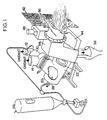
- preconditioning of oxidant is accomplished in a short and compact cylindrical precombustor 10 to which essentially all of the first oxidant is supplied.
- a portion of the first oxidant is introduced at conduit 12 and used, in part, to combust from about 10% to about 25% of the total carbonaceous feed to form a first reaction product.
- a second portion of the first oxidant enters the precombustor 10 at conduit 14 and mixes with the first reaction product to form a hot, oxidant-rich gas stream which is directed in a controlled fashion into primary combustion chamber 16.
- the oxidant-rich gas stream carries with it all residual precombustor fuel and non-combustibles, including still-burning carbonaceous particles dispersed throughout its volume.
- Precombustor exit temperature may range from about 1500°F to about 2000°F or more.
- the particulate carbonaceous material in the precombustor is introduced, in most instances as solids, into an intense, whirling gas field at the head end of the precombustor 10.
- Introduction is through a centrally-located injector (not shown) that produces a conical flow of particulate carbonaceous materials mixed into a whirling flow field of first oxidant.
- the whirling flow field of first or primary oxidant and resulting reaction products produces a strong recirculation zone of hot gases and combusting particles, once ignition is achieved.
- Precombustor geometry enables self-sustaining combustion when air is used as the oxidant and such air is introduced at temperatures of from about 300°F or higher.
- the precombustor is preferably arranged, with all flows being downward from the head end to rectangular exit 18, to assure that no solids or liquid slag remain in precombustor 10.
- the overall stoichiometry is regulated by controlling the mass-flow rate of particulate carbonaceous material into the first oxidant flow to maintain the above precombustor exit temperatures.
- This precombustor-effluent stream is introduced substantially tangential to the interior wall of primary combustor chamber 16.
- the rectangular exit 18 of precombustor 10 is sized such that the dimension parallel to the axis of the primary combustor is larger than the dimension perpendicular to the axis of the primary combustor. A length-to-height ratio of 2.5 to 1 is preferred.
- the centerline of the rectangular exit is aligned with the longitudinal axis of the precombustor and is positioned, upstream from the midpoint of the primary combustor's longitudinal axis, i.e., about 1/3 to 1/2 of the distance from the head end 20 to the primary combustor's apertured baffle 22.
- the precombustor effluent causes a swirling motion to be imparted to the flow within primary combustor 16.
- damper plates 24 located within the rectangular exit region of precombustor 10
- the above-described location of rectangular exit 18 also causes a division of the effluent into two nearly-equal flows: one flow whirls along the walls toward the head end, while the other flow generally moves helically along the wall of primary combustor 16 toward its exit.
- the axial component of the whirling flow toward the head end has a relatively low velocity, generally in the order of 50 fps.
- This flow is turned inward at the head-end 20 of the primary combustor, and then axially back towards the exit of the primary combustor, all the while following helical flow paths.
- the exit end of the primary combustor is provided with a baffle plate 22 perpendicular to the axis of the primary combustor and which has a generally centrally-located aperture.
- the major part of the carbonaceous fuel is introduced into the primary combustor, approximately at the center of the head end through a fuel-injector assembly 28, which extends into the primary combustor 16 from the head end 20 to a point slightly upstream of the rectangular opening 18.
- Assembly 28 causes the particulate carbonaceous material to be introduced as solids in a gas or liquid carrier, in a conical flow pattern, into the swirling flow field.
- the heated first oxidizer inflow to the primary combustor 16 divides into two streams, with about 50% of the precombustor effluent flowing toward the head end 20, where fuel ignition occurs in a fuel-rich reaction zone, with an overall head-end stoichiometry of from about 0.4 to about 0.5.
- the balance of the incoming oxidizer flows towards exit end 22 of the primary combustor 16.
- the interaction of the conical-pattern fuel injection with the high-velocity swirling flow field provides intimate and rapid mixing of the fuel, heated oxidizer and products of combustion.
- the bulk of the fuel's combustibles are oxidized in flight through the heated oxidizer flow field, giving up energy in the form of heat of reaction and further heating the resultant combustion products.
- the particles in free flight follow generally helical flow paths towards the walls and exit end of the primary chamber, all as more extensively described in copending application Serial No. 788,929.
- a small fraction, preferably not more than about 12%, of the carbon content of the fuel reaches the wall of the primary combustor in the form of unburned carbon, normally a combustible char, which continues to be consumed.
- a layer of molten slag having a viscosity of the order of 250 poise, flows helically along the walls of the primary chamber, in response to aerodynamic drag and gravity, toward the exit-end baffle 22.
- combustion of the fuel takes place through a rapid heating of the particles, which causes a gasification of volatile organics, which may be in the order of from 30% to 50% by weight of the total combustibles.
- the remainder is combusted essentially to particles of char, primarily while in flight within chamber 16.
- Fuel-rich gases generated in the head end of the primary combustor 16 generally flow towards the exit-end baffle 22 while the swirling flow is maintained, and are finally forced inward by the baffle plate, react with the fuel and fuel-rich gases, bringing the overall stoichiometry of primary combustor 16 up to a level of from about 0.7 to about 0.9, preferably from about 0.7 to about 0.8, and yielding, as the output product of the primary combustor, a stream of hot products of combustion, rich in CO and H2 and from which most of the noncombustibles have been removed as liquid slag.
- the internal mixing and reaction are further enhanced in the primary combustor by a strong secondary recirculation flow along the centerline of primary combustor 16, the flow moving generally along the centerline towards the head end of the primary combustor.
- This recirculation flow is, also, swirling and, therefore, substantially helical; but its axial component is toward the head end of the primary combustor. It produces a fuel-rich core portion within the primary combustor 16.
- the average diameter and mass-flow rate of this reverse-flowing core portion is determined and controlled by the precombustor exit-flow velocity and selection of the diameter of the primary combustor's baffle aperture 26.
- precombustor exit velocity is about 330 fps.
- a preferred ratio of baffle opening diameter to primary combustor diameter is approximately 0.5 or more. This produces ideal secondary recirculation flows for enhanced control of ignition and overall combustion in primary combustor 16.
- Fuel injection assembly 28 is designed to allow molten slag to flow along its exterior surface from head end 20, towards the point of injection of the particulate carbonaceous fuel.
- This very hot (molten slag) exterior surface on the injector assembly functions as a flame holder to assure immediate ignition of fuel particles as they leave the injector, thereby promoting and maximizing efficient combustion.
- the flowing slag along the injector strips off short of the point of solid particle injection, and provides small-point centers of intense radiation and ignition of the head end-generated fuel-rich gases.
- the particulate carbonaceous fuel is carried into the primary combustor in dense-phase transport, wherein the solids-to-carrier fluid ratio at normal power levels is in the range from about 3 to 1 to about 10 to 1 by weight. Regulation of this solids-to-carrier fluid ratio within the above-stated range provides another independent variable means for controlling combustion conditions within primary chamber 16.
- fuel to carrier fluid weight ratios of about 2:1 or higher may be used.
- the products of combustion are, in the primary combustor 16, sufficiently hot to maintain a molten slag layer at a temperature above the ash-fusion temperature of the fuel, and preferably high enough to maintain a molten slag layer having a viscosity of about 250 poise. Accordingly, slag flows freely along the walls of the primary chamber 16. Coolant flow to the metal walls of the primary chamber is controlled; particulate fuel mass-flow rate is controlled; and mass flow rate and velocity of oxidizer from the precombustor are also independently controlled.
- Coordinated regulation of these independent variables keeps the primary combustion zone temperature in a range such that slag vaporization is avoided, a protective slag layer is maintained on the metal walls and liquid slag flows continuously, over that slag layer, toward the slag disposal subassembly.
- Fuel rich combustion in the head end region and the core portion facilitate NO x control down to environmentally acceptable levels.
- the walls of the precombustor 10 and primary combustor 16 are made of water-cooled, tube-and-membrane construction, with a generally circumferentially-directed winding of the tubing.
- the tube-and-membrane structure is further equipped with slag-retaining studs.
- the containment walls are initially lined with a sacrificial refractory, applied at a nominal thickness of about 0.5 inch and maintained by the studs.
- the refractory employed causes the molten slag to tightly adhere to the refractory in a thin frozen layer, with the remainder of the slag flowing over the frozen-slag layer. After long periods of operation this refractory material is eroded away, i.e., sacrificed.
- the longitudinal axis of primary combustor 16 is positioned, preferably, at an angle with respect to horizontal, to insure that proper slag flow occurs, avoiding accumulation of excessive quantities at the bottom of the primary combustor.
- the slag generally is driven, by aerodynamic drag forces, in a helical pattern towards the exit-end baffle 22 along the wall of the primary combustor 16. As the slag flow builds up along the wall, a larger portion of the molten slag flows to the bottom of the primary combustor, since the gravity forces exceed the aerodynamic forces. The bottom-collected slag flows toward the baffle plate 22.
- Baffle plate 22 has a centrally-located rectangular slot or "key hole” (not shown) extending from aperture 26 to the bottom wall of primary combustion chamber 16. This rectangular slot enables slag flow through the baffle plate, adjacent to the bottom wall of primary combustor 16.
- key hole a rectangular slot extending from aperture 26 to the bottom wall of primary combustion chamber 16.
- This rectangular slot enables slag flow through the baffle plate, adjacent to the bottom wall of primary combustor 16.
- the combustion products and liquid slag from the primary combustor 16 pass into slag-recovery chamber 30.
- the slag-recovery chamber 30 preferably has a diameter equal to or greater than that of the primary chamber and an axial length approximately equal to its diameter.
- conduit 34 preferably leaves the slag-recovery section at an angle to the axis of primary combustor 16, and extends for about one to two length-to-diameter ratios before turning and directing the combustion-products stream horizontally towards the end use equipment.
- the slag-recovery unit 30 additionally provides a sufficient distance between the primary chamber's baffle 22 and the exit 40 so that a major portion of any residual slag droplets in the gaseous-products stream leaving baffle 22 are captured on the walls of the slag-recovery section 30.
- the slag-recovery section 30, in conjunction with the baffle plate 22, provides a source of the hot recirculation gases which flow helically back into the core portion of primary combustor 16.
- This fuel-rich core portion is normally about 70% to about 75% of the diameter of the aperture of the primary chamber's baffle plate. This results in increased tangential and axial velocity of the exiting combustion-products stream at the baffle's aperture. Slag droplets which are in this flow are further accelerated towards the wall of the slag-recovery chamber 30 for capture as molten slag.
- section 30 there is maintained in section 30 a high-velocity swirling flow of fuel-rich gases which form the feed to end-use equipment 36 and serve as an integral part of sulfur recovery in accordance with the practice of this invention.
- Captured slag collects in slag tank 38.
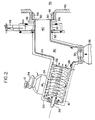
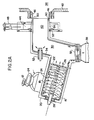
- Products of combustion under reducing conditions leave chamber 30 and enter transition conduit 40 leading to end-use apparatus 36 depicted as the front wall 42 of a furnace or conventional utility boiler.
- Surrounding duct 40 is a wind box 44, fed by supplementary oxidant duct 48.
- Combustion gases exiting duct 40 combine with secondary oxidant from annular opening 50 adjacent furnace tile 46, thus forming a mixture appropriate to complete the combustion of the fuel gases in the heat-utilization equipment.
- Oxidant air doors 52 control oxidant flow to converging ducts 54 so as to maintain the furnace at a desired stoichiometry in the range of about 1.1 to about 1.3, preferably about 1.2.
- Sulfur sorbent is introduced to the system by any suitable means such as tangential injectors 56 (FIG. 2) or, alternatively, a single tubular injector 58 (FIG. 2A) which may be, for example, a coaxial-pintle injector assembly of the type described in U.S. Patent 4,386,443 to Burge et al. incorporated herein by reference.
- the combustion gases contain sulfur constituents in various forms.
- the predominant constituents is sulfur dioxide (SO2).
- Other constituents which may be present include sulfur trioxide (SO3), carbonyl sulfide (COS), H2S and carbon disulfide (CS2). When combined with the supplementary oxidant they, in the main, convert to sulfur dioxide.
- the alkaline earth metals of the sulfur sorbent react with the sulfur dioxide before effective temperature becomes too high, i.e., where kinetics favor the reverse reaction. It is, therefore, desirable to achieve a combination of sulfur sorbent, supplemental oxidant and sulfur constituents in a regime where effective temperature is below about 2300°F.
- the sulfur capture reaction is reversible with kinetics being directly proportional to temperature and unfavorable at temperatures above about 2300°F.
- limestone is the cheapest alkaline earth metal sulfur sorbent and therefore preferred; other suitable sorbents are dolomite, hydrated lime, pressure hydrated lime and the like.
- the gaseous products from the slag recovery chamber 30 constitute about 75-85 percent of the total inflow to the boiler or furnace.
- Such gaseous products therefore constitute a copious source of heat energy or rapidly calcining the sulfur sorbent.
- they provide swirling-flow kinetic energy to aid thorough mixing of the sulfur sorbent and supplementary oxidant into the gaseous-products stream.
- sulfur constituents contained in the gaseous products are contacted with the sulfur sorbent at temperatures in the range from about 1600°F to about 2300°F, more preferably between about 1800°F to about 2000°F, within times of the order of a few seconds after entering the furnace or boiler.
- sulfur sorbent may be introduced into the gaseous products shortly after such products leave the slag-recovery chamber as by pintle valve 58, and while these gaseous products are above the ash-fusion temperature.
- This has the advantage of promoting rapid calcining, within times of the order of 2 to 20 milliseconds; while "dead burning" or structural changes in the lattice or matrix structure of the sulfur sorbent is avoided because the sulfur sorbent is carried into a lower-temperature environment, i.e., the furnaces or boiler, within transit times of a fraction of a second.
- the particles do not have the opportunity to reach bulk gas temperature and the regime about the particles are maintained at an effective temperature of about 2300°F or less.
- the gaseous products are also quickly cooled to the lower temperature regime, i.e., 1800°F to about 2000°F, by the combination of several cooling mechanisms: radiation heat transfer to the much colder water-tube walls of the boiler; convective mixing with cooler gases circulating within the boiler or furnace; and mixing with additional secondary oxidant, introduced simultaneously with the sorbent or introduced separately and mixed with the gaseous combustion products within the boiler.
- the slagging combustor system removes 80-90% of the non-combustible minerals from the gaseous products before such products pass through duct 40 to furnace 36. This is significant in the sense that if the sulfur sorbent were contacted by material amounts of solids such as fly-ash, deactivation would occur, rendering the sulfur sorbent less effective for sulfur capture.
- additional cooling to the desired temperature occurs by radiation to the furnace walls and back flow of cooler furnace gases.
- Secondary oxidant introduction may be in any manner desired, including rotational flow, co-current or countercurrent to the flow of combustion gases exiting the duct 40.
- sulfur sorbent can be introduced with the oxidant or with the products of combustion provided residence time is short such that the particles do not "dead burn".
- FIG. 4 there is shown sulfur capture as a function the (Ca/S) molar ratio, the curve shown is a best fit of the results of several runs including sulfur sorbent injection as shown in FIG. 2A.
- the sulfur sorbent materials used were VicronTM200 limestone and differing coals. The sulfur sorbent materials performed equally well, as compared to each other, and at a calcium-to-sulfur molar ratio of approximately 2.5 to 3.5 yielded sulfur reductions of from 80 to 90%.
- the range of calcium-to-sulfur molar ratios is from 2 to about 5 more, preferably about 2.5 to about 3.5.
- Sulfur sorbent injection directly into the combustion products seems to indicate a slightly higher degree of sulfur capture than sulfur capture by injection of sorbent into the secondary oxidant, all other factors being the same. As indicated, sulfur capture appears complete in the region of between 4 and 12 feet from the point of secondary oxidant introduction to boiler 34.
- FIG. 3 depicts a slagging combustion system, having a nominal power rating of 40MM BTU per hour, coupled to a boiler simulator 56 which includes an assembly of heat extraction modules 58 having water-cooled inner and outer walls. The inner wall simulate well the radiative characteristics of a typical furnace. Coupled together at one end 42 is duct 30 from the primary combustor 16 where first stage combustion occurs to yield a swirling flow of products of combustion which are fuel rich having an oxygen-to-fuel ratio of about 0.7 to 0.9. Typically, as used in the hereinafter-described tests, the slagging combustor was controlled to:
- combustion gases enter the boiler in a high-velocity swirling flow, at a temperature of about 2600°F to about 3200°F, and with a stoichiometry of about 0.7 to about 0.9.
- Sufficient oxidant is introduced to preferably increase the overall stoichiometry to about 1.2 and sulfur sorbent introduction is sufficient to provide a calcium-to-sulfur molar ratio of from about 2 to about 5, preferably from about 2.5 to about 3.5, depending upon the sulfur content of the fuel.
- the combination of sorbent and supplementary oxidant dilution, radiative heat transfer and back flow or cooler furnace gases reduce gas temperature to about 2000°F or less when sulfur compound elimination by sulfur sorbent takeup occurs rapidly.
- the boiler simulator depicted in FIG. 3 was coupled to a 40 MMBTU/hr nominal combustor, as before. Air feed temperature was in the range of 100°F to 500°F to the precombustor. About 25% of the powdered coal was consumed in the precombustor to deliver oxidant (air) at temperatures of 1500°F to 2000°F. The hot air was tangentially introduced into the slagging combustor 16.
- Coal was delivered in a dense phase at a total rate, i.e., precombustor and primary combustor, of about 1.5 tons per hour. Bulk gas flow residence time in the boiler simulator was about 4.5 seconds. Incoming primary combustor combustion products were in excess of 3000°F. Incoming secondary air was at a temperature of about 450°F and produced exhaust products were at exit, at a temperature of 1800°F to 2000°F.
- VicronTM and MarblewhiteTM200 behaved identically, both removing from 45 to 80% of the sulfur at a calcium-to-sulfur ratio of about 2 and from 55 to 90% at a calcium-to-sulfur ratio of about 3 with sulfur capture completed within 4 to 12 feet from the point where the secondary air enters the boiler simulator, and complete within 50% of the length of the boiler simulator depicted in FIG. 3.
- TABLE 1
Landscapes
- Engineering & Computer Science (AREA)
- Mechanical Engineering (AREA)
- General Engineering & Computer Science (AREA)
- Chemical & Material Sciences (AREA)
- Combustion & Propulsion (AREA)
- Treating Waste Gases (AREA)
Applications Claiming Priority (2)
| Application Number | Priority Date | Filing Date | Title |
|---|---|---|---|
| US7937387A | 1987-07-30 | 1987-07-30 | |
| US79373 | 1987-07-30 |
Publications (2)
| Publication Number | Publication Date |
|---|---|
| EP0301714A2 true EP0301714A2 (fr) | 1989-02-01 |
| EP0301714A3 EP0301714A3 (fr) | 1989-07-19 |
Family
ID=22150127
Family Applications (1)
| Application Number | Title | Priority Date | Filing Date |
|---|---|---|---|
| EP88306124A Withdrawn EP0301714A3 (fr) | 1987-07-30 | 1988-07-05 | Désulfuration par injection d'adsorbant dans les zones de combustion secondaire |
Country Status (6)
| Country | Link |
|---|---|
| EP (1) | EP0301714A3 (fr) |
| JP (1) | JP2682848B2 (fr) |
| KR (1) | KR950007382B1 (fr) |
| CN (1) | CN1036069A (fr) |
| DK (1) | DK400788A (fr) |
| ES (1) | ES2009994A6 (fr) |
Cited By (2)
| Publication number | Priority date | Publication date | Assignee | Title |
|---|---|---|---|---|
| WO2003031873A1 (fr) * | 2001-10-05 | 2003-04-17 | Kawasaki Jukogyo Kabushiki Kaisha | Chaudiere de combustion a allumage en u du type a fusion des cendres et procede de fonctionnement de la chaudiere |
| EP1508741A3 (fr) * | 2003-08-21 | 2005-11-30 | Air Products And Chemicals, Inc. | Combustion de combustibles secondaires enrichie en oxygène pour fours cycloniques de scorification |
Families Citing this family (5)
| Publication number | Priority date | Publication date | Assignee | Title |
|---|---|---|---|---|
| JPH03236503A (ja) * | 1990-02-14 | 1991-10-22 | Takuma Co Ltd | ボイラ等の燃焼装置に於けるNOx低減装置 |
| US8986002B2 (en) * | 2009-02-26 | 2015-03-24 | 8 Rivers Capital, Llc | Apparatus for combusting a fuel at high pressure and high temperature, and associated system |
| US10859264B2 (en) | 2017-03-07 | 2020-12-08 | 8 Rivers Capital, Llc | System and method for combustion of non-gaseous fuels and derivatives thereof |
| ES2989187T3 (es) | 2017-03-07 | 2024-11-25 | 8 Rivers Capital Llc | Sistemas y métodos de funcionamiento de una cámara de combustión de combustible flexible para una turbina de gas |
| CA3106955A1 (fr) | 2018-07-23 | 2020-01-30 | 8 Rivers Capital, Llc | Systeme et procede de production d'energie avec une combustion sans flamme |
Family Cites Families (6)
| Publication number | Priority date | Publication date | Assignee | Title |
|---|---|---|---|---|
| JPS58190605A (ja) * | 1982-04-28 | 1983-11-07 | Hitachi Zosen Corp | 脱硫を同時に行うNOx抑制三段燃焼法 |
| JPS58190606A (ja) * | 1982-04-28 | 1983-11-07 | Hitachi Zosen Corp | 三段燃焼法を用いた脱硫法 |
| JPS6196319A (ja) * | 1984-10-16 | 1986-05-15 | Hitachi Zosen Corp | 脱硫を同時におこなう低NOx燃焼法 |
| US4660478A (en) * | 1984-11-13 | 1987-04-28 | Trw Inc. | Slagging combustor with externally-hot fuel injector |
| JPS61208411A (ja) * | 1985-03-14 | 1986-09-16 | Hitachi Zosen Corp | 脱硫を同時に行なうNO↓x抑制2段燃焼法 |
| DE3621109A1 (de) * | 1985-06-27 | 1987-01-02 | Gewerk Sophia Jakoba | Liegende vorrichtung zum verbrennen von schwefelhaltigem, reaktionstraegem kohlenstaub |
-
1988
- 1988-07-05 EP EP88306124A patent/EP0301714A3/fr not_active Withdrawn
- 1988-07-18 DK DK400788A patent/DK400788A/da not_active Application Discontinuation
- 1988-07-26 ES ES8802347A patent/ES2009994A6/es not_active Expired
- 1988-07-29 JP JP63190477A patent/JP2682848B2/ja not_active Expired - Lifetime
- 1988-07-30 CN CN88104688A patent/CN1036069A/zh active Pending
- 1988-07-30 KR KR1019880009693A patent/KR950007382B1/ko not_active Expired - Fee Related
Cited By (7)
| Publication number | Priority date | Publication date | Assignee | Title |
|---|---|---|---|---|
| WO2003031873A1 (fr) * | 2001-10-05 | 2003-04-17 | Kawasaki Jukogyo Kabushiki Kaisha | Chaudiere de combustion a allumage en u du type a fusion des cendres et procede de fonctionnement de la chaudiere |
| GB2397115A (en) * | 2001-10-05 | 2004-07-14 | Kawasaki Heavy Ind Ltd | Ash melting type u-firing combustion boiler and method of operating the boiler |
| GB2397115B (en) * | 2001-10-05 | 2005-05-18 | Kawasaki Heavy Ind Ltd | U-type slag-tap firing boiler and method of operating the boiler |
| US7077069B2 (en) | 2001-10-05 | 2006-07-18 | Kawasaki Jukogyo Kabushiki Kaisha | U-type slag-tap firing boiler and method of operating the boiler |
| CN1318795C (zh) * | 2001-10-05 | 2007-05-30 | 川崎重工业株式会社 | 液态排渣式u型燃烧锅炉及其运转方法 |
| DE10297306B4 (de) * | 2001-10-05 | 2008-03-20 | Kawasaki Jukogyo K.K., Kobe | U-förmiger Schmelzkammerverbrennungskessel und Verfahren zum Betrieb des Kessels |
| EP1508741A3 (fr) * | 2003-08-21 | 2005-11-30 | Air Products And Chemicals, Inc. | Combustion de combustibles secondaires enrichie en oxygène pour fours cycloniques de scorification |
Also Published As
| Publication number | Publication date |
|---|---|
| KR890002607A (ko) | 1989-04-11 |
| ES2009994A6 (es) | 1989-10-16 |
| JP2682848B2 (ja) | 1997-11-26 |
| DK400788A (da) | 1989-01-31 |
| EP0301714A3 (fr) | 1989-07-19 |
| DK400788D0 (da) | 1988-07-18 |
| JPH01111108A (ja) | 1989-04-27 |
| KR950007382B1 (ko) | 1995-07-10 |
| CN1036069A (zh) | 1989-10-04 |
Similar Documents
| Publication | Publication Date | Title |
|---|---|---|
| US4873930A (en) | Sulfur removal by sorbent injection in secondary combustion zones | |
| US4765258A (en) | Method of optimizing combustion and the capture of pollutants during coal combustion in a cyclone combustor | |
| US4602573A (en) | Integrated process for gasifying and combusting a carbonaceous fuel | |
| US4685404A (en) | Slagging combustion system | |
| US4843980A (en) | Composition for use in reducing air contaminants from combustion effluents | |
| CA2747163C (fr) | Procede pour un processus de gazeification et gazeificateur | |
| US5458659A (en) | Desulfurization of carbonaceous fuels | |
| EP0073231B1 (fr) | Procede et dispositif de combustion | |
| US4920898A (en) | Gas turbine slagging combustion system | |
| GB2082314A (en) | Combustion method and apparatus | |
| US4523532A (en) | Combustion method | |
| US6152054A (en) | Method and system for the disposal of coal preparation plant waste coal through slurry co-firing in cyclone-fired boilers to effect a reduction in nitrogen oxide emissions | |
| US4800825A (en) | Slagging-combustor sulfur removal process and apparatus | |
| EP0301714A2 (fr) | Désulfuration par injection d'adsorbant dans les zones de combustion secondaire | |
| US4922840A (en) | Sulfur equilibrium desulfurization of sulfur containing products of combustion | |
| EP0289487B1 (fr) | Systeme de combustion a scorification | |
| KR100387732B1 (ko) | 펠릿 연료화 제조설비를 갖춘 무연탄용 순환 유동층보일러 시스템 | |
| JP2869937B2 (ja) | スラグ式燃焼装置 | |
| CN86108138A (zh) | 排渣式燃烧装置 | |
| CA1262839A (fr) | Systeme de combustion de poussier | |
| GB2104796A (en) | Reduction of NOx emission from fluidized bed combustion systems | |
| WO1985002454A1 (fr) | Procede de diminution des emissions gazeuses et particulaires et de recuperation de chaleur pendant la combustion ou la fusion de substances contenant des cendres et du soufre | |
| IE862122L (en) | Apparatus for combustion of particulate solid¹carbonaceous fuel wilt slag recovery and disposition means |
Legal Events
| Date | Code | Title | Description |
|---|---|---|---|
| PUAI | Public reference made under article 153(3) epc to a published international application that has entered the european phase |
Free format text: ORIGINAL CODE: 0009012 |
|
| AK | Designated contracting states |
Kind code of ref document: A2 Designated state(s): BE DE FR GB IT NL SE |
|
| PUAL | Search report despatched |
Free format text: ORIGINAL CODE: 0009013 |
|
| AK | Designated contracting states |
Kind code of ref document: A3 Designated state(s): BE DE FR GB IT NL SE |
|
| 17P | Request for examination filed |
Effective date: 19891204 |
|
| 17Q | First examination report despatched |
Effective date: 19900417 |
|
| STAA | Information on the status of an ep patent application or granted ep patent |
Free format text: STATUS: THE APPLICATION IS DEEMED TO BE WITHDRAWN |
|
| 18D | Application deemed to be withdrawn |
Effective date: 19901030 |