EP0301889A2 - Skiübungsgerät - Google Patents
Skiübungsgerät Download PDFInfo
- Publication number
- EP0301889A2 EP0301889A2 EP88307017A EP88307017A EP0301889A2 EP 0301889 A2 EP0301889 A2 EP 0301889A2 EP 88307017 A EP88307017 A EP 88307017A EP 88307017 A EP88307017 A EP 88307017A EP 0301889 A2 EP0301889 A2 EP 0301889A2
- Authority
- EP
- European Patent Office
- Prior art keywords
- rails
- holes
- adjustment
- platform
- roller
- Prior art date
- Legal status (The legal status is an assumption and is not a legal conclusion. Google has not performed a legal analysis and makes no representation as to the accuracy of the status listed.)
- Granted
Links
- 239000000463 material Substances 0.000 claims description 17
- 230000033001 locomotion Effects 0.000 claims description 14
- 238000005096 rolling process Methods 0.000 claims description 3
- 230000000295 complement effect Effects 0.000 claims 1
- 230000000712 assembly Effects 0.000 description 16
- 238000000429 assembly Methods 0.000 description 16
- 239000004033 plastic Substances 0.000 description 11
- 238000000034 method Methods 0.000 description 10
- 210000005069 ears Anatomy 0.000 description 8
- VYZAMTAEIAYCRO-UHFFFAOYSA-N Chromium Chemical compound [Cr] VYZAMTAEIAYCRO-UHFFFAOYSA-N 0.000 description 6
- 238000007688 edging Methods 0.000 description 6
- 239000011435 rock Substances 0.000 description 5
- 238000011282 treatment Methods 0.000 description 5
- 229910000831 Steel Inorganic materials 0.000 description 4
- 239000002184 metal Substances 0.000 description 4
- 239000010959 steel Substances 0.000 description 4
- 229910000906 Bronze Inorganic materials 0.000 description 3
- 239000010974 bronze Substances 0.000 description 3
- KUNSUQLRTQLHQQ-UHFFFAOYSA-N copper tin Chemical compound [Cu].[Sn] KUNSUQLRTQLHQQ-UHFFFAOYSA-N 0.000 description 3
- 230000000694 effects Effects 0.000 description 3
- 229920001971 elastomer Polymers 0.000 description 3
- 230000007935 neutral effect Effects 0.000 description 3
- 239000005060 rubber Substances 0.000 description 3
- 238000010079 rubber tapping Methods 0.000 description 3
- 230000001133 acceleration Effects 0.000 description 2
- 238000005304 joining Methods 0.000 description 2
- 125000006850 spacer group Chemical group 0.000 description 2
- 238000003860 storage Methods 0.000 description 2
- 229920003051 synthetic elastomer Polymers 0.000 description 2
- 239000005061 synthetic rubber Substances 0.000 description 2
- 239000000853 adhesive Substances 0.000 description 1
- 230000001070 adhesive effect Effects 0.000 description 1
- 238000005452 bending Methods 0.000 description 1
- 230000015572 biosynthetic process Effects 0.000 description 1
- ZCDOYSPFYFSLEW-UHFFFAOYSA-N chromate(2-) Chemical compound [O-][Cr]([O-])(=O)=O ZCDOYSPFYFSLEW-UHFFFAOYSA-N 0.000 description 1
- 239000011248 coating agent Substances 0.000 description 1
- 238000000576 coating method Methods 0.000 description 1
- 238000010276 construction Methods 0.000 description 1
- 230000007797 corrosion Effects 0.000 description 1
- 238000005260 corrosion Methods 0.000 description 1
- 230000009977 dual effect Effects 0.000 description 1
- 238000009408 flooring Methods 0.000 description 1
- 229920001821 foam rubber Polymers 0.000 description 1
- 238000010348 incorporation Methods 0.000 description 1
- 238000004519 manufacturing process Methods 0.000 description 1
- 229920001206 natural gum Polymers 0.000 description 1
- 230000010355 oscillation Effects 0.000 description 1
- 238000007747 plating Methods 0.000 description 1
- 229920000642 polymer Polymers 0.000 description 1
- 230000002035 prolonged effect Effects 0.000 description 1
- 238000004080 punching Methods 0.000 description 1
- 239000012858 resilient material Substances 0.000 description 1
- 239000007787 solid Substances 0.000 description 1
- 229920002994 synthetic fiber Polymers 0.000 description 1
- 230000003313 weakening effect Effects 0.000 description 1
Images




Classifications
-
- A—HUMAN NECESSITIES
- A63—SPORTS; GAMES; AMUSEMENTS
- A63B—APPARATUS FOR PHYSICAL TRAINING, GYMNASTICS, SWIMMING, CLIMBING, OR FENCING; BALL GAMES; TRAINING EQUIPMENT
- A63B69/00—Training appliances or apparatus for special sports
- A63B69/18—Training appliances or apparatus for special sports for skiing
-
- A—HUMAN NECESSITIES
- A63—SPORTS; GAMES; AMUSEMENTS
- A63B—APPARATUS FOR PHYSICAL TRAINING, GYMNASTICS, SWIMMING, CLIMBING, OR FENCING; BALL GAMES; TRAINING EQUIPMENT
- A63B2208/00—Characteristics or parameters related to the user or player
- A63B2208/12—Characteristics or parameters related to the user or player specially adapted for children
Definitions
- This invention relates to exercizing apparatus for allowing a user to simulate the motions, exertions and techniques involved in skiing, thereby increasing the user's strength and skill, and more particularly to improvements in such apparatus.
- the inventions referenced above each comprise a safety strap attached to a transverse member between the parallel rails and to the carriage on the rails in addition to the flexible member by which the carriage is constrained to travel on the rails. Without the safety strap a clear danger exists by virtue of the fact that the aforementioned flexible member is firmly attached to each end of the apparatus and also to the center underside of the wheeled carriage. If, during operation, the flexible member should rupture on either side, the carriage would suddenly and forcibly snap to the opposite end, and a user would almost certainly be ejected and perhaps seriously injured.
- the aforementioned safety strap in the referenced inventions is fastened to a U-shaped transverse member near the center of the arched rail set and by the other end to the underside of the carriage.
- the length of the safety strap is such that with the carriage at its neutral position near the center of the rails the strap is loose, and has considerable slack length.
- the carriage may thus move a relatively long distance toward one end or the other of the rail set under only the constraint of the main flexible strap before the safety strap is straightened and will begin to extend. This distance (to either side) is approximately one half of the distance from the neutral carriage position at the center of the rail set to either end of the rail set.
- the safety strap is a flexible member like the main flexible member so that it can do this. This action is certainly an improvement over what would be expected if there were no safety strap, but, owing to the original slack, there would be still a period of acceleration, followed by a sudden decelleration, and certainly oscillation about the point at which the forces provided by the main flexible strap and the safety strap would balance. A user, surprised by the sudden rupture and acceleration, might still be thrown off, and perhaps injured.
- the U-shaped transverse member of the two referenced inventions is a single rail fastened with asingle screw fastener at each end to the track rails, and the aforementioned safety strap is fastened to the bottom (central) leg of this member, near the floor. If the previously discussed accident should occur, at the point that the slack in the safety strap is all taken up, a twisting moment would be applied about an axis of rotation passing through the two screw fasteners where the transverse member is fastened to the rail set, with a magnitude equal to the force applied by the safety strap and the length of a side leg (vertical leg) of the transverse member to which the safety strap is fastened.
- the apparatus of the prior art while not providing adequately for the user's safety, also provides only a minimum amount of adjustability for the user to compensate for the user's weight (or mass), and to provide for changes in force against the carriage to simulate varying skiing conditions.
- the only way to make such adjustments is to loosen the flexible straps at the ends of the rails away from the carriage and pre-stretch the strap, using the buckle that holds the strap around the end transverse member. Both straps have to be stretched an equal amount to accomplish such an adjustment, and there is no clear way to tell when equal adjustment has been accomplished; only the neutral position of the carriage.
- each time the buckle at one end or the other is loosened, there is an opportunity to make a mistake in the rethreading and securing of the buckle, posing an additional safety hazard for the user.
- a ski exercising apparatus that is safer for the user, and that has a broader range of adjustments than the exercisers of the prior art. Further, it would be desireable to have an exerciser in which the broader range of adjustments may be made conveniently and without danger of weakening the apparatus or providing other hazards, for example, leaving a main flexible member or safety strap undone or improperly assembled. Also, it would be desireable to have an apparatus that is more stable in operation and more durable than exercisers of the prior art, without adding appreciably to the cost of manufacture, and which is relatively easy to assemble, and may be packaged in a minimum volume for storage and shipment.
- a device for exercising having a pair of rails that are held in a spaced apart parallel relationship by a brace element.
- a platform is provided for riding on the rails and a first resilient element provides a first restoring force on the platform which is directed toward the middle of the rails.
- a second resilient element provides a second restoring force on the platform which is directed toward the middle of the rails.
- an adjustment element is then used to adjust the magnitude of the second restoring force, the adjustment element contacting the second resilient element at at least three points, with a first one of the three points located in a vertical plane on one side of the middle of the rails, with a second one of the three points located in a vertical plane on the other side of the middle of the rails, and with a third one of the three points associated with the platform and moving therewith.
- the adjustment of the second restoring force is affected by a movement element which moves the first and second points in a horizontal direction, thereby changing the magnitude of the second restoring force caused by the second resilient element.
- the rails are arcuate, so that the user, by moving his body in the motions normally associated with Wedeln skiing, may cause the platform to swing back and forth.
- the exerciser of the preferred embodiment further includes a unique central brace supporting an assembly of easily moveable rollers, which together with the second resilient element are parts of the adjustment device providing a means of adjusting the forces operable on the platform over a wide variety of conditions. Adjustments may be made without ever diconnecting a main anchor point for any resilient element.
- the central brace that holds the adjustment assembly serves also as a broad and rugged additional support in use.
- the incorporation of two resilient elements, separately anchored to the frame provides redundancy in the event of failure of one or the other of the resilient elements. Additional improvements render the exerciser of the invention quieter, easier to operate, more convenient to assemble, more attractive and easier to package and ship than previous exercisers.
- Fig. 1A is an elevation view of an exerciser according to the preferred embodiment of the invention.
- Fig. 1B is a plan view of the exerciser of Fig. 1A.
- a wheeled carriage 11 rides on a pair of arcuate rails 13 and 15, which are fastened together and held parallel by transverse end members 17 and 19.
- the rails are about 2.5 cm. diameter in cross section, and the center-to-center spacing between the rails is about 23 cm.
- the rails are preferrably steel tubing with a wall thickness of 13 gauge, and buffed and chrome plated, which provides exceptional wear and pleasing appearance, although in order embodiments other materials and treatments may be used, as long as the strength of the members is sufficient to stand the expected loading with an adequate safety margin.
- End members 17 and 19 are also steel tubing, similarly finished as the rails.
- the diameter of the end members is about 6 cm.
- the overall width of the assembly is about 38 cm., the overall length in the direction of the arc about 1.6 meters, and the height from floor line 21 to the top of the rails at the highest (center) point is about 15 cm.
- a flexible strap 23 is fastened at one end to end member 17 by clamp assembly 25, at a central point to carriage 11 by a clamp assembly (shown in Fig. 7B), and at the other end to end member 19 by another clamp assembly 27 similar to clamp assembly 25.
- the flexible strap is natural gum rubber in the preferred embodiment, but may be other flexible materials in other embodiments, such as synthetic rubber.
- a cap also of rubber in the preferred embodiment, to form the contact of the overall assembly to the floor and to provide a non-skid characteristic on the floor.
- Caps 33 and 35 are at the ends of end member 17 and caps 37 and 39 are at the ends of end member 19.
- Carriage 11 has ball bearing wheels by which it rides on the rail set, which are shown in subsequent drawings, and two foot platforms 29 and 31.
- the foot platforms are pivoted on flanges of a pivot platform 41, which is fixedly attached to carriage 11, and the foot platforms are connected by links 43 and 45 such that the foot platforms may rock back and forth in the direction of the carriage travel, but are constrained to rock together, and forced to assume a common attitude of tilt.
- Link 43 is seen by broken section in Fig. 1A.
- Link 45 is in Fig. 6B.
- Each foot platform has a non-skid pad added to the upper surface, pad 47 on platform 31 and pad 49 on platform 29.
- the amount that the foot platforms may tilt to one side and the force required to accomplish the tilt is limited by a stack of resilient strips 51 to one side and by a similar stack of resilient strips 53 to the other side.
- the resilient strips are foam rubber, but may be other flexible material in other embodiments.
- U-shaped support member 55 attached to the rails near the center between the end pieces 17 and 19.
- This member has a dual purpose. One purpose is to provide additional strength for the rail assembly.
- Two vertical portions 56 and 58 of support member 55 fit into and fasten to the rails, one portion to rail 13 and the other to rail 15.
- the strength of the vertical legs of member 55 which in the preferred embodiment is steel, about .3 cm. in wall thicness, helps to hold the spacing between side rails 13 and 15.
- the bottom of member 55 when the apparatus is not in use is about .6 cm. above the floor line, so that when the apparatus is in use, flexure of the rails will result in the bottom of member 55 contacting the floor and providing sturdy support for the assembly.
- Member 55 is, like the rails, end pieces, and other highly visible pieces of the apparatus, buffed and chrome plated for appearance sake; although that particular treatment may be different in other embodiments.
- the support member is as a frame support for an adjustment assembly 57 which, along with a flexible strap 59 and a roller assembly 61 attached to carriage 11, forms an arrangement of elements whereby tension may be adjusted and broadly varied on the carriage without disturbing either clamps 25 and 27 that anchor strap 23, or a clamp assembly 63 which anchors strap 59.
- This adjustment is done by simply moving pivot rollers from one set of holes to another, as will be subsequently shown in greater detail.
- rails 13 and 15 are spaced apart and fastened together at each end of the exerciser. It is desirable that the way in which the fastening is done should allow rails 13 and 15 and end members 17 and 19 to be separable so the package in which the parts of an exerciser is shipped and stored may be conveniently small. Accordingly, a unique rail end bracket 65, shown in detail in Figs. 2A, B and C, is used within each end member to hold the rails in the proper orientation and at the proper spacing.
- Bracket 65 in the preferred embodiment, is formed from a single shaped strip of steel plate, approximately .3 cm. thick, and does not require special finishing for appearance.
- the bracket is given a treatment for corrosion resistance, such as a chromate coating, but it may also be formed from a non-corroding material.
- the bracket has a central portion 71 that is in the plane of the original material from which the bracket is formed. The ends of the original material are bent at 90 degrees to portion 71, forming two flanges 73 and 75, which are shaped to the approximate curvature of the inside diameter of a tubular end member.
- End flange 73 has a punched hole 81 of about .6 cm. diameter, and end flange 75 has a similar hole 83.
- the formation of the bracket is such that curved outer edge 85 of flange 75 is a circular arc and curved outer edge 87 of flange 79 is also a circular arc of the same radius.
- End flange 73 and inner flange 77 are formed in a similar manner.
- the radius of curvature for these edges is a small amount less than the radius of the inside of an end member of the apparatus, so that the bracket may be inserted freely into an end member in the process of assembly, but leaving very little margin for diametral movement.
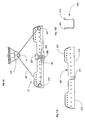
- Fig. 3A and Fig. 3B show how bracket 65 is used within an end member to fasten rails together.
- Fig. 3A is a plan view, cut away to show the inside of end member 17, and bracket 65 is shown positioned within the tubular end member about midway between the ends.
- the spacing between the holes is the desired spacing between the rails, and with the rails in the holes, each rail is adjacent to an end flange of bracket 65.
- a self-tapping screw 69 passes through a hole near the end of rail 13 and into hole 81, where it form its own threads and firmly attaches the rail to the bracket within end member 17.
- Rail 15 is similarly inserted and fastened by self tapping screw 67. Both rails butt against the inside diameter of member 17, adding additional stability to the assembly. Once the screws are secure, end caps 33 and 35 may be installed at the ends of the end member leaving the fastening arrangement hidden from view, and allowing still that the several parts may be stored and shipped disassembled to save space and cost. Rails 13 and 15 are joined at the opposite end of the exerciser with another bracket in a manner similar to that described at end member 17.
- the bracket of the preferred embodiment for joining and spacing the rails for the exerciser is but one of a number of ways that the joining and spacing may be accomplished. It will be apparent to a worker skilled in the art that other ways are available to accomplish the object. Rails 13 and 15 may be welded to end members 15 and 17 for instance, but there are problems with the welded structure, such as difficulty in achieving a uniform chrome plating for a proper appearance, and the size of the package required for storage and shipping, that are solved by the technique of the preferred embodiment.
- Fig. 4 is a section view taken along A-A of Fig. 1A in the direction of the arrows.
- the section is through wheeled carriage 11 at the mounting point for two of four wheels upon which the carriage rides on arcuate rails 13 and 15.
- the carriage has a main body 93 which is a sheet metal stamping, and the stamping has four punched holes for mounting wheel assemblies such as assembly 95.
- Body 93 in the preferred embodiment is buffed and chrome plated for appearance sake, but other treatments might be suitable in other embodiments.
- the sides of body 93 are angled at approximately 20 degrees away from the axis of symmetry so that the force of the weight of a user of the apparatus, who would be standing on the foot platforms, will be directed slightly outward to each side, thereby increasing the stability of the assembly.
- the wheel assemblies mount through these angled portions.
- a skirt extension 97 below the point where the wheel assemblies mount that follows the shape of one of the rails. This extension is repeated on the opposite side of the carriage, and serves to guard the area of rolling contact between the wheels and the rails, and to aid in keeping the carriage on the rails in the event of accident or enthusiastic use.
- the skirts are thus a safety feature.
- Each of the four wheel assemblies in the preferred embodiment, of which assembly 95 is representative, is an assembly comprising precision bearings and a wheel, and is a distinct improvement over the prior art.
- Fig. 5 is a cross-section of wheel assembly 95.
- Wheel 99 is machined from a synthetic material formed of extremely long-chain polymers, called UHMW (for ultra high molecular weight).
- UHMW for ultra high molecular weight
- the width of the wheel is about 2 cm., which is about 80% of the diameter of one of the rails. This is considerably wider than wheels of devices in the prior art, and the increased area of contact of a wheel with a rail, wrapping as it does further around a rail, provides a more stable and quieter operation than was before possible.
- a larger force in the direction orthogonal to the direction of carriage movement is needed to dislodge the carriage from the rails.
- Wheel 99 has machined internal shoulders into which precision ball bearings 101 and 103 are mounted.
- the bearings are of a higher quality than have heretofore been used with exercisers of this type, and are of a kind commercially available and used wth skates and skateboards.
- a hex head bolt 105 is the shaft of the wheel and mounts with a flat washer 107 from one side.
- a cylindrical spacer 109 spaces the bearings inside the wheel on the inner races of the bearings and a second spacer 111 stands the wheel and bearing assembly away from body 93 of the carriage.
- a chromed flat washer 113, a lock washer 115 and a chrome-plated castle nut 117 fasten the assembly to the carriage body on the side opposite the wheel.
- a pivot platform 41 is fastened atop carriage body 93 of carriage 11, and the pivot platform is for the mounting of two foot platforms for the user's feet.
- the exerciser may be used to simulate Wedeln type skiing without edging technique, and this use is an alternative embodiment of the invention.
- two individual foot platforms, platform 29 and platform 31 are mounted pivotally to the carriage assembly so that a user may simulate edging technique while using the apparatus.
- the two platforms are shown mounted side by side to flanges of pivot platform 41 in Fig. 1A, and the cross-section view of Fig. 4 shows a section through pivot platform 41 and foot platform 29.
- Platform 29 is of sheet metal construction and has non-skid pad 49 affixed to its upper surface.
- the pad material is synthetic rubber with tread impressions similar to and for the same purpose as a tire for a vehicle.
- the pad is fixed to the foot platform by an adhesive in the preferred embodiment.
- Foot platform 29 has two depending ears 119 and 121, and each ear has a hole through which a hinge rod 123 passes.
- Pivot platform 41 has two upward extending flanges 125 and 127, and the flanges also have each a hole through which pivot rod 123 passes.
- the assembly of the foot platform to the pivot platform is by means of the hinge rod 123 and flanged bronze bushings 129, 131, 133 and 135.
- the spacing of ears 119 and 121 relative to the spacing of flanges 125 and 127 is such that ear 121 is spaced apart from flange 127 and ear 119 is spaced apart from flange 125 in assembly by a distance of about 1.3 cm.
- Hinge rod 123 is held in place by spring clips 137 and 143.
- the spacing between ear 119 and flange 125 and between ear 121 and flange 127 is to allow space for connecting links 43 and 45 that constrain the foot platforms to move together.
- Bushings 151 and 153 are used with connecting links 43 and 45, and the link arrangements are shown in more detail in Fig. 6B.
- flanged bronze bushings in the hinge rod assembly adds bearing surface which provides lateral structural stability, resulting in prolonged life and smoother operation, and is an improvement over the prior art.
- the hinging of foot platform 31 to the pivot platform is accomplished in a similar manner and with similar parts as is shown in Fig. 4 for foot platform 29.
- Pivot platform 41 is mounted to carriage 11 by stove bolt and lock nut pairs 145 and 147, and this fastener set also secures a roller bracket 149 beneath the carriage that is further illustrated relative to roller assembly 61.
- the bushings may be of other bearing material in other embodiments, such as plastic bushings, for example.
- Fig. 6A is an elevation view of the two foot platforms showing the hinging and other connections in additional detail.
- Fig. 6B is a section view of this assembly along section line A-A of Fig. 6A, and in the direction of the arrows.
- Connecting link 43 is shown in Fig. 6A and both links 43 and 45 are shown in Fig. 6B.
- Link 43 connects ear 119 of foot platform 29 with ear 120 of foot platform 31 utilizing flanged bronze bushings 151 and 132.
- Link 45 connects ear 121 of foot platform 29 with ear 122 of foot platform 31 utilizing bushings 153 and 130. These connections constrain foot platforms 29 and 31 to rock together about their respective hinge rods so that they have at all times the same angular inclination to the horizontal.
- a stack 53 of resilient strips is positioned on pivot platform 41 so that rocking of the foot platforms in a clockwise direction is limited, but the limit is resilient rather than unyielding as would be the case if a metal stop were used.
- a similar stack 51 of resilient strips is positioned to similarly limit the rocking of the foot platforms in a counter-clockwise direction.
- the amount of movement afforded to the foot platforms and the force to resist the movement is adjustable by altering the stack height of the resilient strips and by changing the material.
- carriage 11 rolls along rails 13 and 15 and is restrained in that movement both by flexible strap 23 and by adjustment assembly 57.
- Strap 23 is fastened underneath carriage 11 by clamp assembly 61, at one end of the rail set by clamp assembly 25 and at the opposite end of the rail set by clamp assembly 27.
- a user stands on the foot platforms and moves the carriage by shifting his or her weight from one side to the other in the actions associated with parallel skiing.
- hand poles may be used that are similar to ski poles, but somewhat longer and tipped with a resilient material so they may be used indoors without damage to flooring or other materials that might be in the immediate area where an exerciser is used.
- Fig. 7A illustrates clamp assembly 61 under the carriage, which is associated with roller bracket 149.
- Fig. 7B is a side view of the pivot bracket and clamp assembly.
- Roller bracket 149 which is bolted through carriage body 93 and pivot platform 41, has openings 167 and 169 through which a clamp bar 171 extends.
- Strap 23 passes between the clamp bar and the base of the roller bracket, and the clamp bar has two holes through which stove bolts 173 and 175 pass.
- the stove bolts extend through holes in the carriage with the heads on the upper end, and two plastic knobs 177 and 179 thread onto the stove bolts just below the clamp bar.
- the plastic knobs are commercially available hardware items with threaded metal inserts. By rotating the knobs, pressure is applied to the clamp bar, hence to the flexible strap, firmly clamping the strap between the bar and the bracket base.
- Fig. 8A and Fig. 8B show clamp assembly 25 associated with end member 17, where strap 23 is clamped at one end of the rail set. As may best be seen in Fig. 8B, strap 23 passes over and around end member 17, then up through an opening between the end member and a clamp strip 181. As may best be seen in Fig. 8A, both clamp strip 181 and a guide strip 183 are held proximate to end member 17 by two stove bolts 185 and 187, each bolt passing through end member 17 and both clamp strip 181 and guide strip 183.
- Two plastic knobs, 189 and 191 similar to knobs 177 and 179, are threaded onto the ends of the stove bolts, and by being rotated cause strap 23 to be clamped between clamp strip 181 and the cylinder of end member 17.
- the purpose of guide strip 183 is to neatly retain the end of strap 23 after it has been clamped.
- FIG. 8B The plastic knobs are not shown in section view Fig. 8B so the nature of the other components may be more clearly illustrated.
- the view of Fig. 8B is with the end cap removed, and rail end bracket 65 may be seen in position within end member 17.
- Bolts 185 and 187 pass through holes 66 and 68 in bracket 65 (see Fig. 2B).
- Clamp assembly 27 at the opposite end of the rail set, associated with end member 19, is similar to clamp assembly 25 illustrated above.
- the opposite end of flexible strap 23 is secured to end member 19 by clamp assembly 27.
- Center support 55 is a U-shaped member fastened below the rail set and to each rail.
- Fig. 9 shows a central portion of rail 15 from a side view and an upper portion of one vertical leg 56 of support member 55.
- Vertical leg 56 of member 55 has three ears 197, 199 and 201.
- Ears 199 and 201 are at each end of the vertical leg, and fit into slots on the underside of rail 15.
- Central ear 197 fits also into a slot on the underside of rail 15, and has also a hole 203 of about .6 cm.diameter.
- a similar vertical leg with similar ears fits into slots in rail 13.
- Fig. 4 shows self tapping screws 193 and 195 that pass through holes in rails 13 and 15 to engage the holes in the central ears of the sides of support member 55.
- Support member 55 spaces and supports the rail set, and also supports adjustment assembly 57 and clamp assembly 63, seen in end view.
- Fig. 10 is a side elevation view of the adjustment and clamp assembly from the vantage of line B-B of Fig. 4.
- Fig. 11A is a side view of a U-shaped member 205 that is the principal frame of the adjustment assembly. Frame 205 is fastened in assembly to support member 55 by rivets (not shown). Riveting allows that each of the pieces be polished and chrome plated separately and that the assembly be made without harming the desired finish. Other methods of fastening may also be used.
- Fig. 11B is an end view of frame 205.
- Lips 207 and 209 which are welded to upper edges of side legs of frame 205 are to present a blunt edge for safety purposes. Similar lips are added to the opposite end of the frame member. In the preferred embodiment, these lips are welded, but the sharp edges may be occluded as well in other ways, such as with plastic edging strips.
- Frame 205 is symmetrical about a centerline 211 and there are four upright portions.
- Portions 213 and 215 of Fig. 11A are mirror image portions, and there are similar portions forming the other side of the frame.
- the holes are square to fit the under-head of standard stove bolts.
- the lower row in each portion is an array of seven holes in the preferred embodiment, about 2.9 cm. above the base and spaced about 3.5 cm. apart.
- the upper row of five holes is about 6 cm. above the base and the holes are spaced about 2 cm. apart.
- a roller assembly may be assembled.
- Fig. 12 shows such an assembly.
- a roller 217 of UHMW material and with a central hole is suspended between the vertical legs of frame 205 by a stove bolt 219.
- the under-head of the stove bolt fits into the square hole on one side, and the threaded portion extends through the round hole on the other.
- a spring washer 221 is used with a plastic knob 223, which is similar to plastic knobs 189 and 191, to secure the assembly.
- the fit between the central hole of the roller and the shaft of the stove bolt is such that the roller may freely rotate.
- the use of the spring washer allows a user to snug the plastic knob without applying so much pressure that the sides of the frame will flex and bind the assembly.
- roller assembly 225 similar to the assembly of Fig. 12 is assembled to the outermost position of the lower line of seven hole sets at one end of frame member 205.
- Another roller assembly 227 is assembled to the outermost hole set in the lower row at the opposite end of the frame member.
- Roller assembly 61 is similar to the other roller assemblies illustrated, and is assembled across the sides of roller bracket 149 which is fastened underneath carriage 11. Roller assembly 61 differs in that a lock nut is used in place of a plastic knob because this assembly is not normally moved for adjustment of forces for the exerciser.
- Lock nut 229 is shown relative to roller assembly 61 in end view in Fig. 4.
- a clamp assembly 63 for clamping flexible strap 59 which is similar to the clamp used at the center of roller bracket 149 to clamp flexible strap 23.
- a clamp rod 231 passes through the center opening of frame 205, and has two holes through which stove bolts 233 and 235 pass. The stove bolts protrude through holes in support member 55 from below.
- Plastic knobs 237 and 239 are used with the stove bolts to apply downward pressure to clamp ends of flexible strap 59 between the clamp rod and the base of frame member 205.
- Flexible strap 59 is represented in Fig. 10 by a solid and dotted line passing over roller assembly 61 under the carriage, around roller assemblies 225 and 227 near the ends of adjustment assembly 57, with the ends clamped at the center with clamp assembly 63.
- This is a standard position for the assembly of the exerciser according to the preferred embodiment.
- Fig. 14 shows a situation in which a user has shifted the carriage to one side, so that roller assembly 61 is about overhead one end of adjustment assembly 57.
- the force applied by the stretching of flexible strap 59 is a result of the stretch of the entire length of the strap over the three roller assemblies. Force is thus applied more gradually as the carriage moves rather than suddenly as is the case which the safety strap in the prior art.
- the sharing of the deformation over a greater length of strap with no localized areas of excessive deformation lowers the average stress level and alleviates fatigue effects, so that the straps may be expected to perform much longer in service.
- roller assemblies 225 and 227 may be each moved to a position toward the center of the adjustment assembly. By successively moving the roller assemblies one hole spacing toward the center, on each side, the beginning restoring force and the range of force may be reduced in seven steps, corresponding to the seven hole positions in the set.
- Fig. 15 shows roller assemblies 225 and 227 assembled in the No. 6 position, where the outermost position is considered the No. 7 position.
- Fig. 16 shows two additional roller assemblies 241 and 243 assembled to the innermost hole positions in the top row of holes in the frame of the adjustment assembly. This is the most agressive adjustment position of the roller assemblies, and will provide a challenge to the skill and endurance of the most agressive skier.
- Fig. 17 shows the adjustment of Fig. 16 with the carriage deflected to one side about the same amount as was the case in Fig. 14, and it is seen that the unique pattern of hole placement for the adjustment assembly provides not only a higher starting force, but also will provide a greater range of force and an increase in the rate at which force applies, due to the folding of strap 59 around the roller assemblies.
- the force applied to the carriage will increase dramatically, and the same will be true for movement, in the opposite direction as roller assembly 61 passes over assembly 241 and continues. Still, the stretching of flexible strap 59 always is over the full length of the strap, due to the rollers, which do not tend to fray the strap.
Landscapes
- Health & Medical Sciences (AREA)
- General Health & Medical Sciences (AREA)
- Physical Education & Sports Medicine (AREA)
- Rehabilitation Tools (AREA)
- Golf Clubs (AREA)
- Footwear And Its Accessory, Manufacturing Method And Apparatuses (AREA)
- Fittings On The Vehicle Exterior For Carrying Loads, And Devices For Holding Or Mounting Articles (AREA)
- Handcart (AREA)
Priority Applications (1)
| Application Number | Priority Date | Filing Date | Title |
|---|---|---|---|
| AT88307017T ATE103829T1 (de) | 1987-07-30 | 1988-07-29 | Skiuebungsgeraet. |
Applications Claiming Priority (2)
| Application Number | Priority Date | Filing Date | Title |
|---|---|---|---|
| US07/080,755 US4743014A (en) | 1987-07-30 | 1987-07-30 | Ski exercising apparatus |
| US80755 | 1987-07-30 |
Publications (3)
| Publication Number | Publication Date |
|---|---|
| EP0301889A2 true EP0301889A2 (de) | 1989-02-01 |
| EP0301889A3 EP0301889A3 (en) | 1990-01-03 |
| EP0301889B1 EP0301889B1 (de) | 1994-04-06 |
Family
ID=22159403
Family Applications (1)
| Application Number | Title | Priority Date | Filing Date |
|---|---|---|---|
| EP88307017A Expired - Lifetime EP0301889B1 (de) | 1987-07-30 | 1988-07-29 | Skiübungsgerät |
Country Status (7)
| Country | Link |
|---|---|
| US (1) | US4743014A (de) |
| EP (1) | EP0301889B1 (de) |
| JP (1) | JPS6437970A (de) |
| AT (1) | ATE103829T1 (de) |
| AU (1) | AU2018888A (de) |
| CA (1) | CA1276658C (de) |
| DE (1) | DE3888893T2 (de) |
Cited By (1)
| Publication number | Priority date | Publication date | Assignee | Title |
|---|---|---|---|---|
| EP0409889A4 (en) * | 1988-04-06 | 1991-04-17 | R. Joel Loane | Ski exercising apparatus |
Families Citing this family (71)
| Publication number | Priority date | Publication date | Assignee | Title |
|---|---|---|---|---|
| US5147257A (en) * | 1987-07-30 | 1992-09-15 | Loane R Joel | Ski exercising apparatus |
| US6569064B1 (en) * | 2000-03-22 | 2003-05-27 | R. Joel Loane | Ski exercising apparatus |
| US7090621B2 (en) * | 1987-07-30 | 2006-08-15 | Loane R Joel | Ski exercising and training apparatus |
| US5020793A (en) * | 1988-04-06 | 1991-06-04 | Loane R Joel | Ski exercising apparatus |
| US4949712A (en) * | 1988-05-19 | 1990-08-21 | Masakatsu Torii | Body shaking device |
| WO1990008577A1 (en) * | 1989-01-26 | 1990-08-09 | Ski Jive Limited | Exercise apparatus |
| US5374228A (en) * | 1992-06-02 | 1994-12-20 | Nordictrack, Inc. | Downhill skiing exercise machine |
| US5441255A (en) * | 1993-06-11 | 1995-08-15 | Verbick; Basil G. | Practice device for bowling and other sports |
| US5496239A (en) * | 1993-09-16 | 1996-03-05 | Kallman; Robert | Exercise and ski simulating device |
| US5749811A (en) * | 1994-11-02 | 1998-05-12 | Wilson; Roger F. | Skiing simulator |
| US7867139B2 (en) * | 2000-03-22 | 2011-01-11 | Loane R Joel | Ski exercising and training apparatus |
| EP1258498B1 (de) | 2000-10-25 | 2014-04-02 | Asahi Kasei Kabushiki Kaisha | Hydriertes polymer |
| US7303511B2 (en) * | 2005-02-01 | 2007-12-04 | John Bull | Exercise device |
| WO2006088187A1 (ja) | 2005-02-21 | 2006-08-24 | Asahi Kasei Chemicals Corporation | 水添ブロック共重合体及びその組成物 |
| DE112006002443T5 (de) | 2005-09-14 | 2008-07-10 | Asahi Kasei Chemicals Corporation | Blockcopolymeres und Verfahren zur Herstellung einer Schrumpffolie |
| ITRA20060017A1 (it) * | 2006-03-13 | 2007-09-14 | Technogym Spa | Macchina ginnica. |
| US7862489B2 (en) * | 2006-07-17 | 2011-01-04 | Studio Moderna Sa | Multipurpose exercise system |
| CN101646729B (zh) | 2007-03-26 | 2012-04-25 | 旭化成化学株式会社 | 热塑性组合物及其成型体 |
| CN101641378B (zh) | 2007-03-28 | 2011-07-27 | 旭化成化学株式会社 | 改性共轭二烯系聚合物的制造方法、含有该聚合物的组合物以及含有该组合物的轮胎 |
| ES2631912T3 (es) | 2008-04-14 | 2017-09-06 | Asahi Kasei Kabushiki Kaisha | Composición adhesiva |
| WO2009146353A2 (en) * | 2008-05-31 | 2009-12-03 | Potok Paul S | Exercise apparatus for performing an armless push-up and method of using same |
| JP5437247B2 (ja) | 2008-08-12 | 2014-03-12 | 旭化成ケミカルズ株式会社 | 水添ブロック共重合体組成物及びこれを用いた成形体 |
| WO2010067564A1 (ja) | 2008-12-10 | 2010-06-17 | 旭化成ケミカルズ株式会社 | 熱可塑性エラストマー組成物 |
| WO2010073589A1 (ja) | 2008-12-22 | 2010-07-01 | 旭化成ケミカルズ株式会社 | 架橋発泡用組成物、架橋発泡体及びこれを用いた靴用ミッドソール |
| US7780585B1 (en) * | 2009-02-24 | 2010-08-24 | Esperanza Cruz | Portable dual incline adjustable resistance abdominal muscle exercise machine |
| KR101310443B1 (ko) | 2009-03-12 | 2013-09-24 | 아사히 가세이 케미칼즈 가부시키가이샤 | 폴리프로필렌계 수지 조성물, 그의 성형품 및 그것을 이용한 자동차용 내외장 재료 |
| USD624135S1 (en) * | 2009-07-02 | 2010-09-21 | Cheng-Ta Tsai | Exercise device |
| TWM373750U (en) * | 2009-08-14 | 2010-02-11 | ru-juan Deng | Structure improvement of pull-stretch exercise machine |
| USD626186S1 (en) * | 2010-01-18 | 2010-10-26 | Cheng-Kang Chu | Leg stretch exerciser |
| ES2583329T3 (es) | 2010-03-08 | 2016-09-20 | Asahi Kasei Chemicals Corporation | Composición de espuma, procedimiento para producirla y espuma |
| MY160673A (en) | 2010-04-16 | 2017-03-15 | Asahi Kasei Chemicals Corp | Method for producing modified conjugated diene polymer, modified conjugated diene polymer, and composition of modified conjugated diene polymer |
| USD668727S1 (en) * | 2011-03-24 | 2012-10-09 | Wei-Teh Ho | Chest developer |
| PL2754674T3 (pl) | 2011-09-08 | 2015-08-31 | Asahi Kasei Chemicals Corp | Sposób wytwarzania zmodyfikowanego polimeru na bazie sprzężonego dienu, zmodyfikowany polimer na bazie sprzężonego dienu, kompozycja zmodyfikowanego polimeru na bazie sprzężonego dienu oraz kompozycja kauczuku i opony |
| US9050517B2 (en) | 2012-09-05 | 2015-06-09 | Bryan P. Oliver | Ski training device and method |
| JP6176696B2 (ja) * | 2012-12-04 | 2017-08-09 | 治夫 千重 | 雪面滑走スポーツ用のトレーニング装置 |
| US9186543B2 (en) * | 2013-10-31 | 2015-11-17 | R. Joel Loane | Ski exersize apparatus |
| CN104340403B (zh) * | 2014-10-28 | 2017-01-18 | 王兆刚 | 料堆覆盖机 |
| US10754682B2 (en) | 2014-11-26 | 2020-08-25 | Henry Bernard Bradford, III | Snow ski training apparatus and methods of use |
| CN206315402U (zh) * | 2016-11-16 | 2017-07-11 | 姚谷丰 | 一种新型踏步机 |
| CN110023403B (zh) | 2017-01-24 | 2022-08-09 | 旭化成株式会社 | 热塑性弹性体组合物、栓体和容器 |
| JP2017070861A (ja) * | 2017-01-27 | 2017-04-13 | 治夫 千重 | 雪面滑走スポーツ用のトレーニング装置 |
| WO2018164053A1 (ja) | 2017-03-07 | 2018-09-13 | 旭化成株式会社 | 変性共役ジエン系重合体、重合体組成物、及びゴム組成物 |
| WO2019031354A1 (ja) | 2017-08-10 | 2019-02-14 | 旭化成株式会社 | 感圧型接着剤用組成物、感圧型接着剤用材料、感圧型接着剤の形成方法、感圧型接着剤、多層フィルム及び包装体 |
| WO2020070961A1 (ja) | 2018-10-03 | 2020-04-09 | 旭化成株式会社 | 共役ジエン系重合体、分岐化剤、共役ジエン系重合体の製造方法、伸展共役ジエン系重合体、ゴム組成物、及びタイヤ |
| JP7166433B2 (ja) | 2019-03-20 | 2022-11-07 | 旭化成株式会社 | 水添ブロック共重合体 |
| JP7516355B2 (ja) | 2019-04-01 | 2024-07-16 | 株式会社Eneosマテリアル | 架橋物及びタイヤ |
| EP3974459B1 (de) | 2019-05-23 | 2024-01-17 | Asahi Kasei Kabushiki Kaisha | Hydriertes copolymerzusammentsetzung, klebefolie, harzzusammensetzung und geformter gegenstand |
| CN112239511B (zh) | 2019-07-16 | 2023-07-18 | 旭化成株式会社 | 氢化嵌段共聚物、氢化嵌段共聚物组合物以及成型体 |
| HUE064687T2 (hu) | 2019-08-06 | 2024-04-28 | Asahi Chemical Ind | Konjugált dién alapú polimer, elágazást biztosító anyag, eljárás konjugált dién alapú polimer elõállítására, olajjal hígított konjugált dién alapú polimer, gumikészítmény és gumiabroncs |
| TW202110916A (zh) | 2019-08-30 | 2021-03-16 | 日商Jsr股份有限公司 | 聚合物組成物、交聯體以及輪胎 |
| JP7315686B2 (ja) | 2019-09-05 | 2023-07-26 | 旭化成株式会社 | 共役ジエン系重合体、共役ジエン系重合体の製造方法、共役ジエン系重合体組成物、及びゴム組成物。 |
| US11884760B2 (en) | 2019-12-12 | 2024-01-30 | Asahi Kasei Kabushiki Kaisha | Production method for branched conjugated diene-based polymer, production method for rubber composition, production method for tire, branched conjugated diene-based polymer, and branched conjugated diene-based polymer composition |
| HUE067763T2 (hu) | 2019-12-12 | 2024-11-28 | Asahi Chemical Ind | Eljárás módosított konjugált dién alapú polimer elõállítására, a módosított konjugált dién alapú polimer, egy gumikészítmény, eljárás a gumikészítmény elõállítására és eljárás gumiabroncs elõállítására |
| USD948638S1 (en) | 2020-01-10 | 2022-04-12 | Shop Latino Network, S. De R.L. De C.V. | Ski exercising apparatus |
| US10806985B1 (en) * | 2020-01-31 | 2020-10-20 | R. Joel Loane | Ski exercising apparatus |
| WO2021201289A1 (ja) | 2020-04-03 | 2021-10-07 | 旭化成株式会社 | 共役ジエン系重合体、共役ジエン系重合体の製造方法、共役ジエン系重合体組成物、及びゴム組成物 |
| US12577390B2 (en) | 2020-05-27 | 2026-03-17 | Asahi Kasei Kabushiki Kaisha | Resin composition, method for producing modified hydrogenated block copolymer, and molded article |
| EP4332189B1 (de) | 2020-07-13 | 2025-12-31 | Asahi Kasei Kabushiki Kaisha | Verfahren zur herstellung eines druckempfindlichen klebstoffs |
| JP7588997B2 (ja) | 2020-09-30 | 2024-11-25 | 株式会社Eneosマテリアル | 重合体組成物、架橋体及びタイヤ |
| US20240042296A1 (en) * | 2020-12-18 | 2024-02-08 | Shop Latino Netowrk S. De R.L. De C.V. | Resistance mechanism with improved stability for ski simulation equipment |
| WO2022196643A1 (ja) | 2021-03-15 | 2022-09-22 | 株式会社Eneosマテリアル | 共役ジエン系重合体及びその製造方法、重合体組成物、架橋体並びにタイヤ |
| JP7738646B2 (ja) | 2021-03-31 | 2025-09-12 | 三井化学株式会社 | 熱可塑性エラストマー組成物およびその用途 |
| WO2023074089A1 (ja) | 2021-10-25 | 2023-05-04 | 旭化成株式会社 | ブロック共重合体、アスファルト組成物、及び改質アスファルト混合物 |
| EP4186911A1 (de) | 2021-11-30 | 2023-05-31 | Trinseo Europe GmbH | Aminhaltige vinyldisiloxane in der herstellung von elastomerpolymeren |
| CN118475629A (zh) | 2022-01-25 | 2024-08-09 | 旭化成株式会社 | 氢化嵌段共聚物、氢化嵌段共聚物组合物以及成型体 |
| EP4265646B1 (de) | 2022-04-18 | 2024-10-16 | Japan Elastomer Co., Ltd. | Granulat aus blockcopolymer oder hydriertem produkt davon und aspahlt-zusammensetzung |
| JP7836391B2 (ja) | 2022-05-18 | 2026-03-26 | 旭化成株式会社 | 複層成形用の熱可塑エラストマー組成物、複層成形体、及び複層成形体の製造方法 |
| EP4570827A4 (de) | 2022-08-12 | 2025-11-26 | Asahi Chemical Ind | Konjugiertes dienbasiertes polymer, formkörper, herstellungsverfahren für konjugiertes dienbasiertes polymer, kautschukzusammensetzung und reifen |
| EP4421121A1 (de) | 2023-02-24 | 2024-08-28 | Asahi Kasei Kabushiki Kaisha | Blockcopolymer, asphaltzusammensetzung und modifizierte asphaltmischung |
| WO2025028621A1 (ja) | 2023-08-02 | 2025-02-06 | 旭化成株式会社 | 変性共役ジエン系重合体、ベール、変性共役ジエン系重合体の製造方法、ゴム組成物及びタイヤ |
| EP4741404A1 (de) | 2024-11-12 | 2026-05-13 | Synthos Dwory 7 spolka z ograniczona odpowiedzialnoscia | Funktionalisiertes aminosilan zur herstellung von polymeren |
Family Cites Families (6)
| Publication number | Priority date | Publication date | Assignee | Title |
|---|---|---|---|---|
| DE8411358U1 (de) * | 1984-07-12 | Steiof, Josef, 1000 Berlin | Sportgerät | |
| US3524641A (en) * | 1967-10-02 | 1970-08-18 | American Mach & Foundry | Ski exercising apparatus |
| DE1578640B2 (de) * | 1967-12-05 | 1977-05-26 | Regenhardt, Heinz, 4000 Düsseldorf | Trainingsgeraet zum skilaufen, insbesondere zur nachbildung des bewegungsablaufs beim parallelschwung |
| US3547434A (en) * | 1968-09-12 | 1970-12-15 | American Mach & Foundry | Movable-carriage ski exerciser |
| US3620530A (en) * | 1969-04-18 | 1971-11-16 | Ira R Cosby | Elastic band-resistance exercising device |
| US4669723A (en) * | 1985-10-16 | 1987-06-02 | Panaram Alpine Corporation Inc. | Ski trainer |
-
1987
- 1987-07-30 US US07/080,755 patent/US4743014A/en not_active Expired - Lifetime
-
1988
- 1988-06-10 JP JP63141890A patent/JPS6437970A/ja active Pending
- 1988-07-08 CA CA000571614A patent/CA1276658C/en not_active Expired - Lifetime
- 1988-07-29 EP EP88307017A patent/EP0301889B1/de not_active Expired - Lifetime
- 1988-07-29 AU AU20188/88A patent/AU2018888A/en not_active Abandoned
- 1988-07-29 AT AT88307017T patent/ATE103829T1/de not_active IP Right Cessation
- 1988-07-29 DE DE3888893T patent/DE3888893T2/de not_active Expired - Lifetime
Cited By (1)
| Publication number | Priority date | Publication date | Assignee | Title |
|---|---|---|---|---|
| EP0409889A4 (en) * | 1988-04-06 | 1991-04-17 | R. Joel Loane | Ski exercising apparatus |
Also Published As
| Publication number | Publication date |
|---|---|
| CA1276658C (en) | 1990-11-20 |
| EP0301889A3 (en) | 1990-01-03 |
| JPS6437970A (en) | 1989-02-08 |
| ATE103829T1 (de) | 1994-04-15 |
| DE3888893T2 (de) | 1994-11-10 |
| EP0301889B1 (de) | 1994-04-06 |
| AU2018888A (en) | 1989-02-02 |
| DE3888893D1 (de) | 1994-05-11 |
| US4743014A (en) | 1988-05-10 |
Similar Documents
| Publication | Publication Date | Title |
|---|---|---|
| EP0301889B1 (de) | Skiübungsgerät | |
| US5147257A (en) | Ski exercising apparatus | |
| CA2526999C (en) | Ski exercising and training apparatus | |
| US4953853A (en) | Ski exercising apparatus | |
| US7867139B2 (en) | Ski exercising and training apparatus | |
| US4082265A (en) | Bicycle support system | |
| US7935032B1 (en) | Exercise system | |
| US4489933A (en) | Exercise device | |
| US4781372A (en) | Ice-skating exercise device | |
| US5429567A (en) | Cross-country and downhill slalom skiing exercise machine | |
| US5221241A (en) | Gymnastic training device | |
| US6569064B1 (en) | Ski exercising apparatus | |
| CA2027717C (en) | Ski exercising apparatus | |
| US9764175B2 (en) | Slackline apparatus and training method | |
| US6428451B1 (en) | Rotatable pedestal | |
| US4650184A (en) | Ski exerciser apparatus | |
| US7081075B2 (en) | Recreational balancing apparatus | |
| US20080312043A1 (en) | Balance Training and Exercise Device and Method | |
| US5451192A (en) | Adjustable exercise device for a child | |
| KR200302525Y1 (ko) | 복근 단련 운동기구 | |
| KR20030083838A (ko) | 개량형 널뛰기 장치 | |
| CA2146296A1 (en) | Adjustable exercise device for a child |
Legal Events
| Date | Code | Title | Description |
|---|---|---|---|
| PUAI | Public reference made under article 153(3) epc to a published international application that has entered the european phase |
Free format text: ORIGINAL CODE: 0009012 |
|
| AK | Designated contracting states |
Kind code of ref document: A2 Designated state(s): AT CH DE FR GB IT LI NL SE |
|
| PUAL | Search report despatched |
Free format text: ORIGINAL CODE: 0009013 |
|
| AK | Designated contracting states |
Kind code of ref document: A3 Designated state(s): AT CH DE FR GB IT LI NL SE |
|
| 17P | Request for examination filed |
Effective date: 19900628 |
|
| 17Q | First examination report despatched |
Effective date: 19910621 |
|
| GRAA | (expected) grant |
Free format text: ORIGINAL CODE: 0009210 |
|
| AK | Designated contracting states |
Kind code of ref document: B1 Designated state(s): AT CH DE FR GB IT LI NL SE |
|
| PG25 | Lapsed in a contracting state [announced via postgrant information from national office to epo] |
Ref country code: NL Effective date: 19940406 Ref country code: SE Free format text: THE PATENT HAS BEEN ANNULLED BY A DECISION OF A NATIONAL AUTHORITY Effective date: 19940406 |
|
| REF | Corresponds to: |
Ref document number: 103829 Country of ref document: AT Date of ref document: 19940415 Kind code of ref document: T |
|
| REF | Corresponds to: |
Ref document number: 3888893 Country of ref document: DE Date of ref document: 19940511 |
|
| ITF | It: translation for a ep patent filed | ||
| ET | Fr: translation filed | ||
| NLV1 | Nl: lapsed or annulled due to failure to fulfill the requirements of art. 29p and 29m of the patents act | ||
| PLBE | No opposition filed within time limit |
Free format text: ORIGINAL CODE: 0009261 |
|
| STAA | Information on the status of an ep patent application or granted ep patent |
Free format text: STATUS: NO OPPOSITION FILED WITHIN TIME LIMIT |
|
| 26N | No opposition filed | ||
| REG | Reference to a national code |
Ref country code: GB Ref legal event code: IF02 |
|
| PGFP | Annual fee paid to national office [announced via postgrant information from national office to epo] |
Ref country code: DE Payment date: 20070726 Year of fee payment: 20 |
|
| PGFP | Annual fee paid to national office [announced via postgrant information from national office to epo] |
Ref country code: AT Payment date: 20070711 Year of fee payment: 20 Ref country code: CH Payment date: 20070727 Year of fee payment: 20 |
|
| PGFP | Annual fee paid to national office [announced via postgrant information from national office to epo] |
Ref country code: GB Payment date: 20070725 Year of fee payment: 20 |
|
| PGFP | Annual fee paid to national office [announced via postgrant information from national office to epo] |
Ref country code: IT Payment date: 20070727 Year of fee payment: 20 |
|
| PGFP | Annual fee paid to national office [announced via postgrant information from national office to epo] |
Ref country code: FR Payment date: 20070710 Year of fee payment: 20 |
|
| REG | Reference to a national code |
Ref country code: CH Ref legal event code: PL |
|
| REG | Reference to a national code |
Ref country code: GB Ref legal event code: PE20 Expiry date: 20080728 |
|
| PG25 | Lapsed in a contracting state [announced via postgrant information from national office to epo] |
Ref country code: GB Free format text: LAPSE BECAUSE OF EXPIRATION OF PROTECTION Effective date: 20080728 |