EP0301909A2 - Appareil pour l'accès rapide à une grande base de données - Google Patents
Appareil pour l'accès rapide à une grande base de données Download PDFInfo
- Publication number
- EP0301909A2 EP0301909A2 EP88307061A EP88307061A EP0301909A2 EP 0301909 A2 EP0301909 A2 EP 0301909A2 EP 88307061 A EP88307061 A EP 88307061A EP 88307061 A EP88307061 A EP 88307061A EP 0301909 A2 EP0301909 A2 EP 0301909A2
- Authority
- EP
- European Patent Office
- Prior art keywords
- read
- disc
- data
- address
- track
- Prior art date
- Legal status (The legal status is an assumption and is not a legal conclusion. Google has not performed a legal analysis and makes no representation as to the accuracy of the status listed.)
- Granted
Links
- 230000008859 change Effects 0.000 claims description 21
- 238000007639 printing Methods 0.000 claims description 9
- 230000006870 function Effects 0.000 claims description 8
- 230000004044 response Effects 0.000 claims description 8
- 230000003287 optical effect Effects 0.000 claims description 3
- 238000012937 correction Methods 0.000 claims description 2
- 238000013500 data storage Methods 0.000 claims description 2
- 238000001514 detection method Methods 0.000 claims description 2
- 230000000875 corresponding effect Effects 0.000 claims 8
- 238000006073 displacement reaction Methods 0.000 claims 2
- 241000700159 Rattus Species 0.000 claims 1
- 230000002596 correlated effect Effects 0.000 claims 1
- 238000004519 manufacturing process Methods 0.000 abstract description 4
- 238000000034 method Methods 0.000 description 16
- 230000008569 process Effects 0.000 description 8
- 238000009826 distribution Methods 0.000 description 3
- 238000005516 engineering process Methods 0.000 description 3
- 230000003068 static effect Effects 0.000 description 3
- 238000004422 calculation algorithm Methods 0.000 description 2
- 238000013144 data compression Methods 0.000 description 2
- 238000013461 design Methods 0.000 description 2
- 238000010586 diagram Methods 0.000 description 2
- 238000000465 moulding Methods 0.000 description 2
- 238000012015 optical character recognition Methods 0.000 description 2
- 230000007704 transition Effects 0.000 description 2
- 238000007792 addition Methods 0.000 description 1
- 230000003679 aging effect Effects 0.000 description 1
- 238000004364 calculation method Methods 0.000 description 1
- 239000011248 coating agent Substances 0.000 description 1
- 238000000576 coating method Methods 0.000 description 1
- 238000004590 computer program Methods 0.000 description 1
- 230000007613 environmental effect Effects 0.000 description 1
- 239000000284 extract Substances 0.000 description 1
- 238000012423 maintenance Methods 0.000 description 1
- 230000007246 mechanism Effects 0.000 description 1
- 230000005055 memory storage Effects 0.000 description 1
- 238000012544 monitoring process Methods 0.000 description 1
- 230000000737 periodic effect Effects 0.000 description 1
- 239000004033 plastic Substances 0.000 description 1
- 238000003825 pressing Methods 0.000 description 1
- 238000012545 processing Methods 0.000 description 1
- 239000011253 protective coating Substances 0.000 description 1
- 230000009467 reduction Effects 0.000 description 1
- 239000004065 semiconductor Substances 0.000 description 1
- 239000007787 solid Substances 0.000 description 1
- 238000003860 storage Methods 0.000 description 1
- 230000002459 sustained effect Effects 0.000 description 1
- 239000012815 thermoplastic material Substances 0.000 description 1
Images
Classifications
-
- B—PERFORMING OPERATIONS; TRANSPORTING
- B07—SEPARATING SOLIDS FROM SOLIDS; SORTING
- B07C—POSTAL SORTING; SORTING INDIVIDUAL ARTICLES, OR BULK MATERIAL FIT TO BE SORTED PIECE-MEAL, e.g. BY PICKING
- B07C3/00—Sorting according to destination
-
- G—PHYSICS
- G11—INFORMATION STORAGE
- G11B—INFORMATION STORAGE BASED ON RELATIVE MOVEMENT BETWEEN RECORD CARRIER AND TRANSDUCER
- G11B27/00—Editing; Indexing; Addressing; Timing or synchronising; Monitoring; Measuring tape travel
- G11B27/002—Programmed access in sequence to a plurality of record carriers or indexed parts, e.g. tracks, thereof, e.g. for editing
-
- G—PHYSICS
- G11—INFORMATION STORAGE
- G11B—INFORMATION STORAGE BASED ON RELATIVE MOVEMENT BETWEEN RECORD CARRIER AND TRANSDUCER
- G11B27/00—Editing; Indexing; Addressing; Timing or synchronising; Monitoring; Measuring tape travel
- G11B27/10—Indexing; Addressing; Timing or synchronising; Measuring tape travel
- G11B27/102—Programmed access in sequence to addressed parts of tracks of operating record carriers
- G11B27/105—Programmed access in sequence to addressed parts of tracks of operating record carriers of operating discs
-
- G—PHYSICS
- G11—INFORMATION STORAGE
- G11B—INFORMATION STORAGE BASED ON RELATIVE MOVEMENT BETWEEN RECORD CARRIER AND TRANSDUCER
- G11B27/00—Editing; Indexing; Addressing; Timing or synchronising; Monitoring; Measuring tape travel
- G11B27/10—Indexing; Addressing; Timing or synchronising; Measuring tape travel
- G11B27/19—Indexing; Addressing; Timing or synchronising; Measuring tape travel by using information detectable on the record carrier
- G11B27/28—Indexing; Addressing; Timing or synchronising; Measuring tape travel by using information detectable on the record carrier by using information signals recorded by the same method as the main recording
-
- G—PHYSICS
- G11—INFORMATION STORAGE
- G11B—INFORMATION STORAGE BASED ON RELATIVE MOVEMENT BETWEEN RECORD CARRIER AND TRANSDUCER
- G11B27/00—Editing; Indexing; Addressing; Timing or synchronising; Monitoring; Measuring tape travel
- G11B27/10—Indexing; Addressing; Timing or synchronising; Measuring tape travel
- G11B27/19—Indexing; Addressing; Timing or synchronising; Measuring tape travel by using information detectable on the record carrier
- G11B27/28—Indexing; Addressing; Timing or synchronising; Measuring tape travel by using information detectable on the record carrier by using information signals recorded by the same method as the main recording
- G11B27/32—Indexing; Addressing; Timing or synchronising; Measuring tape travel by using information detectable on the record carrier by using information signals recorded by the same method as the main recording on separate auxiliary tracks of the same or an auxiliary record carrier
- G11B27/327—Table of contents
- G11B27/329—Table of contents on a disc [VTOC]
-
- G—PHYSICS
- G11—INFORMATION STORAGE
- G11B—INFORMATION STORAGE BASED ON RELATIVE MOVEMENT BETWEEN RECORD CARRIER AND TRANSDUCER
- G11B7/00—Recording or reproducing by optical means, e.g. recording using a thermal beam of optical radiation by modifying optical properties or the physical structure, reproducing using an optical beam at lower power by sensing optical properties; Record carriers therefor
- G11B7/002—Recording, reproducing or erasing systems characterised by the shape or form of the carrier
- G11B7/0037—Recording, reproducing or erasing systems characterised by the shape or form of the carrier with discs
-
- G—PHYSICS
- G11—INFORMATION STORAGE
- G11B—INFORMATION STORAGE BASED ON RELATIVE MOVEMENT BETWEEN RECORD CARRIER AND TRANSDUCER
- G11B2220/00—Record carriers by type
- G11B2220/20—Disc-shaped record carriers
- G11B2220/21—Disc-shaped record carriers characterised in that the disc is of read-only, rewritable, or recordable type
- G11B2220/213—Read-only discs
-
- G—PHYSICS
- G11—INFORMATION STORAGE
- G11B—INFORMATION STORAGE BASED ON RELATIVE MOVEMENT BETWEEN RECORD CARRIER AND TRANSDUCER
- G11B2220/00—Record carriers by type
- G11B2220/20—Disc-shaped record carriers
- G11B2220/25—Disc-shaped record carriers characterised in that the disc is based on a specific recording technology
- G11B2220/2537—Optical discs
- G11B2220/2545—CDs
Definitions
- This invention relates to an apparatus for accessing a relatively large data base, preferably in one seek.
- USPS United States Postal Service
- OCR optical character reading
- the USPS employs two types of automatic sorting equipment.
- this first type the characters of the address block are read by optical character reader (OCR) systems.
- OCR optical character reader
- existing sorters the bottom line containing the city, state and zip code is read. From this data a barcode is marked on the envelope by an ink jet printer.
- This barcode can be read by automatic sorters of the second type, which are less expensive since they are not equipped with the OCR system.
- the USPS system contains many more sorters of the second type than of the first type.
- Each such letter sorter requires a data base which contains the destination addresses corresponding to the nine digit (zip+4) or eleven digit (zip+6) zip codes.
- the nine digit zip code defines the ranges of addresses, such as a side of a street, or a floor of an office building.
- the USPS maintains a file of standard address ranges for the zip+4 codes, which consists of about 29 million records requiring approximately 3 gigabytes for storage.
- a standard address is that assigned by the USPS. Individual postal patrons may inscribe mailpieces with variations on or additions to the standard address. These variations are a problem in the design of OCR systems for USPS.
- the present inventor recognises a need to provide rapid access to the file of standard addresses.
- the eleven digit zip code defines all the specific mail destinations in the country, and consists of some 86 million records. An additional factor is that there are approximately 40 million changes of addresses each year; the change of address file is kept for eighteen months. Thus, there are an average of about 110 thousand changes of address per day. The data base to retain these addresses for eighteen months contains 60 million records.
- the letter sorters process twelve letters per second (80 millisec per letter). Further, the data base containing all of the addresses must be accessed at this rate of a continued sustained basis. It is intended that there by 650 letter sorters on a nation wide basis. Such sorters will be located at 250 sectional centers. Letters entering the center are to be marked with a bar code containing the nine or eleven zip digits; thereafter, simple sorters will read the code. Each of the 650 data bases is a duplicate containing the addresses for the entire country.
- Magnetic disc recording systems of requisite capacity are standard features of large computer systems. These are controlled by data base software which enable continuous incremental updates of the records by many users. The consequence of this procedure is that the distribution of data on a disc becomes progressively more complex and multiple seeks are necessary to find specific items. Thus, even though the access time for a high performance disc may be as low as 18 milliseconds (ms), so many accesses are required that the 80ms (12 per second) goal cannot be met.
- Such a data base can be updated periodically at a central site and copies distributed to local cites where it can be read but not revised.
- Such data bases can be updated, published and distributed as wholes and local updating may be by complete replacement of the entire data base. Because any specific issue of the data base is static, it can be organized in a simple manner such that one seek to a track and scan of that track will find any record.
- CD-ROM compact disc read only memory
- D-1 format digital video tape
- CD-ROM compact disc read only memory
- CD-ROM refers to the use of compact audio disc technology for the distribution and reproduction of digital data. A single such disc contains in excess of 0.5 gigibytes (GB) of user data, after system overhead and error correction are included.
- Digital video tape refers to the use of helical scan video recording technology to record digital signals. The recording density is significantly greater than on conventional computer tapes.
- CD-ROMS's are conventionally recorded with a spiral track at constant linear velocity.
- the recorded data rate is constant and the disc speed must change with the radial position of the recording or read head.
- the read head contains a semiconductor laser and sensors which provide signals for focus and tracking servos, as well as data readout.
- Commerical CD-ROM players are intended for personal computers and feature access times of the order of one second, which is impractical for the USPS applications.
- a plurality of read head means are coupled to the drive means for independently accessing and reading data at a plurality of disc locations from anywhere on a given disc at substantially the same constant data rate regardless the difference in actual data rate occurring on the different track portions being read. Control means select and operate the selected read head means.
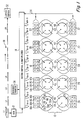
- a conveyer 11 conveys a serial stream of letters L1-LN or other types of mail for reading by an optical character reader (OCR) 12.
- OCR 12 reads the name, street, city, state and five digit zip code appearing on the face of the letters L1-LN.
- the name, street, city, state and five digit zip code read by the OCR 12 is supplied to system controller and multiplexer 14.
- Multiplexer 14 has a plurality of parallel channel outputs 1A-D, 2A-D - 10A-D. These outputs are applied via multiple lines to CD-ROM controllers for reading data from an array 15 of CD-ROM read systems.
- outputs 1A are applied to controller 16A
- outputs 1B are applied to controller 16B
- outputs 2A-D of multiplexer 14 are respectively applied to a second set of identical controllers 17A-17D wherein outputs 2A are applied to controller 17A, outputs 2B are applied to controller 17B and so on.
- the remaining outputs 3A-D - 10A-D are applied respectively to the remaining sets of controllers 18, 20, 22, 24, 26, 28, 30 and 32 of the system.
- Each of the sets 18-32 comprise four identical controllers which are also identical to controller sets 16A-16D and 17A-17D for receiving inputs from the system control and multiplexer 14.
- Controller 16A operates an actuator 34
- controller 16B operates an actuator 36
- controller 16C operates an actuator 38
- controller 16D operates an actuator 40
- Actuators 34-40 are mechanical devices for radially displacing respective laser read heads 44-50 secured thereto. Actuators 34, 36, 38 and 40 are represented by radial lines relative to CD-ROM drive 42. Actuator 34 is radially aligned with actuator 38 on diametrical opposite sides of the drive 42. Similarly, actuators 36 and 40 are radially aligned normal to actuators 34 and 38. Actuator 34 is coupled to a read head 44, actuator 36 is coupled to read head 46, actuator 38 is coupled to read head 48 and actuator 40 is coupled to read head 50.
- Read heads 44-50 are identical and comprise a laser read mechanism as available in commercially available CD-ROM drive systems. Each controller 16A-16D independently drives and controls the position of its respective corresponding read head 44-50 via the respective actuators 34-40.
- the use of plural read heads with independent actuators and controllers allows overlapping of periods of time to adjust the radial position of the heads as part of a seek operation. This permits the plural heads to be read consecutively without having to allow intervening time periods to adjust read head radial positions.
- a CD-ROM read head and actuator system is associated with each controller 17A-17D and the remaining controller sets 18-32.
- the laser read drive subsystems are identical.
- System control and multiplexer 14 responds to the scan of the address on a given letter L1-LN and activates a selected one of the controllers to access a portion of a disc known a priori to contain the standard address and five+four zip code corresponding to the read letter.
- a CD-ROM disc is on each of the CD-ROM drives. Each disc is part of a data base containing the standard address including the city, state and five+four zip code. As known, the five-digit zip code refers to a destination locality whereas the additional four digit zip code narrows the destination to a given street or carrier route.
- the United States Postal System desires to bar code print the nine-digit zip code (five+four) onto each letter so that the letter may be automatically sorted by the bar code imprinted address by a sorter 52.
- Sorter 52 may be of the first or second types as described above. To do this the controllers for each of the CD-ROM drive systems supply the additional four digit specific zip code in response to the reading of the normal five digit zip code appearing on each letter.
- System control and multiplexer 14 generates from the read address and five-digit zip code an appropriate signal which identifies a particular controller of a particular disc drive system corresponding to that read data. That signal causes the read head of a given drive system to access the standard address and nine-digit zip code information from a given CD-ROM disc driven by that drive system. To perform this access the read head radial position is slewed to the approximate track location using a digital position encoder. The read head is then positioned to the desired track portion by counting tracks. Because conventional CD-ROMs have access time of about 1 to 2 seconds and because the postal system requires accessing of the data base at a rate of 12 items per second, normal CD-ROMs are too slow for this purpose.
- each drive system 42, 43, 45, 47, 49, 51, 53, 57, and 59 each receiving a CD-ROM disc containing a different portion of the standard address and nine-digit zip code data base and by providing each drive system with four read heads it is possible to access the selected addresses and zip codes at an average rate of 12 units/second.
- the number of read heads and thus access channels is a function of the required access time in relation to the required read rate. Access time is the time required to radially position the head plus the time to rotate the disc about one revolution under the head.
- the access time for a disc is a function of the disc rotation speed and head seek time.
- CD-ROMs normally have about 18,000 spirally connected tracks.
- the system control and multiplexer 14 determines which one of the systems 42-59 and which one of the controllers 16A-16D through 32 contains the desired address and generates an appropriate signal. That signal selects the specific read head and given drive system for accessing the data at that selected drive system. How the controllers operate and select the information and how the system controller derives the signal for selecting a given controller is described below in more detail in connection with FIGURE 3.
- the information is applied via line 54 to system control and multiplexer 14.
- the information accessed on a given CD-ROM disc is the standard street address range and corresponding nine-digit zip code.
- multiplexer 14 causes bar code printer 56, which may be a jet ink printer, to print the bar code representing the nine digit zip code on the individual letters such as letter L3.
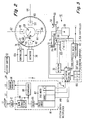
- representative system 42 includes a disc drive 58 and a CD-ROM disc 60.
- One controller 16A and its corresponding actuator 36 are shown in solid, the remaining controllers and actuators are represented by the broken radial lines 62, 64 and 66.
- Disc 60 contains data which are recorded in a continuous inside out spiral track.
- CD-ROM discs contain data in a series of user data blocks of fixed size alternating with headers containing serial numbers and error detection codes.
- User data files may contain any number of data blocks.
- the length of a file depends on the amount of data in that file and the angular location of the beginning of the file may vary from track to track along the spiral.
- the header information as employed on the disc of the present data base is conventional.
- the access time in a disc recording system has two components, conventionally named seek time and latency time.
- Seek time is that required for the read head to find a specific track, commonly by a generally radial movement (which may be in a straight line or arc).
- Latency time is that required for the disc to rotate to bring the desired data past the read head.
- the latency time is determined by the rotation speed of the disc which in turn is a function of the data density of the track and the data bandwith of the processing circuits.
- latency time may be over 200ms. Seek time must be reduced to tens of milliseconds to achieve the performance goal of 320ms access time.
- a CD-ROM player utilizes a pre-recorded plastic whose tracks are spaced about 1.6 micrometers apart. Because of thermal expansion and manufacturing variations, the exact radial position of a track is initially unknown to the system. In conventional CD-ROM players, specific tracks must be located by a method of successive approximation as described above. The present system provides a means for accessing the disc by each head in 320 milliseconds in on seek.
- Each disc of the data base for example disc 60, is marked with reference indicia 68 and 70.
- Indicium 68 represents an angular reference mark by which the angular position of data from that reference mark is measured by the value of angle ⁇ .
- Indicia 70 divide the disc into small angular increments to provide precise angular location of any point on the disc with reference to the indicia 68.
- Two sensors 72 and 74 are coupled to controller 16A for supplying information relative to the angular position of the reference indicium 68 and for providing information via indicia 70 of the exact angular position of any point on the disc 60.
- Each controller 16A through 16D controllers 32 include sensors such as sensors 72 and 74 for sensing the reference indicia on the corresponding rotating disc.
- the disc drive 58 of system 42 includes a turntable 78 which receives the disc 60 and further includes a drive motor 80 for rotating the table 78 at a constant angular rate.
- Each of the discs 60 as is known comprises static data impressed upon an optically reflective surface and coated with a transparent protective coating.
- the data comprise impressions formed in the reflective coating surface so that the transitions at the beginning and end of each depression form a binary signal representing the data.
- the binary one for example may represent the transition from the bottom of the depression to the disc surface or vice versa whereas a binary zero may represent the bottom of the depression or the disc surface between depressions.
- These depressions are formed in a spiral track.
- the disc may be premastered and pressed in a conventional manner and the distributed to a wide number of local postal sorting stations located throughout the United States.
- the data base comprises a set of ten discs. Each disc is associated with a separate drive system 42. Encoded at the end of the data track of each disc is an indexing table.
- the indexing table comprises a hash index number and the r- ⁇ coordinates of the file headers expressed in radial and angular dimensions.
- the table of coordinates is recorded last on the disc so that its presence does not disturb the locations of the files whose coordinates are calculated from the location of those files.
- the recording of a CD-ROM master is a precision process so that angular and radial location of any data block can be calculated in advance.
- a computer program prepares the database and the data block headers.
- a number is extracted from the address including the street, city, state and five-digit zip code.
- the hash algorithm generates the index number.
- the five digit zip code is concatenated with the address number and the initial letters of a street name. These represent a large digital number which is divided by 180,000 (the number of tracks on the ten discs). The remainder of such division comprises an index position on the spiral track relating to the header block serial number identifying a given file.
- the system control and multiplexer 14 includes computer memory 82.
- the memory 82 stores the hash index table that is read from a given disc 60 when the disc 60 is loaded onto the drive system 42.
- One of the four read heads, e.g., head 46, reads that table and transfers the information to the memory 82 of multiplexer 14 upon command by multiplexer 14.
- Multiplexer 14 includes a buffer memory 84 for storing the name, street, city, state and five digit zip code read by OCR 12. This information is supplied to computer 86 which derives the hashing index number, as discussed above. Since in computer machine language all alpha characters are represented in ASCII character numbers, the letters and digits of the address form a serial set of digits which form can be interpreted as a number from which the hashing alogrithm of the computer 86 derives the hash index as previously explained. The name and address are supplied from the memory 84 to a comparator 88 for reasons to be explained later.
- a processor in multiplexer 14 in response to the index number derived from the name and address read by OCR 12 from a letter L1-LN in the letter stream searches for the corresponding hashed index number in the table of memory 82. That index number corresponds to a given drive system 42-59 (FIGURE 1) and r- ⁇ coordinates which locate the beginning of the file containing that name, address and nine-digit zip code in the disc on that drive system.
- the information is sent via electronic signals on lines 90 to controller 16A.
- the signal on line 90′ is one which activates drive system 42 based on the correspondence of the hash index number to drive 42 in the memory 82.
- the lines 90 represent the lines to a single controller and that similar lines are fed to each of the other controllers corresponding to each read head in the system.
- Multiplexer 14 via a signal such as on line 90′ selects that controller which is to receive the control signals and coordinates for driving the selected read head.
- Actuator control 92 may be a microprocessor for performing various functions to be described.
- One set of inputs to control 92 is the sense signals from sensor 72 and 74 for indicating an angular position of the reference angle ⁇ .
- One output of control 92 drives actuator 36.
- Actuator 36 is a commercially available read head drive for moving the read head 46 back and forth in the radial direction relative to disc 60.
- Read head 46 is commerically available and includes a laser 96 for reading the encoded data on disc 60.
- the laser 96 is on a support 98 which is moved in the radial directions by actuator 36. Coupled to support 98 is a linear position encoder 100.
- Linear position encoder 100 provides a digitally encoded signal representing the position of the laser 96 along the radius r. The position of the laser 96 is also measured by monitoring the track sense line from the disc read electronics 102. This line transmits a plus or minus signal depending on whether the read head is inside or outside a specific track. When searching across the tracks, this signal varies cyclically as it passes over the tracks. By counting the cycles, the number of tracks passed can be determined by an algorithm in actuator control 92.
- the linear position encoder 100 serves to provide information to enable the actuator 36 to slew the read head 46 to within several tracks ahead of the track containing the file of interest. The track count provides additional information to enable the actuator to position the read head 46 at the track of interest.
- Linear position encoder 100 provides a signal to actuator control 92 giving the encoded position information of the radial location of the read head 46.
- the actuator control 92 uses this information from encoder 100 to process the signals from the multiplexer 14 to precisely position the laser 96 where desired in accordance with the given hash index number derived from a given letter.
- control 92 Associated with the read head 46 are the disc read electronics 102 which read the information including sensing the tracks and other housekeeping track and data reading information.
- the control 92 generates a clock signal on line 104 for providing the appropriate data read rate for electronics 102.
- the clock rate on line 104 differs in accordance with the radial distance r sensed by the read head 46 and as interpreted by the electronics 102.
- Included within control 92 is memory 106.
- Memory 106 contains a calibration table which includes the track radial distance r as derived from the memory 82 in multiplexer 14, and which includes the actual distance r′ as measured by position encoder 100 to the actual track represented by the corresponding hash index number. For each such assumed radius r and actual measured radius r′, a clock signal having a frequency f is assigned the r and r′ values. The clock frequency changes as the radial distance r of a given track changes relative to the axis 76 and is computed by the system for each actual r′ measured.
- the table in memory 106 is created as the system is started up.
- the information on the tracks may include self-clocking codes for synchronizing the data read electronics.
- the actuator control 92 includes a microprocessor (not shown) which periodically causes a read head to scan the tracks of its disc 60 to update track r′ information into memory 106 updating the table. This update information may be multiplexed with the normal deployment of the read heads during data seek cycles.
- the reason for updating the track location with the value r′ periodically and for providing the calibration table in memory 106 is to compensate for manufacturing and environmentally caused track location errors. Temperature variations, manufacturing processes, and tolerances in pressing each disc are such that actual locations of the tracks on each disc may change from any predetermined value. Normally there will be local and global errors in the molding process, shrinkage after molding, and thermal expansion and aging effects in use which need to be compensated.
- the disc is thermoplastic material in which these track spacings are approximately 16 microns, which dimension can easily change due to the environmental conditions. Therefore, the radius r of any specific track, that is a turn of the spiral, cannot be precisely known in advance except by a periodic update calibration process.
- the focus servo in a conventional CD-ROM system embodied in the actuator control 92 operates independently of the data tracking.
- a drive signal on lead 90′ is applied to actuator controller 92 selecting system 42.
- the signals applied to actuator control 92 represent and r and ⁇ coordinates for the hash index number derived from the street address on the letter L1 then being read by OCR 12. These coordinates, particularly the r coordinate, is used by the calibration computer 106 to derive the r′ coordinate and determine the data clock frequency f for that r′.
- the actuator control 92 in response to the r′ signal from the calibration computer then causes the encoder 100 to slew the laser 96 of the read head 46 into position.
- the read electronics 102 counts tracks supplying the track count to control 92.
- Control 92 in response to the track count moves laser 96 to the position represented by the distance r′.
- the disc read electronics counts tracks to position the read head 46 at the target track.
- the address information in that file located on the targeted track is then read at the f data rate. Address information is supplied by the disc read electronics 102 to terminal T, which applies that signal to comparator 88.
- Comparator 88 includes a buffer for storing the street, city, state and zip code information that is read from the letter L1 and which corresponds to the file being read from disc 60.
- the city, state and the five-digit zip are compared with the city, state, five digit zip read from the file from disc 60.
- the comparator produces a signal and applies it to the bar code printer 56 for printing a bar code on letter L1, which in the meantime during operation of the system has moved along conveyor 11 into position over printer 56.
- the bar code represents the nine-digit zip stored on the disc 60 then being read.
- Bar code printer 56 is a ink jet printer which prints the bar code at the 12 letter per second rate.
- Data sorter 52 then reads the printed bar codes and sorts the letters by the nine-digit code. In the example given with respect to FIGURES 1-3, a zip+4 digit code was employed. However, the system is equally applicable to a zip+6 digit zip code which is a complete destination address for every entity in the United States.
- system 42 was given by way of example in conjunction with the operation of controller 16A.
- the operation of every other controller in the system associated with each of the ten disc drives is represented by the description given above.
- the system control the multiplexer 14 can rapidly provide a read signal to each of the controllers 16A through 16D of a given disc drive operating those read heads. It should be understood that the letters are read sequentially and, therefore, there is a time lag between the operation of each of the read heads.
- Each head operation has a 320 millisecond duration, as described above.
- the use of four heads per disc permits the four heads to operate in that 320 millisecond time frame and therefore, read that disc in 80 milliseconds.
- Any of the read heads at any of the disc drive systems may be read in any given time frame in accordance with the data read from letters L1-L N . Not shown in a synchronization system for synchronizing printing onto letter L3 by printer 56.
- a single indicia mark such as indicium 68 may be provided without the indicia 70.
- the speed control system in a conventional CD-ROM player includes sufficient accurate speed control so that suitable timing can be derived from the speed setting system for providing precise angular locating information of data on the disc relative to indicia 68. Because the files may be of unknown length and differ from one another it does not matter where the file headers are positioned relative to the reference indicium 68. In this way the relatively slow operation of the actuator 36 is compensated for by the multiple actuators and read head systems associated with each disc drive system.
- control 92 automatically updates the calibration table in memory 106. This is done by recomputing the values of r′ for each of the tracks on the disc. This recomputed r′ value is inserted in memory 106 and the prior value erased.
- the values of the frequency f for the clock rate for reading the data are calculated by the calibration computer to providing accurate clock data for each value of r′. This calculation may be done, for example, using a lookup table stored in memory to specify a given clock rate for a range of values for r′ for all possible ranges on a given disc.
- track as employed in the claims is intended to include a continuous spiral format or a plurality of concentric rings.
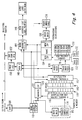
- FIGURE 4 illustrates a system which can provide an on-line updated data base including the current changes of address.
- This system assumes that simple data compression techniques can be used to compress an eleven-digit zip code file to 5 gigabytes.
- This database is contained on ten discs each of which is accessed by the four heads described above in connection with FIGURES 1-3. Two sets 118 and 140 of such ten discs are employed in the system of FIGURE 4.
- Data from the OCR 108 is stored in memory 110 and includes the name, state, city, state and five digit zip code.
- the information is supplied to computer in memory 112 for extracting a hash index from the city, state and zip code in a manner similar to that described above in connection with FIGURE 3.
- the derived index is applied to a track index table stored in memory and derived from the CD-ROMs to initialize the system as also described above.
- the track index table in computer memory 112 provides the disc drive number and the r and ⁇ coordinates on the particular disc. This information is applied on line 114 to a four-channel control multiplexer 116.
- Multiplexer 116 includes the functions of disc drive selection channel allocation and control of head actuators in a manner similar to that described with respect to the system control and multiplexer 14 of FIGURE 3.
- CD-ROM player systems array 118 may have 10 players with four heads each.
- Each disc contains a portion of a data base comprising a five-digit zip+6 standard address file for all mail destinations in the United States. This data base comprises approximately 6 gigabytes of data which may be compressed.
- the information read from the array 118 is applied to comparator buffer 120.
- the comparator buffer contains the standard address and eleven-digit zip codes from the disc then being read by OCR 108. This information is used to locate the actual zip+6 code that is desired.
- the desired zip+6 code is placed in memory 122 of the buffer. That zip+6 code is the information that is read from the CD-ROM disc of one of the selected player systems 118.
- the zip+6 code is applied to a hash indexing computer 124 which derives a index hash number from that zip code. This provides an index to table 126 in memory of names of people who have moved and changed addresses.
- Controller 128 receives the index information from table 126 and in a fashion similar to the operation of multiplexer 14 of FIGURE 3 selects that particular CD-ROM player system from system array 130 which may be six player systems for seeking the name and zip+6 code from a CD-ROM disc containing a change of address file.
- the array 130 of discs contain current change of address files which is periodically updated. These discs contain only the names and zip+6 codes of those individuals or entities who have changed address.
- Each player of system array 130 is operated by four heads as described above.
- the information on each of the discs of system 130 include the old zip+6 code, the name of a person who has moved, and the new zip+6 code as the record format.
- a set of magnetic disc drives 132 for example, Winchester disc drives, contain the daily updates of change of addresses. Such daily change of address updates are provided to each local sorting station on a magnetic casette type cartridge. The cartridge is fed into a system which reads the information from the casette onto the magnetic discs of drives 132.
- the postal service compiles on a daily basis the change of address notices nationwide and reads them onto the magnetic tape casette which are duplicated and mailed each day to the mail sorting centers. These tapes add to the track index table and to the contents of the magnetic discs so that these become extensions of a CD-ROM file on the array 130 of discs.
- the information from the CD-ROMs in the change of address file of array 130 is selectively supplied via the multiplexer 128 to the comparator buffer 134.
- the comparator buffer 134 contains the old zip code, the name of the individual and the new zip code. This provides a correspondence of the old zip code, the name of the individual who has moved, with the new zip code.
- the buffer 134 may also include memory storage including the forwarding instructions, if any, that an individual has requested and is recorded on the particular CD-ROMs of the system 130.
- the hash/index procedure described above is used via hash computer 136 and track index table 138 to derive an index to a second standard of addresses stored on array 140 of CD-ROM discs and corresponding discs players.
- the array of discs 140 are operated under the control of multiplexer 142 which is similar in operation and function to multiplexer 116.
- Buffer 144 accumulates the new address and zip codes for change of address letters.
- the name and address are received from multiplexer 142 and the new eleven-digit zip code is received from buffer 134. This information is delivered to an external priner 146 which prepares printed labels.
- Those labels are the type which will be attached to the letters and have the name, address and new zip+6 codes on them so they can be ready by a mail delivery carrier. These letters are to be directed to a specific output channel in the letter sorter from which they will be taken to a printing station where the address labels can be attached. The order of the letters on the conveyer after being read by OCR 108 is preserved in this process.
- the labels may be applied by automatic or manual means.
- a new zip code is supplied to comparator 148 which compares the new zip code to the zip code in buffer 122, which letter code is the standard zip code found in the CD-ROM systems array 118. If the new zip code differs from the old zip code in buffer 122, a signal is sent to a print list controller 150, which operates a bar code printer 152 to print a bar code representing the new zip code. If the new zip code does not differ from the old zip code, indicating no change of address having been found, then the print list controller 150 causes the bar code printer 152 to print the bar code representing the old zip code from buffer 122. The bar code is imprinted on the letters in the letter stream which are then later automatically sorted in the process.
- the sorted letters are then stored in sequence as printed by printer 152 for receiving the labels for those which have a new address.
- the new address label is then applied as set forth above.
- the bar code from printer 152 indicates on the information encoded in the bar code that a particular letter is in need of a change of address label or that its address is unchanged.
- the magnetic discs 132 are updated daily, change of addresses for all destinations are included in the zip+6 code on a current, practical basis.
- the CD-ROM discs are easily manufactured and distributed, as needed, to the different letter sorting locations throughout the nation.
Landscapes
- Signal Processing For Digital Recording And Reproducing (AREA)
- Optical Recording Or Reproduction (AREA)
Applications Claiming Priority (2)
| Application Number | Priority Date | Filing Date | Title |
|---|---|---|---|
| US80123 | 1987-07-31 | ||
| US07/080,123 US4871903A (en) | 1987-07-31 | 1987-07-31 | Apparatus for rapidly accessing a large data base employing an optical disc reading system with multiple heads and track position compensation means |
Publications (3)
| Publication Number | Publication Date |
|---|---|
| EP0301909A2 true EP0301909A2 (fr) | 1989-02-01 |
| EP0301909A3 EP0301909A3 (en) | 1990-09-26 |
| EP0301909B1 EP0301909B1 (fr) | 1994-09-28 |
Family
ID=22155396
Family Applications (1)
| Application Number | Title | Priority Date | Filing Date |
|---|---|---|---|
| EP88307061A Expired - Lifetime EP0301909B1 (fr) | 1987-07-31 | 1988-07-29 | Appareil pour l'accès rapide à une grande base de données |
Country Status (4)
| Country | Link |
|---|---|
| US (1) | US4871903A (fr) |
| EP (1) | EP0301909B1 (fr) |
| JP (1) | JPH01100783A (fr) |
| DE (1) | DE3851674T2 (fr) |
Cited By (4)
| Publication number | Priority date | Publication date | Assignee | Title |
|---|---|---|---|---|
| EP0420209A3 (en) * | 1989-09-29 | 1991-12-27 | Kabushiki Kaisha Toshiba | A recording/reproducing apparatus |
| EP0550080A1 (fr) * | 1991-10-18 | 1993-07-07 | Wouterus Hendrikus Maria Dekkers | Procédé et dispositif de traitement automatique de données enregistrées sur des disques de tachygraphe |
| US6954729B2 (en) * | 2000-01-27 | 2005-10-11 | Bowe Bell & Howell Postal Systems Company | Address learning system and method for using same |
| US20120030473A1 (en) * | 2005-07-15 | 2012-02-02 | Microsoft Corporation | Unique block header patterns for media verification |
Families Citing this family (40)
| Publication number | Priority date | Publication date | Assignee | Title |
|---|---|---|---|---|
| US4992649A (en) * | 1988-09-30 | 1991-02-12 | United States Postal Service | Remote video scanning automated sorting system |
| US4972396A (en) * | 1988-10-24 | 1990-11-20 | Honeywell Inc. | Multiple independently positionable recording-reading head disk system |
| US5568454A (en) * | 1989-03-09 | 1996-10-22 | Tosoh Corporation | Apparatus and method for detecting a defect on a magneto-optical disk |
| US5291002A (en) * | 1989-06-28 | 1994-03-01 | Z Mark International Inc. | System for generating machine readable codes to facilitate routing of correspondence using automatic mail sorting apparatus |
| US5274463A (en) * | 1990-03-27 | 1993-12-28 | Sony Corporation | Still picture storing and sequencing apparatus |
| US5431288A (en) * | 1991-08-28 | 1995-07-11 | Nec Corporation | Mail sorting apparatus |
| US5434678A (en) * | 1993-01-11 | 1995-07-18 | Abecassis; Max | Seamless transmission of non-sequential video segments |
| US5420403A (en) * | 1992-05-26 | 1995-05-30 | Canada Post Corporation | Mail encoding and processing system |
| EP0646882B1 (fr) * | 1993-10-04 | 2002-03-20 | Siemens Aktiengesellschaft | Procédé et dispositif pour accès rapide aux données d'une liste triée et support de base de données pour l'utilisation avec une telle méthode et/ou un tel dispositif |
| US5542087A (en) * | 1993-10-15 | 1996-07-30 | Hewlett-Packard Company | Linear hashing for distributed records |
| US5523995A (en) * | 1994-04-01 | 1996-06-04 | Lichtenberg; Heinz D. | Optical information read/write system with a spread plane beam |
| US5502696A (en) * | 1994-09-23 | 1996-03-26 | Cirrus Logic, Inc. | CD-ROM subcode R-W channel de-interleaving and de-scrambling method and apparatus |
| US5734731A (en) * | 1994-11-29 | 1998-03-31 | Marx; Elliot S. | Real time audio mixer |
| ES2182965T3 (es) * | 1995-04-28 | 2003-03-16 | Koninkl Philips Electronics Nv | Sistema para almacenar y reproducir informacion. |
| DE69610861T2 (de) * | 1995-10-09 | 2001-03-15 | Matsushita Electric Industrial Co., Ltd. | Optische Scheibe und optisches Wiedergabegerät |
| US5872747A (en) * | 1997-01-16 | 1999-02-16 | Jbs Enterprises, Inc. | Apparatus and method for scheduled playing of compact disc audio tracks |
| US5923891A (en) * | 1997-03-14 | 1999-07-13 | Diva Systems Corporation | System for minimizing disk access using the computer maximum seek time between two furthest apart addresses to control the wait period of the processing element |
| US7296004B1 (en) * | 1997-12-19 | 2007-11-13 | Checkfree Corporation | Electronic bill payment system with merchant identification |
| US7711690B1 (en) | 1998-01-21 | 2010-05-04 | Checkfree Corporation | Dual source remittance processing |
| US6268228B1 (en) * | 1999-01-27 | 2001-07-31 | International Business Machines Corporation | Electrical mask identification of memory modules |
| US7302582B2 (en) * | 2000-08-21 | 2007-11-27 | United States Postal Service | Delivery point validation system |
| US6898799B1 (en) | 2000-10-23 | 2005-05-24 | Clearplay, Inc. | Multimedia content navigation and playback |
| US6889383B1 (en) | 2000-10-23 | 2005-05-03 | Clearplay, Inc. | Delivery of navigation data for playback of audio and video content |
| US7975021B2 (en) | 2000-10-23 | 2011-07-05 | Clearplay, Inc. | Method and user interface for downloading audio and video content filters to a media player |
| US7518080B2 (en) * | 2000-12-15 | 2009-04-14 | United States Postal Service | Just-in-time sort plan creation |
| WO2002077874A1 (fr) * | 2001-03-22 | 2002-10-03 | United States Postal Service | Systeme et procede de normalisation d'une adresse postale |
| AU2002244330A1 (en) * | 2001-03-23 | 2002-10-08 | United States Postal Service | Residential delivery indicator |
| JP2003199045A (ja) * | 2001-12-26 | 2003-07-11 | Victor Co Of Japan Ltd | 情報記録信号の生成方法、情報信号の再生方法、情報信号の伝送方法、情報記録信号生成装置、情報信号再生装置、情報信号伝送装置、情報信号記録媒体、及び情報信号伝送用プログラム |
| US7587408B2 (en) * | 2002-03-21 | 2009-09-08 | United States Postal Service | Method and system for storing and retrieving data using hash-accessed multiple data stores |
| US7664731B2 (en) * | 2002-03-21 | 2010-02-16 | United States Postal Service | Method and system for storing and retrieving data using hash-accessed multiple data stores |
| US7159119B2 (en) * | 2002-09-06 | 2007-01-02 | United States Postal Service | Method and system for efficiently retrieving secured data by securely pre-processing provided access information |
| US8935717B2 (en) | 2003-10-22 | 2015-01-13 | Clearplay, Inc. | Apparatus and method for blocking audio/visual programming and for muting audio |
| US8117282B2 (en) | 2004-10-20 | 2012-02-14 | Clearplay, Inc. | Media player configured to receive playback filters from alternative storage mediums |
| US7230784B2 (en) * | 2004-12-03 | 2007-06-12 | Searete, Llc | High bandwidth data transfer to and from rotating data storage devices |
| US8279545B2 (en) | 2004-12-03 | 2012-10-02 | The Invention Science Fund I, Llc | High bandwidth data transfer to and from rotating data storage devices |
| US7849048B2 (en) * | 2005-07-05 | 2010-12-07 | Clarabridge, Inc. | System and method of making unstructured data available to structured data analysis tools |
| US7849049B2 (en) * | 2005-07-05 | 2010-12-07 | Clarabridge, Inc. | Schema and ETL tools for structured and unstructured data |
| US8210948B2 (en) | 2005-07-15 | 2012-07-03 | Mitsubishi Electric Corporation | Recording medium reproducing apparatus, recording medium reproducing method, and portable recording medium |
| US10372741B2 (en) | 2012-03-02 | 2019-08-06 | Clarabridge, Inc. | Apparatus for automatic theme detection from unstructured data |
| US10664170B2 (en) * | 2016-12-14 | 2020-05-26 | Microsoft Technology Licensing, Llc | Partial storage of large files in distinct storage systems |
Family Cites Families (23)
| Publication number | Priority date | Publication date | Assignee | Title |
|---|---|---|---|---|
| DE2126075C3 (de) * | 1971-05-26 | 1981-08-20 | Agfa-Gevaert Ag, 5090 Leverkusen | Wiedergabegerät für Bild- und Tonaufzeichnungen und plattenförmigen Aufzeichnungsträger hierfür |
| US3774172A (en) * | 1972-03-23 | 1973-11-20 | D Silverman | Random access multiple disc optical information storage system |
| GB1577133A (en) * | 1976-03-19 | 1980-10-22 | Rca Corp | Video information record and playback apparatus |
| US4270154A (en) * | 1978-03-01 | 1981-05-26 | Crawford John E | Head selection technique |
| US4423448A (en) * | 1979-12-26 | 1983-12-27 | Burroughs Corporation | Multi-path to data facility for disk drive transducer arms |
| JPS57208639A (en) * | 1981-06-18 | 1982-12-21 | Toshiba Corp | Recording method of disk |
| US4414590A (en) * | 1981-06-29 | 1983-11-08 | Storage Technology Corporation | Media interchange switch for magnetic disk drives |
| JPS5855076A (ja) * | 1981-09-29 | 1983-04-01 | 株式会社東芝 | 紙葉類の区分装置 |
| US4481412A (en) * | 1982-06-21 | 1984-11-06 | Fields Craig I | Interactive videodisc training system with bar code access |
| US4529871A (en) * | 1982-09-29 | 1985-07-16 | Loblaw Companies Limited | Price marking system |
| JPS59186138A (ja) * | 1983-04-06 | 1984-10-22 | Konishiroku Photo Ind Co Ltd | 光学的情報記録再生装置 |
| EP0156880A1 (fr) * | 1983-09-19 | 1985-10-09 | Storage Technology Partners Ii | Stockage optique de donnees numeriques |
| JPS60109087A (ja) * | 1983-11-17 | 1985-06-14 | Nec Corp | ディスク記憶装置 |
| JPS6093172U (ja) * | 1983-11-30 | 1985-06-25 | パイオニア株式会社 | 記録情報再生装置 |
| JPS60137476A (ja) * | 1983-12-26 | 1985-07-22 | 株式会社東芝 | 郵便物区分装置 |
| JPS60177404A (ja) * | 1984-02-23 | 1985-09-11 | Toshiba Corp | デイスク装置 |
| US4884259A (en) * | 1984-08-28 | 1989-11-28 | Fuji Photo Film Co., Ltd. | Optical memory disk and track access therefor |
| US4644515A (en) * | 1984-11-20 | 1987-02-17 | Resolution Research, Inc. | Interactive multi-user laser disc system |
| JPS61131236A (ja) * | 1984-11-29 | 1986-06-18 | Matsushita Electric Ind Co Ltd | 光学情報記録再生方式 |
| KR940002001B1 (ko) * | 1985-03-22 | 1994-03-12 | 가부시끼가이샤 히다찌세이사꾸쇼 | 액세스 방법과 그 정보 검색장치 |
| US4725718A (en) * | 1985-08-06 | 1988-02-16 | Pitney Bowes Inc. | Postage and mailing information applying system |
| JPS6292293A (ja) * | 1985-10-18 | 1987-04-27 | Nec Corp | 応答装置 |
| EP0228646A3 (en) * | 1985-12-20 | 1987-10-14 | Hitachi, Ltd. | A signal processing apparatus for disc memory devices |
-
1987
- 1987-07-31 US US07/080,123 patent/US4871903A/en not_active Expired - Lifetime
-
1988
- 1988-07-29 DE DE3851674T patent/DE3851674T2/de not_active Expired - Fee Related
- 1988-07-29 EP EP88307061A patent/EP0301909B1/fr not_active Expired - Lifetime
- 1988-07-29 JP JP63188514A patent/JPH01100783A/ja active Pending
Cited By (6)
| Publication number | Priority date | Publication date | Assignee | Title |
|---|---|---|---|---|
| EP0420209A3 (en) * | 1989-09-29 | 1991-12-27 | Kabushiki Kaisha Toshiba | A recording/reproducing apparatus |
| US5155722A (en) * | 1989-09-29 | 1992-10-13 | Kabushiki Kaisha Toshiba | Recording/reproducing apparatus |
| EP0550080A1 (fr) * | 1991-10-18 | 1993-07-07 | Wouterus Hendrikus Maria Dekkers | Procédé et dispositif de traitement automatique de données enregistrées sur des disques de tachygraphe |
| US6954729B2 (en) * | 2000-01-27 | 2005-10-11 | Bowe Bell & Howell Postal Systems Company | Address learning system and method for using same |
| US20120030473A1 (en) * | 2005-07-15 | 2012-02-02 | Microsoft Corporation | Unique block header patterns for media verification |
| US8555076B2 (en) * | 2005-07-15 | 2013-10-08 | Microsoft Corporation | Unique block header patterns for media verification |
Also Published As
| Publication number | Publication date |
|---|---|
| DE3851674D1 (de) | 1994-11-03 |
| JPH01100783A (ja) | 1989-04-19 |
| DE3851674T2 (de) | 1995-05-18 |
| EP0301909A3 (en) | 1990-09-26 |
| US4871903A (en) | 1989-10-03 |
| EP0301909B1 (fr) | 1994-09-28 |
Similar Documents
| Publication | Publication Date | Title |
|---|---|---|
| US4871903A (en) | Apparatus for rapidly accessing a large data base employing an optical disc reading system with multiple heads and track position compensation means | |
| US3662363A (en) | Memory system using phonograph-type disc | |
| CN1020977C (zh) | 记录系统及其记录载体和记录装置 | |
| US4634850A (en) | Quad density optical data system | |
| US5737287A (en) | Method for recording/reproducing status information on/from an optical disc | |
| US5757568A (en) | System and method for encoding a servo address | |
| CN1053506A (zh) | 与数据结构无关的扇形扫描伺服 | |
| WO1988009021A1 (fr) | Carte et systeme de consultation seule a donnee optique | |
| JPH02501014A (ja) | データカードのための光記録方法 | |
| US4912312A (en) | Optical card duplicating system | |
| US4352165A (en) | Apparatus for storing and retrieving data | |
| JPH08227531A (ja) | プレレコードパターン付き情報媒体の読取り装置 | |
| EP0160008B1 (fr) | Systeme optique de stockage de donnees a quadruple densite | |
| US5513160A (en) | Optical disc and contamination detection system in an apparatus for recording and reproducing the same | |
| US6736475B2 (en) | Method for providing angular position information for a radial printing system | |
| US4740941A (en) | System for aligning sector marks with data in a disk storage system | |
| US5107377A (en) | Method and apparatus for digital storage and retrieval of data | |
| US5424526A (en) | High data density label and system using same | |
| US4176996A (en) | Automatic positioning system for a carriage in a storage and retrieval system | |
| WO1982004489A1 (fr) | Stockage et recherche d'informations | |
| WO1996034389A3 (fr) | Systeme pour la memorisation et la reproduction d'informations | |
| US5794238A (en) | Method and apparatus for accessing a large scale data array | |
| US4888753A (en) | Information recording medium capable of accurately detecting the recording and reproduction starting positions and an information recording-reproducing method and apparatus therefor | |
| US3662339A (en) | Listing verification system | |
| CA1213977A (fr) | Dispositif pour determiner la position angulaire d'un disque tournant a pistes de positionnement approximatif |
Legal Events
| Date | Code | Title | Description |
|---|---|---|---|
| PUAI | Public reference made under article 153(3) epc to a published international application that has entered the european phase |
Free format text: ORIGINAL CODE: 0009012 |
|
| AK | Designated contracting states |
Kind code of ref document: A2 Designated state(s): DE FR NL |
|
| PUAL | Search report despatched |
Free format text: ORIGINAL CODE: 0009013 |
|
| AK | Designated contracting states |
Kind code of ref document: A3 Designated state(s): DE FR NL |
|
| RHK1 | Main classification (correction) |
Ipc: G11B 7/14 |
|
| 17P | Request for examination filed |
Effective date: 19901210 |
|
| 17Q | First examination report despatched |
Effective date: 19920416 |
|
| GRAA | (expected) grant |
Free format text: ORIGINAL CODE: 0009210 |
|
| AK | Designated contracting states |
Kind code of ref document: B1 Designated state(s): DE FR NL |
|
| ET | Fr: translation filed | ||
| REF | Corresponds to: |
Ref document number: 3851674 Country of ref document: DE Date of ref document: 19941103 |
|
| PLBE | No opposition filed within time limit |
Free format text: ORIGINAL CODE: 0009261 |
|
| STAA | Information on the status of an ep patent application or granted ep patent |
Free format text: STATUS: NO OPPOSITION FILED WITHIN TIME LIMIT |
|
| 26N | No opposition filed | ||
| PG25 | Lapsed in a contracting state [announced via postgrant information from national office to epo] |
Ref country code: NL Effective date: 19960201 |
|
| NLV4 | Nl: lapsed or anulled due to non-payment of the annual fee |
Effective date: 19960201 |
|
| PG25 | Lapsed in a contracting state [announced via postgrant information from national office to epo] |
Ref country code: DE Effective date: 19960402 |
|
| PG25 | Lapsed in a contracting state [announced via postgrant information from national office to epo] |
Ref country code: FR Effective date: 19960430 |
|
| REG | Reference to a national code |
Ref country code: FR Ref legal event code: ST |
|
| REG | Reference to a national code |
Ref country code: FR Ref legal event code: ST |
|
| REG | Reference to a national code |
Ref country code: FR Ref legal event code: ST |