EP0302332A2 - Procédé pour la purification de glycols polyoxybutylénique-polyoxyalkyléniques - Google Patents
Procédé pour la purification de glycols polyoxybutylénique-polyoxyalkyléniques Download PDFInfo
- Publication number
- EP0302332A2 EP0302332A2 EP88111910A EP88111910A EP0302332A2 EP 0302332 A2 EP0302332 A2 EP 0302332A2 EP 88111910 A EP88111910 A EP 88111910A EP 88111910 A EP88111910 A EP 88111910A EP 0302332 A2 EP0302332 A2 EP 0302332A2
- Authority
- EP
- European Patent Office
- Prior art keywords
- weight
- tetrahydrofuran
- ethylene oxide
- hydrogenation
- polyoxibutylene
- Prior art date
- Legal status (The legal status is an assumption and is not a legal conclusion. Google has not performed a legal analysis and makes no representation as to the accuracy of the status listed.)
- Withdrawn
Links
Images
Classifications
-
- C—CHEMISTRY; METALLURGY
- C08—ORGANIC MACROMOLECULAR COMPOUNDS; THEIR PREPARATION OR CHEMICAL WORKING-UP; COMPOSITIONS BASED THEREON
- C08G—MACROMOLECULAR COMPOUNDS OBTAINED OTHERWISE THAN BY REACTIONS ONLY INVOLVING UNSATURATED CARBON-TO-CARBON BONDS
- C08G65/00—Macromolecular compounds obtained by reactions forming an ether link in the main chain of the macromolecule
- C08G65/34—Macromolecular compounds obtained by reactions forming an ether link in the main chain of the macromolecule from hydroxy compounds or their metallic derivatives
- C08G65/46—Post-polymerisation treatment, e.g. recovery, purification, drying
-
- C—CHEMISTRY; METALLURGY
- C08—ORGANIC MACROMOLECULAR COMPOUNDS; THEIR PREPARATION OR CHEMICAL WORKING-UP; COMPOSITIONS BASED THEREON
- C08G—MACROMOLECULAR COMPOUNDS OBTAINED OTHERWISE THAN BY REACTIONS ONLY INVOLVING UNSATURATED CARBON-TO-CARBON BONDS
- C08G65/00—Macromolecular compounds obtained by reactions forming an ether link in the main chain of the macromolecule
- C08G65/02—Macromolecular compounds obtained by reactions forming an ether link in the main chain of the macromolecule from cyclic ethers by opening of the heterocyclic ring
- C08G65/32—Polymers modified by chemical after-treatment
- C08G65/321—Polymers modified by chemical after-treatment with inorganic compounds
- C08G65/322—Polymers modified by chemical after-treatment with inorganic compounds containing hydrogen
-
- C—CHEMISTRY; METALLURGY
- C08—ORGANIC MACROMOLECULAR COMPOUNDS; THEIR PREPARATION OR CHEMICAL WORKING-UP; COMPOSITIONS BASED THEREON
- C08G—MACROMOLECULAR COMPOUNDS OBTAINED OTHERWISE THAN BY REACTIONS ONLY INVOLVING UNSATURATED CARBON-TO-CARBON BONDS
- C08G65/00—Macromolecular compounds obtained by reactions forming an ether link in the main chain of the macromolecule
- C08G65/02—Macromolecular compounds obtained by reactions forming an ether link in the main chain of the macromolecule from cyclic ethers by opening of the heterocyclic ring
- C08G65/04—Macromolecular compounds obtained by reactions forming an ether link in the main chain of the macromolecule from cyclic ethers by opening of the heterocyclic ring from cyclic ethers only
- C08G65/06—Cyclic ethers having no atoms other than carbon and hydrogen outside the ring
- C08G65/16—Cyclic ethers having four or more ring atoms
- C08G65/20—Tetrahydrofuran
-
- C—CHEMISTRY; METALLURGY
- C08—ORGANIC MACROMOLECULAR COMPOUNDS; THEIR PREPARATION OR CHEMICAL WORKING-UP; COMPOSITIONS BASED THEREON
- C08G—MACROMOLECULAR COMPOUNDS OBTAINED OTHERWISE THAN BY REACTIONS ONLY INVOLVING UNSATURATED CARBON-TO-CARBON BONDS
- C08G65/00—Macromolecular compounds obtained by reactions forming an ether link in the main chain of the macromolecule
- C08G65/02—Macromolecular compounds obtained by reactions forming an ether link in the main chain of the macromolecule from cyclic ethers by opening of the heterocyclic ring
- C08G65/30—Post-polymerisation treatment, e.g. recovery, purification, drying
Definitions
- This invention relates to a process for the purification of polyoxibutylene polyoxyalkylene glycols obtained by cationically catalyzed copolymerization of tetrahydrofuran and alkylene oxides.
- Polyoxibutylene polyoxyalkylene glycols are obtained by copolymerization of tetrahydrofuran (THF) and alkylene oxides using cationic catalysts e.g. obtained by the methods described in GB-PS 854 958 or US Pat. Nos. 4,139,567, 4,153,786 and 4,329,445.
- the copolymers are e.g. important starting materials for the production of polyurethanes, polyethers and polyether polyamides.
- the copolymers obtainable by copolymerizing THF and alkylene oxides on cationic catalysts contain production-related impurities, such as oligomeric cyclic ethers, which are composed of THF and alkylene oxide units. They also contain small amounts of dioxane, 2-methyldioxolane-1,3 and carbonyl compounds, traces of alkylene oxide used, as well as coloring impurities with an unknown structure and minor components that increase the acid number of the polymers. The latter have a particularly harmful effect on the properties of the end products made from the copolyether glycols. Without it being possible to assign the color of the end products to certain defined impurities in the copolyether glycols, it must be assumed that such relationships exist.
- Copolymers which contain a cyclic ether content of about 7 to 10% by weight are used for less demanding purposes such as for the production of polyurethanes (US Pat. Nos. 3,425,999 and 4,071,492). They cause a drop in the mechanical level of the polyurethanes, which is not observed in those polyurethanes which are obtained from THF homopolymers without a content of oligomeric cyclic ethers. The decrease in properties in the polyurethanes manifests itself as if it contained an excess of plasticizers.
- the low molecular weight cyclic ethers evaporate slowly at a higher temperature or are leached out by water and organic solvents. The result is weight loss and a change in the dimensions of the shaped bodies.
- the formation of cyclic oligomeric ethers in the copolymerization of alkylene oxides and THF is suppressed by less than 2% by weight by continuously polymerizing in a reactor and less than 30% by weight of the circulating reaction mixture .% of fresh feed from THF and 1,2-alkylene oxide.
- the disadvantage is that the resulting polymers are very polydisperse.
- the heterogeneity quotient M w / M n is over 4.
- the object of this invention was to remove the by-products contained in the copolymers of THF and alkylene oxide as far as possible.
- the alkylene oxides contained in traces in the copolyether glycols, which belong to a class of substances that have been shown to be carcinogenic, should also be removed safely and completely. Since an increased acid number of the copolymers has an undesirable effect on their reactivity when reacting with isocyanates and the minimum amount of discoloration required for some uses should be fulfilled, it was also desirable that the by-products responsible for the adverse effects, the nature of which is not known are to be removed as much as possible.
- This goal was achieved by catalytically hydrogenating the polyoxibutylene polyoxyalkylene glycols obtained by copolymerizing THF and a 1,2-alkylene oxide at temperatures up to 250.degree.
- the cleaning process of this invention surprisingly removes the various by-products in the THF-alkylene oxide copolymers to such an extent that it is not necessary to apply the customary aftertreatment methods to the products obtained for the purpose of reducing the proportion of oligomeric cyclic ethers or for decolorization.
- polyoxibutylene polyoxyalkylene glycols are purified, which, according to methods known per se, by copolymerizing THF with a 1,2-alkylene oxide, such as 1,2-butylene oxide, 2,3-butylene oxide, styrene oxide, epichlorohydrin, in particular ethylene oxide and 1,2 -Propylene oxide, on a cationic catalyst such as fluorosulfonic acid, boron fluoride etherate, bleaching earth or zeolite.
- a 1,2-alkylene oxide such as 1,2-butylene oxide, 2,3-butylene oxide, styrene oxide, epichlorohydrin, in particular ethylene oxide and 1,2 -Propylene oxide
- a cationic catalyst such as fluorosulfonic acid, boron fluoride etherate, bleaching earth or zeolite.
- hydrogen is hydrogenated at temperatures up to 250 ° C, preferably at 50 to 250 ° C, and under normal pressure or elevated pressure, such as at 1 to 300 bar. Since the additional pressure application has only relatively minor advantages over the unpressurized mode of operation, hydrogen is preferably hydrogenated at pressures between 10 and 100 bar.
- Examples of hydrogenation catalysts are the metals of subgroup 8, in particular nickel, cobalt, iron, and the noble metals ruthenium, palladium or platinum, and also copper.
- the metals can be in pure form e.g. as Raney metals, as mixtures or e.g. be used as reduced oxides.
- Catalysts which have the hydrogenation metals on suitable supports, such as aluminum oxide, silicon oxide, pumice stone, bentonite or e.g. Magnesium silicate included.
- the catalysts, which contain base metals such as iron, cobalt, nickel and copper, are advantageously converted into the active form by reduction with hydrogen before use. In most cases, such an operation is not necessary when using precious metal catalysts.
- the catalytic hydrogenation is carried out in a conventional manner.
- One works in the liquid phase e.g. according to the technique of fixed bed catalysis, in which the trickle or sump method is used.
- hydrogenation can also be carried out with suspended catalyst with very good success.
- the polyoxibutylene polyoxyalkylene glycols are hydrogenated at temperatures of 20 to 150 ° C. with 0.2 to 5 parts by weight, preferably 20 to 50 ° C. with 0.2 to 5, preferably 0.5 to 3, before the hydrogenation Parts by weight of oxygen treated per 1000 parts by weight of polyoxibutylene polyoxyalkylene glycol.
- the crude solutions of the copolymer containing THF mentioned above are also used for this pretreatment.
- oxygen-containing gas mixtures such as air, can also be used.
- the pretreatment with oxygen makes it possible to significantly shorten the hydrogenation time required for successful cleaning.
- the cleaning process according to the invention removes the impurities contained in the copolymer, which are disadvantageous for further processing. In some cases where colored during the copolymerization Products are produced, they are also decolored. In most cases, the copolymers which are prepared by cationic polymerization are already colorless products which, however, have an acid number which is too high. The treatment according to the invention keeps them colorless, while the acid number drops to zero. This important result was unpredictable. The same also applies to the change in the copolymer with regard to further processing properties and the reduction in the content of cyclic oligomeric ethers. A scientifically sound explanation for this behavior cannot be given.
- the crude copolymers can be successfully cleaned under unexpectedly mild conditions.
- the amount of hydrogen consumed during cleaning is negligible.
- Another advantage of the process according to the invention is that the copolymerization of THF and alkylene oxide can now be carried out at a higher temperature than usual.
- the impurities in the crude copolymers depend, among other things, on the polymerization temperature chosen. The higher the temperature chosen, the higher the concentration of undesirable impurities in the polymer. However, a higher polymerization temperature also results in a higher reaction rate and the narrowing of the molecular weight distribution in the copolymers.
- the parts mentioned in the examples are parts by weight; they relate to parts by volume like kilograms to liters.
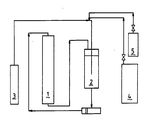
- the polymerization was carried out in an apparatus, the principle of which is shown in the figure.
- the dried extrusions were placed in a reaction tube (1) provided with a thermostatted cooling jacket and containing 5000 parts by volume and a ratio of diameter to length of approximately 1:10.
- the storage vessel (2) with a useful volume of 7000 parts by volume was charged with 5000 parts of the purified tetrahydrofuran, 43 parts of water and 20.3 parts of ethylene oxide. Tetrahydrofuran (4), water (5) and ethylene oxide (3) were removed from the storage containers provided for this purpose.
- This mixture of the starting compounds was added to the catalyst bed (1), the temperature of which was kept at 47 to 49 ° C.
- the reaction mixture was circulated at a pump output of 12,000 parts by volume / h, which was kept constant for the entire duration of the experiment, from the storage vessel (2) over the catalyst (1).
- the ethylene oxide concentration in the feed mixture had then dropped to 0% by weight.
- the total amount of ethylene oxide used and converted was 355.6 parts.
- reaction mixture 5350 parts of the reaction mixture were removed from the storage vessel (2) by emptying. This first reaction mixture was discarded. The storage vessel was then again charged with 5500 parts of fresh feed consisting of 98.7% tetrahydrofuran, 0.9% water and 0.4% ethylene oxide. This mixture was then circulated through the catalyst bed (1) at a pump output of 12,000 parts by volume per hour. At the same time, 35 parts of ethylene oxide were gassed into the storage vessel (2) every hour, which made it possible to keep the concentration of ethylene oxide in the storage vessel at 0.4%. After 9 hours, the ethylene oxide feed was stopped. The reaction mixture was still 4 hours with an hourly performance pumped in circles by 12,000 parts by volume per hour.
- reaction product in the storage vessel (2) was drained and the storage vessel was again charged with the mixture of tetrahydrofuran, water and ethylene oxide in the manner described above. Then the polymerization was carried out as described above for a further 4 hours for the post-reaction for 9 hours.
- the reaction mixture obtained in this way hardly differed from the discharges which were obtained in 100 further polymerization batches of this type.
- the crude copolymer solution thus obtained was colorless (color number ⁇ 5 APHA) and had an acid number of 0.2 mg KOH / g. It had a polyoxibutylene polyoxyalkylene glycol content (of molecular weight 1260) of about 45% by weight and a THF content of about 55% by weight. It contained 0.038% by weight of unreacted ethylene oxide. Since the ethylene oxide could not be exactly determined by the usual measurement analysis method, the concentration was determined by gas chromatography. The copolymerized ethylene oxide content of the copolymer was 15% by weight.
- the crude polyoxibutylene polyoxyalkylene glycol solution obtained in this way was hydrogenated for 10 hours at 80 ° C. and 150 bar of hydrogen in the presence of 3% by weight of Raney nickel in a stirred stirred autoclave. After the hydrogenation and separation of the catalyst by filtration, a crude polymer solution with the color number 5 APHA and the acid number 0.2 mg KOH / g was obtained. This acid number and color number also showed the copolymer freed of THF by vacuum distillation. The acid number was caused by a non-volatile substance.
- Casting elastomers were produced from the copolymer after-hydrogenated after this example in a known manner by reaction with diphenylmethane-pp'-diisocyanate (MDI) and the chain extender, with a molar ratio of copolymer to MDI to 1,4-butanediol of 1: 1.85: 0.77 was observed.
- MDI diphenylmethane-pp'-diisocyanate
- the cast elastomers obtained in this way gave the values "color DIN 1: 2: 1" in the color coding in the DIN color system.
- the crude solution of the copolymer obtained according to Example 1 was evaporated without hydrogenating aftertreatment at normal pressure and in vacuo to 1 mbar at 200 ° C. in a film evaporator.
- the distillate obtained was 98% THF. It contained approximately 2% by weight of low molecular weight copolymer with an average molecular weight of 250 (cryoscopic or vapor pressure osmometric determination) and a hydroxyl number of 220 mg KOH / g. Since a glycol with a molecular weight of 250 has a theoretical hydroxyl number of 448.8 mg KOH / g, it can be deduced that the distilled oligomers are composed in approximately equal parts of cyclic oligomeric ethers and glycols.
- the distilled tetrahydrofuran contained approximately 0.09% ethylene oxide, 0.06% 1,4-dioxane and 0.07% 2-methyldioxolane-1,3.
- about 1.8% by weight of low molecular weight copolymer with the average molecular weight 260 (cryoscopic or vapor pressure osmometric determination) and the hydroxyl number of 510 mg KOH / g was found in the distilled tetrahydrofuran from the crude discharge hydrogenated according to Example 1.
- the dioxane and dioxolane content was ⁇ 0.01%. Ethylene oxide was undetectable.
- Casting elastomers were produced from the copolymer obtained according to this example, as described in the last paragraph of Example 1, which had a deeper color and gave the values "colors DIN 1: 5: 1" in the color coding in the DIN color system.
- the crude THF-containing polyoxibutylene polyoxyalkylene glycol solution obtained according to Example 1 was subjected to the hydrogenation treatment in a continuous manner.
- 700 parts by volume of a catalyst were used, which consisted of 24% by weight nickel oxide, 8% by weight copper oxide and 68% by weight silicon dioxide in the non-activated form.
- the catalyst which was in the form of cylindrical tablets of 3 mm in height and 3 mm in diameter, was activated before use by conventional treatment with hydrogen at 200 ° C. and 50 bar of hydrogen pressure.
- the catalyst was in a shaft furnace, the length of which was 58: 1 in diameter.
- the crude solution of the copolymer was subjected to the hydrogenation treatment in a bottoms procedure at 150 ° C.
- the average residence time of the polymer solution on the catalyst was 4 hours.
- the copolymer freed of THF after the hydrogenation by vacuum distillation had the same properties as the product obtained according to Example 1, as long as the catalyst was not less than 4 hours in length.
- catalyst (a) which was prepared according to Example 21 of DE-OS 2 726 710 and had approximately the composition CuO ⁇ 1/2 Co2O3 ⁇ 2 SiO2 or if ( b) a catalyst was used which contained 0.5% by weight of palladium on 3 mm silica gel strands and the hydrogenating treatment was carried out at 110 ° C. and 100 bar hydrogen pressure.
- the crude THF-containing solution of the copolymer from Example 1 was treated with 5 parts by volume of air per kg of copolymer before the hydrogenation at 45 ° C.
- the air was gassed under the surface of the polymer solution with vigorous stirring.
- the solution pretreated in this way was subjected to the hydrogenation purification at 150 ° C. and 250 bar on the copper / nickel catalyst on silica gel as described in Example 3. Complete cleaning has now been achieved with an average residence time on the catalyst of only 1 hour.
Landscapes
- Chemical & Material Sciences (AREA)
- Health & Medical Sciences (AREA)
- Chemical Kinetics & Catalysis (AREA)
- Medicinal Chemistry (AREA)
- Polymers & Plastics (AREA)
- Organic Chemistry (AREA)
- Inorganic Chemistry (AREA)
- General Chemical & Material Sciences (AREA)
- Polyethers (AREA)
Applications Claiming Priority (2)
| Application Number | Priority Date | Filing Date | Title |
|---|---|---|---|
| DE3725577 | 1987-08-01 | ||
| DE3725577A DE3725577A1 (de) | 1987-08-01 | 1987-08-01 | Verfahren zur reinigung von polyoxybutylenpolyoxyalkylenglykolen |
Publications (2)
| Publication Number | Publication Date |
|---|---|
| EP0302332A2 true EP0302332A2 (fr) | 1989-02-08 |
| EP0302332A3 EP0302332A3 (fr) | 1991-03-13 |
Family
ID=6332885
Family Applications (1)
| Application Number | Title | Priority Date | Filing Date |
|---|---|---|---|
| EP19880111910 Withdrawn EP0302332A3 (fr) | 1987-08-01 | 1988-07-23 | Procédé pour la purification de glycols polyoxybutylénique-polyoxyalkyléniques |
Country Status (5)
| Country | Link |
|---|---|
| US (1) | US4952673A (fr) |
| EP (1) | EP0302332A3 (fr) |
| JP (1) | JPS6462323A (fr) |
| KR (1) | KR890003834A (fr) |
| DE (1) | DE3725577A1 (fr) |
Cited By (5)
| Publication number | Priority date | Publication date | Assignee | Title |
|---|---|---|---|---|
| EP0424791A3 (en) * | 1989-10-27 | 1991-10-16 | Basf Aktiengesellschaft | Process for the preparation of high purity tetrahydrofuron polymers |
| WO1994026803A1 (fr) * | 1993-05-14 | 1994-11-24 | Basf Aktiengesellschaft | Procede de preparation du polytetrahydrofurane |
| WO1995015991A1 (fr) * | 1993-12-09 | 1995-06-15 | Centre National De La Recherche Scientifique | Procede de preparation d'un terpolymere du type poly(oxyalkylene) par hydrogenation |
| WO1995019383A1 (fr) * | 1994-01-18 | 1995-07-20 | Eastman Chemical Company | Glycols et alcools de polyether derives de 3,4-epoxy-1-butene |
| WO2002014405A1 (fr) * | 2000-08-16 | 2002-02-21 | Basf Aktiengesellschaft | Procede ameliore pour produire du polytetrahydrofurane a faible indice de coloration |
Families Citing this family (6)
| Publication number | Priority date | Publication date | Assignee | Title |
|---|---|---|---|---|
| US5342541A (en) * | 1989-03-29 | 1994-08-30 | The Dow Chemical Company | Purified hydroxy-functional polyether compounds |
| DE19715831A1 (de) * | 1997-04-16 | 1998-10-22 | Basf Ag | Verfahren zur Entfärbung von Polymerisaten oder Copolymerisaten des Tetrahydrofurans |
| US20040211729A1 (en) * | 2003-04-25 | 2004-10-28 | Sunkara Hari Babu | Processes for recovering oligomers of glycols and polymerization catalysts from waste streams |
| US8372946B2 (en) * | 2009-04-15 | 2013-02-12 | Invista North America S.A R.L. | Copolyether glycol manufacturing process |
| KR20120017040A (ko) * | 2009-04-15 | 2012-02-27 | 인비스타 테크놀러지스 에스.에이.알.엘. | 코폴리에테르 글리콜 제조 방법 |
| JP4838380B1 (ja) * | 2010-10-11 | 2011-12-14 | 秀哉 横井 | 裾はみ出し防止具 |
Family Cites Families (14)
| Publication number | Priority date | Publication date | Assignee | Title |
|---|---|---|---|---|
| GB710842A (en) * | 1951-10-27 | 1954-06-16 | Basf Ag | Improvements in the production of pure polyglycol ethers or pure derivatives of mono-, di- and poly-glycol ethers |
| GB1019166A (en) * | 1962-03-20 | 1966-02-02 | Olin Mathieson | Purification of polyalkylene ethers |
| JPS5346905A (en) * | 1976-10-08 | 1978-04-27 | Kuraray Co Ltd | Preparation of etherified polyoxyalkylene compounds of high quality |
| JPS5346906A (en) * | 1976-10-08 | 1978-04-27 | Kuraray Co Ltd | Preparation of etherified polyoxyalylene compounds of high quality |
| US4127513A (en) * | 1977-11-09 | 1978-11-28 | E. I. Du Pont De Nemours And Company | Method for preparing polyether glycols |
| GB1566770A (en) * | 1977-12-28 | 1980-05-08 | Kuraray Co | Etherification of polyocyalkylene compounds |
| US4192943A (en) * | 1978-06-13 | 1980-03-11 | E. I. Du Pont De Nemours And Company | Method for reducing oligomeric cyclic ether content of a polymerizate |
| US4228272A (en) * | 1979-03-27 | 1980-10-14 | E. I. Du Pont De Nemours And Company | Method of catalytically preparing tetrahydrofuran/alkylene oxide polymerizates using a montmorillonite clay as the catalyst |
| US4251654A (en) * | 1979-08-14 | 1981-02-17 | E. I. Du Pont De Nemours And Company | Copolyether glycols of tetrahydrofuran and alkylene oxides having low oligomeric cyclic ether content |
| US4306058A (en) * | 1980-11-19 | 1981-12-15 | E. I. Du Pont De Nemours And Company | Method for reducing oligomeric cyclic ether content of a polymerizate |
| DE3112065A1 (de) * | 1981-03-27 | 1982-10-07 | Basf Ag, 6700 Ludwigshafen | Verfahren zur herstellung von polytetramethylenether-glykol oder -glykoldiester mit niedriger farbzahl |
| DE3346136A1 (de) * | 1983-12-21 | 1985-07-04 | Basf Ag, 6700 Ludwigshafen | Verfahren zur kontinuierlichen herstellung von polyoxibutylenpolyoxialkylenglykolen |
| US4500705A (en) * | 1984-01-09 | 1985-02-19 | E. I. Du Pont De Nemours And Company | Method for reducing oligomeric cyclic ether content of a polymerizate |
| US4585592A (en) * | 1985-02-28 | 1986-04-29 | Basf Aktiengesellschaft | Reducing the content of oligomeric cyclic ethers in polyoxybutylene polyoxyalkylene glycols |
-
1987
- 1987-08-01 DE DE3725577A patent/DE3725577A1/de not_active Withdrawn
-
1988
- 1988-07-23 EP EP19880111910 patent/EP0302332A3/fr not_active Withdrawn
- 1988-08-01 JP JP63190746A patent/JPS6462323A/ja active Pending
- 1988-08-01 KR KR1019880009850A patent/KR890003834A/ko not_active Withdrawn
- 1988-08-01 US US07/226,688 patent/US4952673A/en not_active Expired - Fee Related
Cited By (8)
| Publication number | Priority date | Publication date | Assignee | Title |
|---|---|---|---|---|
| EP0424791A3 (en) * | 1989-10-27 | 1991-10-16 | Basf Aktiengesellschaft | Process for the preparation of high purity tetrahydrofuron polymers |
| WO1994026803A1 (fr) * | 1993-05-14 | 1994-11-24 | Basf Aktiengesellschaft | Procede de preparation du polytetrahydrofurane |
| WO1995015991A1 (fr) * | 1993-12-09 | 1995-06-15 | Centre National De La Recherche Scientifique | Procede de preparation d'un terpolymere du type poly(oxyalkylene) par hydrogenation |
| FR2713646A1 (fr) * | 1993-12-09 | 1995-06-16 | Centre Nat Rech Scient | Procédé de préparation d'un terpolymère du type poly(oxyalkylène) par hydrogénation. |
| WO1995019383A1 (fr) * | 1994-01-18 | 1995-07-20 | Eastman Chemical Company | Glycols et alcools de polyether derives de 3,4-epoxy-1-butene |
| CN1056628C (zh) * | 1994-01-18 | 2000-09-20 | 伊斯特曼化学公司 | 从3,4-环氧-1-丁烯衍生的聚醚二元醇和醇 |
| WO2002014405A1 (fr) * | 2000-08-16 | 2002-02-21 | Basf Aktiengesellschaft | Procede ameliore pour produire du polytetrahydrofurane a faible indice de coloration |
| US6852869B2 (en) | 2000-08-16 | 2005-02-08 | Basf Aktiengesellschaft | Method for the production of polytetrahydrofuran with low color index |
Also Published As
| Publication number | Publication date |
|---|---|
| KR890003834A (ko) | 1989-04-18 |
| US4952673A (en) | 1990-08-28 |
| DE3725577A1 (de) | 1989-02-09 |
| EP0302332A3 (fr) | 1991-03-13 |
| JPS6462323A (en) | 1989-03-08 |
Similar Documents
| Publication | Publication Date | Title |
|---|---|---|
| EP0239787B1 (fr) | Procédé de préparation de glycols de poly(oxyde de butylène-oxyde d'alcoylène) ayant une distribution étroite du poids moléculaire et ayant une teneur réduite en éthers cycliques oligomères | |
| EP0061668B1 (fr) | Procédé de préparation d'un polytétraméthylène éther glycol ou diester glycol à plus faible indice de couleur | |
| EP0149143B1 (fr) | Procédé pour la préparation en continu de polyoxyde de butylène-polyoxyde d'alcoylène glycols | |
| DE3725577A1 (de) | Verfahren zur reinigung von polyoxybutylenpolyoxyalkylenglykolen | |
| EP0807139B1 (fr) | Procede pour produire des polymeres de tetrahydrofurane | |
| EP1015509B1 (fr) | Procede ameliore de preparation de polytetrahydrofurane | |
| EP0759452A2 (fr) | Polyétherpolyols purifiés, leur préparation et utilisation | |
| EP0698050B1 (fr) | Procede de preparation du polytetrahydrofurane | |
| US6197979B1 (en) | Method for producing polytetrahydrofuran with low color index | |
| DE10237954A1 (de) | Verfahren zur Herstellung von Tetrahydrofuran | |
| DE3613106A1 (de) | Verfahren zur herstellung von polytetramethylenetherglykoldiestern mit niedriger farbzahl | |
| EP0202487B1 (fr) | Procédé de diminution de la quantité d'éthers cycliques oligomères dans le poly(tétraméthylène éther)glycol ou dans les polyoxybutylène-polyoxyalkylène glycols | |
| EP0424791B1 (fr) | Procédé de préparation de polymère du tétrahydrofuronne de haute pureté | |
| DE69505270T2 (de) | Polyätherglycole und alkohole aus 3,4-epoxy-1-burne, tetrahydrofuran und ein initiator | |
| EP0104609B1 (fr) | Procédé pour la préparation de diesters d'acides carboxyliques de polyoxyde de butylène-polyoxyde d'alcoylène glycols | |
| EP0158060B1 (fr) | Procédé pour diminuer la teneur en éthers cycliques oligomères polyoxyde de butylène-polyoxyde d'alcoylène glycols | |
| DE19881631B4 (de) | Verfahren zur Reinigung von Tetrahydrofuranen, die als Ausgangsmaterial für Polyetherpolyole verwendet werden | |
| EP0636638A1 (fr) | Procédé pour la production de poly(tétrahydrofurane) ou copolymères de tétrahydrofurane et d'oxydes de alkylène | |
| EP0153680A2 (fr) | Procédé pour la préparation de tétrahydrofuranne | |
| EP1123340B1 (fr) | Procede de production de polymeres de tetrahydrofurane | |
| EP0226759B1 (fr) | Procédé de dépolymérisation de glycols de polyoxyde de butylène-polyoxyde d'alcoylène et d'éthers de polyoxybutylène-polyoxyalcoylène | |
| DE19514826A1 (de) | Verfahren zur Herstellung von Tetrahydrofuranpolymeren | |
| DE19502970A1 (de) | Verfahren zur Herstellung von Polyoxibutylenpolyoxialkylenglykolen | |
| DE10259136A1 (de) | Verfahren zur Herstellung von Tetrahydrofuran-Copolymeren | |
| DE10359810A1 (de) | Verfahren zur Herstellung von Mono- und Diestern des Polytetrahydrofurans oder der Tetrahydrofuran-Copolymere |
Legal Events
| Date | Code | Title | Description |
|---|---|---|---|
| PUAI | Public reference made under article 153(3) epc to a published international application that has entered the european phase |
Free format text: ORIGINAL CODE: 0009012 |
|
| AK | Designated contracting states |
Kind code of ref document: A2 Designated state(s): BE DE ES FR GB IT NL |
|
| PUAL | Search report despatched |
Free format text: ORIGINAL CODE: 0009013 |
|
| 17P | Request for examination filed |
Effective date: 19901227 |
|
| AK | Designated contracting states |
Kind code of ref document: A3 Designated state(s): BE DE ES FR GB IT NL |
|
| 17Q | First examination report despatched |
Effective date: 19930304 |
|
| STAA | Information on the status of an ep patent application or granted ep patent |
Free format text: STATUS: THE APPLICATION HAS BEEN WITHDRAWN |
|
| 18W | Application withdrawn |
Withdrawal date: 19940301 |