EP0302527A2 - Formkörper aus Polyurethankunststoff mit Stabilisierungsmitteln, sowie Verfahren und Mittel zu seiner Herstellung - Google Patents
Formkörper aus Polyurethankunststoff mit Stabilisierungsmitteln, sowie Verfahren und Mittel zu seiner Herstellung Download PDFInfo
- Publication number
- EP0302527A2 EP0302527A2 EP88112863A EP88112863A EP0302527A2 EP 0302527 A2 EP0302527 A2 EP 0302527A2 EP 88112863 A EP88112863 A EP 88112863A EP 88112863 A EP88112863 A EP 88112863A EP 0302527 A2 EP0302527 A2 EP 0302527A2
- Authority
- EP
- European Patent Office
- Prior art keywords
- shaped body
- weight
- parts
- mold
- stabilizing agents
- Prior art date
- Legal status (The legal status is an assumption and is not a legal conclusion. Google has not performed a legal analysis and makes no representation as to the accuracy of the status listed.)
- Withdrawn
Links
- 239000003381 stabilizer Substances 0.000 title claims abstract description 42
- 239000004814 polyurethane Substances 0.000 title claims abstract description 23
- 229920002635 polyurethane Polymers 0.000 title claims abstract description 21
- 238000002360 preparation method Methods 0.000 title description 2
- 229920003023 plastic Polymers 0.000 claims abstract description 9
- 239000004033 plastic Substances 0.000 claims abstract description 9
- 239000000839 emulsion Substances 0.000 claims abstract description 6
- 239000002904 solvent Substances 0.000 claims abstract description 6
- XLYOFNOQVPJJNP-UHFFFAOYSA-N water Substances O XLYOFNOQVPJJNP-UHFFFAOYSA-N 0.000 claims abstract description 5
- NBVXSUQYWXRMNV-UHFFFAOYSA-N fluoromethane Chemical compound FC NBVXSUQYWXRMNV-UHFFFAOYSA-N 0.000 claims abstract 3
- 239000003995 emulsifying agent Substances 0.000 claims abstract 2
- 239000000203 mixture Substances 0.000 claims description 8
- 239000006260 foam Substances 0.000 claims description 7
- 238000004519 manufacturing process Methods 0.000 claims description 5
- 238000000034 method Methods 0.000 claims description 5
- 239000003795 chemical substances by application Substances 0.000 claims description 4
- PNKUSGQVOMIXLU-UHFFFAOYSA-N Formamidine Chemical group NC=N PNKUSGQVOMIXLU-UHFFFAOYSA-N 0.000 claims description 2
- -1 p-ethoxycarbonylphenyl Chemical group 0.000 claims description 2
- 239000002344 surface layer Substances 0.000 claims 4
- 230000005855 radiation Effects 0.000 claims 3
- 230000001680 brushing effect Effects 0.000 claims 1
- 230000003247 decreasing effect Effects 0.000 claims 1
- 238000005507 spraying Methods 0.000 claims 1
- 230000006641 stabilisation Effects 0.000 abstract description 6
- 238000011105 stabilization Methods 0.000 abstract description 6
- 238000004383 yellowing Methods 0.000 description 12
- 229920005862 polyol Polymers 0.000 description 9
- 238000000465 moulding Methods 0.000 description 7
- 150000003077 polyols Chemical class 0.000 description 7
- YMWUJEATGCHHMB-UHFFFAOYSA-N Dichloromethane Chemical compound ClCCl YMWUJEATGCHHMB-UHFFFAOYSA-N 0.000 description 6
- 239000004721 Polyphenylene oxide Substances 0.000 description 6
- 229920000570 polyether Polymers 0.000 description 6
- CSCPPACGZOOCGX-UHFFFAOYSA-N Acetone Chemical compound CC(C)=O CSCPPACGZOOCGX-UHFFFAOYSA-N 0.000 description 5
- 229920000728 polyester Polymers 0.000 description 5
- 239000000243 solution Substances 0.000 description 5
- UPMLOUAZCHDJJD-UHFFFAOYSA-N 4,4'-Diphenylmethane Diisocyanate Chemical compound C1=CC(N=C=O)=CC=C1CC1=CC=C(N=C=O)C=C1 UPMLOUAZCHDJJD-UHFFFAOYSA-N 0.000 description 4
- 229920005830 Polyurethane Foam Polymers 0.000 description 4
- 239000003963 antioxidant agent Substances 0.000 description 4
- 239000012948 isocyanate Substances 0.000 description 4
- 239000004970 Chain extender Substances 0.000 description 3
- LFQSCWFLJHTTHZ-UHFFFAOYSA-N Ethanol Chemical compound CCO LFQSCWFLJHTTHZ-UHFFFAOYSA-N 0.000 description 3
- OKKJLVBELUTLKV-UHFFFAOYSA-N Methanol Chemical compound OC OKKJLVBELUTLKV-UHFFFAOYSA-N 0.000 description 3
- 239000006096 absorbing agent Substances 0.000 description 3
- 238000011161 development Methods 0.000 description 3
- 230000018109 developmental process Effects 0.000 description 3
- 150000002513 isocyanates Chemical class 0.000 description 3
- 239000007787 solid Substances 0.000 description 3
- XLLIQLLCWZCATF-UHFFFAOYSA-N 2-methoxyethyl acetate Chemical compound COCCOC(C)=O XLLIQLLCWZCATF-UHFFFAOYSA-N 0.000 description 2
- 239000004604 Blowing Agent Substances 0.000 description 2
- RTZKZFJDLAIYFH-UHFFFAOYSA-N Diethyl ether Chemical compound CCOCC RTZKZFJDLAIYFH-UHFFFAOYSA-N 0.000 description 2
- XEEYBQQBJWHFJM-UHFFFAOYSA-N Iron Chemical compound [Fe] XEEYBQQBJWHFJM-UHFFFAOYSA-N 0.000 description 2
- KFZMGEQAYNKOFK-UHFFFAOYSA-N Isopropanol Chemical compound CC(C)O KFZMGEQAYNKOFK-UHFFFAOYSA-N 0.000 description 2
- GLUUGHFHXGJENI-UHFFFAOYSA-N Piperazine Chemical compound C1CNCCN1 GLUUGHFHXGJENI-UHFFFAOYSA-N 0.000 description 2
- 101150081727 UL32 gene Proteins 0.000 description 2
- 238000005299 abrasion Methods 0.000 description 2
- 230000032683 aging Effects 0.000 description 2
- 230000003078 antioxidant effect Effects 0.000 description 2
- WERYXYBDKMZEQL-UHFFFAOYSA-N butane-1,4-diol Chemical compound OCCCCO WERYXYBDKMZEQL-UHFFFAOYSA-N 0.000 description 2
- 230000015556 catabolic process Effects 0.000 description 2
- 239000003054 catalyst Substances 0.000 description 2
- 238000006731 degradation reaction Methods 0.000 description 2
- FLKPEMZONWLCSK-UHFFFAOYSA-N diethyl phthalate Chemical compound CCOC(=O)C1=CC=CC=C1C(=O)OCC FLKPEMZONWLCSK-UHFFFAOYSA-N 0.000 description 2
- 150000002009 diols Chemical class 0.000 description 2
- MCPKSFINULVDNX-UHFFFAOYSA-N drometrizole Chemical compound CC1=CC=C(O)C(N2N=C3C=CC=CC3=N2)=C1 MCPKSFINULVDNX-UHFFFAOYSA-N 0.000 description 2
- 238000007654 immersion Methods 0.000 description 2
- 229920005906 polyester polyol Polymers 0.000 description 2
- 239000011496 polyurethane foam Substances 0.000 description 2
- 239000000047 product Substances 0.000 description 2
- 239000002994 raw material Substances 0.000 description 2
- 239000000126 substance Substances 0.000 description 2
- QSRJVOOOWGXUDY-UHFFFAOYSA-N 2-[2-[2-[3-(3-tert-butyl-4-hydroxy-5-methylphenyl)propanoyloxy]ethoxy]ethoxy]ethyl 3-(3-tert-butyl-4-hydroxy-5-methylphenyl)propanoate Chemical compound CC(C)(C)C1=C(O)C(C)=CC(CCC(=O)OCCOCCOCCOC(=O)CCC=2C=C(C(O)=C(C)C=2)C(C)(C)C)=C1 QSRJVOOOWGXUDY-UHFFFAOYSA-N 0.000 description 1
- SVONRAPFKPVNKG-UHFFFAOYSA-N 2-ethoxyethyl acetate Chemical compound CCOCCOC(C)=O SVONRAPFKPVNKG-UHFFFAOYSA-N 0.000 description 1
- OYPRJOBELJOOCE-UHFFFAOYSA-N Calcium Chemical compound [Ca] OYPRJOBELJOOCE-UHFFFAOYSA-N 0.000 description 1
- VOPWNXZWBYDODV-UHFFFAOYSA-N Chlorodifluoromethane Chemical compound FC(F)Cl VOPWNXZWBYDODV-UHFFFAOYSA-N 0.000 description 1
- 239000004971 Cross linker Substances 0.000 description 1
- 239000012963 UV stabilizer Substances 0.000 description 1
- HCHKCACWOHOZIP-UHFFFAOYSA-N Zinc Chemical compound [Zn] HCHKCACWOHOZIP-UHFFFAOYSA-N 0.000 description 1
- 238000010521 absorption reaction Methods 0.000 description 1
- 230000002411 adverse Effects 0.000 description 1
- 125000001931 aliphatic group Chemical group 0.000 description 1
- 150000001412 amines Chemical class 0.000 description 1
- 150000004945 aromatic hydrocarbons Chemical class 0.000 description 1
- 125000003118 aryl group Chemical group 0.000 description 1
- RWCCWEUUXYIKHB-UHFFFAOYSA-N benzophenone Chemical compound C=1C=CC=CC=1C(=O)C1=CC=CC=C1 RWCCWEUUXYIKHB-UHFFFAOYSA-N 0.000 description 1
- 239000012965 benzophenone Substances 0.000 description 1
- QRUDEWIWKLJBPS-UHFFFAOYSA-N benzotriazole Chemical compound C1=CC=C2N[N][N]C2=C1 QRUDEWIWKLJBPS-UHFFFAOYSA-N 0.000 description 1
- 239000012964 benzotriazole Substances 0.000 description 1
- 229910052793 cadmium Inorganic materials 0.000 description 1
- BDOSMKKIYDKNTQ-UHFFFAOYSA-N cadmium atom Chemical compound [Cd] BDOSMKKIYDKNTQ-UHFFFAOYSA-N 0.000 description 1
- 229910052791 calcium Inorganic materials 0.000 description 1
- 239000011575 calcium Substances 0.000 description 1
- 238000005266 casting Methods 0.000 description 1
- 239000007795 chemical reaction product Substances 0.000 description 1
- 239000003426 co-catalyst Substances 0.000 description 1
- 229910017052 cobalt Inorganic materials 0.000 description 1
- 239000010941 cobalt Substances 0.000 description 1
- GUTLYIVDDKVIGB-UHFFFAOYSA-N cobalt atom Chemical compound [Co] GUTLYIVDDKVIGB-UHFFFAOYSA-N 0.000 description 1
- 230000000052 comparative effect Effects 0.000 description 1
- 230000007423 decrease Effects 0.000 description 1
- 125000005442 diisocyanate group Chemical group 0.000 description 1
- 230000009189 diving Effects 0.000 description 1
- 230000000694 effects Effects 0.000 description 1
- 230000007613 environmental effect Effects 0.000 description 1
- LTGPEBRDBMFYBR-UHFFFAOYSA-N ethyl 4-[(n-ethylanilino)methylideneamino]benzoate Chemical compound C1=CC(C(=O)OCC)=CC=C1N=CN(CC)C1=CC=CC=C1 LTGPEBRDBMFYBR-UHFFFAOYSA-N 0.000 description 1
- 238000011156 evaluation Methods 0.000 description 1
- 238000009472 formulation Methods 0.000 description 1
- 239000012760 heat stabilizer Substances 0.000 description 1
- 150000002460 imidazoles Chemical class 0.000 description 1
- 238000002347 injection Methods 0.000 description 1
- 239000007924 injection Substances 0.000 description 1
- 229910052742 iron Inorganic materials 0.000 description 1
- 239000011133 lead Substances 0.000 description 1
- 239000004611 light stabiliser Substances 0.000 description 1
- 230000007774 longterm Effects 0.000 description 1
- 239000000463 material Substances 0.000 description 1
- 238000005259 measurement Methods 0.000 description 1
- 239000003208 petroleum Substances 0.000 description 1
- 229920001296 polysiloxane Polymers 0.000 description 1
- 229920006295 polythiol Polymers 0.000 description 1
- 239000011148 porous material Substances 0.000 description 1
- 239000010453 quartz Substances 0.000 description 1
- 150000003839 salts Chemical class 0.000 description 1
- VYPSYNLAJGMNEJ-UHFFFAOYSA-N silicon dioxide Inorganic materials O=[Si]=O VYPSYNLAJGMNEJ-UHFFFAOYSA-N 0.000 description 1
- 230000000087 stabilizing effect Effects 0.000 description 1
- 238000003860 storage Methods 0.000 description 1
- 238000004381 surface treatment Methods 0.000 description 1
- 150000003512 tertiary amines Chemical class 0.000 description 1
- 238000012360 testing method Methods 0.000 description 1
- 150000003585 thioureas Chemical class 0.000 description 1
- 150000003606 tin compounds Chemical class 0.000 description 1
- 230000000699 topical effect Effects 0.000 description 1
- CYRMSUTZVYGINF-UHFFFAOYSA-N trichlorofluoromethane Chemical compound FC(Cl)(Cl)Cl CYRMSUTZVYGINF-UHFFFAOYSA-N 0.000 description 1
- 229940029284 trichlorofluoromethane Drugs 0.000 description 1
- ZIBGPFATKBEMQZ-UHFFFAOYSA-N triethylene glycol Chemical compound OCCOCCOCCO ZIBGPFATKBEMQZ-UHFFFAOYSA-N 0.000 description 1
- 239000011701 zinc Substances 0.000 description 1
- 229910052725 zinc Inorganic materials 0.000 description 1
Classifications
-
- C—CHEMISTRY; METALLURGY
- C08—ORGANIC MACROMOLECULAR COMPOUNDS; THEIR PREPARATION OR CHEMICAL WORKING-UP; COMPOSITIONS BASED THEREON
- C08J—WORKING-UP; GENERAL PROCESSES OF COMPOUNDING; AFTER-TREATMENT NOT COVERED BY SUBCLASSES C08B, C08C, C08F, C08G or C08H
- C08J7/00—Chemical treatment or coating of shaped articles made of macromolecular substances
- C08J7/04—Coating
- C08J7/06—Coating with compositions not containing macromolecular substances
- C08J7/065—Low-molecular-weight organic substances, e.g. absorption of additives in the surface of the article
-
- C—CHEMISTRY; METALLURGY
- C08—ORGANIC MACROMOLECULAR COMPOUNDS; THEIR PREPARATION OR CHEMICAL WORKING-UP; COMPOSITIONS BASED THEREON
- C08J—WORKING-UP; GENERAL PROCESSES OF COMPOUNDING; AFTER-TREATMENT NOT COVERED BY SUBCLASSES C08B, C08C, C08F, C08G or C08H
- C08J2375/00—Characterised by the use of polyureas or polyurethanes; Derivatives of such polymers
- C08J2375/04—Polyurethanes
Definitions
- the invention relates to the stabilization of moldings made of polyurethane plastic against UV rays, light and / or heat.
- the weathering resistance of the polyurethanes strongly depends on the composition of the raw materials used for their manufacture and thus also on their structure (linear or cross-linked).
- polyurethane raw materials are to be understood as (polyester or polyether) polyurethane-polyol components and polyurethane-isocyanate components (isocyanate prepolymers).
- the end product integrated polyurethane foam is produced by the shoe manufacturers using the injection or casting process.
- the polyol component is made from a mixture of polyester or polyether polyols, chain extenders (diols), catalysts, stabilizers, blowing agents (water), color pastes, etc.
- the recipes differ depending on the desired density, hardness or other properties.
- single-color soles or the comfort part with two-color soles can be colored white. In these cases and also with lightly colored soles, the requirement is that the materials have good lightfastness.
- the polyurethane isocyanate component is a diisocyanate prepolymer, for the production of which MDI (diphenylmethane diisocyanate) and polyester or polyether polyols are used.
- MDI diphenylmethane diisocyanate
- polyester or polyether polyols are used.
- the aromatic diisocyanate has a strong influence on the light resistance of the polyurethanes.
- the white and light-colored polyol components are stabilized against the effects of air, light and heat by adding UV absorbers and antioxidants to the mixture.
- the stabilizers are then contained in the foam.
- the stabilizers used for this are, for example, for UV absorption Tinuvin (R) and / or as an antioxidant Irganox (R) (registered trademarks of Ciba-Geigy, Basel), such as Tinuvin P, chemical formula: 2- (2'-Hydroxy-5'-methylphenyl) benzotriazole Tinuvin 765 from the class of sterically hindered amines Irganox 245, chemical formula: Triethylene glycol bis-3- (3'-tert-butyl-4-hydroxy-5-methylphenyl) propionate
- a mixture of three stabilizers in different concentrations is added in the preparation of the polyol component.
- the following polyether-polyol component is produced and then reacted in a ratio of 101 to 100 with an MDI prepolymer to form a PU foam body: 1,4-butanediol 11.80 Propylan DP2770 84.14 (a polyether polyol from Lankro, Manchester) Triethanoliamine 0.31 Co-catalysts 0.10 (Polycat 41, Fomrez UL32) Diethylenediamine 1.00 Dest. Water 0.40 Color paste white 1.50 Stabilizers 0.75 (Tinuvine, Irganox) 100.00 parts Polycat 41 is a tertiary amine from Air Products, USA. Fomrez UL32 is a tin compound from Witco, USA.
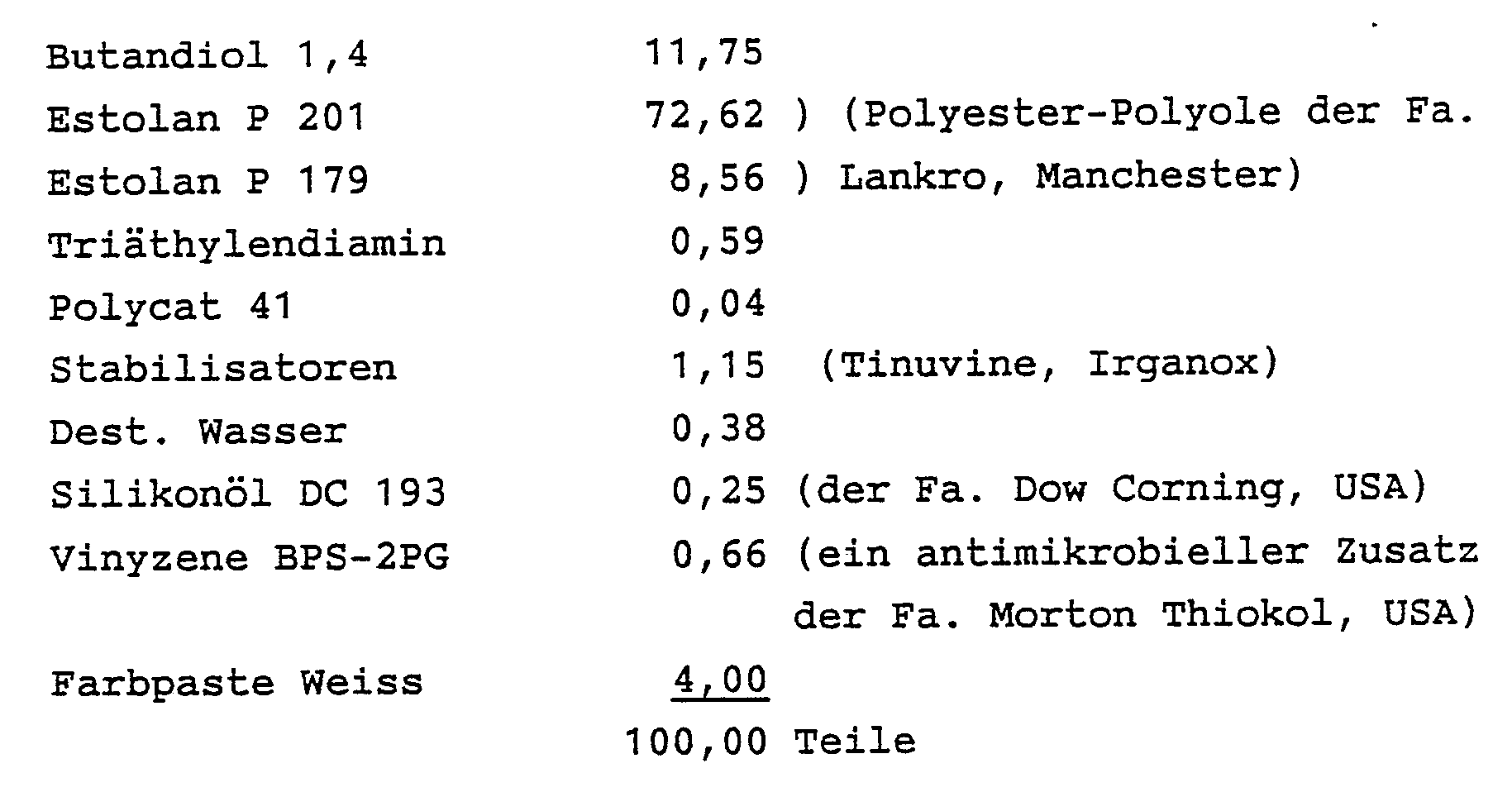
- a polyester-polyol component is produced analogously to Example 1 and reacted with an MDI prepolymer in a ratio of 115 to 100:
- the object of the invention is therefore to create a polyurethane-plastic molded body, possibly also polyurethane foam, which does not suffer any loss in quality due to the stabilizing agents used and has better heat, light and UV stabilization.
- These tasks are solved satisfactorily for the first time by the feature of claim 1.
- the core of the shaped body can also have a stabilizer content, albeit in comparison to the usual, if appropriate, greatly reduced content.
- a stabilizing agent content of significantly less than 0.01 g / cm3 surface very soon leads to the same or worse stabilization values as the conventional addition to the mass.
- a content of more than 0.2 g / cm3 no longer brings any noticeable improvement in the stabilizing effect; with a significant increase, the mechanical properties of the surface deteriorate.
- Easily soluble stabilizing agents are preferred for moldings according to the invention, such as e.g. a new class of stabilizers that has also been developed for the polyurethane industry, namely the formamidines, e.g. Givsorb UV-2. (R) (registered trademark of Givaudan, Geneva); this is both a UV absorber, an antioxidant and a heat stabilizer. His product description (group No. 42.19), as well as the content of US patent 4,021,471 are hereby considered to be disclosed within the scope of this description.
- this stabilizer gives better lightfastness compared to the usual stabilizers.
- a disadvantage of this stabilizer is that it reacts slowly with the chain extender (diol) and can thus negatively affect the shelf life of the finished systems.
- the treatment of the mold surface before the introduction of the polyurethane plastic and / or (in particular!) is preferably carried out with an - in particular aqueous - emulsion.
- an - in particular aqueous - emulsion not only can the proportions of solvent (which, however, is still required as a "carrier” for the stabilizing agent, albeit sometimes in smaller amounts) be kept lower. This not only increases the cost-effectiveness, but also - for which the reason has not yet been able to be clarified theoretically - the effectiveness.
- Suitable solvents include diethyl phthalate, 2-ethoxyethyl acetate, 2-methoxyethyl acetate, petroleum ether, but preferably fluorocarbons, especially trichlorofluoromethane, which gives the best results.
- the stabilizing agent according to the invention is best constructed according to the features described in claim 10.
- the diving time at low density (e.g. 0.4) has no major influence on the light stability of the treated samples; at most, the stabilizing agents penetrate deeper and may result in a particularly long-term stabilization.
- the stabilizers mentioned in Examples 1 and 2 cannot be dissolved in all solvents. However, the three stabilizers in a ratio of 2 to 2 to 1 are soluble in acetone and methylene chloride.
- Comparative tests were also carried out by exposing samples to natural light for 3 weeks or by storing them in an oven at 70 ° C for several days. The positive influence on the surface treatment was clear in all cases.
- the skin of the integral foams is 0.50-0.60 mm and depends on the mold temperature.
- the stabilizer penetrates the surface and cannot be washed off. Even after several days of water storage, surface-treated moldings have good lightfastness.
- the light stability of the foam deteriorates only when the skin is removed. This is because open-pore foam is then irradiated without stabilizing agents.
- the mechanical properties of the polyurethane moldings treated according to Example 3 such as fatigue behavior, tensile strength and tensile strength, and elongation and abrasion are also not adversely affected compared to those of the moldings produced according to Examples 1 and 2; the abrasion is even slightly improved.
Landscapes
- Chemical & Material Sciences (AREA)
- Health & Medical Sciences (AREA)
- Chemical Kinetics & Catalysis (AREA)
- Medicinal Chemistry (AREA)
- Polymers & Plastics (AREA)
- Organic Chemistry (AREA)
- Moulds For Moulding Plastics Or The Like (AREA)
- Compositions Of Macromolecular Compounds (AREA)
- Polyurethanes Or Polyureas (AREA)
Abstract
Description
- Die Erfindung bezieht sich auf die Stabilisierung von Formkörpern aus Polyurethankunststoff gegenüber UV-Strahlen,Licht und/oder Wärme.
- Mit der Entwicklung der Kunststoffe ergab sich die Notwendigkeit, nach Mitteln und Wegen zu suchen, um die durch die Umgebungsparameter Luft, Licht und Wärme bedingten Schädigungen zu vermeiden oder zumindest zu verzögern. Dies lässt sich durch Zusatz von Antioxydantien, sowie von UV- und Lichtschutzmitteln erreichen, die dem jeweiligen Kunststoff angepasst sein müssen.
- Es ist bekannt, dass aliphatische Polyurethane die beste und aromatische Polyurethane bezüglich der Vergilbung die geringste Lichtbeständigkeit aufweisen.
- Die Bewitterungsbeständigkeit der Polyurethane ist stark abhängig von der Zusammensetzung der zu ihrer Herstellung verwendeten Rohstoffe und damit auch von ihrem Strukturaufbau (linear oder vernetzt).
- Die Beständigkeit gegen fotochemischen Abbau der Polyurethane auf Basis von aromatischen Diisocyanaten nimmt in folgender Reihe ab:
Polyesterpolyurethane--->Polyätherpolyurethane--->
--->Polythioätherpolyurethane
Die Alterung der Polyurethane an der Atmosphäre ist ein sehr komplizierter Prozess, dessen Mechanismus noch nicht vollständig bekannt ist. - Die Vergilbungsneigung von Polyurethanen bei Bewitterung lässt sich durch UV-Absorber vom Benzophenon- oder Benzotriazoltyp wirksam unterdrücken. Zum Stabilisieren werden auch Zink-, Calcium-, Blei-, Kobalt-, Cadmium-, Eisen-III-Salze, Thioharnstoffderivate,Imidazole,Naphthylimide etc.empfohlen. Alle PUR-Typen auf Basis von aromatischen Diisocyanaten sind anfällig gegen Abbau durch Bewitterung.
- Unter Polyuretanrohstoffen sind im folgenden (Polyester- oder Polyäther-) Polyurethan-Polyol-Komponenten und Polyurethan-Isocyanat-Komponenten (Isocyanat-Prepolymere) zu verstehen. Das Endprodukt (Polyurethan-Integralschaumstoff) entsteht bei den Schuhherstellern im Spritz- oder Giessverfahren.
- Die Polyol-Komponente entsteht aus einer Mischung aus Polyester- oder Polyätherpolyolen, Kettenverlängerern (Diolen), Katalysatoren, Stabilisatoren, Treibmitteln (Wasser), Farbpasten, etc.
- Die Rezepturen unterscheiden sich je nach gewünschter Dichte, Härte, bzw. anderen Eigenschaften.
- Beispiele für die Verwendung der Schaumstoffe in der Schuhindustrie:
- einfarbige Sohlen Dichte 0,60 g/cm3
zweifarbige Sohlen
(Sohlen mit unterschiedlichen Dichten)
- Laufsohle Dichte 0,80-1,0 g/cm3
- Komfortteil Dichte 0,40-0,45 g/cm3
- einfarbige Sohlen Dichte 0,55-0,60 g/cm3
- einfarbige Sohlen Dichte 0,65-0,70 g/cm3
zweifarbige Sohlen
- Laufsohle Dichte 0,99-1,0 g/cm3
- Komfortteil Dichte 0,45-0,50 g/cm3 - Je nach Schuhmodell können einfarbige Sohlen oder das Komfortteil bei zweifarbigen Sohlen weiss eingefärbt sein. In diesen Fällen und auch bei hell eingefärbten Sohlen wird die Anforderung gestellt, dass die Materialien eine gute Lichtbeständigkeit aufweisen.
- Die Polyurethan-Isocyanat-Komponente ist ein Diisocyanat-Prepolymer, für dessen Herstellung MDI (Diphenylmethandiisocyanat) und Polyester- oder Polyätherpolyole verwendet werden. Das aromatische Diisocyanat hat eine starken Einfluss auf die Lichtbeständigkeit der Polyurethane.
- Insbesondere die weissen und hell eingefärbten Polyol-Komponenten werden gegen Luft-, Licht- und Wärmeeinwirkung stabilisiert, indem man der Mischung UV-Absorber und Antioxidantien zufügt.Die Stabilisatoren sind dann im Schaum enthalten.
- Die dafür verwendeten Stabilisatoren sind z.B. für die UV-Absorption Tinuvin (R) und/oder als Antioxydans Irganox (R) (eingetragene Marken der Ciba-Geigy, Basel), wie etwa Tinuvin P, chemische Formel:
2-(2′-Hydroxi-5′-methylphenyl)-benzotriazol
Tinuvin 765 aus der Klasse der sterisch gehinderten Amine Irganox 245, chemische Formel:
Triäthylenglykol-bis-3-(3′-tert.butyl-4-hydroxi-5-methylphenyl)propionat - Eine Mischung von drei Stabilisatoren in verschiedenen Konzentrationen wird bei der Herstellung der Polyol-Komponente zugegeben.
- Für die Herstellung einer weissen PU-Schaumsohle wird folgende Polyäther-Polyol-Komponente hergestellt und anschliessend im Verhältnis 101 zu 100 mit einem MDI-Prepolymer zu einem PU-Schaumkörper reagiert:
Butandiol-1,4 11,80 Propylan DP2770 84,14 (ein Polyäther-Polyol der Fa. Lankro, Manchester) Triäthanoldiamin 0,31 Ko-Katalysatoren 0.10 (Polycat 41, Fomrez UL32) Diäthylendiamin 1,00 Dest. Wasser 0,40 Farbpaste Weiss 1,50 Stabilisatoren 0,75 (Tinuvine, Irganox) 100,00 Teile Polycat 41 ist ein tertiäres Amin der Firma Air Products, USA. Fomrez UL32 ist eine Zinn-Verbindung der Firma Witco, USA. - Analog wie nach Beispiel 1 wird eine Polyester-Polyol-Komponente hergestellt und im Verhältnis 115 zu 100 mit einem MDI-Prepolymer reagiert:
- Darüber hinaus lässt auch mit den besten derzeit am Markt befindlichen Stabilisatoren der Schutz vor Vergilbung und Alterung, insbesondere bei weissen Mischungen, noch sehr zu wünschen übrig. Die Verbesserung der Bewitterungsbeständigkeit ist eine immer aktuelle Anforderung.
- Die Erfindung hat sich daher die Aufgabe gestellt, einen Polyurethan-Kunststoff-Formkörper, gegebenenfalls auch Polyurethanschaumstoff zu schaffen, der durch die verwendeten Stabilisierungsmittel keine Einbusse an Qualität erleidet und eine bessere Wärme-, Licht- und UV-Stabilisierung aufweist. Diese Aufgaben werden durch das Merkmal des Anspruches 1 erstmals zufriedenstellend gelöst. In besonderen Fällen kann (wie dort erwähnt) auch der Kern des Formkörpers einen - wenn auch gegenüber dem üblichen gegebenenfalls stark reduzierten - Gehalt an Stabilisierungsmittel aufweisen.
- Vorteilhafte Weiterbildungen der Erfindung sind in den Kennzeichen der Ansprüche 2 bis 6 beschrieben.
- Ein Gehalt an Stabilisierungsmittel von wesentlich unter 0,01 g/cm3 Oberfläche führt sehr bald zu gleichen oder schlechteren Stabilisierungswerten wie der herkömmliche Zusatz zur Masse. Ein Gehalt von über 0,2 g/cm3 bringt keine merkliche Verbesserung der Stabilisierungswirkung mehr; bei wesentlicher Steigerung verschlechtern sich die mechanischen Eigenschaften der Oberfläche.
- Für erfindungsgemässe Formkörper werden insbesondere gut lösliche Stabilisierungsmittel bevorzugt, wie z.B. eine neue Klasse von Stabilisatoren, die unter anderem auch für die Polyurethanindustrie entwickelt wurde, nämlich die Formamidine , z.B. Givsorb UV-2. (R) (eingetragene Marke der Givaudan, Genf); dieses ist sowohl ein UV-Absorber, ein Antioxidans, als auch ein Wärmestabilisator. Seine Produktbeschreibung (Gruppen Nr. 42.19), sowie der Inhalt des US Patentes 4.021.471 gelten hiemit als im Rahmen dieser Beschreibung geoffenbart.
- Auch im Schaum eingebaut verleiht dieser Stabilisator eine bessere Lichtbeständigkeit im Vergleich zu den üblichen Stabilisatoren. Ein Nachteil dieses Stabilisators ist, dass er mit dem Kettenverlängerer (Diol) langsam reagiert und somit die Lagerbeständigkeit der fertigen Systeme negativ beeinflussen kann.
- Man müsste daher auf 3-Komponenten-Systeme (Polyol-Komponente bestehend aus Polyesterpolyol und Stabilisator; Vernetzer-Komponente bestehend aus Katalysatoren, Kettenverlängerern und Treibmitteln; Isocyanat-Komponente ev. als Prepolymer) übergehen. Das aber wiederum ist teuer und aufwendig, und wird von Anwendern nicht gerne gesehen.
- In einer Weiterführung der Erfindung wird daher zur Herstellung der erfindungsgemässen Formkörper ein Verfahren vorgeschlagen, wie es in den Merkmalen der Ansprüche 7 bis 9 beschrieben ist.
- Es wurde nämlich erfindungsgemäss festgestellt, dass die Behandlung der Formoberfläche vor dem Einbringen des Polyurethankunststoffes und/oder (insbesondere!) die Behandlung der Oberfläche des Formkörpers nach dem Entformen vorzugsweise mit einer - insbesondere wässrigen - Emulsion erfolgt. Dadurch können nicht nur die Anteile an Lösungsmittel (das aber immer noch als "Träger" für das Stabilisierungsmittel, wenn auch gegenbenfalls in geringeren Mengen, erforderlich ist) geringer gehalten werden. Es steigt damit nicht nur die Wirtschaftlichkeit, sondern auch - wofür der Grund bisher theoretisch nicht genau geklärt werden konnte - die Wirksamkeit.
- Als Lösungsmittel kommen unter anderem Diäthylphthalat, 2-Aethoxyäthylacetat, 2-Methoxyäthylacetat, Petroleumbenzin, vorzugsweise aber Fluorkohlenwasserstoffe, insbesondere Trichlorfluormethan in Frage, welch letzteres die besten Ergebnisse bringt.
- Das erfindungsgemässe Stabilisierungsmittel ist am besten nach den in Anspruch 10 beschriebenen Merkmalen aufgebaut.
- Die beiden Rezepturen aus den Beispielen 1 und 2 wurden ohne die jeweiligen Stabilisatoren angesetzt. Die daraus resultierenden PU-Formkörper wurden nun mit verschiedenen Lösungen von Stabilisierungsmitteln oberflächenbehandelt.
- In allen Fällen wurden bessere Stabilitätsergebnisse erzielt, als die Muster nach den Beispielen 1 und 2 sie zeigten, und zwar unabhängig davon, ob es sich um Polyäther- oder Polyester-Polyurethane handelte; ob es sich um naturfarbige (auch solche wurden angesetzt !) oder weisse Mischungen handelte; ob die Behandlungslösungen 1, 2 oder 3 % Stabilisierungsmittel enthielten; ob die Behandlungsmittel auf die Oberfläche gestrichen, versprüht oder durch Tauchen (1 Minute lang, dann 10 Minuten Trocknen bei Raumtemperatur) aufgebracht wurden; ob es sich um Lösungen in Aceton, Methylenchlorid, Methanol, Aethanol oder Isopropanol gehandelt hatte; ob die Behandlung unmittelbar nach der Herstellung, Tage danach, oder sogar einen Monat nach der Herstellung vorgenommen wird.
- Wie vermutet, hat die Tauchzeit bei kleiner Dichte (z.B. 0,4) keinen grossen Einfluss auf die Lichtstabilität der behandelten Proben; höchstens dringen die Stabilisierungsmittel tiefer ein und ergeben vielleicht eine besonders langzeitige Stabilisierung.
- Je grösser aber die Dichte (z.B. 1,0) ist, desto deutlicher ergibt sich ein Unterschied (eine Verbesserung) in der Lichtbeständigkeit des Formkörpers, wenn die Tauchzeit erhöht wurde. Man darf annehmen, dass die Lösung des Stabilisierungsmittels längere Zeit zum Eindiffundieren braucht und weniger tief eindringt, so dass sich eine höhere Konzentration des Stabilisierungsmittels in der Oberfläche ergibt.
- Die in den Beispielen 1 und 2 genannten Stabilisierungsmittel lassen sich nicht in allen Lösungsmitteln lösen. Die drei Stabilisierungsmittel im Verhältnis 2 zu 2 zu 1 sind allerdings in Aceton und Methylenchlorid löslich.
- Gute Ergebnisse wurden erzielt, wenn 10 bis 12 ml einer Givsorb-Lösung in Trennmittel in die Form gesprüht und erst anschliessend der Formkörper darin hergestellt wurde. Das Trennmittel enthält Frigen, Spezialbenzin ohne aromatische Kohlenwasserstoffe, sowie Polysiloxane. Allerdings neigt die Oberfläche der Formkörper unter bestimmten Bedingungen dazu, matt zu werden.
- Für die Messergebnisse typisch ist etwa folgende Bewertungstabelle, wobei die Proben einer Höhensonne-Bestrahlungs-Quarzlampe im Abstand von 40 cm drei Stunden lang ausgesetzt und anschliessend für ein Monat unter normalem Tageslicht abgelegt wurden:
Beispiele 1 und 2 Beispiel 3 Tinuvin/Irganox Givsorb nach 1h leichte Vergilbung fast keine Vergilbung fast keine Vergilbung " 2h stärkere Vergilbung etwas Vergilbung leichte Vergilbung " 3h starke Vergilbung geringfügig stärkere Vergilbung unverändert gegenüber 2 h æ 1 Mon. sehr starke Vergilbung unverändert gegenüber 3 h unverändert gegenüber 2 h - Vergleichsprüfungen wurden auch dadurch gemacht, dass Proben während 3 Wochen dem natürlichen Licht ausgesetzt, bzw. im Wärmeschrank bei 70 Grad C über mehrere Tage gelagert wurden. Die positive Beeinflussung der Oberflächenbehandlung war in allen Fällen deutlich.
- Die Haut der Integralschaumstoffe beträgt 0,50-0,60 mm und ist von der Formentemperatur abhängig. Der Stabilisator dringt in die Oberfläche ein und kann nicht abgewaschen werden. Auch nach mehreren Tagen Wasserlagerung haben oberflächenbehandelte Formkörper eine gute Lichtbeständigkeit.
- Nur bei einer Entfernung der Haut verschlechtert sich die Lichtstabilität des Schaumes. Bestrahlt wird dann nämlich offenporiger Schaum ohne Stabilisierungsmittel.
- Aber auch die mechanischen Eigenschaften der nach Beispiel 3 behandelten Polyurethan-Formkörper, wie Dauerbiegeverhalten, Reiss- und Zugfestigkeit, sowie Dehnung und Abrieb werden gegenüber denjenigen der nach Beispiel 1 und 2 hergestellten Formkörper nicht negativ beeinflusst; der Abrieb wird sogar geringfügig verbessert.
Claims (10)
Applications Claiming Priority (2)
| Application Number | Priority Date | Filing Date | Title |
|---|---|---|---|
| CH3041/87 | 1987-08-07 | ||
| CH304187 | 1987-08-07 |
Publications (2)
| Publication Number | Publication Date |
|---|---|
| EP0302527A2 true EP0302527A2 (de) | 1989-02-08 |
| EP0302527A3 EP0302527A3 (de) | 1990-08-22 |
Family
ID=4247292
Family Applications (1)
| Application Number | Title | Priority Date | Filing Date |
|---|---|---|---|
| EP88112863A Withdrawn EP0302527A3 (de) | 1987-08-07 | 1988-08-07 | Formkörper aus Polyurethankunststoff mit Stabilisierungsmitteln, sowie Verfahren und Mittel zu seiner Herstellung |
Country Status (3)
| Country | Link |
|---|---|
| EP (1) | EP0302527A3 (de) |
| ES (1) | ES2009721A4 (de) |
| GR (1) | GR890300118T1 (de) |
Cited By (1)
| Publication number | Priority date | Publication date | Assignee | Title |
|---|---|---|---|---|
| EP1437372A1 (de) * | 2003-01-08 | 2004-07-14 | Inoac Corporation | Polyurethanschaum |
Family Cites Families (5)
| Publication number | Priority date | Publication date | Assignee | Title |
|---|---|---|---|---|
| FR1492253A (fr) * | 1966-07-06 | 1967-08-18 | Quillery | Procédé de fabrication d'un produit moulé en mousse de polyuréthane recouvert d'une couche colorée |
| DE1285734B (de) * | 1966-09-06 | 1968-12-19 | Jenaer Glaswerk Schott & Gen | Stabilisierung von Formkoerpern aus Polyurethanen gegen die Einwirkung von ultravioletten Strahlen |
| US4021471A (en) * | 1974-04-18 | 1977-05-03 | Givaudan Corporation | Formamidines useful as ultraviolet light absorbers |
| DE3014161A1 (de) * | 1980-04-12 | 1981-10-22 | Basf Ag, 6700 Ludwigshafen | Verfahren zur herstellung von polyurethan-formkoerpern |
| JPS595040A (ja) * | 1982-07-02 | 1984-01-11 | Nippon Plast Co Ltd | 車輌用外装品の製造方法 |
-
1988
- 1988-08-07 EP EP88112863A patent/EP0302527A3/de not_active Withdrawn
- 1988-08-07 ES ES88112863T patent/ES2009721A4/es active Pending
-
1990
- 1990-01-19 GR GR89300118T patent/GR890300118T1/el unknown
Cited By (1)
| Publication number | Priority date | Publication date | Assignee | Title |
|---|---|---|---|---|
| EP1437372A1 (de) * | 2003-01-08 | 2004-07-14 | Inoac Corporation | Polyurethanschaum |
Also Published As
| Publication number | Publication date |
|---|---|
| ES2009721A4 (es) | 1989-10-16 |
| GR890300118T1 (en) | 1990-01-19 |
| EP0302527A3 (de) | 1990-08-22 |
Similar Documents
| Publication | Publication Date | Title |
|---|---|---|
| DE1494009C3 (de) | Monocarbodiimide als stabilisierendes Mittel in Polyurethankunststoffen | |
| EP0176013B1 (de) | Verfahren zur Herstellung von geschäumten Polyurethanen, die mit einem anderen Werkstoff verbunden oder konfektioniert worden sind. | |
| EP0250969A1 (de) | Verfahren zur Herstellung von zelligen Polyurethanelastomeren | |
| DE1285747B (de) | Carbodiimide als Kunststoff-Stabilisatoren | |
| DE1222669B (de) | Verfahren zur Herstellung von Polyurethanen unter Formgebung | |
| DE2945855A1 (de) | Verfahren zur herstellung von nicht-vergilbenden, mit einer integrierten haut versehenen polyurethanschaeumen | |
| EP0068281B1 (de) | Verwendung von Poly-N,N-hydroxyalkyl-amiden mehrwertiger Carbonsäuren als Zellöffner bei der Herstellung elastischer Polyurethanschaumstoffe | |
| DE1222248B (de) | Verfahren zur Herstellung von Polyurethanschaumstoffen | |
| DE3022093A1 (de) | Farbbestaendiger integralhautschaumstoff | |
| DE2621582C2 (de) | Verfahren zur Herstellung von flammfesten, keinen Rauch entwickelnden Polyurethanschaumstoffen | |
| DE3409402A1 (de) | Nicht vergilbender, halbstarrer polyurethanschaum | |
| EP0532939A1 (de) | Verfahren zur Herstellung von heisshärtenden, flexiblen, Urethangruppen aufweisenden Schaumstoffen mit verminderter Stauchhärte | |
| DE2509478A1 (de) | Verfahren zur herstellung von polyaetherurethanschaeumen mit hoher rueckprallelastizitaet | |
| DE2914134A1 (de) | Verfahren zur herstellung von polyurethan-schaumstoffen | |
| EP0731120A2 (de) | Verfahren zur Herstellung von hochelastischen Polyurethanschaumstoffen | |
| EP0009111A1 (de) | Transparente, elastische Polyurethan-Harnstoff-Elastomere, Verfahren zu deren Herstellung und deren Verwendung zur Herstellung von Schuhsohlen | |
| DE2106726B2 (de) | Hydrolyseschutzmittel rar estergruppenhaltige Kunststoffe | |
| EP0000761B1 (de) | Verfahren zur Herstellung von Urethangruppen aufweisenden Schaumstoffen | |
| DE1270275B (de) | Stabilisierung von Polyurethanen | |
| DE1131398B (de) | Verfahren zur Herstellung von hochmolekularen vernetzten, Urethangruppen aufweisenden Kunststoffen | |
| DE1645513A1 (de) | Verfahren zur Haertung bzw. Vernetzung von Isocyanat-Verbindungen | |
| DE1042889B (de) | Verwendung von stabilisierenden Mitteln gegenueber dem Einfluss von Licht und Sauerstoff in aus Polyoxy-Verbindungen und Polyisocyanaten hergestellten Schaumstoffen | |
| DE2031477B2 (de) | Stabilisieren von polyurethanelastomeren gegen uv-strahlung | |
| DE2036873C3 (de) | Verfahren zum Herstellen von lagerbeständigen, endständige Isocyanatgruppen aufweisenden Polyurethanprepolymeren | |
| DE1100944B (de) | Verfahren zur Herstellung von Urethangruppen aufweisenden Kunststoffen |
Legal Events
| Date | Code | Title | Description |
|---|---|---|---|
| PUAI | Public reference made under article 153(3) epc to a published international application that has entered the european phase |
Free format text: ORIGINAL CODE: 0009012 |
|
| AK | Designated contracting states |
Kind code of ref document: A2 Designated state(s): AT BE CH DE ES FR GB GR IT LI LU NL SE |
|
| ITCL | It: translation for ep claims filed |
Representative=s name: JACOBACCI CASETTA & PERANI S.P.A. |
|
| TCNL | Nl: translation of patent claims filed | ||
| GBC | Gb: translation of claims filed (gb section 78(7)/1977) | ||
| EL | Fr: translation of claims filed | ||
| PUAL | Search report despatched |
Free format text: ORIGINAL CODE: 0009013 |
|
| AK | Designated contracting states |
Kind code of ref document: A3 Designated state(s): AT BE CH DE ES FR GB GR IT LI LU NL SE |
|
| STAA | Information on the status of an ep patent application or granted ep patent |
Free format text: STATUS: THE APPLICATION IS DEEMED TO BE WITHDRAWN |
|
| 18D | Application deemed to be withdrawn |
Effective date: 19910301 |