EP0302694A2 - Substituted aryloxyamino-propanols and methods of preparing same - Google Patents
Substituted aryloxyamino-propanols and methods of preparing same Download PDFInfo
- Publication number
- EP0302694A2 EP0302694A2 EP88307115A EP88307115A EP0302694A2 EP 0302694 A2 EP0302694 A2 EP 0302694A2 EP 88307115 A EP88307115 A EP 88307115A EP 88307115 A EP88307115 A EP 88307115A EP 0302694 A2 EP0302694 A2 EP 0302694A2
- Authority
- EP
- European Patent Office
- Prior art keywords
- general formula
- formula
- acetyl
- same meaning
- alkyl ester
- Prior art date
- Legal status (The legal status is an assumption and is not a legal conclusion. Google has not performed a legal analysis and makes no representation as to the accuracy of the status listed.)
- Withdrawn
Links
- 0 CC[C@](C)(***)C1CC(*)C(*)CC1 Chemical compound CC[C@](C)(***)C1CC(*)C(*)CC1 0.000 description 3
Classifications
-
- C—CHEMISTRY; METALLURGY
- C07—ORGANIC CHEMISTRY
- C07C—ACYCLIC OR CARBOCYCLIC COMPOUNDS
- C07C271/00—Derivatives of carbamic acids, i.e. compounds containing any of the groups, the nitrogen atom not being part of nitro or nitroso groups
- C07C271/06—Esters of carbamic acids
Definitions
- the invention relates to 1-aryloxy-3-amino-2-propanols of the general formula I wherein R1 is alkyl with 3 to 4 carbon atoms, and R2 is a ramified alkyl with 3 to 4 carbon atoms, as well as to a method of preparing said substances.
- aryloxyaminopropanols of the general formula I, as defined above are new undescribed compounds, not found in the relevant literature hitherto, which exhibit typical effects of betaadrenolytics, similarly as with aryloxyaminopropanols substituted on the benzene ring in the ortho-, meta- and para- position by an alkoxy-carbonylamino substituent (Czechoslovak Authorship Certificate No. 220,271).
- the prepared substances were tested on betaadrenolytic and antiarrhythmic properties and compared with standard ones, viz . practolol and pindolol. It has been found from the negatively chronotropic effect evaluation, that all of the substances reduce the pulse frequency, on average, by 7 to 17 per cent. The force of contraction of spontaneously pulsating auricles was significantly raised by pindolol, practolol and the substance of the general formula I in which R1 stands for propyl, and R2 for isopropyl group.
- aryloxyaminopropanols of the general formula I as defined hereinbefore can be prepared, according to the invention, in different ways, such as, for instance, that the following substances, respectively, are allowed to react in a polar solvent:
- the reaction mixture is mostly treated in such a way that the raw product, after the organic solvent has been distilled off, is dissolved in diluted hydrochloric acid, shaken with ether, and the base released by alkalinisation from the separated aqueous phase is extracted into ether. From this solution, the basic ester can be immediately converted to the desired salt whereupon the latter can be cleaned by crystallizing from an organic solvent or a blend of such solvents.
- organic acid salts there may be considered, for example, hydrochloride, hydrobromide, sulphate, phosphate, and among inorganic acid salts e.g. oxalate, maleinate, fumarate and so forth.
- the hydrochloride was separated from the filtrate by adding an etheric solution of dry hydrogen chloride, the hydrochloride being recrystallized out of the acetone/ethanol mixture (melting point 163 - 165°C).
- the released base was shaken into ether and after drying by anhydrous magnesium sulphate and adding an etheric solution of dry hydrogen chloride the hydrochloride was separated from the filtrate and then recrystallized from 2-propanol (melting point 138 - 141°C).
Landscapes
- Chemical & Material Sciences (AREA)
- Organic Chemistry (AREA)
- Organic Low-Molecular-Weight Compounds And Preparation Thereof (AREA)
- Low-Molecular Organic Synthesis Reactions Using Catalysts (AREA)
Abstract

- (a) alkyl ester of 3-acetyl-4[(3-bromo-2-hydroxy)-propoxy]phenylcarbamic acid with a primary alkylamine;
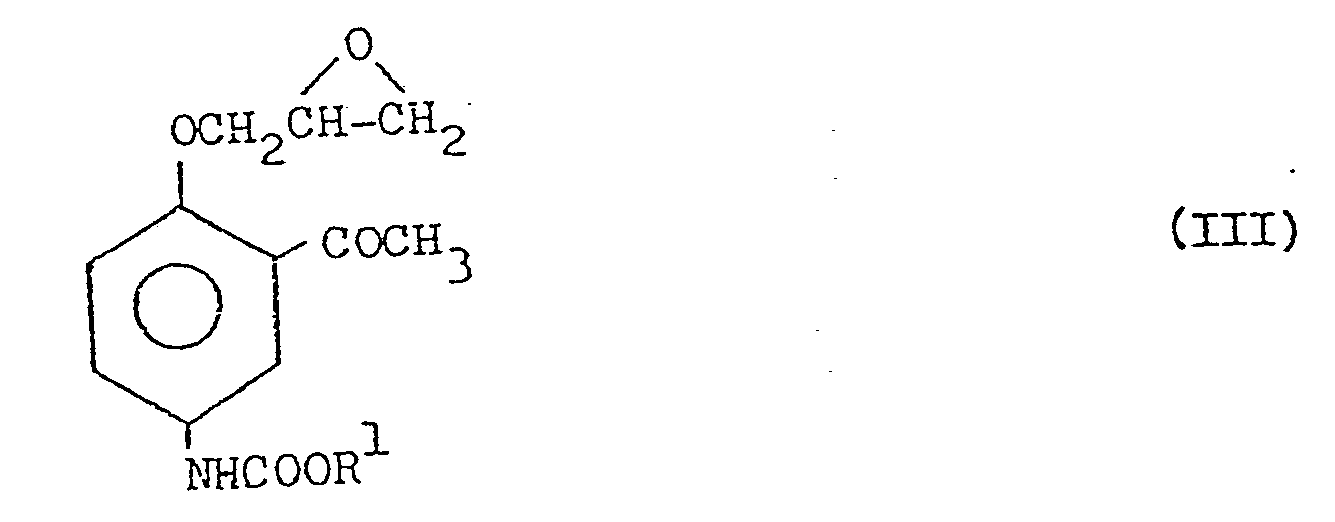
- (b) alkyl ester of 3-acetyl-4[(2-3,epoxy)-propoxy]phenylcarbamic acid with a primary alkylamine in the medium of an alkanol with 1 to 3 carbon atoms;
- (c) alkyl ester of 3-acetyl-4-hydroxyphenylcarbamic acid with 1-alkylamino-2,3-epoxypropane, the reaction being catalyzed by an alkali metal hydroxide; and
- (d) alkyl ester of 3-acetyl-4-hydroxyphenylcarbamic acid with 1-alkylamino-3-chloro-2-propanol, the reaction being catalyzed by an alkali metal hydroxide.
Description
- The invention relates to 1-aryloxy-3-amino-2-propanols of the general formula I

- Substituted aryloxyaminopropanols of the general formula I, as defined above are new undescribed compounds, not found in the relevant literature hitherto, which exhibit typical effects of betaadrenolytics, similarly as with aryloxyaminopropanols substituted on the benzene ring in the ortho-, meta- and para- position by an alkoxy-carbonylamino substituent (Czechoslovak Authorship Certificate No. 220,271).
- The prepared substances were tested on betaadrenolytic and antiarrhythmic properties and compared with standard ones, viz. practolol and pindolol. It has been found from the negatively chronotropic effect evaluation, that all of the substances reduce the pulse frequency, on average, by 7 to 17 per cent. The force of contraction of spontaneously pulsating auricles was significantly raised by pindolol, practolol and the substance of the general formula I in which R¹ stands for propyl, and R² for isopropyl group. A cumulative curve (both chronotropic and inotropic) expressing the dependence of the effect upon the isoprenaline dose was being markedly shifted to the right also by applying the substance of the general formula I with the above meanings of R¹ and R² and with the pA₂ values of 6.8 and 8.2.
- Substituted aryloxyaminopropanols of the general formula I as defined hereinbefore can be prepared, according to the invention, in different ways, such as, for instance, that the following substances, respectively, are allowed to react in a polar solvent:
- (a) alkyl ester of 3-acetyl-4-[(3-bromo-2-hydroxy)-propoxy]phenylcarbamic acid of the general formula II

- (b) alkyl ester of 3-acetyl-4[(2,3-epoxy)-propoxy]phenylcarbamic acid of the general formula III
- (c) alkyl ester of 3-acetyl-4-hydroxyphenylcarbamic acid of the general formula IV


- (d) alkyl ester of 3-acetyl-4-hydroxyphenylcarbamic acid of the general formula IV in which R¹ has the same meaning as in the formula I, with 1-alkylamino-3-chloro-2-propanol of the general formula VI
ClCH₂CH₂NHR² (VI)
in which R² has the same meaning as in the general formula I, preferably in ethanolic medium, the reaction being catalyzed by an alkali metal hydroxide such as e.g. sodium hydroxide, preferably in a sealed tube or an autoclave at a temperature of from 100 to 120°C. - After the reaction according to one of the above variants (a), (b), (c) or (d), respectively, the reaction mixture is mostly treated in such a way that the raw product, after the organic solvent has been distilled off, is dissolved in diluted hydrochloric acid, shaken with ether, and the base released by alkalinisation from the separated aqueous phase is extracted into ether. From this solution, the basic ester can be immediately converted to the desired salt whereupon the latter can be cleaned by crystallizing from an organic solvent or a blend of such solvents.
- Among organic acid salts there may be considered, for example, hydrochloride, hydrobromide, sulphate, phosphate, and among inorganic acid salts e.g. oxalate, maleinate, fumarate and so forth.
- Details of the process are given in the following examples.
- To 2.3 g (0.04 mol) of isopropylamine in 10 ml water there were successively added 6.5 g (0.02 mol) of propyl ester of 3-acetyl-4-[(3-bromo-2-hydroxy)-propoxy]phenylcarbamic acid (Czechoslovak Authorship Certificate No. (PV 1890-87)), the mixture having been agitated for 24 hours at room temperature. After the reaction, excessive isopropylamine was distilled off the reaction mixture in vacuo whereupon the evaporation residue was dissolved in diluted hydrochloric acid, three times shaken with ether, and from the separated aqueous phase there was released by alkalinization the base which was extracted into ether. After drying by anhydrous magnesium sulphate, the hydrochloride was separated from the filtrate by adding an etheric solution of dry hydrogen chloride, the hydrochloride being recrystallized out of the acetone/ethanol mixture (melting point 163 - 165°C).
-
- To a solution of 10.2 g (0.03 mol) of propyl ester of 3-acetyl-4[(2,3-epoxy)-propoxy]phenylcarbamic acid (Czechoslovak Authorship Certificate No. (PV 1891-87)) in 30 ml of ethanol, there was added 3.5 g (0.06 mol) of tert. butylamine and 2 ml water, the mixture having been heated for 24 hours at the reaction mixture boiling temperature. The solvent and an amine excess were distilled off in vacuo. The procedure of Example 1 was then followed. The separated hydrochloride was re-crystallized from ethanol (melting point 181 - 183°C).
- 15.0 g (0.06 mol) of butyl ester of 3-acetyl-4-hydroxyphenylcarbamic acid (Czechoslovak Authorship Certificate No. (PV 9795-86)) and 7.7 g (0.06 mol) of 1-tert.butylamino-2,3-epoxypropane in 40 ml water together with sodium hydroxide as catalyst, were mixed for 6 hours at room temperature. A clear solution was decanted and a bituminous layer was dissolved in diluted hydrochloric acid, shaken three times with ether, and the base released by alkalinization from the separated aqueous phase was extracted into ether. After drying by anhydrous magnesium sulphate, and adding an etheric oxalic acid solution, the oxalate was separated and recrystallized from acetone (melting point 227 - 230°C).
- 5.0 g (0.02 mol) of butyl ester of 3-acetyl-4-hydroxyphenylcarbamic acid (Czechoslovak Authorship Certificate No. (PV 9795-86)), 3.7 g (0.02 mol) of hydrochloride of 1-chloro-3-isopropylamino-2-propanol and 1.9 g (0.05 mol) of sodium hydroxide in 75 ml ethanol were heated in a sealed tube for 10 hours at 100°C. The solvent was distilled off the reaction mixture in vacuo, and a residue was suspended in 30 ml of 2N sodium hydroxide. The released base was shaken into ether and after drying by anhydrous magnesium sulphate and adding an etheric solution of dry hydrogen chloride the hydrochloride was separated from the filtrate and then recrystallized from 2-propanol (melting point 138 - 141°C).
- By using the above described methods the following new, unpublished substances were prepared:
- as hydrochloride, melting point 163 - 165°C (acetoneethanol) according to EXAMPLES 1, 2, 3 and 4
Anal.: C₁₈H₂₉N₂O₅Cl
theory/actual value
C 55.59/55.53
H 7.51/ 7.57
N 7.20/ 7.01
IR (KBr) C=O (1675, 1695 cm⁻¹), C=C (1590, 1615 cm⁻¹), N-H (3310 cm⁻¹).
- as hydrochloride, melting point 138 - 141°C (2-propanol) according to EXAMPLES 1, 2, 3 and 4
Anal.: C₁₉H₃₁N₂O₅Cl
theory/actual value
C 56.62/56.48
H 7.75/ 7.97
N 6.95/ 7.03
IR (KBr) C=O (1675, 1695 cm⁻¹), C=C (1590, 1612 cm⁻¹), N-H (3310 cm⁻¹).
- as hydrochloride, melting point 181 - 183°C (ethanol) according to EXAMPLES 1, 2, 3 and 4
Anal.: C₁₉H₃₁N₂O₅Cl
theory/actual value
C 56.63/56.65
H 7.75/8.00
N 6.95/6.75
IR (KBr) C=O (1665, 1725 cm⁻¹), C=C (1592, 1615 cm⁻¹), N-H (3305 cm⁻¹).
- as oxalate, m.p. 227 - 230°C
according to EXAMPLES 1, 2, 3 and 4
Anal.: C₂₂H₃₄N₂O₉
theory/actual value
C 56.16/55.92
H 7.28/ 6.93
N 5.95/ 5.56
IR (KBr) C=O (1670, 1750 cm⁻¹), C=C (1590, 1610 cm⁻¹), N-H (3315 cm⁻¹).
Claims (9)


ClCH₂

in which R² has the same meaning as in the formula I, in a polar solvent medium, the reaction being catalyzed by an alkali metal hydroxide.
Applications Claiming Priority (2)
| Application Number | Priority Date | Filing Date | Title |
|---|---|---|---|
| CS5824/87 | 1987-08-05 | ||
| CS875824A CS263555B1 (en) | 1987-08-05 | 1987-08-05 | Substituted aryloxyaminopropanoles and process for preparing them |
Publications (2)
| Publication Number | Publication Date |
|---|---|
| EP0302694A2 true EP0302694A2 (en) | 1989-02-08 |
| EP0302694A3 EP0302694A3 (en) | 1989-08-02 |
Family
ID=5403878
Family Applications (1)
| Application Number | Title | Priority Date | Filing Date |
|---|---|---|---|
| EP88307115A Withdrawn EP0302694A3 (en) | 1987-08-05 | 1988-08-02 | Substituted aryloxyamino-propanols and methods of preparing same |
Country Status (3)
| Country | Link |
|---|---|
| EP (1) | EP0302694A3 (en) |
| JP (1) | JPH01110661A (en) |
| CS (1) | CS263555B1 (en) |
Family Cites Families (3)
| Publication number | Priority date | Publication date | Assignee | Title |
|---|---|---|---|---|
| DE2454406A1 (en) * | 1974-11-16 | 1976-05-20 | Boehringer Mannheim Gmbh | Adrenergic beta-receptor inhibitory amino propanol derivs - prepd by reacting substd propoxyindoles with amines |
| DE2926517A1 (en) * | 1979-06-30 | 1981-01-15 | Beiersdorf Ag | SUBSTITUTED 3-ARYL-PYRAZOLE AND 5-ARYL-ISOXAZOLE AND METHOD FOR THE PRODUCTION THEREOF |
| CS220271B1 (en) * | 1981-08-18 | 1983-03-25 | Jozef Csoellei | Substituted aryloxypropanolamines, salts and their production |
-
1987
- 1987-08-05 CS CS875824A patent/CS263555B1/en unknown
-
1988
- 1988-08-02 EP EP88307115A patent/EP0302694A3/en not_active Withdrawn
- 1988-08-04 JP JP19356088A patent/JPH01110661A/en active Pending
Also Published As
| Publication number | Publication date |
|---|---|
| EP0302694A3 (en) | 1989-08-02 |
| CS582487A1 (en) | 1988-09-16 |
| CS263555B1 (en) | 1989-04-14 |
| JPH01110661A (en) | 1989-04-27 |
Similar Documents
| Publication | Publication Date | Title |
|---|---|---|
| SU867298A3 (en) | Method of preparing piperidine derivatives or their salts | |
| US3247212A (en) | Thio substituted 3 amino isoquinolines | |
| RU2210565C2 (en) | Novel method for metoprolol production | |
| SU453836A3 (en) | Method of producing 3-benzylpyridine derivatives or their salts | |
| JPS6126538B2 (en) | ||
| EP0302694A2 (en) | Substituted aryloxyamino-propanols and methods of preparing same | |
| US3225096A (en) | N-cyclopropylamine aralkanone and aralkanol amine derivatives | |
| DE69703483T2 (en) | METHOD FOR PRODUCING GLYCIDYL SULFONATES | |
| US4620015A (en) | Synthesis of β-((2-methylpropoxy)methyl)-N-phenyl-N-(phenylmethyl)-1-pyrrolidineethanamine | |
| SU505358A3 (en) | The method of producing piperazine derivatives | |
| CH616416A5 (en) | ||
| US3101345A (en) | 2-hydroxymethyl-8-hydroxy-1,4-benzodioxane | |
| SU617007A3 (en) | Method of obtaining amines or salts thereof | |
| US4201715A (en) | Process for the anilidization of carboxylic acid esters | |
| US5332821A (en) | Process for preparing isoquinolines | |
| US2810719A (en) | Morpholino alkyl ethers of hydroxybenzoic acid esters | |
| DE69812957T2 (en) | PROCESS FOR THE PREPARATION OF 1,3-DIAZA SPIRO [4.4] NON-1-EN-4-ON DERIVATIVES AND 1-CYANO-1-ACYLAMINOCYCLOPENTANE INTERMEDIATE PRODUCTS | |
| US3045023A (en) | Dialkylaminoethyl diphenylmethylpiperidinepropionates | |
| DE3931326A1 (en) | METHOD FOR PRODUCING 2- (N-ALKYLAMINO) -4-AMINOBENZENE SULPHONIC ACIDS | |
| IL31593A (en) | Preparation of 1-alkyl(or alkenyl)-2-aminoalkylpyrrolidine derivatives and certain intermediates therefor containing the phthalimido group | |
| AU4319796A (en) | New process for the preparation of sameridine | |
| SU552021A3 (en) | The method of obtaining derivatives of biphenyl or their salts | |
| US2422957A (en) | 1-bromo-4-(n-alkylamino)-hexanes and process of making them | |
| SU810693A1 (en) | Method of preparing pentadecanolides | |
| EP0238569B1 (en) | Process for the manufacture of cycloalkane carboxylic acids |
Legal Events
| Date | Code | Title | Description |
|---|---|---|---|
| PUAI | Public reference made under article 153(3) epc to a published international application that has entered the european phase |
Free format text: ORIGINAL CODE: 0009012 |
|
| AK | Designated contracting states |
Kind code of ref document: A2 Designated state(s): BE CH DE GB LI NL SE |
|
| PUAL | Search report despatched |
Free format text: ORIGINAL CODE: 0009013 |
|
| AK | Designated contracting states |
Kind code of ref document: A3 Designated state(s): BE CH DE GB LI NL SE |
|
| 17P | Request for examination filed |
Effective date: 19891004 |
|
| 17Q | First examination report despatched |
Effective date: 19910404 |
|
| STAA | Information on the status of an ep patent application or granted ep patent |
Free format text: STATUS: THE APPLICATION HAS BEEN WITHDRAWN |
|
| 18W | Application withdrawn |
Withdrawal date: 19910921 |
|
| R18W | Application withdrawn (corrected) |
Effective date: 19910921 |