EP0302916B1 - Element d'affichage electro-optique - Google Patents
Element d'affichage electro-optique Download PDFInfo
- Publication number
- EP0302916B1 EP0302916B1 EP88901584A EP88901584A EP0302916B1 EP 0302916 B1 EP0302916 B1 EP 0302916B1 EP 88901584 A EP88901584 A EP 88901584A EP 88901584 A EP88901584 A EP 88901584A EP 0302916 B1 EP0302916 B1 EP 0302916B1
- Authority
- EP
- European Patent Office
- Prior art keywords
- trans
- propylcyclohexyl
- biphenyl
- voltage
- pentylcyclohexyl
- Prior art date
- Legal status (The legal status is an assumption and is not a legal conclusion. Google has not performed a legal analysis and makes no representation as to the accuracy of the status listed.)
- Expired - Lifetime
Links
- 0 C1CC*CC1 Chemical compound C1CC*CC1 0.000 description 14
- XDTMQSROBMDMFD-UHFFFAOYSA-N C1CCCCC1 Chemical compound C1CCCCC1 XDTMQSROBMDMFD-UHFFFAOYSA-N 0.000 description 6
- UHOVQNZJYSORNB-UHFFFAOYSA-N c1ccccc1 Chemical compound c1ccccc1 UHOVQNZJYSORNB-UHFFFAOYSA-N 0.000 description 4
- YEYLPTTXAKJJEF-UHFFFAOYSA-N CC1CC2[O](C)C2CC1 Chemical compound CC1CC2[O](C)C2CC1 YEYLPTTXAKJJEF-UHFFFAOYSA-N 0.000 description 1
- RYTUQCCMZQNVQV-UHFFFAOYSA-N CC1CC=C=CC1 Chemical compound CC1CC=C=CC1 RYTUQCCMZQNVQV-UHFFFAOYSA-N 0.000 description 1
- DPGVNSDPGIWYQK-UHFFFAOYSA-N CCCCCC(C)C#N Chemical compound CCCCCC(C)C#N DPGVNSDPGIWYQK-UHFFFAOYSA-N 0.000 description 1
- GHDIHPNJQVDFBL-UHFFFAOYSA-N COC1CCCCC1 Chemical compound COC1CCCCC1 GHDIHPNJQVDFBL-UHFFFAOYSA-N 0.000 description 1
- GOYDNIKZWGIXJT-UHFFFAOYSA-N Fc(cccc1)c1F Chemical compound Fc(cccc1)c1F GOYDNIKZWGIXJT-UHFFFAOYSA-N 0.000 description 1
- PYLWMHQQBFSUBP-UHFFFAOYSA-N Fc1ccccc1 Chemical compound Fc1ccccc1 PYLWMHQQBFSUBP-UHFFFAOYSA-N 0.000 description 1
- HPXRVTGHNJAIIH-UHFFFAOYSA-N OC1CCCCC1 Chemical compound OC1CCCCC1 HPXRVTGHNJAIIH-UHFFFAOYSA-N 0.000 description 1
Classifications
-
- C—CHEMISTRY; METALLURGY
- C09—DYES; PAINTS; POLISHES; NATURAL RESINS; ADHESIVES; COMPOSITIONS NOT OTHERWISE PROVIDED FOR; APPLICATIONS OF MATERIALS NOT OTHERWISE PROVIDED FOR
- C09K—MATERIALS FOR MISCELLANEOUS APPLICATIONS, NOT PROVIDED FOR ELSEWHERE
- C09K19/00—Liquid crystal materials
- C09K19/04—Liquid crystal materials characterised by the chemical structure of the liquid crystal components, e.g. by a specific unit
- C09K19/06—Non-steroidal liquid crystal compounds
- C09K19/08—Non-steroidal liquid crystal compounds containing at least two non-condensed rings
- C09K19/30—Non-steroidal liquid crystal compounds containing at least two non-condensed rings containing saturated or unsaturated non-aromatic rings, e.g. cyclohexane rings
-
- C—CHEMISTRY; METALLURGY
- C09—DYES; PAINTS; POLISHES; NATURAL RESINS; ADHESIVES; COMPOSITIONS NOT OTHERWISE PROVIDED FOR; APPLICATIONS OF MATERIALS NOT OTHERWISE PROVIDED FOR
- C09K—MATERIALS FOR MISCELLANEOUS APPLICATIONS, NOT PROVIDED FOR ELSEWHERE
- C09K19/00—Liquid crystal materials
- C09K19/04—Liquid crystal materials characterised by the chemical structure of the liquid crystal components, e.g. by a specific unit
- C09K19/06—Non-steroidal liquid crystal compounds
- C09K19/34—Non-steroidal liquid crystal compounds containing at least one heterocyclic ring
- C09K19/3491—Non-steroidal liquid crystal compounds containing at least one heterocyclic ring having sulfur as hetero atom
-
- C—CHEMISTRY; METALLURGY
- C09—DYES; PAINTS; POLISHES; NATURAL RESINS; ADHESIVES; COMPOSITIONS NOT OTHERWISE PROVIDED FOR; APPLICATIONS OF MATERIALS NOT OTHERWISE PROVIDED FOR
- C09K—MATERIALS FOR MISCELLANEOUS APPLICATIONS, NOT PROVIDED FOR ELSEWHERE
- C09K19/00—Liquid crystal materials
- C09K19/04—Liquid crystal materials characterised by the chemical structure of the liquid crystal components, e.g. by a specific unit
- C09K19/06—Non-steroidal liquid crystal compounds
- C09K19/08—Non-steroidal liquid crystal compounds containing at least two non-condensed rings
- C09K19/30—Non-steroidal liquid crystal compounds containing at least two non-condensed rings containing saturated or unsaturated non-aromatic rings, e.g. cyclohexane rings
- C09K19/3001—Cyclohexane rings
-
- C—CHEMISTRY; METALLURGY
- C09—DYES; PAINTS; POLISHES; NATURAL RESINS; ADHESIVES; COMPOSITIONS NOT OTHERWISE PROVIDED FOR; APPLICATIONS OF MATERIALS NOT OTHERWISE PROVIDED FOR
- C09K—MATERIALS FOR MISCELLANEOUS APPLICATIONS, NOT PROVIDED FOR ELSEWHERE
- C09K19/00—Liquid crystal materials
- C09K19/04—Liquid crystal materials characterised by the chemical structure of the liquid crystal components, e.g. by a specific unit
- C09K19/06—Non-steroidal liquid crystal compounds
- C09K19/08—Non-steroidal liquid crystal compounds containing at least two non-condensed rings
- C09K19/30—Non-steroidal liquid crystal compounds containing at least two non-condensed rings containing saturated or unsaturated non-aromatic rings, e.g. cyclohexane rings
- C09K19/3098—Unsaturated non-aromatic rings, e.g. cyclohexene rings
-
- C—CHEMISTRY; METALLURGY
- C09—DYES; PAINTS; POLISHES; NATURAL RESINS; ADHESIVES; COMPOSITIONS NOT OTHERWISE PROVIDED FOR; APPLICATIONS OF MATERIALS NOT OTHERWISE PROVIDED FOR
- C09K—MATERIALS FOR MISCELLANEOUS APPLICATIONS, NOT PROVIDED FOR ELSEWHERE
- C09K19/00—Liquid crystal materials
- C09K19/04—Liquid crystal materials characterised by the chemical structure of the liquid crystal components, e.g. by a specific unit
- C09K19/06—Non-steroidal liquid crystal compounds
- C09K19/34—Non-steroidal liquid crystal compounds containing at least one heterocyclic ring
-
- C—CHEMISTRY; METALLURGY
- C09—DYES; PAINTS; POLISHES; NATURAL RESINS; ADHESIVES; COMPOSITIONS NOT OTHERWISE PROVIDED FOR; APPLICATIONS OF MATERIALS NOT OTHERWISE PROVIDED FOR
- C09K—MATERIALS FOR MISCELLANEOUS APPLICATIONS, NOT PROVIDED FOR ELSEWHERE
- C09K19/00—Liquid crystal materials
- C09K19/04—Liquid crystal materials characterised by the chemical structure of the liquid crystal components, e.g. by a specific unit
- C09K19/06—Non-steroidal liquid crystal compounds
- C09K19/34—Non-steroidal liquid crystal compounds containing at least one heterocyclic ring
- C09K19/3402—Non-steroidal liquid crystal compounds containing at least one heterocyclic ring having oxygen as hetero atom
-
- C—CHEMISTRY; METALLURGY
- C09—DYES; PAINTS; POLISHES; NATURAL RESINS; ADHESIVES; COMPOSITIONS NOT OTHERWISE PROVIDED FOR; APPLICATIONS OF MATERIALS NOT OTHERWISE PROVIDED FOR
- C09K—MATERIALS FOR MISCELLANEOUS APPLICATIONS, NOT PROVIDED FOR ELSEWHERE
- C09K19/00—Liquid crystal materials
- C09K19/04—Liquid crystal materials characterised by the chemical structure of the liquid crystal components, e.g. by a specific unit
- C09K19/06—Non-steroidal liquid crystal compounds
- C09K19/34—Non-steroidal liquid crystal compounds containing at least one heterocyclic ring
- C09K19/3402—Non-steroidal liquid crystal compounds containing at least one heterocyclic ring having oxygen as hetero atom
- C09K2019/3422—Non-steroidal liquid crystal compounds containing at least one heterocyclic ring having oxygen as hetero atom the heterocyclic ring being a six-membered ring
Definitions
- the invention relates to electro-optical liquid crystal display elements (LC display elements) based on TN cells with a particularly short turn-on time T on when switching from a first voltage, which is below or approximately at the threshold voltage, to a second voltage, which increases in the electro-optical characteristic lies.
- the invention is therefore of particular importance in the case of high-multiplex LC display elements and in particular in TFT-addressed LC display elements with a particularly short switch-on time.
- nematic or nematic-cholesteric liquid-crystalline materials are used for LC display elements to change their optical properties such as light absorption, light scattering, birefringence, reflectivity or color under the influence of electrical fields.
- the function of such display elements is based, for example, on the phenomena of dynamic scattering, the deformation of aligned phases, the guest-host effect, the Schadt-Helfrich effect in the twisted cell, the SBE effect or the cholesteric-nematic phase transition.
- LC phases are required, which have to meet a variety of requirements.
- the chemical resistance to moisture, air and physical influences such as heat, radiation in the infrared, visible and ultraviolet range and electrical DC and AC fields are particularly important here.
- technically usable LC phases require a liquid-crystalline mesophase in a suitable temperature range, low viscosity, an optical anisotropy adapted to the layer thickness, low temperature dependence of the threshold voltage, high steepness of the electro-optical characteristic curve and sufficient solvency for pleochroic dyes.
- components with low viscosities or glass transition temperatures and / or particularly advantageous elastic constants are used in previously known LC phases.
- these phases do not at the same time satisfy all of the above-mentioned requirements, in particular both of which, for many applications, still have an on time T on which is too high, in particular in LC display elements in which the switchover from a first voltage which is below or approximately to the threshold voltage , to a second voltage, which is in the rise of the electro-optical characteristic.
- V (on) to V (off) is 1.73.
- V (on) is 1.73 volts and V (off) is 1.00 volts.
- V (on) to V (off) is for example 1.29; with an operating voltage of 5 volts V (on) is 1.58 volts, V (off) is 1.22 volts.
- the second voltage V (on) then lies in the rise in the characteristic curve above the threshold voltage.
- the invention has for its object to provide LC display elements that have a wide working temperature range and do not have the disadvantages indicated above or only to a lesser extent.
- the dielectrics can also contain further additives known to the person skilled in the art and described in the literature.
- 0-15% pleochroic dyes can be added, furthermore conductive salts, preferably ethyl dimethyldodecylammonium 4-hexoxybenzoate, tetrabutylammonium tetraphenylboranate or complex salts of crown ethers (see, for example, Haller et al., Mol. Cryst. Liq. Cryst. Volume 24, pages 249 -258, (1973)) to improve the ability to let or substances to change the dielectric anisotropy, the viscosity and / or the orientation of the nematic phases.
- Such substances are e.g. in DE-OS 22 09 127, 22 40 864, 23 21 632, 23 38 281, 24 50 083, 26 37 430 and 28 63 728.
- the dielectrics according to the invention in particular the combination of components of the formulas 1 and II and / or III under the special control conditions mentioned (ie, for example in TFT or high-multiplex displays) have significantly shorter switching times (in particular significantly shorter switch-on times) than other dielectrics without this special combination of substances, even if "relevant physical properties and measuring conditions (rotational viscosity, elastic constants, the product of the layer thickness and optical anisotropy, control voltage) are practically the same.
- the better (on) switching times of the LC display elements according to the invention are not only due to better viscosities or more suitable elastic constants. The reason for this is most likely the nature of the interactions between the LC molecules and the display surfaces. In particular, we assume that the mixtures according to the invention have a larger tilt angle than comparable other mixtures and therefore also clearly the switch-on time. is shorter.
- Straight-chain alkyl groups with 1 to 5 carbon atoms are particularly preferred.
- R 2 is alkanoyl.
- R 2 is then preferably straight-chain alkanoyl having 2 to 5 carbon atoms.
- Z 1 is -CH 2 CH 2 - or a single bond. In particularly preferred compounds, Z1 is a single bond.
- A is trans-1,4-cyclohexylene.
- A is preferably 1,4-phenylene.
- Particularly preferred components of the For mel are those of the sub-formulas la, Ib and Id: Compounds of sub-formula la are particularly preferred.
- the dielectrics of the display elements according to the invention preferably contain 10 to 80%, in particular 20 to 70%, total proportion of compounds of the formula I.
- a further preferred total proportion of compounds of the formula 1 is 35 to 69%.
- a 2 and A 3 are each, independently of one another, preferably preferably trans-1,4-cyclohexylene or trans-1,3-dioxane-2,5-diyl, particularly preferably trans-1,4-cyclohexylene.
- N-Alkyl is particularly preferred.
- R 4 are n-alkyl, n-alkoxy, F, CN and NCS.
- Z 2 and Z 3 are preferably each independently of the other -CH 2 CH 2 -, -CO-O-, -O-CO- or a single bond, at least one of the groups Z 2 and Z 3 being a single bond.
- a ' is preferably 1,4-phenylene, 2- or 3-fluoro-1,4-phenylene, pyridine-2,5-diyl or pyrimidine-2,5-diyl. Particularly preferred meanings of A 'are 1,4-phenylene and 2- or 3-fluoro-1,4-phenylene.
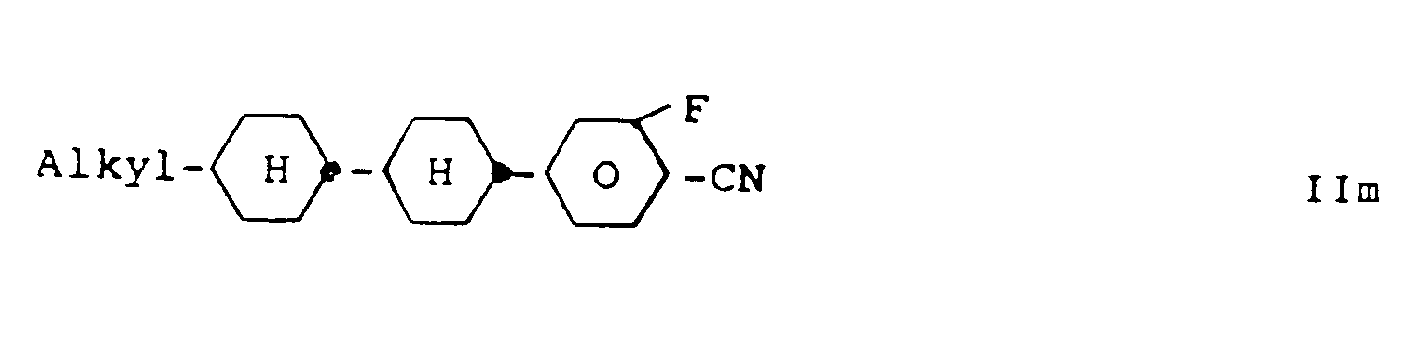
- Particularly preferred components of the formula II are those of the sub-formulas Ila to Ilv:
- sub-formula IIa, IIc, IIj, III, IIm, Iln, IIo, Ilp, IIq, IIr and Ils are preferred.
- those of the sub-formulas Ilo and Ilp are particularly preferred.
- Particularly preferred components of the formula III are those of the sub-formulas Illa, Illb and IIIc:
- sub-formulas IIIa and IIIc in particular Illa, are preferred.
- preferred dielectrics contain at least one component of the formula II.
- the dielectrics preferably contain 5 to 50%, in particular 10 to 40%, of the total proportion of compounds of the formulas II and III. Another preferred total proportion is 20 to 35%.
- Z 4 and Z5 each independently of one another preferably denote - CH 2 CH 2 -, -CO-O-, -O-CO- or a single bond.
- a 4 and A 5 are preferably trans-1,4-cyclohexylene or 1,4-phenylene.
- R 3 , R 4 , A 2 , A 3 , A ', Z 2 and Z 3 have the preferred meanings given in the formulas II and III.
- (m + n) is preferably 1.
- Particularly preferred compounds of the formula IV are those of the sub-formulas IVa to IVk:
- those of the sub-formulas IVa, IVb, IVg, IVh, 1Vj and IVK are particularly preferred, in particular those of the sub-formula IVa.
- the dielectrics preferably contain 0 to 40%, in particular 5 to 30%, of the total proportion of compounds of the formula IV.
- dielectric positive compounds in the dielectrics are advantageously 10 to 50%, particularly preferably 20 to 40%. In principle, all usual dielectric positive components can be used. The choice of the most suitable connections depends above all on the threshold voltage and optical anisotropy desired. Dielectric positive compounds of the formulas II, III and / or IV can be selected and / or other conventional compounds, e.g. B. those of the following formulas Va to Ve:
- a switch is made from a first voltage, which is below or approximately at the threshold, to a second voltage, which is in the rise of the characteristic curve. This applies in particular to higher multiplex ratios and TFT displays. Under these conditions, the switch-on times in particular are very long.
Landscapes
- Chemical & Material Sciences (AREA)
- Crystallography & Structural Chemistry (AREA)
- Engineering & Computer Science (AREA)
- Materials Engineering (AREA)
- Organic Chemistry (AREA)
- Liquid Crystal Substances (AREA)
Abstract
Claims (9)

en tant que composants de diélectriques à cristaux liquides à au moins trois composés à cristaux liquides, en vue d'écourter le temps de mise en circuit Ton d'éléments d'affichage électro-optiques à base d'une cellule TN à la commutation d'une première tension située au-dessous ou au voisinage de la tension de seuil, à une deuxième tension située dans la partie montante de la caractéristique électro-optique.



et au moins un composant choisi parmi les composés de formules II et III




et au moins un composant choisi parmi les composés de formules II et III


Applications Claiming Priority (2)
| Application Number | Priority Date | Filing Date | Title |
|---|---|---|---|
| DE3705071 | 1987-02-18 | ||
| DE19873705071 DE3705071A1 (de) | 1987-02-18 | 1987-02-18 | Elektrooptisches anzeigeelement |
Publications (2)
| Publication Number | Publication Date |
|---|---|
| EP0302916A1 EP0302916A1 (fr) | 1989-02-15 |
| EP0302916B1 true EP0302916B1 (fr) | 1992-04-22 |
Family
ID=6321209
Family Applications (1)
| Application Number | Title | Priority Date | Filing Date |
|---|---|---|---|
| EP88901584A Expired - Lifetime EP0302916B1 (fr) | 1987-02-18 | 1988-02-08 | Element d'affichage electro-optique |
Country Status (5)
| Country | Link |
|---|---|
| EP (1) | EP0302916B1 (fr) |
| JP (1) | JPH01502274A (fr) |
| KR (1) | KR950014735B1 (fr) |
| DE (2) | DE3705071A1 (fr) |
| WO (1) | WO1988006178A1 (fr) |
Families Citing this family (6)
| Publication number | Priority date | Publication date | Assignee | Title |
|---|---|---|---|---|
| GB8813024D0 (en) * | 1988-06-02 | 1988-07-06 | Merck Patent Gmbh | Fluorinated biphenyldiole derivatives |
| US5387369A (en) * | 1988-10-20 | 1995-02-07 | Merck Patent Gesellschaft Mit Beschrankter Haftung | Supertwist liquid crystal display |
| US5064565A (en) * | 1989-07-26 | 1991-11-12 | Chisso Corporation | Cyclohexenylethane compound |
| EP0438574B1 (fr) * | 1989-08-12 | 1995-01-25 | MERCK PATENT GmbH | Heterocycles 2,5-disubstitues et milieu mesomorphe |
| DE69110733T2 (de) * | 1990-04-12 | 1996-02-22 | Dainippon Ink & Chemicals | Phenylcyclohexyldioxanderivate mit einer Ätherbindung für elektrooptische Stoffe. |
| EP0770663A4 (fr) * | 1995-04-25 | 1999-02-24 | Chisso Corp | Composition de cristaux liquides et element d'affichage a cristaux liquides |
Family Cites Families (5)
| Publication number | Priority date | Publication date | Assignee | Title |
|---|---|---|---|---|
| GB2070594B (en) * | 1980-01-30 | 1984-05-23 | Secr Defence | Liquid crystal compounds containing an alicyclic ring |
| DE3006666A1 (de) * | 1980-02-22 | 1981-09-17 | Merck Patent Gmbh, 6100 Darmstadt | Phenylcyclohexenderivate, verfahren zu ihrer herstellung, diese enthaltende fluessigkristalline dielektrika und elektrooptisches anzeieelement |
| DE3201721A1 (de) * | 1981-01-30 | 1982-08-19 | F. Hoffmann-La Roche & Co. AG, 4002 Basel | Disubstituierte aethane |
| WO1982003855A1 (fr) * | 1981-05-06 | 1982-11-11 | Shionozaki Yoshio | Derives de phenylcyclohexane |
| DE3407013A1 (de) * | 1984-02-27 | 1985-09-05 | Merck Patent Gmbh, 6100 Darmstadt | Cyclohexanderivate |
-
1987
- 1987-02-18 DE DE19873705071 patent/DE3705071A1/de not_active Withdrawn
-
1988
- 1988-02-08 KR KR1019880701293A patent/KR950014735B1/ko not_active Expired - Lifetime
- 1988-02-08 DE DE8888901584T patent/DE3870350D1/de not_active Expired - Lifetime
- 1988-02-08 JP JP63501599A patent/JPH01502274A/ja active Pending
- 1988-02-08 WO PCT/EP1988/000090 patent/WO1988006178A1/fr not_active Ceased
- 1988-02-08 EP EP88901584A patent/EP0302916B1/fr not_active Expired - Lifetime
Also Published As
| Publication number | Publication date |
|---|---|
| DE3870350D1 (de) | 1992-05-27 |
| JPH01502274A (ja) | 1989-08-10 |
| WO1988006178A1 (fr) | 1988-08-25 |
| EP0302916A1 (fr) | 1989-02-15 |
| KR950014735B1 (ko) | 1995-12-14 |
| KR890700652A (ko) | 1989-04-26 |
| DE3705071A1 (de) | 1988-09-01 |
Similar Documents
| Publication | Publication Date | Title |
|---|---|---|
| EP0205503B1 (fr) | Phase cristalline liquide | |
| EP0207975B1 (fr) | Phases cristallines liquides | |
| DE10064995B4 (de) | Flüssigkristallines Medium und seine Verwendung in einer elektrooptischen Anzeige | |
| EP0281611B1 (fr) | Phases de cristaux liquides pour elements electro-optiques d'affichage fondes sur l'effet ecb | |
| EP0332005B1 (fr) | Affichage à cristaux liquides du mode super-torsadé | |
| EP1146104A2 (fr) | Milieu liquide cristallin | |
| DE10329140A1 (de) | Flüssigkristallines Medium | |
| EP0474062A2 (fr) | Affichage à cristaux liquides du type matrice | |
| EP0258346A1 (fr) | Element d'affichage a cristaux liquides. | |
| EP0258349B1 (fr) | Element d'affichage electro-optique | |
| EP0151446B1 (fr) | Phase liquide cristalline | |
| DE69008544T2 (de) | Flüssigkristallverbindungen mit hoher optischer Anisotropie. | |
| DE60226356T2 (de) | Flüssigkristallzusammensetzung, welche eine optisch aktive Verbindung und enthält, und elektrooptisches Flüssigkristallelement | |
| EP0226592B1 (fr) | Phase cristalline liquide | |
| EP0158252A2 (fr) | Phase liquide cristalline | |
| EP0302916A1 (fr) | Element d'affichage electro-optique. | |
| DE4337439B4 (de) | Flüssigkristallgemisch | |
| DE10340535A1 (de) | Flüssigkristallines Medium | |
| DE4223059A1 (de) | Flüssigkristallanzeige | |
| EP0470218B1 (fr) | Melange de cristaux liquides a faible viscosite | |
| DE3807909A1 (de) | Guest-host-fluessigkristallanzeigeelement | |
| DE4425321B4 (de) | Flüssigkristalline Mischung | |
| DE19603257A1 (de) | Flüssigkristallgemisch | |
| DE19718260A1 (de) | Verfahren zur Verbesserung der Frequenzabhängigkeit der Schwellspannung | |
| DE19809118A1 (de) | Flüssigkristallines Medium |
Legal Events
| Date | Code | Title | Description |
|---|---|---|---|
| PUAI | Public reference made under article 153(3) epc to a published international application that has entered the european phase |
Free format text: ORIGINAL CODE: 0009012 |
|
| AK | Designated contracting states |
Kind code of ref document: A1 Designated state(s): CH DE FR GB LI NL |
|
| 17P | Request for examination filed |
Effective date: 19881223 |
|
| 17Q | First examination report despatched |
Effective date: 19900621 |
|
| GRAA | (expected) grant |
Free format text: ORIGINAL CODE: 0009210 |
|
| AK | Designated contracting states |
Kind code of ref document: B1 Designated state(s): CH DE FR GB LI NL |
|
| REF | Corresponds to: |
Ref document number: 3870350 Country of ref document: DE Date of ref document: 19920527 |
|
| GBT | Gb: translation of ep patent filed (gb section 77(6)(a)/1977) | ||
| ET | Fr: translation filed | ||
| PLBE | No opposition filed within time limit |
Free format text: ORIGINAL CODE: 0009261 |
|
| STAA | Information on the status of an ep patent application or granted ep patent |
Free format text: STATUS: NO OPPOSITION FILED WITHIN TIME LIMIT |
|
| 26N | No opposition filed | ||
| PGFP | Annual fee paid to national office [announced via postgrant information from national office to epo] |
Ref country code: FR Payment date: 19960125 Year of fee payment: 9 |
|
| PGFP | Annual fee paid to national office [announced via postgrant information from national office to epo] |
Ref country code: GB Payment date: 19960130 Year of fee payment: 9 |
|
| PGFP | Annual fee paid to national office [announced via postgrant information from national office to epo] |
Ref country code: NL Payment date: 19960229 Year of fee payment: 9 |
|
| PGFP | Annual fee paid to national office [announced via postgrant information from national office to epo] |
Ref country code: CH Payment date: 19960308 Year of fee payment: 9 |
|
| PG25 | Lapsed in a contracting state [announced via postgrant information from national office to epo] |
Ref country code: GB Effective date: 19970208 |
|
| PG25 | Lapsed in a contracting state [announced via postgrant information from national office to epo] |
Ref country code: LI Effective date: 19970228 Ref country code: CH Effective date: 19970228 |
|
| PG25 | Lapsed in a contracting state [announced via postgrant information from national office to epo] |
Ref country code: NL Effective date: 19970901 |
|
| GBPC | Gb: european patent ceased through non-payment of renewal fee |
Effective date: 19970208 |
|
| REG | Reference to a national code |
Ref country code: CH Ref legal event code: PL |
|
| PG25 | Lapsed in a contracting state [announced via postgrant information from national office to epo] |
Ref country code: FR Effective date: 19971030 |
|
| NLV4 | Nl: lapsed or anulled due to non-payment of the annual fee |
Effective date: 19970901 |
|
| REG | Reference to a national code |
Ref country code: FR Ref legal event code: ST |
|
| PGFP | Annual fee paid to national office [announced via postgrant information from national office to epo] |
Ref country code: DE Payment date: 20070201 Year of fee payment: 20 |