EP0303087A2 - Polymere Dihydroxyverbindungen und ihre Verwendung als Stabilisatoren für Polymere - Google Patents
Polymere Dihydroxyverbindungen und ihre Verwendung als Stabilisatoren für Polymere Download PDFInfo
- Publication number
- EP0303087A2 EP0303087A2 EP88111928A EP88111928A EP0303087A2 EP 0303087 A2 EP0303087 A2 EP 0303087A2 EP 88111928 A EP88111928 A EP 88111928A EP 88111928 A EP88111928 A EP 88111928A EP 0303087 A2 EP0303087 A2 EP 0303087A2
- Authority
- EP
- European Patent Office
- Prior art keywords
- alkyl
- dihydroxy compounds
- polymer
- polymeric
- polymers
- Prior art date
- Legal status (The legal status is an assumption and is not a legal conclusion. Google has not performed a legal analysis and makes no representation as to the accuracy of the status listed.)
- Granted
Links
- 0 CC(C)(*(*)*)*(*)(N)N Chemical compound CC(C)(*(*)*)*(*)(N)N 0.000 description 1
Classifications
-
- C—CHEMISTRY; METALLURGY
- C08—ORGANIC MACROMOLECULAR COMPOUNDS; THEIR PREPARATION OR CHEMICAL WORKING-UP; COMPOSITIONS BASED THEREON
- C08F—MACROMOLECULAR COMPOUNDS OBTAINED BY REACTIONS ONLY INVOLVING CARBON-TO-CARBON UNSATURATED BONDS
- C08F8/00—Chemical modification by after-treatment
Definitions
- the invention relates to polymeric dihydroxy compounds, a process for the preparation of these compounds and polymers equipped with these dihydroxy compounds.
- Synthetic polymers especially those with unsaturated bonds in the molecular chain, are subject to degradation reactions under the influence of oxygen, heat or light, which lead to a deterioration in the properties and to problems in the practical use of the parts produced from the polymers.
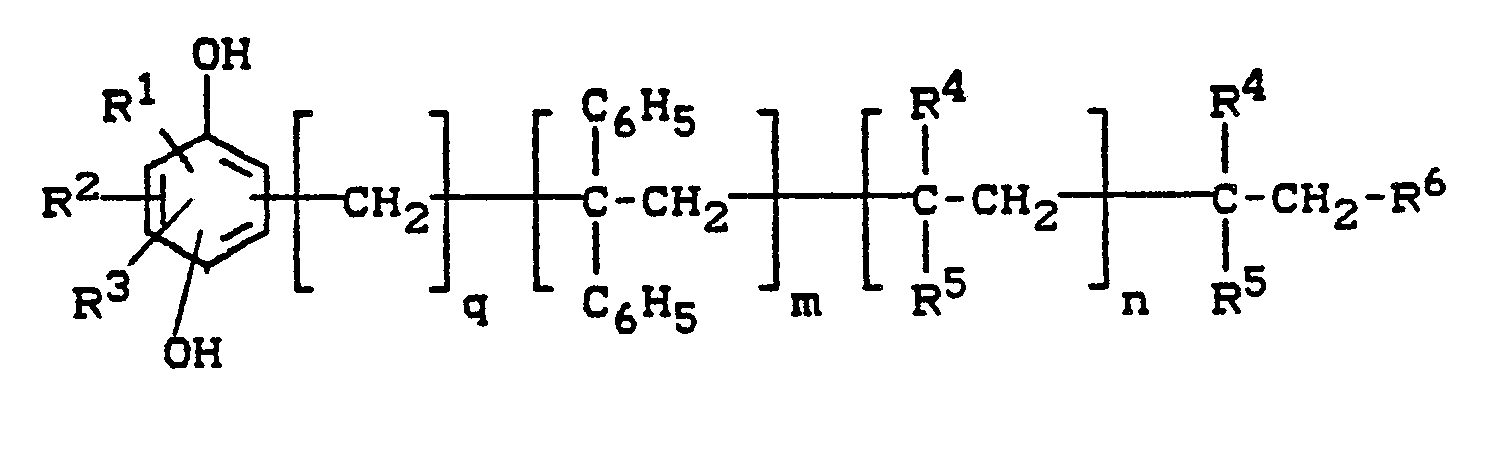
- phenolic hydroxyl group-containing polymeric compounds of the formula (I) are substances with particularly good activity as stabilizers with good compatibility with polymers and in particular low volatility.
- R1, R2, R3 H, C1 ⁇ 4-alkyl
- R4 H, C1 ⁇ 4 alkyl
- R7 C1 ⁇ 4 alkyl
- m 0.1
- n 5-50.
- q 0.1
- the invention relates to polymeric dihydroxy compounds of the formula (I) which have a degree of polymerization from 5 to 100, preferably from 5 to 30 and particularly preferably from 10 to 25.
- anionically polymerizable vinyl monomers are polymerized in an aromatic solvent or an ether by means of an alkylalkali metal or arylalkali metal compound to form a living polymeric anion, 1,1-diphenylethylene is optionally added to reduce the reactivity of the polymeric anion, and then a benzyl halide is added (II) and then an ether cleavage or a cleavage of trialkylsilyl radicals is carried out to form the hydroxyl groups.
- Anionically polymerizable vinyl monomers for the purposes of the invention are, for example, styrene, p-methylstyrene, ⁇ -methylstyrene, butadiene, isoprene, methyl methacrylate or mixtures thereof.
- the preferred monomer is styrene.
- Aromatic solvents for the purposes of the invention are benzene, toluene;
- ethers are tetrahydrofuran and dioxane, in particular tetrahydrofuran ("THF").
- THF tetrahydrofuran
- Alkylalkali metal compounds in the context of the invention are butyllithium, in particular secondary butyllithium, and sodium naphthalene, K-naphthalene or phenyllithium are preferably used as arylalkali metal compounds.
- the polymerization and the reaction with the compound (II) take place between -100 ° C. and 60 ° C., preferably between room temperature and 0 ° C.
- the resulting polymer can be isolated by precipitation from the polymer solution, preferably using methanol.
- the protective groups are preferably removed in solution using suitable reagents.
- Suitable for this is e.g. treating the polymer dissolved in chloroform with trimethyliodosilane or treating the polymer dissolved in an acetonitrile / toluene mixture with a mixture of trimethylchlorosilane and sodium iodide or treating the polymer with an acid or a Lewis acid, e.g. Boron tribromide.
- the resulting polymers have degrees of polymerization which can be controlled via the amount of initiator from 5 to 100.
- the present invention furthermore relates to the use of the polymeric dihydroxy compounds (I) as stabilizers in the stabilization of synthetic polymers, it also being possible to use sulfur-containing or phosphorus-containing compounds as co-stabilizers.
- the compounds according to the invention are particularly effective in stabilizing rubbers, e.g. of polybutadiene, polyisoprene, polychloroprene, styrene-butadiene copolymers, acrylonitrile-butadiene copolymers, acrylate rubbers, ethylene-propylene rubbers or EPDM rubbers (ethylene / propylene / diene rubbers, which as a diene is a non-conjugated diene such as hexadiene-1 , 5 or norbornadiene contained in small amounts), of thermoplastics, e.g.
- rubbers e.g. of polybutadiene, polyisoprene, polychloroprene, styrene-butadiene copolymers, acrylonitrile-butadiene copolymers, acrylate rubbers, ethylene-propylene rubbers or EPDM rubbers (ethylene / propylene / diene rubbers
- ABS Acrylonitrile / butadiene / styrene terpolymers
- MVS methyl methacrylate / butadiene / styrene terpolymers
- HIPS impact-resistant polystyrene
- ABS polycarbonate mixtures.
- co-stabilizers e.g. Dilauryl thiodipropionate or trisnonylphenyl phosphite are suitable.
- 0.1 to 10 parts by weight, preferably 0.25 to 5 parts by weight and particularly preferably 0.5 to 4 parts by weight of polymer containing aromatic hydroxyl groups (based in each case on 100 parts by weight) are added stabilizing polymer).
- the polymer containing aromatic hydroxyl groups can be added to the polymer material in solid form, in solution or in the form of a dispersion or emulsion.
- kneaders Depending on the form of the polymer to be stabilized, kneaders, rollers, in emulsion or in solution are used.
- Parts are always parts by weight
- 2,5-Dimethoxybenzylbromid was after a modified procedure from A.L. Shulgin and E.M. Gal, J. Chem. Soc. (London), 1316 (1953).
- the stabilizer to be tested is worked into the melt at 200 ° C. for 4 minutes in a laboratory kneader.
- the polypropylene is then pressed into 0.5 mm thick plates (7 minutes at 200 ° C. and 10 bar, 10 minutes cooling under pressure).
- Triplicates are stored at 150 ° C in the air circulation cabinet. Time is measured until the onset of oxidative destruction (brown color, embrittlement). The results of the aging tests are shown in Table 1.
- Table 1 Amount of polymer from Example 3 (parts by weight per 100 parts by weight of polypropylene) Time to destruction (days) - 6 0.5 27th 1.0 29
Landscapes
- Chemical & Material Sciences (AREA)
- General Chemical & Material Sciences (AREA)
- Health & Medical Sciences (AREA)
- Chemical Kinetics & Catalysis (AREA)
- Medicinal Chemistry (AREA)
- Polymers & Plastics (AREA)
- Organic Chemistry (AREA)
- Addition Polymer Or Copolymer, Post-Treatments, Or Chemical Modifications (AREA)
- Compositions Of Macromolecular Compounds (AREA)
- Polyesters Or Polycarbonates (AREA)
- Graft Or Block Polymers (AREA)
Abstract

R¹, R², R³ = H, C₁₋₄-Alkyl,
R⁴ = H, C₁₋₄-Alkyl,
R⁵ = -C₆H₅, -C₆H₄CH₃, -CH=CH₂, -CO₂R⁷, Heteroaryl,
R⁶ = C₁₋₄-Alkyl, Aryl, H,
R⁷ = C₁₋₄-Alkyl,
m = 0,1,
n = 5 bis 100,
q = 0, 1
ein Verfahren zu ihrer Herstellung und ihre Verwendung in thermoplastischen Formmassen.
Description
- Die Erfindung betrifft polymere Dihydroxyverbindungen, ein Verfahren zur Herstellung dieser Verbindungen sowie mit diesen Dihydroxyverbindungen augerüstete Polymerisate.
- Synthetische Polymere, insbesondere solche mit ungesättigten Bindungen in der Molekülkette, unterliegen unter der Einwirkung von Sauerstoff, Hitze oder Licht Abbaureaktionen, die zu einer Verschlechterung der Eigenschaften und zu Problemen beim praktischen Einsatz der aus den Polymeren hergestellten Teile führen.
- Zur Verhinderung derartiger Abbaueffekte wurden bereits zahlreiche Stabilisatoren für Polymere vorgeschlagen, insbesondere Verbindungen mit phenolischen Hydroxylgruppen (siehe z.B. R. Gächter und H. Müller: Taschenbuch der Kunststoff-Additive, Carl-Hanser-Verlag München Wien 1979).
- Es wurde gefunden, daß phenolische Hydroxylgruppen enthaltende polymer Verbindungen der Formel (I) Substanzen mit besonders guter Wirksamkeit als Stabilisatoren bei guter Verträglichkeit mit Polymeren und insbesondere geringer Flüchtigkeit darstellen.

R¹, R², R³ = H, C₁₋₄-Alkyl,
R⁴ = H, C₁₋₄-Alkyl,
R⁵ = -C₆H₅, -C₆H₄CH₃, -CH=CH₂, -CO₂R⁷,
R⁶ = C₁₋₄-Alkyl, Aryl,
R⁷ = C₁₋₄-Alkyl,
m = 0,1,
n = 5-50.
q = 0,1 - Gegenstand der Erfindung sind polymere Dihydroxyverbindungen der Formel (I), die einen Polymerisationsgrad von 5 bis 100, vorzugsweise von 5 bis 30 und besonders bevorzugt von 10 bis 25 besitzen.
- Ein weiterer Gegenstand der Erfindung ist ein Verfahren zur Herstellung dieser polymeren Dihydroxyverbindungen über die Stufen:
- 1.) Anionische Polymerisation anionisch polymerisierbarer Vinylmonomeren,
gegebenenfalls - 2.) Verminderung der Reaktivität durch Umsetzung des lebenden Anions mit 1,1-Diphenylethylen,
- 3.) Umsetzung des resultierenden Produktes mit einer Verbindung der Formel (II)

R¹⁰, R¹¹, R¹² = C₁₋₄-Alkyl, -C₆H₅,
X = Cl, Br, I - 4.) Isolierung des danach resultierenden Polymeren und
- 5.) Abspaltung der Schutzgruppen R⁸ und R⁹.
- Dabei polymerisiert man anionisch polymerisierbare Vinylmonomere in einem aromatischen Lösungsmittel oder einem Ether mittels einer Alkylalkalimetall- bzw. Arylalkalimetall-Verbindung unter Ausbildung eines lebenden polymeren Anions, setzt gegebenenfalls 1,1-Diphenylethylen zur Verminderung der Reaktivität des polymeren Anions zu, wonach man mit einem Benzylhalogenid (II) umsetzt und anschließend eine Etherspaltung oder eine Abspaltung von Trialkylsilylresten unter Bildung der Hydroxylgruppen durchführt.
- Anionisch polymerisierbare Vinylmonomere im Sinne der Erfindung sind beispielsweise Styrol, p-Methylstyrol, α-Methylstyrol, Butadien, Isopren, Methylmethacrylat oder Mischungen daraus. Bevorzugtes Monomer ist Styrol.
- Aromatische Lösungsmittel im Sinne der Erfindung sind Benzol, Toluol; Ether im Sinne der Erfindung sind Tetrahydrofuran und Dioxan, insbesondere Tetrahydrofuran ("THF"), zum Erzielen bestimmter Molekulargewichte kann man auch in Gemischen aus aromatischen Kohlenwasserstoffen und Ethern arbeiten.
- Alkylalkalimetallverbindungen im Sinne der Erfindung sind Butyllithium, insbesondere sekundär-Butyllithium, als Arylalkalimetallverbindungen werden bevorzugt Na-Naphthalin, K-Naphthalin oder Phenyllithium eingesetzt.
- Als Verbindungen der Formel (II) sind z.B. 2,5-Dimethoxybenzylchlorid, 2,5-Dimethoxybenzylbromid, 2,5-Dimethoxybenzyliodid 2,6-Dimethoxybenzylbromid, 2,4-Dimethoxybenzylbromid, 2,3-Dimethoxybenzylbroimid, 2,5-Di(trimethylsilyloxy)benzylbromid, 2,4-Di(trimethylsilyloxy)benzylbromid, 2,5-Dimethoxy-3-methylbenzylbromid, 2,5-Dimethoxy-3,4dimethylbenzylbromid geeignet, bevorzugt ist 2,5-Dimethoxybenzylbromid.
- Die Polymerisation und die Umsetzung mit der Verbindung (II) erfolgt zwischen -100° C und 60° C, vorzugsweise zwischen Raumtemperatur und 0° C.
- Da das erfindungsgemäße Verfahren mittels sogenannter lebender Anionen arbeitet, sind natürlich Bedingungen einzuhalten, die sich nicht nachteilig auf die lebenden Anionen auswirken, z.B. Arbeiten unter inerten, wasserfreien Bedingungen; derartige Bedingungen sind Stand der Technik.
- Die Isolierung des resultierenden Polymeren kann durch Ausfällen aus der Polymerlösung, vorzugsweise unter Verwendung von Methanol, erfolgen.
- Die Abspaltung der Schutzgruppen führt man vorzugsweise in Lösung unter Verwendung geeigneter Reagenzien durch.
- Geeignet hierzu ist z.B. eine Behandlung des in Chloroform gelösten Polymeren mit Trimethyliodsilan oder eine Behandlung des in einem Acetonitril/Toluol-Gemisch gelösten Polymeren mit einem Gemisch aus Trimethylchlorsilan und Natriumiodid oder eine Behandlung des Polymeren mit einer Säure bzw. einer Lewissäure, z.B. Bortribromid.
- Die resultierenden Polymerisate besitzen über die Initiatormenge steuerbare Polymerisationsgrade von 5 bis 100.
- Ein weiterer Gegenstand der vorliegenden Erfindung ist die Verwendung der polymeren Dihydroxyverbindungen (I) als Stabilisatoren bei der Stabilisierung von synthetischen Polymeren, wobei zusätzlich schwefelhaltige oder phosphorhaltige Verbindungen als Co-Stabilisatoren mitverwendet werden können.
- Besondere Wirksamkeit zeigen die erfindungsgemäßen Verbindungen bei der Stabilisierung von Kautschuken, z.B. von Polybutadien, Polyisopren, Polychloropren, Styrol-Butadien-Copolymerisaten, Acrylnitril-Butadien-Copolymerisaten, Acrylatkautschuken, Ethylen-Propylen-Kautschuken oder EPDM-Kautschuken (Ethylen/Propylen/Dien-Kautschuke, die als Dien ein nichtkonjugiertes Dien wie z.B. Hexadien-1,5 oder Norbornadien in kleinen Mengen enthalten), von Thermoplasten, z.B. Polyethylen, Polypropylen, Polystyrol, Polymethylmethacrylat, Styrol/Acrylnitril-Copolymerisaten, Polycarbonat, Polyamid, Polyester und besonders von kautschukmodifizierten Thermoplasten, z.B. Acrylnitril/Butadien/Styrol-Terpolymerisaten (ABS), Methylmethacrylat/Butadien/Styrol-Terpolymerisate (MBS), schlagzähem Polystyrol (HIPS) oder ABS/Polycarbonat-Gemischen.
- Als Co-Stabilisatoren sind z.B. Dilaurylthiodipropionat oder Trisnonylphenylphosphit geeignet.
- Im allgemeinen setzt man 0,1 bis 10 Gew.-Teile, bevorzugt 0,25 bis 5 Gew.-Teile und besonders bevorzugt 0,5 bis 4 Gew.-Teile aromatische Hydroxylgruppen enthaltendes Polymerisat (jeweils bezogen auf 100 Gew.-Teile zu stabilisierendes Polymer) zu.
- Dabei kann das aromatische Hydroxylgruppen enthaltende Polymerisat in fester Form, in Lösung oder in Form einer Dispersion oder Emulsion zu dem Polymermaterial zugegeben werden.
- Je nach Form des zu stabilisierenden Polymeren arbeitet man auf Knetern, Walzen, in Emulsion oder in Lösung ein.
- Teile sind immer Gewichtsteile
- 2,5-Dimethoxybenzylbromid wurde nach einer modifizierten Vorschrift von A.L. Shulgin und E.M. Gal, J. Chem. Soc. (London), 1316 (1953) hergestellt.
- Zu einer Lösung von 20 ml (138,9 mmol) 2,5-Dimethoxybenzylalkohol in 200 ml trockenem CCl₄ wurde im Verlauf einer Stunde eine Lösung von 4,35 ml (46,3 mmol) PBr₃ in 60 ml CCl₄ unter Eiskühlung zugetropft und das resultierende Gemisch 15 h unter Feuchtigkeitsausschluß bei 20°C gerührt. Nach Dekantieren der CCl₄-Phase und Waschen der anorganischen Phase (phosphorige Säure) mit CCl₄ wurden die vereinigten organischen Phasen an neutralem Aluminiumoxid (Alumina Woelm N-Super I) chromatographiert und eingeengt. Das Rohprodukt wurde durch Sublimation im Hochvakuum (T = 80 - 100° C; 0,1 mbar) gereinigt; weiße Nadeln (Schmelzpunkt 74,5° C, Messung mit Perkin Elmer DSC 7) (lit. 75-76° C). Ausbeute 20,2 g = 45 % der Theorie.
- Zu einem Gemisch aus 120 ml Toluol und 10 ml THF wurden mittels einer Spritze 11,5 ml (0,1 mol) Styrol gegeben und mit einem Eisbad gekühlt. Bei Zugabe von 5 mmol sec.-BuLi in Cyclohexan/Isopentan unter schnellem Rühren erfolgt eine momentane Verfärbung nach kirschrot (in reinem Toluol organgerot). Nach Beendigung der starken Wärmeentwicklung (ca. 3 min) wurde die Lösung noch 2 h bei Raumtemperatur gerührt. Danach erfolgte Zugabe von 6 mmol 1,1-Diphenylethylen, wobei eine rotviolette Färbung auftrat. Nach weiterem 1 stündigem Rühren wurde die Lösung mit einer Spritze aufgenommen und zu einer Lösung von 2,31 g (10 mmol) des in Beispiel 1 beschriebenen 2,5-Dimethoxybenzylbromids in 100 ml Toluol unter schnellem Rühren zugetropft. Isolierung des Polymeren erfolgte durch Eintropfen der Reaktionslösung in 1000 ml stickstoffgesättigtes Methanol.
- Zu einer Lösung von 10,39 g (4,478 mmol) des in Beispiel 2 beschriebenen Polymeren in 60 ml CHCl₃ (über Alumina Woelm b von Ethanol befreit) wurde unter Schutzgas 1,65 ml (11,64 mmol) Me₃SiI gegeben und die braun-violett gefärbte Lösung 72 h unter Schutzgasatmosphäre gerührt. Nach Zugabe von 10 ml H₂O wurde weitere 24 h gerührt und das Produkt anschließend durch Eintropfen in 800 ml Methanol gefällt. Das gelbe Produkt wurde in 30 ml Chloroform gelöst und mit einer Lösung von 3 g Na₂S₂O₄ in 20 ml Wasser 60 min kräftig geschüttelt. Die Fällung des Polymeren in Methanol lieferte einen weißen Feststoff, welcher nach Umfällen aus THF und intensivem Waschen mit H₂O/Methanol in Hochvakuum getrocknet wurde. Ausbeute: 8,29 g = 79,8 % der Theorie.
- Handelsübliches Polypropylen-Granulat wird 8 h in einer Soxhlet-Apparatur mit Methylenchorid extrahiert, um den vorhandenen Stabilisator zu entfernen. Anschließend trocknet man 12 h im Vakuum.
- In einem Laborkneter wird der zu prüfende Stabilisator in der Schmelze bei 200° C 4 Minuten lang eingearbeitet. Das Polypropylen wird anschließend zu 0,5 mm dicken Platten gepreßt (7 Min. bei 200° C und 10 bar, 10 Min. unter Druck abkühlen). Jeweils Triplikate werden bei 150° C im Umluftschrank gelagert. Gemessen wird die Zeit bis zum Einsetzen der oxidativen Zerstörung (Braunfärbung, Versprödung). Die Ergebnisse der Alterungsversuche sind in Tabelle 1 aufgeführt.
Tabelle 1 Zusatzmenge an Polymer aus Beispiel 3 (Gew.-Teile pro 100 Gew.-Teile Polypropylen) Zeit bis zur Zerstörung (Tage) - 6 0,5 27 1,0 29 - 100 Teile eines Pfropfkautschukpulvers, das durch Emulsionspolymerisation eines Gemisches aus 36 Gew.-Teilen Styrol und 14 Gew.-Teilen Acrylnitril in Gegenwart von 50 Gew.-Teilen eines in Latexform vorliegenden Polybutadiens mit einem durch Lichtstreuung gemessenen mittleren Teilchendurchmesser von 0,35 µm und anschließende Koagulation unter Verwendung einer 1 %igen wäßrigen Lösung eines Essigsäure/Magnesiumsulfat-1:1-Gemisches sowie Trocknung im Vakuum bei Raumtemperatur hergestellt wurde, wurden
- a) ohne Zusatz eines Stabilisators,
- b) mit 0,5 Teilen des Polymeren aus Beispiel 3
- c) mit 1,0 Teilen des Polymeren aus Beispiel 3
- An den Platten wurden dynamische DSC-Messungen (Aufheizrate: 20 K/min, Spülgas: O₂ 3,6 l/h, Meßgerät: DSC 2 von Perkin Elmer), sowie isotherme DSC-Messungen bei 150° C (Spülgas Sauerstoff 3,6 l/h) durchgeführt, die Ergebnisse sind in Tabelle 2 zusammengestellt.
Tabelle 2 Zusatzmenge an Polymer aus Beispiel 3 (Gew.-Tle. pro 100 Gew.-Tle. Pfropfkautschuk) Beginn der exothermen Reaktion (°C) (dynamische DSC) Induktionszeit bis zur maximalen Oxidationsrate [min] (isotherme DSC) - 186 6 0,5 198,5 16 1,0 200 18
Claims (3)
R¹, R², R³ = H, C₁₋₄-Alkyl,
R⁴ = H, C₁₋₄-Alkyl,
R⁵ = -C₆H₅, -C₆H₄CH₃, -CH=CH₂, -CO₂R⁷, Heteroaryl,
R⁶ = C₁₋₄-Alkyl, Aryl, H,
R⁷ = C₁₋₄-Alkyl,
m = 0,1,
n = 5 bis 100,
q = 0, 1.
gegebenenfalls

R¹⁰, R¹¹, R¹² = C₁₋₄-Alkyl, -C₆H₅,
X = Cl, Br, I
und
Applications Claiming Priority (2)
| Application Number | Priority Date | Filing Date | Title |
|---|---|---|---|
| DE3725848 | 1987-08-04 | ||
| DE3725848A DE3725848A1 (de) | 1987-08-04 | 1987-08-04 | Polymere dihydroxyverbindungen und ihre verwendung als stabilisatoren fuer polymere |
Publications (3)
| Publication Number | Publication Date |
|---|---|
| EP0303087A2 true EP0303087A2 (de) | 1989-02-15 |
| EP0303087A3 EP0303087A3 (de) | 1991-04-24 |
| EP0303087B1 EP0303087B1 (de) | 1993-09-29 |
Family
ID=6333039
Family Applications (1)
| Application Number | Title | Priority Date | Filing Date |
|---|---|---|---|
| EP88111928A Expired - Lifetime EP0303087B1 (de) | 1987-08-04 | 1988-07-25 | Polymere Dihydroxyverbindungen und ihre Verwendung als Stabilisatoren für Polymere |
Country Status (4)
| Country | Link |
|---|---|
| US (1) | US4859731A (de) |
| EP (1) | EP0303087B1 (de) |
| JP (1) | JPS6451404A (de) |
| DE (2) | DE3725848A1 (de) |
Cited By (1)
| Publication number | Priority date | Publication date | Assignee | Title |
|---|---|---|---|---|
| CN105121477A (zh) * | 2013-03-13 | 2015-12-02 | 宇部兴产株式会社 | 共轭二烯聚合用催化剂及使用该催化剂的共轭二烯聚合物、改性共轭二烯聚合物、其制造方法、轮胎用橡胶组合物、及橡胶皮带用橡胶组合物 |
Families Citing this family (2)
| Publication number | Priority date | Publication date | Assignee | Title |
|---|---|---|---|---|
| US5524318A (en) * | 1993-11-17 | 1996-06-11 | Thomas; Carroll M. | Aircraft loading bridge adapter |
| EP1138704B1 (de) * | 1998-09-14 | 2005-04-27 | Kaneka Corporation | Härtbare zusammensetzungen |
Family Cites Families (17)
| Publication number | Priority date | Publication date | Assignee | Title |
|---|---|---|---|---|
| US2455746A (en) * | 1944-03-30 | 1948-12-07 | Olin Mathieson | Stabilization of vinyl aromatic compounds |
| US2553470A (en) * | 1947-10-04 | 1951-05-15 | Universal Oil Prod Co | Production of alkenyl phenols |
| US2682563A (en) * | 1951-05-31 | 1954-06-29 | Eastman Kodak Co | Propenyl hydroquinones as antioxidants |
| US3177190A (en) * | 1961-06-14 | 1965-04-06 | Phillips Petroleum Co | Preparing and curing compositions of terminally reactive polymers |
| NL290039A (de) * | 1962-05-02 | |||
| DE1265756B (de) * | 1963-08-13 | 1968-04-11 | Koppers Co Inc | Verfahren zur selektiven o-Alkylierung von Phenolen |
| US3413347A (en) * | 1966-01-26 | 1968-11-26 | Ethyl Corp | Mannich reaction products of high molecular weight alkyl phenols, aldehydes and polyaminopolyalkyleneamines |
| US3424821A (en) * | 1967-07-20 | 1969-01-28 | Uniroyal Inc | Di(higher secondary alkylated) hydroquinone antioxidants |
| US3646222A (en) * | 1968-05-20 | 1972-02-29 | Takeda Chemical Industries Ltd | Method for production of substituted hydroquinones |
| US3766276A (en) * | 1970-03-16 | 1973-10-16 | Ethyl Corp | Phenol alkylation process |
| US3845143A (en) * | 1971-05-13 | 1974-10-29 | Ethyl Corp | Process for alkylating phenols |
| GB1432782A (en) * | 1972-04-14 | 1976-04-22 | Cpc International Inc | Polymers and processes therefor |
| US4054676A (en) * | 1974-12-04 | 1977-10-18 | Dynapol | Edible with polymeric hydroquinone antioxidant |
| US4307012A (en) * | 1979-12-17 | 1981-12-22 | Standard Oil Company | Polymeric alkylbenzenoid hydroquinoid antioxidants |
| DE3010474A1 (de) * | 1980-03-19 | 1981-10-01 | Basf Ag, 6700 Ludwigshafen | 4-(dihydroxyphen-l-yl)-crotonsaeure und deren derivate sowie verfahren zur herstellung dieser verbindungen |
| DE3360926D1 (en) * | 1982-06-16 | 1985-11-07 | Ciba Geigy Ag | Hydroquinone ethers and a process for preparing them |
| FR2561641B1 (fr) * | 1984-03-22 | 1987-01-09 | Rhone Poulenc Sante | Procede de c-alcoylation selective des phenols |
-
1987
- 1987-08-04 DE DE3725848A patent/DE3725848A1/de not_active Withdrawn
-
1988
- 1988-07-25 DE DE88111928T patent/DE3884520D1/de not_active Expired - Fee Related
- 1988-07-25 EP EP88111928A patent/EP0303087B1/de not_active Expired - Lifetime
- 1988-07-25 US US07/223,541 patent/US4859731A/en not_active Expired - Fee Related
- 1988-07-29 JP JP63188573A patent/JPS6451404A/ja active Pending
Cited By (1)
| Publication number | Priority date | Publication date | Assignee | Title |
|---|---|---|---|---|
| CN105121477A (zh) * | 2013-03-13 | 2015-12-02 | 宇部兴产株式会社 | 共轭二烯聚合用催化剂及使用该催化剂的共轭二烯聚合物、改性共轭二烯聚合物、其制造方法、轮胎用橡胶组合物、及橡胶皮带用橡胶组合物 |
Also Published As
| Publication number | Publication date |
|---|---|
| US4859731A (en) | 1989-08-22 |
| DE3725848A1 (de) | 1989-02-16 |
| JPS6451404A (en) | 1989-02-27 |
| EP0303087B1 (de) | 1993-09-29 |
| EP0303087A3 (de) | 1991-04-24 |
| DE3884520D1 (de) | 1993-11-04 |
Similar Documents
| Publication | Publication Date | Title |
|---|---|---|
| US3426006A (en) | Process for the production of polymers of conjugated dienes | |
| DE69701517T2 (de) | In situ blockcopolymerbildung während der polymerisation eines vinylaromatischen monomers | |
| Solomon et al. | Reactions catalyzed by minerals. Part II. Chain termination in free‐radical polymerizations | |
| EP0000726B1 (de) | Erdalkalicarbonat enthaltende Polyolefin-Formmassen und ihre Herstellung | |
| EP0274021A1 (de) | Am Kettenende funktionalisierte Polymere und Verfahren zu ihrer Herstellung | |
| US4182818A (en) | Polyfunctional lithium containing initiator | |
| BE1022183B1 (de) | Funktionelles dienpolymer, herstelungsverfahren hierfür und kautschukzusammensetzung, die dieses enthält | |
| KR20120023146A (ko) | 주기율표의 제2열에 속하는 금속을 함유하는 신규한 유기금속 화합물, 및 이의 제조방법 | |
| EP0303087B1 (de) | Polymere Dihydroxyverbindungen und ihre Verwendung als Stabilisatoren für Polymere | |
| EP0348744A2 (de) | Trialkylsilyloxy-1,1-diphenyl-ethylene und damit hergestellte Polymere | |
| EP0295675A2 (de) | Verfahren zur Herstellung von Mercapto-Endgruppen aufweisenden Homo- oder Copolymerisaten und deren Verwendung | |
| US3663558A (en) | Delta**3 piperidone enol ethers and a process for their preparation | |
| EP0363659A1 (de) | Verwendung von Stilbenverbindungen bei der anionischen Polymerisation | |
| EP0113318B1 (de) | Neue (4-Hydroxyphenylthio)-imid Stabilisatoren | |
| EP0213565A2 (de) | Schwefelhaltige aliphatische Polyester und ihre Verwendung als Stabilisatoren für Polymere | |
| DE19603331A1 (de) | Verfahren zur Herstellung von Polyisoolefinen mittels neuer Initiatorsysteme vom Metallocen-Typ | |
| EP0705836A1 (de) | Polyalkylpiperidin-Verbindungen | |
| DE69226676T2 (de) | Als Stabilisatoren geeignete Polymere, Verbindungen, die sterisch gehinderte Aminogruppen enthalten, und diese enthaltende polymere Zusammensetzungen | |
| US4797451A (en) | Solid polymeric stabilizer compounds and process for their manufacture | |
| RU2061704C1 (ru) | Способ получения полидиенов | |
| KR0124953B1 (ko) | 표면에 관능기가 있는 분산 고분자의 제조 방법 | |
| EP1159306B1 (de) | Heteroleptische erdalkalimetallverbindungen und verfahren zur stereoselektiven anionischen polymerisation | |
| DE3227283C2 (de) | ||
| Pourahmady et al. | Chemical modification of poly (vinyl chloride): improved thermal stability by partial reduction with organoboron reagents | |
| EP0553059A1 (de) | Neue Cycloalkyliden-bisphenol-phosphite |
Legal Events
| Date | Code | Title | Description |
|---|---|---|---|
| PUAI | Public reference made under article 153(3) epc to a published international application that has entered the european phase |
Free format text: ORIGINAL CODE: 0009012 |
|
| 17P | Request for examination filed |
Effective date: 19880725 |
|
| AK | Designated contracting states |
Kind code of ref document: A2 Designated state(s): DE FR GB IT |
|
| PUAL | Search report despatched |
Free format text: ORIGINAL CODE: 0009013 |
|
| AK | Designated contracting states |
Kind code of ref document: A3 Designated state(s): DE FR GB IT |
|
| 17Q | First examination report despatched |
Effective date: 19920930 |
|
| ITTA | It: last paid annual fee | ||
| GRAA | (expected) grant |
Free format text: ORIGINAL CODE: 0009210 |
|
| AK | Designated contracting states |
Kind code of ref document: B1 Designated state(s): DE FR GB IT |
|
| REF | Corresponds to: |
Ref document number: 3884520 Country of ref document: DE Date of ref document: 19931104 |
|
| ITF | It: translation for a ep patent filed | ||
| GBT | Gb: translation of ep patent filed (gb section 77(6)(a)/1977) |
Effective date: 19931215 |
|
| ET | Fr: translation filed | ||
| PLBE | No opposition filed within time limit |
Free format text: ORIGINAL CODE: 0009261 |
|
| STAA | Information on the status of an ep patent application or granted ep patent |
Free format text: STATUS: NO OPPOSITION FILED WITHIN TIME LIMIT |
|
| 26N | No opposition filed | ||
| PGFP | Annual fee paid to national office [announced via postgrant information from national office to epo] |
Ref country code: DE Payment date: 19950619 Year of fee payment: 8 |
|
| PGFP | Annual fee paid to national office [announced via postgrant information from national office to epo] |
Ref country code: GB Payment date: 19950714 Year of fee payment: 8 |
|
| PGFP | Annual fee paid to national office [announced via postgrant information from national office to epo] |
Ref country code: FR Payment date: 19950719 Year of fee payment: 8 |
|
| PG25 | Lapsed in a contracting state [announced via postgrant information from national office to epo] |
Ref country code: GB Effective date: 19960725 |
|
| GBPC | Gb: european patent ceased through non-payment of renewal fee |
Effective date: 19960725 |
|
| PG25 | Lapsed in a contracting state [announced via postgrant information from national office to epo] |
Ref country code: FR Effective date: 19970328 |
|
| PG25 | Lapsed in a contracting state [announced via postgrant information from national office to epo] |
Ref country code: DE Effective date: 19970402 |
|
| REG | Reference to a national code |
Ref country code: FR Ref legal event code: ST |
|
| PG25 | Lapsed in a contracting state [announced via postgrant information from national office to epo] |
Ref country code: IT Free format text: LAPSE BECAUSE OF NON-PAYMENT OF DUE FEES;WARNING: LAPSES OF ITALIAN PATENTS WITH EFFECTIVE DATE BEFORE 2007 MAY HAVE OCCURRED AT ANY TIME BEFORE 2007. THE CORRECT EFFECTIVE DATE MAY BE DIFFERENT FROM THE ONE RECORDED. Effective date: 20050725 |