EP0303351A1 - Niederschläge vermindernde Motorbrennstoffzusammensetzung mit einem Zusatz, der die Verwendung von die Oktanzahl steigernden Mitteln herabsetzt - Google Patents
Niederschläge vermindernde Motorbrennstoffzusammensetzung mit einem Zusatz, der die Verwendung von die Oktanzahl steigernden Mitteln herabsetzt Download PDFInfo
- Publication number
- EP0303351A1 EP0303351A1 EP88306166A EP88306166A EP0303351A1 EP 0303351 A1 EP0303351 A1 EP 0303351A1 EP 88306166 A EP88306166 A EP 88306166A EP 88306166 A EP88306166 A EP 88306166A EP 0303351 A1 EP0303351 A1 EP 0303351A1
- Authority
- EP
- European Patent Office
- Prior art keywords
- value
- formula
- reaction product
- composition according
- composition
- Prior art date
- Legal status (The legal status is an assumption and is not a legal conclusion. Google has not performed a legal analysis and makes no representation as to the accuracy of the status listed.)
- Granted
Links
Images



Classifications
-
- C—CHEMISTRY; METALLURGY
- C10—PETROLEUM, GAS OR COKE INDUSTRIES; TECHNICAL GASES CONTAINING CARBON MONOXIDE; FUELS; LUBRICANTS; PEAT
- C10L—FUELS NOT OTHERWISE PROVIDED FOR; NATURAL GAS; SYNTHETIC NATURAL GAS OBTAINED BY PROCESSES NOT COVERED BY SUBCLASSES C10G OR C10K; LIQUIFIED PETROLEUM GAS; USE OF ADDITIVES TO FUELS OR FIRES; FIRE-LIGHTERS
- C10L1/00—Liquid carbonaceous fuels
- C10L1/10—Liquid carbonaceous fuels containing additives
- C10L1/14—Organic compounds
- C10L1/22—Organic compounds containing nitrogen
- C10L1/222—Organic compounds containing nitrogen containing at least one carbon-to-nitrogen single bond
- C10L1/224—Amides; Imides carboxylic acid amides, imides
-
- C—CHEMISTRY; METALLURGY
- C10—PETROLEUM, GAS OR COKE INDUSTRIES; TECHNICAL GASES CONTAINING CARBON MONOXIDE; FUELS; LUBRICANTS; PEAT
- C10L—FUELS NOT OTHERWISE PROVIDED FOR; NATURAL GAS; SYNTHETIC NATURAL GAS OBTAINED BY PROCESSES NOT COVERED BY SUBCLASSES C10G OR C10K; LIQUIFIED PETROLEUM GAS; USE OF ADDITIVES TO FUELS OR FIRES; FIRE-LIGHTERS
- C10L1/00—Liquid carbonaceous fuels
- C10L1/10—Liquid carbonaceous fuels containing additives
- C10L1/14—Organic compounds
- C10L1/143—Organic compounds mixtures of organic macromolecular compounds with organic non-macromolecular compounds
-
- C—CHEMISTRY; METALLURGY
- C10—PETROLEUM, GAS OR COKE INDUSTRIES; TECHNICAL GASES CONTAINING CARBON MONOXIDE; FUELS; LUBRICANTS; PEAT
- C10L—FUELS NOT OTHERWISE PROVIDED FOR; NATURAL GAS; SYNTHETIC NATURAL GAS OBTAINED BY PROCESSES NOT COVERED BY SUBCLASSES C10G OR C10K; LIQUIFIED PETROLEUM GAS; USE OF ADDITIVES TO FUELS OR FIRES; FIRE-LIGHTERS
- C10L1/00—Liquid carbonaceous fuels
- C10L1/10—Liquid carbonaceous fuels containing additives
- C10L1/14—Organic compounds
- C10L1/16—Hydrocarbons
- C10L1/1625—Hydrocarbons macromolecular compounds
- C10L1/1633—Hydrocarbons macromolecular compounds homo- or copolymers obtained by reactions only involving carbon-to carbon unsaturated bonds
- C10L1/1641—Hydrocarbons macromolecular compounds homo- or copolymers obtained by reactions only involving carbon-to carbon unsaturated bonds from compounds containing aliphatic monomers
-
- C—CHEMISTRY; METALLURGY
- C10—PETROLEUM, GAS OR COKE INDUSTRIES; TECHNICAL GASES CONTAINING CARBON MONOXIDE; FUELS; LUBRICANTS; PEAT
- C10L—FUELS NOT OTHERWISE PROVIDED FOR; NATURAL GAS; SYNTHETIC NATURAL GAS OBTAINED BY PROCESSES NOT COVERED BY SUBCLASSES C10G OR C10K; LIQUIFIED PETROLEUM GAS; USE OF ADDITIVES TO FUELS OR FIRES; FIRE-LIGHTERS
- C10L1/00—Liquid carbonaceous fuels
- C10L1/10—Liquid carbonaceous fuels containing additives
- C10L1/14—Organic compounds
- C10L1/16—Hydrocarbons
- C10L1/1625—Hydrocarbons macromolecular compounds
- C10L1/1633—Hydrocarbons macromolecular compounds homo- or copolymers obtained by reactions only involving carbon-to carbon unsaturated bonds
- C10L1/165—Hydrocarbons macromolecular compounds homo- or copolymers obtained by reactions only involving carbon-to carbon unsaturated bonds from compounds containing aromatic monomers
-
- C—CHEMISTRY; METALLURGY
- C10—PETROLEUM, GAS OR COKE INDUSTRIES; TECHNICAL GASES CONTAINING CARBON MONOXIDE; FUELS; LUBRICANTS; PEAT
- C10L—FUELS NOT OTHERWISE PROVIDED FOR; NATURAL GAS; SYNTHETIC NATURAL GAS OBTAINED BY PROCESSES NOT COVERED BY SUBCLASSES C10G OR C10K; LIQUIFIED PETROLEUM GAS; USE OF ADDITIVES TO FUELS OR FIRES; FIRE-LIGHTERS
- C10L1/00—Liquid carbonaceous fuels
- C10L1/10—Liquid carbonaceous fuels containing additives
- C10L1/14—Organic compounds
- C10L1/16—Hydrocarbons
- C10L1/1625—Hydrocarbons macromolecular compounds
- C10L1/1633—Hydrocarbons macromolecular compounds homo- or copolymers obtained by reactions only involving carbon-to carbon unsaturated bonds
- C10L1/1658—Hydrocarbons macromolecular compounds homo- or copolymers obtained by reactions only involving carbon-to carbon unsaturated bonds from compounds containing conjugated dienes
-
- C—CHEMISTRY; METALLURGY
- C10—PETROLEUM, GAS OR COKE INDUSTRIES; TECHNICAL GASES CONTAINING CARBON MONOXIDE; FUELS; LUBRICANTS; PEAT
- C10L—FUELS NOT OTHERWISE PROVIDED FOR; NATURAL GAS; SYNTHETIC NATURAL GAS OBTAINED BY PROCESSES NOT COVERED BY SUBCLASSES C10G OR C10K; LIQUIFIED PETROLEUM GAS; USE OF ADDITIVES TO FUELS OR FIRES; FIRE-LIGHTERS
- C10L1/00—Liquid carbonaceous fuels
- C10L1/10—Liquid carbonaceous fuels containing additives
- C10L1/14—Organic compounds
- C10L1/22—Organic compounds containing nitrogen
- C10L1/221—Organic compounds containing nitrogen compounds of uncertain formula; reaction products where mixtures of compounds are obtained
-
- C—CHEMISTRY; METALLURGY
- C10—PETROLEUM, GAS OR COKE INDUSTRIES; TECHNICAL GASES CONTAINING CARBON MONOXIDE; FUELS; LUBRICANTS; PEAT
- C10L—FUELS NOT OTHERWISE PROVIDED FOR; NATURAL GAS; SYNTHETIC NATURAL GAS OBTAINED BY PROCESSES NOT COVERED BY SUBCLASSES C10G OR C10K; LIQUIFIED PETROLEUM GAS; USE OF ADDITIVES TO FUELS OR FIRES; FIRE-LIGHTERS
- C10L1/00—Liquid carbonaceous fuels
- C10L1/10—Liquid carbonaceous fuels containing additives
- C10L1/14—Organic compounds
- C10L1/22—Organic compounds containing nitrogen
- C10L1/234—Macromolecular compounds
- C10L1/238—Macromolecular compounds obtained otherwise than by reactions involving only carbon-to-carbon unsaturated bonds
- C10L1/2383—Polyamines or polyimines, or derivatives thereof (poly)amines and imines; derivatives thereof (substituted by a macromolecular group containing 30C)
Definitions
- This invention relates to a gasoline-soluble reaction product, to a concentrate comprising the reaction product dissolved in a hydrocarbon solvent, and to a haze-free, deposit resistant and ORI-inhibited motor fuel composition comprising the reaction product.
- Combustion of a hydrocarbon and hydrocarbonaceous motor fuel in an internal combustion engine generally results in the formation and accumulation of deposits on various parts of the combustion chamber as well as on the fuel intake and exhaust systems of the engine.
- the presence of deposits in the combustion chamber seriously reduces the operating efficiency of the engine.
- deposit accumulation within the combustion chamber inhibits heat transfer between the chamber and the engine cooling system. This leads to higher temperatures within the combustion chamber, resulting in increases in the end gas temperature of the incoming charge. Consequently, end gas auto-ignition occurs, which causes engine knock.
- the accumulation of deposits within the combustion chamber reduces the volume of the combustion zone, causing a higher than design compression ratio in the engine. This, in turn also results in serious engine knocking.
- a knocking engine does not effectively utilize the energy of combustion.
- a third problem common to internal combustion engines is the formation of intake valve deposits.
- Intake valve deposits interfere with valve closing and eventually result in valve burning. Such deposits interfere with valve motion and valve sealing, and in addition reduce volumetric efficiency of the engine and limit maximum power.
- Valve deposits are usually a result of thermal and oxidative unstable fuel or lubricating oil oxidation products.
- Hard carbonaceous deposits collect in the tubes and runners that conduct the exhaust gas recirculation (EGR) gases. These deposits are believed to be formed from exhaust particles which are subjected to rapid cooling while mixing with the air-fuel mixture. Reduced EGR flow can result in engine knock and NO x emission increases. It would therefore be desirable to provide a motor fuel composition which minimizes or overcomes the formation of intake valve deposits.
- EGR exhaust gas recirculation
- Deposit-inhibiting additives for use in motor fuel compositions are well known in the art. For example:
- Co-assigned U. S. 4,689,031 discloses an additive composition useful in improving the storage stability of middle distillate fuel oils, the additive prepared by reacting (i) a hydrocarbon-substituted mono primary amine or a hydrocarbon-substituted mono primary ether amine, (ii) a dibasic acid anhydride, and (iii) an N-alkyl alkylene diamine.
- reaction product taught is a condensate product of the process comprising: (i) reacting a dibasic acid anhydride with a polyoxyisopropylenediamine thereby forming a maleamic acid; (ii) reacting the maleamic acid with a polyalkylene polyamine, thereby forming a condensate product; and (iii) recovering the condensate product.
- U.S. 4,604,103 discloses a motor fuel deposit control additive for use in internal combustion engines which maintains cleanliness of the engine intake system without contributing to combustion chamber deposits or engine octane requirement increase (ORI).
- the additive disclosed is a hydrocarbyl polyoxyalkylene polyamine ethane of molecular weight range 300-2500 having the formula where R is a hydrocarbyl radical of from 1 to about 30 carbon atoms; R′ is selected from methyl and ethyl; x is an integer from 5 to 30; and R ⁇ and R′′′ are independently selected from hydrogen and -(CH2CH2NH-) y H where y is an integer from 0-5.
- U. S. 4,357,148 discloses a motor fuel additive useful in controlling ORI which is the combination of (a) an oil-soluble aliphatic polyamine containing at least one olefinic polymer chain, and (b) a polymer, copolymer, or corresponding hydrogenated polymer or copolymer of a C2-C6 mono olefin with a molecular weight of 500-1500.
- U. S. 4,166,726 discloses a fuel additive which is the combination of (i) the reaction product of an alkylphenol, an aldehyde, and an amine, and (ii) a polyalkylene amine.
- motor fuel compositions of the instant invention are haze-free, ORI-inhibited, and deposit-resistant. It is another advantage of this invention that the reaction product additive of the instant invention is soluble in gasoline and similar motor fuel compositions, and therefore requires no admixing with a solvent prior to introduction into a base motor fuel composition.
- the invention will now be described by reference to two embodiments.
- the first embodiment is a soluble additive in a motor fuel composition and has utility as an ORI inhibitor.
- the second embodiment provides a motor fuel composition exhibiting both reduced ORI and increased resistance to carburetor intake valve, intake manifold, and EGR system deposit formation in comparison with conventional motor fuel compositions.
- composition comprising the reaction product of a dibasic acid anhydride, a novel diamine containing block copolymers with polyalkylene backbones, and a hydrocarbyl polyamine has utility as an ORI inhibitor when employed as a soluble additive in a motor fuel composition.
- the novel reaction product of the instant invention is obtained by reacting at a temperature of 30°C-200°C, preferably 90°C-150°C:
- the instant invention is also directed to a concentrate comprising 1.0-75.0 weight percent, preferably 5.0-35.0 weight percent of the prescribed reaction product dissolved in a hydrocarbon solvent, preferably xylene.
- the instant invention is directed to a haze-free motor fuel composition comprising 0.0005-5.0 weight percent, preferably 0.001-1.0, most preferably 0.01-0.1 weight percent of the prescribed reaction product.
- An additional polymer/copolymer additive with a molecular weight range of 500-3500, preferably 650-2600 may also be employed in admixture with the motor fuel composition of the instant invention in concentrations of 0.001-1.0 wt. %, preferably 0.01-0.5 wt. %.
- Figure 1 is a graphical representation of data obtained which compares the octane requirement (as a function of hours of engine operation) of a 1983 Chevrolet 2.0 liter engine using an unleaded base fuel containing 60 PTB of a commercial fuel additive, and the identical engine using a motor fuel composition of the instant invention which is an unleaded base fuel containing 100 PTB of the reaction product of the instant invention, as exemplified by Example II.
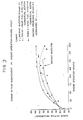
- Figure 2 is a graphical representation of data obtained which compares the octane requirement (as a function of hours of engine operation) of a 1983 Chevrolet 2.0 liter engine using an unleaded base fuel containing 60 PTB of a commercial fuel additive, and the identical engine using a motor fuel composition of the instant invention, as exemplified by Example VI, which is an unleaded base fuel containing 30 PTB of the reaction product of the instant invention, as exemplified by Example II, in combination with 150 PTB of polyisobutylene of a molecular weight of about 1300.
- the reaction product additive of the instant invention is prepared by reacting a dibasic acid anhydride, a diamine containing block copolymers with polyoxyalkylene backbones and a hydrocarbyl polyamine.
- dibasic acid anhydride reactant used to prepare the reaction product is of the formula where R1 is either H or a C1-C5 alkyl radical.
- dibasic acid anhydrides suitable for use include maleic anhydride; alpha-methyl maleic anhydride; alpha-ethyl maleic anhydride; and alpha, beta-dimethyl maleic anhydride.
- the preferred dibasic acid anhydride for use is maleic anhydride.
- the novelty of the prescribed polyoxyalkylene diamine reactant resides in the fact that it contains a large number (5-150, preferably 8-50) of polyoxypropylene ether moieties in combination with a smaller number (2-12, preferably 4-8) of polyoxybutylene ether moieties.
- Ten pounds of a polyethylene glycol of an approximate molecular weight of 600 and 100 g of 45% aqueous KOH were charged into a ten-gallon reactor, which was then purged with prepurified nitrogen. While maintaining a nitrogen purge, the reactor was heated to 100°C, and the initiator was then dried to a water content of less than 0.1% by vacuum stripping followed by nitrogen stripping. Thereafter, 19.1 lb of ethylene oxide was charged and reacted at 105-110°C and 50 psig for 1.25 hours. Without digestion, 26.2 lb of propylene oxide was then charged and reacted at 105-110°C and 50 psig over a 3 hour period.
- the reaction mixture was thereafter heated to about 120°C, and 2.9 lb. of butylene oxide was added over a 30 minute period. After a 2 hour digestion period, the alkaline polyol was neutralized by stirring for 2 hours with 360 g of MAGNESOL 30/40, which was added as an aqueous slurry. To stabilize the material, 26.4 g of di-t-butyl p-cresol was added. The neutralized product was then vacuum stripped to about 5 mm Hg pressure, nitrogen stripped, and filtered.
- the finished product had the following properties: Acid no., mg KOH/g 0.01 Hydroxyl no., mg KOH/g 35 Water, wt % 0.01 pH in 10:6 isopropanol-water 8.1 Color, Pt-Co 40 Sodium, ppm 0.2 Potassium, ppm 0.2 Peroxide, ppm 1.1 Viscosity, °F, cc 77 988 100 513
- the hydrocarbyl polyamine reactant used to prepare the reaction product may be either: (i) a hydrocarbyl polyamine of the formula R2(NH-R3) x -NH2 where R2 is an alkyl radical having from about 1-24, preferably 12-20 carbon atoms, R3 is an alkylene radical having from about 1-6 carbon atoms, and x has a value from 1-10, preferably 1-5; or (ii) a n-alkyl-alkylene diamine of the formula R4 - NH - (CH2) n - NH2 where R4 is an aliphatic hydrocarbon radical having from about 1 to 24 carbon atoms, preferably from about 12 to 20 carbon atoms, and n has a value from about 1 to 6, preferably having a value of 3.
- N-alkyl-alkylene diamines suitable for use in preparing the reaction product of the instant invention include aliphatic diamines commercially available from Akzo Chemie America Co. under the DUOMEEN series trade name.
- n-alkyl-alkylene diamines include n-coco-1,3-diaminopropane (DUOMEEN C), n-soya-1,3-diaminopropane (DUOMEEN S), n-tallow-1,3-diaminopropane (DUOMEEN T), and n-oleyl-1,3-diaminopropane (DUOMEEN OL).
- the most preferred n-alkyl-alkylene diamine reactant for use in preparing the reaction product is n-tallow-1,3 diaminopropane.
- the reaction product is prepared by first reacting about 1 mole of dibasic acid anhydride with about 1 to 2 moles, preferably 1.5 moles of the prescribed novel diamine containing block copolymers with polyoxyethylene, polyoxypropylene and polyoxybutylene backbones at a temperature of 30°C-200°C, preferively 90°C-150°C.
- the reaction of dibasic acid anhydride with the novel polyoxyalkylene diamine is preferably carried out in the presence of a solvent.
- a preferred solvent is one which will distill with water azeotropically. Suitable solvents include hydrocarbons boiling in the gasoline boiling range of about 30°C to about 200°C. Generally, this will include saturated and unsaturated hydrocarbons having from about 5 to about 10 carbon atoms.
- hydrocarbon solvents include hexane, cyclohexane, benzene, toluene, and mixtures thereof.
- Xylene is the preferred solvent.
- the solvent can be present in an amount of up to about 90% by weight of the total reaction mixture.
- the reaction mixture is thereafter cooled to 50°C-75°C, preferably 60°C, and 1-2 moles, preferably 1 mole of the hydrocarbyl polyamine is added.
- the new mixture is then reacted at 30°C-200°C, preferably 90°C-150°C.
- the new mixture is then reacted at about 140°C for reflux and azeotroping for 5 hours, with about 1 to 1.5 moles of water being removed.
- the reaction product can then be separated from the solvent using conventional means, or left in admixture with some or all of the solvent.
- a critical feature of the reaction product composition of the instant invention is the presence of a large number (5-150, preferably 8-50) of polyoxypropylene ether moieties in combination with more limited numbers (2-12, preferably 4-8) of polyoxybutylene ether moieties. These moieties are provided by the prescribed novel polyoxyalkylene diamine reactant.
- the presence of a large number of polyoxypropylene ether moieties enhances the gasoline solubility of the reaction product, thus increasing the efficacy of the reaction product as an additive in motor fuel compositions.
- the reaction product additive of the instant invention is advantageous over other ORI-controlling motor fuel additives such as those disclosed in U. S. Pat. Appl. Serial Nos.
- reaction product of the instant invention is soluble in gasoline and similar motor fuel compositions, and therefore requires no admixing with a solvent prior to introduction into a base motor fuel composition.
- polyoxybutylene ether moieties in the reaction product of the instant invention has been found to prevent hazing in a motor fuel composition of the instant invention.
- a reaction product was formed by reacting 54 parts of maleic anhydride, 3265 parts of xylene, and 3000 parts of a polyoxyalkylene diamine at 100°C for 2 hours.
- the polyoxyalkylene diamine was of the formula where c had an approximate value of 40.5, b+d had an approximate value of 40.5, and a+e had an approximate value of 2.5.
- the mixture was thereafter cooled to about 60°C, and 54 parts of n-tallow-1,3 diaminopropane (DUOMEEN T) were added.
- the new mixture was then reacted at about 140°C for 5 hours to produce the final reaction product.
- the final reaction product was then filtered and stripped of remaining solvent under vacuum.
- a reaction product is formed by reacting 54 parts of maleic anhydride, 3206 parts of xylene, and 3000 parts of a polyoxyalkylene diamine at 100°C for 2 hours.
- the polyoxyalkylene diamine is of the formula where c has an approximate value of 40.5, b+d has an approximate value of 40.5, and a+e has an approximate value of 2.5.
- the mixture is thereafter cooled to about 60°C, and 152 parts of n-coco-1,2 diaminopropane (DUOMEEN C) are added.
- the new mixture is then reacted at about 140°C for 5 hours to produce the final reaction product.
- the final reaction product is then filtered and stripped of remaining solvent under vacuum.
- a reaction product is formed by reacting 54 parts of maleic anhydride, 3231 parts of xylene, and 3000 parts of a polyoxyalkylene diamine at 100°C for 2 hours.
- the polyoxyalkylene diamine is of the formula where c has an approximate value of 40.5, b+d has an approximate value of 40.5, and a+e has an approximate value of 2.5.
- the mixture is thereafter cooled to about 60°C, and 176 parts of n-oleyl-1,3 diaminopropane (DUOMEEN OL) are added.
- the new mixture is then reacted at about 140°C for 5 hours to produce the final reaction product.
- the final reaction product is then filtered and stripped of remaining solvent under vacuum.
- a motor fuel composition containing 0.0005-5.0 weight percent, preferably 0.001-1.0 preferably 0.01-0.1 weight percent of the reaction product of the instant invention is surprisingly effective in minimizing and reducing the ORI of a gasoline internal combustion engine.
- This improvement has been demonstrated in engine tests where the performance characteristics of a base motor fuel composition containing a commercial fuel additive and an improved motor fuel composition of the instant invention were compared.
- the specific engine tests were made on a 2.0 liter 1983 Chevrolet four cylinder engine (Chevy Test). This test correlates well with results obtained via road simulation tests.
- Base Fuel A The base motor fuel employed in the tests (herein designated as Base Fuel A) was a premium grade gasoline essentially unleaded (less than 0.05 g of tetraethyl lead per gallon), and comprised a mixture of hydrocarbons boiling in the gasoline boiling range consisting of about 22% aromatic hydrocarbons, 11% olefinic carbons, and 67% paraffinic hydrocarbons, boiling in the range from about 90°F to 450°F.
- a suitable amount of the reaction product of the instant invention was added directly to Base Fuel A without any hazing of the motor fuel composition, and without additional solvents being necessary.
- the gasoline solubility of the reaction product of the instant invention is attributed to the presence of a large number of polyoxypropylene ether moieties in combination with polyoxyethylene and polyoxybutylene ether moieties.
- the haze-free property of the motor fuel composition comprising the reaction product is attributed to the presence of the polyoxybutylene ether moieties.
- Base Fuel A containing 60 PTB of a commercial fuel additive 60 pounds of reaction product per 1000 barrels of gasoline, equivalent to about 0.02 weight percent of reaction product based on the weight of the fuel composition
- Base Fuel A containing 100 PTB of the reaction product of Example II 100 pounds of reaction product per 1000 barrels of gasoline, equivalent to about 0.033 weight percent of reaction product based upon the weight of the fuel composition
- the Chevy Test employs a 2.0 liter 1983 Chevrolet in-line four cylinder engine with a cast alloy iron cylinder head having separate intake and exhaust ports for each cylinder.
- An electronically controlled fuel injection system maintains the required fuel flow to each engine cylinder by monitoring various engine operating parameters (e.g.
- the fuel system supplying fuel to the engine is specifically adapted for the determination of engine ORI.
- a fuel with an octane rating high enough to ensure that no audible engine knock is present is employed.
- the next lower octane fuel is then switched with the previous fuel, and this procedure continues until a knock becomes audible.
- the difference between the octane level at knock and no-knock conditions is the engine ORI.
- Engine ORI was determined as a function of hours of engine operation for both Base Fuel A containing 100 PTB of reaction product, and for Base Fuel A containing 60 PTB of a typical commercial motor fuel additive.
- the motor fuel composition of the instant invention comprises a major amount of a base motor fuel and 0.0005-5.0 weight percent, preferably 0.001-1.0, most preferably 0.01-0.1 weight percent of the above-described reaction product.
- Preferred base motor fuel compositions for use with the reaction product additive are those intended for use in spark ignition internal combustion engines.
- Such motor fuel compositions generally referred to as gasoline base stocks, preferably comprise a mixture of hydrocarbons boiling in the gasoline boiling range, preferably from about 90°F to about 450°F.
- This base fuel may consist of straight chains or branched chains or paraffins, cycloparaffins, olefins, aromatic hydrocarbons, or mixtures thereof.
- the base fuel can be derived from, among others, straight run naphtha, polymer gasoline, natural gasoline, or from catalytically cracked or thermally cracked hydrocarbons and catalytically reformed stock.
- the composition and octane level of the base fuel are not critical and any conventional motor fuel base can be employed in the practice of this invention.
- the motor fuel composition may contain any of the additive generally employed in gasoline.
- the fuel composition can contain anti-knock compounds such as tetraethyl lead compounds, anti-icing additives, upper cylinder lubricating oils, and the like.
- the motor fuel composition of the instant invention may additionally comprise a polymeric component, present in a concentration ranging from about 0.001-1.0 weight percent, preferably 0.01-0.5 weight percent, based on the total weight of the motor fuel composition.
- the polymeric component may be a polyolefin polymer, copolymer, or corresponding hydrogenated polymer or copolymer of a C2-C6 unsaturated hydrocarbon.
- the polymer component is prepared from monoolefins and diolefins, or copolymers thereof, having an average molecular weight in the range from abut 500-3500, preferably about 650-2600. Mixtures of olefin polymers with an average molecular weight falling within the foregoing range are also effective.
- the olefin monomers from which the polyolefin polymer component is prepared are unsaturated C2-C6 hydrocarbons.
- Specific olefins which may be employed to prepare the polyolefin polymer component include ethylene, propylene, isopropylene, butylene, isobutylene, amylene, hexylene, butadiene, and isoprene.
- Propylene, isopropylene, butylene, and isobutylene are particularly preferred for use in preparing the polyolefin polymer component.
- polystyrene resins which may be employed are those prepared by cracking polyolefin polymers or copolymers of high molecular weight to a polymer in the above-noted molecular weight range. Derivatives of the noted polymers obtained by saturating the polymers by hydrogenation are also effective and are a part of this invention.
- the word "polymers" is intended to include the polyolefin polymers and their corresponding hydrogenated derivatives.
- the average molecular weight range of the polymer component is a critical feature.
- the polyolefin polymer, copolymer, or corresponding hydrogenated polymer or copolymer component may have an average molecular weight in the range from abut 500-3500, preferably from about 650-2600.
- the most preferred polymer components for use in the instant invention are polypropylene with an average molecular weight in the range of about 750-1000, preferably about 800, and polyisobutylene with an average molecular weight in the range of about 1000-1500, preferably about 1300.
- the polymer component if employed, enhances the ORI reduction of the instant invention, and additionally provides enhanced cleanliness at the engine intake valves and ports.
- Examples V and VI set forth below, are illustrative of motor fuel compositions of the instant invention comprising the above-described reaction product and polymer components. It will be understood that the following examples are merely illustrative, and are not meant to limit the invention in any way.
- a motor fuel composition was obtained by mixing with Base Fuel A about 100 PTB of the reaction product component set forth in Example II (equivalent to about 0.033 wt. %) and about 150 PTB of polypropylene polymer component of a molecular weight of about 800 (equivalent to about 0.05 wt. %).
- a motor fuel composition was obtained by mixing with Base Fuel A about 30 PTB of the reaction product component set forth in Example II (equivalent to about 0.01 wt. %) and about 150 PTB of polyisobutylene of a molecular weight of about 1300 (equivalent to about 0.05 wt. %).
- a concentrate of the reaction product additive which may be added to a base motor fuel to produce the motor fuel composition of the instant invention.
- the concentrate may be prepared in a suitable liquid solvent containing from about 1.0-75.0 weight percent, preferably 5.0-35.0 weight percent of the additive component or components: namely, the above-described novel reaction product either alone or in combination with the above-described additional polymer component.
- suitable solvents for use in the concentrate include hydrocarbon solvents such as toluene and xylene, with xylene being preferred.
- Motor fuel compositions of the instant invention show improved ORI-inhibition and carburetor and valve deposit resistance over conventional motor fuel compositions.
- Motor fuel compositions of the instant invention comprise a mixture of hydrocarbons boiling in the range 90°F-450°F and additionally comprise:
- the instant invention is also directed to a concentrate comprising a hydrocarbon solvent in admixture with 0.1-10.0 weight percent of the abovedescribed reaction product component and 25.0-75.0 weight percent of the abovedescribed hydrocarbon solvent-polyisobutylene ethylene diamine-polyisobutylene mixture.
- Figure 3 is a graphical representation of data obtained which compares the octane requirement (as a function of hours of engine operation) of a Chevrolet 1.8 liter engine using an commercial unleaded base fuel containing 60 PTB of a commercial fuel additive, and the identical engine using a motor fuel composition of the instant invention as exemplified by Example IV.
- Figure 4 is a graphical representation of data obtained which compares the octane requirement (as a function of hours of engine operation) of a Chevrolet 2.0 liter engine using a commercial gasoline, and the identical engine using a motor fuel composition of the instant invention as exemplified by Example IV.
- Component (I) of the instant invention is a reaction product prepared by reacting a dibasic acid anhydride, a diamine containing block copolymers with polyoxyalkylene backbones, and a hydrocarbyl polyamine.
- the reaction product component of the instant invention is identical to the reaction product disclosed in co-assigned U. S. Pat. Appl. Serial No. 000,230 (D#78,679), incorporated herein by reference.
- dibasic acid anhydride reactant used to prepare the reaction product component of the instant invention is of the formula where R1 is either H or a C1-C5 alkyl radical.
- dibasic acid anhydrides suitable for use include maleic anhydride; alpha-methyl maleic anhydride; alpha-ethyl maleic anhydride; and alpha, beta-dimethyl maleic anhydride.
- the preferred dibasic acid anhydride for use is maleic anhydride.
- the polyoxyalkylene diamine reactant used to prepare the reaction product component of the instant invention is a diamine of the formula where c has a value from about 5-150, preferably 8-50; b + d has a value from about 5-150, preferably 8-50; and a + e has a value from about 2-12, preferably 4-8.
- the novelty of the prescribed polyoxyalkylene diamine reactant resides in the fact that it contains a large number (5-150, preferably 8-50) of polyoxypropylene and polyoxyethylene ether moieties in combination with a smaller number (2-12, preferably 4-8) of polyoxybutylene ether moieties.
- the method of synthesis of the prescribed novel polyoxyalkylene diamine reactant is set forth in detail in co-assigned U. S. Pat. Appl. Serial No. 000,253 (D#78,650), incorporated herein by reference.
- the hydrocarbyl polyamine reactant used to prepare the reaction product component of the instant invention may be either: (i) a hydrocarbyl polyamine of the formula R2(NH-R3) x -NH2 where R2 is an alkyl radical having from about 1-24, preferably 12-20 carbon atoms, R3 is an alkylene radical having from about 1-6 carbon atoms, and x has a value from 1-10, preferably 1-5; or (ii) a n-alkyl-alkylene diamine of the formula R4 - NH - (CH2) n - NH2 where R4 is an aliphatic hydrocarbon radical having from about 1 to 24 carbon atoms, preferably from about 12 to 20 carbon atoms, and n has a value from about 1 to 6, preferably having a value of 3.
- N-alkyl-alkylene diamines suitable for use in preparing the reaction product of the instant invention include aliphatic diamines commercially available from Akzo Chemie America Co. under the DUOMEEN series trade name.
- n-alkyl-alkylene diamines include n-coco-1,3-diaminopropane (DUOMEEN C), n-soya-1,3-diaminopropane (DUOMEEN S), n-tallow-1,3-diaminopropane (DUOMEEN T), and n-oleyl-1,3-diaminopropane (DUOMEEN OL).
- the most preferred n-alkyl-alkylene diamine reactant for use in preparing the reaction product component of the instant invention is n-tallow-1,3 diaminopropane.
- the reaction product component of the instant invention is prepared by first reacting about 1 mole of dibasic acid anhydride with about 1 to 2 moles, preferably 1.5 moles of the prescribed diamine reactant containing block copolymers with polyoxyethylene, polyoxypropylene and polyoxybutylene backbones at a temperature of 30°C-200°C, preferably 90°C-150°C.
- the reaction of dibasic acid anhydride with the polyoxyalkylene diamine reactant is preferably carried out in the presence of a solvent.
- a preferred solvent is one which will distill with water azeotropically. Suitable solvents include hydrocarbons boiling in the gasoline boiling range of about 30°C to about 200°C.
- this will include saturated and unsaturated hydrocarbons having from about 5 to about 10 carbon atoms.
- suitable hydrocarbon solvents include hexane, cyclohexane, benzene, toluene, and mixtures thereof.
- Xylene is the preferred solvent.
- the solvent can be present in an amount of up to about 90% by weight of the total reaction mixture.
- the reaction mixture is thereafter cooled to 50°C-75°C, preferably 60°C, and 1-2 moles, preferably 1 mole of the hydrocarbyl polyamine is added.
- the new mixture is then reacted at 30°C-200°C, preferably 90°C-150°C.
- reaction product component of the instant invention In a preferred mode of preparing the reaction product component of the instant invention, about 1 mole of maleic anhydride and about 1.5 moles of the prescribed polyoxyalkylene diamine where c has a value of 8-50, b+d has a value of 8-50, and a+e has a value of 4-8 are combined with the solvent xylene and reacted at a temperature of about 100°C. The reaction mixture is maintained at this temperature for approximately 2 hours. The mixture is then cooled to about 60°C, whereupon about 1 mole of the hydrocarbyl polyamine n-tallow-1,3 diaminopropane is added.
- the new mixture is then reacted at about 140°C for reflux and azeotroping for 5 hours, with about 1 to 1.5 moles of water being removed.
- the reaction product can then be separated from the solvent using conventional means, or left in admixture with some or all of the solvent.
- a critical feature of the reaction product component of the instant invention is the presence of a large number (5-150, preferably 8-50) of polyoxypropylene and polyoxyethylene ether moieties in combination with more limited numbers (2-12, preferably 4-8) of polyoxybutylene ether moieties. These moieties are provided by the prescribed polyoxyalkylene diamine reactant.
- the presence of a large number of polyoxypropylene and polyoxyethylene ether moieties enhances the gasoline solubility of the reaction product component, thus increasing the efficacy of the reaction product as an additive in motor fuel compositions.
- the reaction product component of the instant invention is advantageous over other reaction product additives employed to control ORI in motor fuels such as those disclosed in co-assigned U. S. Patents 4,659,336 and 4,659,337 in that the reaction product component of the instant invention is soluble in gasoline and similar motor fuel compositions, and therefore requires no admixing with a solvent prior to introduction into a base motor fuel composition.
- the mixture was thereafter cooled to about 60°C, and 54 parts of n-tallow-1,3 diaminopropane (DUOMEEN T) were added.
- the new mixture was then reacted at about 140°C for 5 hours to produce the final reaction product.
- the final reaction product was then filtered and stripped off remaining solvent under vacuum.
- a reaction product is formed by reacting 54 parts of maleic anhydride, 3206 parts of xylene, and 3000 parts of a polyoxyalkylene diamine at 100°C for 2 hours.
- the polyoxyalkylene diamine is of the formula where c has an approximate value of 5-150, b+d has an approximate value of 5-150, and a+e has an approximate value of 2-12.
- the mixture is thereafter cooled to about 60°C, and 152 parts of n-coco-1,2 diaminopropane (DUOMEEN C) are added.
- the new mixture is then reacted at about 140°C for 5 hours to produce the final reaction product.
- the final reaction product is then filtered and stripped of remaining solvent under vacuum.
- a reaction product is formed by reacting 54 parts of maleic anhydride, 3231 parts of xylene, and 3000 parts of a polyoxyalkylene diamine at 100°C for 2 hours.
- the polyoxyalkylene diamine is of the formula where c has an approximate value of 5-150, b+d has an approximate value of 5-150, and a+e has an approximate value of 2-12.
- Component (II) of the motor fuel composition of the instant invention is a mixture of a major amount of polyisobutylene ethylene diamine and a minor amount of polyisobutylene. These subcomponents will usually be employed in admixture with a hydrocarbon solvent to facilitate addition of Component (II) to a base motor fuel composition.
- the polyisobutylene ethylene diamine subcomponent of Component (II) of the instant invention is typically present in a concentration range of 50-75 parts, preferably about 60 parts by weight, based upon the weight of the entire composition which makes up Component (II).
- the polyisobutylene ethylene diamine subcomponent is of the formula where z has a value of 30-40, preferably 32-35, most preferably 33.
- the polyisobutylene subcomponent of Component (II) of the instant invention is typically present in a concentration range of 5-25 parts, preferably 10-20 parts by weight, based upon the weight of the entire composition which makes up Component (II).
- the polyisobutylene subcomponent is of the formula where z again has a value of 30-40, preferably 32-35, most preferably 33.
- the hydrocarbon solvent employed to facilitate admixture of the abovedescribed subcomponents is preferably a light aromatic distillate composition.
- a commercially available light aromatic distillate composition containing the abovedescribed polyisobutylene ethylene diamine and polyisobutylene compounds in the abovespecified concentrations and particularly preferred for use as Component (II) of the instant invention is the commercial gasoline additive ORONITE OGA-472, available from Chevron Chemical Company.
- ORONITE OGA-472 is a composition containing approximately 60 parts by weight of polyisobutylene ethylene diamine, approximately 13 parts by weight polyisobutylene, and approximately 27 parts by weight light aromatic distillate, including xylene and C9 alkylbenzenes.
- Fuel compositions containing ORONITE OGA-472 as an additive include those described in U. S. 4,141,693 (Feldman et al.), 4,028,065 (Sprague et al.), and 3,966,429 (Sprague et al.).
- the motor fuel composition of the instant invention comprises a major amount of a base motor fuel and 0.0005-5.0 weight percent, preferably 0.001-1.0 weight percent of Component (I) (the abovedescribed reaction product component) and 0.001-1.0 weight percent, preferably 0.01-0.5 weight percent of Component (II), (the abovedescribed mixture comprising a major amount of polyisobutylene ethylene diamine and a minor amount of polyisobutylene in a hydrocarbon solvent).
- Preferred base motor fuel compositions are those intended for use in spark ignition internal combustion engines.
- Such motor fuel compositions generally referred to as gasoline base stocks, preferably comprise a mixture of hydrocarbons boiling in the gasoline boiling range, preferably from about 90°F to about 450°F.
- This base fuel may consist of straight chains or branched chains or paraffins, cycloparaffins, olefins, aromatic hydrocarbons, or mixtures thereof.
- the base fuel can be derived from, among others, straight run naphtha, polymer gasoline, natural gasoline, or from catalytically cracked or thermally cracked hydrocarbons and catalytically reformed stock.
- the composition and octane level of the base fuel are not critical and any conventional motor fuel base can be employed in the practice of this invention.
- the motor fuel composition may contain any of the additives generally employed in gasoline.
- the fuel composition can contain conventional carburetor detergents, anti-knock compounds such as tetraethyl lead compounds, anti-icing additives, upper cylinder lubricating oils, and the like.
- a motor fuel composition representing the best mode of practicing the instant invention is set forth in Example IV, below.
- 30 PTB of the reaction product set forth in Example I i.e. 30 pounds of reaction product per 1000 barrels of gasoline, equivalent to about 0.01 weight percent of reaction product component based on the weight of the fuel composition
- 205 PTB about 0.07 weight percent
- a composition (ORONITE 0GA-472) containing approximately 60 parts by weight polyisobutylene ethylene diamine, approximately 13 parts by weight polyisobutylene, and approximately 27 parts by weight light aromatic distillate comprising xylene and C9 alkylbenzenes were added to a major amount of a base motor fuel composition which comprises a mixture of hydrocarbons boiling in the range of about 90°F-450°F.
- a motor fuel composition containing 0.0005-5.0 weight percent, preferably 0.001-1.0 weight percent of Component (I) and 0.001-1.0 weight percent, preferably 0.01-0.5 weight percent of Component (II) is effective in both minimizing and reducing the ORI of a gasoline internal combustion engine, and in improving carburetor detergency and intake valve cleanliness of the motor fuel.
- Base Fuel A The base motor fuel employed in the tests (herein designated as Base Fuel A) was a premium grade gasoline essentially unleaded (less than 0.05 g of tetraethyl lead per gallon), and comprised a mixture of hydrocarbons boiling in the gasoline boiling range consisting of about 22% aromatic hydrocarbons, 11% olefinic carbons, and 67% paraffinic hydrocarbons, boiling in the range from about 90°F to 450°F.
- a suitable amount of the reaction product component of the instant invention was added directly to Base Fuel A without additional solvents being necessary.
- the gasoline solubility of the reaction product component of the instant invention is attributed to the presence of a large number of polyoxypropylene ether moieties in combination with polyoxyethylene and polyoxybutylene ether moieties.
- Base Fuel A containing 60 PTB of a commercial fuel additive 60 pounds of reaction product per 1000 barrels of gasoline, equivalent to about 0.02 weight percent of reaction product based on the weight of the fuel composition
- a motor fuel composition of the instant invention as exemplified by Example IV
- FRDT Fuel Related Deposit Test
- the test measures the octane requirement of an engine for a particular motor fuel as a function of varying engine speed and load.
- This test employs a 1.8 liter Chrysler engine controlled by a dedicated computer which operates the engine speed and load controls, test stand safeties, and data acquisition. Due to the multifunctional capabilities of the computer controlled system, the test cycle very closely simulates an actual engine in a vehicle.
- the computer can change the engine speed and load quickly and often, and therefore provides a good simulation of a vehicle driving in an urban environment.
- the carburetor intake valve and intake manifold detergency properties of a commercially available motor fuel and a motor fuel composition of the instant invention were also measured via the Merit Rating Test. This test may be described as follows. At the end of a FRDT run for a given motor fuel composition, portions of the engine are dissassembled and various engine components are visually examined to determined the extent of deposit formation. This is determined via a visual rating system scaled from 1-10, with a value of 10 being a clean component and a value of 1 being a deposit-laden component.
- the ORI tendencies of a commercially available gasoline and a motor fuel composition of the instant invention were also measured via the 2.0 liter Chrysler (Throttle Body Injector) multicylinder engine test (Chevy Test).
- the Chevy Test employs a 2.0 liter Chrysler in-line four cylinder engine with a cast alloy iron cylinder head having separate intake and exhaust ports for each cylinder.
- An electronically controlled fuel injection system maintains the required fuel flow to each engine cylinder by monitoring various engine operating parameters (e.g. manifold absolute pressure, throttle valve position, coolant temperature, engine r.p.m., the exhaust gas oxygen content) and adjusting the fuel flow accordingly.
- the fuel system supplying fuel to the engine is specifically adapted for the determination of engine ORI.
- a fuel with an octane rating high enough to ensure that no audible engine knock is present is employed.
- the next lower octane fuel is then switched with the previous fuel, and this procedure continues until a knock becomes audible.
- the octane level one number above knock is the engine octane requirement.
- Engine ORI was determined as a function of hours of engine operation for both the commercial gasoline and a motor fuel composition of the instant invention.
- the carburetor, intake valve and intake manifold detergency properties of the commercial gasoline and a motor fuel composition of the instant invention were also compared via the Merit Rating Test.
- portions of the engine are disassembled and various engine components are visually examined to determine the extent of the deposit formation. This is determined via a visual rating system scaled from 1-10, with a value of 10 being a clean component and a value of 1 being a deposit-laden component.
- a concentrate of the reaction product and polyisobutylene ethylene diamine-polyisobutylene components of the instant invention may be prepared in a suitable liquid solvent such as toluene and xylene, with xylene being preferred.
- a suitable liquid solvent such as toluene and xylene, with xylene being preferred.
- approximately 0.1-10.0, preferably 5.0-10.0 percent of the reaction product of Example I, and approximately 25.0-75.0, preferably 50.0-60.0 weight percent of the abovedescribed aromatic distillate-polyisobutylene ethylene diamine-polyisobutylene mixture are employed in admixture with 25.0-50.0, preferably 30.0-40.0 weight percent of aromatic hydrocarbons, preferably xylene. All weight percents are based upon the total weight of the concentrate.
Landscapes
- Chemical & Material Sciences (AREA)
- Oil, Petroleum & Natural Gas (AREA)
- Engineering & Computer Science (AREA)
- Chemical Kinetics & Catalysis (AREA)
- General Chemical & Material Sciences (AREA)
- Organic Chemistry (AREA)
- Liquid Carbonaceous Fuels (AREA)
- Addition Polymer Or Copolymer, Post-Treatments, Or Chemical Modifications (AREA)
Applications Claiming Priority (4)
| Application Number | Priority Date | Filing Date | Title |
|---|---|---|---|
| US158424 | 1980-06-11 | ||
| US07/084,354 US4852993A (en) | 1987-08-12 | 1987-08-12 | ORI-inhibited and deposit-resistant motor fuel composition |
| US07/158,424 US4810261A (en) | 1987-01-02 | 1988-02-19 | Reaction product additive and ori-inhibited motor fuel composition |
| US84354 | 1988-02-19 |
Publications (2)
| Publication Number | Publication Date |
|---|---|
| EP0303351A1 true EP0303351A1 (de) | 1989-02-15 |
| EP0303351B1 EP0303351B1 (de) | 1991-06-19 |
Family
ID=26770890
Family Applications (1)
| Application Number | Title | Priority Date | Filing Date |
|---|---|---|---|
| EP19880306166 Expired EP0303351B1 (de) | 1987-08-12 | 1988-07-06 | Niederschläge vermindernde Motorbrennstoffzusammensetzung mit einem Zusatz, der die Verwendung von die Oktanzahl steigernden Mitteln herabsetzt |
Country Status (3)
| Country | Link |
|---|---|
| EP (1) | EP0303351B1 (de) |
| JP (1) | JP2613271B2 (de) |
| DE (1) | DE3863325D1 (de) |
Families Citing this family (1)
| Publication number | Priority date | Publication date | Assignee | Title |
|---|---|---|---|---|
| JP7562548B2 (ja) * | 2019-02-21 | 2024-10-07 | ハンツマン ペトロケミカル エルエルシー | 多官能性添加剤化合物 |
Citations (10)
| Publication number | Priority date | Publication date | Assignee | Title |
|---|---|---|---|---|
| US3806456A (en) * | 1971-05-17 | 1974-04-23 | Lubrizol Corp | Acylated nitrogen compositions |
| US3960515A (en) * | 1973-10-11 | 1976-06-01 | Chevron Research Company | Hydrocarbyl amine additives for distillate fuels |
| US4141693A (en) * | 1974-12-18 | 1979-02-27 | Standard Oil Company (Ohio) | Manganese containing fuels |
| GB2010324A (en) * | 1977-12-16 | 1979-06-27 | Chevron Res | Dispersant additive for diesel fuel and a fuel composition containing the same |
| US4313764A (en) * | 1980-07-31 | 1982-02-02 | Gaf Corporation | Isocyanate polyoxyalkylenes |
| EP0062940A2 (de) * | 1981-04-13 | 1982-10-20 | Shell Internationale Researchmaatschappij B.V. | Verfahren, Motortreibstoffzusammensetzung und Konzentrat zur Kontrolle der Steigerung der erforderlichen Oktanzahl |
| EP0207560A1 (de) * | 1985-06-24 | 1987-01-07 | Shell Internationale Researchmaatschappij B.V. | Benzinzusammensetzung |
| EP0208978A1 (de) * | 1985-07-19 | 1987-01-21 | Texaco Development Corporation | Reaktionsprodukt aus Maleinsäureanhydrid-Polyether-Polyamin und dieses enthaltende Motorkraftstoffzusammensetzung |
| US4659336A (en) * | 1986-03-28 | 1987-04-21 | Texaco Inc. | Motor fuel composition |
| EP0273545A1 (de) * | 1987-01-02 | 1988-07-06 | Texaco Development Corporation | Reaktionsprodukt und ori-gehemmte Motortreibstoffzusammensetzung |
-
1988
- 1988-07-06 DE DE8888306166T patent/DE3863325D1/de not_active Expired - Fee Related
- 1988-07-06 EP EP19880306166 patent/EP0303351B1/de not_active Expired
- 1988-08-10 JP JP63198113A patent/JP2613271B2/ja not_active Expired - Fee Related
Patent Citations (10)
| Publication number | Priority date | Publication date | Assignee | Title |
|---|---|---|---|---|
| US3806456A (en) * | 1971-05-17 | 1974-04-23 | Lubrizol Corp | Acylated nitrogen compositions |
| US3960515A (en) * | 1973-10-11 | 1976-06-01 | Chevron Research Company | Hydrocarbyl amine additives for distillate fuels |
| US4141693A (en) * | 1974-12-18 | 1979-02-27 | Standard Oil Company (Ohio) | Manganese containing fuels |
| GB2010324A (en) * | 1977-12-16 | 1979-06-27 | Chevron Res | Dispersant additive for diesel fuel and a fuel composition containing the same |
| US4313764A (en) * | 1980-07-31 | 1982-02-02 | Gaf Corporation | Isocyanate polyoxyalkylenes |
| EP0062940A2 (de) * | 1981-04-13 | 1982-10-20 | Shell Internationale Researchmaatschappij B.V. | Verfahren, Motortreibstoffzusammensetzung und Konzentrat zur Kontrolle der Steigerung der erforderlichen Oktanzahl |
| EP0207560A1 (de) * | 1985-06-24 | 1987-01-07 | Shell Internationale Researchmaatschappij B.V. | Benzinzusammensetzung |
| EP0208978A1 (de) * | 1985-07-19 | 1987-01-21 | Texaco Development Corporation | Reaktionsprodukt aus Maleinsäureanhydrid-Polyether-Polyamin und dieses enthaltende Motorkraftstoffzusammensetzung |
| US4659336A (en) * | 1986-03-28 | 1987-04-21 | Texaco Inc. | Motor fuel composition |
| EP0273545A1 (de) * | 1987-01-02 | 1988-07-06 | Texaco Development Corporation | Reaktionsprodukt und ori-gehemmte Motortreibstoffzusammensetzung |
Also Published As
| Publication number | Publication date |
|---|---|
| JPS6466293A (en) | 1989-03-13 |
| DE3863325D1 (de) | 1991-07-25 |
| EP0303351B1 (de) | 1991-06-19 |
| JP2613271B2 (ja) | 1997-05-21 |
Similar Documents
| Publication | Publication Date | Title |
|---|---|---|
| US4810261A (en) | Reaction product additive and ori-inhibited motor fuel composition | |
| US4747851A (en) | Novel polyoxyalkylene diamine compound and ori-inhibited motor fuel composition | |
| US4968321A (en) | ORI-inhibited motor fuel composition | |
| EP1518918B1 (de) | Kraftstoffzusammensetzungen und Verfahren zu deren Verwendung | |
| US5752991A (en) | Very long chain alkylphenyl polyoxyalkylene amines and fuel compositions containing the same | |
| EP0240743B1 (de) | Kraftstoffgemisch | |
| US5211721A (en) | Polyoxyalkylene ester compounds and ORI-inhibited motor fuel compositions | |
| CA1254388A (en) | Maleic anhydride-polyether-polyamine reaction product and motor fuel composition containing same | |
| US4985047A (en) | Poly(oxybutylene)poly(oxyethylene)diamine compound and ORI-inhibited motor fuel composition | |
| US5131921A (en) | Polyoxyalkylene N-acyl sarcosinate ester compounds and ORI-inhibited motor fuel compositions | |
| US5061291A (en) | Ori-inhibited motor fuel composition and storage stable concentrate | |
| US4852993A (en) | ORI-inhibited and deposit-resistant motor fuel composition | |
| EP0444770B1 (de) | Neue Polyoxyalkylenesterverbindungen und im Oktanzahlbedarfsanstieg gehemmte Motorbrennstoffzusammensetzungen | |
| EP0380305B1 (de) | Ori-gehemmte und niederschlagsbeständige Motorkraftstoffzusammensetzung | |
| US4944770A (en) | Motor fuel additive and ori-inhibited motor fuel composition | |
| EP0327097B1 (de) | O.R.I.-gehemmte Motorbrennstoffzusammensetzung, und einlagerungsbeständiges Konzentrat | |
| US4869728A (en) | Motor fuel additive and ORI-inhibited motor fuel composition | |
| US4981493A (en) | ORI-Inhibited and deposit-resistant motor fuel composition | |
| EP0381359B1 (de) | Ori-gehemmte und niederschlagsbeständige Motorkraftstoffzusammensetzung | |
| US5366518A (en) | Motor fuel additive and fuel composition | |
| EP0303351B1 (de) | Niederschläge vermindernde Motorbrennstoffzusammensetzung mit einem Zusatz, der die Verwendung von die Oktanzahl steigernden Mitteln herabsetzt | |
| EP0534551B1 (de) | Benzinzusammensetzung | |
| CA1331188C (en) | Reaction product additive and ori-inhibited motor fuel composition |
Legal Events
| Date | Code | Title | Description |
|---|---|---|---|
| PUAI | Public reference made under article 153(3) epc to a published international application that has entered the european phase |
Free format text: ORIGINAL CODE: 0009012 |
|
| AK | Designated contracting states |
Kind code of ref document: A1 Designated state(s): BE DE FR GB IT NL SE |
|
| 17P | Request for examination filed |
Effective date: 19890411 |
|
| 17Q | First examination report despatched |
Effective date: 19900206 |
|
| GRAA | (expected) grant |
Free format text: ORIGINAL CODE: 0009210 |
|
| AK | Designated contracting states |
Kind code of ref document: B1 Designated state(s): BE DE FR GB IT NL SE |
|
| PG25 | Lapsed in a contracting state [announced via postgrant information from national office to epo] |
Ref country code: IT Free format text: LAPSE BECAUSE OF FAILURE TO SUBMIT A TRANSLATION OF THE DESCRIPTION OR TO PAY THE FEE WITHIN THE PRE;WARNING: LAPSES OF ITALIAN PATENTS WITH EFFECTIVE DATE BEFORE 2007 MAY HAVE OCCURRED AT ANY TIME BEFORE 2007. THE CORRECT EFFECTIVE DATE MAY BE DIFFERENT FROM THE ONE RECORDED.SCRIBED TIME-LIMIT Effective date: 19910619 Ref country code: FR Effective date: 19910619 Ref country code: NL Effective date: 19910619 Ref country code: SE Effective date: 19910619 |
|
| REF | Corresponds to: |
Ref document number: 3863325 Country of ref document: DE Date of ref document: 19910725 |
|
| EN | Fr: translation not filed | ||
| NLV1 | Nl: lapsed or annulled due to failure to fulfill the requirements of art. 29p and 29m of the patents act | ||
| PLBE | No opposition filed within time limit |
Free format text: ORIGINAL CODE: 0009261 |
|
| STAA | Information on the status of an ep patent application or granted ep patent |
Free format text: STATUS: NO OPPOSITION FILED WITHIN TIME LIMIT |
|
| 26N | No opposition filed | ||
| PGFP | Annual fee paid to national office [announced via postgrant information from national office to epo] |
Ref country code: GB Payment date: 19970623 Year of fee payment: 10 |
|
| PGFP | Annual fee paid to national office [announced via postgrant information from national office to epo] |
Ref country code: BE Payment date: 19970624 Year of fee payment: 10 |
|
| PGFP | Annual fee paid to national office [announced via postgrant information from national office to epo] |
Ref country code: DE Payment date: 19970930 Year of fee payment: 10 |
|
| PG25 | Lapsed in a contracting state [announced via postgrant information from national office to epo] |
Ref country code: GB Free format text: LAPSE BECAUSE OF NON-PAYMENT OF DUE FEES Effective date: 19980706 |
|
| PG25 | Lapsed in a contracting state [announced via postgrant information from national office to epo] |
Ref country code: BE Free format text: LAPSE BECAUSE OF NON-PAYMENT OF DUE FEES Effective date: 19980731 |
|
| BERE | Be: lapsed |
Owner name: TEXACO DEVELOPMENT CORP. Effective date: 19980731 |
|
| GBPC | Gb: european patent ceased through non-payment of renewal fee |
Effective date: 19980706 |
|
| PG25 | Lapsed in a contracting state [announced via postgrant information from national office to epo] |
Ref country code: DE Free format text: LAPSE BECAUSE OF NON-PAYMENT OF DUE FEES Effective date: 19990501 |