EP0303390A1 - Fabrication de diodes - Google Patents
Fabrication de diodes Download PDFInfo
- Publication number
- EP0303390A1 EP0303390A1 EP88307157A EP88307157A EP0303390A1 EP 0303390 A1 EP0303390 A1 EP 0303390A1 EP 88307157 A EP88307157 A EP 88307157A EP 88307157 A EP88307157 A EP 88307157A EP 0303390 A1 EP0303390 A1 EP 0303390A1
- Authority
- EP
- European Patent Office
- Prior art keywords
- layer
- intrinsic
- diodes
- manufacturing
- conductivity type
- Prior art date
- Legal status (The legal status is an assumption and is not a legal conclusion. Google has not performed a legal analysis and makes no representation as to the accuracy of the status listed.)
- Granted
Links
Images
Classifications
-
- H—ELECTRICITY
- H10—SEMICONDUCTOR DEVICES; ELECTRIC SOLID-STATE DEVICES NOT OTHERWISE PROVIDED FOR
- H10W—GENERIC PACKAGES, INTERCONNECTIONS, CONNECTORS OR OTHER CONSTRUCTIONAL DETAILS OF DEVICES COVERED BY CLASS H10
- H10W74/00—Encapsulations, e.g. protective coatings
- H10W74/10—Encapsulations, e.g. protective coatings characterised by their shape or disposition
- H10W74/131—Encapsulations, e.g. protective coatings characterised by their shape or disposition the semiconductor body being only partially enclosed
- H10W74/147—Encapsulations, e.g. protective coatings characterised by their shape or disposition the semiconductor body being only partially enclosed the encapsulations being multilayered
-
- C—CHEMISTRY; METALLURGY
- C09—DYES; PAINTS; POLISHES; NATURAL RESINS; ADHESIVES; COMPOSITIONS NOT OTHERWISE PROVIDED FOR; APPLICATIONS OF MATERIALS NOT OTHERWISE PROVIDED FOR
- C09J—ADHESIVES; NON-MECHANICAL ASPECTS OF ADHESIVE PROCESSES IN GENERAL; ADHESIVE PROCESSES NOT PROVIDED FOR ELSEWHERE; USE OF MATERIALS AS ADHESIVES
- C09J4/00—Adhesives based on organic non-macromolecular compounds having at least one polymerisable carbon-to-carbon unsaturated bond ; adhesives, based on monomers of macromolecular compounds of groups C09J183/00 - C09J183/16
-
- H—ELECTRICITY
- H10—SEMICONDUCTOR DEVICES; ELECTRIC SOLID-STATE DEVICES NOT OTHERWISE PROVIDED FOR
- H10P—GENERIC PROCESSES OR APPARATUS FOR THE MANUFACTURE OR TREATMENT OF DEVICES COVERED BY CLASS H10
- H10P54/00—Cutting or separating of wafers, substrates or parts of devices
Definitions
- This invention relates to a method of manufacturing diodes and in particular to a method of manufacturing diodes comprising a region of intrinsic material between highly doped p-type and n-type layers to form a PIN diode.
- the intrinsic region When there is no bias applied to a PIN diode, the intrinsic region is empty of tree charges. However, when the device is forward-biased, electrons from the n-type layer flow into the intrinsic region thus lowering the AC resistance of the device. In this way, as the DC current through the device increases, the AC resistance decreases.
- PIN diodes It is known to manufacture PIN diodes by diffusing p-type material into one surface and n-type material into the opposite surface of a thin slice of intrinsic silicon.
- Conventional PIN diodes have an intrinsic region of thickness 5 to 10 ⁇ m. It is difficult to reduce the width of the intrinsic region of a diode made by presently-known techniques without impairing the quality of the intrinsic material; the transition regions become less abrupt and impurities diffuse into the intrinsic region.
- a method of manufacturing a plurality of diodes comprises the steps of introducing a dopant of a first conductivity type into one surface of a layer of intrinsic material; growing a layer of supporting material onto the surface into which the dopant of said first conductivity type was introduced; introducing a dopant of a second conductivity type into the other surface of the layer of intrinsic material; and subsequently dividing the layer of intrinsic material into individual elements each of which constitutes a diode.
- Each resulting diode is therefore a PIN (or a NIP) diode in which the purity of the middle layer of intrinsic semiconductor material is preserved.
- the intrinsic semiconductor material can be a very thin and fragile wafer or slice.
- a coating of a passivation material is formed on the surface of the intrinsic material where the layer of supporting material is to be grown.
- the coating of passivation material preferably comprises a layer of silicon dioxide overlaid with a layer of silicon nitride.
- the supporting material is preferably formed of polysilicon or of any grown material, provided that the material would not damage the intrinsic layer (e.g. by transfer of dopants). It acts to strengthen the substrate and facilitates the handling of the device during the manufacturing process.
- the material used should be capable of withstanding high temperatures and should have a temperature coefficient of expansion compatible with that of the semiconductor material.
- the intrinsic layer may then be thinned to a degree which is not practicable using other methods of manufacture, to produce a very thin device.
- dopants of a second conductivity type may be diffused into the exposed surface.
- the surface of the intrinsic layer into which the dopants of the second conductivity type are diffused may be masked.
- a mesa structure for the device can then be formed by etching through the intrinsic layer as far as the supporting layer.
- the masking layer is removed and further coatings of silicon oxide and silicon nitride are formed, for passivation.
- a further glass passivating layer may be formed over the oxide and nitride coatings.
- the passivation coatings covering the semiconductor layer, into which dopants of said second conductivity type have been introduced may be at least partially removed to expose the surface of the said semiconductor layer.
- a metal contact may then be formed on the exposed surface.
- the supporting material is conveniently etched away, having mounted the wafer on a ceramic carrier using wax.
- the exposed areas of the passivation coating may then be removed also by etching so as to expose the semiconductor material doped with dopants of said first conductivity type.
- the exposed material is coated with metal to form the other diode contact.
- the other side of the semiconductor material doped with dopants of said first conductivity type is preferably plated with metal to form a base which acts as an integral heat sink. As the thermal paths to the heat sink are thus very short, this improves the power handling of the device.
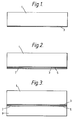
- a 2 ⁇ m layer 3 of heavily doped p-type silicon is formed by diffusing boron into a 250 ⁇ m substrate 1 of intrinsic silicon.
- a Silox process a 0.1 ⁇ m coating 5 of silicon dioxide is deposited onto the diffused surfaces followed by a 0.2 ⁇ m coating 7 of silicon nitride deposited by chemical vapour deposition (Figure 2), to form passivation coatings.
- Figure 3 shows a 125 ⁇ m supporting layer 9 of polysilicon which is grown on top of the nitride coating 7 by chemical vapour deposition.
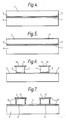
- the intrinsic silicon substrate 1 is the thinned ( Figure 4) to the required final thickness, which is of the order of 5 ⁇ m, using a mixture of nitric acid, hydrogen fluoride and ethanoic acid. Phosphorus is then diffused into the exposed surface of the substrate to form an n-type layer 11 ( Figure 5).
- a masking layer 13 is placed onto the substrate 1 ( Figure 6) and a mesa structure is formed by etching through the silicon as far as the nitride coating 7.
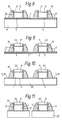
- the masking layer 13 is then removed and a passivation coating of silicon oxide 15 and silicon nitride 17 is deposited, followed by a further passivating coating of glass 19. Parts of the passivation coating (15, 17, 19) are removed to make a top contact 21 ( Figure 8). This contact 21 is then covered with a layer of metal 23.
- the substrate is mounted on a ceramic carrier (not shown) using wax and the polysilicon supporting layer 9 is etched away.
- Figure 10 shows the substrate with the exposed silicon nitride 7 and silicon dioxide 5 removed so as to open up the second diode contact 25.
- the silicon nitride is plasma etched with CF4:02 in the ratio 9:1.
- Buffered HF is used to etch the silicon dioxide layer.
- the second contact 25 is also metalised by evaporating a layer of titanium silver 27, onto the surface and covering the base of the wafer. The area is then plated with silver to a thickness of approximately 10-20 ⁇ m.
- the top of the contact is then defined in photoresist and etched with a mixture of ammonium hydroxide, hydrogen peroxide and water.
- the individual diodes may then be separated ( Figure 11) by sawing through the metalised base layer 27.
Landscapes
- Chemical & Material Sciences (AREA)
- Organic Chemistry (AREA)
- Electrodes Of Semiconductors (AREA)
- Light Receiving Elements (AREA)
- Bipolar Transistors (AREA)
Applications Claiming Priority (2)
| Application Number | Priority Date | Filing Date | Title |
|---|---|---|---|
| GB878719309A GB8719309D0 (en) | 1987-08-14 | 1987-08-14 | Diodes |
| GB8719309 | 1987-08-14 |
Publications (2)
| Publication Number | Publication Date |
|---|---|
| EP0303390A1 true EP0303390A1 (fr) | 1989-02-15 |
| EP0303390B1 EP0303390B1 (fr) | 1990-10-31 |
Family
ID=10622327
Family Applications (1)
| Application Number | Title | Priority Date | Filing Date |
|---|---|---|---|
| EP88307157A Expired EP0303390B1 (fr) | 1987-08-14 | 1988-08-03 | Fabrication de diodes |
Country Status (4)
| Country | Link |
|---|---|
| EP (1) | EP0303390B1 (fr) |
| JP (1) | JP2816684B2 (fr) |
| DE (1) | DE3860929D1 (fr) |
| GB (2) | GB8719309D0 (fr) |
Cited By (4)
| Publication number | Priority date | Publication date | Assignee | Title |
|---|---|---|---|---|
| EP0627764A3 (fr) * | 1993-05-27 | 1995-12-06 | Siemens Ag | Procédé de séparation de puces sur un substrat. |
| RU2393583C1 (ru) * | 2009-06-19 | 2010-06-27 | Открытое акционерное общество "Оптрон" | Способ изготовления кристаллов p-i-n диодов групповым методом (варианты) |
| RU2452057C1 (ru) * | 2011-02-17 | 2012-05-27 | Открытое акционерное общество "Оптрон" | Способ изготовления полупроводниковых ограничительных диодов сверхвысокочастотного диапазона групповым методом |
| RU2546856C2 (ru) * | 2013-05-28 | 2015-04-10 | Закрытое акционерное общество "НИИМП-Т" | Способ изготовления полупроводниковых свч приборов |
Families Citing this family (2)
| Publication number | Priority date | Publication date | Assignee | Title |
|---|---|---|---|---|
| FR2676594B1 (fr) * | 1991-05-17 | 1997-04-18 | Sgs Thomson Microelectronics | Procede de prise de contact sur un composant semiconducteur. |
| US5656547A (en) * | 1994-05-11 | 1997-08-12 | Chipscale, Inc. | Method for making a leadless surface mounted device with wrap-around flange interface contacts |
Citations (2)
| Publication number | Priority date | Publication date | Assignee | Title |
|---|---|---|---|---|
| EP0085607A2 (fr) * | 1982-02-02 | 1983-08-10 | Thomson-Csf | Procédé collectif de fabrication de diodes hyperfréquences avec encapsulation incorporée et diodes obtenues par ce procédé |
| FR2538616A1 (fr) * | 1982-12-28 | 1984-06-29 | Thomson Csf | Procede de fabrication collective de diodes hyperfrequence avec encapsulation incorporee et diodes ainsi obtenues |
-
1987
- 1987-08-14 GB GB878719309A patent/GB8719309D0/en active Pending
-
1988
- 1988-08-03 GB GB8818486A patent/GB2208964B/en not_active Expired - Lifetime
- 1988-08-03 DE DE8888307157T patent/DE3860929D1/de not_active Expired - Lifetime
- 1988-08-03 EP EP88307157A patent/EP0303390B1/fr not_active Expired
- 1988-08-10 JP JP63199768A patent/JP2816684B2/ja not_active Expired - Lifetime
Patent Citations (2)
| Publication number | Priority date | Publication date | Assignee | Title |
|---|---|---|---|---|
| EP0085607A2 (fr) * | 1982-02-02 | 1983-08-10 | Thomson-Csf | Procédé collectif de fabrication de diodes hyperfréquences avec encapsulation incorporée et diodes obtenues par ce procédé |
| FR2538616A1 (fr) * | 1982-12-28 | 1984-06-29 | Thomson Csf | Procede de fabrication collective de diodes hyperfrequence avec encapsulation incorporee et diodes ainsi obtenues |
Cited By (4)
| Publication number | Priority date | Publication date | Assignee | Title |
|---|---|---|---|---|
| EP0627764A3 (fr) * | 1993-05-27 | 1995-12-06 | Siemens Ag | Procédé de séparation de puces sur un substrat. |
| RU2393583C1 (ru) * | 2009-06-19 | 2010-06-27 | Открытое акционерное общество "Оптрон" | Способ изготовления кристаллов p-i-n диодов групповым методом (варианты) |
| RU2452057C1 (ru) * | 2011-02-17 | 2012-05-27 | Открытое акционерное общество "Оптрон" | Способ изготовления полупроводниковых ограничительных диодов сверхвысокочастотного диапазона групповым методом |
| RU2546856C2 (ru) * | 2013-05-28 | 2015-04-10 | Закрытое акционерное общество "НИИМП-Т" | Способ изготовления полупроводниковых свч приборов |
Also Published As
| Publication number | Publication date |
|---|---|
| EP0303390B1 (fr) | 1990-10-31 |
| GB8818486D0 (en) | 1988-09-07 |
| GB2208964A (en) | 1989-04-19 |
| GB8719309D0 (en) | 1987-09-23 |
| GB2208964B (en) | 1991-02-06 |
| DE3860929D1 (de) | 1990-12-06 |
| JPS6467977A (en) | 1989-03-14 |
| JP2816684B2 (ja) | 1998-10-27 |
Similar Documents
| Publication | Publication Date | Title |
|---|---|---|
| US4873205A (en) | Method for providing silicide bridge contact between silicon regions separated by a thin dielectric | |
| US3966577A (en) | Dielectrically isolated semiconductor devices | |
| US4261095A (en) | Self aligned schottky guard ring | |
| US4349394A (en) | Method of making a zener diode utilizing gas-phase epitaxial deposition | |
| EP0202240B1 (fr) | REVETEMENT DE SEMICONDUCTEURS DE COMPOSES DE III-V et II-VI | |
| US4662956A (en) | Method for prevention of autodoping of epitaxial layers | |
| US3400309A (en) | Monolithic silicon device containing dielectrically isolatng film of silicon carbide | |
| US5677562A (en) | Planar P-N junction semiconductor structure with multilayer passivation | |
| US4180422A (en) | Method of making semiconductor diodes | |
| JPH051623B2 (fr) | ||
| EP0076106B1 (fr) | Procédé de fabrication d'un transistor bipolaire | |
| US4900689A (en) | Method of fabrication of isolated islands for complementary bipolar devices | |
| US3746587A (en) | Method of making semiconductor diodes | |
| US4032373A (en) | Method of manufacturing dielectrically isolated semiconductive device | |
| US3777227A (en) | Double diffused high voltage, high current npn transistor | |
| EP0303390B1 (fr) | Fabrication de diodes | |
| EP0111706B1 (fr) | Isolation de paroi latérale pour la grille d'un transistor à effet de champ et procédé pour sa fabrication | |
| EP0042698B1 (fr) | Dispositif à semi-conducteur | |
| US4051507A (en) | Semiconductor structures | |
| US3519900A (en) | Temperature compensated reference diodes and methods for making same | |
| US4210472A (en) | Manufacturing process of semiconductor devices | |
| EP0206445A2 (fr) | Procédé de formation d'une cellule semi-conductrice dans un corps à semi-conducteur en silicium et un circuit intégré comportant des éléments CMOS et bipolaires formés dans une pluralité de telles cellules | |
| KR880000483B1 (ko) | 반도체소자의 제조방법 | |
| EP0140749A1 (fr) | Procédé de fabrication d'un dispositif semi-conducteur complémentaire à isolement diélectrique | |
| US4978636A (en) | Method of making a semiconductor diode |
Legal Events
| Date | Code | Title | Description |
|---|---|---|---|
| PUAI | Public reference made under article 153(3) epc to a published international application that has entered the european phase |
Free format text: ORIGINAL CODE: 0009012 |
|
| AK | Designated contracting states |
Kind code of ref document: A1 Designated state(s): DE FR |
|
| 17P | Request for examination filed |
Effective date: 19890203 |
|
| 17Q | First examination report despatched |
Effective date: 19900409 |
|
| GRAA | (expected) grant |
Free format text: ORIGINAL CODE: 0009210 |
|
| AK | Designated contracting states |
Kind code of ref document: B1 Designated state(s): DE FR |
|
| ET | Fr: translation filed | ||
| REF | Corresponds to: |
Ref document number: 3860929 Country of ref document: DE Date of ref document: 19901206 |
|
| PLBE | No opposition filed within time limit |
Free format text: ORIGINAL CODE: 0009261 |
|
| STAA | Information on the status of an ep patent application or granted ep patent |
Free format text: STATUS: NO OPPOSITION FILED WITHIN TIME LIMIT |
|
| 26N | No opposition filed | ||
| REG | Reference to a national code |
Ref country code: FR Ref legal event code: TP |
|
| REG | Reference to a national code |
Ref country code: FR Ref legal event code: TP |
|
| PGFP | Annual fee paid to national office [announced via postgrant information from national office to epo] |
Ref country code: DE Payment date: 20010730 Year of fee payment: 14 |
|
| PGFP | Annual fee paid to national office [announced via postgrant information from national office to epo] |
Ref country code: FR Payment date: 20010810 Year of fee payment: 14 |
|
| PG25 | Lapsed in a contracting state [announced via postgrant information from national office to epo] |
Ref country code: DE Free format text: LAPSE BECAUSE OF NON-PAYMENT OF DUE FEES Effective date: 20030301 |
|
| PG25 | Lapsed in a contracting state [announced via postgrant information from national office to epo] |
Ref country code: FR Free format text: LAPSE BECAUSE OF NON-PAYMENT OF DUE FEES Effective date: 20030430 |
|
| REG | Reference to a national code |
Ref country code: FR Ref legal event code: ST |
|
| REG | Reference to a national code |
Ref country code: FR Ref legal event code: CD Ref country code: FR Ref legal event code: CA |