EP0304217A2 - Appareil d'embrouillage vidéo et méthode basée sur des courbes remplissant l'espace - Google Patents
Appareil d'embrouillage vidéo et méthode basée sur des courbes remplissant l'espace Download PDFInfo
- Publication number
- EP0304217A2 EP0304217A2 EP88307385A EP88307385A EP0304217A2 EP 0304217 A2 EP0304217 A2 EP 0304217A2 EP 88307385 A EP88307385 A EP 88307385A EP 88307385 A EP88307385 A EP 88307385A EP 0304217 A2 EP0304217 A2 EP 0304217A2
- Authority
- EP
- European Patent Office
- Prior art keywords
- video signal
- sfc
- video
- scrambler
- descrambler
- Prior art date
- Legal status (The legal status is an assumption and is not a legal conclusion. Google has not performed a legal analysis and makes no representation as to the accuracy of the status listed.)
- Withdrawn
Links
Images



Classifications
-
- H—ELECTRICITY
- H04—ELECTRIC COMMUNICATION TECHNIQUE
- H04N—PICTORIAL COMMUNICATION, e.g. TELEVISION
- H04N7/00—Television systems
- H04N7/16—Analogue secrecy systems; Analogue subscription systems
- H04N7/167—Systems rendering the television signal unintelligible and subsequently intelligible
- H04N7/169—Systems operating in the time domain of the television signal
- H04N7/1696—Systems operating in the time domain of the television signal by changing or reversing the order of active picture signal portions
Definitions
- the present invention relates to video scrambling techniques and devices, more particularly, to a video scrambling technique employing a pseudo-random Space Filling Curve for scrambling/descrambling a digital representation of a video signal before and after a video transmission procedure.
- Video scrambling techniques are known for use in home cable TV systems where it is desired to restrict programs to authorized viewer-subscribers, and also for use in military applications such as transmission of video signals from an airplane. In between these extremes are industrial applications such as video conferencing, videophone, two-way TV, etc.
- the difficulty in encryption of a video signal is that the signal is analog, has a very high information rate, and re-ordering of analog video information in a line may adversely affect the signal and noise spectra seen at a receiver.
- VLSI electronics technology which has become feasible only in the last few years, very quick digital storage methods became available using fast RAMs that can store and retrieve video information in real time in a frame buffer. This led to the possibility of scrambling the video signals by digital methods, leaving the transmission format intact.
- correlation techniques make it possible to decode the schemes by comparing and matching lines or segments until the original arrangement of these lines or segments is found in order to recover a significant portion of the entire picture.
- VideoCipher One very common video scrambling technique is provided by a system known by the trademark VideoCipher, as made available by M/A-COM Linkabit, Inc., and described in a paper entitled "The VideoCipher Scrambling System" by P. Mulroney et al., IEEE publication 84CH2069-3 (1984).
- This system is also described in European patent application number 84303322.6, and is based on permutations of portions of video information lines. The number of possible permutations is very high, but since the line portions are long, the number of jumps within the video signal is kept low and so the bandwidth increase is insignificant.
- the method is used with a video scrambler/descrambler device and is characterized by a much higher cryptographic strength than existing techniques, which is not subject to simple correlation attacks by comparing and matching of line portions.
- the method features a reduction in the video signal bandwidth for typical pictures.
- a method of encrypting a video signal comprising the steps of:
- the inventive method is applied in the operation of a video scrambler which uses the frame buffer to store a grid graph representation of the horizontally and vertically adjacent pixels in a video picture.
- a Space Filling Curve (SFC) is defined as a Hamiltonian path which visits each pixel exactly once.
- the SFC is generated by the scrambler to exploit the two-dimensional nature of the video picture representing the original source of the video signal.
- the use of a pseudo-random SFC to define the sequence in which frame buffer addresses are read provides a highly irregular scanning pattern of the adjacent pixels in the video picture since there are enormous possibilities of irregular paths based on horizontal and vertical motion between them.
- the encryption provided by the video scrambler in the transmission of the video signal is decoded by the descrambler.
- the descrambler By using a shared key stream between both the scrambler and the descrambler, the latter generates the same pseudo-random Space Filling Curve as is used in the scrambler, thereby providing it with access to the correct locations of the frame buffer for restoring the original video signal.
- the pseudo-random SFC is generated by each execution of an algorithm whose output is in the domain of a family of Hamiltonian paths in the rectangular grid graph provided by the frame buffer. Once the SFC is chosen from the Hamiltonian path family, it is used to define the sequence in which the frame buffer addresses are read. After a predetermined period of time, the original SFC is replaced by another one from the Hamiltonian family, further increasing the security of the encryption method.
- a feature of the inventive method is that the bandwidth of the video signal is usually reduced with typical pictures since the SFC provides a scanning pattern which preserves the correlation between adjacent pixels.
- the broken lines of vertical and horizontal movement which characterize the SFC make it a more"local"scanning pattern than a conventional raster scan for a group of sequential frame buffer locations. This reduces the amount of pixel-to-pixel change in values, allowing for the reduced bandwidth.
- An alternative embodiment of the invention is the transmission of the SFC so that the descrambler does not have to generate it, with the transmission being accomplished along with the video signal.
- several SFC's can be stored in the descrambler in advance of its operation, with the appropriate SFC (which has been used in the scrambler) being selected in accordance with an encrypted signal included in the transmission.
- Another feature of the invention is the application of the SFC to a sequence of consecutive frames in the video picture.
- Storage of the video information in sequential frame stores allows a three-dimensional SFC to be used since the sequence of possible locations is contained within a cubic grid built by the consecutive video frames. This further increases the security of the encryption method while further reducing the bandwidth of the signal due to the 3-D locality of the scan.
- FIG. 1 there is shown an overall block diagram of a direct broadcast satellite system incorporating the method of the present invention in a preferred embodiment.
- the need to securely transmit the video information in these types of systems is shared by many applications, including TVRO (TV receive only) stations in cable TV networks, videoconferencing, videophone, analog facsimile and military communication systems.
- TVRO TV receive only
- the present invention provides a method which is cryptographically much stronger than existing methods of scrambling the video information.
- a scrambler 10 receives a standard video signal for encryption and transmission via an uplink transmitter 12 to a communications satellite 14. Reception of the transmission is provided by satellite receiver 16, and descrambler 18 decodes the encrypted video signal to restore it to its original form as output.
- the input and output of the scrambler 10 and the descrambler 18 are both video signals normally in a standard format, thus full compatibility is achieved.
- the scrambler 10 interferes only with the order of the video signal content and not with the signal's form.
- the scrambler 10 and descrambler 18 are modules that are added onto an existing system while other components remain unchanged.
- the descrambler is envisioned as a "black box" that is located between the TV set and the cable input of the video signal, which usually comes from a receive-only antenna. Cables or telephone lines may replace the satellite communications link.
- FIG. 2 there is shown a system block diagram illustrating the encryption method of the present invention as used in the scrambler 10 of Fig. 1.
- the encryption method is based on a reordering of the transmitted pixels in the video signal.
- An A/D converter 20 converts the video signal input into a digital sequence, and the video signal information is then fed to frame buffer 22 for storage in raster scan format.
- An addressing and control computer 24 controls the order in which the pixels are retrieved from the frame buffer 22.
- a D/A converter 26 converts the reordered digital sequence back into an analog video signal, which has been scrambled, and the scrambled video is prepared for transmission by uplink transmitter 12 or other transmission station.
- the scrambled video signal provided by scrambler 10 must meet seemingly contradictory requirements. On the one hand, it must have a certain randomness so as to survive correlation-based attacks, while on the other hand, its smoothness must remain unaffected so that the bandwidth is not increased, requiring an autocorrelation function that is equal to or even higher than that of the original raster scan.
- a conventional raster scan involves scanning of pixels in a frame from top to bottom and from left to right.
- the inventive method is based on pixel permutation by changing the scanning order without changing the pixel's values.
- the frame buffer 22 is used to store a grid graph representation of the horizontally and vertically adjacent pixels in a video picture. Since it is desired to preserve the correlation between adjacent pixels, a scanning pattern is chosen which is a connected curve, denoted as a Space Filling Curve (SFC). This type of curve exploits the two-dimensional nature of the video picture by making use of the similarity of the vertical autocorrelation between pixels to the horizontal autocorrelation.
- the scanning pattern is provided by the addressing and control computer 24 which reorders the retrieval of the digital sequence in frame buffer 22.
- a Space Filling Curve which provides the inventive method with a scanning pattern that makes possible vertical advances between pixels on different horizontal video lines. Since the scan is to be continuous in the picture, i.e., adjacent pixels in the scan are also adjacent in the picture, the scrambled video signal will remain smooth.
- the Space filling Curve is a Hamiltonian path which visits all the pixels in the picture and does not intersect itself, so that there are no jumps in the scan nor any second transmission of the same pixel.
- the use of a pseudo-random SFC to define the sequence in which frame buffer addresses are read provides a highly irregular scanning pattern of the adjacent pixels in the video picture since there are enormous possibilities of irregular paths based on horizontal and vertical motion between them.
- the encryption method chooses the SFC in a pseudo-random fashion, and then uses the SFC as the scanning pattern for reordering the retrieval of the pixel sequence in the frame buffer 22.
- the choice of SFC's is based on execution of an algorithm which efficiently generates an SFC out of a family of Hamiltonian paths in accordance with a mathematical treatment of the geometry of a representation of the video picture, which is now presented.
- G be the infinite graph whose vertex set consists of all points of the plane with integer coordinates and in which two vertices are connected if and only if the (Euclidean) distance between them is 1.
- a grid graph is a vertex induced subgraph of G.
- v X and vy be the coordinates of the vertex v.
- a rectangular grid graph (R(m,n) is a grid graph whose vertex set is m and 1 ⁇ v y ⁇ n ⁇ . Therefore, if frame buffer 22 is considered as a rectangular grid graph R(m,n) whose vertices are pixels, the SFC is a Hamiltonian path in R(m,n).
- degree (v) is defined to be the number of v's neighbors that were already chosen in the algorithm.
- vertices vi and v 2 are defined to be partners if they are (at the moment) the endpoints of the same path. In a certain row, let v 1 be the leftmost vertex v such that degree(v) ⁇ 2 and let v, be the rightmost vertex v such that degree(v) ⁇ 2. If there is no vertex with degree ⁇ 2, there is considered to be no v r .
- v 1 right( V2 ) since degree(right(v 2 )) ⁇ 2.
- v,ast (as determined in step 2 of algorithm Ham + shown in appendix page A1 ) is either vi or v 2 , then all vertices in the row have degree 2 and there is no v,.
- Algorithm Ham + constructs the "almost" Hamiltonian circuit by scanning the rows of the frame buffer 22 from top to bottom. A convention that may be used is to enumerate the rows from top to bottom and the columns from left to right.
- the rectangle R(i-1, n) is completely covered with disjoint paths whose endpoints are all in the i'th row.
- the i'th row is filled by advancing the endpoints. No endpoint is left inside R(i,n) and no path becomes a circuit. This is accomplished by letting the endpoints of each path identify each other as partners. In the final two rows the paths are tied together in order to get a global circuit.
- the result as illustrated in Fig. 3 is a pseudo-random SFC which is based on a set of directions of movement in the frame buffer 22. These movements can be denoted by the directions left, right, up or down.
- the sequence of directions left, right, up or down is all that is needed by the address control 24 to specify the movements. This sequence is what is provided by the SFC. It is estimated that for a video picture of 250 x 250 pixels, there exists 2 340CO possible SFC's, which is an enormous number and prevents attacks on the system by exhaustive attempts or by comparing and matching line portions.
- the use of SFCs enables even a reduced size memory, for example containing 25 x 25 pixels, to be used. In such a case, there would exist 2 300 possibles SFCs.
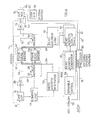
- FIG. 4 there is shown a schematic block diagram of a video scrambler 10 employing the method of the present invention.
- the scrambler 10 is provided with a video signal 30 at sync separator 32 for detection of horizontal and vertical synchronization signals which are fed to control logic 34.
- video signal 30 is provided to A/D converter 20 for conversion to digital form.
- the digital video signal 38 is fed to frame switch 40 which controls the signal feed to one of frame stores 42 or 44 (forming frame buffer 22) via respective lines 46 or 48.
- the particular frame store is selected by control logic 34 for storage of either an odd or even field.
- two frame stores 42 and 44 are used, which enables each to be slower than if only one frame store were used. This is because the video signal can be written into one while the other can be read, so that if the TV picture has 60 frames per second, each of frame stores 42 and 44 has 1/60 sec to complete its task of writing or reading out the video signal, in accordance with the operation of frame switch 40 and frame switch 50 on the output side.
- the two frame stores 42 and 44 are fast video RAMs each organized in a 256 x 256 x 8 bit matrix, for example, which are used to store incoming video on lines 46 and 48. All control signals and addresses are supplied to frame stores 42 and 44 by write address generator 52 under supervision of control logic 34 via control bus 54.
- a key stream signal 56 is provided to scramble control 58 for processing to generate pseudo-random space filling curves, using the Ham + algorithm in the preferred embodiment.
- the key stream signal 56 may be provided as the output of a pseudo-random number generator which is started by a "seed" number.
- the output of scramble control 58 is a sequence of left, right, up, and down direction instructions (L, R, U, D) which are fed to read address generator 60.
- the direction instructions are converted by read address generator 60 to physical addresses corresponding to those in frame stores 42 and 44. These physical addresses are stored in one of a pair of read address look-up tables 62 and 64. If more than two frames stores are provided, the number of read address loop-up tables is increased correspondingly.
- the scrambled video signals 70 and 72 are fed to a D/A converter 26 for conversion to analog video signal 79 and are passed to output mixer 76 which also receives the key stream 56.
- the audio portion of video signal 78 which may also be encrypted by digitization and scrambling, is processed by audio processor 80 and passed as audio signal 81 to output mixer 76.
- the complete analog video signal output 84 is formed from analog video signal 79, key stream signal 56, audio signal 81 and sync signals 85 from sync generator 86.
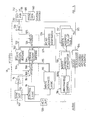
- a schematic block diagram of the descrambler 18 is shown.
- the descrambler 18 is provided with a video signal 90 at sync separator 92 for detection of horizontal and vertical synchronization signals which are fed to control logic 94.
- video signal 90 is provided to A/D converter 96 for conversion to digital form.
- the digital video signal 98 is fed to frame switch 100 which controls the signal feed to one of frame stores 102 or 104 via respective lines 106 or 108.
- the particular frame store is selected by control logic 94 for storage of either an odd or even field.
- the two frame stores 102 and 104 are fast video RAMs each organized in a 256 x 256 x 8 bit matrix (same as in scrambler 10), for storing incoming video on lines 106 and 108. All control signals and addresses are supplied to frame stores 102 and 104 by write address logic 110 and write address look-up tables 112 and 114 under supervision of control logic 94 via control bus 115.
- the key stream signal 56 which was used in the scrambler 10 is provided to unscramble control 116, for processing to generate pseudo-random space filling curves, using the same Ham + algorithm.
- the key stream signal may also be generated by a pseudo-random number generator having the same "seed" as used in the scrambler. In such a case the key stream need not be supplied to the mixer 76. Instead a synchronizing signal may be employed.
- the output of unscramble control 116 is a sequence of left, right, up, and down direction instructions (L, R, U, D) which are fed to write address generator 118.
- the direction instructions are converted by write address generator 118 to physical addresses corresponding to those in frame stores 102 and 104. These physical addresses are stored in one of the pair of write address look-up tables 112 and 114.
- the incoming video signal 90 has already been scrambled in the scrambler 10 by means of pixel reposition according to the SFC.
- unit pixels are written into frame store 102 and 104 using addresses produced by the same algorithm employing the identical key stream signal 56 as used in the scrambler 10, with the key stream signal 56 being separated (or locally generated) in key separation unit 120. These addresses are supplied via write address look-up tables 112 and 113 to write address logic 110 which feeds address bus 115.
- the result is that the digital video signal is written into each of frame stores 102 and 104 in the same order that it was read out in the scrambler 10, thus restoring the original picture.
- This provides descrambled video signals 122 and 124 which are retrieved in raster scan format by switching out via operation of frame switch 125 as controlled by control logic 94.
- the unscrambled video signals 122 and 124 are fed to a D/A converter 128 for conversion to analog video signal 130 and are passed to output mixer 132.
- the audio portion of video signal 90 which may require decoding if encrypted in scrambler 10, is processed by audio processor 134 and passed as audio signal 135 to output mixer 132.
- the complete analog video signal output 136 is formed from analog video signal 130, audio signal 135 and sync signals 138 from sync generator 140.
- key stream signal 56 is transmitted with the video signal. Since the inventive method incorporates an efficient algorithm for generating the SFC, this signal may be transmitted occasionally to begin the generation of another SFC and so increase the cryptographic strength of the system.
- the key stream signal 56 itself may be encrypted, or in an alternative embodiment, the key may be based on use of a "smart card" which carries a code number. In this arrangement, the descrambler combines use of the smart card with a transmitted "seed" number, which together generate a new key stream signal 56 via a pseudo-random number generator.
- An alternative embodiment of the invention is the transmission of the SFC so that the descrambler 18 does not have to generate it, with the transmission being accomplished along with the video signal.
- several SFC's can be stored in the descrambler in advance of its operation, with the appropriate SFC (which has been used in the scrambler 10) being selected in accordance with an encrypted signal included in the transmission.
- the key stream signal 56 may be used for the purpose of selecting the appropriate SFC in the descrambler 18 or for encrypting the transmission of the SFC itself. These alternatives could reduce the descrambler cost.
- the bandwidth of the video signal is usually reduced but certainly not increased for typical pictures. This is true since the SFC provides a scanning pattern which preserves the correlation between adjacent pixels. The broken lines of vertical and horizontal movement which characterize the SFC make it a "local" scanning pattern for a group of sequential frame buffer locations, and this reduces the amount of pixel-to-pixel change in values, allowing for the reduced bandwidth.
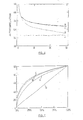
- this reduced bandwidth feature is represented as a graph showing the behavior of the autocorrelation function applied .to the scrambled video signal produced by the inventive method.
- Curve A shows a typical raster scan, where the autocorrelation is low since the pixel value changes quickly as the scan is racing as fast as it can from one side of the picture to the other.
- curves B and C show two scans using two different SFC's, and exhibit a higher autocorrelation among adjacent pixels.
- Curve D shows a low autocorrelation function for a random scan, where no pixel relationship obtains.
- Fig. 7 is a graph comparing the normalized integral of the power spectral density produced by the scrambled video signal to that of a conventional raster scan.
- the integral shows the amount of power that remains in a signal after a low pass filtering is applied; therefore the higher the integral the better the scan for bandwidth purposes.
- the straight line D is that of the random scan.
- the raster scan A has a higher power spectral density, being just above that of the random scan. But the highest power spectral densities belong to the two top curves B and C, which correspond to scan using SFC's.
- Another feature of the invention is the application of the SFC to a sequence of consecutive frames in the video picture.
- Storage of the video information in sequential frame stores allows a three-dimensional SFC to be used since the sequence of possible locations is contained within a cubic grid built by the consecutive video frames. This further increases the security of the encryption method, since the number of possible SFC's is much higher because the third dimension provides an extra degree of freedom. It is estimated that for a 3-dimensional SFC in which each frame store contains 250 x 250 pixels, there are 2 7 1000 possible variations.
- tile-and-merge method is based on production of Hamiltonian paths by first covering all vertices of a rectangular grid graph by disjoint elementary circuits, and then merging these circuits into a single Hamiltonian circuit. For this method, some definitions are required.
- G be an undirected graph.
- circuits C 1 , C 2 , -, C k that cover all the vertices of G.
- f 1 and f 2 complete ei and e 2 into a square.
- C, and C j are neighbors then they can be connected into one circuit C ij which covers exactly the same vertices as C 1 and C i by replacing e 1 and e 2 by f, and f 2 .
- this replacement denote this replacement as a legal replacement and denote (e 1 , e 2 ) as a legally replaced couple (LRC) in ⁇ C, and G j ).
- LRC legally replaced couple
- edges of a legally replaced couple are adjacent edges that are located in different circuits. Denote two circuits to be external if neither of them is surrounded by the other.
- the circuits C 1 ,C 2 ,...,C k are considered as a tile of G. If the circuits are all external in pairs then they are denoted as external circuits and the tile is denoted as an external tile.
- Figs. 8a-d show the entrance edge as being the upper left edge of the cube.
- an unlabeled cube one that can rotate around its axis of symmetry
- This 3-dimensional method of producing a SFC also has advantages in further reducing the bandwidth, since the SFC exploits the interframe correlation. That is, since there is a high correlation between two pixels at the same spatial location in consecutive frames, there is frame-to-frame redundancy.
- the 3- dimentional SFC visits the entire volume formed by the consecutive frame stores.
- the two pixels which are 200 pixels apart would be around 50-60 pixels (N o.75 ) apart in the corresponding picture.
- 200 pixels apart in the video signal would be approximately the same in the picture. This comparison illustrates the smoothness of the video signal in the 3-dimensional case, hence the lower bandwidth.
- Fig. 9 there is shown the autocorrelation functions of a raster scan signal (A), a random 2-dimensional SFC scan signal (B) and a random 3-dimensional SFC scan signal (C). This demonstrates the improvement in performance in the 2-dimensional SFC scan signal and the further improvement in the 3-dimensional SFC scan signal over the the conventional raster scan signal.
Landscapes
- Engineering & Computer Science (AREA)
- Multimedia (AREA)
- Signal Processing (AREA)
- Two-Way Televisions, Distribution Of Moving Picture Or The Like (AREA)
Applications Claiming Priority (2)
| Application Number | Priority Date | Filing Date | Title |
|---|---|---|---|
| IL83549A IL83549A (en) | 1987-08-16 | 1987-08-16 | Video scrambling apparatus and method based on space filling curves |
| IL83549 | 1987-08-16 |
Publications (2)
| Publication Number | Publication Date |
|---|---|
| EP0304217A2 true EP0304217A2 (fr) | 1989-02-22 |
| EP0304217A3 EP0304217A3 (fr) | 1991-12-11 |
Family
ID=11058075
Family Applications (1)
| Application Number | Title | Priority Date | Filing Date |
|---|---|---|---|
| EP19880307385 Withdrawn EP0304217A3 (fr) | 1987-08-16 | 1988-08-10 | Appareil d'embrouillage vidéo et méthode basée sur des courbes remplissant l'espace |
Country Status (5)
| Country | Link |
|---|---|
| US (2) | US4910772A (fr) |
| EP (1) | EP0304217A3 (fr) |
| JP (1) | JPH01157686A (fr) |
| AU (1) | AU2067188A (fr) |
| IL (1) | IL83549A (fr) |
Cited By (8)
| Publication number | Priority date | Publication date | Assignee | Title |
|---|---|---|---|---|
| FR2638045A1 (fr) * | 1989-10-31 | 1990-04-20 | Belloli Pascal | Encodeur-decodeur video et/ou audio |
| WO1991007850A1 (fr) * | 1989-11-09 | 1991-05-30 | Zone Technology Pty Limited | Camera video numerique |
| EP0359729A3 (fr) * | 1988-09-15 | 1991-11-21 | Telia Ab | Chiffrage de code avec codage de source ultérieure |
| US9350382B1 (en) | 2014-12-19 | 2016-05-24 | International Business Machines Corporation | Pad encoding and decoding |
| GB2533392A (en) * | 2014-12-19 | 2016-06-22 | Ibm | Path encoding and decoding |
| US9425825B2 (en) | 2012-05-22 | 2016-08-23 | International Business Machines Corporation | Path encoding and decoding |
| US9950261B2 (en) | 2016-04-29 | 2018-04-24 | International Business Machines Corporation | Secure data encoding for low-resource remote systems |
| US10027345B2 (en) | 2014-12-19 | 2018-07-17 | International Business Machines Corporation | Wall encoding and decoding |
Families Citing this family (22)
| Publication number | Priority date | Publication date | Assignee | Title |
|---|---|---|---|---|
| IL83549A (en) * | 1987-08-16 | 1992-08-18 | Yossi Matias | Video scrambling apparatus and method based on space filling curves |
| JP2661206B2 (ja) * | 1988-10-31 | 1997-10-08 | キヤノン株式会社 | 映像信号記録装置 |
| US5249229A (en) * | 1989-04-04 | 1993-09-28 | Laboratoire Europeen De Recherches Electroniques Avancees Societe En Nom Collectif | Device and method for generating control signals |
| US5014310A (en) * | 1989-12-18 | 1991-05-07 | General Instrument Corporation | Video scrambling and descrambling by varying sequence of segments in adjacent video information lines |
| GB9004901D0 (en) * | 1990-03-05 | 1990-05-02 | Space Communications Sat Tel L | Television scrambler |
| KR930004823B1 (ko) * | 1990-04-14 | 1993-06-08 | 삼성전자 주식회사 | 텔레비젼 신호의 스크램블링 및 디스크램블링 회로 |
| US20040073953A1 (en) * | 1990-09-28 | 2004-04-15 | Qi Xu | Audio/video apparatus for use with a cable television network |
| US5732164A (en) * | 1991-05-23 | 1998-03-24 | Fujitsu Limited | Parallel video processor apparatus |
| DE69332529T2 (de) * | 1992-07-21 | 2003-08-14 | Matsushita Electric Industrial Co., Ltd. | Verschlüsselungsvorrichtung |
| US5321749A (en) * | 1992-09-21 | 1994-06-14 | Richard Virga | Encryption device |
| US5666516A (en) * | 1993-12-16 | 1997-09-09 | International Business Machines Corporation | Protected programmable memory cartridge having selective access circuitry |
| US5689696A (en) * | 1995-12-28 | 1997-11-18 | Lucent Technologies Inc. | Method for maintaining information in a database used to generate high biased histograms using a probability function, counter and threshold values |
| US6373947B1 (en) | 1996-08-26 | 2002-04-16 | Aliroo Ltd. | Document processing |
| US5881226A (en) * | 1996-10-28 | 1999-03-09 | Veneklase; Brian J. | Computer security system |
| US6226384B1 (en) * | 1996-12-18 | 2001-05-01 | Philips Electronics North America Corporation | Method and device for providing controlled access video signals without providing a signal in the clear |
| US6222926B1 (en) * | 1996-12-18 | 2001-04-24 | Philips Electronics North America Corporation | Method and device for providing controlled access video signals without providing a signal in the clear |
| US6823068B1 (en) * | 1999-02-01 | 2004-11-23 | Gideon Samid | Denial cryptography based on graph theory |
| US6971027B1 (en) * | 1999-04-01 | 2005-11-29 | Veneklase Brian J | Computer security system |
| US6590981B2 (en) * | 2000-02-22 | 2003-07-08 | Zyfer, Inc. | System and method for secure cryptographic communications |
| AU2003284118A1 (en) * | 2002-10-14 | 2004-05-04 | Battelle Memorial Institute | Information reservoir |
| US9456075B2 (en) * | 2014-10-13 | 2016-09-27 | Avaya Inc. | Codec sequence detection |
| US11056009B2 (en) | 2018-01-31 | 2021-07-06 | Performance Drone Works Llc | Secure control and operation of drones |
Family Cites Families (19)
| Publication number | Priority date | Publication date | Assignee | Title |
|---|---|---|---|---|
| CA1097794A (fr) * | 1975-08-08 | 1981-03-17 | Harold B. Shutterly | Systeme de transmission secrete d'images de television |
| GB1590579A (en) * | 1977-12-16 | 1981-06-03 | Micro Consultants Ltd | Information scrambler system |
| US4459611A (en) * | 1978-08-28 | 1984-07-10 | Fuji Xerox Co., Ltd. | Image conversion system |
| US4389671A (en) * | 1980-09-29 | 1983-06-21 | Harris Corporation | Digitally-controlled analog encrypton |
| US4405942A (en) * | 1981-02-25 | 1983-09-20 | Telease, Inc. | Method and system for secure transmission and reception of video information, particularly for television |
| US4484027A (en) * | 1981-11-19 | 1984-11-20 | Communications Satellite Corporation | Security system for SSTV encryption |
| WO1983003942A1 (fr) * | 1982-04-23 | 1983-11-10 | Independent Broadcasting Authority | Codage de signaux pour une transmission sure |
| US4575754A (en) * | 1983-01-06 | 1986-03-11 | Rca Corporation | Video scrambler system |
| GB8301694D0 (en) * | 1983-01-21 | 1983-02-23 | Beecham Group Plc | Beta-lactam antibacterial agents |
| EP0123422A3 (fr) * | 1983-03-28 | 1985-04-03 | Plessey Overseas Limited | Appareil pour brouillage et débrouillage de signaux |
| US4604650A (en) * | 1983-05-17 | 1986-08-05 | Westinghouse Electric Corp. | Three line video scrambling method |
| US4563702A (en) * | 1983-05-27 | 1986-01-07 | M/A-Com Linkabit, Inc. | Video signal scrambling and descrambling systems |
| US4594609A (en) * | 1983-06-30 | 1986-06-10 | Viewstar Inc. | Scrambling system for television video signal |
| US4605961A (en) * | 1983-12-22 | 1986-08-12 | Frederiksen Jeffrey E | Video transmission system using time-warp scrambling |
| US4742544A (en) * | 1984-07-09 | 1988-05-03 | Kupnicki Richard A | Television transmission network with scrambling and descrambling |
| US4620224A (en) * | 1985-04-03 | 1986-10-28 | Communications Satellite Corp. | Video scrambling technique for multiplexed analog component formats |
| IT1190565B (it) * | 1986-04-07 | 1988-02-16 | Cselt Centro Studi Lab Telecom | Procedimento e dispositivo di codifica di segnali numerizati mediante quantizzazione vettoriale |
| US4736420A (en) * | 1986-09-19 | 1988-04-05 | M/A-Com Government Systems, Inc. | Video scrambling by segmenting video information lines |
| IL83549A (en) * | 1987-08-16 | 1992-08-18 | Yossi Matias | Video scrambling apparatus and method based on space filling curves |
-
1987
- 1987-08-16 IL IL83549A patent/IL83549A/xx unknown
-
1988
- 1988-08-10 EP EP19880307385 patent/EP0304217A3/fr not_active Withdrawn
- 1988-08-12 US US07/231,801 patent/US4910772A/en not_active Expired - Lifetime
- 1988-08-12 AU AU20671/88A patent/AU2067188A/en not_active Abandoned
- 1988-08-16 JP JP63203682A patent/JPH01157686A/ja active Pending
-
1990
- 1990-03-19 US US07/495,476 patent/US5058158A/en not_active Expired - Fee Related
Cited By (21)
| Publication number | Priority date | Publication date | Assignee | Title |
|---|---|---|---|---|
| EP0359729A3 (fr) * | 1988-09-15 | 1991-11-21 | Telia Ab | Chiffrage de code avec codage de source ultérieure |
| FR2638045A1 (fr) * | 1989-10-31 | 1990-04-20 | Belloli Pascal | Encodeur-decodeur video et/ou audio |
| WO1991007850A1 (fr) * | 1989-11-09 | 1991-05-30 | Zone Technology Pty Limited | Camera video numerique |
| US9425825B2 (en) | 2012-05-22 | 2016-08-23 | International Business Machines Corporation | Path encoding and decoding |
| US9667271B2 (en) | 2014-12-19 | 2017-05-30 | International Business Machines Corporation | Path encoding and decoding |
| US10027345B2 (en) | 2014-12-19 | 2018-07-17 | International Business Machines Corporation | Wall encoding and decoding |
| GB2533392A (en) * | 2014-12-19 | 2016-06-22 | Ibm | Path encoding and decoding |
| US9473167B2 (en) | 2014-12-19 | 2016-10-18 | International Business Machines Corporation | Pad encoding and decoding |
| US9577670B2 (en) | 2014-12-19 | 2017-02-21 | International Business Machines Corporation | Path encoding and decoding |
| US9647681B2 (en) | 2014-12-19 | 2017-05-09 | International Business Machines Corporation | Pad encoding and decoding |
| US9350382B1 (en) | 2014-12-19 | 2016-05-24 | International Business Machines Corporation | Pad encoding and decoding |
| US9735804B2 (en) | 2014-12-19 | 2017-08-15 | International Business Machines Corporation | Path encoding and decoding |
| US9876508B2 (en) | 2014-12-19 | 2018-01-23 | International Business Machines Corporation | Pad encoding and decoding |
| GB2533393A (en) * | 2014-12-19 | 2016-06-22 | Ibm | Pad encoding and decoding |
| US10396816B2 (en) | 2014-12-19 | 2019-08-27 | International Business Machines Corporation | Pad encoding and decoding |
| US9950261B2 (en) | 2016-04-29 | 2018-04-24 | International Business Machines Corporation | Secure data encoding for low-resource remote systems |
| US9968852B2 (en) | 2016-04-29 | 2018-05-15 | International Business Machines Corporation | Secure data encoding for low-resource remote systems |
| US10080965B2 (en) | 2016-04-29 | 2018-09-25 | International Business Machines Corporation | Secure data encoding for low-resource remote systems |
| US10166475B2 (en) | 2016-04-29 | 2019-01-01 | International Business Machines Corporation | Secure data encoding for low-resource remote systems |
| US10166476B2 (en) | 2016-04-29 | 2019-01-01 | International Business Machines Corporation | Secure data encoding for low-resource remote systems |
| US9968851B2 (en) | 2016-04-29 | 2018-05-15 | International Business Machines Corporation | Secure data encoding for low-resource remote systems |
Also Published As
| Publication number | Publication date |
|---|---|
| AU2067188A (en) | 1989-02-16 |
| JPH01157686A (ja) | 1989-06-20 |
| EP0304217A3 (fr) | 1991-12-11 |
| IL83549A0 (en) | 1988-01-31 |
| US4910772A (en) | 1990-03-20 |
| US5058158A (en) | 1991-10-15 |
| IL83549A (en) | 1992-08-18 |
Similar Documents
| Publication | Publication Date | Title |
|---|---|---|
| US4910772A (en) | Video scrambling apparatus and method based on space filling curves | |
| Tanaka et al. | Embedding secret information into a dithered multi-level image | |
| Matias et al. | A video scrambling technique based on space filling curves | |
| US5754704A (en) | Method and apparatus for compressing and decompressing three-dimensional digital data using fractal transform | |
| US5751363A (en) | System and method for coding and/or decoding image-adaptive split region of motion picture | |
| KR0184313B1 (ko) | 디지털영상신호를 스크램블 및 디스크램블해서 전송하는 스크램블전송장치 | |
| US6339616B1 (en) | Method and apparatus for compression and decompression of still and motion video data based on adaptive pixel-by-pixel processing and adaptive variable length coding | |
| ES2823195T3 (es) | Dispositivo de codificación de imagen, procedimiento de codificación de imagen, programa de codificación de imagen, dispositivo de decodificación de imagen, procedimiento de decodificación de imagen y programa de decodificación de imagen | |
| US20210092479A1 (en) | Video processing apparatus | |
| KR100966192B1 (ko) | 신호 처리 시스템 및 방법, 신호 처리 장치 및 방법, 및 기록 매체 | |
| CA2100064C (fr) | Dispositif et methode de suppression des signaux superposes aux signaux d'imagerie | |
| JP2534276B2 (ja) | オリジナル・イメ−ジのペル信号の処理方法 | |
| US5963342A (en) | Image processing apparatus and method thereof | |
| US8073055B2 (en) | Biased motion vector interpolation for reduced video artifacts | |
| GB1590579A (en) | Information scrambler system | |
| JP2640939B2 (ja) | 画像へのデータ合成方法 | |
| Wong | Halftoning by multiscale dot distribution | |
| KR102946242B1 (ko) | 3d 포인트들을 인코딩/재구성하기 위한 방법 및 디바이스 | |
| US20040109565A1 (en) | Method and system for encrypting or decrypting an image code block | |
| JP4239465B2 (ja) | 画像信号伝送装置および方法、並びに画像信号受信装置および方法 | |
| Katritzke et al. | Enhancements of partitioning techniques for image compression using weighted finite automata | |
| Patil et al. | Visual cryptography for color images using error diffusion and pixel synchronization | |
| Holtz et al. | Advanced data compression promises the next big leap in network performance | |
| EP4195158A1 (fr) | Procédé et appareil de codage/décodage d'une série de données | |
| US6288654B1 (en) | Data conversion apparatus, data conversion method, and recording medium |
Legal Events
| Date | Code | Title | Description |
|---|---|---|---|
| PUAI | Public reference made under article 153(3) epc to a published international application that has entered the european phase |
Free format text: ORIGINAL CODE: 0009012 |
|
| AK | Designated contracting states |
Kind code of ref document: A2 Designated state(s): AT BE CH DE ES FR GB GR IT LI LU NL SE |
|
| RAP1 | Party data changed (applicant data changed or rights of an application transferred) |
Owner name: MATIAS, YOSSI |
|
| PUAL | Search report despatched |
Free format text: ORIGINAL CODE: 0009013 |
|
| AK | Designated contracting states |
Kind code of ref document: A3 Designated state(s): AT BE CH DE ES FR GB GR IT LI LU NL SE |
|
| 17P | Request for examination filed |
Effective date: 19920611 |
|
| 17Q | First examination report despatched |
Effective date: 19940518 |
|
| STAA | Information on the status of an ep patent application or granted ep patent |
Free format text: STATUS: THE APPLICATION IS DEEMED TO BE WITHDRAWN |
|
| 18D | Application deemed to be withdrawn |
Effective date: 19941129 |