EP0304400A2 - Phenanthridinderivate, Verfahren zu ihrer Herstellung und Mittel zur Ausführung des Verfahrens - Google Patents
Phenanthridinderivate, Verfahren zu ihrer Herstellung und Mittel zur Ausführung des Verfahrens Download PDFInfo
- Publication number
- EP0304400A2 EP0304400A2 EP88810545A EP88810545A EP0304400A2 EP 0304400 A2 EP0304400 A2 EP 0304400A2 EP 88810545 A EP88810545 A EP 88810545A EP 88810545 A EP88810545 A EP 88810545A EP 0304400 A2 EP0304400 A2 EP 0304400A2
- Authority
- EP
- European Patent Office
- Prior art keywords
- formula
- compound
- strain
- dsm
- culture
- Prior art date
- Legal status (The legal status is an assumption and is not a legal conclusion. Google has not performed a legal analysis and makes no representation as to the accuracy of the status listed.)
- Granted
Links
- 0 CC[C@]1C*CCC1 Chemical compound CC[C@]1C*CCC1 0.000 description 5
Classifications
-
- A—HUMAN NECESSITIES
- A61—MEDICAL OR VETERINARY SCIENCE; HYGIENE
- A61P—SPECIFIC THERAPEUTIC ACTIVITY OF CHEMICAL COMPOUNDS OR MEDICINAL PREPARATIONS
- A61P35/00—Antineoplastic agents
-
- C—CHEMISTRY; METALLURGY
- C07—ORGANIC CHEMISTRY
- C07D—HETEROCYCLIC COMPOUNDS
- C07D221/00—Heterocyclic compounds containing six-membered rings having one nitrogen atom as the only ring hetero atom, not provided for by groups C07D211/00 - C07D219/00
- C07D221/02—Heterocyclic compounds containing six-membered rings having one nitrogen atom as the only ring hetero atom, not provided for by groups C07D211/00 - C07D219/00 condensed with carbocyclic rings or ring systems
- C07D221/04—Ortho- or peri-condensed ring systems
- C07D221/18—Ring systems of four or more rings
-
- C—CHEMISTRY; METALLURGY
- C07—ORGANIC CHEMISTRY
- C07H—SUGARS; DERIVATIVES THEREOF; NUCLEOSIDES; NUCLEOTIDES; NUCLEIC ACIDS
- C07H17/00—Compounds containing heterocyclic radicals directly attached to hetero atoms of saccharide radicals
- C07H17/02—Heterocyclic radicals containing only nitrogen as ring hetero atoms
-
- C—CHEMISTRY; METALLURGY
- C12—BIOCHEMISTRY; BEER; SPIRITS; WINE; VINEGAR; MICROBIOLOGY; ENZYMOLOGY; MUTATION OR GENETIC ENGINEERING
- C12N—MICROORGANISMS OR ENZYMES; COMPOSITIONS THEREOF; PROPAGATING, PRESERVING, OR MAINTAINING MICROORGANISMS; MUTATION OR GENETIC ENGINEERING; CULTURE MEDIA
- C12N1/00—Microorganisms; Compositions thereof; Processes of propagating, maintaining or preserving microorganisms or compositions thereof; Processes of preparing or isolating a composition containing a microorganism; Culture media therefor
- C12N1/20—Bacteria; Culture media therefor
- C12N1/205—Bacterial isolates
-
- C—CHEMISTRY; METALLURGY
- C12—BIOCHEMISTRY; BEER; SPIRITS; WINE; VINEGAR; MICROBIOLOGY; ENZYMOLOGY; MUTATION OR GENETIC ENGINEERING
- C12P—FERMENTATION OR ENZYME-USING PROCESSES TO SYNTHESISE A DESIRED CHEMICAL COMPOUND OR COMPOSITION OR TO SEPARATE OPTICAL ISOMERS FROM A RACEMIC MIXTURE
- C12P17/00—Preparation of heterocyclic carbon compounds with only O, N, S, Se or Te as ring hetero atoms
- C12P17/10—Nitrogen as only ring hetero atom
- C12P17/12—Nitrogen as only ring hetero atom containing a six-membered hetero ring
-
- C—CHEMISTRY; METALLURGY
- C12—BIOCHEMISTRY; BEER; SPIRITS; WINE; VINEGAR; MICROBIOLOGY; ENZYMOLOGY; MUTATION OR GENETIC ENGINEERING
- C12P—FERMENTATION OR ENZYME-USING PROCESSES TO SYNTHESISE A DESIRED CHEMICAL COMPOUND OR COMPOSITION OR TO SEPARATE OPTICAL ISOMERS FROM A RACEMIC MIXTURE
- C12P19/00—Preparation of compounds containing saccharide radicals
- C12P19/44—Preparation of O-glycosides, e.g. glucosides
- C12P19/60—Preparation of O-glycosides, e.g. glucosides having an oxygen of the saccharide radical directly bound to a non-saccharide heterocyclic ring or a condensed ring system containing a non-saccharide heterocyclic ring, e.g. coumermycin, novobiocin
-
- C—CHEMISTRY; METALLURGY
- C12—BIOCHEMISTRY; BEER; SPIRITS; WINE; VINEGAR; MICROBIOLOGY; ENZYMOLOGY; MUTATION OR GENETIC ENGINEERING
- C12R—INDEXING SCHEME ASSOCIATED WITH SUBCLASSES C12C - C12Q, RELATING TO MICROORGANISMS
- C12R2001/00—Microorganisms ; Processes using microorganisms
- C12R2001/01—Bacteria or Actinomycetales ; using bacteria or Actinomycetales
- C12R2001/465—Streptomyces
-
- Y—GENERAL TAGGING OF NEW TECHNOLOGICAL DEVELOPMENTS; GENERAL TAGGING OF CROSS-SECTIONAL TECHNOLOGIES SPANNING OVER SEVERAL SECTIONS OF THE IPC; TECHNICAL SUBJECTS COVERED BY FORMER USPC CROSS-REFERENCE ART COLLECTIONS [XRACs] AND DIGESTS
- Y10—TECHNICAL SUBJECTS COVERED BY FORMER USPC
- Y10S—TECHNICAL SUBJECTS COVERED BY FORMER USPC CROSS-REFERENCE ART COLLECTIONS [XRACs] AND DIGESTS
- Y10S435/00—Chemistry: molecular biology and microbiology
- Y10S435/8215—Microorganisms
- Y10S435/822—Microorganisms using bacteria or actinomycetales
- Y10S435/886—Streptomyces
Definitions
- the invention relates to certain benzo [b] phenanthridine derivatives, namely 1,8-dihydroxy-3-methyl-benzo [b] phenanthridine-7,12-dione and certain derivatives thereof, processes for the preparation of these compounds, microorganisms for carrying out a production process, medicaments containing such a phenanthridine derivative and the use of these compounds as anti-tumor agents.
- the invention relates to 1,8-dihydroxy-3-methyl-benzo [b] phenanthridine-7,12-dione and its derivative of the formula I, where R1 is hydrogen or the radical of the formula II, and salts of the compound in which R 1 represents a radical of formula II, processes for the preparation of these compounds, microorganisms for carrying out a production process, medicaments which contain such a phenanthridine derivative, and the use of these compounds as anti-tumor agents.
- the invention relates in particular to the compound of the formula I, in which R 1 is the optically active radical of the formula II, in the absolute configuration obtainable by breeding the strain Streptomyces viridochromogenes DSM 3972.
- This compound is referred to below as phenanthroviridine.
- phenanthroviridine is called 1- (2,3,6-tri-deoxy-3-methylamino- ⁇ -ribo-hexopyranosyloxy) -8-hydroxy-3-methyl-benzo [b] phenanthridine-7,12- called dion.
- phenanthroviridine can be referred to as 1- (2,3,6-trideoxy-3-methylamino- ⁇ -allopyranosyloxy) -8-hydroxy-3-methyl-benzo [b] phenanthridine-7,12-dione.
- Salts of a compound of formula I are preferably pharmaceutically usable and non-toxic, for example acid addition salts with inorganic acids, such as hydrochloric acid, sulfuric acid or phosphoric acid, or with suitable organic carboxylic or sulfonic acids, for example trifluoroacetic acid, and with amino acids, such as arginine and lysine.
- inorganic acids such as hydrochloric acid, sulfuric acid or phosphoric acid
- suitable organic carboxylic or sulfonic acids for example trifluoroacetic acid
- amino acids such as arginine and lysine.
- the compounds of formula I and their pharmaceutically usable salts have valuable pharmacological properties, in particular tumoricidal properties, in warm-blooded animals, including humans, such as those found in experimental tumors, e.g. human lung cancer MBA 9812, can be demonstrated.
- the administration of 5 mg / kg i.p. the compound of the formula I in which R 1 is hydrogen (aglycone) for 15 days brings about a reduction in the tumor weight by 96% to only 4%.
- the process for the preparation of the compounds of formula I or a salt of such a compound, in which R 1 represents the rest of formula II, is characterized in that the strain Streptomyces viridochromogenes (Krainsky) Waksman et Henrici (without melanin formation) DSM 3972 or one of culture derived from this strain in a suitable nutrient medium, the compound of formula I, wherein R1 is the rest of formula II, isolated from the culture broth and, if desired, the compound obtained is converted into a salt and, if desired, by treatment with a acidic agents in the compound of formula I, wherein R1 is hydrogen, converted.
- the strain Streptomyces viridochromogenes (Krainsky) Waksman et Henrici (without melanin formation) DSM 3972 or one of culture derived from this strain in a suitable nutrient medium the compound of formula I, wherein R1 is the rest of formula II, isolated from the culture broth and, if desired, the
- the compounds of formula I mentioned are obtained with the aid of a new, microbiological process, namely by fermentation with the new strain Streptomyces viridochromogenes (Krainsky) Waksman et Henrici [without melanin formation], which on February 2, 1987 according to Budapest contract with the German Collection for Microorganisms, Grisebachstr. 8, D-3400 Goettingen, Federal Republic of Germany, under the number DSM 3972.
- the strain was isolated in 1983 from an earth sample from tropical canyon near Ribeirao Preto, province of Sao Paulo, Brazil. The determination was made according to R. Wilson, "Systematics of Streptomycetes", Verlag Karger, Basel 1967, p. 96 ff. (L, L) -diaminopimelic acid can be detected in cell hydrolyzates.
- the strain DSM 3972 does not form a melanoid dye on peptone-iron agar or on tyrosine agar. This is in contrast to the previously known representatives of Streptomyces viridochromogenes.
- the agar used in testing melanin formation have the following composition: Peptone-iron agar (pH 7.4) Grams / liter Yeast extract 1 Bactopeptone 15 Iron ammonium citrate 0.5 K2HPO4 1 Na2S2O3 0.08 Bacto agar 15 Synthetic medium (pH 7.4) Grams / liter Tyrosine 1 Glycerin 15 L-arginine HCl 5 Methionine 0.3 K2HPO4 0.5 MgSO4 x 7 H2O 0.02 CuSO4 x 5 H2O 0.01 CaCl2 x 2 H2O 0.01 FeSO4 x 7 H2O 0.01 ZnSO4 x 7 H2O 0.01 MnSO4 x 7 H2O 0.04 Bacto agar 15
- the strain DSM 3972 utilizes the following sugars or alcohols: arabinose, xylose, rhamnose, raffinose, mannitol, inositol, fructose, sucrose, glucose, lactose, cellobiose and adonite. No growth is observed on inulin.
- the test for carbohydrate utilization is carried out in the following medium:
- the strain DSM 3972 agrees with Streptomyces albocyaneus in some characteristics, but in contrast does not form an endopigment.
- Substrate mycelium yellowish brown
- Aerial mycelium beige-brown
- later greenish-blue Spore color greenish blue Spore chains: short
- tight spirals Spore shape roundish-ellipsoid Spore surface: prickly Cultivation medium yeast agar (pH 7.0) Grams / liter Yeast extract 4th malt extract 5 glucose 4th Agar 20th
- Any culture which has the characteristics of the deposited culture which are essential for carrying out the method according to the invention i.e. mainly a derived culture, in particular a culture whose microorganisms contain the same structural genes as the structural genes of the strain DSM 3972 which are responsible for the formation of the compound of the formula I.
- Any culture whose microorganisms contain a possible degeneracy of the genetic code of the structural genes of the strain DSM 3972 which are responsible for the formation of compound I also counts as a derivable culture.
- the term "derivable culture of the strain DSM 3972" also includes all mutants of this strain which are capable of producing compound I.
- carbon sources are: glycerol, assimilable carbohydrates, such as cyclitols, eg mannitol, polysaccharides, eg starch, disaccharides, eg lactose and sucrose, and monosaccharides, especially glucose and fructose, as well as corresponding carbohydrate-containing raw materials, such as sugar beet or sugar cane molasses.
- Amino acids especially the naturally occurring ⁇ -amino acids, peptides and proteins and their Degradation products, such as peptones and tryptones, but also ammonium salts and nitrates, as well as corresponding technical nitrogen-containing raw materials, such as meat extracts, casein hydrolyzate and yeast autolysate and extract.
- Mixed technical C and N sources are also possible, such as various plant seeds which are used in the form of aqueous extracts, flour or mash, for example beans, for example soybeans, cereal grains, for example wheat, and in particular maize ("corn steep liquor "); also cotton seeds and malt extract.
- the nutrient medium can contain, as inorganic salts, chlorides, carbonates, sulfates and in particular phosphates of alkali and alkaline earth metals, such as in particular sodium, potassium, magnesium and calcium, and trace elements, such as iron, zinc and manganese.
- the nutrient medium is sterilized and inoculated with a culture of the production strain while observing the usual measures.
- the cultivation takes place aerobically, that is to say, for example, in a still surface culture or preferably submerged with shaking or stirring with air or oxygen in the shaking flask or in fermenters.
- a temperature between about 15 ° C. and 40 ° C., in particular between about 22 ° C. and 32 ° C., preferably about 28 ° C., is suitable as the temperature.
- the fermentation time is preferably between 2 and 12 days, e.g. at 7-8 days.
- Cultivation is preferably carried out in several stages, i.e. one first produces one or more precultures in liquid nutrient medium, which are then incorporated into the actual production medium, e.g. in a ratio of 1:20.
- the isolation takes place in physico-chemical ways by means of separation methods known per se, in particular by centrifuging, filtering, solvent extraction, precipitation, crystallization and chromatography, especially adsorption and distribution chromatography.
- a suitable solvent for example ethyl acetate
- the evaporated extract is purified by partitioning, for example between a suitable alcohol, such as methanol, and a suitable non-polar organic solvent, for example a hydrocarbon, such as heptane.
- the evaporated alcoholic phase is chromatographed on silica gel.
- the main fraction is further purified in a slightly acidic medium by reverse phase chromatography.
- the fractions containing the desired product are lyophilized.
- the lyophilisate is chromatographed on a modified dextran gel, for example Sephadex®, and then crystallized.
- the conversion of the compound of formula I, wherein R1 is a radical of formula II, into the aglycone is carried out with an acidic agent, such as a mineral acid or an acidic ion exchanger, preferably by heating the trifluoroacetate in dilute hydrochloric acid, e.g. 0.1 N HCl, at 50-120 ° C, e.g. 90 ° C.
- the aglycone precipitates, is filtered off, in a suitable organic solvent, e.g. Chloroform, taken up and purified by extraction with water and crystallization of the dried organic phase.
- the invention relates to a process for the preparation of phenanthroviridine, characterized in that the strain Streptomyces viridochromogenes DSM 3972 or a microorganism which contains the same structural genes as the structural genes which are responsible for the formation of phenanthroviridine in an aqueous, a carbon - and nitrogen source as well as nutrient medium containing inorganic salts are grown aerobically and phenanthroviridine is isolated.
- the invention relates primarily to an embodiment of the above-mentioned method, which is characterized in that a microorganism of the species Streptomyces viridochromogenes which forms phenanthroviridine is cultivated.
- a preferred embodiment of the above-mentioned method is characterized in that the strain Streptomyces viridochromogenes DSM 3972 or a mutant of this strain which forms phenanthroviridine is cultivated.
- a particularly preferred embodiment of the above-mentioned method is characterized in that the strain Streptomyces viridochromogenes DSM 3972 is cultivated.
- the fermentation is preferably carried out under the conditions described in the example section.
- Microorganisms which contain the same structural genes which are responsible for the formation of phenanthroviridine as the strain DSM 3972 can e.g. can be created artificially by genetic manipulation by isolating the corresponding structural genes from the strain DSM 3972 and incorporating them at a suitable point in the genetic material of a suitable, different microorganism.
- Suitable microorganisms are those into which the structural genes in question can not only be incorporated, but also in which these structural genes are expressed and in which the phenanthroviridine formed is not broken down again and, preferably, is excreted into the fermentation broth.
- Such suitable microorganisms are primarily other strains of the genus Streptomyces, in particular those of the species Streptomyces viridochromogenes, provided they do not already have the structural genes mentioned above.
- nucleotide sequence of the structural genes mentioned above can also be produced synthetically. Due to the degeneracy of the genetic code, it is possible to exchange certain nucleotide sequences from three successive nucleotides, so-called codons, for other codons which code for the same amino acid.
- Phenanthroviridine-forming mutants can, for example, be exposed to ultraviolet or X-rays or chemical mutagens, e.g. N-methyl-N'-nitro-N-nitroso-guanidine, generated and isolated by selection according to their specific properties in a manner known per se.
- ultraviolet or X-rays or chemical mutagens e.g. N-methyl-N'-nitro-N-nitroso-guanidine
- the invention also relates to a process for the production of a fermentation product which contains detectable amount of phenanthroviridine and which is characterized in that the strain Streptomyces viridochromogenes DSM 3972 or a culture derived from this strain is grown in a nutrient medium and the process for isolating or purifying Phenanthroviridine terminates at a suitable point.
- the invention also relates to the use of a compound of formula I for the medical treatment of diseases in warm-blooded animals, including humans, in particular for the treatment of tumor diseases, e.g. in the case of lung tumors, especially by the administration of therapeutically effective amounts, e.g. tumoricidal amounts, a compound of formula I.
- the dosage when administered to warm-blooded animals of about 70 kg body weight, e.g. to such a person, is 100 to 1000 mg per day.
- Administration is preferably in the form of pharmaceutical preparations parenterally, e.g. intravenously or intraperitoneally.
- the invention also relates to pharmaceutical preparations which contain a compound of formula I, in particular an effective, i.e. e.g. tumoricidal dose of a compound I, together with a pharmaceutical carrier material, preferably a significant amount of carrier material.
- the pharmacologically active compounds of the present invention can be used in the form of parenterally administrable preparations or infusion solutions.
- solutions are preferably isotonic aqueous solutions or suspensions, these being able to be prepared before use, for example in the case of lyophilized preparations which contain the active substance alone or together with a carrier material, for example mannitol.
- the pharmaceutical preparations can be sterilized and / or auxiliary substances, for example preservatives, stabilizers, wetting agents and / or Contain emulsifiers, solubilizers, salts for regulating the osmotic pressure and / or buffers.
- the present pharmaceutical preparations which, if desired, can contain further pharmacologically active substances, such as antibiotics, are produced in a manner known per se, for example by means of conventional solution or lyophilization processes, and contain from about 0.1% to 90%, in particular from about 0.5% to about 30%, for example 1-5% active substance (s).
- the following examples illustrate the invention without restricting it in any way.
- the R f values are determined on silica gel thin-layer plates (Merck, Darmstadt, Germany).
- the ratio of the solvents in the solvent mixtures used to each other is in volume fractions (V / V), temperatures are given in degrees Celsius.
- the concentration, c, of the substance in the solvent (mixture) is given in percent (weight / volume) in the case of optical rotation.
- the residue is on 500 g of silica gel in methylene chloride Chromatographed methanol-25% aqueous ammonia solution (94: 6: 1).
- the dry residue of the main fraction ( ⁇ 1 g) is dissolved in acetonitrile-water-trifluoroacetic acid (50: 50: 1) and on Lichroprep® RP 18 (silica gel modified with C18-alkyl, supplied by E. Merck, Darmstadt, Federal Republic of Germany ) purified by reverse phase chromatography.
- the fractions containing the desired product phenanthroviridine
- the residue is chromatographed on Sephadex®-LH 20 (modified dextran gel, supplier: Pharmacia, Sweden) in methanol.
- the crude product is crystallized from methanol-isopropanol.
- the culture solution used as the starting material is obtained as follows:
- yeast slant agar cultures are inoculated with the strain Streptomyces viridochromogenes [without melanin formation] DSM 3972, which is stored in ampoules at -80 ° C., and incubated for 7-10 days at 28 ° C.
- These agar cultures have the following composition: g / liter Yeast extract (supplier: Fould Springer) 4th Malt extract (supplier: Difco) 5 glucose 4th Bacto agar 20th
- the content of one of these slant agar cultures is then transferred to a 500 ml Erlenmeyer flask with a chicane containing 100 ml of the medium SCR / 9.
- the medium SCR / 9 has the following composition: g / liter Cerelose (glucose in commercial grade) 22 Oxo Lab Lemco (meat extract; supplier: Oxoid) 5 Peptone (Difco) 5 Yeast extract (Difco) 5 Anti-foam agent (Silicon A / AF) 0.01 Casein hydrolyzate (Difco) 3rd Sodium chloride 1.5
- the above-mentioned Erlenmeyer flask is incubated on a shaker at 250 revolutions per minute and 50 mm amplitude (deflection) at 28 ° C. for 48 hours, after which the centrifugable mycelial volume of the culture broth ("packed mycelial volume", cell volume, which is obtained by centrifugation for ten minutes at 1690 g is determined) is 5 - 8%.
- 750 ml (2.5 volume percent) of the culture broth obtained according to step 1.2 are then transferred under aseptic conditions into a 50 liter preculture fermenter which contains 30 liters of the above-mentioned sterile medium SCR / 9.
- the small fermenter is equipped with a six-bladed turbine stirrer with a diameter of 115 mm, which rotates at 600 revolutions per minute.
- the fermenter is incubated at 28 ° C., with aeration of 1 liter of air per 1 liter of culture broth per minute and at a pressure of 50,000 Pa (0.5 bar) for 48 hours, after which the centrifugable mycelium volume is 8-10% .
- step 1.3 5 volume percent of the culture broth obtained according to step 1.3 are then transferred under aseptic conditions into a fermenter of the same type as described in step 1.3, which contains 30 liters of the production medium with the following composition: g / liter Cerelose (commercial grade glucose) 20th Protaminal (fish protein concentrate, supplier: Traders Protein) 20th Yeast extract (supplier: Fould Springer) 10th Potassium dihydrogen phosphate 0.5 Calcium carbonate 3.0 Antifoam upon need
- the fermentation is carried out for 7-8 days under the same conditions as in step 1.3.
- the pH value, the centrifugable mycelium volume, the sterility, the temperature, the ventilation, the excess pressure and the stirring speed are determined at regular intervals.
- the culture broth has a pH> 8.0 and a centrifugable mycelium volume of 20-25%.
- phenanthroviridine trifluoroacetate see Example 1 are mixed with 50 ml of 0.1 N hydrochloric acid and heated to 90 ° C. for 30 minutes. After the reaction mixture has cooled in an ice bath, the dark brown precipitate is filtered off, the filter residue is dissolved in 40 ml of chloroform and extracted once with 10 ml of water. The chloroform phase is dried with sodium sulfate and concentrated in vacuo until crystallization begins. The crystals formed are suction filtered and dried over phosphorus pentoxide in vacuo.
- phenanthroviridine hydrochloride 5 ml of a 1% sterile aqueous solution of phenanthroviridine hydrochloride are filled into ampoules or vials under aseptic conditions and freeze-dried. The ampoules or vials are sealed and checked under nitrogen.
Landscapes
- Chemical & Material Sciences (AREA)
- Organic Chemistry (AREA)
- Life Sciences & Earth Sciences (AREA)
- Engineering & Computer Science (AREA)
- Health & Medical Sciences (AREA)
- Zoology (AREA)
- Wood Science & Technology (AREA)
- Genetics & Genomics (AREA)
- Biotechnology (AREA)
- General Health & Medical Sciences (AREA)
- Biochemistry (AREA)
- Bioinformatics & Cheminformatics (AREA)
- General Engineering & Computer Science (AREA)
- Microbiology (AREA)
- Chemical Kinetics & Catalysis (AREA)
- General Chemical & Material Sciences (AREA)
- Medicinal Chemistry (AREA)
- Tropical Medicine & Parasitology (AREA)
- Virology (AREA)
- Molecular Biology (AREA)
- Biomedical Technology (AREA)
- Public Health (AREA)
- Animal Behavior & Ethology (AREA)
- Nuclear Medicine, Radiotherapy & Molecular Imaging (AREA)
- Veterinary Medicine (AREA)
- Pharmacology & Pharmacy (AREA)
- Pharmaceuticals Containing Other Organic And Inorganic Compounds (AREA)
- Preparation Of Compounds By Using Micro-Organisms (AREA)
- Micro-Organisms Or Cultivation Processes Thereof (AREA)
- Saccharide Compounds (AREA)
- Nitrogen Condensed Heterocyclic Rings (AREA)
- Other In-Based Heterocyclic Compounds (AREA)
- Pyridine Compounds (AREA)
Abstract
Description
- Die Erfindung betrifft bestimmte Benzo[b]phenanthridinderivate, nämlich 1,8-Dihydroxy-3-methyl-benzo[b]phenanthridin-7,12-dion und bestimmte Derivate davon, Verfahren zur Herstellung dieser Verbindungen, Mikroorganismen zur Durchführung eines Herstellungsverfahrens, Arzneimittel, die ein solches Phenanthridinderivat enthalten, und die Verwendung dieser Verbindungen als Anti-Tumor-Mittel.
- Im Detail betrifft die Erfindung 1,8-Dihydroxy-3-methyl-benzo[b]phenanthridin-7,12-dion und sein Derivat der Formel I,

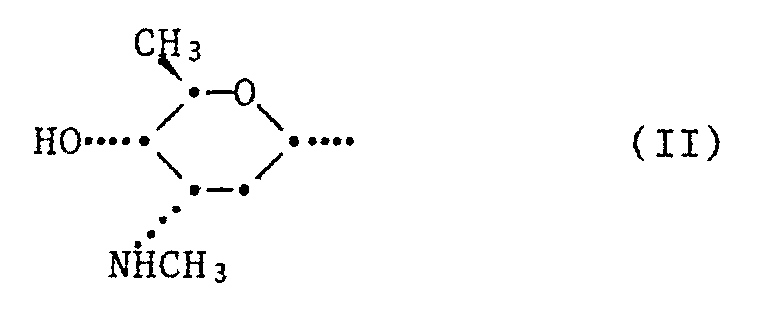
- Der Rest der Formel II hat gemäss NMR-Spektroskopie die oben angegebene, auch aus der folgenden, äquivalenten Formel IIa zum Ausdruck kommende relative Konfiguration:

- Der Rest der Formel II liegt in optisch aktiver Form vor, wobei seine absolute Konfiguration noch unbekannt ist, aber durch das Herstellungsverfahren eindeutig definiert werden kann.
- Die Erfindung betrifft insbesondere die Verbindung der Formel I, worin R¹ den optisch aktiven Rest der Formel II bedeutet, in der durch Züchtung des Stammes Streptomyces viridochromogenes DSM 3972 erhältlichen absoluten Konfiguration. Diese Verbindung wird im folgenden als Phenanthroviridin bezeichnet. Nach der IUPAC-Nomenklatur wird phenanthroviridin als 1-(2,3,6-Tri-desoxy-3-methylamino-α-ribo-hexopyranosyloxy)-8-hydroxy-3-methyl-benzo[b]phenanthridin-7,12-dion bezeichnet. Dabei gibt das Präfix "ribo" analog dem Präfix "erythro" oder "threo" nur die relative Konfiguration an den Asymmetriezentren in 3-, 4- und 5-Stellung des 2,3,6-Tri-desoxy-3-methylamino-hexopyranosyl-restes an. Die Konfigurationsangabe "α" bezieht sich nicht auf "ribo", sondern definiert die relative Konfiguration in 1-Stellung des Hexopyranosyl-restes. Die absolute Konfiguration, d.h. die Zugehörigkeit zur D- oder L-Reihe, bleibt offen. Alternativ kann man Phenanthroviridin als 1-(2,3,6-Tridesoxy-3-methylamino-α-allopyranosyloxy)-8-hydroxy-3-methyl-benzo[b]phenanthridin-7,12-dion bezeichnen.
- Salze einer Verbindung der Formel I sind vorzugsweise pharmazeutisch-verwendbar und nicht-toxisch, z.B. Säureadditionssalze mit anorganischen Säuren, wie Salzsäure, Schwefelsäure oder Phosphorsäure, oder mit geeigneten organischen Carbon- oder Sulfonsäuren, z.B. Trifluoressigsäure, sowie mit Aminosäuren, wie Arginin und Lysin.
- Zur Isolierung oder Reinigung können auch pharmazeutisch ungeeignete Salze Verwendung finden. Zur therapeutischen Anwendung gelangen jedoch nur die pharmazeutisch verwendbaren, nicht-toxischen Salze, die deshalb bevorzugt werden.
- Die Verbindungen der Formel I und ihre pharmazeutisch verwendbaren Salze weisen wertvolle pharmakologische Eigenschaften, insbesondere tumorizide Eigenschaften, bei Warmblütern einschliesslich des Menschen auf, wie sich beispielsweise an experimentellen Tumoren, z.B. menschlichem Lungenkarzinom MBA 9812, demonstrieren lässt. So reduzieren die Verbindungen der Formel I in einer Dosierung zwischen 5 und 20 mg/kg/Tag i.p. das Gewicht (25 mg) von Lungenkarzinom MBA 9812, welches in schwarze, nackte, weibliche C-57 Mäuse mit einem Körpergewicht von 18 - 22 g implantiert worden ist, im Vergleich zu unbehandelten Tieren nach 14 - 15 Tagesdosen bis auf ca. 10 %. Die Verabreichung von zweimal täglich 5 mg/kg i.p. der Verbindung der Formel I, worin R¹ Wasserstoff bedeutet, (Aglykon) während 15 Tagen bewirkt eine Reduktion des Tumorgewichts um 96 % auf nur noch 4 %.
- Das Verfahren zur Herstellung der Verbindungen der Formel I oder eines Salzes einer solchen Verbindung, worin R¹ den Rest der Formel II bedeutet, ist dadurch charakterisiert, dass man den Stamm Streptomyces viridochromogenes (Krainsky) Waksman et Henrici (ohne Melaninbildung) DSM 3972 oder eine von diesem Stamm ableitbare Kultur in einem geeigneten Nährmedium züchtet, die Verbindung der Formel I, worin R¹ den Rest der Formel II bedeutet, aus der Kulturbrühe isoliert und, wenn erwünscht, die erhaltene Verbindung in ein Salz überführt und, wenn erwünscht, durch Behandlung mit einem sauren Mittel in die Verbindung der Formel I, worin R¹ Wasserstoff bedeutet, überführt.
- Die genannten Verbindungen der Formel I werden mit Hilfe eines neuen, mikrobiologischen Verfahrens, nämlich durch Fermentation mit dem neuen Stamm Streptomyces viridochromogenes (Krainsky) Waksman et Henrici [ohne Melaninbildung], erhalten, welcher am 2. Februar 1987 gemäss dem Budapester Vertrag bei der Deutschen Sammlung für Mikroorganismen, Grisebachstr. 8, D-3400 Göttingen, Bundesrepublik Deutschland, unter der Nummer DSM 3972 hinterlegt wurde.
- Der Stamm wurde im Jahre 1983 aus einer Erdprobe aus tropischem Urwald bei Ribeirao Preto, Provinz Sao Paulo, Brasilien, isoliert. Die Bestimmung erfolgte gemäss R. Hütter, "Systematik der Streptomyceten", Verlag Karger, Basel 1967, S. 96 ff. In Zellhydrolysaten kann (L,L)-Diaminopimelinsäure nachgewiesen werden. Der Stamm DSM 3972 bildet weder auf Pepton-Eisen-Agar noch auf Tyrosin-Agar einen melanoiden Farbstoff. Dies steht im Gegensatz zu den bisher bekannten Vertretern von Streptomyces viridochromogenes. Die bei der Prüfung der Melaninbildung verwendeten Agar haben folgende Zusammensetzung:
Pepton-Eisen-Agar (pH 7,4) Gramm/Liter Hefeextrakt 1 Bactopepton 15 Eisen-Ammonium-Citrat 0,5 K₂HPO₄ 1 Na₂S₂O₃ 0,08 Bacto Agar 15 Synthetisches Medium (pH 7,4) Gramm/Liter Tyrosin 1 Glycerin 15 L-Arginin-HCl 5 Methionin 0,3 K₂HPO₄ 0,5 MgSO₄ x 7 H₂O 0,02 CuSO₄ x 5 H₂O 0,01 CaCl₂ x 2 H₂O 0,01 FeSO₄ x 7 H₂O 0,01 ZnSO₄ x 7 H₂O 0,01 MnSO₄ x 7 H₂O 0,04 Bacto Agar 15 - Der Stamm DSM 3972 verwertet die folgenden Zucker bzw. Alkohole: Arabinose, Xylose, Rhamnose, Raffinose, Mannit, Inositol, Fructose, Saccharose, Glucose, Lactose, Cellobiose und Adonit. Auf Inulin wird kein Wachstum beobachtet. Die Prüfung auf Kohlehydratverwertung wird in folgendem Medium durchgeführt:

- Der Stamm DSM 3972 stimmt in einigen Merkmalen mit Streptomyces albocyaneus überein, bildet aber im Gegensatz dazu kein Endopigment.
- Weitere Angaben zur Charakterisierung des Stammes DSM 3972 enthält die nachfolgende Uebersicht:
- Substratmyzel: gelbbräunlich
Luftmyzel: beigebräunlich, später grünlichblau
Sporenfarbe: grünlichblau
Sporenketten: kurze, enge Spiralen
Sporenform: rundlich-ellipsoid
Sporenoberfläche: stachelig
Kultivierungsmedium Hefeagar (pH 7,0) Gramm/Liter Hefeextrakt 4 Malzextrakt 5 Glucose 4 Agar 20 - Als ableitbare Kultur im obigen Sinne gilt jede Kultur, welche noch die für die Durchführung des erfindungsgemässen Verfahrens wesentlichen Merkmale der hinterlegten Kultur aufweist, d.h. hauptsächlich eine abgeleitete Kultur, insbesondere eine Kultur, deren Mikroorganismen die gleichen Strukturgene wie die für die Bildung der Verbindung der Formel I ursächlichen Strukturgene des Stammes DSM 3972 enthalten. Als ableitbare Kultur gilt auch jede Kultur, deren Mikroorganismen ein wegen der Entartung des genetischen Codes mögliches Aequivalent der für die Bildung von Verbindung I ursächlichen Strukturgene des Stammes DSM 3972 enthalten. Als ableitbare Kultur gilt insbesondere jede Kultur, die Mikroorganismen der Gattung Streptomyces, vorzugsweise der Art Streptomyces viridochromogenes, welche zur Produktion der Verbindung der Formel I befähigt sind, enthält. Der Begriff "ableitbare Kultur des Stammes DSM 3972" schliesst auch alle Mutanten dieses Stammes ein, die zur Produktion von Verbindung I befähigt sind.
- Als Nährmedium verwendet man eine vorzugsweise wässrige Lösung oder Suspension, welche mindestens eine Kohlenstoffquelle und mindestens eine Stickstoffquelle, und vorzugsweise auch Mineralstoffe enthält. Als Kohlenstoffquelle sind beispielsweise zu nennen: Glycerin, assimilierbare Kohlenhydrate, wie Cyclitole, z.B. Mannit, Polysaccharide, z.B. Stärke, Disaccharide, z.B. Lactose und Saccharose, und Monosaccharide, vor allem Glucose und Fructose, sowie entsprechende Kohlenhydrat-haltige technische Rohstoffe, wie Zuckerrüben- oder Zuckerrohrmelasse. Als Stickstoffquelle seien genannt; Aminosäuren, insbesondere die in der Natur vorkommenden α-Aminosäuren, Peptide sowie Proteine und deren Abbauprodukte, wie Peptone und Tryptone, aber auch Ammoniumsalze und Nitrate, sowie entsprechende technische stickstoffhaltige Rohstoffe, wie Fleischextrakte, Kaseinhydrolysat sowie Hefeautolysat und -extrakt. Es kommen auch gemischte technische C- und N-Quellen in Betracht, wie verschiedene Pflanzensamen, die in Form von wässrigen Auszügen, Mehl oder Maische verwendet werden, z.B. von Bohnen, z.B. Sojabohnen, Getreidekörnern, z.B. Weizen, und insbesondere Mais ("Corn-steep liquor"); ferner auch Baumwollsamen und Malzextrakt. Neben Ammoniumsalzen, wie insbesondere Ammoniumchlorid, -sulfat oder -nitrat und weiteren Nitraten kann das Nährmedium als anorganische Salze Chloride, Carbonate, Sulfate und insbesondere Phosphate von Alkali-und Erdalkalimetallen, wie insbesondere von Natrium, Kalium, Magnesium und Calcium, sowie von Spurenelementen, wie Eisen, Zink und Mangan, enthalten.
- Das Nährmedium wird sterilisiert und mit einer Kultur des Produktionsstammes unter Einhalten der üblichen Massnahmen eingeimpft.
- Die Züchtung erfolgt aerob, also beispielsweise in ruhender Oberflächenkultur oder vorzugsweise submers unter Schütteln oder Rühren mit Luft oder Sauerstoff im Schüttelkolben oder in Fermentern. Als Temperatur eignet sich eine solche zwischen etwa 15°C und 40°C, insbesondere zwischen etwa 22°C und 32°C, vorzugsweise etwa 28°C. Die Fermentationszeit liegt bevorzugterweise zwischen 2 und 12 Tagen, z.B. bei 7 - 8 Tagen. Vorzugsweise kultiviert man in mehreren Stufen, d.h. man stellt zunächst eine oder mehrere Vorkulturen in flüssigem Nährmedium her, die dann in das eigentliche Produktionsmedium, z.B. im Verhältnis 1:20, überimpft werden.
- Die Isolierung erfolgt auf physiko-chemischen Wege mittels an sich bekannter Trennungsmethoden, insbesondere durch Zentrifugieren, Filtrieren, Lösungsmittel-Extraktion, Fällung, Kristallisieren und Chromatographie, vor allem Adsorptions- und Verteilungschromatographie.
- Vorzugsweise wird die Kulturbrühe zunächst, z.B. mit 50%iger Schwefelsäure, auf ca. pH = 2 angesäuert und mit einem geeigneten Lösungsmittel, z.B. Essigsäureethylester, zwecks Entfernung von Verunreinigungen extrahiert. Der Extrakt wird verworfen. Raffinat und Mycel werden mit einer geeigneten Lauge, z.B. 5 N NaOH, auf ca. pH 10 gestellt und mit einem geeigneten Lösungsmittel, z.B. Essigsäureethylester, extrahiert. Der eingedampfte Extrakt wird durch Verteilung, z.B. zwischen einem geeigneten Alkohol, wie Methanol, und einem geeigneten unpolaren organischen Lösungsmittel, z.B. einem Kohlenwasserstoff, wie Heptan, gereinigt. Die eingedampfte alkoholische Phase wird an Kieselgel chromatographiert. Die Hauptfraktion wird in leicht saurem Medium durch Umkehrphasenchromatographie weiter gereinigt. Die das gewünschte Produkt enthaltenden Fraktionen werden lyophilisiert. Das Lyophilisat wird an einem modifizierten Dextrangel, z.B. Sephadex®, chromatographiert und anschliessend kristallisiert.
- Die Ueberführung der Verbindung der Formel I, worin R¹ einen Rest der Formel II bedeutet, in das Aglykon erfolgt mit einem sauren Mittel, wie einer Mineralsäure oder einem sauren Ionenaustauscher, vorzugsweise durch Erwärmen des Trifluoracetats in verdünnter Salzsäure, z.B. 0,1 N HCl, auf 50 - 120°C, z.B. 90°C. Das Aglykon fällt aus, wird abfiltriert, in einem geeigneten organischen Lösungsmittel, z.B. Chloroform, aufgenommen und durch Extraktion mit Wasser und Kristallisation der getrockneten organischen Phase gereinigt.
- Insbesondere betrifft die Erfindung ein Verfahren zur Herstellung von Phenanthroviridin, dadurch gekennzeichnet, dass man den Stamm Streptomyces viridochromogenes DSM 3972 oder einen Mikroorganismus, der die gleichen Strukturgene enthält wie die für die Bildung von Phenanthroviridin ursächlichen Strukturgene des genannten Stammes, in einem wässerigen, eine Kohlenstoff- und Stickstoffquelle sowie anorganische Salze enthaltenden Nährmedium aerob züchtet und Phenanthroviridin isoliert.
- In erster Linie betrifft die Erfindung eine Ausführungsform des obengenannten Verfahrens, die dadurch gekennzeichnet ist, dass man einen Phenanthroviridin bildenden Mikroorganismus der Art Streptomyces viridochromogenes züchtet.
- Eine bevorzugte Ausführungsform des obengenannten Verfahrens ist dadurch gekennzeichnet, dass man den Stamm Streptomyces viridochromogenes DSM 3972 oder eine Phenanthroviridin bildende Mutante dieses Stammes züchtet.
- Eine besonders bevorzugte Ausführungsform des obengenannten Verfahrens ist dadurch gekennzeichnet, dass man den Stamm Streptomyces viridochromogenes DSM 3972 züchtet.
- Vorzugsweise führt man die Fermentation unter den im Beispielteil beschriebenen Bedingungen durch.
- Mikroorganismen, die die gleichen für die Bildung von Phenanthroviridin ursächlichen Strukturgene enthalten wie der Stamm DSM 3972, können z.B. durch Genmanipulation künstlich geschaffen werden, indem man die entsprechenden Strukturgene aus dem Stamm DSM 3972 isoliert und an geeigneter Stelle in das Genmaterial eines geeigneten, anderen Mikroorganismus einbaut. Geeignete Mikroorganismen sind solche, in die man die betreffenden Strukturgene nicht nur einbauen kann, sondern in denen diese Strukturgene auch ausgedrückt werden und in denen das gebildete Phenanthroviridin nicht wieder abgebaut sowie, vorzugsweise, in die Fermentationsbrühe ausgeschieden wird. Solche geeigneten Mikroorganismen sind in erster Linie andere Stämme der Gattung Streptomyces, insbesondere solche der Art Streptomyces viridochromogenes, sofern sie die obengenannten Strukturgene nicht bereits besitzen.
- Nach Aufklärung der Nucleotidsequenz der obengenannten Strukturgene können diese auch synthetisch hergestellt werden. Dabei besteht aufgrund der Entartung des genetischen Codes die Möglichkeit, bestimmte Nucleotidsequenzen aus drei aufeinanderfolgenden Nucleotiden, sogenannte Codons, gegen andere Codons auszutauschen, die für die gleiche Aminosäure codieren.
- Phenanthroviridin bildende Mutanten können zum Beispiel unter der Einwirkung von Ultraviolett- oder Röntgenstrahlen oder von chemischen Mutagenen, z.B. N-Methyl-N′-nitro-N-nitroso-guanidin, erzeugt und durch Selektion nach ihren spezifischen Eigenschaften in an sich bekannter Weise isoliert werden.
- Die Erfindung betrifft auch ein Verfahren zur Herstellung eines Fermentationsgutes, das Phenanthroviridin in nachweisbarer Menge enthält und das dadurch gekennzeichnet ist, dass man den Stamm Streptomyces viridochromogenes DSM 3972 oder eine von diesem Stamm ableitbare Kultur in einem Nährmedium züchtet und das Verfahren zur Isolierung oder Reinigung von Phenanthroviridin an geeigneter Stelle abbricht.
- Die Erfindung betrifft auch die Verwendung einer Verbindung der Formel I zur medizinischen Behandlung von Krankheiten bei Warmblütern einschliesslich des Menschen, insbesondere zur Behandlung von Tumorerkrankungen, z.B. im Falle von Lungentumoren, insbesondere durch die Verabreichung therapeutisch wirksamer Mengen, z.B. tumorizider Mengen, einer Verbindung der Formel I. Die Dosierung bei Verabreichung an Warmblüter von etwa 70 kg Körpergewicht, wie z.B. an einen solchen Menschen, beträgt 100 bis 1000 mg pro Tag. Die Verabreichung erfolgt vorzugsweise in Form pharmazeutischer Präparate parenteral, z.B. intravenös oder intraperitoneal.
- Die Erfindung betrifft auch pharmazeutische Präparate, die eine Verbindung der Formel I, insbesondere eine effektive, d.h. z.B. tumorizide Dosis einer Verbindung I, zusammen mit einem pharmazeutischen Trägermaterial, vorzugsweise einer signifikanten Menge Trägermaterial, enthalten.
- Man kann die pharmakologisch wirksamen Verbindungen der vorliegenden Erfindung in Form von parenteral verabreichbaren Präparaten oder von Infusionslösungen verwenden. Solche Lösungen sind vorzugsweise isotonische wässrige Lösungen oder Suspensionen, wobei diese z.B. bei lyophilisierten Präparaten, welche die Wirksubstanz allein oder zusammen mit einem Trägermaterial, z.B. Mannit, enthalten, vor Gebrauch hergestellt werden können. Die pharmazeutischen Präparate können sterilisiert sein und/oder Hilfsstoffe, z.B. Konservier-, Stabilisier-, Netz- und/oder Emulgiermittel, Löslichkeitsvermittler, Salze zur Regulierung des osmotischen Drucks und/oder Puffer enthalten. Die vorliegenden pharmazeutischen Präparate, die, wenn erwünscht, weitere pharmakologisch wirksame Stoffe, wie Antibiotika, enthalten können, werden in an sich bekannter Weise, z.B. mittels konventioneller Lösungs- oder Lyophilisierungsverfahren, hergestellt und enthalten von etwa 0,1 % bis 90 %, insbesondere von etwa 0,5 % bis etwa 30 %, z.B. 1-5 % Aktivstoff(e).
- Die nachfolgenden Beispiele illustrieren die Erfindung, ohne sie in irgendeiner Form einzuschränken. Die Rf-Werte werden auf Kieselgeldünnschichtplatten (Firma Merck, Darmstadt, Deutschland) ermittelt. Das Verhältnis der Laufmittel in den verwendeten Laufmittelgemischen zueinander ist in Volumenanteilen (V/V), Temperaturen sind in Grad Celsius angegeben. Die Konzentration, c, der Substanz im Lösungsmittel(gemisch) ist im Falle der optischen Drehung in Prozent (Gewicht/volumen) angegeben.
- Bei der Angabe der Kernresonanzspektren werden folgende Abkürzungen und Kombinationen davon verwendet:
b = breit
d = Dublett
Hz = Hertz
J = Kopplungskonstante
m = Multiplett
q = Quartett
s = Singulett
t = Triplett - 21 Liter Kulturlösung pH 8,8 (aus Stufe 1.4) werden mit 50%iger Schwefelsäure auf pH 2 gestellt und 15 Minuten mit 50 Liter Essigsäureethylester gerührt. Der saure Essigesterextrakt wird verworfen. Raffinat und Mycel werden mit 5 N Natronlauge auf pH 10 gestellt und mit 110 Liter Essigsäureethylester 30 Minuten gerührt. Der basische Essigesterextrakt wird eingedampft und das zurückbleibende Oel zwischen Methanol und Heptan verteilt. Die Heptanphase wird verworfen, die Methanolphase zur Trockne eingedampft. Der Rückstand wird an 500 g Kieselgel in Methylenchlorid Methanol-25%ige wässrige Ammoniaklösung (94:6:1) chromatographiert. Der Trockenrückstand der Hauptfraktion (∼1 g) wird in Acetonitril-Wasser-Trifluoressigsäure (50:50:1) gelöst und an Lichroprep® RP 18 (mit C₁₈-Alkyl modifiziertes Kieselgel, geliefert von der Firma E. Merck, Darmstadt, Bundesrepublik Deutschland) durch Umkehrphasenchromatographie gereinigt. Die das gewünschte Produkt (Phenanthroviridin) enthaltenden Fraktionen werden lyophilisiert. Der Rückstand wird an Sephadex®-LH 20 (modifiziertes Dextrangel, Lieferfirma: Pharmacia, Schweden) in Methanol chromatographiert. Das Rohprodukt wird aus Methanol-Isopropanol kristallisiert.
- Man erhält 1-(2,3,6-Tri-desoxy-3-methylamino-α-ribo-hexopyranosyloxy)-8-hydroxy-3-methyl-benzo[b]phenanthridin-7,12-dion-trifluoracetat (Phenanthroviridin-trifluoracetat) der Formel III, Smp. 196 - 197°, [α]


- Die als Ausgangsmaterial verwendete Kulturlösung erhält man folgendermassen:
- Zur Herstellung des Impfmaterials für die eigentliche Produktionsfermentation impft man mehrere Hefe-Schrägagarkulturen mit dem Stamm Streptomyces viridochromogenes [ohne Melaninbildung] DSM 3972, welcher in Ampullen bei -80°C aufbewahrt wird, und inkubiert 7 - 10 Tage lang bei 28°C. Diese Agarkulturen haben die folgende Zusammensetzung:
g/Liter Hefeextrakt (Lieferfirma: Fould Springer) 4 Malzextrakt (Lieferfirma: Difco) 5 Glucose 4 Bacto Agar 20 g/Liter Cerelose (Glucose in handelsüblicher [commercial grade] Qualität) 22 Oxo Lab Lemco (Fleischextract; Lieferfirma: Oxoid) 5 Pepton (Difco) 5 Hefeextrakt (Difco) 5 Anti-Schaum-Mittel (Silicon A/AF) 0,01 Casein Hydrolysat (Difco) 3 Natriumchlorid 1,5 - Der obengenannte Erlenmeyer Kolben wird auf einer Schüttelmaschine bei 250 Umdrehungen pro Minute und 50 mm Amplitude (Auslenkung) bei 28°C 48 Stunden lang bebrütet, wonach das zentrifugierbare Myzelvolumen der Kulturbrühe ("packed mycelial volume", Zellvolumen, das durch zehnminütige Zentrifugation bei 1690 g bestimmt wird) 5 - 8 % beträgt.
- Anschliessend werden je 25 ml (5 Volumenprozent) der so erhaltenen Kulturbrühe unter aseptischen Bedingungen in zwei 2-Liter-Erlenmeyer-Kolben mit 4 Schikanen überimpft, die je 500 ml des oben genannten Mediums SCR/9 enthalten. Diese Kolben werden auf Schüttelmaschinen bei 120 Umdrehungen pro Minute und 50 mm Amplitude bei 28°C 48 Stunden lang bebrütet, wonach das zentrifugierbare Myzelvolumen 10 - 30 % beträgt.
- 750 ml (2,5 Volumenprozent) der gemäss Stufe 1.2 erhaltenen Kulturbrühe werden anschliessend unter aseptischen Bedingungen in einen 50-Liter-Vorkultur-Fermenter überführt, der 30 Liter des obengenannten sterilen Mediums SCR/9 enthält. Der Kleinfermenter ist mit einem sechsblätterigen Turbinenrührer mit einem Durchmesser von 115 mm ausgerüstet, der sich mit 600 Umdrehungen pro Minute dreht. Der Fermenter wird bei 28°C, bei einer Belüftung von 1 Liter Luft pro 1 Liter Kulturbrühe in der Minute und bei einem Ueberdruck von 50 000 Pa (0,5 Bar) 48 Stunden lang inkubiert, wonach das zentrifugierbare Myzelvolumen 8 - 10 % beträgt.
- 5 Volumenprozent der gemäss Stufe 1.3 erhaltenen Kulturbrühe werden anschliessend unter aseptischen Bedingungen in einen Fermenter vom gleichen Typ, wie bei Stufe 1.3 beschrieben, überführt, welcher 30 Liter des Produktionsmediums mit der folgenden Zusammensetzung enthält:
g/Liter Cerelose (Glucose in handelsüblicher Qualität) 20 Protaminal (Fischproteinkonzentrat, Lieferfirma: Traders Protein) 20 Hefeextrakt (Lieferfirma: Fould Springer) 10 Kaliumdihydrogenphosphat 0,5 Calciumcarbonat 3,0 Antischaummittel nach Bedarf - Die Fermentation wird 7 - 8 Tage lang unter gleichen Bedingungen wie bei Stufe 1.3 durchgeführt. Dabei werden in regelmässigen Zeitabständen der pH-Wert, das zentrifugierbare Myzelvolumen, die Sterilität, die Temperatur, die Belüftung, der Ueberdruck und die Rührgeschwindigkeit bestimmt. Am Ende der Fermentation weist die Kulturbrühe einen pH-Wert > 8.0 und ein zentrifugierbares Myzelvolumen von 20 - 25 % auf.
- 278 mg Phenanthroviridin-trifluoracetat (s. Beispiel 1) werden mit 50 ml 0,1 N Salzsäure versetzt und 30 Minuten auf 90°C erhitzt. Nach Abkühlen des Reaktionsgemisches im Eisbad wird der dunkelbraune Niederschlag abfiltriert, der Filterrückstand in 40 ml Chloroform gelöst und einmal mit 10 ml Wasser extrahiert. Die Chloroformphase wird mit Natriumsulfat getrocknet und im Vakuum bis zur beginnenden Kristallisation eingeengt. Die gebildeten Kristalle werden abgesaugt und im Vakuum über Phosphorpentoxid getrocknet. Man erhält 1,8-Dihydroxy-3-methyl-benzo[b]phenanthridin-7,12-dion (Bezifferung analog Beispiel 1, Formel III); Smp. 234-235°.
360 MHz-¹H-NMR (CDCl₃:CD₃OD = 9:1): δ = 2.6 (s; 3H, CH₃), 7.33 (s; 1H, 9-H), 7.44 (d, J = 9 Hz; 1 H, 4-H), 7.51 (s; 1H, 11-H), 7.78 (t, J = 9 Hz; 1H, 5-H), 7.95 (d, J = 9 Hz; 1H, 6-H), 9.45 (s; 1H, 12-H).
90 MHz-¹³C-NMR (CDCl₃:CD₃OD = 9:1): δ = 20.3 (C-13), 113.6 (C-7a), 119.5 (C-12b), 120.5 (C-11), 120.7 (C-2), 122.8 (C-4), 124.7 (C-9), 127.5 (C-12a), 131.7 (C-11a), 132.7 (C-4a), 136.3 (C-10), 143.4 (C-3), 144.4 (C-6a), 153.8 (C-1), 159.1 (C-5), 161.0 (C-8), 185.1 (C-12), 188.6 (C-7). - Je 5 ml einer 1%igen sterilen wässrigen Lösung von Phenanthroviridinhydrochlorid werden unter aseptischen Bedingungen in Ampullen oder Vials eingefüllt und gefriergetrocknet. Die Ampullen bzw. Vials werden unter Stickstoff verschlossen und geprüft.
- Je 10 ml einer sterilen wässrigen Lösung von 0,5 % Phenanthroviridinhydrochlorid und 2,5 % Lactose werden unter aseptischen Bedingungen in Ampullen oder Vials eingefüllt und gefriergetrocknet. Die Ampullen bzw. Vials werden verschlossen und geprüft.
Claims (10)


Priority Applications (1)
| Application Number | Priority Date | Filing Date | Title |
|---|---|---|---|
| AT88810545T ATE101393T1 (de) | 1987-08-20 | 1988-08-11 | Phenanthridinderivate, verfahren zu ihrer herstellung und mittel zur ausfuehrung des verfahrens. |
Applications Claiming Priority (2)
| Application Number | Priority Date | Filing Date | Title |
|---|---|---|---|
| CH319687 | 1987-08-20 | ||
| CH3196/87 | 1987-08-20 |
Publications (3)
| Publication Number | Publication Date |
|---|---|
| EP0304400A2 true EP0304400A2 (de) | 1989-02-22 |
| EP0304400A3 EP0304400A3 (en) | 1990-04-25 |
| EP0304400B1 EP0304400B1 (de) | 1994-02-09 |
Family
ID=4250737
Family Applications (1)
| Application Number | Title | Priority Date | Filing Date |
|---|---|---|---|
| EP88810545A Expired - Lifetime EP0304400B1 (de) | 1987-08-20 | 1988-08-11 | Phenanthridinderivate, Verfahren zu ihrer Herstellung und Mittel zur Ausführung des Verfahrens |
Country Status (10)
| Country | Link |
|---|---|
| US (2) | US4939158A (de) |
| EP (1) | EP0304400B1 (de) |
| JP (1) | JPS6483069A (de) |
| AT (1) | ATE101393T1 (de) |
| CA (1) | CA1306213C (de) |
| DE (1) | DE3887713D1 (de) |
| DK (1) | DK467488A (de) |
| ES (1) | ES2061722T3 (de) |
| IE (1) | IE62423B1 (de) |
| PT (1) | PT88294B (de) |
Families Citing this family (4)
| Publication number | Priority date | Publication date | Assignee | Title |
|---|---|---|---|---|
| JP3141148B2 (ja) * | 1995-08-08 | 2001-03-05 | 大鵬薬品工業株式会社 | 縮合インダン誘導体及びその塩 |
| DE19538088A1 (de) * | 1995-10-13 | 1997-04-17 | Bernd Prof Dr Clement | Phenanthridinderivate und ihre Herstellung |
| JP4730879B2 (ja) * | 2004-09-21 | 2011-07-20 | 公益財団法人微生物化学研究会 | キガマイシノン類及びその製造方法、並びに、該キガマイシノン類を含む薬用組成物 |
| CN111892574A (zh) * | 2020-05-19 | 2020-11-06 | 中国科学院南海海洋研究所 | 一类非典型角环素类化合物及其制备方法和应用 |
Family Cites Families (4)
| Publication number | Priority date | Publication date | Assignee | Title |
|---|---|---|---|---|
| US3131126A (en) * | 1959-07-23 | 1964-04-28 | Ciba Geigy Corp | Antibiotic and process for its manufacture |
| JPS59212499A (ja) * | 1983-05-13 | 1984-12-01 | アドリヤ・ラボラトリ−ズ・インコ−ポレ−テツド | 抗腫瘍性抗生物質アントラサイクリンの4−デメトキシ−3′−デアミノ−3′(4−モリホリニル)誘導体 |
| US4600691A (en) * | 1983-10-12 | 1986-07-15 | Merck & Co., Inc. | R-(Z)-4-amino-3-chloro-2-pentenedioic acid, novel antibacterial agent |
| DE3722699A1 (de) * | 1987-07-09 | 1989-01-19 | Behringwerke Ag | Zytostatisch wirksame anthacyclin-konjugate |
-
1988
- 1988-08-11 DE DE88810545T patent/DE3887713D1/de not_active Expired - Fee Related
- 1988-08-11 ES ES88810545T patent/ES2061722T3/es not_active Expired - Lifetime
- 1988-08-11 US US07/230,941 patent/US4939158A/en not_active Expired - Fee Related
- 1988-08-11 EP EP88810545A patent/EP0304400B1/de not_active Expired - Lifetime
- 1988-08-11 AT AT88810545T patent/ATE101393T1/de active
- 1988-08-18 PT PT88294A patent/PT88294B/pt not_active IP Right Cessation
- 1988-08-18 CA CA000575090A patent/CA1306213C/en not_active Expired - Lifetime
- 1988-08-19 JP JP63204828A patent/JPS6483069A/ja active Pending
- 1988-08-19 IE IE254188A patent/IE62423B1/en not_active IP Right Cessation
- 1988-08-19 DK DK467488A patent/DK467488A/da not_active Application Discontinuation
-
1990
- 1990-02-08 US US07/477,087 patent/US5093247A/en not_active Expired - Fee Related
Non-Patent Citations (2)
| Title |
|---|
| JOURNAL OF ORGANIC CHEMISTRY, Band 31, Nr. 9, September 1966, Washington, DC, US, Seiten 2920-2925; M.P. KUNSTMANN et al.: "The Structural Characterization of Tetrangomycin and Tetrangulol" * |
| JOURNAL OF THE CHEMICAL SOCIETY PERKIN TRANSACTION 1, 1976, Seiten 997-1000, London, GB; P. MARGARET BROWN et al.: "Naturally Occurring Quinones. Part XXVI. A Synthesis of Tetrangulol (1,8-Dihydroxy-3-methylbenzÄaÜanthracene-7,12-quinone)" * |
Also Published As
| Publication number | Publication date |
|---|---|
| EP0304400A3 (en) | 1990-04-25 |
| PT88294B (pt) | 1995-03-31 |
| ES2061722T3 (es) | 1994-12-16 |
| DK467488D0 (da) | 1988-08-19 |
| PT88294A (pt) | 1989-06-30 |
| JPS6483069A (en) | 1989-03-28 |
| EP0304400B1 (de) | 1994-02-09 |
| IE62423B1 (en) | 1995-02-08 |
| US5093247A (en) | 1992-03-03 |
| DK467488A (da) | 1989-02-21 |
| ATE101393T1 (de) | 1994-02-15 |
| DE3887713D1 (de) | 1994-03-24 |
| US4939158A (en) | 1990-07-03 |
| IE882541L (en) | 1989-02-20 |
| CA1306213C (en) | 1992-08-11 |
Similar Documents
| Publication | Publication Date | Title |
|---|---|---|
| DE69422526T2 (de) | Polyzyklische antiparasitäre derivate, verfahren und stamm zu ihrer herstellung und ihrer verwendung | |
| EP0366060B1 (de) | Glykosidase-Inhibitor Salbostatin, Verfahren zu seiner Herstellung und seine Verwendung | |
| DE2532568A1 (de) | Aclacinomycine a und b und verfahren zu ihrer herstellung | |
| DE68902670T2 (de) | Ks-506 verbindungen und verfahren zu deren herstellung. | |
| DE3521436C2 (de) | ||
| DE68906825T2 (de) | Glycosid-Antibiotika BU-3608D und BU-3608E. | |
| EP0304400B1 (de) | Phenanthridinderivate, Verfahren zu ihrer Herstellung und Mittel zur Ausführung des Verfahrens | |
| EP0057349B1 (de) | Neues Peptid-Antibiotikum Komponente B, Verfahren zu seiner Herstellung sowie seine Verwendung in Arzneimitteln | |
| DE69917668T2 (de) | Substanz gm-95, verfahren zu ihrer herstellung und ihre verwendung | |
| DE2839668C2 (de) | ||
| DE69114252T2 (de) | Reveromycin-a, herstellung und verwendung als antitumormittel sowie als fungizid. | |
| DE2028403B2 (de) | Pepstatin | |
| DE69816621T2 (de) | Macrolide mit antitumoraktivität | |
| EP0236894B1 (de) | Efomycin G, seine Herstellung und seine Verwendung als Leistungsförderer bei Tieren | |
| EP0057812B1 (de) | Neues Peptid-Antibiotikum Komponente A, Verfahren zu seiner Herstellung sowie seine Verwendung in Arzneimitteln | |
| EP0259751A2 (de) | Annomycin, ein Antibiotikum; mikrobiologisches Verfahren zu dessen Herstellung und seine Verwendung | |
| DE3889213T2 (de) | Antibiotika NK 86-0279, deren Verfahren zur Herstellung und deren Benutzung. | |
| DE2946793C2 (de) | 4-O-Desmethyl-11-desoxy-anthracyclinglycoside, Verfahren zu deren Herstellung sowie diese Verbindungen enthaltende pharmazeutische Zusammensetzungen | |
| DE3881566T2 (de) | Antitumor-derivate, verfahren zu ihrer herstellung und pharmazeutische zusammensetzungen, die sie enthalten. | |
| DE69206858T2 (de) | Verbindung UCA1064-B | |
| EP0259778B1 (de) | Antibiotisch wirksames Gentisinsäurederivat | |
| DE68903507T2 (de) | Antitumor-antibiotika. | |
| EP0297523A2 (de) | Verfahren zur Herstellung von Elaiophylin und dessen Verwendung | |
| DE3446052A1 (de) | Anthracyclin-derivate, ein mikrobiologisches verfahren zu ihrer herstellung und ihre verwendung als arzneimittel | |
| AT388385B (de) | Neue antibiotika, ein mikrobiologisches verfahren zu ihrer herstellung und ihre verwendung als arzneimittel |
Legal Events
| Date | Code | Title | Description |
|---|---|---|---|
| PUAI | Public reference made under article 153(3) epc to a published international application that has entered the european phase |
Free format text: ORIGINAL CODE: 0009012 |
|
| 17P | Request for examination filed |
Effective date: 19880813 |
|
| AK | Designated contracting states |
Kind code of ref document: A2 Designated state(s): AT BE CH DE ES FR GB GR IT LI LU NL SE |
|
| PUAL | Search report despatched |
Free format text: ORIGINAL CODE: 0009013 |
|
| AK | Designated contracting states |
Kind code of ref document: A3 Designated state(s): AT BE CH DE ES FR GB GR IT LI LU NL SE |
|
| 17Q | First examination report despatched |
Effective date: 19920807 |
|
| ITTA | It: last paid annual fee | ||
| GRAA | (expected) grant |
Free format text: ORIGINAL CODE: 0009210 |
|
| AK | Designated contracting states |
Kind code of ref document: B1 Designated state(s): AT BE CH DE ES FR GB GR IT LI LU NL SE |
|
| REF | Corresponds to: |
Ref document number: 101393 Country of ref document: AT Date of ref document: 19940215 Kind code of ref document: T |
|
| REF | Corresponds to: |
Ref document number: 3887713 Country of ref document: DE Date of ref document: 19940324 |
|
| ET | Fr: translation filed | ||
| REG | Reference to a national code |
Ref country code: GR Ref legal event code: FG4A Free format text: 3010725 |
|
| ITF | It: translation for a ep patent filed | ||
| GBT | Gb: translation of ep patent filed (gb section 77(6)(a)/1977) |
Effective date: 19940513 |
|
| PGFP | Annual fee paid to national office [announced via postgrant information from national office to epo] |
Ref country code: CH Payment date: 19941116 Year of fee payment: 7 |
|
| PLBE | No opposition filed within time limit |
Free format text: ORIGINAL CODE: 0009261 |
|
| STAA | Information on the status of an ep patent application or granted ep patent |
Free format text: STATUS: NO OPPOSITION FILED WITHIN TIME LIMIT |
|
| REG | Reference to a national code |
Ref country code: ES Ref legal event code: FG2A Ref document number: 2061722 Country of ref document: ES Kind code of ref document: T3 |
|
| EAL | Se: european patent in force in sweden |
Ref document number: 88810545.9 |
|
| 26N | No opposition filed | ||
| PGFP | Annual fee paid to national office [announced via postgrant information from national office to epo] |
Ref country code: FR Payment date: 19950627 Year of fee payment: 8 |
|
| PGFP | Annual fee paid to national office [announced via postgrant information from national office to epo] |
Ref country code: NL Payment date: 19950628 Year of fee payment: 8 |
|
| PGFP | Annual fee paid to national office [announced via postgrant information from national office to epo] |
Ref country code: DE Payment date: 19950710 Year of fee payment: 8 |
|
| PGFP | Annual fee paid to national office [announced via postgrant information from national office to epo] |
Ref country code: AT Payment date: 19950711 Year of fee payment: 8 |
|
| PGFP | Annual fee paid to national office [announced via postgrant information from national office to epo] |
Ref country code: GB Payment date: 19950719 Year of fee payment: 8 |
|
| PGFP | Annual fee paid to national office [announced via postgrant information from national office to epo] |
Ref country code: ES Payment date: 19950721 Year of fee payment: 8 |
|
| PGFP | Annual fee paid to national office [announced via postgrant information from national office to epo] |
Ref country code: LU Payment date: 19950801 Year of fee payment: 8 |
|
| PGFP | Annual fee paid to national office [announced via postgrant information from national office to epo] |
Ref country code: GR Payment date: 19950822 Year of fee payment: 8 |
|
| PG25 | Lapsed in a contracting state [announced via postgrant information from national office to epo] |
Ref country code: LI Effective date: 19950831 Ref country code: CH Effective date: 19950831 |
|
| PGFP | Annual fee paid to national office [announced via postgrant information from national office to epo] |
Ref country code: SE Payment date: 19950831 Year of fee payment: 8 |
|
| PGFP | Annual fee paid to national office [announced via postgrant information from national office to epo] |
Ref country code: BE Payment date: 19950911 Year of fee payment: 8 |
|
| REG | Reference to a national code |
Ref country code: CH Ref legal event code: PL |
|
| PG25 | Lapsed in a contracting state [announced via postgrant information from national office to epo] |
Ref country code: LU Free format text: LAPSE BECAUSE OF NON-PAYMENT OF DUE FEES Effective date: 19960811 Ref country code: GB Effective date: 19960811 Ref country code: AT Effective date: 19960811 |
|
| PG25 | Lapsed in a contracting state [announced via postgrant information from national office to epo] |
Ref country code: SE Effective date: 19960812 Ref country code: ES Free format text: LAPSE BECAUSE OF THE APPLICANT RENOUNCES Effective date: 19960812 |
|
| PG25 | Lapsed in a contracting state [announced via postgrant information from national office to epo] |
Ref country code: BE Effective date: 19960831 |
|
| BERE | Be: lapsed |
Owner name: CIBA-GEIGY A.G. Effective date: 19960831 |
|
| PG25 | Lapsed in a contracting state [announced via postgrant information from national office to epo] |
Ref country code: GR Free format text: THE PATENT HAS BEEN ANNULLED BY A DECISION OF A NATIONAL AUTHORITY Effective date: 19970228 |
|
| PG25 | Lapsed in a contracting state [announced via postgrant information from national office to epo] |
Ref country code: NL Effective date: 19970301 |
|
| REG | Reference to a national code |
Ref country code: GR Ref legal event code: MM2A Free format text: 3010725 |
|
| GBPC | Gb: european patent ceased through non-payment of renewal fee |
Effective date: 19960811 |
|
| PG25 | Lapsed in a contracting state [announced via postgrant information from national office to epo] |
Ref country code: FR Effective date: 19970430 |
|
| NLV4 | Nl: lapsed or anulled due to non-payment of the annual fee |
Effective date: 19970301 |
|
| PG25 | Lapsed in a contracting state [announced via postgrant information from national office to epo] |
Ref country code: DE Effective date: 19970501 |
|
| EUG | Se: european patent has lapsed |
Ref document number: 88810545.9 |
|
| REG | Reference to a national code |
Ref country code: FR Ref legal event code: ST |
|
| REG | Reference to a national code |
Ref country code: ES Ref legal event code: FD2A Effective date: 19991007 |
|
| PG25 | Lapsed in a contracting state [announced via postgrant information from national office to epo] |
Ref country code: IT Free format text: LAPSE BECAUSE OF NON-PAYMENT OF DUE FEES;WARNING: LAPSES OF ITALIAN PATENTS WITH EFFECTIVE DATE BEFORE 2007 MAY HAVE OCCURRED AT ANY TIME BEFORE 2007. THE CORRECT EFFECTIVE DATE MAY BE DIFFERENT FROM THE ONE RECORDED. Effective date: 20050811 |