EP0305900A2 - Récipient pour essai immuno-enzymatique - Google Patents
Récipient pour essai immuno-enzymatique Download PDFInfo
- Publication number
- EP0305900A2 EP0305900A2 EP88113875A EP88113875A EP0305900A2 EP 0305900 A2 EP0305900 A2 EP 0305900A2 EP 88113875 A EP88113875 A EP 88113875A EP 88113875 A EP88113875 A EP 88113875A EP 0305900 A2 EP0305900 A2 EP 0305900A2
- Authority
- EP
- European Patent Office
- Prior art keywords
- vessel
- depressions
- set forth
- depression
- substance
- Prior art date
- Legal status (The legal status is an assumption and is not a legal conclusion. Google has not performed a legal analysis and makes no representation as to the accuracy of the status listed.)
- Withdrawn
Links
Images


Classifications
-
- G—PHYSICS
- G01—MEASURING; TESTING
- G01N—INVESTIGATING OR ANALYSING MATERIALS BY DETERMINING THEIR CHEMICAL OR PHYSICAL PROPERTIES
- G01N33/00—Investigating or analysing materials by specific methods not covered by groups G01N1/00 - G01N31/00
- G01N33/48—Biological material, e.g. blood, urine; Haemocytometers
- G01N33/50—Chemical analysis of biological material, e.g. blood, urine; Testing involving biospecific ligand binding methods; Immunological testing
- G01N33/53—Immunoassay; Biospecific binding assay; Materials therefor
- G01N33/5302—Apparatus specially adapted for immunological test procedures
- G01N33/5304—Reaction vessels, e.g. agglutination plates
-
- G—PHYSICS
- G01—MEASURING; TESTING
- G01N—INVESTIGATING OR ANALYSING MATERIALS BY DETERMINING THEIR CHEMICAL OR PHYSICAL PROPERTIES
- G01N33/00—Investigating or analysing materials by specific methods not covered by groups G01N1/00 - G01N31/00
- G01N33/48—Biological material, e.g. blood, urine; Haemocytometers
- G01N33/50—Chemical analysis of biological material, e.g. blood, urine; Testing involving biospecific ligand binding methods; Immunological testing
- G01N33/53—Immunoassay; Biospecific binding assay; Materials therefor
- G01N33/543—Immunoassay; Biospecific binding assay; Materials therefor with an insoluble carrier for immobilising immunochemicals
- G01N33/54366—Apparatus specially adapted for solid-phase testing
Definitions
- This invention relates to a vessel which is used for conducting an enzymeimmunoassay.
- An assay for a substance existing in a very small amount in a biological fluid is often performed for a variety of purposes including the diagnosis of disease and the examination of results of medical treatment.
- Various methods for such an assay have been developed and include simple methods which are easy to carry out, and sophisticated methods having a high degree of sensitivity and accuracy.
- An appropriate method is selected to suit the purpose for which a particular assay is intended.
- the simple methods can be performed easily without the aid of any particular instrument or reaction device, they are particularly useful for the diagnosis of cases for which a qualitative or semiquantitative assay is sufficient. Therefore, they are widely used for e.g. the diagnosis of pregnancy.
- agglutination reaction method which is based on an agglutination or agglutination-inhibition reaction employing red blood cells or a latex as a carrier
- EIA enzymeimmunoassay
- the method which employs red blood cells as a carrier is easy to perform and has a relatively high degree of determination sensitivity, but requires a long time for completing an assay.
- the method which employs a latex can be performed easily and quickly, though its sensitivity is relatively low.
- the latter method is, therefore, used more often than any other method for the diagnosis of cases of pregnancy, or other cases where no particularly high sensitivity is required.
- it can be used only at a hospital, or other medical organization, since a high degree of skill is required for deriving a proper conclusion from the results of an assay.
- EIA is a method which enables a very high degree of sensitivity.
- it has a number of drawbacks, too.
- a long time of reaction is required for achieving a high degree of sensitivity.
- No desired sensitivity can be expected from a short time of reaction.
- a complicated step is required for the B/F separation, i.e. the physical separation of the labelled antibodies which have been combined with antigens to be assayed preceding an enzyme reaction, from those which have not been combined. If said separation is not properly done, a non-specific enzyme reaction is likely to result.
- EIA simple methods as hereinabove described, except EIA, can be used for detecting a substance, but not for determining the amount thereof, i.e. none of them is effective for quantitative determination.
- EIA is useful not only for qualitative determination, as the enzyme reaction solution presents the color developed by the substance to be assayed, if any, but also for quantitative determination, as the quantity of the substance can be estimated by the intensity of the color which it develops.
- the assay can be conducted easily and accurately.
- an object of this invention to provide a device which can be used to facilitate an enzymeimmunoassay and, more particularly, to simplify a series of steps including the antigen-antibody reaction, the B/F separation, the enzyme reaction and the evaluation of results when an enzymeimmunoassay is conducted.
- This object is essentially attained by a vessel in the shape of a dish having a substantially flat inner bottom surface provided with at least one depression to the wall of which antibodies or antigens are combined or bound, whereby the antibody or antigen is insolubilized.
- FIG. 1A and 1B An EIA vessel embodying this invention is shown in Figures 1A and 1B.
- the vessel 1 is shaped like a dish and has a substantially flat inner bottom surface provided with nine depressions 2-1 to 2-9. Each depression is provided for holding an antibody or antigen which is specifically reactive with a substance to be assayed or a control substance.
- the vessel 1 shown in Figure 1A has nine depressions arranged in an array forming a matrix, the number and arrangement of the depressions depend on the purpose of an assay and the convenience of the operation involved. For example, therefore, it is beneficial to use a vessel having three depressions when a specimen, a 'positive' control substance and a 'negative' control substance are caused to undergo reactions simultaneously.
- a vessel having a depression for the specimen in or about its center and a set of depressions for the standard substances arranged in an array surrounding the depression for the specimen.
- the depressions for the standard substances can, for example, be arranged to form a regular hexagonal array with one depression located at each corner of a regular hexagon, while the depression for the specimen is provided in the center thereof.
- the depressions may alternatively be arranged in a sectorial array so that the depressions for the standard substances may form an arcuate array, while the depression for the specimen is located at the center of a circle of which the sectorial array forms a part.
- the depressions in an array shaped like a cross (+), so that the color produced in the depressions may form a sign looking like "+” if the specimen contains a substance to be assayed, or a sign looking like "-” if not.
- the depressions are preferably so sized as to be capable of retaining a liquid in the depression when the vessel is inclined, turned upside down, or shaken lightly to allow any unnecessary amount of liquid to flow out of the depressions. More specifically, they are pr ferably so sized that the surface tension, or capillary action of the liquid may enable it to stay in the depressions when the vessel is inclined, etc. It is, however, essential that they be sufficiently large to be easily filled with a specimen or reagent, and to be satisfactorily washed for the B/F separation. Accordingly, each depression preferably has a diameter or side length of about 2 to 5 mm.
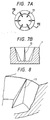
- each depression preferably has an uneven or roughened wall surface so as to present a large surface area.
- This uneven surface can, for example, be obtained if the wall of the depression is provided with a plurality of pleats or ridges, as shown by way of example at 13 in Figures 7A, 7B and 8.
- the wall of the depression may alternatively have a fine-grained roughened surface which is similar to the surface of frosted glass.
- Every two adjacent depressions are spaced apart from each other by a distance which prevents any mixing of the liquid in one depression with the liquid in the other.
- the size and shape of the vessel depend on the number and spacing of the depressions. Too large a vessel should be avoided, as it requires too large amounts of a specimen and reagents which are practically disadvantageous.
- a circular, oval or square vessel having a diameter or side length of about 20 to 35 mm, and a rectangular vessel having a width of about 5 mm and a length of about 50 mm are, for example, appropriate, though differently sized vessels may also be appropriate in certain cases.
- the depressions may be circular as shown for example in Figure 1A, or of any other appropriate shape, such as square or hexagonal.
- the vessel can be formed from any of various kinds of materials including glass, plastics and paper. However, it is preferably formed from plastics, and more specifically, polystyrene, polypropylene, polyacrylate or polyester. It is also desirable to employ a white material so that the color which is developed, and its intensity may be easily recognizable.
- the vessel can be manufactured by injection molding, extrusion, pressing, cutting, or any other method that is usually employed for manufacturing a product of a plastic material.
- Any known method, such as chemical bonding or physical adsorption can be employed for binding an antibody or antigen with the wall surface of each depression to insolubilize the antibody or antigen.
- Tap water can, for example, be used to wash the vessel as a whole for the separation of bound and free antigen or antibody.
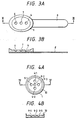
- the vessel is, therefore, easier to wash if it is provided with a removable handle which is attached to the vessel when it is washed, as shown by, e.g., the reference numeral 8 in Figs. 3A and 3B.
- Any enzyme for labeling an antibody or antigen, any substrate acted on by the enzyme and any chromogen that has hitherto been used for an EIA can be utilized for conducting an assay by employing the vessel of this invention.
- the vessel may be used either for qualitative analysis, which is based on a color developed by a substance to be assayed, or for semiquantitative analysis, which is based on a comparison of the intensity of the color developed by the substance to be assayed with that of the color developed by a control substance.
- FIG. 2A to 6B Various modified forms of vessels embodying this invention are shown by way of example in Figures 2A to 6B.
- the vessel 1 shown in Figures 2A and 2B has a sectorial array of six depressions, i.e. a depression 4 for a specimen and five depressions 5-1 to 5-5 for differently diluted standard substances.
- the vessel 1 enables more accurate semiquantitative determination, as the intensity of the color developed by the specimen can be compared with the different degrees of intensity of color developed by the standard substances.
- the vessel 1 shown in Figures 3A and 3B has a depression 4 for a specimen, a depression 6 for a positive control substance and a depression 7 for a negative control substance.
- the positive control substance comprises the substance to be assayed and the negative control substance is a substance which does not undergo any immunological cross reaction with the substance to be assayed.
- the vessel 1 is provided with a handle 8 which is used when the vessel is washed, as hereinbefore stated.
- the vessel 1 shown in Figures 4A and 4B has a cross-shaped array of five depressions 4-1, 4-2 and 9-1 to 9-3.
- the depressions 4-1 and 4-2 are each provided for holding an insolubilized antibody or antigen for a substance to be assayed and the depressions 9-1 to 9-3 are each provided for holding an insolubilized antibody or antigen for a substance which is always present in a specimen, but which does not undergo any immunological cross reaction with the substance to be assayed.
- the vessel 1 also has a circumferentially extending groove 10 which facilitates draining when the depressions are washed.
- the vessel 1 shown in Figures 5A to 5C is a modified form of the vessel shown in Figures 4A and 4B. It has two depressions 4-1 and 4-2 for a specimen and three depressions 9-1 to 9-3 for a control substance which form a cross-shaped array which is identical to the array shown in Figure 4A.
- the vessel of Figure 5A further has four additional depressions 11-1 to 11-4 which are somewhat smaller than the other depressions and form therewith an array similar to the matrix shown in Figure 1A.
- the additional depressions 11-1 to 11-4 are located at the four corners, respectively, of the array and are each provided for holding an insolubilized antibody or antigen for a substance which does not undergo any immunological cross reaction with a substance to be assayed. In other words, they are each provided for ascertaining a non-specific reaction.
- the vessel 1 shown in Figures 6A and 6B is rectangular and has a linear array of five depressions 12-1 to 12-5.
- each of the depressions can be used for holding an insolubilized antibody or antigen which reacts with only one of the substances to be assayed so that a single assay may be sufficient for simultaneously detecting all of those substances.
- hCG human chorionic gonadotropin
- the vessel shown in Figures 2A and 2B makes it possible to carry out the semiquantitative determination of hCG easily and correctly, as the intensity of the color developed by a specimen can be compared with the intensity of the color developed by each of five different standard quantities of hCG, e.g. 0, 10, 20, 50 and 100 mIU/ml.
- the vessel means a vessel for an enzymeimmunoassay in accordance with the present invention.
- the vessel shown in Figures 1A and 1B was employed.
- PBS 0.05M phosphate buffered saline solution
- the solutions each containing one of the antigens were put in the nine depressions 2-1 to 2-9, respectively.
- the vessel was left at 37°C for an hour and was then washed with PBS, whereby the antigens were insolubilized in the depressions.
- Each depression was then supplied with 10 ⁇ l of the serum of a patient having an allergic disease and 5 ⁇ l of a dilute solution of an anti-IgE antibody labeled with horseradish peroxidase (enzyme). They were allowed to react together for 10 minutes and the vessel was then washed with PBS. Then, each depression was supplied with 5 ⁇ l of each of an aqueous solution of hydrogen peroxide and a solution of tetramethylbenzidine. After five minutes, a blue color indicating a positive reaction appeared in various depressions in the vessel for the serum of some of the 10 patients for which an allergen assay had been conducted.
- an allergen assay had been carried out by a patch test conducted by injecting an antigen into the skin of a patient, a RAST employing a radioactive isotope, etc. All of those methods had, however, been complicated.
- the vessel of this invention was found to be capable of simplifying any such assay.
- the vessel shown in Figures 5A to 5C was employed. Each of two depressions 4-1 and 4-2 was supplied with a solution of an anti-hCG antibody diluted with PBS, each of three depressions 9-1 to 9-3 with a solution of an anti- ⁇ 2-microglobulin antibody diluted with PBS, and each of the remaining four depressions 11-1 to 11-4 with a solution of IgG diluted with PBS, each solution having a concentration of 100 ⁇ g/ml.
- the vessel was left to stand at a temperature of 37°C for an hour and was then washed with PBS.
- the vessel was supplied with 1 ml of a solution which had been obtained by diluting a mixture of an enzyme-labeled anti-hCG antibody and an enzyme-labeled anti- ⁇ 2-microglobulin antibody with PBS, and was subjected to freeze drying.
- the vessel was used for analyzing the urine of each of 10 pregnant women and 10 non-pregnant women.
- the vessel was supplied with 1 ml of the urine and after two minutes of reaction, it was washed with tap water for 10 seconds.
- each depression was supplied with 5 ⁇ l of each of an aqueous solution of hydrogen peroxide and a solution of tetramethylbenzidine and after one minute, its color was examined. An intense blue color was observed in all of the depressions 4-1, 4-2 and 9-1 to 9-3 in each of the vessels which had been used for analyzing the urine of the 10 pregnant women, and confirmed that they were pregnant.
- the colored depressions formed a sign looking like "+".
- each of the vessels which had been used for analyzing the urine of the 10 non-pregnant women developed an intense blue color only in the depressions 9-1 to 9-3, whereby a sign looking like "-" was formed. This confirmed that they were not pregnant. The signs "+” and "-" were useful for distinguishing pregnant women from non-pregnant ones easily. No such color was developed in any of the depressions 11-1 to 11-4 of any vessel.
- the vessel of this invention thus, enables a very accurate pregnancy test by analyzing the urine for both hCG, which is present only in the urine of a pregnant woman, and ⁇ 2-microglobulin, which is present in the urine of any person, whether she may be pregnant or not. Moreover, the test is easy to perform even by an unskilled person, as the vessel makes it possible to distinguish a non-specific reaction easily from a specific one.
- the vessel shown in Figures 6A and 6B was employed. Each of the five depressions 12-1 to 12-5 was supplied with a solution obtained by diluting an antibody against CEA (carcino-embryonic antigen), AFP ( ⁇ -fetoprotein), hCG, SCC (squamous cell carcinoma related antigen) and ferritin, respectively, with PBS and having a concentration of 10 ⁇ g/ml. The vessel was left at 38°C for an hour and was then washed with PBS.
- CEA carcino-embryonic antigen
- AFP ⁇ -fetoprotein
- hCG hCG
- SCC squamous cell carcinoma related antigen
- ferritin ferritin
- a tumor marker test was conducted with the serum of 10 patients having colorectal cancer, 10 patients having hepatoma, 10 patients having lung cancer, 10 patients having a chorionic disease, and 10 normal persons, while the negative-positive cut-off values of CEA, AFP, hCG, SCC and ferritin were selected at 5 ng/ml, 20 ng/ml, 5 mIU/ml, 2 ng/ml and 100 ng/ml, respectively.
- each of the vessels which had been prepared for analyzing the serum of each of those persons were each supplied with 10 ⁇ l of the serum of the same person. They were also supplied with 5 ⁇ l of a solution of an enzyme-labeled antibody which had been diluted to attain the corresponding cut-off value as hereinabove stated. After 10 minutes of reaction, the vessel was washed with PBS. Then, each depression was supplied with 5 ⁇ l of each of an aqueous solution of hydrogen peroxide and a solution of o-phenylenediamine. Each of the depressions in which a yellowish brown color appeared after two minutes was concluded as one in which a positive reaction had taken place.
- the vessel of this invention was found to enable an assay for a plurality of tumor markers all at once and to be, therefore, useful for a screening test.
- the vessel of this invention has a substantially flat inner bottom surface provided with one or more depressions in which an antibody or antigen is insolubilized, it is possible to supply a specimen, a reagent or a washing solution into all of the depressions simultaneously. It is not necessary to supply a specimen, etc. into each depression individually, or wash each depression individually for the separation of bound and free antigen or antibody. This quickens and simplifies an assay. However, it is, of course, possible to supply a specimen of reagent into each depression individually.
- the vessel is small and each depression is, of course, much smaller. Therefore, the vessel calls for only a small amount of a specimen or reagent, or an antibody or antigen to be insolubilized. As each depression is small, it has a large surface area relative to its volume. This feature contributes to promoting the reaction between an insolubilized antibody or antigen and a specimen, or between an enzyme and a substrate, thereby greatly shortening the time required for an assay.
- Table 1 compares an assay for hCG conducted by using the vessel of this invention as shown in Figures 2A and 2B, with the assays conducted by the conventional EIA and also by the conventional method employing hemagglutination.
- TABLE 1 Method with the vessel of the Invention Conventional EIA Method Hemagglutination Method Sensitivity of analysis 5 mIU/ml 5 mIU/ml 5 mIU/ml Number of measurements 1 1 5 Time required 5 min. 30 min.- 4 hr. 2 hr. Amount of specimen required 10 ⁇ l 50 to 200 ⁇ l 100 ⁇ l Analysis Semiquantitative Quantitative Semiquantitative Other instrument Not required Required Not required
- the foregoing describes the cases wherein an antibody or antigen is used as a substance which is combined or bound to the depressions of the vessel.
- the present invention is also directed to cases wherein use is made of substances other than an antibody or antigen which substances are specifically bindable to a substance to be measured. Accordingly, various kinds of assays other than the EIA can be conducted using the vessel of the present invention.
Landscapes
- Health & Medical Sciences (AREA)
- Immunology (AREA)
- Life Sciences & Earth Sciences (AREA)
- Engineering & Computer Science (AREA)
- Chemical & Material Sciences (AREA)
- Urology & Nephrology (AREA)
- Hematology (AREA)
- Biomedical Technology (AREA)
- Molecular Biology (AREA)
- Medicinal Chemistry (AREA)
- Analytical Chemistry (AREA)
- Cell Biology (AREA)
- Pathology (AREA)
- Food Science & Technology (AREA)
- Biotechnology (AREA)
- Physics & Mathematics (AREA)
- Microbiology (AREA)
- Biochemistry (AREA)
- General Health & Medical Sciences (AREA)
- General Physics & Mathematics (AREA)
- Chemical Kinetics & Catalysis (AREA)
- Automatic Analysis And Handling Materials Therefor (AREA)
- Peptides Or Proteins (AREA)
- Investigating Or Analysing Biological Materials (AREA)
Applications Claiming Priority (2)
| Application Number | Priority Date | Filing Date | Title |
|---|---|---|---|
| JP215992/87 | 1987-08-29 | ||
| JP21599287A JPS6486065A (en) | 1987-08-29 | 1987-08-29 | Container for enzyme immunological measurement |
Publications (2)
| Publication Number | Publication Date |
|---|---|
| EP0305900A2 true EP0305900A2 (fr) | 1989-03-08 |
| EP0305900A3 EP0305900A3 (fr) | 1990-07-04 |
Family
ID=16681608
Family Applications (1)
| Application Number | Title | Priority Date | Filing Date |
|---|---|---|---|
| EP88113875A Withdrawn EP0305900A3 (fr) | 1987-08-29 | 1988-08-25 | Récipient pour essai immuno-enzymatique |
Country Status (3)
| Country | Link |
|---|---|
| EP (1) | EP0305900A3 (fr) |
| JP (1) | JPS6486065A (fr) |
| AU (1) | AU2146888A (fr) |
Cited By (2)
| Publication number | Priority date | Publication date | Assignee | Title |
|---|---|---|---|---|
| US5985594A (en) * | 1995-11-14 | 1999-11-16 | Idexx Laboratories, Inc. | Method for quantification of biological material in a sample |
| US7122338B2 (en) | 1995-11-14 | 2006-10-17 | Biocontrol Systems, Inc. | Method for quantification of biological material in a sample |
Families Citing this family (1)
| Publication number | Priority date | Publication date | Assignee | Title |
|---|---|---|---|---|
| JP6039965B2 (ja) * | 2012-08-22 | 2016-12-07 | 森永製菓株式会社 | イムノクロマトグラフィー用デバイス |
Family Cites Families (4)
| Publication number | Priority date | Publication date | Assignee | Title |
|---|---|---|---|---|
| EP0058428B1 (fr) * | 1981-02-18 | 1985-10-09 | Eisai Co., Ltd. | Immuno-essai enzymatique pour la mesure simultanée d'une pluralité d'échantillons et dispositif pour la mise en oeuvre de ce procédé |
| US4608231A (en) * | 1984-12-12 | 1986-08-26 | Becton, Dickinson And Company | Self-contained reagent package device for an assay |
| EP0248882A1 (fr) * | 1985-11-27 | 1987-12-16 | Alerchek Associates, Dba Alerchek | Tige de microtitrage jetable |
| US4789628A (en) * | 1986-06-16 | 1988-12-06 | Vxr, Inc. | Devices for carrying out ligand/anti-ligand assays, methods of using such devices and diagnostic reagents and kits incorporating such devices |
-
1987
- 1987-08-29 JP JP21599287A patent/JPS6486065A/ja active Pending
-
1988
- 1988-08-23 AU AU21468/88A patent/AU2146888A/en not_active Abandoned
- 1988-08-25 EP EP88113875A patent/EP0305900A3/fr not_active Withdrawn
Cited By (4)
| Publication number | Priority date | Publication date | Assignee | Title |
|---|---|---|---|---|
| US5985594A (en) * | 1995-11-14 | 1999-11-16 | Idexx Laboratories, Inc. | Method for quantification of biological material in a sample |
| US6287797B1 (en) | 1995-11-14 | 2001-09-11 | Biocontrol Systems, Inc. | Method for quantification of biological material in a sample |
| US6509168B2 (en) | 1995-11-14 | 2003-01-21 | Biocontrol Systems, Inc. | Method for quantification of biological material in a sample |
| US7122338B2 (en) | 1995-11-14 | 2006-10-17 | Biocontrol Systems, Inc. | Method for quantification of biological material in a sample |
Also Published As
| Publication number | Publication date |
|---|---|
| JPS6486065A (en) | 1989-03-30 |
| AU2146888A (en) | 1989-03-02 |
| EP0305900A3 (fr) | 1990-07-04 |
Similar Documents
| Publication | Publication Date | Title |
|---|---|---|
| EP0200507B1 (fr) | Essai immuno-enzymatique et trousse pour sa mise en oeuvre | |
| US5147607A (en) | Reaction vessel with a rocking base | |
| EP0362809B1 (fr) | Appareil et procédé pour la détection d'un analyte | |
| JP2999238B2 (ja) | クロマトグラフィーストリップ結合アッセイ装置 | |
| US5356785A (en) | Immunoassays having at least two test spots and reference spot | |
| US4639419A (en) | Immunological color change test involving two differently colored reagent spots | |
| US4446232A (en) | Enzyme immunoassay with two-zoned device having bound antigens | |
| US4789628A (en) | Devices for carrying out ligand/anti-ligand assays, methods of using such devices and diagnostic reagents and kits incorporating such devices | |
| CN1242270C (zh) | 生物传感器及测定方法 | |
| US5556789A (en) | Device for the simultaneous determination of several analytes | |
| US5252489A (en) | Down syndrome screening method utilizing dried blood samples | |
| US6187598B1 (en) | Capillary immunoassay and device therefor comprising mobilizable particulate labelled reagents | |
| US6410341B1 (en) | Analytical test device and method for use in medical diagnoses | |
| US5244815A (en) | Fingerprint test pad and method for fingerprinting using particle based immunoassay | |
| FI60935B (fi) | Foerfarande foer koncentrering och rening av ett urin- och serumprov foer bestaemning av hcg eller dess beta-underenhet immunologiskt och i foerfarandet anvaendbar anordning | |
| EP3904878A1 (fr) | Bandellette d'immunochromatographie pour diagnostic de grossesse, comportant de multiples traits de test, et kit de diagnostic de grossesse la comprenant | |
| CN1008403B (zh) | 免疫测定方法和装置 | |
| US20020160538A1 (en) | Assay device | |
| NO854545L (no) | Analysemetode for paavisning av medikamentmisbruk. | |
| CN109142758A (zh) | 一种检测糖化血红蛋白的免疫层析试纸条、试剂盒及其制备方法 | |
| JPH09101302A (ja) | マイクロプレート | |
| WO1994023299A1 (fr) | Dispositif pour dosages multiples | |
| GB2173304A (en) | Method of assay for hemoglobin in feces | |
| KR101254512B1 (ko) | 면역 크로마토그래피용 시험구 및 이것을 사용한 반정량방법 | |
| EP0305900A2 (fr) | Récipient pour essai immuno-enzymatique |
Legal Events
| Date | Code | Title | Description |
|---|---|---|---|
| PUAI | Public reference made under article 153(3) epc to a published international application that has entered the european phase |
Free format text: ORIGINAL CODE: 0009012 |
|
| AK | Designated contracting states |
Kind code of ref document: A2 Designated state(s): AT BE CH DE ES FR GB GR IT LI LU NL SE |
|
| PUAL | Search report despatched |
Free format text: ORIGINAL CODE: 0009013 |
|
| AK | Designated contracting states |
Kind code of ref document: A3 Designated state(s): AT BE CH DE ES FR GB GR IT LI LU NL SE |
|
| STAA | Information on the status of an ep patent application or granted ep patent |
Free format text: STATUS: THE APPLICATION HAS BEEN WITHDRAWN |
|
| 18W | Application withdrawn |
Withdrawal date: 19900830 |