EP0307627A1 - Procédé de production et de distribution de clés secrètes - Google Patents
Procédé de production et de distribution de clés secrètes Download PDFInfo
- Publication number
- EP0307627A1 EP0307627A1 EP19880113189 EP88113189A EP0307627A1 EP 0307627 A1 EP0307627 A1 EP 0307627A1 EP 19880113189 EP19880113189 EP 19880113189 EP 88113189 A EP88113189 A EP 88113189A EP 0307627 A1 EP0307627 A1 EP 0307627A1
- Authority
- EP
- European Patent Office
- Prior art keywords
- secret key
- key
- public
- generated
- secret
- Prior art date
- Legal status (The legal status is an assumption and is not a legal conclusion. Google has not performed a legal analysis and makes no representation as to the accuracy of the status listed.)
- Granted
Links
- 238000000034 method Methods 0.000 title claims abstract description 49
- 238000010586 diagram Methods 0.000 description 5
- 230000005540 biological transmission Effects 0.000 description 3
- 230000001419 dependent effect Effects 0.000 description 1
- 238000009434 installation Methods 0.000 description 1
- 230000006855 networking Effects 0.000 description 1
Images

Classifications
-
- H—ELECTRICITY
- H04—ELECTRIC COMMUNICATION TECHNIQUE
- H04L—TRANSMISSION OF DIGITAL INFORMATION, e.g. TELEGRAPHIC COMMUNICATION
- H04L9/00—Cryptographic mechanisms or cryptographic arrangements for secret or secure communications; Network security protocols
- H04L9/08—Key distribution or management, e.g. generation, sharing or updating, of cryptographic keys or passwords
- H04L9/0816—Key establishment, i.e. cryptographic processes or cryptographic protocols whereby a shared secret becomes available to two or more parties, for subsequent use
- H04L9/0838—Key agreement, i.e. key establishment technique in which a shared key is derived by parties as a function of information contributed by, or associated with, each of these
- H04L9/0841—Key agreement, i.e. key establishment technique in which a shared key is derived by parties as a function of information contributed by, or associated with, each of these involving Diffie-Hellman or related key agreement protocols
- H04L9/0844—Key agreement, i.e. key establishment technique in which a shared key is derived by parties as a function of information contributed by, or associated with, each of these involving Diffie-Hellman or related key agreement protocols with user authentication or key authentication, e.g. ElGamal, MTI, MQV-Menezes-Qu-Vanstone protocol or Diffie-Hellman protocols using implicitly-certified keys
Definitions
- the object of the present invention is therefore to create a method for the generation and distribution of secret keys, a common secret key being generated by two end points by means of a PKD method, which allows common secret keys to be authenticated without the use of a secret channel.
- the solution is that for the authentication of the secret key, each end point forms a public characteristic value using the common secret key, and these characteristic values are compared with one another via a separate, public auxiliary channel.
- a Diffie-Hellman method is used as the PKD method and the public characteristic value is generated using a one-way function.
- the essence of the invention is that the secret key is only generated after the encryption device has been installed and that it can be authenticated without the use of a secret channel. It is no longer necessary to transport secret information in any form.
- the public support channel is an authenticated connection;
- a telephone dialing line will meet this requirement, since the interposition of a spoofer is largely impossible.
- a safe main channel 12 is to be set up between a first end point 1a and a second end point 1b. This comprises two data lines 31, 3b.
- An encryption device 2a, 2b is located in each terminal 1a, 1b.
- an auxiliary channel 4 between the two end stations 1a, 1b, which in this exemplary embodiment is a public telephone dialing line.
- An encryption device 2a / 2b comprises a cipher 5a / 5b, a decipherer 6a / 6b, a key generator 7a / 7b, a changeover switch 13a / 13b, an output unit 8a / 8b and an input unit 9a / 9b.
- the data to be transmitted which are in plain text at an input terminal 10a / 10b, are stored in the cipher 5a / 5b, for example by modulo 2 addition of one of a secret key dependent pseudo random signal encrypted in a known manner.
- Via the data lines 3a / 3b they are sent in a secure manner to the other terminal 1b / 1a, where they are decrypted in the decipherer 6b / 6a of the encryption device 2b / 2a with the same secret key as is used in the cipher 5a / 5b.
- the data is thus again available in plain text at an output terminal 11b / 11a.
- a key generator 7a / 7b together with the key generator 7b / 7a of the other end station, generates a shared secret key used for encryption and outputs it to the cipher 5a / 5b and the decipherer 6a / 6b.
- the key generators 7a, 7b of the two end stations 1a, 1b can connect to one another via the data lines 3a, 3b in order to generate secret keys.
- an input of the key generator 7a / 7b is connected to a connection between the decipherer 6a / 6b and the output terminal 11a / 11b and an output of the same by means of the switch 13a / 13b to a connection between the input terminal 10a / 10b and the encryptor 5a / 5b.
- the input unit 9a / 9b which can include, for example, some function keys and a numeric keypad, and the output unit 8a / 8b, e.g. in the form of a display. In this way e.g. the generation of secret keys and the authentication of such, or operating states and error messages are displayed.
- FIG. 2a and 2b show the possible switch positions of the changeover switch 13a / 13b. If the key generators 7a, 7b of the two encryption devices 2a, 2b want to connect to one another, the changeover switch 13a / 13b must be brought into the key transfer ( ⁇ ) switch position. The data transmission is then interrupted (Fig. 2a). When the main channel 12 is secured, data can be transmitted and the Changeover switch has the switch position data transfer (-) (Fig. 2b). The current switch position can also be displayed by the output unit 8a / 8b.
- a method according to the invention for generating and distributing secret keys is described below using a first exemplary embodiment.
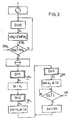
- FIG. 3 shows a flow diagram of such a method. It is assumed that a new main channel 12 is to be put into operation.
- the encryption devices 2a, 2b are installed; the ciphers 5a, 5b and the decryptors 6a, 6b still work without a secret key, i.e. in clear operation.
- the data lines 3a, 3b are functional, but have not yet been secured because of the missing secret key.
- the changeover switch 13a / 13b is brought into the key transfer switch position ( ⁇ ). Then a first common secret key K0 is generated in a known manner using a Diffie-Hellman method DHO.
- the authentication of this shared secret key basically comprises two process steps.
- a public characteristic value KW a , KW b is formed in each encryption device 2a / 2b with the aid of a one-way function EWF.
- these two characteristic values KW a , KW b are fed to the respective output unit 8a, 8b and compared with one another via the separate public auxiliary channel 4. If they match (V), the shared secret key K0 is also shared with the other terminal that is actually desired. That means the secret key K0 is authentic. If the two characteristic values KW a , KW b do not match (N), you have to start again.
- the main channel 12 is now secured with the authentic secret key K0, ie cipher 5a / 5b and decipherer 6a / 6b, which until now have been in the clear drive, ie worked without a secret key, are provided with the secret key K o .
- this is shown by a double-framed and grounded with K0 block. Since the main channel 12 is now secured, the transmission of the data can begin. For this purpose, the changeover switch 13a / 13b is brought into the data transfer (-) switch position.
- a Diffie-Hellman method DH1 Via the secured main channel 12, a Diffie-Hellman method DH1 generates a second secret key K 1, which is used as an authentication key IK of the main channel 12 existing between the two end points 1a, 1b. It is securely stored in the key generator 7a / 7b and is used for authentication of the new secret key each time the secret key is changed.
- the secret key K2 is generated, from which the active secret key AK used to encrypt the data to be transmitted is obtained. Namely, the active secret key AK results from a combination of the secret key K2 with the authentication key IK.
- a reserve key is used immediately after the calculation of the active secret key AK so as not to interrupt the data exchange longer than necessary SK generated and saved securely.
- the reserve key SK results from a combination of a secret key K3 generated with a Diffie-Hellman method DH3 with the authentication key IK in the same way the active secret key AK.
- each key generator has to calculate an integer power function twice and intermediate values have to be exchanged via the data lines 3a / 3b. Since the interim values are exchanged very quickly, but the calculation of the integer power function can take seconds, it is advantageous to switch the switch 13a / 13b from data transfer (-) to key transfer ( ⁇ ) only while exchanging the interim values to leave it in the data transfer (-) switch position during the remaining calculations.
- Another method for authenticating secret keys is described below using a second exemplary embodiment.
- This embodiment differs from the first in that a second secret key (K01) is generated for authentication with a Diffie-Hellman method, this secret key is linked to the first secret key and the result of this link is displayed and compared.
- K01 second secret key
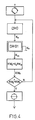
- FIG. 4 shows a flow diagram of a part of the method. As before, it is assumed that a new main channel 12 is to be put into operation under the conditions already mentioned.
- the method begins with the fact that, after the changeover switch has been brought into the key transfer ( ⁇ ) switch position, the two end stations 1a, 1b generate a first common secret key K0 using a Diffie-Hellman method DHO.
- the main channel 12 is secured with this secret key K0.
- the secret key K Vietnamese is formed with a Diffie-Hellman method DHO1.
- the keys K0 and K01 are then linked together to a characteristic value KW a / KW b . This is preferably done with a bitwise modulo 2 addition.
- the characteristic values KW a / KW b are fed to the respective task unit 8a / 8b and compared with one another via the separate public auxiliary channel 4. If they match (Y), the two shared secret keys K0, K01 are authentic. If the two characteristic values KW a / KW b do not match (N), you have to start again.
- the authentication key IK, the active key AK and the reserve key SK are then generated in succession in the same way as already described in the first exemplary embodiment.
- the secret key K0 It is common to represent the secret key K0 in the form of a decimal number. The more decimal places the secret key has, the more difficult it is to crack it. The number of decimal places is limited by the performance of a microprocessor used to evaluate the integer power function. Today, a hundred decimal places are a manageable length.
- the characteristic value KW a / KW b is obtained directly from the secret key K0 by exercising the integer power function according to formula (II), it naturally has the same number of decimal places as the latter. According to the above exemplary embodiment, a hundred digits would therefore have to be exchanged without errors via the telephone dialing line. In view of this fact, it corresponds to a preferred embodiment of the invention to generate a characteristic value KW a which is shorter than the secret key.
- RO is a reducing operation that generates a 10-digit decimal number from a 100-digit number, for example.
- the reducing operation RO can consist, for example, in that a checksum is formed from the function value F of the integer power function, or that a new number is formed from a number of selected decimal places of the function value F.
- a range of values of the reducing operation RO should, however, be sufficiently large that a purely coincidence of the characteristic values KW a , KW b exchanged via the separate, public auxiliary channel 4 can be ruled out.
- a terminal 1a in a central office and the other terminal 1b in a branch of a company, which is to be connected to the central office it is generally sufficient mean when the head office calls the branch.
- a particularly secure variant is seen in the fact that the telephone dialing line is set up once from each terminal.
- the Diffie-Hellman method does not allow authentication of a secret key that is generated jointly. Therefore, when generating each new secret key, care must be taken that a spoofer cannot switch on.
- an authentication key IK is generated and stored immediately after the authentication of a secret key K0. This is used as a parameter when generating a new active secret key AK.
- the method according to the invention can be applied to all PCD methods. It is crucial that there is a shared secret key from which a public characteristic KW a , KW b is obtained in a given manner in each terminal and that these two characteristic values KW a , KW b are compared via a separate, public auxiliary channel. Instead of a telephone dialing line, a separate data connection can also serve as an auxiliary channel.
- the characteristic value can be generated with at least one one-way function EWF.
- the reducing operation RO can be implemented in a variety of ways. It is neither secret nor indispensable and is therefore implemented in the simplest possible way.
- the method according to the invention allows the authentication of a common secret key to be carried out via a separate, public auxiliary channel without having to store secret information a priori or having to use a secret channel.
Landscapes
- Engineering & Computer Science (AREA)
- Computer Security & Cryptography (AREA)
- Computer Networks & Wireless Communication (AREA)
- Signal Processing (AREA)
- Mobile Radio Communication Systems (AREA)
Applications Claiming Priority (2)
| Application Number | Priority Date | Filing Date | Title |
|---|---|---|---|
| CH340787 | 1987-09-04 | ||
| CH3407/87 | 1987-09-04 |
Publications (2)
| Publication Number | Publication Date |
|---|---|
| EP0307627A1 true EP0307627A1 (fr) | 1989-03-22 |
| EP0307627B1 EP0307627B1 (fr) | 1992-04-29 |
Family
ID=4255327
Family Applications (1)
| Application Number | Title | Priority Date | Filing Date |
|---|---|---|---|
| EP19880113189 Expired - Lifetime EP0307627B1 (fr) | 1987-09-04 | 1988-08-13 | Procédé de production et de distribution de clés secrètes |
Country Status (2)
| Country | Link |
|---|---|
| EP (1) | EP0307627B1 (fr) |
| DE (1) | DE3870558D1 (fr) |
Cited By (10)
| Publication number | Priority date | Publication date | Assignee | Title |
|---|---|---|---|---|
| WO1990016124A1 (fr) * | 1989-06-16 | 1990-12-27 | Siemens Aktiengesellschaft | Attribution de codes dans des reseaux ouverts de communication selon des degres de securite |
| AU611562B2 (en) * | 1988-06-01 | 1991-06-13 | Siemens Telecomunicazioni S.P.A. | Enciphering and deciphering device for high bit-rate transmission systems |
| EP0535863A3 (en) * | 1991-10-02 | 1993-12-22 | American Telephone & Telegraph | A cryptographic protocol for secure communications |
| DE4416253A1 (de) * | 1994-05-07 | 1995-11-09 | Deutsche Bundespost Telekom | Verfahren zur datenschutzgerechten Verteilung von Schlüsselinformationen |
| WO1996037064A1 (fr) * | 1995-05-19 | 1996-11-21 | Siemens Aktiengesellschaft | Procede d'echange assiste par ordinateur de codes cryptographiques entre un premier et un second ordinateur |
| EP0661844A3 (fr) * | 1993-12-30 | 1997-01-02 | Ibm | Amélioration de la sécurité dans des systèmes de traitement de données. |
| WO1997047108A1 (fr) * | 1996-06-05 | 1997-12-11 | Siemens Aktiengesellschaft | Procede de gestion de cles cryptographiques, fonde sur un groupe, entre une premiere unite informatique et des unites informatiques d'un groupe |
| WO1999057846A1 (fr) * | 1998-05-06 | 1999-11-11 | Kyberpass Corp. | Authentification d'utilisateur au moyen d'une cle privee virtuelle |
| WO2000052876A1 (fr) * | 1999-03-01 | 2000-09-08 | Cipherit Ltd. | Nouveau systeme d'accord de cle et procede correspondant |
| EP0977396A3 (fr) * | 1998-07-31 | 2002-11-27 | Lucent Technologies Inc. | Procédé d'établissement de clé utilisant une communication radio et un protocole de mot de passe |
Citations (1)
| Publication number | Priority date | Publication date | Assignee | Title |
|---|---|---|---|---|
| EP0090771A1 (fr) * | 1982-03-26 | 1983-10-05 | GRETAG Aktiengesellschaft | Procédé et dispositif pour la transmission chiffrée d'informations |
-
1988
- 1988-08-13 EP EP19880113189 patent/EP0307627B1/fr not_active Expired - Lifetime
- 1988-08-13 DE DE8888113189T patent/DE3870558D1/de not_active Expired - Lifetime
Patent Citations (1)
| Publication number | Priority date | Publication date | Assignee | Title |
|---|---|---|---|---|
| EP0090771A1 (fr) * | 1982-03-26 | 1983-10-05 | GRETAG Aktiengesellschaft | Procédé et dispositif pour la transmission chiffrée d'informations |
Non-Patent Citations (2)
| Title |
|---|
| DATA COMMUNICATIONS, Band 15, Nr. 4, April 1986, Seiten 149-160, New York, US; C.R. ABBRUSCATO et al.: "Choosing a key management style that suits the application" * |
| PROCEEDINGS OF THE FIFTH INTERNATIONAL CONFERENCE ON COMPUTER COMMUNICATION, Atlanta, Oktober 1980, Seiten 525-530, New York, US; D.W. DAVIES et al.: "The application of digital signatures based on public key cryptosystems" * |
Cited By (16)
| Publication number | Priority date | Publication date | Assignee | Title |
|---|---|---|---|---|
| AU611562B2 (en) * | 1988-06-01 | 1991-06-13 | Siemens Telecomunicazioni S.P.A. | Enciphering and deciphering device for high bit-rate transmission systems |
| US5216715A (en) * | 1989-06-16 | 1993-06-01 | Siemens Aktiengesellschaft | Key distribution in public communication networks taking account of security gradations |
| WO1990016124A1 (fr) * | 1989-06-16 | 1990-12-27 | Siemens Aktiengesellschaft | Attribution de codes dans des reseaux ouverts de communication selon des degres de securite |
| EP0535863A3 (en) * | 1991-10-02 | 1993-12-22 | American Telephone & Telegraph | A cryptographic protocol for secure communications |
| EP0661844A3 (fr) * | 1993-12-30 | 1997-01-02 | Ibm | Amélioration de la sécurité dans des systèmes de traitement de données. |
| DE4416253A1 (de) * | 1994-05-07 | 1995-11-09 | Deutsche Bundespost Telekom | Verfahren zur datenschutzgerechten Verteilung von Schlüsselinformationen |
| DE4416253B4 (de) * | 1994-05-07 | 2005-09-22 | Deutsche Telekom Ag | Verfahren zur datenschutzgerechten Verteilung von Schlüsselinformationen |
| US6526509B1 (en) | 1995-05-19 | 2003-02-25 | Siemens Aktiengesellschaft | Method for interchange of cryptographic codes between a first computer unit and a second computer unit |
| WO1996037064A1 (fr) * | 1995-05-19 | 1996-11-21 | Siemens Aktiengesellschaft | Procede d'echange assiste par ordinateur de codes cryptographiques entre un premier et un second ordinateur |
| WO1997047108A1 (fr) * | 1996-06-05 | 1997-12-11 | Siemens Aktiengesellschaft | Procede de gestion de cles cryptographiques, fonde sur un groupe, entre une premiere unite informatique et des unites informatiques d'un groupe |
| US6052787A (en) * | 1996-06-05 | 2000-04-18 | Siemens Aktiengesellschaft | Process for group-based cryptographic code management between a first computer unit and group computer units |
| WO1999057846A1 (fr) * | 1998-05-06 | 1999-11-11 | Kyberpass Corp. | Authentification d'utilisateur au moyen d'une cle privee virtuelle |
| US6189096B1 (en) | 1998-05-06 | 2001-02-13 | Kyberpass Corporation | User authentification using a virtual private key |
| EP0977396A3 (fr) * | 1998-07-31 | 2002-11-27 | Lucent Technologies Inc. | Procédé d'établissement de clé utilisant une communication radio et un protocole de mot de passe |
| EP1401141A3 (fr) * | 1998-07-31 | 2004-03-31 | Lucent Technologies Inc. | Procédé d'établissement d'une clé utilisant une communication radio |
| WO2000052876A1 (fr) * | 1999-03-01 | 2000-09-08 | Cipherit Ltd. | Nouveau systeme d'accord de cle et procede correspondant |
Also Published As
| Publication number | Publication date |
|---|---|
| DE3870558D1 (de) | 1992-06-04 |
| EP0307627B1 (fr) | 1992-04-29 |
Similar Documents
| Publication | Publication Date | Title |
|---|---|---|
| DE3919734C1 (fr) | ||
| DE69217440T2 (de) | Verfahren zur Algorithmus-unabhängigen Geheimübertragungsschlüsselverwaltung | |
| DE2231835C3 (de) | Verfahren zur in mehreren Stufen erfolgenden Ver- und Entschlüsselung binärer Daten | |
| EP0944992B1 (fr) | Procede et dispositif pour utiliser et commander a distance des dispositifs et des appareils par l'intermediaire d'un reseau telephonique | |
| DE2231849B2 (de) | Verschlüsselungsverfahren zur Erhöhung der Entschlüsselungsfestigkeit von blockweise zu verschlüsselnden Binärdaten und Anordnung zur Durchführung des Verfahrens | |
| EP0472714A1 (fr) | Procede d'authentification d'un utilisateur utilisant une station de donnees | |
| EP0832542B1 (fr) | Procede et dispositif d'authentification d'abonnes aupres de centres de commutation numeriques | |
| DE3688423T2 (de) | Verfahren zur gesicherten uebertragung in einem uebertragungssystem. | |
| DE69729297T2 (de) | Verschlüsselungsvorrichtung für binärkodierte nachrichten | |
| EP0307627B1 (fr) | Procédé de production et de distribution de clés secrètes | |
| EP0090771B1 (fr) | Procédé et dispositif pour la transmission chiffrée d'informations | |
| EP1010146A2 (fr) | Procede d'authentification mutuelle de deux unites | |
| DE60132996T2 (de) | Mobilkommunikationssystem | |
| EP0048903A1 (fr) | Système de sécurité pour éviter des manipulations non autorisées loss de la transmission électronique de textes dans des réseaux de données | |
| EP0067340A1 (fr) | Procédé pour la transmission de clés | |
| EP0834238B1 (fr) | Procede et dispositif pour la transmission d'informations confidentielles d'etablissement de connexion et de service entre des terminaux d'abonnes et un ou plusieurs centres de commutation numeriques | |
| DE3631797C2 (fr) | ||
| DE3244537C2 (fr) | ||
| EP0198384A2 (fr) | Procédé et dispositif pour chiffrer des données | |
| DE3033871C2 (de) | Nachrichtenübertragungssystem | |
| EP0844762A2 (fr) | Procédé d'échange sécurisé de messages pour services de masse ainsi que dispositif d'abonné et dispositif serveur y adaptés | |
| EP0173647A2 (fr) | Procédé de chiffrage et de déchiffrage | |
| DE19524021C2 (de) | Verfahren zum Verschlüsseln von Informationen in ATM-Systemen | |
| EP0481121A1 (fr) | Authentification pour communication chiffrée | |
| EP0877507B1 (fr) | Chiffrage point-à-point |
Legal Events
| Date | Code | Title | Description |
|---|---|---|---|
| PUAI | Public reference made under article 153(3) epc to a published international application that has entered the european phase |
Free format text: ORIGINAL CODE: 0009012 |
|
| AK | Designated contracting states |
Kind code of ref document: A1 Designated state(s): CH DE FR GB LI NL SE |
|
| 17P | Request for examination filed |
Effective date: 19890408 |
|
| 17Q | First examination report despatched |
Effective date: 19910627 |
|
| RAP3 | Party data changed (applicant data changed or rights of an application transferred) |
Owner name: ASCOM RADIOCOM AG |
|
| GRAA | (expected) grant |
Free format text: ORIGINAL CODE: 0009210 |
|
| AK | Designated contracting states |
Kind code of ref document: B1 Designated state(s): CH DE FR GB LI NL SE |
|
| REF | Corresponds to: |
Ref document number: 3870558 Country of ref document: DE Date of ref document: 19920604 |
|
| GBT | Gb: translation of ep patent filed (gb section 77(6)(a)/1977) | ||
| REG | Reference to a national code |
Ref country code: CH Ref legal event code: PFA Free format text: ASCOM RADIOCOM AG |
|
| ET | Fr: translation filed | ||
| PLBE | No opposition filed within time limit |
Free format text: ORIGINAL CODE: 0009261 |
|
| STAA | Information on the status of an ep patent application or granted ep patent |
Free format text: STATUS: NO OPPOSITION FILED WITHIN TIME LIMIT |
|
| 26N | No opposition filed | ||
| EAL | Se: european patent in force in sweden |
Ref document number: 88113189.0 |
|
| PGFP | Annual fee paid to national office [announced via postgrant information from national office to epo] |
Ref country code: FR Payment date: 19950710 Year of fee payment: 8 |
|
| PGFP | Annual fee paid to national office [announced via postgrant information from national office to epo] |
Ref country code: SE Payment date: 19950717 Year of fee payment: 8 |
|
| PGFP | Annual fee paid to national office [announced via postgrant information from national office to epo] |
Ref country code: GB Payment date: 19950718 Year of fee payment: 8 Ref country code: CH Payment date: 19950718 Year of fee payment: 8 |
|
| PGFP | Annual fee paid to national office [announced via postgrant information from national office to epo] |
Ref country code: NL Payment date: 19950721 Year of fee payment: 8 Ref country code: DE Payment date: 19950721 Year of fee payment: 8 |
|
| PG25 | Lapsed in a contracting state [announced via postgrant information from national office to epo] |
Ref country code: GB Effective date: 19960813 |
|
| PG25 | Lapsed in a contracting state [announced via postgrant information from national office to epo] |
Ref country code: SE Effective date: 19960814 |
|
| PG25 | Lapsed in a contracting state [announced via postgrant information from national office to epo] |
Ref country code: LI Effective date: 19960831 Ref country code: CH Effective date: 19960831 |
|
| PG25 | Lapsed in a contracting state [announced via postgrant information from national office to epo] |
Ref country code: NL Effective date: 19970301 |
|
| GBPC | Gb: european patent ceased through non-payment of renewal fee |
Effective date: 19960813 |
|
| REG | Reference to a national code |
Ref country code: CH Ref legal event code: PL |
|
| PG25 | Lapsed in a contracting state [announced via postgrant information from national office to epo] |
Ref country code: FR Effective date: 19970430 |
|
| NLV4 | Nl: lapsed or anulled due to non-payment of the annual fee |
Effective date: 19970301 |
|
| PG25 | Lapsed in a contracting state [announced via postgrant information from national office to epo] |
Ref country code: DE Effective date: 19970501 |
|
| EUG | Se: european patent has lapsed |
Ref document number: 88113189.0 |
|
| REG | Reference to a national code |
Ref country code: FR Ref legal event code: ST |