EP0307790A2 - Détecteur électrochimique pour des gaz - Google Patents
Détecteur électrochimique pour des gaz Download PDFInfo
- Publication number
- EP0307790A2 EP0307790A2 EP88114649A EP88114649A EP0307790A2 EP 0307790 A2 EP0307790 A2 EP 0307790A2 EP 88114649 A EP88114649 A EP 88114649A EP 88114649 A EP88114649 A EP 88114649A EP 0307790 A2 EP0307790 A2 EP 0307790A2
- Authority
- EP
- European Patent Office
- Prior art keywords
- gas
- electrode
- membrane
- working electrode
- counter electrode
- Prior art date
- Legal status (The legal status is an assumption and is not a legal conclusion. Google has not performed a legal analysis and makes no representation as to the accuracy of the status listed.)
- Ceased
Links
Images

Classifications
-
- G—PHYSICS
- G01—MEASURING; TESTING
- G01N—INVESTIGATING OR ANALYSING MATERIALS BY DETERMINING THEIR CHEMICAL OR PHYSICAL PROPERTIES
- G01N27/00—Investigating or analysing materials by the use of electric, electrochemical, or magnetic means
- G01N27/26—Investigating or analysing materials by the use of electric, electrochemical, or magnetic means by investigating electrochemical variables; by using electrolysis or electrophoresis
- G01N27/403—Cells and electrode assemblies
- G01N27/404—Cells with anode, cathode and cell electrolyte on the same side of a permeable membrane which separates them from the sample fluid, e.g. Clark-type oxygen sensors
- G01N27/4045—Cells with anode, cathode and cell electrolyte on the same side of a permeable membrane which separates them from the sample fluid, e.g. Clark-type oxygen sensors for gases other than oxygen
Definitions
- This invention relates to electrochemical gas sensors and in its preferred embodiment to a electrochemical cell for measurement of carbon monoxide.
- Electrochemical gas sensors are well known for determining a variety of noxious gases, including hydrogen sulfide, chlorine, nitric oxide, carbon monoxide and hydrocarbons. It is now conventional to apply the active electrode material, which may be an electrocatalyst, to a membrane that is permeable to the gas to be analyzed and is impermeable to the electrolyte. An electrochemical reaction occurs at the electrode, ordinarily called the working electrode, where the electrolyte, the active electrode material and gas diffusing through the membrane interface. An opposing counter electrode is immersed in the electrolyte and the potential or current of the cell is a measure of the gas concentration exposed to the working electrode.
- the active electrode material which may be an electrocatalyst
- United Kingdom Patent 2,001,763B is a galvanic electrochemical sensor for CO in which the working electrode and counter electrode are identical noble metals in contact with an acid electrolyte, the counter electrode being immersed in the electrolyte. CO, or other depolarizing species, is measured by measuring the current or voltage across the electrodes. The cell is said to be immune to zero drift.
- This invention is based on our discovery that zero current temperature sensitivity of electrochemical sensor cells can be reduced to an extent that electronic temperature compensation is unnecessary by exposing the counter electrode to the atmosphere to be tested and masking at least a portion of the counter electrode from the electrochemically active gas in the atmosphere to be tested.
- Our invention comprises an electrochemical gas sensor for determining an electrochemically active gas in the atmosphere comprising a working electrode and a counter electrode in close proximity and in contact with an electrolyte, each of said electrodes comprising an electrocatalytic material, means for exposing the working electrode and the counter electrode to the atmosphere to be tested, and masking means for preventing exposure of at least a portion of the counter electrode to the electrochemically active gas whereby the presence of electrochemically active gas in the atmosphere to be tested produces a current.
- a preferred embodiment comprises a working electrode and a counter electrode deposited on one surface of a gas-permeable membrane phobic to the electrolyte.
- the masking means may comprise a gas-impermeable film secured to the opposite surface of the membrane over a portion of the counter-electrode sufficient to give a measurable cell output.
- the mask permits only a portion of the counter electrode to be exposed to gas passing through the membrane while the entire area of the electrode is exposed to the electrolyte.
- the cell output increases as the masked area is made larger and is the preferred embodiment.
- the masked area is at least equal to the unmasked area and the unmasked area is approximately equal to the area of the working electrode.
- An alternative masking means comprises a cover made of gas-impervious material secured to and having a portion spaced from the opposite surface of the membrane to form a chamber between the membrane and cover extending over at least a portion of the working electrode and counter electrode, and a gas diffusion path through the cover and aligned so that the working electrode intercepts substantially all the electrochemically active gas diffusing through said diffusion path.
- This type of masking exposes the counter electrode to atmosphere to be tested from which at least a portion of the electrochemically active gas has been reacted.
- the most preferred embodiment uses both types of masking.
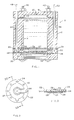
- electrochemical cell 10 comprises a cylindrical housing 12 having a central cavity 14 containing electrolyte.
- the cavity is closed on one end by membrane 16 sealingly engaged between the body and endplate 18.
- Membrane 16 is a flexible material, to contain electrolyte and accommodate pressure changes in the cell, such as, e.g., PTFE sheet.
- Endplate 18 contains a relief port 20 open to the atmosphere.
- the electrolyte is contained at the other end by working/counter electrode 22 comprising a membrane 24 on which a platinum black working electrode 26 and counter electrode 28 are deposited.
- the electrode 22 is sealed to the cell body by endplate 30, electrode holder 32 and gaskets 34 and 38, and O-Rings 36.
- Membrane 33 has holes and serves as a baffle to diminish electrolyte sloshing.
- the electrode is supported by porous separator or filter 37 of glass fiber that also serves as an electrolyte wick.
- the cell components are provided with holes 40 to receive mounting bolts 42. Holes 44 and 46 receive leads 48 and 50 that are electrically connected respectively to the working electrode and counter electrode. The leads are connected to an external circuit for measuring current flow between the electrodes to indicate the concentration of the gas being analyzed.
- Endplate 30 has an opening 52 for exposing the electrode to the atmosphere being tested.
- the opening is threaded to receive, if desired, a plug (not shown) having inlet and outlet openings for flowing sample gas through the cell.
- the electrode 22 includes a gas diffusion membrane 24 having a catalytic working electrode 26 and an identical catalytic counter electrode 28 bonded thereto.
- Membrane 24 is preferably a porous fluorocarbon membrane such as Goretex®.
- Other similar membrane materials may be used that are phobic, or not wetted, by the electrolyte, having a large number of pores (e.g., 50% porous) which have a small pore size, are non-reactive with the electrolyte or atmosphere, and are thin enough to permit adequate diffusion of CO to the working electrode.
- the working and counter electrodes are preferably prepared by mixing a suitable catalyst with polytetrafluoroethylene (Teflon®) dispersion and painting the mixture onto the gas diffusion membrane 24.
- the membrane and catalyst mixture are dried and sintered to give a good bond.
- the catalytic material is preferably platinum black when measuring CO, but may be other noble metals.
- These or other catalysts may be selected for measuring other gases in galvanic or potentiostated cells.
- Such catalysts include gold, silver, platinum, palladium, iridium, ruthenium, rhodium, osmium, and alloys and mixtures of these metals.
- the electrode 22 includes a mask 54 formed of a gas-impervious film, such as, for example, 2 mil polyethylene, covering a portion of the counter electrode.
- the mask may also cover a portion of the working electrode to adjust the relative areas of the electrodes exposed to the atmosphere through membrane 24.
- the electrode may also include a cover 53, also formed of a gas-impermeable film, having a portion spaced from the membrane 24 and mask 54 to form a chamber 56.
- Cover 53 has an opening 58 aligned with the working electrode to restrict entrance of the atmosphere to be measured into chamber 56 for adjusting the output of the cell to a desired range compatible with the electronic measuring current and the gas concentrations to be measured.
- the opening may be any size, including coextensive with mask 54; as shown in Fig. 4, the cell output goes through a maximum with a change in the size of opening 58.
- the film cover is flexible and resulting variations in the shape of chamber 56 have no detrimental effect so long as the cover is sized so that the gas diffusing through the opening 58 first contacts the working electrode. Gas diffuses into and through chamber 56, to the portion of the diffusion membrane on which the working electrode is deposited, and then through the membrane 24 where the reactive gas is electrochemically oxidized.
- the counter electrode being outside this diffusion path is exposed to the same atmosphere within chamber 56 as the working electrode, except for the removed electrochemically reacted gas.
- the working and counter electrodes are of identical (platinum black) material and have identical areas exposed to chamber 56 through membrane 24.
- the area of the working electrode is preferred to be sufficient to react substantially all the CO reaching it, although incomplete reaction is permissible with a resultant loss of signal magnitude.
- the relative area of the two electrodes can be modified to account for varying activity when the two electrodes are made of different materials or maintained at different potentials, or to adjust for IR drop if the electrodes are more widely spaced.
- FIG. 5 An alternate construction is shown in Fig. 5 in which no mask like mask 54 is used; i.e. the entire area of the counter electrode is exposed to the atmosphere through the membrane.
- the working electrode 60 and counter electrode 62 are of equal area and bonded to one surface of gas-permeable membrane 64.
- Cover 66 is laminated to the membrane to form a chamber between the cover and membrane with an opening 68 aligned with the center of the working electrode.
- This cell has an output about one-half that of the cell of Fig. 2, but does have flat zero temperature characteristics.
- the cells of this invention in addition to being resistant to zero drift, show little change of zero or base current with temperature change, thus avoiding the need to measure cell temperature and make corrections for zero current changes.
- Illustrative of the invention five cells configured as Figs. 1-3, were made in which the working electrode and counter electrode were platinum black, each with a geometric area of 1.1 cm2. The diffusion opening in the electrode cover was 0.06 inches in diameter.
- Table 1 is a chart of zero current (expressed as ppm of CO corresponding to the zero current) for cell temperature, for cells run through temperature cycling indicated by reading from the top to the bottom of the table. Zero current is expressed as the ppm CO signal equivalent to the zero amount.
Landscapes
- Chemical & Material Sciences (AREA)
- Life Sciences & Earth Sciences (AREA)
- Health & Medical Sciences (AREA)
- Physics & Mathematics (AREA)
- Chemical Kinetics & Catalysis (AREA)
- Electrochemistry (AREA)
- Molecular Biology (AREA)
- Analytical Chemistry (AREA)
- Biochemistry (AREA)
- General Health & Medical Sciences (AREA)
- General Physics & Mathematics (AREA)
- Immunology (AREA)
- Pathology (AREA)
- Measuring Oxygen Concentration In Cells (AREA)
Applications Claiming Priority (2)
| Application Number | Priority Date | Filing Date | Title |
|---|---|---|---|
| US07/098,365 US4790925A (en) | 1987-09-18 | 1987-09-18 | Electrochemical gas sensor |
| US98365 | 1987-09-18 |
Publications (2)
| Publication Number | Publication Date |
|---|---|
| EP0307790A2 true EP0307790A2 (fr) | 1989-03-22 |
| EP0307790A3 EP0307790A3 (fr) | 1990-07-04 |
Family
ID=22268965
Family Applications (1)
| Application Number | Title | Priority Date | Filing Date |
|---|---|---|---|
| EP88114649A Ceased EP0307790A3 (fr) | 1987-09-18 | 1988-09-08 | Détecteur électrochimique pour des gaz |
Country Status (2)
| Country | Link |
|---|---|
| US (1) | US4790925A (fr) |
| EP (1) | EP0307790A3 (fr) |
Cited By (2)
| Publication number | Priority date | Publication date | Assignee | Title |
|---|---|---|---|---|
| EP0405483A3 (en) * | 1989-06-30 | 1991-03-06 | Draegerwerk Aktiengesellschaft | Measurement cell for the electrochemical detection of gases |
| EP0486179A3 (en) * | 1990-11-12 | 1992-07-08 | City Technology Limited | Gas diffusion control assembly |
Families Citing this family (27)
| Publication number | Priority date | Publication date | Assignee | Title |
|---|---|---|---|---|
| JP3025027B2 (ja) * | 1991-01-21 | 2000-03-27 | 株式会社日立製作所 | 酸素センサ |
| JP2512843B2 (ja) * | 1991-09-24 | 1996-07-03 | 株式会社日立製作所 | 炭酸ガスセンサ |
| AUPM506894A0 (en) * | 1994-04-14 | 1994-05-05 | Memtec Limited | Novel electrochemical cells |
| GB9422334D0 (en) * | 1994-11-04 | 1994-12-21 | Central Research Lab Ltd | Gas sensor |
| AUPN239395A0 (en) * | 1995-04-12 | 1995-05-11 | Memtec Limited | Method of defining an electrode area |
| GB2314635B (en) * | 1995-04-21 | 1999-04-21 | Mine Safety Appliances Co | Electrochemical gas sensor for the detection of nitrogen dioxide |
| US5565075A (en) * | 1995-06-06 | 1996-10-15 | Mine Safety Appliances Company | Electrochemical gas sensor for the detection of nitric oxide |
| AUPN363995A0 (en) | 1995-06-19 | 1995-07-13 | Memtec Limited | Electrochemical cell |
| US8075760B2 (en) | 1995-06-19 | 2011-12-13 | Lifescan, Inc. | Electrochemical cell |
| US6413410B1 (en) * | 1996-06-19 | 2002-07-02 | Lifescan, Inc. | Electrochemical cell |
| US6863801B2 (en) | 1995-11-16 | 2005-03-08 | Lifescan, Inc. | Electrochemical cell |
| US6521110B1 (en) | 1995-11-16 | 2003-02-18 | Lifescan, Inc. | Electrochemical cell |
| AUPN661995A0 (en) | 1995-11-16 | 1995-12-07 | Memtec America Corporation | Electrochemical cell 2 |
| US9075004B2 (en) | 1996-06-19 | 2015-07-07 | Lifescan, Inc. | Electrochemical cell |
| US5908546A (en) * | 1997-07-02 | 1999-06-01 | Mine Safety Appliances Company | Detection of hydrogen chloride |
| US6878251B2 (en) * | 1998-03-12 | 2005-04-12 | Lifescan, Inc. | Heated electrochemical cell |
| US6475360B1 (en) | 1998-03-12 | 2002-11-05 | Lifescan, Inc. | Heated electrochemical cell |
| US6652734B1 (en) | 1999-03-16 | 2003-11-25 | Lifescan, Inc. | Sensor with improved shelf life |
| DE19939011C1 (de) * | 1999-08-17 | 2001-01-11 | Draegerwerk Ag | Elektrochemischer Gassensor mit diamantartigen Kohlenstoffelektroden |
| EP1442289A2 (fr) | 2001-10-10 | 2004-08-04 | Lifescan, Inc. | Cellule electrochimique |
| DE10208074C1 (de) * | 2002-02-25 | 2003-09-25 | Draegerwerk Ag | Elektrochemischer Gassensor mit nicht planarer Diffusionsmembran und Elektrodenanordnung |
| US8529751B2 (en) | 2006-03-31 | 2013-09-10 | Lifescan, Inc. | Systems and methods for discriminating control solution from a physiological sample |
| US8778168B2 (en) | 2007-09-28 | 2014-07-15 | Lifescan, Inc. | Systems and methods of discriminating control solution from a physiological sample |
| US8603768B2 (en) | 2008-01-17 | 2013-12-10 | Lifescan, Inc. | System and method for measuring an analyte in a sample |
| US8551320B2 (en) | 2008-06-09 | 2013-10-08 | Lifescan, Inc. | System and method for measuring an analyte in a sample |
| US20100122916A1 (en) * | 2008-11-19 | 2010-05-20 | Nair Balakrishnan G | Sensor with electrodes of a same material |
| JP6382162B2 (ja) * | 2015-07-08 | 2018-08-29 | 株式会社Soken | ガスセンサのポンプ電極及び基準電極 |
Family Cites Families (6)
| Publication number | Priority date | Publication date | Assignee | Title |
|---|---|---|---|---|
| GB1587880A (en) * | 1976-12-29 | 1981-04-08 | Hagihara B | Oxygen measuring electrode assembly |
| GB2001763B (en) * | 1977-07-27 | 1982-01-06 | Coal Ind | Co-detection |
| GB1585070A (en) * | 1977-11-22 | 1981-02-25 | Nat Res Dev | Electrochemical cell |
| DE2823485C2 (de) * | 1978-05-30 | 1986-03-27 | Albert Prof. Dr. 3550 Marburg Huch | Trogelektrode |
| GB2049952B (en) * | 1979-05-17 | 1983-03-30 | City Tech | Diffusion barrier gas sensor |
| US4707242A (en) * | 1984-08-30 | 1987-11-17 | Mine Safety Appliances Company | Electrochemical cell for the detection of noxious gases |
-
1987
- 1987-09-18 US US07/098,365 patent/US4790925A/en not_active Expired - Lifetime
-
1988
- 1988-09-08 EP EP88114649A patent/EP0307790A3/fr not_active Ceased
Cited By (3)
| Publication number | Priority date | Publication date | Assignee | Title |
|---|---|---|---|---|
| EP0405483A3 (en) * | 1989-06-30 | 1991-03-06 | Draegerwerk Aktiengesellschaft | Measurement cell for the electrochemical detection of gases |
| EP0486179A3 (en) * | 1990-11-12 | 1992-07-08 | City Technology Limited | Gas diffusion control assembly |
| US5321971A (en) * | 1990-11-12 | 1994-06-21 | The Governor And Company Of The Bank Of Scotland | Gas diffusion control assembly |
Also Published As
| Publication number | Publication date |
|---|---|
| EP0307790A3 (fr) | 1990-07-04 |
| US4790925A (en) | 1988-12-13 |
Similar Documents
| Publication | Publication Date | Title |
|---|---|---|
| US4790925A (en) | Electrochemical gas sensor | |
| US4406770A (en) | Gas sensor | |
| US4227984A (en) | Potentiostated, three-electrode, solid polymer electrolyte (SPE) gas sensor having highly invariant background current characteristics with temperature during zero-air operation | |
| US7601250B2 (en) | Hybrid film type sensor | |
| US4171253A (en) | Self-humidifying potentiostated, three-electrode hydrated solid polymer electrolyte (SPE) gas sensor | |
| US5284566A (en) | Electrochemical gas sensor with wraparound reference electrode | |
| US4025412A (en) | Electrically biased two electrode, electrochemical gas sensor with a H.sub.2 | |
| US4265714A (en) | Gas sensing and measuring device and process using catalytic graphite sensing electrode | |
| EP0886776B1 (fr) | Detecteur electrochimique | |
| US7258773B2 (en) | Solid polymer electrolyte oxygen sensor | |
| CA2360616C (fr) | Detecteur a ionomere de polymere solide de type film et cellule de detection | |
| US4478704A (en) | Gas detection device | |
| EP0126623A2 (fr) | Détecteur de gaz | |
| EP1304565A2 (fr) | Capteur de gaz électrochimique avec une membrane sèche ionomère | |
| EP1544614A1 (fr) | Capteur électrochimique | |
| EP1336840B1 (fr) | Capteur électrochimique pour la détection de monoxyde de carbone | |
| US4769122A (en) | Compact electrochemical cell for gas detection | |
| US4051006A (en) | Portable electrochemical cell structure | |
| CA2373870C (fr) | Micro-capteur de pile a combustible, et methode de modelisation du temps de reponse du capteur | |
| US3855096A (en) | Electrochemical cells | |
| US4591414A (en) | Method of determining methane and electrochemical sensor therefor | |
| US4201634A (en) | Method for the detection of hydrazine | |
| CA2449549C (fr) | Capteur a film hybride | |
| US6251244B1 (en) | Electrochemical measuring cell for detecting hydride gases | |
| EP0239190A2 (fr) | Procédé et cellule électrochimique pour détecter des hydrures et des vapeurs d'hydrures |
Legal Events
| Date | Code | Title | Description |
|---|---|---|---|
| PUAI | Public reference made under article 153(3) epc to a published international application that has entered the european phase |
Free format text: ORIGINAL CODE: 0009012 |
|
| AK | Designated contracting states |
Kind code of ref document: A2 Designated state(s): DE FR GB IT |
|
| PUAL | Search report despatched |
Free format text: ORIGINAL CODE: 0009013 |
|
| AK | Designated contracting states |
Kind code of ref document: A3 Designated state(s): DE FR GB IT |
|
| 17P | Request for examination filed |
Effective date: 19901124 |
|
| 17Q | First examination report despatched |
Effective date: 19920430 |
|
| STAA | Information on the status of an ep patent application or granted ep patent |
Free format text: STATUS: THE APPLICATION HAS BEEN REFUSED |
|
| 18R | Application refused |
Effective date: 19930408 |