EP0307880A2 - Flüssigkristalline, insbesondere ferroelektrische flüssigkristalline Mischungen - Google Patents
Flüssigkristalline, insbesondere ferroelektrische flüssigkristalline Mischungen Download PDFInfo
- Publication number
- EP0307880A2 EP0307880A2 EP88115003A EP88115003A EP0307880A2 EP 0307880 A2 EP0307880 A2 EP 0307880A2 EP 88115003 A EP88115003 A EP 88115003A EP 88115003 A EP88115003 A EP 88115003A EP 0307880 A2 EP0307880 A2 EP 0307880A2
- Authority
- EP
- European Patent Office
- Prior art keywords
- mol
- mixture
- phenyl
- pyrimidine
- octyloxy
- Prior art date
- Legal status (The legal status is an assumption and is not a legal conclusion. Google has not performed a legal analysis and makes no representation as to the accuracy of the status listed.)
- Granted
Links
- 0 COC(C=*1)=C*C1c(cc1)ccc1O* Chemical compound COC(C=*1)=C*C1c(cc1)ccc1O* 0.000 description 2
Classifications
-
- C—CHEMISTRY; METALLURGY
- C09—DYES; PAINTS; POLISHES; NATURAL RESINS; ADHESIVES; COMPOSITIONS NOT OTHERWISE PROVIDED FOR; APPLICATIONS OF MATERIALS NOT OTHERWISE PROVIDED FOR
- C09K—MATERIALS FOR MISCELLANEOUS APPLICATIONS, NOT PROVIDED FOR ELSEWHERE
- C09K19/00—Liquid crystal materials
- C09K19/04—Liquid crystal materials characterised by the chemical structure of the liquid crystal components, e.g. by a specific unit
- C09K19/06—Non-steroidal liquid crystal compounds
- C09K19/08—Non-steroidal liquid crystal compounds containing at least two non-condensed rings
-
- C—CHEMISTRY; METALLURGY
- C09—DYES; PAINTS; POLISHES; NATURAL RESINS; ADHESIVES; COMPOSITIONS NOT OTHERWISE PROVIDED FOR; APPLICATIONS OF MATERIALS NOT OTHERWISE PROVIDED FOR
- C09K—MATERIALS FOR MISCELLANEOUS APPLICATIONS, NOT PROVIDED FOR ELSEWHERE
- C09K19/00—Liquid crystal materials
- C09K19/04—Liquid crystal materials characterised by the chemical structure of the liquid crystal components, e.g. by a specific unit
- C09K19/06—Non-steroidal liquid crystal compounds
- C09K19/34—Non-steroidal liquid crystal compounds containing at least one heterocyclic ring
- C09K19/3441—Non-steroidal liquid crystal compounds containing at least one heterocyclic ring having nitrogen as hetero atom
- C09K19/345—Non-steroidal liquid crystal compounds containing at least one heterocyclic ring having nitrogen as hetero atom the heterocyclic ring being a six-membered aromatic ring containing two nitrogen atoms
- C09K19/3458—Uncondensed pyrimidines
-
- C—CHEMISTRY; METALLURGY
- C09—DYES; PAINTS; POLISHES; NATURAL RESINS; ADHESIVES; COMPOSITIONS NOT OTHERWISE PROVIDED FOR; APPLICATIONS OF MATERIALS NOT OTHERWISE PROVIDED FOR
- C09K—MATERIALS FOR MISCELLANEOUS APPLICATIONS, NOT PROVIDED FOR ELSEWHERE
- C09K19/00—Liquid crystal materials
- C09K19/04—Liquid crystal materials characterised by the chemical structure of the liquid crystal components, e.g. by a specific unit
- C09K19/06—Non-steroidal liquid crystal compounds
- C09K19/34—Non-steroidal liquid crystal compounds containing at least one heterocyclic ring
- C09K19/3441—Non-steroidal liquid crystal compounds containing at least one heterocyclic ring having nitrogen as hetero atom
- C09K19/345—Non-steroidal liquid crystal compounds containing at least one heterocyclic ring having nitrogen as hetero atom the heterocyclic ring being a six-membered aromatic ring containing two nitrogen atoms
- C09K19/3458—Uncondensed pyrimidines
- C09K19/3466—Pyrimidine with at least another heterocycle in the chain
-
- C—CHEMISTRY; METALLURGY
- C09—DYES; PAINTS; POLISHES; NATURAL RESINS; ADHESIVES; COMPOSITIONS NOT OTHERWISE PROVIDED FOR; APPLICATIONS OF MATERIALS NOT OTHERWISE PROVIDED FOR
- C09K—MATERIALS FOR MISCELLANEOUS APPLICATIONS, NOT PROVIDED FOR ELSEWHERE
- C09K19/00—Liquid crystal materials
- C09K19/52—Liquid crystal materials characterised by components which are not liquid crystals, e.g. additives with special physical aspect: solvents, solid particles
- C09K19/58—Dopants or charge transfer agents
- C09K19/586—Optically active dopants; chiral dopants
- C09K19/588—Heterocyclic compounds
Definitions
- Ferroelectric liquid crystals have recently gained interest as a display medium in electro-optical components (e.g. Lagerwall et al. "Ferroelectric Liquid Crystals for Displays", SID Symposium, October Meeting 1985, San Diego, Ca.USA).
- the condition must additionally be met that the pitch of the helix is large in the S * phase, i.e. greater than 5 ⁇ m, and very large in the N 'phase, i.e. is larger than 10 ⁇ m or infinite.
- the optical switching time ⁇ [ ⁇ s] of ferroelectric liquid crystal systems which should be as short as possible, depends on the rotational viscosity of the system, ⁇ [mPas], the spontaneous polarization Ps [nC / cm 2 ] and the electric field strength E [V / m] the relationship
- the ferroelectric display medium Since the field strength E is determined by the electrode spacing in the electro-optical component and by the applied voltage, the ferroelectric display medium must be of low viscosity and have a high spontaneous polarization so that a short switching time is achieved.
- the basis (or matrix) used is preferably compounds which, if possible, themselves already have the desired phase sequence I ⁇ N ⁇ -S A ⁇ S c .
- Other components of the mixture are often added to lower the melting point and broaden the S c and usually also the N phase, to induce optical activity, to compensate for pitch and to adapt the optical and dielectric anisotropy, but, for example, the rotational viscosity, if possible, not should be enlarged.
- the object of the present invention is therefore to create compositions from suitable components for liquid-crystalline. in particular to find ferroelectrical liquid-crystalline mixtures which meet as many of the criteria described above as possible.
- the invention relates to the liquid-crystalline mixtures characterized below a content of structurally similar compounds (at least 2 components of type a, for example a and a "), which are suitable as a matrix (base) for ferroelectric mixtures.
- the invention then furthermore relates to liquid-crystalline mixtures with favorable values for the optical and the dielectric anisotropy and a nematic phase which is sufficiently wide for practical use and which contain a further component of type b.
- Yet another object of the invention are liquid-crystalline mixtures with a low melting point and low transition point of the lower limit of the S c phase and a broad S c phase, which contain a further component of type c and / or d.
- a particularly preferred object of the invention are ferroelectric liquid-crystalline mixtures with a short switching time, the phase sequence I ⁇ N * ⁇ S * A. S * C , the pitch being> 15 ⁇ m in the nematic phase and> 5 ⁇ m in the S * C phase, and a negative ⁇ and An ⁇ 0.15.
- Ferroelectric liquid-crystalline mixtures in particular are particularly well suited: at least 2 different compounds a and a "are present in the mixture.
- the compounds are prepared by the method specified in DE-C 22 57 588.
- the mixtures according to the invention preferably contain 20 to 90 mol% of the compounds of type a, based on the mixture of all components.
- the mixtures according to the invention of compounds of the formula (I) are already very suitable as a matrix for ferroelectric liquid-crystalline mixtures. However, they still have a large optical (An) and a large positive dielectric (A E ) anisotropy. In addition, depending on the chain length n or x of the substituents, the nematic phase is still narrow.
- a lowering of the melting point and the lower phase transition temperature of the S c phase of the mixtures, if these are still too high, by adding at least one compound (alkenyloxy-phenyl-pyrimidine derivative) of the general formula (III), ie a compound of Type c, to mixtures of compounds of type a alone or with an additional content of compounds of type b can be achieved:
- R 3 is a branched or straight-chain alkyl radical having 7 to 16 carbon atoms or a straight-chain or branched alkoxy radical having 6 to 14 carbon atoms and y is an integer from 4 to 14.
- R 3 is a branched or straight-chain alkyl radical having 7 to 16 carbon atoms or a straight-chain or branched alkoxy radical having 6 to 14 carbon atoms and y is an integer from 4 to 14.
- compounds of formula (IV), ie of type d can be added, where m and p are independently integers from 6 to 14.
- m and p are independently integers from 6 to 14.
- the lower temperature limit of the S c - is reduced. Phase by up to 10 ° C.
- the mixtures of compounds of types a, b and c and / or d are particularly suitable as a matrix for the production of ferroelectric liquid-crystal mixtures which are obtained therefrom by doping with optically active compounds.
- these dopants induce even with small additional amounts from 0.5 and in particular from 3 mol%. based on the total mixture, the ferroelectric behavior.
- the upper limit of the amount added is 30 mol%.
- the addition of these dopants generally influences the melting and phase behavior of the mixture, with a frequent lowering of the melting point and the lower temperature limit of the S * c phase.
- the upper temperature limit of the S * c phase can be lowered or increased and the width of the N * phase can change. what has to be considered when producing the matrix mixture.
- the optically active dopant induces a helical twist in the S c and in the N phase. whereby these phases are converted into the S * c or N * phases.
- the pitch and the sense of rotation of these helices in the N * phase depend on the type and amount of the optically active dopant.
- a ferroelectric liquid crystal mixture should have a helix with a pitch of more than 10 ⁇ m in the N * phase and at least 5 ⁇ m in the S * c phase.
- the compounds used to compensate the pitch should preferably not produce any or only a negligibly small spontaneous polarization or a spontaneous polarization with the same sign as the optically active dopant in the mixture.
- oxirane-2-carboxylic acid esters as described in b 1 ) and ci), has the additional advantage that these compounds themselves produce a very high positive P s and thus increase the P s of the overall mixture and shorten the switching time.
- the P s values are determined according to the method of H. Diamant et al. (Rev. Sci. Instr., 28 30, 1957) measured using measuring cells with 2 ⁇ m electrode spacing and rubbed polyimide as the orientation layer.
- the measuring cell is attached to the turntable of a polarizing microscope between the crossed analyzer and polarizer.
- the optical inclination angle or switching angle 2 e is determined by rotating the measuring cell from maximum to minimum light passage with the voltage applied.
- the switching time ⁇ is determined by measuring the rise time of the light signal from 10 to 90% signal level.
- the switching voltage consists of rectangular pulses and is ⁇ 10 V ⁇ m.
- the rotational viscosity was determined as in C. Escher et al. "First International Symposium on Ferroelectric Liquid Crystals", Bordeaux Arcachon, Sept. 1987. The values refer to the rotation of the C director.
- the N * pitch was determined in wedge-shaped cells by the method of Grandjean-Cano [F. Grandjean, CR Acad, Sci, (Paris) 172, 71 (1921); R. Cano, Bull. Soc. Franc. Mineral. Crystallogr. XC, 333 (1967)] and the determination of the S * c pitch by evaluating the diffraction pattern of a laser beam using cells with a thickness of 400 ⁇ m [K. Kondo et al. Jpn. J. Appl. Phys. 21, 224 (1982)]. A polarization microscope with a Berek compensator was used to determine An.
- a ferroelectric liquid crystal mixture of the following components is provided.
- a ferroelectric liquid crystal mixture of the following components is provided.
- a ferroelectric liquid crystal mixture of the following components is provided.
- phase sequence X ⁇ S C ⁇ N- ⁇ I is favored for some special applications of ferroelectric liquid crystals (see, for example, C. Bowry et al., Eurodisplay 87, conference proceedings, page 33 (1987)].
- the spontaneous polarization is 18 nC: cm 2 (20 ° C).
- the spontaneous polarization is 29 nC / cm 2 and the switching time 38 us at 10 V / ⁇ m.
- the mixtures in Examples 41 to 44 are pitch-compensated in the cholesteric phase, i.e. the two optically active dopants have an opposite helical direction of rotation, so that the cholesteric helical pitch becomes infinite at a certain temperature. In the rest of the cholesteric temperature range, the helical pitch is> 10 u.m, so that a good planar orientation is obtained.
Landscapes
- Chemical & Material Sciences (AREA)
- Crystallography & Structural Chemistry (AREA)
- Engineering & Computer Science (AREA)
- Materials Engineering (AREA)
- Organic Chemistry (AREA)
- Liquid Crystal Substances (AREA)
- Crystals, And After-Treatments Of Crystals (AREA)
- Inorganic Compounds Of Heavy Metals (AREA)
- Liquid Crystal (AREA)
Abstract


Description
- Ferroelektrische Flüssigkristalle haben in jüngerer Zeit Interesse als Anzeigemedium in elektro-optischen Bauelementen gewonnen (z.B. Lagerwall et al. "Ferroelectric Liquid Crystals for Displays", SID Symposium, October Meeting 1985, San Diego, Ca. USA).
- Für die praktische Verwendung von ferroelektrischen Flüssigkristallen in elektro-optischen Anzeigen werden chirale, geneigt-smektische Phasen wie Sc-Phasen benötigt [R.B. Meyer, L. Liebert, L. Strzelecki und P. Keller, J. Physique 36, L-69 (1975)], die über einen großen Temperaturbereich stabil sind. Dieses Ziel kann man erreichen mit Verbindungen, die selbst solche Phasen, z.B. Sc-Phasen, ausbilden oder aber, indem man nicht chirale, geneigt-smektische Phasen ausbildende Verbindungen mit optisch aktiven Verbindungen dotiert [M. Brunet, CI. Williams, Ann. Phys. 3, 237 (1978)].
- Weiterhin ist bei der Verwendung ferroelektrischer Flüssigkristallmischungen in elektro-optischen Bauelementen eine einheitliche planare Orientierung der Flüssigkristalle notwendig, um ein hohes Kontrastverhältnis zu erzielen. Es hat sich gezeigt, daß sich eine einheitliche planare Orientierung in der Sc-Phase erreichen läßt, wenn die Phasenfolge der Flüssigkristallmischung mit abnehmender Temperatur lautet:
- Isotrop - nematisch - smektisch A - smektisch C.
- (z.B. K. Flatischler et al., Mol. Cryst. Liq. Cryst. 131, 21 (1985); T. Matsumoto et al., p. 468-470, Proc. of the
- 6th Int. Display Research Conf., Japan Display 30. September-2. October 1986, Tokyo, Japan; M. Murakami et al., ibid. p. 344-347).
- Für ferroeletrische (chiral smektische) Flüssigkristallmischungen muß zusätzlich die Bedingung erfüllt sein, daß die Ganghöhe (pitch) der Helix in der S* -Phase groß, d.h. größer als 5 u.m, und in der N'-Phase sehr groß, d.h. größer als 10 um bzw. unendlich ist.
- Die optische Schaltzeit τ[µs] ferroelektrischer Flüssigkristallsysteme, die möglichst kurz sein soll, hängt von der Rotationsviskosität des Systems, γ[mPas], der spontanen Polarisation Ps[nC/cm2] und der elektrischen Feldstärke E[V/m] ab nach der Beziehung

- Da die Feldstärke E durch den Elektrodenabstand im elektrooptischen Bauteil und durch die angelegte Spannung festgelegt ist, muß das ferroelektrische Anzeigemedium niedrigviskos sein und eine hohe spontane Polarisation aufweisen, damit eine kurze Schaltzeit erreicht wird.
- Schließlich werden neben thermischer, chemischer und photochemischer Stabilität eine kleine optische Anisotropie Δn, vorzugsweise <0,13, und eine gering positive oder vorzugsweise negative dielektrische Anisotropie Δε verlangt. (S.T. Lagerwall et al., "Ferroelectric Liquid Crystals for Displays" SID Symposium. Oct. Meeting 1985, San Diego, Ca, USA).
- Die Gesamtheit dieser Forderungen ist nur mit Mischungen aus mehreren Komponenten zu erfüllen. Als Basis (oder Matrix) dienen dabei bevorzugt Verbindungen, die möglichst selbst bereits die gewünschte Phasenfolge l→N→-SA→Sc aufweisen. Weitere Komponenten der Mischung werden oftmals zur Schmelzpunktserniedrigung und zur Verbreiterung der Sc-und meist auch der N-Phase, zum Induzieren der optischen Aktivität, zur pitch-Kompensation und zur Anpassung der optischen und dielektrischen Anisotropie zugesetzt, wobei aber beispielsweise die Rotationsviskosität möglichst nicht vergrößert werden soll.
- Einzelne dieser Komponenten und auch bestimmte Mischungen sind bereits aus dem Stand der Technik bekannt. Da aber die Entwicklung, insbesondere von ferroelektrischen Flüssigkristall-Mischungen, noch in keinster Weise als abgeschlossen betrachtet werden kann, sind der Hersteller von Anzeigeelementen ("displays") an unterschiedlichsten Mischungen interessiert. Dies u. a. auch deshalb, weil erst das Zusammenwirken der flüssigkristallinen Mischungen mit den einzelnen Bauteilen der Anzeigeelemente bzw. der Zellen (z. B. der Orientierungsschicht) Rückschlüsse auf die Qualität auch der flüssigkristallinen Mischungen zuläßt. Aufgabe der vorliegenden Erfindung ist es dehalb, Kompositionen aus geeigneten Komponenten für flüssigkristalline. insbesondere ferroeletrische flüssigkristalline Mischungen aufzufinden, die möglichst viele der vorstehend dargestellten Kriterien erfüllen.
- Ein Gegenstand der Erfindung sind die nachstehend charakterisierten flüssigkristallinen Mischungen mit einem Gehalt an strukturell ähnlichen Verbindungen (mindestens 2 Komponenten vom Typ a, beispielsweise a und a"), die als Matrix (Basis) für ferroelektrische Mischungen geeignet sind.
- Ein weiterer Gegenstand der Erfindung sind dann flüssigkristalline Mischungen mit günstigen Werten für die optische und die dielektrische Anisotropie und einer für die praktische Verwendung ausreichend breiten nematischen Phase, die eine weitere Komponente vom Typ b enthalten.
- Noch ein weiterer Gegenstand der Erfindung sind flüssigkristalline Mischungen mit tiefem Schmelzpunkt und tiefem Umwandlungspunkt der unteren Grenze der Sc-Phase und breiter Sc-Phase, die eine weitere Komponente vom Typ c und/oder d enthalten.
- Ein besonders bevorzugter Gegenstand der Erfindung sind ferroelektrische flüssigkristalline Mischungen mit kurzer Schaltzeit, der Phasenfolge I→N*→S*A. S*C, wobei der pitch in der nematischen Phae > 15 um und in der S*C -Phase >5 u.m ist, und einem negativen Δε und An <0.15.
- Es ist bekannt, daß bestimmte Derivate des Phenylpyrimidins, insbesondere 5-Alkyl-2(4-alkyloxy- phenyl)-pyrimidine, Sc-, SA- und N-Phasen ausbilden können (D. Demus und H. Zaschke, "Flüssige Kristalle in Tabellen", VEB Deutscher Verlag für Grundstoffindustrie, Leipzig 1974, S. 260-261) und daneben durch Zusatz optisch aktiver Dotierstoffe in ferroelektrische Flüssigkristall-Mischungen umgewandelt werden können [L.M. Blinov et al., Sow. Phys. Usp. 27 (7), 492 (1984); L.A. Beresnew et al., Ferroelectrics, 59 - [321]1 (1984), vorgetragen auf der 5th. Conference of Soc. Countries on Liquid Crystals, Odessa, UdSSR. Oct. 1983; DE-A 35 15 347, EP-A 0 206 228, EP-A 0 225 195].
- Es ist weiter bekannt, daß tiefere Schmelzpunkte und eine Verbreiterung der gewünschen flüssigkristallinen Phasen durch Mischen mehrerer flüssigkristalliner Verbindungen erreicht werden [D. Demus et al.. Mol. Cryst. Liq. Cryst. 25, 215 (1974), J.W. Goodby, Ferroelectrics 49, 275 (1983)], und daß die Schmelzpunktsdepression umso ausgeprägter ist, je stärker sich auch die Mischungskomponenten strukturell unterscheiden. (J.S. Dave et al., J. Chem. Soc. 1955. 4305). Es war also davon auszugehen, daß besonders tiefe Mischungsschmelzpunkte und damit tiefe Phasenumwandlungspunkte der Sc-Phase erhalten werden, wenn Verbindungen gemischt werden, die sich einerseits strukturell wesentlich unterscheiden. andererseits aber ähnlich genug sind, um gut mischbar zu sein.
- Aus der DE-C 22 57 588 ist ein 5-Butyloxy-2(-4-pentyloxy-phenyl)-pyrimidin bekannt, das aber nur eine nematische Phase bildet.
- Es wurde nun überraschend gefunden, daß sich als Verbindungen vom Typ a 5-Alkoxy-2(4-alkoxy-phenyl)-pyrimidine der allgemeinen Formel (I)

- Besonders überraschend und vorteilhaft ist es. daß Mischungen mit tiefem Schmelzpunkt und besonders breiter Sc-Phase unter Verbindungen weniger Komponenten erhalten werden. wenn man Verbindungen vom Typ a mischt. bei denen der Alkoxysubstituent am Pyrimidinring konstant bleibt. und nur die Kettenlänge des Alkoxysubstituenten am Phenylring sich jeweils um mindestens den Betrag 2 ändert, d.h. n = const. und x variabel mit Δx mindestens 2. Bevorzugt sind dann Mischungen. die mindestens drei Verbindungen a' a"und a" vom Typ a enthalten. bei denen n gleich ist und x sich jeweils mindestens um den Betrag Δx= 2 unterscheidet: dabei liegt n insbesondere im Bereich zwischen 7 und 14. Der vorteilhafte. sehr große Sc-Phasenbereich rührt vermutlich von dem überraschenden Ergebnis her, daß zwar der Schmelzpunkt dieser Mischungen niedrig ist. aber der Sc SA-Übergang bei sehr hohen Temperaturen erfolgt und nicht oder nur geringfügig durch die erfindungsgemäße Abmischung der Verbindungen abnimmt.
- Ein weiterer Vorteil besteht hier darin, daß bei der Herstellung der Verbindungen stets von demselben Phenolkörper

- Die erfindungsgemäßen Mischungen aus Verbindungen der Formel (I) eignen sich bereits sehr gut als Matrix für ferroelektrische flüssigkristalline Mischungen. Sie weisen allerdings noch eine größe optische (An) und eine große positive dielektrische (AE) Anisotropie auf. Außerdem ist die nematische Phase, je nach der Kettenlänge n bzw. x der Substituenten, noch schmal.
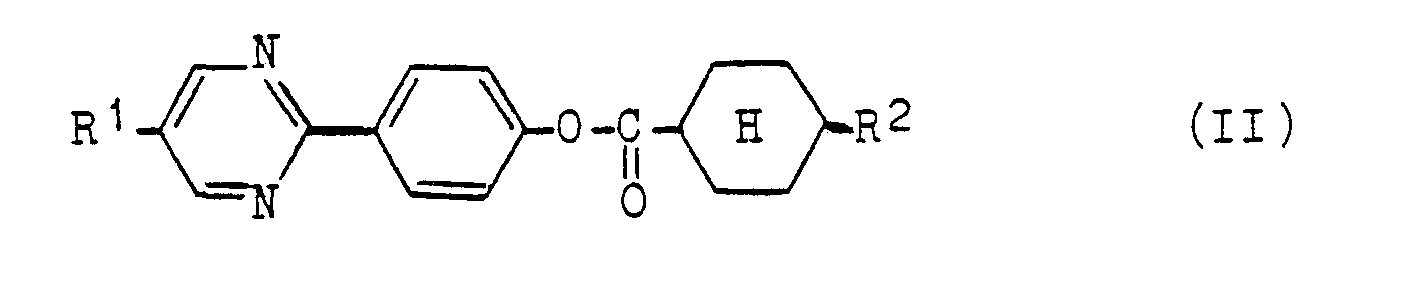
- Durch Zusatz mindestens einer Verbindung (Cyclohexancarbonsäureester) der allgemeinen Formel (11), d. h. einer Verbindung vom Typ b,

- Es bedeuten in der allgemeinen Formel (II):
- R1 eine Alkylkette mit 10 bis 16 oder eine Alkoxykette mit 8 bis 14 C-Atomen und R2 eine Alkylkette mit 2 bis 9 C-Atomen. Diese Verbindungen werden in der DE-A 37 31 639 beschrieben. Sie entfalten ihre günstige Wirkung bereits bei Zusatzmengen ab etwa 2 mol% bezogen auf die Mischung aus den Komponenten vom Typ a und b. Bei Zusatzmengen ab etwa 10 und bis etwa 40 mol% ergibt sich eine Verbreiterung der nematischen Phase um etwa 8 bis 18° C und der smektischen Phase um etwa 6 bis 15 C. Sehr vorteilhaft ist es daneben, daß der Zusatz die an sich bereits sehr niedrige Rotationsviskosität der erfindungsgemäßen Basis-Mischung nur unwesentlich erhöht.
- Eine Absenkung des Schmelzpunkts und der unteren Phasen umwandlungstemperatur der Sc-Phase der Mischungen kann, wenn diese noch zu hoch liegen, durch Zusatz mindestens einer Verbindung (Alkenyloxy-phenyl-pyrimidin-Derivat) der allgemeinen Formel (III), d. h. einer Verbindung vom Typ c, zu Mischungen aus Verbindungen vom Typ a alleine oder mit einem zusätzlichen Gehalt an Verbindungen vom Typ b erreicht werden:

- In der allgemeinen Formel (III) bedeuten R3 einen verzeigten oder geradkettigen Alkylrest mit 7 bis 16-C-Atomen oder einen geradkettigen oder verzweigten Alkoxyrest mit 6 bis 14 C-Atomen und y eine ganze Zahl von 4 bis 14. Diese Verbindungen werden in der DE-A 37 31 638 beschrieben. Zusatzmengen von etwa 10 bis 35 mol%. bezogen auf die Gesamtmischung, bewirken eine Absenkung der unteren Temperaturgrenze der Sc-Phase um bis zu 5°C. Die übrigen günstigen physikalischen Eigenschaften der Mischungen werden durch diesen Zusatz in der Regel nicht beeinträchtigt.
- Zur Absenkung des Schmelzpunkts und der unteren Temperaturgrenze der Sc-Phase können zusammen mit Verbindungen des Typs c oder an ihrer Stelle auch Verbindungen der Formel (IV), d. h. des Typs d,

- Die Mischungen aus Verbindungen der Typen a, b und c und/oder d eignen sich besonders gut als Matrix zur Herstellung von ferroelektrischen Flüssigkristall-Mischungen, die man daraus durch Dotieren mit optisch aktiven Verbindungen erhält.
- Als besonders geeignet für die Zwecke der Erfindung haben sich folgende Dotierstoffe des Typs e erwiesen:
- a) optisch aktive Ester aus a-Chlorcarbonsäuren und mesogenen Phenolen gemäß der DE-A 37 03 228 und insbesondere der optisch aktive Ester gemäß der nachstehenden Formel

- b) optisch aktive Ester des N-Acylprolins gemäß der DE-A 36 44 522
- c) optisch aktive Ester von 1,3-Dioxolan-4-carbonsäuren gemäß der DE-A 37 13 273
- d) optisch aktive Ester von Oxiran-2-carbonsäuren gemäß der DE-A 37 18 174.
- Diese Dotierstoffe induzieren vielfach schon bei geringen Zusatzmengen ab 0.5 und insbesondere ab 3 mol%. bezogen auf die Gesamtmischung, das ferroelektrische Verhalten. Die obere Grenze der Zusatzmenge liegt bei 30 mol%.
- Der Zusatz dieser Dotierstoffe beeinflußt in der Regel das Schmelz- und Phasenverhalten der Mischung, wobei vielfach eine nochmalige Absenkung des Schmelzpunkts und der unteren Temperaturgrenze der S*c -Phase auftritt. Außerdem kann je nach Art und Menge des Dotierstoffs eine Senkung oder Erhöhung der oberen Temperaturgrenze der S*c-Phase und eine Änderung der Breite der N*-Phase eintreten. was bei der Herstellung der Matrixmischung zu berücksichtigen ist. Der optisch aktive Dotierstoff induziert bekanntlich in der Sc- und in der N-phase eine helixförmige Verdrillung. wodurch diese Phasen in die S*c- bzw. N*-Phasen überführt werden. Die Ganghöhe (pitch) und der Drehsinn dieser Helices in der N*-Phase hängen von Art und Menge des optisch aktiven Dotierstoffs ab. Sie müssen vielfach durch Zusatz eines weiteren Dotierstoffs kompensiert werden, der eine Helix mit entgegengesetztem Drehsinn induziert. Allgemein gilt. daß eine ferroelektrische Flüssigkristallmischung in der N*-Phase eine Helix mit einer Ganghöhe von mehr als 10 um und in der S*c -Phase von mindestens 5 um aufweisen sollte. Die zur Kompensation der Ganghöhe verwendeten Verbindungen sollen in der Mischung vorzugsweise keine oder nur eine vernachlässigbar geringe spontane Polansation oder eine spontane Polansation mit dem gleichen Vorzeichen wie der optisch aktive Dotierstoff erzeugen.
- Falls eine pitch-Kompensation erforderlich wird. so sind in den erfindungsgemäßen Mischungen die folgenden Kombinationen besonders geeignet:
- a.) Optisch aktive a-Chlorcarbonsäureester erzeugen eine negative Ps und eine Helix mit negativem Drehsinn. Zur Kompensation setzt man vorteilhaft Derivate des Citronellols der allgemeinen Formel (V) zu

- bi) Optisch aktive N-Acylprolinester mit S-Konfiguration am asymmetrischen C-Atom die in den erfindungsgemäßen Mischungen eine positive Ps und einen negativen pitch erzeugen, lassen sich kompensieren durch Zusatz optisch aktiver Oxiran-2-carbonsäureester gemäß DE-A 37 18 174 mit positiver Ps und insbesondere 2-R-3-R-Konfiguration. Die zuzusetzende Menge beträgt bis zu 6 mol% bezogen auf die Gesamtmischung bzw. 1 mol Oxiran-2-carbonsäureester auf 5 bis 9 mol M-Acylprolinester.
- c1) Die Kompensation bei optisch aktiven 1,3-Dioxolan-4-carbonsäureestern mit R-Konfiguration, die ebenfalls eine postive Ps und einen negativen pitch erzeugen, erfolgt zweckmäßig ebenfalls mit Oxiran-2-carbonsäureestern wie unter bi) beschrieben.
- Die Verwendung von Oxiran-2-carbonsäureestern, wie bei b1) und ci) beschrieben, hat den zusätzlichen Vorteil, daß diese Verbindungen selbst eine sehr hohe positive Ps erzeugen und damit die Ps der Gesamtmischung erhöhen und die Schaltzeit verkürzen.
- Für die gebrauchsfertigen ferroelektrischen Flüssigkristall Mischungen wurden die Werte für
- die spontane Polarisation Ps [nC/cm2]
- die optische Schaltzeit τ [u.s]
- der optische Neigungswinkel ("tilt"-Winkel) θ [Grad]
- die Rotationsviskosität y [mPas]
- die Ganghöhe der Helix (pitch) in der N*-Phase [µm]
- die Ganghöhe der Helix (pitch) in der S*c Phase [µm]
- die dielektrische Anisotropie Δε
- und die optische Anisotropie Δn ermittelt.
- Die Ps-Werte werden nach der Methode von H. Diamant et al. (Rev. Sci. Instr., 28 30, 1957) gemessen, wobei Meßzellen mit 2 µm Elektrodenabstand und geriebenem Polyimid als Orientierungsschicht verwendet werden.
- Zur Bestimmung von τ und θ wird die Meßzelle auf dem Drehtisch eines Polarisationsmikroskops zwischen gekreuztem Analysator und Polarisator befestigt. Durch Drehen der Meßzelle von maximalem zu minimalem Lichtdurchgang bei angelegter Spannung wird der optische Neigungswinkel bzw. Schaltwinkel 2 e bestimmt. Mit Hilfe einer Photodiode erfolgt die Bestimmung der Schaltzeit τ indem die Anstiegszeit des Lichtsignals von 10 auf 90% Signalhöhe gemessen wird. Die Schaltspannung besteht aus Rechteckpulsen und beträgt ± 10 V µm.
- Die Rotationsviskosität wurde bestimmt wie bei C. Escher et al. "First International Symposium on Ferroelectric Liquid Crystals", Bordeaux Arcachon, Sept. 1987, beschrieben. Die Werte beziehen sich auf die Rotation des C-Direktors.
- Die Bestimmung des N*-pitches erfolgte in keilförmigen Zellen nach der Methode von Grandjean-Cano [F. Grandjean, CR Acad, Sci, (Paris) 172, 71 (1921); R. Cano, Bull. Soc. Franc. Mineral. Crystallogr. XC, 333 (1967)] und die Bestimmung des S*c - pitches durch Auswertung des Beugungsbildes eines Laserstrahls unter Verwendung von Zellen mit 400 µm Dicke [K. Kondo et al. Jpn. J. Appl. Phys. 21, 224 (1982)]. Zur Bestimmung von An wurde ein Polarisationsmikroskop mit Berek-Kompensator benutzt.
- Auf die in der Beschreibung zitierten DE-A's 37 31 638, 37 31 639, 37 03 228, 36 44 522, 37 13 273 und 37 18 174 wird ausdrücklich Bezug genommen.
- Eine Mischung aus den drei Komponenten
- 5-Octyloxy-2-(4-octyloxy-phenyl)-pyrimidin 57,5 mol%
- LC *)-Bereiche: X 50,7 Sc 92,3 SA 99,5 N 100,3 I
- 5-Ocytloxy-2(4-hexyloxy-phenyl)-pyridimin 25 mol%
- LC-Bereiche: X 47 Sc 90 SA 97 N 98,8 I
- 5-Hexyloxy-2(4-hexyloxy-phenyl)-pyrimidin 17,5 mol%
- *)=Liquid Crystal (= flüssigkristalline)
- LC-Bereiche: X 63,6 Sc 71,7 SA 72,7 N 97,4 I
- zeigt die folgenden flüssigkristallinen Phasen mit den genannten Temperaturbereichen (LC-Bereiche):
- X 33 Sc 85 SA 96,1 N 98,6 1
- Eine Mischung aus den 3 Komponenten:
- 5-Heptyloxy-2(4-pentyloxy-phenyl)-pyrimidin 30 mol% LC-Bereiche: X 53,5 Sc 77,5 SA 84,2 N 91 I
- 5-Octyloxy-2(4-octyloxy-phenyl)-pyrimidin 42 mol% 5-Hexyloxy-2(4-hexyloxy-phenyl)-pyrimidin 28 mol%
- zeigt die LC-Bereiche: X 34,5 Sc 72 SA 80,5 N 95,5 I
- Eine Mischung aus den 3 Komponenten
- 5-Octyloxy-2(4-octyloxy-phenyl)-pyrimidin 32 mol%
- 5-Octyloxy-2(4-hexyloxy-phenyl)-pyrimidin 48 mol%
- 5-Octyloxy-2(4-heptyloxy-phenyl)-pyrimidin 20 mol% LC-Bereiche: X 53,1 Sc 86,2 SA 96,7 N 97.9 I
- zeigt die folgenden LC-Bereiche:
- X 35.5 Sc 88 SA 97 N 98,5 1
- Eine Mischung aus den drei Komponenten
- 5-Octyloxy-2(4-octyloxy-phenyl)-pyrimidin 26.8 mol%
- 5-Octyloxy-2(4-hexyloxy-phenyl)-pyrimidin 40.2 mol%
- 5-Octyloxy-2(4-butyloxy-phenyl)-pyrimidin 33 mol% LC-Bereiche: X 57.6 Sc 82,2 SA 97.2 N 99.6 I
- zeigt die folgenden LC-Bereiche:
- X 21.5 Sc 85 SA 95 N 97,5 1
- Dieses Beispiel zeigt gut. daß sich aus nur drei Homologen der erfindungsgemäß verwendeten Klasse der 5-Alkyloxy-2-(4-alkyloxyphenyl)-pyrimidine eine Mischung mit bereits relativ niedrigem Schmelzpunkt und breiter Sc-Phase herstellen läßt.
- Eine Mischung aus den vier Komponenten
- 5-Octyloxy-2(4-octyloxy-phenyl)-pynmidin 32 mol%
- 5-Octyloxy-2(4-hexyloxy-phenyl)-pyrimidin 48 mol%
- 5-Hexyloxy-2(4-octyloxy-phenyl)-pyrimidin 12 mol% LC-Bereiche: X 60,6 Sc 73,8 SA 81 N 97.3 I
- 5-Hexyloxy-2(4-hexyloxy-phenyl)-pyrimidin 8 mol%
- zeigt die folgenden LC-Bereiche:
- X 32,5 Sc 85 SA 95,5 N 99 I
- Eine Mischung aus den vier Komponenten
- 5-Octyloxy-2(4-octyloxy-phenyl)-pyrimidin 21,44 mol%
- 5-Octyloxy-2(4-hexyloxy-phenyl)-pyrimidin 32,16 mol%
- 5-Octyloxy-2(4-butyloxy-phenyl)-pyrimidin 26,4 mol%
- 5-Hexyloxy-2(4-hexyloxy-phenyl)-pyrimidin 20 mol%
- zeigt die folgenden LC-Bereiche:
- X 26 Sc 82 SA 93,5 N 98 I
- Eine Mischung aus den vier Komponenten
- 5-Octyloxy-2(4-octyloxy-phenyl)-pyrimidin 24,12 mol%
- 5-Octyloxy-2(4-hexyloxy-phenyl)-pyrimidin 36,18 mol%
- 5-Octyloxy-2(4-butyloxy-phenyl)-pyrimidin 29,7 mol%
- 5-Nonyloxy-2(4-heptyloxy-phenyl)-pyrimidin 10mol% LC-Bereiche: X 56 Sc 94,4 SA 97,5 I
- zeigt die LC-Bereiche:
- X 22.5 Sc 85,5 SA 96 N 98 I
- Eine Mischung aus den fünf Komponenten
- 5-Octyloxy-2(4-propyloxy-phenyl)-pyrimidin 29,75 mol% LC-Bereiche: X 51,7 Sc 72 SA 87,7 N 88 l
- 5-Heptyloxy-2(4-octyloxy-phenyl)-pyrimidin 15,0 mol% LC-Bereiche: X 54,7 Sc 82,7 SA 89.5 N 96,3 I
- 5-Heptyloxy-2(4-pentyloxy-phenyl)-pyrimidin 16,58 mol% 5-Hexyloxy-2(4-octyloxy-phenyl)-pyrimidin 23,20 mol% 5-Hexyloxy-2(4-hexyloxy-phenyl)-pyrimidin 15,47 Mol%
- zeigt die LC-Bereich:
- X 15 Sc 66,5 SA 83,5 N 93 I
- Eine Mischung aus den fünf Komponenten:
- 5-Octyloxy-2(4-octyloxy-phenyl)-pyrimidin 18,76 mol%
- 5-Octyloxy-2(4-hexyloxy-phenyl)-pyrimidin 28,14 mol% 5-Octyloxy-2(4-butyloxy-phenyl)-pyrimidin 23,10 mol%
- 5-Hexyloxy-2(4-octyloxy-phenyl)-pyrimidin 15,0 mol%
- 5-Hexyloxy-2(4-hexyloxy-phenyl)-pyrimidin 15,0 mol%
- zeigt die folgenden LC-Bereiche: X 27,7 Sc 80 SA 92,3 N 97,6 I
- Eine Mischung bestehend aus den vier Komponenten
- 5-Octyloxy-2(4-decyloxy-phenyl)-pyrimidin 25,0 mol% LC-Bereich: X 50,2 Sc 88,9 SA 99,6 I
- 5-Octyloxy-2(4-octyloxy-phenyl)-pyrimidin 13,75 mol%
- 5-Octyloxy-2(4-hexyloxy-phenyl)-pyrimidin 29,8 mol%
- 5-Octyloxy-2(4-butyloxy-phenyl)-pyrimidin 31,45 mol% zeigt die folgenden LC-Bereiche:
- X 13.1 Sc 81,6 SA 95,4 N 98,2 I
- Durch Mischen von nur vier Komponenten ergibt sich ein Sc-Bereich von 13.1°C bis 81.6° C, d.h. mit einer Phasenbreite von 68,5 °C. Zusätzlich zeigt diese Mischung auch die gewünschte Phasenfolge I → N - SA → Sc und besitzt einen Klärpunkt von weniger als 100°C. was für die Anwendung (z.B. Füllen der Displays) von Vorteil ist.
- Eine Mischung aus den vier Komponenten
- Mischung aus Beispiel 4 85 mol%
- trans-4-Pentyl-cyclohexancarbonsäure-[4-(5-decyl-pyrimidin-2-yi)]phenyl-ester 15 mol%
- zeigt die folgenden LC-Bereiche:
- X15 Sc 84.5 SA 91.5 N 105 l
- In Vergleich zu Beispiel 4 wird durch Zugabe des Cyclohexancarbonsäureesters sowohl die Breite der Sc-als auch die der N-Phase stark vergrößert.
- Eine Mischung aus den fünf Komponenten
- Mischung aus Beispiel 10 75 mol%
- trans-4-Pentyl-cyclohexancarbonsäure-[4-(5-undecyl-pyrimidin-2-y!1]phenyl-uster 25 mol%
- zeigt die folgenden LC-Bererche:
- X3.4 Sc 85.6 SA 91 N 110.2 l
- Eine Mischung aus den fünf Komponenten
- Mischung aus Beispiel 10 80 mol%
- trans-4-Pentyl-cyclohexancarbonsäure-[4-(5-dodecyl-pyrimidin-2-yl)]phenyl-ester 20 mol%
- zeigt die folgenden LC-Bereiche:
- X 8,3 Sc 81,5 SA 93 N 107 I
- Eine Mischung aus den sechs Komponenten
- 5-Octyloxy-2(4-decyloxy-phenyl)-pyrimidin 12,8 mol%
- 5-Octyloxy-2(4-octyloxy-phenyl)-pyrimidin 18,0 mol%
- 5-Octyloxy-2(4-hexyloxy-phenyl)-pyrimidin 27,02 mol%
- 5-Octyloxy-2(4-butyloxy-phenyl)-pyrimidin 22,18 mol%
- trans-4-Pentyl-cyclohexancarbonsäure-4[-(5-decyl-pyrimidin-2-yl)]phenyl-ester 12 mol%
- trans-4-Pentyl-cyclohexancarbonsäure-[4-(5-octyloxy-pyrimidin-2-yl)]phenyl-ester 8 mol%
- zeigt die folgenden LC-Bereiche:
- X 10,7 Sc 86 SA 90,1 N 108,5 I.
- Eine Mischung aus den sechs Komponenten
- Mischung aus Beispiel 10 81 mol%
- 5-Octyloxy-2(4-ethyloxy-phenyl)-pyrimidin 10 mol%
- LC-Bereiche: X 64,5 SC 66 SA 98,5 N 97,4 I
- trans-4-Pentyl-cyclohexancarbonsäure-[4-(5-octyloxy-pyrimidin-2-yl)]phenyl-ester 9 mol%
- zeigt die folgenden LC-Bereiche:
- X 12.2 Sc 79,5 SA 91 N 102.6 I
- Die Zugabe von 30 mol% 5-Octyl-2(4-decyloxy-phenyl)-pyrimidin zu 70 mol% der Mischung aus Beispiel 15a ergibt eine Erniedrigung des Schmelzpunkts und der SA.SC-Übergangstemperatur um jeweils 6°C. verschiebt also den breiten Sc-Phasenbereich günstig zu niedrigeren Temperaturen hin, ohne ihn wesentlich einzuschränken.
- Eine Mischung aus den folgenden sieben Komponenten
- 5-Octyloxy-2(4-decyloxy-phenyl)-pyrimidin 12.7 mol%
- 5-Octyloxy-2(4-octyloxy-phenyl)-pyrimidin 6,98 mol%
- 5-Cctyloxy-2(4-hexyloxy-phenyl)-pyrimidin 15,14 mol%
- 5-Octyfoxy-2(4-butyloxy-phenyl)-pyrimidin 15,98 mol%
- 5-Octyloxy-2(4-ethyloxy-phenyl)-pyrimidin 11,69 mol%
- trans-4-Pentyl-cyclohexancarbonsäure-[4-(5-octyloxy-pyrimidin-2-yl)]phenyl-ester 10,69 mol%
- 2-[4-(10-Undecen-1-yl)oxyphenyl]-5-octyl-pyrimidin 26,88 mol%
- zeigt die folgenden LC-Bereiche:
- X 2,5 Sc 69,4 SA 81,6 N 95 I
- Eine Mischung aus den folgenden sechs Komponenten
- 5-Octyloxy-2(4-dodecyloxy-phenyl)-pyrimidin 12.49 mol% LC-Bereiche: X 54 Sc 86,5 SA 97.6 I
- 5-Octyloxy-2(4-decyloxy-phenyl)-pyrimidin 12,48 mol% 5-Octyioxy-2(4-octyloxy-phenyl)-pyrimidin 6,88 mol%
- 5-Octyloxy-2(4-hexyloxy-phenyl)-pyrimidin 20.51 mol% 5-Octyloxy-2(4-butyloxy-phenyl)-pyrimidin 22,64 mol%
- trans-4-Pentyl-cyclohexancarbonsäure-[4-(5-decyl-pyrimidin-2-yl)jphenyl-ester 25,0 mol%
- zeigt die folgenden LC-Bereiche:
- X 7,0 Sc 85,6 SA 89.7 N 110,1 I
- Eine Mischung aus den folgenden sieben Komponenten
- Mischung aus Beispiel 17 85 mol%
- 5-Octyloxy-2(4-dodecyloxy-phenyl)-pyrimidin 15 mol%
- zeigt die folgenden LC-Bereiche:
- X -2,5 Sc 80.6 SA 87,2 N 102.5 I
- Eine ferroelektrische Flüssigkristallmischung aus den folgenden Komponenten
- 5-Cctyloxy-2(4-dodecyloxy-phenyl)-pyrimidin 10.9 mol%
- 5-Octyloxy-2(4-decyloxy-phenyl)-pyrimidin 10.9 mol5
- 5-Cctyloxy-2(4-octyloxy-phenyl)-pyrimidin 6.0 mol%
- 5-Octyloxy-2(4-hexyloxy-phenyl)-pyrimidin 13.0 mol%
- 5-Octyloxy-2(4-butyloxy-phenyl)-pyrimidin 16.57 mol%
- 5-Octyloxy-2(4-ethyloxy-phenyl)-pyrimidin 10.13 mol%
- trans-4-Pentyl-cyclohexancarbonsäure-[4-(5-decyl-pyrimidin-2-yl)]phenylester 22.50 mol%
- 4-(2-((S)-7-Methyl-nonyoxy)pyrimidin-5-yl]-phenyl-(2S,3S)-2-chlor-3-methyl-pentansäureester 10.0 mol%
- zeigt die LC-Bereiche:
- X -5,5 Sc 78 SA 82,5 N* 99,5 I
- Bei 25° C betragen die spontane Polarisation Ps= -19 nC/cm2, τ = 30 µs, e = 30.5°, Δ∈ (20 kHz) -0.8 und γ= 110 mPas.
- Eine ferroelektrische Flüssigkristallmischung aus den folgenden Komponenten:
- 5-Octyloxy-2(4-decyloxy-phenyl)-pyrimidin 11,95 mol%
- 5-Octyloxy-2(4-octyloxy-phenyl)-pyrimidin 6,58 mol%
- 5-Octyloxy-2(4-hexyloxy-phenyl)-pyrimidin 14,25 mol%
- 5-Octyloxy-2(4-butyloxy-phenyl)-pyrimidin 15,03 mol%
- 5-Octyloxy-2(4-ethyloxy-phenyl)-pyrimidin 5,92 mol%
- trans-4-Pentyl-cyclohexancarbonsäure-[4-(5-octyloxy-pyrimidin-2-yl)]phenyl-ester 10,07 mol%
- 4-[2-((S)-7-Methyl-nonyloxy)pyrimidin-5-yl]-phenyl-(2S,3S)-2-chlor-3-methyl-pentansäureester 9,9 mol%
- 5-[ 4-((S)-3,7-Dimethyl-oct-6-en-1-yl)oxyphenyl]-2-octyloxy-pyrimidin 1 mol%
- 2-[4-(10-Undecen-1-yl)oxyphenyl]-5-octyl-pyrimidin 25,3 mol%
- zeigt die LC-Bereiche:
- X -1 S*c 71 S*A 79 N* 90 I
- Bei 25 °C betragen die Werte für die spontane Polarisation Ps = -20nC/cm2, τ = 30 µs, θ = 29,5°, γ = 54 mPas, Δn= 0,12, Δ∈ (20 kHz)= -0,8 und pitch N* für 79° C= -36 µm und für 82° C= +74,3 µm, d.h. es tritt in der N*-Phase eine Helixinversion auf, was auf eine optimale pitch-Kompensation hinweist.
- Eine ferroelektrische Flüssigkristallmischung aus den folgenden Komponenten:
- LC-Matrix-Mischung aus Beispiel 18 78,8 mol%
- 4-[2-((S)-7-Methyl-nonyloxy)pyrimidin-5-yl]-phenyl-(2S;3S)-2-chlor-3-methyl-pentansäureester 19,7 mol%
- 5-[(4-((S)-3,7-Dimethyl-oct-6-en-1-yl)oxyphenyl]-2-octyloxy-pyrimidin 1,5 mol%
- zeigt die folgenden LC-Bereiche:
- X -7,2 S*c 71,6 S*A 76,4 N* 86,1 I
- Bei 25° C betragen die Werte für PS = -41 nC/cm2, τ = 18 µs, e = 32°, y- 160 mPas, Δn = 0,12, Δ∈ (20 kHz) -0.9, pitch S*C = 9 µm und pitch N* (78,5° C) -31,8 µm.
- Eine ferroelektrische Flüssigkristallmischung aus den folgenden Komponenten
- LC-Matrix-Mischung aus Beispiel 18 95 mol%
- 4-[2-((S)-7-Methyl-nonyloxy)pyrimidin-5-yl]-phenyl-(2S,3S)-2-chlor-3-methyl-pentansäureester 5 mol%
- zeigt die folgenden LC-Bereiche:
- X -6,5 S*C 77,4 S*A 82,5 N* 91,5 l
- Bei 25°C betragen die Werte für Ps= -8 nC/cm2, τ = 100 µs, θ = 30 ° , γ = 56 mPas, Δn = 0,12, Δ∈-(20kHz) = -0,8, pitch S*C größer 15 um and pitch N* (86° C) = -26 um.
- Mit dem hier verwendeten optisch aktiven Dotierstoff in einer Konzentration von 5 mol% ist eine pitch-Komposition, wie die Ergebnisse zeigen, nicht notwendig.
- Eine ferroelektrische Flüssigkristallmischung aus den folgenden Komponenten
- LC-Matrix-Mischung aus Beispiel 18 95 mol%
- (R)-[4-(5-n-Octyl-pyrimidin-2-yl)-phenyl]-2,2-dimethyl-1,3-dioxolan-4-carbonsäureester 5 mol%
- zeigt die folgenden LC-Bereiche:
- X -4,5 SC 78 SA 83,7 N* 98,5 I
- Bei 25° C ergeben sich die folgenden Werte für PS = + 8 nC/cm2, τ = 70 us, θ = 29°. Δn = 0.12, Δ∈-(20 kHz) kleiner Null und pitch N* (84°)= -14um. Bei dieser Mischung kann ebenfalls auf eine pitch-Kompensation verzichtet werden.
- Eine Mischung aus den fünf Komponenten
- Mischung aus Beispiel 10 70 mol-%
- trans-4-Pentyl-cyclohexancarbonsäure-[4-(5-dodecyi-pyrimidin-2-yl)jphenylester 30 mol-%
- zeigt die Phasensequenz:
- X9 SC 86 SA 92 N 112 l.
- Eine Mischung aus den fünf Komponenten
- Mischung aus Beispiel 10 85 mol-%
- 5-Cctyl-2(4-decyloxyphenyl)-pyrimidin 15 mol-%
- zeigt die Phasenfolge
- X 9 Sc 76 SA 89 N 93 I.
- Eine Mischung aus den sechs Komponenten
- Mischung aus Beispiel 10 80 mol-%
- trans-4-Pentyl-cyclohexancarbonsäure-[4(5-undecyl-pyrimidin-2-yl)]phenylester 13 mol-%
- trans-4-Pentyl-cyclohexancarbonsäure-[4(5-octyloxy-pyrimidin-2-yl)jphenylester 7 mol-%
- zeigt die Phasensequenz
- X 8 SC 85 SA 91 N 109 I und damit einen Sc-Bereich von 77 °C.
- Eine Mischung aus den sechs Komponenten
- Mischung aus Beispiel 10 49 mol-%
- 5-Octyl-2(4-decyloxyphenyl)-pyrimidin 30 mol-%
- trans-4-Pentyl-cyclohexancarbonsäure-4(5-decyl-pyrimidin-2-yl)]phenylester 21 mol-%
- hat die Phasenfolge:
- X 8 SC 80 SA 83 N 102 I und ist unterkühlbar bis -10° C.
- Eine Mischung aus den sieben Komponenten
- 5-Octyloxy-2(4-hexyloxy-phenyl)-pyrimidin 17 mol-%
- 5-Octyloxy-2(4-octyloxy-phenyl)-pyrimidin 6 mol-%
- 5-Octyloxy-2(4-butyloxy-phenyl)-pyrimidin 19 mol-%
- 5-Octyloxy-2(4-decyloxy-phenyl)-pyrimidin 11 mol-%
- 5-Octyloxy-2(4-dodecyloxy-phenyl)-pyrimidin 11 mol-%
- trans-4-Pentyl-cyclohexancarbonsäure[4(5-decyl-pyrimidin-2-yl)]phenylester 21 mol-%
- 5-Octyl-2(4-dodecyloxy-phenyl)-pyrimidin 15 mol-%
- hat die Phasenfolge
- X-1 SC 81 SA 87 N 102 I
- Eine Mischung aus den neun Komponenten:
- Mischung aus Beispiel 15a 72,5 mol-%
- 5-Octyl-2(4-dodecyloxyphenyl)-pyrimidin 27,5 mol-%
- hat die Phasenfolge
- X φ SC 70 SA 85 N 93 l.
- Eine Mischung aus den sieben Komponenten:
- Mischung aus Beispiel 10 48 mol-%
- 5-Octyloxy-2(4-dodecyloxyphenyl)-pyrimidin 11 mol-% ,
- 5-Octyloxy-2(4-ethoxyphenyl)-pyrimidin 11 mol-%
- trans-4-Pentyl-cyclohexancarbonsäure-[4(5-decyl-pyrimidin-2-yl)]phenylester 30 mol-%
- hat die Phasenfolge
- X-3 Sc 81 SA 82 N 112 l.
- Eine binäre Mischung aus
- 5-Octyloxy-2(4-butyloxyphenyl)-pyrimidin 50 mol-%
- X 58 Sc 87 SA 97 N 99
- und
- 5-Octyloxy-2(4-decyloxyphenyl)-pyrimidin 50 mol-%
- X 52 SC 89 SA 99 I
- hat die Phasenfolge
- X19 SC 75 SA 93 N 94 l
- und somit bereits einen 56 °C breiten SC-Bereich.
- Eine binäre Mischung aus
- 5-Decyloxy-2(4-decyloxyphenyl)-pyrimidin 40 mol-%
- X 53 SC 103 I
- und
- 5-Decyloxy-2(4-octyloxyphenyl)-pyrimdin 60 mol-%
- X 58 Sc 101 SA 102 I
- besitzt die Phasenfolge
- X 43 SC 101 SA 102 I.
- Dieses Beispiel zeigt, daß zwar der Schmelzpunkt nicht aber der Übergang SC-SA abgesenkt wird.
- Eine Mischung aus der drei Komponenten
- Mischung aus Beispiel 32 50 mol-%
- 5-Decyloxy-2(4-hexyloxyphenyl)-pyrfmidin 50 mol-%
- X 52 SC 100 SA 102 I,
- hat die Phasenfolge
- X 32 SC 100 SA 102 I.
- Dieses Beispiel zeigt wiederum die starke Absenkung des Schmelzpunktes ohne Absenkung der Sc-SA Übergangstemperatur. Dadurch erhält man bereits mit drei Komponenten einen SC-ereich von 68° C, ähnlich wie beim Beispiel 10, bei dem die Abmischung nach dem selben Prinzip erfolgt.
- Eine Mischung aus den acht Komponenten:
- Mischung aus Beispiel 10 45 mol-%
- 5-Octyl-2(4-decyloxyphenyl)-pyrimidin 14 mol-%
- 5-Octyl-2(4-hexyloxyphenyl)-pyrimidin 22 mol-%
- 5-Octyl-2(4-octyloxyphenyl)-pyrimdin 19 mol-%
- hat die Phasenfolge X 5 Sc 63 SA 77 N 82 l.
- Ausgehend von der Mischung dieses Beispiels wird gezeigt, daß es möglich ist, auf dieser Basis eine breite SC-Phase ohne SA-Phase zu erhalten. Die Phasenfolge X→SC→N-→I wird für einige spezielle Anwendungen ferroelektrischer Flüssigkristalle favorisiert (siehe z.B. C.Bowry et al., Eurodisplay 87, Tagungsband, Seite 33 (1987)].
- Eine Mischung aus den acht Komponenten:
- Mischung aus Beispiel 34 65 mol-%
- trans-4-Pentyl-cyclohexancarbonsäure-4(5-decylpyrimidin-2-yl)]phenylester 35 mol-%
- besitzt die Phasenfolge: X -2 Sc 71 N 108 I.
- Eine Mischung aus den fünf Komponenten:
- Mischung aus Beispiel 10 70 mol-%
- trans-4-Pentyl-cyclohexancarbonsäure-[4(5-decyl-pyrimdin-2-yl)]phenylester 30 mol-%
- besitzt die Phasenfolge X 7 SC 86 N 113 l.
- Eine ferroelektrische Flüssigkristallmischung bestehend aus den sechs Komponenten:
- Mischung aus Beispiel 36 90 mol-%
- 4-[2-((S)-7-Methyl-nonyloxy)pyrimdin-5-yl]-phenyl-(2S,3S)-2-chlor-3-methyl-pentansäureester 10 mol-%ö
- besitzt die Phasenfolge
- X -4 S*C 83 N* 104 I.
- Die spontane Polarisation beträgt 18 nC:cm2 (20 °C).
- Eine ferroelektrische Mischung bestehend aus den neun Komponenten:
- 5-Octyloxy-2(4-hexyloxy-phenyl)-pyrimidin 16 mol-%
- 5-Octyloxy-2(4-octyloxy-phenyl)-pyrimidin 5 mol-%
- 5-Octyloxy-2(4-butyloxy-phenyl)-pyrimidin 18 mol-%
- 5-Octyloxy-2(4-decyloxy-phenyl)-pyrimidin 10 mol-%
- 5-Octyloxy-2(4-dodecyloxy-phenyl)-pyrimidin 10 mol-%
- trans-4-Pentyl-cyclohexancarbonsäure-[4(5-decyl-pyrimidin-2-yl)]-phenylester 23 mol-%
- 5-Octyl-2(4-dodecyloxy-phenyl)-pyrimidin 14 mol-%
- (2R,3R)-3-Propyl-oxiran-2-carbonsäure-[4(2-octyloxy-pyrimidin-5-yl)phenyl]-ester 1,24 mol-%
- (R)-4-(5-n-Octyl-pyrimidin-2-yl)-phenyl-2,2-dimethyl-1,3-dioxolan-4-carbonsäureester 2,76 mol-%
- Eine ferroelektrische Mischung bestehend aus den neun Komponenten:
- 5-Octyloxy-2(4-hexyloxy-phenyl)-pyrimidin 14 mol-%
- 5-Octyloxy-2(4-octyloxy-phenyl)-pyrimidin 5 mol-%
- 5-Octyloxy-2(4-butyloxy-phenyl)-pyrimidin 16 mol-%
- 5-Octyloxy-2(4-decyloxy-phenyl)-pyrimidin 9 mol-%
- 5-Octyloxy-2(4-dodecyloxy-phenyl)-pyrimidin 9 mol-%
- trans-4-Pentyl-cyclohexancarbonsäure-[4(5-decyl-pyrimidin-2-yl)]-phenylester 21 mol-%
- 5-Octyl-2(4-dodecyloxy-phenyl)-pyrimfdin 13 mol-%
- (2R.3R)-3-Propyl-oxiran-2-carbonsäure-[4(2-octyloxy-pyrfmidin-5-yl)-phenyl]-ester 4 mol-%
- (R)-4-(5-n-Octyl-pyrimidin-2-yl)-phenyl-2,2-dimethyl-1.3-dioxolan-4-carbonsäureester 9 mol-%
- Eine Mischung aus den fünf Komponenten:
- Mischung aus Beispiel 10 85 mol-%
- trans-4-Pentyl-cyclohexancarbonsäure-[4(5-decyl-pyrimidin-2-yl)]-phenylester 15 mol-%
- besitzt die Phasenfolge
- X 9 SC 84 SA 93 N 105 l.
- Eine ferroelektrische Mischung aus den sieben Komponenten
- Mischung aus Beispiel 40 90 mol-%
- (R)-4-(5-n-Octyloxy-pyrimidin-2-yl)-phenyl-2,2-dimethyl-1,3-dioxolan-4-carbonsäureester 7,4 mol-%
- (2R,3R)-3-Propyl-oxiran-2-carbonsäure-[4(2-[(S)-7-Methyl]nonyloxy-pyrimidin-5-yl)phenyl]-ester 2,6 mol- %
- besitzt eine S*C -Phase von -1 °C bis 79 °C. Bei 25 °C beträgt die spontane Polarisation 28 nC/cm2 und die Schaltzeit 16 µs bei 10 Vium.
- Eine ferroelektrische Mischung aus den sieben Komponenten
- Mischung aus Beispiel 40 90 mol-%
- (R)-4-(5-n-Octyloxy-pyrimidin-2-yl)-phenyl-2,2-dimethyl-1,3-dioxolan-4-carbonsäureester 8,1 mol-%
- (2R,3R)-3-Propyl-oxiran-2-carbonsäure-[4(2-octyloxy-pyrimidin-5-yl)phenyl]-ester 1,9 mol-%
- besitzt eine S*C -Phase von -1 °C bis 78 C. Bei 25 °C beträgt die spontane Polarisation 24 nC/cm2 und die Schaltzeit 29 µs bei 10 V/um.
- Eine ferroelektrische Mischung aus den sieben Komponenten
- Mischung aus Beispiel 40 90 mol-%
- (R)-4-(5-n-Octyloxy-pyrimidin-2-yl)-phenyl-2,2-pentamethylen-1,3-dioxolan-4-carbonsäureester 7,4 mol- %
- (2R,3R)-3-Propyl-oxiran-2-carbonsäure-[4(2-[ (S)-7-Methyl]nonyloxy-pyrimidin-5-yl)phenyl]-ester 2,6 mol- %
- besitzt eine S*C -Phase von -1 °C bis 79 °C. Bei 25 °C beträgt die spontane Polarisation 29 nC/cm2 und die Schaltzeit 38 us bei 10 V/µm.
- Eine ferroelektrische Mischung aus den sieben Komponenten
- Mischung aus Beispiel 40 98 mol-%
- (R)-4-(5-n-Octyloxy-pyrimidin-2-ylj-phenyl-2,2-dimethyl-1,3-dioxolan-4-carbonsäureester 1,6 mol-%
- (2R.3R)-3-Propyl-oxiran-2-carbonsäure-[4(2-octyloxy-pyrimidin-5-yl)phenyl]-ester 0.4 mol-%
- besitzt eine S*C -Phase von 7 °C bis 82 C. Bei 25 °C beträgt die spontane Polarisation 3 nC,cm2.
- Die Mischungen in den Beispielen 41 bis 44 sind in der cholesterischen Phase pitch-kompensiert, d.h. die beiden optisch-aktiven Dotierstoffe besitzen einen umgekehrten Helixdrehsinn, so daß bei einer bestimmten Temperatur die cholesterische Helixganghöhe unendlich wird. Im restlichen cholesterischen Temperaturbereich ist die Helixganghöhe >10 u.m, so daß eine gute Planare Orientierung erhalten wird.
besitzt einen S*c -Bereich von -5 bis 79° C und bei 25 °C eine spontane Polarisation von 8,7 nC cm2 Die oberhalb der SA-Phase liegende cholesterische Phase ist pitch-kompensiert.
besitzt einen S*C -Bereich von 3 bis 75 °C und eine spontane Polarisation von 38 nC cm2, sowie eine elektro-optische Schaltzeit von 20 µs bei 10 V µm Rechteckspannung und 25 °C.
Claims (16)


als Dotierstoff.


Priority Applications (1)
| Application Number | Priority Date | Filing Date | Title |
|---|---|---|---|
| AT88115003T ATE100132T1 (de) | 1987-09-19 | 1988-09-14 | Fluessigkristalline, insbesondere ferroelektrische fluessigkristalline mischungen. |
Applications Claiming Priority (2)
| Application Number | Priority Date | Filing Date | Title |
|---|---|---|---|
| DE3731640 | 1987-09-19 | ||
| DE3731640 | 1987-09-19 |
Publications (3)
| Publication Number | Publication Date |
|---|---|
| EP0307880A2 true EP0307880A2 (de) | 1989-03-22 |
| EP0307880A3 EP0307880A3 (en) | 1990-03-21 |
| EP0307880B1 EP0307880B1 (de) | 1994-01-12 |
Family
ID=6336446
Family Applications (1)
| Application Number | Title | Priority Date | Filing Date |
|---|---|---|---|
| EP88115003A Expired - Lifetime EP0307880B1 (de) | 1987-09-19 | 1988-09-14 | Flüssigkristalline, insbesondere ferroelektrische flüssigkristalline Mischungen |
Country Status (7)
| Country | Link |
|---|---|
| US (1) | US5071589A (de) |
| EP (1) | EP0307880B1 (de) |
| JP (1) | JPH0196285A (de) |
| KR (1) | KR890005244A (de) |
| AT (1) | ATE100132T1 (de) |
| DE (2) | DE3831226A1 (de) |
| NO (1) | NO884137L (de) |
Cited By (7)
| Publication number | Priority date | Publication date | Assignee | Title |
|---|---|---|---|---|
| EP0361272A1 (de) * | 1988-09-24 | 1990-04-04 | Hoechst Aktiengesellschaft | Optische aktive Ester der 5-Ethyl- und der 5-Vinyl-1,3-dioxolan-4-carbonsäure, ihre Verwendung als Dotierstoffe in Flüssigkristallmischungen und die Ester enthaltende Flüssigkristallmischungen |
| EP0401522A1 (de) * | 1989-05-08 | 1990-12-12 | Canon Kabushiki Kaisha | Flüssig-Kristall-Zusammensetzung und deren Anwendung in einer Flüssigkristall-Vorrichtung |
| US4988459A (en) * | 1987-05-29 | 1991-01-29 | Hoechst Aktiengesellschaft | Use of optically active oxirane-2-carboxylic acid esters as dopants in liquid-crystal mixtures, liquid-crystal mixtures containing same and novel optically active oxirane-2-carboxylic acid esters |
| EP0412409A3 (en) * | 1989-08-05 | 1991-12-11 | Hoechst Aktiengesellschaft | Liquid crystal mixtures, especially ferroelectric liquid crystal mixtures and their use in electrooptic devices |
| US5250219A (en) * | 1989-05-08 | 1993-10-05 | Canon Kabushiki Kaisha | Mesomorphic compound, liquid crystal composition containing same and liquid crystal device using same |
| US5695683A (en) * | 1993-09-30 | 1997-12-09 | Hoechst Aktiengesellschaft | Ferroelectric liquid crystal mixture |
| US6413448B1 (en) | 1999-04-26 | 2002-07-02 | Displaytech, Inc. | Cyclohexyl- and cyclohexenyl-substituted liquid crystals with low birefringence |
Families Citing this family (13)
| Publication number | Priority date | Publication date | Assignee | Title |
|---|---|---|---|---|
| DE3827600A1 (de) | 1988-08-13 | 1990-02-15 | Hoechst Ag | Organosilylalkyl- oder -alkenyl-verbindungen, verfahren zu ihrer herstellung und ihre verwendung in fluessigkristallinen mischungen |
| DE3909356A1 (de) * | 1989-03-22 | 1990-09-27 | Hoechst Ag | Fluessigkristalline, insbesondere ferroelektrische fluessigkristalline mischungen |
| DE3909355A1 (de) * | 1989-03-22 | 1990-09-27 | Hoechst Ag | Ferroelektrische fluessigkristalline mischungen |
| DE3909354A1 (de) * | 1989-03-22 | 1990-09-27 | Hoechst Ag | Ferroelektrische fluessigkristallsysteme mit hoher spontaner polarisation und guten orientierungseigenschaften |
| US5196955A (en) * | 1990-05-24 | 1993-03-23 | Semiconductor Energy Laboratory Co., Ltd. | Ferroelectric liquid crystal optical device with viscosity not more than 30000 cps |
| EP0518190B1 (de) * | 1991-06-14 | 2000-08-02 | Rolic AG | Verwendung von alkenyloxyphenylpyrimidinen für ferroelektrische mischungen |
| US7195719B1 (en) | 2001-01-03 | 2007-03-27 | Displaytech, Inc. | High polarization ferroelectric liquid crystal compositions |
| US6669999B2 (en) * | 2001-05-30 | 2003-12-30 | Industrial Technology Research Institute | Method for broadening bandwidth of cholesteric liquid crystal |
| EP1306419A1 (de) * | 2001-10-23 | 2003-05-02 | Clariant International Ltd. | Aktivmatrix-Flüssigkristallvorrichtung und smektische Flüssigkristallmischung |
| US6824707B2 (en) | 2001-10-23 | 2004-11-30 | Clariant International Ltd. | Active matrix liquid crystal device and smectic liquid crystal mixture |
| US6838128B1 (en) | 2002-02-05 | 2005-01-04 | Displaytech, Inc. | High polarization dopants for ferroelectric liquid crystal compositions |
| US7169944B2 (en) | 2002-09-25 | 2007-01-30 | Tosoh Corporation | Optically active epoxy compounds and processes for their production |
| EP4175635B1 (de) | 2020-07-02 | 2026-03-25 | Sea Pharmaceuticals LLC | Pharmazeutische zusammensetzungen aus 6-(2-(2h-tetrazol-5-yl)ethyl)-6-fluordecahydroisochinolin-3-carbonsäure und esterderivaten davon |
Family Cites Families (16)
| Publication number | Priority date | Publication date | Assignee | Title |
|---|---|---|---|---|
| DE3404117A1 (de) * | 1984-02-07 | 1985-08-08 | Merck Patent Gmbh, 6100 Darmstadt | Fluessigkristalline phase |
| WO1986000087A1 (fr) * | 1984-06-07 | 1986-01-03 | Seiko Instruments & Electronics Ltd. | Compose de cristaux liquides |
| GB2170214A (en) * | 1985-01-26 | 1986-07-30 | Stc Plc | Ferroelectric smectic liquid crystal mixture |
| DE3500909A1 (de) * | 1985-01-12 | 1986-07-17 | Merck Patent Gmbh, 6100 Darmstadt | Pyrimidine |
| JPS61246284A (ja) * | 1985-04-24 | 1986-11-01 | Teikoku Chem Ind Corp Ltd | 液晶組成物 |
| DE3515374C2 (de) * | 1985-04-27 | 1998-02-26 | Hoechst Ag | Chirale getilte smektische flüssigkristalline Phasen und deren Verwendung in elektrooptischen Anzeigeelementen |
| DE3518734A1 (de) * | 1985-05-24 | 1986-11-27 | Merck Patent Gmbh, 6100 Darmstadt | Smektische fluessigkristalline phasen |
| JPH07113112B2 (ja) * | 1985-06-18 | 1995-12-06 | チッソ株式会社 | 強誘電性カイラルスメクチツク液晶組成物 |
| EP0225195B1 (de) * | 1985-12-04 | 1993-11-24 | Ajinomoto Co., Inc. | Verbindungen auf der Basis der Phenylpyrimidine und sie enthaltende flüssigkristalline Zusammensetzungen |
| EP0257048B1 (de) * | 1986-02-17 | 1994-08-24 | MERCK PATENT GmbH | Optisch aktive verbindungen |
| JPS62209190A (ja) * | 1986-03-10 | 1987-09-14 | Alps Electric Co Ltd | 液晶組成物 |
| JPS6337186A (ja) * | 1986-08-01 | 1988-02-17 | Matsushita Electric Ind Co Ltd | 液晶組成物 |
| JP2508125B2 (ja) * | 1986-09-09 | 1996-06-19 | 味の素株式会社 | フェニルピリミジン化合物及びこれを含有してなる液晶組成物 |
| JPH0629424B2 (ja) * | 1987-06-05 | 1994-04-20 | キヤノン株式会社 | 強誘電性カイラルスメクチツク液晶組成物およびこれを含む液晶素子 |
| EP0293910B1 (de) * | 1987-06-04 | 1994-02-02 | Canon Kabushiki Kaisha | Flüssigkristallzusammensetzung und Flüssigkristall-Vorrichtung, die diese enthält |
| DE3731639A1 (de) * | 1987-09-19 | 1989-03-30 | Hoechst Ag | Fluessigkristalline phenylpyrimidin-cyclohexancarbonsaeureester, verfahren zu ihrer herstellung und ihre verwendung in fluessigkristallmischungen |
-
1988
- 1988-09-14 EP EP88115003A patent/EP0307880B1/de not_active Expired - Lifetime
- 1988-09-14 DE DE3831226A patent/DE3831226A1/de not_active Withdrawn
- 1988-09-14 DE DE88115003T patent/DE3887048D1/de not_active Expired - Fee Related
- 1988-09-14 AT AT88115003T patent/ATE100132T1/de not_active IP Right Cessation
- 1988-09-16 NO NO88884137A patent/NO884137L/no unknown
- 1988-09-16 JP JP63230221A patent/JPH0196285A/ja active Pending
- 1988-09-16 US US07/245,408 patent/US5071589A/en not_active Expired - Lifetime
- 1988-09-19 KR KR1019880012075A patent/KR890005244A/ko not_active Ceased
Cited By (8)
| Publication number | Priority date | Publication date | Assignee | Title |
|---|---|---|---|---|
| US4988459A (en) * | 1987-05-29 | 1991-01-29 | Hoechst Aktiengesellschaft | Use of optically active oxirane-2-carboxylic acid esters as dopants in liquid-crystal mixtures, liquid-crystal mixtures containing same and novel optically active oxirane-2-carboxylic acid esters |
| EP0361272A1 (de) * | 1988-09-24 | 1990-04-04 | Hoechst Aktiengesellschaft | Optische aktive Ester der 5-Ethyl- und der 5-Vinyl-1,3-dioxolan-4-carbonsäure, ihre Verwendung als Dotierstoffe in Flüssigkristallmischungen und die Ester enthaltende Flüssigkristallmischungen |
| US5328638A (en) * | 1988-09-24 | 1994-07-12 | Hoechst Aktiengesellschaft | Optically active esters of 5-ethyl- and 5-vinyl-1,3-dioxolane-4-carboxylic acid, their use as doping substances in liquid crystal mixtures and the liquid crystal mixtures containing the new esters |
| EP0401522A1 (de) * | 1989-05-08 | 1990-12-12 | Canon Kabushiki Kaisha | Flüssig-Kristall-Zusammensetzung und deren Anwendung in einer Flüssigkristall-Vorrichtung |
| US5250219A (en) * | 1989-05-08 | 1993-10-05 | Canon Kabushiki Kaisha | Mesomorphic compound, liquid crystal composition containing same and liquid crystal device using same |
| EP0412409A3 (en) * | 1989-08-05 | 1991-12-11 | Hoechst Aktiengesellschaft | Liquid crystal mixtures, especially ferroelectric liquid crystal mixtures and their use in electrooptic devices |
| US5695683A (en) * | 1993-09-30 | 1997-12-09 | Hoechst Aktiengesellschaft | Ferroelectric liquid crystal mixture |
| US6413448B1 (en) | 1999-04-26 | 2002-07-02 | Displaytech, Inc. | Cyclohexyl- and cyclohexenyl-substituted liquid crystals with low birefringence |
Also Published As
| Publication number | Publication date |
|---|---|
| KR890005244A (ko) | 1989-05-13 |
| JPH0196285A (ja) | 1989-04-14 |
| EP0307880A3 (en) | 1990-03-21 |
| NO884137L (no) | 1989-03-20 |
| US5071589A (en) | 1991-12-10 |
| DE3887048D1 (de) | 1994-02-24 |
| NO884137D0 (no) | 1988-09-16 |
| ATE100132T1 (de) | 1994-01-15 |
| EP0307880B1 (de) | 1994-01-12 |
| DE3831226A1 (de) | 1989-03-30 |
Similar Documents
| Publication | Publication Date | Title |
|---|---|---|
| EP0307880B1 (de) | Flüssigkristalline, insbesondere ferroelektrische flüssigkristalline Mischungen | |
| EP0218132A1 (de) | Flüssigkristall-Phase mit eine Temperaturkompensation bewirkenden Dotierstoffen | |
| EP0355561B1 (de) | Verwendung von optisch aktiven Tetrahydrofuran-2-carbonsäureestern als Dotierstoffe in Flüssigkristallmischungen, diese enthaltende Flüssigkristallmischungen und neue optisch aktive Tetrahydrofuran-2-carbonsäureester | |
| EP0292954B1 (de) | Verwendung von optisch aktiven Oxiran-2-carbonsäureestern als Dotierstoffe in Flüssigkristallmischungen, diese enthaltende Flüssigkristallmischungen und neue optisch aktive Oxiran-2-carbonsäureester | |
| DE69008544T2 (de) | Flüssigkristallverbindungen mit hoher optischer Anisotropie. | |
| EP0288813B1 (de) | Verwendung von optisch aktiven 1,3-Dioxolan-4-carbonsäureestern als Dotierstoffe in Flüssigkristallmischungen, diese enthaltende Flüssigkristallmischungen und neue optisch aktive 1,3-Dioxolan-4-carbonsäureester | |
| EP0620263B1 (de) | Smektische Flüssigkristallmischung | |
| EP0520292A1 (de) | Chirale Azetidinon-Derivate und ihre Verwendung als Dotierstoffe in Flüssigkristallmischungen | |
| EP0618914B1 (de) | Chirale oxiranylmethyl-ether und ihre verwendung als dotierstoffe in flüssigkristallmischungen | |
| DE4030579A1 (de) | Cyclohexylphenylpyrimidine, verfahren zu ihrer herstellung und ihre verwendung in fluessigkristallinen mischungen | |
| DE4311968A1 (de) | Smektische Flüssigkristallmischung | |
| EP0464058B1 (de) | Ferroelektrische flüssigkristalline mischungen | |
| EP0464072B1 (de) | Flüssigkristalline, insbesondere ferroelektrische flüssigkristalline mischungen | |
| EP0286043B1 (de) | Verwendung von Verbindungen mit chiralem, polarem Molekülteil als Komponenten in Flüssigkristall-Mischungen für die Ausnutzung des elektroklinen Effektes | |
| EP0438811A2 (de) | Ester von 3-Halogen- bzw. 3-Cyano-substituierten 2-Methylalkancarbonsäuren und ihre Verwendung als Dotierstoffe in flüssigkristallinen Mischungen | |
| DE4201712A1 (de) | Ferroelektrische fluessigkristalline medien und ihre verwendung in elektrooptischen vorrichtungen | |
| WO1991011441A1 (de) | Geminale dimethylalkyl-verbindungen, verfahren zu ihrer herstellung und ihre verwendung in flüssigkristallinen mischungen | |
| EP0412409A2 (de) | Flüssigkristalline, insbesondere ferroelektrische flüssigkristalline Mischungen und ihre Verwendung in elektrooptischen Vorrichtungen | |
| DE4116751A1 (de) | Cyclohexylphenylpyrimidine, verfahren zu ihrer herstellung und ihre verwendung in fluessigkristallinen mischungen | |
| EP0462156B1 (de) | Optisch aktive, einen mesogenen rest tragende dioxolanylacryl- und dioxolanylpropionsäureester, ein verfahren zu ihrer herstellung und ihre verwendung als dotierstoffe in flüssigkristallmischungen | |
| DE4306570A1 (de) | Ferroelektrische flüssigkristalline Medien und ihre Verwendung in elektrooptischen Anzeigen | |
| DE3703228A1 (de) | Chirale ester aus (alpha)-substituierten carbonsaeuren und mesogenen hydroxylverbindungen und ihre verwendung als dotierstoff in fluessigkristall-phasen | |
| DE4331675A1 (de) | Ferroelektrische flüssigkristalline Medien und ihre Verwendung in elektrooptischen Vorrichtungen |
Legal Events
| Date | Code | Title | Description |
|---|---|---|---|
| PUAI | Public reference made under article 153(3) epc to a published international application that has entered the european phase |
Free format text: ORIGINAL CODE: 0009012 |
|
| AK | Designated contracting states |
Kind code of ref document: A2 Designated state(s): AT BE CH DE FR GB IT LI NL SE |
|
| PUAL | Search report despatched |
Free format text: ORIGINAL CODE: 0009013 |
|
| AK | Designated contracting states |
Kind code of ref document: A3 Designated state(s): AT BE CH DE FR GB IT LI NL SE |
|
| 17P | Request for examination filed |
Effective date: 19900529 |
|
| 17Q | First examination report despatched |
Effective date: 19911001 |
|
| GRAA | (expected) grant |
Free format text: ORIGINAL CODE: 0009210 |
|
| AK | Designated contracting states |
Kind code of ref document: B1 Designated state(s): AT BE CH DE FR GB IT LI NL SE |
|
| PG25 | Lapsed in a contracting state [announced via postgrant information from national office to epo] |
Ref country code: IT Free format text: LAPSE BECAUSE OF FAILURE TO SUBMIT A TRANSLATION OF THE DESCRIPTION OR TO PAY THE FEE WITHIN THE PRE;WARNING: LAPSES OF ITALIAN PATENTS WITH EFFECTIVE DATE BEFORE 2007 MAY HAVE OCCURRED AT ANY TIME BEFORE 2007. THE CORRECT EFFECTIVE DATE MAY BE DIFFERENT FROM THE ONE RECORDED.SCRIBED TIME-LIMIT Effective date: 19940112 Ref country code: SE Effective date: 19940112 Ref country code: BE Effective date: 19940112 Ref country code: NL Effective date: 19940112 |
|
| REF | Corresponds to: |
Ref document number: 100132 Country of ref document: AT Date of ref document: 19940115 Kind code of ref document: T |
|
| REF | Corresponds to: |
Ref document number: 3887048 Country of ref document: DE Date of ref document: 19940224 |
|
| GBT | Gb: translation of ep patent filed (gb section 77(6)(a)/1977) |
Effective date: 19940321 |
|
| ET | Fr: translation filed | ||
| NLV1 | Nl: lapsed or annulled due to failure to fulfill the requirements of art. 29p and 29m of the patents act | ||
| PGFP | Annual fee paid to national office [announced via postgrant information from national office to epo] |
Ref country code: FR Payment date: 19940812 Year of fee payment: 7 |
|
| PGFP | Annual fee paid to national office [announced via postgrant information from national office to epo] |
Ref country code: GB Payment date: 19940819 Year of fee payment: 7 |
|
| PG25 | Lapsed in a contracting state [announced via postgrant information from national office to epo] |
Ref country code: AT Effective date: 19940914 |
|
| PG25 | Lapsed in a contracting state [announced via postgrant information from national office to epo] |
Ref country code: LI Effective date: 19940930 Ref country code: CH Effective date: 19940930 |
|
| PLBE | No opposition filed within time limit |
Free format text: ORIGINAL CODE: 0009261 |
|
| STAA | Information on the status of an ep patent application or granted ep patent |
Free format text: STATUS: NO OPPOSITION FILED WITHIN TIME LIMIT |
|
| 26N | No opposition filed | ||
| REG | Reference to a national code |
Ref country code: CH Ref legal event code: PL |
|
| PG25 | Lapsed in a contracting state [announced via postgrant information from national office to epo] |
Ref country code: GB Effective date: 19950914 |
|
| GBPC | Gb: european patent ceased through non-payment of renewal fee |
Effective date: 19950914 |
|
| PG25 | Lapsed in a contracting state [announced via postgrant information from national office to epo] |
Ref country code: FR Effective date: 19960531 |
|
| REG | Reference to a national code |
Ref country code: FR Ref legal event code: ST |
|
| PGFP | Annual fee paid to national office [announced via postgrant information from national office to epo] |
Ref country code: DE Payment date: 20020821 Year of fee payment: 15 |
|
| PG25 | Lapsed in a contracting state [announced via postgrant information from national office to epo] |
Ref country code: DE Free format text: LAPSE BECAUSE OF NON-PAYMENT OF DUE FEES Effective date: 20040401 |