EP0308122B1 - Verband mit Klebstoffschicht und Applikator dafür - Google Patents
Verband mit Klebstoffschicht und Applikator dafür Download PDFInfo
- Publication number
- EP0308122B1 EP0308122B1 EP88308241A EP88308241A EP0308122B1 EP 0308122 B1 EP0308122 B1 EP 0308122B1 EP 88308241 A EP88308241 A EP 88308241A EP 88308241 A EP88308241 A EP 88308241A EP 0308122 B1 EP0308122 B1 EP 0308122B1
- Authority
- EP
- European Patent Office
- Prior art keywords
- dressing
- adhesive
- protector
- adhesive surface
- applicator
- Prior art date
- Legal status (The legal status is an assumption and is not a legal conclusion. Google has not performed a legal analysis and makes no representation as to the accuracy of the status listed.)
- Expired - Lifetime
Links
- 239000000853 adhesive Substances 0.000 title claims abstract description 119
- 230000001070 adhesive effect Effects 0.000 title claims abstract description 119
- 239000010408 film Substances 0.000 claims abstract description 45
- 230000001012 protector Effects 0.000 claims abstract description 43
- 239000010409 thin film Substances 0.000 claims abstract description 9
- 239000003814 drug Substances 0.000 claims description 25
- 239000013543 active substance Substances 0.000 claims description 7
- 210000004877 mucosa Anatomy 0.000 claims description 3
- 230000009885 systemic effect Effects 0.000 claims description 3
- 230000000844 anti-bacterial effect Effects 0.000 claims description 2
- 229940119073 medicated pad Drugs 0.000 abstract 1
- 238000000576 coating method Methods 0.000 description 12
- 239000011248 coating agent Substances 0.000 description 10
- 229920002635 polyurethane Polymers 0.000 description 10
- 239000004814 polyurethane Substances 0.000 description 10
- 206010052428 Wound Diseases 0.000 description 8
- 208000027418 Wounds and injury Diseases 0.000 description 8
- 238000000034 method Methods 0.000 description 7
- 239000000463 material Substances 0.000 description 6
- 239000004721 Polyphenylene oxide Substances 0.000 description 5
- 208000037265 diseases, disorders, signs and symptoms Diseases 0.000 description 5
- 208000035475 disorder Diseases 0.000 description 5
- 229920000570 polyether Polymers 0.000 description 5
- 230000005540 biological transmission Effects 0.000 description 4
- 239000003795 chemical substances by application Substances 0.000 description 4
- 239000000835 fiber Substances 0.000 description 4
- 230000000699 topical effect Effects 0.000 description 4
- 208000004898 Herpes Labialis Diseases 0.000 description 3
- 206010067152 Oral herpes Diseases 0.000 description 3
- 230000002745 absorbent Effects 0.000 description 3
- 239000002250 absorbent Substances 0.000 description 3
- NIXOWILDQLNWCW-UHFFFAOYSA-N acrylic acid group Chemical group C(C=C)(=O)O NIXOWILDQLNWCW-UHFFFAOYSA-N 0.000 description 3
- 238000005520 cutting process Methods 0.000 description 3
- 229920003023 plastic Polymers 0.000 description 3
- 239000004033 plastic Substances 0.000 description 3
- 229920000728 polyester Polymers 0.000 description 3
- SMZOUWXMTYCWNB-UHFFFAOYSA-N 2-(2-methoxy-5-methylphenyl)ethanamine Chemical compound COC1=CC=C(C)C=C1CCN SMZOUWXMTYCWNB-UHFFFAOYSA-N 0.000 description 2
- GOXQRTZXKQZDDN-UHFFFAOYSA-N 2-Ethylhexyl acrylate Chemical compound CCCCC(CC)COC(=O)C=C GOXQRTZXKQZDDN-UHFFFAOYSA-N 0.000 description 2
- NIXOWILDQLNWCW-UHFFFAOYSA-M Acrylate Chemical compound [O-]C(=O)C=C NIXOWILDQLNWCW-UHFFFAOYSA-M 0.000 description 2
- 241000894006 Bacteria Species 0.000 description 2
- 239000004820 Pressure-sensitive adhesive Substances 0.000 description 2
- 239000002313 adhesive film Substances 0.000 description 2
- CQEYYJKEWSMYFG-UHFFFAOYSA-N butyl acrylate Chemical compound CCCCOC(=O)C=C CQEYYJKEWSMYFG-UHFFFAOYSA-N 0.000 description 2
- 229920001577 copolymer Polymers 0.000 description 2
- 229940079593 drug Drugs 0.000 description 2
- 238000012986 modification Methods 0.000 description 2
- 230000004048 modification Effects 0.000 description 2
- 239000000123 paper Substances 0.000 description 2
- -1 polyethylene Polymers 0.000 description 2
- 229920001289 polyvinyl ether Polymers 0.000 description 2
- 238000007789 sealing Methods 0.000 description 2
- GHXZTYHSJHQHIJ-UHFFFAOYSA-N Chlorhexidine Chemical class C=1C=C(Cl)C=CC=1NC(N)=NC(N)=NCCCCCCN=C(N)N=C(N)NC1=CC=C(Cl)C=C1 GHXZTYHSJHQHIJ-UHFFFAOYSA-N 0.000 description 1
- XIQVNETUBQGFHX-UHFFFAOYSA-N Ditropan Chemical compound C=1C=CC=CC=1C(O)(C(=O)OCC#CCN(CC)CC)C1CCCCC1 XIQVNETUBQGFHX-UHFFFAOYSA-N 0.000 description 1
- 229920011453 Hytrel® 4056 Polymers 0.000 description 1
- SNIOPGDIGTZGOP-UHFFFAOYSA-N Nitroglycerin Chemical compound [O-][N+](=O)OCC(O[N+]([O-])=O)CO[N+]([O-])=O SNIOPGDIGTZGOP-UHFFFAOYSA-N 0.000 description 1
- 239000000006 Nitroglycerin Substances 0.000 description 1
- 239000004698 Polyethylene Substances 0.000 description 1
- 239000004743 Polypropylene Substances 0.000 description 1
- 208000025865 Ulcer Diseases 0.000 description 1
- 238000005299 abrasion Methods 0.000 description 1
- 238000010521 absorption reaction Methods 0.000 description 1
- MKUXAQIIEYXACX-UHFFFAOYSA-N aciclovir Chemical compound N1C(N)=NC(=O)C2=C1N(COCCO)C=N2 MKUXAQIIEYXACX-UHFFFAOYSA-N 0.000 description 1
- 229960004150 aciclovir Drugs 0.000 description 1
- 239000003522 acrylic cement Substances 0.000 description 1
- 229940124326 anaesthetic agent Drugs 0.000 description 1
- 230000003444 anaesthetic effect Effects 0.000 description 1
- 238000004873 anchoring Methods 0.000 description 1
- 229940088710 antibiotic agent Drugs 0.000 description 1
- 238000010276 construction Methods 0.000 description 1
- 238000011109 contamination Methods 0.000 description 1
- 238000007796 conventional method Methods 0.000 description 1
- 238000010227 cup method (microbiological evaluation) Methods 0.000 description 1
- 210000000416 exudates and transudate Anatomy 0.000 description 1
- 229920005570 flexible polymer Polymers 0.000 description 1
- 238000007429 general method Methods 0.000 description 1
- 229960003711 glyceryl trinitrate Drugs 0.000 description 1
- 238000005470 impregnation Methods 0.000 description 1
- 238000003475 lamination Methods 0.000 description 1
- 239000007788 liquid Substances 0.000 description 1
- 238000002803 maceration Methods 0.000 description 1
- 229960005434 oxybutynin Drugs 0.000 description 1
- 230000000149 penetrating effect Effects 0.000 description 1
- ZQHYKVKNPWDQSL-KNXBSLHKSA-N phenazocine Chemical compound C([C@@]1(C)C2=CC(O)=CC=C2C[C@@H]2[C@@H]1C)CN2CCC1=CC=CC=C1 ZQHYKVKNPWDQSL-KNXBSLHKSA-N 0.000 description 1
- 229960000897 phenazocine Drugs 0.000 description 1
- 229920000573 polyethylene Polymers 0.000 description 1
- 229920001155 polypropylene Polymers 0.000 description 1
- 229920006264 polyurethane film Polymers 0.000 description 1
- 239000004800 polyvinyl chloride Substances 0.000 description 1
- 229920000915 polyvinyl chloride Polymers 0.000 description 1
- 238000002360 preparation method Methods 0.000 description 1
- 230000002787 reinforcement Effects 0.000 description 1
- 229920002050 silicone resin Polymers 0.000 description 1
- UEJSSZHHYBHCEL-UHFFFAOYSA-N silver(1+) sulfadiazinate Chemical compound [Ag+].C1=CC(N)=CC=C1S(=O)(=O)[N-]C1=NC=CC=N1 UEJSSZHHYBHCEL-UHFFFAOYSA-N 0.000 description 1
- 239000007921 spray Substances 0.000 description 1
- GKCBAIGFKIBETG-UHFFFAOYSA-N tetracaine Chemical compound CCCCNC1=CC=C(C(=O)OCCN(C)C)C=C1 GKCBAIGFKIBETG-UHFFFAOYSA-N 0.000 description 1
- 229960002372 tetracaine Drugs 0.000 description 1
- 230000037317 transdermal delivery Effects 0.000 description 1
- 231100000397 ulcer Toxicity 0.000 description 1
- XLYOFNOQVPJJNP-UHFFFAOYSA-N water Substances O XLYOFNOQVPJJNP-UHFFFAOYSA-N 0.000 description 1
Images

Classifications
-
- A—HUMAN NECESSITIES
- A61—MEDICAL OR VETERINARY SCIENCE; HYGIENE
- A61F—FILTERS IMPLANTABLE INTO BLOOD VESSELS; PROSTHESES; DEVICES PROVIDING PATENCY TO, OR PREVENTING COLLAPSING OF, TUBULAR STRUCTURES OF THE BODY, e.g. STENTS; ORTHOPAEDIC, NURSING OR CONTRACEPTIVE DEVICES; FOMENTATION; TREATMENT OR PROTECTION OF EYES OR EARS; BANDAGES, DRESSINGS OR ABSORBENT PADS; FIRST-AID KITS
- A61F13/00—Bandages or dressings; Absorbent pads
- A61F13/02—Adhesive bandages or dressings
- A61F13/023—Adhesive bandages or dressings wound covering film layers without a fluid retention layer
Definitions
- the invention relates to thin flexible film adhesive coated dressings and applicators therefor.
- This patent further discloses that the adhesive handle can be adhered to the patient to serve as an anchor so that both hands are available to manoeuvre the dressing into position and remove the main protector prior to adhering it to the skin.
- the present invention provides an adhesive coated thin film dressing having a releasable protector in contact with an adhesive surface which protector extends over another protector covering a major portion of the adhesive surface characterised in that the protector covering the major adhesive surface is an applicator which comprises a pair of superposed laminar members hinged at one end, the upper member being adapted to support the dressing and being in releasable contact with a major portion of the adhesive surface thereof and the lower member being adapted to be grasped at the end remote from the hinge and being longer than the upper member.
- the dressing of the invention can be applied to a patient by removing the protector to expose an adhesive end portion of the dressing, adhering this portion to the skin to anchor the dressing and then grasping and pulling the lower member of the applicator to expose the major portion of the adhesive surface and adhere the remainder of the dressing to the skin.
- the lower member is preferably sufficiently rigid to support the upper member bearing the dressing to enable the dressing, after removal of the protector to be positioned accurately on the treatment area and to be applied to the skin in controlled manner without handling the dressing. Furthermore, such an application may be achieved using one hand.
- the portion of the adhesive surface of the dressing covered by the protector can conveniently be a marginal end portion of the dressing. Removal of the protector from such a portion can expose a marginal end adhesive portion of the dressing which can be adhered to the skin to provide an anchor to apply the remainder of the adhesive dressing under light tension to the skin.
- the protector may extend beyond the adhesive surface of the marginal end portion of the dressing to provide a tab to facilitate removal thereof from the adhesive surface.
- the extended protector or tab may project beyond the end of the dressing or overlap the lower member at the hinged end of the applicator.
- the end portion of dressing covered by the protector can be stiffened to inhibit the end portion "drooping" when the protector layer is removed and thereby facilitate adhering the portion to the skin.
- the stiffened end portion of the dressing can be provided by a variety of methods including use of a stiffer film portion such as a chemically modified, for example crosslinked, film portion, a thickened film portion, a reinforced film portion in which for example a stiffening strip is adhered to the non-adhesive side of the film or by attaching a stiffer adhesive coated layer, for example an adhesive coated strip, to the end portion of the film.
- Favoured dressings of the invention have a stiffened end portion which comprise an adhesive coated strip attached to the non-adhesive side of the film at this end portion.
- the adhesive coated strip may be coterminous with the film at the end portion in which case it is not necessarily stiffer than the film.
- an adhesive strip which is stiffer than the adhesive coated film can be adhered in an overlapping manner to the edge of the film to form the stiffened end portion of the dressing.
- the major portion of the dressing is supported and in contact with the upper member.
- This portion can have a similar size to that of the upper member so that it is coterminous therewith or has a smaller size for example in the length direction thereof.
- the lower member of the applicator is adapted to be grasped so that it can be pulled to allow removal of the upper member during application of a major portion of the dressing to the skin.
- the lower member is longer than the upper member to facilitate grasping and to inhibit contact with the dressing during application.
- the lower member of the applicator can be provided with a lip to accommodate or receive an end portion of the overlapping tab of the extended protector.
- a lip will temporarily anchor the protector so that the portion of dressing adhered thereto will be substantially flat and be inhibited from flapping and moving prior to use so prevent creasing or puckering of the dressing adjacent to the tab before application.
- the lower member can be advantageously provided with a lip which accommodates the end portion of the upper member remote from the hinged end of the applicator. Such a lip will anchor the upper member so that portion of the dressing adhered thereto will lie substantially flat prior to use and be inhibited from flapping or moving.
- the applicator upper and lower members adjacent to the hinge portion thereof can be advantageously provided with chamfered or tapered sides to inhibit excess or uneven stretching and possible creasing of the adhesive film sides adjacent to the hinge portion when the upper member is removed.
- the dressing of the invention can be provided with a pad or medicament area located on the adhesive side of the coated film.
- the pad can be an absorbent pad suitable for absorbing exudate from wounds and dermatological disorders such as cold sores.
- the pad can be a carrier for a medicament such as topical active medicament for the treatment of wounds or dermatological disorders.
- a medicament can be provided on or within an adhesive area of the dressing.
- the medicament is in the medicament area of the dressing, is present in a dry form such as particulate, film or sheet form.
- Suitable topically active medicament for use in the invention includes topical antibacterials such as chlorhexidine salts, silver sulphadiazine, topical viricides such as Acyclovir (Trade mark) available from Wellcome Foundation and topical anaesthetics such as amethocaine.
- topical antibacterials such as chlorhexidine salts, silver sulphadiazine
- topical viricides such as Acyclovir (Trade mark) available from Wellcome Foundation
- topical anaesthetics such as amethocaine.
- the medicament can be pharmacologically active agent which has a systemic effect when absorbed via the skin or mucosa.
- Suitable pharmacologically active agents include any of those suitable for transdermal or transmucosal delivery. Suitable pharmacologically active agents of this type are disclosed in European Patent Application No. 0250125. Particularly suitable agents for transdermal delivery are nitroglycerin, oxybutynin and phenazocine.
- Suitable pads include the fibre mats and in particularly the polyurethane fibre mats disclosed in the hereinabove mentioned European Patent Application.
- the pad or medicament area can conveniently be located in a central position of the adhesive surface of the dressing which is covered by the upper member.
- Favoured dressings of the invention comprise a rectangular pad which is located thereon with one edge adjacent to the folded hinge of the applicator members. Such a location of the pad on the adhesive surface of the dressing inhibits uneven stretching or creasing of the adhesive film sides adjacent to the folded hinge when upper member is removed.
- Dressings of the invention preferably comprise a transparent or translucent adhesive coated film. Such dressings can advantageously have an applicator means which allow the pad or medicament area to be located over the skin treatment site.
- the upper and lower members of the applicator are sufficiently transparent or translucent to allow the pad or medicament area to be aligned with the treatment site prior to the application of the dressing.
- the upper and lower members of the applicator each have an aperture which is aligned with the pad or medicament area to allow the pad or medicament area to be aligned with the treatment site prior to the application of the dressing.
- Dressings of the invention which comprise a pharmacologically active agent will normally be impermeable to the agent and also to moisture vapour to promote absorption of the drug through the skin.
- Such impermeability properties can conveniently be provided by a suitable backing film.
- Suitable impermeable backing films for dressings of this type are disclosed in European Patent Application No. 0250125.
- Dressings of the invention are preferably moisture vapour permeable to inhibit maceration of the skin in use.
- Moisture vapour permeable dressings of the invention can suitably have a moisture vapour transmission rate of at least 300g/m2/24h, more suitably at least 500/m2/24h and preferably at least 700g/m2/24h at 37°C at 100% to 10% relative humidity difference.
- the moisture vapour transmission rate of an adhesive dressing can be readily determined by the Payne Cup Method (in the upright position) described in European Patent No. 46071.
- the adhesive coated thin film of moisture vapour permeable dressing of the invention may contain apertures such as perforations to render the dressings permeable to liquids such as water.
- Dressings of the invention are preferably bacteria-proof in use to inhibit bacteria penetrating therethrough to the treatment site.
- Films for use in the invention can be any of the thin flexible films used as backings for wound dressings.
- Favoured flexible films are elastomeric moisture vapour permeable films. Suitable films of this type are disclosed in British Patent No. 1280631 and European Patent No. 91800.
- Favoured elastomeric moisture vapour permeable films include those formed from polyether polyurethane, polyester polyurethane, hydrophilic polyurethane and polyester-polyether copolymers.
- Suitable polyether polyurethanes are described in United States Patent No. 2899411. Suitable polyester polyurethanes are described in United States Patent No. 2871218. Apt polyester and polyether polyurethanes are known Estane (Trade mark) available from B.F. Goodrich and in particular grades 5701, 5702, 5703, 5714F and 580201.
- Hytrel 4056 An apt polyester-polyether copolymer is known as Hytrel 4056 available from Dupont.
- Suitable hydrophilic polyurethane films for use in the inventions are disclosed in European Patent No. 91800.
- the thickness of the films used in the invention can suitably be 9 to 80 ⁇ m, more suitable 15 to 50 ⁇ m and can preferably be 20 to 40 ⁇ m for example 30 ⁇ m.
- the moisture vapour permeable films used in the invention can suitably have a moisture vapour transmission rate of at least 300g/m2/24h, more suitably at 500g/m2/24h and can preferably have a moisture vapour transmission rate of at least 700g/m2/24h at 37°C at 100 to 10% relative humidity difference.
- the adhesive coating used in the dressing of the invention can be any of the pressure sensitive adhesives used on conventional wound dressings.
- the adhesive coating can suitably have a thickness of 15 to 65 ⁇ m, and can preferably have a thickness of 20 to 40 ⁇ m.
- Such adhesive coatings will generally have a weight per unit area of 10 to 75g/m2, more usually of 15 to 65g/m2 and will preferably have a weight per unit area of 20 to 40g/m2.
- the adhesive coating can be a continuous or a discontinuous coating for example a pattern, porous or microporous coating.
- the adhesive coating however, is preferably continuous and moisture vapour permeable. Suitable adhesives for this type of coating are disclosed in British Patent 1280631, United Kingdom Application No. 2040631 and European Patent Applications No. 35399. Favoured adhesives are polyvinyl ether adhesives and acrylic adhesives. An apt acrylic adhesive comprising a copolymer of 47 parts by weight of butyl acrylate, 47 parts by weight of 2-ethylhexylacrylate and 6 parts by weight of acrylic acid is disclosed in United Kingdom Patent No. 2070631.
- Moisture vapour permeable continuous adhesive coatings used in the invention can suitably have a moisture vapour transmitting rate of at least 300g/m2/24h, desirably at least 500g/m2/24h and preferably at least 700/m2/24h at 37°C at 100 to 10% relative humidity difference.
- the adhesive coated strip used to provide the stiffened end portion of the dressing of the invention can suitably be a strip material coated with a pressure sensitive adhesive suitable for adhesive dressings.
- Suitable strip materials for use in the invention include those disclosed in the aforementioned United Kingdom Application No. 2157955 for the handles of the adhesive dressings described therein.
- Favoured strip materials comprise an integral net.
- Preferred integral nets include those described in British Patent 1531715.
- the adhesives used on the adhesive coated strips are favourably those described in relation to the adhesive dressing of the invention.
- the protector used in the invention may be any of the flexible release materials used to protect the adhesive surface of a conventional adhesive dressing.
- Suitable protectors include plastics films such as polyethylene, polypropylene or unplasticised polyvinyl chloride, paper sheets and coated paper sheets which have been treated with a release agent such as silicone resin.
- the upper member of the applicator can conveniently comprise a flexible release material similar to that used for the protector.
- the lower member of the applicator can comprise a cardboard sheet or stiff plastics sheet portion.
- the flexible film adhesive coated dressings of the invention include wound dressings for example those suitable for the treatment of cuts, ulcers, burns, abrasions or dermatological disorders, surgical drapes, catheter fixing dressings and transdermal drug devices.
- the dressings may be of large or medium size.
- the dressing and applicator of the invention are highly suitable for small dressings such as first aid dressings, dressings for dermatological disorders such as spots or cold sores and dressings for fixing IV catheters in place.
- the dressing can conveniently be rectangular and have a length or width dimension of up to 12cm for example 10cm x 5cm, 9cm x 6cm, 7cm x 5cm and 2.5cm x 2cm.
- the dressings are preferably sterile within a bacteria proof pack.
- the applicator can be formed either by attaching a stiff sheet to release sheet and folding the release sheet to provide a hinge or by attaching the release sheet and stiff sheet separately to an intermediate hinge member. Where the stiff sheet is attached directly to the release sheet it can be attached to a marginal portion or over a substantial proportion thereof to provide a reinforcement for the release sheet.
- the stiff sheet can be attached to either face of the release sheet by a conventional heat sealing or adhesive method. Where necessary a marginal portion of the card can be left non-adhered to the release sheet to provide a lip for accommodating an end portion of the protector or upper member of the applicator.
- the applicator may be of unitary construction, folded over to provide the upper and lower members hinged at the fold, and made from suitable release sheet.
- the lower member may be reinforced or stiffened by lamination of or impregnation by another suitable material.
- the adhesive dressing of the invention can then be formed by adhering a major proportion of the adhesive coated film to the upper member which forms a protector layer so that a marginal proportion projects beyond the hinge and covering the adhesive surface of the marginal proportion with a protector.
- An adhesive strip can be adhered to the non-adhesive side of the film at the marginal portion to form a stiffened end portion.
- the adhesive coated film can be applied to the upper member without projecting beyond the hinge and the adhesive strip is adhered to the edge of the dressing to form a projecting stiffened end portion.
- the applicator can be provided with chamfered edges by cutting by a conventional method the sides of applicator adjacent to hinge at angle which reduces the length of the hinge.
- the lower and upper members of the applicator can be provided with aligned apertures by a conventional die cutting method.
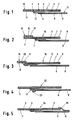
- Figure 1 shows a dressing of the invention (1) having a thin film (2) coated with adhesive (3) and an applicator (4) therefor.
- Applicator (4) comprises a pair of superposed laminar members (5, 6) having folded hinge (7) at one end.
- the lower member (6) is laminated to portion (8) to render it more stiff than the upper member (5).
- Upper member (5) releasably supports the dressing (1) and provides a flexible protector layer for a major portion (9) of the surface of adhesive (3) of dressing (1).
- End portion (10) of dressing (1), which extends beyond folded hinge end (7) has its adhesive surface covered by a protector (11) which has a tab (12) to facilitate removal thereof.
- Tab (12) is shown in Figure 1 overlapping the applicator (4) at the folded hinge end (7).
- lower member (6) is longer than upper member (5) and its end (13) remote from hinge (7) extends beyond the end of the dressing to facilitate grasping during application of the dressing.
- the dressing of Figure 1 can be applied to the skin by removing protector (11) from end portion (10) of the adhesive by means of tab (12), adhering end portion (10) to the skin to anchor the dressing at one end and then gradually peeling back upper member (5) from portion (9) of the adhesive surface by pulling stiff portion (8) of lower member (6) in the direction of end (13) thereof and thereafter adhering portion (9) to the skin.
- Portion (8) of lower member (6) because of its stiff nature can act as a handle to facilitate accurate positioning and initial anchoring of end portion of the adhesive dressing without undue handling thereof and inhibits the upper member from twisting during its removal from the remainder of the adhesive surface so that the dressing can be applied to the skin without substantial creasing or puckering. Furthermore such an application of the dressing advantageously can be achieved by grasping the lower member in one hand.
- Figure 2 shows a dressing (14) similar to that of Figure 1 in which the end portion (15) is stiffened with a strip (16) coated with a adhesive (17) and adhered to the non-adhesive side of film 2.
- Figure 3 shows a dressing (18) similar to that of Figure 1 with a stiffened end portion (19) in the form of a strip (20) coated with adhesive (21) which overlaps and is adhered to the non-adhesive surface of film 2.
- stiffened portions (15, 19) of dressings (14, 18) of Figures 2 and 3 do not "flop” or "droop" when second protector layer (11) is removed. Such stiffened portions, therefore, will facilitate initial application of the dressing to the skin.
- Figure 4 shows a dressing (22) similar to that of Figure 1 in which lower member (6) is provided with a lip (23) to accommodate an end portion of tab (12) of protector (11).
- Figure 5 shows a dressing (24) similar to that of Figure 1 in which lower member (6) has a lip (25) which can accommodate an end portion of upper member (5).
- Figures 4 and 5 shows the end portion of tab (12) and the end portion of upper member (5) within respective lips (23, 25).
- tab (12) and/or upper member (5) are temporarily maintained in a flat position and inhibited from "flapping" or moving prior to use.
- Figures 6 and 7 show a dressing (26) similar to that of Figure 1 in which dressing (26) has a rectangular pad (27) containing medicament centrally located on the surface of adhesive (3) and circular apertures (28, 29) in upper and lower members (5, 6) respectively. Apertures (28, 29) as shown in Figure 6 are aligned with pad (27) so that the pad can be positioned over the skin are to be treated prior to application of dressing (26).
- Figure 8 shows a dressing (30) similar to that of Figure 1 in which the sides of applicator members (5, 6) adjacent to the folded hinge (7) has chamfered edges (31, 32). Such chamfered sides can inhibit undue stretching of the side edges of film (2) when upper member (5) is removed and thus can also inhibit creasing caused by such stretching or retraction of the film.
- Figure 9 shows a dressing (33) similar to that of Figure 7 in which rectangular pad (27) is located with one edge adjacent to folded hinge (7) of the applicator members. Such an arrangement of the pad allows dressing 33 to be removed from upper member 5 without creasing or puckering of thin film (2) adjacent to the sides of the pad.
- An applicator for the dressing was formed by heat sealing one end of a rectangular (9.5cm x 5.0cm) release sheet of plastic coated layer to an end marginal portion of a rectangular (5.5cm x 5cm) cardboard sheet and folding the attached sheets to form an upper release member (length 6cm) and lower member (length 7.7cm) with a stiff portion (5.5cm).
- a rectangular adhesive dressing (7cm x 5cm) was adhered onto the upper release member so that an end marginal portion (1cm) of dressing extended beyond the hinge.
- the adhesive surface of this portion was then covered with release strip (width 3.3cm) which overlapped the hinge to provide a tab.
- the adhesive dressing used in this example comprised a thin film (30 ⁇ m) of polyurethane (Estane 5714) coated with a polyvinyl ether adhesive (30g/m2).
- the adhesive dressing was formed and adhered onto the release sheet of the applicator by the general methods given in Example 1 of United Kingdom Patent Application No. 2157955.
- An adhesive dressing and applicator was formed in the same manner as Example 1 except that a marginal end portion of the adhered cardboard sheet was not adhered to the release sheet to provide a lip adjacent to the hinge to accommodate an end portion of the release strip. It was found that when the end portion of the release strip was coated within the lip the release strip was maintained aligned with stiff member and was prevented from "flapping" prior to use.
- An adhesive dressing and applicator was formed in the same manner as Example 1 except that the side edges of the applicator adjacent to the folded hinge were chamfered by cutting into the hinge to inhibit creasing when the upper release sheet was removed.
- a rectangular adhesive dressing and applicator were formed in the same manner as Example 1 except that the applicator had a rectangular lower stiff member (length 8cm) connected via the hinge to an upper release member (length 7cm) which completely covered the adhesive surface of the film portion of the dressing and the adhesive dressing had a reinforced end portion provided by an adhesive strip (2.5cm) which is adhered to a marginal portion thereof in a overlapping manner to provide a portion (1cm) which extends beyond the hinge.
- the adhesive strip used in this example had a fibrillated backing coated with an acrylate adhesive (30g/m2) and was formed by the method given in British Patent No. 1531715.
- the acrylate adhesive comprised a copolymer of 47 parts by weight butyl acrylate 47 parts by weight 2 ethylhexyl acrylate and 6 parts by weight acrylic acid prepared by the method given in United Kingdom Patent No. 2070631.
- An adhesive dressing was formed in the same manner as Example 1 with the following modifications.
- the adhesive dressing had a size of 2.5cm x 2cm and had a medicament in particulate form applied as a circular area (diameter 0.5cm) on a central portion of the adhesive surface of the dressing.
- the upper release member (2cm x 2cm) covered a major proportion of the dressing to leave an end margin (0.5cm) to be covered by the release strip (2.5cm x 2.5cm).
- the upper release member was attached via the hinge to a lower member (7.5cm) having a stiff cardboard portion (5.5cm).
- the lower member had a lip on its upper side, provided by the end portion stiff member adjacent to the hinge being left unadhered, to accommodate an end portion of the upper member.
- Both the upper and lower members had circular apertures (0.5cm) which were aligned with the medicament area on the dressing.
- the dressing of this example when provided with a suitable medicament, is suitable for the treatment of dermatological disorders such as spots and cold sores. It was found that the apertures in the upper and lower members of applications allowed the dressing to be applied accurately over the area to be treated.
- An adhesive dressing and applicator was formed in the same manner as Example 1 with the following modifications.
- the rectangular adhesive dressing (3.5cm x 2cm) had a rectangular absorbent pad (1cm x 1cm) of spray hydrophilic polyurethane fibre mats (weight per unit area 175g/m2) on its adhesive surface.
- the polyurethane fibre mat of the pad was made according to the method given in Example 1 of European Patent Application No. 0250125.
- the upper release member (3.5cm x 2cm) covered a major proportion of the dressing to leave an end margin (0.5 x 2cm) covered by the release protector (2.5cm x 2cm).
- the upper release member was attached via a folded hinge to a lower member (9cm x 2cm) having a flexible portion (4cm x 2cm) and attached to stiffer cardboard portion (5cm x 2cm) in overlapping manner.
- the lower member had a lip on its upper side, provided a non-adhered end part of the stiffer cardboard portion adjacent to the hinge, to accommodate an end portion of the upper member.
- the pad of the dressing was located with one side thereof adjacent to the folded hinge.
- the dressing of this example had a absorbent pad suitable for carrying a pharmacologically active agent which has a systemic effect when absorbed via the skin or mucosa such as those disclosed in European Patent Application No. 0250125.
- All the dressings of Examples 1 to 6 could be simply applied to the skin by removing the strip release sheet to expose the marginal end portion of adhesive, adhering the end portion to the skin to provide and anchor and then pulling the stiff portion of the lower member to remove the upper release member and adhere the dressing to the skin. It was found that these dressings after being anchored could be applied by one hand without any substantial creasing or puckering.
Landscapes
- Health & Medical Sciences (AREA)
- Animal Behavior & Ethology (AREA)
- Biomedical Technology (AREA)
- Heart & Thoracic Surgery (AREA)
- Vascular Medicine (AREA)
- Life Sciences & Earth Sciences (AREA)
- Engineering & Computer Science (AREA)
- General Health & Medical Sciences (AREA)
- Public Health (AREA)
- Veterinary Medicine (AREA)
- Materials For Medical Uses (AREA)
- Medicinal Preparation (AREA)
- Media Introduction/Drainage Providing Device (AREA)
Claims (11)
- Klebstoffbeschichteter Verband (1) aus einer dünnen Folie mit einem ablösbaren Schutzbelag (11), der mit einer Klebstofffläche (3) in Kontakt ist und sich über einen anderen Schutzbelag erstreckt, der einen Hauptteil der Klebstofffläche bedeckt, dadurch gekennzeichnet, daß der die Hauptklebstofffläche bedeckende Schutzbelag ein Applikator ist, der ein Paar übereinander angeordneter, schichtförmiger Teile (5, 6) aufweist, die an einem Ende gelenkig verbunden sind, und das obere Teil (5), das sich in ablösbarem Kontakt mit dem Hauptteil der Klebstofffläche befindet, derart ausgebildet ist, daß es den Verband stützt, und das untere Teil (6), das länger als das obere Teil ist, derart ausgebildet ist, daß es an dem von dem Gelenk (7) entfernten Ende (13) erfaßt werden kann.
- Verband nach Anspruch 1, bei welchem das untere Teil des Applikators eine Steifigkeit aufweist derart, daß es das obere Teil, welches die Verbände trägt, stützt.
- Verband nach Anspruch 1 oder 2, bei welchem der Schutzbelag einen am Rand liegenden Endabschnitt (10) der Klebstoffoberfläche des Verbandes bedeckt.
- Verband nach einem der Ansprüche 1 - 3, bei welchem sich der Schutzbelag über die Klebstofffläche hinaus erstreckt.
- Verband nach Anspruch 4, bei welchem der überstehende Schutzbelag den unteren Teil überlappt.
- Verband nach Anspruch 5, bei welchem das untere Teil einen Rand (23) aufweist, um den überstehenden Schutzbelag aufzunehmen.
- Verband nach einem der Ansprüche 1 - 6, bei welchem das untere Teil einen Rand (25) aufweist, um den dem Gelenkende abgekehrten Endabschnitt des oberen Teils aufzunehmen.
- Verband nach einem der Ansprüche 1 - 7, bei welchem der Verband ein Medikament-Kissen (27) oder einen Medikament-Bereich aufweist, das bzw. der auf der Klebstoff-Seite der beschichteten Folie angeordnet ist.
- Verband nach Anspruch 8, bei welchem das Medikament antibakteriell oder viruzid ist.
- Verband nach Anspruch 8, bei welchem das Medikament ein pharmakologisch aktiver Wirkstoff ist, der eine systemische Wirkung erzielt, wenn er über die Haut oder die Schleimhaut absorbiert wird.
- Verband nach einem der Ansprüche 8 - 10, der genügend durchsichtig oder durchscheinend ist, um die Ausrichtung des Medikament-Kissens oder -Bereichs zur Behandlungsstelle vor der Anbringung des Verbandes zu ermöglichen.
Priority Applications (1)
| Application Number | Priority Date | Filing Date | Title |
|---|---|---|---|
| AT88308241T ATE101332T1 (de) | 1987-09-15 | 1988-09-07 | Verband mit klebstoffschicht und applikator dafuer. |
Applications Claiming Priority (2)
| Application Number | Priority Date | Filing Date | Title |
|---|---|---|---|
| GB878721659A GB8721659D0 (en) | 1987-09-15 | 1987-09-15 | Adhesive coated dressings & applicators |
| GB8721659 | 1987-09-15 |
Publications (3)
| Publication Number | Publication Date |
|---|---|
| EP0308122A2 EP0308122A2 (de) | 1989-03-22 |
| EP0308122A3 EP0308122A3 (en) | 1989-09-06 |
| EP0308122B1 true EP0308122B1 (de) | 1994-02-09 |
Family
ID=10623795
Family Applications (1)
| Application Number | Title | Priority Date | Filing Date |
|---|---|---|---|
| EP88308241A Expired - Lifetime EP0308122B1 (de) | 1987-09-15 | 1988-09-07 | Verband mit Klebstoffschicht und Applikator dafür |
Country Status (9)
| Country | Link |
|---|---|
| US (1) | US4928680A (de) |
| EP (1) | EP0308122B1 (de) |
| JP (1) | JPH01107761A (de) |
| AT (1) | ATE101332T1 (de) |
| AU (1) | AU610645B2 (de) |
| CA (1) | CA1317176C (de) |
| DE (1) | DE3887720T2 (de) |
| GB (2) | GB8721659D0 (de) |
| ZA (1) | ZA886781B (de) |
Cited By (1)
| Publication number | Priority date | Publication date | Assignee | Title |
|---|---|---|---|---|
| US8497407B2 (en) | 2005-01-11 | 2013-07-30 | Molnlycke Health Care Ab | Sealing film dressing |
Families Citing this family (38)
| Publication number | Priority date | Publication date | Assignee | Title |
|---|---|---|---|---|
| US5833061A (en) * | 1981-10-30 | 1998-11-10 | Storandt; Duane L. | Applicator mitt |
| US5454207A (en) * | 1981-10-30 | 1995-10-03 | Storandt; Duane L. | Applicator mitt |
| US5301490A (en) * | 1981-10-30 | 1994-04-12 | Storandt Duane L | Applicator mitt |
| US5356397A (en) * | 1981-10-30 | 1994-10-18 | Storandt Duane L | Applicator mitt |
| US5074293A (en) * | 1988-11-30 | 1991-12-24 | Sherwood Medical Company | Wound dressing having peeling-force varying release liners |
| US5242381A (en) * | 1989-09-16 | 1993-09-07 | Lts Lohmann Therapie- Systeme Gmbh & Co. Kg. | Application aid and the use thereof |
| CA2123003A1 (en) * | 1991-11-06 | 1993-05-13 | Dennis M. Kay | Occlusive wound dressing and applicator |
| ZA933349B (en) * | 1992-05-13 | 1994-06-15 | Alza Corp | Transdermal administration of oxybutynin |
| US5900250A (en) * | 1992-05-13 | 1999-05-04 | Alza Corporation | Monoglyceride/lactate ester permeation enhancer for oxybutnin |
| GB9310185D0 (en) * | 1993-05-18 | 1993-06-30 | Giltech Ltd | Wound dressing |
| US5520762A (en) * | 1993-12-23 | 1996-05-28 | Wilshire Technologies, Inc. (Wilshire Medical Products Division) | Method of manufucturing a wound dressing delivery system |
| US5397297A (en) | 1994-02-28 | 1995-03-14 | Hunter; Theodore K. | Adhesive bandage with improved application system |
| US5628724A (en) * | 1994-12-29 | 1997-05-13 | Deroyal Industries, Inc. | Wound dressing and delivery system therefor |
| US5733251A (en) * | 1996-08-20 | 1998-03-31 | Medical Device Designs, Inc. | Pop top dressing applicator |
| DE29621366U1 (de) | 1996-12-11 | 1997-03-06 | Lohmann Gmbh & Co Kg | Applikationshilfe für Folienverbände |
| US6008429A (en) * | 1997-06-06 | 1999-12-28 | Ritger; Philip L. | Wound dressing delivery system |
| AU8648798A (en) * | 1997-08-13 | 1999-03-08 | Chugai Seiyaku Kabushiki Kaisha | Support for patches and patches provided with the support |
| US6660295B2 (en) | 1997-09-30 | 2003-12-09 | Alza Corporation | Transdermal drug delivery device package with improved drug stability |
| US6159497A (en) * | 1998-10-30 | 2000-12-12 | Noven Pharmaceuticals, Inc. | Patch applicator |
| US6129929A (en) * | 1998-10-30 | 2000-10-10 | Noven Pharmaceuticals, Inc. | Patch applicator |
| FR2794969B1 (fr) * | 1999-06-16 | 2002-01-18 | Technosphere Sarl | Pansement adhesif |
| JP2001048783A (ja) * | 2000-01-01 | 2001-02-20 | Lead Chemical Co Ltd | 経皮吸収型頻尿・尿失禁治療剤 |
| CZ305947B6 (cs) * | 2000-08-22 | 2016-05-18 | Uzin Tyro Ag | Použití samolepicí fólie |
| ES2651343T3 (es) * | 2003-11-28 | 2018-01-25 | Coloplast A/S | Un producto de vendaje |
| JP2007512055A (ja) * | 2003-11-28 | 2007-05-17 | コロプラスト アクティーゼルスカブ | 接着パッチ |
| DE102005009635A1 (de) * | 2005-03-03 | 2006-09-07 | Paul Hartmann Ag | Folienverband mit Applikationshilfe |
| DE102005009634A1 (de) * | 2005-03-03 | 2006-09-07 | Paul Hartmann Ag | Folienverband mit verbesserter Applikationshilfe |
| SE0602303L (sv) * | 2006-11-01 | 2008-05-02 | Moelnlycke Health Care Ab | Operationslakan med lättböjlig kant och förstyvande kantskikt |
| KR101463601B1 (ko) * | 2007-06-26 | 2014-11-20 | 린텍 가부시키가이샤 | 경피흡수형 패치 |
| JP5476062B2 (ja) * | 2008-07-25 | 2014-04-23 | 南部化成株式会社 | 経皮投薬デバイス |
| EP2316395B1 (de) * | 2009-10-27 | 2016-06-01 | Nitto Denko Corporation | Druckempfindliches medizinisches Klebeband |
| MX2013001116A (es) * | 2010-07-29 | 2013-06-05 | Santen Pharma Co Ltd | Cuerpo para soporte de farmaco, y metodo para producir el mismo. |
| MX343728B (es) * | 2011-12-01 | 2016-11-18 | Alfred E Mann Inst For Biomedical Eng At The Univ Of Southern California | Dispositivo de retencion. |
| EP4699626A3 (de) | 2012-08-01 | 2026-05-06 | Smith & Nephew plc | Wundverband und behandlungsverfahren |
| HUE033329T2 (en) * | 2012-08-01 | 2017-11-28 | Smith & Nephew | Wound dressing |
| USD852368S1 (en) | 2017-03-27 | 2019-06-25 | Avery Dennison Corporation | Catheter dressing |
| GB201713511D0 (en) | 2017-08-23 | 2017-10-04 | Scapa Uk Ltd | Wound dressing |
| US20240229467A1 (en) * | 2023-01-06 | 2024-07-11 | Griff And Associates, L.P. | Roof membrane with a folded release liner |
Family Cites Families (17)
| Publication number | Priority date | Publication date | Assignee | Title |
|---|---|---|---|---|
| US247064A (en) * | 1881-09-13 | Damper-regulator | ||
| US2469064A (en) * | 1945-02-07 | 1949-05-03 | Mine Safety Appliances Co | Adhesive compress |
| GB904632A (en) * | 1959-06-09 | 1962-08-29 | Peter Schladermundt | Adhesive bandage |
| US4176664A (en) * | 1978-03-13 | 1979-12-04 | Stanley Kalish | Impregnated bandage |
| SE414994B (sv) * | 1978-11-28 | 1980-09-01 | Landstingens Inkopscentral | Venkateterforband |
| US4706662A (en) * | 1981-12-11 | 1987-11-17 | Johnson & Johnson Products, Inc. | Film dressing with fabric backing |
| US4413621A (en) * | 1981-12-11 | 1983-11-08 | Johnson & Johnson Products, Inc. | Film dressing |
| GB2128479A (en) * | 1982-10-20 | 1984-05-02 | Smith & Nephew Ass | Application of surgical dressings |
| GB2131299B (en) * | 1982-10-20 | 1987-05-07 | Smith & Nephew Ass | Adhesive film dressing |
| NZ206837A (en) * | 1983-01-27 | 1986-08-08 | Johnson & Johnson Prod Inc | Thin film adhesive dressing:backing material in three sections |
| GB2157955B (en) * | 1984-05-03 | 1987-06-10 | Smith & Nephew Ass | Adhesive wound dressing |
| FR2566266B1 (fr) * | 1984-06-25 | 1986-09-19 | Beghin Say Sa | Pansement adhesif permettant une application aisee sur la peau |
| US4598004A (en) * | 1985-01-24 | 1986-07-01 | Minnesota Mining And Manufacturing Company | Thin film surgical dressing with delivery system |
| JPS6327710Y2 (de) * | 1985-09-28 | 1988-07-27 | ||
| US4666441A (en) * | 1985-12-17 | 1987-05-19 | Ciba-Geigy Corporation | Multicompartmentalized transdermal patches |
| US4664106A (en) * | 1985-12-20 | 1987-05-12 | Labeltape Meditect Inc. | Wound dressing |
| US4744355A (en) * | 1986-05-23 | 1988-05-17 | Faasse Jr Adrian L | Hinged end wound dressing |
-
1987
- 1987-09-15 GB GB878721659A patent/GB8721659D0/en active Pending
-
1988
- 1988-09-07 EP EP88308241A patent/EP0308122B1/de not_active Expired - Lifetime
- 1988-09-07 DE DE3887720T patent/DE3887720T2/de not_active Expired - Fee Related
- 1988-09-07 AT AT88308241T patent/ATE101332T1/de not_active IP Right Cessation
- 1988-09-07 GB GB8820943A patent/GB2209677B/en not_active Expired - Lifetime
- 1988-09-09 US US07/242,727 patent/US4928680A/en not_active Expired - Fee Related
- 1988-09-12 CA CA000577177A patent/CA1317176C/en not_active Expired - Fee Related
- 1988-09-12 ZA ZA886781A patent/ZA886781B/xx unknown
- 1988-09-14 AU AU22210/88A patent/AU610645B2/en not_active Ceased
- 1988-09-16 JP JP63233377A patent/JPH01107761A/ja active Pending
Cited By (2)
| Publication number | Priority date | Publication date | Assignee | Title |
|---|---|---|---|---|
| US8497407B2 (en) | 2005-01-11 | 2013-07-30 | Molnlycke Health Care Ab | Sealing film dressing |
| US9271876B2 (en) | 2005-01-11 | 2016-03-01 | Mölnlycke Health Care Ab | Sealing film dressing |
Also Published As
| Publication number | Publication date |
|---|---|
| GB8721659D0 (en) | 1987-10-21 |
| GB8820943D0 (en) | 1988-10-05 |
| DE3887720D1 (de) | 1994-03-24 |
| ATE101332T1 (de) | 1994-02-15 |
| AU610645B2 (en) | 1991-05-23 |
| JPH01107761A (ja) | 1989-04-25 |
| DE3887720T2 (de) | 1994-05-19 |
| EP0308122A3 (en) | 1989-09-06 |
| ZA886781B (en) | 1990-06-27 |
| EP0308122A2 (de) | 1989-03-22 |
| AU2221088A (en) | 1989-03-16 |
| CA1317176C (en) | 1993-05-04 |
| GB2209677A (en) | 1989-05-24 |
| GB2209677B (en) | 1991-07-03 |
| US4928680A (en) | 1990-05-29 |
Similar Documents
| Publication | Publication Date | Title |
|---|---|---|
| EP0308122B1 (de) | Verband mit Klebstoffschicht und Applikator dafür | |
| US5035687A (en) | Adhesive dressings | |
| EP0161865B1 (de) | Heftpflaster für Wunden | |
| US5489262A (en) | Transparent hydrogel wound dressing with release tab | |
| EP0284219B1 (de) | Klebverbände, ihre Herstellung und Anwendung | |
| EP0507459B1 (de) | Kombiniertes System für Klebestreifen und durchsichtige Verbände | |
| EP0699127B1 (de) | Selbstklebendes laminat | |
| US5052381A (en) | Adhesive wound dressing and perforated shield | |
| EP0341045A2 (de) | Verband-System | |
| CA2127173A1 (en) | Medical dressing with semi-peripheral delivery system and methods therefor | |
| CA2241791A1 (en) | Wound dressing | |
| EP0802777A1 (de) | Selbstklebende mehrschichtfolie | |
| GB2157955A (en) | Adhesive wound dressing | |
| EP0254493A1 (de) | Wundverband, Verfahren zur Herstellung und Gebrauch | |
| AU632061B2 (en) | Adhesive dressings | |
| EP1204391B1 (de) | Leicht ablösbare klebeschichten | |
| IE57398B1 (en) | Adhesive wound dressing |
Legal Events
| Date | Code | Title | Description |
|---|---|---|---|
| PUAI | Public reference made under article 153(3) epc to a published international application that has entered the european phase |
Free format text: ORIGINAL CODE: 0009012 |
|
| 17P | Request for examination filed |
Effective date: 19880928 |
|
| AK | Designated contracting states |
Kind code of ref document: A2 Designated state(s): AT BE CH DE FR GB IT LI NL SE |
|
| PUAL | Search report despatched |
Free format text: ORIGINAL CODE: 0009013 |
|
| AK | Designated contracting states |
Kind code of ref document: A3 Designated state(s): AT BE CH DE FR GB IT LI NL SE |
|
| 17Q | First examination report despatched |
Effective date: 19910529 |
|
| GRAA | (expected) grant |
Free format text: ORIGINAL CODE: 0009210 |
|
| ITF | It: translation for a ep patent filed | ||
| AK | Designated contracting states |
Kind code of ref document: B1 Designated state(s): AT BE CH DE FR GB IT LI NL SE |
|
| REF | Corresponds to: |
Ref document number: 101332 Country of ref document: AT Date of ref document: 19940215 Kind code of ref document: T |
|
| REF | Corresponds to: |
Ref document number: 3887720 Country of ref document: DE Date of ref document: 19940324 |
|
| ET | Fr: translation filed | ||
| PGFP | Annual fee paid to national office [announced via postgrant information from national office to epo] |
Ref country code: GB Payment date: 19940831 Year of fee payment: 7 |
|
| PGFP | Annual fee paid to national office [announced via postgrant information from national office to epo] |
Ref country code: DE Payment date: 19940908 Year of fee payment: 7 |
|
| PGFP | Annual fee paid to national office [announced via postgrant information from national office to epo] |
Ref country code: FR Payment date: 19940909 Year of fee payment: 7 |
|
| PGFP | Annual fee paid to national office [announced via postgrant information from national office to epo] |
Ref country code: AT Payment date: 19940913 Year of fee payment: 7 |
|
| PGFP | Annual fee paid to national office [announced via postgrant information from national office to epo] |
Ref country code: CH Payment date: 19940914 Year of fee payment: 7 |
|
| PGFP | Annual fee paid to national office [announced via postgrant information from national office to epo] |
Ref country code: SE Payment date: 19940915 Year of fee payment: 7 |
|
| PGFP | Annual fee paid to national office [announced via postgrant information from national office to epo] |
Ref country code: NL Payment date: 19940930 Year of fee payment: 7 |
|
| PGFP | Annual fee paid to national office [announced via postgrant information from national office to epo] |
Ref country code: BE Payment date: 19941104 Year of fee payment: 7 |
|
| PLBE | No opposition filed within time limit |
Free format text: ORIGINAL CODE: 0009261 |
|
| STAA | Information on the status of an ep patent application or granted ep patent |
Free format text: STATUS: NO OPPOSITION FILED WITHIN TIME LIMIT |
|
| EAL | Se: european patent in force in sweden |
Ref document number: 88308241.4 |
|
| 26N | No opposition filed | ||
| PG25 | Lapsed in a contracting state [announced via postgrant information from national office to epo] |
Ref country code: GB Effective date: 19950907 Ref country code: AT Effective date: 19950907 |
|
| PG25 | Lapsed in a contracting state [announced via postgrant information from national office to epo] |
Ref country code: SE Effective date: 19950908 |
|
| PG25 | Lapsed in a contracting state [announced via postgrant information from national office to epo] |
Ref country code: LI Effective date: 19950930 Ref country code: CH Effective date: 19950930 Ref country code: BE Effective date: 19950930 |
|
| BERE | Be: lapsed |
Owner name: SMITH & NEPHEW P.L.C. Effective date: 19950930 |
|
| PG25 | Lapsed in a contracting state [announced via postgrant information from national office to epo] |
Ref country code: NL Effective date: 19960401 |
|
| GBPC | Gb: european patent ceased through non-payment of renewal fee |
Effective date: 19950907 |
|
| REG | Reference to a national code |
Ref country code: CH Ref legal event code: PL |
|
| PG25 | Lapsed in a contracting state [announced via postgrant information from national office to epo] |
Ref country code: FR Effective date: 19960531 |
|
| PG25 | Lapsed in a contracting state [announced via postgrant information from national office to epo] |
Ref country code: DE Effective date: 19960601 |
|
| NLV4 | Nl: lapsed or anulled due to non-payment of the annual fee |
Effective date: 19960401 |
|
| EUG | Se: european patent has lapsed |
Ref document number: 88308241.4 |
|
| REG | Reference to a national code |
Ref country code: FR Ref legal event code: ST |
|
| PG25 | Lapsed in a contracting state [announced via postgrant information from national office to epo] |
Ref country code: IT Free format text: LAPSE BECAUSE OF NON-PAYMENT OF DUE FEES;WARNING: LAPSES OF ITALIAN PATENTS WITH EFFECTIVE DATE BEFORE 2007 MAY HAVE OCCURRED AT ANY TIME BEFORE 2007. THE CORRECT EFFECTIVE DATE MAY BE DIFFERENT FROM THE ONE RECORDED. Effective date: 20050907 |