EP0308805A2 - Anwenderprogramm-Schnittstelle für Vollbild-Eingabe/Ausgabe - Google Patents
Anwenderprogramm-Schnittstelle für Vollbild-Eingabe/Ausgabe Download PDFInfo
- Publication number
- EP0308805A2 EP0308805A2 EP88115068A EP88115068A EP0308805A2 EP 0308805 A2 EP0308805 A2 EP 0308805A2 EP 88115068 A EP88115068 A EP 88115068A EP 88115068 A EP88115068 A EP 88115068A EP 0308805 A2 EP0308805 A2 EP 0308805A2
- Authority
- EP
- European Patent Office
- Prior art keywords
- application program
- full
- screen
- request
- display device
- Prior art date
- Legal status (The legal status is an assumption and is not a legal conclusion. Google has not performed a legal analysis and makes no representation as to the accuracy of the status listed.)
- Granted
Links
Images


Classifications
-
- G—PHYSICS
- G06—COMPUTING OR CALCULATING; COUNTING
- G06F—ELECTRIC DIGITAL DATA PROCESSING
- G06F9/00—Arrangements for program control, e.g. control units
- G06F9/06—Arrangements for program control, e.g. control units using stored programs, i.e. using an internal store of processing equipment to receive or retain programs
- G06F9/44—Arrangements for executing specific programs
- G06F9/445—Program loading or initiating
- G06F9/44505—Configuring for program initiating, e.g. using registry, configuration files
Definitions
- the present invention generally relates to input/output (I/O) operations in information handling systems, and, more particularly, to full-screen input/output (I/O) operation of a display device in an information handling system, such as a computer system running one or more application programs (software) in conjunction with an operating system (software).
- I/O input/output
- software application programs
- an information handling system such as a computer system, includes a central processing unit (CPU) controlled by an operating system (software), and has one or more application programs (software) that perform I/O operations using a display device, such as a terminal with an attached keyboard, through which a user of the computer system can input information (data) to, and receive information (data) from, the computer system.
- the operating system normally includes a control program (CP) capable of controlling I/O operation of the display device by causing control signals to be provided to the display device as required during normal operation of the computer system.
- the application program(s) may control I/O operation of the display device by including in their program code appropriate instructions for causing these same kinds of CP control signals to be provided to the display device.
- CMS Conversational Monitor System
- VM/SP Virtual Machine/System Product
- XEDIT System Product Editor
- the interface presented by the Diagnose X'58' instruction is equivalent to that of the System/370 Start I/O (SIO) instruction, which is a System/370 assembler programming language instruction, and which is described in more detail in an IBM publication entitled "IBM System/370 Principles of Operation” (GA22-7000), the entire disclosure of which is incorporated herein by reference.
- Any computer program issuing the Diagnose X'58' instruction must construct channel programs defining the I/O operations to be performed, field I/O interrupts generated either by execution of the channel programs or by user activity at the keyboard, and recover from any errors that may result. Doing this correctly involves delicate and complicated programming, and, if the programming is not done carefully, can result in faulty program code in CMS application programs which do full-screen I/O to a display device.
- HNDINT fielding I/O interrupts
- the System/370-XA PSW format is different from that traditionally used by CMS in System/370 mode, leading to additional complexity in stealing the I/O new PSW when both modes must be supported.
- the Diagnose X'58' interface is only valid for the virtual console. I/O to a dedicated display device must be performed with the System/370 SIO or System/370-XA Start Subchannel (SSCH) instruction, and somewhat different channel programs must be built.
- SSCH System/370 SIO or System/370-XA Start Subchannel
- an object of the present invention is to provide a method and means for allowing an application programmer to write an application program without the need to be concerned with low level detail of a full-screen I/O operation.
- Another object of the present invention is to provide a method and means for coordinating full-screen I/O use of a display device by several application programs in an information handling system.
- a further object of the present invention is to provide a method and means for allowing an application program to be architecture independent with respect to full-screen I/O operation.
- an information handling system having a central processing unit controlled by an operating system and having one or more application programs that perform I/O operations to a display device, an application program interface (computer program) which, in its basic form, determines characteristics of a display device in response to a request from an application program prior to performing a full-screen input/output operation and provides these characteristics to the application program so that the application program can provide a buffer and, if an output operation is to be performed, construct a valid data stream for the device; builds a parameter list in response to a request from the application program to perform the full screen input/output operation using the buffer and any data stream provided by the application program; responds to the parameter list by generating instructions to process the request and coordinates this request with other requests that may be made by the application programs; passes the generated instructions to the control program to perform the desired full screen input/output operation; and handles status information resulting from the input/output operation.
- an application program interface computer program
- FIG. 1 a block diagram is shown illustrating the application program interface (API) according to the present invention as it is embodied in the IBM "CMS Console I/O Facility" (hereinafter called Console Facility 6) which is part of the current IBM VM/SP operating system, and which was designed to fit into the overall structure of the IBM Virtual Machine/System Product (VM/SP) Conversational Monitor System (CMS) I/O handling routines, at a VM/SP Release 5 level or later release of VM/SP.
- the IBM "CMS Console I/O Facility” is described in an IBM publication entitled “Virtual Machine/System Product CMS Console Facility, Release 4" (SC24-5333-0), the entire disclosure of which is incorporated herein by reference.
- Blocks 1 and 2 in Figure 1 depict the CMS system in a non-full-screen environment, sometimes referred to as a line mode environment, which does not involve the API according to the present invention.
- the commands at this level are handled by a line mode (3215) start I/O (SIO) instruction in a System/370 mode machine, or a start subchannel (SSCH) instruction in an System/370-XA mode machine, and CMS has to be sensitive to the machine architecture to handle all its own I/O to and from a display device 7.
- SIO start I/O
- SSCH start subchannel
- the System Product Editor (XEDIT) 3 is an application program that resides in the CMS nucleus, and which can take advantage of the I/O processing provided by the Console Facility 6.
- the system HELP routines and productivity aids such as "RDRLIST” and "FILELIST” programs in CMS also display full-screens of data in this manner using XEDIT 3.
- XEDIT previously performed all of its own input/output operations, and handled the architecture-dependent processing involved with those operations.
- VM/SP Release 5 the building of a 3270 data stream is done in CMS Session Services 4, which sets up calls to the Console Facility 6 for particular requests.
- the data stream consists of orders (instructions that provide control information) and data to be written to a 3270-type display device, based on the size, attributes, and other characteristics of the device.
- Console Facility 6 comprises a macro interface and one or more modules which allow an application program to request the following functions, which will be detailed further below in reference to Figures 2 and 3:
- OPEN - Sets up an application "path" to a display device specified by the application program, such as display device 7.
- the path name uniquely identifies one application from another.
- the Console Facility 6 supports doing I/O to dedicated 3270 devices, including dialed devices and 3270 graphics printers, as well as to the virtual console.
- CCWs Channel Command Words
- EXCP - Performs I/O operations using CCWs supplied by the application program.
- QUERY - Returns display device information if a user specifies QUERY DEVICE, or returns both path and associated device information if QUERY PATH is specified.
- FIGS 2 and 3 show the logic of the Console Facility 6 illustrated in Figure 1.
- an application program 10 issues a request for a particular function to the macro of the Console Facility 6 (console macro) which generates instructions that build a parameter list (Plist) 20 needed for the requested function. Included in the generated instructions is a supervisor call (SVC), which passes control to a module, DMSCCSVC, that processes the request (block 30). This process takes place each time the application program 10 issues a macro call to the Console Facility 6.
- SVC supervisor call
- DMSCCSVC module
- This process takes place each time the application program 10 issues a macro call to the Console Facility 6.
- the scenario about to be described is one example of what steps an application program 10 may need to take to use the Console Facility 6 to effectively communicate with the display device 7.
- Each application program may take a somewhat different approach, some more complex than others, but for demonstration purposes the following description will provide the necessary information to understand the processing involved in the underlying functions.
- the application program 10 must first define itself to the Console Facility 6 by issuing an Open request. This establishes a communication path to the associated display device 7.
- a return code will be issued and the information about that path and display device will be returned in a buffer, if provided by the application program 10; otherwise, if the path name does not exist, processing continues to attempt to open a path. This is the only Console Facility 6 function that proceeds when a path is not found.
- the Console Facility 6 is a single interface to both the virtual console and dedicated 3270 devices. If the parameter list (Plist) does not have a device number specified, the virtual console is assumed. A Diagnose X'24' instruction is issued by the Console Facility 6 to get the virtual and real device characteristics of the device number in the Plist. Providing the device is defined and capable of full-screen I/O, and is not, for example, a typewriter-type terminal (TTY), a Diagnose X'8C' will also be issued by the Console Facility 6 to obtain additional device characteristics, including information about whether or not the device supports color, extended highlighting, or programmable symbol sets (PSS).
- PSS programmable symbol sets
- Console Facility 6 determines the device is valid for the Open function, it will save the path and device information in control blocks maintained in a linked list, to be used for subsequent I/O operations. Each path opened has an associated device entry, and there may be more than one path opened to any given device. Some information is extracted from these path and device control blocks and stored in a buffer supplied by the application program 10. The application program 10 can then use a mapping macro (CQYSECT) provided by the Console Facility 6 to interpret the information returned.
- CQYSECT mapping macro
- the application program 10 can then proceed to construct a valid 3270 data stream for that device as shown in diagram block 60.
- a data stream controls the processing and formatting of the data with commands, orders (instructions that provide control information), control characters, attributes, or structured fields.
- the application On a Console Facility 6 Write request (block 70), the application must supply a buffer that contains the data stream.
- DMSCCSVC checks the parameters passed in by the parameter list, and ensures that all the required parameters are specified and conflicting options are not specified (block 80). Once it is determined that there is a valid I/O request, the processing continues to build the necessary information for the I/O operation.
- the Write function of the Console Facility 6 allows applications to write a full-screen of data to their display device. By keeping track of the path which did the last I/O operation, the Console Facility 6 can coordinate the use of the screen among several applications.
- EW Erase/Write
- EWA Erase/Write Alternate
- Block 90 shows DMSCCSVC checking the virtual machine architecture that the application is running on (370 or XA mode).
- CCWs are built for a Diagnose X'58' instruction; for dedicated devices CCWs are built for SIO instructions according to System/370 Architecture.
- Block 100 involves a very similar process in XA mode, however the CCWs must be built in accordance with the System/370-Extended Architecture.
- the CCWs are built for a SSCH instruction, which involves a different format (format-1) and additional information contained in an Operation Request Block (ORB).
- a Diagnose X'58' instruction must be used for I/O to a virtual console in both 370 and XA modes of operation, but it only accepts a format-0 CCW that can only have a 3-byte data address.
- the Console Facility 6 sets up an Indirect Data Address List (IDAL) which can then address storage above 16 megabytes.
- IDAL Indirect Data Address List
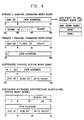
- Figure 4 shows a format-0 CCW used in System/370 architecture or for Diagnose X'58' instructions in both System/370 and System/370-XA architectures, and a format-1 CCW used in System/370-XA.
- the address portion of the format-0 CCW may point to data or an IDAL.
- Each four-byte entry, or Indirect Data Address Word (IDAW) in the IDAL will point to the data to be written or read.
- IDALs allow programs to address buffers in storage located above 16 megabytes for a Diagnose X'58' channel program in XA mode. There is a bit in the CCW that lets the control program know whether or not the CCW data address actually points to a data buffer or to an IDAL.
- Figure 4 also shows the formats of a System/370 Channel Status Word (CSW) and a System/370-XA Subchannel Status Word (SCSW) to give the contrast of the two architectures in dealing with the building blocks of I/O operations.
- CSW System/370 Channel Status Word
- SCSW System/370-XA Subchannel Status Word
- the Console Facility 6 performs its I/O operations synchronously; that is, the Console Facility 6 waits for completion of the I/O operation by issuing Test I/O (TIO) instructions in 370 mode, or Test Subchannel (TSCH) instructions in XA mode.
- TIO Test I/O
- TSCH Test Subchannel
- the checking of the Channel Status Word (CSW) in 370 mode (block 115), or the Subchannel Status Word (SCSW) in XA mode (block 105) and retrying I/O for some error conditions is the responsibility of the Console Facility 6.
- the Console Facility 6 attempts to find out more information about why the operation failed.
- the application program 10 issues a Wait request (block 120).
- an application program wants to wait for an interrupt on a device associated with its path, it issues a Wait request, or a Read with a Wait option request.
- the wait routine keeps track of the path which is waiting and then loads an enabled wait PSW (block 130).
- the interrupt comes in through the first-level interrupt handler, DMSITI, control will return to the Console Facility 6 wait routine after the load PSW instruction (LPSW). Then control will return to either the application program that issued a wait request, or to the Console Facility 6 routine that issues a read operation to handle the interrupt. If the application program issued an explicit wait request, then it must handle the interrupt by issuing a read request when control returns to it.
- DMSITI (block 140) must pass the interrupts back to the Console Facility module, DMSCCSVC, (block 160).
- the Console Facility 6 device entries are searched for a device address that matches the interrupting device address. If found and a path is waiting for that interrupt, the CSW/SCSW is moved to the path entry and control is returned to the Console Facility 6. If the device entry indicated the device was disconnected, then this is assumed to be a reconnect and an entry point is called to update the device information in the Console Facility 6 device entry (block 150). This helps keep the device information current.
- the read function allows the application program 10 to read the contents of the physical screen into the buffer that it provides. This can be either the entire screen or just the modified fields on the screen.
- the application program 10 may choose to use the Console Facility 6 read function with the wait option. The latter will tell the Console Facility 6 to first wait for the interrupt, then perform the read, thus saving the user an additional call to DMSCCSVC.
- Read CCWs are built in the same manner as for the write function by checking the options contained in the parameter list (block 20) and building channel programs for either Diagnose X'58' or System/370 I/O instructions (block 180). Like writing, DMSCCX will be called to handle the reading for System/370-XA (block 190). READ and WRITE share the same subroutines for performing the I/O and checking the Channel Status Word or Subchannel Status Word.
- Block 200 shows control returned to the application program 10 where that program must process the information just read into its buffer.
- Most application programs will need to determine what key on the terminal was pressed and if there are any modified fields on the screen that need to be displayed (i.e. the user typed something in and hit enter). Generally, the application program 10 will then go back and rewrite the screen, with any new information.
- the processing between blocks 60 and 200 will usually be in some type of loop, with a series of writes, waits, and reads.
- EXCP execute channel program
- Block 210 shows the application program 10 issuing a Query request.
- This query function returns information about a specific path and/or device in a buffer provided by the application program.
- a request to query a device will return just device information (block 220); the device need not have a path opened to it.
- a request to query a path will return path information as well as information about its associated device (block 230).
- a query request may be useful after an I/O error has occurred so an application program can further examine the CSW/SCSW or any sense data from the I/O operation.
- the information returned for a query request is taken from the existing path and/or device entries in storage, unless the device is one that the Console Facility 6 does not have any paths opened to. In that case, the device characteristics are obtained from Diagnose X'24' and X'8C' instructions and stored in the application program's buffer.
- Block 250 shows that this function releases the storage occupied by the path entry that is no longer needed.
- the device entry is also freed and a CP RESET command is issued if the device was dedicated. This will clear any pending interrupts from the device and will drop a dialed connection for dialed devices.
Landscapes
- Engineering & Computer Science (AREA)
- Software Systems (AREA)
- Theoretical Computer Science (AREA)
- Physics & Mathematics (AREA)
- General Engineering & Computer Science (AREA)
- General Physics & Mathematics (AREA)
- Digital Computer Display Output (AREA)
- Debugging And Monitoring (AREA)
Applications Claiming Priority (2)
| Application Number | Priority Date | Filing Date | Title |
|---|---|---|---|
| US07/101,537 US4855936A (en) | 1987-09-25 | 1987-09-25 | Full-screen input/output application program interface |
| US101537 | 1987-09-25 |
Publications (3)
| Publication Number | Publication Date |
|---|---|
| EP0308805A2 true EP0308805A2 (de) | 1989-03-29 |
| EP0308805A3 EP0308805A3 (en) | 1990-05-09 |
| EP0308805B1 EP0308805B1 (de) | 1994-11-30 |
Family
ID=22285162
Family Applications (1)
| Application Number | Title | Priority Date | Filing Date |
|---|---|---|---|
| EP88115068A Expired - Lifetime EP0308805B1 (de) | 1987-09-25 | 1988-09-15 | Anwenderprogramm-Schnittstelle für Vollbild-Eingabe/Ausgabe |
Country Status (4)
| Country | Link |
|---|---|
| US (1) | US4855936A (de) |
| EP (1) | EP0308805B1 (de) |
| JP (1) | JPH0195354A (de) |
| DE (1) | DE3852257T2 (de) |
Cited By (1)
| Publication number | Priority date | Publication date | Assignee | Title |
|---|---|---|---|---|
| EP2690551A1 (de) * | 2012-07-26 | 2014-01-29 | QNX Software Systems Limited | Hintergrunddienststartsystem für dynamische Dienstbereitstellung |
Families Citing this family (27)
| Publication number | Priority date | Publication date | Assignee | Title |
|---|---|---|---|---|
| JPH0814827B2 (ja) * | 1987-11-11 | 1996-02-14 | キヤノン株式会社 | 情報処理装置 |
| US5155809A (en) * | 1989-05-17 | 1992-10-13 | International Business Machines Corp. | Uncoupling a central processing unit from its associated hardware for interaction with data handling apparatus alien to the operating system controlling said unit and hardware |
| US5168554A (en) * | 1989-10-13 | 1992-12-01 | International Business Machines Corporation | Converting trace data from processors executing in parallel into graphical form |
| JPH0731586B2 (ja) * | 1991-07-23 | 1995-04-10 | インターナショナル・ビジネス・マシーンズ・コーポレイション | ディスプレイ・アダプタ・インターフェース装置及び方法 |
| US5237684A (en) * | 1991-08-12 | 1993-08-17 | International Business Machines Corporation | Customized and versatile event monitor within event management services of a computer system |
| US5355484A (en) * | 1991-08-12 | 1994-10-11 | International Business Machines Corporation | Dynamically established event monitors in event management services of a computer system |
| US5625821A (en) * | 1991-08-12 | 1997-04-29 | International Business Machines Corporation | Asynchronous or synchronous operation of event signaller by event management services in a computer system |
| US5305454A (en) * | 1991-08-12 | 1994-04-19 | International Business Machines Corporation | Notification of event handlers in broadcast or propagation mode by event management services in a computer system |
| US5673403A (en) * | 1992-11-13 | 1997-09-30 | International Business Machines Corporation | Method and system for displaying applications of different operating systems on a single system using the user interface of the different operating systems |
| EP0610677A3 (de) * | 1993-02-12 | 1995-08-02 | Ibm | In zwei Modi arbeitender Kommunikationsgerätetreiber. |
| US5461721A (en) * | 1993-04-14 | 1995-10-24 | International Business Machines Corporation | System for transferring data between I/O devices and main or expanded storage under dynamic control of independent indirect address words (IDAWs) |
| JP3197403B2 (ja) * | 1993-09-07 | 2001-08-13 | 富士通株式会社 | 計算機システムのアプリケーションプログラム障害発生時の制御方法 |
| US5621912A (en) * | 1994-12-29 | 1997-04-15 | International Business Machines Corporation | Method and apparatus for enabling monitoring of guests and native operating systems |
| US5652914A (en) * | 1995-06-12 | 1997-07-29 | International Business Machines Corporation | Method and system for superimposing, creating and altering I/O applications and controls within an I/O subsystem by using an I/O subchannel intercept field |
| US6289396B1 (en) | 1995-11-21 | 2001-09-11 | Diamond Multimedia Systems, Inc. | Dynamic programmable mode switching device driver architecture |
| US5752032A (en) * | 1995-11-21 | 1998-05-12 | Diamond Multimedia Systems, Inc. | Adaptive device driver using controller hardware sub-element identifier |
| US6009476A (en) * | 1995-11-21 | 1999-12-28 | Diamond Multimedia Systems, Inc. | Device driver architecture supporting emulation environment |
| US6393495B1 (en) * | 1995-11-21 | 2002-05-21 | Diamond Multimedia Systems, Inc. | Modular virtualizing device driver architecture |
| US5867153A (en) * | 1996-10-30 | 1999-02-02 | Transaction Technology, Inc. | Method and system for automatically harmonizing access to a software application program via different access devices |
| US7249344B1 (en) | 1996-10-31 | 2007-07-24 | Citicorp Development Center, Inc. | Delivery of financial services to remote devices |
| US6049832A (en) * | 1996-11-15 | 2000-04-11 | Wall Data Incorporated | Method for accessing information on a host computer from a client computer through an intelligent virtual host component |
| US6078747A (en) * | 1998-01-05 | 2000-06-20 | Jewitt; James W. | Application program interface to physical devices |
| JP2002145080A (ja) * | 2000-11-10 | 2002-05-22 | Nsk Ltd | 電動パワーステアリング装置 |
| US6957423B1 (en) * | 2001-05-15 | 2005-10-18 | Xilinx, Inc. | Method of inlining a VHDL function call into Verilog |
| US8817029B2 (en) * | 2005-10-26 | 2014-08-26 | Via Technologies, Inc. | GPU pipeline synchronization and control system and method |
| CN101499013B (zh) * | 2009-03-11 | 2011-11-16 | 浙江中控软件技术有限公司 | 一种调用动态库的方法和调用装置 |
| US8368707B2 (en) * | 2009-05-18 | 2013-02-05 | Apple Inc. | Memory management based on automatic full-screen detection |
Family Cites Families (4)
| Publication number | Priority date | Publication date | Assignee | Title |
|---|---|---|---|---|
| JPS57137957A (en) * | 1981-02-20 | 1982-08-25 | Hitachi Ltd | Terminal connection system |
| JPS5917628A (ja) * | 1982-07-20 | 1984-01-28 | Hitachi Ltd | 端末操作代行制御方法 |
| US4509122A (en) * | 1982-11-18 | 1985-04-02 | International Business Machines Corporation | Method for controlling the file transfer capability of an interactive text processing system that is emulating a host processing system terminal |
| JPS59171276A (ja) * | 1983-03-17 | 1984-09-27 | Canon Inc | 画像処理装置 |
-
1987
- 1987-09-25 US US07/101,537 patent/US4855936A/en not_active Expired - Fee Related
-
1988
- 1988-08-29 JP JP63212665A patent/JPH0195354A/ja active Pending
- 1988-09-15 EP EP88115068A patent/EP0308805B1/de not_active Expired - Lifetime
- 1988-09-15 DE DE3852257T patent/DE3852257T2/de not_active Expired - Fee Related
Non-Patent Citations (2)
| Title |
|---|
| COMPUTER DESIGN, vol. 25, no. 21, 15th November 1986, pages 84-89; J.F. PETERSEN et al.: "Unix environment offers flexible I/O design" * |
| VIRTUAL MACHINE/SYSTEM PRODUCT, IBM, CMS CONSOLE FACILITY, Release 4, SC 24-5333-0, 1st Edition, July 1986 * |
Cited By (1)
| Publication number | Priority date | Publication date | Assignee | Title |
|---|---|---|---|---|
| EP2690551A1 (de) * | 2012-07-26 | 2014-01-29 | QNX Software Systems Limited | Hintergrunddienststartsystem für dynamische Dienstbereitstellung |
Also Published As
| Publication number | Publication date |
|---|---|
| EP0308805B1 (de) | 1994-11-30 |
| US4855936A (en) | 1989-08-08 |
| DE3852257D1 (de) | 1995-01-12 |
| DE3852257T2 (de) | 1995-05-24 |
| EP0308805A3 (en) | 1990-05-09 |
| JPH0195354A (ja) | 1989-04-13 |
Similar Documents
| Publication | Publication Date | Title |
|---|---|---|
| US4855936A (en) | Full-screen input/output application program interface | |
| US6028585A (en) | Screen display control method and a screen display control apparatus | |
| US5784549A (en) | Reduced or fail-safe bootstrapping of a system having a graphical user interface | |
| EP0519695B1 (de) | Verfahren und Gerät, die es Rechnerschaltkreisen ermöglichen, mit aktualisierten Versionen von Rechnersoftware zu funktionieren | |
| US5648795A (en) | Method of resetting a computer video display mode | |
| US7552244B2 (en) | Universal graphic adapter for interfacing with UGA hardware for support of a plurality of emumerated devices | |
| EP0168034B1 (de) | Emulationseinrichtung in einem Datenverarbeitungssystem | |
| US5586324A (en) | Computer system having system feature extension software containing a self-describing feature table for accessing I/O devices according to machine independent format | |
| US5315711A (en) | Method and apparatus for remotely and centrally controlling a plurality of host processors | |
| US4859995A (en) | Mouse pointer with switchable emulation mode | |
| CA2039027C (en) | Method and apparatus for assisting in the presentation and removal of windows | |
| US5247614A (en) | Method and apparatus for distributed processing of display panel information | |
| EP1986086A1 (de) | Steuereinrichtung, steuerprogramm und steuerverfahren zur steuerung der anzeige einer anzeigeeinrichtung zum anzeigen überlagerter fenster | |
| EP1220099A2 (de) | Fehlerbeseitigungsystem, Verfahren zur Erweiterung von Fehlerbeseitigung in einem Fehlerbeseitigungssystem und Fehlerbeseitigungsprogrammprodukt | |
| US5623664A (en) | Interactive memory organization system and method therefor | |
| US5613119A (en) | Data processor initialization program and method therefor | |
| CA1278386C (en) | Method and apparatus for controlling the execution of host computer application programs through a second computer | |
| US5504920A (en) | Video driver system for communicating device specific primitive commands to multiple video controller types | |
| JP3033713B2 (ja) | 仮想計算機エミュレート装置 | |
| US5812846A (en) | Method and apparatus for passing control from a first process to a second process | |
| US5680646A (en) | Input/output control system | |
| JPH02146630A (ja) | マイクロプロセッサのプログラム開発システム | |
| JPH03268033A (ja) | リモートデバッグ方式 | |
| JPH06161783A (ja) | マルチosシステムにおける表示制御方法 |
Legal Events
| Date | Code | Title | Description |
|---|---|---|---|
| PUAI | Public reference made under article 153(3) epc to a published international application that has entered the european phase |
Free format text: ORIGINAL CODE: 0009012 |
|
| AK | Designated contracting states |
Kind code of ref document: A2 Designated state(s): DE FR GB |
|
| 17P | Request for examination filed |
Effective date: 19890720 |
|
| PUAL | Search report despatched |
Free format text: ORIGINAL CODE: 0009013 |
|
| AK | Designated contracting states |
Kind code of ref document: A3 Designated state(s): DE FR GB |
|
| 17Q | First examination report despatched |
Effective date: 19930604 |
|
| GRAA | (expected) grant |
Free format text: ORIGINAL CODE: 0009210 |
|
| AK | Designated contracting states |
Kind code of ref document: B1 Designated state(s): DE FR GB |
|
| REF | Corresponds to: |
Ref document number: 3852257 Country of ref document: DE Date of ref document: 19950112 |
|
| ET | Fr: translation filed | ||
| PGFP | Annual fee paid to national office [announced via postgrant information from national office to epo] |
Ref country code: GB Payment date: 19950822 Year of fee payment: 8 |
|
| PGFP | Annual fee paid to national office [announced via postgrant information from national office to epo] |
Ref country code: FR Payment date: 19950911 Year of fee payment: 8 |
|
| PGFP | Annual fee paid to national office [announced via postgrant information from national office to epo] |
Ref country code: DE Payment date: 19950921 Year of fee payment: 8 |
|
| PLBE | No opposition filed within time limit |
Free format text: ORIGINAL CODE: 0009261 |
|
| STAA | Information on the status of an ep patent application or granted ep patent |
Free format text: STATUS: NO OPPOSITION FILED WITHIN TIME LIMIT |
|
| 26N | No opposition filed | ||
| PG25 | Lapsed in a contracting state [announced via postgrant information from national office to epo] |
Ref country code: GB Effective date: 19960915 |
|
| PG25 | Lapsed in a contracting state [announced via postgrant information from national office to epo] |
Ref country code: FR Effective date: 19960930 |
|
| GBPC | Gb: european patent ceased through non-payment of renewal fee |
Effective date: 19960915 |
|
| PG25 | Lapsed in a contracting state [announced via postgrant information from national office to epo] |
Ref country code: DE Effective date: 19970603 |
|
| REG | Reference to a national code |
Ref country code: FR Ref legal event code: ST |
|
| REG | Reference to a national code |
Ref country code: FR Ref legal event code: ST |