EP0309178A2 - Craquage d'huiles rédisuelles et donation d'hydrogène accélérés avec des catalyseurs sulfures d'ammonium - Google Patents
Craquage d'huiles rédisuelles et donation d'hydrogène accélérés avec des catalyseurs sulfures d'ammonium Download PDFInfo
- Publication number
- EP0309178A2 EP0309178A2 EP88308662A EP88308662A EP0309178A2 EP 0309178 A2 EP0309178 A2 EP 0309178A2 EP 88308662 A EP88308662 A EP 88308662A EP 88308662 A EP88308662 A EP 88308662A EP 0309178 A2 EP0309178 A2 EP 0309178A2
- Authority
- EP
- European Patent Office
- Prior art keywords
- ammonium sulfide
- hydrogen donor
- resid
- tetralin
- hydrogen
- Prior art date
- Legal status (The legal status is an assumption and is not a legal conclusion. Google has not performed a legal analysis and makes no representation as to the accuracy of the status listed.)
- Withdrawn
Links
Images
Classifications
-
- C—CHEMISTRY; METALLURGY
- C10—PETROLEUM, GAS OR COKE INDUSTRIES; TECHNICAL GASES CONTAINING CARBON MONOXIDE; FUELS; LUBRICANTS; PEAT
- C10G—CRACKING HYDROCARBON OILS; PRODUCTION OF LIQUID HYDROCARBON MIXTURES, e.g. BY DESTRUCTIVE HYDROGENATION, OLIGOMERISATION, POLYMERISATION; RECOVERY OF HYDROCARBON OILS FROM OIL-SHALE, OIL-SAND, OR GASES; REFINING MIXTURES MAINLY CONSISTING OF HYDROCARBONS; REFORMING OF NAPHTHA; MINERAL WAXES
- C10G47/00—Cracking of hydrocarbon oils, in the presence of hydrogen or hydrogen- generating compounds, to obtain lower boiling fractions
- C10G47/32—Cracking of hydrocarbon oils, in the presence of hydrogen or hydrogen- generating compounds, to obtain lower boiling fractions in the presence of hydrogen-generating compounds
- C10G47/34—Organic compounds, e.g. hydrogenated hydrocarbons
-
- C—CHEMISTRY; METALLURGY
- C10—PETROLEUM, GAS OR COKE INDUSTRIES; TECHNICAL GASES CONTAINING CARBON MONOXIDE; FUELS; LUBRICANTS; PEAT
- C10G—CRACKING HYDROCARBON OILS; PRODUCTION OF LIQUID HYDROCARBON MIXTURES, e.g. BY DESTRUCTIVE HYDROGENATION, OLIGOMERISATION, POLYMERISATION; RECOVERY OF HYDROCARBON OILS FROM OIL-SHALE, OIL-SAND, OR GASES; REFINING MIXTURES MAINLY CONSISTING OF HYDROCARBONS; REFORMING OF NAPHTHA; MINERAL WAXES
- C10G51/00—Treatment of hydrocarbon oils, in the absence of hydrogen, by two or more cracking processes only
- C10G51/02—Treatment of hydrocarbon oils, in the absence of hydrogen, by two or more cracking processes only plural serial stages only
- C10G51/023—Treatment of hydrocarbon oils, in the absence of hydrogen, by two or more cracking processes only plural serial stages only only thermal cracking steps
Definitions
- This invention is concerned with the hydrogen donor diluent cracking of residual crude oils, particularly vacuum reduced crudes.
- the addition of hydrogen donor to a residual oil prior to a coking or visbreaking operation is known to decrease markedly the amount of coke made and to improve the quality of the overhead product by increasing the yield of distillate.
- Typical hydrogen donors are tetralin from the hydrogenation of naphthalene, alkyl substituted tetralin, hydrogenated anthracenes, phenanthrenes, pyrenes, and the hydrogenated derivatives of other condensed ring aromatics. In such processes the hydrogen donor functions to supply hydrogen to thermally cracked hydrocarbon fragments thereby reducing coke formation and providing a superior cracked product.
- the actual hydrogen donation can be carried out on the resid in a heat-soak drum before the coking or visbreaking operation or it can take place during the coke or visbreaking operation.
- One problem with hydrogen donation in using a heat soak drum is the length of time it takes for the hydrogen to be transferred to the resid.
- This invention provides a method of accelerating the transfer of hydrogen from the donor to the resid during the heat soaking operation prior to a visbreaking or coking operation.
- this invention comprises adding to the hydrogen donor or to the resid feedstock to be subjected, in the presence of a hydrogen donor, to a cracking, visbreaking, or coking operation an aqueous solution of ammonium sulfide (NH4)2S.
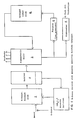
- a selected hydrogen donor such as tetralin, alkyl substituted tetralin, hydrogenated anthracenes, phenanthrenes, pyrenes, or the hydrogenated derivatives of other condensed ring aromatics is mixed with the petroleum resid, such as a vacuum resid, to be subjected to coking or visbreaking and is carried into a presoak drum 1.
- the resid and hydrogen donor can be introduced into the heat-soaking drum in separate streams.
- the concentration of ammonium sulfide in the aqueous solution preferably is between 1 and 30 weight percent.
- the weight ratio of ammonium sulfide solution to hydrogen donor should be between 0.1:1 and 10:1.
- the weight ratio of hydrogen donor material to the incoming resid can be determined by those skilled in the art, but ordinarily will be between 0.1:1 and 5:1.
- Residence time of the resid plus H-donor and ammonium sulfide solution in the presoak drum will depend on temperature and can range from 0.01 hours to 1000 hours at temperatures ranging between 316°C (600°F) and 482°C (900°F) and a pressure of 206 to 13900 kPa (15 to 2000 psig).
- residence time will range from 5-300 hours; at 400°C (750°F) the range will be from 20 minutes to 15 hours while at 427°C (800°F) the soak time will be from 5 minutes to 3 hours. At higher temperatures shorter residence times will be used.
- the mixture of resid, hydrogen donor and aqueous ammonium sulfide solution is then flowed into a settling tank 2 where the water phase settles to the bottom, is removed, and is recycled to the operation.
- the supernatant petroleum residue phase is carried to a still 3 where overhead products are taken off at a temperature of 150° to 316°C (300 to 600°F).
- the liquid bottom product from the still is then carried to either a visbreaking operation 4 or through a low pressure 207 to 2860 kPa (15 to 400 psig) furnace 5 and to a delayed coker operation drum where it is converted to coke and an overhead product which is removed and returned to the atmospheric still.
- Aqueous ammonium sulfide solutions can be synthesized from hydrogen sulfide and ammonia refinery off-gases. This synthesized ammonium sulfide is readily soluble in water and can easily be stored in aqueous solution in tanks prior to use. Since ammonium sulfide solution is more dense than resid, it can be separated easily in a settler tank after reaction.
- Run No. 3 was conducted under conditions similar to those of Run No. 1 using only resid and tetralin in an autoclave. In this run, however, the reactants were heat-soaked for 65 hours in a hydrogen sulfide atmosphere, and 21.35% conversion of tetralin and 9.47% conversion of the 566°C+ (1050°F+) fraction occurred. These results reported in Table 3 show less conversion achieved than that at 16 hours in Run No. 2 with the added aqueous ammonium sulfide. Run No. 3 also illustrates that hydrogen sulfide does not effect great improvements in the conversion of tetralin or 566°C+ (1050°F+) fraction under these mild conditions. This demonstrates that the ammonium sulfide and not the hydrogen sulfide from the decomposed ammonium sulfide acts as a catalyst.
- Run No. 4 was conducted in much the same manner as Run Nos 1 and 3 except the heat-soak time was extended to 96 hours. This extended period of heat-soaking was required to attain a 22% conversion of the 566°C+ (1050°F+) fraction, the equivalent of the conversion achieved with the shorter heat-soak period of Example 2 in which aqueous ammonium sulfide was used. Thus a factor of six times more soak-time at 343°C (650°F) is needed to achieve about the same level of conversion as that attained when the aqueous ammonium sulfide is present.
- aqueous ammonium sulfide solution to the hydrogen donor, such as tetralin
- the resid subjected to a heat-soaking step prior to coking, cracking, or visbreaking catalyzes the hydrogen donation of the donor and the conversion of the heavier material.
- the same level of hydrogen donor and heavy resid can be achieved in one-sixth of the time required by the incorporation of aqueous ammonium sulfide solution. Accelerating the reaction rates means more throughput and/or requires lower capacity equipment for hydrogen donation and conversion during heat-soaking. Reduced coke production and less sediment in fuel oil production is also benefit.
Landscapes
- Chemical & Material Sciences (AREA)
- Oil, Petroleum & Natural Gas (AREA)
- Engineering & Computer Science (AREA)
- Chemical Kinetics & Catalysis (AREA)
- General Chemical & Material Sciences (AREA)
- Organic Chemistry (AREA)
- Physics & Mathematics (AREA)
- Thermal Sciences (AREA)
- Production Of Liquid Hydrocarbon Mixture For Refining Petroleum (AREA)
- Catalysts (AREA)
- Coke Industry (AREA)
- Organic Low-Molecular-Weight Compounds And Preparation Thereof (AREA)
Applications Claiming Priority (2)
| Application Number | Priority Date | Filing Date | Title |
|---|---|---|---|
| US100868 | 1987-09-25 | ||
| US07/100,868 US4814065A (en) | 1987-09-25 | 1987-09-25 | Accelerated cracking of residual oils and hydrogen donation utilizing ammonium sulfide catalysts |
Publications (2)
| Publication Number | Publication Date |
|---|---|
| EP0309178A2 true EP0309178A2 (fr) | 1989-03-29 |
| EP0309178A3 EP0309178A3 (fr) | 1989-10-11 |
Family
ID=22281947
Family Applications (1)
| Application Number | Title | Priority Date | Filing Date |
|---|---|---|---|
| EP88308662A Withdrawn EP0309178A3 (fr) | 1987-09-25 | 1988-09-19 | Craquage d'huiles rédisuelles et donation d'hydrogène accélérés avec des catalyseurs sulfures d'ammonium |
Country Status (6)
| Country | Link |
|---|---|
| US (1) | US4814065A (fr) |
| EP (1) | EP0309178A3 (fr) |
| JP (1) | JPH01108296A (fr) |
| AU (1) | AU615213B2 (fr) |
| CA (1) | CA1297827C (fr) |
| ZA (1) | ZA887159B (fr) |
Families Citing this family (5)
| Publication number | Priority date | Publication date | Assignee | Title |
|---|---|---|---|---|
| JP2003049174A (ja) * | 2001-08-08 | 2003-02-21 | Idemitsu Kosan Co Ltd | 重質油の分解処理方法 |
| US7067053B2 (en) * | 2002-08-16 | 2006-06-27 | Intevep, S.A. | Additives for improving thermal conversion of heavy crude oil |
| US8197668B2 (en) * | 2009-07-09 | 2012-06-12 | Exxonmobil Chemical Patents Inc. | Process and apparatus for upgrading steam cracker tar using hydrogen donor compounds |
| US9039889B2 (en) | 2010-09-14 | 2015-05-26 | Saudi Arabian Oil Company | Upgrading of hydrocarbons by hydrothermal process |
| CA2912768C (fr) | 2014-11-24 | 2018-11-20 | Rodger Francesco Bernar | Systeme d'actualisation partielle et procede destine aux hydrocarbures lourds |
Family Cites Families (15)
| Publication number | Priority date | Publication date | Assignee | Title |
|---|---|---|---|---|
| US3803259A (en) * | 1972-08-03 | 1974-04-09 | Continental Oil Co | H2s modified cracking of naphtha |
| US4216078A (en) * | 1976-05-17 | 1980-08-05 | Exxon Research & Engineering Co. | Hydrogenation of petroleum liquids using quinone catalysts |
| US4233138A (en) * | 1979-01-22 | 1980-11-11 | Mobil Oil Corporation | Process for the visbreaking of high-metals crudes and resids |
| US4298455A (en) * | 1979-12-31 | 1981-11-03 | Texaco Inc. | Viscosity reduction process |
| US4454024A (en) * | 1982-11-01 | 1984-06-12 | Exxon Research And Engineering Co. | Hydroconversion process |
| US4448665A (en) * | 1982-12-30 | 1984-05-15 | Exxon Research And Engineering Co. | Use of ammonia to reduce the viscosity of bottoms streams produced in hydroconversion processes |
| US4465584A (en) * | 1983-03-14 | 1984-08-14 | Exxon Research & Engineering Co. | Use of hydrogen sulfide to reduce the viscosity of bottoms streams produced in hydroconversion processes |
| ZA845721B (en) * | 1983-08-01 | 1986-03-26 | Mobil Oil Corp | Process for visbreaking resids in the presence of hydrogen-donor materials |
| AU580617B2 (en) * | 1984-09-10 | 1989-01-19 | Mobil Oil Corporation | Process for visbreaking resids in the presence of hydrogen- donor materials and organic sulfur compounds |
| US4587007A (en) * | 1984-09-10 | 1986-05-06 | Mobil Oil Corporation | Process for visbreaking resids in the presence of hydrogen-donor materials and organic sulfur compounds |
| EP0175571A1 (fr) * | 1984-09-21 | 1986-03-26 | Oberview Pty. Ltd. | Production d'impressions |
| US4661241A (en) * | 1985-04-01 | 1987-04-28 | Mobil Oil Corporation | Delayed coking process |
| US4560467A (en) * | 1985-04-12 | 1985-12-24 | Phillips Petroleum Company | Visbreaking of oils |
| US4659453A (en) * | 1986-02-05 | 1987-04-21 | Phillips Petroleum Company | Hydrovisbreaking of oils |
| FR2607145B1 (fr) * | 1986-11-25 | 1990-06-08 | Inst Francais Du Petrole | Procede ameliore de conversion thermique de fractions lourdes de petrole et de residus de raffinage, en presence de composes oxygenes du soufre, de l'azote ou du phosphore |
-
1987
- 1987-09-25 US US07/100,868 patent/US4814065A/en not_active Expired - Fee Related
-
1988
- 1988-09-19 EP EP88308662A patent/EP0309178A3/fr not_active Withdrawn
- 1988-09-21 AU AU22494/88A patent/AU615213B2/en not_active Ceased
- 1988-09-23 CA CA000578224A patent/CA1297827C/fr not_active Expired - Lifetime
- 1988-09-23 ZA ZA887159A patent/ZA887159B/xx unknown
- 1988-09-26 JP JP63240611A patent/JPH01108296A/ja active Pending
Also Published As
| Publication number | Publication date |
|---|---|
| JPH01108296A (ja) | 1989-04-25 |
| US4814065A (en) | 1989-03-21 |
| AU2249488A (en) | 1989-04-06 |
| CA1297827C (fr) | 1992-03-24 |
| EP0309178A3 (fr) | 1989-10-11 |
| AU615213B2 (en) | 1991-09-26 |
| ZA887159B (en) | 1990-05-30 |
Similar Documents
| Publication | Publication Date | Title |
|---|---|---|
| EP0593462B1 (fr) | Procede d'amelioration de goudrons de vapocraqueur | |
| US4659454A (en) | Hydrocracking of heavy feeds plus light fractions with dispersed dual function catalyst | |
| US4443325A (en) | Conversion of residua to premium products via thermal treatment and coking | |
| US4615791A (en) | Visbreaking process | |
| US4200520A (en) | Catalytic cracking process | |
| US4659453A (en) | Hydrovisbreaking of oils | |
| US4435272A (en) | Process for upgrading crude oil and residual fractions thereof by vaporizing the charge in a falling curtain of contact particles | |
| KR0148566B1 (ko) | 중 탄화수소성 공급 원료의 전환 방법 | |
| US4324935A (en) | Special conditions for the hydrogenation of heavy hydrocarbons | |
| US5413702A (en) | High severity visbreaking of residual oil | |
| EP0250136B1 (fr) | Procédé de cokéfaction retardée | |
| EP0309178A2 (fr) | Craquage d'huiles rédisuelles et donation d'hydrogène accélérés avec des catalyseurs sulfures d'ammonium | |
| US1955829A (en) | Conversion of carbonaceous materials into useful hydrocarbon products | |
| US4487686A (en) | Process of thermally cracking heavy hydrocarbon oils | |
| SU850011A3 (ru) | Способ получени олефинов | |
| US4446004A (en) | Process for upgrading vacuum resids to premium liquid products | |
| US4663018A (en) | Method for coke retardant during hydrocarbon processing | |
| US4522703A (en) | Thermal treatment of heavy hydrocarbon oil | |
| US4560467A (en) | Visbreaking of oils | |
| US4040943A (en) | Combination thermal cracking and coking process | |
| CN103102983B (zh) | 一种页岩油延迟焦化—加氢精制工艺方法 | |
| AU573440B2 (en) | Hydrocarbons pyrolysis | |
| EP0204410A2 (fr) | Méthode pour fournir de la chaleur à des courants processionnels à haute température | |
| RU2009166C1 (ru) | Способ получения топливных дистиллятов | |
| US4620920A (en) | Catalytic cracking of hydrocarbon oils from two mixtures boiling above the gasoline range |
Legal Events
| Date | Code | Title | Description |
|---|---|---|---|
| PUAI | Public reference made under article 153(3) epc to a published international application that has entered the european phase |
Free format text: ORIGINAL CODE: 0009012 |
|
| AK | Designated contracting states |
Kind code of ref document: A2 Designated state(s): BE DE FR GB IT NL |
|
| PUAL | Search report despatched |
Free format text: ORIGINAL CODE: 0009013 |
|
| AK | Designated contracting states |
Kind code of ref document: A3 Designated state(s): BE DE FR GB IT NL |
|
| 17P | Request for examination filed |
Effective date: 19900307 |
|
| 17Q | First examination report despatched |
Effective date: 19900925 |
|
| STAA | Information on the status of an ep patent application or granted ep patent |
Free format text: STATUS: THE APPLICATION HAS BEEN WITHDRAWN |
|
| 18W | Application withdrawn |
Withdrawal date: 19920817 |