EP0309400B1 - N-acyloxyamines stabilisantes à empêchement stérique - Google Patents
N-acyloxyamines stabilisantes à empêchement stérique Download PDFInfo
- Publication number
- EP0309400B1 EP0309400B1 EP88810621A EP88810621A EP0309400B1 EP 0309400 B1 EP0309400 B1 EP 0309400B1 EP 88810621 A EP88810621 A EP 88810621A EP 88810621 A EP88810621 A EP 88810621A EP 0309400 B1 EP0309400 B1 EP 0309400B1
- Authority
- EP
- European Patent Office
- Prior art keywords
- alkyl
- group
- hydrogen
- acid
- phenyl
- Prior art date
- Legal status (The legal status is an assumption and is not a legal conclusion. Google has not performed a legal analysis and makes no representation as to the accuracy of the status listed.)
- Expired - Lifetime
Links
- 0 C1C2C1CCC*2 Chemical compound C1C2C1CCC*2 0.000 description 9
- KYJMPHWVYLRLGA-UHFFFAOYSA-N CCC(C)CN(C)C=O Chemical compound CCC(C)CN(C)C=O KYJMPHWVYLRLGA-UHFFFAOYSA-N 0.000 description 1
- RAPPADDLZKQDPE-UHFFFAOYSA-N CO[N](C=O)([N+]([O-])=O)OC Chemical compound CO[N](C=O)([N+]([O-])=O)OC RAPPADDLZKQDPE-UHFFFAOYSA-N 0.000 description 1
- VGDUJYMSDCDCED-UHFFFAOYSA-N C[N]([N+]([O-])=O)(OC)OC Chemical compound C[N]([N+]([O-])=O)(OC)OC VGDUJYMSDCDCED-UHFFFAOYSA-N 0.000 description 1
Classifications
-
- C—CHEMISTRY; METALLURGY
- C08—ORGANIC MACROMOLECULAR COMPOUNDS; THEIR PREPARATION OR CHEMICAL WORKING-UP; COMPOSITIONS BASED THEREON
- C08K—Use of inorganic or non-macromolecular organic substances as compounding ingredients
- C08K5/00—Use of organic ingredients
- C08K5/16—Nitrogen-containing compounds
- C08K5/17—Amines; Quaternary ammonium compounds
-
- C—CHEMISTRY; METALLURGY
- C07—ORGANIC CHEMISTRY
- C07D—HETEROCYCLIC COMPOUNDS
- C07D211/00—Heterocyclic compounds containing hydrogenated pyridine rings, not condensed with other rings
- C07D211/04—Heterocyclic compounds containing hydrogenated pyridine rings, not condensed with other rings with only hydrogen or carbon atoms directly attached to the ring nitrogen atom
- C07D211/06—Heterocyclic compounds containing hydrogenated pyridine rings, not condensed with other rings with only hydrogen or carbon atoms directly attached to the ring nitrogen atom having no double bonds between ring members or between ring members and non-ring members
- C07D211/36—Heterocyclic compounds containing hydrogenated pyridine rings, not condensed with other rings with only hydrogen or carbon atoms directly attached to the ring nitrogen atom having no double bonds between ring members or between ring members and non-ring members with hetero atoms or with carbon atoms having three bonds to hetero atoms with at the most one bond to halogen, e.g. ester or nitrile radicals, directly attached to ring carbon atoms
-
- C—CHEMISTRY; METALLURGY
- C08—ORGANIC MACROMOLECULAR COMPOUNDS; THEIR PREPARATION OR CHEMICAL WORKING-UP; COMPOSITIONS BASED THEREON
- C08K—Use of inorganic or non-macromolecular organic substances as compounding ingredients
- C08K5/00—Use of organic ingredients
- C08K5/16—Nitrogen-containing compounds
- C08K5/34—Heterocyclic compounds having nitrogen in the ring
- C08K5/3412—Heterocyclic compounds having nitrogen in the ring having one nitrogen atom in the ring
- C08K5/3432—Six-membered rings
- C08K5/3435—Piperidines
-
- C—CHEMISTRY; METALLURGY
- C08—ORGANIC MACROMOLECULAR COMPOUNDS; THEIR PREPARATION OR CHEMICAL WORKING-UP; COMPOSITIONS BASED THEREON
- C08K—Use of inorganic or non-macromolecular organic substances as compounding ingredients
- C08K5/00—Use of organic ingredients
- C08K5/16—Nitrogen-containing compounds
- C08K5/34—Heterocyclic compounds having nitrogen in the ring
- C08K5/3467—Heterocyclic compounds having nitrogen in the ring having more than two nitrogen atoms in the ring
- C08K5/3477—Six-membered rings
- C08K5/3492—Triazines
- C08K5/34926—Triazines also containing heterocyclic groups other than triazine groups
-
- C—CHEMISTRY; METALLURGY
- C09—DYES; PAINTS; POLISHES; NATURAL RESINS; ADHESIVES; COMPOSITIONS NOT OTHERWISE PROVIDED FOR; APPLICATIONS OF MATERIALS NOT OTHERWISE PROVIDED FOR
- C09D—COATING COMPOSITIONS, e.g. PAINTS, VARNISHES OR LACQUERS; FILLING PASTES; CHEMICAL PAINT OR INK REMOVERS; INKS; CORRECTING FLUIDS; WOODSTAINS; PASTES OR SOLIDS FOR COLOURING OR PRINTING; USE OF MATERIALS THEREFOR
- C09D7/00—Features of coating compositions, not provided for in group C09D5/00; Processes for incorporating ingredients in coating compositions
- C09D7/40—Additives
- C09D7/48—Stabilisers against degradation by oxygen, light or heat
Definitions
- the instant invention relates to the stabilization of a wide variety of ambient temperature curable and of acid catalyzed thermosetting coating compositions by the incorporation therein of N-acyloxy-substituted hindered amine light stabilizers as well as to new N-acyloxy hindered amines.
- Hindered amine light stabilizers are well known to be effective in stabilizing a host of organic substrates including polymers against the deleterious effects of oxygen and light. Such hindered amine light stabilizers have been used in the stabilization of hot-crosslinkable alkyd or acrylic metallic stoving lacquers (US 4,426,472) and in stabilizing acid-catalyzed stoving lacquers based on hot-crosslinkable acrylic polyester or alkyd resins (US 4,344,876 and 4,426,471). The hindered amine light stabilizers of these patents do not possess structures having an acyloxy group substituted directly on the hindered N-atom of the compound.
- EP-A-I3O,945 describes some N-acyloxy substituted hindered amines as light stabilizers for a variety of organic materials including stoving lacquers.
- the present invention relates to a stabilized ambient temperature curable or acid catalyzed thermosetting coating composition containing an effective stabilizing amount of a hindered amine compound containing the group wherein R is hydrogen or methyl and R1 is a group wherein D is C1-C18 alkyl, C1-C18 alkoxy, phenyl, phenyl substituted by hydroxy, alkyl or alkoxy, or D is amino or amino mono- or disubstituted by alkyl or phenyl.
- the instant invention relates to the use of a compound having one of formulae A to N wherein R is hydrogen or methyl, R1 is a group D-CO- , wherein D is C1-C18 alkyl, C1-C18 alkoxy, phenyl, phenyl substituted by hydroxy, C1-C4 alkyl or C1-C4 alkoxy, or amino or amino mono- or disubstituted by C1-C12 alkyl or phenyl; m is 1-4, when m is 1, R2 is hydrogen, C1-C18 alkyl optionally interrupted by one or more oxygen atoms, C2-C12 alkenyl, C6-C10 aryl, C7-C18 aralkyl, glycidyl, a monovalent acyl radical of an aliphatic, cycloaliphatic, araliphatic or aromatic carboxylic acid, or of a carbamic acid, preferably an acyl radical of an aliphatic
- any substituents are C1-C18 alkyl, they are for example methyl, ethyl, n-propyl, n-butyl, sec-butyl, tert-butyl, n-hexyl, n-octyl, 2-ethylhexyl, n-nonyl, n-decyl, n-undecyl, n-dodecyl, n-tridecyl, n-tetradecyl, n-hexadecyl or n-octadecyl.
- R2 is a monovalent acyl radical of a carboxylic acid, it is for example an acyl radical of acetic acid, stearic acid, salicylic acid, methacrylic acid, benzoic acid or ⁇ -(3,5-di-tert-butyl-4-hydroxyphenyl)-propionic acid.
- R2 is a divalent acyl radical of a dicarboxylic acid, it is for example an acyl radical of adipic acid, succinic acid, suberic acid sebacic acid, phthalic acid, maleic acid, dibutylmalonic acid, dibenzylmalonic acid or butyl-(3,5-di-tert-butyl-4-hydroxybenzyl)-malonic acid, or bicycloheptenedicarboxylic acid.
- R2 is a divalent acyl radical of a dicarbamic acid, it is for example an acyl radical of hexamethylenedicarbamic acid or of 2,4-toluylenedicarbamic acid.
- R3 is particularly phenetyl or above all benzyl.
- R3 is for example propionyl, butyryl, octanoyl, dodecanoyl, hexadecanoyl, octadecanoyl, but preferably acetyl; and a C3-C5 alkenoyl, R3 is in particular acryloyl.
- R4 is C2-C8 alkenyl unsubstituted or substituted by a cyano, carbonyl or carbamide group, it is for example 1-propenyl, allyl, methallyl, 2-butenyl, 2-pentenyl, 2-hexenyl, 2-octenyl, 2,2-dicyanovinyl, 1-methyl-2-cyano-2-methoxycarbonyl-vinyl or 2,2-diacetylaminovinyl.
- substituents are C2-C12 alkylene, they are for example ethylene, propylene, 2,2-dimethylpropylene, tetramethylene, hexamethylene, octamethylene, decamethylene or dodecamethylene.
- substituents are C6-C15 arylene, they are for example o-, m- or p-phenylene, 1,4-naphthylene or 4,4′-diphenylene.
- X is especially cyclohexylene.
- R5 is C2-C8 alkylene or hydroxyalkylene, it is for example ethylene, 1-methyl-ethylene, propylene, 2-ethylpropylene or 2-ethyl-2-hydroxymethylpropylene.
- R5 is for example 2-ethyl-2-acetoxymethylpropylene.
- substituents are C2-C6 alkoxyalkyl, they are for example methoxymethyl, ethoxymethyl, propoxymethyl, tert-butoxyethyl, ethoxyethyl, ethoxypropyl, n-butoxyethyl, tert-butoxyethyl, isopropoxyethyl or propoxypropyl.
- R7 is C3-C5 alkenyl, it is for example 1-propenyl, allyl, methallyl, 2-butenyl or 2-pentenyl.
- R7 is in particular phenethyl or above all benzyl; and as C5-C7 cycloalkyl, R7 is especially cyclohexyl.
- R7 is C2-C4 hydroxyalkyl, it is for example 2-hydroxyethyl, 2-hydroxypropyl, 3-hydroxypropyl, 2-hydroxybutyl or 4-hydroxybutyl.
- R7 is in particular phenyl, or alpha- or ⁇ -naphthyl which is unsubstituted or substituted by halogen or C1-C4 alkyl.
- R7 is C2-C12 alkylene, it is for example ethylene, propylene 2,2-dimethylpropylene, tetramethylene, hexamethylene, octamethylene, decamethylene or dodecamethylene.
- R7 is C6-C12 arylene, it is for example o-, m- or p-phenylene, 1,4-naphthylene or 4,4′-diphenylene.
- Z′ is C2-C12 alkanoyl, it is for example propionyl, butyryl, octanoyl, dodecanoyl or preferably acetyl.
- R8 is in particular cyclohexyl.
- R8 is particularly phenyl, or alpha- or ⁇ -naphthyl which is unsubstituted or substituted with halogen or C1-C4 alkyl.
- E is for example methylene, ethylene or propylene.
- G is for example ethylene, propylene, 2,2-dimethylpropylene, tetramethylene or hexamethylene; and as C6-C12 arylene, G is o-, m- or p-phenylene, 1,4-naphthylene or 4,4′-diphenylene.
- Preferred hindered amine compounds are the compounds of formulae A, B, D, J, K or M wherein R is hydrogen and T5 and T6 are methyl.
- R is hydrogen
- R1 is a group D-CO- and D is C1-C12 alkyl, C1-C4 alkoxy, phenyl, amino or amino monosubstituted by C1-C12 alkyl or phenyl
- m is 1, 2 or 4 and when m is 1,
- R2 is an acyl radical of an aliphatic C2-C18 carboxylic acid, of a cycloaliphatic C6-C12 carboxylic acid or of an aromatic C7-C15 carboxylic acid and when m is 2,
- R2 is a divalent acyl radical of an aliphatic C2-C18 dicarboxylic acid or of a cycloaliphatic or aromatic C8-C14 dicarboxylic acid, or of an aliphatic, cycloaliphatic or aromatic C8-C14 dicarbamic acid, or R2 is a group wherein D1 is C1-C8 alkyl or 3,5-di-tert.-
- R is hydrogen
- R1 is a group D-CO- and D is C1-C12 alkyl, C1-C4 alkoxy, phenyl, amino or amino monosubstituted by C1-C12 alkyl or phenyl
- p is 1 or 2
- R3 is hydrogen, C1-C12 alkyl or C2-C12 alkanoyl and when p is 1, R4 is C1-C12 alkyl, C5-C7 cycloalkyl or a group of formula I, and when p is 2, R4 is C2-C8 alkylene, phenylene or xylylene, and if R3 is not alkanoyl, R4 may also be a divalent acyl residue of an aliphatic C2-C10 dicarboxylic acid or of an aromatic C6 dicarboxylic acid or of an aliphatic or aromatic C8-C15 dicarbamic acid.
- the coating compositions of this invention may be ambient curable or acid catalyzed hot curable systems, depending from the type of binder resins of the composition.
- Resins for ambient curable coatings may be, for example, alkyd resins, thermoplastic acrylic resins, acrylic alkyd resins, polyurethane resins, or polyester resins, said resins may be modified with silicons, isocyanates, epoxides, isocyanurates, ketimines or oxazolidines.
- the resins may be esters of cellulose such as nitrocellulose or cellulose acetobutyrate or the resins may be epoxide resins hardenable with polyamines or other hardeners.
- alkyd, acrylic, polyester und epoxide resins are described in S. Paul's "Surface Coatings: Science and Technology” (1985) at pages 70-310.
- the unmodified and modified alkyd resins which can be stabilized in accordance with the invention are the conventional resins which are used in trade sales, maintenance and automative refinish coatings.
- such coatings are based on alkyd resins, alkyd/acrylic resins and alkyd/silicon resins optionally crosslinked by isocyanates or epoxy resins.
- Resins for acid catalyzed thermosetting coatings may be, for example, hot crosslinkable acrylic, polyester, polyurethane, polyamide or alkyd resins. This implies mixtures of those resins or mixtures with cross-linking agents such as melamine resins.
- the acrylic resin lacquers are the conventional acrylic resin stoving lacquers or thermosetting resins including acrylic/melamine systems which are described, for example, in H. Kittel's "Lehrbuch der Lacke und Be Anlagen", Vol. 1, Part 2, on pages 735 and 742 (Berlin 1972), “Lackkunstharze” (1977), by H. Wagner und H.F. Sarx, on pages 229-238, and in S. Paul's "Surface Coatings: Science and Technology” (1985).
- polyester lacquers are the conventional stoving lacquers described e.g. in H. Wagner and H.F. Sarx, op. cit., on pages 86-99.
- the alkyd resin lacquers which can be stabilized in accordance with the invention are the conventional stoving lacquers which are used in particular for coating automobiles (automobile finishing lacquers), for example lacquers based on alkyd/melamine resins and alkyd/acrylic/melamine resins (see H. Wagner and H.F. Sarx, op. cit., pages 99-123).
- Other crosslinking agents include glycoluril resins, blocked isocyanates or epoxy resins.
- enamels with high solids content based on crosslinkable acrylic, polyester, urethane or alkyd resins are cured with an additional acid catalyst.
- Light stabilizers containing a basic nitrogen group are generally less than satisfactory in this application. Formation of a salt between the acid catalyst and the light stabilizer leads to incompatibility or insolubility and precipitation of the salt and to a reduced level of cure and to reduced light protective action and poor resistance to moisture.
- the ambient temperature curable coatings are well as the acid catalyzed hot curable coatings stabilized in accordance with the invention are suitable both for metal finish coatings and solid shade finishes, especially in the case of retouching finishes.
- the lacquers stabilized in accordance with the invention are preferably applied in the conventional manner by two methods, either by the single-coat method or by the two-coat method. In the latter method, the pigment-containing base coat is applied first and a covering coat of clear lacquer applied over it.
- the amount of hindered amine derivative employed is 0.1 to 10 % by weight, based on the solvent-free binder, preferably 0.5 to 5 % by weight.
- the binders can be dissolved or dispersed in customary organic solvents or in water or can be solvent-free.
- the hindered amine derivative When used in two-coat finishes, the hindered amine derivative can be incorporated in the clear coat or both in the clear coat and in the pigmented base coat.
- polymerizable hindered amine derivatives can be polymerized into the resin.
- the incorporation into the lacquer binder can also, however, be effected via polycondensation in the manufacture of the alkyd or polyester resins. In these cases, there is the additional advantage that the light stabilizers cannot be removed by extraction or migration so that their action is very prolonged.
- these additional light stabilizers can be added to the clear coat and/or the pigmented base coat.
- the sum of all light stabilizers is 0.2 to 20 % by weight, preferably 0.5 to 5 % by weight, based on the film-forming resin.
- UV absorbers which may be used in the instant compositions in conjunction with the aforementioned hindered amine compounds are:
- benzotriazoles of high molecular weight and low volatility such as 2-[2-hydroxy-3,5-di(alpha,alpha-dimethylbenzyl)-phenyl]-benzotriazole, 2-(2-hydroxy-3,5-di-tert-octylphenyl]-benzotriazole, 2-(2-hydroxy-3-alpha,alpha-dimethylbenzyl-5-tert-octylphenyl)-benzotriazole, 2-(2-hydroxy-3-tert-octyl-5,alpha,alpha-dimethylbenzylphenyl)-benzotriazole, 2-(2-hydroxy-3,5-di-tert-amylphenyl)-benzotriazole, 2-[2-hydroxy-3-tert.butyl-5-(2-omega-hydroxy-octa(ethyleneoxy)-carbonyl)-ethylphenyl]-benzotriazole, 2-[2-hydroxy-3-tert.butyl-5-(
- benzotriazoles useful in the instant compositions are 2-[2-hydroxy-3,5-di(alpha,alpha-dimethylbenzyl)-phenyl]-benzotriazole and 2-[2-hydroxy-3-tert.butyl-5-(2-omega-hydroxy-octa(ethyleneoxy)-carbonyl)-ethylphenyl]-benzotriazole.
- antioxidants for example those of the sterically hindered phenol derivative type, phosphorus compounds, such as phosphites, phosphines or phosphonites, conventional hindered amine light stabilizers, plasticizers, levelling assistants, hardening catalysts, thickeners, dispersants or adhesion promoters.
- the stabilizers are needed to impart greater retention of durability to the cured enamels (as measured by 20° gloss, distinction of image, cracking or chalking); the enamel should not yellow on curing and further color change on exposure to light should be minimized; the stabilizers should be soluble in the organic solvents normally used in coating applications such as methyl amyl ketone, xylene, n-hexyl acetate, alcohol and the like.
- the instant hindered amine light stabilizers substituted on the hindered N-atom by a acyloxy group fulfill each of these requirements and provide individually or in combination with a UV-absorber outstanding light stabilization protection to the cured coatings.
- Pieces of 1.27 cm x 30.32 cm x 30.48 cm western red cedar panels having a fine radial cut are used to test a commercially available tung oil phenolic varnish (supplied by McCloskey).
- One half of each panel is coated with two coats of the unstabilized varnish.
- An equal amount of varnish containing 5 % (by weight based on resins solids) of light stabilizers is applied to the other half of the panel in two coats.
- the 60° gloss of each half of the panel is measured at the top, middle, and bottom portion of the panel and averaged (ASTM D 523).
- a white polyurethane was formulated as shown below.
- a medium oil alkyd enamel pigmented with non-leafing aluminum pigment and tinted light blue is stabilized with the indicated amounts of ultraviolet light absorber and hindered amine derivative, and then spray applied onto cold rolled steel panels primed with an epoxy primer. After the coating is allowed to cure at room temperature for 2 weeks, the panels are exposed for accelerated weathering in a Xenon Arc Weatherometer for 840 hours. The 20° gloss values of the panels are determined before and after exposure and indicated below in terms of % gloss retention. Additive Conc.
- a silver metallic acrylic alkyd enamel hardened with an aliphatic isocyanate is stabilized with the indicated amounts of ultraviolet light absorber and hindered amine derivative (by weight on total resin solids) and then spray applied onto Bonderite 40 panels primed with a black alkyd primer. After the coatings are aged at ambient temperature for 2 weeks, the panels are exposed in a Xenon Arc Weatherometer for 1550 hours. The 20° gloss values of the unexposed and exposed panels are determined and reported below in terms of % gloss retention. Additive Conc. (% by weight) 20° Gloss Retention (%) B/A 3/2 20.7 B/3 3/2 25.7 B/22 3/2 24.3
- the formulations are stabilized with the indicated materials in the indicated concentrations (by weight on total resin solids) and sprayed onto cold rolled steel panels primed with an electrocoated epoxy primer.
- the coating is allowed to cure overnight at room temperature and the panels are then exposed in Florida at an angle of 45° South. 60° gloss, distinciton of image (DI) (Hunter Associates Apparatus) and color change based on Yellowness Index values are determined and tabulated below.
- Example 7 Stabilization of a High Solids Acid-catalyzed, Thermoset Acrylic Resin Enamel
- thermoset acrylic resin enamel catalyzed by 0.5 % by weight of p-toluenesulfonic acid, based on the film-forming resin, is stabilized by the addition of various derivatives of the instant invention.
- thermoset acrylic resin enamel formulation (Acryloid® AT 400 from Rohm and Haas) is based on hydroxyethyl methacrylate, methyl methacrylate, styrene, butyl acrylate and butyl methacrylate and a melamine curing agent.
- the base coat is sprayed onto the sheet to a thickness of about 0.8 mil (0.02 mm), air dried for 3 minutes and baked at 121°C for 10 minutes.
- the clear finishing enamel coat is then wire-coated onto the sheet to a thickness of about 0.06 mm. After 15 minutes air-drying, the coated sheets are baked for 30 minutes at 82°C.
- the stabilizers under test are added to the thermoset acrylic resin finishing enamel in concentrations of 2 % by weight, before the enamel is coated onto the base coated sheet.
- Gardner yellowness index color values are determined on the baked sample and on the sample after having been subjected to an additional 30 minutes baking at 82°C.
- the coated sheets are subjected to weathering for 150 hours according to test method ASTM G-53/77 in a QUV exposure apparatus.
- the samples are subjected to weathering in repreated cycles for 4 hours in a humid atmosphere at 50°C and then for 8 hours under UV light at 70°C.
- Equivalent samples are also subjected to accelerated weathering for 2625 hours in a Xenon arc (6500 watt) Weatherometer. The samples are exposed to repeated cycles for 102 minutes to the light source, then for 18 minutes to a water spray and light at 60°C. The Gardner color value is also determined for each sample after QUV and Zenon exposure. Compound Orig.
- Example 7 The samples of Example 7 are also evaluated on the basis of Knoop Hardness (ASTM D-1474-68) on the baked and overbaked samples; distinction of image (DI), Hunter Associates Apparatus; 20° gloss (ASTM D-523-80); and cracking based on visual observation on a scale of 0-8 with "0” reflecting absence of cracking and "8” relecting excessive cracking and "a", "b", "c” designations for crack depth with "a” relecting shallow cracks and "c” relecting deepest cracks.
- thermoset acrylic enamel of Example 7 is formulated to include 2 % by weight of a benzotriazole UV-absorber and 1.5 %, by weight, of the hindered amine light stabilizer.
- the enamel is coated over a white base coat or over a silver metallic base coat. Baking is conducted for 30 minutes at 121°C.
- thermoset acrylic enamels are formulated to include 2 %, by weight, of a benzotriazole UV-absorber and 1 %, by weight of a hindered amine light stabilizer as described in Example 9,
- thermoset acrylic enamels are based on a binder of 70 % of a copolymer from hydroxyethyl acrylate, styrene, acrylonitrile, butyl acrylate and acrylic acid and 30 % of a melamine resin and an acid catalyst (0.5 % of p-toluenesulfonic acid).
- the base coat is sprayed onto the sheet to a thickness of about 0.02 mm and air dried for 3 minutes.
- the clear finishing enamel coat is then sprayed onto the sheet to a thickness of about 0.038 mm. After 15 minutes air-drying, the coated sheets are baked for 30 minutes at 121°C. QUV evaluations are then conducted.
- a white polyester/melamine based oil-free alkyd coil coating is utilized in this example.
- the fully formulated point is applied over a primed steel sheet using a wire wound rod to give a 0.015-0.020 mm dry film.
- the panels are baked for 90 seconds at 218°C.
- the baked panels are removed from the oven and are immediately quenched in water.
- the coated panels are exposed in a Carbon Arc Weatherometer, a Xenon Arc Weatherometer, and in South Florida at an angle of 45°S to the sun. 20° gloss values are determined.
- thermoset acrylic enamel of Example 10 including 0.5 % of p-toluenesulfonic acid is formulated to include varying concentrations of a benzotriazole UV-absorber and a hindered amine light stabilizer of the invention.
- the enamel is coated over a silver metallic base coat pursuant to the procedure in Example 10 and baking is conducted for 30 minutes at 121°C bake temperature.
- N-acyloxy hindered amine derivatives have been disclosed.
- N-Acetoxy derivatives prepared from the N-hydroxy starting material are described in Kurumada et al., J.Polym.Sci. , Polym.Chem. Ed. 22 , 277-81 (1984).
- Felder et al., Helv.Chim.Acta. 63 , 132 (1980) teach the preparation of an N-phenylacetoxy derivative.
- the bis(N-acetoxypiperidyl) sebacate has been disclosed in Carlsson et al, Polym.Science Technol. 26 , 35-47 (1984).
- a further object of the invention are the new N-acyloxy hindered amine compounds having one of formulae A′ to N′ wherein R is hydrogen or methyl, preferably hydrogen;
- R1 is a group wherein D is C1-C18 alkyl, C1-C18 alkoxy, phenyl, phenyl substituted by hydroxy, C1-C4 alkyl or C1-C4 alkoxy, or amino or amino mono- or disubstituted by C1-C12 alkyl or phenyl; preferably D is C1-C12 alkyl, C1-C4 alkoxy, phenyl, amino, C1-C12 alkylamino or phenylamino;
- m is 1-4, when m is 1, R2 is a group wherein x is 0 or 1, or R2 is a group wherein y is 2-4; when m is 2 and D is alkyl, R2 is C1-C12 alkylene, C4-C12 al
- any substituents are C1-C18 alkyl, they are for example methyl, ethyl, n-propyl, n-butyl, sec-butyl, tert-butyl, n-hexyl, n-octyl, 2-ethylhexyl, n-nonyl, n-decyl, n-undecyl, n-dodecyl, n-tridecyl, n-tetradecyl, n-hexadecyl or n-octadecyl.
- Typical cycloalkyl groups include cyclopentyl and cyclohexyl, while typical aralkyl groups include benzyl, alpha-methyl-benzyl, alpha,alpha-dimethylbenzyl or phenethyl.
- R2 is a divalent acyl radical of a dicarboxylic acid, it is for example an acyl radical of adipic acid, succinic acid, suberic acid, sebacic acid, phthalic acid, dibutylmalonic acid, dibenzylmalonic acid or (3,5-di-tert-butyl-4-hydroxybenzyl)-malonic acid, or bicycloheptenedicarboxylic acid.
- R2 is a divalent acyl radical of a dicarbamic acid, it is for example an acyl radical of hexamethylenedicarbamic acid or of 2,4-toluylenedicarbamic acid.
- the following compounds are examples of polyalkylpiperidine starting materials useful in making hindered amine derivatives of formula A′. (Depending on the selected preparative procedure). di-(2,2,6,6-tetramethylpiperidin-4-yl) phthalate alpha,alpha′-(di-2,2,6,6-tetramethylpiperidyl-4-oxy)-p-xylene 1,4-dihydroxy-2,2,6,6-tetramethylpiperidine 1-acetoxy-4-hydroxy-2,2,6,6-tetramethylpiperidine di-(1-oxyl-2,2,6,6-tetramethylpiperidin-4-yl) phthalate 1-oxyl-2,2,6,6-tetramethylpiperidin-4-one (1-hydroxy-2,2,6,6-tetramethylpiperidin-4-yl) stearate (2,2,6,6-tetramethylpiperidin-4-yl)-[4-(2-oxoazepin-1-yl)-2,2,6,6-tetramethylpiperid
- R4 is C2-C8 alkenyl unsubstituted or substituted by a cyano, carbonyl or carbamide group, it is for example 1-propenyl, allyl, methallyl, 2-butenyl, 2-pentenyl, 2-hexenyl, 2-octenyl, 2,2-dicyanovinyl, 1-methyl-2-cyano-2-methoxycarbonyl-vinyl or 2,2-diacetylaminovinyl.
- substituents are C2-C12 alkylene, they are for example ethylene, propylene, 2,2-dimethylpropylene, tetramethylene, hexamethylene, octamethylene, decamethylene or dodecamethylene.
- substituents are C6-C12 arylene, they are for example o-, m- or p-phenylene, 1,4-naphthylene or 4,4′-di-phenylene.
- X is especially cyclohexylene.
- polyalkylpiperidine starting materials useful in making compounds of formula B′.
- N,N′-bis-(2,2,6,6-tetramethylpiperidin-4-yl)-hexamethylene-1,6-diamine N,N′-bis-(2,2,6,6-tetramethylpiperidin-4-yl)-hexamethylene-1,6-diacetamide, 4-benzylamino-2,2,6,6-tetramethylpiperidine, N-n-butyl-N-(2,2,6,6-tetramethylpiperidine-4-yl)-4-hydroxy-3,5-di-tert.butylbenzamide, N,N′-bis-(2,2,6,6-tetramethylpiperidin-4-yl)-N,N′-di-butyl-adipamide, N,N′-bis-(2,2,6,6-tetramethylpiperidin-4-yl)-N,N′-dicyclohexyl-(2-hydroxypropy
- R5 and R′5 together are C2-C8 alkylene or hydroxyalkylene or C4-C22 acyloxyalkylene, it is for example ethylene, 1-methyl-ethylene, propylene, 2-ethylpropylene, 2-ethyl-2-hydroxymethylpropylene or 2-ethyl-2-acetoxymethyl-propylene.
- the following compounds are examples of polyalkylpiperidine starting materials useful in making the compounds of formula C′.
- 9-aza-8,8,10,10-tetramethyl-1,5-dioxaspiro[5.5]undecane 9-aza-8,8,10,10-tetramethyl-3-ethyl-1,5-dioxaspiro[5.5]undecane
- substituents are C2-C6 alkoxyalkyl, they are for example methoxymethyl, ethoxymethyl, propoxymethyl, tert-butoxyethyl, ethoxyethyl, ethoxypropyl, n-butoxyethyl, tert-butoxyethyl, isopropoxyethyl or propoxypropyl.
- R7 is C3-C5 alkenyl, it is for example 1-propenyl, allyl, methallyl, 2-butenyl or 2-pentenyl.
- R7 is in particular phenethyl or above all benzyl; and as C5-C7 cycloalkyl, R7 is especially cyclohexyl.
- R7 is C2-C4 hydroxyalkyl, it is for example 2-hydroxyethyl, 2-hydroxypropyl, 3-hydroxypropyl, 2-hydroxybutyl or 4-hydroxybutyl.
- the substituents are in particular phenyl, or alpha- or ⁇ -naphthyl which is unsubstituted or substituted by halogen or C1-C4 alkyl.
- Z′ is C2-C12 alkanoyl, it is for example propionyl, butyryl, octanoyl, dodecanoyl or preferably acetyl.
- the following compounds are examples of polyalkylpiperidine starting materials useful in making compounds of formula D′.
- R8 is in particular cyclohexyl.
- R8 is particularly phenyl, or alpha- or ⁇ -naphthyl which is unsubstituted or substituted with halogen or C1-C4 alkyl.
- E is for example methylene, ethylene or propylene.
- G is for example ethylene, propylene, 2,2-dimethylpropylene, tetramethylene or hexamethylene; and as C6-C12 arylene, G is o-, m- or p-phenylene, 1,4-naphthylene or 4,4′-diphenylene.
- the following compounds are examples of polyalkylpiperidine starting materials useful in making the compounds of formula E′. N-hydroxymethyl-N′-2,2,6,6-tetramethylpiperidin-4-yl-urea, N-methoxymethyl-N′-2,2,6,6-tetramethylpiperidin-4-yl-urea, N-methoxymethyl-N′-n-dodecyl-N′-2,2,6,6-tetramethylpiperidin-4-yl-urea, and O-(2,2,6,6-tetramethylpiperidin-4-yl)-N-methoxymethyl-urethane.
- the instant hindered amine derivative is of formula F′
- the following polymeric compounds are examples of starting materials useful in preparing said derivatives. Additional starting hindered amine derivatives include for formula J′: poly- ⁇ [6-[(1,1,3,3-tetramethylbutyl)-imino]-1,3,5-triazine-2,4-diyl][2-(1-oxyl-2,2,6,6-tetramethylpiperidyl)-imino]-hexamethylene-4[4-(1-oxyl-2,2,6,6-tetramethylpiperidyl]-imino] ⁇ .
- Preferred compounds are the compounds of formulae A′, B′, D′, F′, J′, K′, M′ or N′, wherein R is hydrogen, R1 is -CO-D and D is C1-C12 alkyl, C1-C4 alkoxy, phenyl, amino, C1-C12 alkylamino or phenylamino, m is 1, 2 or 4, and when m is 1, R2 is wherein x is 0 or 1, when m is 2 and D is alkyl, R2 is a divalent acyl radical of a cycloaliphatic or aromatic dicarboxylic acid having 8-14 C atoms, or of an aliphatic, cycloaliphatic or aromatic dicarbamic acid having 8-14 C atoms; or R2 is a group wherein D1 is C1-C4 alkyl or 3,5-di- t -butyl-4-hydroxybenzyl and D2 is D1 or hydrogen, and when m is 2 and D is phen
- R is hydrogen, R1 is -CO-D and D is C1-C4 alkyl, C1-C4 alkoxy, phenyl, amino, C1-C4 alkylamino or phenylamino; m is 1 or 2 and when m is 1, R2 is a group when m is 2 and D is alkyl, R2 is a divalent acyl radical of a phenylenedicarboxylic acid or is a group -CO-C(D1)(D2)-CO- wherein D1 is C1-C4 alkyl or 3,5-di- t -butyl-4-hydroxybenzyl and D2 is D1 or hydrogen and when m is 2 and D is alkoxy, phenyl, amino or alkylamino, R2 is a divalent acyl radical of an aliphatic or aromatic dicarboxylic acid having 8-10 C atoms
- the compounds of formula A′ are generally prepared by oxidizing the corresponding hindered amine with an appropriate peroxy compound such as hydrogen peroxide or tert-butyl hydroperoxide in the presence of a metal carbonyl or metal oxide catalyst followed by reduction of the oxyl intermediate formed to the desired N-hydroxy derivative, preferably by catalytic hydrogenation.
- an appropriate peroxy compound such as hydrogen peroxide or tert-butyl hydroperoxide in the presence of a metal carbonyl or metal oxide catalyst followed by reduction of the oxyl intermediate formed to the desired N-hydroxy derivative, preferably by catalytic hydrogenation.
- N-acyloxy, N-carbamoyloxy and N-(alkoxyacyl)oxy derivatives are prepared by reacting the N-hydroxy hindered amine with the appropriate acid chloride, anhydride, cyanate, isocyanate or substituted chloroformate (for carbonates).
- the catalytic hydrogenation can also be conducted in acetic anhydride to prepare the N-acetoxy derivative.
- the compounds of formula N′ can be prepared analogously by reacting the 1-hydroxy intermediates with an dicarboylic acid derivative or with a diisocyanate.
- the derivatives are particularly effective in stabilizing organic materials against the degradative effects of actinic stimuli.
- organic materials include polymeric materials such as the following polymers:
- the instant compounds are added to the polymers in a concentration of 0.05 to 5 % by weight, calculated relative to the material to be stabilized.
- 0.1 to 2.5 % by weight of the stabilizer calculated relative to the material to be stabilized is incorporated into the latter.
- Incorporation can be effected during the polymerization or after polymerization, for example by mixing the compounds and, if desired, further additives into the melt by the methods customary in the art, before or during shaping, or by applying the dissolved or dispersed compounds to the polymer.
- Further additives used in combination with the instant compounds may be other stabilizers such as phenolic antioxidants, metal desactivators, phosphites, thiodipropionic diesters, fatty acid salts, UV-absorbers or nickel complex salts. Further additives may be pigments, fillers, plasticizers, flame retardants or antistatica.
- the stabilizers of this invention are employed from about 0.05 to about 5 % by weight of the stabilized composition, although this will vary with the particular substrate and application.
- An advantageous range is from about 0.1 to about 2.5 %.
- the compounds are particularly active as light stabilizers in ambient cured and acid catalyzed thermoset coatings or enamels. Since these materials are considerably less basic than conventional hindered amines, they do not inhibit or interfere with cure as is encountered with the conventional hindered amines nor are they interacting. They likewise do not exhibit the color problems encountered with nitroxyl radicals and, unlike N-hydroxy hindered amines, tend to resist air oxidation during handling. Finally, the N-acyloxy hindered amines exhibit greater solubility in the solvents typically utilized in coatings. These areas are further described in a copending application.
- the compounds alone or in combination with phenols can further be used in photographic layers as yellow dye light stabilizers, as cyan dye dark stabilizers, as antistain agents in magenta layers (especially for two-equivalent magenta couplers) and as thermal stabilizers for magenta couplers.
- a mixture of 20.0 g (42 mmol) of di-(1-oxyl-2,2,6,6-tetramethyl-piperidin-4-yl) phthalate, 100 ml of acetic anhydride, and 500 mg of 5 % Pd on C is hydrogenated in a Parr apparatus (50 psi, ambient temperature, 1 hour). Catalyst is filtered and solvent is evaporated. The residue is dissolved in 150 ml of ethyl acetate. The ethyl acetate solution is washed with 5 % aqueous ammonia (2 x 100 ml), water (100 ml), and saturated sodium chloride (100 ml), then dried over magnesium sulfate and concentrated to obtain a crude solid.
- Triethylamine hydrochloride is removed by filtration, and the filtrate is washed with 1N HCl (200 ml) and saturated sodium bicarbonate solution (200 ml). The solution is dried over magnesium sulfate and concentrated to an oil which is triturated in hexane to yield 1.5 g of a white solid impurity.
- Example 19 A second recrystallization crop from Example 19 is recrystallized until a constant melting point is obtained. The yield is 4.4 g of a white solid, m.p. 161-164°C, with an analysis consistent with the title compound.
- a mixture of 42.6 g (250 mmol) of 1-oxyl-2,2,6,6-tetramethylpiperidin-4-one, 47.0 g (250 mmol) of n -dodecylamine, 600 mg of platinum oxide and 200 ml of toluene is hydrogenated in a Parr apparatus (50 psi, ambient temperature) for 3 hours.
- Acetic anhydride (77.9 g, 760 mmol) is added.
- the catalyst is removed by filtration, and the filtrate is refluxed for 3 hours.
- Solvent is evaporated at reduced pressure, and the residue is dissolved in 2:1 hexane:ether (500 ml).
- Benzoyl chloride (29.5 g, 210 mmol) is added dropwise over 30 minutes to a mixture of 51.3 g (100 mmol) of di-(1-hydroxy-2,2,6,6-tetramethylpiperidin-4-yl) sebacate, 250 ml of toluene, and 30.4 g (300 mmol) of triethylamine under nitrogen. The temperature rises from 22° to 48°C during the addition. The reaction mixture is then heated at 70°C for 45 minutes, cooled below 40°C, and diluted with 150 ml of toluene.
- Triethylamine hydrochloride is filtered off, and the filtrate is washed with 10 % aqueous ammonia (200 ml), warm water (3 x 400 ml), 1N HCl (2 x 200 ml), saturated sodium bicarbonate solution (200 ml) and saturated sodium chloride solution (200 ml). The solution is dried over magnesium sulfate and concentrated. The residue is recrystallized from methanol to obtain 51.5 g (71 % yield) of a white solid, m.p. 92-100°C. Anal. Calcd. for C42H60N2O8: C, 70.0; H, 8.4; N, 3.9. Found: C, 69.8; H, 8.6; N, 3,9.
- the compound is prepared from the reaction of 1-hydroxy-4-(N- n -butylamino)-2,2,6,6-tetramethylpiperidine with benzoyl chloride following a procedure similar to that used for Example 26. m.p. 155-159°C. Anal. Calcd. for C27H36N2O3: C, 74.3; H, 8.3; N, 6.4. Found: C, 74.0; H, 8.4; N, 6.3.
- a solution of 31.2 g (116 mmol) of 4-hydroxy-3,5-di- tert -butylbenzoyl chloride in 100 ml of toluene is added dropwise over 3 minutes to a mixture of 10.0 g (58.8 mmol) of 1,4-dihydroxy-2,2,6,6-tetramethylpiperidine and 15.5 g (128 mmol) of N,N-dimethylaniline in 50 ml of toluene in a nitrogen atmosphere.
- the reaction mixture is heated at 80° for three hours, then diluted to 400 ml.
- the solution is washed with 1N HCl, saturated sodium bicarbonate solution, and saturated sodium chloride solution, then dried over magnesium sulfate and concentrated.
- a solution of 6.7 ml of 12 N HCl in 10 ml of water is added dropwise over 10 minutes with cooling below 0°C to a suspension of 20.8 g (75 mmol) of 1-hydroxy-4-benzoyloxy-2,2,6,6-tetramethylpiperidine, 75 ml of methanol, and 25 ml of water in a nitrogen atmosphere.
- a clear solution resulted.
- a solution of 6.1 g (75 mmol) of potassium cyanate in 25 ml of water is added dropwise over 30 minutes. The reaction temperature is maintained at 0-5°C during the cyanate addition. The reaction mixture is stirred 30 minutes at ambient temperature, then filtered.
- Phenyl isocyanate (9.5 g, 80 mmol) is added over 5 minutes to a suspension of 20.0 g (39 mmol) of di-(1-hydroxy-2,2,6,6-tetramethylpiperidin-4-yl) sebacate in 125 ml of dichloromethane. The resulting solution is refluxed for 30 minutes and then evaporated to obtain a solid. The crude solid is briefly refluxed in methanol, filtered off, and recrystallized from 2-propanol:dichloromethane to give 22.2 g (76 % yield) of white solid, m.p. 159-161°C(dec). Anal. Calcd. for C42H62N4O8: C, 67.2; H, 8.3; N, 7.5. Found: C, 66.9; H, 8.3; N, 7.3.
- the compound is prepared from 4-benzoyloxy-1-hydroxy-2,2,6,6-tetramethylpiperidine and 2,4,4-trimethylhexane-1,6-diisocyanate according to the procedure given in Example 33. m.p. 165-167°C. Anal. Calcd. for C43H64N4O8: C, 67.5; H, 8.4; N, 7.3. Found: C, 67.4; H, 9.0; N, 7.4.
- Triethylamine hydrochloride is filtered, the filtrate washed with 1N HCl (200 ml), saturated sodium bicarbonate (200 ml), and saturated sodium chloride (200 ml), then dried over magnesium sulfate and concentrated. The resulting oil is crystallized from hexane to give 14.1 g (69 % yield) of a white solid, m.p. 83-84°C.
- this invention is seen to provide a series of new O-acyl, O-carbamoyl and O-carbonate substituted N-hydroxy hindered amine stabilizers. Variations may be made in proportions, procedures and materials without departing from the scope of the invention as defined by the following claims.
Landscapes
- Chemical & Material Sciences (AREA)
- Organic Chemistry (AREA)
- Health & Medical Sciences (AREA)
- Chemical Kinetics & Catalysis (AREA)
- Medicinal Chemistry (AREA)
- Polymers & Plastics (AREA)
- Materials Engineering (AREA)
- Engineering & Computer Science (AREA)
- Life Sciences & Earth Sciences (AREA)
- Wood Science & Technology (AREA)
- Hydrogenated Pyridines (AREA)
- Paints Or Removers (AREA)
- Plural Heterocyclic Compounds (AREA)
- Nitrogen Condensed Heterocyclic Rings (AREA)
- Nitrogen And Oxygen Or Sulfur-Condensed Heterocyclic Ring Systems (AREA)
- Compositions Of Macromolecular Compounds (AREA)
- Organic Low-Molecular-Weight Compounds And Preparation Thereof (AREA)
Claims (28)
- Une composition stabilisée de revêtement thermodurcissable catalysée par un acide ou durcissable à température ambiante contenant une quantité efficace pour la stabilisation d'un composé aminé à empêchement stérique contenant le groupement


- La composition selon la Revendication 1, qui contient un composé aminé à empêchement stérique correspondant à l'une des formules A-N


R est un atome d'hydrogène ou un groupement méthyle,
R₁ est un groupement D-CO- dans lequel D est un groupement alkyle en C₁-C₁₈, alkoxy en C₁-C₁₈, phényle, phényle substitué par un groupement hydroxy, alkyle en C₁-C₄ ou alkoxy en C₁-C₄, ou un groupement amino ou amino mono- ou di-substitué par un groupement alkyle en C₁-C₁₂, ou phényle ;
m vaut 1-4,
lorsque m vaut 1,
R₂ est un atome d'hydrogène, un groupement alkyle en C₁-C₁₈, éventuellement interrompu par un ou plusieurs atomes d'oxygène, alkényle en C₂-C₁₂, aryle en C₆-C₁₀, aralkyle en C₇-C₁₈, glycidyle, un radical acyle monovalent d'un acide carboxylique aliphatique, cycloaliphatique, araliphatique ou aromatique, ou d'un acide carbamique, ou R₂ est un groupement
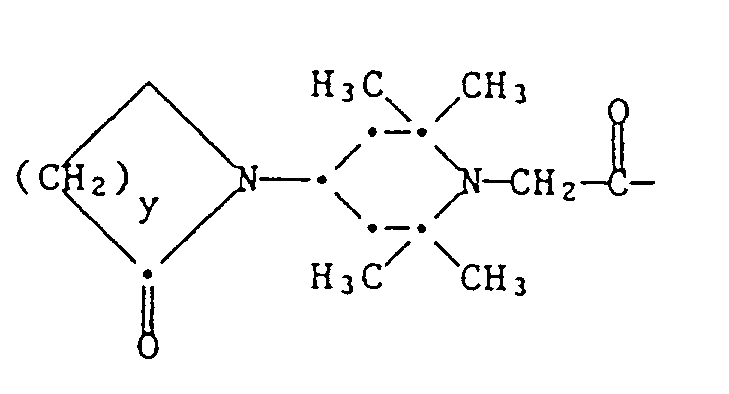
lorsque m vaut 2,
R₂ est un groupement alkylène en C₁-C₁₂, alkénylène en C₄-C₁₂, xylylène, un radical acyle divalent d'un acide dicarboxylique aliphatique, cycloaliphatique, araliphatique ou aromatique ou d'un acide dicarbamique, ou R₂ est un groupement
R₃ représente un atome d'hydrogène, un groupement alkyle en C₁-C₁₂, cycloalkyle en C₅-C₇, aralkyle en C₇-C₉, alkanoyle en C₂-C₁₈, alkénoyle en C₃-C₅, ou benzoyle ;
lorsque p vaut 1,
R₄ représente un atome d'hydrogène, un groupement alkyle en C₁-C₁₈, cycloalkyle en C₅-C₇, alkényle en C₂-C₈ non substitué ou substitué par un groupement cyano, carbonyle ou carbamide, ou représente un groupement aryle, aralkyle, glycidyle, un groupement de formule -CH₂-CH(OH)-Z ou de formule -CONH-Z dans laquelle Z représente un atome d'hydrogène, un groupement méthyle ou phényle ;
ou R₄ est un groupement de formule I
lorsque p vaut 2,
R₄ est un groupement alkylène en C₁-C₁₂, arylène en C₆-C₁₂, xylylène, un groupement -CH₂CH(OH)-CH₂, ou un groupement -CH₂-CH(OH)-CH₂-O-X-O-CH₂-CH(OH)-CH₂- dans lequel X représente un groupement alkylène en C₂-C₁₀, arylène en C₆-C₁₅ ou cycloalkylène en C₆-C₁₂ ou, à condition que R₃ ne soit pas un groupement alkanoyle, alkénoyle ou benzoyle, R₄ peut aussi être un radical acyle divalent d'un acide dicarbamique ou dicarboxylique aliphatique, cycloaliphatique ou aromatique, ou peut être le groupe -CO- ; ou R₄ représente un groupement de formule II
lorsque p vaut 3, R₄ représente un groupement 2,4,6-triazinetriyle ;
n vaut 1 ou 2 et
lorsque n vaut 1,
R₅ et R'₅ représentent indépendamment un groupement alkyle en C₁-C₁₂, alkényle en C₂-C₁₂, aralkyle en C₇-C₁₂, ou R₅ représente aussi un atome d'hydrogène ou R₅ et R'₅ représentent ensemble un groupement alkylène en C₂-C₈, ou hydroxyalkylène ou (acyle en C₄-C₂₂)oxyalkylène ;
lorsque n vaut 2, R₅ et R'₅ représentent ensemble (-CH₂)₂C(CH₂-)₂ ;
R₆ représente un atome d'hydrogène, un groupement alkyle en C₁-C₁₂, allyle, benzyle, glycidyle ou alkoxyalkyle en C₂-C₆ ; lorsque n vaut 1,
R₇ représente un atome d'hydrogène, un groupement alkyle en C₁-C₁₂, alkényle en C₃-C₅, aralkyle en C₇-C₉, cycloalkyle en C₅-C₇, hydroxyalkyle en C₂-C₄, alkoxyalkyle en C₂-C₆, aryle en C₆-C₁₀, glycidyle, un groupement de formule -(CH₂)t-COO-Q ou de formule -(CH₂)t-O-CO-Q dans laquelle t vaut 1 ou 2, et Q représente un groupement alkyle en C₁-C₄, ou phényle ; ou lorsque n vaut 2,
R₇ représente un groupement alkylène en C₂-C₁₂, arylène en C₆-C₁₂, un groupement -CH₂CH(OH)-CH₂-O-X-O-CH₂-CH(OH)-CH₂- dans lequel X est un groupement alkylène en C₂-C₁₀, arylène en C₆-C₁₅ ou cycloalkylène en C₆-C₁₂, ou un groupement -CH₂CH(OZ')CH₂-(OCH₂-CH(OZ')CH₂)₂- dans lequel Z' est un atome d'hydrogène, un groupement (alkyle en C₁-C₁₈), allyle, benzyle, (alkanoyle en C₂-C₁₂), ou benzoyle ;
Q₁ représente -N(R₈)- ou -O- ;
E est un groupement alkylène en C₁-C₃, le groupement CH₂-CH(R₉)-O- dans lequel R₉ est un atome d'hydrogène, un groupement méthyle ou phényle, ou E est le groupement -(CH₂)₃-NH- ou une liaison directe ;
R₁₀ est un atome d'hydrogène ou un groupement alkyle en C₁-C₁₈,
R₈ est un atome d'hydrogène, un groupement alkyle en C₁-C₁₈, cycloalkyle en C₅-C₇, aralkyle en C₇-C₁₂, cyanoéthyle, aryle en C₆-C₁₀, le groupement -CH₂-CH(R₉)-OH dans lequel R₉ a la signification définie ci-dessus ; un groupement de formule I ou un groupement de formule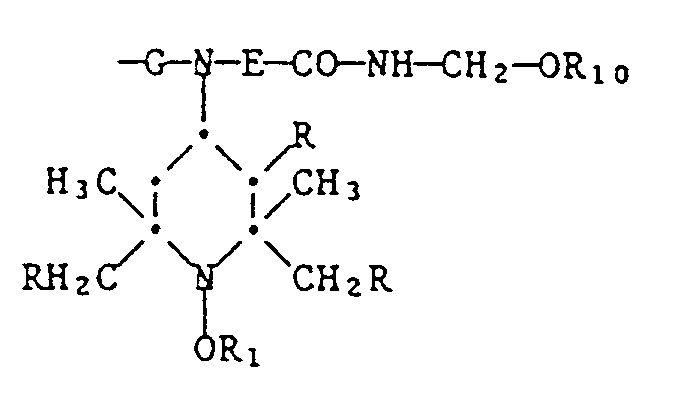
T₃ est un groupement éthylène ou 1,2-propylène, ou est l'unité structurale répétitive dérivée d'un copolymère d'alpha-oléfine avec un acrylate ou un méthacrylate d'alkyle ;
k vaut de 2 à 100 ;
T₄ a la même signification que R₄ lorsque p vaut 1 ou 2,
T₅ représente un groupement méthyle,
T₆ est un groupement méthyle ou éthyle,
M et Y représentent indépendamment un groupement méthylène ou carbonyle ;
T₇ est identique à R₇ ;
T₁₀ et T₁₁ représentent indépendamment un groupement alkylène de 2 à 12 atomes de carbone, ou T₁₁ représente un groupe de formule II ;
e vaut 2, 3 ou 4 et
T₁₂ est un groupe -N(R₅)-(CH₂)d-N(R₅)- ou -NH(CH₂)a-N(CH₂)b-N[(CH₂)c-N]fH dans lequel a, b et c valent indépendamment 2 ou 3, d vaut de 2 à 10 et f vaut 0 ou 1 ;
T₁₃ est le même que R₄ à condition que R₁₃ ne puisse pas être un hydrogène lorsque n vaut 1 ;
E₁ et E₂, étant différents, représentent chacun -CO- ou -N(E₅)-, dans lequel E₅ est un atome d'hydrogène, un groupement alkyle en C₁-C₁₂ ou alkoxycarbonylalkyle en C₄-C₂₂, E₃ est un groupement hydrogène, un groupement alkyle de 1 à 30 atomes de carbone, phényle, naphtyle, ledit groupement phényle ou ledit groupement naphtyle étant substitués par un atome de chlore ou par une groupement alkyle comprenant de 1 à 4 atomes de carbone, ou un groupement phénylalkyle comprenant de 7 à 12 atomes de carbone, ou ledit groupement phénylalkyle substitué par un groupement alkyle comprenant de 1 à 4 atomes de carbone,
E₄ représente un atome d'hydrogène, un groupement alkyle comprenant de 1 à 30 atomes de carbone, un groupement phényle, naphtyle, ou phénylalkyle comprenant de 7 à 12 atomes de carbone ou,
E₃ et E₄ représentent ensemble un groupement polyméthylène de 4 à 17 atomes de carbone, ou ledit polyméthylène substitué par jusqu'à 4 groupements alkyle comprenant de 1 à 4 atomes de carbone ;
R₂ de formule (N) est comme défini précédemment lorsque m vaut 1 ;
G₁ est une liaison directe, un groupement alkylène en C₁-C₁₂, phénylène ou -NH-G'-NH dans lequel G' est un groupement alkylène en C₁-C₁₂. - Composition selon la revendication 2 qui contient un composé de formule A, B, D, J, K ou M, dans laquelle R est un atome d'hydrogène, et T₅ et T₆ représentent un groupement méthyle.
- Composition selon la revendication 2 qui contient un composé de formule A dans laquelle R est un atome d'hydrogène,
R₁ est un groupe D-CO- et D représente un groupement alkyle en C₁-C₁₂, alkoxy en C₁-C₄, phényle, amino ou amino monosubstitué par un groupement alkyle en C₁-C₁₂, ou phényle ;
m vaut 1, 2 ou 4 et lorsque m vaut 1,
R₂ est un radical acyle d'un acide carboxylique aliphatique en C₂-C₁₈, d'un acide carboxylique cycloaliphatique en C₆-C₁₂ ou d'un acide carboxylique aromatique en C₇-C₁₅ et lorsque m vaut 2, R₂ est un radical acyle divalent d'un acide dicarboxylique aliphatique en C₂-C₁₈ ou d'un acide dicarboxylique cycloaliphatique ou aromatique en C₈-C₁₄, ou d'un acide dicarbamique aliphatique, cycloaliphatique ou aromatique en C₈-C₁₄, ou R₂ est un groupement
- Composition selon la revendication 2 qui contient un composé de formule B dans laquelle R est un atome d'hydrogène,
R₁ est un groupe D-CO- et D représente un groupement alkyle en C₁-C₁₂, alkoxy en C₁-C₄, phényle, amino ou amino monosubstitué par un groupement alkyle en C₁-C₁₂, ou phényle ,
p vaut 1 ou 2, R₃ représente un atome d'hydrogène, un groupement alkyle en C₁-C₁₂, alkanoyle en C₂-C₁₂ et lorsque p vaut 1, R₄ est un groupement alkyle en C₁-C₁₂, cycloalkyle en C₅-C₇ ou un groupe de formule I, et lorsque p vaut 2, R₄ est un groupement alkylène en C₂-C₈, phénylène ou xylylène, et si R₃ n'est pas un groupement alkanoyle, R₄ peut aussi être un résidu acyle divalent d'un acide dicarboxylique aliphatique en C₂-C₁₀ ou d'un acide dicarboxylique aromatique en C₆ ou d'un acide dicarbamique aliphatique ou aromatique en C₈-C₁₅. - Composition selon la revendication 1, qui contient du di-(1-acétoxy-2,2,6,6-tétraméthylpipéridin-4-yl)sébaçate.
- Composition selon la revendication 3, qui contient de l'α,α-(di-1-éthoxy-2,2,6,6-tétraméthylpipéridin-4-yloxy)-p-xylène.
- Composition selon la revendication 3, qui contient de la 1,4-dibenzyloxy-2,2,6,6-tétraméthylpipéridine.
- Composition selon la revendication 3, qui contient du di-(1-benzyloxy-2,2,6,6-tétraméthylpipéridin-4-yl)-sébaçate.
- Composition selon la revendication 3, qui contient de la 4-benzyloxy-1-éthoxy-2,2,6,6-tétraméthylpipéridine.
- Composition selon la revendication 3, qui contient de la 1,4-di-(4-hydroxy-3,5-di-tert-butylbenzoyloxy)-2,2,6,6-tétraméthylpipéridine.
- Composition selon la revendication 3, qui contient de l'α,α-(di-1-benzoyloxy-2,2,6,6-tétraméthylpipéridin-4-yloxy)-p-xylène.
- Composition de revêtement selon la revendication 1, qui est un système durcissable à température ambiante à base de résine alkyde, de résine acrylique themoplastique, de résine alkyde acrylique, de résine de polyuréthane ou de résine polyester, ou desdites résines modifiées avec des silicones, isocyanates, époxydes, isocyanurates, cétimines ou oxazolidines, ou bien encore le système est à base d'ester cellulosique ou de résine époxyde.
- Composition de revêtement selon la revendication 1, qui est un système thermodurcissable catalysé par un acide à base de résine réticulable à chaud de type acrylique, polyester, polyuréthane, polyamide ou alkyde.
- Composition selon la revendication 1, qui est un vernis industriel de finition.
- Composition selon la revendication 1, qui est un vernis de retouche pour les automobiles.
Applications Claiming Priority (6)
| Application Number | Priority Date | Filing Date | Title |
|---|---|---|---|
| US99420 | 1979-12-03 | ||
| US9941987A | 1987-09-21 | 1987-09-21 | |
| US9941187A | 1987-09-21 | 1987-09-21 | |
| US9942087A | 1987-09-21 | 1987-09-21 | |
| US99419 | 1987-09-21 | ||
| US99411 | 1987-09-21 |
Publications (3)
| Publication Number | Publication Date |
|---|---|
| EP0309400A2 EP0309400A2 (fr) | 1989-03-29 |
| EP0309400A3 EP0309400A3 (en) | 1990-11-07 |
| EP0309400B1 true EP0309400B1 (fr) | 1994-03-02 |
Family
ID=27378822
Family Applications (1)
| Application Number | Title | Priority Date | Filing Date |
|---|---|---|---|
| EP88810621A Expired - Lifetime EP0309400B1 (fr) | 1987-09-21 | 1988-09-13 | N-acyloxyamines stabilisantes à empêchement stérique |
Country Status (7)
| Country | Link |
|---|---|
| EP (1) | EP0309400B1 (fr) |
| JP (1) | JP2867026B2 (fr) |
| KR (1) | KR0152432B1 (fr) |
| BR (1) | BR8804883A (fr) |
| CA (1) | CA1339741C (fr) |
| DE (1) | DE3888065T2 (fr) |
| ES (1) | ES2061723T3 (fr) |
Cited By (4)
| Publication number | Priority date | Publication date | Assignee | Title |
|---|---|---|---|---|
| US7442711B2 (en) | 2002-05-17 | 2008-10-28 | Othera Holding, Inc. | Amelioration of the development of cataracts and other ophthalmic diseases |
| US7825134B2 (en) | 2003-05-19 | 2010-11-02 | Othera Holding, Inc. | Amelioration of cataracts, macular degeneration and other ophthalmic diseases |
| US20130302728A1 (en) * | 2009-03-23 | 2013-11-14 | Basf Se | Photoresist compositions |
| WO2026096421A1 (fr) | 2024-10-30 | 2026-05-07 | Lubrizol Advanced Materials, Inc. | Composition de polyuréthane thermoplastique pour mousse à haut rebond |
Families Citing this family (28)
| Publication number | Priority date | Publication date | Assignee | Title |
|---|---|---|---|---|
| US5173289A (en) * | 1988-01-20 | 1992-12-22 | Centre International De Recherches Dermatologiques (C.I.R.D.) | Aromatic esters and thioesters, a process for their preparation and their use in human or veterinary medicine and in cosmetic compositions |
| US5216156A (en) * | 1992-05-05 | 1993-06-01 | Ciba-Geigy Corporation | Non-migrating 1-hydrocarbyloxy-2,2,6,6-tetramethylpiperidine 1,3,5-triazine derivatives |
| JP3631262B2 (ja) * | 1993-11-11 | 2005-03-23 | 麒麟麦酒株式会社 | 飽和ポリエステル樹脂組成物からなるコンテナまたはパレット |
| ATE194596T1 (de) * | 1994-11-15 | 2000-07-15 | Moreno Paolini | N-hydroxypiperidine als superoxid-radikalfänger |
| EP1089985B1 (fr) | 1998-06-22 | 2005-09-21 | Cytec Technology Corp. | Trisaryl-1,3,5-triazines decalees vers le rouge utilisees comme absorbeurs de rayons ultraviolets |
| US6297377B1 (en) | 1998-06-22 | 2001-10-02 | Cytec Technology Corporation | Benzocycle-substituted triazine and pyrimidine ultraviolet light absorbers |
| JP2002518489A (ja) | 1998-06-22 | 2002-06-25 | チバ スペシャルティ ケミカルズ ホールディング インコーポレーテッド | ポリ(トリスアリール−1,3,5−トリアジン=カルバマート)紫外光吸収剤 |
| US6239276B1 (en) | 1998-06-22 | 2001-05-29 | Cytec Technology Corporation | Non-yellowing para-tertiary-alkyl phenyl substituted triazine and pyrimidine ultraviolet light absorbers |
| EP1132085A4 (fr) * | 1998-11-25 | 2003-04-23 | Daiichi Radioisotope Lab | Medicaments ou reactifs contenant des composes cycloalkyl n-acyloxyles |
| JP4829447B2 (ja) * | 1999-07-02 | 2011-12-07 | チバ ホールディング インコーポレーテッド | 官能化されたマクロマーの製造のための1および多官能価アルコキシアミン |
| US6867250B1 (en) | 2000-10-30 | 2005-03-15 | Cytec Technology Corp. | Non-yellowing ortho-dialkyl aryl substituted triazine ultraviolet light absorbers |
| US6727300B2 (en) | 2000-11-03 | 2004-04-27 | Cytec Technology Corp. | Polymeric articles containing hindered amine light stabilizers based on multi-functional carbonyl compounds |
| US6545156B1 (en) | 2000-11-03 | 2003-04-08 | Cytec Technology Corp. | Oligomeric hindered amine light stabilizers based on multi-functional carbonyl compounds and methods of making same |
| US6492521B2 (en) | 2000-11-03 | 2002-12-10 | Cytec Technology Corp. | Hindered amine light stabilizers based on multi-functional carbonyl compounds and methods of making same |
| US6414155B1 (en) | 2000-11-03 | 2002-07-02 | Cytec Technology Corp. | Oligomeric hindered amine light stabilizers based on multi-functional carbonyl compounds and methods of making same |
| ATE539058T1 (de) * | 2003-02-26 | 2012-01-15 | Basf Se | Wasserverträgliche sterisch gehinderte hydroxysubstitutierte alkoxyamine |
| WO2006022405A1 (fr) | 2004-08-24 | 2006-03-02 | Fujifilm Corporation | Matériau photosensible photographique couleur à base d’halogénure d’argent et procédé de formation d’image |
| EP1814937B1 (fr) * | 2004-11-09 | 2009-07-29 | Ciba Holding Inc. | Formules polymères antimicrobiennes présentant une résistance améliorée à la décoloration |
| US20100130638A1 (en) | 2007-03-30 | 2010-05-27 | Fujifilm Corporation | Ultraviolet absorbent composition |
| CN102604181B (zh) | 2007-08-06 | 2014-08-13 | 通用电缆技术公司 | 耐受树枝化的绝缘组合物 |
| JP5295549B2 (ja) * | 2007-11-07 | 2013-09-18 | 株式会社Adeka | 塗料組成物 |
| JP5244437B2 (ja) | 2008-03-31 | 2013-07-24 | 富士フイルム株式会社 | 紫外線吸収剤組成物 |
| JP2010059235A (ja) | 2008-09-01 | 2010-03-18 | Fujifilm Corp | 紫外線吸収剤組成物 |
| JP5261319B2 (ja) | 2008-09-10 | 2013-08-14 | 富士フイルム株式会社 | 照明カバー |
| CA2916530C (fr) * | 2013-07-08 | 2021-06-22 | Basf Se | Nouveaux stabilisants lumiere |
| KR20240058933A (ko) | 2021-09-16 | 2024-05-07 | 루브리졸 어드밴스드 머티어리얼스, 인코포레이티드 | 스티어링 휠 구성 |
| EP4402199A1 (fr) | 2021-09-16 | 2024-07-24 | Lubrizol Advanced Materials, Inc. | Couvre-volant en mousse de polyuréthane thermoplastique |
| WO2026015328A1 (fr) | 2024-07-09 | 2026-01-15 | Lubrizol Advanced Materials, Inc. | Polyuréthanes thermoplastiques |
Family Cites Families (3)
| Publication number | Priority date | Publication date | Assignee | Title |
|---|---|---|---|---|
| US4472547A (en) * | 1983-06-30 | 1984-09-18 | Ciba-Geigy Corporation | N-Piperidyl lactam light stabilizers |
| US4590231A (en) * | 1983-10-11 | 1986-05-20 | Ciba-Geigy Corporation | Polyolefin compositions stabilized against degradation using hydroxylamine derivatives |
| US4691015A (en) * | 1984-07-23 | 1987-09-01 | Ciba-Geigy Corporation | Hydroxylamines derived from hindered amines |
-
1988
- 1988-09-13 DE DE3888065T patent/DE3888065T2/de not_active Expired - Fee Related
- 1988-09-13 EP EP88810621A patent/EP0309400B1/fr not_active Expired - Lifetime
- 1988-09-13 ES ES88810621T patent/ES2061723T3/es not_active Expired - Lifetime
- 1988-09-19 CA CA000577796A patent/CA1339741C/fr not_active Expired - Fee Related
- 1988-09-21 BR BR8804883A patent/BR8804883A/pt not_active Application Discontinuation
- 1988-09-21 KR KR1019880012229A patent/KR0152432B1/ko not_active Expired - Fee Related
- 1988-09-21 JP JP63237494A patent/JP2867026B2/ja not_active Expired - Fee Related
Cited By (5)
| Publication number | Priority date | Publication date | Assignee | Title |
|---|---|---|---|---|
| US7442711B2 (en) | 2002-05-17 | 2008-10-28 | Othera Holding, Inc. | Amelioration of the development of cataracts and other ophthalmic diseases |
| US8383648B2 (en) | 2002-05-17 | 2013-02-26 | Colby Pharmaceutical Company | Amelioration of the development of cataracts and other ophthalmic diseases |
| US7825134B2 (en) | 2003-05-19 | 2010-11-02 | Othera Holding, Inc. | Amelioration of cataracts, macular degeneration and other ophthalmic diseases |
| US20130302728A1 (en) * | 2009-03-23 | 2013-11-14 | Basf Se | Photoresist compositions |
| WO2026096421A1 (fr) | 2024-10-30 | 2026-05-07 | Lubrizol Advanced Materials, Inc. | Composition de polyuréthane thermoplastique pour mousse à haut rebond |
Also Published As
| Publication number | Publication date |
|---|---|
| DE3888065D1 (de) | 1994-04-07 |
| EP0309400A3 (en) | 1990-11-07 |
| KR890005197A (ko) | 1989-05-13 |
| ES2061723T3 (es) | 1994-12-16 |
| EP0309400A2 (fr) | 1989-03-29 |
| BR8804883A (pt) | 1989-04-25 |
| JP2867026B2 (ja) | 1999-03-08 |
| CA1339741C (fr) | 1998-03-17 |
| KR0152432B1 (ko) | 1998-10-15 |
| DE3888065T2 (de) | 1994-07-14 |
| JPH01132562A (ja) | 1989-05-25 |
Similar Documents
| Publication | Publication Date | Title |
|---|---|---|
| CA1339741C (fr) | Agents stabilisants de type amine steriquement encombres par des groupesn-acryloxy | |
| EP0309402B1 (fr) | Stabilisateurs à base d'amines avec empêchement stérique N-substituées | |
| EP0309401B2 (fr) | Stabilisation d'enduits par des amines N-hydroxy substituées avec empêchement stérique | |
| US5112890A (en) | Stabilization of acid catalyzed thermoset resins | |
| US5124378A (en) | Stabilization of ambient cured coatings | |
| EP0427672B1 (fr) | Stabilisants de polymères, les stabilisants contenant des groupements amine encombrants et des groupements hydroxylamine | |
| US5145893A (en) | Non-migrating 1-hydrocarbyloxy hindered amine derivatives as polymer stabilizers | |
| EP0389419B1 (fr) | Composés nonmigrants 1-hydrocarbyloxyamines à encombrement stérique comme stabilisateurs pour polymères | |
| RU2086540C1 (ru) | Этиленово-ненасыщенные полимеризующиеся мономеры на основе производного пиперидина | |
| US5006577A (en) | Stabilization of ambient cured coatings with N-hydroxy hindered amines | |
| US4972009A (en) | Polymer stabilizers containing both hindered amine and nitrone moieties | |
| US5064883A (en) | Stabilization of acid catalyzed thermoset resins with n-hydroxy hindered amines | |
| HK1000211B (en) | N-substituted hindered amine stabilizers | |
| HK1000211A1 (en) | N-substituted hindered amine stabilizers | |
| JPH02286676A (ja) | トリアジンとヘキサヒドロトリアジンのヒンダードアミン誘導体 | |
| KR0155259B1 (ko) | N-치환된 입체 장애 아민 화합물 |
Legal Events
| Date | Code | Title | Description |
|---|---|---|---|
| PUAI | Public reference made under article 153(3) epc to a published international application that has entered the european phase |
Free format text: ORIGINAL CODE: 0009012 |
|
| 17P | Request for examination filed |
Effective date: 19880915 |
|
| AK | Designated contracting states |
Kind code of ref document: A2 Designated state(s): BE DE ES FR GB IT NL SE |
|
| PUAL | Search report despatched |
Free format text: ORIGINAL CODE: 0009013 |
|
| AK | Designated contracting states |
Kind code of ref document: A3 Designated state(s): BE DE ES FR GB IT NL SE |
|
| 17Q | First examination report despatched |
Effective date: 19920416 |
|
| GRAA | (expected) grant |
Free format text: ORIGINAL CODE: 0009210 |
|
| ITF | It: translation for a ep patent filed | ||
| AK | Designated contracting states |
Kind code of ref document: B1 Designated state(s): BE DE ES FR GB IT NL SE |
|
| REF | Corresponds to: |
Ref document number: 3888065 Country of ref document: DE Date of ref document: 19940407 |
|
| ET | Fr: translation filed | ||
| PGFP | Annual fee paid to national office [announced via postgrant information from national office to epo] |
Ref country code: ES Payment date: 19940912 Year of fee payment: 7 |
|
| PGFP | Annual fee paid to national office [announced via postgrant information from national office to epo] |
Ref country code: SE Payment date: 19940928 Year of fee payment: 7 |
|
| REG | Reference to a national code |
Ref country code: ES Ref legal event code: FG2A Ref document number: 2061723 Country of ref document: ES Kind code of ref document: T3 |
|
| PLBE | No opposition filed within time limit |
Free format text: ORIGINAL CODE: 0009261 |
|
| STAA | Information on the status of an ep patent application or granted ep patent |
Free format text: STATUS: NO OPPOSITION FILED WITHIN TIME LIMIT |
|
| EAL | Se: european patent in force in sweden |
Ref document number: 88810621.8 |
|
| 26N | No opposition filed | ||
| PG25 | Lapsed in a contracting state [announced via postgrant information from national office to epo] |
Ref country code: SE Effective date: 19950914 Ref country code: ES Free format text: LAPSE BECAUSE OF NON-PAYMENT OF DUE FEES Effective date: 19950914 |
|
| EUG | Se: european patent has lapsed |
Ref document number: 88810621.8 |
|
| BECN | Be: change of holder's name |
Effective date: 19961129 |
|
| NLS | Nl: assignments of ep-patents |
Owner name: CIBA SC HOLDING AG |
|
| REG | Reference to a national code |
Ref country code: GB Ref legal event code: 732E |
|
| NLT1 | Nl: modifications of names registered in virtue of documents presented to the patent office pursuant to art. 16 a, paragraph 1 |
Owner name: CIBA SPECIALTY CHEMICALS HOLDING INC. |
|
| REG | Reference to a national code |
Ref country code: FR Ref legal event code: TP |
|
| REG | Reference to a national code |
Ref country code: GB Ref legal event code: IF02 |
|
| PGFP | Annual fee paid to national office [announced via postgrant information from national office to epo] |
Ref country code: NL Payment date: 20020821 Year of fee payment: 15 |
|
| PGFP | Annual fee paid to national office [announced via postgrant information from national office to epo] |
Ref country code: BE Payment date: 20021028 Year of fee payment: 15 |
|
| PGFP | Annual fee paid to national office [announced via postgrant information from national office to epo] |
Ref country code: FR Payment date: 20030806 Year of fee payment: 16 |
|
| PGFP | Annual fee paid to national office [announced via postgrant information from national office to epo] |
Ref country code: GB Payment date: 20030820 Year of fee payment: 16 |
|
| PGFP | Annual fee paid to national office [announced via postgrant information from national office to epo] |
Ref country code: DE Payment date: 20030825 Year of fee payment: 16 |
|
| PG25 | Lapsed in a contracting state [announced via postgrant information from national office to epo] |
Ref country code: BE Free format text: LAPSE BECAUSE OF NON-PAYMENT OF DUE FEES Effective date: 20030930 |
|
| REG | Reference to a national code |
Ref country code: ES Ref legal event code: FD2A Effective date: 19961011 |
|
| BERE | Be: lapsed |
Owner name: *CIBA SPECIALTY CHEMICALS HOLDING INC. Effective date: 20030930 |
|
| PG25 | Lapsed in a contracting state [announced via postgrant information from national office to epo] |
Ref country code: NL Free format text: LAPSE BECAUSE OF NON-PAYMENT OF DUE FEES Effective date: 20040401 |
|
| NLV4 | Nl: lapsed or anulled due to non-payment of the annual fee |
Effective date: 20040401 |
|
| PG25 | Lapsed in a contracting state [announced via postgrant information from national office to epo] |
Ref country code: GB Free format text: LAPSE BECAUSE OF NON-PAYMENT OF DUE FEES Effective date: 20040913 |
|
| PG25 | Lapsed in a contracting state [announced via postgrant information from national office to epo] |
Ref country code: DE Free format text: LAPSE BECAUSE OF NON-PAYMENT OF DUE FEES Effective date: 20050401 |
|
| GBPC | Gb: european patent ceased through non-payment of renewal fee |
Effective date: 20040913 |
|
| PG25 | Lapsed in a contracting state [announced via postgrant information from national office to epo] |
Ref country code: FR Free format text: LAPSE BECAUSE OF NON-PAYMENT OF DUE FEES Effective date: 20050531 |
|
| REG | Reference to a national code |
Ref country code: FR Ref legal event code: ST |
|
| PG25 | Lapsed in a contracting state [announced via postgrant information from national office to epo] |
Ref country code: IT Free format text: LAPSE BECAUSE OF NON-PAYMENT OF DUE FEES;WARNING: LAPSES OF ITALIAN PATENTS WITH EFFECTIVE DATE BEFORE 2007 MAY HAVE OCCURRED AT ANY TIME BEFORE 2007. THE CORRECT EFFECTIVE DATE MAY BE DIFFERENT FROM THE ONE RECORDED. Effective date: 20050913 |