EP0309406B1 - Reaktivfarbstoffe, deren Herstellung und Verwendung - Google Patents
Reaktivfarbstoffe, deren Herstellung und Verwendung Download PDFInfo
- Publication number
- EP0309406B1 EP0309406B1 EP88810630A EP88810630A EP0309406B1 EP 0309406 B1 EP0309406 B1 EP 0309406B1 EP 88810630 A EP88810630 A EP 88810630A EP 88810630 A EP88810630 A EP 88810630A EP 0309406 B1 EP0309406 B1 EP 0309406B1
- Authority
- EP
- European Patent Office
- Prior art keywords
- formula
- radical
- dye
- parts
- amino
- Prior art date
- Legal status (The legal status is an assumption and is not a legal conclusion. Google has not performed a legal analysis and makes no representation as to the accuracy of the status listed.)
- Expired - Lifetime
Links
- 239000000985 reactive dye Substances 0.000 title claims description 91
- 238000002360 preparation method Methods 0.000 title claims description 10
- -1 polyazo Polymers 0.000 claims description 181
- 239000000975 dye Substances 0.000 claims description 139
- 150000003254 radicals Chemical class 0.000 claims description 93
- 125000004432 carbon atom Chemical group C* 0.000 claims description 75
- 125000000020 sulfo group Chemical group O=S(=O)([*])O[H] 0.000 claims description 58
- 229910052736 halogen Inorganic materials 0.000 claims description 41
- 150000001875 compounds Chemical class 0.000 claims description 39
- 125000000217 alkyl group Chemical group 0.000 claims description 38
- 150000002367 halogens Chemical class 0.000 claims description 38
- 238000000034 method Methods 0.000 claims description 36
- 239000001257 hydrogen Substances 0.000 claims description 35
- 229910052739 hydrogen Inorganic materials 0.000 claims description 35
- UHOVQNZJYSORNB-UHFFFAOYSA-N Benzene Chemical compound C1=CC=CC=C1 UHOVQNZJYSORNB-UHFFFAOYSA-N 0.000 claims description 34
- 125000003178 carboxy group Chemical group [H]OC(*)=O 0.000 claims description 31
- 238000005859 coupling reaction Methods 0.000 claims description 30
- 229920000742 Cotton Polymers 0.000 claims description 27
- 125000000664 diazo group Chemical group [N-]=[N+]=[*] 0.000 claims description 27
- 238000004043 dyeing Methods 0.000 claims description 27
- 230000008878 coupling Effects 0.000 claims description 26
- 238000010168 coupling process Methods 0.000 claims description 26
- 125000000449 nitro group Chemical group [O-][N+](*)=O 0.000 claims description 25
- 230000008569 process Effects 0.000 claims description 25
- UFHFLCQGNIYNRP-UHFFFAOYSA-N Hydrogen Chemical compound [H][H] UFHFLCQGNIYNRP-UHFFFAOYSA-N 0.000 claims description 24
- 125000001424 substituent group Chemical group 0.000 claims description 20
- 125000003545 alkoxy group Chemical group 0.000 claims description 19
- 125000004397 aminosulfonyl group Chemical group NS(=O)(=O)* 0.000 claims description 19
- 125000002887 hydroxy group Chemical group [H]O* 0.000 claims description 18
- 125000003277 amino group Chemical group 0.000 claims description 16
- 125000004093 cyano group Chemical group *C#N 0.000 claims description 16
- 239000000543 intermediate Substances 0.000 claims description 16
- PXGOKWXKJXAPGV-UHFFFAOYSA-N Fluorine Chemical compound FF PXGOKWXKJXAPGV-UHFFFAOYSA-N 0.000 claims description 15
- 125000001495 ethyl group Chemical group [H]C([H])([H])C([H])([H])* 0.000 claims description 15
- 125000001153 fluoro group Chemical group F* 0.000 claims description 15
- 125000003917 carbamoyl group Chemical group [H]N([H])C(*)=O 0.000 claims description 14
- 239000011737 fluorine Substances 0.000 claims description 14
- 229910052731 fluorine Inorganic materials 0.000 claims description 14
- 125000002023 trifluoromethyl group Chemical group FC(F)(F)* 0.000 claims description 14
- 150000001412 amines Chemical class 0.000 claims description 13
- 125000002496 methyl group Chemical group [H]C([H])([H])* 0.000 claims description 13
- 239000002243 precursor Substances 0.000 claims description 13
- 239000000463 material Substances 0.000 claims description 11
- NYGZLYXAPMMJTE-UHFFFAOYSA-M metanil yellow Chemical group [Na+].[O-]S(=O)(=O)C1=CC=CC(N=NC=2C=CC(NC=3C=CC=CC=3)=CC=2)=C1 NYGZLYXAPMMJTE-UHFFFAOYSA-M 0.000 claims description 11
- 125000000229 (C1-C4)alkoxy group Chemical group 0.000 claims description 10
- 125000001309 chloro group Chemical group Cl* 0.000 claims description 10
- 150000002790 naphthalenes Chemical class 0.000 claims description 10
- 125000001997 phenyl group Chemical group [H]C1=C([H])C([H])=C(*)C([H])=C1[H] 0.000 claims description 10
- 125000004178 (C1-C4) alkyl group Chemical group 0.000 claims description 9
- 125000003282 alkyl amino group Chemical group 0.000 claims description 9
- 125000004390 alkyl sulfonyl group Chemical group 0.000 claims description 9
- UFWIBTONFRDIAS-UHFFFAOYSA-N Naphthalene Chemical compound C1=CC=CC2=CC=CC=C21 UFWIBTONFRDIAS-UHFFFAOYSA-N 0.000 claims description 8
- 239000000835 fiber Substances 0.000 claims description 8
- 125000005843 halogen group Chemical group 0.000 claims description 8
- 125000002924 primary amino group Chemical group [H]N([H])* 0.000 claims description 8
- DGVVWUTYPXICAM-UHFFFAOYSA-N β‐Mercaptoethanol Chemical compound OCCS DGVVWUTYPXICAM-UHFFFAOYSA-N 0.000 claims description 8
- 125000000738 acetamido group Chemical group [H]C([H])([H])C(=O)N([H])[*] 0.000 claims description 7
- 125000004453 alkoxycarbonyl group Chemical group 0.000 claims description 7
- 239000001000 anthraquinone dye Substances 0.000 claims description 7
- 239000000987 azo dye Substances 0.000 claims description 7
- 125000002861 (C1-C4) alkanoyl group Chemical group 0.000 claims description 6
- RYGMFSIKBFXOCR-UHFFFAOYSA-N Copper Chemical group [Cu] RYGMFSIKBFXOCR-UHFFFAOYSA-N 0.000 claims description 6
- 125000005118 N-alkylcarbamoyl group Chemical group 0.000 claims description 6
- 125000004442 acylamino group Chemical group 0.000 claims description 6
- 125000002490 anilino group Chemical group [H]N(*)C1=C([H])C([H])=C([H])C([H])=C1[H] 0.000 claims description 6
- 125000003236 benzoyl group Chemical group [H]C1=C([H])C([H])=C(C([H])=C1[H])C(*)=O 0.000 claims description 6
- 229920002678 cellulose Polymers 0.000 claims description 6
- 239000001913 cellulose Substances 0.000 claims description 6
- 239000007859 condensation product Substances 0.000 claims description 6
- PPSZHCXTGRHULJ-UHFFFAOYSA-N dioxazine Chemical compound O1ON=CC=C1 PPSZHCXTGRHULJ-UHFFFAOYSA-N 0.000 claims description 6
- BWWHTIHDQBHTHP-UHFFFAOYSA-N 2-nitrobenzoyl chloride Chemical compound [O-][N+](=O)C1=CC=CC=C1C(Cl)=O BWWHTIHDQBHTHP-UHFFFAOYSA-N 0.000 claims description 5
- 239000010949 copper Substances 0.000 claims description 5
- 125000000956 methoxy group Chemical group [H]C([H])([H])O* 0.000 claims description 5
- VMGAPWLDMVPYIA-HIDZBRGKSA-N n'-amino-n-iminomethanimidamide Chemical compound N\N=C\N=N VMGAPWLDMVPYIA-HIDZBRGKSA-N 0.000 claims description 5
- WLFXSECCHULRRO-UHFFFAOYSA-N pyridine-2,6-diol Chemical compound OC1=CC=CC(O)=N1 WLFXSECCHULRRO-UHFFFAOYSA-N 0.000 claims description 5
- BOLDJAUMGUJJKM-LSDHHAIUSA-N renifolin D Natural products CC(=C)[C@@H]1Cc2c(O)c(O)ccc2[C@H]1CC(=O)c3ccc(O)cc3O BOLDJAUMGUJJKM-LSDHHAIUSA-N 0.000 claims description 5
- 125000005236 alkanoylamino group Chemical group 0.000 claims description 4
- 150000004056 anthraquinones Chemical class 0.000 claims description 4
- 125000000043 benzamido group Chemical group [H]N([*])C(=O)C1=C([H])C([H])=C([H])C([H])=C1[H] 0.000 claims description 4
- 150000004696 coordination complex Chemical class 0.000 claims description 4
- 229910052802 copper Inorganic materials 0.000 claims description 4
- 125000001301 ethoxy group Chemical group [H]C([H])([H])C([H])([H])O* 0.000 claims description 4
- DNJIEGIFACGWOD-UHFFFAOYSA-N ethyl mercaptane Natural products CCS DNJIEGIFACGWOD-UHFFFAOYSA-N 0.000 claims description 4
- 239000001007 phthalocyanine dye Substances 0.000 claims description 4
- 125000000391 vinyl group Chemical group [H]C([*])=C([H])[H] 0.000 claims description 4
- NXTNASSYJUXJDV-UHFFFAOYSA-N 3-nitrobenzoyl chloride Chemical compound [O-][N+](=O)C1=CC=CC(C(Cl)=O)=C1 NXTNASSYJUXJDV-UHFFFAOYSA-N 0.000 claims description 3
- PYKYMHQGRFAEBM-UHFFFAOYSA-N anthraquinone Natural products CCC(=O)c1c(O)c2C(=O)C3C(C=CC=C3O)C(=O)c2cc1CC(=O)OC PYKYMHQGRFAEBM-UHFFFAOYSA-N 0.000 claims description 3
- 150000004699 copper complex Chemical class 0.000 claims description 3
- IEQIEDJGQAUEQZ-UHFFFAOYSA-N phthalocyanine Chemical compound N1C(N=C2C3=CC=CC=C3C(N=C3C4=CC=CC=C4C(=N4)N3)=N2)=C(C=CC=C2)C2=C1N=C1C2=CC=CC=C2C4=N1 IEQIEDJGQAUEQZ-UHFFFAOYSA-N 0.000 claims description 3
- JEXVQSWXXUJEMA-UHFFFAOYSA-N pyrazol-3-one Chemical compound O=C1C=CN=N1 JEXVQSWXXUJEMA-UHFFFAOYSA-N 0.000 claims description 3
- 229920002554 vinyl polymer Polymers 0.000 claims description 3
- GJCOSYZMQJWQCA-UHFFFAOYSA-N 9H-xanthene Chemical compound C1=CC=C2CC3=CC=CC=C3OC2=C1 GJCOSYZMQJWQCA-UHFFFAOYSA-N 0.000 claims description 2
- VGGSQFUCUMXWEO-UHFFFAOYSA-N Ethene Chemical compound C=C VGGSQFUCUMXWEO-UHFFFAOYSA-N 0.000 claims description 2
- 229930192627 Naphthoquinone Natural products 0.000 claims description 2
- PCNDJXKNXGMECE-UHFFFAOYSA-N Phenazine Natural products C1=CC=CC2=NC3=CC=CC=C3N=C21 PCNDJXKNXGMECE-UHFFFAOYSA-N 0.000 claims description 2
- YFPSDOXLHBDCOR-UHFFFAOYSA-N Pyrene-1,6-dione Chemical compound C1=CC(C(=O)C=C2)=C3C2=CC=C2C(=O)C=CC1=C32 YFPSDOXLHBDCOR-UHFFFAOYSA-N 0.000 claims description 2
- PJANXHGTPQOBST-VAWYXSNFSA-N Stilbene Natural products C=1C=CC=CC=1/C=C/C1=CC=CC=C1 PJANXHGTPQOBST-VAWYXSNFSA-N 0.000 claims description 2
- CIUQDSCDWFSTQR-UHFFFAOYSA-N [C]1=CC=CC=C1 Chemical compound [C]1=CC=CC=C1 CIUQDSCDWFSTQR-UHFFFAOYSA-N 0.000 claims description 2
- WDEQGLDWZMIMJM-UHFFFAOYSA-N benzyl 4-hydroxy-2-(hydroxymethyl)pyrrolidine-1-carboxylate Chemical compound OCC1CC(O)CN1C(=O)OCC1=CC=CC=C1 WDEQGLDWZMIMJM-UHFFFAOYSA-N 0.000 claims description 2
- QDLAGTHXVHQKRE-UHFFFAOYSA-N lichenxanthone Natural products COC1=CC(O)=C2C(=O)C3=C(C)C=C(OC)C=C3OC2=C1 QDLAGTHXVHQKRE-UHFFFAOYSA-N 0.000 claims description 2
- 150000002791 naphthoquinones Chemical class 0.000 claims description 2
- 125000004999 nitroaryl group Chemical group 0.000 claims description 2
- PJANXHGTPQOBST-UHFFFAOYSA-N stilbene Chemical compound C=1C=CC=CC=1C=CC1=CC=CC=C1 PJANXHGTPQOBST-UHFFFAOYSA-N 0.000 claims description 2
- 235000021286 stilbenes Nutrition 0.000 claims description 2
- YRHRIQCWCFGUEQ-UHFFFAOYSA-N thioxanthen-9-one Chemical compound C1=CC=C2C(=O)C3=CC=CC=C3SC2=C1 YRHRIQCWCFGUEQ-UHFFFAOYSA-N 0.000 claims description 2
- AAAQKTZKLRYKHR-UHFFFAOYSA-N triphenylmethane Chemical compound C1=CC=CC=C1C(C=1C=CC=CC=1)C1=CC=CC=C1 AAAQKTZKLRYKHR-UHFFFAOYSA-N 0.000 claims description 2
- 125000004435 hydrogen atom Chemical class [H]* 0.000 claims 11
- VEXZGXHMUGYJMC-UHFFFAOYSA-M Chloride anion Chemical compound [Cl-] VEXZGXHMUGYJMC-UHFFFAOYSA-M 0.000 claims 3
- VEPOHXYIFQMVHW-XOZOLZJESA-N 2,3-dihydroxybutanedioic acid (2S,3S)-3,4-dimethyl-2-phenylmorpholine Chemical compound OC(C(O)C(O)=O)C(O)=O.C[C@H]1[C@@H](OCCN1C)c1ccccc1 VEPOHXYIFQMVHW-XOZOLZJESA-N 0.000 claims 1
- SKDHHIUENRGTHK-UHFFFAOYSA-N 4-nitrobenzoyl chloride Chemical compound [O-][N+](=O)C1=CC=C(C(Cl)=O)C=C1 SKDHHIUENRGTHK-UHFFFAOYSA-N 0.000 claims 1
- RZVHIXYEVGDQDX-UHFFFAOYSA-N 9,10-anthraquinone Chemical group C1=CC=C2C(=O)C3=CC=CC=C3C(=O)C2=C1 RZVHIXYEVGDQDX-UHFFFAOYSA-N 0.000 claims 1
- 239000000243 solution Substances 0.000 description 122
- XLYOFNOQVPJJNP-UHFFFAOYSA-N water Chemical compound O XLYOFNOQVPJJNP-UHFFFAOYSA-N 0.000 description 79
- HEMHJVSKTPXQMS-UHFFFAOYSA-M Sodium hydroxide Chemical compound [OH-].[Na+] HEMHJVSKTPXQMS-UHFFFAOYSA-M 0.000 description 72
- VEXZGXHMUGYJMC-UHFFFAOYSA-N Hydrochloric acid Chemical compound Cl VEXZGXHMUGYJMC-UHFFFAOYSA-N 0.000 description 49
- 239000000203 mixture Substances 0.000 description 46
- FAPWRFPIFSIZLT-UHFFFAOYSA-M Sodium chloride Chemical compound [Na+].[Cl-] FAPWRFPIFSIZLT-UHFFFAOYSA-M 0.000 description 43
- 239000002253 acid Substances 0.000 description 43
- 238000006243 chemical reaction Methods 0.000 description 39
- CDBYLPFSWZWCQE-UHFFFAOYSA-L sodium carbonate Substances [Na+].[Na+].[O-]C([O-])=O CDBYLPFSWZWCQE-UHFFFAOYSA-L 0.000 description 38
- ZAMOUSCENKQFHK-UHFFFAOYSA-N Chlorine atom Chemical compound [Cl] ZAMOUSCENKQFHK-UHFFFAOYSA-N 0.000 description 31
- 0 C*1CCCC1 Chemical compound C*1CCCC1 0.000 description 29
- 230000007935 neutral effect Effects 0.000 description 28
- CSCPPACGZOOCGX-UHFFFAOYSA-N Acetone Chemical compound CC(C)=O CSCPPACGZOOCGX-UHFFFAOYSA-N 0.000 description 27
- 239000000460 chlorine Substances 0.000 description 26
- LFQSCWFLJHTTHZ-UHFFFAOYSA-N Ethanol Chemical compound CCO LFQSCWFLJHTTHZ-UHFFFAOYSA-N 0.000 description 24
- 229910052801 chlorine Inorganic materials 0.000 description 24
- 239000000047 product Substances 0.000 description 24
- UIIMBOGNXHQVGW-UHFFFAOYSA-M Sodium bicarbonate Chemical compound [Na+].OC([O-])=O UIIMBOGNXHQVGW-UHFFFAOYSA-M 0.000 description 23
- 229910052757 nitrogen Inorganic materials 0.000 description 23
- 239000011780 sodium chloride Substances 0.000 description 21
- MGNCLNQXLYJVJD-UHFFFAOYSA-N cyanuric chloride Chemical compound ClC1=NC(Cl)=NC(Cl)=N1 MGNCLNQXLYJVJD-UHFFFAOYSA-N 0.000 description 19
- 239000004744 fabric Substances 0.000 description 17
- 238000009833 condensation Methods 0.000 description 14
- 230000005494 condensation Effects 0.000 description 14
- 239000011541 reaction mixture Substances 0.000 description 14
- 238000003756 stirring Methods 0.000 description 14
- WCUXLLCKKVVCTQ-UHFFFAOYSA-M Potassium chloride Chemical compound [Cl-].[K+] WCUXLLCKKVVCTQ-UHFFFAOYSA-M 0.000 description 13
- 150000002431 hydrogen Chemical class 0.000 description 12
- 239000000843 powder Substances 0.000 description 12
- 229910000029 sodium carbonate Inorganic materials 0.000 description 12
- 235000017550 sodium carbonate Nutrition 0.000 description 12
- LPXPTNMVRIOKMN-UHFFFAOYSA-M sodium nitrite Chemical compound [Na+].[O-]N=O LPXPTNMVRIOKMN-UHFFFAOYSA-M 0.000 description 12
- 229910000030 sodium bicarbonate Inorganic materials 0.000 description 11
- 235000017557 sodium bicarbonate Nutrition 0.000 description 11
- 230000002378 acidificating effect Effects 0.000 description 10
- 239000003795 chemical substances by application Substances 0.000 description 10
- JYEUMXHLPRZUAT-UHFFFAOYSA-N 1,2,3-triazine Chemical group C1=CN=NN=C1 JYEUMXHLPRZUAT-UHFFFAOYSA-N 0.000 description 9
- OKKJLVBELUTLKV-UHFFFAOYSA-N Methanol Chemical compound OC OKKJLVBELUTLKV-UHFFFAOYSA-N 0.000 description 9
- YXFVVABEGXRONW-UHFFFAOYSA-N Toluene Chemical compound CC1=CC=CC=C1 YXFVVABEGXRONW-UHFFFAOYSA-N 0.000 description 9
- VMKJWLXVLHBJNK-UHFFFAOYSA-N cyanuric fluoride Chemical compound FC1=NC(F)=NC(F)=N1 VMKJWLXVLHBJNK-UHFFFAOYSA-N 0.000 description 8
- 150000001989 diazonium salts Chemical class 0.000 description 8
- 238000004519 manufacturing process Methods 0.000 description 8
- 239000000725 suspension Substances 0.000 description 8
- APRRQJCCBSJQOQ-UHFFFAOYSA-N 4-amino-5-hydroxynaphthalene-2,7-disulfonic acid Chemical compound OS(=O)(=O)C1=CC(O)=C2C(N)=CC(S(O)(=O)=O)=CC2=C1 APRRQJCCBSJQOQ-UHFFFAOYSA-N 0.000 description 7
- OKTJSMMVPCPJKN-UHFFFAOYSA-N Carbon Chemical compound [C] OKTJSMMVPCPJKN-UHFFFAOYSA-N 0.000 description 7
- IOVCWXUNBOPUCH-UHFFFAOYSA-N Nitrous acid Chemical compound ON=O IOVCWXUNBOPUCH-UHFFFAOYSA-N 0.000 description 7
- QAOWNCQODCNURD-UHFFFAOYSA-N Sulfuric acid Chemical compound OS(O)(=O)=O QAOWNCQODCNURD-UHFFFAOYSA-N 0.000 description 7
- 239000012954 diazonium Substances 0.000 description 7
- 239000002657 fibrous material Substances 0.000 description 7
- IIACRCGMVDHOTQ-UHFFFAOYSA-N sulfamic acid Chemical compound NS(O)(=O)=O IIACRCGMVDHOTQ-UHFFFAOYSA-N 0.000 description 7
- JJYPMNFTHPTTDI-UHFFFAOYSA-N 3-methylaniline Chemical compound CC1=CC=CC(N)=C1 JJYPMNFTHPTTDI-UHFFFAOYSA-N 0.000 description 6
- QTBSBXVTEAMEQO-UHFFFAOYSA-N Acetic acid Chemical compound CC(O)=O QTBSBXVTEAMEQO-UHFFFAOYSA-N 0.000 description 6
- XEKOWRVHYACXOJ-UHFFFAOYSA-N Ethyl acetate Chemical compound CCOC(C)=O XEKOWRVHYACXOJ-UHFFFAOYSA-N 0.000 description 6
- AFBPFSWMIHJQDM-UHFFFAOYSA-N N-methylaniline Chemical compound CNC1=CC=CC=C1 AFBPFSWMIHJQDM-UHFFFAOYSA-N 0.000 description 6
- ISWSIDIOOBJBQZ-UHFFFAOYSA-N Phenol Chemical compound OC1=CC=CC=C1 ISWSIDIOOBJBQZ-UHFFFAOYSA-N 0.000 description 6
- 239000003599 detergent Substances 0.000 description 6
- 239000003792 electrolyte Substances 0.000 description 6
- 239000013067 intermediate product Substances 0.000 description 6
- 239000001103 potassium chloride Substances 0.000 description 6
- 235000011164 potassium chloride Nutrition 0.000 description 6
- 235000010288 sodium nitrite Nutrition 0.000 description 6
- RMVRSNDYEFQCLF-UHFFFAOYSA-N thiophenol Chemical compound SC1=CC=CC=C1 RMVRSNDYEFQCLF-UHFFFAOYSA-N 0.000 description 6
- QGZKDVFQNNGYKY-UHFFFAOYSA-N Ammonia Chemical compound N QGZKDVFQNNGYKY-UHFFFAOYSA-N 0.000 description 5
- PAYRUJLWNCNPSJ-UHFFFAOYSA-N Aniline Chemical compound NC1=CC=CC=C1 PAYRUJLWNCNPSJ-UHFFFAOYSA-N 0.000 description 5
- BVKZGUZCCUSVTD-UHFFFAOYSA-M Bicarbonate Chemical class OC([O-])=O BVKZGUZCCUSVTD-UHFFFAOYSA-M 0.000 description 5
- WKBOTKDWSSQWDR-UHFFFAOYSA-N Bromine atom Chemical compound [Br] WKBOTKDWSSQWDR-UHFFFAOYSA-N 0.000 description 5
- XSQUKJJJFZCRTK-UHFFFAOYSA-N Urea Natural products NC(N)=O XSQUKJJJFZCRTK-UHFFFAOYSA-N 0.000 description 5
- GDTBXPJZTBHREO-UHFFFAOYSA-N bromine Substances BrBr GDTBXPJZTBHREO-UHFFFAOYSA-N 0.000 description 5
- 229910052794 bromium Inorganic materials 0.000 description 5
- 125000000484 butyl group Chemical group [H]C([*])([H])C([H])([H])C([H])([H])C([H])([H])[H] 0.000 description 5
- 238000006193 diazotization reaction Methods 0.000 description 5
- 238000001704 evaporation Methods 0.000 description 5
- 239000005457 ice water Substances 0.000 description 5
- 125000001449 isopropyl group Chemical group [H]C([H])([H])C([H])(*)C([H])([H])[H] 0.000 description 5
- 229910052751 metal Inorganic materials 0.000 description 5
- 239000002184 metal Substances 0.000 description 5
- RZXMPPFPUUCRFN-UHFFFAOYSA-N p-toluidine Chemical compound CC1=CC=C(N)C=C1 RZXMPPFPUUCRFN-UHFFFAOYSA-N 0.000 description 5
- 125000001436 propyl group Chemical group [H]C([*])([H])C([H])([H])C([H])([H])[H] 0.000 description 5
- 239000002002 slurry Substances 0.000 description 5
- 239000011734 sodium Substances 0.000 description 5
- 238000010186 staining Methods 0.000 description 5
- 238000006886 vinylation reaction Methods 0.000 description 5
- DOAFUVYUPXCDIJ-UHFFFAOYSA-N 1-n,4-n-dichloropentane-1,4-diamine;hydrochloride Chemical compound Cl.ClNC(C)CCCNCl DOAFUVYUPXCDIJ-UHFFFAOYSA-N 0.000 description 4
- VOWZNBNDMFLQGM-UHFFFAOYSA-N 2,5-dimethylaniline Chemical compound CC1=CC=C(C)C(N)=C1 VOWZNBNDMFLQGM-UHFFFAOYSA-N 0.000 description 4
- KFZMGEQAYNKOFK-UHFFFAOYSA-N Isopropanol Chemical compound CC(C)O KFZMGEQAYNKOFK-UHFFFAOYSA-N 0.000 description 4
- LRHPLDYGYMQRHN-UHFFFAOYSA-N N-Butanol Chemical compound CCCCO LRHPLDYGYMQRHN-UHFFFAOYSA-N 0.000 description 4
- NBIIXXVUZAFLBC-UHFFFAOYSA-N Phosphoric acid Chemical compound OP(O)(O)=O NBIIXXVUZAFLBC-UHFFFAOYSA-N 0.000 description 4
- 239000003513 alkali Substances 0.000 description 4
- 150000008044 alkali metal hydroxides Chemical class 0.000 description 4
- 239000007864 aqueous solution Substances 0.000 description 4
- 239000002270 dispersing agent Substances 0.000 description 4
- 230000008020 evaporation Effects 0.000 description 4
- ZSIAUFGUXNUGDI-UHFFFAOYSA-N hexan-1-ol Chemical compound CCCCCCO ZSIAUFGUXNUGDI-UHFFFAOYSA-N 0.000 description 4
- ZXEKIIBDNHEJCQ-UHFFFAOYSA-N isobutanol Chemical compound CC(C)CO ZXEKIIBDNHEJCQ-UHFFFAOYSA-N 0.000 description 4
- 125000000959 isobutyl group Chemical group [H]C([H])([H])C([H])(C([H])([H])[H])C([H])([H])* 0.000 description 4
- 150000003839 salts Chemical class 0.000 description 4
- 159000000000 sodium salts Chemical class 0.000 description 4
- 239000007858 starting material Substances 0.000 description 4
- 239000002562 thickening agent Substances 0.000 description 4
- KEQGZUUPPQEDPF-UHFFFAOYSA-N 1,3-dichloro-5,5-dimethylimidazolidine-2,4-dione Chemical compound CC1(C)N(Cl)C(=O)N(Cl)C1=O KEQGZUUPPQEDPF-UHFFFAOYSA-N 0.000 description 3
- RUFPHBVGCFYCNW-UHFFFAOYSA-N 1-naphthylamine Chemical compound C1=CC=C2C(N)=CC=CC2=C1 RUFPHBVGCFYCNW-UHFFFAOYSA-N 0.000 description 3
- JVMSQRAXNZPDHF-UHFFFAOYSA-N 2,4-diaminobenzenesulfonic acid Chemical compound NC1=CC=C(S(O)(=O)=O)C(N)=C1 JVMSQRAXNZPDHF-UHFFFAOYSA-N 0.000 description 3
- KDSNLYIMUZNERS-UHFFFAOYSA-N 2-methylpropanamine Chemical compound CC(C)CN KDSNLYIMUZNERS-UHFFFAOYSA-N 0.000 description 3
- MKARNSWMMBGSHX-UHFFFAOYSA-N 3,5-dimethylaniline Chemical compound CC1=CC(C)=CC(N)=C1 MKARNSWMMBGSHX-UHFFFAOYSA-N 0.000 description 3
- HVBSAKJJOYLTQU-UHFFFAOYSA-N 4-aminobenzenesulfonic acid Chemical compound NC1=CC=C(S(O)(=O)=O)C=C1 HVBSAKJJOYLTQU-UHFFFAOYSA-N 0.000 description 3
- ALYNCZNDIQEVRV-UHFFFAOYSA-N 4-aminobenzoic acid Chemical compound NC1=CC=C(C(O)=O)C=C1 ALYNCZNDIQEVRV-UHFFFAOYSA-N 0.000 description 3
- JLLYLQLDYORLBB-UHFFFAOYSA-N 5-bromo-n-methylthiophene-2-sulfonamide Chemical compound CNS(=O)(=O)C1=CC=C(Br)S1 JLLYLQLDYORLBB-UHFFFAOYSA-N 0.000 description 3
- KYARBIJYVGJZLB-UHFFFAOYSA-N 7-amino-4-hydroxy-2-naphthalenesulfonic acid Chemical compound OC1=CC(S(O)(=O)=O)=CC2=CC(N)=CC=C21 KYARBIJYVGJZLB-UHFFFAOYSA-N 0.000 description 3
- 229920003043 Cellulose fiber Polymers 0.000 description 3
- ROSDSFDQCJNGOL-UHFFFAOYSA-N Dimethylamine Chemical compound CNC ROSDSFDQCJNGOL-UHFFFAOYSA-N 0.000 description 3
- IAZDPXIOMUYVGZ-UHFFFAOYSA-N Dimethylsulphoxide Chemical compound CS(C)=O IAZDPXIOMUYVGZ-UHFFFAOYSA-N 0.000 description 3
- YLQBMQCUIZJEEH-UHFFFAOYSA-N Furan Chemical compound C=1C=COC=1 YLQBMQCUIZJEEH-UHFFFAOYSA-N 0.000 description 3
- AEMRFAOFKBGASW-UHFFFAOYSA-N Glycolic acid Chemical compound OCC(O)=O AEMRFAOFKBGASW-UHFFFAOYSA-N 0.000 description 3
- LSDPWZHWYPCBBB-UHFFFAOYSA-N Methanethiol Chemical compound SC LSDPWZHWYPCBBB-UHFFFAOYSA-N 0.000 description 3
- BAVYZALUXZFZLV-UHFFFAOYSA-N Methylamine Chemical compound NC BAVYZALUXZFZLV-UHFFFAOYSA-N 0.000 description 3
- YNAVUWVOSKDBBP-UHFFFAOYSA-N Morpholine Chemical compound C1COCCN1 YNAVUWVOSKDBBP-UHFFFAOYSA-N 0.000 description 3
- PXHVJJICTQNCMI-UHFFFAOYSA-N Nickel Chemical compound [Ni] PXHVJJICTQNCMI-UHFFFAOYSA-N 0.000 description 3
- GLUUGHFHXGJENI-UHFFFAOYSA-N Piperazine Chemical compound C1CNCCN1 GLUUGHFHXGJENI-UHFFFAOYSA-N 0.000 description 3
- NQRYJNQNLNOLGT-UHFFFAOYSA-N Piperidine Chemical compound C1CCNCC1 NQRYJNQNLNOLGT-UHFFFAOYSA-N 0.000 description 3
- PMZURENOXWZQFD-UHFFFAOYSA-L Sodium Sulfate Chemical compound [Na+].[Na+].[O-]S([O-])(=O)=O PMZURENOXWZQFD-UHFFFAOYSA-L 0.000 description 3
- DKGAVHZHDRPRBM-UHFFFAOYSA-N Tert-Butanol Chemical compound CC(C)(C)O DKGAVHZHDRPRBM-UHFFFAOYSA-N 0.000 description 3
- WGQKYBSKWIADBV-UHFFFAOYSA-N benzylamine Chemical compound NCC1=CC=CC=C1 WGQKYBSKWIADBV-UHFFFAOYSA-N 0.000 description 3
- 230000015572 biosynthetic process Effects 0.000 description 3
- HQABUPZFAYXKJW-UHFFFAOYSA-N butan-1-amine Chemical compound CCCCN HQABUPZFAYXKJW-UHFFFAOYSA-N 0.000 description 3
- 150000004649 carbonic acid derivatives Chemical class 0.000 description 3
- XTHPWXDJESJLNJ-UHFFFAOYSA-N chlorosulfonic acid Substances OS(Cl)(=O)=O XTHPWXDJESJLNJ-UHFFFAOYSA-N 0.000 description 3
- 229910052804 chromium Inorganic materials 0.000 description 3
- 239000011651 chromium Substances 0.000 description 3
- 238000004040 coloring Methods 0.000 description 3
- PAFZNILMFXTMIY-UHFFFAOYSA-N cyclohexylamine Chemical compound NC1CCCCC1 PAFZNILMFXTMIY-UHFFFAOYSA-N 0.000 description 3
- JQVDAXLFBXTEQA-UHFFFAOYSA-N dibutylamine Chemical compound CCCCNCCCC JQVDAXLFBXTEQA-UHFFFAOYSA-N 0.000 description 3
- 238000004108 freeze drying Methods 0.000 description 3
- 238000000227 grinding Methods 0.000 description 3
- 150000005694 halopyrimidines Chemical group 0.000 description 3
- 229910001385 heavy metal Inorganic materials 0.000 description 3
- 239000012433 hydrogen halide Substances 0.000 description 3
- 229910000039 hydrogen halide Inorganic materials 0.000 description 3
- QUSNBJAOOMFDIB-UHFFFAOYSA-N monoethyl amine Natural products CCN QUSNBJAOOMFDIB-UHFFFAOYSA-N 0.000 description 3
- RNVCVTLRINQCPJ-UHFFFAOYSA-N ortho-methyl aniline Natural products CC1=CC=CC=C1N RNVCVTLRINQCPJ-UHFFFAOYSA-N 0.000 description 3
- SUVIGLJNEAMWEG-UHFFFAOYSA-N propane-1-thiol Chemical compound CCCS SUVIGLJNEAMWEG-UHFFFAOYSA-N 0.000 description 3
- WGYKZJWCGVVSQN-UHFFFAOYSA-N propylamine Chemical compound CCCN WGYKZJWCGVVSQN-UHFFFAOYSA-N 0.000 description 3
- 230000035484 reaction time Effects 0.000 description 3
- 230000004044 response Effects 0.000 description 3
- 238000007127 saponification reaction Methods 0.000 description 3
- 125000002914 sec-butyl group Chemical group [H]C([H])([H])C([H])([H])C([H])(*)C([H])([H])[H] 0.000 description 3
- 229910052708 sodium Inorganic materials 0.000 description 3
- 229910052938 sodium sulfate Inorganic materials 0.000 description 3
- 235000011152 sodium sulphate Nutrition 0.000 description 3
- LJRGBERXYNQPJI-UHFFFAOYSA-M sodium;3-nitrobenzenesulfonate Chemical compound [Na+].[O-][N+](=O)C1=CC=CC(S([O-])(=O)=O)=C1 LJRGBERXYNQPJI-UHFFFAOYSA-M 0.000 description 3
- 238000001694 spray drying Methods 0.000 description 3
- 230000019635 sulfation Effects 0.000 description 3
- 238000005670 sulfation reaction Methods 0.000 description 3
- 150000003457 sulfones Chemical class 0.000 description 3
- 238000003786 synthesis reaction Methods 0.000 description 3
- 125000000999 tert-butyl group Chemical group [H]C([H])([H])C(*)(C([H])([H])[H])C([H])([H])[H] 0.000 description 3
- UMGDCJDMYOKAJW-UHFFFAOYSA-N thiourea Chemical compound NC(N)=S UMGDCJDMYOKAJW-UHFFFAOYSA-N 0.000 description 3
- 210000002268 wool Anatomy 0.000 description 3
- WZCQRUWWHSTZEM-UHFFFAOYSA-N 1,3-phenylenediamine Chemical compound NC1=CC=CC(N)=C1 WZCQRUWWHSTZEM-UHFFFAOYSA-N 0.000 description 2
- BMVXCPBXGZKUPN-UHFFFAOYSA-N 1-hexanamine Chemical compound CCCCCCN BMVXCPBXGZKUPN-UHFFFAOYSA-N 0.000 description 2
- IXPNQXFRVYWDDI-UHFFFAOYSA-N 1-methyl-2,4-dioxo-1,3-diazinane-5-carboximidamide Chemical compound CN1CC(C(N)=N)C(=O)NC1=O IXPNQXFRVYWDDI-UHFFFAOYSA-N 0.000 description 2
- KJCVRFUGPWSIIH-UHFFFAOYSA-N 1-naphthol Chemical compound C1=CC=C2C(O)=CC=CC2=C1 KJCVRFUGPWSIIH-UHFFFAOYSA-N 0.000 description 2
- VHYBUUMUUNCHCK-UHFFFAOYSA-N 2,4,6-tribromo-1,3,5-triazine Chemical compound BrC1=NC(Br)=NC(Br)=N1 VHYBUUMUUNCHCK-UHFFFAOYSA-N 0.000 description 2
- HEAHMJLHQCESBZ-UHFFFAOYSA-N 2,5-diaminobenzenesulfonic acid Chemical compound NC1=CC=C(N)C(S(O)(=O)=O)=C1 HEAHMJLHQCESBZ-UHFFFAOYSA-N 0.000 description 2
- NAZDVUBIEPVUKE-UHFFFAOYSA-N 2,5-dimethoxyaniline Chemical compound COC1=CC=C(OC)C(N)=C1 NAZDVUBIEPVUKE-UHFFFAOYSA-N 0.000 description 2
- RFCQDOVPMUSZMN-UHFFFAOYSA-N 2-Naphthalenethiol Chemical compound C1=CC=CC2=CC(S)=CC=C21 RFCQDOVPMUSZMN-UHFFFAOYSA-N 0.000 description 2
- NGNBDVOYPDDBFK-UHFFFAOYSA-N 2-[2,4-di(pentan-2-yl)phenoxy]acetyl chloride Chemical compound CCCC(C)C1=CC=C(OCC(Cl)=O)C(C(C)CCC)=C1 NGNBDVOYPDDBFK-UHFFFAOYSA-N 0.000 description 2
- GRGSHONWRKRWGP-UHFFFAOYSA-N 2-amino-4-sulfobenzoic acid Chemical compound NC1=CC(S(O)(=O)=O)=CC=C1C(O)=O GRGSHONWRKRWGP-UHFFFAOYSA-N 0.000 description 2
- LDCCBULMAFILCT-UHFFFAOYSA-N 2-aminobenzene-1,4-disulfonic acid Chemical compound NC1=CC(S(O)(=O)=O)=CC=C1S(O)(=O)=O LDCCBULMAFILCT-UHFFFAOYSA-N 0.000 description 2
- UHGULLIUJBCTEF-UHFFFAOYSA-N 2-aminobenzothiazole Chemical compound C1=CC=C2SC(N)=NC2=C1 UHGULLIUJBCTEF-UHFFFAOYSA-N 0.000 description 2
- MLFIYYDKLNZLAO-UHFFFAOYSA-N 2-aminoethane-1,1-diol Chemical compound NCC(O)O MLFIYYDKLNZLAO-UHFFFAOYSA-N 0.000 description 2
- JWAZRIHNYRIHIV-UHFFFAOYSA-N 2-naphthol Chemical compound C1=CC=CC2=CC(O)=CC=C21 JWAZRIHNYRIHIV-UHFFFAOYSA-N 0.000 description 2
- DTNODBHGOLWROS-UHFFFAOYSA-N 3-amino-4-methylbenzenesulfonic acid Chemical compound CC1=CC=C(S(O)(=O)=O)C=C1N DTNODBHGOLWROS-UHFFFAOYSA-N 0.000 description 2
- ZAJAQTYSTDTMCU-UHFFFAOYSA-N 3-aminobenzenesulfonic acid Chemical compound NC1=CC=CC(S(O)(=O)=O)=C1 ZAJAQTYSTDTMCU-UHFFFAOYSA-N 0.000 description 2
- FAXDZWQIWUSWJH-UHFFFAOYSA-N 3-methoxypropan-1-amine Chemical compound COCCCN FAXDZWQIWUSWJH-UHFFFAOYSA-N 0.000 description 2
- FOINSAWEWXUXPQ-UHFFFAOYSA-N 4-acetamido-2-aminobenzenesulfonic acid Chemical compound CC(=O)NC1=CC=C(S(O)(=O)=O)C(N)=C1 FOINSAWEWXUXPQ-UHFFFAOYSA-N 0.000 description 2
- LDQMZKBIBRAZEA-UHFFFAOYSA-N 4-amino-2-aminobenzoic acid Natural products NC1=CC=C(C(O)=O)C(N)=C1 LDQMZKBIBRAZEA-UHFFFAOYSA-N 0.000 description 2
- YPNUYFJLBFZDTE-UHFFFAOYSA-N 4-amino-2-sulfobenzoic acid Chemical compound NC1=CC=C(C(O)=O)C(S(O)(=O)=O)=C1 YPNUYFJLBFZDTE-UHFFFAOYSA-N 0.000 description 2
- NUKYPUAOHBNCPY-UHFFFAOYSA-N 4-aminopyridine Chemical compound NC1=CC=NC=C1 NUKYPUAOHBNCPY-UHFFFAOYSA-N 0.000 description 2
- WUBBRNOQWQTFEX-UHFFFAOYSA-N 4-aminosalicylic acid Chemical compound NC1=CC=C(C(O)=O)C(O)=C1 WUBBRNOQWQTFEX-UHFFFAOYSA-N 0.000 description 2
- QSNSCYSYFYORTR-UHFFFAOYSA-N 4-chloroaniline Chemical compound NC1=CC=C(Cl)C=C1 QSNSCYSYFYORTR-UHFFFAOYSA-N 0.000 description 2
- WXNZTHHGJRFXKQ-UHFFFAOYSA-N 4-chlorophenol Chemical compound OC1=CC=C(Cl)C=C1 WXNZTHHGJRFXKQ-UHFFFAOYSA-N 0.000 description 2
- IMPPGHMHELILKG-UHFFFAOYSA-N 4-ethoxyaniline Chemical compound CCOC1=CC=C(N)C=C1 IMPPGHMHELILKG-UHFFFAOYSA-N 0.000 description 2
- PHRVJZNHPVJYOM-UHFFFAOYSA-N 5-acetamido-2-aminobenzenesulfonic acid Chemical compound CC(=O)NC1=CC=C(N)C(S(O)(=O)=O)=C1 PHRVJZNHPVJYOM-UHFFFAOYSA-N 0.000 description 2
- HTYRTGGIOAMLRR-UHFFFAOYSA-N 5-amino-4-hydroxybenzene-1,3-disulfonic acid Chemical compound NC1=CC(S(O)(=O)=O)=CC(S(O)(=O)=O)=C1O HTYRTGGIOAMLRR-UHFFFAOYSA-N 0.000 description 2
- UYJDHSGEGWMTLJ-UHFFFAOYSA-N 7-[[4-amino-2-(carbamoylamino)phenyl]diazenyl]naphthalene-1,3,6-trisulfonic acid Chemical compound NC(=O)NC1=CC(N)=CC=C1N=NC1=CC2=C(S(O)(=O)=O)C=C(S(O)(=O)=O)C=C2C=C1S(O)(=O)=O UYJDHSGEGWMTLJ-UHFFFAOYSA-N 0.000 description 2
- WREVVZMUNPAPOV-UHFFFAOYSA-N 8-aminoquinoline Chemical compound C1=CN=C2C(N)=CC=CC2=C1 WREVVZMUNPAPOV-UHFFFAOYSA-N 0.000 description 2
- MMNWSHJJPDXKCH-UHFFFAOYSA-N 9,10-dioxoanthracene-2-sulfonic acid Chemical compound C1=CC=C2C(=O)C3=CC(S(=O)(=O)O)=CC=C3C(=O)C2=C1 MMNWSHJJPDXKCH-UHFFFAOYSA-N 0.000 description 2
- IJGRMHOSHXDMSA-UHFFFAOYSA-N Atomic nitrogen Chemical compound N#N IJGRMHOSHXDMSA-UHFFFAOYSA-N 0.000 description 2
- HEDRZPFGACZZDS-UHFFFAOYSA-N Chloroform Chemical compound ClC(Cl)Cl HEDRZPFGACZZDS-UHFFFAOYSA-N 0.000 description 2
- MHAJPDPJQMAIIY-UHFFFAOYSA-N Hydrogen peroxide Chemical compound OO MHAJPDPJQMAIIY-UHFFFAOYSA-N 0.000 description 2
- OJGMBLNIHDZDGS-UHFFFAOYSA-N N-Ethylaniline Chemical compound CCNC1=CC=CC=C1 OJGMBLNIHDZDGS-UHFFFAOYSA-N 0.000 description 2
- KFSLWBXXFJQRDL-UHFFFAOYSA-N Peracetic acid Chemical compound CC(=O)OO KFSLWBXXFJQRDL-UHFFFAOYSA-N 0.000 description 2
- 239000004952 Polyamide Substances 0.000 description 2
- JUJWROOIHBZHMG-UHFFFAOYSA-N Pyridine Chemical compound C1=CC=NC=C1 JUJWROOIHBZHMG-UHFFFAOYSA-N 0.000 description 2
- SMWDFEZZVXVKRB-UHFFFAOYSA-N Quinoline Chemical compound N1=CC=CC2=CC=CC=C21 SMWDFEZZVXVKRB-UHFFFAOYSA-N 0.000 description 2
- WYURNTSHIVDZCO-UHFFFAOYSA-N Tetrahydrofuran Chemical compound C1CCOC1 WYURNTSHIVDZCO-UHFFFAOYSA-N 0.000 description 2
- YTPLMLYBLZKORZ-UHFFFAOYSA-N Thiophene Chemical compound C=1C=CSC=1 YTPLMLYBLZKORZ-UHFFFAOYSA-N 0.000 description 2
- POBVFBZSGDEOTI-UHFFFAOYSA-N [1-butan-2-yloxy-1-butoxy-3-ethoxy-2-(methoxymethyl)-1-(2-methylpropoxy)-3-propan-2-yloxy-3-propoxypropan-2-yl] hypofluorite Chemical compound CCCCOC(OCC(C)C)(OC(C)CC)C(COC)(OF)C(OCC)(OCCC)OC(C)C POBVFBZSGDEOTI-UHFFFAOYSA-N 0.000 description 2
- 125000002777 acetyl group Chemical group [H]C([H])([H])C(*)=O 0.000 description 2
- 230000009471 action Effects 0.000 description 2
- 238000005917 acylation reaction Methods 0.000 description 2
- 229910000147 aluminium phosphate Inorganic materials 0.000 description 2
- 229910021529 ammonia Inorganic materials 0.000 description 2
- 239000007900 aqueous suspension Substances 0.000 description 2
- 125000003710 aryl alkyl group Chemical group 0.000 description 2
- 125000003118 aryl group Chemical group 0.000 description 2
- 150000005840 aryl radicals Chemical class 0.000 description 2
- 125000004429 atom Chemical group 0.000 description 2
- CREXVNNSNOKDHW-UHFFFAOYSA-N azaniumylideneazanide Chemical group N[N] CREXVNNSNOKDHW-UHFFFAOYSA-N 0.000 description 2
- HFACYLZERDEVSX-UHFFFAOYSA-N benzidine Chemical group C1=CC(N)=CC=C1C1=CC=C(N)C=C1 HFACYLZERDEVSX-UHFFFAOYSA-N 0.000 description 2
- IOJUPLGTWVMSFF-UHFFFAOYSA-N benzothiazole Chemical compound C1=CC=C2SC=NC2=C1 IOJUPLGTWVMSFF-UHFFFAOYSA-N 0.000 description 2
- 239000011230 binding agent Substances 0.000 description 2
- DMVOXQPQNTYEKQ-UHFFFAOYSA-N biphenyl-4-amine Chemical group C1=CC(N)=CC=C1C1=CC=CC=C1 DMVOXQPQNTYEKQ-UHFFFAOYSA-N 0.000 description 2
- 238000009835 boiling Methods 0.000 description 2
- BTANRVKWQNVYAZ-UHFFFAOYSA-N butan-2-ol Chemical compound CCC(C)O BTANRVKWQNVYAZ-UHFFFAOYSA-N 0.000 description 2
- WQAQPCDUOCURKW-UHFFFAOYSA-N butanethiol Chemical compound CCCCS WQAQPCDUOCURKW-UHFFFAOYSA-N 0.000 description 2
- 239000004202 carbamide Substances 0.000 description 2
- 229910052799 carbon Inorganic materials 0.000 description 2
- 150000001805 chlorine compounds Chemical class 0.000 description 2
- 238000001816 cooling Methods 0.000 description 2
- 150000001879 copper Chemical class 0.000 description 2
- 125000000753 cycloalkyl group Chemical group 0.000 description 2
- HPXRVTGHNJAIIH-UHFFFAOYSA-N cyclohexanol Chemical compound OC1CCCCC1 HPXRVTGHNJAIIH-UHFFFAOYSA-N 0.000 description 2
- 238000000151 deposition Methods 0.000 description 2
- 230000008021 deposition Effects 0.000 description 2
- IJGRMHOSHXDMSA-UHFFFAOYSA-O diazynium Chemical compound [NH+]#N IJGRMHOSHXDMSA-UHFFFAOYSA-O 0.000 description 2
- 125000006125 ethylsulfonyl group Chemical group 0.000 description 2
- 239000000706 filtrate Substances 0.000 description 2
- 238000001914 filtration Methods 0.000 description 2
- NVVZQXQBYZPMLJ-UHFFFAOYSA-N formaldehyde;naphthalene-1-sulfonic acid Chemical compound O=C.C1=CC=C2C(S(=O)(=O)O)=CC=CC2=C1 NVVZQXQBYZPMLJ-UHFFFAOYSA-N 0.000 description 2
- 238000009472 formulation Methods 0.000 description 2
- 150000004820 halides Chemical class 0.000 description 2
- 230000002140 halogenating effect Effects 0.000 description 2
- 125000005842 heteroatom Chemical group 0.000 description 2
- IXCSERBJSXMMFS-UHFFFAOYSA-N hydrogen chloride Substances Cl.Cl IXCSERBJSXMMFS-UHFFFAOYSA-N 0.000 description 2
- 229910000041 hydrogen chloride Inorganic materials 0.000 description 2
- JJWLVOIRVHMVIS-UHFFFAOYSA-N isopropylamine Chemical compound CC(C)N JJWLVOIRVHMVIS-UHFFFAOYSA-N 0.000 description 2
- 238000001465 metallisation Methods 0.000 description 2
- PEMGGJDINLGTON-UHFFFAOYSA-N n-(3-aminophenyl)acetamide Chemical compound CC(=O)NC1=CC=CC(N)=C1 PEMGGJDINLGTON-UHFFFAOYSA-N 0.000 description 2
- 229910052759 nickel Inorganic materials 0.000 description 2
- LQNUZADURLCDLV-UHFFFAOYSA-N nitrobenzene Chemical compound [O-][N+](=O)C1=CC=CC=C1 LQNUZADURLCDLV-UHFFFAOYSA-N 0.000 description 2
- 125000006501 nitrophenyl group Chemical group 0.000 description 2
- FWFGVMYFCODZRD-UHFFFAOYSA-N oxidanium;hydrogen sulfate Chemical compound O.OS(O)(=O)=O FWFGVMYFCODZRD-UHFFFAOYSA-N 0.000 description 2
- 230000003647 oxidation Effects 0.000 description 2
- 238000007254 oxidation reaction Methods 0.000 description 2
- 230000001590 oxidative effect Effects 0.000 description 2
- TUXSUKLRDNJDOR-UHFFFAOYSA-N oxolan-2-ylmethylazanium;chloride Chemical compound [Cl-].[NH3+]CC1CCCO1 TUXSUKLRDNJDOR-UHFFFAOYSA-N 0.000 description 2
- BHAAPTBBJKJZER-UHFFFAOYSA-N p-anisidine Chemical compound COC1=CC=C(N)C=C1 BHAAPTBBJKJZER-UHFFFAOYSA-N 0.000 description 2
- WXWCDTXEKCVRRO-UHFFFAOYSA-N para-Cresidine Chemical compound COC1=CC=C(C)C=C1N WXWCDTXEKCVRRO-UHFFFAOYSA-N 0.000 description 2
- XHXFXVLFKHQFAL-UHFFFAOYSA-N phosphoryl trichloride Chemical compound ClP(Cl)(Cl)=O XHXFXVLFKHQFAL-UHFFFAOYSA-N 0.000 description 2
- 230000000865 phosphorylative effect Effects 0.000 description 2
- 229920002647 polyamide Polymers 0.000 description 2
- 229920000728 polyester Polymers 0.000 description 2
- 229920000137 polyphosphoric acid Polymers 0.000 description 2
- BWHMMNNQKKPAPP-UHFFFAOYSA-L potassium carbonate Chemical compound [K+].[K+].[O-]C([O-])=O BWHMMNNQKKPAPP-UHFFFAOYSA-L 0.000 description 2
- BDERNNFJNOPAEC-UHFFFAOYSA-N propan-1-ol Chemical compound CCCO BDERNNFJNOPAEC-UHFFFAOYSA-N 0.000 description 2
- KJRCEJOSASVSRA-UHFFFAOYSA-N propane-2-thiol Chemical compound CC(C)S KJRCEJOSASVSRA-UHFFFAOYSA-N 0.000 description 2
- QLNJFJADRCOGBJ-UHFFFAOYSA-N propionamide Chemical compound CCC(N)=O QLNJFJADRCOGBJ-UHFFFAOYSA-N 0.000 description 2
- LJXQPZWIHJMPQQ-UHFFFAOYSA-N pyrimidin-2-amine Chemical compound NC1=NC=CC=N1 LJXQPZWIHJMPQQ-UHFFFAOYSA-N 0.000 description 2
- 238000001953 recrystallisation Methods 0.000 description 2
- 230000009467 reduction Effects 0.000 description 2
- 238000005185 salting out Methods 0.000 description 2
- 229920006395 saturated elastomer Polymers 0.000 description 2
- 239000000661 sodium alginate Substances 0.000 description 2
- 235000010413 sodium alginate Nutrition 0.000 description 2
- 229940005550 sodium alginate Drugs 0.000 description 2
- 150000003388 sodium compounds Chemical class 0.000 description 2
- 230000001180 sulfating effect Effects 0.000 description 2
- AKEJUJNQAAGONA-UHFFFAOYSA-N sulfur trioxide Chemical compound O=S(=O)=O AKEJUJNQAAGONA-UHFFFAOYSA-N 0.000 description 2
- DHCDFWKWKRSZHF-UHFFFAOYSA-N sulfurothioic S-acid Chemical compound OS(O)(=O)=S DHCDFWKWKRSZHF-UHFFFAOYSA-N 0.000 description 2
- DLYUQMMRRRQYAE-UHFFFAOYSA-N tetraphosphorus decaoxide Chemical compound O1P(O2)(=O)OP3(=O)OP1(=O)OP2(=O)O3 DLYUQMMRRRQYAE-UHFFFAOYSA-N 0.000 description 2
- YODZTKMDCQEPHD-UHFFFAOYSA-N thiodiglycol Chemical class OCCSCCO YODZTKMDCQEPHD-UHFFFAOYSA-N 0.000 description 2
- 150000003568 thioethers Chemical class 0.000 description 2
- FYSNRJHAOHDILO-UHFFFAOYSA-N thionyl chloride Chemical compound ClS(Cl)=O FYSNRJHAOHDILO-UHFFFAOYSA-N 0.000 description 2
- 238000005406 washing Methods 0.000 description 2
- ZNXSFVXZQBETRJ-UHFFFAOYSA-N (3-aminophenyl)urea Chemical compound NC(=O)NC1=CC=CC(N)=C1 ZNXSFVXZQBETRJ-UHFFFAOYSA-N 0.000 description 1
- WRIDQFICGBMAFQ-UHFFFAOYSA-N (E)-8-Octadecenoic acid Natural products CCCCCCCCCC=CCCCCCCC(O)=O WRIDQFICGBMAFQ-UHFFFAOYSA-N 0.000 description 1
- JIHQDMXYYFUGFV-UHFFFAOYSA-N 1,3,5-triazine Chemical compound C1=NC=NC=N1 JIHQDMXYYFUGFV-UHFFFAOYSA-N 0.000 description 1
- FFNXJNJCOZGLBM-UHFFFAOYSA-N 1,3,5-triazine-2,4,6-trisulfonic acid Chemical compound OS(=O)(=O)C1=NC(S(O)(=O)=O)=NC(S(O)(=O)=O)=N1 FFNXJNJCOZGLBM-UHFFFAOYSA-N 0.000 description 1
- BCMCBBGGLRIHSE-UHFFFAOYSA-N 1,3-benzoxazole Chemical compound C1=CC=C2OC=NC2=C1 BCMCBBGGLRIHSE-UHFFFAOYSA-N 0.000 description 1
- CBCKQZAAMUWICA-UHFFFAOYSA-N 1,4-phenylenediamine Chemical compound NC1=CC=C(N)C=C1 CBCKQZAAMUWICA-UHFFFAOYSA-N 0.000 description 1
- ULHFFAFDSSHFDA-UHFFFAOYSA-N 1-amino-2-ethoxybenzene Chemical compound CCOC1=CC=CC=C1N ULHFFAFDSSHFDA-UHFFFAOYSA-N 0.000 description 1
- MBTLJJHFAWFTBJ-UHFFFAOYSA-N 1-amino-4-(3-amino-4-methyl-5-sulfoanilino)-9,10-dioxoanthracene-2-sulfonic acid Chemical compound C1=C(S(O)(=O)=O)C(C)=C(N)C=C1NC1=CC(S(O)(=O)=O)=C(N)C2=C1C(=O)C1=CC=CC=C1C2=O MBTLJJHFAWFTBJ-UHFFFAOYSA-N 0.000 description 1
- HYZJCKYKOHLVJF-UHFFFAOYSA-N 1H-benzimidazole Chemical compound C1=CC=C2NC=NC2=C1 HYZJCKYKOHLVJF-UHFFFAOYSA-N 0.000 description 1
- WCZNKVPCIFMXEQ-UHFFFAOYSA-N 2,3,5,6-tetramethylbenzene-1,4-diamine Chemical compound CC1=C(C)C(N)=C(C)C(C)=C1N WCZNKVPCIFMXEQ-UHFFFAOYSA-N 0.000 description 1
- RDMFEHLCCOQUMH-UHFFFAOYSA-N 2,4'-Diphenyldiamine Chemical compound C1=CC(N)=CC=C1C1=CC=CC=C1N RDMFEHLCCOQUMH-UHFFFAOYSA-N 0.000 description 1
- GVBHCMNXRKOJRH-UHFFFAOYSA-N 2,4,5,6-tetrachloropyrimidine Chemical compound ClC1=NC(Cl)=C(Cl)C(Cl)=N1 GVBHCMNXRKOJRH-UHFFFAOYSA-N 0.000 description 1
- DVXMQZHDVBYYEQ-UHFFFAOYSA-N 2,4,6-triaminopyridine-3-carbonitrile Chemical compound NC1=CC(N)=C(C#N)C(N)=N1 DVXMQZHDVBYYEQ-UHFFFAOYSA-N 0.000 description 1
- ZVDSMYGTJDFNHN-UHFFFAOYSA-N 2,4,6-trimethylbenzene-1,3-diamine Chemical compound CC1=CC(C)=C(N)C(C)=C1N ZVDSMYGTJDFNHN-UHFFFAOYSA-N 0.000 description 1
- VFIWQBCLEGAHDR-UHFFFAOYSA-N 2,4,6-tris(benzenesulfonyl)-1,3,5-triazine Chemical compound N=1C(S(=O)(=O)C=2C=CC=CC=2)=NC(S(=O)(=O)C=2C=CC=CC=2)=NC=1S(=O)(=O)C1=CC=CC=C1 VFIWQBCLEGAHDR-UHFFFAOYSA-N 0.000 description 1
- RXAURVMWXQUURQ-UHFFFAOYSA-N 2,4,6-tris(methylsulfonyl)-1,3,5-triazine Chemical compound CS(=O)(=O)C1=NC(S(C)(=O)=O)=NC(S(C)(=O)=O)=N1 RXAURVMWXQUURQ-UHFFFAOYSA-N 0.000 description 1
- BAHPQISAXRFLCL-UHFFFAOYSA-N 2,4-Diaminoanisole Chemical compound COC1=CC=C(N)C=C1N BAHPQISAXRFLCL-UHFFFAOYSA-N 0.000 description 1
- XAQCYASNAMYTQA-UHFFFAOYSA-N 2,4-diamino-5-methylbenzenesulfonic acid Chemical compound CC1=CC(S(O)(=O)=O)=C(N)C=C1N XAQCYASNAMYTQA-UHFFFAOYSA-N 0.000 description 1
- VOZKAJLKRJDJLL-UHFFFAOYSA-N 2,4-diaminotoluene Chemical compound CC1=CC=C(N)C=C1N VOZKAJLKRJDJLL-UHFFFAOYSA-N 0.000 description 1
- RRSOCWPIZGUDEQ-UHFFFAOYSA-N 2,5-diamino-4-chlorobenzenesulfonic acid Chemical compound NC1=CC(S(O)(=O)=O)=C(N)C=C1Cl RRSOCWPIZGUDEQ-UHFFFAOYSA-N 0.000 description 1
- UWQNVSVKVKKKOC-UHFFFAOYSA-N 2,5-diamino-4-methylbenzenesulfonic acid Chemical compound CC1=CC(N)=C(S(O)(=O)=O)C=C1N UWQNVSVKVKKKOC-UHFFFAOYSA-N 0.000 description 1
- QGNJPFLIBOTDKU-UHFFFAOYSA-N 2,5-diaminobenzene-1,3-disulfonic acid Chemical compound NC1=CC(S(O)(=O)=O)=C(N)C(S(O)(=O)=O)=C1 QGNJPFLIBOTDKU-UHFFFAOYSA-N 0.000 description 1
- VOPSFYWMOIKYEM-UHFFFAOYSA-N 2,5-diaminobenzene-1,4-disulfonic acid Chemical compound NC1=CC(S(O)(=O)=O)=C(N)C=C1S(O)(=O)=O VOPSFYWMOIKYEM-UHFFFAOYSA-N 0.000 description 1
- UONVFNLDGRWLKF-UHFFFAOYSA-N 2,5-diaminobenzoic acid Chemical compound NC1=CC=C(N)C(C(O)=O)=C1 UONVFNLDGRWLKF-UHFFFAOYSA-N 0.000 description 1
- LUZXGSRCYGQGQF-UHFFFAOYSA-N 2,5-dichloro-4-(5-methyl-3-oxo-1h-pyrazol-2-yl)benzenesulfonic acid Chemical compound N1C(C)=CC(=O)N1C1=CC(Cl)=C(S(O)(=O)=O)C=C1Cl LUZXGSRCYGQGQF-UHFFFAOYSA-N 0.000 description 1
- AVYGCQXNNJPXSS-UHFFFAOYSA-N 2,5-dichloroaniline Chemical compound NC1=CC(Cl)=CC=C1Cl AVYGCQXNNJPXSS-UHFFFAOYSA-N 0.000 description 1
- JEMXXNLAGKMIQQ-UHFFFAOYSA-N 2,5-diethoxybenzene-1,4-diamine Chemical compound CCOC1=CC(N)=C(OCC)C=C1N JEMXXNLAGKMIQQ-UHFFFAOYSA-N 0.000 description 1
- MJGXYJUUKICJFL-UHFFFAOYSA-N 2,5-diethylbenzene-1,4-diamine Chemical compound CCC1=CC(N)=C(CC)C=C1N MJGXYJUUKICJFL-UHFFFAOYSA-N 0.000 description 1
- FOVOBTLEKSQTFG-UHFFFAOYSA-N 2,5-dimethoxybenzene-1,4-diamine Chemical compound COC1=CC(N)=C(OC)C=C1N FOVOBTLEKSQTFG-UHFFFAOYSA-N 0.000 description 1
- BWAPJIHJXDYDPW-UHFFFAOYSA-N 2,5-dimethyl-p-phenylenediamine Chemical compound CC1=CC(N)=C(C)C=C1N BWAPJIHJXDYDPW-UHFFFAOYSA-N 0.000 description 1
- POKNWSWQFXJOBG-UHFFFAOYSA-N 2-(3-aminophenyl)-5-methyl-1h-pyrazol-3-one Chemical compound N1C(C)=CC(=O)N1C1=CC=CC(N)=C1 POKNWSWQFXJOBG-UHFFFAOYSA-N 0.000 description 1
- ZGXJVLAIEZQGHY-UHFFFAOYSA-N 2-(3-methyl-5-oxo-4h-pyrazol-1-yl)benzene-1,4-disulfonic acid Chemical compound O=C1CC(C)=NN1C1=CC(S(O)(=O)=O)=CC=C1S(O)(=O)=O ZGXJVLAIEZQGHY-UHFFFAOYSA-N 0.000 description 1
- KGZUHYIHYBDNLC-UHFFFAOYSA-N 2-(4-aminophenyl)-6-methyl-1,3-benzothiazole-7-sulfonic acid Chemical compound S1C2=C(S(O)(=O)=O)C(C)=CC=C2N=C1C1=CC=C(N)C=C1 KGZUHYIHYBDNLC-UHFFFAOYSA-N 0.000 description 1
- HZAXFHJVJLSVMW-UHFFFAOYSA-N 2-Aminoethan-1-ol Chemical compound NCCO HZAXFHJVJLSVMW-UHFFFAOYSA-N 0.000 description 1
- XNWFRZJHXBZDAG-UHFFFAOYSA-N 2-METHOXYETHANOL Chemical compound COCCO XNWFRZJHXBZDAG-UHFFFAOYSA-N 0.000 description 1
- PLDDEHCUVORBIV-UHFFFAOYSA-N 2-[(6-amino-1-hydroxy-3-sulfonaphthalen-2-yl)diazenyl]benzene-1,4-disulfonic acid Chemical compound OS(=O)(=O)C1=CC2=CC(N)=CC=C2C(O)=C1N=NC1=CC(S(O)(=O)=O)=CC=C1S(O)(=O)=O PLDDEHCUVORBIV-UHFFFAOYSA-N 0.000 description 1
- UJJIPRCLIYLSHI-UHFFFAOYSA-N 2-[2-amino-5-[4-amino-3-(carboxymethoxy)phenyl]phenoxy]acetic acid Chemical compound C1=C(OCC(O)=O)C(N)=CC=C1C1=CC=C(N)C(OCC(O)=O)=C1 UJJIPRCLIYLSHI-UHFFFAOYSA-N 0.000 description 1
- HUIFFRHUIIATQH-UHFFFAOYSA-N 2-amino-3,5-dimethoxybenzenesulfonic acid Chemical compound COC1=CC(OC)=C(N)C(S(O)(=O)=O)=C1 HUIFFRHUIIATQH-UHFFFAOYSA-N 0.000 description 1
- MGXGKFVIYYCLPT-UHFFFAOYSA-N 2-amino-3,6-dichlorobenzenesulfonic acid Chemical compound NC1=C(Cl)C=CC(Cl)=C1S(O)(=O)=O MGXGKFVIYYCLPT-UHFFFAOYSA-N 0.000 description 1
- VRLPHBSFRWMMPW-UHFFFAOYSA-N 2-amino-4-chloro-5-methylbenzenesulfonic acid Chemical compound CC1=CC(S(O)(=O)=O)=C(N)C=C1Cl VRLPHBSFRWMMPW-UHFFFAOYSA-N 0.000 description 1
- FJHGMUDVUAXUEK-UHFFFAOYSA-N 2-amino-4-methylbenzenesulfonic acid Chemical compound CC1=CC=C(S(O)(=O)=O)C(N)=C1 FJHGMUDVUAXUEK-UHFFFAOYSA-N 0.000 description 1
- SFLMBHYNCSYPOO-UHFFFAOYSA-N 2-amino-4-methylsulfonylphenol Chemical compound CS(=O)(=O)C1=CC=C(O)C(N)=C1 SFLMBHYNCSYPOO-UHFFFAOYSA-N 0.000 description 1
- IIQLVLWFQUUZII-UHFFFAOYSA-N 2-amino-5-(4-amino-3-carboxyphenyl)benzoic acid Chemical compound C1=C(C(O)=O)C(N)=CC=C1C1=CC=C(N)C(C(O)=O)=C1 IIQLVLWFQUUZII-UHFFFAOYSA-N 0.000 description 1
- PRUBFRVIKDZCCS-UHFFFAOYSA-N 2-amino-5-(aminomethyl)naphthalene-1,7-disulfonic acid Chemical compound NC1=CC=C2C(CN)=CC(S(O)(=O)=O)=CC2=C1S(O)(=O)=O PRUBFRVIKDZCCS-UHFFFAOYSA-N 0.000 description 1
- ILFIVTCNXZZSQT-UHFFFAOYSA-N 2-amino-5-[(4-aminobenzoyl)amino]benzene-1,4-disulfonic acid Chemical compound C1=CC(N)=CC=C1C(=O)NC1=CC(S(O)(=O)=O)=C(N)C=C1S(O)(=O)=O ILFIVTCNXZZSQT-UHFFFAOYSA-N 0.000 description 1
- DCYBHNIOTZBCFS-UHFFFAOYSA-N 2-amino-5-[(4-sulfophenyl)diazenyl]benzenesulfonic acid Chemical compound C1=C(S(O)(=O)=O)C(N)=CC=C1N=NC1=CC=C(S(O)(=O)=O)C=C1 DCYBHNIOTZBCFS-UHFFFAOYSA-N 0.000 description 1
- VYZCFAPUHSSYCC-UHFFFAOYSA-N 2-amino-5-chloro-4-methylbenzenesulfonic acid Chemical compound CC1=CC(N)=C(S(O)(=O)=O)C=C1Cl VYZCFAPUHSSYCC-UHFFFAOYSA-N 0.000 description 1
- HIVUAOXLSJITPA-UHFFFAOYSA-N 2-amino-5-hydroxynaphthalene-1,7-disulfonic acid Chemical compound OC1=CC(S(O)(=O)=O)=CC2=C(S(O)(=O)=O)C(N)=CC=C21 HIVUAOXLSJITPA-UHFFFAOYSA-N 0.000 description 1
- GLABVBIYGGDCNO-UHFFFAOYSA-N 2-amino-5-methoxybenzene-1,4-disulfonic acid Chemical compound COC1=CC(S(O)(=O)=O)=C(N)C=C1S(O)(=O)=O GLABVBIYGGDCNO-UHFFFAOYSA-N 0.000 description 1
- LTPSRQRIPCVMKQ-UHFFFAOYSA-N 2-amino-5-methylbenzenesulfonic acid Chemical compound CC1=CC=C(N)C(S(O)(=O)=O)=C1 LTPSRQRIPCVMKQ-UHFFFAOYSA-N 0.000 description 1
- MJNYPLCGWXFYPD-UHFFFAOYSA-N 2-amino-5-sulfobenzoic acid Chemical compound NC1=CC=C(S(O)(=O)=O)C=C1C(O)=O MJNYPLCGWXFYPD-UHFFFAOYSA-N 0.000 description 1
- ZMCHBSMFKQYNKA-UHFFFAOYSA-N 2-aminobenzenesulfonic acid Chemical compound NC1=CC=CC=C1S(O)(=O)=O ZMCHBSMFKQYNKA-UHFFFAOYSA-N 0.000 description 1
- QPKNFEVLZVJGBM-UHFFFAOYSA-N 2-aminonaphthalen-1-ol Chemical compound C1=CC=CC2=C(O)C(N)=CC=C21 QPKNFEVLZVJGBM-UHFFFAOYSA-N 0.000 description 1
- ICSNLGPSRYBMBD-UHFFFAOYSA-N 2-aminopyridine Chemical compound NC1=CC=CC=N1 ICSNLGPSRYBMBD-UHFFFAOYSA-N 0.000 description 1
- AKLDPNVZTZIVFA-UHFFFAOYSA-N 2-azaniumyl-4,5-dichlorobenzenesulfonate Chemical compound NC1=CC(Cl)=C(Cl)C=C1S(O)(=O)=O AKLDPNVZTZIVFA-UHFFFAOYSA-N 0.000 description 1
- MGLZGLAFFOMWPB-UHFFFAOYSA-N 2-chloro-1,4-phenylenediamine Chemical compound NC1=CC=C(N)C(Cl)=C1 MGLZGLAFFOMWPB-UHFFFAOYSA-N 0.000 description 1
- AKCRQHGQIJBRMN-UHFFFAOYSA-N 2-chloroaniline Chemical compound NC1=CC=CC=C1Cl AKCRQHGQIJBRMN-UHFFFAOYSA-N 0.000 description 1
- VKPPFDPXZWFDFA-UHFFFAOYSA-N 2-chloroethanamine Chemical compound NCCCl VKPPFDPXZWFDFA-UHFFFAOYSA-N 0.000 description 1
- ISPYQTSUDJAMAB-UHFFFAOYSA-N 2-chlorophenol Chemical compound OC1=CC=CC=C1Cl ISPYQTSUDJAMAB-UHFFFAOYSA-N 0.000 description 1
- PKMIIMPMZIHGAJ-UHFFFAOYSA-N 2-ethoxybenzene-1,4-diamine Chemical compound CCOC1=CC(N)=CC=C1N PKMIIMPMZIHGAJ-UHFFFAOYSA-N 0.000 description 1
- BPGIOCZAQDIBPI-UHFFFAOYSA-N 2-ethoxyethanamine Chemical compound CCOCCN BPGIOCZAQDIBPI-UHFFFAOYSA-N 0.000 description 1
- ZNQVEEAIQZEUHB-UHFFFAOYSA-N 2-ethoxyethanol Chemical compound CCOCCO ZNQVEEAIQZEUHB-UHFFFAOYSA-N 0.000 description 1
- MLPVBIWIRCKMJV-UHFFFAOYSA-N 2-ethylaniline Chemical compound CCC1=CC=CC=C1N MLPVBIWIRCKMJV-UHFFFAOYSA-N 0.000 description 1
- GVBHRNIWBGTNQA-UHFFFAOYSA-N 2-methoxy-4-nitroaniline Chemical compound COC1=CC([N+]([O-])=O)=CC=C1N GVBHRNIWBGTNQA-UHFFFAOYSA-N 0.000 description 1
- KNRVAYVZVIKHHL-UHFFFAOYSA-N 2-methoxy-5-methylbenzene-1,4-diamine Chemical compound COC1=CC(N)=C(C)C=C1N KNRVAYVZVIKHHL-UHFFFAOYSA-N 0.000 description 1
- HGUYBLVGLMAUFF-UHFFFAOYSA-N 2-methoxybenzene-1,4-diamine Chemical compound COC1=CC(N)=CC=C1N HGUYBLVGLMAUFF-UHFFFAOYSA-N 0.000 description 1
- ASUDFOJKTJLAIK-UHFFFAOYSA-N 2-methoxyethanamine Chemical compound COCCN ASUDFOJKTJLAIK-UHFFFAOYSA-N 0.000 description 1
- OBCSAIDCZQSFQH-UHFFFAOYSA-N 2-methyl-1,4-phenylenediamine Chemical compound CC1=CC(N)=CC=C1N OBCSAIDCZQSFQH-UHFFFAOYSA-N 0.000 description 1
- JBIJLHTVPXGSAM-UHFFFAOYSA-N 2-naphthylamine Chemical compound C1=CC=CC2=CC(N)=CC=C21 JBIJLHTVPXGSAM-UHFFFAOYSA-N 0.000 description 1
- NMFFUUFPJJOWHK-UHFFFAOYSA-N 2-phenoxyaniline Chemical compound NC1=CC=CC=C1OC1=CC=CC=C1 NMFFUUFPJJOWHK-UHFFFAOYSA-N 0.000 description 1
- 125000000094 2-phenylethyl group Chemical group [H]C1=C([H])C([H])=C(C([H])=C1[H])C([H])([H])C([H])([H])* 0.000 description 1
- LQJBNNIYVWPHFW-UHFFFAOYSA-N 20:1omega9c fatty acid Natural products CCCCCCCCCCC=CCCCCCCCC(O)=O LQJBNNIYVWPHFW-UHFFFAOYSA-N 0.000 description 1
- HUWXDEQWWKGHRV-UHFFFAOYSA-N 3,3'-Dichlorobenzidine Chemical compound C1=C(Cl)C(N)=CC=C1C1=CC=C(N)C(Cl)=C1 HUWXDEQWWKGHRV-UHFFFAOYSA-N 0.000 description 1
- JRBJSXQPQWSCCF-UHFFFAOYSA-N 3,3'-Dimethoxybenzidine Chemical compound C1=C(N)C(OC)=CC(C=2C=C(OC)C(N)=CC=2)=C1 JRBJSXQPQWSCCF-UHFFFAOYSA-N 0.000 description 1
- NUIURNJTPRWVAP-UHFFFAOYSA-N 3,3'-Dimethylbenzidine Chemical compound C1=C(N)C(C)=CC(C=2C=C(C)C(N)=CC=2)=C1 NUIURNJTPRWVAP-UHFFFAOYSA-N 0.000 description 1
- HEMGYNNCNNODNX-UHFFFAOYSA-N 3,4-diaminobenzoic acid Chemical compound NC1=CC=C(C(O)=O)C=C1N HEMGYNNCNNODNX-UHFFFAOYSA-N 0.000 description 1
- IPQWXJDRMKGSFI-UHFFFAOYSA-N 3,5-diamino-4-methylbenzenesulfonic acid Chemical compound CC1=C(N)C=C(S(O)(=O)=O)C=C1N IPQWXJDRMKGSFI-UHFFFAOYSA-N 0.000 description 1
- UENRXLSRMCSUSN-UHFFFAOYSA-N 3,5-diaminobenzoic acid Chemical compound NC1=CC(N)=CC(C(O)=O)=C1 UENRXLSRMCSUSN-UHFFFAOYSA-N 0.000 description 1
- KNOUFVBOBNEGMH-UHFFFAOYSA-N 3,7-diaminonaphthalene-1,5-disulfonic acid Chemical compound C1=C(N)C=C(S(O)(=O)=O)C2=CC(N)=CC(S(O)(=O)=O)=C21 KNOUFVBOBNEGMH-UHFFFAOYSA-N 0.000 description 1
- IRGXCZQWHGTCIF-UHFFFAOYSA-N 3-[(4,6-diamino-3-cyanopyridin-2-yl)amino]benzenesulfonic acid Chemical compound NC1=CC(N)=C(C#N)C(NC=2C=C(C=CC=2)S(O)(=O)=O)=N1 IRGXCZQWHGTCIF-UHFFFAOYSA-N 0.000 description 1
- SFUJTLIHMWZDTL-UHFFFAOYSA-N 3-acetamido-5-amino-4-hydroxybenzenesulfonic acid Chemical compound CC(=O)NC1=CC(S(O)(=O)=O)=CC(N)=C1O SFUJTLIHMWZDTL-UHFFFAOYSA-N 0.000 description 1
- OBEQWTGDHGJFQR-UHFFFAOYSA-N 3-acetamido-5-hydroxynaphthalene-2,7-disulfonic acid Chemical compound C1=C(S(O)(=O)=O)C=C2C=C(S(O)(=O)=O)C(NC(=O)C)=CC2=C1O OBEQWTGDHGJFQR-UHFFFAOYSA-N 0.000 description 1
- ULUIMLJNTCECJU-UHFFFAOYSA-N 3-amino-4-hydroxybenzenesulfonate;hydron Chemical compound NC1=CC(S(O)(=O)=O)=CC=C1O ULUIMLJNTCECJU-UHFFFAOYSA-N 0.000 description 1
- VNWVMZDJPMCAKD-UHFFFAOYSA-N 3-amino-5-hydroxynaphthalene-2,7-disulfonic acid Chemical compound C1=C(S(O)(=O)=O)C=C2C=C(S(O)(=O)=O)C(N)=CC2=C1O VNWVMZDJPMCAKD-UHFFFAOYSA-N 0.000 description 1
- XFDUHJPVQKIXHO-UHFFFAOYSA-N 3-aminobenzoic acid Chemical compound NC1=CC=CC(C(O)=O)=C1 XFDUHJPVQKIXHO-UHFFFAOYSA-N 0.000 description 1
- MTJGVAJYTOXFJH-UHFFFAOYSA-N 3-aminonaphthalene-1,5-disulfonic acid Chemical compound C1=CC=C(S(O)(=O)=O)C2=CC(N)=CC(S(O)(=O)=O)=C21 MTJGVAJYTOXFJH-UHFFFAOYSA-N 0.000 description 1
- CUYKNJBYIJFRCU-UHFFFAOYSA-N 3-aminopyridine Chemical compound NC1=CC=CN=C1 CUYKNJBYIJFRCU-UHFFFAOYSA-N 0.000 description 1
- PNPCRKVUWYDDST-UHFFFAOYSA-N 3-chloroaniline Chemical compound NC1=CC=CC(Cl)=C1 PNPCRKVUWYDDST-UHFFFAOYSA-N 0.000 description 1
- HORNXRXVQWOLPJ-UHFFFAOYSA-N 3-chlorophenol Chemical compound OC1=CC=CC(Cl)=C1 HORNXRXVQWOLPJ-UHFFFAOYSA-N 0.000 description 1
- WEZAHYDFZNTGKE-UHFFFAOYSA-N 3-ethoxyaniline Chemical compound CCOC1=CC=CC(N)=C1 WEZAHYDFZNTGKE-UHFFFAOYSA-N 0.000 description 1
- YBRVSVVVWCFQMG-UHFFFAOYSA-N 4,4'-diaminodiphenylmethane Chemical compound C1=CC(N)=CC=C1CC1=CC=C(N)C=C1 YBRVSVVVWCFQMG-UHFFFAOYSA-N 0.000 description 1
- YADSWTKOIHUSDX-UHFFFAOYSA-N 4,6-diaminobenzene-1,3-disulfonic acid Chemical compound NC1=CC(N)=C(S(O)(=O)=O)C=C1S(O)(=O)=O YADSWTKOIHUSDX-UHFFFAOYSA-N 0.000 description 1
- CWJQQASJVVAXKL-UHFFFAOYSA-N 4-(3-Methyl-5-oxo-4,5-dihydro-1H-pyrazol-1-yl)benzenesulfonic acid Chemical compound O=C1CC(C)=NN1C1=CC=C(S(O)(=O)=O)C=C1 CWJQQASJVVAXKL-UHFFFAOYSA-N 0.000 description 1
- QYIMZXITLDTULQ-UHFFFAOYSA-N 4-(4-amino-2-methylphenyl)-3-methylaniline Chemical compound CC1=CC(N)=CC=C1C1=CC=C(N)C=C1C QYIMZXITLDTULQ-UHFFFAOYSA-N 0.000 description 1
- KRLKXOLFFQWKPZ-UHFFFAOYSA-N 4-(bromomethyl)pyridine Chemical compound BrCC1=CC=NC=C1 KRLKXOLFFQWKPZ-UHFFFAOYSA-N 0.000 description 1
- HLBLWEWZXPIGSM-UHFFFAOYSA-N 4-Aminophenyl ether Chemical compound C1=CC(N)=CC=C1OC1=CC=C(N)C=C1 HLBLWEWZXPIGSM-UHFFFAOYSA-N 0.000 description 1
- ZWUBBMDHSZDNTA-UHFFFAOYSA-N 4-Chloro-meta-phenylenediamine Chemical compound NC1=CC=C(Cl)C(N)=C1 ZWUBBMDHSZDNTA-UHFFFAOYSA-N 0.000 description 1
- NZDXSXLYLMHYJA-UHFFFAOYSA-M 4-[(1,3-dimethylimidazol-1-ium-2-yl)diazenyl]-n,n-dimethylaniline;chloride Chemical compound [Cl-].C1=CC(N(C)C)=CC=C1N=NC1=[N+](C)C=CN1C NZDXSXLYLMHYJA-UHFFFAOYSA-M 0.000 description 1
- KOGDFDWINXIWHI-OWOJBTEDSA-N 4-[(e)-2-(4-aminophenyl)ethenyl]aniline Chemical compound C1=CC(N)=CC=C1\C=C\C1=CC=C(N)C=C1 KOGDFDWINXIWHI-OWOJBTEDSA-N 0.000 description 1
- RXNKCIBVUNMMAD-UHFFFAOYSA-N 4-[9-(4-amino-3-fluorophenyl)fluoren-9-yl]-2-fluoroaniline Chemical compound C1=C(F)C(N)=CC=C1C1(C=2C=C(F)C(N)=CC=2)C2=CC=CC=C2C2=CC=CC=C21 RXNKCIBVUNMMAD-UHFFFAOYSA-N 0.000 description 1
- SJCTXIKOXTUQHC-UHFFFAOYSA-N 4-amino-2,5-dichlorobenzenesulfonic acid Chemical compound NC1=CC(Cl)=C(S(O)(=O)=O)C=C1Cl SJCTXIKOXTUQHC-UHFFFAOYSA-N 0.000 description 1
- MICDVUDJBHIFHA-UHFFFAOYSA-N 4-amino-2,5-dimethoxybenzenesulfonic acid Chemical compound COC1=CC(S(O)(=O)=O)=C(OC)C=C1N MICDVUDJBHIFHA-UHFFFAOYSA-N 0.000 description 1
- UQKAOPWZAUTFPK-UHFFFAOYSA-N 4-amino-2-chloro-5-hydroxybenzenesulfonic acid Chemical compound NC1=CC(Cl)=C(S(O)(=O)=O)C=C1O UQKAOPWZAUTFPK-UHFFFAOYSA-N 0.000 description 1
- WTTCZWSXMOTFAH-UHFFFAOYSA-N 4-amino-3-[(2,5-disulfophenyl)diazenyl]-5-hydroxynaphthalene-2,7-disulfonic acid Chemical compound OS(=O)(=O)C1=CC2=CC(S(O)(=O)=O)=CC(O)=C2C(N)=C1N=NC1=CC(S(O)(=O)=O)=CC=C1S(O)(=O)=O WTTCZWSXMOTFAH-UHFFFAOYSA-N 0.000 description 1
- DHXPRBHRJQAXHK-UHFFFAOYSA-N 4-amino-3-hydroxy-7-nitronaphthalene-1-sulfonic acid Chemical compound [O-][N+](=O)C1=CC=C2C(N)=C(O)C=C(S(O)(=O)=O)C2=C1 DHXPRBHRJQAXHK-UHFFFAOYSA-N 0.000 description 1
- HCEYSAVOFADVMD-UHFFFAOYSA-N 4-amino-3-hydroxybenzenesulfonic acid Chemical compound NC1=CC=C(S(O)(=O)=O)C=C1O HCEYSAVOFADVMD-UHFFFAOYSA-N 0.000 description 1
- WQTCZINVPXJNEL-UHFFFAOYSA-N 4-amino-3-methylbenzenesulfonic acid Chemical compound CC1=CC(S(O)(=O)=O)=CC=C1N WQTCZINVPXJNEL-UHFFFAOYSA-N 0.000 description 1
- MPRNZGSLMIZZRE-UHFFFAOYSA-N 4-amino-3-sulfobenzoic acid Chemical compound NC1=CC=C(C(O)=O)C=C1S(O)(=O)=O MPRNZGSLMIZZRE-UHFFFAOYSA-N 0.000 description 1
- FDOSTONYMRTLHT-UHFFFAOYSA-N 4-amino-5-hydroxy-3-[(4-sulfophenyl)diazenyl]naphthalene-2,7-disulfonic acid Chemical compound OS(=O)(=O)C1=CC2=CC(S(O)(=O)=O)=CC(O)=C2C(N)=C1N=NC1=CC=C(S(O)(=O)=O)C=C1 FDOSTONYMRTLHT-UHFFFAOYSA-N 0.000 description 1
- NGMCUDNHKBEPEV-UHFFFAOYSA-N 4-amino-5-hydroxy-3-phenyldiazenylnaphthalene-2,7-disulfonic acid Chemical compound OS(=O)(=O)C1=CC2=CC(S(O)(=O)=O)=CC(O)=C2C(N)=C1N=NC1=CC=CC=C1 NGMCUDNHKBEPEV-UHFFFAOYSA-N 0.000 description 1
- FAUBEOOTIMQVFX-UHFFFAOYSA-N 4-amino-5-hydroxynaphthalene-1,3,7-trisulfonic acid Chemical compound OS(=O)(=O)C1=CC(O)=C2C(N)=C(S(O)(=O)=O)C=C(S(O)(=O)=O)C2=C1 FAUBEOOTIMQVFX-UHFFFAOYSA-N 0.000 description 1
- ZFRBZRZEKIOGQI-UHFFFAOYSA-N 4-amino-5-hydroxynaphthalene-1,3-disulfonic acid Chemical compound C1=CC(O)=C2C(N)=C(S(O)(=O)=O)C=C(S(O)(=O)=O)C2=C1 ZFRBZRZEKIOGQI-UHFFFAOYSA-N 0.000 description 1
- LRDIEHDJWYRVPT-UHFFFAOYSA-N 4-amino-5-hydroxynaphthalene-1-sulfonic acid Chemical compound C1=CC(O)=C2C(N)=CC=C(S(O)(=O)=O)C2=C1 LRDIEHDJWYRVPT-UHFFFAOYSA-N 0.000 description 1
- KKBQCLVIBFUKGQ-UHFFFAOYSA-N 4-amino-5-methylbenzene-1,3-disulfonic acid Chemical compound CC1=CC(S(O)(=O)=O)=CC(S(O)(=O)=O)=C1N KKBQCLVIBFUKGQ-UHFFFAOYSA-N 0.000 description 1
- IMUUNYPYNWXUBO-UHFFFAOYSA-N 4-aminobenzene-1,3-disulfonic acid Chemical compound NC1=CC=C(S(O)(=O)=O)C=C1S(O)(=O)=O IMUUNYPYNWXUBO-UHFFFAOYSA-N 0.000 description 1
- NQHVJMJEWQQXBS-UHFFFAOYSA-N 4-ethoxybenzene-1,3-diamine Chemical compound CCOC1=CC=C(N)C=C1N NQHVJMJEWQQXBS-UHFFFAOYSA-N 0.000 description 1
- PTMVFRKAMOUORT-UHFFFAOYSA-N 4-ethylbenzene-1,3-diamine Chemical compound CCC1=CC=C(N)C=C1N PTMVFRKAMOUORT-UHFFFAOYSA-N 0.000 description 1
- FEPBITJSIHRMRT-UHFFFAOYSA-N 4-hydroxybenzenesulfonic acid Chemical compound OC1=CC=C(S(O)(=O)=O)C=C1 FEPBITJSIHRMRT-UHFFFAOYSA-N 0.000 description 1
- HGWQOFDAUWCQDA-UHFFFAOYSA-N 4-hydroxynaphthalene-1-sulfonic acid Chemical compound C1=CC=C2C(O)=CC=C(S(O)(=O)=O)C2=C1 HGWQOFDAUWCQDA-UHFFFAOYSA-N 0.000 description 1
- ODRQFTFZXVRPDA-UHFFFAOYSA-N 4-methoxy-3-(3-oxobutanoylamino)benzenesulfonic acid Chemical compound COC1=CC=C(S(O)(=O)=O)C=C1NC(=O)CC(C)=O ODRQFTFZXVRPDA-UHFFFAOYSA-N 0.000 description 1
- DPIZKMGPXNXSGL-UHFFFAOYSA-N 4-nitro-1,3-phenylenediamine Chemical compound NC1=CC=C([N+]([O-])=O)C(N)=C1 DPIZKMGPXNXSGL-UHFFFAOYSA-N 0.000 description 1
- ZESWUEBPRPGMTP-UHFFFAOYSA-N 4-nitrobenzamide Chemical compound NC(=O)C1=CC=C([N+]([O-])=O)C=C1 ZESWUEBPRPGMTP-UHFFFAOYSA-N 0.000 description 1
- FVELBSCPKVNJHA-UHFFFAOYSA-N 5-acetamido-3-amino-2-hydroxybenzenesulfonic acid Chemical compound CC(=O)NC1=CC(N)=C(O)C(S(O)(=O)=O)=C1 FVELBSCPKVNJHA-UHFFFAOYSA-N 0.000 description 1
- HJHPHEQBDSUHJO-UHFFFAOYSA-N 5-acetamido-4-hydroxynaphthalene-2-sulfonic acid Chemical compound OS(=O)(=O)C1=CC(O)=C2C(NC(=O)C)=CC=CC2=C1 HJHPHEQBDSUHJO-UHFFFAOYSA-N 0.000 description 1
- CFZAOQASYGKUBO-UHFFFAOYSA-N 5-amino-4-hydroxynaphthalene-2-sulfonic acid Chemical compound OS(=O)(=O)C1=CC(O)=C2C(N)=CC=CC2=C1 CFZAOQASYGKUBO-UHFFFAOYSA-N 0.000 description 1
- SPUFGPMEUWWLNM-UHFFFAOYSA-N 5-amino-5-(anilinomethyl)cyclohexa-1,3-diene-1-sulfonic acid Chemical compound NC1(CNC2=CC=CC=C2)CC(=CC=C1)S(=O)(=O)O SPUFGPMEUWWLNM-UHFFFAOYSA-N 0.000 description 1
- SYWHLDMITWIYIJ-UHFFFAOYSA-N 5-amino-5-[(4-chloroanilino)methyl]cyclohexa-1,3-diene-1-sulfonic acid Chemical compound NC1(CNC2=CC=C(C=C2)Cl)CC(=CC=C1)S(=O)(=O)O SYWHLDMITWIYIJ-UHFFFAOYSA-N 0.000 description 1
- OXQJOAGKNHVOAI-UHFFFAOYSA-N 5-amino-6-methoxynaphthalene-2-sulfonic acid Chemical compound C1=C(S(O)(=O)=O)C=CC2=C(N)C(OC)=CC=C21 OXQJOAGKNHVOAI-UHFFFAOYSA-N 0.000 description 1
- KPYURLAXBKQIAC-UHFFFAOYSA-N 5-aminonaphthalene-1,3,6-trisulfonic acid Chemical compound C1=C(S(O)(=O)=O)C=C2C(N)=C(S(O)(=O)=O)C=CC2=C1S(O)(=O)=O KPYURLAXBKQIAC-UHFFFAOYSA-N 0.000 description 1
- REJHVSOVQBJEBF-OWOJBTEDSA-N 5-azaniumyl-2-[(e)-2-(4-azaniumyl-2-sulfonatophenyl)ethenyl]benzenesulfonate Chemical compound OS(=O)(=O)C1=CC(N)=CC=C1\C=C\C1=CC=C(N)C=C1S(O)(=O)=O REJHVSOVQBJEBF-OWOJBTEDSA-N 0.000 description 1
- GOYNRDSJTYLXBU-UHFFFAOYSA-N 5-chloro-2,4,6-trifluoropyrimidine Chemical compound FC1=NC(F)=C(Cl)C(F)=N1 GOYNRDSJTYLXBU-UHFFFAOYSA-N 0.000 description 1
- OBLCBBOOUYCSBT-UHFFFAOYSA-N 5-oxo-1-(2-sulfophenyl)-4h-pyrazole-3-carboxylic acid Chemical compound O=C1CC(C(=O)O)=NN1C1=CC=CC=C1S(O)(=O)=O OBLCBBOOUYCSBT-UHFFFAOYSA-N 0.000 description 1
- JIVBTUTXPPFXGY-UHFFFAOYSA-N 6-[acetyl(methyl)amino]-4-hydroxynaphthalene-2-sulfonic acid Chemical compound C1=C(S(O)(=O)=O)C=C(O)C2=CC(N(C(C)=O)C)=CC=C21 JIVBTUTXPPFXGY-UHFFFAOYSA-N 0.000 description 1
- YKVBYISUDGOVDM-UHFFFAOYSA-N 6-acetamido-4-hydroxynaphthalene-2-sulfonic acid Chemical compound C1=C(S(O)(=O)=O)C=C(O)C2=CC(NC(=O)C)=CC=C21 YKVBYISUDGOVDM-UHFFFAOYSA-N 0.000 description 1
- PXAKYGVDSAQIRG-UHFFFAOYSA-N 6-amino-2-(aminomethyl)-3-methoxybenzenesulfonic acid Chemical compound COC1=CC=C(N)C(S(O)(=O)=O)=C1CN PXAKYGVDSAQIRG-UHFFFAOYSA-N 0.000 description 1
- HBZVNWNSRNTWPS-UHFFFAOYSA-N 6-amino-4-hydroxynaphthalene-2-sulfonic acid Chemical compound C1=C(S(O)(=O)=O)C=C(O)C2=CC(N)=CC=C21 HBZVNWNSRNTWPS-UHFFFAOYSA-N 0.000 description 1
- KZCSUEYBKAPKNH-UHFFFAOYSA-N 6-aminonaphthalene-1,3-disulfonic acid Chemical compound OS(=O)(=O)C1=CC(S(O)(=O)=O)=CC2=CC(N)=CC=C21 KZCSUEYBKAPKNH-UHFFFAOYSA-N 0.000 description 1
- OAEWJWQHOOSVLC-UHFFFAOYSA-N 7-(4-amino-3-sulfoanilino)-4-hydroxynaphthalene-2-sulfonic acid Chemical compound C1=C(S(O)(=O)=O)C(N)=CC=C1NC1=CC=C(C(O)=CC(=C2)S(O)(=O)=O)C2=C1 OAEWJWQHOOSVLC-UHFFFAOYSA-N 0.000 description 1
- DXQHKRLJFRUIKF-UHFFFAOYSA-N 7-(ethylamino)-4-hydroxynaphthalene-2-sulfonic acid Chemical compound OC1=CC(S(O)(=O)=O)=CC2=CC(NCC)=CC=C21 DXQHKRLJFRUIKF-UHFFFAOYSA-N 0.000 description 1
- YKTXKMBNYJNHAU-UHFFFAOYSA-N 7-[acetyl(methyl)amino]-4-hydroxynaphthalene-2-sulfonic acid Chemical compound OC1=CC(S(O)(=O)=O)=CC2=CC(N(C(C)=O)C)=CC=C21 YKTXKMBNYJNHAU-UHFFFAOYSA-N 0.000 description 1
- KKAMNIDZQVXDJV-UHFFFAOYSA-N 7-acetamido-4-hydroxynaphthalene-2-sulfonic acid Chemical compound OC1=CC(S(O)(=O)=O)=CC2=CC(NC(=O)C)=CC=C21 KKAMNIDZQVXDJV-UHFFFAOYSA-N 0.000 description 1
- CUJGROXHJQNORR-UHFFFAOYSA-N 7-amino-6-hydroxynaphthalene-1,3-disulfonic acid Chemical compound C1=C(S(O)(=O)=O)C=C2C=C(O)C(N)=CC2=C1S(O)(=O)=O CUJGROXHJQNORR-UHFFFAOYSA-N 0.000 description 1
- ZLHGMJOGMLVDFS-UHFFFAOYSA-N 7-benzamido-4-hydroxynaphthalene-2-sulfonic acid Chemical compound C=1C=C2C(O)=CC(S(O)(=O)=O)=CC2=CC=1NC(=O)C1=CC=CC=C1 ZLHGMJOGMLVDFS-UHFFFAOYSA-N 0.000 description 1
- GGZZISOUXJHYOY-UHFFFAOYSA-N 8-amino-4-hydroxynaphthalene-2-sulfonic acid Chemical compound C1=C(S(O)(=O)=O)C=C2C(N)=CC=CC2=C1O GGZZISOUXJHYOY-UHFFFAOYSA-N 0.000 description 1
- QSBYPNXLFMSGKH-UHFFFAOYSA-N 9-Heptadecensaeure Natural products CCCCCCCC=CCCCCCCCC(O)=O QSBYPNXLFMSGKH-UHFFFAOYSA-N 0.000 description 1
- WDJHALXBUFZDSR-UHFFFAOYSA-N Acetoacetic acid Natural products CC(=O)CC(O)=O WDJHALXBUFZDSR-UHFFFAOYSA-N 0.000 description 1
- NGNCNTUQSOXGHY-UHFFFAOYSA-N C(C1C2)C1C13C2(C2)C12C3 Chemical compound C(C1C2)C1C13C2(C2)C12C3 NGNCNTUQSOXGHY-UHFFFAOYSA-N 0.000 description 1
- MVUQKZQXVJRCLH-WAYWQWQTSA-N C=[I]/N=N\CCS(O)(=O)=O Chemical compound C=[I]/N=N\CCS(O)(=O)=O MVUQKZQXVJRCLH-WAYWQWQTSA-N 0.000 description 1
- IEDRZUMOYGFGFZ-UHFFFAOYSA-N CC(C(C)(C)N)N=O Chemical compound CC(C(C)(C)N)N=O IEDRZUMOYGFGFZ-UHFFFAOYSA-N 0.000 description 1
- YPSSXGOHVWGMBW-UHFFFAOYSA-N CC(NCN=C)=C Chemical compound CC(NCN=C)=C YPSSXGOHVWGMBW-UHFFFAOYSA-N 0.000 description 1
- JTXICCVHZBQQLH-UHFFFAOYSA-N CC(NNC[IH](S(O)(=O)=O)=C)=C Chemical compound CC(NNC[IH](S(O)(=O)=O)=C)=C JTXICCVHZBQQLH-UHFFFAOYSA-N 0.000 description 1
- 244000025254 Cannabis sativa Species 0.000 description 1
- 235000012766 Cannabis sativa ssp. sativa var. sativa Nutrition 0.000 description 1
- 235000012765 Cannabis sativa ssp. sativa var. spontanea Nutrition 0.000 description 1
- KZBUYRJDOAKODT-UHFFFAOYSA-N Chlorine Chemical compound ClCl KZBUYRJDOAKODT-UHFFFAOYSA-N 0.000 description 1
- VYZAMTAEIAYCRO-UHFFFAOYSA-N Chromium Chemical compound [Cr] VYZAMTAEIAYCRO-UHFFFAOYSA-N 0.000 description 1
- ALEIDVBLZKNOHC-UHFFFAOYSA-N ClN1NC(=CC(=N1)Cl)OC(C)C Chemical compound ClN1NC(=CC(=N1)Cl)OC(C)C ALEIDVBLZKNOHC-UHFFFAOYSA-N 0.000 description 1
- REJHVSOVQBJEBF-UHFFFAOYSA-N DSD-acid Natural products OS(=O)(=O)C1=CC(N)=CC=C1C=CC1=CC=C(N)C=C1S(O)(=O)=O REJHVSOVQBJEBF-UHFFFAOYSA-N 0.000 description 1
- DGAQECJNVWCQMB-PUAWFVPOSA-M Ilexoside XXIX Chemical compound C[C@@H]1CC[C@@]2(CC[C@@]3(C(=CC[C@H]4[C@]3(CC[C@@H]5[C@@]4(CC[C@@H](C5(C)C)OS(=O)(=O)[O-])C)C)[C@@H]2[C@]1(C)O)C)C(=O)O[C@H]6[C@@H]([C@H]([C@@H]([C@H](O6)CO)O)O)O.[Na+] DGAQECJNVWCQMB-PUAWFVPOSA-M 0.000 description 1
- QGIPHXAEIYNEBP-UHFFFAOYSA-N N-(acetamido-amino-ethoxy-methoxy-lambda5-chloranyl)benzamide Chemical compound COCl(N)(NC(C1=CC=CC=C1)=O)(NC(C)=O)OCC QGIPHXAEIYNEBP-UHFFFAOYSA-N 0.000 description 1
- SECXISVLQFMRJM-UHFFFAOYSA-N N-Methylpyrrolidone Chemical compound CN1CCCC1=O SECXISVLQFMRJM-UHFFFAOYSA-N 0.000 description 1
- 239000005642 Oleic acid Substances 0.000 description 1
- ZQPPMHVWECSIRJ-UHFFFAOYSA-N Oleic acid Natural products CCCCCCCCC=CCCCCCCCC(O)=O ZQPPMHVWECSIRJ-UHFFFAOYSA-N 0.000 description 1
- SJEYSFABYSGQBG-UHFFFAOYSA-M Patent blue Chemical compound [Na+].C1=CC(N(CC)CC)=CC=C1C(C=1C(=CC(=CC=1)S([O-])(=O)=O)S([O-])(=O)=O)=C1C=CC(=[N+](CC)CC)C=C1 SJEYSFABYSGQBG-UHFFFAOYSA-M 0.000 description 1
- WUGQZFFCHPXWKQ-UHFFFAOYSA-N Propanolamine Chemical compound NCCCO WUGQZFFCHPXWKQ-UHFFFAOYSA-N 0.000 description 1
- WTKZEGDFNFYCGP-UHFFFAOYSA-N Pyrazole Chemical compound C=1C=NNC=1 WTKZEGDFNFYCGP-UHFFFAOYSA-N 0.000 description 1
- CZPWVGJYEJSRLH-UHFFFAOYSA-N Pyrimidine Chemical compound C1=CN=CN=C1 CZPWVGJYEJSRLH-UHFFFAOYSA-N 0.000 description 1
- 229920000297 Rayon Polymers 0.000 description 1
- UIIMBOGNXHQVGW-DEQYMQKBSA-M Sodium bicarbonate-14C Chemical compound [Na+].O[14C]([O-])=O UIIMBOGNXHQVGW-DEQYMQKBSA-M 0.000 description 1
- NINIDFKCEFEMDL-UHFFFAOYSA-N Sulfur Chemical compound [S] NINIDFKCEFEMDL-UHFFFAOYSA-N 0.000 description 1
- DYRDKSSFIWVSNM-UHFFFAOYSA-N acetoacetanilide Chemical compound CC(=O)CC(=O)NC1=CC=CC=C1 DYRDKSSFIWVSNM-UHFFFAOYSA-N 0.000 description 1
- 239000000980 acid dye Substances 0.000 description 1
- 230000010933 acylation Effects 0.000 description 1
- 238000007259 addition reaction Methods 0.000 description 1
- 125000001931 aliphatic group Chemical group 0.000 description 1
- 229910000288 alkali metal carbonate Inorganic materials 0.000 description 1
- 150000008041 alkali metal carbonates Chemical class 0.000 description 1
- 239000012670 alkaline solution Substances 0.000 description 1
- 125000005907 alkyl ester group Chemical group 0.000 description 1
- 125000004414 alkyl thio group Chemical group 0.000 description 1
- 229960004050 aminobenzoic acid Drugs 0.000 description 1
- 229960004909 aminosalicylic acid Drugs 0.000 description 1
- 150000001450 anions Chemical class 0.000 description 1
- RWZYAGGXGHYGMB-UHFFFAOYSA-N anthranilic acid Chemical compound NC1=CC=CC=C1C(O)=O RWZYAGGXGHYGMB-UHFFFAOYSA-N 0.000 description 1
- 125000001691 aryl alkyl amino group Chemical group 0.000 description 1
- 125000001769 aryl amino group Chemical group 0.000 description 1
- 125000004104 aryloxy group Chemical group 0.000 description 1
- QVGXLLKOCUKJST-UHFFFAOYSA-N atomic oxygen Chemical compound [O] QVGXLLKOCUKJST-UHFFFAOYSA-N 0.000 description 1
- 125000001797 benzyl group Chemical group [H]C1=C([H])C([H])=C(C([H])=C1[H])C([H])([H])* 0.000 description 1
- 229950011260 betanaphthol Drugs 0.000 description 1
- 235000015895 biscuits Nutrition 0.000 description 1
- 239000006172 buffering agent Substances 0.000 description 1
- 125000004106 butoxy group Chemical group [*]OC([H])([H])C([H])([H])C(C([H])([H])[H])([H])[H] 0.000 description 1
- 235000009120 camo Nutrition 0.000 description 1
- 125000001951 carbamoylamino group Chemical group C(N)(=O)N* 0.000 description 1
- 125000002837 carbocyclic group Chemical group 0.000 description 1
- 150000003857 carboxamides Chemical class 0.000 description 1
- 125000002057 carboxymethyl group Chemical group [H]OC(=O)C([H])([H])[*] 0.000 description 1
- 239000003054 catalyst Substances 0.000 description 1
- 238000009903 catalytic hydrogenation reaction Methods 0.000 description 1
- 235000005607 chanvre indien Nutrition 0.000 description 1
- 239000007795 chemical reaction product Substances 0.000 description 1
- KRVSOGSZCMJSLX-UHFFFAOYSA-L chromic acid Substances O[Cr](O)(=O)=O KRVSOGSZCMJSLX-UHFFFAOYSA-L 0.000 description 1
- 238000005352 clarification Methods 0.000 description 1
- 229910017052 cobalt Inorganic materials 0.000 description 1
- 239000010941 cobalt Substances 0.000 description 1
- GUTLYIVDDKVIGB-UHFFFAOYSA-N cobalt atom Chemical compound [Co] GUTLYIVDDKVIGB-UHFFFAOYSA-N 0.000 description 1
- 125000006310 cycloalkyl amino group Chemical group 0.000 description 1
- 125000000113 cyclohexyl group Chemical group [H]C1([H])C([H])([H])C([H])([H])C([H])(*)C([H])([H])C1([H])[H] 0.000 description 1
- 230000007812 deficiency Effects 0.000 description 1
- WOWBFOBYOAGEEA-UHFFFAOYSA-N diafenthiuron Chemical compound CC(C)C1=C(NC(=S)NC(C)(C)C)C(C(C)C)=CC(OC=2C=CC=CC=2)=C1 WOWBFOBYOAGEEA-UHFFFAOYSA-N 0.000 description 1
- 150000004985 diamines Chemical class 0.000 description 1
- 150000008049 diazo compounds Chemical class 0.000 description 1
- ZBCBWPMODOFKDW-UHFFFAOYSA-N diethanolamine Chemical compound OCCNCCO ZBCBWPMODOFKDW-UHFFFAOYSA-N 0.000 description 1
- HPNMFZURTQLUMO-UHFFFAOYSA-N diethylamine Chemical compound CCNCC HPNMFZURTQLUMO-UHFFFAOYSA-N 0.000 description 1
- 238000009792 diffusion process Methods 0.000 description 1
- 150000005125 dioxazines Chemical class 0.000 description 1
- 239000000986 disperse dye Substances 0.000 description 1
- QELUYTUMUWHWMC-UHFFFAOYSA-N edaravone Chemical compound O=C1CC(C)=NN1C1=CC=CC=C1 QELUYTUMUWHWMC-UHFFFAOYSA-N 0.000 description 1
- 238000003379 elimination reaction Methods 0.000 description 1
- 230000032050 esterification Effects 0.000 description 1
- 238000005886 esterification reaction Methods 0.000 description 1
- 150000002148 esters Chemical class 0.000 description 1
- 229960004979 fampridine Drugs 0.000 description 1
- 239000012065 filter cake Substances 0.000 description 1
- AWJWCTOOIBYHON-UHFFFAOYSA-N furo[3,4-b]pyrazine-5,7-dione Chemical compound C1=CN=C2C(=O)OC(=O)C2=N1 AWJWCTOOIBYHON-UHFFFAOYSA-N 0.000 description 1
- 238000010438 heat treatment Methods 0.000 description 1
- RBTKNAXYKSUFRK-UHFFFAOYSA-N heliogen blue Chemical compound [Cu].[N-]1C2=C(C=CC=C3)C3=C1N=C([N-]1)C3=CC=CC=C3C1=NC([N-]1)=C(C=CC=C3)C3=C1N=C([N-]1)C3=CC=CC=C3C1=N2 RBTKNAXYKSUFRK-UHFFFAOYSA-N 0.000 description 1
- 239000011487 hemp Substances 0.000 description 1
- 230000007062 hydrolysis Effects 0.000 description 1
- 238000006460 hydrolysis reaction Methods 0.000 description 1
- 150000002440 hydroxy compounds Chemical class 0.000 description 1
- 125000004356 hydroxy functional group Chemical group O* 0.000 description 1
- 229910052500 inorganic mineral Inorganic materials 0.000 description 1
- 238000010409 ironing Methods 0.000 description 1
- QXJSBBXBKPUZAA-UHFFFAOYSA-N isooleic acid Natural products CCCCCCCC=CCCCCCCCCC(O)=O QXJSBBXBKPUZAA-UHFFFAOYSA-N 0.000 description 1
- 239000010985 leather Substances 0.000 description 1
- 239000003446 ligand Substances 0.000 description 1
- NCBZRJODKRCREW-UHFFFAOYSA-N m-anisidine Chemical compound COC1=CC=CC(N)=C1 NCBZRJODKRCREW-UHFFFAOYSA-N 0.000 description 1
- 230000008018 melting Effects 0.000 description 1
- 238000002844 melting Methods 0.000 description 1
- 125000001160 methoxycarbonyl group Chemical group [H]C([H])([H])OC(*)=O 0.000 description 1
- SQYUJKVKVFILNB-UHFFFAOYSA-N methyl 2-amino-4-[(2,5-dichlorophenyl)carbamoyl]benzoate Chemical compound C1=C(N)C(C(=O)OC)=CC=C1C(=O)NC1=CC(Cl)=CC=C1Cl SQYUJKVKVFILNB-UHFFFAOYSA-N 0.000 description 1
- 125000004170 methylsulfonyl group Chemical group [H]C([H])([H])S(*)(=O)=O 0.000 description 1
- 235000010755 mineral Nutrition 0.000 description 1
- 239000011707 mineral Substances 0.000 description 1
- 230000004048 modification Effects 0.000 description 1
- 238000012986 modification Methods 0.000 description 1
- 239000012452 mother liquor Substances 0.000 description 1
- BIYQLXLSSLKTNE-UHFFFAOYSA-N n-(3-aminophenyl)-2-hydroxyacetamide Chemical compound NC1=CC=CC(NC(=O)CO)=C1 BIYQLXLSSLKTNE-UHFFFAOYSA-N 0.000 description 1
- CHMBIJAOCISYEW-UHFFFAOYSA-N n-(4-aminophenyl)acetamide Chemical compound CC(=O)NC1=CC=C(N)C=C1 CHMBIJAOCISYEW-UHFFFAOYSA-N 0.000 description 1
- GOGZBMRXLADNEV-UHFFFAOYSA-N naphthalene-2,6-diamine Chemical compound C1=C(N)C=CC2=CC(N)=CC=C21 GOGZBMRXLADNEV-UHFFFAOYSA-N 0.000 description 1
- 125000001624 naphthyl group Chemical group 0.000 description 1
- 238000006386 neutralization reaction Methods 0.000 description 1
- 150000002828 nitro derivatives Chemical class 0.000 description 1
- QJGQUHMNIGDVPM-UHFFFAOYSA-N nitrogen group Chemical group [N] QJGQUHMNIGDVPM-UHFFFAOYSA-N 0.000 description 1
- VMPITZXILSNTON-UHFFFAOYSA-N o-anisidine Chemical compound COC1=CC=CC=C1N VMPITZXILSNTON-UHFFFAOYSA-N 0.000 description 1
- ZQPPMHVWECSIRJ-KTKRTIGZSA-N oleic acid Chemical compound CCCCCCCC\C=C/CCCCCCCC(O)=O ZQPPMHVWECSIRJ-KTKRTIGZSA-N 0.000 description 1
- 239000003960 organic solvent Substances 0.000 description 1
- 229910052760 oxygen Inorganic materials 0.000 description 1
- 239000001301 oxygen Substances 0.000 description 1
- 125000004430 oxygen atom Chemical group O* 0.000 description 1
- 150000002978 peroxides Chemical class 0.000 description 1
- 125000002080 perylenyl group Chemical group C1(=CC=C2C=CC=C3C4=CC=CC5=CC=CC(C1=C23)=C45)* 0.000 description 1
- CSHWQDPOILHKBI-UHFFFAOYSA-N peryrene Natural products C1=CC(C2=CC=CC=3C2=C2C=CC=3)=C3C2=CC=CC3=C1 CSHWQDPOILHKBI-UHFFFAOYSA-N 0.000 description 1
- 239000003495 polar organic solvent Substances 0.000 description 1
- 239000004814 polyurethane Substances 0.000 description 1
- 229920002635 polyurethane Polymers 0.000 description 1
- 229910000027 potassium carbonate Inorganic materials 0.000 description 1
- 239000012286 potassium permanganate Substances 0.000 description 1
- USHAGKDGDHPEEY-UHFFFAOYSA-L potassium persulfate Chemical compound [K+].[K+].[O-]S(=O)(=O)OOS([O-])(=O)=O USHAGKDGDHPEEY-UHFFFAOYSA-L 0.000 description 1
- 235000019353 potassium silicate Nutrition 0.000 description 1
- 230000001376 precipitating effect Effects 0.000 description 1
- UMJSCPRVCHMLSP-UHFFFAOYSA-N pyridine Natural products COC1=CC=CN=C1 UMJSCPRVCHMLSP-UHFFFAOYSA-N 0.000 description 1
- XMIAFAKRAAMSGX-UHFFFAOYSA-N quinolin-5-amine Chemical compound C1=CC=C2C(N)=CC=CC2=N1 XMIAFAKRAAMSGX-UHFFFAOYSA-N 0.000 description 1
- RJSRSRITMWVIQT-UHFFFAOYSA-N quinolin-6-amine Chemical compound N1=CC=CC2=CC(N)=CC=C21 RJSRSRITMWVIQT-UHFFFAOYSA-N 0.000 description 1
- 230000009257 reactivity Effects 0.000 description 1
- 238000010992 reflux Methods 0.000 description 1
- 239000004627 regenerated cellulose Substances 0.000 description 1
- 239000013535 sea water Substances 0.000 description 1
- BHRZNVHARXXAHW-UHFFFAOYSA-N sec-butylamine Chemical compound CCC(C)N BHRZNVHARXXAHW-UHFFFAOYSA-N 0.000 description 1
- 239000000344 soap Substances 0.000 description 1
- ORFSSYGWXNGVFB-UHFFFAOYSA-N sodium 4-amino-6-[[4-[4-[(8-amino-1-hydroxy-5,7-disulfonaphthalen-2-yl)diazenyl]-3-methoxyphenyl]-2-methoxyphenyl]diazenyl]-5-hydroxynaphthalene-1,3-disulfonic acid Chemical compound COC1=C(C=CC(=C1)C2=CC(=C(C=C2)N=NC3=C(C4=C(C=C3)C(=CC(=C4N)S(=O)(=O)O)S(=O)(=O)O)O)OC)N=NC5=C(C6=C(C=C5)C(=CC(=C6N)S(=O)(=O)O)S(=O)(=O)O)O.[Na+] ORFSSYGWXNGVFB-UHFFFAOYSA-N 0.000 description 1
- 239000001488 sodium phosphate Substances 0.000 description 1
- NTHWMYGWWRZVTN-UHFFFAOYSA-N sodium silicate Chemical compound [Na+].[Na+].[O-][Si]([O-])=O NTHWMYGWWRZVTN-UHFFFAOYSA-N 0.000 description 1
- AKHNMLFCWUSKQB-UHFFFAOYSA-L sodium thiosulfate Chemical compound [Na+].[Na+].[O-]S([O-])(=O)=S AKHNMLFCWUSKQB-UHFFFAOYSA-L 0.000 description 1
- 235000019345 sodium thiosulphate Nutrition 0.000 description 1
- 239000002904 solvent Substances 0.000 description 1
- 238000001228 spectrum Methods 0.000 description 1
- 239000007921 spray Substances 0.000 description 1
- 238000010025 steaming Methods 0.000 description 1
- 229950000244 sulfanilic acid Drugs 0.000 description 1
- 125000000542 sulfonic acid group Chemical group 0.000 description 1
- 229910052717 sulfur Inorganic materials 0.000 description 1
- 239000011593 sulfur Substances 0.000 description 1
- 210000004243 sweat Anatomy 0.000 description 1
- 239000000979 synthetic dye Substances 0.000 description 1
- YBRBMKDOPFTVDT-UHFFFAOYSA-N tert-butylamine Chemical compound CC(C)(C)N YBRBMKDOPFTVDT-UHFFFAOYSA-N 0.000 description 1
- 239000004753 textile Substances 0.000 description 1
- HFRXJVQOXRXOPP-UHFFFAOYSA-N thionyl bromide Chemical compound BrS(Br)=O HFRXJVQOXRXOPP-UHFFFAOYSA-N 0.000 description 1
- 229930192474 thiophene Natural products 0.000 description 1
- 150000003918 triazines Chemical class 0.000 description 1
- RYFMWSXOAZQYPI-UHFFFAOYSA-K trisodium phosphate Chemical compound [Na+].[Na+].[Na+].[O-]P([O-])([O-])=O RYFMWSXOAZQYPI-UHFFFAOYSA-K 0.000 description 1
- 229910000406 trisodium phosphate Inorganic materials 0.000 description 1
- 235000019801 trisodium phosphate Nutrition 0.000 description 1
- WFKWXMTUELFFGS-UHFFFAOYSA-N tungsten Chemical compound [W] WFKWXMTUELFFGS-UHFFFAOYSA-N 0.000 description 1
- 229910052721 tungsten Inorganic materials 0.000 description 1
- 239000010937 tungsten Substances 0.000 description 1
- 239000010981 turquoise Substances 0.000 description 1
- 150000003682 vanadium compounds Chemical class 0.000 description 1
- 230000004584 weight gain Effects 0.000 description 1
- 235000019786 weight gain Nutrition 0.000 description 1
Classifications
-
- C—CHEMISTRY; METALLURGY
- C09—DYES; PAINTS; POLISHES; NATURAL RESINS; ADHESIVES; COMPOSITIONS NOT OTHERWISE PROVIDED FOR; APPLICATIONS OF MATERIALS NOT OTHERWISE PROVIDED FOR
- C09B—ORGANIC DYES OR CLOSELY-RELATED COMPOUNDS FOR PRODUCING DYES, e.g. PIGMENTS; MORDANTS; LAKES
- C09B62/00—Reactive dyes, i.e. dyes which form covalent bonds with the substrates or which polymerise with themselves
-
- C—CHEMISTRY; METALLURGY
- C09—DYES; PAINTS; POLISHES; NATURAL RESINS; ADHESIVES; COMPOSITIONS NOT OTHERWISE PROVIDED FOR; APPLICATIONS OF MATERIALS NOT OTHERWISE PROVIDED FOR
- C09B—ORGANIC DYES OR CLOSELY-RELATED COMPOUNDS FOR PRODUCING DYES, e.g. PIGMENTS; MORDANTS; LAKES
- C09B62/00—Reactive dyes, i.e. dyes which form covalent bonds with the substrates or which polymerise with themselves
- C09B62/44—Reactive dyes, i.e. dyes which form covalent bonds with the substrates or which polymerise with themselves with the reactive group not directly attached to a heterocyclic ring
- C09B62/4401—Reactive dyes, i.e. dyes which form covalent bonds with the substrates or which polymerise with themselves with the reactive group not directly attached to a heterocyclic ring with two or more reactive groups at least one of them being directly attached to a heterocyclic system and at least one of them being directly attached to a non-heterocyclic system
-
- C—CHEMISTRY; METALLURGY
- C09—DYES; PAINTS; POLISHES; NATURAL RESINS; ADHESIVES; COMPOSITIONS NOT OTHERWISE PROVIDED FOR; APPLICATIONS OF MATERIALS NOT OTHERWISE PROVIDED FOR
- C09B—ORGANIC DYES OR CLOSELY-RELATED COMPOUNDS FOR PRODUCING DYES, e.g. PIGMENTS; MORDANTS; LAKES
- C09B62/00—Reactive dyes, i.e. dyes which form covalent bonds with the substrates or which polymerise with themselves
- C09B62/44—Reactive dyes, i.e. dyes which form covalent bonds with the substrates or which polymerise with themselves with the reactive group not directly attached to a heterocyclic ring
- C09B62/503—Reactive dyes, i.e. dyes which form covalent bonds with the substrates or which polymerise with themselves with the reactive group not directly attached to a heterocyclic ring the reactive group being an esterified or non-esterified hydroxyalkyl sulfonyl or mercaptoalkyl sulfonyl group, a quaternised or non-quaternised aminoalkyl sulfonyl group, a heterylmercapto alkyl sulfonyl group, a vinyl sulfonyl or a substituted vinyl sulfonyl group, or a thiophene-dioxide group
Definitions
- the present application relates to new improved reactive dyes which are particularly suitable for dyeing cellulose-containing fiber materials by the processes customary for reactive dyes and which give wet and lightfast dyeings; and processes for the preparation of these dyes, and their use for dyeing or printing textile materials.
- EP-A-0 233 139 describes bisreactive dyes of the bisvinylsulfonyl type which also have a hydroxyl group bonded to the triazine ring. Furthermore, intermediate products, for example of the formula which contain a symmetrically-substituted reactive amino group.
- the radical D in formula (1) can contain the substituents customary in organic dyes bound to its basic structure.
- radical D examples of further substituents in radical D are: alkyl groups having 1 to 4 carbon atoms, such as methyl, ethyl, propyl, isopropyl or butyl, alkoxy groups having 1 to 4 carbon atoms, such as methoxy, ethoxy, propoxy, isopropoxy or butoxy, acylamino groups 1 to 8 carbon atoms, such as acetylamino, propionylamino or benzoylamino, amino, alkylamino having 1 to 4 carbon atoms, such as methylamino, ethylamino; Propylamino, isopropylamino or butylamino, phenylamino, N, N-di-ß-hydroxyethylamino, N, N-di-ß-sulfatoethylamino, sulfobenzylamino, N, N-disulfobenzylamino, alkoxycarbonyl with 1
- the radical D preferably contains one or more sulfonic acid groups.
- Reactive dyes of the formula (1), in which D is the residue of an azo dye contain, as substituents, above all methyl, ethyl, methoxy, ethoxy, acetylamino, benzoylamino, amino, chlorine, bromine, ureido, hydroxy, carboxy, sulfomethyl or sulfo.
- the ⁇ -acyloxyethyl suitable for Z or Z ' is in particular the ⁇ -acetoxyethyl radical and the ⁇ -haloethyl particularly the ⁇ -chloroethyl radical.
- the radical B contains 1 to 6, preferably 1 to 4, carbon atoms; Examples of B are: methylene, ethylene, propylene, butylene, methyleneoxy, ethyleneoxy, propyleneoxy and butyleneoxy. If B is a remainder represents, B is bound by the oxygen atom to D or in the formula (2e) to the phenyl nucleus.
- radicals R, B 1 and B 2 are, if they are alkyl radicals, straight-chain or branched; they can be further substituted, for example by halogen, hydroxy, cyano, C 1 -C 4 alkoxy, C 1 -C 4 alkoxycarbonyl, carboxy, sulfamoyl, sulfo or sulfato.
- R, B 1 and B 2 are preferably hydrogen, methyl or ethyl.
- the substituents X and Y which can be split off as anions are fluorine or chlorine.
- the substituent Q is e.g. Hydrogen, methyl, ethyl, propyl, isopropyl, butyl, isobutyl, sec-butyl, tert-butyl, methoxy, ethoxy, propyloxy, isopropyloxy, butyloxy, isobutyloxy, sec-butyloxy, tert-butyloxy, fluorine, chlorine, bromine , Carboxy or sulfo.
- the remaining U-A can be present once or twice in the molecule; both formula variants are equally important. If a dye of formula (1) contains two such formula parts, these can be the same or different be; preferably they are the same.
- the amino substituent A has two reactive residues, namely the groups -S0 2 -Z and -S0 2 -Z '; these reactive radicals contain a leaving group, for example if Z or Z 'is ⁇ -chloroethyl, or they can act in the manner of fiber-reactive groups, for example if Z or Z' is vinyl (for basic information on reactive dyes see Venkataraman, K .: The Chemistry of Synthetic Dyes. New York: Academic Press 1972; Vol. VI, Reactive Dyes).
- reactive dyes of the formula (1) in which the radical D includes yet another reactive radical.
- the additional reactive residues included in D can be via amino groups, or in some other way e.g. be bound to D by a direct bond.
- Heavy metal complexes of reactive dyes of the formula (1) are also preferred; copper, nickel, cobalt or chromium are particularly suitable as complex-forming heavy metals.
- reactive dyes of the formula (1) in which Z and Z 'is the ß-sulfatoethyl, ß-chloroethyl or vinyl group, and in which X and Y in the formulas (2c) to (2f) is fluorine or chlorine. Combinations of features according to the preceding description, if applicable, should also be considered.
- R 12 in the formulas (16) to (18) is a halotriazine radical, it is preferably a monochloro or monofluorotriazine radical which contains a non-fiber-reactive substituent, for example -NH 2 , ⁇ -sulfoethylamino, ß-hydroxyethylamino, N. , N-Di-ß-hydroxyethylamino, anilino, toluidino, sulfoanilino, morpholino, methoxy, isopropoxy or the like.
- a non-fiber-reactive substituent for example -NH 2 , ⁇ -sulfoethylamino, ß-hydroxyethylamino, N. , N-Di-ß-hydroxyethylamino, anilino, toluidino, sulfoanilino, morpholino, methoxy, isopropoxy or the like.
- the non-fiber-reactive substituent is in particular the residue of an aliphatic, aromatic or heterocyclic amine or also the residue of a mixed aliphatic-aromatic, aliphatic-heterocyclic or aromatic-heterocyclic amine.
- Examples are: alkylamino, N, N-dialkylamino, cycloalkylamino, N, N-dicycloalkylamino, aralkylamino, arylamino groups, mixed substituted amino groups, such as N-alkyl-N-cyclohexylamino and N-alkyl-N-arylamino groups, furthermore amino groups which contain heterocyclic radicals which may have further fused-on carbocyclic rings, and amino groups in which the amino nitrogen atom is a member of an N-heterocyclic ring which optionally contains further heteroatoms.
- alkylamino or N, N-dialkylamino groups in which the alkyl chains can also be interrupted by other types of atoms or groups, such as -O-, -NH-or -CO-.
- the alkyl radicals can be straight-chain or branched, low molecular weight or higher molecular weight; alkyl radicals having 1 to 6 carbon atoms are preferred; suitable cycloalkyl, aralkyl and aryl radicals are, in particular, cyclohexyl, benzyl, phenethyl, phenyl and naphthyl radicals; heterocyclic radicals are especially furan, thiophene, pyrazole, pyridine, pyrimidine, quinoline, benzimidazole, benzothiazole and benzoxazole; and as amino groups in which the amino nitrogen atom is a member of an N-heterocyclic ring, preference is given to residues of six-membered N-heterocyclic compounds which may contain nitrogen, oxygen or sulfur as further heteroatoms.
- alkyl, cycloalkyl, aralkyl and aryl radicals, the heterocyclic radicals and the N-heterocyclic rings can also be further substituted, for example by: halogen, such as fluorine, chlorine and bromine, nitro, cyano, trifluoromethyl, sulfamoyl, carbamoyl, C 1 -C 4 alkyl, C 1 -C 4 alkoxy, acylamino groups such as acetylamino or benzoylamino, ureido, hydroxy, carboxy, sulfomethyl or sulfo.
- halogen such as fluorine, chlorine and bromine, nitro, cyano, trifluoromethyl
- sulfamoyl carbamoyl
- C 1 -C 4 alkyl C 1 -C 4 alkoxy
- acylamino groups such as acetylamino or benzoylamino, ureido
- the molar ratio of the starting materials must be chosen in accordance with the composition of the end product, depending on whether only one residue or two residues of the formula (1b) should be present in the reactive dye of the formula (1).
- reaction is carried out step by step, the sequence of the simple reactions between the individual reaction components advantageously depending on the particular conditions.
- a modified embodiment of the method consists in first producing a dye which contains a precursor of the reactive radical and converting it subsequently into the final stage, for example by esterification or an addition reaction.
- the sulfation of the hydroxyl group in a dye of the formula (1) or a suitable precursor is carried out, for example, by reaction with concentrated sulfuric acid at 0 ° C. to a moderately elevated temperature.
- the sulfation can also be carried out by reacting the hydroxy compound with two equivalents of chlorosulfonic acid per hydroxy group in a polar organic solvent, such as, for example, N-methylpyrrolidone, at 10 to 80 ° C.
- the sulfation is preferably carried out by introducing the compound in question into sulfuric acid monohydrate at temperatures between 5 and 15.degree.
- Another Z radical is introduced into a compound of the formula (1) or an intermediate product instead of a halogen atom or the sulfato group, for example a thiosulfato or phosphato group, in a manner known per se.
- the route of production via an intermediate stage of the reactive radical is in many cases uniform and complete.
- reactive dyes of the formula (1) which contain sulfatoethylsulfonyl radicals can be treated with agents which release hydrogen halide, such as sodium hydroxide, the sulfatoethylsulfonyl radicals being converted into vinylsulfonyl radicals.
- a process variant can be used in which one starts from dye precursors.
- This variant is suitable for producing reactive dyes of the formula (1), in which D is the remainder of a dye composed of two or more than two components, for example a monoazo, disazo, trisazo, metal complexazo, formazane or azomethine dye.
- the reactive dyes of the formula (1) of all classes of dyes can be prepared in a manner known per se or analogously to known procedures, starting from precursors or intermediates for dyes which contain fiber-reactive radicals according to formula (1), or these fiber-reactive radicals in suitable formulations therefor Introduces intermediate products with dye character.
- Reactive dyes of the formula (1) are preferred in which D is the residue of a mono- or disazo dye or a metal complex azo dye.
- the radicals of the formula (1b) are bound to the diazo and / or coupling components. If two radicals of the formula (1b) are present in a reactive dye of the formula (1), preferably one radical of the formula (1b) is bonded to one component, ie to a diazo component or coupling component.
- the reactive dyes thus have, for example, the formulas and wherein D 1 is the rest of a diazo component, and K is the rest of a coupling component.
- reactive dyes of the formula (1) are obtained, for example, by condensing a component of the dye of the formula (1) which contains a group -N (R) H and a triazine, before or after with one Compound of formula HA condensed, and reacted with the other component of the dye of formula (1).
- the diazo components and the coupling components together must have at least one amino group -N (R) H, and may contain further amino groups.
- 1,3-phenylenediamine-4-sulfonic acid, 1,4-phenylenediamine-2-sulfonic acid, 1,4-phenylenediamine-2,5-disulfonic acid or 1,3-phenylenediamine-4 are used as diazo components. 6-disulfonic acid.
- corresponding acetylamino or nitro compounds are used, in which the acetylamino or nitro group is converted into the H 2 N group by saponification or reduction before the condensation with the triazine.
- the reactive dyes can also be subsequently metallized.
- metal complex azo dyes are obtained by azo compounds obtained according to the invention which complex-forming groups in the ortho-ortho 'position to the azo bridge, e.g. Hydroxy or carboxy groups contain, before or optionally after the condensation with the triazine treated with heavy metal releasing agents.
- Copper complexes of reactive dyes of the formula (1) are of particular interest.
- metallization and, for the production of copper complexes, oxidative coppering also come into consideration as the method of metallization.
- Cr and Co complexes can contain the azo compound of the formula given above once or twice, ie they can be symmetrical or unsymmetrical with any other ligand.
- Pc stands for the Cu or Ni phthalocyanine residue
- the total number of substituents on the Pc skeleton is 4.
- the radicals R 17 to R 23 and R 30 to R 33 are hydrogen or C 1 -C 4 alkyl
- the radicals R 15 ' R 16 and R 24 to R 29 are hydrogen, C 1 -C 4 -Alkyl, C 1 -C 4 -alkoxy, C 1 -C 4 -alkanoylamino, ureido or halogen, where the radicals R 15 ' R 16 ... etc. which belong to one and the same formula are independent of one another.
- radicals R 17 to R 23 and R 30 to R 33 are preferably hydrogen, methyl or ethyl, and the radicals R 15 ' R 16 and R 24 to R 29 are hydrogen, methyl, ethyl, methoxy, ethoxy, acetylamino, ureido or chlorine .
- the aromatic rings in the above dyes can be further substituted, the benzene rings especially by methyl, ethyl, methoxy, ethoxy, methylsulfonyl, ethylsulfonyl, carboxy, acetylamino or chlorine, and the naphthalene rings in particular by methoxy, carboxy, acetylamino, nitro or chlorine; the same applies to the anthraquinones, dioxazines, etc.
- the benzene rings are preferably not further substituted.
- Aminobenzene 1-amino-2-, -3- or -4-methylbenzene, 1-amino-2-, -3-or-4-methoxybenzene, 1-amino-2-, -3- or -4-chlorobenzene, 1-amino-2,5-dichlorobenzene, 1-amino-2,5-dimethylbenzene, 1-amino-3-methyl-6-methoxybenzene, 1-amino-2-methoxy-4-nitrobenzene, 4-aminobiphenyl, 1- Aminobenzene-2-, -3-or-4-carboxylic acid, 2-aminodiphenyl ether, 1-aminobenzene-2-, -3- or 4-sulfonic acid amide, -N-methylamide, -N-ethylamide, -N, N-di - methylamide or -N, N-diethylamide, dehydrothio-p-toluidine-sulfonic acid
- the diazo component an amino-acetylamino compound is to be used as the diazo component, from which the acetyl group is subsequently split off again by saponification, as described above in the explanations of the process variants
- the monoacetyl compounds of the above-mentioned diazo components can be used, e.g. 1-acetylamino-3-aminobenzene-4-sulfonic acid or 1-acetylamino-4-aminobenzene-3-sulfonic acid.
- 2,4,6-trifluoro-s-triazine cyanuric fluoride
- 2,4,6-trichloro-s-triazine cyanuric chloride
- 2,4,6-tribromo-s-triazine cyanuric bromide
- 2,4,6 -Trisulfo-s-triazine 2,4,6-tris-methylsulfonyl-s-triazine, 2,4,6-trisphenylsulfonyl-s-triazine.
- Amine HA which of the formula or correspond in which Z and Z 'have the meanings given under formula (1 a).
- Another object of the invention are their precursors, the corresponding bis- ⁇ -hydroxyethylthioether compounds.
- the compounds of the formulas (1a ') and (1b') are prepared by reacting a suitable dihalaminoalkane with mercaptoethanol and oxidizing the bis- ⁇ -hydroxyethylthioaminoalkane obtained with elemental chlorine to the corresponding bis- ⁇ -chloroethylsulfonylaminoalkane, and if appropriate the ß-chloroethyl groups are converted into other Z or Z 'radicals.
- the preparation of the compound of formula (Ib '), wherein Z and Z' is chlorine, is described in Example 1.
- connections of the formulas and in which B, B 1 ' Q and A have the meanings given under the formulas (2a) to (2f) can be prepared by condensing corresponding nitrophenylcarboxylic acid chlorides or nitrophenyl or nitrophenoxyalkanoic acid chlorides with amines of the formula HA, and the nitro group to form the amino group reduced.
- the reaction is preferably carried out in a high boiling organic solvent, e.g. Nitrobenzene.
- a high boiling organic solvent e.g. Nitrobenzene.
- the nitro group is reduced to the amino group in a manner known per se by catalytic hydrogenation with Pd / carbon in ethanol, ethyl acetate or tetrahydrofuran at room temperature to about 40 ° C.
- the reduction can also be carried out with Fe / hydrochloric acid or Fe / acetic acid in aqueous solution.
- the corresponding hydroxyethylthioether compounds which can also be used as intermediates, can be prepared by condensing the acid chloride with a dihaloalkylamine and heating the condensation product with 2-mercaptoethanol and sodium alcoholate in alcohol. The thioether compounds are then oxidized to the corresponding sulfones.
- the oxidation of the thioether compounds to the sulfones can be carried out by various methods, for example with hydrogen peroxide with or without addition of tungsten or vanadium compounds as catalysts, further with peracetic acid, potassium permanganate, potassium persulfate or chromic acid, or with chlorine / hydrochloric acid each in aqueous, aqueous-organic or organic medium.
- the amines or carboxamides thus obtainable, in which the group -S0 2 -Z or -SO 2 -Z 'represents a ß-hydroxyethylsulfonyl group, can be treated with sulfating agents, phosphorylating agents, halogenating agents, alkyl or arylsulfonic acid halides, alkyl or arylcarboxylic acid halides or Alkyl or aryl carboxylic acid anhydrides are converted into the corresponding dye precursors in which the group -S0 2 -Z, for example the group -SO 2 -CH 2 -CH 2 -O-SO 3 H, -S0 2 -CH 2 -CH 2 -O -PO 3 H 2 , -S0 2 -CH 2 -CH 2 -halogen, -SO 2 -CH 2 -CH 2 -O-CO-CH 3 or -S0 2 -CH 2 -CH 2 -O-CO-C
- alkaline agents such as, for example, alkali metal hydroxide or alkali metal carbonate, such as sodium hydroxide or sodium carbonate
- the products thus obtained can in turn by reaction (addition) with salts of Thiosulfuric acid, such as sodium thiosulfate, are converted into compounds in which the grouping - S0 2 -Z means the grouping -S0 2 -CH 2 -CH 2 -S-SO a H.
- Suitable sulfating agents are, for example, concentrated sulfuric acid and chlorosulfonic acid and amidosulfonic acid or other compounds which give off sulfur trioxide.
- Suitable phosphorylating agents are, for example, concentrated phosphoric acid, pyro-, meta- or polyphosphoric acid, polyphosphoric acid alkyl esters, phosphorus oxychloride or mixtures of phosphoric acid and phosphorus (V) oxide.
- thionyl chloride or thionyl bromide can be used as the halogenating agent.
- compounds of the formulas (29) to (32) can also be prepared in such a way that a nitrophenyl carboxylic acid chloride or nitrophenyl or nitrophenoxyalkanoic acid chloride with an intermediate which occurs in the synthesis of the amine of the formula H-A, the corresponding dihydroxydithioether compound condensed.
- the condensation product is then oxidized with elemental chlorine to the corresponding ⁇ -chloroethylsulfonyl compound, and the nitro group is reduced to the amino group.
- the condensation of the acid chlorides with the amines of the formula H-A or their intermediates is e.g. in chloroform or toluene at room temperature and in the presence of alkaline acid-binding agents, e.g. Alkali metal hydroxides, carbonates or bicarbonates.
- alkaline acid-binding agents e.g. Alkali metal hydroxides, carbonates or bicarbonates.
- the condensation product is then oxidized in a manner known per se with a chlorine / hydrochloric acid mixture.
- the nitro group is reduced to the amino group as described above.
- the preferred reactive dyes of the formulas (19) to (25) are prepared by stepwise condensation and coupling.
- the condensation of an s-triazine, in particular a 2,4,6-trihalogen-s-triazine with the organic dyes or the diazotizable and / or couplable components containing a group -N (R) H is preferably carried out in aqueous solution or suspension low temperatures, preferably between 0 ° and 5 ° C and at weakly acidic, neutral to weakly alkaline pH.
- the hydrogen halide liberated during the condensation is advantageously continuously neutralized by adding aqueous alkali metal hydroxides, carbonates or bicarbonates.
- the free amines or are used for the further reaction of the halotriazine dyes thus obtained or for the reaction of the 2,4,6-trihalogen-s-triazine with the amines of the formula HA or the compounds of the formulas (29) to (32) the salts thereof, preferably in the form of the hydrochloride.
- the reaction is carried out at temperatures between about 0 and 40 °, preferably between 5 and 25 ° C, with the addition of acid-binding agents, preferably sodium carbonate, in a pH range from 2 to 8, preferably 5 to 6.5.
- acid-binding agents preferably sodium carbonate
- the condensation of the halotriazine with the amines mentioned can take place before or after the condensation of the halotriazine with a dye.
- the condensation of the halotriazine with one of the amines mentioned is preferably carried out in aqueous solution or suspension, at low temperature and at a weakly acidic to neutral pH.
- the hydrogen halide liberated during the condensation is advantageously neutralized by the continuous addition of aqueous alkali metal hydroxides, carbonates or bicarbonates.
- the diazotization of the diazo components or of the intermediates containing a diazotizable amino group is generally carried out by the action of nitrous acid in aqueous mineral acid solution at low temperature.
- the coupling to the coupling component takes place at strongly acidic, neutral to weakly alkaline pH values.
- the condensation of the halotriazines with the amino, hydroxy or mercapto compounds mentioned is carried out in a manner known per se, preferably in the presence of alkaline agents.
- the reactive dyes of the formula (1) are suitable for dyeing and printing a wide variety of materials, such as silk, leather, wool, polyamide fibers and polyurethanes, and in particular cellulose-containing fiber materials of all kinds.
- Such fiber materials are, for example, natural cellulose fibers such as cotton, linen and hemp, and pulp and regenerated cellulose, for example Viscose, also modal fibers and their blends with cotton.
- the reactive dyes of formula (1) are also suitable for dyeing or printing fibers containing hydroxyl groups which are contained in blended fabrics, e.g. of mixtures of cotton with polyamide fibers, or in particular polyester fibers.
- the reactive dyes of formula (1) can also be used in mixtures with one another or in mixtures with other reactive dyes or non-reactive dyes, e.g. Acid dyes or disperse dyes are used for dyeing or printing the fiber materials mentioned.
- the dyes according to the invention can be applied to the fiber material and fixed on the fiber in various ways, in particular in the form of aqueous dye solutions and printing pastes. They are suitable both for the exhaust process and for dyeing according to the foulard dyeing process, according to which the goods are impregnated with aqueous, optionally salt-containing dye solutions, and the dyes are fixed after an alkali treatment or in the presence of alkali, if appropriate with the action of heat. After fixation, the dyeings or prints are thoroughly rinsed with cold and hot water, if appropriate with the addition of a dispersing agent which promotes the diffusion of the unfixed portions.
- the reactive dyes of the formula (1) are notable for high reactivity, good fixing power and very good build-up power. They can therefore be used at low dyeing temperatures using the pull-out dyeing process and only require short steaming times with the pad-steam process.
- the degrees of fixation are high and the non-fixed portions can be easily washed out, the difference between the degree of exhaustion and the degree of fixation being remarkably small, i.e. the soap loss is very low.
- the reactive dyes of the formula (1) are also particularly suitable for printing, especially on cotton, but also for printing nitrogen-containing fibers, e.g. wool or silk or blended fabrics containing wool or silk.
- the dyeings and prints on cellulose fiber materials produced with the dyes according to the invention have a high color strength and high fiber-dye binding stability, both in the acidic and in the alkaline range, furthermore good light fastness and very good wet fastness properties, such as washing, water and sea water -, Dyeing and sweat fastness, as well as good pleating fastness, ironing fastness and rubbing fastness.
- a solution of 4 g of sodium hydroxide in 12 ml of water is added to 23.9 g of 1-aminopentane-2,5-bis ( ⁇ -hydroxyethyl thioether) and then a solution is left at 20 to 30 ° C. over a period of 45 minutes
- Add 20.5 g of m-nitrobenzoyl chloride in 40 ml of toluene is stirred for a further 2 hours at 30 to 40 ° C and then distilled off on a rotavapor toluene and water.
- 100 ml of water, 100 ml of ethanol and 20 g of sodium carbonate are then added to the residue, the mixture is stirred at 75 to 80 ° C.
- the yellow monoazo dye is vinylated at pH 10.0 and room temperature for 30 minutes and then isolated neutrally; it corresponds to the formula
- the yellow monoazo dye is isolated after vinylation and corresponds to the formula
- the reactive dyes of the following formulas can also be prepared by the procedure described in Example 3.
- the material to be pressed is dried by spray drying.
- a powder is obtained which dyes cotton in pure orange tones and has the following structure
- a black, electrolyte-containing powder is obtained, which is the sodium compound of the formula contains, this is very suitable as a dye for dyeing cellulose fiber materials according to the dyeing and printing methods known in the art and common fixing methods for fiber-reactive dyes; on these materials it delivers navy blue shades with good fastness properties.
- the aqueous solution of the dye mentioned in Example 24 is vinylated at room temperature and pH 10 for about 30 minutes. The pH is then reset to 5.0 with hydrochloric acid and the monoazo dye is spray-dried. It corresponds to the formula and dyes cotton in navy blue shades with very good fastness properties.
- aniline-p-sulfonic acid 44 parts are introduced into 200 parts of water and dissolved at 20 to 22 ° C. within one hour using sodium bicarbonate at a pH of 5.3 to 6.0. Then 54 volumes of 31% aqueous hydrochloric acid and 225 parts of ice are added to make the solution Congo acidic and to a temperature of 0 to 5 ° C. At this temperature, the diazotization is carried out using 32.75 parts by volume of a 40% aqueous sodium nitrite solution; then a small excess of nitrous acid is destroyed with 0.5 part of amidosulfonic acid.
- a black, electrolyte-containing powder is obtained, which is the sodium compound of the formula contains and dyes cotton in navy shades with very good fastness properties.
- the chlorotriazine dye formed is isolated; it corresponds to the formula
- cyanuric chloride 195 parts are dissolved in 800 parts by volume of acetone; While stirring well, this solution is added to a mixture of 1300 parts of water and 1300 parts of crushed ice and 20 parts by volume of 2N hydrochloric acid.
- the reaction of the cyanuric chloride with the aminonaphthol is carried out at a temperature between 0 and 5 ° C and a pH of 3 to 5. The mixture is stirred until no free amine can be detected by a diazotization sample.
- the solution of the coupling component thus prepared is mixed with 540 parts of product 111.
- the mixture is stirred for 2 hours and during this time the pH is raised to 6.5 to 7.0 by sprinkling in sodium carbonate in portions.
- the mixture is stirred for a further hour at this pH and at room temperature.
- 173 parts of aniline-m-sulfonic acid and about 110 parts of sodium carbonate are then added in portions in order to keep the pH at 5.0 to 6.0.
- This reaction solution is heated to 50 ° C. and kept at this temperature with stirring for one hour.
- the azo compound formed is precipitated using sodium chloride, suction filtered and dried at 60 ° C. under reduced pressure.
- a red, electrolyte-containing powder is obtained, which is the sodium salt of the compound of the formula
- This azo compound is ideal as a dye. As a result of its fiber-reactive properties, it delivers deep orange dyeings on cotton fibers, for example, from an aqueous alkaline liquor using a conventional exhaust or padding process. The dyeings have very good fastness to washing and light.
- the solution is used as a coupling component for dye production.
- diazonium compound 86 parts of product II are suspended in 500 parts of ice water, with 45 parts of conc. acidified aqueous hydrochloric acid and diazotized with 40 parts by volume of a 5N sodium nitrite solution. The mixture is subsequently stirred at about 5 ° C. for 2 hours and then excess nitrous acid is destroyed using amidosulfonic acid.
- the diazonium salt solution thus prepared is slowly run into the coupling component solution at pH 5.5 to 6.0. The mixture is stirred for 2 hours until the coupling is complete. The pH is kept at 5.5 to 6.0 by adding sodium bicarbonate. Then the dye is separated with sodium chloride, isolated on the suction filter and dried in vacuo at 40 ° C. After grinding, a red, electrolyte-containing dye powder is obtained, which is the sodium salt of the compound of the formula
- This compound has very good dye properties and dyes cellulose materials according to the usual dyeing and printing processes for reactive dyes in red tones with very good wet fastness properties.
- the solution is used as a coupling component for dye production.
- This compound has very good dye properties and dyes cellulose materials according to the usual dyeing and printing processes for reactive dyes in bluish red tones with very good wet fastness properties.
- the solution is used as a coupling component for dye production.
- This compound has very good dye properties and dyes cellulose materials according to the usual dyeing and printing processes for reactive dyes in red tones with very good wet fastness properties.
- this intermediate is coupled with 54 parts of diazotized product 111 at 0 to 10 ° C. and pH 6.5.
- the reaction mixture is clarified and the reactive dye of the formula formed isolated by evaporation or freeze-drying of the reaction solution at pH 7. It dyes cotton in red tones.
- the resulting dye of the formula: is separated neutral by adding sodium chloride and dried in vacuo at 40 to 50 °.
- the reactive dye thus produced has the following constitution:
- the reactive dye thus produced has the following constitution:
- this intermediate is coupled at 0 ° to 10 ° and pH 6.5 with 30.3 parts of diazotized 2-amino-1,5-disulfonic acid naphthalene.
- the coupling reaction is complete at pH 8
- the reaction mixture is clarified and the reactive dye of the formula formed isolated by evaporation or freeze-drying of the reaction solution at pH 7. It dyes cotton in red tones.
- the reactive dye produced has the following constitution:
- the ruby-red reactive dye obtained corresponds to the following formula: It is separated with sodium chloride, filtered and dried at 55-60 °.
- the well-dried dye is introduced into three times the amount by weight of sulfuric acid monohydrate and stirred until it is completely dissolved. Then the dye solution is poured onto ice, the ester dye precipitating. It is filtered off, then stirred in a mixture of ice / water and, after neutralization with potassium carbonate, salted out by sprinkling in potassium chloride, filtered off and dried.
- the reactive dye of the formula formed dyes cotton in pure blue tones.
- the 250 parts of paste are suspended with 800 parts of ice water, pH 2.5 to 3.0. Now the solution of 80 parts of product V dissolved in 200 parts of water is added; pH of about 2.0. The pH is slowly increased to 5.0 to 5.5 with 20 parts of conc. ammoniacal solution, the temperature is gradually increased to 25 ° C.
- the mixture is stirred at 50 ° C. for six hours while the pH is kept at 5.0 with 2N ammonia.
- the dye With 120 parts of sodium chloride (5 volume percent), the dye is the following formula salted out. It dyes cotton in turquoise tones.
- Example 3 2 parts of the dye obtained in Example 3 are dissolved in 400 parts of water; 1500 parts of a solution containing 53 g of sodium chloride per liter are added. This dye bath is mixed with 100 parts of a cotton fabric at 40 ° C. After 45 minutes, 100 parts of a solution containing 16 g of sodium hydroxide and 20 g of soda ash per liter are added. The temperature of the dyebath is kept at 40 ° C. for a further 45 minutes. The dyed goods are then rinsed, soaped at the boil with a nonionic detergent for a quarter of an hour, rinsed again and dried.
- Example 3 4 parts of the reactive dye obtained in Example 3 are dissolved in 50 parts of water. 50 parts of a solution are added, which contains 5 g of sodium hydroxide and 20 g of calcined soda per liter. A cotton fabric is padded with the solution obtained so that it increases by 70% of its weight, and then wound onto a drum. The cotton fabric is stored for 3 hours at room temperature. The dyed goods are then rinsed, soaped at the boil with a nonionic detergent for a quarter of an hour, rinsed again and dried.
- Example 3 6 parts of the reactive dye obtained in Example 3 are dissolved in 50 parts of water. Add 50 parts of a solution containing 16 g sodium hydroxide and 0.04 liter water glass (38 ° Be) per liter. A cotton fabric is padded with the solution obtained so that it increases by 70% of its weight, and then wound onto a drum. The cotton fabric is stored for 10 hours at room temperature. The dyed goods are then rinsed, soaped at the boil with a nonionic detergent for a quarter of an hour, rinsed again and dried.
- Example 3 2 parts of the reactive dye obtained in Example 3 are dissolved in 100 parts of water with the addition of 0.5 part of sodium m-nitrobenzenesulfonate.
- a cotton fabric is impregnated with the solution obtained so that it increases by 75% of its weight, and then dried. Then the fabric is impregnated with a 20 ° C. solution containing 4 g of sodium hydroxide and 300 g of sodium chloride per liter, squeezed to 75% weight gain, the dye is dampened for 30 seconds at 100 to 102 ° C., rinsed and soaped for a quarter of an hour in a 0.3% boiling solution of a non-ionic detergent, rinsed and dried.
- Example 3 parts of the reactive dye obtained in Example 3 are sprinkled with rapid stirring into 100 parts of a stock thickener containing 50 parts of 5% sodium alginate thickener, 27.8 parts of water, 20 parts of urea, 1 part of sodium m-nitrobenzenesulfonate and 1.2 parts of sodium hydrogen carbonate .
- a cotton fabric is printed with the printing paste thus obtained, and the printed material obtained is dried and steamed in saturated steam at 102 ° C. for 2 minutes. The printed fabric is then rinsed, if necessary soaped at the boil and rinsed again, and then dried.
- Example 3 5 parts of the reactive dye obtained in Example 3 are sprinkled with rapid stirring into 100 parts of a stock thickener containing 50 parts of 5% sodium alginate thickener, 36.5 parts of water, 10 parts of urea, 1 part of sodium m-nitrobenzenesulfonate and 2.5 parts of sodium hydrogen carbonate .
- a cotton fabric is printed with the printing paste thus obtained, the stability of which corresponds to the technical requirements, and the printed material obtained is dried and steamed for 8 minutes at 102 ° C. in saturated steam. The printed fabric is then rinsed, if necessary soaped at the boil and rinsed again, and then dried.
Landscapes
- Chemical & Material Sciences (AREA)
- Organic Chemistry (AREA)
- Coloring (AREA)
- Pyridine Compounds (AREA)
- Nitrogen And Oxygen Or Sulfur-Condensed Heterocyclic Ring Systems (AREA)
- Organic Low-Molecular-Weight Compounds And Preparation Thereof (AREA)
Description
- Die vorliegende Anmeldung betrifft neue verbesserte Reaktivfarbstoffe, die sich besonders für das Färben von cellulosehaltigen Fasermaterialien nach den für Reaktivfarbstoffe gebräuchlichen Verfahren eignen, und die nass- und lichtechte Färbungen ergeben; sowie Verfahren zur Herstellung dieser Farbstoffe, und deren Verwendung zum Färben oder Bedrucken von textilen Materialien.
- Die EP-A-0 233 139 beschreibt bisreaktive Farbstoffe vom Bisvinylsulfonyltyp, welche ausserdem eine an den Triazinring gebundene Hydroxygruppe aufweisen. Weiterhin werden in obiger EP-A auch Zwischenprodukte z.B. der Formel
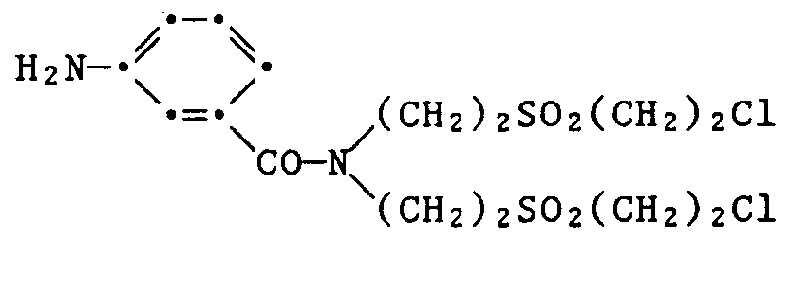
- Gegenstand der Erfindung sind Reaktivfarbstoffe der Formel D(̵U-A)1-2 (1), worin D der Rest eines Monoazo-, Polyazo-, Metallkomplexazo-, Anthrachinon-, Phthalocyanin-, Formazan-, Azomethin-, Dioxazin-, Phenazin-, Stilben-, Triphenylmethan-, Xanthen-, Thioxanthon-, Nitroaryl-, Naphthochinon-, Pyrenchinon- oder Perylentetracarbimid-Farbstoffes; -U-A einen Rest der Formel


- Der Rest D in Formel (1) kann an seinem Grundgerüst die bei organischen Farbstoffen üblichen Substituenten gebunden enthalten.
- Als Beispiele für weitere Substituenten im Rest D seien genannt: Alkylgruppen mit, 1 bis 4 Kohlenstoffatomen, wie Methyl, Aethyl, Propyl, Isopropyl oder Butyl, Alkoxygruppen mit 1 bis 4 Kohlenstoffatomen, wie Methoxy, Aethoxy, Propoxy, Isopropoxy oder Butoxy, Acylaminogruppen mit 1 bis 8 Kohlenstoffatomen, wie Acetylamino, Propionylamino oder Benzoylamino, Amino, Alkylamino mit 1 bis 4 Kohlenstoffatomen, wie Methylamino, Aethylamino; Propylamino, Isopropylamino oder Butylamino, Phenylamino, N,N-Di-ß-hydroxyäthylamino, N,N-Di-ß-sulfatoäthylamino, Sulfobenzylamino, N,N-Disulfobenzylamino, Alkoxycarbonyl mit 1 bis 4 Kohlenstoffatomen im Alkoxyrest, wie Methoxycarbonyl oder Aethoxycarbonyl, Alkylsulfonyl mit 1 bis 4 Kohlenstoffatomen, wie Methylsulfonyl oderAethylsulfonyl, Trifluormethyl, Nitro, Cyano, Halogen, wie Fluor, Chlor oder Brom, Carbamoyl, N-Alkylcarbamoyl mit 1 bis 4 Kohlenstoffatomen im Alkylrest, wie N-Methylcarbamoyl oder N-Aethylcarbamoyl, Sulfamoyl, N-Alkylsulfamoyl mit 1 bis 4 Kohlenstoffatomen, wie N-Methylsulfamoyl, N-Aethylsulfamoyl, N-Propylsulfamoyl, N-Isopropylsulfamoyl oder N-Butylsulfamoyl, N-(ß-Hydroxyäthyl)-sulfamoyl, N,N-Di-(ß-hydroxyäthyl)-sulfamoyl, N-Phenylsulfamoyl, Ureido, Hydroxy, Carboxy, Sulfomethyl oder Sulfo. Vorzugsweise enthält der Rest D eine oder mehrere Sulfonsäuregruppen. Reaktivfarbstoffe der Formel (1), worin D der Rest eines Azofarbstoffes ist, enthalten als Substituenten vor allem Methyl, Aethyl, Methoxy, Aethoxy, Acetylamino, Benzoylamino, Amino, Chlor, Brom, Ureido, Hydroxy, Carboxy, Sulfomethyl oder Sulfo.
- Als ß-Acyloxyäthyl kommt für Z bzw. Z' insbesondere der ß-Acetoxyäthylrest und als ß-Halogenäthyl insbesondere der ß-Chloräthylrest in Betracht.
- Der Rest B enthält 1 bis 6, vorzugsweise 1 bis 4 Kohlenstoffatome; Beispiele für B sind: Methylen, Aethylen, Propylen, Butylen, Methylenoxy, Aethylenoxy, Propylenoxy und Butylenoxy. Falls B einen Rest

- Die Reste R, B1 bzw. B2 sind, falls es sich um Alkylreste handelt, geradkettig oder verzweigt; sie können weitersubstituiert sein, z.B. durch Halogen, Hydroxy, Cyan, C1-C4-Alkoxy, C1-C4-Alkoxycarbonyl, Carboxy, Sulfamoyl, Sulfo oder Sulfato. Als Beispiele für R, B1 und B2 seien die folgenden Reste genannt: Methyl, Aethyl, Propyl, Isopropyl, Butyl, Isobutyl, sek.-Butyl, tert.-Butyl, Carboxymethyl, ß-Carboxyäthyl, ß-Carboxypropyl, Methoxycarbonylmethyl, Aethoxycarbonylmethyl, β-Methoxyäthyl, β-Aethoxyäthyl, β-Methoxypropyl, ß-Chloräthyl, y-Brompropyl, β-Hydroxyäthyl, β-Hydroxybutyl, β-Cyanäthyl, Sulfomethyl, ß-Sulfoäthyl, Aminosulfonylmethyl und ß-Sulfatoäthyl. Vorzugsweise ist R, B1 bzw. B2 Wasserstoff, Methyl oder Aethyl.
- Die als Anionen abspaltbaren Substituenten X und Y sind Fluor oder Chlor.
- Der Substituent Q ist z.B. Wasserstoff, Methyl, Aethyl, Propyl, Isopropyl, Butyl, Isobutyl, sek.-Butyl, tert.-Butyl, Methoxy, Aethoxy, Propyloxy, Isopropyloxy, Butyloxy, Isobutyloxy, sek.-Butyloxy, tert.Butyloxy, Fluor, Chlor, Brom, Carboxy oder Sulfo. Vorzugsweise ist Q eine Sulfogruppe und sein Index = 1.
- Der Rest-U-Akann ein- oder zweimal im Molekül vorhanden sein; beide Formelvarianten sind gleich wichtig. Falls ein Farbstoff der Formel (1) zwei derartige Formelteile enthält, können diese gleich oder verschieden sein; vorzugsweise sind sie gleich. Der AminosubstituentAweist zwei Reaktivreste auf, und zwar die Gruppen -S02-Z und -S02-Z'; diese Reaktivreste enthalten eine Abgangsgruppe, z.B. wenn Z bzw. Z' ß-Chloräthyl ist, oder sie können nach Art von faserreaktiven Gruppen wirksam werden, z.B. wenn Z bzw. Z' Vinyl ist (Grundlegendes über Reaktivfarbstoffe siehe Venkataraman, K.: The Chemistry of Synthetic Dyes. New York: Academic Press 1972; Vol. VI, Reactive Dyes).
- Ferner sind in Betracht zu ziehen, Reaktivfarbstoffe der Formel (1), worin der Rest D noch einen weiteren Reaktivrest einschliesst. Die zusätzlichen, in D eingeschlossenen Reaktivreste können über Aminogruppen, oder in anderer Weise z.B. durch eine direkte Bindung an D gebunden sein.
- Bevorzugte Ausführungsformen der Reaktivfarbstoffe der Formel (1) sind:
- a) Reaktivfarbstoffe der Formel (1), worin A ein Rest der Formel

Entsprechende Aminosubstituenten A sind beispielsweise:- 2,5-Bis-ß-chloräthylsulfonylpentylamino,
- 2,5-Bis-ß-sulfatoäthylsulfonylpentylamino,
- 2,5-Bis-vinylsulfonylpentylamino,
- 2,4-Bis-ß-chloräthylsulfonylbutylamino und
- 2,3-Bis-ß-chloräthylsulfonylpropylamino. Vorzugsweise ist A einer der drei zuerst genannten Reste.
- b) Reaktivfarbstoffe der Formel (1), worin -U-A einer der Reste der Formeln (2c) bis (2f), R Wasserstoff,
Methyl oder Aethyl; B1 und B2 Wasserstoff; Q Sulfo; und X und Y Fluor- oder Chloratome sind.
Die Triazinsubstituenten in den Formeln (2d) und (2e) haben vorzugsweise die Form

Bevorzugt sind weiterhin: - c) Reaktivfarbstoffe der Formel (1), worin D der Rest eines Mono- oder Disazofarbstoffes ist.
- d) Reaktivfarbstoffe der Formel (1), worin D der Rest eines Metallkomplexazo-oder Formazanfarbstoffes ist.
- e) Reaktivfarbstoffe der Formel (1), worin D der Rest eines Anthrachinonfarbstoffes ist.
- f) Reaktivfarbstoffe der Formel (1), worin D der Rest eines Phthalocyaninfarbstoffes ist.
- g) Reaktivfarbstoffe der Formel (1), worin D der Rest eines Dioxazinfarbstoffes ist.
- h) Reaktivfarbstoffe gemäss c), worin D ein Mono- oder Disazofarbstoffrest der Formel


- i) Reaktivfarbstoffe gemäss c), worin D ein Disazofarbstoffrest der Formel


- j) Reaktivfarbstoffe gemäss d), worin D der Rest eines 1:1-Kupferkomplexazofarbstoffes der Benzol- oder Naphthalinreihe ist, und das Kupferatom an je eine metallisierbare Gruppe beidseitig in ortho-Stellung zur Azobrücke gebunden ist.
- k) Reaktivfarbstoffe gemäss d), worin D der Rest eines Formazanfarbstoffes der Formel

- I) Reaktivfarbstoffe gemäss e), worin D der Rest eines Anthrachinonfarbstoffes der Formel

- m) Reaktivfarbstoffe gemäss f), worin D der Rest eines Phthalocyaninfarbstoffes der Formel


Bevorzugt sind insbesondere Reaktivfarbstoffe gemäss h) oder i), der nachfolgenden Formeln (9) bis (25):


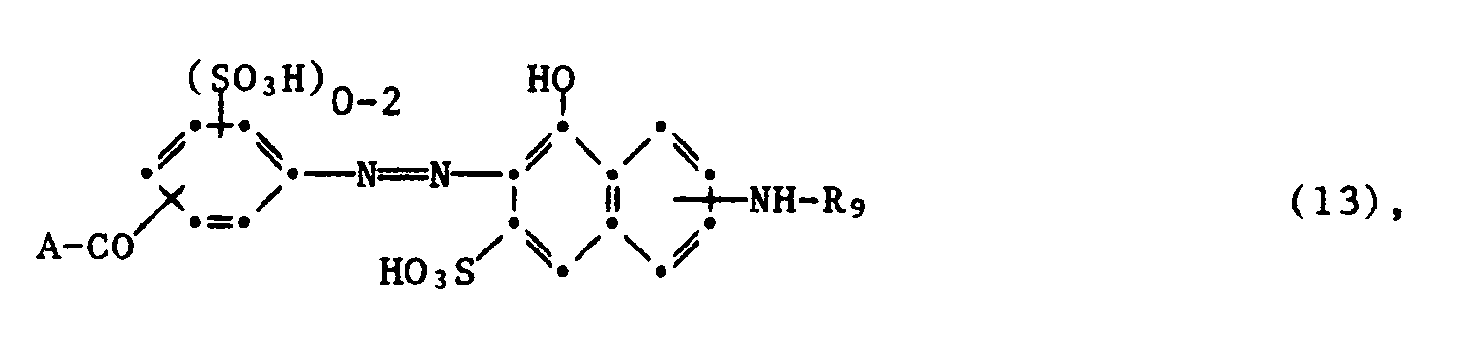


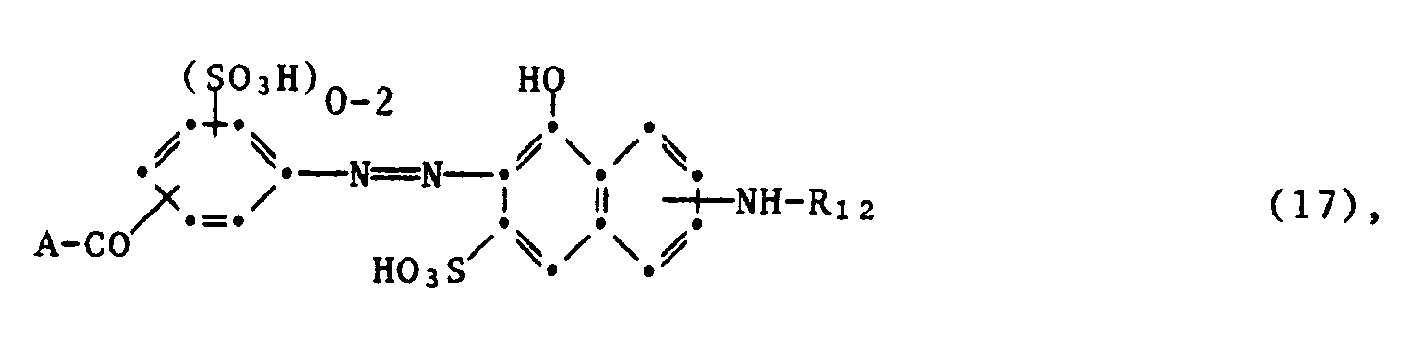
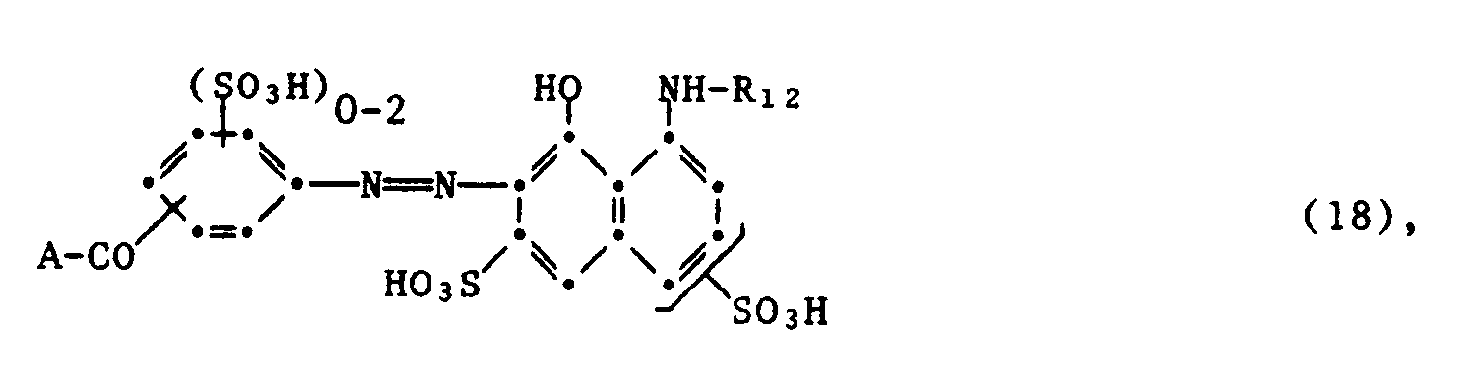


- Bevorzugt sind ausserdem Schwermetallkomplexe von Reaktivfarbstoffen der Formel (1); als komplexbildende Schwermetalle kommen vor allem Kupfer, Nickel, Kobalt oder Chrom in Betracht.
- Bevorzugt sind insbesondere Reaktivfarbstoffe der Formel (1), worin Z und Z' die ß-Sulfatoäthyl-, ß-Chloräthyl- oder Vinylgruppe ist, und worin X bzw. Y in den Formeln (2c) bis (2f) Fluor oder Chlor ist. In Betracht zu ziehen sind insbesondere auch Kombinationen von Merkmalen gemäss der vorhergehenden Beschreibung, sofern anwendbar.
- Falls R12 in den Formeln (16) bis (18) ein Halogentriazinrest ist, handelt es sich vorzugsweise um einen Monochlor- oder Monofluortriazinrest, der einen nichtfaserreaktiven Substituenten enthält, z.B. -NH2, ß-Sulfo- äthylamino, ß-Hydroxyäthylamino, N,N-Di-ß-hydroxyäthylamino, Anilino, Toluidino, Sulfoanilino, Morpholino, Methoxy, Isopropoxy oder dergleichen. Als nichtfaserreaktiver Substituent kommt insbesondere der Rest eines aliphatischen, aromatischen oder heterocyclischen Amins oder auch der Rest eines gemischt aliphatisch-aromatischen, aliphatisch-heterocyclischen oder aromatisch-heterocyclischen Amins in Betracht. Beispiele sind: Alkylamino-, N,N-Dialkylamino-, Cycloalkylamino-, N,N-Dicycloalkylamino-, Aralkylamino-, Arylaminogruppen, gemischt substituierte Aminogruppen, wie N-Alkyl-N-cyclohexylamino- und N-Alkyl-N-arylaminogruppen, ferner Aminogruppen, die heterocyclische Reste enthalten, welche weitere ankondensierte carbocyclische Ringe aufweisen können, sowie Aminogruppen, worin das Aminostickstoffatom Glied eines N-heterocyclischen Ringes ist, der gegebenenfalls weitere Heteroatome enthält. Falls es der Rest eines aliphatischen Amins ist, handelt es sich vorzugsweise um Alkylamino- oder N,N-Dialkylaminogruppen, worin die Alkylketten auch durch andersartige Atome oder Gruppen, wie -O-, -NH-oder -CO-, unterbrochen sein können. Die Alkylreste können geradkettig oder verzweigt, niedrigmolekular oder höhermolekular sein, bevorzugt sind Alkylreste mit 1 bis 6 Kohlenstoffatomen; als Cycloalkyl-, Aralkyl- und Arylreste kommen insbesondere Cyclohexyl-, Benzyl-, Phen- äthyl-, Phenyl- und Naphthylreste in Frage; heterocyclische Reste sind vor allem Furan-, Thiophen-, Pyrazol-, Pyridin-, Pyrimidin-, Chinolin-, Benzimidazol-, Benzthiazol- und Benzoxazolreste; und als Aminogruppen, worin das Aminostickstoffatom Glied eines N-heterocyclischen Ringes ist, kommen vorzugsweise Reste von sechsgliedrigen N-heterocyclischen Verbindungen in Betracht, die als weitere heteroatome Stickstoff, Sauerstoff oder Schwefel enthalten können. Die oben genannten Alkyl-, Cycloalkyl-, Aralkyl- und Arylreste, die heterocyclischen Reste, sowie die N-heterocyclischen Ringe können ausserdem weitersubstituiert sein, z.B. durch: Halogen, wie Fluor, Chlorund Brom, Nitro, Cyan, Trifluormethyl, Sulfamoyl, Carbamoyl, C1-C4-Alkyl, C1-C4-Alkoxy, Acylaminogruppen, wie Acetylamino oder Benzoylamino, Ureido, Hydroxy, Carboxy, Sulfomethyl oder Sulfo.
- Man erhält die Reaktivfarbstoffe der Formel (1), indem man in einen organischen Farbstoff mit dem Rest D oder in ein Farbstoffvorprodukt einen Rest oder zwei Reste der Formel
- -U-A (1b)
- Das molare Verhältnis der Ausgangsstoffe muss der Zusammensetzung des Endprodukts entsprechend gewählt werden, je nachdem ob nur ein Rest oder zwei Reste der Formel (1 b) in dem Reaktivfarbstoff der Formel (1) vorhanden sein sollen.
- Gegebenenfalls wird an das erfindungsgemässe Verfahren eine weitere Umwandlungsreaktion angeschlossen. Bei der Herstellung der Endfarbstoffe aus Vorprodukten handelt es sich vor allem um Kupplungen, die zu Azofarbstoffen führen.
- Da die einzelnen oben angegebenen Verfahrensschritte in unterschiedlicher Reihenfolge, gegebenenfalls teilweise auch gleichzeitig, ausgeführtwerden können, sind verschiedene Verfahrensvarianten möglich. Im allgemeinen führt man die Umsetzung schrittweise nacheinander aus, wobei die Reihenfolge der einfachen Reaktionen zwischen den einzelnen Reaktionskomponenten vorteilhafterweise sich nach den besonderen Bedingungen richtet.
- Dabei hängt es von der Struktur der Ausgangsstoffe ab, welche der möglichen Verfahrensvarianten die besten Resultate ergeben, oder unter welchen speziellen Bedingungen, z.B. bei welcher Kondensationstemperatur, die Reaktion am vorteilhaftesten auszuführen ist.
- Da unter bestimmten Voraussetzungen Hydrolyse eines Halogentriazinrestes eintritt, muss ein Zwischenprodukt, welches Acetylaminogruppen enthält, zwecks Abspaltung der Acetylgruppen verseift werden, bevor mit einem Halogentriazin kondensiert wird. Welche Reaktion z.B. bei der Herstellung eines sekundären Kondensationsproduktes aus einer Verbindung der Formel H-A, dem Triazin und dem organischen Farbstoff oder einem Vorprodukt zweckmässigerweise zuerst ausgeführt wird, die des Triazins mit der Verbindung der Formel H-A oder mit dem organischen Farbstoff oder einem Vorprodukt des Farbstoffs, ist von Fall zu Fall verschieden und richtet sich vor allem nach der Löslichkeit der beteiligten Aminoverbindungen und der Basizität der zu acylierenden Aminogruppen.
- Eine abgewandelte Ausführungsform des Verfahrens besteht darin, zunächst einen Farbstoff herzustellen, der eine Vorstufe des Reaktivrestes enthält, und diese nachträglich in die Endstufe umzuwandeln, z.B. durch Veresterung oder eine Additionsreaktion. Beispielsweise kann man einen Farbstoff, worin Z ein Rest HOCH2CH2-ist, herstellen und das Zwischenprodukt vor oder nach der Acylierung mit Schwefelsäure umsetzen, so dass die Hydroxygruppe in die Sulfatogruppe übergeführt wird; oder man verwendet einen analogen Farbstoff, worin Z die Gruppe H2C=CH- ist, und lagert an das Zwischenprodukt Thioschwefelsäure an, wobei ein Rest H03SS-CH2CH2-entsteht. Die Sulfatierung der Hydroxygruppe in einem Farbstoff der Formel (1) oder einem geeigneten Vorprodukt, erfolgt z.B. durch Umsetzung mit konzentrierter Schwefelsäure bei 0°C bis mässig erhöhter Temperatur. Die Sulfatierung kann auch durch Reaktion der Hydroxyverbindung mit zwei Aequivalenten Chlorsulfonsäure pro Hydroxygruppe in einem polaren organischen Lösungsmittel, wie beispielsweise N-Methylpyrrolidon, bei 10 bis 80°C erfolgen. Vorzugsweise erfolgt die Sulfatierung durch Eintragen der betreffenden Verbindung in Schwefelsäuremonohydrat bei Temperaturen zwischen 5 und 15°C. Die Einführung eines anderen Restes für Z in eine Verbindung der Formel (1) oder ein Zwischenprodukt anstelle eines Halogenatoms oder der Sulfatogruppe, beispielsweise einer Thiosulfato- oder Phosphatogruppe, erfolgt in an sich bekannter Weise. Der Weg der Herstellung über eine Zwischenstufe des Reaktivrestes geht in vielen Fällen einheitlich und vollständig.
- Ausserdem können Eliminierungsreaktionen an die Synthese angeschlossen werden. Beispielsweise kann man Reaktivfarbstoffe der Formel (1), welche Sulfatoäthylsulfonylreste enthalten, mit halogenwasserstoffabspaltenden Mitteln, wie Natriumhydroxid, behandeln, wobei die Sulfatoäthylsulfonylreste in Vinylsulfonylreste übergehen.
- Gegebenenfalls ist eine Verfahrensvariante anwendbar, bei welcher man von Farbstoffvorprodukten ausgeht. Diese Variante ist geeignet zur Herstellung von Reaktivfarbstoffen der Formel (1), worin D der Rest eines aus zwei oder mehr als zwei Komponenten zusammengesetzten Farbstoffes ist, beispielsweise eines Monoazo-, Disazo-, Trisazo-, Metallkomplexazo-, Formazan- oder Azomethinfarbstoffes.
- Grundsätzlich lassen sich die Reaktivfarbstoffe der Formel (1) sämtlicher Farbstoffklassen in an sich bekannterweise oder analog zu bekannten Verfahrensweisen herstellen, indem man von Vorprodukten oderZwischenprodukten für Farbstoffe, die faserreaktive Reste gemäss Formel (1) enthalten, ausgeht, oder diese faserreaktiven Reste in hierfür geeignete Zwischenprodukte mit Farbstoffcharakter einführt.
- Bevorzugt sind Reaktivfarbstoffe der Formel (1), worin D der Rest eines Mono- oder Disazofarbstoffes oder eines Metallkomplexazofarbstoffes ist. In diesem Falle sind die Reste der Formel (1b) an die Diazo-und/oder Kupplungskomponenten gebunden. Falls in einem Reaktivfarbstoff der Formel (1) zwei Reste der Formel (1 b) enthalten sind, ist vorzugsweise je ein Rest der Formel (1 b) an eine Komponente, d.h. an eine Diazokomponente oder Kupplungskomponente, gebunden. Die Reaktivfarbstoffe haben somit z.B. die Formeln


- Falls man von Farbstoffvorprodukten ausgeht, gelangt man zu Reaktivfarbstoffen der Formel (1), indem man z.B. eine Komponente des Farbstoffes der Formel (1), die eine Gruppe -N(R)H enthält, und ein Triazin kondensiert, vorher oder nachher mit einer Verbindung der Formel H-A kondensiert, und mit der anderen Komponente des Farbstoffes der Formel (1) umsetzt. Bei der Herstellung der bevorzugten Azofarbstoffe müssen die Diazokomponenten und die Kupplungskomponenten zusammen mindestens eine Aminogruppe -N(R)H, und können weitere Aminogruppen enthalten. Man verwendet in diesem Falle als Diazokomponenten vor allem die 1,3-Phenylendiamin-4-sulfonsäure, 1,4-Phenylendiamin-2-sulfonsäure, 1,4-Phenylendiamin-2,5-disulfonsäure oder 1,3-Phenylendiamin-4,6-disulfonsäure. Gegebenenfalls verwendet man entsprechende Acetylamino- oder Nitroverbindungen, worin die Acetylamino- bzw. Nitrogruppe vor der Kondensation mit dem Triazin durch Verseifen bzw. Reduzieren in die H2N-Gruppe übergeführt wird.
- Liegen in den hergestellten Reaktivfarbstoffen zur Metallkomplexbildung befähigte Gruppen, wie Hydroxy, Carboxy, Amino oder Sulfo, vor, können die Reaktivfarbstoffe auch nachträglich metallisiert werden. Beispielsweise erhält man Metallkomplexazofarbstoffe, indem man erfindungsgemäss erhaltene Azoverbindungen, welche in ortho-ortho'-Stellung zurAzobrücke komplexbildende Gruppen, z.B. Hydroxy-oderCarboxygruppen, enthalten, vor oder gegebenenfalls auch nach der Kondensation mit dem Triazin mit schwermetallabgebenden Mitteln behandelt. Von besonderem Interesse sind Kupferkomplexe von Reaktivfarbstoffen der Formel (1). Als Methode der Metallisierung kommt ausser der oben genannten auch die entalkylierende Metallisierung und, für die Herstellung von Kupferkomplexen, die oxydative Kupferung in Betracht.
- Die wichtigsten Verfahrensvarianten sind in den Ausführungsbeispielen dargestellt.
- Im folgenden sollen mögliche Ausgangsstoffe, die zur Herstellung der Reaktivfarbstoffe der Formel (1) verwendet werden können, einzeln genannt werden.
- Organische Farbstoffe zur Herstellung von Reaktivfarbstoffen der Formeln (16) bis (25) etc.


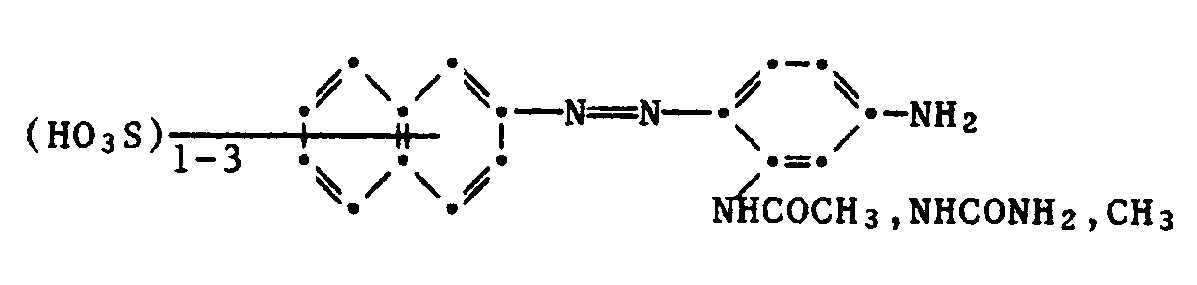


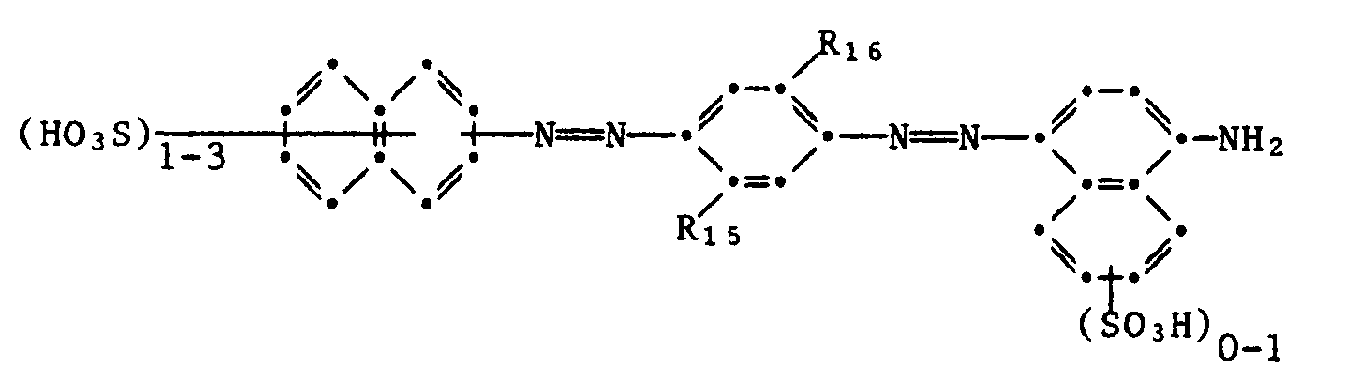


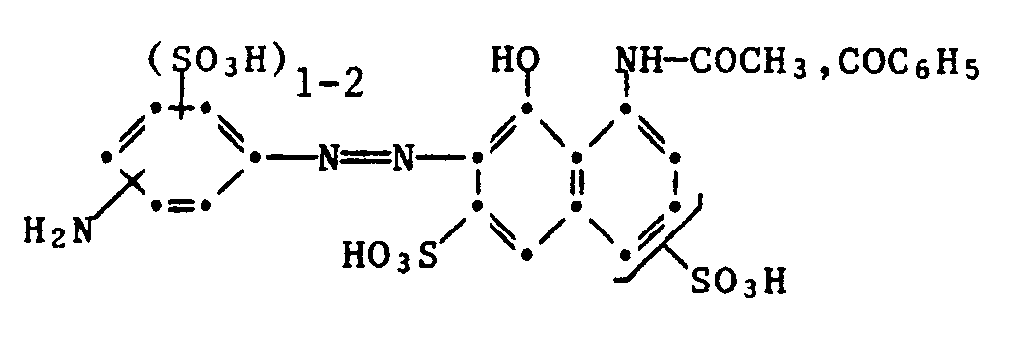
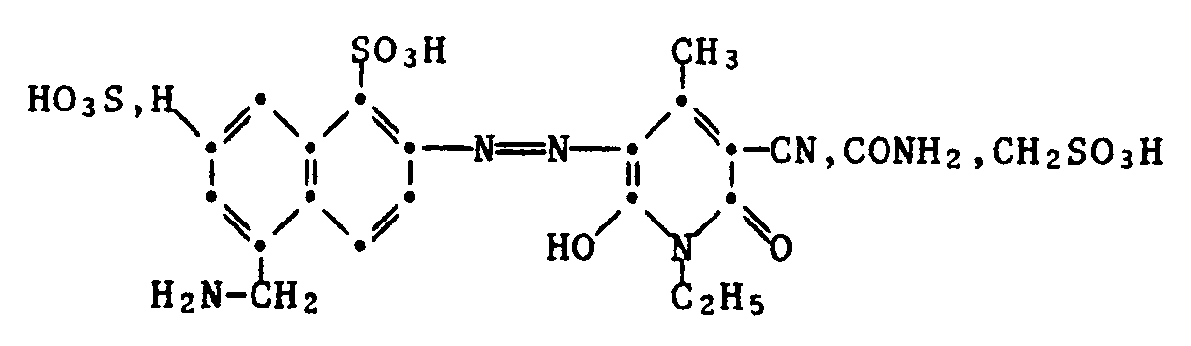
- Metallkomplexe von Farbstoffen der Formeln:


- Als Metallatome sind Cu (1:1-Komplex) oder Cr und Co (1:2-Komplex) bevorzugt. Cr- und Co-Komplexe können die Azoverbindung der oben angegebenen Formel einmal oder zweimal enthalten, d.h. sie können symmetrisch oder mit beliebigen anderen Liganden unsymmetrisch aufgebaut sein.


- In dieser Formel steht Pc für den Cu- oder Ni-Phthalocyaninrest, die Gesamtzahl der Substituenten am Pc-Gerüst ist 4.


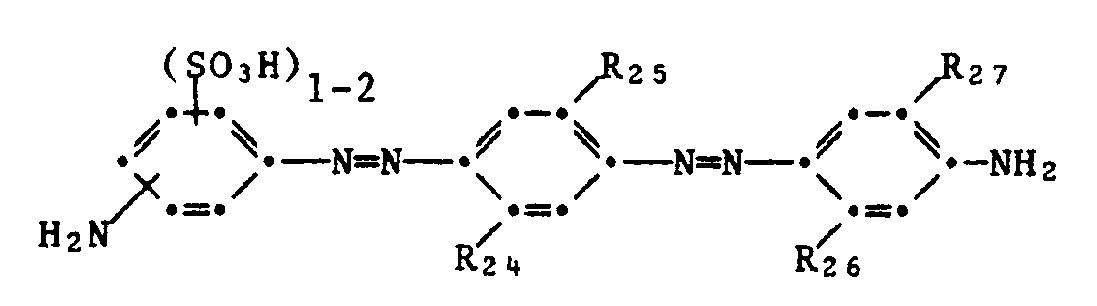


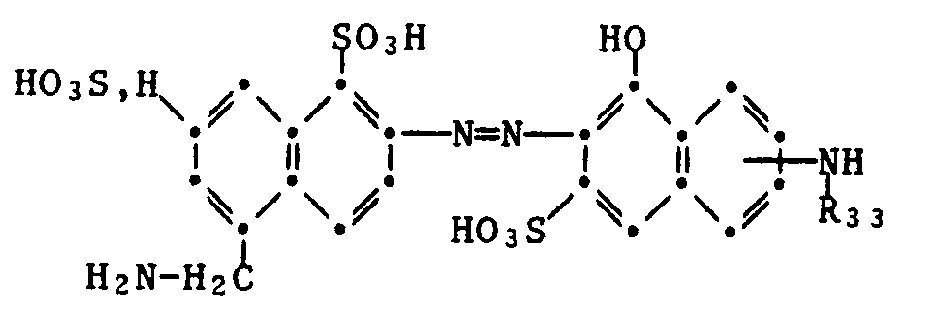


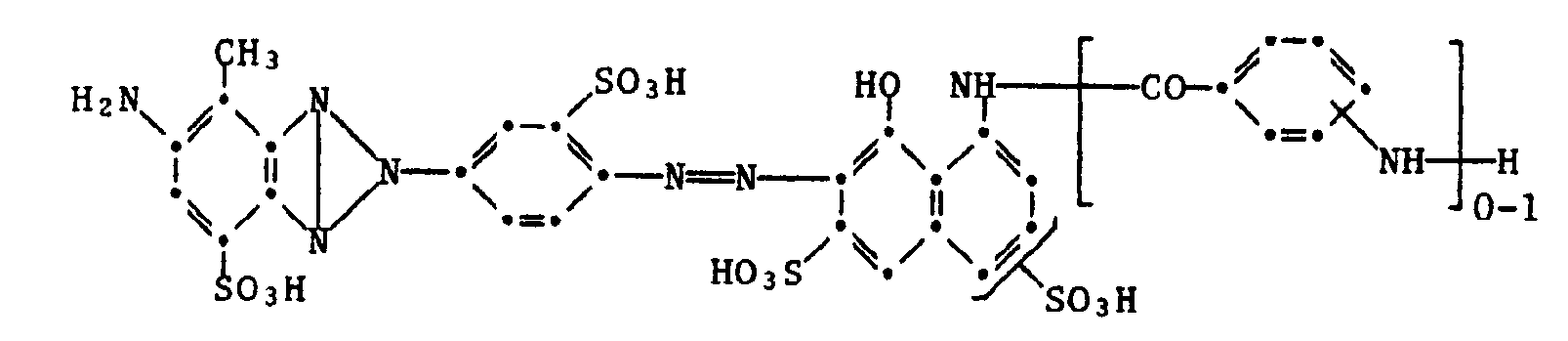


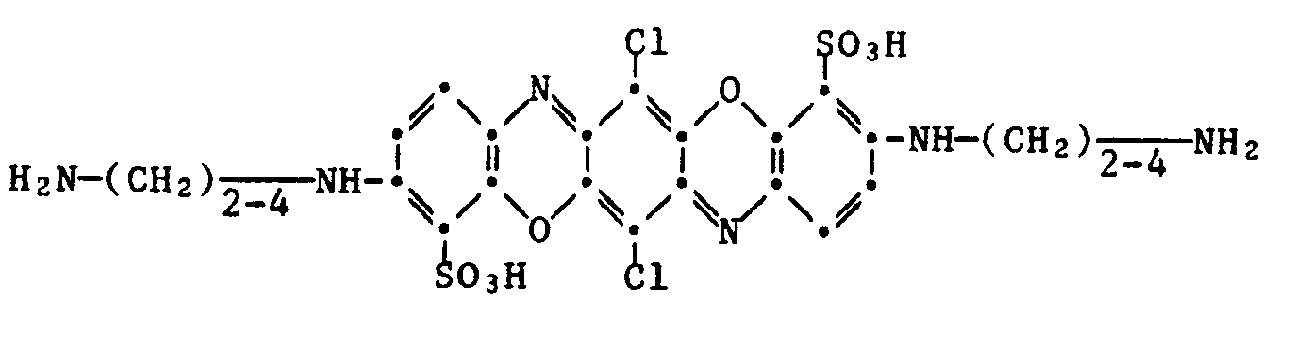

- In den oben aufgeführten Formeln bedeuten die Reste R17 bis R23 und R30 bis R33 Wasserstoff oder C1-C4-Alkyl, und die Reste R15' R16 und R24 bis R29 Wasserstoff, C1-C4-Alkyl, C1-C4-Alkoxy, C1-C4-Alkanoylamino, Ureido oder Halogen, wobei die Reste R15' R16 ... etc., die zu ein und derselben Formel gehören, voneinander unabhängig sind. Vorzugsweise bedeuten die Reste R17 bis R23 und R30 bis R33 Wasserstoff, Methyl oder Aethyl, und die Reste R15' R16 und R24 bis R29 Wasserstoff, Methyl, Aethyl, Methoxy, Aethoxy, Acetylamino, Ureido oder Chlor. Die aromatischen Ringe in den obigen Farbstoffen können weitersubstituiert sein, die Benzolringe vor allem durch Methyl, Aethyl, Methoxy, Aethoxy, Methylsulfonyl, Aethylsulfonyl, Carboxy, Acetylamino oder Chlor, und die Naphthalinringe insbesondere durch Methoxy, Carboxy, Acetylamino, Nitro oder Chlor; gleiches gilt für die Anthrachinone, Dioxazine usw. Vorzugsweise sind die Benzolringe nicht weitersubstituiert.
- Als Diazo- und Kupplungskomponenten seien einzeln genannt:
- Aminobenzol, 1-Amino-2-, -3- oder -4-methylbenzol, 1-Amino-2-, -3-oder-4-methoxybenzol, 1-Amino-2-, - 3- oder -4-chlorbenzol, 1-Amino-2,5-dichlorbenzol, 1-Amino-2,5-dimethylbenzol, 1-Amino-3-methyl-6-methoxybenzol, 1-Amino-2-methoxy-4-nitrobenzol, 4-Aminobiphenyl, 1-Aminobenzol-2-, -3-oder-4-carbonsäure, 2-Aminodiphenyläther, 1-Aminobenzol-2-, -3- oder-4-sulfonsäureamid, -N-methylamid, -N-äthylamid, -N,N-di- methylamid oder -N,N-diäthylamid, Dehydrothio-p-toluidin-sulfonsäure, 1-Amino-3-trifluormethyl-6-sulfonsäure, 1-Amino-3- oder -4-nitrobenzol, 1-Amino-3- oder -4-acetylaminobenzol, 1-Aminobenzol-2-, -3- oder -4-sulfonsäure, 1-Aminobenzol-2,4- und -2,5-disulfonsäure, 1-Amino-4-methylbenzol-2-sulfonsäure, 1-Amino-3-methylbenzol-6-sulfonsäure, 1-Amino-6-methylbenzol-3-oder -4-sulfonsäure, 1-Amino-2-carboxybenzol-4-sulfonsäure, 1-Amino-4-carboxybenzol-2-sulfonsäure, 1-Amino-4- oder -5-chlorbenzol-2-sulfonsäure, 1-Amino-6-chlorbenzol-3- oder -4-sulfonsäure, 1-Amino-3,4-dichlorbenzol-6-sulfonsäure, 1-Amino-2,5-dichlorbenzol-6-sulfonsäure, 1-Amino-2,5-dichlorbenzol-4-sulfonsäure, 1-Amino-4-methyl-5-chlorbenzol-2-sulfonsäure, 1-Amino-5-methyl-4-chlorbenzol-2-sulfonsäure, 1-Amino-4- oder -5-methoxybenzol-2-sulfonsäure, 1-Amino-6-methoxybenzol-3- oder -4-sulfonsäure, 1-Amino-6-äthoxybenzol-3-oder -4-sulfonsäure, 1-Amino-2,4-dimethoxybenzol-6-sulfonsäure, 1-Amino-2,5-dimethoxybenzol-4-sulfonsäure, 1-Amino-3-acetylaminobenzol-60-sulfonsäure, 1-Amino-4-acetylaminobenzol-2-sulfonsäure, 1-Amino-3-acetylamino-4-methyl- benzo-6- sulfonsäure, 2-Amino-1-methylbenzol-3,5-disulfonsäure, 1-Amino-4-methoxybenzol-2,5-disulfonsäure, 1-Amino-3- oder -4-nitrobenzol-6-sulfonsäure, 1-Aminonaphthalin, 2-Aminonaphthalin, 1-Aminonaphthalin-2-, -4-, -5-, -6-, -7- oder -8-sulfonsäure, 2-Aminonaphthalin-1-, -3-, -4-, -5-, -6-, -7- oder 8-sulfonsäure, 1-Aminonaphthalin-3,6-oder-5,7-disulfonsäure, 2-Aminonaphthalin-1,5-, -1,7-, -3,6-, -5,7-, -4,8-oder-6,8-disulfonsäure, 1-Aminonaphthalin-2,5,7-trisulfonsäure, 2-Aminonaphthalin-1,5,7-, -3,6,8- oder -4,6,8-trisulfonsäure, 1-Hydroxy-2-aminobenzol-4-sulfonsäure, 1-Hydroxy-2-aminobenzol-5-sulfonsäure, 1-Hydroxy-2-aminobenzol-4,6-disulfonsäure, 1-Hydroxy-2-amino-4-acetylaminobenzol-6-sulfonsäure, 1-Hydroxy-2-amino-6-acetylaminobenzol-4-sulfonsäure, 1-Hydroxy-2-amino-4-chlorbenzol-5-sulfonsäure, 1-Hydroxy-2-amino-4-methylsulfonylbenzol, 1-Amino-2-hydroxy-6-nitronaphthalin-4-sulfonsäure, 2-Amino-1-hydroxynaphthaiin-4,8- disulfonsäure, 4-Aminoazobenzol-3,4'-disulfonsäure, 3-Methoxy-4-amino-6-methylazobenzol-2',4'-disulfonsäure, 3-Methoxy-4-amino-6-methylazobenzol-2',5'-disulfonsäure, 1,3-Diaminobenzol, 1,4-Diaminobenzol, 1,3-Diamino-4-chlorbenzol, 1,3-Diamino-4-methylbenzol, 1,3-Diamino-4-äthylbenzol, 1,3-Diamino-4-methoxybenzol, 1,3-Diamino-4-äthoxybenzol, 1,4-Diamino-2-methylbenzol, 1,4-Diamino-2-methoxybenzol, 1,4-Diamino-2-äthoxybenzol, 1,4-Diamino-2-chlorbenzol, 1,4-Diamino-2,5-dimethylbenzol, 1,4-Diamino-2,5-diäthylbenzol, 1,4-Diamino-2-methyl-5-methoxybenzol, 1,4-Diamino-2,5-dimethoxybenzol, 1,4-Diamino-2,5-diät- hoxybenzol, 2,6-Diamino-naphthalin, 1,3-Diamino-2,4,6-trimethylbenzol, 1,4-Diamino-2,3,5,6-tetramethylbenzol, 1,3-Diamino-4-nitrobenzol, 4,4'-Diaminostilben, 4,4'-Diaminodiphenylmethan, 4,4'-Diaminobiphenyl (Benzidin), 3,3'-Dimethylbenzidin, 3,3'-Dimethoxybenzidin, 3,3'-Dichlor-benzidin, 3,3'-Dicarboxybenzidin, 3,3'-Dicarboxymethoxy-benzidin, 2,2'-Dimethylbenzidin, 4,2'-Diaminodiphenyl (Diphenylin), 2,6-Diamino-naphthalin-4,8-disulfonsäure, 1,4-Diaminobenzol-2-sulfonsäure, 1,4-Diaminobenzol-2,5-disulfonsäure, 1,4-Diaminobenzol-2,6-disulfonsäure, 1,3-Diaminobenzol-4-sulfonsäure, 1,3-Diaminobenzol-4,6-disulfonsäure, 1,4-Diamino-2-chlorbenzol-5-sulfonsäure, 1,4-Diamino-2-methylbenzol-5-sulfonsäure, 1,5-Diamino-6-methylbenzol-3-sulfonsäure, 1,3-Diamino-6-methylbenzol-4-sulfonsäure, 3-(3'- bzw. 4'-Aminobenzoylamino)-1-aminobenzol-6-sulfonsäure, 1-(4'-Aminobenzoylamino)-4-aminobenzol-2,5-disulfonsäure, 1,4-Diaminobenzol-2-carbonsäure, 1,3-Diaminobenzol-4-carbonsäure, 1,2-Diaminobenzol-4-carbonsäure, 1,3-Diaminobenzol-5-carbonsäure, 4,4'-Diaminodiphenyloxid, 4,4'-Diaminodiphenylharnstoff-2,2'-disulfonsäure, 4,4'-Diaminodi- phenyloxyäthan-2,2'-disulfonsäure, 4,4'-Diaminostilben-2,2'-disulfonsäure, 4,4'-Diaminodiphenyläthan-2,2'- disulfonsäure, 2-Amino-5-aminomethyInaphthalin-1-sulfonsäure, 2-Amino-5-aminomethylnaphthalin-1,7-disulfonsäure, 1-Amino-4-methoxy-5-aminomethylbenzol-6-sulfonsäure.
- Wenn als Diazokomponente statt eines Diamins eine Amino-acetylaminoverbindung eingesetzt werden soll, aus welcher nachträglich die Acetylgruppe durch Verseifen wieder abgespalten wird, wie dies oben in den Erläuterungen der Verfahrensvarianten beschrieben ist, kommen die Monoacetylverbindungen der oben genannten Diazokomponenten in Frage, z.B. 1-Acetylamino-3-aminobenzol-4-sulfonsäure oder 1-Acetylamino-4-aminobenzol-3-sulfonsäure.
- Phenol, 1-Hydroxy-3- oder -4-methylbenzol, 1-Hydroxybenzol-4-sulfonsäure, 1-Hydroxynaphthalin, 2-Hydroxynaphthalin, 2-Hydroxynaphthalin-6-oder-7-sulfonsäure,2-Hydroxynaphthalin-3,6-oder-6,8-disulfonsäure, 1-Hydroxynaphthalin-4-sulfonsäure, 1-Hydroxynaphthalin-4,6- oder -4,7-disuifonsäure, 1-Amino-3-methylbenzol, 1-Amino-2-methoxy-5-methylbenzol, 1-Amino-2,5-dimethylbenzol, 3-Aminophenylharnstoff, 1-Amino-3-acetylaminobenzol, 1-Amino-3-hydroxyacetylaminobenzol, 1,3-Diaminobenzol-4-sulfonsäure, 1-Amino-naphthalin-6- oder -8-sulfonsäure, 1-Amino-2-methoxynaphthalin-6-sulfonsäure, 2-Aminonaphthalin-5,7-disulfonsäure, 1-Amino-8-hydroxynaphthalin-4-sulfonsäure, 1-Amino-8-hydroxynaphthalin-6-sulfonsäure, 1-Amino-8-hydroxynaphthalin-2,4-disulfonsäure, 2-Hydroxy-3-aminonaphthalin-5,7-disulfonsäure, 1-Amino-8-hydroxynaphthalin-2,4,6-trisulfonsäure, 1-Hydroxy-8-acetylaminonaphthalin-3-sulfonsäure, 1-Benzoylamino-8-hydroxynaphthalin-3,6- oder -4,6-disulfonsäure, 2-Benzoylamino-5-hydroxynaphthalin-7-sulfonsäure, 2-Amino-5-hydroxynaphthalin-7-sulfonsäure, 2-Methyl- bzw. 2-Aethylamino-5-hydroxynaphthalin-7-sulfonsäure, 2-(N-Acetyl-N-methylamino)-5-hydroxynaphthalin-7-sulfonsäure, 2-Acetylamino-5-hydroxynaphthalin-7-sulfonsäure, 2-Amino-5-hydroxynaphthalin-1,7-disulfonsäure, 2-Amino-8-hydroxynaphthalin-6-sulfonsäure, 2-Methyl- bzw. -Aethylamino-8-hydroxynaphthalin-6-sulfonsäure, 2-(N-Acetyl-N-methylamino)-8-hydroxynaphthalin-6-sulfonsäure, 2-Acetylamino-8-hydroxynaphthalin-6-sulfonsäure, 2-Amino-8-hydroxynaphthalin-3,6- disulfonsäure, 2-Acetylamino-8-hydroxynaphthalin-3,6-disulfonsäure, 1-Amino-5-hydroxynaphthalin-7-sulfonsäure, 1-Amino-8-hydroxynaphthalin-3,6-bzw. -4,6-disulfonsäure, 1-Acetylamino-8-hydroxynaphthalin-3,6- bzw. -4,6-d isulfonsäure, 1-(4'-Aminobenzoylamino)-8-hydroxynaphthalin-3,6-bzw. -4,6-disulfonsäure, 1-(4'-Ni- i-trobenzoylamino)-8-hydroxynaphthalin-3,6-bzw. -4,6-disulfonsäure, 1-(3'-Aminobenzoylamino)-8-hydroxynaphthalin-3,6-bzw. -4,6-disulfonsäure, 1-(3'-Nitrobenzoylamino)-8-hydroxynaphthalin-3,6- bzw. -4,6- disulfonsäure, 2-(4'-Amino-3'-sulfophenylamino)-5-hydroxynaphthalin-7-sulfonsäure, 3-Methylpyrazolon-(5), 1-Phenyl-3-methyl-5-pyrazolon, 1-(4'-Sulfophenyl)-3-methyl-5-pyrazolon, 1-(4'Sulfophenyl)-pyrazolon-(5)-3-carbonsäure, 1-(3'-Aminophenyl)-3-methyl-5-pyrazolon, 1-(2',5'-Disulfophenyl)-3-methyl-5-pyrazolon, 1-(2'-Methyl-4'-sulfophenyl)-5-pyrazolon-3-carbonsäure, 1-(4',8'-Disulfonaphthyl-[2'])-3-methyl-5-pyrazolon, 1-(5',7'-Disulfonaphthyl-[2'])-3-methyl-5-pyrazolon, 1-(2',5'-Dichlor-4'-sulfophenyl)-3-methyl-5-pyrazolon, 3-Aminocarbonyl-4-methyl-6-hydroxypyridion-(2), 1-Aethyl-3-cyan- oder -3-chlor-4-methyl-6-hydroxypyridon-(2), 1-Aethyl-3-sulfomethyl-4-methyl-6-hydroxypyridon-(2), 2,4,6-Triamino-3-cyanpyridin, 2-(3'-Sulfophe- nylamino)-4,6-diamino-3-cyanpyridin, 2-(2'-Hydroxyäthyl- amino)-3-cyan-4-methyl-6-aminopyridin, 2,6-Bis-(2'-hydroxyäthylamino)-3-cyan-4-methylpyridin, 1-Aethyl-3-Carbamoyl-4-methyl-6-hydroxypyridon-(2), 1-Aethyl-3-sulfomethyl-4-methyl-5-carbamoyl-6-hydroxypyridon-(2), N-Acetoacetylaminobenzol, 1-(N-Acetoace- tylamino)-2-methoxybenzol-5-sulfonsäure, 4-Hydroxychinolon-(2), 1-Amino-8-hydroxy-2-(phenylazo)-naphthalin-3,6-disulfonsäure, 1-Amino-8-hydroxy-2-(4'-sulfophenylazo)-naphthalin-3,6-disulfonsäure, 1-Amino-8-hydroxy-2-(2',5'-disulfophenylazo)-naphthalin-3,6-disulfonsäure, 1-ß-Aminoäthyl-3-cyan-4-methyl-6-hydroxy- pyridon-(2), 1-y-Aminopropyl-3-sulfomethyl-4-methyl-6-hydroxypyridon-(2), 1,3-Diaminobenzol, 1-Amino-3-N,N-di-ß-hydroxyäthylaminobenzol, 1-Amino-3-N,N-di-ß-sulfatoäthylaminobenzol, 1-Amino-3-N,N-di-ß-hydroxyäthylamino-4-methoxybenzol, 1-Amino-3-N,N-di-ß-sulfatoäthylamino-4-methoxybenzol, 1-Amino-3- sulfobenzylaminobenzol, 1-Amino-3-sulfo-benzylamino-4-chlorbenzol, 1-Amino-3-N,N-disulfobenzylaminobenzol.
- 2,4,6-Trifluor-s-triazin (Cyanurfluorid), 2,4,6-Trichlor-s-triazin (Cyanurchlorid), 2,4,6-Tribrom-s-triazin (Cyanurbromid), 2,4,6-Trisulfo-s-triazin, 2,4,6-Tris-methylsulfonyl-s-triazin, 2,4,6-Trisphenyl-sulfonyl-s-triazin.
- Amine H-A, welche der Formel

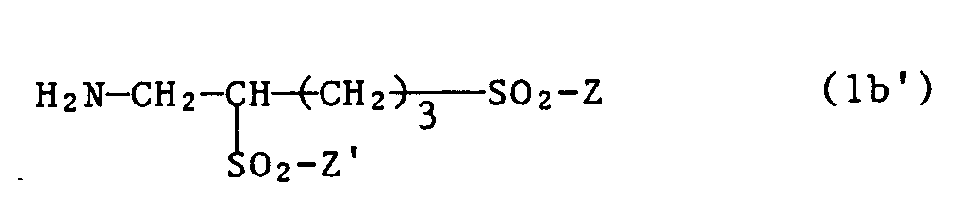
- Einen weiteren Gegenstand der Erfindung bilden deren Vorprodukte, die entsprechenden Bis-ß-hydroxyäthylthioäther-Verbindungen.
- Bevorzugt sind die Amine der Formel

- Die Verbindungen der Formeln (1a') und (1 b') werden hergestellt, indem man ein geeignetes Dihalogenaminoalkan mit Mercaptoäthanol umsetzt und das erhaltene Bis-ß-hydroxyäthylthio-aminoalkan mit elementarem Chlor zu dem entsprechenden Bis-ß-chloräthylsulfonylaminoalkan oxydiert, und gegebenenfalls die ß-chloräthylgruppen in andere Reste Z bzw. Z' überführt. Die Herstellung der Verbindung der Formel (Ib'), worin Z und Z' Chlor ist, ist in Beispiel 1 beschrieben.
- Die Verbindungen der Formeln

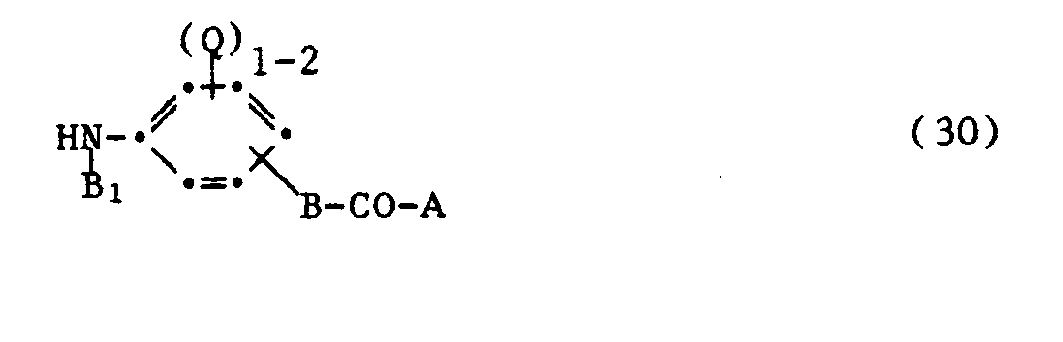
- Die Umsetzung wird vorzugsweise in einem hochsiedenden organischen Lösungsmittel, z.B. Nitrobenzol, durchgeführt. Die Reduktion der Nitrogruppe zur Aminogruppe erfolgt in an sich bekannter Weise durch katalytische Hydrierung mit Pd/Kohlenstoff in Aethanol, Essigester oder Tetrahydrofuran bei Raumtemperatur bis etwa 40°C. Die Reduktion kann auch mit Fe/Salzsäure oder Fe/Essigsäure in wässriger Lösung durchgeführt werden.
- Die entsprechenden Hydroxyäthylthioäther-Verbindungen, welche ebenfalls als Zwischenprodukte verwendbar sind, können hergestellt werden, indem man das Säurechlorid mit einem Dihalogenalkylamin kondensiert, und das Kondensationsprodukt mit 2-Mercaptoäthanol und Natriumalkoholat in Alkohol erwärmt. Die Thioätherverbindungen werden dann noch zu den entsprechenden Sulfonen oxydiert.
- Die Oxydation der Thioätherverbindungen zu den Sulfonen kann nach verschiedenen Methoden erfolgen, beispielsweise mit Wasserstoffperoxid mit oder ohne Zusatz von Wolfram- oder Vanadinverbindungen als Katalysatoren, ferner mit Peressigsäure, Kaliumpermanganat, Kaliumpersulfat oder Chromsäure, oder mit Chlor/Salzsäure je in wässrigem, wässrig-organischem oder organischem Medium.
- Die so erhältlichen Amine bzw. Carbonsäureamide, in denen die Gruppierung -S02-Z bzw. -SO2-Z' eine ß-Hydroxyäthylsulfonylgruppe darstellt, können durch Behandeln mit Sulfatierungsmitteln, Phosphorylierungsmitteln, Halogenierungsmitteln, Alkyl- oder Arylsulfonsäurehalogeniden Alkyl- oder Arylcarbonsäurehalogeniden oder Alkyl- oder Arylcarbonsäureanhydriden in die entsprechenden Farbstoffvorprodukte übergeführt werden, in denen die Gruppierung -S02-Z z.B. die Gruppierung -SO2-CH2-CH2-O-SO3H, -S02-CH2-CH2-O-PO3H2, -S02-CH2-CH2-Halogen, -SO2-CH2-CH2-O-CO-CH3 oder -S02-CH2-CH2-O-CO-C6H5 bedeutet. Die so erhaltenen Produkte können ihrerseits durch Behandeln mit alkalisch wirkenden Mitteln, wie beispielsweise Alkalihydroxid oder Alkalicarbonat, wie Natriumhydroxyd oder Natriumcarbonat, in entsprechende Verbindungen übergeführt werden, in denen die Gruppierung -S02-Z die Gruppierung -S02-CH=CH2 bedeutet. Die so erhaltenen Produkte können wiederum durch Umsetzung (Addition) mit Salzen der Thioschwefelsäure, wie Natriumthiosulfat, in Verbindungen übergeführt werden, in denen die Gruppierung - S02-Z die Gruppierung -S02-CH2-CH2-S-SOaH bedeutet.
- Geeignete Sulfatierungsmittel sind hierbei beispielsweise konzentrierte Schwefelsäure sowie Chlorsulfonsäure und Amidosulfonsäure oder andere Schwefeltrioxid abgebende Verbindungen. Geeignete Phosphorylierungsmittel sind hierbei beispielsweise konzentrierte Phosphorsäure, Pyro-, Meta-oder Polyphosphorsäure, Polyphosphorsäurealkylester, Phosphoroxichlorid oder Gemische aus Phosphorsäure und Phosphor-(V)-oxid. Als Halogenierungsmittel können beispielsweise Thionylchlorid oder Thionylbromid verwendet werden.
- Bevorzugt sind Verbindungen der Formel


- Nach einer Abänderung des oben beschriebenen Verfahrens können Verbindungen der Formeln (29) bis (32) auch in der Weise hergestellt werden, dass man ein Nitrophenylcarbonsäurechlorid bzw. Nitrophenyl-oder Nitrophenoxyalkansäurechlorid mit einem bei der Synthese des Amins der Formel H-Aauftretenden Zwischenprodukt, der entsprechenden Dihydroxydithioätherverbindung kondensiert. Anschliessend wird das Kondensationsprodukt mit elementarem Chlor zu der entsprechenden ß-Chloräthylsulfonyl-Verbindung oxydiert, und die Nitrogruppe zurAminogruppe reduziert.
- Ferner ist noch eine andere Verfahrensvariante anwendbar, wonach man zuerst das erhaltene Zwischenprodukt mit einem Peroxid zum Sulfon oxydiert, dann die Nitrogruppe zur Aminogruppe reduziert, und zuletzt die Hydroxygruppen in dem Rest des Amins sulfatiert.
- Die Kondensation der Säurechloride mit den Aminen der Formel H-A bzw. deren Zwischenprodukten wird z.B. in Chloroform oder Toluol bei Raumtemperatur und in Gegenwart von alkalischen, säurebindenden Mitteln, z.B. Alkalihydroxiden, -carbonaten oder-bicarbonaten, durchgeführt. Anschliessend wird das Kondensationsprodukt in an sich bekannter Weise mit einer Chlor/Salzsäure-Mischung oxydiert. Die Reduktion der Nitrogruppe zur Aminogruppe erfolgt wie oben beschrieben.
- Die bevorzugten Reaktivfarbstoffe der Formeln (19) bis (25) werden durch schrittweise Kondensation und Kupplung hergestellt.
- Die Kondensation eines s-Triazins, insbesondere eines 2,4,6-Trihalogen-s-triazins mit den organischen Farbstoffen bzw. den eine Gruppe -N(R)H enthaltenden diazotierbaren und/oderkupplungsfähigen Komponenten erfolgt vorzugsweise in wässriger Lösung oder Suspension, bei niedrigen Temperaturen, vorzugsweise zwischen 0° und 5°C und bei schwach saurem, neutralem bis schwach alkalischem pH-Wert. Vorteilhaft wird der bei der Kondensation freiwerdende Halogenwasserstoff laufend durch Zugabe wässrigerAlkalihydroxide, -carbonate oder -bicarbonate neutralisiert. Für die weitere Umsetzung der so erhaltenen Halogentriazinfarbstoffe bzw. für die Umsetzung des 2,4,6-Trihalogen-s-triazins mit den Aminen der Formel H-A bzw. den Verbindungen der Formeln (29) bis (32) setzt man die freien Amine oder deren Salze, bevorzugt in Form des Hydrochlorids, ein.
- Die Umsetzung wird bei Temperaturen etwa zwischen 0 und 40°, bevorzugt zwischen 5 und 25°C, unter Zusatz säurebindender Mittel, bevorzugt Natriumcarbonat, in einem pH-Bereich von 2 bis 8 bevorzugt 5 bis 6,5, durchgeführt.
- Die Kondensation des Halogentriazins mit den genannten Aminen kann vor oder nach der Kondensation des Halogentriazins mit einem Farbstoff geschehen. Die Kondensation des Halogentriazins mit einem der genannten Amine erfolgt vorzugsweise in wässriger Lösung oder Suspension, bei niedriger Temperatur und bei schwach saurem bis neutralem pH-Wert. Auch hier wird der bei der Kondensation freiwerdende Halogenwasserstoff vorteilhafterweise durch laufende Zugabe von wässrigen Alkalihydroxiden, -carbonaten oder -bicarbonaten neutralisiert.
- Die Diazotierung der Diazokomponenten bzw. der eine diazotierbare Aminogruppe enthaltenden Zwischenprodukte erfolgt in der Regel durch Einwirkung salpetriger Säure in wässrig-mineralsaurer Lösung bei tiefer Temperatur. Die Kupplung auf die Kupplungskomponente erfolgt bei stark sauren, neutralen bis schwach alkalischen pH-Werten.
- Falls in den ebenfalls bevorzugten Reaktivfarbstoffen der Formeln (16) bis (18) oder ähnlichen der Rest R12 ein Monochlor- oder Monofluortriazinrest ist, der einen nichtfaserreaktiven Substituenten enthält, so kann dieser in an sich bekannter Weise in den Triazinring eingeführt werden, indem durch vorhergehende oder nachträgliche Kondensation mit einer Amino-, Hydroxy- oder Mercaptoverbindung ein Halogenatom am Triazinring gegen einen Amino-, Alkoxy-, Aryloxy-, Alkylthio oder Arylthiorestausgetauscht wird. Als Beispiele für derartige Amino-, Hydroxy- und Mercaptoverbindungen seien die folgenden genannt:
- Ammoniak, Methylamin, Dimethylamin, Aethylamin, Diäthylamin, Propylamin, Isopropylamin, Butylamin, Dibutylamin, Isobutylamin, sek.-Butylamin, tert.-Butylamin, Hexylamin, Methoxyäthylamin, Aethoxyäthylamin, Methoxypropylamin, Chloräthylamin, Hydroxyäthylamin, Dihydroxyäthylamin, Hydroxypropylamin, Aminoäthansulfonsäure, β-Sulfatoäthylamin, Benzylamin, Cyclohexylamin, Anilin, o-, m- und p-Toluidin, 2,3-, 2,4-, 2,5-, 2,6-, 3,4- und 3,5-Dimethylanilin, o-, m- und p-Chloranilin, N-Methylanilin, N-Aethylanilin, 3- oder4-Acetylaminoanilin, 2,5-Dimethoxyanilin, o-, m-und p-Anisidin, o-, m- und p-Phenetidin, Naphthylamin-(1), Naphthylamin-(2), Orthanil-säure, Metanilsäure, Sulfanilsäure, Anilin-2,4-disulfonsäure, Anilin-2,5-disulfonsäure, Anthrani-Isäure, m- und p-Aminobenzoesäure, 2-Amino-toluol-4-sulfonsäure, 2-Aminotoluol-5-sulfonsäure, p-Aminosalicylsäure, 1-Amino-4-carboxybenzol-3-sulfonsäure, 1-Amino-2-carboxybenzol-5-sulfonsäure, 1-Amino-5-car- boxybenzol-2-sulfonsäure, 1-Naphthylamin-2-, -3-, -4-, -5-, -6-, -7- und -8-sulfonsäure, 2-Naphthylamin-1-, -3-, -4-, -5-, -6-, -7- und -8-sulfonsäure, 1-Naphthylamin-2,4-, -2,5-, -2,7-, -2,8-, -3,5-, -3,6-, -3,7-, -3,8-, -4,6-, -4,7-, -4,8- und -5,8-disulfonsäure, 2-Naphthylamin-1 ,5-, -1,6-, -1,7-, -3,6-, -3,7-, -4,7-, -4,8-, -5,7- und -6,8-disulfonsäure, 1-Naphthylamin-2,4,6-, -2,4,7-, -2,5,7-, -3,5-7-, -3,6,8- und -4,6,8-trisulfonsäure, 2-Naphthylamin-1,3,7-, -1,5,7-, -3,5,7-, -3,6,7-, -3,6,8- und 4,6,8-trisulfonsäure, 2-, 3-und 4-Aminopyridin, 2-Aminobenzthiazol, 5-, 6-und 8-Aminochinolin, 2-Aminopyrimidin, Morpholin, Piperidin, Piperazin, Wasser, Methanol, Aethanol, Propanol, Isopropanol, n-Butanol, Isobutanol, sek.-Butanol, tert.-Butanol, Hexanol, Cyclohexanol, ß-Methoxyäthanol, ß-Aethoxyäthanol, y-Methoxypropanol, y-Aethoxypropanol, ß-Aethoxy-ß-äthoxyäthanol, Glycolsäure, Phenol, o-, m- und p-Chlorphenol, Methanthiol, Aethanthiol, Propanthiol, Isopropanthiol, n-Butanthiol, Thioglycolsäure, Thioharnstoff, Thiophenol, a-Thionaphthol, β-Thionaphthol.
- Ferner kommen hier auch viele als Diazokomponenten geeignete Verbindungen in Betracht, insbesondere jene, die einen Vinylsulfonylrest oder einen gleichwertigen oder ähnlichen Reaktivrest enthalten, sowie auch die Verbindungen:
- 3-N-Aethylaminobenzoesäure-N'-ß-(ß'-chloräthylsulfonyl)-äthylamid,
- 3-N-Isopropylaminobenzoesäure-N'-ß-(ß'-chloräthylsulfonyl)-äthylamid,
- 3-N-Isopropylaminobenzoesäure-N'-y-(ß'-chloräthylsulfonyl)-propylamid,
- 4-N-Aethylaminobenzoesäure-N'-ß-(ß'-chloräthylsulfonyl)-äthylamid,
- 4-N-Isopropylaminobenzoesäure-N'-y-(ß'-chloräthylsulfonyl)-propylamid.
- Die Kondensation der Halogentriazine mit den genannten Amino-, Hydroxy-oder Mercaptoverbindungen erfolgt in an sich bekannter Weise, vorzugsweise in Gegenwart von alkalischen Mitteln.
- Die Reaktivfarbstoffe der Formel (1) eignen sich zum Färben und Bedrucken der verschiedensten Materialien, wie Seide, Leder, Wolle, Polyamidfasern und Polyurethanen, und insbesondere cellulosehaltiger Fasermaterialien aller Art. Solche Fasermaterialien sind beispielsweise die natürlichen Cellulosefasern, wie Baumwolle, Leinen und Hanf, sowie Zellstoff und regenerierte Cellulose z.B. Viscose, ferner Modalfasern und deren Mischungen mit Baumwolle. Die Reaktivfarbstoffe der Formel (1) sind auch zum Färben oder Bedrucken von hydroxylgruppenhaltigen Fasern geeignet, die in Mischgeweben enthalten sind, z.B. von Gemischen aus Baumwolle mit Polyamidfasern, oder insbesondere Polyesterfasern.
- Die Reaktivfarbstoffe der Formel (1) können auch in Mischungen untereinander oder in Mischungen mit anderen Reaktivfarbstoffen oder nicht reaktiven Farbstoffen, z.B. Säurefarbstoffen oder Dispersionsfarbstoffen, zum Färben oder Bedrucken der genannten Fasermaterialien verwendet werden.
- Die erfindungsgemässen Farbstoffe lassen sich auf verschiedene Weise auf das Fasermaterial applizieren und auf der Faser fixieren, insbesondere in Form von wässrigen Farbstofflösungen und -druckpasten. Sie eignen sich sowohl für das Ausziehverfahren als auch zum Färben nach dem Foulard-Färbeverfahren, wonach die Ware mit wässrigen, gegebenenfalls salzhaltigen Farbstofflösungen imprägniert wird, und die Farbstoffe nach einer Alkalibehandlu ng oder in Gegenwart von Alkali, gegebenenfalls unter Wärmeeinwirkung fixiert werden. Nach dem Fixieren werden die Färbungen oder Drucke mit kaltem und heissem Wasser, gegebenenfalls unter Zusatz eines dispergierend wirkenden und die Diffusion der nicht fixierten Anteile fördernden Mittels gründlich gespült.
- Falls die Reaktivfarbstoffe der Formel (1), worin D der Rest eines Anthrachinonfarbstoffes ist, eine ungenügende Löslichkeit in der alkalischen Färbeflotte aufweisen, kann dieser Mangel in der aus der Literatur bekannten Weise durch Zusatz von Dispergatoren oder anderen nichtfarbigen Verbindungen z.B. ein Naphthalinsulfonsäure-Formaldehyd-Kondensat oder insbesondere Anthrachinon-2-sulfonsäure, behoben werden.
- Die Reaktivfarbstoffe der Formel (1) zeichnen sich durch hohe Reaktivität, gutes Fixiervermögen und ein sehr gutes Aufbauvermögen aus. Sie können daher nach dem Ausziehfärbeverfahren bei niedrigen Färbetemperaturen eingesetzt werden und erfordern beim Pad-Steam-Verfahren nur kurze Dämpfzeiten. Die Fixiergrade sind hoch und die nicht fixierten Anteile können leicht ausgewaschen werden, wobei die Differenz zwischen Ausziehgrad und Fixiergrad bemerkenswert klein, d.h. der Seifverlust sehr gering ist. Die Reaktivfarbstoffe der Formel (1) eignen sich auch besonders zum Druck, vor allem auf Baumwolle, ebenso aber auch zum Bedrucken von stickstoffhaltigen Fasern, z.B. von Wolle oder Seide oder von Mischgeweben, die Wolle oder Seide enthalten.
- Die mit den erfindungsgemässen Farbstoffen hergestellten Färbungen und Drucke auf Cellulosefasermaterialien besitzen eine hohe Farbstärke und eine hohe Faser-Farbstoff-Bindungsstabilität, sowohl in saurem als auch in alkalischem Bereich, weiterhin eine gute Lichtechtheit und sehr gute Nassechtheitseigenschaften, wie Wasch-, Wasser-, Seewasser-, Ueberfärbe- und Schweissechtheiten, sowie eine gute Plissierechtheit, Bügelechtheit und Reibechtheit.
- Die nachfolgenden Beispiele dienen zur Erläuterung der Erfindung. Die Temperaturen sind in Celsiusgraden angegeben, Teile sind Gewichtsteile, die Prozentangaben beziehen sich auf Gewichtsprozente, sofern nicht anders vermerkt. Gewichtsteile stehen zu Volumenteilen im Verhältnis von Kilogramm zu Liter.
- Die Herstellung der Monoazo- oder Disazozwischenverbindungen ist in den nachfolgenden Ausführungsbeispielen nicht in allen Fällen beschrieben, sie ergibt sich jedoch ohne weiteres aus der allgemeinen Beschreibung.
- 137,5 Teile Tetrahydrofurfurylaminhydrochlorid werden mit 1500 Teilen Salzsäure (chem. rein) bei Raumtemperatur versetzt. Anschliessend wird die Reaktionslösung in einer Druckapparatur auf 130°C erwärmt. Dabei steigt der Druck bis auf 8 bar. Nach 24 Stunden Reaktionsdauer wird die Temperatur auf 25°C abgekühlt. Die dunkelbraune Lösung wird mit Aktivkohle behandelt und klärfiltriert, und die Mutterlauge wird im Rotationsvacuum-Apparat eingeengt. Nach der Umkristallisation aus 1200 Teilen Aethanol erhält man 130 Teile eines analysenreinen Produktes, 2,5-Dichloraminopentan-hydrochlorid, mit folgender Formel

-

- 25,2 Teile Natriumhydroxidplätzchen werden in 250 Teilen Aethanol (94%ig) bei Raumtemperatur gelöst. Zu dieser Lösung gibt man 32 Teile 2-Mercaptoäthanol so zu, dass die Temperatur nicht über 35°C steigt. Nun wird die Lösung auf 70°C erwärmt, und bei dieser Temperatur werden innerhalb einer Stunde 38,5 Teile 2,5-Dichloraminopentanhydrochlorid gelöst in 240 Teilen Aethanol (94%ig) zugetropft. Anschliessend wird die Reaktionsmasse 3 Stunden unter Rückfluss verrührt. Nun wird Aktivkohle zugesetzt und auf Raumtemperatur abgekühlt. Als ausgefallene Salz wird nun durch Filtration entfernt und das Filtrat unter reduziertem Druck abdestilliert. Als Rückstand verbleibt ein Oel, das sich ab ca. 160°C zersetzt. Die Verbindung hat die Formel

-

- Der Rückstand wird in 200 Teilen Wasser gelöst und bei max. 33°C mit 70 Teilen Salzsäure (37%ig) versetzt. Dann werden unter Eiskühlung bei 15-20°C innerhalb einer Stunde 60 Teile Chlorgas über Niveau eingeleitet, bis keine Chloraufnahme mehr beobachtet wird. Nun wird unter Wasserstrahlvacuum die Salzsäure abdestilliert; Rohausbeute: 55 Teile.
- Nach der Umkristallisation aus Methanol und Aktivkohle erhält man das analysenreine Produkt 2,5-Bis-ßchloräthylsulfonylaminopentanhydrochlorid mit einem Schmelzpunkt von 99°-101°C und folgender Formel

-

- Das 20,1 MHz-13C-Spektrum in DMSO sieht wie folgt aus:


- Zu 23,9 g 1-Aminopentan-2,5-bis-(β-hydroxyäthyl-thioäther) gibt man eine Lösung von 4 g Natriumhydroxid in 12 ml Wasser und lässt dann im Laufe von 45 Minuten bei 20 bis 30°C eine Lösung von 20,5 g m-Nitrobenzoylchlorid in 40 ml Toluol zutropfen. Man rührt das Reaktionsgemisch noch 2 Stunden bei 30 bis 40°C und destilliert dann am Rotavapor Toluol und Wasser ab. Nun versetzt man den Rückstand mit 100 ml Wasser, 100 ml Aethanol und 20 g Soda, rührt das Gemisch 2 Stunden bei 75 bis 80°C, kühlt es dann auf 40°C ab und destilliert Wasser und Aethanol unter Vakuum ab. Der ölige Rückstand wird in 200 ml Essigsäureäthylester aufgenommen, umgelöstes Material wird abfiltriert, und das Lösungsmittel wird unter Vakuum abdestilliert. Das Produkt liegt als gelbes, sehr viskoses Oel vor. Die Verbindung entspricht der Formel

-

- Verwendet man statt des m-Nitrobenzoylchlorids die p-Verbindung und verfährt ansonsten wie oben, so erhält man das entsprechende p-Nitrobenzamid

-

- Zur Gewinnung der Verbindungen, welche den Formeln (31) und (32) entsprechen, werden die Produkte wie vorn angegeben weiterverarbeitet.
- Die in verschiedenen Beispielen als Ausgangsstoffe verwendeten, mit Produkt 1 bis V bezeichneten Verbindungen haben folgende Formeln:


- Die salzsauer diazotierte Lösung von 43 Teilen von Produkt I wird bei 0 bis 5° und pH = 5 bis 6 zu einer Lösung von 28,4 Teilen 1-(2'-Sulfophenyl)-3-carboxy-5-pyrazolon gegeben und gekuppelt. Der gelbe Monoazofarbstoff wird isoliert; er entspricht der Formel

- Die salzsauer diazotierte Lösung von 43 Teilen von Produkt II wird bei 0 bis 5° und pH = 4 bis 5 zu einer Lösung von 23 Teilen 3-Aminoacetanilid-4-sulfonsäure gegeben und gekuppelt. Der gelbe Monoazofarbstoff wird bei pH 10,0 und Raumtemperatur30 Minuten lang vinyliert und anschliessend neutral isoliert; er entspricht der Formel

- Die salzsauer diazotierte Lösung von 54 Teilen von Produkt lll wird bei 0 bis 5° und pH = 5 bis 7 zu einer Lösung von 29 Teilen 1-Aethyl-3-aminocarbonyl-4-methyl-5-sulfomethyl-6-hydroxypyridon-2 gegeben und gekuppelt. Der gelbe Monoazofarbstoff wird nach der Vinylierung isoliert, er entspricht der Formel

- Nach der in Beispiel 3 beschriebenen Verfahrensweise lassen sich auch die Reaktivfarbstoffe der folgenden Formeln herstellen.
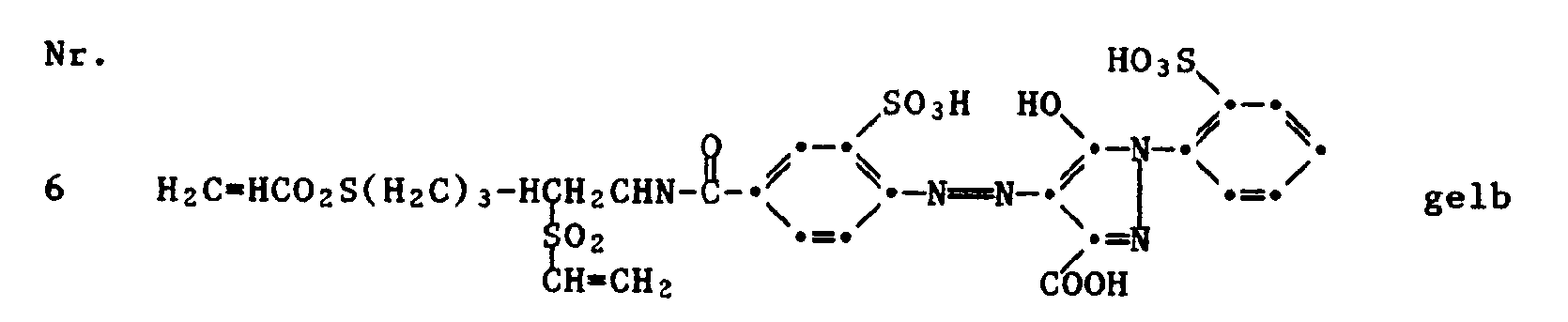


- Zu einer salzsauer diazotierten Lösung von 108 Teilen von Produkt lll werden 1200 Teile einer neutralen Lösung von 56,2 Teilen 2-Acetylamino-5-naphthol-7-sulfonsäure in 400 Teilen Eis/Wasser-Mischung getropft und bei pH 6 bis 7 gekuppelt. Anschliessend wird der Farbstoff bei pH 10,0 und Raumtemperatur vinyliert und dann neutral mit Kochsalz abgeschieden.
- Das Pressgut wird durch Zerstäubungstrocknung getrocknet. Man erhält ein Pulver, das Baumwolle in reinen orangen Tönen färbt, und folgende Struktur aufweist

- Weitere Farbstoffe, die nach der in Beispiel 10 gegebenen Vorschrift hergestellt werden können, sind die Reaktivfarbstoffe der folgenden Formeln.


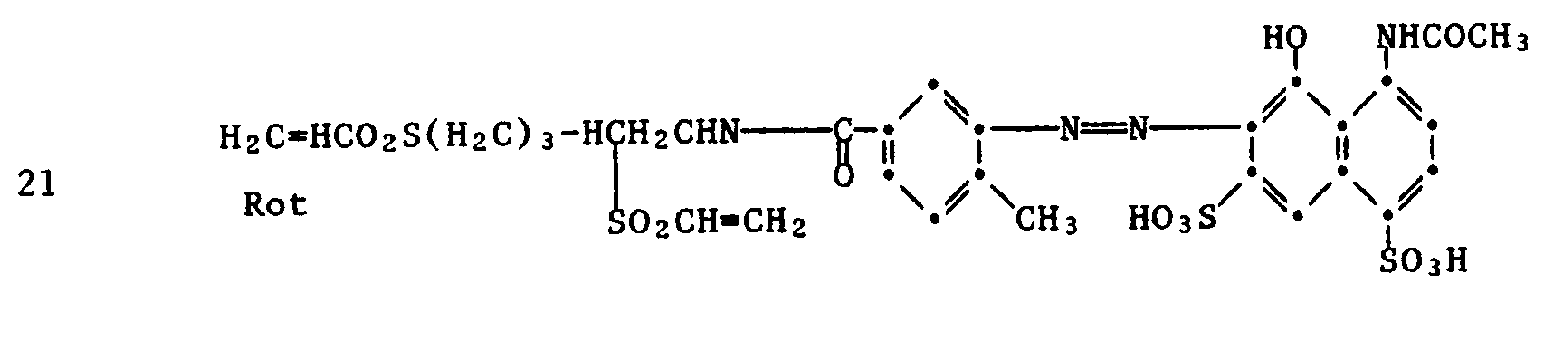
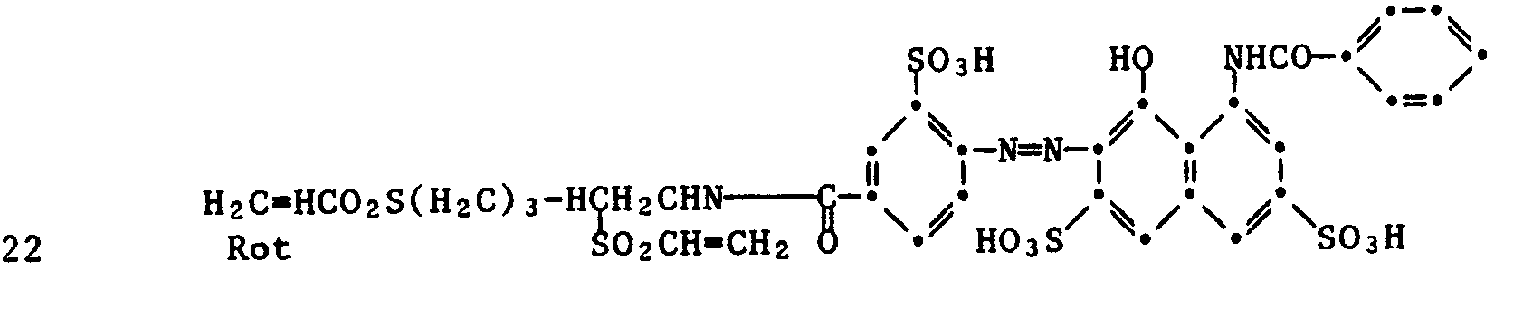

- 70,25 Teile 4-ß-Sulfatoäthylsulfonyl-anilin werden in 325 Teile Wasser eingetragen und bei 20 bis 22°C innerhalb einer Stunde mittels Natriumbicarbonat bei einem pH-Wert von 5,3 bis 6,0 gelöst. Sodann werden 54 Volumenteile einer 31%igen wässrigen Salzsäure und 225 Teile Eis zugegeben, um die Lösung kongosauer und auf eine Temperatur von 0 bis 5°C zu stellen. Bei dieser Temperatur wird die Diazotierung mittels 32,75 Volumenteilen einer 40%igen wässrigen Natriumnitritlösung durchgeführt. Anschliessend wird ein geringer Ueberschuss an salpetriger Säure mit 0,5 Teilen Amidosulfonsäure zerstört. Sodann werden 77,8 Teile 1-Amino-8-hydroxynaphthalin-3,6-disulfonsäure zugegeben und der Ansatz 4 bis 5 Stunden bei einer Temperatur zwischen 4 und 8°C und einem pH-Wert zwischen 1 und 2 gerührt. Nach dieser Reaktionszeit wird der pH-Wert mit Natriumcarbonat auf 6,0 eingestellt.
- In einem separaten Ansatz werden 135 Teile von Produkt 111 analog den obigen Angaben diazotiert. Die erhaltene Diazoniumsuspension wird zu der hergestellten Lösung der Monoazoverbindung gegeben. Der pH-Wert wird bei 6 bis 7 gehalten und der Reaktionsansatz noch 3 Stunden gerührt. Die hergestellte Diazoverbindung wird durch Eindampfen des Reaktionsansatzes, gegebenenfalls nach einer Klärfiltration, isoliert.
- Es wird ein schwarzes, elektrolythaltiges Pulver erhalten, das die Natriumverbindung der Formel

- Die wässrige Lösung des in Beispiel 24 erwähnten Farbstoffes wird bei Raumtemperatur und pH-Wert 10 etwa 30 Minuten lang vinyliert. Anschliessend wird der pH-Wert mit Salzsäure auf 5,0 zurückgestellt und der Monoazofarbstoff sprühgetrocknet. Er entspricht der Formel
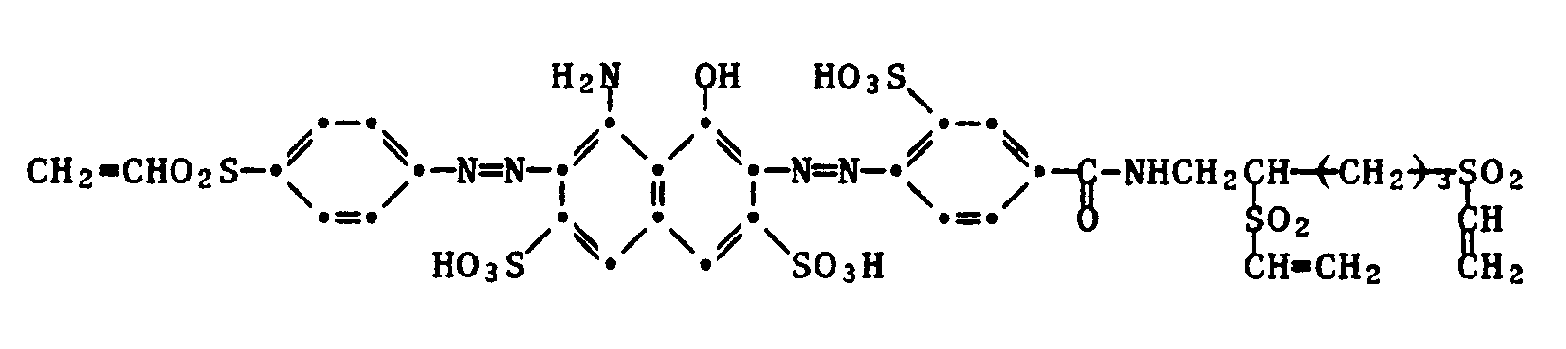
- 44 Teile Anilin-p-sulfonsäure werden in 200 Teile Wasser eingetragen und bei 20 bis 22°C innerhalb einer Stunde mittels Natriumbicarbonat bei einem pH-Wert von 5,3 bis 6,0 gelöst. Sodann werden 54 Volumenteile einer 31%igen wässrigen Salzsäure und 225 Teile Eis zugegeben, um die Lösung kongosauer und auf eine Temperatur von 0 bis 5°C zu stellen. Bei dieser Temperatur wird die Diazotierung mittels 32,75 Volumenteilen einer 40%igen wässrigen Natriumnitritlösung durchgeführt; anschliessend wird ein geringer Ueberschuss an salpetriger Säure mit 0,5 Teilen Amidosulfonsäure zerstört. Sodann werden 77,8 Teile 1-Amino-8-hydroxynaphthalin-3,6-disulfonsäure zugegeben und derAnsatz4 bis 5 Stunden bei einer Temperatur zwischen 4 und 8°C und einem pH-Wert zwischen 1 und 2 gerührt. Nach dieser Reaktionszeit wird der pH-Wert mit Natriumcarbonat auf 6,0 eingestellt.
- In einem separaten Ansatz werden 135 Teile von Produkt 111 analog den obigen Angaben diazotiert. Die erhaltene Diazoniumsuspension wird zu der hergestellten Lösung der Monoazoverbindung gegeben. Der pH-Wert wird bei 6 bis 7 gehalten und der Reaktionsansatz noch 3 Stunden gerührt. Die hergestellte Disazoverbindung wird durch Eindampfen des Reaktionsansatzes, gegebenenfalls nach einer Klärfiltration, isoliert.
- Es wird ein schwarzes, elektrolythaltiges Pulver erhalten, das die Natriumverbindung der Formel

- Die salzsauer diazotierte Lösung von 54 Teilen von Produkt 111 wird bei 0 bis 5°C und pH = 5 bis 6 zu einer Lösung von 29,9 Teilen 1-(2'-Sulfo-5'-aminophenyl)-3-carboxy-5-pyrazolon gegeben und gekuppelt. Der gelbe Monoazofarbstoff wird anschliessend mit einer Suspension von 18,8 Teilen Cyanurchlorid versetzt und bei pH = 6 acyliert.
- Der gebildete Chlortriazinfarbstoff wird isoliert; er entspricht der Formel

- 195 Teile Cyanurchlorid werden in 800 Volumenteilen Aceton gelöst; unter gutem Rühren gibt man diese Lösung in eine Mischung von 1300 Teilen Wasser und 1300 Teilen zerstossenem Eis sowie 20 Volumenteilen einer 2n-Salzsäure. Zu dieser so erhaltenen Suspension lässt man innerhalb von 50 bis 60 Minuten unter Rühren eine Lösung mit einem pH-Wert von 6,9 bis 7,2 aus 239 Teilen 2-Amino-5-naphthol-7-sulfonsäure, 65 Teilen Natriumcarbonat und 2000 Teilen Wasser einlaufen. Die Umsetzung des Cyanurchlorids mit dem Aminonaphthol wird bei einer Temperatur zwischen 0 und 5°C und einem pH-Wert von 3 bis 5 durchgeführt. Es wird so lange gerührt, bis kein freies Amin mehr durch eine Diazotierungsprobe nachweisbar ist.
- Die so hergestellte Lösung der Kupplungskomponente wird mit 540 Teilen von Produkt 111 versetzt. Man rührt 2 Stunden lang und erhöht in dieser Zeit durch portionsweises Einstreuen von Natriumcarbonat den pH-Wert auf 6,5 bis 7,0. Es wird noch eine Stunde bei diesem pH-Wert und bei Raumtemperatur weitergerührt. Anschliessend gibt man 173 Teile Anilin-m-sulfonsäure und portionsweise etwa 110 Teile Natriumcarbonat hinzu, um den pH-Wert auf 5,0 bis 6,0 zu halten. Diese Reaktionslösung wird auf 50°C erwärmt und unter Rühren bei dieser Temperatur eine Stunde gehalten. Nach dem Abkühlen der Reaktionslösung wird die gebildete Azoverbindung mittels Natriumchlorid ausgefällt, abgesaugt und bei 60°C unter reduziertem Druck getrocknet. Es wird ein rotes, elektrolythaltiges Pulver erhalten, das das Natriumsalz der Verbindung der Formel

- Diese Azoverbindung eignet sich hervorragend als Farbstoff. In Folge seinerfaserreaktiven Eigenschaften liefert er beispielsweise aus wässrig-alkalischer Flotte nach einem üblichen Auszieh- oder Klotzverfahren farbtiefe, orange Färbungen auf Baumwollfasern. Die Färbungen besitzen sehr gute Wasch- und Lichtechtheiten.
- 64 Teile 1-Amino-8-naphthol-3,6-disulfonsäure werden in 800 Teilen Wasser unter Zusatz von 30%iger Natriumhydroxidlösung bei pH 5,0 gelöst. Man erwärmt dann auf 30°C und lässt 42 Teile 2,4-Dichlor-6-isopropoxy-triazin zutropfen, wobei der pH-Wert durch Eintropfen von 2n-Natriumhydroxidlösung bei pH 4,0 bis 4,5 gehalten wird. Es wird 15 Stunden bei pH 4,0 bis 4,5 und 65°C kondensiert.
- Die Lösung wird als Kupplungskomponente zur Farbstoffherstellung eingesetzt.
- Zur Herstellung der Diazoniumverbindung werden 86 Teile von Produkt ll in 500 Teilen Eiswasser suspendiert, mit 45 Teilen conc. wässriger Salzsäure angesäuert und mit 40 Volumenteilen einer 5n-Natriumnitritlösung diazotiert. Man rührt 2 Stunden bei ca. 5°C nach und zerstört dann überschüssige salpetrige Säure mittels Amidosulfonsäure. Die so hergestellte Diazoniumsalzlösung lässt man bei einem pH-Wertvon 5,5 bis 6,0 langsam in die Lösung der Kupplungskomponente einlaufen. Man rührt 2 Stunden bis zur vollständigen Kupplung nach. Der pH-Wert wird durch Zugabe von Natriumbicarbonat auf 5,5 bis 6,0 gehalten. Dann wird der Farbstoff mit Natriumchlorid abgeschieden, auf der Nutsche isol iert und im Vakuum bei 40°C getrocknet. Nach dem Mahlen wird ein rotes, elektrolythaltiges Farbstoffpulver erhalten, das das Natriumsalz der Verbindung der Formel

- Diese Verbindung besitzt sehr gute Farbstoffeigenschaften und färbt Cellulosematerialien nach den üblichen Färbe- und Druckverfahren für Reaktivfarbstoffe in roten Tönen mit sehr guten Nassechtheitseigenschaften.
- 64 Teile 1-Amino-8-napthol-3,6-disulfonsäure werden in 800 Teilen Wasser unter Zusatz von 30%iger Natriumhydroxidlösung bei pH 9,0 bis 9,5 gelöst. Man kühlt dann auf 10°C ab und lässt 34 Teile 2,4,6-Trifluor-5-chlor-pyrimidin zutropfen, wobei der pH-Wert durch Eintropfen von 5n-Natriumhydroxidlösung bei pH 9,25 bis 9,5 gehalten wird. Es wird 15 Minuten bei pH 8,5 bis 9 und 15°C nachgerührt und dann mit4n-Salzsäurelösung versetzt, bis der pH-Wert von 6,5 erreicht wird.
- Die Lösung wird als Kupplungskomponente zur Farbstoffherstellung eingesetzt.
- Zur Herstellung der Diazoniumverbindung werden 108 Teile von Produkt 111 in 500 Teilen Eiswasser suspendiert, mit 45 Teilen conc. wässriger Salzsäure angesäuert und mit 40 Volumenteilen einer 5n-Natriumnitritlösung diazotiert. Man rührt 2 Stunden bei ca. 5°C nach und zerstört dann überschüssige salpetrige Säure mittels Amidosulfonsäure. Die so hergestellte Diazoniumsalzlösung lässt man bei einem pH-Wert von 5,5 bis 6,0 langsam in die Lösung der Kupplungskomponente einlaufen. Man rührt 2 Stunden bis zur vollständigen Kupplung nach. Der pH-Wert wird durch Zugabe von Natriumbicarbonat auf 5,5 bis 6,0 gehalten. Dann wird der Farbstoff mit Natriumchlorid abgeschieden, auf der Nutsche isoliert und im Vakuum bei 40°C getrocknet. Nach dem Mahlen wird ein rotes elektrolythaltiges Farbstoffpulver erhalten, das das Natriumsalz der Verbindung der Formel
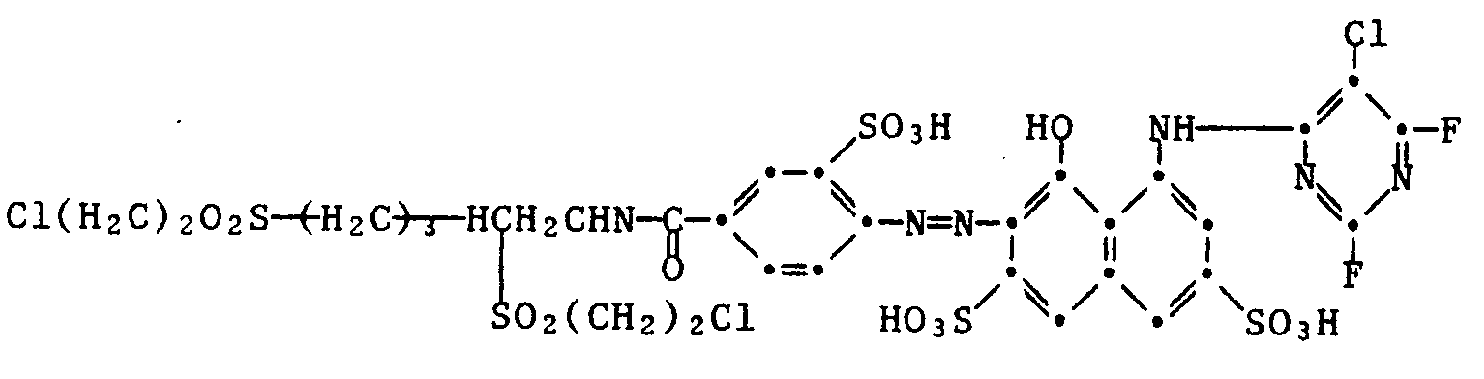
- Diese Verbindung besitzt sehr gute Farbstoffeigenschaften und färbt Cellulosematerialien nach den üblichen Färbe- und Druckverfahren für Reaktivfarbstoffe in blaustichig roten Tönen mit sehr guten Nassechtheitseigenschaften.
- 64 Teile 1-Amino-8-napthol-3,6-disulfonsäure werden in 800 Teilen Wasser unter Zusatz von 30%iger Natriumhydroxidlösung bei pH 5,0 gelöst. Man erwärmt dann auf 60°C und lässt 45 Teile 2,4,5,6-Tetrachlor-pyrimidin zutropfen, wobei der pH-Wert durch Eintropfen von 5n-Natriumhydroxidlösung bei pH 4,0 bis 4,5 gehalten wird. Es wird 15 Stunden bei pH 4,0 bis 4,5 und 65°C kondensiert.
- Die Lösung wird als Kupplungskomponente zur Farbstoffherstellung eingesetzt.
- Zur Herstellung der Diazoniumverbindung werden 108 Teile von Produkt lll in 500 Teilen Eiswasser suspendiert, mit 45 Teilen conc. wässriger Salzsäure angesäuert und mit 40 Volumenteilen einer 5n-Natriumnitritlösung diazotiert. Man rührt 2 Stunden bei ca. 5°C nach und zerstört dann überschüssige salpetrige Säure mittels Amidosulfonsäure. Die so hergestellte Diazoniumsalzlösung lässt man bei einem pH-Wert von 5,5 bis 6,0 langsam in die Lösung der Kupplungskomponente einlaufen. Man rührt 2 Stunden bis zur vollständigen Kupplung nach. Der pH-Wert wird durch Zugabe von Natriumbicarbonat auf 5,5 bis 6,0 gehalten. Dann wird der Farbstoff mit Natriumchlorid abgeschieden, auf der Nutsche isoliert und im Vakuum bei 40°C getrocknet. Nach dem Mahlen wird ein rotes, elektrolythaltiges Farbstoffpulver erhalten, das das Natriumsalz der Verbindung der Formel
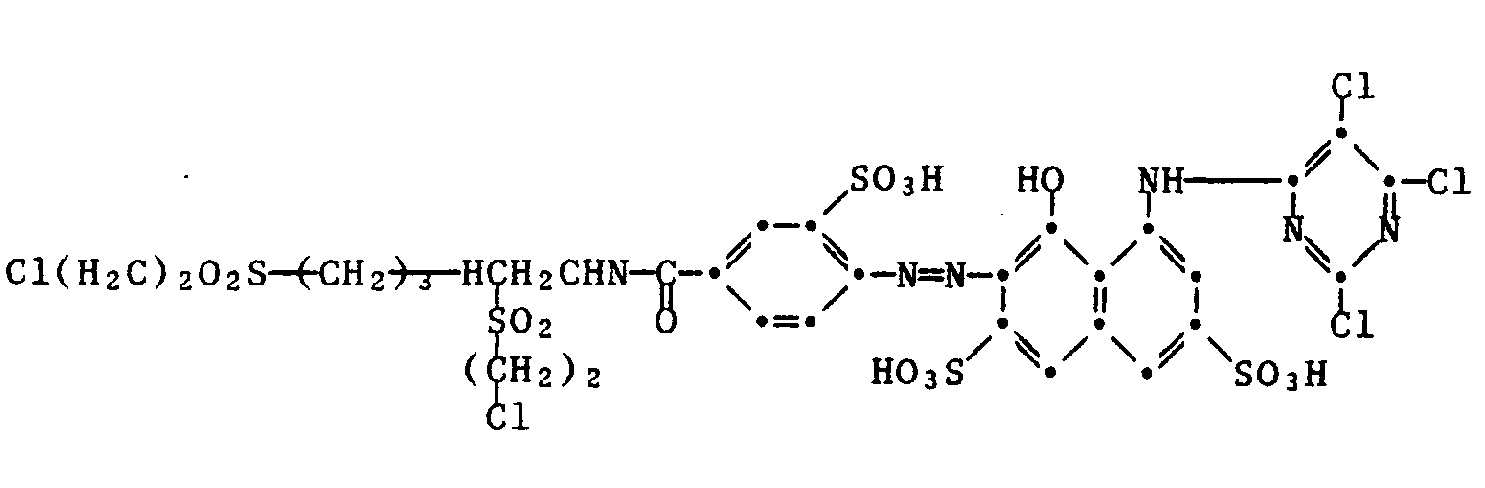
- Diese Verbindung besitzt sehr gute Farbstoffeigenschaften und färbt Cellulosematerialien nach den üblichen Färbe- und Druckverfahren für Reaktivfarbstoffe in roten Tönen mit sehr guten Nassechtheitseigenschaften.
- 31,9 Teile 1-Amino-8-hydroxynaphthalin-3,6-disulfonsäure werden in 800 ml Wasser neutral gelöst und die Lösung auf 0 bis 5°C abgekühlt. Bei dieser Temperatur werden 14,2 Teile 2,4,6-Trifiuor-1 ,3,5-triazin innert 20 Minuten zugetropft, wobei der pH der Reaktionslösung durch gleichzeitige Zugabe von 2n-Natriumhydroxydlösung schwach kongosauer gehalten wird. Nach Zusatz einer auf pH 5 gestellten Mischung von 11 Teilen N-Methylanilin in 100 ml Wasser wird der pH der Reaktionsmischung durch ständige Zugabe von 2n-Natriumhydroxydlösung zuerst kurze Zeit schwach kongosauer und dann bei 5 bis 6 gehalten. Dabei wird die Temperatur innert 2 bis 3 Stunden auf 20 bis 25°C erhöht. Nach vollständiger Reaktion wird dieses Zwischenprodukt bei 0 bis 10°C und pH 6,5 mit 54 Teilen von diazotiertem Produkt 111 gekuppelt. Nach vollständiger Kupplungsreaktion bei pH 8 wird die Reaktionsmischung geklärt und der gebildete Reaktivfarbstoff der Formel

- 54,5 Teile des Farbstoffes 2-(4'-Amino-2'-ureido-phenylazo)-naphthalin-3,6,8-trisulfonsäure werden mit 250 Teilen Wasser neutral gelöst. Die neutrale Lösung wird auf 0°C abgekühlt. Bei dieser Temperatur werden 14,2 Teile 2,4,6-Trifluor-1,3,5-triazin innert 20 Minuten zugetropft, wobei der pH der Reaktionslösung durch gleichzeitige Zugabe von 2n Natriumhydroxidlösung bei 6-6,5 gehalten wird. Nach Zugabe von 38 Teilen 2,5-Bis-ß-chloräthylsulfonyl-aminopentanhydrochlorid in 100 ml Wasser wird die Temperatur auf 20° bis 25°C erhöht und der pH bei 5,5-6,5 gehalten.
Reaktionsdauer ca. 3 Stunden. Dann wird bei pH 10,0 20 Minuten lang vinyliert. - Der entstandene Farbstoff der Formel:

- 54,5 Teile des Farbstoffes 2-(4'-Amino-2'-ureido-phenylazo)-naphthalin-3,6,8-trisulfonsäure werden mit 250 Teilen Wasser neutral gelöst. Diese neutrale Lösung gibt man zu einer wie im Beispiel 5 hergestellten Suspension von Cyanurchlorid in Aceton und Wasser. Durch Kühlung mit Eis hält man die Temperatur bei 0° bis 3°. Im Verlauf der Acylierungsreaktion werden 9 g Bicarbonat so eingetragen, dass der pH zwischen 5,5 und 7 bleibt. Wenn kein Ausgangsfarbstoff mehr im Chromatogramm nachweisbar ist, gibt man 38 Teile 2,5-Bis-ßchloräthylsulfonylaminopentanhydrochlorid in Form einer ca. 50%igen Paste zu und erwärmt auf 50°. Durch Zugabe von weiteren 18 g Bicarbonat hält man den pH-Wert in den Grenzen von 4,5 bis 6,0. Die Reaktion ist beendet, wenn kein weiteres Alkali mehr verbraucht wird. Der entstandene Farbstoff der Formel:
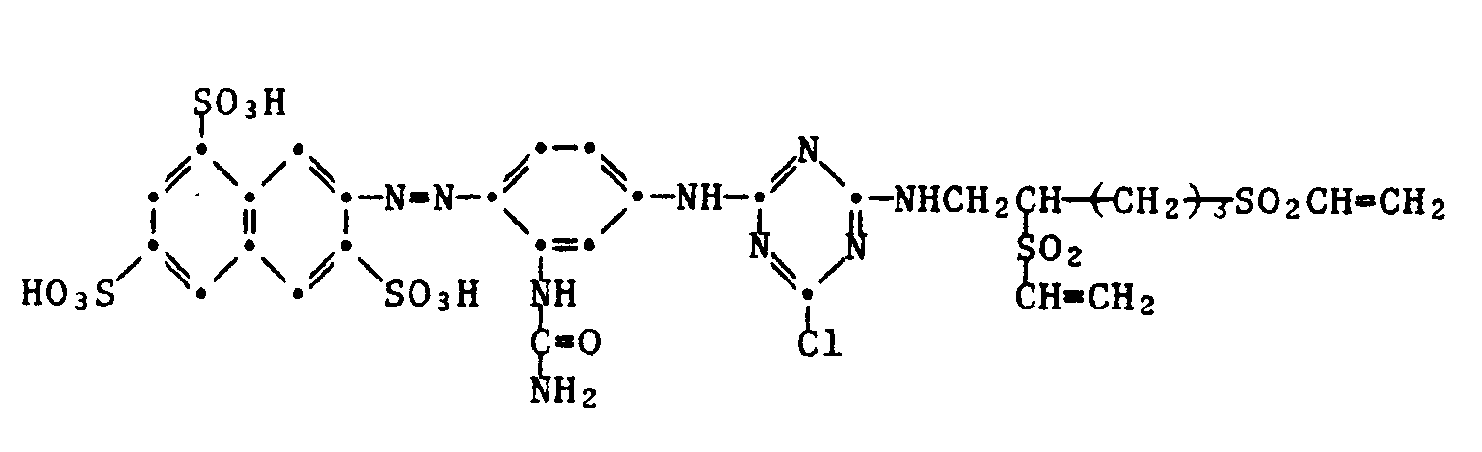
- 50,3 Teile des Farbstoffs 2-Amino-5-hydroxy-6-(2,5-disulfonylbenzolazo)-naphthalin-7-sulfonsäure werden in 800 ml Wasser neutral gelöst und die Lösung auf 0° bis 5°C abgekühlt. Bei dieser Temperatur werden 14,2 Teile 2,4,6-Trifluor-1,3,5-triazin innert 20 Minuten zugetropft, wobei der pH der Reaktionslösung durch gleichzeitige Zugabe von 2n Natriumhydroxidlösung bei 6-6,5 gehalten wird. Nach Zusatz von 43 Teilen von Produkt in 100 ml Wasser wird die Temperatur auf 20 bis 25°C erhöht und der pH bei 5,5-6,5 gehalten. Reaktionsdauer ca. 2 Stunden.
- Zur Abscheidung des Farbstoffes wird die neutrale Lösung mit 10 % Natriumchlorid und 10 % Kaliumchlorid versetzt und filtriert. Die erhaltene Paste wird im Vakuum bei 40 bis 50° getrocknet. Der so hergestellte Reaktivfarbstoff hat die folgende Konstitution:

- 50,3 Teile des Farbstoffs 2-Amino-5-hydroxy-6-(2,5-disulfonylbenzolazo)-naphthalin-7-sulfonsäure werden in 800 ml Wasser neutral gelöst und die Lösung auf 0° bis 5°C abgekühlt. Bei dieser Temperatur werden 14,2 Teile 2,4,6-Trifluor-1,3,5-triazin innert 20 Minuten zugetropft, wobei der pH der Reaktionslösung durch gleichzeitige Zugabe von 2n Natriumhydroxidlösung bei 6-6,5 gehalten wird. Nach Zusatz von 38 Teilen von 2,5-Bis-ß-chloräthylsulfonyl-aminopentanhydrochlorid in 100 ml Wasser wird die Temperatur auf 20 bis 25°C erhöht und der pH bei 5,5-6,5 gehalten. Reaktionsdauer ca. 2 Stunden. Dann wird bei pH 10,0 und Raumtemperatur 20 Minuten lang vinyliert, und der pH wird auf 7,0 zurückgestellt.
- Zur Abscheidung des Farbstoffes wird die neutrale Lösung mit 10 % Natriumchlorid und 10 % Kaliumchlorid versetzt und filtriert. Die erhaltene Paste wird im Vakuum bei 40 bis 50° getrocknet. Der so hergestellte Reaktivfarbstoff hat die folgende Konstitution:

- Der zur Herstellung des erfindungsgemässen Farbstoffs benötigte Ausgangsfarbstoff 2-Amino-5-hydroxy-6-(2',5'-disulfophenylazo)-naphthalin-7-sulfonsäure kann wie folgt erhalten werden:
- 50,6 Teile 2-Amino-benzol-1,4-disulfonsäure werden in 120 Teilen Wasser neutral gelöst und wie üblich diazotiert. Hierauf lässt man die Diazoverbindung bei 0-5° zu einer Mischung von 56,2 Teilen 2-Acetamino-5-naphthol-7-sulfonsäure, welche in 300 Teilen Wasser neutral gelöst wurden, 25 Teilen Natriumhydrogencarbonat und 150 Teilen Eis hinzulaufen. Der pH-Wert beträgt zunächst 6,5 und steigt nach längerem Rühren auf 7,5-7,8. Nach Beendigung der Kupplung gibt man 60 Teile 10-normale Natronlauge hinzu und erwärmt zur Verseifung derAcetaminogruppe 2 Stunden auf 90°. Die alkalische Lösung des orangen Zwischenfarbstoffes wird mit etwa 22 Teilen 10-normaler Salzsäure neutral gestellt, mit 20 % Natriumchlorid und 15 % Kaliumchlorid versetzt, einige Zeit gerührt und filtriert.
- 31,9 Teile 1-Amino-8-hydroxynaphthalin-3,6-disulfonsäure werden in 800 ml Wasser neutral gelöst und die Lösung auf 0° bis 5° abgekühlt. Bei dieser Temperatur werden 14,2 Teile 2,4,6-Trifluor-1,3,5-triazin innert 20 Minuten zugetropft, wobei der pH der Reaktionslösung durch gleichzeitige Zugabe von 2n Natriumhydroxydlösung schwach kongosauer gehalten wird. Nach Zusatz einer auf pH 5 gestellten Mischung von 43 Teilen von Produkt I in 100 ml Wasser wird der pH der Reaktionsmischung durch ständige Zugabe von 2n Natriumhydroxylösung zuerst kurze Zeit schwach kongosauer und dann bei 5-6 gehalten. Dabei wird die Temperatur innert 2 bis 3 Stunden auf 20° bis 25° erhöht. Nach vollständiger Reaktion wird dieses Zwischenprodukt bei 0° bis 10° und pH 6,5 mit 30,3 Teilen diazotiertem 2-Amino-1,5-disulfonsäurenaphthalin gekuppelt. Nach vollständiger Kupplungsreaktion bei pH 8 wird die Reaktionsmischung geklärt und der gebildete Reaktivfarbstoff der Formel

- 31,9 Teile 1-Amino-8-hydroxynaphthalin-3,6-disulfonsäure werden in 800 ml Wasser neutral gelöst und die Lösung auf 0° bis 5° abgekühlt. Bei dieser Temperatur werden 14,2 Teile 2,4,6-Trifluor-1,3,5-triazin innert 20 Minuten zugetropft, wobei der pH der Reaktionslösung durch gleichzeitige Zugabe von 2n Natriumhydroxydlösung schwach kongosauer gehalten wird. Nach Zusatz einer auf pH 5 gestellten Mischung von 38 Teilen 2,5-Bis-ß-chloräthylsulfonylaminopentan-hydrochlorid in 100 ml Wasser wird der pH der Reaktionsmischung durch ständige Zugabe von 2n Natriumhydroxylösung zuerst kurze Zeit schwach kongosauer und dann bei 5-6 gehalten. Dabei wird die Temperatur innert 2 bis 3 Stunden auf 20° bis 25° erhöht. Nach vollständiger Reaktion wird dieses Zwischenprodukt bei 0° bis 10° und pH 6,5 mit 30,3 Teilen diazotiertem 2-Amino-1,5-disulfonsäu- renaphthalin gekuppelt. Nach vollständiger Kupplungsreaktion bei pH 8 wird die Reaktionsmischung geklärt und der gebildete Reaktivfarbstoff der Formel
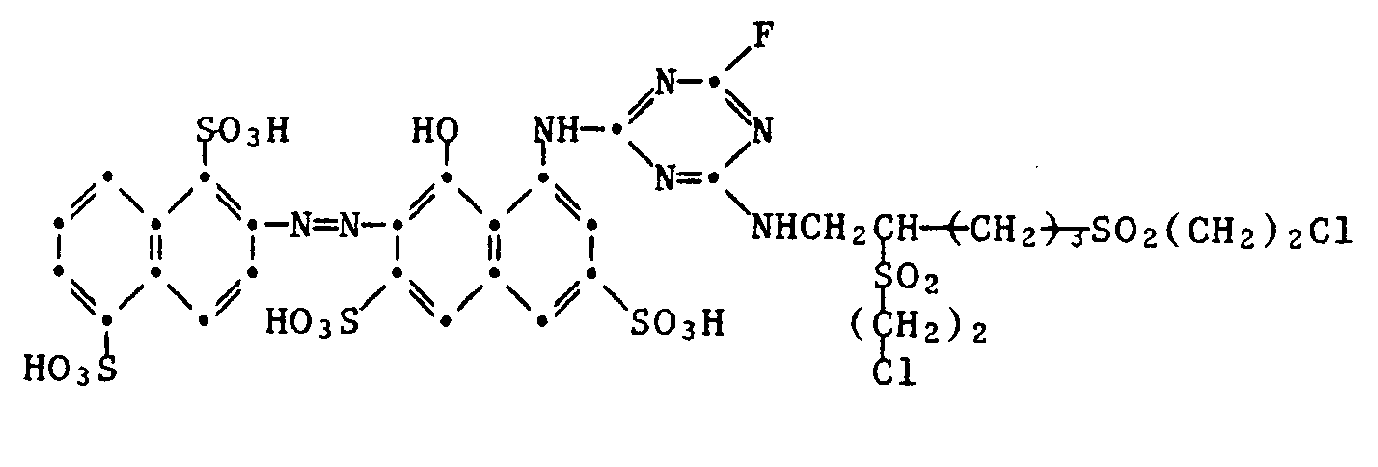
- 18,5 Teile Cyanurchlorid werden in 110 Teilen Aceton gelöst und unter kräftigem Rühren auf 250 Teile Eis gegeben. Dazu lässt man eine Lösung von 55,3 Teilen des Farbstoffs der folgenden Konstitution


- 18,5 Teile Cyanurchlorid werden in 110 Teilen Aceton gelöst und unter kräftigem Rühren auf 250 Teile Eis gegeben. Dazu lässt man eine Lösung von 55,3 Teilen des Farbstoffes der folgenden Konstitution


-
- a) In eine Suspension von 31,9 Teilen 1-Amino-8-naphthol-3,6-disulfonsäure in 144 Teilen Wasser und 72 Teilen Eis werden unter gutem Rühren 18,5 Teile Cyanurchlorid eingetragen; der Reaktionsansatz wird noch 4 Stunden bei einer Temperatur zwischen 3 und 5°C und bei einem pH-Wert zwischen 1,7 und 2,2, der mittels Natriumbicarbonat gehalten wird, weitergerührt.
- b) Getrennt hiervon wird das Diazoniumsalz der Diazokomponente hergestellt: Eine Lösung mit einem pH-Wert von 6,7-6,8 von 28,5 Teilen 4-ß-Sulfatoäthylsulfonylanilin in 64 Teilen Wasser werden mit 105 Volumenteilen einer 40%igen wässrigen Natriumnitritlösung versetzt. Dieses Gemisch lässt man unter gutem Rühren in eine Mischung aus 80 Teilen zerkleinertem Eis und 7 Volumenteilen einer 95%igen wässrigen Schwefelsäure einfliessen. Man rührt noch eine Stunde bei einer Temperatur zwischen 0°C und 5°C nach und zersetzt sodann, wie üblich, überschüssige salpetrige Säure mit wenig Amidosulfonsäure.
- c) Das hier unter a) hergestellte primäre Kondensationsprodukt aus Cyanurchlorid und derAminonaphtholdisulfonsäure wird mit der hier unter b) beschriebenen Diazoniumsalzlösung vereinigt. Zur Durchführung der Kupplungsreaktion wird das stark saure Reaktionsgemisch bei einer Temperatur von etwa 5°C mittels Natriumbicarbonat auf einen pH-Wert von 4,0 bis 4,5 eingestellt und die Temperatur auf 15 bis 20°C erhöht. Es wird noch einige Stunden bei diesem pH-Wert und dieser Temperatur weitergerührt, bis die Kupplung beendet ist.
- d) Die Lösung der Monoazoverbindung von c) wird mit einer Lösung mit einem pH-Wert von 5,5-6,0 von 38 Teilen 2,5-Bis-ß-chloräthylsulfonylaminopentan-hydrochlorid in 64 Teilen Wasser vereinigt. Der pH-Wert wird auf etwa 6 gehalten und das Reaktionsgemisch im Verlaufe von 2 Stunden auf eine Temperatur von 60 bis 65°C erwärmt. Sodann wird der pH mittels Natriumbicarbonat auf einen Wert zwischen 6,5 und 7,0 erhöht, und das Filtrat sprühgetrocknet.
- Es werden etwa 180 Teile natriumchloridhaltiges Pulver der Formel

- 106,6 Teile des Farbstoffes 3-(3'-Amino-4'-sulfophenylamino-sulfonyl)-kupferphthalocyanin-3",3"'-3"'-trisulfonsäure werden mit Wasser und der nötigen Sodamenge neutral gelöst. Diese Lösung lässt man bei 0 bis 5° zu einer Anschlämmung von 18,5 Teilen Cyanurchlorid hinzulaufen, welche durch Zutropfen des in 110 Teilen Aceton gelösten Cyanurchlorids auf 250 Teile Eis hergestellt wurde. Bei der Umsetzung wird der pH-Wert durch Zutropfen von 50 ml 2-normaler Sodalösung auf 6 bis 6,5 gehalten. Zu der erhaltenen Zwischenstufe gibt man 48 Teile 2,5-Bis-ß-chloräthylsulfonyl-aminopentan-hydrochlorid hinzu und erwärmt 4 Stunden auf 35 bis 45°. Durch Zutropfen von 100 Teilen 2-normaler Natronlauge wird gleichzeitig der pH-Wert auf 4,0 bis 4,5-gehalten. Der hergestellte Reaktivfarbstoff hat die folgende Konstitution:

- Er wird mit Natriumchlorid abgeschieden, filtriert und im Vakuum bei 55-60° getrocknet.
- 58,1 Teile des durch Diazotierung von 2-Aminophenol-4,6-disulfonsäure und Kupplung auf 2-Amino-5-naphthol-7-sulfonsäure mit anschliessender Kupferung in essigsaurer Lösung hergestellten Kupferkomplexfarbstoffes werden in Wasser neutral gelöst. Diese Farbstofflösung lässt man bei 0-5° zu einerAnschlämmung von 18,5 Teilen Cyanurchlorid hinzulaufen, welche durch Lösen des Cyanurchlorides in 110 Teilen Aceton und Zutropfen zu 250 Teilen Eis hergestellt wurde. Während der Umsetzung hält man den pH-Wert durch Zutropfen von 50 Teilen 2-normaler Sodalösung auf 4,5-5,5. Es wird 1-2 Stunden bei 0-5° nachgerührt, bis die Umsetzung beendet ist. Dann gibt man 38 Teile


- 70,2 Teile des Diazofarbstoffes 1-Amino-2-(4'-sulfophenylazo)-7-(2"-sulfo-5"-aminophenylazo)-8-naphthol-3,6-disulfonsäure werden in Form einer neutralen Lösung bei 0-5° mit einerAnschlämmung von 18,5 Teilen Cyanurchlorid umgesetzt, welche in 100 Teilen Aceton gelöst und mit 250 Teilen Eis wieder gefällt wurden. Die Umsetzung erfolgt bei pH 6,0-6,5, wobei die Einhaltung des pH-Wertes durch Zutropfen von 50 Teilen 2-normaler Sodalösung erfolgt. Anschliessend werden 38 Teile


- 81 Teile des Diazofarbstoffes 1-Amino-2(4'-ß-sulfatoäthylsulfonyl-phenylazo)-7-(2"-sulfo-5"-aminopheny- lazo)-8-naphthol-3,6-disulfonsäure werden in Form einer neutralen Lösung bei 0-5° mit einer Anschlämmung von 18,5 Teilen Cyanurchlorid umgesetzt, welche in 110 Teilen Aceton gelöst und mit 250 Teilen Eis wieder gefällt wurden. Die Umsetzung erfolgt bei pH 6,0-6,5, wobei die Einhaltung des pH-Wertes durch Zutropfen von 50 Teilen 2-normaler Sodalösung erfolgt. Anschliessend werden 38 Teile


- 50,3 Teile des Farbstoffes 1-Amino-4-(3'-amino-4'-methyl-5'-sulfo-phenyl-amino)-anthrachinon-2-sulfonsäure werden mit Wasser und der nötigen Menge Soda neutral gelöst. Diese Lösung wird bei 0-5° zu einer Anschlämmung von 18,5 Teilen Cyanurchlorid gegeben, welche durch Zutropfen des in 110 Teilen Aceton gelösten Cyanurchlorides auf 250 Teile Eis hergestellt werde. Der bei der Umsetzung entstehende Chlorwasserstoffwird durch Zutropfen von 50 Teilen 2-normaler Sodalösung neutralisiert, wobei sich ein pH-Wert von 6-6,5 einstellt. Dann gibt man 38 Teile


- 11,5 Teile 1-Amino-2-sulfonsäure-4-bromanthrachinon und 11 Teile von Produkt IV werden mit 120 Teilen Wasser suspendiert. Bei Raumtemperatur werden 26 Teile Natriumhydrogencarbonat eingestreut, wobei der pH-Wert 8,5 erreicht wird. Die Suspension wird auf 75° erwärmt. Bei 70 bis 75°C und innert 3 Stunden, werden in 12 Portionen 0,3 Teile Kupferpulver/Kupfer-I-chlorid 1:1 eingetragen. Nach einer weiteren Stunde bei 75°C ist die Reaktion beendet. Die Suspension wird auf Raumtemperatur abgekühlt und mit 13 g Natriumchlorid (~ 0 Volumenprozent) ausgesalzen und abfiltriert.
- Der gut getrocknete Farbstoff wird zur Herstellung des Schwefelsäureesters in die dreifache Gewichtsmenge Schwefelsäure-Monohydrat eingetragen und bis zur vollständigen Lösung gerührt. Dann giesst man die Farbstofflösung auf Eis, wobei der Esterfarbstoff ausfällt. Er wird abfiltriert, sodann in einer Mischung aus Eis/Wasser angerührt und nach dem Neutralisieren mit Kaliumcarbonat durch Einstreuen von Kaliumchlorid ausgesalzen, abfiltriert und getrocknet.
- Der gebildete Reaktivfarbstoff der Formel

- Wird dieser Farbstoff gemäss Färbevorschrift IV eingesetzt, so wird er bei derAlkalizugabe, bedingt durch die eintretende Vinylierung, schwerlöslich, was niedrigere Fixierwerte ergibt. Hervorragende färberische Ergebnisse mit hohen Fixierwerten werden aber erhalten, wenn man den Farbstoff als Formulierung einsetzt, die wie folgt zusammengesetzt ist:
- 6,3 Teile des Farbstoffes der oben angegebenen Formel,
- 2,4 Teile Naphthalinsulfonsäure-Formaldehyd-Dispergator und
- 1,3 Teile Anthrachinon-2-sulfonsäure,
- wobei der Dispergator gegebenenfalls auch weggelassen werden kann.
- Analog können alle folgenden Anthrachinonfarbstoffe mit knapper Löslichkeit im Foulardverfahren eingesetzt werden.
- Nach dem Verfahren von Beispiel 47 können folgende Farbstoffe synthetisiert werden:


- 300 Teile Chlorsulfonsäure werden bei Raumtemperatur vorgelegt. Nun werden 36 Teile Kupferphthalocyanin portionenweise innert einer Stunde eingetragen. Die Temperatur wird nun langsam innert zwei Stunden auf 110°C erhöht. Innert einer Stunde wird die Temperatur auf 135°C erhöht. Unter gutem Rühren wird die Reaktionslösung 6 1/2 Stunden bei 130 bis 135°C gerührt, anschliessend auf Raumtemperatur abgekühlt und auf Eis/Wasser-Mischung ausgetragen; Endvolumen 2,5 Liter. Nun wird mit 37 Teilen (1,5 Volumenprozent) Natriumchlorid versetzt und filtriert. Das Nutschgut mit Eiswasser (1,5 % NaCI) kongoneutral gewaschen.
- Die 250 Teile Paste werden mit 800 Teilen Eiswasser suspendiert, pH 2,5 bis 3,0. Nun wird die Lösung von 80 Teilen von Produkt V gelöst in 200 Teilen Wasser zugegeben; pH von ca. 2,0. Der pH wird langsam auf 5,0 bis 5,5 erhöht mit 20 Teilen conc. ammonialkalischer Lösung, dabei wird die Temperatur allmählich bis 25°C erhöht.
- Zur Beendigung der Reaktion wird bei 50°C sechs Stunden lang gerührt, während der pH-Wert mit 2n Ammoniak bei 5,0 gehalten wird.
- Mit 120 Teilen Natriumchlorid (5 Volumenprozent) wird der Farbstoff folgender Formel

- Analog können folgende Farbstoffe synthetisiert werden:


- Weitere Farbstoffe, welche nach den in den vorangehenden Beispielen beschriebenen Verfahren hergestellt werden können, sind die Verbindungen der folgenden Formeln:

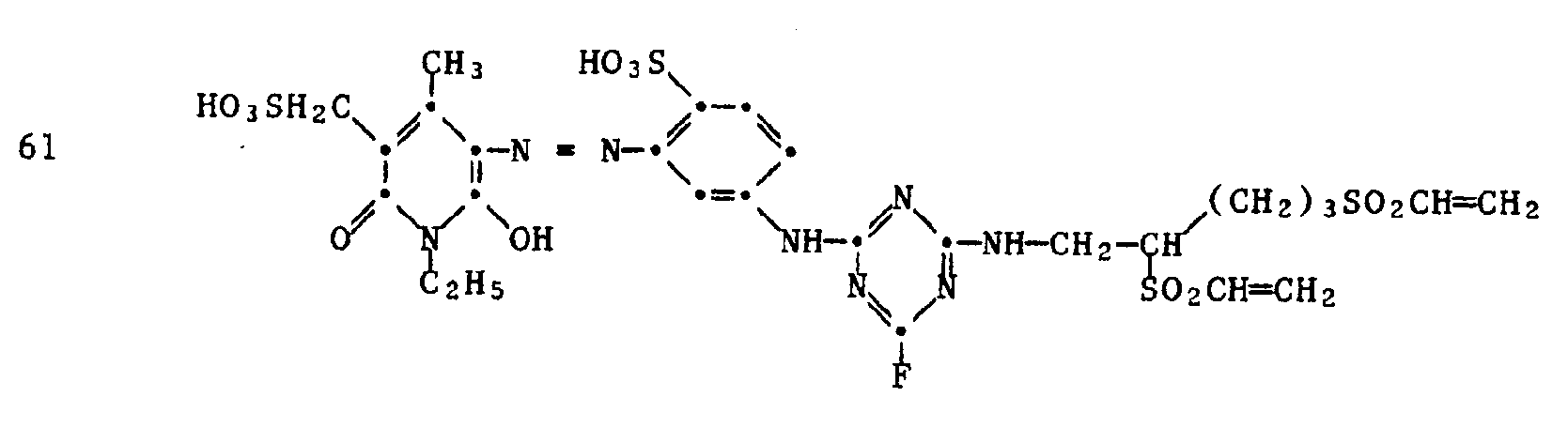
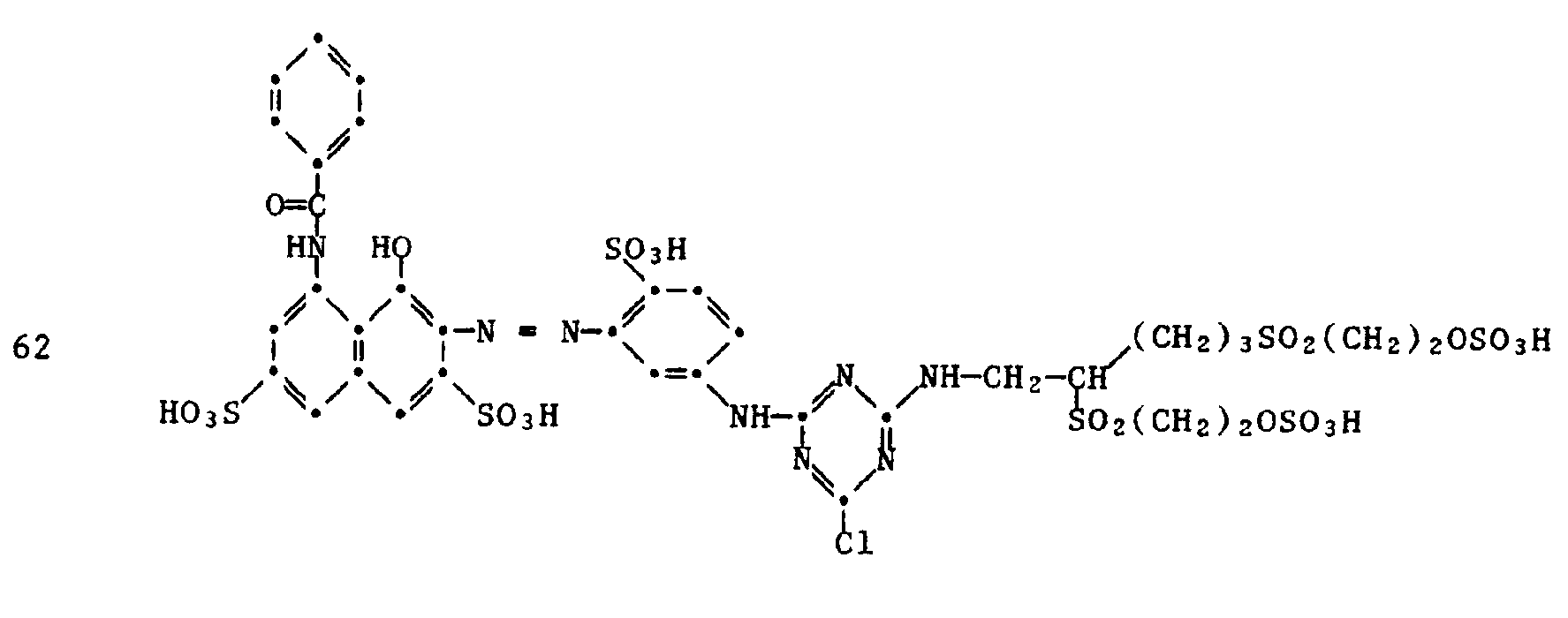

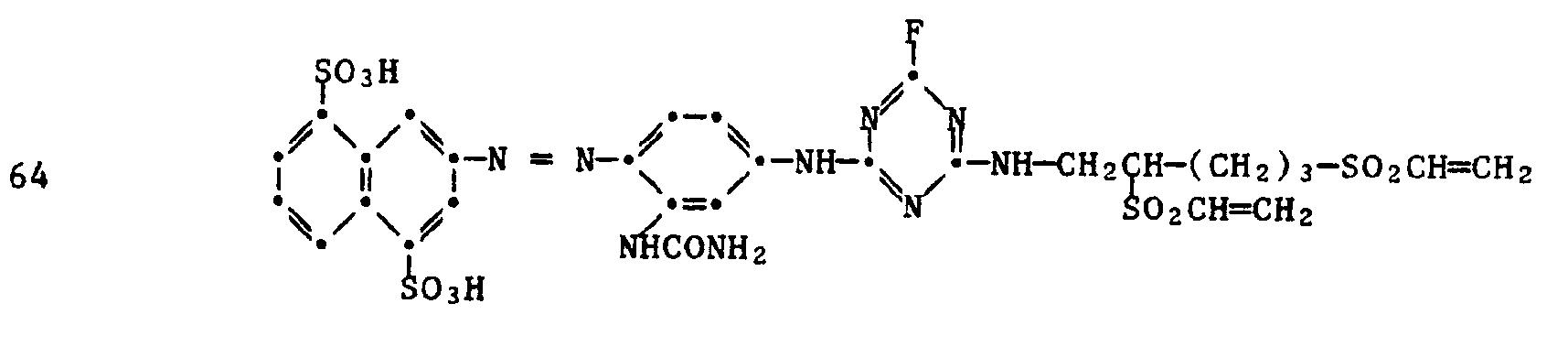





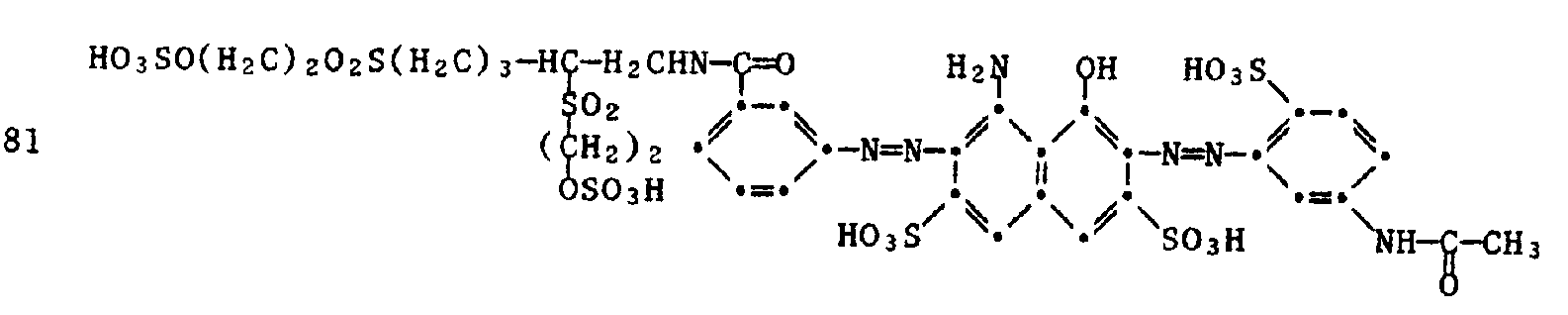



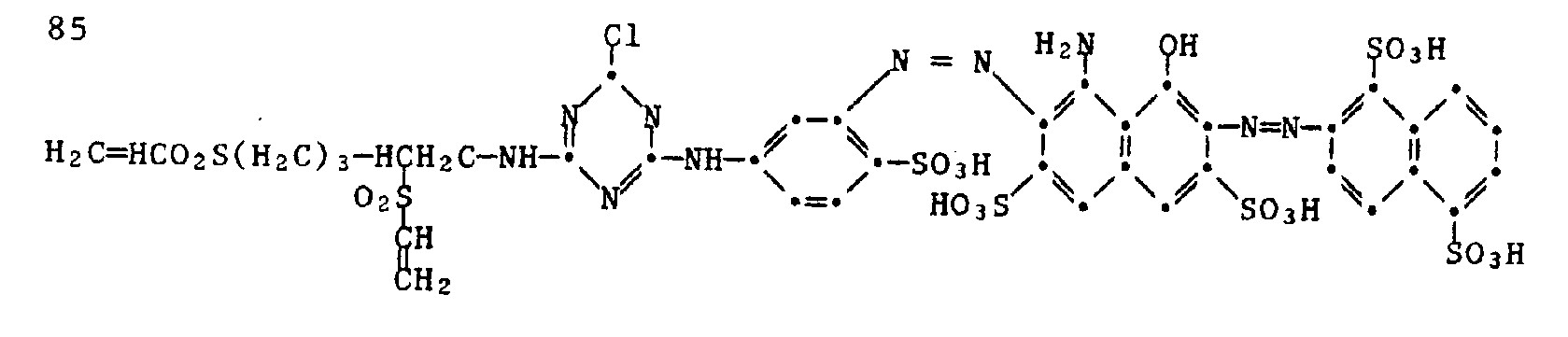


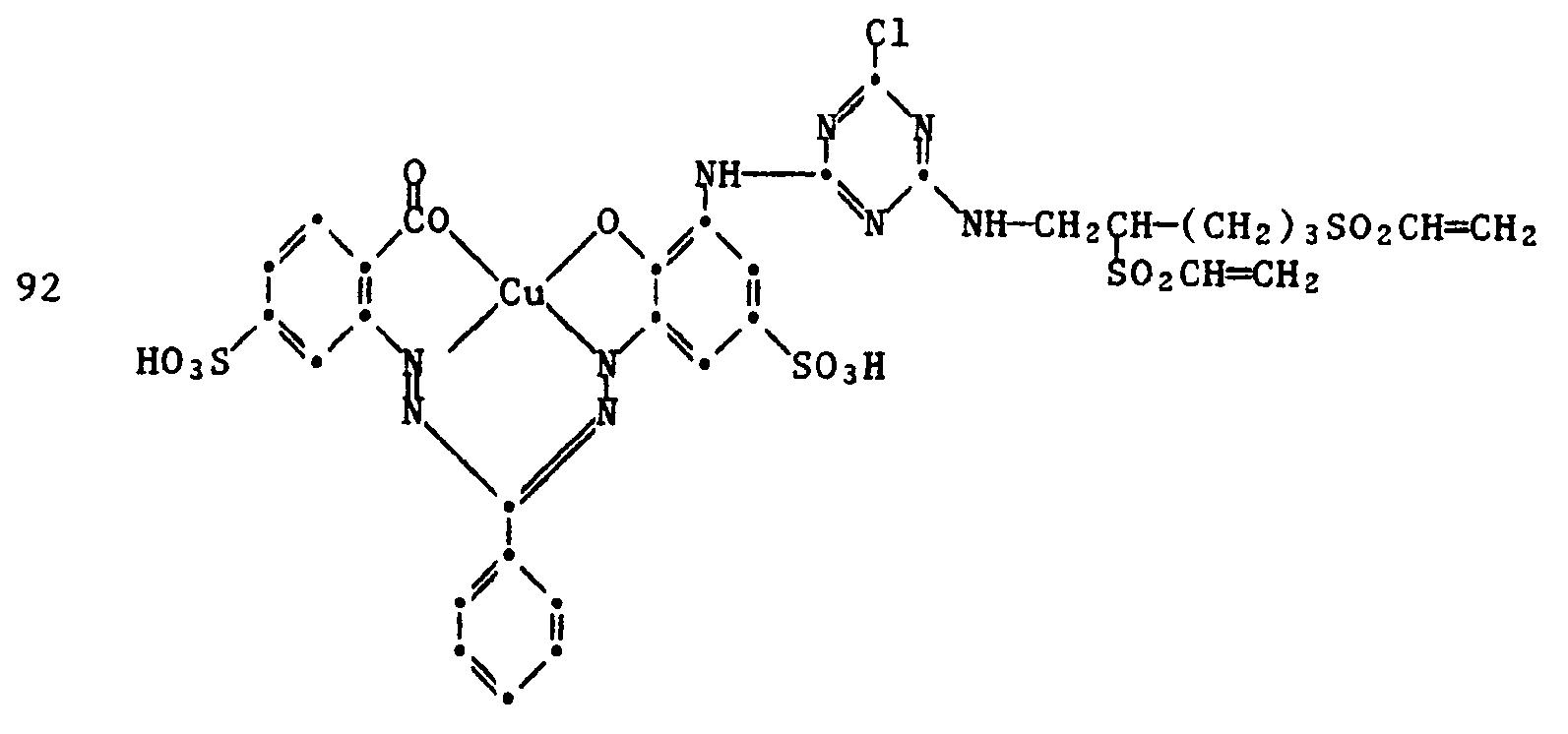


- 2 Teile des gemäss Beispiel 3 erhaltenen Farbstoffes werden in 400 Teilen Wasser gelöst; dazu gibt man 1500 Teile einer Lösung, die pro Liter 53 g Natriumchlorid enthält. In dieses Färbebad geht man bei 40°C mit 100 Teilen eines Baumwollgewebes ein. Nach 45 Minuten werden 100 Teile einer Lösung, die pro Liter 16 g Natriumhydroxyd und 20 g kalziniertes Soda enthält, zugegeben. Die Temperatur des Färbebades wird weitere 45 Minuten bei 40°C gehalten. Danach wird die gefärbte Ware gespült, während einer Viertelstunde mit einem nichtionogenen Waschmittel kochend geseift, nochmals gespült und getrocknet.
- 2 Teile des gemäss Beispiel 3 erhaltenen Reaktivfarbstoffes werden in 400 Teilen Wasser gelöst; dazu gibt man 1500 Teile einer Lösung, die pro Liter 53 g Natriumchlorid enthält. In dieses Färbebad geht man bei 35°C mit 100 Teilen eines Baumwollgewebes ein. Nach 20 Minuten werden 100 Teile einer Lösung, die pro Liter 16 g Natriumhydroxyd und 20 g kalziniertes Soda enthält, zugegeben. Die Temperatur des Färbebades wird weitere 15 Minuten bei 35°C gehalten. Danach wird die Temperatur innerhalb von 20 Minuten auf 60°C erhöht. Die Temperatur wird weitere 35 Minuten bei 60°C gehalten. Danach wird gespült, während einer Viertelstunde mit einem nichtionogenen Waschmittel kochend geseift, nochmals gespült und getrocknet.
- 8 Teile des gemäss Beispiel 3 erhaltenen Reaktivfarbstoffes werden in 400 Teilen Wasser gelöst; dazu gibt man 1400 Teile einer Lösung, die pro Liter 100 g Natriumsulfat enthält. In dieses Färbebad geht man bei 25°C mit 100 Teilen eines Baumwollgewebes ein. Nach 10 Minuten werden 200 Teile einer Lösung, die pro Liter 150 g Trinatriumphosphat enthält, zugegeben. Danach wird die Temperatur des Färbebades innerhalb 10 Minuten auf 60°C erhöht. Die Temperatur wird weitere 90 Minuten auf 60°C gehalten. Danach wird gespült, während einer Viertelstunde mit einem nichtionogenen Waschmittel kochend geseift, nochmals gespült und getrocknet.
- 4 Teile des gemäss Beispiel 3 erhaltenen Reaktivfarbstoffes werden in 50 Teilen Wasser gelöst. Dazu gibt man 50 Teile einer Lösung, die pro Liter 5 g Natriumhydroxyid und 20 g kalziniertes Soda enthält. Mit der erhaltenen Lösung wird ein Baumwollgewebe foulardiert, so dass es um 70 % seines Gewichtes zunimmt, und dann auf eine Kaule aufgewickelt. Das Baumwollgewebe wird so während 3 Stunden bei Raumtemperatur gelagert. Danach wird die gefärbte Ware gespült, während einer Viertelstunde mit einem nichtionogenen Waschmittel kochend geseift, nochmals gespült und getrocknet.
- 6 Teile des gemäss Beispiel 3 erhaltenen Reaktivfarbstoffes werden in 50 Teilen Wasser gelöst. Dazu gibt man 50 Teile einer Lösung, die pro Liter 16 g Natriumhydroxyd und 0,04 Liter Wasserglas (38°Be) enthält. Mit der erhaltenen Lösung wird ein Baumwollgewebe foulardiert, so dass es um 70 % seines Gewichtes zunimmt, und dann auf eine Kaule aufgewickelt. Das Baumwollgewebe wird so während 10 Stunden bei Raumtemperatur gelagert. Danach wird die gefärbte Ware gespült, während einer Viertelstunde mit einem nichtionogenen Waschmittel kochend geseift, nochmals gespült und getrocknet.
- 2 Teile des gemäss Beispiel 3 erhaltenen Reaktivfarbstoffes werden unter Zusatz von 0,5 Teilen m-nitrobenzolsulfonsaurem Natrium in 100 Teilen Wasser gelöst. Mit der erhaltenen Lösung wird ein Baumwollgewebe imprägniert, so dass es um 75% seines Gewichtes zunimmt, und dann getrocknet. Dann imprägniert man das Gewebe mit einer 20°C warmen Lösung, die pro Liter 4g Natriumhydroxyd und 300 g Natriumchlorid enthält, quetscht auf 75% Gewichtszunahme ab, dämpft die Färbung während 30 Sekunden bei 100 bis 102°C, spült, seift während einer Viertelstunde in einer 0,3%igen kochenden Lösung eines nichtionogenen Waschmittels, spült und trocknet.
- In 2000 Teile Wasser werden 2 Teile des Farbstoffes von Beispiel 3, 160 Teile Natriumsulfat und als Puffermittel 4 Teile Na2HP04·12H20 und 1 Teil KH2P04 gegeben, so dass ein Färbebad mit einem pH von 7 erhalten wird. In dieses Bad werden 100 Teile einer Wirkware aus nicht-mercerisierter Baumwolle eingetaucht. Im Laufe von 30 Minuten wird die Temperatur des Bades auf 130°C gebracht, und bei dieser Temperatur wird 60 Minuten lang gefärbt. Danach wird die gefärbte Ware aus dem Bad genommen, mit Wasser gewaschen, geseift, wieder mit Wasser gewaschen und getrocknet. Es wird eine gelbe Färbung erhalten.
- In 2000 Teile Wasser werden 2 Teile des Farbstoffes von Beispiel 29, 2 Teile des bekannten wasserunlöslichen Anthrachinonfarbstoffes der Formel
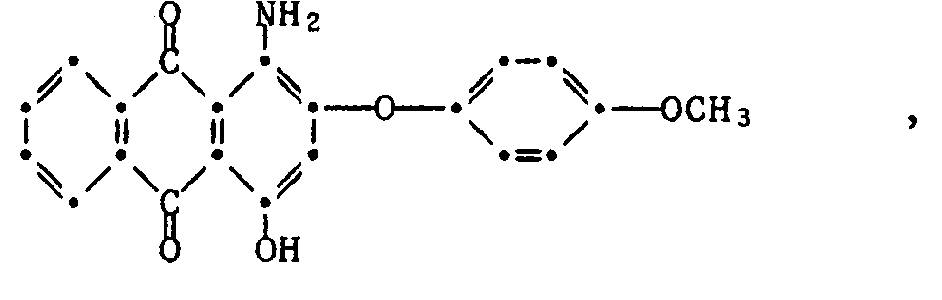
- 3 Teile des gemäss Beispiel 3 erhaltenen Reaktivfarbstoffes werden unter schnellem Rühren in 100 Teile einer Stammverdickung, enthaltend 50 Teile 5%ige Natriumalginatverdickung, 27,8 Teile Wasser, 20 Teile Harnstoff, 1 Teil m-nitrobenzolsulfonsaures Natrium sowie 1,2 Teile Natriumhydrogencarbonat, eingestreut. Mit der so erhaltenen Druckpaste bedruckt man ein Baumwollgewebe, trocknet und dämpft den erhaltenen bedruckten Stoff 2 Minuten bei 102°C in gesättigtem Dampf. Das bedruckte Gewebe wird dann gespült, gegebenenfalls kochend geseift und nochmals gespült, und anschliessend getrocknet.
- 5 Teile des gemäss Beispiel 3 erhaltenen Reaktivfarbstoffes werden unter schnellem Rühren in 100 Teile einer Stammverdickung, enthaltend 50 Teile 5%ige Natriumalginatverdickung, 36,5 Teile Wasser, 10 Teile Harnstoff, 1 Teil m-nitrobenzolsulfonsaures Natrium sowie 2,5 Teile Natriumhydrogencarbonat, eingestreut. Mit der so erhaltenen Druckpaste, deren Stabilität den technischen Anforderungen entspricht, bedruckt man ein Baumwollgewebe, trocknet und dämpft den erhaltenen bedruckten Stoff 8 Minuten bei 102°C in gesättigtem Dampf. Das bedruckte Gewebe wird dann gespült, gegebenenfalls kochend geseift und nochmals gespült, und anschliessend getrocknet.
einführt, wobei D, U und A die unter Formel (1) angegebenen Bedeutungen haben, oder dass man, im Falle der Verwendung von Farbstoffvorprodukten, die erhaltenen Zwischenprodukte in die gewünschten Endfarbstoffe überführt, und gegebenenfalls eine weitere Umwandlungsreaktion anschliesst.
Claims (31)





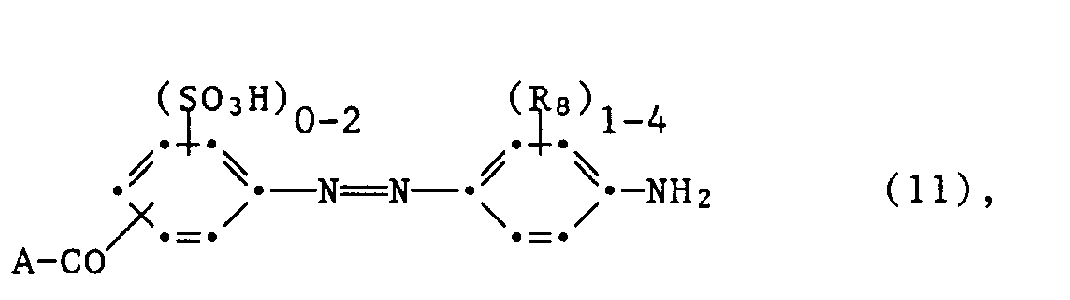


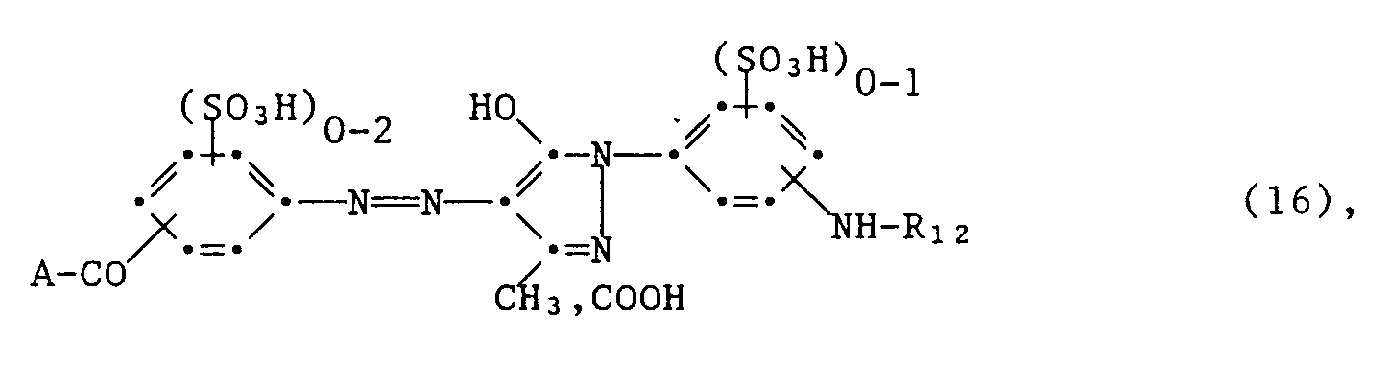
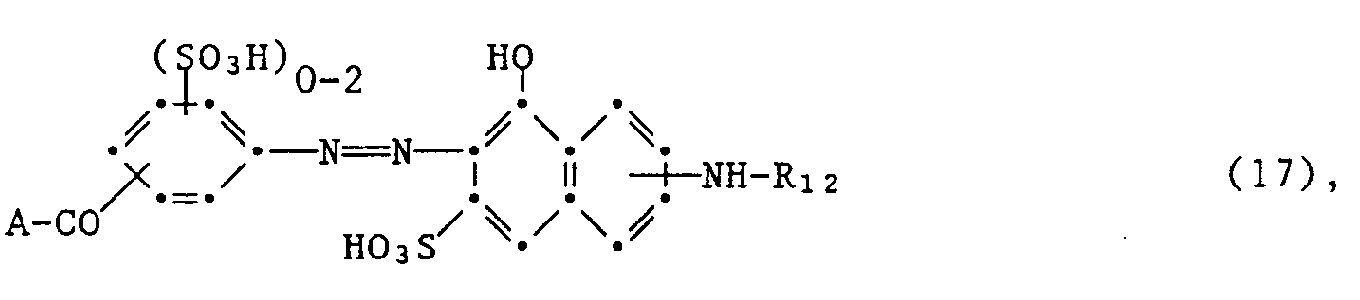


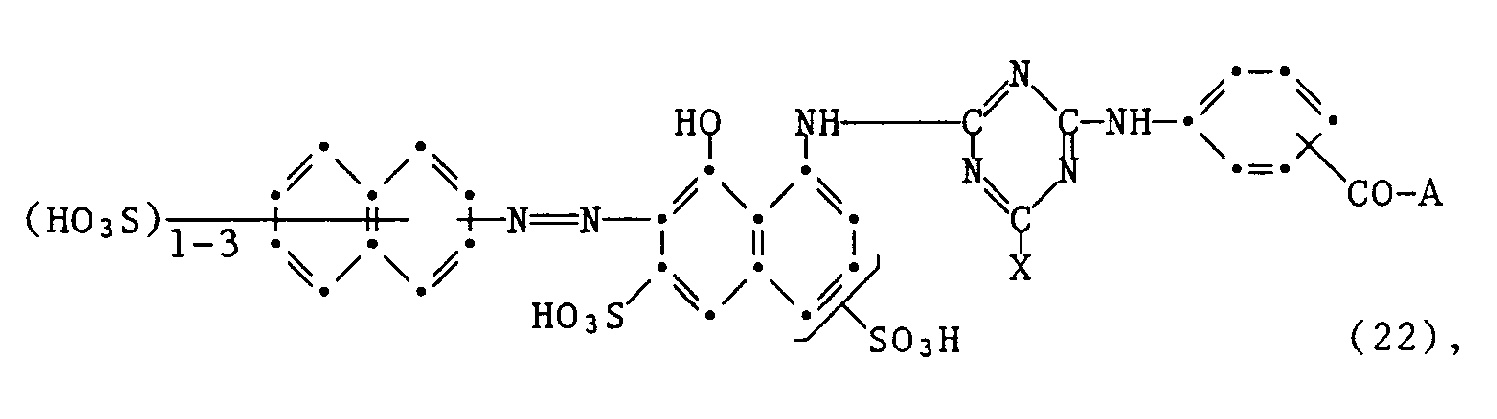


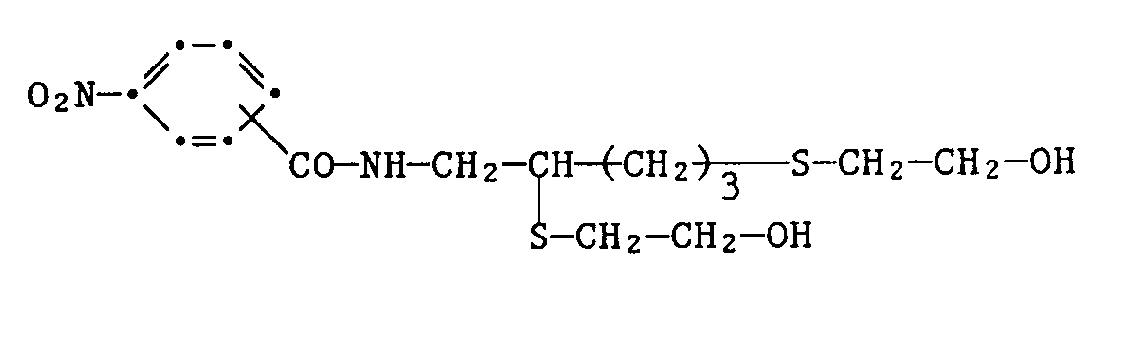
Applications Claiming Priority (3)
| Application Number | Priority Date | Filing Date | Title |
|---|---|---|---|
| CH369987 | 1987-09-24 | ||
| CH369987 | 1987-09-24 | ||
| CH3699/87 | 1987-09-24 |
Publications (3)
| Publication Number | Publication Date |
|---|---|
| EP0309406A1 EP0309406A1 (de) | 1989-03-29 |
| EP0309406B1 true EP0309406B1 (de) | 1992-06-24 |
| EP0309406B2 EP0309406B2 (de) | 2000-07-12 |
Family
ID=4261623
Family Applications (1)
| Application Number | Title | Priority Date | Filing Date |
|---|---|---|---|
| EP88810630A Expired - Lifetime EP0309406B2 (de) | 1987-09-24 | 1988-09-15 | Reaktivfarbstoffe, deren Herstellung und Verwendung |
Country Status (7)
| Country | Link |
|---|---|
| US (1) | US5081296A (de) |
| EP (1) | EP0309406B2 (de) |
| JP (1) | JP2668247B2 (de) |
| KR (1) | KR890005226A (de) |
| BR (1) | BR8804937A (de) |
| DE (1) | DE3872337D1 (de) |
| ES (1) | ES2042796T5 (de) |
Families Citing this family (7)
| Publication number | Priority date | Publication date | Assignee | Title |
|---|---|---|---|---|
| JPH01185370A (ja) * | 1988-01-20 | 1989-07-24 | Sumitomo Chem Co Ltd | ジオキサジン化合物及びそれを用いて繊維材料を染色又は捺染する方法 |
| EP0474596B1 (de) * | 1990-09-06 | 1995-11-15 | Ciba-Geigy Ag | Reaktivfarbstoffe, Verfahren zu deren Herstellung und deren Verwendung |
| EP0570333B1 (de) * | 1992-05-04 | 1996-02-21 | Ciba-Geigy Ag | Faserreaktive Anthrachinonfarbstoffe, Verfahren zu deren Herstellung und deren Verwendung |
| TW506993B (en) | 1999-03-15 | 2002-10-21 | Ciba Sc Holding Ag | Reactive dyes, processes for their preparation and process for dyeing or printing a fibre material |
| DE19918159A1 (de) | 1999-04-22 | 2000-10-26 | Dystar Textilfarben Gmbh & Co | Wasserlösliche Disazoverbindungen mit Arylcarbonamid-Diazokomponenten, Verfahren zu ihrer Herstellung und ihre Verwendung |
| CN106675089A (zh) * | 2016-12-13 | 2017-05-17 | 浙江劲光实业股份有限公司 | 一种活性橙染料的合成方法 |
| CN107216683B (zh) * | 2017-06-21 | 2019-05-10 | 江苏德美科化工有限公司 | 一种含氟双活性基橙色染料及其制备方法 |
Family Cites Families (11)
| Publication number | Priority date | Publication date | Assignee | Title |
|---|---|---|---|---|
| CH514659A (de) * | 1968-08-12 | 1971-10-31 | Cassella Farbwerke Mainkur Ag | Verfahren zur Herstellung wasserlöslicher metallhaltiger Farbstoffe der Phthalocyaninreihe |
| DE2614550C3 (de) * | 1976-04-03 | 1981-06-25 | Cassella Ag, 6000 Frankfurt | Neue Reaktivfarbstoffe, ihre Herstellung und Verwendung zum Färben und Bedrucken von Cellulose sowie natürlichen und synthetischen Polyamidsubstraten |
| US4398033A (en) * | 1981-03-17 | 1983-08-09 | Ciba-Geigy Corporation | 4-Chloro-4-chloromethyloxetan-2-one and a process for its production |
| DE3272886D1 (en) * | 1981-07-21 | 1986-10-02 | Ciba Geigy Ag | Reactive dyestuffs, their preparation and their use |
| EP0076782B1 (de) * | 1981-10-02 | 1986-03-05 | Ciba-Geigy Ag | Reaktivfarbstoffe, deren Herstellung und Verwendung |
| CH660016A5 (de) * | 1983-11-09 | 1987-03-13 | Ciba Geigy Ag | Reaktivfarbstoffe und deren herstellung. |
| EP0210951B1 (de) * | 1985-07-12 | 1990-03-07 | Ciba-Geigy Ag | Reaktivfarbstoffe, deren Herstellung und Verwendung |
| DE3673474D1 (de) * | 1985-07-12 | 1990-09-20 | Ciba Geigy Ag | Reaktivfarbstoffe, deren herstellung und verwendung. |
| BR8606825A (pt) * | 1985-08-14 | 1987-10-27 | Ciba Geigy Ag | Corantes reativos,sua preparacao e emprego |
| US4766206A (en) * | 1985-10-03 | 1988-08-23 | Ciba-Geigy Corporation | Reactive dyestuffs comprising a vinylsulfonylalkylaminocarbonyl moiety |
| EP0233139B1 (de) * | 1986-01-10 | 1991-01-16 | Ciba-Geigy Ag | Reaktivfarbstoffe, deren Herstellung und Verwendung |
-
1988
- 1988-09-15 ES ES88810630T patent/ES2042796T5/es not_active Expired - Lifetime
- 1988-09-15 DE DE8888810630T patent/DE3872337D1/de not_active Expired - Lifetime
- 1988-09-15 EP EP88810630A patent/EP0309406B2/de not_active Expired - Lifetime
- 1988-09-23 BR BR8804937A patent/BR8804937A/pt unknown
- 1988-09-24 JP JP63237556A patent/JP2668247B2/ja not_active Expired - Fee Related
- 1988-09-24 KR KR1019880012394A patent/KR890005226A/ko not_active Withdrawn
-
1990
- 1990-04-17 US US07/510,384 patent/US5081296A/en not_active Expired - Fee Related
Also Published As
| Publication number | Publication date |
|---|---|
| JPH01158076A (ja) | 1989-06-21 |
| JP2668247B2 (ja) | 1997-10-27 |
| EP0309406A1 (de) | 1989-03-29 |
| ES2042796T3 (es) | 1993-12-16 |
| DE3872337D1 (de) | 1992-07-30 |
| EP0309406B2 (de) | 2000-07-12 |
| ES2042796T5 (es) | 2000-10-16 |
| KR890005226A (ko) | 1989-05-13 |
| US5081296A (en) | 1992-01-14 |
| BR8804937A (pt) | 1989-05-02 |
Similar Documents
| Publication | Publication Date | Title |
|---|---|---|
| EP0214093B1 (de) | Reaktivfarbstoffe, deren Herstellung und Verwendung | |
| EP0076782B1 (de) | Reaktivfarbstoffe, deren Herstellung und Verwendung | |
| EP0133843B1 (de) | Reaktivfarbstoffe, deren Herstellung und Verwendung | |
| EP0074928A2 (de) | Reaktivfarbstoffe, deren Herstellung und Verwendung | |
| EP0221013B1 (de) | Reaktivfarbstoffe, deren Herstellung und Verwendung | |
| EP0174909B1 (de) | Reaktivfarbstoffe, deren Herstellung und Verwendung | |
| EP0179019B1 (de) | Reaktivfarbstoffe, deren Herstellung und Verwendung | |
| EP0114032B1 (de) | Reaktivfarbstoffe, deren Herstellung und Verwendung | |
| EP0538785B1 (de) | Wasserlösliche faserreaktive Farbstoffe, Verfahren zu ihrer Herstellung und ihre Verwendung | |
| EP0471702B1 (de) | Wasserlösliche faserreaktive farbstoffe, verfahren zu ihrer herstellung und ihre verwendung | |
| EP0208655A2 (de) | Reaktivfarbstoffe, deren Herstellung und Verwendung | |
| EP0458743A2 (de) | Reaktivfarbstoffe, Verfahren zu deren Herstellung und deren Verwendung | |
| EP0141776B1 (de) | Reaktivfarbstoffe, deren Herstellung und Verwendung | |
| EP0333653B1 (de) | Reaktivfarbstoffe, Verfahren zu deren Herstellung und deren Verwendung | |
| EP0309406B2 (de) | Reaktivfarbstoffe, deren Herstellung und Verwendung | |
| EP0167490A1 (de) | Reaktivfarbstoffe, deren Herstellung und Verwendung | |
| EP0278904B1 (de) | Reaktivfarbstoffe, deren Herstellung und Verwendung | |
| EP0297044B1 (de) | Reaktivfarbstoffe, Verfahren zu deren Herstellung und deren Verwendung | |
| EP0233139B1 (de) | Reaktivfarbstoffe, deren Herstellung und Verwendung | |
| EP0302006B1 (de) | Reaktivfarbstoffe, Verfahren zu deren Herstellung und deren Verwendung | |
| EP0282443B1 (de) | Reaktivfarbstoffe, deren Herstellung und Verwendung | |
| EP0177445A1 (de) | Reaktivfarbstoffe, deren Herstellung und Verwendung | |
| EP0284568B1 (de) | Reaktivfarbstoffe, deren Herstellung und Verwendung | |
| EP0112797A1 (de) | Verfahren zum Färben oder Bedrucken von cellulosehaltigem Fasermaterial mit Reaktivfarbstoffen | |
| EP0388864B1 (de) | Wasserlösliche faserreaktive Farbstoffe, Verfahren zu ihrer Herstellung und ihre Verwendung |
Legal Events
| Date | Code | Title | Description |
|---|---|---|---|
| PUAI | Public reference made under article 153(3) epc to a published international application that has entered the european phase |
Free format text: ORIGINAL CODE: 0009012 |
|
| 17P | Request for examination filed |
Effective date: 19880917 |
|
| AK | Designated contracting states |
Kind code of ref document: A1 Designated state(s): BE CH DE ES FR GB IT LI |
|
| 17Q | First examination report despatched |
Effective date: 19901016 |
|
| GRAA | (expected) grant |
Free format text: ORIGINAL CODE: 0009210 |
|
| AK | Designated contracting states |
Kind code of ref document: B1 Designated state(s): BE CH DE ES FR GB IT LI |
|
| ET | Fr: translation filed | ||
| REF | Corresponds to: |
Ref document number: 3872337 Country of ref document: DE Date of ref document: 19920730 |
|
| ITF | It: translation for a ep patent filed | ||
| GBT | Gb: translation of ep patent filed (gb section 77(6)(a)/1977) | ||
| PLBI | Opposition filed |
Free format text: ORIGINAL CODE: 0009260 |
|
| 26 | Opposition filed |
Opponent name: BAYER AG, LEVERKUSEN KONZERNVERWALTUNG RP PATENTE Effective date: 19930322 |
|
| REG | Reference to a national code |
Ref country code: ES Ref legal event code: FG2A Ref document number: 2042796 Country of ref document: ES Kind code of ref document: T3 |
|
| APAA | Appeal reference recorded |
Free format text: ORIGINAL CODE: EPIDOS REFN |
|
| REG | Reference to a national code |
Ref country code: CH Ref legal event code: PUE Owner name: CIBA-GEIGY AG TRANSFER- CIBA SC HOLDING AG |
|
| APAC | Appeal dossier modified |
Free format text: ORIGINAL CODE: EPIDOS NOAPO |
|
| APAC | Appeal dossier modified |
Free format text: ORIGINAL CODE: EPIDOS NOAPO |
|
| BECN | Be: change of holder's name |
Effective date: 19961129 |
|
| REG | Reference to a national code |
Ref country code: FR Ref legal event code: TP Ref country code: CH Ref legal event code: PFA Free format text: CIBA SC HOLDING AG TRANSFER- CIBA SPECIALTY CHEMICALS HOLDING INC. |
|
| RAP2 | Party data changed (patent owner data changed or rights of a patent transferred) |
Owner name: CIBA SPECIALTY CHEMICALS HOLDING INC. |
|
| REG | Reference to a national code |
Ref country code: GB Ref legal event code: 732E |
|
| REG | Reference to a national code |
Ref country code: FR Ref legal event code: CD |
|
| REG | Reference to a national code |
Ref country code: ES Ref legal event code: PC2A |
|
| APCC | Communication from the board of appeal sent |
Free format text: ORIGINAL CODE: EPIDOS OBAPO |
|
| APCC | Communication from the board of appeal sent |
Free format text: ORIGINAL CODE: EPIDOS OBAPO |
|
| APAC | Appeal dossier modified |
Free format text: ORIGINAL CODE: EPIDOS NOAPO |
|
| PLAW | Interlocutory decision in opposition |
Free format text: ORIGINAL CODE: EPIDOS IDOP |
|
| PUAH | Patent maintained in amended form |
Free format text: ORIGINAL CODE: 0009272 |
|
| STAA | Information on the status of an ep patent application or granted ep patent |
Free format text: STATUS: PATENT MAINTAINED AS AMENDED |
|
| 27A | Patent maintained in amended form |
Effective date: 20000712 |
|
| AK | Designated contracting states |
Kind code of ref document: B2 Designated state(s): BE CH DE ES FR GB IT LI |
|
| REG | Reference to a national code |
Ref country code: CH Ref legal event code: AEN Free format text: AUFRECHTERHALTUNG DES PATENTES IN GEAENDERTER FORM |
|
| GBTA | Gb: translation of amended ep patent filed (gb section 77(6)(b)/1977) | ||
| ITF | It: translation for a ep patent filed | ||
| ET3 | Fr: translation filed ** decision concerning opposition | ||
| REG | Reference to a national code |
Ref country code: ES Ref legal event code: DC2A Kind code of ref document: T5 Effective date: 20000831 |
|
| PGFP | Annual fee paid to national office [announced via postgrant information from national office to epo] |
Ref country code: ES Payment date: 20010905 Year of fee payment: 14 |
|
| REG | Reference to a national code |
Ref country code: GB Ref legal event code: IF02 |
|
| PGFP | Annual fee paid to national office [announced via postgrant information from national office to epo] |
Ref country code: FR Payment date: 20020820 Year of fee payment: 15 Ref country code: CH Payment date: 20020820 Year of fee payment: 15 |
|
| PGFP | Annual fee paid to national office [announced via postgrant information from national office to epo] |
Ref country code: DE Payment date: 20020826 Year of fee payment: 15 |
|
| PGFP | Annual fee paid to national office [announced via postgrant information from national office to epo] |
Ref country code: GB Payment date: 20020903 Year of fee payment: 15 |
|
| PGFP | Annual fee paid to national office [announced via postgrant information from national office to epo] |
Ref country code: BE Payment date: 20021028 Year of fee payment: 15 |
|
| PG25 | Lapsed in a contracting state [announced via postgrant information from national office to epo] |
Ref country code: GB Free format text: LAPSE BECAUSE OF NON-PAYMENT OF DUE FEES Effective date: 20030915 |
|
| PG25 | Lapsed in a contracting state [announced via postgrant information from national office to epo] |
Ref country code: ES Free format text: LAPSE BECAUSE OF NON-PAYMENT OF DUE FEES Effective date: 20030916 |
|
| PG25 | Lapsed in a contracting state [announced via postgrant information from national office to epo] |
Ref country code: LI Free format text: LAPSE BECAUSE OF NON-PAYMENT OF DUE FEES Effective date: 20030930 Ref country code: CH Free format text: LAPSE BECAUSE OF NON-PAYMENT OF DUE FEES Effective date: 20030930 Ref country code: BE Free format text: LAPSE BECAUSE OF NON-PAYMENT OF DUE FEES Effective date: 20030930 |
|
| BERE | Be: lapsed |
Owner name: *CIBA SPECIALTY CHEMICALS HOLDING INC. Effective date: 20030930 |
|
| PG25 | Lapsed in a contracting state [announced via postgrant information from national office to epo] |
Ref country code: DE Free format text: LAPSE BECAUSE OF NON-PAYMENT OF DUE FEES Effective date: 20040401 |
|
| GBPC | Gb: european patent ceased through non-payment of renewal fee |
Effective date: 20030915 |
|
| REG | Reference to a national code |
Ref country code: CH Ref legal event code: PL |
|
| PG25 | Lapsed in a contracting state [announced via postgrant information from national office to epo] |
Ref country code: FR Free format text: LAPSE BECAUSE OF NON-PAYMENT OF DUE FEES Effective date: 20040528 |
|
| REG | Reference to a national code |
Ref country code: FR Ref legal event code: ST |
|
| REG | Reference to a national code |
Ref country code: ES Ref legal event code: FD2A Effective date: 20030916 |
|
| PG25 | Lapsed in a contracting state [announced via postgrant information from national office to epo] |
Ref country code: IT Free format text: LAPSE BECAUSE OF NON-PAYMENT OF DUE FEES Effective date: 20050915 |
|
| APAH | Appeal reference modified |
Free format text: ORIGINAL CODE: EPIDOSCREFNO |