EP0309664A2 - Appareil pour mesurer la température et méthode pour sa fabrication - Google Patents
Appareil pour mesurer la température et méthode pour sa fabrication Download PDFInfo
- Publication number
- EP0309664A2 EP0309664A2 EP88111236A EP88111236A EP0309664A2 EP 0309664 A2 EP0309664 A2 EP 0309664A2 EP 88111236 A EP88111236 A EP 88111236A EP 88111236 A EP88111236 A EP 88111236A EP 0309664 A2 EP0309664 A2 EP 0309664A2
- Authority
- EP
- European Patent Office
- Prior art keywords
- thermistor
- resistance
- temperature
- substrate
- sensor
- Prior art date
- Legal status (The legal status is an assumption and is not a legal conclusion. Google has not performed a legal analysis and makes no representation as to the accuracy of the status listed.)
- Withdrawn
Links
- 238000004519 manufacturing process Methods 0.000 title claims description 15
- 239000000758 substrate Substances 0.000 claims abstract description 69
- 238000009966 trimming Methods 0.000 claims abstract description 19
- 239000000523 sample Substances 0.000 claims description 34
- 238000000034 method Methods 0.000 claims description 23
- 239000004020 conductor Substances 0.000 claims description 18
- 239000000463 material Substances 0.000 claims description 11
- 238000012544 monitoring process Methods 0.000 claims description 7
- 239000007788 liquid Substances 0.000 claims description 4
- 238000004382 potting Methods 0.000 claims description 4
- 230000008859 change Effects 0.000 claims description 3
- 239000013536 elastomeric material Substances 0.000 claims description 3
- 230000001681 protective effect Effects 0.000 claims description 2
- 238000000151 deposition Methods 0.000 claims 2
- 230000001419 dependent effect Effects 0.000 claims 1
- 230000004044 response Effects 0.000 description 9
- 238000010276 construction Methods 0.000 description 6
- 239000011159 matrix material Substances 0.000 description 5
- 235000012431 wafers Nutrition 0.000 description 5
- 239000000306 component Substances 0.000 description 4
- 239000000919 ceramic Substances 0.000 description 3
- 230000006978 adaptation Effects 0.000 description 2
- 239000012080 ambient air Substances 0.000 description 2
- 238000010586 diagram Methods 0.000 description 2
- 238000005538 encapsulation Methods 0.000 description 2
- 230000006870 function Effects 0.000 description 2
- 239000012212 insulator Substances 0.000 description 2
- 238000012986 modification Methods 0.000 description 2
- 230000004048 modification Effects 0.000 description 2
- 238000010257 thawing Methods 0.000 description 2
- 238000012546 transfer Methods 0.000 description 2
- JOYRKODLDBILNP-UHFFFAOYSA-N Ethyl urethane Chemical compound CCOC(N)=O JOYRKODLDBILNP-UHFFFAOYSA-N 0.000 description 1
- HCHKCACWOHOZIP-UHFFFAOYSA-N Zinc Chemical compound [Zn] HCHKCACWOHOZIP-UHFFFAOYSA-N 0.000 description 1
- 229910001297 Zn alloy Inorganic materials 0.000 description 1
- 239000003570 air Substances 0.000 description 1
- 230000005540 biological transmission Effects 0.000 description 1
- 150000001875 compounds Chemical class 0.000 description 1
- 230000001276 controlling effect Effects 0.000 description 1
- 238000001816 cooling Methods 0.000 description 1
- 238000012937 correction Methods 0.000 description 1
- 230000007423 decrease Effects 0.000 description 1
- 229920001971 elastomer Polymers 0.000 description 1
- 239000000806 elastomer Substances 0.000 description 1
- 235000000396 iron Nutrition 0.000 description 1
- 238000005259 measurement Methods 0.000 description 1
- 230000000063 preceeding effect Effects 0.000 description 1
- 230000008569 process Effects 0.000 description 1
- 238000005057 refrigeration Methods 0.000 description 1
- 230000001105 regulatory effect Effects 0.000 description 1
- 238000012216 screening Methods 0.000 description 1
- 238000005476 soldering Methods 0.000 description 1
- 239000007787 solid Substances 0.000 description 1
- 239000000126 substance Substances 0.000 description 1
- XLYOFNOQVPJJNP-UHFFFAOYSA-N water Substances O XLYOFNOQVPJJNP-UHFFFAOYSA-N 0.000 description 1
- 238000004804 winding Methods 0.000 description 1
- 239000011701 zinc Substances 0.000 description 1
- 229910052725 zinc Inorganic materials 0.000 description 1
Images


Classifications
-
- G—PHYSICS
- G01—MEASURING; TESTING
- G01K—MEASURING TEMPERATURE; MEASURING QUANTITY OF HEAT; THERMALLY-SENSITIVE ELEMENTS NOT OTHERWISE PROVIDED FOR
- G01K7/00—Measuring temperature based on the use of electric or magnetic elements directly sensitive to heat ; Power supply therefor, e.g. using thermoelectric elements
- G01K7/02—Measuring temperature based on the use of electric or magnetic elements directly sensitive to heat ; Power supply therefor, e.g. using thermoelectric elements using thermoelectric elements, e.g. thermocouples
-
- G—PHYSICS
- G01—MEASURING; TESTING
- G01K—MEASURING TEMPERATURE; MEASURING QUANTITY OF HEAT; THERMALLY-SENSITIVE ELEMENTS NOT OTHERWISE PROVIDED FOR
- G01K15/00—Testing or calibrating of thermometers
-
- G—PHYSICS
- G01—MEASURING; TESTING
- G01K—MEASURING TEMPERATURE; MEASURING QUANTITY OF HEAT; THERMALLY-SENSITIVE ELEMENTS NOT OTHERWISE PROVIDED FOR
- G01K7/00—Measuring temperature based on the use of electric or magnetic elements directly sensitive to heat ; Power supply therefor, e.g. using thermoelectric elements
- G01K7/16—Measuring temperature based on the use of electric or magnetic elements directly sensitive to heat ; Power supply therefor, e.g. using thermoelectric elements using resistive elements
- G01K7/22—Measuring temperature based on the use of electric or magnetic elements directly sensitive to heat ; Power supply therefor, e.g. using thermoelectric elements using resistive elements the element being a non-linear resistance, e.g. thermistor
- G01K7/24—Measuring temperature based on the use of electric or magnetic elements directly sensitive to heat ; Power supply therefor, e.g. using thermoelectric elements using resistive elements the element being a non-linear resistance, e.g. thermistor in a specially-adapted circuit, e.g. bridge circuit
Definitions
- the present invention relates to a temperature sensor and more particularly to a precision temperature sensor and its fabrication.
- Temperature sensors incorporating thermistors whose resistance changes with temperature are commonly used.
- Thermistors have either a positive or a negative temperature coefficient.
- a positive temperature coefficient means that the resistance of the thermistor increases with increased temperature.
- a negative coefficient means the thermistor resistance decreases with increasing temperature.
- the thermistor is series coupled with a known resistance to form a voltage divider.
- a known voltage is applied across the voltage divider and the voltage at an output junction between the known resistance and the thermistor is measured to determine the thermistor temperature.
- the temperature is derived from the output junction voltage since that voltage varies with thermistor resistance which is directly related to the thermistor temperature.
- Thermistors are calibrated by their manufacturers and a table of thermistor resistances at different temperatures are sent to the customer with each thermistor. Generally the tabulated thermistor resistances are accurate within 10-20 percent at a given temperature. Very accurately calibrated "precision" thermistors are available at substantially increased cost. If precision thermistors are matched with resistors whose resistance is known to a high degree of accuracy (i.e., "precision" resistors) a precision voltage divider can be constructed.
- Resistors can be adjusted or trimmed extremely accurately to produce "precision" resistors. Trimming can be accomplished in various ways. For example, the resistance of wire wound resistors is trimmed by adjusting the number of windings that make up the resistor. Thick film resistors deposited on substrates are sometimes trimmed by adjusting the locations of conductive connector fingers along the resistor (see U.S. Patent 4,085,399) and sometimes by physically removing thick film resistance material until a desired precise resistance value is achieved.
- the present invention provides a new and improved precision temperature sensor and manufacturing process for producing that sensor.
- the temperature sensor is constructed by forming a voltage divider having first and second segments coupled together at an output junction.
- the first segment includes a thermistor element having a resistance which varies with temperature and the second segment includes a monolithic resistor element fixed to a substrate.
- the thermistor is maintained at a precisely known reference temperature while its resistance is measured with a high degree of accuracy.
- the associated resistor element is then precisely trimmed to produce a precise resistance ratio between the first and second voltage divider segments at the reference temperature.
- the new sensor is precisely accurate at the reference temperature even though the thermistor is not a "precision" thermistor. If a temperature sensor is desired for sensing a predetermined set point temperature, a sensor constructed according to the present invention can be supplied which does not employ discrete precision resistors or a precision thermistor, yet which is highly accurate in sensing the set point temperature.
- the new sensor is constructed by encapsulating the voltage divider with an elastomeric substance which prevents transmission of stresses to the voltage divider segments throughout the relatively wide operating temperature range of the sensor (e.g., from minus 40°C to 100°C).
- a second monolithic resistor element is coupled in parallel with the thermistor element to form the first voltage divider segment.
- both resistor elements are precisely trimmed or adjusted to produce a specific ratio between the voltage divider segments at the reference temperature. Adjusting the parallel monolithic element resistance controls the range of sensed voltage divider resistance ratios and can be used to linearize the sensor output over relatively wide temperature ranges.
- the monolithic resistor elements and thermistor are mounted to a substrate with the monolithic resistance elements formed by a thick film application technique.
- the nominal resistance of the deposited elements is chosen based upon a nominal thermistor resistance designated by the thermistor manufacturer at a particular temperature.
- the substrate is immersed in a precision temperature controlled bath and the thermistor resistance precisely measured. Based upon this measurement the resistor elements are trimmed from their nominal values (for example by removing deposited resistor material by use of a controlled laser beam) to produce a voltage divider having highly accurate outputs particularly around the reference temperature.
- the substrate is then assembled to a sensor housing and potted with a material which remains resilient and pliable throughout a wide temperature range to avoid application of mechanical stresses to the thermistor and/or the substrate.
- a large number of sensors formed by voltage divider networks on small substrates, is maintained at a precisely known temperature in a calibrating bath while the resistance of successive thermistors is accurately measured and recorded.
- Respective network resistors are thereafter successively trimmed to precise resistance values, based on the associated thermistor resistance value recorded at the calibration temperature, so that the voltage divider output signal is precisely accurate at the calibration bath temperature.
- Figures 1-4 illustrate a temperature probe P constructed according to the invention including a precision temperature sensor 10 ( Figure 4) disposed in a probe housing 11 and supported within the probe housing 11 by a protective body 12 of elastomeric material.
- the illustrated probe P is constructed and arranged so that it can be mechanically secured in heat transfer relationship to a heat exchanger, or the like, and electrically connected to a control circuit so that operation of the control circuit is governed according to the heat exchanger temperature as sensed by the probe P.
- the sensor 10 includes a temperature responsive voltage divider network, a small substrate 14 supporting the network, and electrical leads connected to the network via the substrate.
- the voltage divider network comprises resistor elements Rl, RX, RT mounted on the substrate 14 (see Figure 4).
- the resistor elements Rl, RX are precision trimmed monolithic resistors deposited on the substrate while the third resistor element, RT, is a thermistor whose resistance RT varies with temperature.
- the thermistor is soldered to the substrate 14.
- the electrical leads are preferably attached to the probe housing 11 so that the sensor 10 can be supported within the housing 11 by the leads during encapsulation by the body 12. Thus, the leads position the sensor 10 away from contact with the probe housing walls while providing for an electrical connection between the sensor and the control circuitry.
- the leads include electrical conductors 22, 24, 26 attached to the sensor 10.
- the conductor 24 carries output signals from an output junction 28 interposed between the resistor Rl, and the parallel combination of the resistor RX and thermistor RT.
- the voltage divider network is connectable across a power supply by the conductors 22, 26. In the illustrated embodiment of the invention the conductors 22, 24, 26 are disposed in a common insulator conduit 29 which is mechanically secured to the probe housing.
- the probe housing 11 is constructed to support and protect the sensor 10 while positioning the sensor for efficient heat transfer with an object or medium whose temperature is being monitored.
- the disclosed housing is formed from a heat conductive material and constructed for mounting in direct contact with a heat exchanger tube, or the like, (not shown).
- the illustrated housing is a generally box-like cast member having an open top and a cylindrically curved bottom wall 11a shaped to conform to heat exchanger tube.
- the housing is preferably cast from zinc or a zinc alloy and physically attached to the heat exchanger tube by clamps, clamping straps, wires or the like so that heat is readily transferred between the heat exchanger through the housing 11 to the sensor 10.
- Opposite side walls 11b, 11c of the housing 11 are formed with aligned recesses, extending along the open housing side, for receiving the clamping straps or wires reeved around the probe housing and heat exchanger tube.
- a probe housing wall 11d is formed with a narrow slot 11e which snugly receives the insulator conduit 29 so that the substrate 14 is suspended in the probe housing, cantilever fashion, by the conduit 29 and by the conductors 22, 24, 26 soldered to the substrate.
- the conduit 29 is resiliently deformed by engagement with the slot and conforms to the shape of the slot.
- the conduit 29 is inserted into the probe housing slot 11e and a pliable grommet-like dam 60 is inserted in the slot 11e to both retain the conduit 29 in place while conforming to the slot beyond the conduit and to prevent escape of liquid potting compound poured into the housing to encapsulate the sensor.
- the potting material is preferably a low durometer elastomer (such as urethane) which cures to form a solid that remains resilient and pliable over the probe operating temperature range (minus 30°C to 100°C). The potting material encapsulates the sensor while the sensor remains spaced from the housing walls to reduce mechanical stress on the thermistor and/or the substrate.
- FIG. 4 schematically illustrates the temperature sensor 10 operating in conjunction with a control circuit C for actuating a solenoid controlled switch S in response to sensed temperature.
- the voltage across the sensor RT is provided by a regulated d.c. power supply 30 via the conductors 22, 26.
- the preferred power supply 30 provides a precisely controlled constant output voltage.
- the voltage at the output junction 28 changes due to the change in resistance of the thermistor RT.
- the voltage at the output junction reaches a precise threshold value at which the control circuit C responds to cause actuation of the switch S.
- a set point ratio of the resistor Rl and the parallel combination of the resistors RX and RT is precisely known at the set point temperature.
- the control circuit C comprises a setpoint detector 32 for producing an output in response to a setpoint voltage value at the sensor output junction 28, and an amplifier 34 for energizing the solenoid switch S in response to the set point detector output.
- the set point detector 32 monitors the voltage at the output junction 28 via the conductor 24.
- the threshold detector output 32a changes when the output junction voltage indicates the set point temperature has been sensed.
- One suitable circuit forming a set point threshold detector 32 comprises a comparator having one input coupled to the output junction 28 and having a second reference input coupled to a voltage divider with fixed resistors having a resistance ratio equal to the set point ratio of the sensor voltage divider network.
- circuitry depicted in Figure 4 is as a temperature responsive safety circuit. So long as the sensed temperature is below a safety threshold value the amplifier 34 energizes the solenoid coil 36 and a normally open switch contact is closed. If the temperature of the sensor 10 rises to the safety set point, however, the detector output 32a changes state, and the amplifier 34 de-energizes the coil 36 causing the switch contact to open. This arrangement could be used, for example, to de-activate an electric resistance baseboard heater in response to a sensed, excessive temperature adjacent the heater.
- the amplifier 34 can be of any suitable or conventional construction and therefore the amplifier is not illustrated or described in detail.
- One suitable embodiment of the amplifier 34 includes a switching transistor having its base coupled to the detector output 32a and one or more power transistors for energizing the coil 36.
- Representative alternate uses of the sensor 10 include a refrigeration system controls, warning or indicator controls for use in motor vehicle cooling and emissions systems, and controls for home appliances such as hot water heaters, ovens, irons and the like.
- the preferred sensor 10 utilizes a ceramic substrate 14 of the sort commonly used in printed circuit fabrication to support and electrically connect the resistor elements Rl, RX, RT (see Figures 1 and 2).
- a conductor network is formed on the ceramic substrate 14 using conventional thick film printing techniques. Conductor networks are formed on a large number of substrates at one time.
- each substrate 14 is initially formed as one of a matrix, or array, of substrate areas defined by score lines on a rectangular wafer of substrate material. For example, each wafer can be scored to provide 36 substrate areas in a 6 by 6 matrix.
- the resistor elements Rl, RX are deposited on each of the substrates using thick film resistor printing techniques. In this procedure a thick film resistor ink is selectively applied to the substrates through a silk screen. The resistance of the deposited monolithic resistors is governed by the geometry of the deposited resistor and the make up of the ink. In the preferred embodiment of the invention the resistors Rl, RX are applied to each substrate to produce nominal resistance values which are less than their respective expected final values.
- the first monolithic resistor element Rl is positioned on each substrate 14 to be coupled in series with a thermistor RT.
- the second monolithic resistor element RX is located to be coupled in parallel to the thermistor.
- the substrates, with the conductor networks and monolithic resistor elements Rl, RX applied, are fired in a common oven in accordance with well known thick film circuit fabrication procedures.
- the substrates, with the completed networks in place are perferably thermally aged for several days before any further fabrication steps are performed. This is preferably accomplished by baking the wafers in an oven at 100°C for 10 days.
- the thermistors RT are not precision thermistors and accordingly the nominal resistance of the thermistors RT is known at a specified temperature to an accuracy ranging between 10 and 20%. This nominal resistance information is provided by the thermistor manufacturer.
- One suitable thermistor is commercially available from Fenwal Electronics of Framingham, Massachusetts.
- the silk screening technique used to form the monolithic resistor elements Rl, RX is controlled to produce nominal resistance values having a general predetermined relation ship to the worst case nominal resistance of the thermistor RT at a specified temperature.
- the monolithic elements Rl have a resistance of less than approximately 0.6 times the resistance of a thermistor RT whose actual resistance is 20% less than the nominal resistance of that thermistor at a reference temperature.
- the second monolithic resistance element RX has a resistance of less than approximately 1.5 times the worst case resistance of the thermistor RT at the reference temperature.
- the substrates are immersed in a liquid bath having a stable, precisely known temperature.
- the bath temperature is approximately the same as the set point temperature.
- the bath is preferably an "electronic liquid" known by the trademark FLOURINERT sold by 3M.
- each thermistor is measured and recorded for later use in conjunction with trimming the resistors Rl, RX.
- electrical probes are stationed in the bath in a matrix configuration and a pair of the probes is engaged across each thermistor when the substrate wafer is immersed in the bath.
- the resistance of each thermistor is measured to within .1% accuracy and the measured resistance is recorded on a floppy disk together with information for identifying the substrate to which the thermistor is mounted.
- the floppy disc is compatible with an IBM P.C. which can access the resistance value and substrate identity for each respective thermistor.
- any suitable arrangement of substrates can be used in the production of sensors according to the invention but in the preferred embodiment the substrate wafer is clamped to a plastic support fixture which is advanced into the bath in accurate alignment with the resistance measuring probe matrix.
- the substrates are identified by row and column.
- a trimming system 70 for adjusting the resistance values of the monolithic resistors is schematically illustrated by Figure 5.
- the preferred trimming system 70 utilizes a laser for removing resistance material.
- a Chicago Laser System CLS-33 laser trimmer (indicated within the broken lines of Figure 5) having a laser 71 and a laser control 72 for turning the laser on and off and moving the laser beam across the surface of a table 74 is preferred.
- the substrate matrix is positioned on the table 74.
- a table position control 76 indexes the table 74 in relation to the laser 71 to position each substrate while the laser control 72 directs movement of the laser beam to trim the resistors deposited on a given substrate. Both the laser control 72 and the position control 76 are operated by a computer 80 sold with the Chicago Laser System laser trimming system.
- a probe system 82 includes a fixture having two pairs of probe fingers, each pair engaging the substrate 12 across an associated individual resistor. The probe contact fingers are coupled to conductors 82a routed away from the probe fixture to a relay and bridge circuit 84 for measuring the resistance of the resistor which is across the fingers.
- a Rockwell microcomputer 86 selectively opens and closes relays to couple the probe fingers to a bridge circuit that senses the resistance of a selected resistor element across the fingers.
- the Rockwell microcomputer 86 also receives data via the computer 80 from an IBM PC 90 concerning the resistance at the reference temperature of thermistor associated with each resistor element being trimmed.
- the Rockwell computer 86 monitors the resistance measured by the bridge circuit 84 until the monolithic resistor element being trimmed has a predetermined value which is precisely determined by the previously measured resistance of the associated thermistor. When this predetermined resistance value is measured the computer 86 signals the computer 80 to stop the trimming operation and initiate trimming of the next succeeding resistor.
- next resistor is on the same substrate as the previous resistor only the laser control 72 is indexed; but if a next resistor is on the succeeding substrate both the position control 76 and the laser control 72 are indexed for trimming the next substrate.
- the computer 86 utilizes a different respective thermistor resistance from the data stored on a floppy disk which is read by the IBM PC 90.
- the laser trimmer adjusts the resistance of the monolithic resistor elements Rl, RX relative to the thermistor resistance of the associated thermistor so that the output signal from each sensor 10 at the set point temperature is virtually identical to the output signal from each of the other sensors when at the same temperature.
- the the resistance of the monolithic resistor elements Rl, RX is adjusted by burning away part of each element by the laser beam, a step which increases the resistance of the element in a controlled fashion.
- the resistance is closely monitored to an accuracy of .1% so that after trimming, a large number of virtually identically performing, highly precise voltage dividers has been produced.
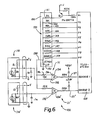
- a temperature monitoring system 100 is disclosed for use in sensing temperature ranges of two different mediums rather than a single setpoint temperature.
- a microprocessor 105 monitors the temperature of two temperature sensors 110, 110′ each associated with respective input circuitry, generally indicated by the reference characters 111, 111′.
- the monitoring system 100 depicted in Figure 6 is used in conjunction with a demand defrost controller for automatically defrosting a heat pump outdoor heat exchanger coil.
- the sensor 110 is utilized for monitoring the temperature of the heat exchanger coil and is directly coupled to that coil.
- the sensor 110′ is mounted in close proximity to the heat exchanger coil and monitors outside air temperature during heat pump operation.
- the sensors 110, 110′ are constructed according to the procedure outlined above and are of identical construction although they function to detect different sensed temperature levels.
- the associated respective input circuits 111, 111′ are also of identical construction. Since the sensors and respective input circuits have the same construction only the sensor 110 and its associated circuitry 111 are described in detail. Components of the sensor 110′ and circuit 111′ which are common to those of the sensor 110 and circuit 111 are indicated by corresponding primed reference characters.
- the sensor 110 includes a thermistor RT, and monolithic resistance elements Rl, RX which in combination form a voltage divider that is energized by a voltage source V to produce a sensor output voltage related to a sensed temperature.
- a comparator amplifier 134 has in inverting input 132 to monitor an output voltage from the sensor 110. Changes in temperature experienced by the sensor 110 alter the resistance of the sensor thermistor RT causing a change in the inverting input to the comparator amplifier 134.
- the microprocessor 105 adjusts the potential at a non-inverting input 136 to the comparator 134 and monitors a voltage at a comparator output 137. Adjusting the voltage at the non-inverting input is accomplished by controlling an output 138 from a voltage divider 120.
- the voltage divider 120 includes a resistance element 140 and a selected parallel combination of nine other resistors 141-149.
- Microprocessor input/output pins P1-P9 dictate which resistor elements 141-149 form the voltage divider 120.
- microprocessor pin P1 goes low, for example, this turns on a transistor Q1 coupled to the resistor element 142 and produces a reference voltage at the output 138 defined by the resistors 142, 140.
- the reference voltage is coupled through a resistor RL to the non-inverting input of the comparator amplifier 134.
- Microprocessor pins P2-P9 can serve as a current source so that these pins are coupled directly to the resistors 141-149.
- the microprocessor selectively controls the state of pins Pl-P9 to couple different parallel combinations of the resistors 141-149 to the output 138.
- the resistor 140 and each of the resistors in the resistor array 141-149 is a precision trimmed monolithic resistor element coupled to a common ceramic mounting substrate 150.
- Each resistor 141-149 has a resistance twice that of a preceeding resistor.
- Different ratios produce different outputs at the junction 138 and the microprocessor steps through these ratios while monitoring the output 137 from the comparator amplifier 134.
- this output 137 changes state, the ratio of the voltage divider 120 equals the ratio of the voltage divider of the sensor 110.
- a look-up table stored in microprocessor memory is accessed to determine the probe sensor temperature once the sensor voltage divider ratio is determined.
- This look-up table stores 512 (29) temperatures corresponding to 512 possible ratios of the voltage divider 120.
- the comparator output 137 changes state in response to microprocessor manipulation of the status of pins P1-P9 the microprocessor 105 accesses the ratio corresponding to that controlled output and obtains a temperature value corresponding to that ratio.
- the ambient air temperature sensed by the sensor 110′ is monitored by as an output 137′ from the comparator 134′ changes in response to sensed temperature changes.
- the microprocessor 105 monitors changes in state from the comparator amplifier 134′ at a separate input/output pin labeled "sensor 2" in Figure 6.
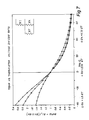
- Figure 7 graphically depicts temperature response curves of three sensors constructed according to the invention wherein the thermistor resistances have all been determined in a bath at 0°C and the respective resistors RX have been trimmed to produce different predtermined ratios relative to the measured resistance of the associated thermistor.
- the resistance ratio at a sensor temperature of 0°C is precisely known because of the method of constructing the sensors.
- the substrate was placed in a 0°C bath and the thermistor resistance measured and recorded.
- the resistance ratio was produced by precision laser trimming the monolithic resistor elements Rl, RX to produce the ratio when the thermistor resistance is at its 0°C value.
- the resistance ratio of the sensor 110 is known to within approximately .1%.
- the remaining points on the three plots depicted in Figure 7 are based upon variations in resistance ratios calculated from data provided by the thermistor manufacturer and reflect the slightly non-linear temperature response inherent in conventional thermistors. These ratios are equal to the resistance of the resistor element Rl divided by the parallel resistance of the thermistor RT and the resistor element RX or
- Choice of different resistance values of the resistor RX can widen or narrow the range of resistance ratios (and therefore the range of output signal values) over a temperature operating range of interest.
- the specific values of RX and RX′ chosen for the embodiment of Figure 6 are based upon the choice of the microprocessor 105 used to sense temperature of the sensors 110, 110′ and the purpose served by the sensor in question.
- the sensor 110 detects the temperature of the outdoor heat exchanger in a heat pump system and primarily functions in connection with defrosting the heat exchanger, it may be desirable to construct the sensor 110 utilizing a resistor RX trimmed to produce a ratio of RX RT of 2.0 since this relationship provides a pronounced, nearly linear, output signal characteristic between 0°C and -40°C.
Landscapes
- Physics & Mathematics (AREA)
- General Physics & Mathematics (AREA)
- Nonlinear Science (AREA)
- Thermistors And Varistors (AREA)
- Measuring Temperature Or Quantity Of Heat (AREA)
Applications Claiming Priority (2)
| Application Number | Priority Date | Filing Date | Title |
|---|---|---|---|
| US101656 | 1987-09-28 | ||
| US07/101,656 US4881057A (en) | 1987-09-28 | 1987-09-28 | Temperature sensing apparatus and method of making same |
Publications (2)
| Publication Number | Publication Date |
|---|---|
| EP0309664A2 true EP0309664A2 (fr) | 1989-04-05 |
| EP0309664A3 EP0309664A3 (fr) | 1990-03-28 |
Family
ID=22285758
Family Applications (1)
| Application Number | Title | Priority Date | Filing Date |
|---|---|---|---|
| EP88111236A Withdrawn EP0309664A3 (fr) | 1987-09-28 | 1988-07-13 | Appareil pour mesurer la température et méthode pour sa fabrication |
Country Status (6)
| Country | Link |
|---|---|
| US (2) | US4881057A (fr) |
| EP (1) | EP0309664A3 (fr) |
| JP (1) | JPH01102331A (fr) |
| KR (1) | KR890005499A (fr) |
| CA (1) | CA1315128C (fr) |
| DK (1) | DK535888A (fr) |
Cited By (5)
| Publication number | Priority date | Publication date | Assignee | Title |
|---|---|---|---|---|
| EP0409635A3 (en) * | 1989-07-20 | 1991-09-18 | Teledyne Industries, Inc. | Monolithic resistor comparator circuit |
| EP0448414A3 (en) * | 1990-03-23 | 1992-01-15 | Respiratory Support Products Inc | Electrical circuits |
| GB2285138A (en) * | 1993-12-27 | 1995-06-28 | Ngk Insulators Ltd | Temperature sensor |
| EP0751383A1 (fr) * | 1995-06-26 | 1997-01-02 | Ngk Insulators, Ltd. | Capteur avec correction du signal de sortie |
| EP1418412A1 (fr) * | 2002-11-07 | 2004-05-12 | Omron Corporation | Dispositif de détection de la température |
Families Citing this family (40)
| Publication number | Priority date | Publication date | Assignee | Title |
|---|---|---|---|---|
| US4881057A (en) * | 1987-09-28 | 1989-11-14 | Ranco Incorporated | Temperature sensing apparatus and method of making same |
| JPH0312144U (fr) * | 1989-06-22 | 1991-02-07 | ||
| US5075690A (en) * | 1989-12-18 | 1991-12-24 | Xerox Corporation | Temperature sensor for an ink jet printhead |
| US5119538A (en) * | 1990-08-10 | 1992-06-09 | Ranco Incorporated Of Delaware | Method of making a temperature sensor |
| ES2099182T3 (es) * | 1991-06-26 | 1997-05-16 | Ppg Industries Inc | Conjunto sensor electroquimico. |
| US5342498A (en) * | 1991-06-26 | 1994-08-30 | Graves Jeffrey A | Electronic wiring substrate |
| GB2278735B (en) * | 1993-06-03 | 1997-07-30 | Motorola Bv | A voltage divider and a method of setting a voltage therefor |
| US5707151A (en) * | 1994-01-13 | 1998-01-13 | Ranco Incorporated Of Delaware | Temperature transducer assembly |
| US5454641A (en) * | 1994-01-13 | 1995-10-03 | Ranco Incorporated Of Delaware | Temperature transducer assembly |
| US5611952A (en) * | 1994-06-30 | 1997-03-18 | Jones; Thaddeus M. | Temperature sensor probe and sensor detection circuit |
| US6099164A (en) * | 1995-06-07 | 2000-08-08 | Thermometrics, Inc. | Sensors incorporating nickel-manganese oxide single crystals |
| US6125529A (en) * | 1996-06-17 | 2000-10-03 | Thermometrics, Inc. | Method of making wafer based sensors and wafer chip sensors |
| WO1997048644A1 (fr) * | 1996-06-17 | 1997-12-24 | Thermometrics, Inc. | Croissance de monocristaux d'oxyde de nickel-cobalt-manganese |
| EP0923504A4 (fr) * | 1996-08-23 | 2002-11-06 | Thermometrics Inc | Croissance de monocristaux d'oxyde de nickel-fer-manganese |
| US5748429A (en) * | 1996-09-09 | 1998-05-05 | Honeywell Inc. | Self checking temperature sensing circuit |
| DE19650038A1 (de) * | 1996-12-03 | 1998-06-04 | Bosch Gmbh Robert | Verfahren zum Betreiben eines Widerstandsheizelementes und Vorrichtung zum Durchführen des Verfahrens |
| US5815064A (en) * | 1997-02-04 | 1998-09-29 | The United States Of America As Represented By The Secretary Of The Army | Snow temperature and depth probe |
| US6072349A (en) * | 1997-12-31 | 2000-06-06 | Intel Corporation | Comparator |
| US6006169A (en) * | 1997-12-31 | 1999-12-21 | Intel Corporation | Method and apparatus for trimming an integrated circuit |
| AU5398199A (en) * | 1998-08-18 | 2000-03-14 | Intel Corporation | Method and apparatus to control the temperature of a component |
| US6532131B1 (en) * | 2000-06-07 | 2003-03-11 | Plasmon Ide, Inc. | Import/export element with selector nut and bevel gear for rotation |
| EP1325666A4 (fr) * | 2000-08-18 | 2007-03-21 | Luxine Inc | Systeme et procede de chauffage par induction et de commande presentant une fiabilite elevee et de meilleures caracteristiques de performance |
| US7280028B2 (en) * | 2001-12-04 | 2007-10-09 | Delphi Technologies, Inc. | Temperature sensor and method of making the same |
| AU2003901253A0 (en) * | 2003-03-17 | 2003-04-03 | Zip Holdings Pty Ltd | Temperature Sensing Devices, Systems and Methods |
| US6915069B2 (en) * | 2003-07-14 | 2005-07-05 | Ken A. Bradenbaugh | Temperature sensor assembly, water heater including the temperature sensor assembly, and method of sensing a temperature |
| DE102004035133A1 (de) * | 2004-07-20 | 2006-02-16 | Bayer Cropscience Ag | Selektive Insektizide auf Basis von substituierten, cyclischen Ketoenolen und Safenern |
| US7686232B2 (en) * | 2005-09-20 | 2010-03-30 | Novarus Corporation | System and method for food safety inspection |
| CN102326060B (zh) * | 2009-01-19 | 2015-02-25 | 皇家飞利浦电子股份有限公司 | 零热通量传感器及使用方法 |
| FR3005730B1 (fr) * | 2013-05-14 | 2016-03-04 | Ct Tech Des Ind Mecaniques | Capteur de temperature en technologie couche epaisse |
| US9412328B2 (en) | 2013-12-26 | 2016-08-09 | Emerson Electric Co. | HVAC controls or controllers including alphanumeric displays |
| US9964345B2 (en) | 2013-12-26 | 2018-05-08 | Emerson Electric Co. | Heat pump controller with user-selectable defrost modes and reversing valve energizing modes |
| US9646745B2 (en) | 2014-07-29 | 2017-05-09 | Ford Global Technologies, Llc | Thermistor assembly including elastomeric body |
| EP3194890B1 (fr) | 2014-09-21 | 2020-02-26 | Athlete Architect LLC | Procédés et appareil de détermination de dépense d'énergie et de technique durant un mouvement des jambes |
| US10115503B2 (en) * | 2016-01-07 | 2018-10-30 | Yazaki North America, Inc. | Terminal-thermistor assembly |
| US10596054B2 (en) * | 2017-06-28 | 2020-03-24 | General Electric Company | Infant warming system and method |
| WO2020050833A1 (fr) * | 2018-09-05 | 2020-03-12 | Medisim Usa | Étalonnage de capteur de température |
| US12059267B2 (en) | 2019-06-26 | 2024-08-13 | Stryd, Inc. | Expenditure to overcome air resistance during bipedal motion |
| CN113514699A (zh) * | 2020-04-09 | 2021-10-19 | 台达电子工业股份有限公司 | 热控系统、热控方法与温度校正装置 |
| KR102893542B1 (ko) | 2021-01-29 | 2025-11-28 | 주식회사 엘지에너지솔루션 | 배터리 팩, 배터리 장치 및 전해액 누설 검출 방법 |
| CN115027070B (zh) * | 2022-06-07 | 2023-05-30 | 北京金诺美科技股份有限公司 | 一种制作温度校准探头的辅助装置和制作工艺 |
Family Cites Families (14)
| Publication number | Priority date | Publication date | Assignee | Title |
|---|---|---|---|---|
| US3474375A (en) * | 1968-07-01 | 1969-10-21 | Vishay Intertechnology Inc | Precision resistor |
| US3990033A (en) * | 1975-05-20 | 1976-11-02 | Power Controls, Corporation (Entire) | Electric power controller |
| US4186368A (en) * | 1978-05-30 | 1980-01-29 | Tektronix, Inc. | Wide range, quick response temperature probe sensor |
| US4332081A (en) * | 1978-06-22 | 1982-06-01 | North American Philips Corporation | Temperature sensor |
| EP0019017B1 (fr) * | 1979-05-21 | 1983-03-16 | BBC Aktiengesellschaft Brown, Boveri & Cie. | Procédé et dispositif d'ajustage d'au moins une résistance dépendant de la température |
| US4300392A (en) * | 1980-02-14 | 1981-11-17 | General Electric Company | Interchangeable networks with non-linear sensors and method of producing such networks |
| DE3128713A1 (de) * | 1981-07-21 | 1983-02-10 | Robert Bosch Gmbh, 7000 Stuttgart | Vorrichtung zur rueckwirkungsfreien mischwerteinstellung bei hubwerken von landmaschinen |
| US4437084A (en) * | 1981-10-09 | 1984-03-13 | Cooper Industries, Inc. | Encapsulated, waterproof temperature sensitive device and method of manufacture |
| JPS59222736A (ja) * | 1983-06-01 | 1984-12-14 | Matsushita Electric Ind Co Ltd | 温度検出装置 |
| JPS60247702A (ja) * | 1984-05-23 | 1985-12-07 | Honda Motor Co Ltd | 信号入力回路 |
| US4670734A (en) * | 1984-11-14 | 1987-06-02 | Caddock Richard E | Method of making a compact, high-voltage, noninductive, film-type resistor |
| US4882908A (en) * | 1987-07-17 | 1989-11-28 | Ranco Incorporated | Demand defrost control method and apparatus |
| US4881057A (en) * | 1987-09-28 | 1989-11-14 | Ranco Incorporated | Temperature sensing apparatus and method of making same |
| US4841274A (en) * | 1987-12-21 | 1989-06-20 | Therm-O-Disc, Incorporated | Temperature responsive probe apparatus |
-
1987
- 1987-09-28 US US07/101,656 patent/US4881057A/en not_active Expired - Lifetime
-
1988
- 1988-07-13 EP EP88111236A patent/EP0309664A3/fr not_active Withdrawn
- 1988-07-16 KR KR1019880008879A patent/KR890005499A/ko not_active Withdrawn
- 1988-08-11 CA CA000574470A patent/CA1315128C/fr not_active Expired - Fee Related
- 1988-08-12 JP JP63201835A patent/JPH01102331A/ja active Pending
- 1988-09-27 DK DK535888A patent/DK535888A/da not_active Application Discontinuation
-
1989
- 1989-11-13 US US07/435,989 patent/US5043692A/en not_active Expired - Fee Related
Cited By (12)
| Publication number | Priority date | Publication date | Assignee | Title |
|---|---|---|---|---|
| EP0409635A3 (en) * | 1989-07-20 | 1991-09-18 | Teledyne Industries, Inc. | Monolithic resistor comparator circuit |
| EP0448414A3 (en) * | 1990-03-23 | 1992-01-15 | Respiratory Support Products Inc | Electrical circuits |
| AU643510B2 (en) * | 1990-03-23 | 1993-11-18 | Respiratory Support Products Inc. | Electrical circuits |
| GB2285138A (en) * | 1993-12-27 | 1995-06-28 | Ngk Insulators Ltd | Temperature sensor |
| DE4445243A1 (de) * | 1993-12-27 | 1995-06-29 | Ngk Insulators Ltd | Temperaturfühler |
| GB2285138B (en) * | 1993-12-27 | 1997-10-22 | Ngk Insulators Ltd | Temperature sensor |
| US5823680A (en) * | 1993-12-27 | 1998-10-20 | Ngk Insulators, Ltd. | Temperature sensor |
| DE4445243C2 (de) * | 1993-12-27 | 2002-03-21 | Ngk Insulators Ltd | Temperaturfühler |
| EP0751383A1 (fr) * | 1995-06-26 | 1997-01-02 | Ngk Insulators, Ltd. | Capteur avec correction du signal de sortie |
| US5844122A (en) * | 1995-06-26 | 1998-12-01 | Ngk Insulators, Ltd. | Sensor with output correcting function |
| EP1418412A1 (fr) * | 2002-11-07 | 2004-05-12 | Omron Corporation | Dispositif de détection de la température |
| US6824308B2 (en) | 2002-11-07 | 2004-11-30 | Omron Corporation | Temperature detecting device |
Also Published As
| Publication number | Publication date |
|---|---|
| JPH01102331A (ja) | 1989-04-20 |
| KR890005499A (ko) | 1989-05-11 |
| US4881057A (en) | 1989-11-14 |
| EP0309664A3 (fr) | 1990-03-28 |
| DK535888D0 (da) | 1988-09-27 |
| CA1315128C (fr) | 1993-03-30 |
| DK535888A (da) | 1989-03-29 |
| US5043692A (en) | 1991-08-27 |
Similar Documents
| Publication | Publication Date | Title |
|---|---|---|
| US4881057A (en) | Temperature sensing apparatus and method of making same | |
| US4623266A (en) | Cold junction compensation for thermocouple | |
| US4609913A (en) | Fluid level sensor | |
| EP1087217B1 (fr) | Ensemble isothermique calibré pour un thermomètre à thermocouple | |
| US5837884A (en) | Humidity sensor using temperature sensing resistor controlled to be at constant temperature of more than 150° C. | |
| US4332081A (en) | Temperature sensor | |
| US6658931B1 (en) | Fluid flow sensing and control method and apparatus | |
| US4471648A (en) | Temperature control system | |
| MXPA06005752A (es) | Sistema calentador en capas de dos hilos. | |
| CA1176345A (fr) | Dispositif de regulation de la temperature pour un detecteur d'humidite | |
| US20100231155A1 (en) | Controller unit with integrated temperature sensor | |
| EP0437325A2 (fr) | Capteurs de températures | |
| JPH0868684A (ja) | 流量センサの較正方法および装置 | |
| US3922658A (en) | Fluid level monitor | |
| CN106482752B (zh) | 传感器装置和用于校准传感器装置的方法 | |
| US4567773A (en) | Pressure transducer system | |
| EP0352987A2 (fr) | Protecteur de circuit à l'état solide | |
| US4377346A (en) | Thermostatic apparatus | |
| EP1608959A1 (fr) | Procede de mesure de coefficients de temperature de composants de circuit electrique | |
| US4418474A (en) | Precision resistor fabrication employing tapped resistive elements | |
| EP0062936B1 (fr) | Capteur de température | |
| US1327800A (en) | Compensating-pyrometer system and apparatus | |
| KR0163637B1 (ko) | 열식 공기 유량 검출 장치 | |
| CN116147799B (zh) | 一种bdu内部多路温度的检测装置及方法 | |
| JPH05223770A (ja) | 熱伝導式絶対湿度センサ |
Legal Events
| Date | Code | Title | Description |
|---|---|---|---|
| PUAI | Public reference made under article 153(3) epc to a published international application that has entered the european phase |
Free format text: ORIGINAL CODE: 0009012 |
|
| AK | Designated contracting states |
Kind code of ref document: A2 Designated state(s): DE FR GB IT |
|
| RAP1 | Party data changed (applicant data changed or rights of an application transferred) |
Owner name: RANCO INCORPORATED OF DELAWARE |
|
| PUAL | Search report despatched |
Free format text: ORIGINAL CODE: 0009013 |
|
| AK | Designated contracting states |
Kind code of ref document: A3 Designated state(s): DE FR GB IT |
|
| 17P | Request for examination filed |
Effective date: 19900719 |
|
| 17Q | First examination report despatched |
Effective date: 19910913 |
|
| STAA | Information on the status of an ep patent application or granted ep patent |
Free format text: STATUS: THE APPLICATION IS DEEMED TO BE WITHDRAWN |
|
| 18D | Application deemed to be withdrawn |
Effective date: 19920825 |