EP0309766B1 - Dérivés N-acylés d'aminoacides et leur utilisation - Google Patents
Dérivés N-acylés d'aminoacides et leur utilisation Download PDFInfo
- Publication number
- EP0309766B1 EP0309766B1 EP88114374A EP88114374A EP0309766B1 EP 0309766 B1 EP0309766 B1 EP 0309766B1 EP 88114374 A EP88114374 A EP 88114374A EP 88114374 A EP88114374 A EP 88114374A EP 0309766 B1 EP0309766 B1 EP 0309766B1
- Authority
- EP
- European Patent Office
- Prior art keywords
- group
- amino
- cyclohexyl
- morpholino
- naphthylmethyl
- Prior art date
- Legal status (The legal status is an assumption and is not a legal conclusion. Google has not performed a legal analysis and makes no representation as to the accuracy of the status listed.)
- Expired - Lifetime
Links
- 0 C1CC*CC1 Chemical compound C1CC*CC1 0.000 description 4
Images

Classifications
-
- C—CHEMISTRY; METALLURGY
- C07—ORGANIC CHEMISTRY
- C07D—HETEROCYCLIC COMPOUNDS
- C07D207/00—Heterocyclic compounds containing five-membered rings not condensed with other rings, with one nitrogen atom as the only ring hetero atom
- C07D207/02—Heterocyclic compounds containing five-membered rings not condensed with other rings, with one nitrogen atom as the only ring hetero atom with only hydrogen or carbon atoms directly attached to the ring nitrogen atom
- C07D207/04—Heterocyclic compounds containing five-membered rings not condensed with other rings, with one nitrogen atom as the only ring hetero atom with only hydrogen or carbon atoms directly attached to the ring nitrogen atom having no double bonds between ring members or between ring members and non-ring members
- C07D207/08—Heterocyclic compounds containing five-membered rings not condensed with other rings, with one nitrogen atom as the only ring hetero atom with only hydrogen or carbon atoms directly attached to the ring nitrogen atom having no double bonds between ring members or between ring members and non-ring members with hydrocarbon radicals, substituted by hetero atoms, attached to ring carbon atoms
-
- C—CHEMISTRY; METALLURGY
- C07—ORGANIC CHEMISTRY
- C07C—ACYCLIC OR CARBOCYCLIC COMPOUNDS
- C07C317/00—Sulfones; Sulfoxides
- C07C317/44—Sulfones; Sulfoxides having sulfone or sulfoxide groups and carboxyl groups bound to the same carbon skeleton
-
- C—CHEMISTRY; METALLURGY
- C07—ORGANIC CHEMISTRY
- C07C—ACYCLIC OR CARBOCYCLIC COMPOUNDS
- C07C323/00—Thiols, sulfides, hydropolysulfides or polysulfides substituted by halogen, oxygen or nitrogen atoms, or by sulfur atoms not being part of thio groups
-
- C—CHEMISTRY; METALLURGY
- C07—ORGANIC CHEMISTRY
- C07C—ACYCLIC OR CARBOCYCLIC COMPOUNDS
- C07C323/00—Thiols, sulfides, hydropolysulfides or polysulfides substituted by halogen, oxygen or nitrogen atoms, or by sulfur atoms not being part of thio groups
- C07C323/23—Thiols, sulfides, hydropolysulfides or polysulfides substituted by halogen, oxygen or nitrogen atoms, or by sulfur atoms not being part of thio groups containing thio groups and nitrogen atoms, not being part of nitro or nitroso groups, bound to the same carbon skeleton
- C07C323/39—Thiols, sulfides, hydropolysulfides or polysulfides substituted by halogen, oxygen or nitrogen atoms, or by sulfur atoms not being part of thio groups containing thio groups and nitrogen atoms, not being part of nitro or nitroso groups, bound to the same carbon skeleton at least one of the nitrogen atoms being part of any of the groups, X being a hetero atom, Y being any atom
- C07C323/43—Y being a hetero atom
-
- C—CHEMISTRY; METALLURGY
- C07—ORGANIC CHEMISTRY
- C07C—ACYCLIC OR CARBOCYCLIC COMPOUNDS
- C07C59/00—Compounds having carboxyl groups bound to acyclic carbon atoms and containing any of the groups OH, O—metal, —CHO, keto, ether, groups, groups, or groups
- C07C59/40—Unsaturated compounds
- C07C59/58—Unsaturated compounds containing ether groups, groups, groups, or groups
- C07C59/64—Unsaturated compounds containing ether groups, groups, groups, or groups containing six-membered aromatic rings
- C07C59/66—Unsaturated compounds containing ether groups, groups, groups, or groups containing six-membered aromatic rings the non-carboxylic part of the ether containing six-membered aromatic rings
-
- C—CHEMISTRY; METALLURGY
- C07—ORGANIC CHEMISTRY
- C07D—HETEROCYCLIC COMPOUNDS
- C07D211/00—Heterocyclic compounds containing hydrogenated pyridine rings, not condensed with other rings
- C07D211/04—Heterocyclic compounds containing hydrogenated pyridine rings, not condensed with other rings with only hydrogen or carbon atoms directly attached to the ring nitrogen atom
- C07D211/06—Heterocyclic compounds containing hydrogenated pyridine rings, not condensed with other rings with only hydrogen or carbon atoms directly attached to the ring nitrogen atom having no double bonds between ring members or between ring members and non-ring members
- C07D211/08—Heterocyclic compounds containing hydrogenated pyridine rings, not condensed with other rings with only hydrogen or carbon atoms directly attached to the ring nitrogen atom having no double bonds between ring members or between ring members and non-ring members with hydrocarbon or substituted hydrocarbon radicals directly attached to ring carbon atoms
- C07D211/10—Heterocyclic compounds containing hydrogenated pyridine rings, not condensed with other rings with only hydrogen or carbon atoms directly attached to the ring nitrogen atom having no double bonds between ring members or between ring members and non-ring members with hydrocarbon or substituted hydrocarbon radicals directly attached to ring carbon atoms with radicals containing only carbon and hydrogen atoms attached to ring carbon atoms
- C07D211/14—Heterocyclic compounds containing hydrogenated pyridine rings, not condensed with other rings with only hydrogen or carbon atoms directly attached to the ring nitrogen atom having no double bonds between ring members or between ring members and non-ring members with hydrocarbon or substituted hydrocarbon radicals directly attached to ring carbon atoms with radicals containing only carbon and hydrogen atoms attached to ring carbon atoms with hydrocarbon or substituted hydrocarbon radicals attached to the ring nitrogen atom
-
- C—CHEMISTRY; METALLURGY
- C07—ORGANIC CHEMISTRY
- C07D—HETEROCYCLIC COMPOUNDS
- C07D215/00—Heterocyclic compounds containing quinoline or hydrogenated quinoline ring systems
- C07D215/02—Heterocyclic compounds containing quinoline or hydrogenated quinoline ring systems having no bond between the ring nitrogen atom and a non-ring member or having only hydrogen atoms or carbon atoms directly attached to the ring nitrogen atom
- C07D215/12—Heterocyclic compounds containing quinoline or hydrogenated quinoline ring systems having no bond between the ring nitrogen atom and a non-ring member or having only hydrogen atoms or carbon atoms directly attached to the ring nitrogen atom with substituted hydrocarbon radicals attached to ring carbon atoms
-
- C—CHEMISTRY; METALLURGY
- C07—ORGANIC CHEMISTRY
- C07D—HETEROCYCLIC COMPOUNDS
- C07D233/00—Heterocyclic compounds containing 1,3-diazole or hydrogenated 1,3-diazole rings, not condensed with other rings
- C07D233/54—Heterocyclic compounds containing 1,3-diazole or hydrogenated 1,3-diazole rings, not condensed with other rings having two double bonds between ring members or between ring members and non-ring members
- C07D233/64—Heterocyclic compounds containing 1,3-diazole or hydrogenated 1,3-diazole rings, not condensed with other rings having two double bonds between ring members or between ring members and non-ring members with substituted hydrocarbon radicals attached to ring carbon atoms, e.g. histidine
-
- C—CHEMISTRY; METALLURGY
- C07—ORGANIC CHEMISTRY
- C07D—HETEROCYCLIC COMPOUNDS
- C07D239/00—Heterocyclic compounds containing 1,3-diazine or hydrogenated 1,3-diazine rings
- C07D239/02—Heterocyclic compounds containing 1,3-diazine or hydrogenated 1,3-diazine rings not condensed with other rings
- C07D239/24—Heterocyclic compounds containing 1,3-diazine or hydrogenated 1,3-diazine rings not condensed with other rings having three or more double bonds between ring members or between ring members and non-ring members
- C07D239/28—Heterocyclic compounds containing 1,3-diazine or hydrogenated 1,3-diazine rings not condensed with other rings having three or more double bonds between ring members or between ring members and non-ring members with hetero atoms or with carbon atoms having three bonds to hetero atoms with at the most one bond to halogen, directly attached to ring carbon atoms
- C07D239/32—One oxygen, sulfur or nitrogen atom
- C07D239/38—One sulfur atom
-
- C—CHEMISTRY; METALLURGY
- C07—ORGANIC CHEMISTRY
- C07D—HETEROCYCLIC COMPOUNDS
- C07D257/00—Heterocyclic compounds containing rings having four nitrogen atoms as the only ring hetero atoms
- C07D257/02—Heterocyclic compounds containing rings having four nitrogen atoms as the only ring hetero atoms not condensed with other rings
- C07D257/04—Five-membered rings
-
- C—CHEMISTRY; METALLURGY
- C07—ORGANIC CHEMISTRY
- C07D—HETEROCYCLIC COMPOUNDS
- C07D285/00—Heterocyclic compounds containing rings having nitrogen and sulfur atoms as the only ring hetero atoms, not provided for by groups C07D275/00 - C07D283/00
- C07D285/01—Five-membered rings
- C07D285/02—Thiadiazoles; Hydrogenated thiadiazoles
- C07D285/04—Thiadiazoles; Hydrogenated thiadiazoles not condensed with other rings
- C07D285/12—1,3,4-Thiadiazoles; Hydrogenated 1,3,4-thiadiazoles
- C07D285/125—1,3,4-Thiadiazoles; Hydrogenated 1,3,4-thiadiazoles with oxygen, sulfur or nitrogen atoms, directly attached to ring carbon atoms, the nitrogen atoms not forming part of a nitro radical
-
- C—CHEMISTRY; METALLURGY
- C07—ORGANIC CHEMISTRY
- C07D—HETEROCYCLIC COMPOUNDS
- C07D295/00—Heterocyclic compounds containing polymethylene-imine rings with at least five ring members, 3-azabicyclo [3.2.2] nonane, piperazine, morpholine or thiomorpholine rings, having only hydrogen atoms directly attached to the ring carbon atoms
- C07D295/04—Heterocyclic compounds containing polymethylene-imine rings with at least five ring members, 3-azabicyclo [3.2.2] nonane, piperazine, morpholine or thiomorpholine rings, having only hydrogen atoms directly attached to the ring carbon atoms with substituted hydrocarbon radicals attached to ring nitrogen atoms
- C07D295/08—Heterocyclic compounds containing polymethylene-imine rings with at least five ring members, 3-azabicyclo [3.2.2] nonane, piperazine, morpholine or thiomorpholine rings, having only hydrogen atoms directly attached to the ring carbon atoms with substituted hydrocarbon radicals attached to ring nitrogen atoms substituted by singly bound oxygen or sulfur atoms
- C07D295/084—Heterocyclic compounds containing polymethylene-imine rings with at least five ring members, 3-azabicyclo [3.2.2] nonane, piperazine, morpholine or thiomorpholine rings, having only hydrogen atoms directly attached to the ring carbon atoms with substituted hydrocarbon radicals attached to ring nitrogen atoms substituted by singly bound oxygen or sulfur atoms with the ring nitrogen atoms and the oxygen or sulfur atoms attached to the same carbon chain, which is not interrupted by carbocyclic rings
-
- C—CHEMISTRY; METALLURGY
- C07—ORGANIC CHEMISTRY
- C07D—HETEROCYCLIC COMPOUNDS
- C07D295/00—Heterocyclic compounds containing polymethylene-imine rings with at least five ring members, 3-azabicyclo [3.2.2] nonane, piperazine, morpholine or thiomorpholine rings, having only hydrogen atoms directly attached to the ring carbon atoms
- C07D295/04—Heterocyclic compounds containing polymethylene-imine rings with at least five ring members, 3-azabicyclo [3.2.2] nonane, piperazine, morpholine or thiomorpholine rings, having only hydrogen atoms directly attached to the ring carbon atoms with substituted hydrocarbon radicals attached to ring nitrogen atoms
- C07D295/12—Heterocyclic compounds containing polymethylene-imine rings with at least five ring members, 3-azabicyclo [3.2.2] nonane, piperazine, morpholine or thiomorpholine rings, having only hydrogen atoms directly attached to the ring carbon atoms with substituted hydrocarbon radicals attached to ring nitrogen atoms substituted by singly or doubly bound nitrogen atoms
- C07D295/125—Heterocyclic compounds containing polymethylene-imine rings with at least five ring members, 3-azabicyclo [3.2.2] nonane, piperazine, morpholine or thiomorpholine rings, having only hydrogen atoms directly attached to the ring carbon atoms with substituted hydrocarbon radicals attached to ring nitrogen atoms substituted by singly or doubly bound nitrogen atoms with the ring nitrogen atoms and the substituent nitrogen atoms attached to the same carbon chain, which is not interrupted by carbocyclic rings
-
- C—CHEMISTRY; METALLURGY
- C07—ORGANIC CHEMISTRY
- C07D—HETEROCYCLIC COMPOUNDS
- C07D295/00—Heterocyclic compounds containing polymethylene-imine rings with at least five ring members, 3-azabicyclo [3.2.2] nonane, piperazine, morpholine or thiomorpholine rings, having only hydrogen atoms directly attached to the ring carbon atoms
- C07D295/04—Heterocyclic compounds containing polymethylene-imine rings with at least five ring members, 3-azabicyclo [3.2.2] nonane, piperazine, morpholine or thiomorpholine rings, having only hydrogen atoms directly attached to the ring carbon atoms with substituted hydrocarbon radicals attached to ring nitrogen atoms
- C07D295/12—Heterocyclic compounds containing polymethylene-imine rings with at least five ring members, 3-azabicyclo [3.2.2] nonane, piperazine, morpholine or thiomorpholine rings, having only hydrogen atoms directly attached to the ring carbon atoms with substituted hydrocarbon radicals attached to ring nitrogen atoms substituted by singly or doubly bound nitrogen atoms
- C07D295/125—Heterocyclic compounds containing polymethylene-imine rings with at least five ring members, 3-azabicyclo [3.2.2] nonane, piperazine, morpholine or thiomorpholine rings, having only hydrogen atoms directly attached to the ring carbon atoms with substituted hydrocarbon radicals attached to ring nitrogen atoms substituted by singly or doubly bound nitrogen atoms with the ring nitrogen atoms and the substituent nitrogen atoms attached to the same carbon chain, which is not interrupted by carbocyclic rings
- C07D295/13—Heterocyclic compounds containing polymethylene-imine rings with at least five ring members, 3-azabicyclo [3.2.2] nonane, piperazine, morpholine or thiomorpholine rings, having only hydrogen atoms directly attached to the ring carbon atoms with substituted hydrocarbon radicals attached to ring nitrogen atoms substituted by singly or doubly bound nitrogen atoms with the ring nitrogen atoms and the substituent nitrogen atoms attached to the same carbon chain, which is not interrupted by carbocyclic rings to an acyclic saturated chain
-
- C—CHEMISTRY; METALLURGY
- C07—ORGANIC CHEMISTRY
- C07D—HETEROCYCLIC COMPOUNDS
- C07D295/00—Heterocyclic compounds containing polymethylene-imine rings with at least five ring members, 3-azabicyclo [3.2.2] nonane, piperazine, morpholine or thiomorpholine rings, having only hydrogen atoms directly attached to the ring carbon atoms
- C07D295/22—Heterocyclic compounds containing polymethylene-imine rings with at least five ring members, 3-azabicyclo [3.2.2] nonane, piperazine, morpholine or thiomorpholine rings, having only hydrogen atoms directly attached to the ring carbon atoms with hetero atoms directly attached to ring nitrogen atoms
- C07D295/24—Oxygen atoms
-
- C—CHEMISTRY; METALLURGY
- C07—ORGANIC CHEMISTRY
- C07D—HETEROCYCLIC COMPOUNDS
- C07D307/00—Heterocyclic compounds containing five-membered rings having one oxygen atom as the only ring hetero atom
- C07D307/02—Heterocyclic compounds containing five-membered rings having one oxygen atom as the only ring hetero atom not condensed with other rings
- C07D307/34—Heterocyclic compounds containing five-membered rings having one oxygen atom as the only ring hetero atom not condensed with other rings having two or three double bonds between ring members or between ring members and non-ring members
- C07D307/38—Heterocyclic compounds containing five-membered rings having one oxygen atom as the only ring hetero atom not condensed with other rings having two or three double bonds between ring members or between ring members and non-ring members with substituted hydrocarbon radicals attached to ring carbon atoms
-
- C—CHEMISTRY; METALLURGY
- C07—ORGANIC CHEMISTRY
- C07D—HETEROCYCLIC COMPOUNDS
- C07D319/00—Heterocyclic compounds containing six-membered rings having two oxygen atoms as the only ring hetero atoms
- C07D319/10—1,4-Dioxanes; Hydrogenated 1,4-dioxanes
- C07D319/14—1,4-Dioxanes; Hydrogenated 1,4-dioxanes condensed with carbocyclic rings or ring systems
- C07D319/16—1,4-Dioxanes; Hydrogenated 1,4-dioxanes condensed with carbocyclic rings or ring systems condensed with one six-membered ring
- C07D319/18—Ethylenedioxybenzenes, not substituted on the hetero ring
-
- C—CHEMISTRY; METALLURGY
- C07—ORGANIC CHEMISTRY
- C07D—HETEROCYCLIC COMPOUNDS
- C07D401/00—Heterocyclic compounds containing two or more hetero rings, having nitrogen atoms as the only ring hetero atoms, at least one ring being a six-membered ring with only one nitrogen atom
- C07D401/02—Heterocyclic compounds containing two or more hetero rings, having nitrogen atoms as the only ring hetero atoms, at least one ring being a six-membered ring with only one nitrogen atom containing two hetero rings
- C07D401/12—Heterocyclic compounds containing two or more hetero rings, having nitrogen atoms as the only ring hetero atoms, at least one ring being a six-membered ring with only one nitrogen atom containing two hetero rings linked by a chain containing hetero atoms as chain links
-
- C—CHEMISTRY; METALLURGY
- C07—ORGANIC CHEMISTRY
- C07F—ACYCLIC, CARBOCYCLIC OR HETEROCYCLIC COMPOUNDS CONTAINING ELEMENTS OTHER THAN CARBON, HYDROGEN, HALOGEN, OXYGEN, NITROGEN, SULFUR, SELENIUM OR TELLURIUM
- C07F7/00—Compounds containing elements of Groups 4 or 14 of the Periodic Table
- C07F7/02—Silicon compounds
- C07F7/08—Compounds having one or more C—Si linkages
- C07F7/18—Compounds having one or more C—Si linkages as well as one or more C—O—Si linkages
- C07F7/1804—Compounds having Si-O-C linkages
Definitions
- the present invention relates to N-acylamino acid derivatives or their salts useful in the pharmaceutical field. More particularly, the present invention relates to N-acylamino acid derivatives or their salts which have renin inhibiting activities and which are thus expected to be useful as hypotensive drugs.
- a renin-angiotensin system is one of hypertensive systems in the living body, and it is an important system for regulating the blood pressure-body fluid electrolyte. Renin is secreted from renal juxtaglomerular cells and enters into the whole body circulation system via the renal vein. In the blood, there exists angiotensinogen which is a glycoprotein produced in the liver. Renin reacts on angiotensinogen to form angiotensin I. Most of angiotensin I will be converted to angiotensin II by angiotensin I-converting enzyme which is present in the pulmonary vascular endothelial cells in one cycle of pulmonary circulation.
- Angiotensin II thus formed directly induces contraction of smooth muscles of peripheral blood vessels and thus shows a strong hypertensive activity. It further acts on the adrenal cortex to induce secretion of aldosterone, which in turn acts on the renal to facilitate reabsorption of sodium, whereby the effective circulatory blood flow increases, the cardiac output increases and the peripheral vascular resistance increases so that the blood pressure increases.
- hypertension will be brought about if this renin-angiotensin system was enhanced abnormally.
- Typical examples are renal vascular hypertension and malignant hypertension.
- hypertension caused by a renin producing tumor is known.
- renin-angiotensin I-converting enzyme For the treatment of the hypertension due to the enhancement of the renin-angiotensin system, inhibitors against the angiotensin I-converting enzyme have been studied, developed and subjected to clinical tests. However, such inhibitors are suspected to have side effects, since the substrate specificity of the angiotensin I-converting enzyme is broad to some extent and there exist some enzymes similar to the angiotensin I-converting enzyme in the living body. On the other hand, it is known that renin has a strict substrate specificity. Accordingly, an inhibitor against renin has a strong specificity and can be a superior hypotensive drug. For this reason, the research on renin inhibitors has been very active, and a number of renin inhibitors have been proposed. Certain renin inhibitors are known from EP-A-229 667 and EP-A-236 734.
- inhibitors are polypeptides, which are hardly absorbable by oral administration and which are susceptible to decomposition by a protease in vivo. Besides, they have high lipophilicity and are likely to be readily excreted to bile, whereby the retention of the hypotensive effects can not be expected.
- each of R 1 and R 2 which may be the same or different is a -B-R 6 group wherein B is a single bond or a straight chain or branched chain lower alkylene group which may have a double bond in the chain, and R 6 is an aryl group or a heteroaryl group, a C 1 -C 10 alkyl group or a -E-R 7 group wherein E is a lower alkylene group which may be interrupted by one oxygen atom, and R 7 is a lower alkoxy group, an aryloxy group, an arylthio group, an aralkyloxy group or a nitrogen-containing heterocyclyl group; R 3 is an ethylene, trimethylene or tetramethylene group which may be substituted by a lower alkyl, phenyl or hydroxyl group, a group wherein R 8 is a nitrogen-containing heterocyclyl
- Japanese Unexamined Patent Publication No. 120370/1987 discloses dipeptide derivatives represented by the formula: wherein R 1 is a carbamoyl group or a lower alkoxycarbonyl group, His is a L-histidine group, n is 0 or 1, Y is -O- or -NH-; and R 2 is a C 1 -C 7 straight chain or branched alkyl group.
- the compounds disclosed in the above publications have relatively short peptide chains and are therefore expected to have improved absorbability by oral administration. However, because of the short peptide chains, their renin-inhibiting activities are poor.
- N-acylamino acid derivatives having a novel structure exhibit strong renin-inhibiting activities in spite of their short peptide chains, and yet they have excellent absorbability by oral administration.
- the present invention is based on this discovery.
- the present invention provides an N-acylamino acid derivative of the formula: as defined in claim 1.
- the present invention also provides a hypotensive drug comprising an effective amount of an N-acylamino acid derivative of the formula I or its pharmaceutically acceptable salt and a pharmaceutically acceptable carrier.
- the N-acylamino acid derivative of the formula I can be prepared by a process which comprises condensing an N-acylamino acid of the formula: wherein R 1 , R 2 , R 3 , R 4 , m and n are as defined above, or a reactive derivative at the carboxyl group thereof with an amine of the formula: wherein R 5 , R 6 and A are as defined above, or condensing a carboxylic acid of the Formula: wherein R 1 , R 2 , m and n are as defined above, or a reactive derivative at the carboxyl group thereof with an amino acid amide of the formula: wherein R 3 , R 4 , R 5 , R 6 and A are as defined above.
- each of R 1 and R 2 which may be the same or different is a hydrogen atom, a substituted or unsubstituted C 1-6 alkyl group, a substituted or unsubstituted cycloalkyl group, a substituted or unsubstituted cycloalkylalkyl group, a substituted or unsubstituted aryl group, a substituted or unsubstituted aralkyl group or a substituted or unsubstituted monocyclic or bicyclic heterocyclic group containing from 1 to 4 hetero atoms selected from the group consisting of nitrogen, sulfur and oxygen atoms;
- R 14 is a carboxyl group, a reactive derivative of a carboxyl group or a protected carboxyl group;
- m is 0, 1 or 2; and n is an integer of from 1 to 5; provided that when R 1 is
- Figure 1 is a graph showing the hypotensive activities of the compound of the present invention as administered to monkeys in Test Example 3 given hereinafter.
- the substituted or unsubstituted lower alkyl group is a straight chain or branched lower alkyl group having from 1 to 6 carbon atoms such as a methyl group, an ethyl group, a propyl group, an isopropyl group, a butyl group, an isobutyl group, a sec-butyl group, a tert-butyl group, a pentyl group, a neopentyl group, an isopentyl group, a hexyl group or an isohexyl group, which is unsubstituted or substituted by a halogen atom such as a chlorine atom, a fluorine atom or a bromine atom; a hydroxyl group; a lower alkoxy group such as a methoxy group, an ethoxy group, a propoxy group, an isopropoxy group, a butoxy group, an isobutoxy group, a sec-butoxy group
- the substituted or unsubstituted cycloalkylalkyl group may be a cycloalkylalkyl group having from 4 to 10 carbon atoms such as a cyclopropylmethyl group, a cyclobutylmethyl group, a cyclopentylmethyl group, a cyclohexylmethyl group, 1-cyclopropylethyl group, a 2-cyclopropylethyl group, a 1-cyclobutylethyl group, a 2-cyclobutylethyl group, a 1-cyclopentylethyl group, a 2-cyclopentylethyl group, a 1-cyclohexylethyl group, a 3-cyclohexylpropyl group, a 3-cyclopentylpropyl group, a 4-cyclohexylbutyl group or a 4-cyclopentylbutyl group, which is unsubstituted or substituted by a halogen atom such
- the substituted or unsubstituted cycloalkyl group may be a cycloalkyl group having from 3 to 6 carbon atoms such as a cyclopropyl group, a cyclobutyl group, a cyclopentyl group or a cyclohexyl group, which is unsubstituted or substituted by a halogen atom such as a chlorine atom, a fluorine atom or a bromine atom; a hydroxyl group; a lower alkyl group such as a methyl group, an ethyl group, a propyl group, an isopropyl group, a butyl group, an isobutyl group, a sec-butyl group or a tert-butyl group; a lower alkoxy group such as a methoxy group, an ethoxy group, a propoxy group, an isopropoxy group, a butoxy group, an isobutoxy group, a sec
- the substituted or unsubstituted aryl group may be an aryl group having from 6 to 15 carbon atoms such as a phenyl group, a biphenylyl group, a 1-naphthyl group or a 2-naphthyl group, which is unsubstituted or substituted by a halogen atom such as a chlorine atom, a fluorine atom or a bromine atom; a nitro group; a hydroxyl group; a lower alkyl group such as a methyl group, an ethyl group, a propyl group, an isopropyl group, a butyl group, an isobutyl group, a sec-butyl group or a tert-butyl group; a lower alkoxy group such as a methoxy group, an ethoxy group, a propoxy group, an isopropoxy group, a butoxy group, an isobutoxy group, a sec-
- the substituted or unsubstituted aralkyl group may be an aralkyl group having from 7 to 15 carbon atoms such as a benzyl group, a 1-naphthylmethyl group, a 2-naphthylmethyl group, a 5,6,7,8-tetrahydro-1-naphthylmethyl group, a 5,6,7,8-tetrahydro-2-naphthylmethyl group, a phenetyl group, a 3-phenylpropyl group or a 4-phenylbutyl group, which is unsubstituted or substituted by a halogen atom such as a chlorine atom, a fluorine atom or a bromine atom; a nitro group; a hydroxyl group; a lower alkyl group such as a methyl group, an ethyl group, a propyl group, an isopropyl group, a butyl group, an is
- the substituted or unsubstituted monocyclic or bicyclic heterocyclic group containing from 1 to 4 hetero atoms selected from the group consisting of nitrogen, sulfur and oxygen atoms may be a heterocyclic group such as a pyrrolyl group, a furyl group, a thienyl group, a pyridyl group, an imidazolyl group, a pyrazolyl group, a thiazolyl group, an isothiazolyl group, an isoxazolyl group, an oxazolyl group, a pyrazinyl group, a pyrimidinyl group, a pyridazinyl group, an indolyl group, a quinolyl group, an isoquinolyl group, a phthalazinyl group, a naphthidinyl group, a quinoxalinyl group, a quinazolinyl group, a 1,4-benzodioxanyl group
- the asymmetric carbon atoms may have R-configuration, S-configuration or RS-configuration.
- the salt of the compound of the present invention may be any pharmaceutically acceptable non-toxic salt.
- it may be a salt with anion such as Cl ⁇ , F ⁇ , Br ⁇ or I ⁇ with an inorganic acid such as hydrochloric acid, sulfuric acid, hydrobromic acid, hydriodic acid or phosphoric acid, or a salt with an organic acid such as oxalic acid, maleic acid, acetic acid, formic acid or tartaric acid.
- R 1 , R 2 , R 3 , R 4 , R 5 , R 6 , m, n and A are as defined above, and T is a leaving group.
- the N-acylamino acid derivative of the formula I of the present invention can be prepared by condensing an N-acylamino acid of the formula: or a reactive derivative at the carboxyl group thereof with an amine of the formula: or condensing a carboxylic acid of the formula: or a reactive derivative at the carboxyl group thereof with an amino acid amide of the formula:
- the condensation of the compounds of the formulas II and III or the condensation of the compounds of the formulas IV and V can be conducted by a usual method for the synthesis of a peptide, such as an azide method, an active ester method, a mixed acid anhydride method, a carbodiimide method, an imidazole method, a diphenylphosphoryl azide method, a Woodward method or condensation method in an oxidation and reduction system.
- a usual method for the synthesis of a peptide such as an azide method, an active ester method, a mixed acid anhydride method, a carbodiimide method, an imidazole method, a diphenylphosphoryl azide method, a Woodward method or condensation method in an oxidation and reduction system.
- a functional group which may adversely affect the condensation reaction such as an amino group, or a carboxyl group
- a functional group may be protected and then condensed, and the protecting group is then removed to obtain the compound of the present invention.
- Such a condensation method, protection of a functional group and removal of the functional group are disclosed in detail, for example, in "Basic for the Peptide Synthesis and Experiments” edited by Nobuo Izumiya et al, Maruzen (1985), “Protein Chemistry I” edited by Shiro Akabori et al, Kyoritsu Shuppan (1969), or "Chemistry of the Amino Acids” edited by J.P. Greenstein and M. Winitz, John Wiley & Sons, Inc. (1961).
- the compound of the formula II can be prepared by the process shown by reaction scheme I.
- a halide such as 1-(chloromethyl)naphthalene is reacted at room temperature in a solvent such as tetrahydrofuran in the presence of a base such as sodium hydride to obtain a compound of the formula 2, which is then subjected to a saponification reaction at room temperature in ethanol by means of e.g. potassium hydroxide or sodium hydroxide to obtain a half ester of the formula 3.
- this hydrolytic reaction is conducted by means of an enzyme such as esterase or lipase, or an insolubilized enzyme thereof, it is possible to obtain an optically active half ester of the formula 3.
- the compound of the formula 3 is condensed with an amino acid having a protected carboxyl group by the above-mentioned usual method for the peptide synthesis, to obtain a compound of the formula 4.
- a tert-butyl ester of an amino acid and the compound of the formula 3 are condensed at room temperature in dimethylformamide by means of N,N'-dicyclohexylcarbodiimide in the presence of 1-hydroxybenzotriazole.
- the compound of the formula 4 is subjected to an extension of the carbon chain, for example, by the method shown by reaction scheme 2.
- the compound of the formula 4 has two ester moieties. By differenciating the types of the ester moieties, it is possible to convert only one of the ester moieties to a carboxylic acid group. For example, by selecting an ethyl group for R and a tert-butyl group for R', it is possible to hydrolyze only the ethyl ester moiety by saponification with an alkali.
- the resulting carboxylic acid compound of the formula 10 may be converted to an acid anhydride or to an acid halide by a usual method and then reacted with a diazomethane to obtain a diazoketone compound of the formula 11, which is then reacted with a silver compound such as silver benzoate or silver oxide dissolved in triethylamine, in a lower alkanol such as methanol or ethanol to obtain a compound of the formula 12 having the carbon number increased by one.
- a compound of the formula 5 having various carbon numbers.
- the compound of the formula 5 has two ester moieties. By differenciating the types of the ester moieties, it is possible to reduce only one of the ester moieties.
- the desired compound of the formula 6 by using an ethyl group for R and a tert-butyl group for R', it is possible to obtain the desired compound of the formula 6 by the reduction with sodium borohydride in ethanol at room temperature.
- the hydroxyl group formed by the reduction of the ester of the compound of the formula 5 is converted to an excellent leaving group shown by T such as a tosyloxy group, a mesyloxy group or a halogen.
- This step can readily be conducted by reacting p-toluene sulfonyl chloride to the compound of the formula 6 at room temperature in the presence of a base such as pyridine.
- the compound of the formula 7 and a thiol compound are reacted usually at room temperature in the presence of a base such as sodium hydride in a solvent such as dimethylformamide to obtain a compound of the formula 8.
- the oxidation of the compound of the formula 8 can be conducted by a usual method, for example, with a manganese compound, chromic acid, a lead compound, a halogen, hydrogen peroxide, an organic per acid, an inorganic nitrogen compound or an organic compound such as dimethylsulfoxide.
- compound of the formula II By removing the protecting group from the compound of the formula 9 by a method suitable for the removal of the particular protecting group, compound of the formula II can be obtained.
- the steric chemistry on the carbon to which R 2 is bonded can be freely controlled by utilizing the Sharpless oxidation reaction, for example, by a method represented by Reaction scheme 3.
- R 2 , R 3 , R 4 , R' and n are as defined above, and P 1 and P 2 represent hydroxyl-protecting groups.
- An allylic alcohol of the formula 13 is subjected to asymmetric epoxidation in accordance with the method disclosed by A. Pfenninger in "Synthesis" p89-116 (1986). Then, the hydroxyl group is protected by a hydroxyl-protecting group P 2 , and then the epoxy ring is selectively opened by a Grignard reagent. Then, P 2 is removed. Then, oxidation is conducted by e.g. sodium periodate to obtain a carboxylic acid, which is then condensed with an amino acid having a protected carboxylic acid by a usual method for peptide synthesis such as a dicyclohexylcarbodiimide method.
- the hydroxy-protecting group P 1 is removed to obtain the compound of the formula 6 having the desired steric coodination.
- the hydroxyl-protecting group P 1 is preferably a benzyl group, and P 2 is preferably a tert-butyldimethylsilyl group.
- a base such as lithium diisopropylamide
- the product is hydrolyzed with an alkali to obtain a compound of the formula 23.
- a suitable oxidizing agent such as hydrogen peroxide
- a sulfoxide compound a compound wherein m is 1
- sulfonic compound compound wherein m is 2
- the optically active compound of the formula D may be recovered and again used for the reaction.
- R 2' is a substituent of R 2 wherein the 1-position is methylene group, such as a naphthylmethyl group.
- a Horner-Emmon's reagent of the formula 1' and an aldehyde are reacted usually at room temperature preferably under an inert gas stream such as argon or nitrogen in a solvent which does not adversely affect the reaction, such as tetrahydrofuran or dimethylformamide, if necessary, by an addition of an alkali metal or alkaline earth metal halide such as lithium chloride, lithium bromide or magnesium bromide and by a further addition of a base e.g.
- a tertiary amine such as diazabicycloundecene, triethylamine or diisopropylethylamine or an alkali metal halide, hydroxide, alcoholate or alkyl compound such as sodium hydride, sodium hydroxide, sodium ethoxide or butyl lithium, to obtain a compound of the formula 2'.
- the hydroxyl-protecting group W' may be a commonly employed hydroxyl-protecting group such as a tetrahydropyranyl group, a trityl group or a benzyl group, but preferably is a tetrahydropyranyl group.
- any reagent equivalent to the compound of the formula 1' may be employed.
- the compound of the formula 2' is catalytically reduced under atmospheric pressure or elevated pressure in the presence of a metal catalyst such as palladium black, palladium-carbon or platinum oxide to obtain a compound of the formula 3', followed by the removal of the protective group to obtain a compound of the formula 4'.
- Steps 4, 5 and 6 can be conducted in the same manner as Steps 6, 7 and 8, respectively, of Reaction scheme 1.
- the saponification of Step 7 can be conducted in a usual manner, for example, saponification with an alkali such as sodium hydroxide in a solvent mixture of water and a lower alkanol, to obtain a compound of the formula 8'.
- the condensation of Step 8 can be conducted in the same manner as Step 3 in Reaction scheme 1. Then, the removal of the protective group is conducted to obtain a compound of the formula II.
- the compound of the formula III can be prepared by a process shown by Reaction scheme 6.
- R 18 is an amino-protecting group
- R 19 is a hydroxyl-protecting group.
- the compound of the formula 24 can be prepared by a method disclosed in J. Med. Chem., Vol. 30, p.976-982 (1987). The compound of the formula 24 is reacted with wherein X is chlorine or bromine, in a solvent such as dry tetrahydrofuran at a temperature of from -78°C to room temperature, to obtain a compound of the formula 25. By removing the protective group, a compound of the formula III can be obtained.
- the compound of the formula 26 is a starting material for the preparation of the compound of the formula 24, and the method for the preparation thereof is also disclosed in J. Med. Chem., Vol 30, p.976-982 (1987).
- the compound of the formula 26 is reacted with an oxidizing agent such as m-chloro perbenzoic acid at room temperature in a solvent such as methylene chloride to obtain a compound of the formula 27, which is then reacted with a morpholino compound B to obtain a compound of the formula 28.
- an oxidizing agent such as m-chloro perbenzoic acid
- a solvent such as methylene chloride
- Some of the compounds of the formula III can be prepared stereospecifically by utilizing the asymmetric center of a saccharide by a process as shown by Reaction scheme 8.
- R 6' corresponds to R 6 except that it is shorter than R 6 by one methylene
- P 1 , P 2 and P 3 are hydroxy-protecting groups
- G represents a morpholino compound.
- the starting material 1,2:5,6-diisopropylidene- ⁇ -D-allofuranose can readily be prepared from a D-glucose by a method disclosed by J.D. Stevens in "Methods in Carbohydrate Chemistry", Vol. VI, p.123 (1972). After protecting the hydroxyl group at the 3-position by P 1 , only the 5,6-isopropylidene was selectively removed by means of e.g. acetic acid. Then, by means of a suitable oxidizing agent such as sodium periodate, the product is converted to an aldehyde. Then, a desired side chain is introduced by Wittig reaction. If necessary, the olefin is reduced by means of e.g. Raney nickel.
- the 1,2-isopropylidene is removed by treatment with an acid in a lower alcohol, and at the same time, the hydroxyl group at the 1-position is protected by P 2 . Further, the hydroxyl group at the 2-position is protected by P 3 , and then the hydroxyl-protecting group P 2 at the 1-position is removed. Morpholine is added, and the amino alkylation reaction is conducted by means of a metal hydride complex compound such as sodium cyano borohydride. Then, the free hydroxyl group at the 4-position is stereoinversibly converted to an azide group by means of diphenylphospholyl azide in the presence of suitable azide-forming agents, preferably triphenylphosphine and diethyl azodicarboxylate.
- suitable azide-forming agents preferably triphenylphosphine and diethyl azodicarboxylate.
- This azide group is reduced to an amino group in a usual manner. Then, the hydroxyl-protecting groups P 1 and P 3 are removed. Thus, some of the compounds of the formula III can be stereospecifically prepared.
- a benzyl group may be mentioned as a preferred example for the hydroxyl-protecting group P 1 or P 3
- a methyl group may be mentioned as a preferred example for the hydroxyl protecting group P 2 .
- such a stereospecific synthesis can be conducted by the above Sharpless asymmetric epoxidation reaction by using an optically inactive compound as the starting material.
- R 6' , T, B, P 1 , P 2 and P 3 are as defined above.
- 1,4-Pentadien-3-ol of the formula 41 prepared from vinyl magnesium bromide and methyl formate, is subjected to the above-mentioned Sharpless asymmetric epoxidation reaction to obtain an epoxy compound of the formula 42.
- the epoxy ring is selectively opened by means of a Grignard reagent R 6' MgX, and the side chain is introduced.
- a hydroxyl group is stereoselectively introduced by an oxidizing agent such as osmium tetraoxide to obtain a compound of the formula 46.
- a leaving group such as a tosyl group or a mesyl group is bonded to the primary hydroxyl group, followed by treatment with an alkali such as potassium carbonate, whereby an epoxy compound of the formula 48 can be stereospecifically obtained.
- This compound of the formula 48 can also be prepared by removing the hydroxyl-protecting group P 1 of the compound of the formula 45, followed by the above sharpless asymmetric epoxidation reaction and against protecting the hydroxyl group by P 1 .
- a morpholino compound B is reacted to the compound of the formula 48, and the formed hydroxyl group is protected by P 3 , and the hydroxyl-protecting group P 2 is removed to obtain a compound of the formula 51.
- a compound of the formula III can be stereospecifically prepared from the compound of the formula 51 in the same manner as shown by the process steps 37 ⁇ 38 ⁇ 39 ⁇ 40 as shown in Reaction Scheme 8.
- the compound of the formula IV can be prepared in the same manner as in Reaction scheme 1 except that the condensation step 3 is omitted. Namely, the compound of the formula 3 is converted to and the subsequent steps are the same as the steps 4 ⁇ 5 ⁇ 6 ⁇ 7 ⁇ 8 ⁇ 9 to obtain a compound of the formula IV.
- the compound of the formula V can readily be obtained by condensing an amino-protecting amino acid and the compound of the formula III in accordance with a usual method for the peptide synthesis, followed by removal of the protecting group.
- the compound of the present invention When the compound of the present invention is to be used as a medicine, it may be administered by itself, but it is usually administered as a mixture with a carrier suitably selected depending upon the route for administration and standard formulations.
- a carrier suitably selected depending upon the route for administration and standard formulations.
- the compound of the present invention may be administered in the form of tablets which may be prepared by adding to a powder of the active ingredient of the present invention an excipient such as starch, lactose, sucrose, glucose, crystalline cellulose, calcium carbonate or kaolin, a binder such as a starch solution, a gelatin solution, a hydroxypropyl cellulose, a glucose solution, a sucrose solution, water or ethanol, a disintegrator such as starch, agar, gelatin powder, carboxymethyl cellulose calcium (CMC-Ca), carboxymethyl cellulose sodium (CMC-Na), crystalline cellulose, calcium carbonate or sodium hydrogencarbonate, or a lubricant such as magnesium
- a film-forming agent composed of e.g. polyvinyl acetal, diethylaminoacetate, cellulose acetate, N,N-dibutylaminohydroxypropyl ether, hydroxypropylmethyl cellulose, hydroxypropyl cellulose, ethyl cellulose or polyvinyl pyrrolidone, or applying an enteric coating by means of a film-forming agent composed of e.g.
- ethyl cellulose phthalate cerac cellulose acetate phthalate or hydroxypropylmethyl cellulose phthalate
- granules or fine granules which may be prepared by adding to the active ingredient of the present invention a binder such as starch, gelatin, gum arabic, methyl cellulose, sodium carboxymethyl cellulose, heavy silicic anhydride or light silicic anhydride, followed by kneading and granulation by usual methods
- a powder of the active ingredient of the present invention by itself or capsules which may be prepared by adding to the active ingredient of the present invention an excipient such as lactose, starch or crystalline cellulose and/or a lubricant such as magnesium stearate, calcium stearate or talc, and filling the mixture into capsules.
- an injection formulation may be used wherein an emulsifying agent such as propylene glycol, polyethylene glycol or a vegetable oil such as olive oil, or a solubilization agent such as sodium benzoate, sodium salicylate, N-hydroxyethyllactamide, calcium ⁇ -saccharide, mannitol, nicotic acid amide or cyclodextrin, is suitably used.
- an emulsifying agent such as propylene glycol, polyethylene glycol or a vegetable oil such as olive oil
- a solubilization agent such as sodium benzoate, sodium salicylate, N-hydroxyethyllactamide, calcium ⁇ -saccharide, mannitol, nicotic acid amide or cyclodextrin
- Such medicinal substances include, for example, acetazolamide, amiloride, chlorothiazide, furosemide, timolol, propranolol, cetamolol, clonidine, methyldopa, minoxidil, hydralazine, captopril, pivalopril, enalapril, lidinopril, verapamil, nifedipine, nicardipine, felodipine, nimodipine and diltiazem.
- An advantageous formulation contains from about 0.1 mg to 500 mg of the compound of the present invention.
- a preferred range of a daily dose for oral administration is from about 0.1 mg/kg to 500 mg/kg, and such a daily dose may be administered at once or in three times a day.
- the dose may be increased or reduced by a doctor's prescription depending upon e.g. the sex and diseased condition of the patient.
- Tested Compounds IC 50 (M) Compound of Example 1 3.4 x 10 -9 Compound of Example 2 8.3 x 10 -9 Compound of Example 7 4.2 x 10 -9 Compound of Example 11 5.9 x 10 -9 Compound of Example 12 2.7 x 10 -9 Compound of Example 14 5.9 x 10 -9 Compound of Example 16 5.3 x 10 -9 Compound of Example 17 1.7 x 10 -9 Compound of Example 18 3.6 x 10 -9 Compound of Example 20 3.8 x 10 -9 Tested Compounds IC 50 (M) Compound of Example 22 2.3 x 10 -9 Compound of Example 24(A) 6.1 x 10 -9 Compound of Example 26(B) 2.0 x 10 -9 Compound of Example 27 3.0 x 10 -9 Compound of Example 29 2.0 x 10 -9
- hypotensive activities were measured in accordance with a method disclosed in J. Cardiovascular Pharmacology, Vol. 7, (Suppl. 4) 558 - 561 (1985). Namely, 30 mg/kg of furosemido (diuretic) was intracutaneously injected to three marmosets i.e. small size monkeys to produce a high renin active state. To these marmosets, 30 mg/kg of the compound of Example 1 was orally administered, whereupon the hypotensive activities were measured. The results are shown in Figure 1.
- the compound of the present invention exhibits hypotensive activities by the oral administration.
- the compound of the present invention has properties useful as a medicine.
- the inorganic salt was filtered off, and the filtrate was concentrated under reduced pressure to obtain a solid.
- the residue was dissolved in 20 ml of ethyl acetate and then washed sequentially with 10 ml of a 4% potassium hydrogen sulfate aqueous solution, with 10 ml of a 4% sodium hydrogencarbonate aqueous solution and with 10 ml of a saturated sodium chloride aqueous solution.
- the organic layer was separated and dried over anhydrous magneisum sulfate. Then, the inorganic salt was removed by filtration, and the filtrate was concentrated under reduced pressure.
- reaction solution was diluted by an addition of 20 ml of benzene and washed sequentially with 10 ml of water and with 10 ml of a saturated sodium chloride aqueous solution.
- the organic layer was separated and dried over anhydrous magnesium sulfate, and then concentrated and dried under reduced pressure to obtain 23 mg of L-N- ⁇ (2R or S)-3-ethylthio-2-(1-naphthylmethyl)propionyl ⁇ norleucine tert-butyl ester as colorless transparent syrup.
- the inorganic salt was removed by filtration, and the reaction solution was concentrated under reduced pressure to obtain a brown syrup.
- the mother solution was concentrated and dried to obtain 3.2 g of the above identified compound as crude syrup (yield: 22%).
- Diethyl (2,3-ethylenedioxybenzyl)malonate was obtained from 2,3-ethylenedioxybenzyl chloride and diethyl malonate in the same manner as the preparation of diethyl (1-naphthylmethyl)malonate.
- Ethyl (2,3-ethylenedioxybenzyl)malonate was prepared from the product of (4) in the same manner as in the preparation of ethyl (1-naphthylmethyl)malonate.
- the reaction solution was added to a solution mixture comprising 100 ml of a 0.5M sodium carbonate aqueous solution and 150 ml of dichloromethane, and the mixture was vigorously stirred.
- the organic layer was separated, washed with 100 ml of a saturated sodium chloride aqueous solution and then dried over anhydrous magnesium sulfate.
- the syrup thereby obtained was subjected to condensation reaction with L-O-acetyl- ⁇ -hydroxynorvaline tert-butyl ester by using a DPPA method (18 ⁇ l of triethylamine, 12 ⁇ l of DPPA and 2 ml of dry DMF), and the reaction mixture was purified by silica gel column chromatography to obtain 26 mg (yield: 34%) of a diastereomer of a polar component and 36 mg (yield: 47%) of a diastereomer of a less-polar component, respectively, as syrups.
- a DPPA method 18 ⁇ l of triethylamine, 12 ⁇ l of DPPA and 2 ml of dry DMF
- reaction solution was neutralized and extracted with ethyl acetate.
- the extract was washed with a saturated sodium chloride aqueous solution and purified by silica gel column chromatography and dried to obtain 23 mg of the above identified compound as white solid.
- step (11) 24 mg of the polar component obtained in the above step (10) was treated in the same manner as in step (11) to obtain 10 mg of the above identified compound as a stereoisomer of the compound obtained in step (11).
- the product was extracted with 300 ml of ethyl acetate.
- the ethyl acetate layer was washed with 200 ml of a saturated sodium chloride aqueous solution, dried over anhydrous sodium sulfate and concentrated under reduced pressure.
- the residue was purified by silica gel column chromatography (ethyl acetate) and dried under reduced pressure to obtain 6.41 g (yield: 59%) of the above identified compound as yellow syrup.
- the combined filtrate was diluted with 60 ml of ethyl acetate and washed with 40 ml of water and then with 40 ml of a saturated sodium chloride aqueous solution.
- this product was saponified by using 12 ml of a 1N potassium hydroxide in ethanol/water (10/1).
- the reaction mixture was left at room temperature for 3 hours and then concentrated at room temperature to a volume of from 2 to 3 ml.
- the mixture was diluted with 35 ml of water and washed with 40 ml of ethyl ether.
- the aqueous layer was separated and neutralized by an addition of about 10 ml of 1N hydrochloric acid, and then 5 g of sodium chloride was added thereto.
- the aqueous layer was extracted four times with 40 ml of ethyl acetate/ethanol (10/1), and the extract was dried over anhydrous magnesium sulfate.
- the inorganic salt was removed by filtration, and the filtrate was concentrated under reduced pressure to obtain 502 mg (yield: 54%) of the above identified compound as white crystals.
- step (1) 114 mg of 3-ethylthio-2-(8-quinolylmethyl)propionic acid obtained in step (1) was condensed with norleucine tert-butyl ester by a usual DPPA method.
- the product was purified by silica gel column chromatography to obtain 149 mg of a condensed product (yield: 81%).
- step (2) 21 mg of the less-polar diastereoisomer obtained in step (2) was treated in the same manner as in step (3), and after the tert-butyl group was deprotected, subjected to the condensation reaction by a DPPA method.
- the product was purified by silica gel column chromatography to obtain 15 mg of the above identified compound as white solid, which is the stereo isomer of the compound obtained in step (3).
- the residue was dissolved in 100 ml of ethyl acetate and washed sequentially with 100 ml of a 4% sodium hydrogen carbonate aqueous solution and with 100 ml of a saturated sodium chloride aqueous solution.
- the organic layer was dried over anhydrous sodium sulfate.
- the eluted fractions containing the desired product were collected and dried over anhydrous magnesium sulfate.
- the inorganic salt was removed by filtration, and the filtrate was concentrated under reduced pressure to obtain 474 mg (yield: 49%) of the desired product as white solid.
- This product was dissolved in 1.0 ml of dichloromethane, and 0.5 ml of TFA was added to remove the protective group for the trityl group.
- the product was concentrated and dried under reduced pressure, and then stereoisomers of the above identified compound were separated by means of preparative TLC (Merck Art. 5715) to obtain 14.3 mg of a polar component (identified as the titled compound) and 9.4 mg of a less-polar component.
- reaction solution was diluted with 30 ml of ethyl acetate, and the ethyl acetate layer was washed with water and with a saturated sodium chloride aqueous solution and dried over anhydrous sodium sulfate.
- reaction solution was diluted with 50 ml of ethyl acetate, and the ethyl acetate layer was washed with water and with a saturated sodium chloride aqueous solution and dried over anhydrous sodium sulfate.
- the condensation reaction was conducted by using 33 mg of L-N-[(2S)-3-ethylsulfonyl-2-(8-quinolylmethyl)propionyl]norleucine which was one of diastereomers, as an acid component, and 1 mg of (2S,3R,4S)-4-amino-5-cyclohexyl-1-morpholino-2,3-pentanediol dihydrochloride, 51 ⁇ l of triethylamine and 21 ⁇ l of DPPA as amine components.
- step (1) 75.3 mg of the compound obtained in step (1) was dissolved in 0.5 ml of dry DMF, and 106 ⁇ l of triethylamine, 56 ⁇ l of DPPA and 90.4 mg of (2S,3R,4S)-4-amino-5-cyclohexyl-1-morpholino-2,3-pentanediol.dihydrochloride were added thereto at -15°C under stirring. The mixture was stirred at room temperature overnight. Ethyl acetate was added to the reaction solution, and the mixture was washed with water and with a saturated sodium chloride aqueous solution and dried over anhydrous magnesium sulfate.
- step (2) 211 mg of the thio ester obtbined in step (2) was dissolved in 2 ml of methanol, and a solution of 41 mg of sodium methoxide in methanol (1 ml) was dropwise added thereto at 0°C under an argon atmosphere. The mixture was stirred at room temperature for 15 minutes. Then, 42 ⁇ l of acetic acid was added to the reaction solution, and the mixture was concentrated under reduced pressure to dryness. To the residue, water and ethyl acetate were added, and the organic layer was separated. The organic layer was washed with water and with a saturated sodium chloride aqueous solution and dried over anhydrous magnesium sulfate. The solvent was distilled off under reduced pressure.
- the organic layer was washed with a saturated sodium chloride aqueous solution and dried over anhydrous magnesium sulfate.
- the ethyl acetate layer was washed with a saturated sodium chloride aqueous solution and dried over anhydrous magnesium sulfate. Then, the solvent was distilled off under reduced pressure to obtain 1.7 g of the above identified compound as colorless powder.
- the filtrate was diluted with 15 ml of ethyl acetate and washed with a 4% sodium carbonate aqeuous solution (10 ml x 1 time) and then with a saturated sodium aqueous solution (10 ml x 2 times).
- the ethyl acetate layer was dried over anhydrous sodium sulfate and then concentrated under reduced pressure to obtain 25 mg of the above identified compound as white solid.
- Example 26 25 mg of (2S,3R,4S)-4- ⁇ L-N-[(2S)-3-cyclopentanesulfonyl-2-benzylpropionyl ⁇ norleucyl ⁇ amino-5-cyclohexyl-1-morpholino-2,3-pentanediol obtained in Example 26 was dissolved in 1.5 ml of methanol, and 150 ⁇ l of a 30% hydrogen peroxide aqueous solution was added thereto. 2 mg of sodium tungstate dihydrate was added thereto as a catalyst, and the mixture was stirred. The mixture was stirred at room temperature for 3 hours, and then the insolubles were removed by filtration.
- the filtrate was diluted with 15 ml of ethyl acetate and washed with a 4% sodium carbonate aqueous solution (10 ml x 1 time) and then with a saturated sodium chloride aqueous solution (10 ml x 2 times).
- the ethyl acetate layer was dried over anhydride sodium sulfate, and then concentrated under reduced pressure to obtain 25 mg of the above identified compound as white solid.
- the syrup thereby obtained was dissolved in 300 ml of ethyl acetate and washed with 100 ml of water and then with 100 ml of a sodium chloride aqueous solution. The ethyl acetate layer was dried over anhydrous magnesium sulfate and then concentrated under reduced pressure. The syrup thereby obtained was dissolved in diethyl ether and the diethyl ether solution was concentrated again and dried under reduced pressure to obtain 32.6 g of the above identified compound as slightly yellow crude syrup. This syrup could be used as a starting material for Wittig reaction in the following step as it was.
- the reactor was cooled with ice, and a 1,2-dimethoxyethane solution (36 g/70 ml) of 3-O-benzyl-1,2-O-isopropylidene- ⁇ -D-ribopentodialdo-1,4-furanose was added thereto over a period of 30 minutes.
- the temperature was returned to room temperature, and the reaction solution was stirred for 18 hours.
- the precipitated salt was separated by filtration.
- the salt thereby separated was washed with a small amount of benzene.
- 100 ml of water was added to decompose the excess ylide.
- the reaction solution was distillated off, and the residue thereby obtained was dissolved in 300 ml of benzene.
- the syrup was dissolved in 66 ml of dry methanol.
- 66 ml of 10% dry methanol hydrochloride was added thereto and reacted therewith at room temperature under sealing for 66 hours.
- 100 ml of methanol was added to the reaction solution and diluted it.
- 500 ml of an anion exchange resin Amberlite (IRA-400, OH - ) was gradually added to the reaction solution for neutralization. The resin was removed by filtration, and then the reaction solution was concentrated under reduced pressure.
- the syrup was dissolved in 45 ml of dry DMF without purification, and the solution was added under cooling with ice to 30 ml of a dry DMF solution containing 1.9 g of sodium hydride prepared separately. The temperature was returned to room temperature, and the mixture was stirred for 30 minutes and cooled with ice. 9.3 ml of benzyl bromide was added thereto and the mixture was stirred at room temperature overnight. Then, the reaction solution was dissolved in 400 ml of ethyl acetate, and the solution was washed sequentially with 300 ml of water and with 300 ml of a saturated sodium chloride aqueous solution. The organic layer was dried over anhydrous sodium sulfate and then concentrated under reduced pressure.
- a dichloromethane solution of 10 g of 1,4-pentadien-3-ol was dropwise added thereto over a period of 20 minutes.
- the mixture was left to stand at -20°C for ten days, and then, 500 ml of acetone containing 10.5 ml of water was added to the reaction solution at -20°C.
- the mixture was stirred at room temperature for three hours. Then, the insoluble substances were removed by filtration, and the filtrate was concentrated under reduced pressure.
- the residual solution was subjected to distillation under reduced pressure, and the eluted fractions of a boiling point of 30-60°C/18 mmHg (first fraction) and a boiling point of 60-73°C/18 mmHg (second fraction) were collected.
- step (2) 38 mg of the compound of step (2) was dissolved in 0.3 ml of dry DMF and subjected to coupling reaction with 48 mg of (2S,3R,4S)-4-amino-5-cyclohexyl-1-morpholino-2,3-pentanediol dihydrochloride by a DPPA method.
- the compounds of the present invention have strong renin-inhibiting activities against a renin-angiotensin hypertensive system and thus expected to be useful as curing agents of hypertension due to the progress of the renin-angiotensin system.
Landscapes
- Chemical & Material Sciences (AREA)
- Organic Chemistry (AREA)
- Pharmaceuticals Containing Other Organic And Inorganic Compounds (AREA)
- Organic Low-Molecular-Weight Compounds And Preparation Thereof (AREA)
- Plural Heterocyclic Compounds (AREA)
Claims (6)
- Dérivé de N-acylamino acide de la formule :dans laquelle :
 R1, R2, R4 et R6, qui peuvent être identiques ou différents, représentent chacun un atome d'hydrogène, un groupe alkyle en C1-6 substitué ou non substitué, un groupe cycloalkyle substitué ou non substitué, un groupe cycloalkylalkyle substitué ou non substitué, un groupe aryle substitué ou non substitué, un groupe aralkyle substitué ou non substitué ou un groupe hétérocyclique monocyclique ou bicyclique, substitué ou non substitué, contenant de 1 à 4 hétéroatomes choisis dans le groupe constitué par les atomes d'azote, de soufre et d'oxygène ;R3 et R5, qui peuvent être identiques ou différents, représentent chacun un atome d'hydrogène ou un groupe alkyle en C1-6;A représente un un groupe de la formule :dans laquelle j est égal à 0 ou 1.
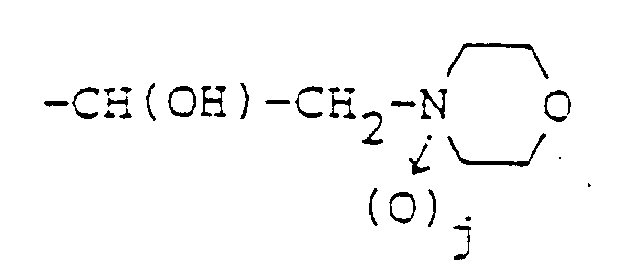 à la condition que, lorsque R1 représente un atome d'hydrogène, m soit égal à 0 ; ou un sel de ce dérivé.m est égal à 0, 1 ou 2 ; etn est un entier de 1 à 5,
 - Dérivé de N-acylamino acide, ou son sel, selon la revendication 1, dans lequel:R1, R2, R4 et R6, qui peuvent être identiques ou différents, représentent chacun un groupe alkyle en C1-6 substitué ou non substitué, un groupe cycloalkyle substitué ou non substitué, un groupe cycloalkylalkyle substitué ou non substitué, un groupe aryle substitué ou non substitué, un groupe aralkyle substitué ou non substitué ou un groupe hétérocyclique monocyclique ou bicyclique, substitué ou non substitué, contenant de 1 à 4 hétéroatomes choisis dans le groupe constitué par les atomes d'azote, d'oxygène et de soufre ;R3 et R5 représentent chacun un atome d'hydrogène ; etn est égal à 1.
- Dérivé de N-acylamino acide, ou son sel, selon la revendication 1, qui est :le (2S, 3R, 4S)-4-{L-N-[(2S)-3-éthylsulfonyl-2-(1-naphtylméthyl)propionyl]séryl}amino-5-cyclohexyl-1-morpholino-2,3-pentanediol,le (2S, 3R, 4S)-4-{L-N-[(2S)-3-éthylsulfonyl-2-(1-naphtylméthyl)propionyl]methionyl}amino-5-cyclohexyl-1-morpholino-2,3-pentanediol,le (2S, 3R, 4S)-4-{L-N-[(2S)-3-isopropylsulfonyl-2-(8-quinolylméthyl)propionyl]leucyl}amino-5-cyclohexyl-1-morpholino-2,3-pentanediol,le (2S, 3R, 4S)-4-{L-N"-[(2S)-1-isopropylsulfinyl-2-(1-naphtylméthyl)propionyl]histidyl}amino-5-cyclohexyl-1-morpholino-2,3-pentanediol,le (2S, 3R, 4S)-4-{L-N-[(2S ou R)-3-(2-hydroxyéthyl)sulfonyl-2-(1-naphtylméthyl)propionyl]norleucyl}amino-5-cyclohexyl-1-morpholino-2,3-pentanediol,le (2S, 3R, 4S)-4-{L-N-[(2S)-2-benzyl-3-éthylsulfonylpropionyl]norleucyl}amino-5-cyclohexyl-1-morpholino-2,3-pentanediol,le (2S, 3R, 4S)-4-{L-N-[(2S)-3-tert-butylsulfonyl-2-(1-naphtylméthyl)propionyl]norleucyl}amino-5-cyclohexyl-1-morpholino-2,3-pentanediol,le (2S, 3R, 4S)-4-{L-N-[(2S)-3-[[(2S)-N-benzyloxycarbonyl-2-pyrrolidinyl]méthyl]sulfonyl-2-(1-naphtylméthyl)propionyl]norleucyl}amino-5-cyclohexyl-1-morpholino-2,3-pentanediol,le (2S, 3R, 4S)-4-{L-N-[(2S ou R)-3-(2-hydroxyéthyl)sulfonyl-2-(1-naphtylméthyl)propionyl]norleucyl)amino-5-cyclohexyl-1-morpholino-2,3-pentanediol,le (2S, 3R, 4S)-4-{L-N-[(2S)-3-éthylsulfinyl-2-(1-naphtylméthyl)propionyl]norleucyl}amino-5-cyclohexyl-1-morpholino-2,3-pentanediol,le N-[(2S, 3R, 4S)-4-{L-N-[(2R)-3-éthylsulfonyl-2-(1-naphtylméthyl)propionyl]norleucyl}amino-5-cyclohexyl-2,3-dihydroxypentyl]morpholine N-oxyde,le (2S, 3R, 4S)-4-{L-N-[(2S ou R)-3-cyclopentanesulfonyl-2-benzylpropionyl]norleucyl}amino-5-cyclohexyl-l-morpholino-2,3-pentanediol,le N-[(2S, 3R, 4S)-4-{L-N-[(2R)-3-cyclopentanesulfonyl-2-benzylpropionyl]norleucyl}amino-5-cyclohexyl-1-2,3-dihydroxypentyl]morpholine N-oxyde,le (2S, 3R, 4S)-4-{L-N-[(2S)-2-benzyl-3-furfurylsulfonylpropionyl]norleucyl}amino-5-cyclohexyl-1-morpholino-2,3-pentanediol,le (2S, 3R, 4S)-4-{L-N-[(2S)-2-(1-naphtylméthyl)-3-pyrimidin-2-yl)thiopropionyl]norleucyl}amino-5-cyclohexyl-1-morpholino-2,3-pentanediol,le (2S, 3R, 4S)-4-{L-N-[(2S)-2-(1-naphtylméthyl)-3-(pyrimidin-2-yl)sulfonylpropionyl]norleucyl}amino-5-cyclohexyl-1-morpholino-2,3-pentanediol,le (2S, 3R, 4S)-4-{L-N-[(2S)-2-(1-naphtylméthyl)-3-(pyrimidin-2-yl)sulfinylpropionyl]norleucyl}amino-5-cyclohexyl-1-morpholino-2,3-pentanediol,le dichlorhydrate de (2S, 3R, 4S)-4-{L-N-[(2S)-2-(1-naphtylméthyl)-3-[(2S)-2-pyrrolidinylméthyl]sulfonylpropionyl]norleucyl}amino-5-cyclohexyl-1-morpholino-2,3-pentanediol,le (2S, 3R, 4S)-4-{L-N-[(2S)-2-benzyl-3-(pyrimidin-2-yl)sulfonylpropionyl]norleucyl}amino-5-cyclohexyl-1-morpholino-2,3-pentanediol,le (2S, 3R, 4s)-4-{L-O-acétyl-N-[(2S)-3-éthylsulfonyl-2-(1-naphtylméthyl)propionyl]homoséryl}amine-5-cyclohexyl-1-morpholino-2,3-pentanediol,le (2S, 3R, 4S)-4-{L-N-[(2S)-3-furfurylsulfonyl-2-(1-naphtylméthyl)propionyl]norleucyl}amino-5-cyclohexyl-1-morpholino-2,3-pentanediol,le (2RS, 3RS, 4S)-4-{L-N-[3-éthylsulfonyl-2-(1-naphtylméthyl)propionyl]norleucyl}amino-5-cyclohexyl-1-morpholino-2,3-pentanediol,le (2S, 3R, 4S)-4-{L-N-[(2S)-3-éthylsulfonyl-2-(1-naphtylméthyl)propionyl]norleucyl}amino-6-méthyl-1-morpholino-2,3-heptanediol,le (2S, 3R, 4S)-4-{L-N-[(2R ou S)-2-éthylsulfonylméthyl-4-méthylpentanoyl]norleucyl}amino-5-cyclohexyl-1-morpholino-2,3-pentanediol,le (2S, 3R, 4S)-4-{L-N-[(2R ou S)-5-éthylthio-2-(1-naphtylméthyl)pentanoyl]norleucyl}amino-5-cyclohexyl-1-morpholino-2,3-pentanediol,le (2S, 3R, 4S)-4-{L-N-[(2R ou S)-5-éthylsulfonyl-2-(1-naphtylméthyl)pentanoyl]norleucyl}amino-5-cyclohexyl-1-morpholino-2,3-pentanediol,le (2S, 3R, 4S)-4-{L-N-[(2S)-3-éthylsulfonyl-2-(8-quinolylméthyl)propionyl]norleucyl}amino-5-cyclohexyl-1-morpholino-2,3-pentanediol,le (2S, 3R, 4 S)-4-{L-Nα-[(2S)-3-éthylsulfonyl-2-(1-naphtylméthyl)propionyl]histidyl}amine-5-cyclohexyl-1-morpholino-2,3-pentanediol,le (2S, 3R, 4S)-4-{L-N-[(2S)-3-éthylsulfonyl-2-[(5,6,7,8-tétrahydro-1-naphtyl)méthyl]propionyl]norleucyl}amino-5-cyclohexyl-1-morpholino-2,3-pentanediol,le (2S, 3R, 4S)-4-{L-N-[(2S)-3-éthylsulfonyl-2-(3-tolylméthyl)propionyl]nerleucyl}amino-5-cyclohexyl-1-morpholino-2,3-pentanediol, oule (2S, 3R, 4S)-4-{L-N-[(2S)-3-éthylsulfonyl-2-(2-tolylméthyl)propionyl]norleucyl}amino-5-cyclohexyl-1-morpholino-2,3-pentanediol.
- Composé de la formule :dans laquelle :
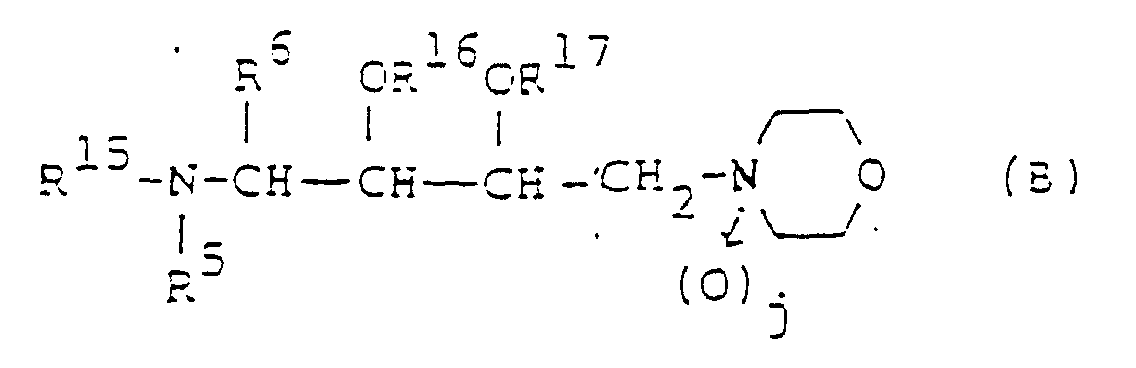 R5 représente un atome d'hydrogène ou un groupe alkyle en C1-6 ;R15 représente un atome d'hydrogène ou un groupe protecteur pour un groupe amino ;R16 et R17, qui peuvent être identiques ou différents, représentent chacun un atome d'hydrogène ou un groupe protecteur pour un groupe hydroxyle ; etR6 et j sont tels que définis à la revendication 1.
 - Procédé de fabrication d'un dérivé de N-acylamino acide de la formule I, tel que défini à la revendication 1, ou de son sel, qui comprend :la condensation d'un N-acylamino acide de la formule :dans laquelle R1, R2, R3, R4, m et n sont tels que définis à la revendication 1, ou d'un dérivé réactif au niveau de groupe carboxyle de celui-ci,
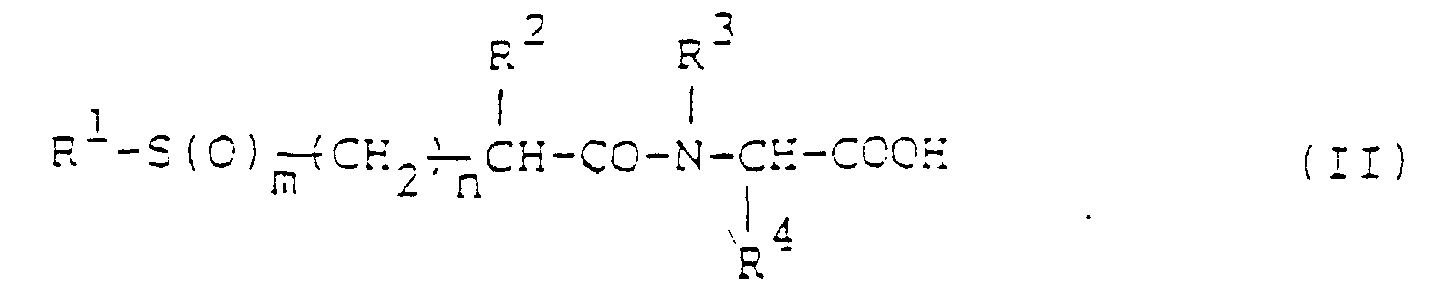
avec une amine de la formule :dans laquelle R5, R6 et j sont tels que définis à la revendication 1 ; ou la condensation d'un acide carboxylique de la formule :dans laquelle R1, R2, m et n sont tels que définis à la revendication 1,
ou d'un dérivé réactif au niveau du groupe carboxyle de celui-ci,
avec un amide d'amino acide de la formule :dans laquelle R3, R4, R5, R6 et A sont tels que définis à la revendication 1.
- Médicament hypotenseur comprenant une quantité efficace d'un dérivé de N-acylamino acide de la formule I, tel que défini à la revendication 1, ou de son sel pharmaceutiquement acceptable, et un support pharmaceutiquement acceptable.
Priority Applications (1)
| Application Number | Priority Date | Filing Date | Title |
|---|---|---|---|
| JP63236728A JPH0262856A (ja) | 1987-09-29 | 1988-09-21 | 新規n−アシルアミノ酸誘導体及びその用途 |
Applications Claiming Priority (2)
| Application Number | Priority Date | Filing Date | Title |
|---|---|---|---|
| JP244934/87 | 1987-09-29 | ||
| JP24493487 | 1987-09-29 |
Publications (3)
| Publication Number | Publication Date |
|---|---|
| EP0309766A2 EP0309766A2 (fr) | 1989-04-05 |
| EP0309766A3 EP0309766A3 (fr) | 1990-06-13 |
| EP0309766B1 true EP0309766B1 (fr) | 1998-04-15 |
Family
ID=17126138
Family Applications (1)
| Application Number | Title | Priority Date | Filing Date |
|---|---|---|---|
| EP88114374A Expired - Lifetime EP0309766B1 (fr) | 1987-09-29 | 1988-09-02 | Dérivés N-acylés d'aminoacides et leur utilisation |
Country Status (7)
| Country | Link |
|---|---|
| US (4) | US5122523A (fr) |
| EP (1) | EP0309766B1 (fr) |
| KR (1) | KR890005148A (fr) |
| CN (1) | CN1032786A (fr) |
| AT (1) | ATE165085T1 (fr) |
| AU (1) | AU620820B2 (fr) |
| DE (1) | DE3856166T2 (fr) |
Families Citing this family (32)
| Publication number | Priority date | Publication date | Assignee | Title |
|---|---|---|---|---|
| SE425322B (sv) * | 1976-05-11 | 1982-09-20 | Kemanobel Ab | Forfarande vid framstellning av alkalimetall- eller jordalkalimetallklorit |
| DE3856166T2 (de) * | 1987-09-29 | 1998-08-06 | Banyu Pharma Co Ltd | N-Acylaminosäurederivate und deren Verwendung |
| US4977277A (en) * | 1988-05-09 | 1990-12-11 | Abbott Laboratories | Functionalized peptidyl aminodiols and -triols 4-amino-5-cyclohexyl-3-hydroxy-1,2-oxopentane and derivatives thereof |
| US5260278A (en) * | 1988-05-27 | 1993-11-09 | Warner-Lambert Company | Diol-containing renin inhibitors |
| DE3839559A1 (de) * | 1988-11-24 | 1990-05-31 | Hoechst Ag | Renin-hemmende aminodiol-derivate |
| CA2004846A1 (fr) * | 1988-12-19 | 1990-06-19 | Yutaka Koike | Composes d'acide acylamine n-substitues, procede de production et utilisation |
| CA2023099A1 (fr) * | 1989-09-04 | 1991-03-05 | Quirico Branca | Derives d'acide amine |
| US5098924A (en) * | 1989-09-15 | 1992-03-24 | E. R. Squibb & Sons, Inc. | Diol sulfonamide and sulfinyl renin inhibitors |
| US5599951A (en) * | 1989-09-15 | 1997-02-04 | Societe Civile Bioprojet | Amino acid derivatives, the process for their preparation and their applications to therapy |
| FR2652087B1 (fr) * | 1989-09-15 | 1993-10-15 | Bioprojet Ste Civile | Derives d'amino-acides, leur procede de preparation et leurs applications therapeutiques. |
| EP0428849A3 (en) * | 1989-09-28 | 1991-07-31 | Hoechst Aktiengesellschaft | Retroviral protease inhibitors |
| US5177069A (en) * | 1989-12-13 | 1993-01-05 | Kissei Pharmaceutical Co., Ltd. | Naphthysulfonylalkanoic acid compounds and pharmaceutical compositions thereof |
| DE59010771D1 (de) * | 1989-12-16 | 1997-12-11 | Hoechst Ag | Inhibitoren retroviraler Proteasen |
| IE68045B1 (en) * | 1990-05-11 | 1996-05-15 | Abbott Lab | Renin inhibitors |
| US5332742A (en) * | 1990-05-11 | 1994-07-26 | Abbott Laboratories | Renin inhibitors |
| EP0473936A1 (fr) * | 1990-09-04 | 1992-03-11 | American Cyanamid Company | Inhibiteurs de rénine |
| US5189023A (en) * | 1990-09-04 | 1993-02-23 | American Cyanamid Company | Renin inhibitors |
| TW198712B (fr) * | 1991-04-17 | 1993-01-21 | Hoffmann La Roche | |
| PL294870A1 (fr) * | 1991-06-21 | 1993-02-08 | Hoechst Ag | |
| GB9211707D0 (en) * | 1992-06-03 | 1992-07-15 | Celltech Ltd | Peptidyl derivatives |
| CA2095671A1 (fr) * | 1992-06-04 | 1993-12-05 | Quirico Branca | Derives d'acide amine |
| DE4233100A1 (de) * | 1992-10-01 | 1994-04-07 | Hoechst Ag | Verfahren zur stereoselektiven Synthese von 3-substituierten 2-Sulfonylmethylpropionsäuren sowie Zwischenprodukte |
| DE4233099A1 (de) * | 1992-10-01 | 1994-04-07 | Hoechst Ag | Verfahren zur stereoselektiven Synthese von 3-substituierten 2-Thiomethylpropionsäuren |
| US5414018A (en) * | 1993-09-24 | 1995-05-09 | G. D. Searle & Co. | Alkylaminoalkyl-terminated sulfide/sulfonyl-containing propargyl amino-diol compounds for treatment of hypertension |
| US7056935B2 (en) | 1995-06-07 | 2006-06-06 | Gpi Nil Holdings, Inc. | Rotamase enzyme activity inhibitors |
| JP3485890B2 (ja) | 1997-11-11 | 2004-01-13 | インフィネオン テクノロジース アクチエンゲゼルシャフト | 光ファイバ終端部材 |
| US6399306B1 (en) | 1998-03-07 | 2002-06-04 | University Of Maryland, College Park Office Of Technology Commercialization | Genetic markers which identify individuals who decrease their blood pressure through exercise |
| US6525386B1 (en) * | 1998-03-10 | 2003-02-25 | Masimo Corporation | Non-protruding optoelectronic lens |
| US6992081B2 (en) * | 2000-03-23 | 2006-01-31 | Elan Pharmaceuticals, Inc. | Compounds to treat Alzheimer's disease |
| WO2004060885A1 (fr) * | 2002-12-27 | 2004-07-22 | Kaneka Corporation | Procedes de production de derive d'acide 2-thiomethyl-3-phenylpropionique optiquement actif et de production d'intermediaire de celui-ci |
| CN109321940A (zh) * | 2018-11-30 | 2019-02-12 | 西南大学 | 一种酰胺的电化学氧化合成方法及其应用 |
| CN112608389B (zh) * | 2020-11-23 | 2022-07-15 | 中国林业科学研究院林产化学工业研究所 | 一种乙基纤维素基自修复聚合物及其制备方法 |
Citations (2)
| Publication number | Priority date | Publication date | Assignee | Title |
|---|---|---|---|---|
| EP0229667A2 (fr) * | 1986-01-16 | 1987-07-22 | Abbott Laboratories | Peptidyl aminodiols |
| EP0236734A2 (fr) * | 1986-02-07 | 1987-09-16 | Ciba-Geigy Ag | Dérivés d'amino-5-hydroxy-4-valeryl substitués par des groupes contenant du soufre |
Family Cites Families (8)
| Publication number | Priority date | Publication date | Assignee | Title |
|---|---|---|---|---|
| GB1231783A (en) * | 1967-05-16 | 1971-05-12 | May & Baker Ltd | Benzene derivatives |
| US4256761A (en) * | 1979-07-13 | 1981-03-17 | Usv Pharmaceutical Corporation | Antihypertensive amides |
| US4304771A (en) * | 1979-07-13 | 1981-12-08 | Usv Pharmaceutical Corporation | Antihypertensive amides |
| US4619944A (en) * | 1981-06-01 | 1986-10-28 | Usv Pharmaceutical Corporation | Antihypertensive compounds |
| US4851387A (en) * | 1986-10-14 | 1989-07-25 | Banyu Pharmaceutical Co., Ltd. | 5-substituted amino-4-hydroxy-pentanoic acid derivatives and their use |
| US4927565A (en) * | 1986-12-19 | 1990-05-22 | Banyu Pharmaceutical Co., Ltd. | 5-substituted amino-4-hydroxy-pentenoic acid derivatives and their use |
| DE3856166T2 (de) * | 1987-09-29 | 1998-08-06 | Banyu Pharma Co Ltd | N-Acylaminosäurederivate und deren Verwendung |
| US5240924A (en) * | 1987-09-29 | 1993-08-31 | Banyu Pharmaceutical Co., Ltd. | N-acylamino acid derivatives and their use |
-
1988
- 1988-09-02 DE DE3856166T patent/DE3856166T2/de not_active Expired - Fee Related
- 1988-09-02 AT AT88114374T patent/ATE165085T1/de not_active IP Right Cessation
- 1988-09-02 EP EP88114374A patent/EP0309766B1/fr not_active Expired - Lifetime
- 1988-09-06 US US07/240,725 patent/US5122523A/en not_active Expired - Fee Related
- 1988-09-24 KR KR1019880012421A patent/KR890005148A/ko not_active Ceased
- 1988-09-29 AU AU22992/88A patent/AU620820B2/en not_active Ceased
- 1988-09-29 CN CN88109019A patent/CN1032786A/zh active Pending
-
1992
- 1992-04-14 US US07/868,140 patent/US5319082A/en not_active Expired - Fee Related
-
1994
- 1994-01-10 US US08/179,195 patent/US5481036A/en not_active Expired - Fee Related
-
1995
- 1995-01-20 US US08/375,738 patent/US5506356A/en not_active Expired - Fee Related
Patent Citations (2)
| Publication number | Priority date | Publication date | Assignee | Title |
|---|---|---|---|---|
| EP0229667A2 (fr) * | 1986-01-16 | 1987-07-22 | Abbott Laboratories | Peptidyl aminodiols |
| EP0236734A2 (fr) * | 1986-02-07 | 1987-09-16 | Ciba-Geigy Ag | Dérivés d'amino-5-hydroxy-4-valeryl substitués par des groupes contenant du soufre |
Also Published As
| Publication number | Publication date |
|---|---|
| DE3856166T2 (de) | 1998-08-06 |
| ATE165085T1 (de) | 1998-05-15 |
| KR890005148A (ko) | 1989-05-13 |
| CN1032786A (zh) | 1989-05-10 |
| EP0309766A3 (fr) | 1990-06-13 |
| US5122523A (en) | 1992-06-16 |
| AU620820B2 (en) | 1992-02-27 |
| DE3856166D1 (de) | 1998-05-20 |
| US5481036A (en) | 1996-01-02 |
| AU2299288A (en) | 1989-04-06 |
| EP0309766A2 (fr) | 1989-04-05 |
| US5506356A (en) | 1996-04-09 |
| US5319082A (en) | 1994-06-07 |
Similar Documents
| Publication | Publication Date | Title |
|---|---|---|
| US5122523A (en) | N-acylamino acid derivatives and their pharmaceutical compositions | |
| AU646156B2 (en) | Improvements in or relating to heterocyclic compounds | |
| US5063208A (en) | Peptidyl aminodiol renin inhibitors | |
| CA1337909C (fr) | Inhibiteurs non peptidiques de la renine | |
| AU613956B2 (en) | Peptidylheterocycles | |
| EP0445796A2 (fr) | Dérivés de l'acide acétique | |
| CA2263932A1 (fr) | Inhibiteurs 1,4-heterocycliques de metalloproteases | |
| SK13352002A3 (sk) | Metaloproteázové inhibítory s vedľajším heterocyklickým reťazcom | |
| CS107990A2 (en) | Method of aminoacids' new derivatives production | |
| KR20010102000A (ko) | 술파마토 히드록삼산 메탈로프로테아제 억제제 | |
| JP2628820B2 (ja) | アミノ酸誘導体及びその医薬品としての利用 | |
| AU624010B2 (en) | Peptidyl aminodiol renin inhibitors | |
| US4857507A (en) | Angiotensinogen analogs | |
| WO1997009066A1 (fr) | INHIBITEUR DE SOLUBILISATION DE LIGAND Fas | |
| EP0377139B1 (fr) | Composés acyl-amino acides n-substitués, leur procédé de production et leur usage | |
| US5240924A (en) | N-acylamino acid derivatives and their use | |
| US5268361A (en) | Hydroxyazido derivatives and related compounds as renin inhibitors | |
| SK16282000A3 (sk) | Substituované beta-aminokyselinové inhibítory metionínaminopeptidázy-2 | |
| KR20010043198A (ko) | 메티오닌 아미노펩티다제-2의 치환된 베타-아미노산 억제제 | |
| WO1989010751A1 (fr) | Peptidyl aminodiols et triols fonctionnalises | |
| HU204262B (en) | Process for producing renin-inhibiting amino-diol derivatives and pharmaceutical compositions containing them | |
| LT3073B (en) | N-(hydroxyethyl)butanediamide derivatives | |
| KR100402561B1 (ko) | 하이드라진 유도체 | |
| JPH0262856A (ja) | 新規n−アシルアミノ酸誘導体及びその用途 | |
| US20080021044A1 (en) | N-[2-[[(diaminomethylene)amino]oxy]ethyl]-3-[(2,2-difluoro-2-phenylethyl)amino]-6-methyl-2-oxo-1(2h)-pyrazineacetamide |
Legal Events
| Date | Code | Title | Description |
|---|---|---|---|
| PUAI | Public reference made under article 153(3) epc to a published international application that has entered the european phase |
Free format text: ORIGINAL CODE: 0009012 |
|
| AK | Designated contracting states |
Kind code of ref document: A2 Designated state(s): AT BE CH DE ES FR GB GR IT LI LU NL SE |
|
| PUAL | Search report despatched |
Free format text: ORIGINAL CODE: 0009013 |
|
| AK | Designated contracting states |
Kind code of ref document: A3 Designated state(s): AT BE CH DE ES FR GB GR IT LI LU NL SE |
|
| 17P | Request for examination filed |
Effective date: 19900921 |
|
| 17Q | First examination report despatched |
Effective date: 19920413 |
|
| RBV | Designated contracting states (corrected) |
Designated state(s): AT BE CH DE FR GB GR IT LI LU NL SE |
|
| RBV | Designated contracting states (corrected) |
Designated state(s): AT BE CH DE FR GB IT LI LU NL SE |
|
| GRAG | Despatch of communication of intention to grant |
Free format text: ORIGINAL CODE: EPIDOS AGRA |
|
| GRAG | Despatch of communication of intention to grant |
Free format text: ORIGINAL CODE: EPIDOS AGRA |
|
| GRAH | Despatch of communication of intention to grant a patent |
Free format text: ORIGINAL CODE: EPIDOS IGRA |
|
| GRAH | Despatch of communication of intention to grant a patent |
Free format text: ORIGINAL CODE: EPIDOS IGRA |
|
| GRAA | (expected) grant |
Free format text: ORIGINAL CODE: 0009210 |
|
| AK | Designated contracting states |
Kind code of ref document: B1 Designated state(s): AT BE CH DE FR GB IT LI LU NL SE |
|
| PG25 | Lapsed in a contracting state [announced via postgrant information from national office to epo] |
Ref country code: NL Free format text: LAPSE BECAUSE OF FAILURE TO SUBMIT A TRANSLATION OF THE DESCRIPTION OR TO PAY THE FEE WITHIN THE PRESCRIBED TIME-LIMIT Effective date: 19980415 Ref country code: LI Free format text: LAPSE BECAUSE OF FAILURE TO SUBMIT A TRANSLATION OF THE DESCRIPTION OR TO PAY THE FEE WITHIN THE PRESCRIBED TIME-LIMIT Effective date: 19980415 Ref country code: CH Free format text: LAPSE BECAUSE OF FAILURE TO SUBMIT A TRANSLATION OF THE DESCRIPTION OR TO PAY THE FEE WITHIN THE PRESCRIBED TIME-LIMIT Effective date: 19980415 Ref country code: BE Free format text: LAPSE BECAUSE OF FAILURE TO SUBMIT A TRANSLATION OF THE DESCRIPTION OR TO PAY THE FEE WITHIN THE PRESCRIBED TIME-LIMIT Effective date: 19980415 Ref country code: AT Free format text: LAPSE BECAUSE OF FAILURE TO SUBMIT A TRANSLATION OF THE DESCRIPTION OR TO PAY THE FEE WITHIN THE PRESCRIBED TIME-LIMIT Effective date: 19980415 |
|
| REF | Corresponds to: |
Ref document number: 165085 Country of ref document: AT Date of ref document: 19980515 Kind code of ref document: T |
|
| REG | Reference to a national code |
Ref country code: CH Ref legal event code: EP |
|
| ITF | It: translation for a ep patent filed | ||
| REF | Corresponds to: |
Ref document number: 3856166 Country of ref document: DE Date of ref document: 19980520 |
|
| ET | Fr: translation filed | ||
| PG25 | Lapsed in a contracting state [announced via postgrant information from national office to epo] |
Ref country code: SE Free format text: LAPSE BECAUSE OF FAILURE TO SUBMIT A TRANSLATION OF THE DESCRIPTION OR TO PAY THE FEE WITHIN THE PRESCRIBED TIME-LIMIT Effective date: 19980715 |
|
| NLV1 | Nl: lapsed or annulled due to failure to fulfill the requirements of art. 29p and 29m of the patents act | ||
| PG25 | Lapsed in a contracting state [announced via postgrant information from national office to epo] |
Ref country code: LU Free format text: LAPSE BECAUSE OF NON-PAYMENT OF DUE FEES Effective date: 19980902 |
|
| REG | Reference to a national code |
Ref country code: CH Ref legal event code: PL |
|
| PLBE | No opposition filed within time limit |
Free format text: ORIGINAL CODE: 0009261 |
|
| STAA | Information on the status of an ep patent application or granted ep patent |
Free format text: STATUS: NO OPPOSITION FILED WITHIN TIME LIMIT |
|
| 26N | No opposition filed | ||
| PGFP | Annual fee paid to national office [announced via postgrant information from national office to epo] |
Ref country code: DE Payment date: 20000828 Year of fee payment: 13 |
|
| PGFP | Annual fee paid to national office [announced via postgrant information from national office to epo] |
Ref country code: GB Payment date: 20000830 Year of fee payment: 13 |
|
| PGFP | Annual fee paid to national office [announced via postgrant information from national office to epo] |
Ref country code: FR Payment date: 20000912 Year of fee payment: 13 |
|
| PG25 | Lapsed in a contracting state [announced via postgrant information from national office to epo] |
Ref country code: GB Free format text: LAPSE BECAUSE OF NON-PAYMENT OF DUE FEES Effective date: 20010902 |
|
| PG25 | Lapsed in a contracting state [announced via postgrant information from national office to epo] |
Ref country code: DE Free format text: LAPSE BECAUSE OF NON-PAYMENT OF DUE FEES Effective date: 20020501 |
|
| PG25 | Lapsed in a contracting state [announced via postgrant information from national office to epo] |
Ref country code: FR Free format text: LAPSE BECAUSE OF NON-PAYMENT OF DUE FEES Effective date: 20020531 |
|
| REG | Reference to a national code |
Ref country code: FR Ref legal event code: ST |
|
| PG25 | Lapsed in a contracting state [announced via postgrant information from national office to epo] |
Ref country code: IT Free format text: LAPSE BECAUSE OF NON-PAYMENT OF DUE FEES;WARNING: LAPSES OF ITALIAN PATENTS WITH EFFECTIVE DATE BEFORE 2007 MAY HAVE OCCURRED AT ANY TIME BEFORE 2007. THE CORRECT EFFECTIVE DATE MAY BE DIFFERENT FROM THE ONE RECORDED. Effective date: 20050902 |