EP0309876A2 - MAC-Fernsehübertragungssystem - Google Patents
MAC-Fernsehübertragungssystem Download PDFInfo
- Publication number
- EP0309876A2 EP0309876A2 EP88115436A EP88115436A EP0309876A2 EP 0309876 A2 EP0309876 A2 EP 0309876A2 EP 88115436 A EP88115436 A EP 88115436A EP 88115436 A EP88115436 A EP 88115436A EP 0309876 A2 EP0309876 A2 EP 0309876A2
- Authority
- EP
- European Patent Office
- Prior art keywords
- signal
- mac
- transmitted
- line
- color difference
- Prior art date
- Legal status (The legal status is an assumption and is not a legal conclusion. Google has not performed a legal analysis and makes no representation as to the accuracy of the status listed.)
- Granted
Links
Images

Classifications
-
- H—ELECTRICITY
- H04—ELECTRIC COMMUNICATION TECHNIQUE
- H04N—PICTORIAL COMMUNICATION, e.g. TELEVISION
- H04N9/00—Details of colour television systems
- H04N9/79—Processing of colour television signals in connection with recording
- H04N9/7921—Processing of colour television signals in connection with recording for more than one processing mode
- H04N9/7925—Processing of colour television signals in connection with recording for more than one processing mode for more than one standard
-
- H—ELECTRICITY
- H04—ELECTRIC COMMUNICATION TECHNIQUE
- H04N—PICTORIAL COMMUNICATION, e.g. TELEVISION
- H04N7/00—Television systems
- H04N7/08—Systems for the simultaneous or sequential transmission of more than one television signal, e.g. additional information signals, the signals occupying wholly or partially the same frequency band, e.g. by time division
-
- H—ELECTRICITY
- H04—ELECTRIC COMMUNICATION TECHNIQUE
- H04N—PICTORIAL COMMUNICATION, e.g. TELEVISION
- H04N7/00—Television systems
- H04N7/08—Systems for the simultaneous or sequential transmission of more than one television signal, e.g. additional information signals, the signals occupying wholly or partially the same frequency band, e.g. by time division
- H04N7/083—Systems for the simultaneous or sequential transmission of more than one television signal, e.g. additional information signals, the signals occupying wholly or partially the same frequency band, e.g. by time division with signal insertion during the vertical and the horizontal blanking interval, e.g. MAC data signals
-
- H—ELECTRICITY
- H04—ELECTRIC COMMUNICATION TECHNIQUE
- H04N—PICTORIAL COMMUNICATION, e.g. TELEVISION
- H04N7/00—Television systems
- H04N7/08—Systems for the simultaneous or sequential transmission of more than one television signal, e.g. additional information signals, the signals occupying wholly or partially the same frequency band, e.g. by time division
- H04N7/087—Systems for the simultaneous or sequential transmission of more than one television signal, e.g. additional information signals, the signals occupying wholly or partially the same frequency band, e.g. by time division with signal insertion during the vertical blanking interval only
- H04N7/088—Systems for the simultaneous or sequential transmission of more than one television signal, e.g. additional information signals, the signals occupying wholly or partially the same frequency band, e.g. by time division with signal insertion during the vertical blanking interval only the inserted signal being digital
Definitions
- a color difference signal and then the luminance signal are first transmitted in a time-compressed manner during each line and expanded again on a line during playback.
- the two color difference signals are transmitted line-sequentially in such a way that the color difference signal B-Y is transmitted alternately in one line and the color difference signal R-Y in the next line.
- a patent application (P 37 32 734), which was filed at the same time, describes a recorder in which, in order to reduce crosstalk between the recorded color signals, there is a special partial delay in the recorded signals.
- This modification of the signals depends on the respective transmission system and requires special measures when receiving a MAC signal. That is because the switch between the color difference signals does not run continuously over all pictures as with PAL or SECAM. Rather, the sequence of the sequentially transmitted color difference signals is controlled so that an image always begins with the same color. With this transmission, which is referred to as a full-screen reset, the same color difference signal is therefore always transmitted in a line of a specific ordinal number from 1 to 625 of a complete image.
- the invention has for its object to effect an automatic adaptation of the receiving device to the MAC signal.
- the identification signal is constantly transmitted, regardless of whether it is a pure black / white signal or a color signal.
- the identification signal preferably consists of one or more words, each with several bits.
- the words initially contain the specified identifier of the MAC signal. They can also contain an identifier for the color sequence, ie specify which of the two color difference signals is transmitted in the line with the identification signal.
- the identification signal can in principle be used for any type of adaptation of the receiving device to the MAC signal, for example for the described pretreatment of the signals when recording, switching the receiving device to a MAC decoder, special equalization circuits for the signal or also actuating an optical or acoustic indication that a MAC signal is being received.
- the identification signal is preferably transmitted during an empty line of the vertical blanking time, for example during lines No. 23 and 335.
- Fig. 1 shows the synchronous pulse scheme for two successive fields A and B according to the interlace system.
- field A begins with line No. 1 and field B with line 312.5.
- a digital identification signal K is transmitted during line No. 23 in field A and during line No. 335 in field B, which contains the identification for a MAC signal and for the color difference signal transmitted in this line.
- a key pulse Ut is generated during lines No. 23 and 335, which key the signal during these lines and feeds it to a detection circuit.
- the received MAC signal for example in the form R, G, B, S 'or Y, (RY), (BY) on the video recorder 1, which operates in four different modes for receiving signals according to NTSC , SECAM, PAL and MAC is switchable, as symbolically represented by the switch 2.
- the synchronization pulses S are separated and fed to the counter 4.
- the counter is started by the vertical synchronizing pulse V and generates the key pulse Ut, which controls the gate 5, during lines No. 23 and 335.
- Characterized signal K thereby reaches evaluation circuit 6.
- the circuit When a MAC signal is received, the circuit generates 6 a switching voltage 7, which switches the video recorder 1 to the special operating mode for MAC. This switchover takes place only if the special MAC identification signal K is received in lines 23 and 335.
- the mode of operation assigned to the respective received signal is switched over manually or automatically.
- Mean P packet of duobinary data
- C color signal
- Y luminance signal
- T clock or trigger edge
- l Logical high level
- ⁇ Logical low level
- t time of the query
- AP cut-off level.
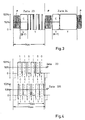
- Fig. 3 shows the MAC signal in the baseband.
- a packet or data burst P of duobinary coded data is first transmitted, which contains synchronization, sound and other data. This is followed by a clamping level at 50% of the maximum level and then the color signal or chroma signal C in time-compressed form with a Krompressinons factor of 3. This is followed by the luminance signal Y, which is time-compressed by a factor of 1.5.
- C means either the sequential color signals U, V or also sequential color difference signals (BY) and (RY).
- BY sequential color difference signals
- RY sequential color difference signals
- the complete color information RY and BY for each line is recovered from the sequential color signal C by means of a buffer and filter.
- the sequential color difference signals RY and BY are transmitted before the associated luminance signal Y.
- the specification for MAC therefore defines that only the color difference signal of lines 24 and 334 is transmitted in lines 23 and 335, while the luminance signal has the value for black.
- the identification signal for MAC is transmitted with which a distinction can be made between MAC and other signals.
- the lines with the numbers 23 and 335 can be recognized by counting the lines from the beginning of the picture, whereby the color difference signal transmitted can be inferred. This is e.g. a 6-bit word that is transmitted in line 23 in its original form and in line 335 in inverted form, as shown in FIG. 4.
- the identification signal is therefore transmitted over a period of 52 ⁇ s of the total line duration of 64 ⁇ s.
- the data is separated at an amplitude of 50% of the maximum amplitude by a comparator from the decoded luminance signal Y or from the green signal G alone. It has been shown that the effects of any information present in the color part are the least for the green signal G.
- the signal obtained in this way can be evaluated either directly with a microprocessor or with appropriate hardware by starting a time window with the trigger or clock edge. Firstly, this prevents retriggering in the period until shortly before the next clock edge. It is also achieved that the logic level of the signal is evaluated after the period t. To increase the detection si signal filtering, an evaluation of pulse length and distance and a succession of original and inverse data word can be used.
Landscapes
- Engineering & Computer Science (AREA)
- Multimedia (AREA)
- Signal Processing (AREA)
- Power Engineering (AREA)
- Color Television Systems (AREA)
- Two-Way Televisions, Distribution Of Moving Picture Or The Like (AREA)
- Studio Circuits (AREA)
- Details Of Television Systems (AREA)
Abstract
Description
- Für die drahtlose oder drahtgebundene Übertragung von Farbfernsehsignalen sind verschiedene Systeme bekannt, die sich insbesondere durch die Art der Übertragung der Farbinformation unterscheiden. Beim NTSC-System werden die beiden Farbdifferenzsignale simultan durch Quadraturmodulation eines Farbträgers übertragen. Beim SECAM-System werden die beiden Farbdifferenzsignale zeilensequentiell durch Frequenzmodulation eines Farbträgers übertragen. Beim PAL-Farbfernsehsystem erfolgt eine simultane Übertragung mit Quadraturmodulation und gleichzeitiger Umschaltung der Phasenmodulationsrichtung zum Ausgleich von auf dem Übertragungsweg entstandenen Phasenfehlern.
- Beim MAC-Übertragungssystem, das insbesondere für die Übertragung zwischen Satelliten entwickelt wurde, werden während einer Zeile zunächst ein Farbdifferenzsignal und anschließend das Leuchtdichtesignal jeweils zeitkomprimiert übertragen und bei der Wiedergabe wieder auf eine Zeile expandiert. Dabei erfolgt die Übertragung der beiden Farbdifferenzsignale zeilensequentiell, derart, daß abwechselnd in einer Zeile das Farbdifferenzsignal B-Y und in der nächsten Zeile das Farbdifferenzsignal R-Y übertragen wird.
- Die unterschiedliche Art der Codierung, insbesondere der Farbdifferenzsignale, erfordert eine entsprechende Anpassung der Empfangsgeräte an das Signal. In einer gleichzeitig eingereichten Patentanmeldung (P 37 32 734) wird ein Recorder beschrieben, bei dem zur Verringerung des Übersprechens zwischen den aufgezeichneten Farbsignalen bei der Aufnahme eine besondere partielle Verzögerung der aufgezeichneten Signale erfolgt. Diese Modifizierung der Signale ist abhängig von dem jeweiligen Übertragungssystem und erfordert spezielle Maßnahmen bei Empfang eines MAC-Signals. Das ist dadurch be dingt, daß die Umschaltung zwischen den Farbdifferenzsignalen nicht wie bei PAL oder SECAM kontinuierlich über alle Bilder durchläuft. Vielmehr wird die Sequenz der sequentiell übertragenen Farbdifferenzsignale so gesteuert, daß jeweils ein Bild immer mit derselben Farbe beginnt. Bei dieser als Vollbild-Reset bezeichneten Übertragung wird somit in einer Zeile einer bestimmten Ordnungszahl von 1 - 625 eines vollständigen Bildes immer dasselbe Farbdifferenzsignal übertragen.
- Der Erfindung liegt die Aufgabe zugrunde, eine selbsttätige Anpassung des Empfangsgerätes an das MAC-Signal zu bewirken.
- Diese Aufgabe wird durch die im Anspruch 1 beschriebene Erfindung gelöst. Vorteilhafte Weiterbildungen der Erfindung sind in den Unteransprüchen beschrieben.
- Das Kennsignal wird ständig übertragen, unabhängig davon, ob es sich um ein reines Schwarz/Weiß-Signal oder ein Farbsignal handelt. Das Kennsignal besteht vorzugsweise aus einem oder mehreren Wörtern mit je mehreren Bits. Die Wörter enthalten zunächst die genannte spezielle Kennung des MAC-Signals. Sie können zusätzlich eine Kennung für die Farbsequenz enthalten, d.h. angeben, welches der beiden Farbdifferenzsignale in der Zeile mit dem Kennsignal jeweils übertragen wird. Das Kennsignal kann grundsätzlich für jede Art der Anpassung des Empfangsgerätes an das MAC-Signal verwendet werden, z.B. für die beschriebene Vorbehandlung der Signale bei der Aufzeichnung, Umschaltung des Empfangsgerätes auf einen MAC-Decoder, spezielle Entzerrungsschaltungen für das Signal oder auch Betätigung einer optischen oder akustischen Anzeige, daß ein MAC-Signal empfangen wird. Die Übertragung des Kennsignals erfolgt vorzugsweise jeweils während einer Leerzeile der Vertikalaustastzeit, z.B. während der Zeilen Nr. 23 und 335.
- Die Erfindung wird um folgenden anhand der Zeichnung erläutert. Darin zeigen
- Fig. 1 das Impulsschema während der Vertikalaustastzeit mit dem Kennsignal
- Fig. 2 ein Blockschaltbild für einen Videorecorder, der alternativ auf MAC-Betrieb umschaltbar ist und
- Fig. 3, 4 ein Ausführungsbeispiel für ein Erkennungswort, das in bestimmten Zeilen während der Vertikalaustastzeit übertragen wird.
- Fig. 1 zeigt das Synchronimpuls-Schema für zwei aufeinanderfolgende Halbbilder A und B gemäß dem Zeilensprungsystem. Zu Beginn des Vertikalsynchronimpulses beginnt jeweils das Halbbild A mit der Zeile Nr. 1 und das Halbbild B mit der Zeile 312,5. Jeweils während der Zeile Nr. 23 im Halbbild A und während der Zeile Nr. 335 im Halbbild B wird ein digitales Kennsignal K übertragen, das die Kennung für ein MAC-Signal und für das jeweils in dieser Zeile übertragene Farbdifferenzsignal enthält. Mit einem vom Vertikalsynchronimpuls V gestarteten Zähler wird jeweils während der Zeilen Nr. 23 und 335 ein Tastimpuls Ut erzeugt, der während dieser Zeilen das Signal auftastet und einer Erkennungschaltung zuführt.
- In Fig. 2 gelant das empfangene MAC-Signal, z.B. in der Form R, G, B, S' oder Y, (R-Y), (B-Y), auf den Videorecorder 1, der auf vier verschiedene Betriebsarten für Empfang von Signalen nach NTSC, SECAM, PAL und MAC umschaltbar ist, wie durch den Umschalter 2 symbolisch dargestellt. Mit der Abtrennstufe 3 werden die Synchronimpulse S abgetrennt und dem Zähler 4 zugeführt. Der Zähler wird vom Vertikalsynchronimpuls V gestartet und erzeugt jeweils während der Zeilen Nr. 23 und 335 den Tastimpuls Ut, der das Tor 5 durchlässig steuert. Dadurch gelangt daß Kennsignal K auf die Auswertschaltung 6. Bei Empfang eines MAC-Signals erzeugt die Schaltung 6 eine Schaltspannung 7, die den Videorecorder 1 auf die spezielle Betriebsart für MAC umschaltet. Diese Umschaltung erfolgt nur, wenn in den Zeilen Nr. 23 and 335 daß spezielle MAC- Kennsignal K empfangen wird. Bei Empfang von Signalen nach einem anderen der drei genannten Systeme wird manuell oder auch selbsttätig auf die dem jeweilgen empfangenen Signal zugeordnete Betriebsweise umgeschaltet.
- Fig. 3, 4 zeigen ein Ausführungsbeispiel für das Erkennungswort für MAC in den Zeilen 23 und 335. Dabei bedeuten
P: Paket aus duobinären Daten
C: Farbsignal
Y: Leuchtdichtesignal
T: Takt- oder Triggerflanke
l: Logischer High-Pegel
Ø: Logischer Low-Pegel
t: Zeitpunkt der Abfrage
AP: Abtrennpegel. - Fig. 3 zeigt das MAC-Signal im Basisband. Innerhalb einer Zeile von 64 µs wird zu erst ein Paket oder Datenburst P aus duobinär kodierten Daten übertragen, der Synchronisation-, Ton- und sonstige Daten enthält. Darauf folgt ein Klemmpegel mit 50% des Maximalpegels und darauf das Farbsignal oder Chromasignal C in zeitkomprimierter Form mit einem Krompressinonsfaktor von 3. Darauf folgt das um den Faktor 1,5 zeitkomprimierte Leuchtdichtesignal Y. C bedeutet entweder die sequentiellen Farbsignale U, V oder auch die sequentiellen Farbdifferenzsignale (B-Y) und (R-Y). Im Decoder wird aus den sequentiellen Farbsignal C durch Zwischenspeicher und Filter die vollständig Farbinformation R-Y und B-Y für jede Zeile zurückgewonnen. Um den Speicheraufwand im Decoder so gering wie möglich zu halten, werden die sequentiellen Farbdifferenzsignale R-Y und B-Y schon vor dem zugehörigen Leuchtdichtesignal Y übertragen. In der Spezifikation für MAC ist deshalb definiert, daß in Zeile 23 und 335 nur das Farbdifferenzsignal der Zeilen 24 bzw. 334 übertragen wird, während das Leuchtdichtesignal den Wert für Schwarz hat.
- Während dieser Zeilen wird also die Zeit für das Leuchtdichtesignal nicht ausgenutzt. Deshalb wird hier das Kennsignal für MAC übertragen, mit dem zwischen MAC und anderen Signale unterschieden werden kann. Die Zeilen mit den Nummern 23 und 335 können durch Zählung der Zeilen vom Bildanfang erkannt werden, wodurch auf das jeweils übertragene Farbdifferenzsignal geschlossen werden kann. Dabei handelt es sich z.B. um ein 6-Bit-Wort, das in Zeile 23 in seiner Originalform und in Zeile 335 in invertierter Form übertragen wird, wie es in Fig. 4 dargestellt ist. Das Kennsignal wird also während einer Zeitdauer von 52 µs der gesamten Zeilendauer von 64 µs übertragen.
- Zur Auswertung des Signals erfolgt die Datenabtrennung bei einer Amplitude von 50% der Maximalamplitude durch einen Komparator aus dem dekodierten Leuchtdichtesignal Y oder auch aus dem Grünsignal G allein. Es hat sich gezeigt, daß beim Grünsignal G die Auswirkungen aus eventuell vorhandenen Informationen im Farbteil am geringsten sind.
- Das so gewonnene, eventuell noch gefilterte Signal kann entweder direkt mit einem Mikroprozessor oder mit entsprechender Hardware dadurch ausgewertet werden, daß mit der Trigger- oder Taktflanke ein Zeitfenster gestartet wird. Damit wird erstens verhindert, daß im Zeitraum bis kurz vor der nächsten Taktflanke eine Nachtriggerung erfolgt. Außerdem wird erreicht, daß nach dem Zeitraum t der logische Pegel des Signals ausgewertet wird. Zur Erhöhung der Erkennungssi cherheit kann eine Signalfilterung, eine Auswertung von Pulslänge- und Abstand und Aufeinanderfolge von Original- und inversen Datenwort ausgenutzt werden.
Claims (5)
Applications Claiming Priority (2)
| Application Number | Priority Date | Filing Date | Title |
|---|---|---|---|
| DE19873733472 DE3733472A1 (de) | 1987-09-30 | 1987-09-30 | D2mac-fernsehuebertragungssystem |
| DE3733472 | 1987-09-30 |
Publications (3)
| Publication Number | Publication Date |
|---|---|
| EP0309876A2 true EP0309876A2 (de) | 1989-04-05 |
| EP0309876A3 EP0309876A3 (de) | 1991-11-21 |
| EP0309876B1 EP0309876B1 (de) | 1994-08-10 |
Family
ID=6337555
Family Applications (1)
| Application Number | Title | Priority Date | Filing Date |
|---|---|---|---|
| EP88115436A Expired - Lifetime EP0309876B1 (de) | 1987-09-30 | 1988-09-21 | MAC-Fernsehübertragungssystem |
Country Status (4)
| Country | Link |
|---|---|
| EP (1) | EP0309876B1 (de) |
| AT (1) | ATE109934T1 (de) |
| DE (2) | DE3733472A1 (de) |
| DK (1) | DK541988A (de) |
Cited By (3)
| Publication number | Priority date | Publication date | Assignee | Title |
|---|---|---|---|---|
| DE4112712A1 (de) * | 1991-04-18 | 1992-10-22 | Inst Rundfunktechnik Gmbh | Verfahren zum uebertragen einer digitalen zusatzinformation in einer zeile eines fernsehsignals |
| EP0424654A3 (en) * | 1989-10-25 | 1992-11-25 | Grundig E.M.V. Elektro-Mechanische Versuchsanstalt Max Grundig Hollaend. Stiftung & Co. Kg. | Device for generating a recognition signal for the image aspect ratio of a video signal |
| EP0488337A3 (en) * | 1990-11-30 | 1993-05-19 | Hitachi, Ltd. | Magnetic recording apparatus |
Family Cites Families (6)
| Publication number | Priority date | Publication date | Assignee | Title |
|---|---|---|---|---|
| US3989891A (en) * | 1974-09-24 | 1976-11-02 | General Electric Company | Line selection circuit for a television receiver |
| ATE26373T1 (de) * | 1982-12-14 | 1987-04-15 | Indep Broadcasting Authority | Geraet zur nachrichtenableitung fuer komponentenfernsehvideosignalempfang. |
| NL194023C (nl) * | 1983-05-06 | 2001-04-03 | Philips Electronics Nv | Kleurentelevisie transmissie- respectievelijk informatieopslagsysteem met tijdmultiplexcodering en daartoe geschikte informatiegever en -ontvanger. |
| DE3332661C1 (de) * | 1983-09-10 | 1985-02-07 | Deutsche Thomson-Brandt Gmbh, 7730 Villingen-Schwenningen | Zeitsequentielles UEbertragungssystem,insbesondere fuer einen Videorecorder |
| NL8304007A (nl) * | 1983-11-22 | 1985-06-17 | Philips Nv | Kleurentelevisie-transmissie- respektievelijk informatie-opslagsysteem met tijdmultiplexkodering en daartoe geschikte informatiegever en -ontvanger. |
| DE3512156A1 (de) * | 1985-04-03 | 1986-10-09 | Standard Elektrik Lorenz Ag, 7000 Stuttgart | Verfahren zur bildung eines schaltsignals in einem rundfunk- oder videoempfangsgeraet |
-
1987
- 1987-09-30 DE DE19873733472 patent/DE3733472A1/de not_active Withdrawn
-
1988
- 1988-09-21 EP EP88115436A patent/EP0309876B1/de not_active Expired - Lifetime
- 1988-09-21 AT AT88115436T patent/ATE109934T1/de not_active IP Right Cessation
- 1988-09-21 DE DE3851024T patent/DE3851024D1/de not_active Expired - Fee Related
- 1988-09-29 DK DK541988A patent/DK541988A/da not_active Application Discontinuation
Non-Patent Citations (1)
| Title |
|---|
| None |
Cited By (4)
| Publication number | Priority date | Publication date | Assignee | Title |
|---|---|---|---|---|
| EP0424654A3 (en) * | 1989-10-25 | 1992-11-25 | Grundig E.M.V. Elektro-Mechanische Versuchsanstalt Max Grundig Hollaend. Stiftung & Co. Kg. | Device for generating a recognition signal for the image aspect ratio of a video signal |
| EP0488337A3 (en) * | 1990-11-30 | 1993-05-19 | Hitachi, Ltd. | Magnetic recording apparatus |
| US5499145A (en) * | 1990-11-30 | 1996-03-12 | Hitachi, Ltd. | Magnetic recording apparatus with capability of recording signals of a plurality of different television systems |
| DE4112712A1 (de) * | 1991-04-18 | 1992-10-22 | Inst Rundfunktechnik Gmbh | Verfahren zum uebertragen einer digitalen zusatzinformation in einer zeile eines fernsehsignals |
Also Published As
| Publication number | Publication date |
|---|---|
| EP0309876B1 (de) | 1994-08-10 |
| DE3851024D1 (de) | 1994-09-15 |
| ATE109934T1 (de) | 1994-08-15 |
| DK541988D0 (da) | 1988-09-29 |
| DE3733472A1 (de) | 1989-04-20 |
| EP0309876A3 (de) | 1991-11-21 |
| DK541988A (da) | 1989-03-31 |
Similar Documents
| Publication | Publication Date | Title |
|---|---|---|
| DE3119013C2 (de) | Verfahren und Einrichtung zum Verschlüsseln von Videosignalen | |
| WO1991000675A1 (de) | Fernsehgerät zur wahlweisen verarbeitung eines fbas- oder in bas und f getrennten signals | |
| DE3409613C2 (de) | ||
| DE3841173C1 (en) | Compatible television transmission system | |
| EP0387517B1 (de) | Einrichtung zur Verarbeitung von Fernseh-Empfangssignalen zum Zweck der Erkennung und Wahl des Bildformates | |
| EP0309876B1 (de) | MAC-Fernsehübertragungssystem | |
| DE3409418A1 (de) | Kompensationsschaltung fuer einen videosignalausfall | |
| EP0582583B1 (de) | Videorecorder zur aufzeichnung von nach dem letterbox-verfahren übertragenen videosignalen | |
| DE3332661C1 (de) | Zeitsequentielles UEbertragungssystem,insbesondere fuer einen Videorecorder | |
| EP0120344B1 (de) | System zur Übertragung, Aufzeichnung und/oder Wiedergabe eines Fernsehsignals | |
| DE4243804C2 (de) | Empfänger zur Verarbeitung von nach dem Letterbox-Verfahren übertragenen Fernsehsignalen | |
| EP0424655B1 (de) | Verfahren zur Übertragung von Breitbild-Videosignalen zur Darstellung auf Fernsehempfängern mit einem herkömmlichen oder einem vergrösserten Bildseitenverhältnis | |
| EP0584684B1 (de) | Farbfernsehsystem mit einer empfangsseitigen Steuereinrichtung zum Umschalten der Signalverarbeitungsverfahren eines Decoders | |
| DE3323750C2 (de) | ||
| DE2652186C2 (de) | Mehrnormen-Farbfernsehempfangsgerät | |
| EP0424654B1 (de) | Einrichtung zur Erzeugung und Einrichtung zur Auswertung eines Kennsignals für das Bildseitenverhältnis eines Videosignals | |
| DE4303883C1 (de) | Kompatibles verbessertes Farbfernsehsystem mit umschaltbarer Decodierung | |
| DE2226614B2 (de) | Bildübertragungseinrichtung zur Übertragung von Bildsignalen über eine Nachrichtenstrecke mit auf Tonfrequenzen begrenzter Bandbreite | |
| DE2909887C2 (de) | ||
| DE19733761C2 (de) | Vorrichtung zum Übertragen farbiger Video-Standbilder über einen Signalkanal geringer Bandbreite | |
| DE2652966C2 (de) | Verfahren zur Verbesserung der Störsicherheit der Horizontalidentifikation bei SECAM-Geräten | |
| EP0250632A1 (de) | Digitaler Bild- und Zeilenzahlwandler für Farbfernsehsignale | |
| DE1935213C3 (de) | Schaltung zur Aufzeichnung und Wiedergabe eines Farbfemsehsignals | |
| DE3933951A1 (de) | Fernsehgeraet mit einem videotextdecoder | |
| DE4012344A1 (de) | Fernsehaufzeichnungssystem |
Legal Events
| Date | Code | Title | Description |
|---|---|---|---|
| PUAI | Public reference made under article 153(3) epc to a published international application that has entered the european phase |
Free format text: ORIGINAL CODE: 0009012 |
|
| AK | Designated contracting states |
Kind code of ref document: A2 Designated state(s): AT BE CH DE ES FR GB GR IT LI LU NL SE |
|
| 17P | Request for examination filed |
Effective date: 19901231 |
|
| PUAL | Search report despatched |
Free format text: ORIGINAL CODE: 0009013 |
|
| AK | Designated contracting states |
Kind code of ref document: A3 Designated state(s): AT BE CH DE ES FR GB GR IT LI LU NL SE |
|
| 17Q | First examination report despatched |
Effective date: 19930331 |
|
| GRAA | (expected) grant |
Free format text: ORIGINAL CODE: 0009210 |
|
| ITF | It: translation for a ep patent filed | ||
| AK | Designated contracting states |
Kind code of ref document: B1 Designated state(s): AT BE CH DE ES FR GB GR IT LI LU NL SE |
|
| PG25 | Lapsed in a contracting state [announced via postgrant information from national office to epo] |
Ref country code: NL Effective date: 19940810 Ref country code: GR Free format text: LAPSE BECAUSE OF FAILURE TO SUBMIT A TRANSLATION OF THE DESCRIPTION OR TO PAY THE FEE WITHIN THE PRESCRIBED TIME-LIMIT Effective date: 19940810 Ref country code: ES Free format text: THE PATENT HAS BEEN ANNULLED BY A DECISION OF A NATIONAL AUTHORITY Effective date: 19940810 Ref country code: BE Effective date: 19940810 |
|
| REF | Corresponds to: |
Ref document number: 109934 Country of ref document: AT Date of ref document: 19940815 Kind code of ref document: T |
|
| GBT | Gb: translation of ep patent filed (gb section 77(6)(a)/1977) |
Effective date: 19940810 |
|
| REF | Corresponds to: |
Ref document number: 3851024 Country of ref document: DE Date of ref document: 19940915 |
|
| PG25 | Lapsed in a contracting state [announced via postgrant information from national office to epo] |
Ref country code: AT Effective date: 19940921 |
|
| ET | Fr: translation filed | ||
| PG25 | Lapsed in a contracting state [announced via postgrant information from national office to epo] |
Ref country code: LU Free format text: LAPSE BECAUSE OF NON-PAYMENT OF DUE FEES Effective date: 19940930 Ref country code: LI Effective date: 19940930 Ref country code: CH Effective date: 19940930 |
|
| PG25 | Lapsed in a contracting state [announced via postgrant information from national office to epo] |
Ref country code: SE Effective date: 19941110 |
|
| NLV1 | Nl: lapsed or annulled due to failure to fulfill the requirements of art. 29p and 29m of the patents act | ||
| REG | Reference to a national code |
Ref country code: CH Ref legal event code: PL |
|
| PLBE | No opposition filed within time limit |
Free format text: ORIGINAL CODE: 0009261 |
|
| 26N | No opposition filed | ||
| REG | Reference to a national code |
Ref country code: GB Ref legal event code: 746 Effective date: 19970904 |
|
| PGFP | Annual fee paid to national office [announced via postgrant information from national office to epo] |
Ref country code: GB Payment date: 19980810 Year of fee payment: 11 |
|
| PGFP | Annual fee paid to national office [announced via postgrant information from national office to epo] |
Ref country code: FR Payment date: 19980911 Year of fee payment: 11 |
|
| PGFP | Annual fee paid to national office [announced via postgrant information from national office to epo] |
Ref country code: DE Payment date: 19980924 Year of fee payment: 11 |
|
| PG25 | Lapsed in a contracting state [announced via postgrant information from national office to epo] |
Ref country code: GB Free format text: LAPSE BECAUSE OF NON-PAYMENT OF DUE FEES Effective date: 19990921 |
|
| GBPC | Gb: european patent ceased through non-payment of renewal fee |
Effective date: 19990921 |
|
| PG25 | Lapsed in a contracting state [announced via postgrant information from national office to epo] |
Ref country code: FR Free format text: LAPSE BECAUSE OF NON-PAYMENT OF DUE FEES Effective date: 20000531 |
|
| REG | Reference to a national code |
Ref country code: FR Ref legal event code: ST |
|
| PG25 | Lapsed in a contracting state [announced via postgrant information from national office to epo] |
Ref country code: DE Free format text: LAPSE BECAUSE OF NON-PAYMENT OF DUE FEES Effective date: 20000901 |
|
| PG25 | Lapsed in a contracting state [announced via postgrant information from national office to epo] |
Ref country code: IT Free format text: LAPSE BECAUSE OF NON-PAYMENT OF DUE FEES;WARNING: LAPSES OF ITALIAN PATENTS WITH EFFECTIVE DATE BEFORE 2007 MAY HAVE OCCURRED AT ANY TIME BEFORE 2007. THE CORRECT EFFECTIVE DATE MAY BE DIFFERENT FROM THE ONE RECORDED. Effective date: 20050921 |