EP0310075B1 - Aktivierbarer elektrochemischer Lithium-Oxyhalogenid-Generator - Google Patents
Aktivierbarer elektrochemischer Lithium-Oxyhalogenid-Generator Download PDFInfo
- Publication number
- EP0310075B1 EP0310075B1 EP19880116089 EP88116089A EP0310075B1 EP 0310075 B1 EP0310075 B1 EP 0310075B1 EP 19880116089 EP19880116089 EP 19880116089 EP 88116089 A EP88116089 A EP 88116089A EP 0310075 B1 EP0310075 B1 EP 0310075B1
- Authority
- EP
- European Patent Office
- Prior art keywords
- electrolyte
- housing
- cover
- electrochemical
- lithium
- Prior art date
- Legal status (The legal status is an assumption and is not a legal conclusion. Google has not performed a legal analysis and makes no representation as to the accuracy of the status listed.)
- Expired - Lifetime
Links
Images


Classifications
-
- H—ELECTRICITY
- H01—ELECTRIC ELEMENTS
- H01M—PROCESSES OR MEANS, e.g. BATTERIES, FOR THE DIRECT CONVERSION OF CHEMICAL ENERGY INTO ELECTRICAL ENERGY
- H01M6/00—Primary cells; Manufacture thereof
- H01M6/14—Cells with non-aqueous electrolyte
-
- H—ELECTRICITY
- H01—ELECTRIC ELEMENTS
- H01M—PROCESSES OR MEANS, e.g. BATTERIES, FOR THE DIRECT CONVERSION OF CHEMICAL ENERGY INTO ELECTRICAL ENERGY
- H01M10/00—Secondary cells; Manufacture thereof
- H01M10/04—Construction or manufacture in general
- H01M10/0413—Large-sized flat cells or batteries for motive or stationary systems with plate-like electrodes
-
- H—ELECTRICITY
- H01—ELECTRIC ELEMENTS
- H01M—PROCESSES OR MEANS, e.g. BATTERIES, FOR THE DIRECT CONVERSION OF CHEMICAL ENERGY INTO ELECTRICAL ENERGY
- H01M10/00—Secondary cells; Manufacture thereof
- H01M10/04—Construction or manufacture in general
- H01M10/0463—Cells or batteries with horizontal or inclined electrodes
-
- H—ELECTRICITY
- H01—ELECTRIC ELEMENTS
- H01M—PROCESSES OR MEANS, e.g. BATTERIES, FOR THE DIRECT CONVERSION OF CHEMICAL ENERGY INTO ELECTRICAL ENERGY
- H01M10/00—Secondary cells; Manufacture thereof
- H01M10/04—Construction or manufacture in general
- H01M10/0477—Construction or manufacture in general with circular plates
-
- H—ELECTRICITY
- H01—ELECTRIC ELEMENTS
- H01M—PROCESSES OR MEANS, e.g. BATTERIES, FOR THE DIRECT CONVERSION OF CHEMICAL ENERGY INTO ELECTRICAL ENERGY
- H01M10/00—Secondary cells; Manufacture thereof
- H01M10/60—Heating or cooling; Temperature control
- H01M10/61—Types of temperature control
- H01M10/613—Cooling or keeping cold
-
- H—ELECTRICITY
- H01—ELECTRIC ELEMENTS
- H01M—PROCESSES OR MEANS, e.g. BATTERIES, FOR THE DIRECT CONVERSION OF CHEMICAL ENERGY INTO ELECTRICAL ENERGY
- H01M10/00—Secondary cells; Manufacture thereof
- H01M10/60—Heating or cooling; Temperature control
- H01M10/65—Means for temperature control structurally associated with the cells
- H01M10/653—Means for temperature control structurally associated with the cells characterised by electrically insulating or thermally conductive materials
-
- H—ELECTRICITY
- H01—ELECTRIC ELEMENTS
- H01M—PROCESSES OR MEANS, e.g. BATTERIES, FOR THE DIRECT CONVERSION OF CHEMICAL ENERGY INTO ELECTRICAL ENERGY
- H01M10/00—Secondary cells; Manufacture thereof
- H01M10/60—Heating or cooling; Temperature control
- H01M10/65—Means for temperature control structurally associated with the cells
- H01M10/655—Solid structures for heat exchange or heat conduction
- H01M10/6553—Terminals or leads
-
- H—ELECTRICITY
- H01—ELECTRIC ELEMENTS
- H01M—PROCESSES OR MEANS, e.g. BATTERIES, FOR THE DIRECT CONVERSION OF CHEMICAL ENERGY INTO ELECTRICAL ENERGY
- H01M10/00—Secondary cells; Manufacture thereof
- H01M10/60—Heating or cooling; Temperature control
- H01M10/65—Means for temperature control structurally associated with the cells
- H01M10/655—Solid structures for heat exchange or heat conduction
- H01M10/6554—Rods or plates
-
- H—ELECTRICITY
- H01—ELECTRIC ELEMENTS
- H01M—PROCESSES OR MEANS, e.g. BATTERIES, FOR THE DIRECT CONVERSION OF CHEMICAL ENERGY INTO ELECTRICAL ENERGY
- H01M50/00—Constructional details or processes of manufacture of the non-active parts of electrochemical cells other than fuel cells, e.g. hybrid cells
- H01M50/60—Arrangements or processes for filling or topping-up with liquids; Arrangements or processes for draining liquids from casings
- H01M50/673—Containers for storing liquids; Delivery conduits therefor
-
- H—ELECTRICITY
- H01—ELECTRIC ELEMENTS
- H01M—PROCESSES OR MEANS, e.g. BATTERIES, FOR THE DIRECT CONVERSION OF CHEMICAL ENERGY INTO ELECTRICAL ENERGY
- H01M6/00—Primary cells; Manufacture thereof
- H01M6/30—Deferred-action cells
- H01M6/32—Deferred-action cells activated through external addition of electrolyte or of electrolyte components
-
- H—ELECTRICITY
- H01—ELECTRIC ELEMENTS
- H01M—PROCESSES OR MEANS, e.g. BATTERIES, FOR THE DIRECT CONVERSION OF CHEMICAL ENERGY INTO ELECTRICAL ENERGY
- H01M6/00—Primary cells; Manufacture thereof
- H01M6/42—Grouping of primary cells into batteries
- H01M6/46—Grouping of primary cells into batteries of flat cells
-
- H—ELECTRICITY
- H01—ELECTRIC ELEMENTS
- H01M—PROCESSES OR MEANS, e.g. BATTERIES, FOR THE DIRECT CONVERSION OF CHEMICAL ENERGY INTO ELECTRICAL ENERGY
- H01M50/00—Constructional details or processes of manufacture of the non-active parts of electrochemical cells other than fuel cells, e.g. hybrid cells
- H01M50/50—Current conducting connections for cells or batteries
-
- Y—GENERAL TAGGING OF NEW TECHNOLOGICAL DEVELOPMENTS; GENERAL TAGGING OF CROSS-SECTIONAL TECHNOLOGIES SPANNING OVER SEVERAL SECTIONS OF THE IPC; TECHNICAL SUBJECTS COVERED BY FORMER USPC CROSS-REFERENCE ART COLLECTIONS [XRACs] AND DIGESTS
- Y02—TECHNOLOGIES OR APPLICATIONS FOR MITIGATION OR ADAPTATION AGAINST CLIMATE CHANGE
- Y02E—REDUCTION OF GREENHOUSE GAS [GHG] EMISSIONS, RELATED TO ENERGY GENERATION, TRANSMISSION OR DISTRIBUTION
- Y02E60/00—Enabling technologies; Technologies with a potential or indirect contribution to GHG emissions mitigation
- Y02E60/10—Energy storage using batteries
-
- Y—GENERAL TAGGING OF NEW TECHNOLOGICAL DEVELOPMENTS; GENERAL TAGGING OF CROSS-SECTIONAL TECHNOLOGIES SPANNING OVER SEVERAL SECTIONS OF THE IPC; TECHNICAL SUBJECTS COVERED BY FORMER USPC CROSS-REFERENCE ART COLLECTIONS [XRACs] AND DIGESTS
- Y02—TECHNOLOGIES OR APPLICATIONS FOR MITIGATION OR ADAPTATION AGAINST CLIMATE CHANGE
- Y02P—CLIMATE CHANGE MITIGATION TECHNOLOGIES IN THE PRODUCTION OR PROCESSING OF GOODS
- Y02P70/00—Climate change mitigation technologies in the production process for final industrial or consumer products
- Y02P70/50—Manufacturing or production processes characterised by the final manufactured product
Definitions
- the present invention relates to a bootable electrochemical generator using a plurality of lithium / oxyhalide couples, for example Li / SOCl2 or Li / SO2Cl2.
- French is known from patent No. 1,534,907 of 22 June 1967 bootable an electrochemical generator comprising a stack of flat elements connected electrically in series, each flat element being constituted by a number of elementary cells electrically connected in parallel.
- the electrodes of each cell are provided with connection tabs located on the periphery of the stack.
- the tabs of the same polarity of the electrodes are connected to each other by means of metal spacers and form a terminal for the corresponding element.
- the flat elements are stacked on top of each other by threading on two rods their output terminals; an electrical assembly is carried out in series by successively threading a positive terminal and a negative terminal with the interposition of a metallic or insulating spacer as the case may be.
- the present invention aims to solve this double problem.
- the present invention relates to a bootable electrochemical generator using a plurality of lithium / oxyhalide couples comprising an electrolyte reservoir capable of being placed in communication with an electrochemical block by means of priming, said electrochemical block comprising a stack flat elements electrically connected in series, each flat element consisting of several elementary cells electrically mounted in parallel by means of internal metal rods on which the electrodes are threaded, with spacers, characterized by the fact that each flat element is enclosed in a sealed insulating housing formed by a bottom, a cover, and a spacer defining the side wall, the bottom of a housing constituting the cover of the adjacent housing, the spacers, said bottom and said cover having orifices corresponding and defining a well c common for the supply of electrolyte orthogonal to all of the elements; the spacers also have electrolyte transfer channels from the supply well to each element; the terminals of each element are constituted by two metal plates applied respectively against the bottom and the cover of the box concerned with edges emerging from the box
- each electrolyte transfer channel formed in a spacer has a small diameter and a great length, the dimensions being chosen so that, from the start, the small amount of electrolyte contained therein is brought to a boil very quickly.
- the amount of electrolyte contained in the electrolyte reservoir is such that there remains electrolyte in the common supply well throughout the discharge.
- FIG. 1 shows the electrochemical block 1 of a generator according to the invention with a lithium anode.
- This electrochemical block contained in a metal tank 2 is connected at its upper part to an electrolyte reservoir associated with priming means not illustrated.
- Reference 3 has been made to the opening allowing the injection of the electrolyte which is an oxyhalide, preferably thionyl chloride or sulfuryl chloride.
- Block 1 is formed by a stack of flat elements 10 which will be described using FIGS. 2A-2B, connected in series by means of metal plates 11, 12 for example made of nickel, the detailed structure of which will be explained below. We simply see in Figure 1 the connection 13 of two adjacent elements 10. The periphery of the flat elements 10 and the edges of the plates 11 and 12 which emerge therefrom are embedded in a thermally conductive resin 4 of the epoxy resin type, for example loaded with alumina.
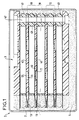
- FIGS. 2A-2B show a flat element 10 in more detail. It comprises a stack of elementary cells 100 electrically mounted in parallel. Each cell consists of a lithium anode 20, a separator 21 and a cathode 22.
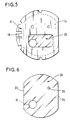
- the geometry of the lithium anode 20 appears in FIG. 6; it has a circular perimeter with two cut sides 23 and 24. It can consist of a lithium sheet or two lithium sheets embedded in an interposed nickel grid.
- the separator 21 has the shape of a disc, and it is preferably formed of two superimposed layers: a mechanically resistant layer of glass fabric, and a microporous layer constituted by a felt of glass fibers.
- the cathode 22 has a shape analogous to that of the anode 20; it consists of an electroformed nickel grid 25, the faces of which are covered with acetylene black bonded with polytetrafluoroethylene.
- anodes and the cathodes are pierced with orifices to allow the passage of an axis 30 associated with a locking screw 31 and serving as a positive terminal.
- Metal spacers 32 resting on the grids 25 of the cathodes 22 ensure adequate spacing of these cathodes and their electrical connection.
- FIG. 6 shows the orifice 26 provided in the anode 20 for the passage of the axis 33 and the orifice 17 provided for the passage of the axis 30 and the spacers 32.
- the cathodes 22 include similar orifices.
- the elementary cells 100 thus connected are enclosed in a housing made of insulating material formed by a bottom 41, a cover 42 and a spacer 43 forming the side wall.
- the material of the housing is preferably chosen from fluoropolymers, melamine.
- Figure 3 shows a top view of a bottom 41
- Figure 4 shows a top view of a spacer 43, the bottom 41 the spacer 43 and the cover 42, having respectively facing holes 44, 45 and 46 (Fig 2B) defining a well 47 for supplying electrolyte common to all the elements 10.
- Each spacer further comprises very fine channels 48 and 49 (FIG. 4) intended to allow the transfer of the electrolyte from the common well 47 to the elementary electrochemical cells 100.
- These channels have a small section and a length such that the quantity of electrolyte that they can retain is very weak and starts to boil very quickly after the generator is primed. As soon as bubbles appear, the electrolyte stream contained in the channel is broken and the leakage current disappears.
- the channels are inclined relative to the plane of the electrodes for reasons of ease of machining.
- the diameter of a channel is 1 mm, and its length 20 mm.
- the temperature rise in the channels is of the order of 4 ° C per second after the generator is primed.
- the boiling point of the electrolyte being close to 80 ° C under 1 atmosphere, it only takes about 20 seconds for the boiling of the electrolyte in the channels and the breaking of the leakage currents.
- the quantity of electrolyte in the reservoir is chosen so that the common well 47 always contains a certain quantity of electrolyte in reserve to avoid drying of the electrodes; the electrolyte thus transferred into the elements by the channels 48, 49 very quickly start to boil again and as soon as bubbles appear, the leakage currents are interrupted.
- the terminals of the element 10 are constituted by nickel plates 11 and 12 disposed respectively against the bottom 41 and the cover 42 of the element 10.
- FIG. 5 shows in view of above a plate 11 of generally circular shape with a cutaway 14.
- the connection 13 between two adjacent elements is made at the level of a tongue 15.
- the calories dissipated during the discharge are evacuated to the thermally conductive resin 4.
- the thermally conductive resin 4 For example, during a 10-minute discharge, there is a dissipation of 135,000 joules.
- the temperature of the cell rises only by 50 ° C, whereas it would exceed 150 ° C without such an arrangement with the risks of explosion which would result therefrom .
Landscapes
- Chemical & Material Sciences (AREA)
- Chemical Kinetics & Catalysis (AREA)
- Electrochemistry (AREA)
- General Chemical & Material Sciences (AREA)
- Engineering & Computer Science (AREA)
- Manufacturing & Machinery (AREA)
- Primary Cells (AREA)
- Secondary Cells (AREA)
- Hybrid Cells (AREA)
Claims (3)
- Aktivierbaren elektrochemischen Generator, der eine Vielzahl von Lithium/Oxyhalogenid-Paaren verwendet, mit einem Elektrolyttank, der mit einem elektrochemischen Block über Aktiviermittel in Verbindung gebracht werden kann, wobei der elektrochemische Block einen Stapel von flachen, elektrisch in Reihe geschalteten Elementen aufweist und jedes flache Element aus mehreren Elementarzellen besteht, die elektrisch parallelgeschaltet sind über innere Metallstäbe, auf denen die Elektroden mit Zwischenstücken aufgesteckt sind, dadurch gekennzeichnet, daß jedes flache Element (10) in einem dichten Isoliergehäuse eingeschlossen ist, das aus einem Boden (41), einem Deckel (42) und einem Zwischenstück (43) besteht, das die Seitenwand darstellt, wobei der Boden eines Gehäuses den Deckel des nächstliegenden Gehäuses bildet, wobei die Zwischenstücke, der Boden und der Deckel einander entsprechende Öffnungen (45, 44, 46) aufweisen, die einen gemeinsamen Brunnen (47) für die Zuführung von Elektrolyt orthogonal zur Einheit der Elemente bilden, wobei die Zwischenstücke weiter Kanäle (48, 49) für die Übertragung von Elektrolyt vom Speisebrunnen zu jedem Element (10) aufweisen und die Klemmen jedes Elements aus zwei Metallplatten (11, 12) bestehen, die gegen den Boden bzw. den Deckel des betreffenden Gehäuses anliegen, wobei Ränder aus dem Gehäuse vorstehen, um die elektrische Reihenschaltung zu ermöglichen, und daß die Einheit der Gehäuse und der daraus hervorstehenden Ränder der Metallplatten (11, 12) in ein wärmeleitendes Harz (4) getaucht ist.
- Elektrochemischer Generator nach Anspruch 1, dadurch gekennzeichnet, daß jeder in einem Zwischenstück vorhandene Kanal (48, 49) zur Übertragung von Elektrolyt einen geringen Durchmesser und eine große Länge aufweist, wobei die Abmessungen so gewählt sind, daß bei der Aktivierung die geringe Menge Elektrolyt, die darin enthalten ist, sehr schnell zum Sieden kommt.
- Elektrochemischer Generator nach einem der Ansprüche 1 und 2, dadurch gekennzeichnet, daß die Menge des im Elektrolyttank enthaltenen Elektrolyten so gewählt ist, daß während der ganzen Entladung Elektrolyt im Speisebrunnen (47) bleibt.
Applications Claiming Priority (2)
| Application Number | Priority Date | Filing Date | Title |
|---|---|---|---|
| FR8713437 | 1987-09-29 | ||
| FR8713437A FR2621175B1 (fr) | 1987-09-29 | 1987-09-29 | Generateur electrochimique amorcable mettant en oeuvre des couples lithium/oxyhalogenure |
Publications (3)
| Publication Number | Publication Date |
|---|---|
| EP0310075A2 EP0310075A2 (de) | 1989-04-05 |
| EP0310075A3 EP0310075A3 (de) | 1991-03-27 |
| EP0310075B1 true EP0310075B1 (de) | 1993-03-10 |
Family
ID=9355321
Family Applications (1)
| Application Number | Title | Priority Date | Filing Date |
|---|---|---|---|
| EP19880116089 Expired - Lifetime EP0310075B1 (de) | 1987-09-29 | 1988-09-29 | Aktivierbarer elektrochemischer Lithium-Oxyhalogenid-Generator |
Country Status (5)
| Country | Link |
|---|---|
| US (1) | US4830936A (de) |
| EP (1) | EP0310075B1 (de) |
| JP (1) | JPH01109667A (de) |
| DE (1) | DE3879068T2 (de) |
| FR (1) | FR2621175B1 (de) |
Families Citing this family (22)
| Publication number | Priority date | Publication date | Assignee | Title |
|---|---|---|---|---|
| US5227264A (en) * | 1991-02-14 | 1993-07-13 | Hydro-Quebec | Device for packaging a lithium battery |
| US5304435A (en) * | 1992-08-07 | 1994-04-19 | Globe-Union Inc. | Pressure vessel construction for a metal oxide-hydrogen battery |
| US5368956A (en) * | 1993-02-08 | 1994-11-29 | Globe-Union, Inc. | Multiple cell flat pack battery and short protection therefor |
| US6120930A (en) * | 1997-07-25 | 2000-09-19 | 3M Innovative Properties Corporation | Rechargeable thin-film electrochemical generator |
| US6087036A (en) * | 1997-07-25 | 2000-07-11 | 3M Innovative Properties Company | Thermal management system and method for a solid-state energy storing device |
| US6146778A (en) * | 1997-07-25 | 2000-11-14 | 3M Innovative Properties Company | Solid-state energy storage module employing integrated interconnect board |
| US6117584A (en) * | 1997-07-25 | 2000-09-12 | 3M Innovative Properties Company | Thermal conductor for high-energy electrochemical cells |
| KR100255358B1 (ko) * | 1997-12-27 | 2000-05-01 | 배문한 | 쌍극전지 |
| US6187471B1 (en) | 1998-07-14 | 2001-02-13 | Zentek Corporation | Bimodal battery |
| US6337154B1 (en) | 1999-09-24 | 2002-01-08 | Electrofuel Inc. | Battery box with a metal plastic laminate end |
| US6296967B1 (en) | 1999-09-24 | 2001-10-02 | Electrofuel Inc. | Lithium battery structure incorporating lithium pouch cells |
| CA2439744C (en) * | 2002-09-04 | 2009-10-13 | National Research Council Of Canada | A high volumetric efficiency electrochemical cell design for treatment of low concentrations of contaminants in low conductivity water |
| US20040159184A1 (en) * | 2003-02-19 | 2004-08-19 | General Electric Company | Non-corrosive treatment to enhance pressurized and non-pressurized pulverized coal combustion |
| US20050026014A1 (en) * | 2003-07-31 | 2005-02-03 | Michael Fogaing | Polymer batteries having thermal exchange apparatus |
| JP2009504790A (ja) * | 2005-08-22 | 2009-02-05 | トランスファート プラス エスイーシー | スルホニルイミド及びその誘導体を調製するための方法 |
| JP4438784B2 (ja) * | 2006-08-25 | 2010-03-24 | トヨタ自動車株式会社 | 蓄電装置 |
| FR2964799B1 (fr) * | 2010-09-09 | 2013-04-05 | Peugeot Citroen Automobiles Sa | Batterie comprenant une plaque d'equilibrage de temperature |
| DE102010051010A1 (de) | 2010-11-10 | 2012-05-10 | Daimler Ag | Vorrichtung zur Speicherung von elektrischer Energie |
| CN103346335B (zh) * | 2013-06-07 | 2015-08-26 | 苏州金科发锂电池有限公司 | 智能多配一次性特种锂电池组 |
| DE102013220171A1 (de) * | 2013-10-07 | 2015-04-09 | Robert Bosch Gmbh | Batteriezelle und Herstellungsverfahren für diese, sowie Batterie |
| FR3106939B1 (fr) * | 2020-01-31 | 2022-01-14 | Accumulateurs Fixes | Element electrochimique de type pochette de format semi-circulaire |
| CN114243193B (zh) * | 2021-11-29 | 2024-07-02 | 歌尔科技有限公司 | 盒盖开合装置及电子产品 |
Family Cites Families (14)
| Publication number | Priority date | Publication date | Assignee | Title |
|---|---|---|---|---|
| GB719335A (en) * | 1952-03-26 | 1954-12-01 | Oldham & Son Ltd | Improvements in or relating to electric batteries |
| NL107901C (de) * | 1953-11-04 | |||
| US3196049A (en) * | 1961-06-01 | 1965-07-20 | Gen Motors Corp | Reserve type battery |
| SE319224B (de) * | 1966-12-19 | 1970-01-12 | Asea Ab | |
| FR1534907A (fr) * | 1967-06-22 | 1968-08-02 | Wonder Piles | Perfectionnements aux piles, notamment du type amorçable, et à leurs procédés de fabrication |
| FR2195853A1 (de) * | 1972-08-10 | 1974-03-08 | Moritz Jean | |
| US4148974A (en) * | 1976-12-09 | 1979-04-10 | Honeywell Inc. | Stable electrolyte for reserve electrochemical cells |
| US4198474A (en) * | 1979-02-26 | 1980-04-15 | The United States Of America As Represented By The Secretary Of The Navy | Seawater battery |
| US4283470A (en) * | 1980-06-13 | 1981-08-11 | Gte Products Corporation | Anode structure for an electrochemical cell |
| FR2539917B1 (fr) * | 1983-01-21 | 1986-03-21 | Accumulateurs Fixes | Generateur electrochimique de type bouton |
| US4471035A (en) * | 1983-05-13 | 1984-09-11 | Gte Communications Products Corporation | Electrochemical battery |
| US4535038A (en) * | 1984-05-21 | 1985-08-13 | Gte Communications Products Corporation | Structure for electrochemical batteries |
| JPS61110974A (ja) * | 1984-11-06 | 1986-05-29 | Yuasa Battery Co Ltd | 高温電池装置 |
| US4752540A (en) * | 1987-06-05 | 1988-06-21 | Honeywell Inc. | Polymeric enclosures for non-aqueous active metal cells |
-
1987
- 1987-09-29 FR FR8713437A patent/FR2621175B1/fr not_active Expired
-
1988
- 1988-06-10 US US07/204,758 patent/US4830936A/en not_active Expired - Fee Related
- 1988-09-28 JP JP63243765A patent/JPH01109667A/ja active Pending
- 1988-09-29 EP EP19880116089 patent/EP0310075B1/de not_active Expired - Lifetime
- 1988-09-29 DE DE8888116089T patent/DE3879068T2/de not_active Expired - Fee Related
Also Published As
| Publication number | Publication date |
|---|---|
| EP0310075A3 (de) | 1991-03-27 |
| EP0310075A2 (de) | 1989-04-05 |
| DE3879068D1 (de) | 1993-04-15 |
| FR2621175B1 (fr) | 1989-12-01 |
| US4830936A (en) | 1989-05-16 |
| FR2621175A1 (fr) | 1989-03-31 |
| DE3879068T2 (de) | 1993-06-24 |
| JPH01109667A (ja) | 1989-04-26 |
Similar Documents
| Publication | Publication Date | Title |
|---|---|---|
| EP0310075A2 (de) | Aktivierbarer elektrochemischer Lithium-Oxyhalogenid-Generator | |
| EP2073300B1 (de) | Bipolare Batterie mit verbesserter Abdichtung zwischen den Platten | |
| EP0402265B1 (de) | Verschlossene Bleiakkumulatorbatterie mit bipolaren Elektroden | |
| EP0271086B1 (de) | Elektrochemischer Generator mit Lithiumanode und flüssiger Kathode | |
| EP2093820B1 (de) | Elektrische Verbindung für Stromakkumulator | |
| FR2504735A1 (fr) | Dispositif de contact pour pile galvanique | |
| EP0025663A2 (de) | Batteriesysteme mit bipolaren Elektroden | |
| FR2579025A1 (fr) | Pile a combustible a separation amelioree | |
| EP3360176A1 (de) | Modul zur speicherung von elektrischer energie und verfahren zur herstellung davon | |
| CA1277368C (fr) | Amenagements aux structures des piles a combustibles | |
| EP3903363B1 (de) | Elektrisches batteriemodul und batterie mit mindestens einem solchen modul | |
| JPH0586633B2 (de) | ||
| FR2683094A1 (fr) | Batterie a oxyde metallique-hydrogene ayant des modules s'etendant longitudinalement par rapport a une receptacle sous pression. | |
| FR2489603A1 (fr) | Element accumulateur electrochimique | |
| JPS5928026B2 (ja) | 円筒形電池 | |
| EP3381073A1 (de) | Zweipolige lithium-ionen-batterie | |
| EP0114667B1 (de) | Knopfförmiger elektrochemischer Generator | |
| FR2861896A1 (fr) | Structure pour pile a combustible | |
| EP0053163A1 (de) | Elektrochemische zelle. | |
| FR2683097A1 (fr) | Batterie a oxyde metallique-hydrogene ayant des modules d'elements scelles avec retenue de l'electrolyte et mise a l'air de l'hydrogene. | |
| FR2766971A1 (fr) | Procede de fabrication de piles et de batteries bipolaires a retention d'electrolyte ameliorees | |
| FR2894720A1 (fr) | Pile a combustible avec collecteurs de courant integres a l'electrolyte solide et procede de fabrication d'une telle pile a combustible. | |
| FR2468212A1 (fr) | Perfectionnements apportes aux generateurs electrochimiques | |
| FR2677812A1 (fr) | Accumulateur alcalin a electrodes bipolaires et procedes de fabrication. | |
| GB2060983A (en) | Battery systems employing bipolar electrodes |
Legal Events
| Date | Code | Title | Description |
|---|---|---|---|
| PUAI | Public reference made under article 153(3) epc to a published international application that has entered the european phase |
Free format text: ORIGINAL CODE: 0009012 |
|
| AK | Designated contracting states |
Kind code of ref document: A2 Designated state(s): DE FR GB |
|
| PUAL | Search report despatched |
Free format text: ORIGINAL CODE: 0009013 |
|
| AK | Designated contracting states |
Kind code of ref document: A3 Designated state(s): DE FR GB |
|
| 17P | Request for examination filed |
Effective date: 19910924 |
|
| RAP1 | Party data changed (applicant data changed or rights of an application transferred) |
Owner name: SAFT (INSCRITE AU REGISTRE DU COMMERCE SOUS LE NUM |
|
| 17Q | First examination report despatched |
Effective date: 19920415 |
|
| GRAA | (expected) grant |
Free format text: ORIGINAL CODE: 0009210 |
|
| AK | Designated contracting states |
Kind code of ref document: B1 Designated state(s): DE FR GB |
|
| REF | Corresponds to: |
Ref document number: 3879068 Country of ref document: DE Date of ref document: 19930415 |
|
| GBT | Gb: translation of ep patent filed (gb section 77(6)(a)/1977) |
Effective date: 19930324 |
|
| PGFP | Annual fee paid to national office [announced via postgrant information from national office to epo] |
Ref country code: GB Payment date: 19930825 Year of fee payment: 6 |
|
| PGFP | Annual fee paid to national office [announced via postgrant information from national office to epo] |
Ref country code: DE Payment date: 19930922 Year of fee payment: 6 |
|
| PGFP | Annual fee paid to national office [announced via postgrant information from national office to epo] |
Ref country code: FR Payment date: 19930930 Year of fee payment: 6 |
|
| PLBE | No opposition filed within time limit |
Free format text: ORIGINAL CODE: 0009261 |
|
| STAA | Information on the status of an ep patent application or granted ep patent |
Free format text: STATUS: NO OPPOSITION FILED WITHIN TIME LIMIT |
|
| 26N | No opposition filed | ||
| PG25 | Lapsed in a contracting state [announced via postgrant information from national office to epo] |
Ref country code: GB Effective date: 19940929 |
|
| GBPC | Gb: european patent ceased through non-payment of renewal fee |
Effective date: 19940929 |
|
| PG25 | Lapsed in a contracting state [announced via postgrant information from national office to epo] |
Ref country code: FR Effective date: 19950531 |
|
| PG25 | Lapsed in a contracting state [announced via postgrant information from national office to epo] |
Ref country code: DE Effective date: 19950601 |
|
| REG | Reference to a national code |
Ref country code: FR Ref legal event code: ST |