EP0310676A1 - Flüssigkristallderivate von 2,5-disubstituierten pyridinen als komponenten von flüssigkristallmaterialien und flüssigkristallmaterial - Google Patents
Flüssigkristallderivate von 2,5-disubstituierten pyridinen als komponenten von flüssigkristallmaterialien und flüssigkristallmaterial Download PDFInfo
- Publication number
- EP0310676A1 EP0310676A1 EP88903125A EP88903125A EP0310676A1 EP 0310676 A1 EP0310676 A1 EP 0310676A1 EP 88903125 A EP88903125 A EP 88903125A EP 88903125 A EP88903125 A EP 88903125A EP 0310676 A1 EP0310676 A1 EP 0310676A1
- Authority
- EP
- European Patent Office
- Prior art keywords
- trans
- formula
- liquid
- pyridine
- compounds
- Prior art date
- Legal status (The legal status is an assumption and is not a legal conclusion. Google has not performed a legal analysis and makes no representation as to the accuracy of the status listed.)
- Withdrawn
Links
Classifications
-
- C—CHEMISTRY; METALLURGY
- C07—ORGANIC CHEMISTRY
- C07D—HETEROCYCLIC COMPOUNDS
- C07D213/00—Heterocyclic compounds containing six-membered rings, not condensed with other rings, with one nitrogen atom as the only ring hetero atom and three or more double bonds between ring members or between ring members and non-ring members
- C07D213/02—Heterocyclic compounds containing six-membered rings, not condensed with other rings, with one nitrogen atom as the only ring hetero atom and three or more double bonds between ring members or between ring members and non-ring members having three double bonds between ring members or between ring members and non-ring members
- C07D213/04—Heterocyclic compounds containing six-membered rings, not condensed with other rings, with one nitrogen atom as the only ring hetero atom and three or more double bonds between ring members or between ring members and non-ring members having three double bonds between ring members or between ring members and non-ring members having no bond between the ring nitrogen atom and a non-ring member or having only hydrogen or carbon atoms directly attached to the ring nitrogen atom
- C07D213/24—Heterocyclic compounds containing six-membered rings, not condensed with other rings, with one nitrogen atom as the only ring hetero atom and three or more double bonds between ring members or between ring members and non-ring members having three double bonds between ring members or between ring members and non-ring members having no bond between the ring nitrogen atom and a non-ring member or having only hydrogen or carbon atoms directly attached to the ring nitrogen atom with substituted hydrocarbon radicals attached to ring carbon atoms
- C07D213/28—Radicals substituted by singly-bound oxygen or sulphur atoms
- C07D213/30—Oxygen atoms
-
- C—CHEMISTRY; METALLURGY
- C07—ORGANIC CHEMISTRY
- C07D—HETEROCYCLIC COMPOUNDS
- C07D213/00—Heterocyclic compounds containing six-membered rings, not condensed with other rings, with one nitrogen atom as the only ring hetero atom and three or more double bonds between ring members or between ring members and non-ring members
- C07D213/02—Heterocyclic compounds containing six-membered rings, not condensed with other rings, with one nitrogen atom as the only ring hetero atom and three or more double bonds between ring members or between ring members and non-ring members having three double bonds between ring members or between ring members and non-ring members
- C07D213/04—Heterocyclic compounds containing six-membered rings, not condensed with other rings, with one nitrogen atom as the only ring hetero atom and three or more double bonds between ring members or between ring members and non-ring members having three double bonds between ring members or between ring members and non-ring members having no bond between the ring nitrogen atom and a non-ring member or having only hydrogen or carbon atoms directly attached to the ring nitrogen atom
- C07D213/06—Heterocyclic compounds containing six-membered rings, not condensed with other rings, with one nitrogen atom as the only ring hetero atom and three or more double bonds between ring members or between ring members and non-ring members having three double bonds between ring members or between ring members and non-ring members having no bond between the ring nitrogen atom and a non-ring member or having only hydrogen or carbon atoms directly attached to the ring nitrogen atom containing only hydrogen and carbon atoms in addition to the ring nitrogen atom
-
- C—CHEMISTRY; METALLURGY
- C07—ORGANIC CHEMISTRY
- C07D—HETEROCYCLIC COMPOUNDS
- C07D213/00—Heterocyclic compounds containing six-membered rings, not condensed with other rings, with one nitrogen atom as the only ring hetero atom and three or more double bonds between ring members or between ring members and non-ring members
- C07D213/02—Heterocyclic compounds containing six-membered rings, not condensed with other rings, with one nitrogen atom as the only ring hetero atom and three or more double bonds between ring members or between ring members and non-ring members having three double bonds between ring members or between ring members and non-ring members
- C07D213/04—Heterocyclic compounds containing six-membered rings, not condensed with other rings, with one nitrogen atom as the only ring hetero atom and three or more double bonds between ring members or between ring members and non-ring members having three double bonds between ring members or between ring members and non-ring members having no bond between the ring nitrogen atom and a non-ring member or having only hydrogen or carbon atoms directly attached to the ring nitrogen atom
- C07D213/24—Heterocyclic compounds containing six-membered rings, not condensed with other rings, with one nitrogen atom as the only ring hetero atom and three or more double bonds between ring members or between ring members and non-ring members having three double bonds between ring members or between ring members and non-ring members having no bond between the ring nitrogen atom and a non-ring member or having only hydrogen or carbon atoms directly attached to the ring nitrogen atom with substituted hydrocarbon radicals attached to ring carbon atoms
- C07D213/26—Radicals substituted by halogen atoms or nitro radicals
-
- C—CHEMISTRY; METALLURGY
- C07—ORGANIC CHEMISTRY
- C07D—HETEROCYCLIC COMPOUNDS
- C07D213/00—Heterocyclic compounds containing six-membered rings, not condensed with other rings, with one nitrogen atom as the only ring hetero atom and three or more double bonds between ring members or between ring members and non-ring members
- C07D213/02—Heterocyclic compounds containing six-membered rings, not condensed with other rings, with one nitrogen atom as the only ring hetero atom and three or more double bonds between ring members or between ring members and non-ring members having three double bonds between ring members or between ring members and non-ring members
- C07D213/04—Heterocyclic compounds containing six-membered rings, not condensed with other rings, with one nitrogen atom as the only ring hetero atom and three or more double bonds between ring members or between ring members and non-ring members having three double bonds between ring members or between ring members and non-ring members having no bond between the ring nitrogen atom and a non-ring member or having only hydrogen or carbon atoms directly attached to the ring nitrogen atom
- C07D213/24—Heterocyclic compounds containing six-membered rings, not condensed with other rings, with one nitrogen atom as the only ring hetero atom and three or more double bonds between ring members or between ring members and non-ring members having three double bonds between ring members or between ring members and non-ring members having no bond between the ring nitrogen atom and a non-ring member or having only hydrogen or carbon atoms directly attached to the ring nitrogen atom with substituted hydrocarbon radicals attached to ring carbon atoms
- C07D213/36—Radicals substituted by singly-bound nitrogen atoms
- C07D213/38—Radicals substituted by singly-bound nitrogen atoms having only hydrogen or hydrocarbon radicals attached to the substituent nitrogen atom
-
- C—CHEMISTRY; METALLURGY
- C07—ORGANIC CHEMISTRY
- C07D—HETEROCYCLIC COMPOUNDS
- C07D213/00—Heterocyclic compounds containing six-membered rings, not condensed with other rings, with one nitrogen atom as the only ring hetero atom and three or more double bonds between ring members or between ring members and non-ring members
- C07D213/02—Heterocyclic compounds containing six-membered rings, not condensed with other rings, with one nitrogen atom as the only ring hetero atom and three or more double bonds between ring members or between ring members and non-ring members having three double bonds between ring members or between ring members and non-ring members
- C07D213/04—Heterocyclic compounds containing six-membered rings, not condensed with other rings, with one nitrogen atom as the only ring hetero atom and three or more double bonds between ring members or between ring members and non-ring members having three double bonds between ring members or between ring members and non-ring members having no bond between the ring nitrogen atom and a non-ring member or having only hydrogen or carbon atoms directly attached to the ring nitrogen atom
- C07D213/24—Heterocyclic compounds containing six-membered rings, not condensed with other rings, with one nitrogen atom as the only ring hetero atom and three or more double bonds between ring members or between ring members and non-ring members having three double bonds between ring members or between ring members and non-ring members having no bond between the ring nitrogen atom and a non-ring member or having only hydrogen or carbon atoms directly attached to the ring nitrogen atom with substituted hydrocarbon radicals attached to ring carbon atoms
- C07D213/54—Radicals substituted by carbon atoms having three bonds to hetero atoms with at the most one bond to halogen, e.g. ester or nitrile radicals
- C07D213/57—Nitriles
-
- C—CHEMISTRY; METALLURGY
- C07—ORGANIC CHEMISTRY
- C07D—HETEROCYCLIC COMPOUNDS
- C07D213/00—Heterocyclic compounds containing six-membered rings, not condensed with other rings, with one nitrogen atom as the only ring hetero atom and three or more double bonds between ring members or between ring members and non-ring members
- C07D213/02—Heterocyclic compounds containing six-membered rings, not condensed with other rings, with one nitrogen atom as the only ring hetero atom and three or more double bonds between ring members or between ring members and non-ring members having three double bonds between ring members or between ring members and non-ring members
- C07D213/04—Heterocyclic compounds containing six-membered rings, not condensed with other rings, with one nitrogen atom as the only ring hetero atom and three or more double bonds between ring members or between ring members and non-ring members having three double bonds between ring members or between ring members and non-ring members having no bond between the ring nitrogen atom and a non-ring member or having only hydrogen or carbon atoms directly attached to the ring nitrogen atom
- C07D213/60—Heterocyclic compounds containing six-membered rings, not condensed with other rings, with one nitrogen atom as the only ring hetero atom and three or more double bonds between ring members or between ring members and non-ring members having three double bonds between ring members or between ring members and non-ring members having no bond between the ring nitrogen atom and a non-ring member or having only hydrogen or carbon atoms directly attached to the ring nitrogen atom with hetero atoms or with carbon atoms having three bonds to hetero atoms with at the most one bond to halogen, e.g. ester or nitrile radicals, directly attached to ring carbon atoms
- C07D213/78—Carbon atoms having three bonds to hetero atoms, with at the most one bond to halogen, e.g. ester or nitrile radicals
- C07D213/84—Nitriles
-
- C—CHEMISTRY; METALLURGY
- C07—ORGANIC CHEMISTRY
- C07D—HETEROCYCLIC COMPOUNDS
- C07D239/00—Heterocyclic compounds containing 1,3-diazine or hydrogenated 1,3-diazine rings
- C07D239/02—Heterocyclic compounds containing 1,3-diazine or hydrogenated 1,3-diazine rings not condensed with other rings
- C07D239/24—Heterocyclic compounds containing 1,3-diazine or hydrogenated 1,3-diazine rings not condensed with other rings having three or more double bonds between ring members or between ring members and non-ring members
- C07D239/26—Heterocyclic compounds containing 1,3-diazine or hydrogenated 1,3-diazine rings not condensed with other rings having three or more double bonds between ring members or between ring members and non-ring members with only hydrogen atoms, hydrocarbon or substituted hydrocarbon radicals, directly attached to ring carbon atoms
-
- C—CHEMISTRY; METALLURGY
- C07—ORGANIC CHEMISTRY
- C07D—HETEROCYCLIC COMPOUNDS
- C07D319/00—Heterocyclic compounds containing six-membered rings having two oxygen atoms as the only ring hetero atoms
- C07D319/04—1,3-Dioxanes; Hydrogenated 1,3-dioxanes
- C07D319/06—1,3-Dioxanes; Hydrogenated 1,3-dioxanes not condensed with other rings
-
- C—CHEMISTRY; METALLURGY
- C09—DYES; PAINTS; POLISHES; NATURAL RESINS; ADHESIVES; COMPOSITIONS NOT OTHERWISE PROVIDED FOR; APPLICATIONS OF MATERIALS NOT OTHERWISE PROVIDED FOR
- C09K—MATERIALS FOR MISCELLANEOUS APPLICATIONS, NOT PROVIDED FOR ELSEWHERE
- C09K19/00—Liquid crystal materials
- C09K19/04—Liquid crystal materials characterised by the chemical structure of the liquid crystal components, e.g. by a specific unit
- C09K19/06—Non-steroidal liquid crystal compounds
- C09K19/34—Non-steroidal liquid crystal compounds containing at least one heterocyclic ring
- C09K19/3441—Non-steroidal liquid crystal compounds containing at least one heterocyclic ring having nitrogen as hetero atom
- C09K19/3444—Non-steroidal liquid crystal compounds containing at least one heterocyclic ring having nitrogen as hetero atom the heterocyclic ring being a six-membered aromatic ring containing one nitrogen atom, e.g. pyridine
Definitions
- the present invention relates to new organic compounds which have liquid-crystalline properties, and in particular relates to liquid-crystalline derivatives of 2,5-disubstituted pyridine as a component for a liquid-crystalline material and a liquid-crystalline material which can be used in electro-optical devices.
- the proposed invention will be widely used in electronics for alphanumeric information display, for example in electronic watches, micro-calculators.
- Liquid-crystalline compounds -trans-4-alkyl- (4-cyanophenyl) cyclohexanes of the formula are currently known wherein the alkyl part contains 3 to 8 carbon atoms, which are used as components of the liquid-crystalline materials, (DE-C 2636684).
- Liquid-crystalline compounds 2- (4-cyanophenyl) -5- (4-alkylphenyl) pyridines of the formula are known wherein the alkyl part contains 4 to 8 carbon atoms (SU, A, 713153), and 6- (4-alkylphenyl) -3-cyanopyridines of the formula represent in which the alkyl part contains 4 to 8 carbon atoms (SU, A, 666797) as components of the liquid-crystalline materials.
- Liquid-crystalline compounds, 5-alkyl-2- (4-cyanophenyl) pyridines of the formula are known in which the alkyl part contains 2 to 7 carbon atoms, (SU, A, 675800) as components of the liquid-crystalline materials.
- these compounds In addition to high anisotropies of the dielectric constant, these compounds have low clearing points and narrow areas of the nematic phase. The properties mentioned above prevent the use of the liquid-crystalline materials containing these compounds in the wide working temperature range.
- the invention has for its object new rivers to develop sigcrystalline derivatives of 2,5-disubstituted pyridine as a component of a liquid-crystalline material which have low values of the rotational viscosity, the temperature of the transition "smectic-nematic", high values of the anisotropy of the dielectric constant of the clearing point, and to develop a liquid-crystalline material, which has a wide range of the nematic phase and has low values of the threshold voltage and the saturation voltage with the twist effect and short switching and switching times.
- liquid crystal derivatives of 2,5-disubstituted pyridine of the general formula which are the following compounds according to the invention: wherein R 1 , R 2 are alkyl having 1 to 12 carbon atoms.
- a liquid-crystalline material is also proposed, containing at least two liquid-crystalline components, in which, according to the invention, at least one of the liquid-crystalline components mentioned serves a liquid-crystalline derivative of 2,5-diaubstituted pyridine of the formula I.
- liquid-crystalline material contains 1 to 75% by mass of liquid-crystalline derivative of 2,5-disubstituted pyridine of the form I-XXVIII.
- the liquid crystalline material with the specified mixing ratio has optimal properties.
- the according to the invention exhibit a wide range of on that make this possible the development of liquid crystalline materials to be used in microcalculators, in clocks, electro-optical devices for external use and in devices with solar battery supply
- 2-Methyl-5- (trans-4-alkylcyclohexyl) pyridines are prepared by reacting 2-methyl-5-lithium-lithium with 4-alkyl-cyclohexanones with subsequent dehydration and hydrogenation. The latter are converted into 2-zyano-5- (trans-4-alkylcyclohexyl) pyridines according to the standardized processes.
- Compounds of formula XXII are prepared by cyclizing the sodium salt of hydroxysiethylene methyl 4 - (4-alkylcyclohexyl) ketone with cyanazetamide and then converting the 6- (4-alkylcyclohexyl) -3-cyanopyridin-2-ones produced to 2 -Chlor-3-zyano-6- (4-alkylcyclohexyl) pyridines in which the halogen is reduced by catalytic hydrogenation.
- the compounds of the formula -XXVI-XXVIII are prepared from 1-dimethylamino-2- (4-alkylphenyl) -4- (4-alkoxy-3-fluorobenzoyl) butadiene-1,3, (for XXVI) or from 1-dimethyl amino-2- (4-alkoxy-3-fluorophenyl) -4- (4-alkoxy- or 4-alkyl-benzoyl) butadiene-1,3 (for XXVII-XXVIII) by successive conversion to substituted 2-methoxy-2H -pyrans, pyrylium salts and pyridine derivatives (XXVI-XXVIII).
- the liquid-crystalline material according to the invention is produced by mixing at least two liquid-crystalline components, one of which is, according to the invention, the derivative of 2,5-disubstituted pyridine of the formula I in an amount of 1 to 75% by mass.
- the amount of components and the mixing ratio are taken according to the specified properties of the liquid crystalline material.
- the substance 1.4.a is in 65% yield by converting the compound 1.3 a into a N ⁇ ⁇ 0 derivative by boiling in the presence of hydrogen peroxide in acetic acid and subsequent rearrangement under the action of acetic anhydride in 2-acetyloxymethyl-5- (cis / trans -4-hexyl-cyclohexyl) pyridine prepared, which is saponified without isolation after distilling off the excess acetic anhydride with 10% aqueous alcoholic alkali.
- other compounds 1.4 bf are prepared, the formulas and properties of which are given in Table 1.
- the yield of other homologues 1.4 bf is 60 to 70%
- the structure of the compounds II is verified by magnetic nuclear magnetic resonance spectroscopy.
- the spectrum of compounds II is a three-spin system ABX ( ⁇ ppm CCl 4 ): 8.24 (H 4 ) 8.34 (H 3 ), 9.06 (H 6 )
- the mixture of the fifth and the seventh homolog was used, which has a wide temperature range of the nematic phase. It should also be borne in mind that the regularity of the change in properties is usually known for members of the homologous series with the sufficient degree of accuracy, i.e. according to the properties of the mixture of the fifth and seventh homologues one can deduce the properties of the terms of the whole homologous series.
- U threshold is 1.2 V and U satur - 1.55 V.
- the temperature range of the nematic phase is +4 to +68 ° C.
- Examples 2 to 24 show that the compounds of Formula II will secure a wide range of nematic phase and low control voltages for liquid crystalline materials. These materials are expediently to be used in electro-optical devices with solar battery supply.
- Rotational viscosity coefficients ⁇ 1 for homologues 2- (4-cyanophenyl) -5- (4-alkylphenyl) pyridines and 2- (4 - cyanophenyl) -5- (trans-4-alkylcyclohexyl) pyridines are calculated from values of corresponding binary mixtures B and D determined.
- Mixture B 10% by mass of 2- (4-cyanophenyl) -5- (4-alkylphenyl) pyridine and 90% by mass of mixture .A.
- Mixture D 10 mass% of 2- (4-cyanophenyl) -5- (trans-4-alkylcyclohexyl) pyridine and 90 mass% of mixture A.
- Mixture A 40 mol.% Of trans-4-pentyl- (4-cyanophenyl ) - cyclohexane and 60 mol.% trans-4-heptyl- (4-cyanophenyl) - cyclohexane
- X 1 1 P at 25 ° C.
- Table 9 shows that clearing points T NI for new compounds of the formula III ad are compared with those of the known compounds.
- the new compounds 2- (4-cyanophenyl) -5- (trans-4-alkylcyclohexyl) pyridines have significantly smaller coefficients of rotational viscosity than the known compounds 2- (4-cyanophenyl) -5- (alkylphenyl) - pyridine on.
- 2- (4-cyanophenyl) -5- (trans-4-butylcyclohexyl) pyridine has a coefficient ⁇ 1 of 17.33 P
- 2- (4-cyanophenyl) -5- (4-butylphenyl) pyridine a coefficient ⁇ 1 of 41 P at 25 ° C.
- Table 10 below shows compositions of the liquid-crystalline material containing the compounds of the formula III ad and properties thereof.
- L-Acryloyl-4 (trans-4-alkylcyclohexyl) benzenes (33.3 e, f) are produced analogously.
- Table 11 gives the formula and the properties of the compounds IV (ad) and phase transition temperatures compared to 4- (trans-4-alkylcyclohexyl) -4 '- (trans-4-alkylcyclohexyl) biphenylene (SU, A, 1055336 ) at.
- compositions and properties of the liquid crystalline materials including new pyridine derivatives of the formula IV, are shown in Table 12.
- liquid crystalline materials given in Table 12 show that the use of new pyridine derivatives of the formula IV as a component of the liquid crystalline materials makes it possible to develop liquid crystalline materials with high upper limits and low lower limits of the temperature range of the nematic phase, which are for use in external electro-optical devices are suitable.
- a solution of 0.69 g (0.01 mol) of NaNC 2 is added dropwise to a suspension of 3.22 g (0.01 mol) of compound VI.a in 30 ml of HBF 4 at a temperature between 0 and 5 ° C in 3 ml of water slowly with stirring. The mixture is stirred for a further 1 hour at this temperature and then the reaction mixture is filtered, washed with 10 ml of cooled ethyl alcohol, dried on the filter and washed with absolute ether. The dry precipitate is introduced into a one-necked flask with 100 ml of absolute toluene therein and the mixture is boiled within 1 hour.
- Table 16 shows that the compounds VII af contain no smectic mesophase and the temperature range of the nematic phase ⁇ T N for the new compounds VII af is wider than ⁇ T N for the known compounds.
- Table 17 shows the composition and properties of liquid-crystalline materials which contain new pyridine derivatives of the formula VII.
- Example 64 Preparation of 2- (4-alkyloxy-3-fluorophenyl) -5- (trans-4-alkylcyclohexyl) pyridines (XV) 64.1. 2- / 4-heptyloxy-3-fluorophenyl) -5- (trans-4-ethylcyclohexyl) pyridine (XVa)
- T SN 97.0 ° C
- T NI 116.0 ° C (from ethanol). Found in%: C 82.50; H 10.00. C25H36N2 Calculated in%: C 82.36; H 9.95.
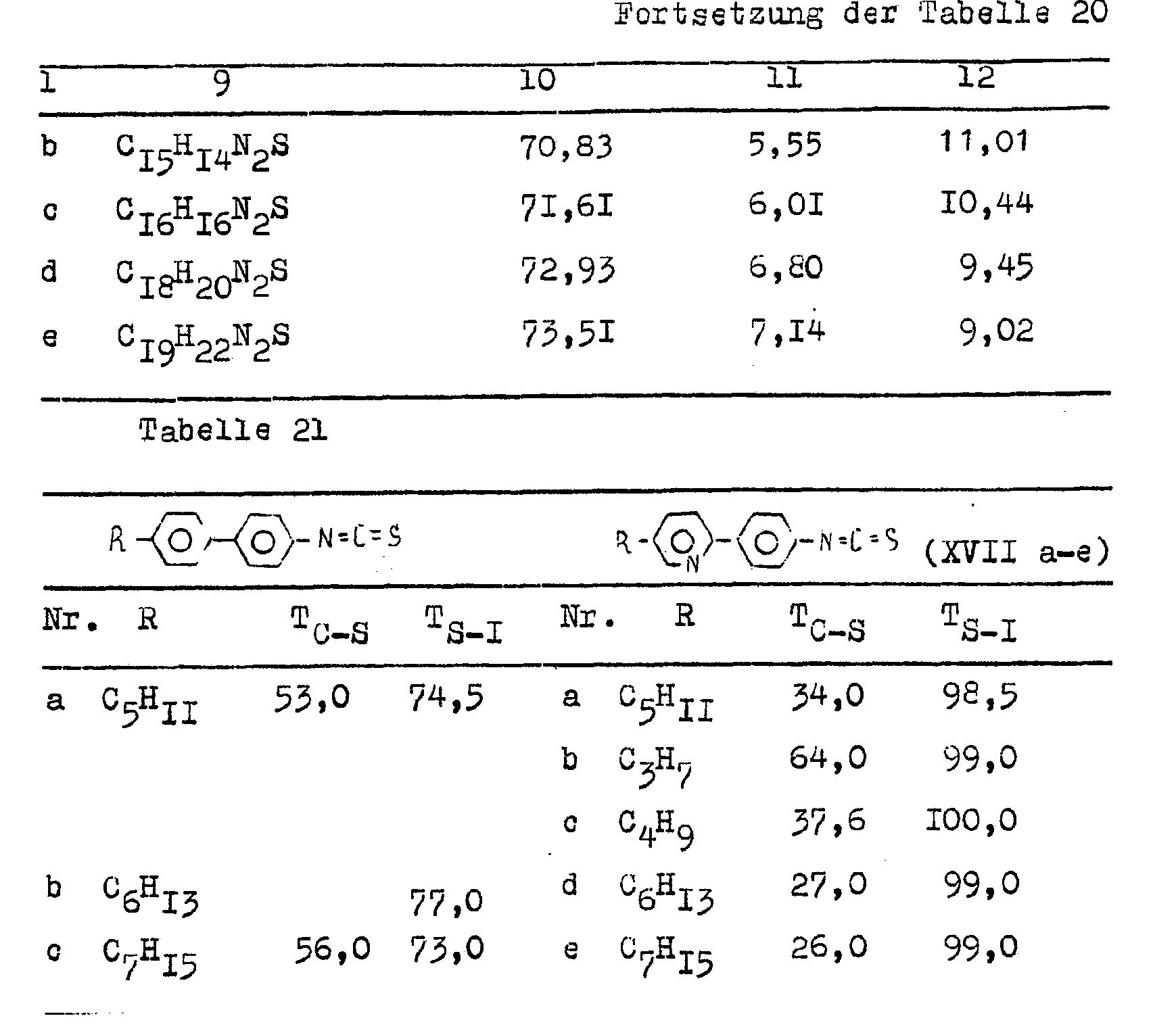
- Phase transition temperatures of the known compounds 4-alkyl-4'-isothiozyanobiphenyle and the new compounds 5-alkyl-2- (4-isothiozyanophenyl) pyridine are compared in Table 21.
- Table 21 shows that the new compounds have significantly higher clearing points than known compounds 4-alkyl-4'-isothiocyanobiphenylene.
- Table 22 shows the composition and properties of the liquid-crystalline materials which contain new derivatives of 2,5-disubstituted pyridine of the formula XVII.
- reaction mixture is dissolved in 100 ml of water, filtered through a glass filter and the filtrate is acidified with 10% hydrochloric acid until a pH of about 6 is reached.
- the precipitate is filtered off, with water and - Washed acetone, air dried. 4 g (99%) 77.1 are isolated. a and leads to the next stage without recrystallization and analysis.
- the substances are sent to the next stage without analysis.
- phase transition temperatures and elemental analysis of the compounds of the formula XIX a-e are shown in Table 23.
- phase transition temperatures of the known compounds 4-alkyl-4 '- (2-E-cyanovinyl) biphenyls and the new compounds of the formula XIX are compared in Table 24.
- Table 25 shows the composition and properties of the liquid-crystalline materials which contain the new pyridine derivatives of the formula XIX (ae).
- Table 25 shows that the use of the new pyridine derivatives of the formula XIX as components of the liquid-crystalline materials makes it possible to produce liquid-crystalline materials with a wide temperature range of the nematic phase and high clearing points.
- Example 85 Preparation of 2- [4 (2-E-cyanovinyl) pheny] -5- (trans-4-alkylcyclohexyl) pyridines (XX) 85.1.
- the compound 85.1.a is analogous to 77.1.a from 25.5. b received and passed to the next stage without purification.
- trans-4-hexyl-4-acetylcyclohexane (87.1.a) is produced in 79% yield from trans-4-hexylcyclohexane carboxylic acid chloride and organomagnesium organomagnesium derivative according to the generally accepted methodology.
- Torr n D 25 1.4590.
- the trans - cis ratio at 87.la is 7: 1.
- mixtures of these substances are to be used because the individual compounds of the bent compounds and the compounds of the formula XXII have substantial nematic ranges which are not sufficient for measuring the electroopric parameters.
- the mixtures of the third, fifth and sixth homologues provide a wide temperature range for the mesophase and are therefore suitable for comparison purposes. It should also be borne in mind that the regularity of the changes in properties in members of the homologous series is usually known with the sufficient degree of accuracy, that is, the properties of the mixture of the third, fifth and sixth homologues can be used to assess the properties of members of the entire homologous series .
- Table 28 shows the compositions and properties of liquid-crystalline materials which contain new pyridine derivatives of the formula XXII.
- the compounds according to the invention have a wide range of properties which make it possible to use these compounds in the development of liquid fall-off materials.
- These liquid-crystalline materials can be used in various electro-optical devices with a static and dynamic mode of operation, for example in clocks, microcalculators, television shields, in devices with solar battery supply and in devices for external use, etc. find their application.
Landscapes
- Chemical & Material Sciences (AREA)
- Organic Chemistry (AREA)
- Crystallography & Structural Chemistry (AREA)
- Engineering & Computer Science (AREA)
- Materials Engineering (AREA)
- Liquid Crystal Substances (AREA)
- Pyridine Compounds (AREA)
Abstract
Flüssigkristalline Derivate von 2,5-disubstituiertem Pyridin weisen die allgemeine Formel
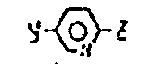



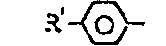
steht renn Y R2 ist, Z für



steht, nenn Y CN ist, Z für R'

steht nenn Y
ist, Z für NC - CH
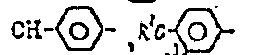
steht, wenn y

ist Z für

steht, R1, R2 eine Alkylgruppe mit 1 bis 12 Kohlenstoffatomen darstellen, R3 F, NO2, NH2, CN bedeutet.
Flüssigkristallines Material, enthaltend zumindest zwei flüssigkristalline Komponenten, von denen mindestens die eine ein flüssigkristallines Derivat von 2,5-disubstituiertem Pyridin der genannten allgemeinen Formel darstellt, das in einer Menge von 1 bis 75 Masse% genommen wird.
Description
- Die vorliegende Erfindung bezieht sich auf neue organische Verbindungen, die flüssigkristalline Eigenschaften aufweisen, und berifft sie insbesondere flüssigkristalline Derivate von 2,5-disubstituiertem Pyridin als Komponente für ein flüssigkristallines Material sowie ein in elektrooptischen Einrichtungen verwendbares flüssigkristallines Material.
- Die vorgeschlagene Erfindung wird in der Elektronik zur alphanumerischen Informationsdarstellung zum Beispiel in elektronischen Uhren, Mikrokalkulatoren weitgehend Verwendung finden.
- Zugrundeliegender Stand der Technik
- Zur Zeit bekannt sind flüssigkristalline Verbindungen -trans-4-Alkyl-(4-zyanophenyl)-zyklohexane der Formel

- Sie zeichnen sich durch einen recht breiten Bereich der nematischen Phase aus, jedoch weisen sie geringe Anisotropien-Werte der Dielektrizitätskonstante Δε was zu hohen Werten der Schwellspannung und der Sättigungsspannung beim Twist-Effekt des flüssigkristallinen Materials, das diese Verbindungen aufweist führt.
- Bekannt sind flüssigkristalline Verbindungen 2-(4--Zyanophenyl)-5-(4-alkylphenyl )-pyridine der Formel


- Diese Verbindungen besitzen hohe Koeffizienten der Rotationsviskosität innerhalb eines breiten Bereichs der nematischen Phase. Wegen solcher Viskosität ist die Verwendung der diese Verbindungen einschließenden Materialien in elektrooptischen Einrichtungen von hoher Schnellwirkung beschränkt.
- Bekannt sind flüssigkristalline Verbindungen,5-Alkyl--2-(4-zyanophenyl)-pyridine der Formel

- Bekannt sind ebenfalls Verbindungen 4-(trans-4-Alkyl- zyklohexyl)-4'-(trans-4-alkylzyklohexyl)biphenyls der Formel


- Diese Verbindungen weisen höhe Klärpunkte auf.
- Diese Verbindungen zeigen hohe Temperaturwerte beim Übergang "smektisch-nematisch", wodurch die Verwendung der flüssigkristallinen Materialien,die diese Verbindungen einschließen, im Bereich negativer Temperaturen beschränkt wird.
- Der Erfindung liegt die Aufgabe zugrunde, neue flüssigkristalline Derivate von 2,5-disubstituiertem Pyridin als Komponente eines flüssigkristallinen Materials zu entwickeln,die geringe Werte der Rotationsviskosität, der Temperatur des Übergangs "smektisch-nematisch", hohe Werte der Anisotropie der Dielektrizitätskonstante des Klärpunkts aufweisen,sowie eine flüssigkristallines Material zu entwickeln, das einen breiten Bereich der nematischen Phase hat und geringe Werte der ,Schwellspannung und der Sät - tigungsspannung beim Twist-Effekt und kleine Schalt- und Ausschaltzeiten aufweist.
- Die Aufgabe wird dadurch gelöst, daß neue flüssigkristalline Derivate von 2,5-disubstituiertem Pyridin der Formel


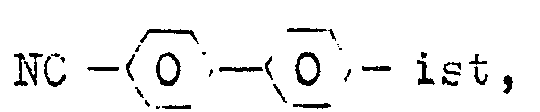


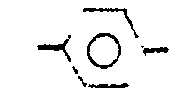

- Nachstehend werden flüssigkristailine Derivate von 2,5-disubstituiertem Pyridin der allgemeinen Formel













- Es wird auch ein flüsaigkristallines Material vorgeschlageng enthaltend zumindest zwei flüssigkristalline Komponenten, bei dem erfindungsgemäß mindestens eine der genannten flüssigkristallinen Komponenten ein flüssigkristallines Derivat von 2,5-diaubstituiertem Pyridin der Formel I dient
- Es ist zweckmäßig, daß das flüssigkristalline Material l bis 75 Masse% flüssigkristallines Derivat von 2,5--disubstituiertem Pyridin der Formed I-XXVIII enthält.
- Das flüssigkristalline Material mit dem angegebenen Mischungsverhältnis besitzt optimale Eigenschaften.
- Die erfindungsgemäβenweisen einen breiten Spektrumbereich der
 auf, die es möglich machen, diese
 der Entwicklung der flüssigkristallinen Materialien zu verwenden, die in Mikrokalkulatoren, in den Uhren, elektrooptischen Einrichtungen für äußeren Verwendung sowie in Einrichtungen mit Sonnenbatteriespeisung eingesetzt werdeno

- Verbindungen der For II werden durch aufeinanderfolgende chemische Umsetzungen synthetisiert. Durch Umsetzung von 2-Methyl-5-lithium-lithium mit 4-Alkyl-zyklohexanonen unter darauffolgender Dehydratisierung und Hydrierung sind 2-Methyl-5-(trans-4-alkylzyklohexyl)-pyridine hergestellt. Die letztgenannten sind nach den genormten Verfahren in 2-Zyano-5-(trans-4-alkylzyklohexyl)-pyridine überführt.
- Nachstehend wird das Verfahren zur Synthese von Verbindungen der Formeln (III-XXI, XXII, XXIII) angegeben.





- Durch Kondensation von Enaminen mit Vinylketonen sind 3,6-disubstituierte 3,4-Dihydro-2-N-piperidino-2H-pyrane hergestellt. Die letztgenannten sind durch Sieden mit Hydroxylammoniumchlorid in einem wäβrig-alkoholischen Medium in 2,5-disubstituierte Pyridine IV,XV, XXIII, XXIV oder ihre Zwischenprodukte überführt, in denen Brom durch Zyangruppe (III, XVIII), Akrylnitrilgruppe (XIX, XX, XXI) nach dem genormten Verfahren substituiert, die Nitrogruppe ist durch aufeinanderfolgende chemische Reaktionen in Isothiozyangruppe (XVII) überführt. Durch Nitrierung von 2,5-disubstituierten Pyridinen sind Verbindungen V, VIII, XII hergestellt, deren Reduktion zur Bildung von Aminopyridinen VI, IX, XIII führt, aus denen fluorsubstituierte Pyridine VII, X, XIV, XVI und Zyanopyridine XI synthetisiert sind.
- Verbindungen der Formel XXII stellt man durch Zyklisierung des Natriumsalzes von Hydroxysiethylen-methyl-4--(4-alkylzyklohexyl)-keton mit Zyanazetamid und derauffolgende Umwandlung der hergestellten 6-(4-Alkylzyklohexyl)--3-zyanopyridin-2-one in 2-Chlor-3-zyano-6-(4-alkylzyklo- hexyl)-pyridine her, in denen das Halogen durch katalytische Hydrierung reduziert wird.
- Die Verbindungen der Formel -XXVI-XXVIII stellt man aus 1-Dimethylamino-2-(4-alkylphenyl)-4-(4-alkoxy-3--fluorbenzoyl)butadien-l,3 (für XXVI) oder aus 1-Dimethyl- amino-2-(4-alkoxy-3-fluorphenyl)-4-(4-alkoxy- bzw. 4-alkyl- benzoyl)butadien- 1,3 (für XXVII-XXVIII) durch aufeinanderfolgende Umwandlung in substituierte 2-Methoxy-2H-pyrane, Pyryliumsalze und Pyridinderivate (XXVI-XXVIII) her.
- Das erfindungsgemäße flüssigkristalline Material wird durch Vermischen von mindenstens zwei flüssigkristallinen Komponenten hergestellt, von denen die eine erfindungsgemäß das Derivat von 2,5-disubtituiertem Pyridin der Formel I in einer Menge von 1 bis 75 Masae% ist.
- Das Vermischen erfolgt unter Erhitzen, bis die isotrope Phase auftritt, und anschließender Abkühlung.
- Als andere Komponente des flüsaigkristallinen Materials kann eine beliebige Verbindung, gewählt aus den Klassen der Derivate von Biphenyl, Zyklohexan, Dioxanen, Pyrimidin, Alkyl(alkoxy)phenylestern der Alkyl(alkoxy)benzoesäuren und trans-Zyklohexankarbonsäuren, Alkylphenylestern der 4-(trans-4-Alkylzyklohexyl)benzoesäure, 4-(trans-4--Alkylzyklohexyl)phenylestern der trans-4-Alkylzyklohexan- karbonsäure, 1,2-Diphenyläthan, 1-Zyklohexyl-2-phenyläthan, dienen.
- Die Menge von Komponenten und das Mischungsverhältnis nimmt man entsprechend den vorgegebenen Eigenschaften des flüssigkristallinen Materials.
- Nachstehend sind Beispiele zur konkreten Ausführung der vorgeschlagenen Erfindung vorgescnlagen, in denen das Verfahren zur Herstellung und die Eigenschaften von Derivaten des 2,5-disubstituierten Pyridins der Formel 1-XXIII sowie das Herstellungsverfahren und die Eigenschaften eines flüssigkristallinen Materials angeführt.
- Zu einer Lösung von 0,504 Mol Butyllithium in 400 ml absolutem Äther wird im Argonstrom bei einer Temperatur von minus 70°C langsam unter innigem Umrühren eine Lösung von 72,2 g (0,42 Mol) 2-Methyl-5-brompyridin in 500 ml Äther getropft. Man rührt 1 Stunde lang bei minus 70 °C um und tropft dann eine Lösung von 114 g (0,63 Mol) 4-Hexylzyklohexanon in 270 ml Äther so zu, daß die Reaktionstemperatur minus 70 °C nicht übersteigt. Das Reaktionsgemisch wird noch 1 Stunde bei dieser Temperatur gerührt, danach die Nacht über ohne Abkühlung stehengelassen. Man gieβt das Reaktionsgemisch auf 1 Liter Wasser, trennt die Ätherphase ab, wäscht zweimal (mit je 300 ml) Wasser, trocknet über Na2S04. Der Äther wird abdestilliert, und der Rückstand wird entweder unter Vakuum (230 °/3 Torr) destilliert oder aus Azeton (durch Ausfrieren) umkristallisiert. Man isoliert 73 g (63,3 %) Verbindung 1.1.a als weißes Pulver mit TSchlumelz > 100°C. Analog werden Verbindungen der allgemeinen Formel

- Zu 57,7 g (0,21 Mol) Verbindung 1,1.a fügt man 98 g (1 Mol) Schwefelsäure unter Rühren hinzu. Die Temperatur des Reaktionsguts wird unter d0 °C gehalten. Dieses Gemisch rührt man bei der angegebenen vamperatur.; innerhalb von 0,5 Stunde um, kühlt ab, gießt auf Eis, alkalisiert, extraniert die Ölschicht mit Chloroform, trocknet über Natriumsulfat, treibt Chloroform ab und destilliert den Rückstand unter Vakuum ab. Man isoliert 46 g (85 %) Verbindung 1.2. a als farbloses Öl mit TSiede= 200 °/3 Torr.
- Analog werden andere Verbindungen 1.2 (b-f) hergestellt, ihre Formeln und Eigenschaften gibt die Tabelle 1 an. Die Ausbeute an Verbindungen 1.2 b-f beträgt 85 bis 90 %.
- Die Lösung von 51,5 g (0,2 der Verbindung 1.2. a in 350 ml absolutem Äthanol wird bei 20 atm Druck über 7 g 5%igem Fd/C mit Wasserstoff hydriert, bis der Wasserstoff vollständig aufgenommen wird. (Die vollständige Aufnahme wird durch Gas-Flüssig-Chromatobrafieüberwacht). Der Niederscnlag wird abfiltriert,der Alkohol abgetrieben, der Rückstand unter Vakum abdestilliert. Man isoliert 45,1 g (87 %) Verbindung 1,3 a mit Tsiede 170 °c/2 Torr.
- Gefunden in %: C 83 d3,51; H 11,2; C18H29N. Berechnet in %: C 83,33; H -11,27. Analog werden andere Verbindungen 1.3 b-f hergestellt, deren Eigenschaften in der Tabelle 1 angegeben sind. Die Ausbeute an Verbindungen 1.3 b-f beträgt 85 bis 90 %.
- Die Substanz 1.4.a ist in 65%iger Ausbeute durch Überführung der Verbindung 1.3 a in N∃→0-Derivat durch Sieden in Gegenwart von Wasserstoffperoxid in Essigsäure und darauffolgende Umlagerung unter Einwirkung von Essigsäureanhydrid in 2-Azetyloxymethyl-5-(cis/trans-4-hexyl- zyklohexyl)-pyridin hergestellt, welches ohne Isolieren nach der Abdestillation des überschüssigen Essigsäureanhydrids mit 10%igem wäßrigalkoholischem Alkali verseift wird. Man isoliert eifie Verbindung 1.4. a mit TSiede = = 205°C/1 Torr. Analog werden andere Verbindungen 1.4 b-f hergestellt, deren Formeln und Eigenschaften in der Tabelle 1 angegeben sind. Die Ausbeute an anderen Homologen 1.4 b-f beträgt 60 bis 70 %
- Zu einer Lösung von 11,1 g (0,04 Mol) Verbindung 1.4. a in 40 ml (0,55 Mol) Dioxan (frisch destilliert über Ätznatron) fügt man 2,6 g (0,02 Mol) fein zerkleinerte selenige Säure hinzu. Man erhitzt das Reaktionsgut auf 80 oC bei einem schnellwirkenden Rührwerk und hält diese Temperatur innerhalb von 2 Stunden unter ununterbrochenem Rühren konstant. Man filtriert durch eine dünne Aluminiumoxidschicht, treibt Dioxan aus dem Filtrat ab. Dem Rückstand werden 100 ml Äthanol, 8 g (0,12 Mol) Hydroxylammoniumhydrogenchlorid und 13,3 g (0,33 Mol) Ätznatron in 50 ml Wasser zugegeben. Das Gemisch wird innerhalb von 1 Stunde zum Sieden erhitzt, in 200 ml Wasser gegossen, mit der verdünnten Salzsäure angesäuert. Der ausgefallene amorphe Niederschlag wird abfiltriert, aus Alkohol umkristallisiert, mit Hexan gewaschen. Man isoliert 4,4 g (38 %) 5-(trans-4--Hexylzyklohexyl)-pyridin-2-oxim, welches man mit 20 ml trockenem Chloroform verdünnt, setzt 5,9 g Phosphoroxidchlorid zu und siedet innerhalb von 1 Stunde mit Rückflußkühler. Die Reaktionsmasse wird auf Wasser gegossen, mit Natriumhydrogenkarbonatlösung neutralisiert, die organische Phase mit Wasser gewaschen, durch eine kleine mit A1203 aufgefüllte Säule gelassen und das Lösungsmittel aus dem Filtrat abdestilliert. Der Rückstand wird aus Hexan (viermal) kristallisiert. Man isoliert 1 g Substanz II a (9,1 %) mit T C-N = 35,3 o und TN-1 49,4 °.
- Gefunden in %: C 80,01; H 9,54. C18H26N2.
- Berechnet i n%: C 79,95; H 9,69.
- Analog werden andere 2-Zyano-5-(trans-4-alkylzyklo- nexyl)-pyridine II b-f hergestellt, deren Eigenschaften, Bruttoformel und Elementaranalysenangaben in der Tabelle 1 dargestellt sind. Die Gesamtausbeute an Verbindungen II a-f beträgt 9-13%- Alle neuen Stoffe der Formel II sind bei Raumtemperatur weiβe kristalline Pulver.
- Der Aufbau der Verbindungen II ist durch magnetische Kernresonanzspektroskopie nachgewiesen. Das Spektrum von Verbindungen II stelit ein Dreispinsystem ABX (δ ppm CCl4): 8,24 (H4) 8,34 (H3), 9,06 (H6)·
- Die Struktur der Verbindungen II wird auch durch magnetische Kernresonanz mit 13C nachgewiesen.
- Die Formeln und die Eigenschaften der synthetisierten Verbindungen 1.2, 1.3, 1.4, II sind in der Tabelle 1 angegeben.


- Zur Messung der elektrooptischen Parameter der Verbindungen der Formel II verwendete man das Gemisch des fünften und des siebten Homologen, welches einen breiten Temperaturenbereich der nematischen Phase aufweist. Es ist auch zu berücksichtigen, daß die Gesetzmäßigkeit der Änderung der Eigenschaften bei Gliedern der homologen Reihe mit dem ausreichenden Genauigkeitsgrad gewöhnlich bekannt ist, d.h. nach den Eigenschaften des Gemisches aus dem fünften und siebten Homologen kann man auf die Eigenschaften der Glieder der ganzen homologen Reihe schließen.
- Es wurden deshalb folgende binäre Mischungen hergestellt: Mischung A aus 40 Mol.% 2-Zyano-5-(trans-4-amylzyk- lohexyl)-pyridin und 60 Mol.% 2-Zyano-5-(trans-4-heptyl- zyklohexyl)-pyridin und vergleichsweise Mischung B aus 40 Mol.% trans-4-Amyl-(4-zyanophenyl)-zyklohexan und 60 MoL% trans-4-Heptyl-(4-zyaxiophenyl)-zyklohexan (DE,B 2636684).
- Vergleichswerte von Klärpunkten (TN-I), Anisotropien der Dielektrizitätskonstante, Schwellspannung und Sättigungsspannung beim Twist-Effekt bei Mischungen A und B sind in der Tabelle 2 angegeben.

- Darin bedeuten:
- △ε=ε11-ε1 Anisotropie der Dielektrizitätskonstante bei der reduzierten Temperatur τ = 0,95 ( τ = TMeB/TN-I in °K)
- U Schcvell und U Sätt Schwellspannung bzw. Sättigungsspannung beim Twist-Effekt, normaler Lichteinfall, Zellendicke 10 µm.
- Aus der Tabelle 2 ist zu ersehen, daβ der Klärpunkt der Mischung aus neuen Verbindungen der Formel II (Mischung A) den der Mischung aus trans-4-Alkyl-(4-zyanophenyl)-zyk- lohexanen (Mischung B) übersteigt. Wie die Tabelle 2 zeigt, beträgt auβerdem die Schwellspannung und die Sättuigungsspannung beim Twist-Effekt für Mschung (neue Substanzen) 1,25 bzw. 1,8 V und ist bedeutend geringer als die für Mi- schung B (USchwell ' 1,7 V USätt = 2'3 V). Die nachstehen- den Beispiele 2 bis 24 veranschaulichen die Verwendung der erfindungsgemäßen Verbindungen II als Komponenten von flüssigkristallinen Materialien, hergestellt nach dem auf der Seite 6 beschriebenen Verfahren.
- In Beispielen 2 bis 24 sind die Zusammensetzungen in Masseprozent angegeben.
-
- 2-Zyano-5-(trans-4-propylzyklohexyl)-pyridin (II ) 6
- 2-Zyano-5-(trans-4-butylzykloheyl)-pyridin (II c) 7
- 2-Zyano-5-(trans-4-amylzyklohexyl)-pyridin (II d) 25
- 2-Zyano-5-(trans-4-hexylzyklohexyl)-pyridin (II a) 10
- 2-Zyano-5-(trans-4-heptylzyklohexyl)-pyridin (II e)35
- 2-Zyano-5-(trans-4-oktylzyklohexyl)-pyridin (II f) 17
- Bei diesem flüssigkristallinen Material ist USchwell= = 1,15 V und Usätt =1,7 V. Der Temperaturenbereich der nematischen Phase beträgt -5 bis + 55 °C.
-
- 2-Zyano-5-(trans-4-propylzyklohexyl)-pyridin (II b) 10
- 2-Zyano-5-(trans-4-amylzyklohaxyl)-pyridin(II d) 20
- 2-Zyano-5-(trans-4-heptylzyklohexyl)-pyridin (II e) 23
- 4-Amyl-4'-zyanobiphenyl 40
- 4-Amyl-4"-zyano-p-terphenyl 7
- Bei diesem flüssigkristallinen Material ist USchwell= =1,3 V, USätt = 1,85 V. Der Temperaturenbereich der nematischen Phase beträgt -9 bis + 60 °C
-
- 2-Zyano-5-(trans-4-butylzyklohexyl)-pyridin (II c) 20
- 2-Zyano-5-(trans-4-hexylzyklohexyl)-pyridin (II a) 28
- trans-4-Propyl-(4-zyanophenyl)-zyklohexan 20
- trans-4-Amyl-(4-zyanophenyl)-zyklohexan 25
- trans-4-Amyl-(4-zyanob iphenyl)-zyklohexan 7
- Bei diesem flüssigkristallinen Material ist USachwell= = 1,5 V und Usätt = 2,1 V. Der Temperaturenbere ich der nematischen Phase beträgt -12 bis + 60 °C.
-
- 2-Zyano-5-(trans-4-hexylzyklohexyl)-pyridin (II a) 15
- 2-Zyano-5-(trans-4-oktylzyklohexyl)-pyridin (II f) 15
- trans-4-Propylzyklohexankarbonsäure-4'-äthoxy-
- phenylester 17,5
- trans-4-Butylzyklohexankarbonsäure-4'-äthoxy-
- phenylester 17,5
- trans-4-Amylzyklohexankarbonsäure-4'-äthoxy-
- phenylester 17,5
- trans-4-Hexylzyklohexankarbonsäure-4'-äthoxy-
- phenylester 17,5
- Bei diesem flüssigkristallinen Material ist USchwell = 1,7 V und USätt =2,25 V. Der Temperaturenbereich der nematischen Phase beträgt -6 bis + 60 °(;.
-
- 2-Zyano-5-(trans-4-propylzyklohexyl)-pyridin (II b) 5
- trans-4-Propyl-(4-zyanophenyl)-zyklohexan 22
- trans-4-Armyl-(4-zyanophenyl)-zyklohexan 27
- trans-4-Heptyl-(4-zyanophenyl)-zyklohexan 22
- 4-Äthyl-4-(trans-4-amylzyklohexyl)-biphenyl 12
- 4-(trans-4-Amylzyklohexyl)-4'-(trans-4-propy1zyklo-
- riexyl )-b iphenyl 12
- Bei diesem flüssigkristallinen Material ist USchwell =1,5 V und USätt = 2,1 V. Der Temperaturenbereich der nematischen Phase beträgt -10 bis +80 oC.
-
- 2-Zyano-5-(trans-4-propylzyklohexyl)-pyridin (II b) 10
- 2-Zyano-5-(trans-4-butylzyklohexyl)-pyridin (II c ) 15
- 2-Zyano-5-(trans-4-amylzyklohexyl)-pyridin (II b) 20
- 2-Zyano-5-(trans-4-hexylzyklohexyl)-pyridin (II a) 15
- 2-Zyano-5-(trans-4-heptylzyklohexyl)-pyridin (II e) 15
- 4-Propyl-4'-(trans-4-amylzyklohexyl)-biphanyl 15
- 4-(trans-4-Amylzyklohexyl)-4'-(traxls-4-propyl- zyklohexyl)-biphenyl 10
- Bei diesem flüesigkristallinen Material ist USchwell = 1,2 V und USätt = 1,7 V. Der Temperaturenbereich der nematischen Phase beträgt -8 bis + 75 C.
-
- 2-Zyano-5-(trans-4-amylzyklohexyl)-pyridin (II d) 3
- trsns-4-Propyl-(4-zyanopheinyl)-zyklohexan 24
- trans-4-Amyl-(4-zyanophenyl)-zyklohexan 27
- trans-4-Heptyl-(4-zyanophenyl)-zyklohexan 22
- 4-Äthyl-4'-(trans-4-amylzyklohexan)-biphenyl 12
- 4=(trans-4-Amylzyklohexyl)-4'-(trans=4-propyl-
- zyklohexyl)-biphenyl 12
- Bei diesem flüssigkristallinen Material ist USchwell =1,6 V und USätt - 2,15 V. Der Temperaturenbereich der nematischen Phase beträgt -12 bis + 80°C.
-
- 2-Zyano-5-(trans-4-propylzyklohexyl)-pyridin(II b) 20
- 2-Zyano-5-(trans-4-butyhzyklohexyl)-pyridin (II c) 15
- 2-Zyano-5-(trans-4-amylzyklohexyl)-pyridin (II d) 25
- 2-Zyano-5-(trans-4-heptylzyklohexyl)-pyridin (II a) 20
- 4-Amyl-4'-zyanobiphenyl 20
- Bei diesem flüssigkristallinen Material ist USchwell =1,2 V und USätt - 1,75 V. Der Temperaturenbe- reich der nematischen Phase beträgt -6 bis +54 °C.
-
- 2-.Zyano-5-(trans-4-amylzyklohexyl)-pyridin (II d) 40
- 2-Zyano-5-(trans-4-heptylzyklohexyl)-pyridin (II e) 25
- trans-4-Butyloxy-(4-zyanophenyl)-zyklohexan 35
- Bei diesem flüssigkristallinen Material ist TN-I=58 °C, USchcvell = 1.,3 V und USätt =1,8 V.
-
- 2-Zyano-5-(trans-4.-butylzyklohexyl)-pyridin (II c) 30
- 4-Butyl-4'-methoxyazoxybenzol 46,9
- 4-Athyl-4'-methoxyazoxybenzol 23,1
- Bei diesem flüssigkristallinen Material ist USchwell =1'25 V und USätt =1,75 V. Der Temperaturenbereich der nematischen Phase beträgt +5 bis +66 °C .
-
- 4-Amyl-4'-zyanob iphenyl 35
- 4-Hexyloxy-4'-zyanobiphenyl 11
- 2-Zyano-5-(trans-4-amylzyklohexyl)-pyridin (II d) 32
- 2-Zyano-5-(trans-4-heptylzyklohexyl)-pyridin (II e) 22
- Bei diesem flüssigkristallinen Material ist USchwell = 1,4 V und USätt - 1,85 V. Der Temperaturenbereich der nematischen Phase beträgt -3 bis +51 °C.
-
- 4'-Methoxybenzoesäure-4-propylphenylester 15
- 4'-IUiethoxybenzoesäure-4-amylphenylester 20
- 4-Hexanoyloxybenzoesäure-4 -propylphenylester 17
- 4 -3utylbenzoesäure-4-(4-propyl)-biphenylester 10
- 4' -Amylbenzoesäure-4-propylbiphenylester 8
- 2-Zyano-5-(trans-4-propylzyklohexyl)-pyridin (II b) 30
- Bei diesem flüssigkristallinen Material ist USchwell =1,5 V und USätt = 2,0 V. Der Temperaturenbereich der nematischen Phase beträgt -2 bis +61 °C.
-
- 2-Zyano-5-(trans-4-amylzyklohexyl)-pyridin(II d) 27
- 4-Amyl-4"-zyano-p-terphenyl 8
- 4 -Methoxybenzoesäure-4-phenylpropylester 17
- 4 -Methoxybenzoesäure-4-aimylphenylester 48
- Bei diesem flüssigkristallinen Material ist USchwell = 1,55 V und USätt = 2,2 V. Der Temperaturenbereich der nemätisohen Phase beträgt 0 bis + 55 °C.
-
- 4-Butyl-4' -methox,yazoxybenzol 33,5
- 4-Äthyl-4' -methoxyazoxybenzol 16,5
- 5-(4-Zyanophenyl)-4-amyl(thiobenzoat) 10
- 2-Zyano-5-(trans-4-propylzyklohexyl)-pyridin (II b) 20
- 2-Zyano-5-(trans-4-butylzyklohexyl)-pyridin (II c) 20
- Bei diesem flüssigkristallinen Material ist USchwell = 1,4 V, und USätt = 1,9 V. Der Temperaturenbereich der nematischen Phase beträgt 0 bis 64 °C.
-
- 4- Butyl-4'-methoxyazoxybenzol- 26,8
- 4- Äthyl-4 -methoxyazoxybenzol 13,2
- 4- Amylbenzoesäure-4'-zyanophenylester 10
- 4'-Heptylbenzoesäure-4-zyanophenylester 10
- 2-Zyano-5-(trans-4-butylzyklohexyl)-pyridin (II c) 20
- 2-Zyano-5-(trans-4-amylzyklohexyl)-pyridin (II d) 20
- Bei diesem flüssigkristallinen Material ist U Schwell= 1,4 V und USätt - 1,85 V. Der Temperaturenbereich der nema-' ' tischen Phase beträgt -2 bis + 62 °C
-
- 2-Zyano-5-(trans-4-heptylzyklohexyl)-pyridin (II e) 30
- N-(4- Hexylbenzyliden)-4-zyanoanilin 49
- N-(4- Propylbenzyliden)-4-zyanoanilin 21
- Bei diesem flüssigkristalinen Material ist USchwell = 1,5 V und USätt = 2,1 V. Der Temperaturenbereich der nematischen Phase betragt -3 bis +64 °C.
-
- 2-Zyano-5-(trans-4-propylzyklohexyl)-pyridin (II b) 10
- 2-Zyano-5-(trans-4-butylzyklohexyl)-pyridin (II c) 10
- 2-Zyano-5-(trans-4-amylzxklohexyl)-pyridin (II d) 25
- 4- Butylbenzoesäure-49-zyanophenylester 15
- 4- Amylbenzoesäure-4-zyanophenylester 20
- 4- Hexylbenzoesäure-4p-zyanophenylester 20
- Bei diesem flüssigkristallinen Material ist USchwell = 1,35 V und USätt = 1,7 V. Der Temperaturenbereich der nematischen Phase beträgt O bis +53 °C.
-
- 4- Anyl-4'-zyanob iphenyl 20
- 4- Heptyl-4 -zyanobiphenyl 20
- 4- Amyl-4" -zyano-p-terphenyl 10
- 2-Zyano-5-(trans-4-amylzyklohexyl)-pyridin (II d) 25
- 2-Zyano-5-(trans-4-heptylzyklohexyl)-pyridin (II e)25
- Bei diesem flüssigkristallinen Material ist USchwell =1' 3 V und USätt- 1,7 V. Der Temperaturenbereich der nematischen Phase beträgt -1 bis +66 °C.
-
- 4- Propyloxy-4-zyanobiphenyl 15
- 4- Amyloxy-4'-zyanobiphenyl 20
- 4- Amyl-4" -zyano-p-terphenyl 15
- 2-Zyano-5-(trans-4-propylzyklohexyl)-pyridin (II b)20
- 2-Zyano-5-(trans-4-butylzyklohexyl)-pyridin (II c) 30
- Bei diesem flüssigkristallinen Material ist U Schwell - 1,25 V und Usätt =1,6 V. Der Temperaturenbereich der nematischen Phase beträgt +4 bis +70 °C.
-
- 2-Zyano-5-(trans-4-heptylzyklohexyl)-pyridin (II e) 29,2
- 4-(2-Methylbutyl)-1(2-zyanophenyl)-zyklohexan 0,8
- N-(4- Hexylbenzyliden)-4-zyanoanilin 49
- N-(4- Propylbenzyliden)-4-zyanoanilin 21
- Bei diesem flüssigkristallinen Material ist USchwell =1,5 V und USätt =2,1 V. Der Temperaturenbereich der nematischen Phase beträgt -5 bis +67 °C.
-
- 4- Propyloxy-4"-zyan -p-terphenyl 15
- 4- Amyloxy-4' -zyanobiphenyl 20
- 4- Amyl-4' zyano-p-terphenyl 15
- 2-Zyano-5-(trans-4-butylzyklohexyl)-pyridin (II c) 30
- 2-Zyano-5-(trans-4-propylzyklohexyl)-pyridin 19
- 4-(Methoxyheptyl)-1-(4-zyanophenyl)-zyklohexan 1
- Bei diesem flüssigkristallinen Material ist USchwell 1,2 V und Usätt - 1,55 V. Der Temperaturenbereich der nematischen Phase beträgt +4 bis +68 °C.
-
- 2-Zyano-5-(trans-4-amylzyklohexyl)-pyridin (II d) 20
- 2-Zyano-5-(trans-4-heptylzyklohexyl)-pyridin (II e) 20
- 5-Amyl-2-(4-zyanophenyl)-pyridin 10
- trans-4-Butylzyklohexankarbonsäure-4-äthoxyphenyl- ester 25
- trans-4-Hexylzyklohexankarbonsaure-4-äthoxyphenyl- ester 15
- trans-4-Butylzyklohexankarbonsäure-4-zyanobiphe- nylester 10
- Bei diesem flüssigkristallinen Material ist USchwell=1,5 V und USätt =2,1 V. Der Temperaturenbereich der nematischen Phase beträgt -9 bis +71 °C.
-
- 2-Zyano-5-(trans-4-amylzyklohexyl)-pyridin (II d) 25
- 5-Amyl-2-(4-zyanophenyl)-1,3-dioxan 25
- trans-4-Butylzyklohexankarborisäure-4-äthoxyphenyl- ester 25
- trans-4-Hexylzyklohexankarbonsäure-4-äthoxyphe- nylester 15
- 4-Äthyl-4-(trans-4-amyl)-zyklohexylbiphenyl 10
- Bei diesem flüssigkristallinen Material ist USchwell =1,35 V und Usätt = 1,75 V. Der Temperaturenbereich der nematischen Phase beträgt -11 bis +67 °C.
- Beispiele 2 bis 24 zeigen, dass die Verbindungen der Formel II einen breiten Bereich der nematischen Phase und geringe Steuerspannungen für flüssigkristalline Materialien sichern werden. Diese Materialien sind zweckmäßigerweise in elektrooptischen Einrichtungen mit Sonnenbatteriespeisung zu verwenden.
- Zu einem Gemisch von 0,05 Mol Magnesiummetall in 20 ml absolutem Tetrahydrofuran werden 0,05 Mol trans-1-Butyl--4-brommethylzyklohexan langsam unter bieden getropft. Nach der Auflösung von Magnesium wird die erhaltene Lösung zu einer auf -40 °C abgekühlten Lösung von 0,045 Mol N-Methyl-N-formyl-2-aminopyridin in 50 ml absolutem Tetrahydrofuran getropft. Man rührt das Reaktionsgemisch bei einer Temperatur von -20 °C innerhalb von 15 bis 20 Minuten um und gießt in 150 ml 5%ige auf 0 °C vorgekühlte Salzsäure aus. Man extrahiert mit Äther, wäscht den Extrakt mit einer gesättigten wäßrigen Natriumchloridlösung, mit Wasser, trocknet über Natriumsulfat, treibt den Äther ab, destilliert den Rückstand unter Vakuum und isoliert die Verbindung 25.1.a in 73%iger Ausbeute mit TSiede = 85 bis 87 °C/1 Torr. IR-Spektrum mit Co- γ - Strahlung, 1720 cm-1 Wellenlänge, kernmagnetisches H-NMR-Spektrum (CCl4, δ , ppm):
- Triplett 0,85 (J 6 Hz, CH3); Multiplett 0,97-1,85 (CH2, CH);
- Doppelduplett 2,22 (J 6 und 2 Hz, CH2CO); Triplett 9,65 (J 2 Hz, CHO).
- 2,4-Dinitrophenylhydrazon (aus Äthanol) hat TSchmelz= 117 bis 118 °C.
- Gefunden in %: C 59,45; H 7,38; N 15,36; C18H26N4O4.
- Berechnet in %: C 59,65; H 7,23; N 15,46.
- Analog sind trans-1-Alkyl-4-zyklohexylazetaldehyde (25.1.b-d) hergestellt, worin b für R = C3H7, c für R = C5H11, d für R = c6H13 stehen, wobei ihre Eigenschaften die Tabelle 3 angibt.

- Anmerkung. Verbindungen 25.l.b, c sind aus 1-Alkyl--4-brommethylzyklohexanen erhalten, welche eine Mischung von trans- und cis-Isomeren im Verhältnis von 7:3 darstellen.
- Man vermischt 0,078 Mol wasserfreies Natriumsulfat mit 0,086 Mol Piperidin und tropft 0,039 Mol Verbindung 25.1. a bei -5 °C im Stickstoffstrom zu, rührt innerhalb von 3 Tagen bei Raumtemperatur um, filtriert den Niederschlag ab, wäscht mit Hexan, vereinigt die Filtrate und destilliert unter Vakuum. Man isoliert die Verbindung 25.2.a in 53%iger Ausbeute mit TSiede von 139 bis 141 °C/3 Torr. Gefunden in %: N 5,80; C17H31N9. Berechnet in %: N 5,61. nD 20 = 1,4973. 1H-NMR-Spektrum (CCl4, δ ppm): Triplett 0,85 (J 6 Hz, CH3) , Multiplett 0,97-1,85 (CH2,CH) , Multiplett 2,52-2,75 (CH2N), Doppelduplett 4,10 (J 7 und 14 Hz, CH = C), Duplett 5,60 (J 14 Hz, C=CH-N)
- Analog sind dazu gehörige Verbindungen 1-[β-(4-trans--Alkylzyklohexyl)-äthylenyl] -piperidine 25.2 b-d hergestellt, deren Eigenschaften und Elementaranalyse in der Tabelle 4 angegeben sind.

- Man vermischt in der Stickstoffatmosphäre bei 20 °C 0,034 Mol Verbindung 25.2. a mit 0,037 Mol 1-Akryloyl--4-brombenzol. Das Gemisch wird innerhalb von 1 Stunde gerührt und über Tag und Nacht stehengelassen. Man kühlt es auf -20 °C ab, setzt 10 ml Methylalkohol zu, filtriert den ausgefallenen Niederschlag ab und trocknet im Vakuum, Man isoliert die Verbindung 25.3.a in 87%iger Ausbeute mit TSchmelz von 93,5 bis 95,5 °C.
- Gefunden in %: C 67,67; H 8,16; N 3,08; C26H38 BrNO
- Berechnet in %: C 67,81; H 8,32; N 3,04.
- 1H-NNR-Spektrum (CCl4, δ ,ppm): Triplett 0,90 (J 6 Hz, CH3) , Multiplett 0,95-2,12 (CH2, CH), Multiplett 2,45-3,07 (CH2N), Duplett 4,27 (J 8 Hz, NCHO), Triplett 5,10 (3 Hz, C = CH), Singulett 7,31 (ArH).
- UV-Spektrum λmax(lgε): 207 (4,23), 258 (4,35) (95%iges Äthanol).
- Analog sind dazu gehörige 3-(trans-4-Alkylzyklohexyl)--6-(4-bromphenyl)-3,4-dihydro-2-N-piperidino-2H-pyrane (25.3 b-d) hergestellt, deren Eigenschaften und Elementaranalyse in der Tabelle 5 angegeben sind.

- Zu einer Lösung von 0,074 Mol Oxalsäure in 70 ml Wasser werden 0,037 Mol Verbindung 25.3.a gegeben und innerhalb von 24 Stunden bei 20 °C gerührt. Man extrahiert mit Äther, wäscht den Extrakt mit Wasser, einer gesättigten wäßrigen Natriumohloridlösung, trocknet über Na2S04 und treibt das Lösungsmittel unter Vakuum ab. Man isoliert die Verbindung 24.4.a in 77%iger Ausbeute mit TSchmelz von 71 bis 72°C (Hexan).
- Gefunden in %: C 64,4; H 7,57; Br 20,03; C21H29BrO2
- Berechnet in %: C 64,12; H 7,43; Br 20,31.
- 1H-NMR-Spektrum (CCl4, δ , ppm): Multiplett 0,73 (J 6 Hz, CH3) , Multiplett 0,85-2,12 (CH2, CH), Multiplett 2,77-3,10 (CH2CO, CHO), Duplett 7,50 und 7,75 (J 9 Hz ArH), Duplett 9,52 (J 2 Hz, CHO).
- IR-Spektrum mit Co- γ -Strahlung 1685 und 1720 cm-1 (Vaselinöl)
- UV-Spektrum: λmax(lg ε ): 210 (4,11), 258 (4,25) (95%iges Äthanol)
- Analog sind dazu gehörige 4-Formyl-4-(trans-4-alkyl- zyklohexyl)-1-(4-bromphenyl)-butanone (25.4 b-d) hergestellt, deren Elementaranalyse und Eigenschaften in der Tabelle 6 angegeben sind.

- Man löst 0,005 Mol Verbindung 25.4.a in 15 ml Eisessig auf, setzt 0,006 Mol Triphenylmethylborfluorid zu, kocht innerhalb von 15 Minuten. Das Reaktionsgut wird abgekühlt, mit absolutem Äther verdünnt, der ausgefallene Niederschlag abfiltriert und im Vakuum getrocknet. Man isoliert 2-(4-Bromphenyl)-5-(trans-4-butylzyklohexyl)-pyri- liumborfluorid in 35%iger Ausbeute. Die Lösung von 0,003 Mol 2-(4-Bromphenyl)-5-(trans-4-butylzyklohexyl)-pyrylium- borfluorid und 0,05 Mol Ammoniumazetat in 30 ml Eisessig wird innerhalb von 2 Stunden gekocht, die Essigsäure im Vakuum abdestilliert. Den Rückstand verdünnt man mit Wasser, extrahiert mit Benzol, wäscht den Extrakt mit Wasser, trocknet über Natriumsulfat und filtriert durch Silikagelschicht (100/160, 3 cm).
- Nach der Abdestillation des Lösungsmittels wird der Rückstand aus CCl4 umkristallisiert. Man isoliert eine Verbindung 25.5. a in 92%iger Ausbeute mit TC-S von 155,2°C, TS-N von 160 °C, TN-I von 196,2 °C.
- Gefunden in %: C 67,78; H 7,20; N 3,78; C21H26BrN
- Berechnet in %: C 67,74; H 7,04; N 3,76.
- UV-Spektrum λmax (lg ε ): 208 (4,35), 257 (4,33), 284 (4,32) (95%iges Äthanol).
- 1H-NMR-Spektrum (CCl4, δ ppm): Triplett 0,90 (J 6 Hz, CH3) , Multiplett 0,95-2,12 (CH2, CH), Multiplitt 2,32-2,75 (CH-Py), Multiplett 7,43-7,64 (ArH), Duplett 7,83 (J 9 Hz, 2-H, 6-H), Duplett 8,51 (J 2 Hz, 6-H).
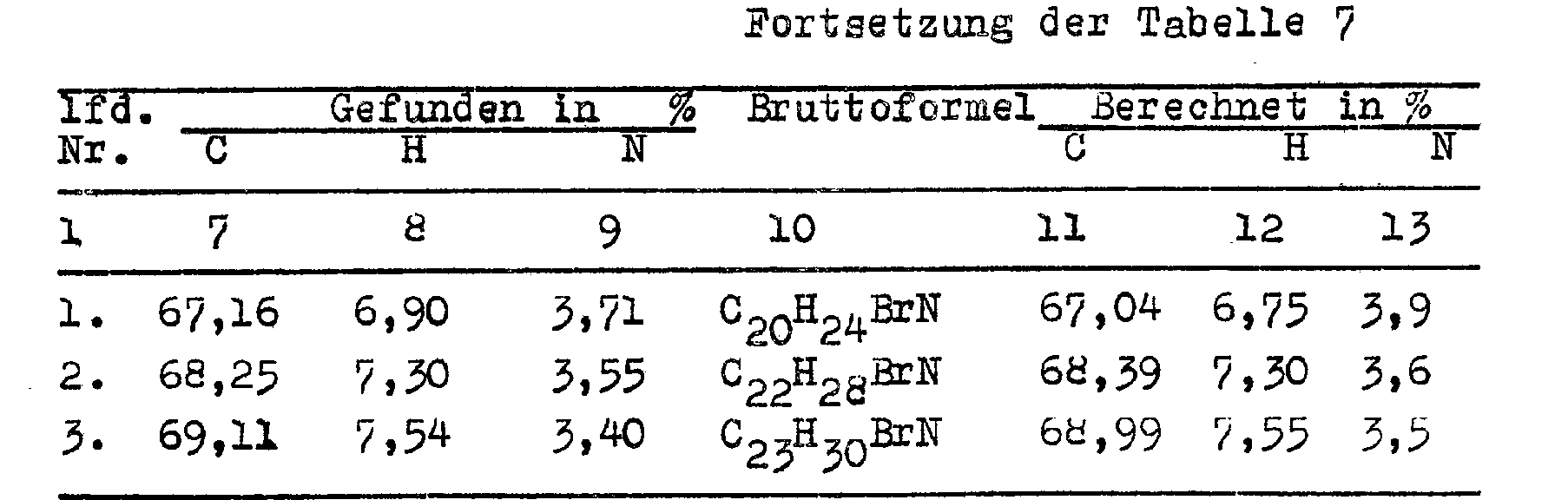
- Analog sind dazu gehörige 2-(4-Bromphenyl)-5-(trans--4"-alkylzyklohexyl)-pyridine (25.5. b-d) hergestellt, deren Eigenschaften und Elementaranalyse in der Tabelle 7 angegeben sind.

- Man vermischt 0,003 Mol Verbindung 25.5. a, 0,004 Mol Kupferzyanid und 10 ml N-Methylpyrrolidon und kocht bis zum Verschwinden der Ausgangsverbindung 25.5. a (etwa 3 Stunden lang). Das Reaktionsgut wird auf Raumtemperatur abgekühlt und in 20 ml wäßrige Ammoniaklösung gegossen. Man extrahiert mit Dichlormethan, wäscht den Extrakt mit Wasser, trocknet über Na2SO4 und filtriert durch Aluminiumoxid. Das Lösungsmittel wird im Vakuum abgetrieben, der Rückstand aus Alkohol und Azeton umkristallisiert. Man isoliert die Verbindung IIIa in 70%iger Ausbeute mit TC-N von 124 °C; und TN-I von 228 °C.
- Gefunden in %: N 8,81; C22H26N2. Berechnet in %: N 8,79.
- IR-Spektrum: γ (CN) mit 2236 cm-1 Wellenlänge
- 1H-NMR-Spektrum (CCl4, δ ,ppm): Triplett 0,90 (J 6 Hz, CH3), Multiplett 0,95-2,12 (CH2, CH),Multiplett 2,32-2,75 (CH-Py) 7,43-7,65 Ar H), Duplett 7,83 (J 9 Hz, 2-H, 6-H), Singulett 7,60 (3H, 4H), 7,65 (2'-H), 6'-H), 8,08 (3'-H, 5'-H), Duplett 8,53 (6-H), (System AA' BB' ). Analog werden Verbindungen III b-d hergestellt.
- Phasenübergangstemperaturen und die Elementaranalyse der Verbindungen der Formel III a-d gibt die Tabelle 8 an.

- Vergleichsdaten über Phasenübergangstemperataren und Koeffizienten der Rotationsviskosität γ1 bei den bekannten 2-(4-Zyanophenyl)-5-(4-alkylphenyl)-pyridinen und neuen Verbindungen 2-(4-Zyanophenyl)-5-(trans-4-al- kylzyklohexyl)-pyridinen (III a-d) sind in der Tabelle 9 dargestellt.
- Koeffizienten der Rotationsviskosität γ1 für Homologen 2-(4-Zyanophenyl)-5-(4-alkylphenyl)-pyridine und 2-(4--Zyanophenyl)-5-(trans-4-alkylzyklohexyl)-pyridine werden ausgehend von Werten der entsprechenden binären Mischungen B und D ermittelt.
- Mischung B: 10 Masse% 2-(4-Zyanophenyl)-5-(4-alkylphenyl)-pyridin und 90 Masse% Mischung .A.
- Mischung D: 10 Masse% 2-(4-Zyanophenyl)-5-(trans-4--alkylzyklohexyl)-pyridin und 90 Masse% Mischung A. Mischung A: 40 Mol.% trans-4-Pentyl-(4-zyanophenyl)--zyklohexan und 60 Mol.% trans-4-Heptyl-(4-zyanophenyl)--zyklohexan X1 = 1 P bei 25 °C.


- Die Tabelle 9 zeigt, daß Klärpunkte TN-I bei neuen Verbindungen der Formel III a-d mit denen der bekannten Verbindungen verglichen sind. Die neuen Verbindungen 2-(4--Zyanophenyl)-5-(trans-4-alkylzyklohexyl)-pyridine weisen dabei bedeutend kleinere Koeffizienten der Rotationsviskosität gegenüber den bekannten Verbindungen 2-(4-Zyanophe- nyl)-5-(alkylphenyl)-pyridine auf. So hat 2-(4-Zyanophe- nyl)-5-(trans-4-butylzyklohexyl)-pyridin einen Koeffizienten γ1 von 17,33 P und 2-(4-Zyanophenyl)-5-(4-butylphenyl)-pyridin einen Koeffizienten γ1 von 41 P bei 25 °C.
- Herstellung eines flüssigkristallinen Materials unter Verwendung der erfindungsgemäßen Verbindung der Formel III a-d
- 1,0 g (10 Masse%) 5 Propyl-2-(4-zyanophenyl)-pyridin
- 1,5 g (15 Masse%) 5-Pentyl-2-(4-zyanophenyl)-pyridin
- 2,0 g (20 Masse%) 2-Zyano-5-heptylphenylpyridin
- 1,5 g (15 Masse%) trans-4'-Propylzyklohexankarbonsäu- re-4-äthoxyphenylester
- 1,0 g (10 Masse%) trans-4'-Butylzyklohexankarbon- säure-4-äthoxyphenylester
- 1,5 g (15 Masse%) trans-4 -Hexylzyklohexankarbonsäure-4-äthoxyphenylester
- 0,5 g (5 Masse%) 2 [4-(trans-4-pentylzyklohexyl)-phenyl]-5-ätnylpyridin
- 1,0 g (10 Masse%) 2-(4-Zyanophenyl)-5-(trans-4-pentyl- zyklohexyl)-pyridin (III c)
- Nachstehend gibt die Tabelle 10 Zusammensetzungen des flüssigkristallinen Materials, enthaltend die Verbindungen der Formel III a-d, und Eigenschaften desselben an.


- Aus der Tabelle 10 ist zu ersehen, daß durch Verwendung neuer Verbindungen der Formel III a-d geringe Koeffizienten der Rotationsviskosität γ1 und einen breiten Temperaturenbereich der nematischen Phase bei flüssigkristallinen Materialien erreicht werden. Dies wird es möglich machen, diese Materialien in schnellwirkenden elektrooptischen Einrichtungen zu verwenden.
- Eine Mischung aus 0,13 Mol 4-(trans-4-Pentylzyklohexyl)-azetophenon, 0,22 Mol Paraform, 0,13 Mol Dimethylaminhydrogenchlorid, 0,25 ml konzentrierter Salzsäure, 15 ml absolutem Äthylalkohol wird innerhalb von 8 bis 10 Stunden gesiedet, abgekühlt, mit 100 ml absolutem Azeton verdünnt. Der ausgefallene Niederschlag von 1-(3-Dimethylaminopropi- onyl)-4-(4-trans-pentylzyklohexyl)-phenylhydrogenchlorid wird abfiltriert, in 200 ml Wasser aufgelöst, mit wäßriger Natriumhydroxidlösung angesäuert und mit Dichlormethan extrahiert. Man trocknet die organische Phase über Na2SO4 und treibt das Lösungsmittel ab. Man isoliert die Base in 75%iger Ausbeute, welche ohne Analyse zur folgenden Stufe kommt.
- Man löst 0,11 Mol Verbindung 33.1.d in 110 ml wasserfreiem Dichlormethan auf und setzt bei 10 °C 0,18 Mol Jodmethan zu, läßt das Reaktionsgut für 2 Tage in der Dunkelheit stehen. Der Niederschlag (der Verbindung 33.3.d) wird abfiltriert, mit wasserfreiem CH2Cl2 gewaschen und an der Luft getrocknet. Die Ausbeute beträgt 98 %. Die Verbindung kommt ohne Analyse zur Stufe 33.3.
- 0,056 Mol Verbindung 33.2.d werden in einem Gemisch aus 110 ml Wasser und 180 ml Dichlormethan suspendiert. Zur Suspension tropft man innerhalb von 15 Minuten unter innigem Umrühren die Lösung von 3,2 g KOH in 32 ml Wasser und rührt das Reaktionsgut noch 10 Minuten lang um, bis die vollständige Auflösung des Niederschlags erfolgt. Die organische Phase wira abgetrennt, die wäßrige Phase mit 20 ml CH2Cl2 extrahiert. Die organischen Extrakte werden vereinigt, mit Wasser gewaschen, man gibt Hydrochinon zu, trocknet über Na2SO4, filtriert durch SiO2 (h = 3 cm), treibt das Lösungsmittel im Vakuum ab. Den hergestellten Rückstand kristallisiert man nicht um, um seine Zersetzung zu vermeiden, und leitet ihn zur folgenden Stufe.
- 1H-NMR-Spektrum (CCl4, δ, ppm): Triplett 0,86 (CH3) , Multiplett 1,0 bis 2,0 (CH2 und CH), Multiplett 2,65-2,78 (Ar-CH), Doppelduplett 5,73 (J 2 Hz und J 10 Hz, C=CH2), Doppelduplett 6,29 (J 2 Hz und J 17 Hz, C=CH2), Doppelduplett 7,03 (J 10 Hz und J 17 Hz, COCH), Duplett 7,14 (J 8 Hz, 3-H, 5-H), Duplett 7,75 (J 3 Hz, 2-H, 6-H).
- Analog sind l-Akryloyl-4(trans-4-alkylzyklohexyl)--benzole (33.3 e,f) hergestellt.
- Man vermischt bei einer Temperatur von 0 bis +10 °C 0,0375 Mol Verbindung 33.3. a, 0,034 Mol Verbindung 25.2. b und 15 ml absolutes Äthanol. Das Gemisch wird bei Raumtemperatur innerhalb von 2 Stunden gehalten, auf 0°C abgekühlt, der Niederschlag abfiltriert und mit 10 ml absolutem Äthanol (auf 0 °C vorgekühlt) gewaschen. Man löst das erhaltene Pyran in 90 ml Alkohol, setzt 0,14 Mol Hydroxylammoniumhydrogenchlorid, 10 ml Wasser und 5 ml konzentrierte Salzsäure zu. Das Reaktionsgut wird umgerührt und innerhalb von 8 Stunden beim Sieden erhitzt. Man treibt 2/3 Volumen Lösungsmittel ab, fügt zum Rückstand 150 ml Wasser hinzu und säuert bei einer zwischen 25 und 30 °C liegenden Temperatur auf einen pH-Wert von etwa 8 mit wäßriger Ätznatronlösung an. Der ausgefallene Rückstand wird abfiltriert, mit Wasser gewaschen, an der Luft getrocknet, in Benzol aufgelöst und durch SiO2-Schicht L = 5/40 (h = 3 cm) filtriert. Aus dem Filtrat wird das Lösungsmittel abdestilliert. Der Rückstand wird aus Azeton oder CC14 umkristallisiert. Man isoliert 0,24 Mol 2-j-4-(trans-4-Pentylzyklohexyl)-phenyl] -5-(trans-4-propylzyklohexyl)-pyridin in 70%iger Ausbeute.
- 1H-NMR-Spektrum (CCl4, δ , ppm): Triplett 1,03 (J 6 Hz, CH), Multiplett 1,10-2,05 (CH2, CH), Multiplett 2,23-2,63 (CH-A), Doppelduplett 7,08 (J 9 Hz, 3' -HH, 5' -H), Doppelduplett 7,29 (J 8 Hz und J 2 Hz, 4-H), Duplett 7,48 (J 8 Hz, 3-H), Duplett 7,71 (J 9 Hz, 2' -H, 6' -H), Duplett 8,34 (J 2 Hz, 6-H).
- Analog sind andere 2- [4-(trans-4-Alkylzyklohexyl)--phenyl] -5-(trans-4-alkylzyklohexyl)-pyridine (IV) hergestellt. Verbindungen der Formel IV sind trans-Isomere. Die 1H-NMR - Spektren von 13C der Verbindungen der Formel IV sind mit dem Fourier-Spektrometer WP-80 in dem durch Protonen angeregten vollständigen Spin-Entladungszustand aufgenommen. Die Kohlenstoff-Signale von Zyklohexanringen 33,5 und 34,5 ppm sind doppelt stark. Der Signalverlauf entspricht der trans-Stellung von Substituenten in beiden Zyklohexanringen.
- Nachstehend gibt die Tabelle 11 die Formel und die Eigenschaften der Verbindungen IV (a-d) sowie Phasenübergangstemperaturen verglichen mit 4-(trans-4-Alkyl- zyklohexyl)-4' -(trans-4-alkylzyklohexyl)-biphenylen (SU, A, 1055336) an.


- Aus der Tabelle 11 ist ersichtlich, daß die Temperaturen TS-N des Übergangs "smektisch-nematisch", d.h. die unteren Grenzen der Temperaturenbereiche der nematischen Phase von neuen Verbindungen der Formel IV (a-g) bedeutend geringer als die Temperaturen TS-N der bekannten Verbindungen (SU, A, 1055336) sind. Die Klärpunkte der neuen Verbindungen liegen dabei höher als die der bekannten Verbindungen, d.h. die neuen Verbindungen weisen breitere Bereiche der nematischen Phase als die bekannten Verbindungen auf.
- Zusammensetzungen und Eigenschaften der flüssigkreistallinen Materialien einschließlich neuer Pyridinderivate der Formel IV sind in der Tabelle 12 dargestellt.


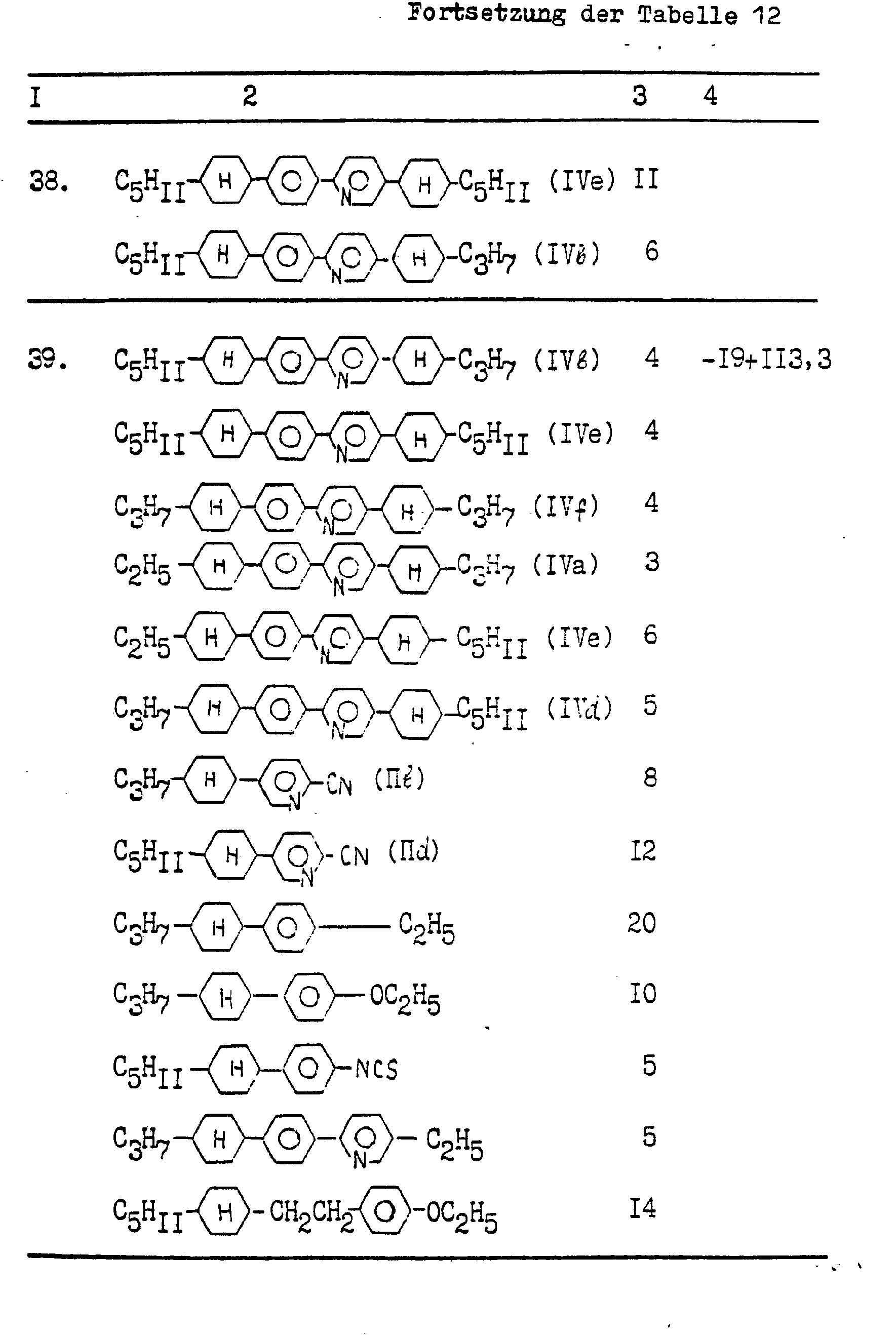

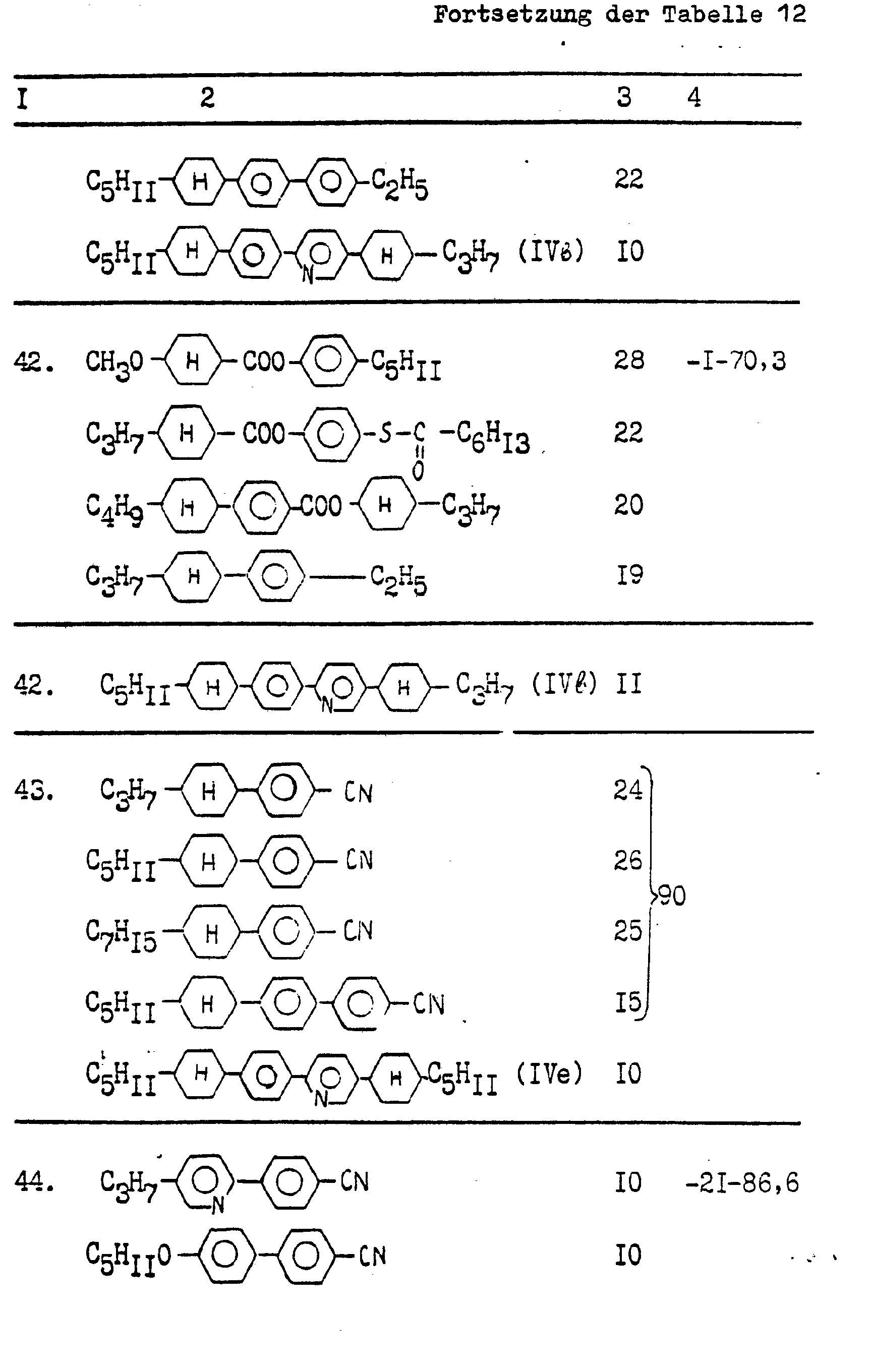


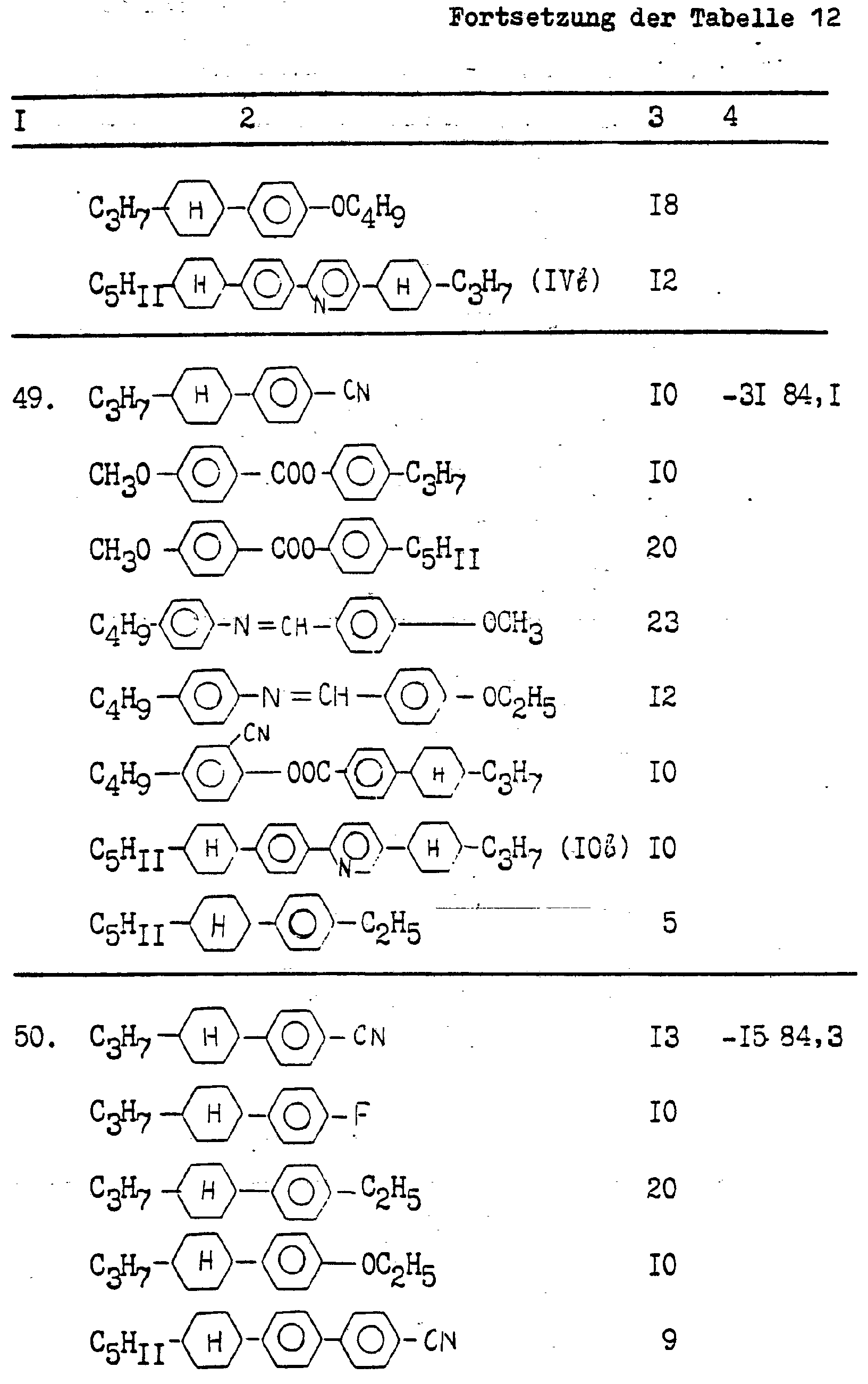

- Die in der Tabelle 12 angegebenen Beispiele für flüssigkristalline Materialien zeigen, daß die Verwendung neuer Pyridinderivate der Formel IV als Komponente der flüssigkristallinen Materialien ermöglicht, flüssigkristalline Materialien mit hohen oberen Grenzen und geringen unteren Grenzen des Temperaturenbereichs der nematischen Phase zu entwickeln, die zur Verwendung in äußeren elektrooptischen Einrichtungen geeignet sind.
- Zu einer auf 0 °C abgekühlten Lösung von 3,07 g (0,01 Mol) 2-[4-(trans-4-Propylzyklohexyl)-phenyl] -5-äthylpy- ridin in 30 ml konzentrierter Schwefelsäure setzt man langsam 1,01 g (0,01 Mol) Kaliumnitrat zu und rührt das Reaktionsgut bei dieser Temperatur innerhalb von 1 Stunde um, bis die Ausgangsverbindung verschwindet. Das Reaktionsgemisch wird auf 100 g Eis gegossen und mit 20%iger KOH-Lösung bis zum Erreichen eines pH-Wertes von etwa 8 angesäuert. Man extrahiert mit Benzol (2x50 ml), wäscht die organische Phase mit Wasser bis neutral und filtriert durch SiO2-Schicht L = 5/40 (h=2 cm). Die Mutterlauge wird in einem Verdampfer mit darin eingebautem Rotor verdampft, und der Rückstand aus Alkohol umkristallisiert.
- Man isoliert 2,53 g (72 %), Rf 0,5 Benzol, TSchmelz= = 62 °C 1H-NMR-Spektrum (δ , ppm, CDCl3): 0,85 (6H, Triplett CH3); 1,2-1,90 (14 H, verbr. Singulett CH2); 2,62 (2 H, Quadruplett, CH2Py); 7,60 (2 H, verbr. Singulett Hβγ ); 8,30 (1 H, Duplett,Jm2Hz,H2); 8,48 (1 H Duplett) Jm, 2 Hz, H); 8,08 (1 H, Doppelduplett, Jo 8 Hz, Jm 2 Hz, H6); 7,48 (1 H, Doppelduplett Jm 2 Hz, Jn 0,6 Hz, H5).
- Gefunden in %: C 75,11; H 8,12; N 8,00; C22H28N2O2.
- Berechnet in %: C 75,07; H 8,01; N 7,95.
- Analog sind andere Verbindungen der Formel V b-f hergestellt. Elementaranalysenangaben, TSchmelz und Ausbeuten an Verbindungen V b-f sind in der Tabelle 13 angeführt.

- Zu einer Lösung von 3,52 g (0,01 Mol) Verbindung V.a in 30 ml Alkohol werden 1 g Ni/Re, 4 ml 64%iges Hydrazin und 0,1 g NaOH hinzugefügt und zum Sieden erhitzt.
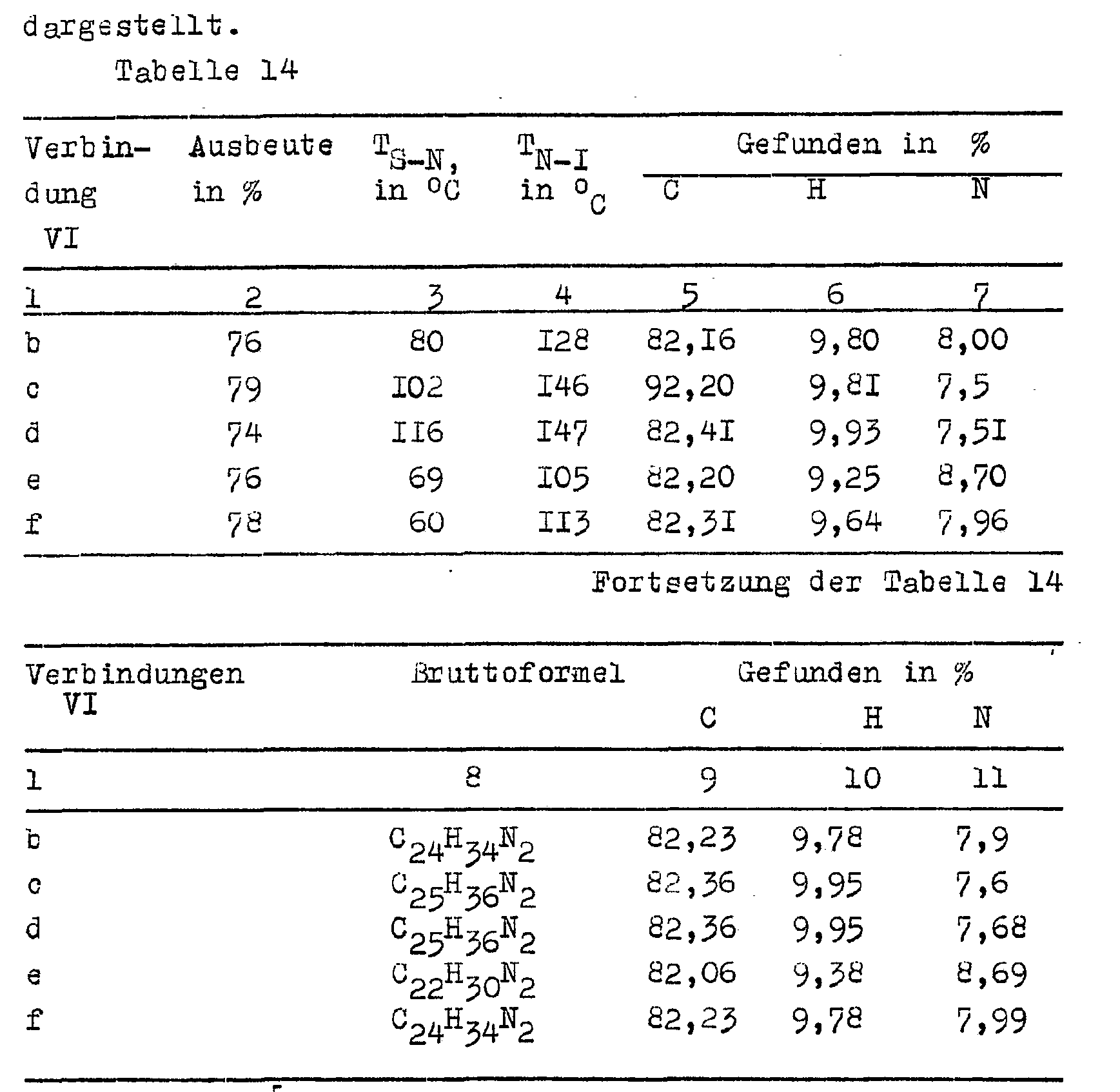
- Die Vollendung der Reaktion wird chromatografisch am Verschwinden des rohen Nitroderivats 52.1. a (etwa 1 Stunde) überwacnt. Man filtriert das Reaktionsgemisch, wäscht am Filter mit Alkohol und kühlt ab. Man isoliert 2,52 g (78 %) Verbindung VI. a, TS-N 86 °C, TN-I 127 °C.
- Gefunden in %: C d2,3; H 9,46; N 8,54; C22H30N2.
- Berechnet in %: C 82,06; H 9,38; N 8,69.
- Analog sind andere Verbindunge VI. b-f hergestellt. Elementaranalysenangaben, Phasenübergangstemperaturen und Ausbeuten an Verbindungen VI. b-f sind in der Tabelle 14
- Zu einer Suspension von 3,22 g (0,01 Mol) Verbindung VI.a in 30 ml HBF4 tropft man bei einer zwischen 0 und 5 °C liegenden Temperatur eine Lösung von 0,69 g (0,01 Mol) NaNC2 in 3 ml Wasser langsam unter Umrühren zu. Man rührt noch 1 Stunde lang bei dieser Temperatur um und filtriert dann das Reaktionsgut, wäscht mit 10 ml abgekühltem Äthylalkohol, trocknet am Filter an und wäscht mit absolutem Ather. Man bringt den trockenen Niederschlag in einen Einhalskolben mit 100 ml darin befindlichem absolutem Toluol ein und siedet das Gemisch innerhalb von 1 Stunde. Dann kühlt man ab und wäscht die Toluollösung mit gesättigter wäßriger Sodalösung und Wasser und filtriert die organische Phase durch Si02-Schicht L 5/40 (h = 2 cm). Das Lösungsmittel wird in einem Verdampfer mit dem darin eingebauten Rotor verdampft. Der Rückstand wird aus Azeton umkristallisiert und chromatografiert. Man isoliert 0,88 g (27 %) Verbindung VII. a mit TC-N = 60,2 °C, TN-I = 145,1 °C.
- Analog werden andere Verbindungen VII b-f hergestellt. Phasenübergangstemperaturen und Elementaranalysenangaben der Verbindungen VII a-f sind in der Tabelle 15 dargestellt.
- Vergleichswerte von Phasenübergangstemperaturen und Temperaturbereichen der nematischen Phase ΔTN für die bekannten, 2-[4-(trans-4-Alkylzyklohexyl)-3-fluorphenyl]--5-alkylpyridine (VII a-f) sind in der Tabelle 16 gegenübergestellt.


- Tabelle 16 zeigt, daß die Verbindungen VII a-f keine smektische Mesophase enthalten und der Temperaturenbereich der nematischen Phase ΔTN bei den neuen Verbindungen VII a-f breiter als ΔTN bei den bekannten Verbindungen ist.
- Tabelle 17 gibt die Zusammensetzung und die Eigenschaften von flüssigkristallinen Materialien, welche neue Pyridinderivate der Formel VII enthalten, an.


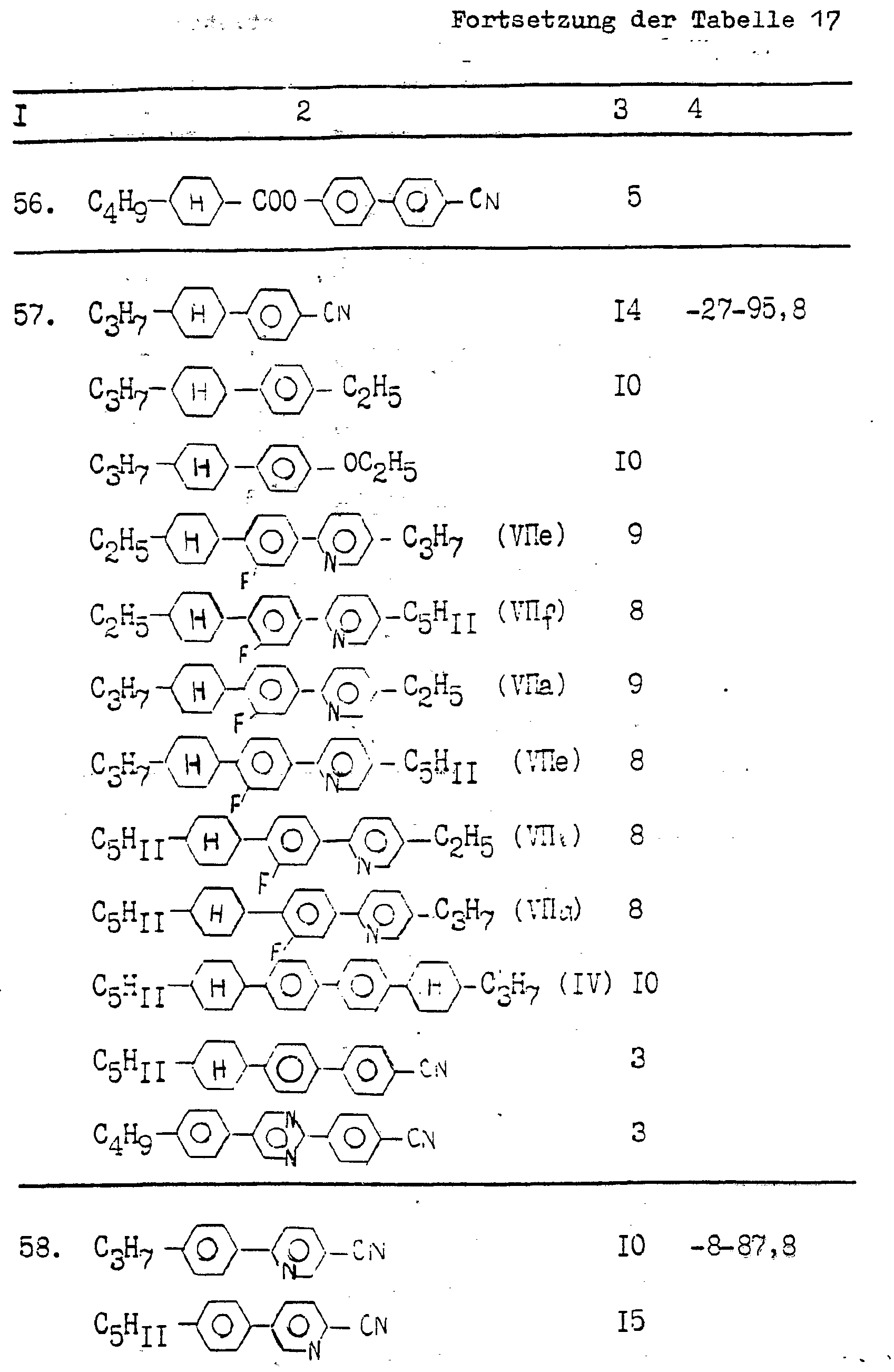


- Wie aus der Tabelle 17 zu ersehen ist, macht die Verwendung neuer Pyridinderivate der Formel VII als Komponenten der flüssigkristallinen Materialien möglich, flüssigkriställine Materialien mit geringen unteren Grenzen und hohen oberen Grenzen der Temperaturenbereiche der nematischen Phase, die zur Verwendung in äusseren elektrooptischen Einrichtungen geeignet sind, herzustellen.
- 62.1 2-[4-(trans-4-Penthyl)-3-nitrophenyl)-5--[4-(trans-4-äthylzyklohexyl)phenyl]-pyridin (VIIIa). Erhalten in 75%iger Ausbeute analog zur Verbindung Va. TC-N =87,0 °C TN-I = 168 °C (aus Äthanol) 1H-NMR-Spektrum ähnelt dem der Verbindung V.a.
- Gefunden in %: C 77,81; H 9,21; C30H42N2O2.
- Berechnet in %: C 77,88; H 9,15.
- Analog zu V.a. werden andere Verbindungen der Formel VIII hergestellt.
- Erhalten in 90%iger Ausbeute analog zu Verbindung VI.a.
- TC-S = 98,1 °C; TS-N =135,0; TN-I = 212,4 °C (aus Alkohol)
- Gefunden in %: C 83,36; H 10,19. C 30 H 44 N 2
- Berechnet in %: C 83,28; H 10,25
- Analog zu VI. a werden andere Verbindungen der Formel IX hergestellt.
- Erhalten analog zu VII a. TC-N =104,6 °C; TN-I > 270,0 °C (aus Alkohol).
- Gefunden in%: C 82,73; H 9,65. C30H42NF
- Berechnet in %: C 82,71; H 9,72
- Analog zu VII.a werden andere Verbindungen der Formel X hergestellt.
- Man erhält analog zu V. a in 70%iger Ausbeute. TC-N = 30 °C, TN-I = 42 °C (aus Äthanol).
- Gefunden in %: C 75,69; H 8,51; C24H32N2O2.
- Berechnet in %: C 75,75; H 8,48
- Analog zu V. a werden andere Verbindungen der Formel XII hergestellt.
-
- TC-N = 63,1 °C; TN-I = 120 oC (aus Äthanol)
- Gefunden in %: C 82,43; H 9,56. C24H34N2
- Berechnet in %: C 82,23; H 9,78
- Analog zu VI. a werden andere Verbindungen der Formel XIII hergestellt.
-
- Erhalten analog zu VIIa. TS-N = 120 °C, TN-I=127 °C.
- Gefunden in %: C 81,46; H 9,23. C24H32NF.
- Berechnet in %: C 81,54; H 9,12
- Analog zu VIIa werden andere Verbindungen der Formel XIV hergestellt.
- Erhalten analog zu Beispiel 33.4. Die Ausbeute beträgt 38 %. TC-S = 53 °C, TS-N = 122 °C, TN-I = 136 °C (aus Äthanol)
- Gefunden in %: C 78,60; H 9,12. C26H36NOF.
- Berechnet in %: C 78,55; H 9,13.
- Analog zu Beispiel 33.4 werden andere Verbindungen der Formel XV hergestellt,
-
- Gefunden in %: C 76,25; H 8,53; C 25 H 34 N 2 0 2
- Berechnet in %: C 76,10; H 8 8,69
- TS-N =97,0 °C, TN-I = 116,0 °C (aus Äthanol). Gefunden in %: C 82,50; H 10,00. C25H36N2 Berechnet in %: C 82,36; H 9,95.
- 65.3. Herstellung von 2-[4-/2-(trans-4-Butylzyklo- hexyl)-äthyl] -3-fluorphenyl -5-äthylpyridin (XVIa) analog zu VIIa.TC-N = 65 °C, TN-I = 115 °C Gefunden in %: C 81,75; H 9,44. C25H34NF Berechnet in %: C 81,70; H 9,32
- Es wird analog zu 25.3.a-25.5.a aus 1-β-Alkyläthylenylpiperidin und 1-Akryloyl-4-nitrobenzol hergestellt.
- TSchmelz = 48 °C (aus Äthanol)
- 1H-NMR-Spektrum (CCl4, δ, ppm): Triplett 0,92 (CH3), Multiplett 1,62 (CH2), Triplett 2,6 (CH2Py), Duplett 8,45 (J 2 Hz, H2), verbr. Singulett 7,55 (Hß Hj), verbr. Sing, 8, 15(H2, 6, 3, 5)
- Analog zu 25.3.a-25.5.a sind andere Verbindungen 66.1.b-e hergestellt.

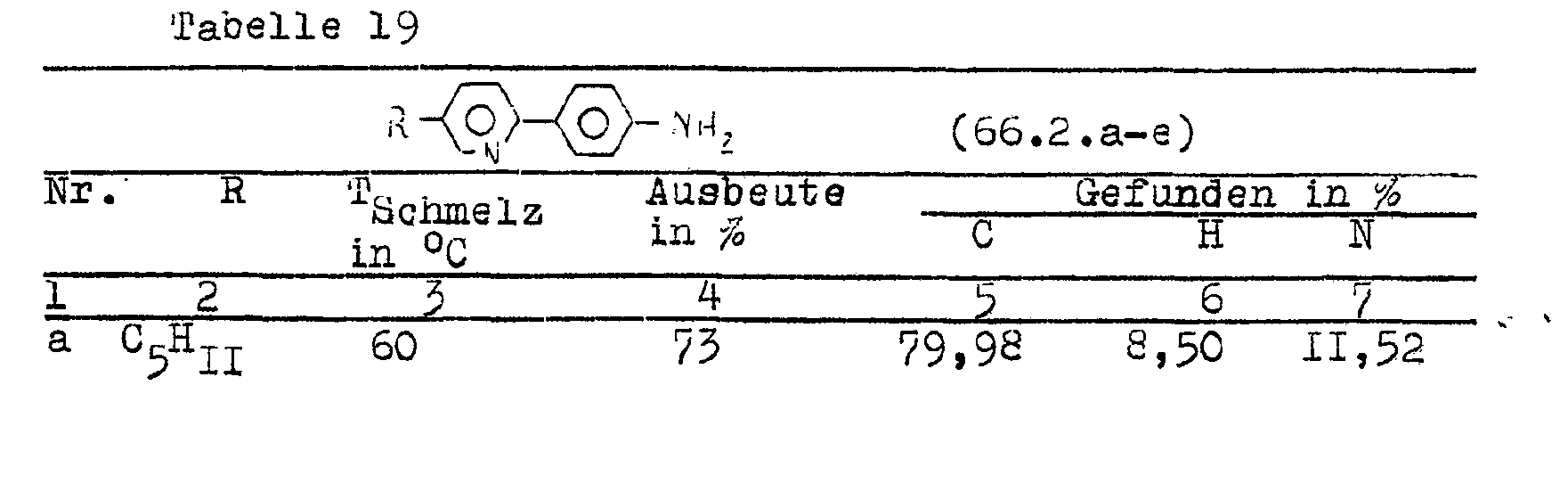
- Ein Gemisch aus 30 ml Äthanol, 0,01 Mol 2-(4-Nitrophenyl)-5-pentylpyridin (66.1.a), 1g Ni/Re, 2,5 ml Hydrazinhydrat und 0,1 g HaOH wird in einem mit Rückflußkühler versehenen Kolben gesiedet, bis die Ausgangsverbindung 66.1.a auf dem Chromatogramm verschwindet. Das Reaktionsgut wird abfiltriert und auf eine Temperatur von -10 °C abgekühlt. Man isoliert 0,0073 mol 2-(4-Aminophenyl)-5-pentylpyridin (66.2.a) in 73%iger Ausbeute. Analog sind andere Verbindungen 66.2 b-e hergestellt, deren Elementaranalyse und Eigenschaften in der Tabelle 19 angegeben sind.

- Man löst 0,02 Mol 2-(4-Aminophenyl)-5-pentylpyridin 66.2.a in 10 ml absolutem Benzol auf, gibt 0,02 Mol CS2, 3 ml Et3N zu und läßt für 5 Tage stehen. Der ausgefallene Niederschlag wird abfiltriert und mit absolutem Äther gewaschen, dann in einen Dreihalskolben, versehen mit einem Rührwerk, einem Thermometer und einem Tropftrichter mit Gegenstrom, eingebracht. Man bringt in den Kolben 20 ml absolutes Chloroform ein und tropft bei 0 °C 3 ml Et3N und dann 3 ml Äthylchlorformiat zu. Das Reaktionsgut wird innerhalb von 10 Minuten bei 0°C und dann innerhalb von 1 Stunde bei Raumtemperatur umgerührt, die Chloroformschicht mit 1%iger Salzsäure und Wasser gewaschen, und nach der Trocknung über Na2SO4 durch SiO2-Schicht L = 5/40 (h = 2 cm) abfiltriert. Man dampft die Mutterlauge unter Vakuum ein, kristallisiert den Rückstand aus Hexan um. Man isoliert 0,0106 Mol 5-(Pentyl-2-(4-isothiozyanophenyl)-pyridin in 53%iger Ausbeute. Analog werden andere Verbindungen XVII b-e, deren Elementaranalyse und Eigenschaften in der Tabelle 20 angegeben sind, hergestellt.
- Phasenübergangstemperaturen der bekannten Verbindungen 4-Alkyl-4'-isothiozyanobiphenyle und der neuen Verbindungen 5-Alkyl-2-(4-isothiozyanophenyl)-pyridine (XVII a-e) sind vergleichsweise in der Tabelle 21 gegenübergestellt. Die Tabelle 21 zeigt, daβ die neuen Verbindungen bedeutend höhere Klärpunkte gegenüber aen bekannten Verbindungen 4-Alkyl-4'-isothiozyanobiphenylen aufweisen. (MCLC, Letters, v.102, no.155, 1984. R.Dabrowski, J.Dzia- duszek, T.Szcucinski. "4-(Trans-4' -n-alkyloyclohexyl)iso- thiocyanatobenzenes", A new class of lowmelting stable nematics")

- Tabelle 22 gibt die Zusammensetzung und Eigenschaften der flüssigkristallinen Materialien an, welche neue Derivate von 2,5-disubstituiertem Pyridin der Formel XVII enthalten.


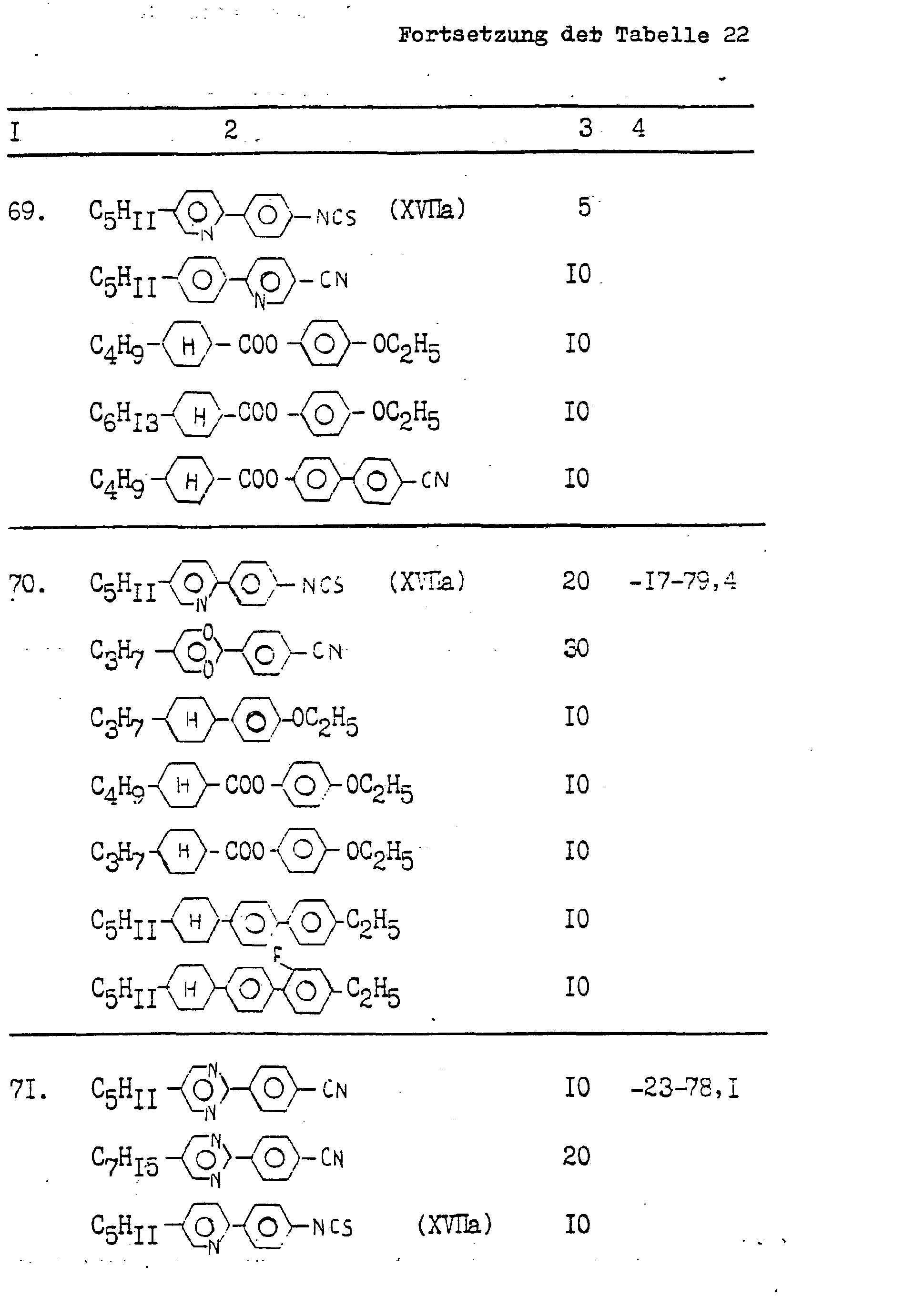

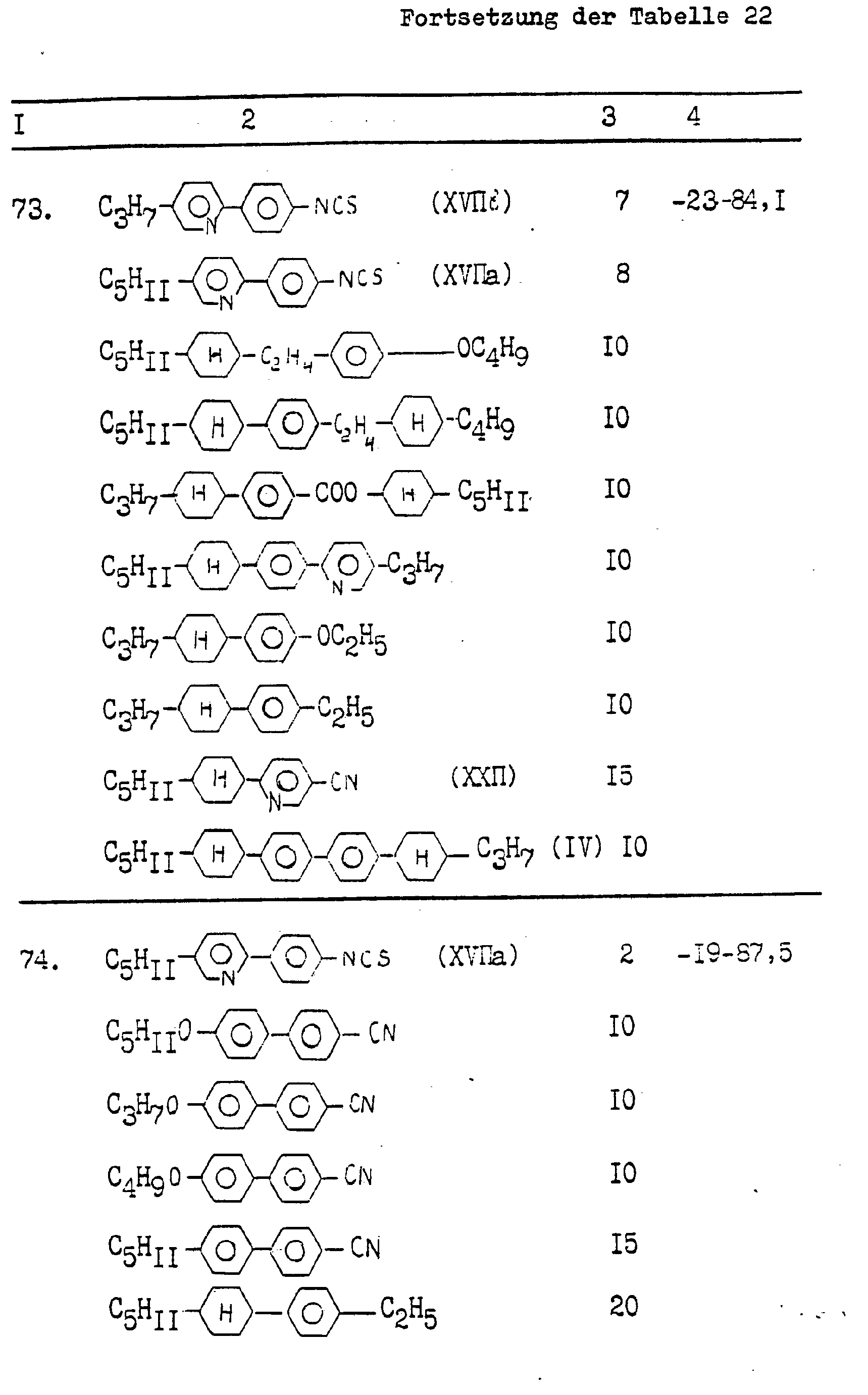

- Aus der Tabelle 22 ist zu ersehen, daß die Verwendung der neuen Pyridinderivate der Formel XVII als Komponenten von flüssigkristallinen Materialien ermöglicht, flüssigkristalline Materialien mit einem breiten Temperaturenbereich der nematischen Phase herzustellen.
- (76.1.a) Man erhält analog zu 25.3.a-25.5.a aus 1-ß-Alkyläthylenylpiperidin und 4-Akryloyl-4'-bromphenyl.
- Gefunden in %: (69,36; H 5,91. C22H22NBr
- Berechnet in %: C 69,48; H 5,83.
- III.a unter Verwendung der Verbindung 76.1.a.
- TC-S = 90,1 °C, TS-N = 162 °C, TN-I = 251 oC.
- Gefunden in %: C 84,71; H 6,65. C23H22N2·
- Berechnet in %: C 84,63; H 6,79.
- Analog zu IIIa werden andere Verbindungen der Formel XVIII hergestellt.
- In einen Kolben, versehen mit einem Rückflußkühler, einem Rührwerk und einem Gaseinlaßrohr, bringt man im Argonstrom 4,14 g (15 mMol) 2-(4-Bromphenyl)-5-propylpyridin, 0,183 g (0,6 mMol) P(aCH3C6H4)3, 0,0345 g (0,15 mMol) Pd(OAc)2, 7,65 ml Et3N und 1,62 g (1,56 ml, 22,5 mMol) Akrylsäure ein. Der Kolben wird bis zum Sieden erhitzt und im Argonstrom innerhalb von 1 Stunde verdampft. Man löst das Reaktionsgut in 100 ml Wasser auf, filtriert durch ein Glasfilter und säuert das Filtrat mit 10%iger Salzsäure bis zum Erzielen eines pH-Wertes von etwa 6 an. Der ausgefallene Niederschlag wird abfiltriert, mit Wasser und - Azeton gewaschen, an der Luft getrocknet. Man isoliert 4 g (99 %) 77.1. a und leitet zur folgenden Stufe ohne Umkristallisation und Analyse.
- Zu einer Mischung von 3,35 g (11,1 mMol) Verbindung 77.1.a in 10 ml Dichlormethan setzt man unter Umrühren 3,5 g (16,5 mMol) Phosphorpentachlorid zu und rührt noch innerhalb von 3 Stunden weiter um. Das Reaktionsgut wird langsam bei 0 °C in 30 ml Ammoniakflüssigkeit gegossen, innerhalb von 1 Stunde gerührt, und das Dichlormethan eingedampft. Der Niederschlag wird abfiltriert, mit Wasser und Azeton gewaschen. Man isoliert 2,3 g (79,5 %) Verbindung 77.2.a. mit TSchmelz = 240 bis 245 °C. Analog isoliert man die Verbindung 77.2.b. mit TSchmelz =238-241°C, 77.2.c mit TSchmelz =235-240 °C, 77.2.d mit TSchmelz = = 230-234 °C, 77.2.e mit TSchmelz = 229-234 °C. Die Stoffe erden ohne Analyse zur folgenden Stufe geleitet.
- Man siedet das Gemisch von 2,3 g (8,75 mMol) ungereinigtem Amid 77.2.a und 10 ml Phosphoroxidchlorid innerhalb von 2 Stunden, destilliert das überschüssige Phosphoroxidohlorid im Vakuum ab, fügt 50 ml Benzol dem Rückstand hinzu und neutralisiert mit der Ammoniakflüssigkeit unter Abkühlung. Die Benzolschioht wird mit Wasser gewaschen, über wasserfreiem Natriumsulfat getrocknet und durch Si02--Schicht L = 5/40 (h = 2 cm) abfiltriert. Man treibt Benzol ab, kristallisiert den Rückstand aus Alkohol um. Man isoliert 1,4 g (61 %) Verbindung XIX a.
- 1H-NMR-Spektrum (CCl4): Multiplett 0,85 (3 H, CH3); Multiplett 1,3-1,6 (2 H, CH2); Triplett 2,65 (2 H, J = = 6 Hz, CH2Ph); Duplett 5,95 (1 H, J = 16,5 Hz, H );Duplett 7,45 (1 H, J = 16,5 Hz, Hß ); Duplett 7,55 (2 H, J = 8 Hz, H3,5); Dopellduplett 7,6 (1 H, Jβγ = 8 Hz, Jαγ =2 Hz, Hγ); Doppelduplett 7,7 (1 H, Jβγ= 8 Hz, Jßα = 1 Hz, Hβ); Duplett 8,05 (2 H, J = 8 Hz, H26); Duplett 8,55 (1 H, J = 1 Hz, Hα ).
- Analog werden andere Verbindungen der Formel XIX b-e hergestellt.
- Die Phasenübargangstemperaturen und Elementaranalyse der Verbindungen der Formel XIX a-e sind in der Tabelle 23 dargestellt.
- Die Phasenübergangstemperaturen der bekannten Verbindungen 4-Alkyl-4' -(2-E-zyanovinyl)-biphenyle und der neuen Verbindungen der Formel XIX sind vergleichsweise in der Tabelle 24 gegenübergestellt.


- Aus der Tabelle 24 ist ersichtlich, daß Klärpunkte der neuen Verbindungen der Formel XIX (a-e) bedeutend höher als die der bekannten. Verbindungen sind (Biuletyn Wojskomej Akademii technicznej, Rok XXX, Nr. 6 (346), 143, 1981. R.Dabrowski, E.Zytynski. "Wlasnosci mesomorficzne pochodnych 4-n-pentylobifenylu",).
- Die Tabelle 25 gibt die Zusammensetzung und die Eigenschaften der flüssigkristallinen Materialien an, welche die neuen Pyridinderivate der Formel XIX (a-e) enthalten.
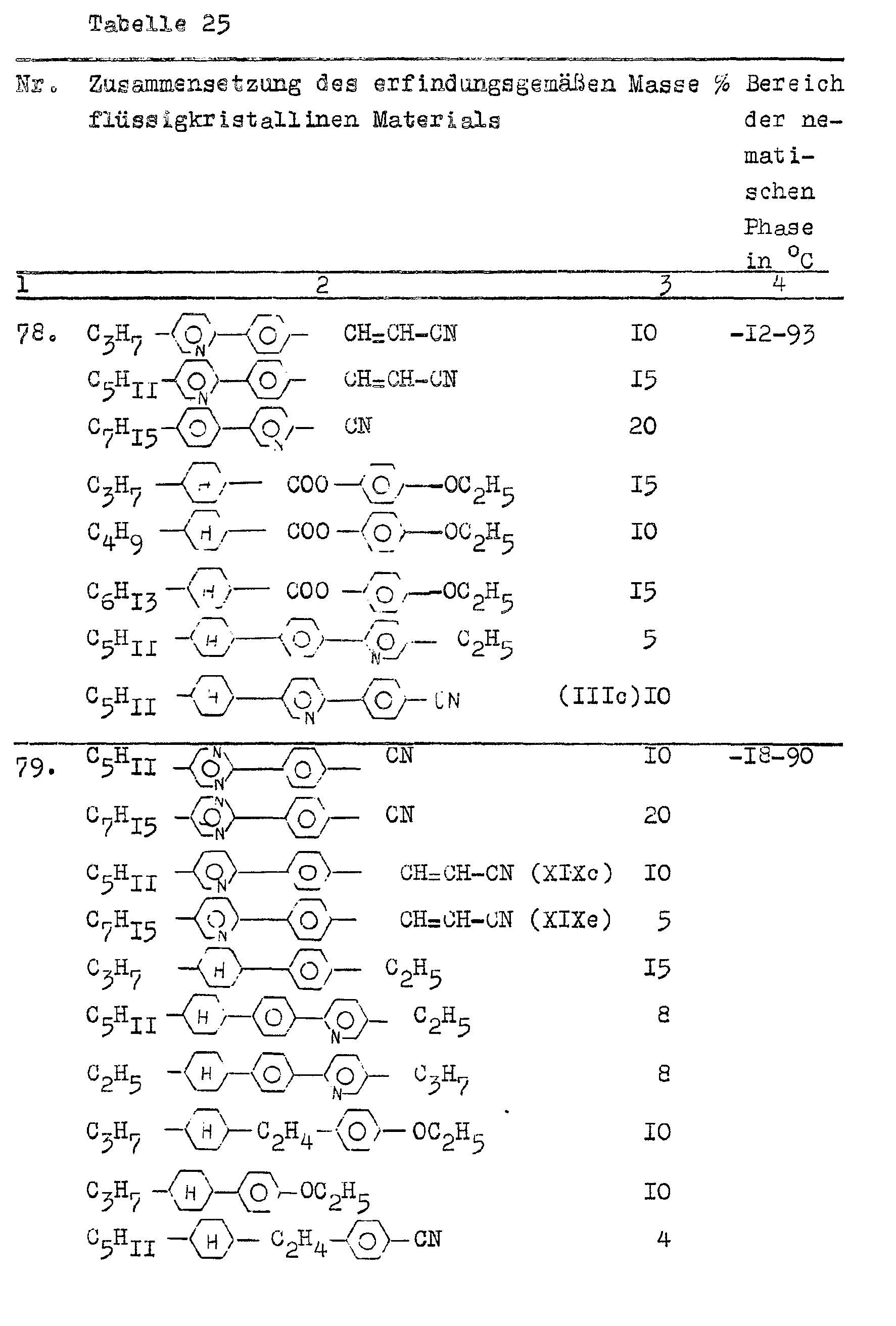

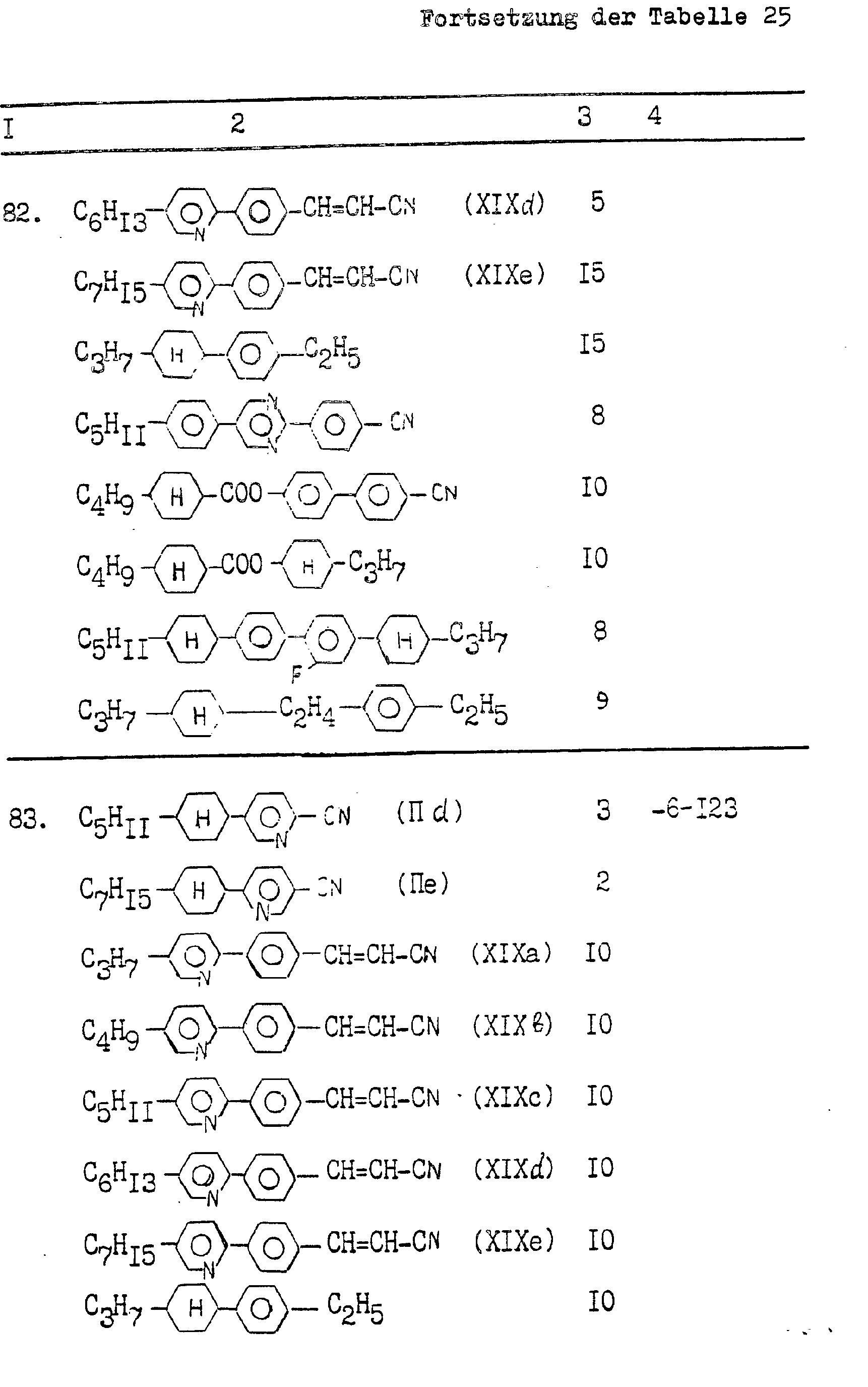
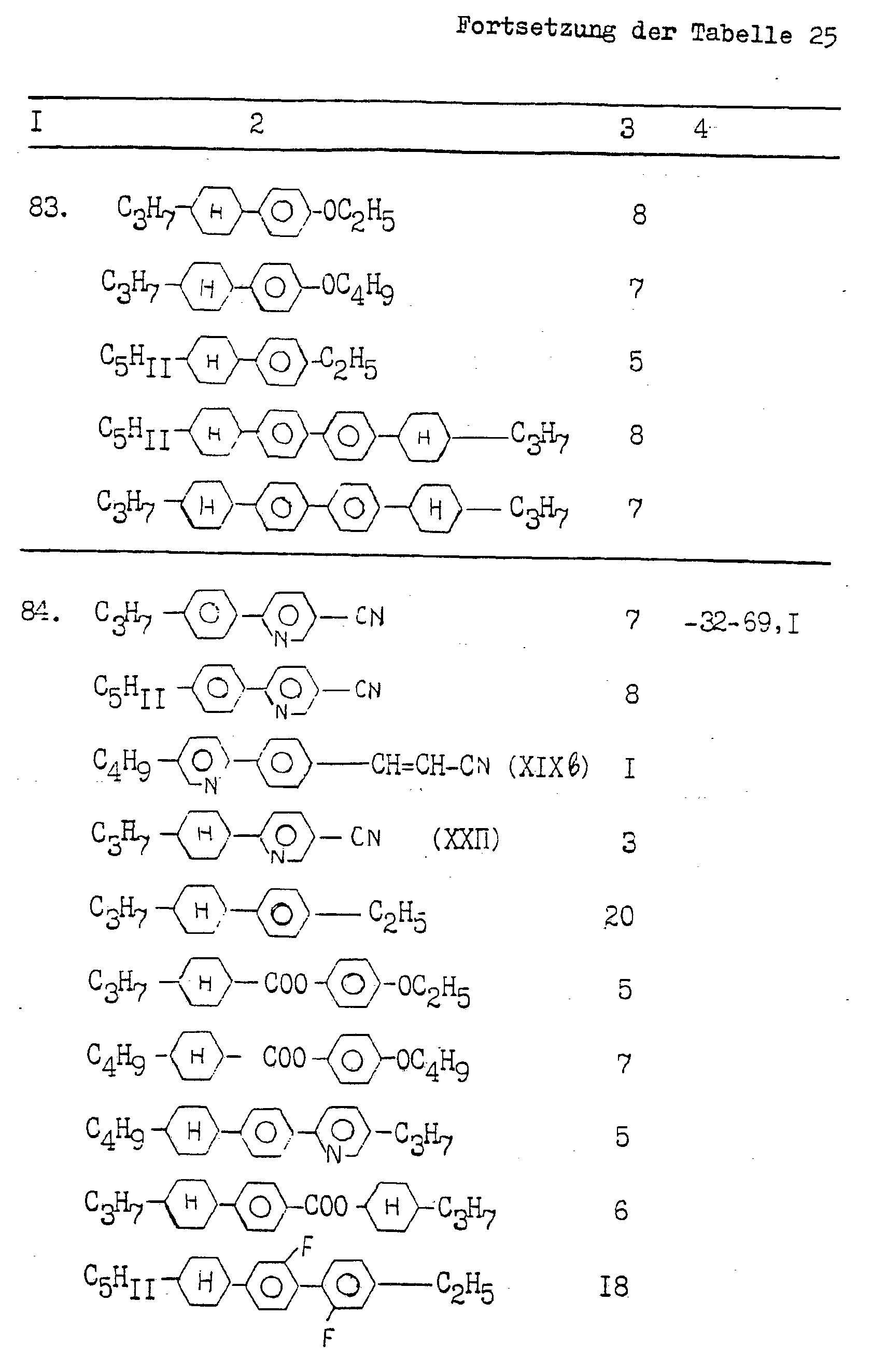

- Die Tabelle 25 zeigt, daß die Verwendung der neuen Pyridinderivate der Formel XIX als Komponenten der flüssigkristallinen Materialien ermöglicht, flüssigkristalline Materialien mit einem breiten Temperaturenbereich der nematischen Phase und hohen Klärpunkten herzustellen.
- Beispiel 85. Herstellung von 2- [4(2-E-Zyanovinyl)-pheny]-5-(trans-4-alkylzyklohexyl)-pyridinen (XX) 85.1. 2-[4-(2-E-Karboxyvinyl)-phenyl] -5-(tran-4-propylzyklohexyl)-pyridin-hydr,ogenchlorid (85.1.a) Die Verbindung 85.1.a ist analog zu 77.1.a aus 25.5.b erhalten und ohne Reinigung zur folgenden Stufe geleitet.
- 85.2. 2- [4-(2-E-Karboxyvinyl)-phenyl]5-(trans-4-propylzyklohexyl)-pyridin-amid.(85.2.a) ist analog zu 79.2.a erhalten und ohne Reinigung zur folgenden Stufe geleitet.
- 85.3. Herstellung von 2-[4-(2-(2-E-Zyanovinyl)-phenyl]--5-(4-trans-propylzyklohexyl)-pyridin (XXa).
- Erhalten analog zu XIX a. TC-N- 133,0 °C, TN-I = = 318,4 °C (aus Äthanol)
- Gefunden in %: C 83,64; H 7,81. C23H26N2
- Berechnet in %: C 83,59; H 7,93.
- Analog zu XIX. a werden andere Verbindungen der Formel XX hergestellt.
- 86,1. Herstellung von 2-[4-(2-E-Zyanovinyl)-phenyl]--5-(4-amylphenyl)-pyridin (XXI.a). Erhalten analog zu XIX.a aus 2-(4-Bromphenyl)-5-(4-amylphenyl)-pyridin. TC-S = 136,1 °C, TS-N = 168,5 °C, TN-I = 310 °C.
- Gefunden in %: C 85,31; H 6,73. C25H24N2
- Berechnet in %: C 85,19; H 6,86.
- Analog zu XIX.a werden andere Verbindungen der Formel XXI hergestellt.
- 87.1. trans-4-Hexyl-4-azetylzyklohexan (87.1.a) ist nach der allgemeinüberlichen Methodik aus trans-4-Hexyl- zyklohexankarbonsäurechlorid und magnesiumorganischem Diäthylmalonatderivat in 79%iger Ausbeute hergestellt. Der Siedepunkt beträgt 120 °C,4,Torr nD 25 = 1,4590. Mit Hilfe der 1H-NMR von 13C wurde nachgewiesen, daß das trans--cis-Verhältnis bei 87.la 7:1 beträgt.
- Analog werden andere Verbindungen der Formel 87.1.b-e hergestellt.

- Zu 3,27 g (0,14 Mol) Natriumdraht in 200 ml absolutem Äther fügt man unter Umrühren und Sieden eine Mischung hinzu, die aus 29,6 g (0,14 Mol) Verbindung (87.1.a) und 12,7 g (0,17 Mol)Äthylformiat besteht. Der ausgefallene Niederschlag wird abfiltriert, mit 50 ml absolutem Äther gewaschen und im Vakuum getrocknet. Man isoliert 31,8 g (87,7%) Natriumsalz. Das erhaltene Salz in einer Menge von 31,8 g (0,12 Mol) und 10,5 g (0,12 Mol) Zyanazetamid bringt man in eine Lösung ein, die 500 ml Dioxan, 50 ml H20, 3,5 ml Essigsäure und 5 ml Piperidin enthält, und rührt bei Raumtemperatur innerhalb von 5 Stunden um. Das Gemisch siedet 12 Stunden lang, dann gießt man es in I 1 H20 und säuert mit Essigsäure an. Der Niederschlag wird abfiltriert, mit Wasser und Äthanol gewaschen, an der Luft getrocknet und ohne Umkristallisation zur folgenden Stufe geleitet. Man isoliert 20 g Verbindung 87.2.a in 56%iger Ausbeute. TSchmelz = 228 °C (aus Dioxan).
- Analog werden andere Verbindungen der Formel 87.2.b-e hergestellt.
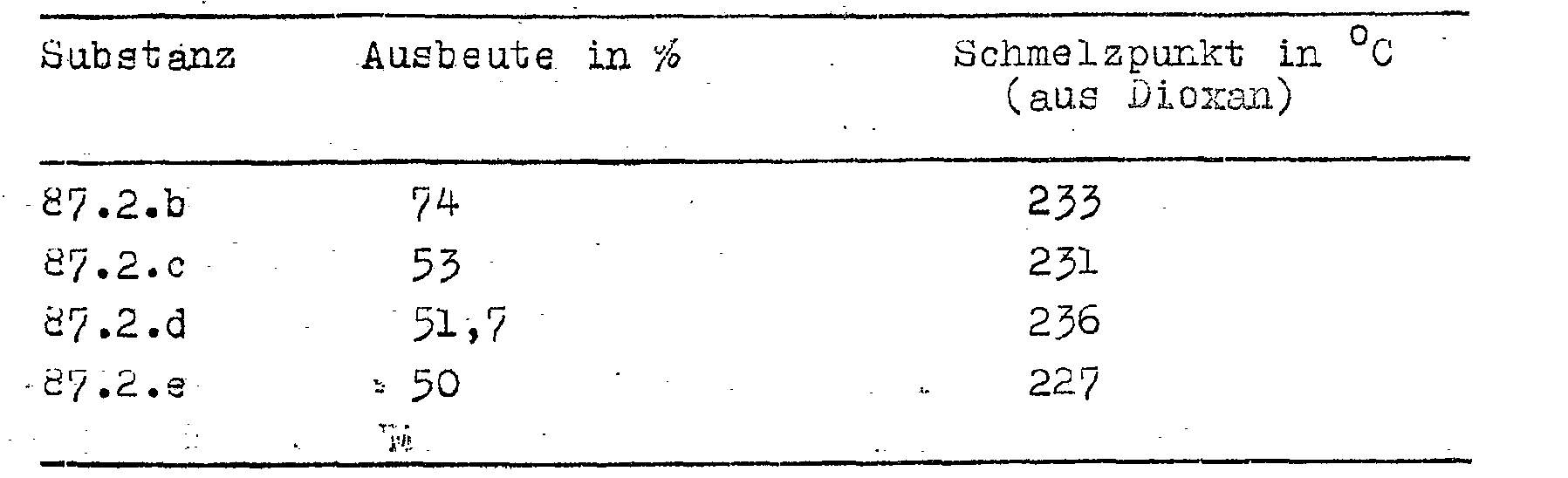
- Eine Mischung aus 18,2 g (0,06 Mol) Verbindung 87.2.a und 25,4 g (0,13 Mol) PhP0Cl2 wird unter Umrühren bei einer zwischen 120 und 130 °C liegenden Temperatur innerhalb von 3 Stunden erhitzt. Elan kühlt das Reaktionsgut auf Raumtemperatur ab und gieβt in 200 g Eis-Wasser-Mischung aus, rührt 1 Stunde lang um und säuert mit wäβriger Ammoniaklösung bis zum Erzielen eines pH-Wertes von etwa 9 an. Der Niederscnlag wird abfiltriert, mit Wasser gewaschen, getrocknet und abdestilliert. Man isoliert 14,8 g Verbindung 87.03.a in 75%iger Ausbeute. TSiede = 220 °C/ /2 Torr. TSchmelz= 61,29 oC (aus Hexan). Analog werden andere Verbindungen 87.3.b-e hergestellt.

- 87.4. 2-(trans-4-Hexylzyklohexyl)-5-zyanopyridin (XXIIa) Eine Mischung aus 14,8 g (0,048 Mol) Verbindung 87.3.a, 1 g 10%igem Pd/C, 5,3 g wässerfreier Soda (0,05 Mol), 200 ml absolutem Athylazetat wird bei Raumtemperatur und 1 atm Wasserstoffdruck hydriert, bis die berechnete Wasserstoffmenge (innerhalb von etwa 10 Stunden) aufgenommen wird. Das Reaktionsgut wird abfiltriert, das Lösungsmittel im Vakuum abdestilliert und der Rückstand durch Chromatografieren in einer Säule mit Silikagel (Säulenhöhe 20 cm, Allkagel 40/100, Eluent Benzol-Hexan-Mischung bei einem Verhältnis von 1:2) gereinigt. Man isoliert 7 g Verbindung XXII.a in 54%iger Ausbeute. TC-S = 36,3 °C, TS-N= = 41,5 °C, TN-I = 60,4 °C (aus Hexan). Analog werden andere Verbindungen der Formel XXII b-e hergestellt. Phasenübergangstemperaturen und Elementaranalyse der Verbindungen der Formel XXII b-f sind in der Tabelle 26 angegeben. Der Aufbau der Verbindungen wird durch 'H-NMR- und NMR-Spekuren mit 13C nachgewiesen. So weist das 'H-NMR-Spektrum (CCl4) der Verbindungen der Formel XXII a (δ, ppm) folgendes auf:
- 1,08-2,85 [23 H, Elultiplett CH3, CH(CH2)9]; 7,28 (1 H, Duplett, Jortho = 8 Hz, H3); 7,92 (1 H Doppelduplett
- Jortho = 8 Hz, H4); 8,8 (1 H, Singulett, H6).

- der bekannten und der neuen Verbindungen sind Mischungen dieser Stoffe zu verwenden, weil die einzelnen Verbindungen der benkanten Verbindungen und die Verbindungen der Formel XXII sehmale nematische Bereiche aufweisen, welche zur Messung der elektrooprischen Parameter nicht ausreichen. Die Mischungen des dritten, fünften und sechsten Homologen liefern dabei einen breiten Temperaturenbereich der Mesophase und eignen sich also zu Vergleichszwecken. Es ist auch zu berücksichtigen, daβ die Gesetzmäßigkeit der Änderungen von Eigenschaften bei Gliedern der homologen Reihe gewöhnlich mit dem ausreichenden Ganauigkeitsgrad bekannt ist, d.h. nach den Eigenschaften der Mischung des dritten, fünften und sechsten Homolgen kann man die Eigenschaften der Glieder der ganzen homologen Reihe beurteilen.

- Es wurden deshalb folgende ternäre Mischungen hergestellt:
- Mischung A: 30 Mol% 2-(trans-4-Propylzyklohexyl)-5-zyano- pyridin, 40 Mol% 2-(trans-4-Pentylzyklohexyl)--5-zyanopyridin, 30 Mol% 2-(trans-4-Hexylzy- klohexyl)-5-zyanopyridin
- Mischung B: 30 Mol% 5-Propyl-2-(4-zyanophenyl)-pyridin. 40 Mol% 5-Pentyl-2-(4-zyanophenyl)-pyridin, 30 Mol% 5-Hexyl-2-(4-zyanophenyl)-pyridin
- Mischung C: 30 Mol% 2-(4-Propylphenyl)-5-zyanopyridin, 40 Mol% 2-(4-Pentylphenyl)-5-zyanopyridin, 30 Mol% 2-(4-Hexylphenyl)-5-zyanopyridin.
- Die Vergleichsdaten der Phasenübergangstemperaturen, Anisotropien der Dielektrizitätskonstante und elektrooptische Parameter von Mischungen A, B, C zeigt die Tabelle 27.


- τ= TMEB, OK/TN-I in OK
- Δε=ε=ε Anisotropie der Dielektrizitätskonstante
- Poise Koeffizient der Rotationsviskosität
- Δn optische Anisotropie
- USchwelle in V Schwellespannung beim Twist-Effekt beim Durchlässigkeitsniveau von 0,9 (die Ausgangsdurchlässigkeit der Zelle beträgt 1,0)
- USätt in V Sättigungsspannung beim Twist-Effekt beim Durchlässigkeitsniveau der Zelle von 0,1
- U, in V Meßspannung
- τAus in ms Ausschaltzeit, d.h. die Zeit, die vom Abschalten der Spannung bis zum Erreichen des Durchlässigkeitsniveaus aus der Zelle von 0,9 dauert.
- d in µm Dicke der Zelle
- Die Tabelle 27 zeigt, daß der Koeffizient der Rotationsviskosität γ1 = 1,40 P bei 25 °C für die Mischung der neuen Verbindungen (Mischung A) bedeutend kleiner als γ1 für die Mischung B (γ1 = 1,92 P) und für die Mischung C (γ1= 3,50 P) ist.
- In der Tabelle 28 sind Zusammensetzungen und Eigenschaften von flüssigkristallinen Materialien dargestellt, welche neue Pyridinderivate der Formel XXII enthalten.
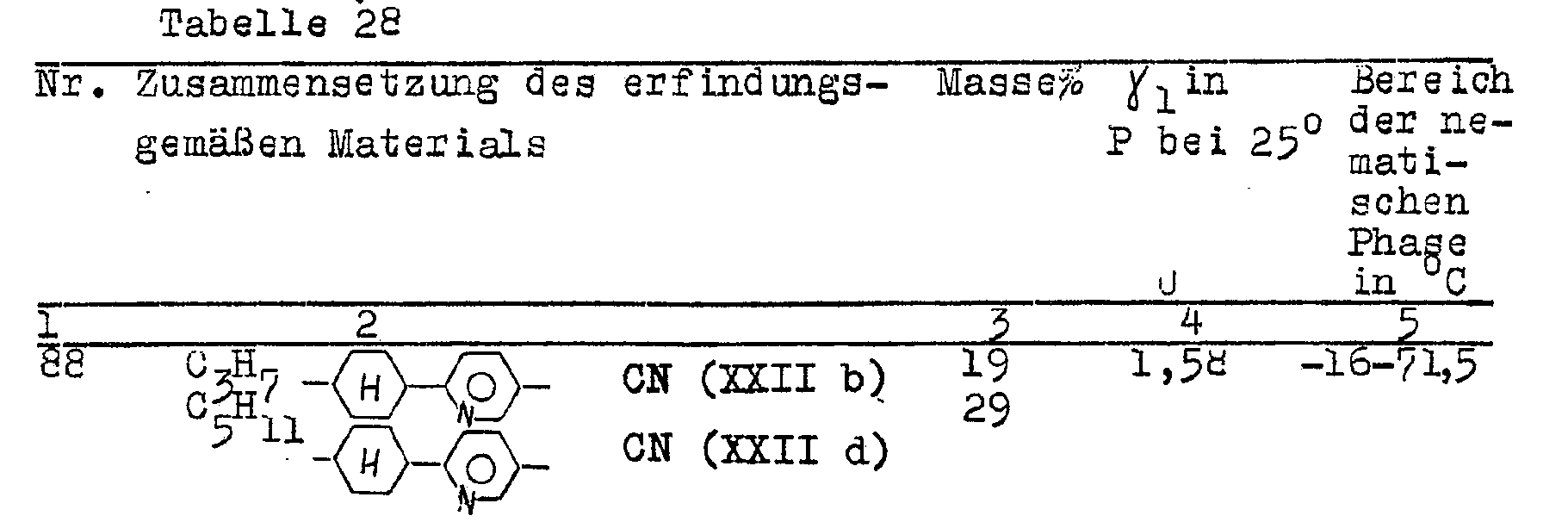


- Aus der Tabelle 28 ist zu ersehen, daß die Verwendung der neuen Pyridinderivate der Formel XXII als Komponenten der flüssigkristallinen Materialien möglich macht, flüssigkristalline Materialien mit geringen Koeffizienten der Rotationsviskosität und breiten Temperaturenbereichen der nematischen Phase herzustellen, die sich zur Verwendung in schnellwirkenden elektrooptischen Einrichtungen eignen.
- Erhalten durch Kondensation von Enamin mit entsprechen .dem Vinylketon unter anschließender Umsetzung von Pyran mit Hydroxylammoniumchlorid analog zu 33.4. Ausbeute 65%. TC-SA = 28 °C, TSA-I = 49,1 °C (aus Äthanol).
- Gefunden in %: C 77,91; H 9,43.C 25 H 36 NDF.
- Berechnet in %: C 77,88; H 9,41.
- Analog werden andere Verbindungen der Formel XXIII hergestellt.
- Die erfindungegemäßen Verbindungen weisen einen breiten Spektrumbereioh der Eigenschaften auf, der es möglich macht,diese Verbindungen bei der Entwicklung von flüssigkeitsfallinen Materialien zu verwenden. Diese flüssigkristallinen Materialien können in verschiedenen elektrooptischen Einrichtungen mit statischer und dynamischer Arbeitsweise, beispielsweise in den Uhren, Mikrokalkulatoren, Fernseheabschirmungen, in den Einrichtungen mit der Sonnenbatteriespeisung sowie in den Einrichtungen der äußeren Anwendung u.a.m. ihre Anwendung finden.
bringt man in ein Gefäß ein, rührt innig unter Erhitzen bis zum Auftreten der isotropen Phase um, kühlt ab und erhält das gebrauchsfertige flüssigkristalline Material mit einem Temperaturenbereich von -15 bis 75,1 °C für die nematische Phase und einem Koeffizienten der Rotationsviskosität γ1 = 1,47 P bei 25 °C.
Claims (30)
1. Flüssigkriatalline Derivate von 2,5-disubstituiertem Pyridin der allgemeinen' Formel

worin wenn Y
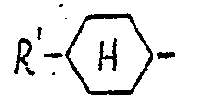
ist, Z für CN,

steht, wenn Y R1, ist, Z für


steht, wenn Y -CN ist, Z für

steht, wenn Y

ist, Z. für

steht, wenn Y

ist, Z für

steht, R1, R2 eine Alkylgruppe mit 1 bis 12 Kohlenstoffatomen R1, R2 eine Alkylgruppe mit 1 bis 12 Kohlenstoffatomen darstellen, A3 für F, NO2, NH2 und CN steht.
2. Verbindung nach Anspruch 1 der Formel

3. Verbindung nach Anspruch 1 der Formel

4. Verbindung nach Anspruch 1 der Formel

5. Verbindung nach Anspruch 1 der Formel

6. Verbindung nach Anspruch 1 der Formel

7. Verbindung nach Anspruch 1 der Formel

8.Verbindung nach Anspruch 1 der Formel

9. Verbindung nach Anspruch 1 der Formel

10. Verbindung nach Anspruch 1 der Formel

11. Verbindung nach Anspruch 1 der Formel
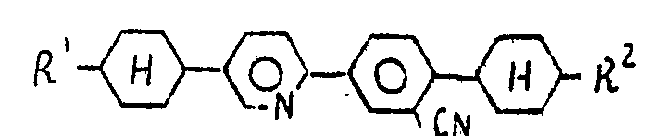
12. Verbindung nach Anspruch 1 der Formel
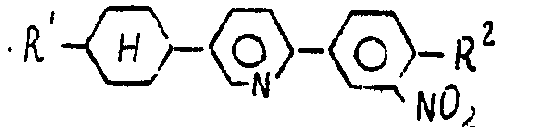
13. Verbindung nach Anspruch 1 der Formel
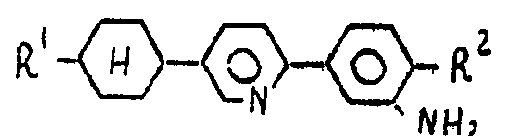
14. Verbindung nach Anspruch 1 der Formel

15. Verbindung nach Anspruch 1 der Formel

16. Verbindung nach Anspruch 1, der Formel

17. Verbindung nach Anspruch 1 der Formel

18. Verbindung nach Anspruch 1 der Formel

19. Verbindung nach Anspruch 1 der Formel

20. Verbindung nach Anspruch 1 der Formel

21. Verbindung nach Anspruch 1 der Formel

22. Verbindung nach Anspruch 1 des Formel

23. Verbindung nach Anspruch 1 der Formel

24. Verbindung nach Anspruch 1 der Formel

25. Verbindung nach Anspruch 1 der Formel

26. Verbindung nach Anspruch 1 der Formel
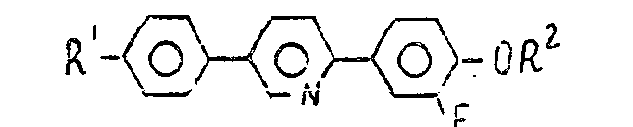
27. Verbindung nach Anspruch 1 der Formel

28. Verbindung nach Anspruch 1 der Formel

29. Flüssigkristallines Material, enthaltend zumindest zwei flüssigkristalline Komponenten, dadurch gekennzeichnet, daß mindestens eine der genannten flüssigkristallinen Komponenten ein flüssigkristallines Derivat von 2,5-disubstituiertem Pyridin nach Anspruch 1 dient.
30. Flüssigkristallines Material nach Anspruch 1, dadurch gekennzeichnet, daß es das genannte flüssigkristalline Derivat von 2,5-disubstituiertem Pyridin in einer Menge von 1 bis 75 Masse% enthält.
Applications Claiming Priority (6)
| Application Number | Priority Date | Filing Date | Title |
|---|---|---|---|
| SU874234348A SU1710556A1 (ru) | 1987-04-07 | 1987-04-07 | 2-[4-(4-Транс-Алкилциклогексил)-фенил]-5-(4-транс-алкилциклогексил)-пиридины в качестве компонентов жидкокристаллического материала дл электрооптических устройств и жидкокристаллический материал дл электрооптических устройств |
| SU4234347 | 1987-04-07 | ||
| SU874234347A SU1710557A1 (ru) | 1987-04-07 | 1987-04-07 | 5-Алкил-2-(4-изотиоцианофенил)-пиридины в качестве компонентов жидкокристаллического материала дл электрооптических устройств и жидкокристаллический материал дл электрооптических устройств |
| SU4234348 | 1987-04-07 | ||
| SU4280285 | 1987-07-07 | ||
| SU874280285A SU1703643A1 (ru) | 1987-07-07 | 1987-07-07 | 5-Алкил-2-[4-(2-Е-циановинил)-фенил]-пиридины в качестве компонентов жидкокристаллического материала и жидкокристаллический материал дл электрооптических устройств |
Publications (2)
| Publication Number | Publication Date |
|---|---|
| EP0310676A1 true EP0310676A1 (de) | 1989-04-12 |
| EP0310676A4 EP0310676A4 (de) | 1989-04-27 |
Family
ID=27356431
Family Applications (1)
| Application Number | Title | Priority Date | Filing Date |
|---|---|---|---|
| EP19880903125 Withdrawn EP0310676A4 (de) | 1987-04-07 | 1987-12-30 | Flüssigkristallderivate von 2,5-disubstituierten pyridinen als komponenten von flüssigkristallmaterialien und flüssigkristallmaterial. |
Country Status (3)
| Country | Link |
|---|---|
| EP (1) | EP0310676A4 (de) |
| HU (1) | HUT47630A (de) |
| WO (1) | WO1988007992A1 (de) |
Cited By (5)
| Publication number | Priority date | Publication date | Assignee | Title |
|---|---|---|---|---|
| US5205962A (en) * | 1989-09-22 | 1993-04-27 | Merck Patent Gesellschaft Mit Beschrankter Haftung | Pyridine derivatives |
| WO1999005097A1 (de) * | 1997-07-24 | 1999-02-04 | Merck Patent Gmbh | Flüssigkristalline propen- oder propynylnitrilderivate |
| US6562817B1 (en) | 1998-01-28 | 2003-05-13 | Shionogi & Co., Ltd. | Tricyclic compound |
| WO2004074253A1 (en) * | 2003-02-22 | 2004-09-02 | Merck Patent Gmbh | Cyanopyridone derivatives as liquid crystals |
| WO2007118572A1 (de) * | 2006-04-15 | 2007-10-25 | Merck Patent Gmbh | Flüssigkristalline mischungen und flüssigkristallanzeigen |
Families Citing this family (2)
| Publication number | Priority date | Publication date | Assignee | Title |
|---|---|---|---|---|
| EP0242716B1 (de) * | 1986-04-22 | 1991-03-20 | F. Hoffmann-La Roche Ag | Flüssigkristalline Pyridinderivate |
| JP2532886B2 (ja) * | 1987-09-08 | 1996-09-11 | チッソ株式会社 | ネマチツク液晶組成物 |
Family Cites Families (9)
| Publication number | Priority date | Publication date | Assignee | Title |
|---|---|---|---|---|
| EP0164721A3 (de) * | 1984-06-13 | 1986-02-26 | Chisso Corporation | Flüssigkristalline Verbindung und flüssigkristalline Zusammensetzung welche diese enthält |
| DE3524489A1 (de) * | 1984-07-12 | 1986-01-23 | Kabushiki Kaisha Suwa Seikosha, Tokio/Tokyo | 2-phenylpyridinderivate und verfahren zu ihrer herstellung |
| US4684477A (en) * | 1985-03-06 | 1987-08-04 | Chisso Corporation | Pyridine derivatives and their use in liquid crystals |
| DE3545345A1 (de) * | 1985-12-20 | 1987-07-02 | Merck Patent Gmbh | Fluessigkristalline senfoele |
| DE3600052A1 (de) * | 1986-01-03 | 1987-07-09 | Merck Patent Gmbh | Heterocyclische verbindungen |
| JPH0739392B2 (ja) * | 1986-03-26 | 1995-05-01 | チッソ株式会社 | 含ハロゲンピリジン液晶化合物及び液晶組成物 |
| JPS62234066A (ja) * | 1986-04-01 | 1987-10-14 | Chisso Corp | フエニルピリジン誘導体 |
| EP0242716B1 (de) * | 1986-04-22 | 1991-03-20 | F. Hoffmann-La Roche Ag | Flüssigkristalline Pyridinderivate |
| JP2516014B2 (ja) * | 1986-05-24 | 1996-07-10 | チッソ株式会社 | 2−(アルキルオキシカルボニルオキシフエニル)−5−アルキルピリジン及び組成物 |
-
1987
- 1987-12-30 WO PCT/SU1987/000161 patent/WO1988007992A1/ru not_active Ceased
- 1987-12-30 EP EP19880903125 patent/EP0310676A4/de not_active Withdrawn
-
1988
- 1988-04-07 HU HU172888A patent/HUT47630A/hu unknown
Cited By (8)
| Publication number | Priority date | Publication date | Assignee | Title |
|---|---|---|---|---|
| US5205962A (en) * | 1989-09-22 | 1993-04-27 | Merck Patent Gesellschaft Mit Beschrankter Haftung | Pyridine derivatives |
| WO1999005097A1 (de) * | 1997-07-24 | 1999-02-04 | Merck Patent Gmbh | Flüssigkristalline propen- oder propynylnitrilderivate |
| US6444279B1 (en) | 1997-07-24 | 2002-09-03 | Merck Patent Gmbh | Liquid crystal propene or propenyl nitrile derivatives |
| US6562817B1 (en) | 1998-01-28 | 2003-05-13 | Shionogi & Co., Ltd. | Tricyclic compound |
| WO2004074253A1 (en) * | 2003-02-22 | 2004-09-02 | Merck Patent Gmbh | Cyanopyridone derivatives as liquid crystals |
| US7442475B2 (en) | 2003-02-22 | 2008-10-28 | Merck Patent Gmbh | Cyanopyridone derivatives as liquid crystals |
| WO2007118572A1 (de) * | 2006-04-15 | 2007-10-25 | Merck Patent Gmbh | Flüssigkristalline mischungen und flüssigkristallanzeigen |
| US7785678B2 (en) | 2006-04-15 | 2010-08-31 | Merck Patent Gmbh | Liquid-crystalline mixtures and liquid-crystal displays |
Also Published As
| Publication number | Publication date |
|---|---|
| HUT47630A (en) | 1989-03-28 |
| WO1988007992A1 (fr) | 1988-10-20 |
| EP0310676A4 (de) | 1989-04-27 |
Similar Documents
| Publication | Publication Date | Title |
|---|---|---|
| EP0154840B1 (de) | Flüssigkristalline Verbindungen | |
| EP0107759B1 (de) | Cyclohexanderivate und ihre Verwendung als Komponenten Flüssigkristalliner-Dielektrika | |
| DE3342631A1 (de) | Thienothiophenderivate | |
| EP0471813B1 (de) | 4,4'-disubstituierte 2',3-difluorbiphenyle und flüssigkristallines medium | |
| EP0182054A2 (de) | Heterocyclische Verbindungen | |
| WO1987005017A2 (en) | Optically active compounds | |
| EP0473208B1 (de) | Ein Pyrazin oder Pyridin-Ring enthaltende flüssigkristalline Verbindungen | |
| EP0117476A1 (de) | Tetrahydropyrane | |
| DE3871725T2 (de) | Cyclohexan-derivate. | |
| DD231369A5 (de) | Fluessigkristalline phase | |
| CH645102A5 (de) | Disubstituierte pyrimidine. | |
| DE3743965C2 (de) | Optisch aktive Flüssigkristall-Verbindung und sie enthaltende Flüssigkristall-Zusammensetzung | |
| DE3742885C2 (de) | ||
| EP0095626B1 (de) | Piperidinderivate | |
| DD261803A5 (de) | Chirale getiltete smektisch fluessigkristalline phase | |
| DE3322982A1 (de) | 1,4-dioxane | |
| EP0387315B1 (de) | Fluorierte alkoxyverbindungen | |
| DE3404055C2 (de) | ||
| EP0168701A2 (de) | Tercyclohexyle | |
| EP0428665B1 (de) | Fluorphenylpyrimidine | |
| DE3814346A1 (de) | Pyridinderivate, ihre verwendung als komponenten fluessigkristalliner phasen, entsprechende fluessigkristallphasen und sie enthaltende fluessigkristallanzeigeelemente | |
| DE10217771A1 (de) | Biscyclohexyl-1,3-dioxane und Verfahren zu deren Herstellung | |
| EP0184068A1 (de) | Carbonitrile | |
| EP0374849A2 (de) | Flüssigkristalline Derivate von stickstoffhaltigen heterocyclischen Systemen als Komponenten eines flüssigkristallinen Materials und ein flüssigkristallines Material | |
| EP0438574B1 (de) | 2,5-disubstituierte heterocyclen und flüssigkristallines medium |
Legal Events
| Date | Code | Title | Description |
|---|---|---|---|
| PUAI | Public reference made under article 153(3) epc to a published international application that has entered the european phase |
Free format text: ORIGINAL CODE: 0009012 |
|
| 17P | Request for examination filed |
Effective date: 19881202 |
|
| AK | Designated contracting states |
Kind code of ref document: A1 Designated state(s): DE FR GB IT NL |
|
| A4 | Supplementary search report drawn up and despatched |
Effective date: 19890427 |
|
| 17Q | First examination report despatched |
Effective date: 19910613 |
|
| STAA | Information on the status of an ep patent application or granted ep patent |
Free format text: STATUS: THE APPLICATION HAS BEEN WITHDRAWN |
|
| 18W | Application withdrawn |
Withdrawal date: 19911001 |