EP0310903A2 - Verwendung von Organosilicium-Verbindungen zum Verdicken von Ölen - Google Patents
Verwendung von Organosilicium-Verbindungen zum Verdicken von Ölen Download PDFInfo
- Publication number
- EP0310903A2 EP0310903A2 EP88115776A EP88115776A EP0310903A2 EP 0310903 A2 EP0310903 A2 EP 0310903A2 EP 88115776 A EP88115776 A EP 88115776A EP 88115776 A EP88115776 A EP 88115776A EP 0310903 A2 EP0310903 A2 EP 0310903A2
- Authority
- EP
- European Patent Office
- Prior art keywords
- radical
- oils
- carbon atoms
- general formula
- hydrogen
- Prior art date
- Legal status (The legal status is an assumption and is not a legal conclusion. Google has not performed a legal analysis and makes no representation as to the accuracy of the status listed.)
- Granted
Links
Images


Classifications
-
- A—HUMAN NECESSITIES
- A61—MEDICAL OR VETERINARY SCIENCE; HYGIENE
- A61K—PREPARATIONS FOR MEDICAL, DENTAL OR TOILETRY PURPOSES
- A61K8/00—Cosmetics or similar toiletry preparations
- A61K8/18—Cosmetics or similar toiletry preparations characterised by the composition
- A61K8/72—Cosmetics or similar toiletry preparations characterised by the composition containing organic macromolecular compounds
- A61K8/84—Cosmetics or similar toiletry preparations characterised by the composition containing organic macromolecular compounds obtained by reactions otherwise than those involving only carbon-carbon unsaturated bonds
- A61K8/89—Polysiloxanes
- A61K8/891—Polysiloxanes saturated, e.g. dimethicone, phenyl trimethicone, C24-C28 methicone or stearyl dimethicone
- A61K8/894—Polysiloxanes saturated, e.g. dimethicone, phenyl trimethicone, C24-C28 methicone or stearyl dimethicone modified by a polyoxyalkylene group, e.g. cetyl dimethicone copolyol
-
- A—HUMAN NECESSITIES
- A61—MEDICAL OR VETERINARY SCIENCE; HYGIENE
- A61K—PREPARATIONS FOR MEDICAL, DENTAL OR TOILETRY PURPOSES
- A61K47/00—Medicinal preparations characterised by the non-active ingredients used, e.g. carriers or inert additives; Targeting or modifying agents chemically bound to the active ingredient
- A61K47/30—Macromolecular organic or inorganic compounds, e.g. inorganic polyphosphates
- A61K47/34—Macromolecular compounds obtained otherwise than by reactions only involving carbon-to-carbon unsaturated bonds, e.g. polyesters, polyamino acids, polysiloxanes, polyphosphazines, copolymers of polyalkylene glycol or poloxamers
-
- A—HUMAN NECESSITIES
- A61—MEDICAL OR VETERINARY SCIENCE; HYGIENE
- A61K—PREPARATIONS FOR MEDICAL, DENTAL OR TOILETRY PURPOSES
- A61K8/00—Cosmetics or similar toiletry preparations
- A61K8/18—Cosmetics or similar toiletry preparations characterised by the composition
- A61K8/72—Cosmetics or similar toiletry preparations characterised by the composition containing organic macromolecular compounds
- A61K8/84—Cosmetics or similar toiletry preparations characterised by the composition containing organic macromolecular compounds obtained by reactions otherwise than those involving only carbon-carbon unsaturated bonds
- A61K8/89—Polysiloxanes
- A61K8/891—Polysiloxanes saturated, e.g. dimethicone, phenyl trimethicone, C24-C28 methicone or stearyl dimethicone
-
- A—HUMAN NECESSITIES
- A61—MEDICAL OR VETERINARY SCIENCE; HYGIENE
- A61K—PREPARATIONS FOR MEDICAL, DENTAL OR TOILETRY PURPOSES
- A61K8/00—Cosmetics or similar toiletry preparations
- A61K8/18—Cosmetics or similar toiletry preparations characterised by the composition
- A61K8/72—Cosmetics or similar toiletry preparations characterised by the composition containing organic macromolecular compounds
- A61K8/84—Cosmetics or similar toiletry preparations characterised by the composition containing organic macromolecular compounds obtained by reactions otherwise than those involving only carbon-carbon unsaturated bonds
- A61K8/89—Polysiloxanes
- A61K8/891—Polysiloxanes saturated, e.g. dimethicone, phenyl trimethicone, C24-C28 methicone or stearyl dimethicone
- A61K8/893—Polysiloxanes saturated, e.g. dimethicone, phenyl trimethicone, C24-C28 methicone or stearyl dimethicone modified by an alkoxy or aryloxy group, e.g. behenoxy dimethicone or stearoxy dimethicone
-
- A—HUMAN NECESSITIES
- A61—MEDICAL OR VETERINARY SCIENCE; HYGIENE
- A61Q—SPECIFIC USE OF COSMETICS OR SIMILAR TOILETRY PREPARATIONS
- A61Q19/00—Preparations for care of the skin
-
- B—PERFORMING OPERATIONS; TRANSPORTING
- B01—PHYSICAL OR CHEMICAL PROCESSES OR APPARATUS IN GENERAL
- B01J—CHEMICAL OR PHYSICAL PROCESSES, e.g. CATALYSIS OR COLLOID CHEMISTRY; THEIR RELEVANT APPARATUS
- B01J19/00—Chemical, physical or physico-chemical processes in general; Their relevant apparatus
- B01J19/06—Solidifying liquids
-
- C—CHEMISTRY; METALLURGY
- C08—ORGANIC MACROMOLECULAR COMPOUNDS; THEIR PREPARATION OR CHEMICAL WORKING-UP; COMPOSITIONS BASED THEREON
- C08G—MACROMOLECULAR COMPOUNDS OBTAINED OTHERWISE THAN BY REACTIONS ONLY INVOLVING UNSATURATED CARBON-TO-CARBON BONDS
- C08G77/00—Macromolecular compounds obtained by reactions forming a linkage containing silicon with or without sulfur, nitrogen, oxygen or carbon in the main chain of the macromolecule
- C08G77/04—Polysiloxanes
-
- C—CHEMISTRY; METALLURGY
- C09—DYES; PAINTS; POLISHES; NATURAL RESINS; ADHESIVES; COMPOSITIONS NOT OTHERWISE PROVIDED FOR; APPLICATIONS OF MATERIALS NOT OTHERWISE PROVIDED FOR
- C09K—MATERIALS FOR MISCELLANEOUS APPLICATIONS, NOT PROVIDED FOR ELSEWHERE
- C09K3/00—Materials not provided for elsewhere
-
- C—CHEMISTRY; METALLURGY
- C10—PETROLEUM, GAS OR COKE INDUSTRIES; TECHNICAL GASES CONTAINING CARBON MONOXIDE; FUELS; LUBRICANTS; PEAT
- C10M—LUBRICATING COMPOSITIONS; USE OF CHEMICAL SUBSTANCES EITHER ALONE OR AS LUBRICATING INGREDIENTS IN A LUBRICATING COMPOSITION
- C10M119/00—Lubricating compositions characterised by the thickener being a macromolecular compound
- C10M119/30—Lubricating compositions characterised by the thickener being a macromolecular compound containing atoms of elements not provided for in groups C10M119/02 - C10M119/28
-
- C—CHEMISTRY; METALLURGY
- C10—PETROLEUM, GAS OR COKE INDUSTRIES; TECHNICAL GASES CONTAINING CARBON MONOXIDE; FUELS; LUBRICANTS; PEAT
- C10M—LUBRICATING COMPOSITIONS; USE OF CHEMICAL SUBSTANCES EITHER ALONE OR AS LUBRICATING INGREDIENTS IN A LUBRICATING COMPOSITION
- C10M2229/00—Organic macromolecular compounds containing atoms of elements not provided for in groups C10M2205/00, C10M2209/00, C10M2213/00, C10M2217/00, C10M2221/00 or C10M2225/00 as ingredients in lubricant compositions
- C10M2229/04—Siloxanes with specific structure
-
- C—CHEMISTRY; METALLURGY
- C10—PETROLEUM, GAS OR COKE INDUSTRIES; TECHNICAL GASES CONTAINING CARBON MONOXIDE; FUELS; LUBRICANTS; PEAT
- C10M—LUBRICATING COMPOSITIONS; USE OF CHEMICAL SUBSTANCES EITHER ALONE OR AS LUBRICATING INGREDIENTS IN A LUBRICATING COMPOSITION
- C10M2229/00—Organic macromolecular compounds containing atoms of elements not provided for in groups C10M2205/00, C10M2209/00, C10M2213/00, C10M2217/00, C10M2221/00 or C10M2225/00 as ingredients in lubricant compositions
- C10M2229/04—Siloxanes with specific structure
- C10M2229/041—Siloxanes with specific structure containing aliphatic substituents
-
- C—CHEMISTRY; METALLURGY
- C10—PETROLEUM, GAS OR COKE INDUSTRIES; TECHNICAL GASES CONTAINING CARBON MONOXIDE; FUELS; LUBRICANTS; PEAT
- C10M—LUBRICATING COMPOSITIONS; USE OF CHEMICAL SUBSTANCES EITHER ALONE OR AS LUBRICATING INGREDIENTS IN A LUBRICATING COMPOSITION
- C10M2229/00—Organic macromolecular compounds containing atoms of elements not provided for in groups C10M2205/00, C10M2209/00, C10M2213/00, C10M2217/00, C10M2221/00 or C10M2225/00 as ingredients in lubricant compositions
- C10M2229/04—Siloxanes with specific structure
- C10M2229/042—Siloxanes with specific structure containing aromatic substituents
-
- C—CHEMISTRY; METALLURGY
- C10—PETROLEUM, GAS OR COKE INDUSTRIES; TECHNICAL GASES CONTAINING CARBON MONOXIDE; FUELS; LUBRICANTS; PEAT
- C10M—LUBRICATING COMPOSITIONS; USE OF CHEMICAL SUBSTANCES EITHER ALONE OR AS LUBRICATING INGREDIENTS IN A LUBRICATING COMPOSITION
- C10M2229/00—Organic macromolecular compounds containing atoms of elements not provided for in groups C10M2205/00, C10M2209/00, C10M2213/00, C10M2217/00, C10M2221/00 or C10M2225/00 as ingredients in lubricant compositions
- C10M2229/04—Siloxanes with specific structure
- C10M2229/043—Siloxanes with specific structure containing carbon-to-carbon double bonds
-
- C—CHEMISTRY; METALLURGY
- C10—PETROLEUM, GAS OR COKE INDUSTRIES; TECHNICAL GASES CONTAINING CARBON MONOXIDE; FUELS; LUBRICANTS; PEAT
- C10M—LUBRICATING COMPOSITIONS; USE OF CHEMICAL SUBSTANCES EITHER ALONE OR AS LUBRICATING INGREDIENTS IN A LUBRICATING COMPOSITION
- C10M2229/00—Organic macromolecular compounds containing atoms of elements not provided for in groups C10M2205/00, C10M2209/00, C10M2213/00, C10M2217/00, C10M2221/00 or C10M2225/00 as ingredients in lubricant compositions
- C10M2229/04—Siloxanes with specific structure
- C10M2229/044—Siloxanes with specific structure containing silicon-to-hydrogen bonds
-
- C—CHEMISTRY; METALLURGY
- C10—PETROLEUM, GAS OR COKE INDUSTRIES; TECHNICAL GASES CONTAINING CARBON MONOXIDE; FUELS; LUBRICANTS; PEAT
- C10M—LUBRICATING COMPOSITIONS; USE OF CHEMICAL SUBSTANCES EITHER ALONE OR AS LUBRICATING INGREDIENTS IN A LUBRICATING COMPOSITION
- C10M2229/00—Organic macromolecular compounds containing atoms of elements not provided for in groups C10M2205/00, C10M2209/00, C10M2213/00, C10M2217/00, C10M2221/00 or C10M2225/00 as ingredients in lubricant compositions
- C10M2229/04—Siloxanes with specific structure
- C10M2229/045—Siloxanes with specific structure containing silicon-to-hydroxyl bonds
-
- C—CHEMISTRY; METALLURGY
- C10—PETROLEUM, GAS OR COKE INDUSTRIES; TECHNICAL GASES CONTAINING CARBON MONOXIDE; FUELS; LUBRICANTS; PEAT
- C10M—LUBRICATING COMPOSITIONS; USE OF CHEMICAL SUBSTANCES EITHER ALONE OR AS LUBRICATING INGREDIENTS IN A LUBRICATING COMPOSITION
- C10M2229/00—Organic macromolecular compounds containing atoms of elements not provided for in groups C10M2205/00, C10M2209/00, C10M2213/00, C10M2217/00, C10M2221/00 or C10M2225/00 as ingredients in lubricant compositions
- C10M2229/04—Siloxanes with specific structure
- C10M2229/046—Siloxanes with specific structure containing silicon-oxygen-carbon bonds
-
- C—CHEMISTRY; METALLURGY
- C10—PETROLEUM, GAS OR COKE INDUSTRIES; TECHNICAL GASES CONTAINING CARBON MONOXIDE; FUELS; LUBRICANTS; PEAT
- C10M—LUBRICATING COMPOSITIONS; USE OF CHEMICAL SUBSTANCES EITHER ALONE OR AS LUBRICATING INGREDIENTS IN A LUBRICATING COMPOSITION
- C10M2229/00—Organic macromolecular compounds containing atoms of elements not provided for in groups C10M2205/00, C10M2209/00, C10M2213/00, C10M2217/00, C10M2221/00 or C10M2225/00 as ingredients in lubricant compositions
- C10M2229/04—Siloxanes with specific structure
- C10M2229/047—Siloxanes with specific structure containing alkylene oxide groups
-
- C—CHEMISTRY; METALLURGY
- C10—PETROLEUM, GAS OR COKE INDUSTRIES; TECHNICAL GASES CONTAINING CARBON MONOXIDE; FUELS; LUBRICANTS; PEAT
- C10M—LUBRICATING COMPOSITIONS; USE OF CHEMICAL SUBSTANCES EITHER ALONE OR AS LUBRICATING INGREDIENTS IN A LUBRICATING COMPOSITION
- C10M2229/00—Organic macromolecular compounds containing atoms of elements not provided for in groups C10M2205/00, C10M2209/00, C10M2213/00, C10M2217/00, C10M2221/00 or C10M2225/00 as ingredients in lubricant compositions
- C10M2229/04—Siloxanes with specific structure
- C10M2229/048—Siloxanes with specific structure containing carboxyl groups
Definitions
- Thickeners for non-aqueous systems in particular thickeners for mineral oils, ester oils and vegetable oils are used in particular in cosmetics and for the production of lubricants. Depending on the intended use, different thickeners are used.
- R2 is a hydrogen radical, a methyl radical or a radical of the general formula - (CH2) x R3.
- x is an integer from 2 to 12.
- R3 has either the meaning of a -COOR4 radical or the meaning of the radical -O [C r H 2r O-] y R5.
- R4 is a hydrogen radical or an alkyl radical with 1 to 4 carbon atoms;
- R5 is a hydrogen radical, an alkyl radical with 1 to 4 carbon atoms or an acyl radical, in particular an acetyl radical.
- r has a value of 2 or 3, whereby in the average molecule both values can exist side by side and therefore broken values between 2 and 3 are also possible.
- y is ⁇ 0.
- the modified organopolysiloxanes of the general formula I are waxy compounds. They dissolve in the oils at temperatures above 40 ° C. When cooled to room temperature, the modified polysiloxanes to be used according to the invention presumably form a framework-like crystalline structure in the oils, which can be the cause of the structural viscosity of the oils thickened according to the invention. If shear forces are applied to the thickened oils, for example by means of a high-shear stirrer, the thickened preparations liquefy. With renewed formation of the structural framework in the oil, its viscosity increases again. The same effect can be seen if the preparation thickened according to the invention is heated to a temperature above 40 ° C.
- the modified organopolysiloxane dissolves in the oil and the preparation essentially has the viscosity of the base oil. If the preparation is cooled to a temperature below the aforementioned temperature range, the structure causing the thickening builds up again in the oil.
- vegetable oils examples include sunflower oil and soybean oil.
- the thickeners to be used according to the invention are used in amounts of 2 to 10% by weight, preferably 5 to 10% by weight, based on oil.
- the viscosity is given as a function of the speed gradient.
- the viscosity is determined at each speed level after 15 seconds. Between each speed level, the thickened oils are not mechanically stressed for 15 seconds.
- Example 1 is repeated, but an 8% solution is examined instead of the 5% solution (FIG. 2).
- the viscosity of the thickened isooctyl stearate as a function of the rate gradient at 25 ° C. is shown in FIG. 4.
- the viscosity of the thickened isooctyl stearate as a function of the rate gradient at 25 ° C. is shown in FIG. 5.
- Example 1 is repeated, but the paraffin oil is replaced by white spirit with a boiling range of 145 to 200 ° C.
- Example 6 is repeated, but the paraffin oil is replaced by white spirit with a boiling range of 145 to 200 ° C.
Landscapes
- Health & Medical Sciences (AREA)
- Chemical & Material Sciences (AREA)
- Life Sciences & Earth Sciences (AREA)
- Animal Behavior & Ethology (AREA)
- General Health & Medical Sciences (AREA)
- Public Health (AREA)
- Veterinary Medicine (AREA)
- Organic Chemistry (AREA)
- Epidemiology (AREA)
- Chemical Kinetics & Catalysis (AREA)
- Birds (AREA)
- Medicinal Chemistry (AREA)
- Inorganic Chemistry (AREA)
- Engineering & Computer Science (AREA)
- Polymers & Plastics (AREA)
- Proteomics, Peptides & Aminoacids (AREA)
- Materials Engineering (AREA)
- Pharmacology & Pharmacy (AREA)
- General Chemical & Material Sciences (AREA)
- Oil, Petroleum & Natural Gas (AREA)
- Dermatology (AREA)
- Compositions Of Macromolecular Compounds (AREA)
- Cosmetics (AREA)
- Silicon Polymers (AREA)
Abstract

R¹ ein Alkylrest mit 18 bis 36 Kohlenstoffatomen ist,
R² ein Wasserstoffrest, ein Methylrest oder ein Rest der allgemeinen Formel -(CH₂)xR³ ist,
wobei R³ ein COOR⁴-Rest, in dem R⁴ ein Wasserstoffrest oder ein Alkylrest mit 1 bis 4 Kohlenstoffatomen ist, oder
ein -O[CrH2rO-]yR⁵-Rest, in dem R⁵ ein Wasserstoffrest ein Alkylrest mit 1 bis 4 Kohlenstoffatomen oder ein Acylrest,
r = 2 oder 3 und y ≧ 0 ist,
x = 2 bis 12 ist,
n ≧ 20 und m = 0 bis 0,5 n ist,
als Verdickungsmittel für Kohlenwasserstofföle, Esteröle und pflanzliche Öle in Mengen von 2 bis 10 Gew.-%, bezogen auf die Öle.
Description
- Die Erfindung betrifft die Verwendung von ausgewählten Organopolysiloxanen mit an Siliciumatomen gebundenen langkettigen Alkylgruppen als Verdickungsmittel für Kohlenwasserstofföle, Esteröle und pflanzliche Öle.
- Verdickungsmittel für nicht wäßrige Systeme, insbesondere Verdickungsmittel für Mineralöle, Esteröle und pflanzliche Öle werden insbesondere in der Kosmetik und zur Herstellung von Schmiermitteln verwendet. Je nach Verwendungszweck werden unterschiedliche Verdickungsmittel eingesetzt.
- Als Verdickungsmittel werden in der Kosmetik höhere Fettalkohole, Fettsäuren und deren Ethoxylierungsprodukte, Glycerinmonofettsäureester, pflanzliche und andere Wachse, polymere Verbindungen und Metallseifen verwendet. Diese in kosmetischen Zubereitungen verwendeten Verdickungsmittel müssen hautverträglich sein und dürfen bei der bestimmungsgemäßen Verwendung der Kosmetika keine störenden Effekte verursachen.
- Zur Verdickung von Schmiermitteln werden insbesondere Alkali-, Erdalkali-, Zink- und Aluminiumstearate verwendet. Es haben sich auch aromatische Polyharnstoffe als brauchbar erwiesen. Man verwendet zur Verdickung ferner hochdisperse Kieselsäure, Ruß und aufbereitete Tonmineralien, wie Bentonite.
- Weitere Verwendungsmöglichkeiten für Verdickungsmittel ergeben sich zur Beeinflussung und/oder Stabilisierung der Viskosität von Treibstoffen und zur Herstellung von Brandsätzen für militärische Einsatzzwecke.
- Der vorliegenden Erfindung liegt die Aufgabe zugrunde, neue Verdikkungsmittel zu finden, die vielseitig verwendbar, in möglichst geringen Konzentrationen wirksam und physiologisch unbedenklich sind, um ihre Verwendbarkeit auch im kosmetischen und pharmazeutischen Bereich zu ermöglichen.
- Überraschenderweise wurde gefunden, daß ausgewählte modifizierte Organopolysiloxane verdickende Eigenschaften aufweisen und dabei Effekte zeigen, die ihre Verwendung in der Kosmetik und Pharmazie, aber auch in bestimmten Bereichen der Technik besonders empfehlen.
- Gegenstand vorliegender Erfindung ist deshalb die Verwendung von Verbindungen der allgemeinen Formel

R¹ ein Alkylrest mit 18 bis 36 Kohlenstoffatomen ist,
R² ein Wasserstoffrest, ein Methylrest oder ein Rest der allgemeinen Formel -(CH₂)xR³ ist,
wobei R³ ein COOR⁴-Rest, in dem R⁴ ein Wasserstoffrest oder ein Alkylrest mit 1 bis 4 Kohlenstoffatomen ist, oder
ein -O[CrH2rO-]yR⁵-Rest, in dem R⁵ ein Wasserstoffrest, ein Alkylrest mit 1 bis 4 Kohlenstoffatomen oder ein Acylrest,
r = 2 oder 3 und y ≧ 0 ist,
x = 2 bis 12 ist,
n ≧ 20 und m = 0 bis 0,5 n ist,
als Verdickungsmittel für Kohlenwasserstofföle, Esteröle und pflanzliche Öle in Mengen von 2 bis 10 Gew.-%, bezogen auf die Öle. - R¹ ist ein Alkylrest mit 18 bis 36 Kohlenstoffatomen, wobei Alkylreste mit 22 bis 36 Kohlenstoffatomen bevorzugt sind.
- R² ist ein Wasserstoffrest, ein Methylrest oder ein Rest der allgemeinen Formel -(CH₂)xR³. x ist dabei eine ganze Zahl von 2 bis 12. R³ hat entweder die Bedeutung eines -COOR⁴-Restes oder die Bedeutung des Restes -O[CrH2rO-]yR⁵. R⁴ ist ein Wasserstoffrest oder ein Alkylrest mit 1 bis 4 Kohlenstoffatomen; R⁵ ist ein Wasserstoffrest, ein Alkylrest mit 1 bis 4 Kohlenstoffatomen oder ein Acylrest, insbesondere ein Acetylrest. r hat einen Wert von 2 oder 3, wobei im durchschnittlichen Molekül beide Werte nebeneinander vorliegen können und deshalb auch gebrochene Werte zwischen 2 und 3 möglich sind. y ist ≧ 0.
- Die Anzahl der difunktionellen Siloxyeinheiten n ist ≧ 20; m hat einen Wert von 0 bis 0,5 n.
- Zur weiteren Erläuterung des Aufbaus der erfindungsgemäß zu verwendenden modifizierten Organopolysiloxane dienen die folgenden Strukturformeln typischer und bevorzugter Verbindungen.


- Die erfindungsgemäß zu verwendenden Verbindungen können in an sich bekannter Weise aus Wasserstoff-methyl-polysiloxanen der allgemeinen Formel

CH₂=CH-(CH₂)x-2R³
in Gegenwart von Katalysatoren, insbesondere Platinverbindungen, hergestellt werden. - Die modifizierten Organopolysiloxane der allgemeinen Formel I sind wachsartige Verbindungen. Sie lösen sich in den Ölen bei Temperaturen oberhalb 40°C. Beim Abkühlen auf Raumtemperatur bilden die erfindungsgemäß zu verwendenden modifizierten Polysiloxane in den Ölen vermutlich eine gerüstartige kristalline Struktur aus, die Ursache für die Strukturviskosität der erfindungsgemäß verdickten Öle sein kann. Läßt man auf die verdickten Öle Scherkräfte, z.B. mittels eines scherkraftreichen Rührers, einwirken, verflüssigen sich die verdickten Zubereitungen. Mit erneuter Ausbildung des Strukturgerüstes im Öl steigt dessen Viskosität wieder an. Der gleiche Effekt ist zu beobachten, wenn die erfindungsgemäß verdickte Zubereitung auf eine Temperatur oberhalb 40°C erwärmt wird. Oberhalb dieses Temperaturbereiches löst sich das modifizierte Organopolysiloxan im Öl und die Zubereitung weist im wesentlichen die Viskosität des Grundöles auf. Wird die Zubereitung auf eine Temperatur unterhalb des vorgenannten Temperturbereiches abgekühlt, baut sich im Öl wieder die die Verdickung bewirkende Struktur aus.
- Dieses Verhalten kann insbesondere bei kosmetischen oder pharmazeutischen Zubereitungen ausgenutzt werden. So lassen such beispielsweise Zubereitungen herstellen, die bei Raumtemperatur hohe Viskosität aufweisen, sich aber beim Auftragen auf die Haut verflüssigen und dadurch leicht appliziert, auf der Haut verteilt und gegebenenfalls in diese eingerieben werden können.
- Die mit den modifizierten Organopolysiloxanen erfindungsgemäß verdickten Öle lassen sich leicht mit einem Spatel rühren. Sie sind weich und geschmeidig. Sie sind weder zäh noch klebrig.
- Als Beispiele für die erfindungsgemäß zu verdickenden Kohlenwasserstofföle können Paraffinöle und Testbenzin genannt werden.
- Beispiele für Esteröle sind Isooctylstearat und Isooctadecylisononanat.
- Beispiele für pflanzliche Öle sind Sonnenblumenöl und Sojaöl.
- Die erfindungsgemäß zu verwendenden Verdickungsmittel werden in Mengen von 2 bis 10 Gew.-%, vorzugsweise 5 bis 10 Gew-%, bezogen auf Öl, eingesetzt.
- In den folgenden Beispielen werden die Eigenschaften der erfindungsgemäß zu verwendenden modifizierten Polysiloxane und das Strukturverhalten der verdickten Öle näher erläutert.
- Die Viskositäten wurden mit einem Rotationsviskosimeter (Rheomat 115 der Firma Contraves AG, Zürich) nach DIN 125 (Modul 7/7) bestimmt.
- In den Beispielen wird die Viskosität als Funktion des Geschwindigkeitsgefälles angegeben. Die Viskosität wird bei jeder Geschwindigkeitsstufe nach 15 Sekunden bestimmt. Zwischen jeder Geschwindigkeitsstufe werden die verdickten Öle 15 Sekunden mechanisch nicht beansprucht.
- Bei der graphischen Darstellung der Viskosität (mPas) als Funktion des Geschwindigkeitsgefälles (s-1) ist zu beachten, daß die einzelnen Geschwindigkeitsstufen in Pfeilrichtung durchlaufen werden.
- 5 g einer Verbindung der allgemeinen Formel

- Die Viskosität des verdickten Paraffinöles bei 25°C als Funktion des Geschwindigkeitsgefälles ist in Fig. 1 dargestellt.
- Das Beispiel 1 wird wiederholt, jedoch wird anstelle der 5 %igen Lösung eine 8 %ige Lösung untersucht (Fig. 2).
- In diesem Beispiel wird der Einfluß der Temperatur auf die Viskosität des erfindungsgemäß verdickten Paraffinöles bei einem konstanten Geschwindigkeitsgefälle von 6,65 s-1 untersucht (Fig. 3).
- 5 g einer Verbindung der allgemeinen Formel

- Die Viskosität des verdickten Isooctylstearates als Funktion des Geschwindigkeitsgefälles bei 25°C ist in Fig. 4 dargestellt.
- 5 g einer Verbindung der allgemeinen Formel

- Die Viskosität des verdickten Isooctylstearates als Funktion des Geschwindigkeitsgefälles bei 25°C ist in Fig. 5 dargestellt.
- 5 g einer Verbindung der allgemeinen Formel

- Die Viskosität des verdickten Paraffinöles bei 25°C als Funktion des Geschwindigkeitsgefälles ist in Fig 6 dargestellt.
- Beispiel 1 wird wiederholt, jedoch wird das Paraffinöl durch Testbenzin eines Siedebereiches von 145 bis 200°C ersetzt.
- Die Viskosität des verdickten Testbenzins bei 25°C als Funktion des Geschwindigkeitsgefälles ist in Fig. 7 dargestellt.
- Beispiel 6 wird wiederholt, jedoch wird das Paraffinöl durch Testbenzin eines Siedebereiches von 145 bis 200°C ersetzt.
- Die Viskosität des verdickten Testbenzins bei 25°C als Funktion des Geschwindigkeitsgefälles ist in Fig. 8 dargestellt.
Claims (1)
- Verwendung von Verbindungen der allgemeinen Formel
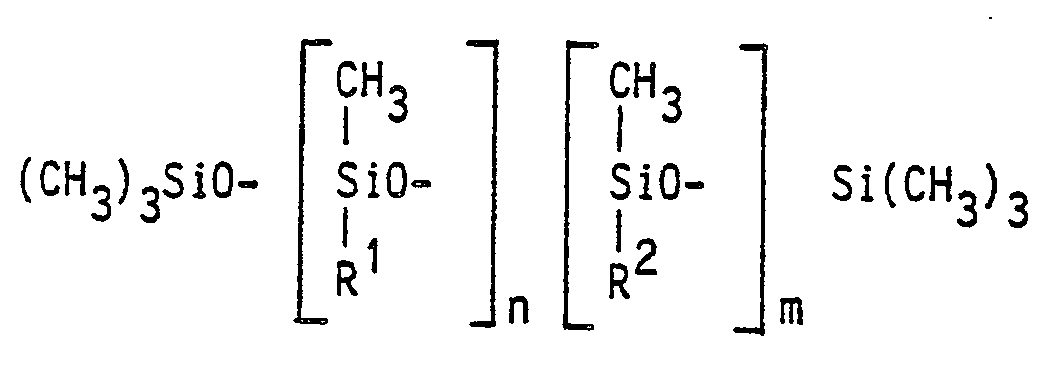
R¹ ein Alkylrest mit 18 bis 36 Kohlenstoffatomen ist,
R² ein Wasserstoffrest, ein Methylrest oder ein Rest der allgemeinen Formel -(CH₂)xR³ ist,
wobei R³ ein COOR⁴-Rest, in dem R⁴ ein Wasserstoffrest oder ein Alkylrest mit 1 bis 4 Kohlenstoffatomen ist, oder
ein -O[CrH2rO-]yR⁵-Rest, in dem R⁵ ein Wasserstoffrest, ein Alkylrest mit 1 bis 4 Kohlenstoffatomen oder ein Acylrest,
r = 2 oder 3 und y ≧ 0 ist,
x = 2 bis 12 ist,
n ≧ 20 und m = 0 bis 0,5 n ist,
als Verdickungsmittel für Kohlenwasserstofföle, Esteröle und pflanzliche Öle in Mengen von 2 bis 10 Gew.-%, bezogen auf die Öle.
Priority Applications (1)
| Application Number | Priority Date | Filing Date | Title |
|---|---|---|---|
| AT88115776T ATE70084T1 (de) | 1987-10-09 | 1988-09-24 | Verwendung von organosilicium-verbindungen zum verdicken von oelen. |
Applications Claiming Priority (2)
| Application Number | Priority Date | Filing Date | Title |
|---|---|---|---|
| DE3734217A DE3734217C1 (de) | 1987-10-09 | 1987-10-09 | Verwendung von Organosilicium-Verbindungen zum Verdicken von OElen |
| DE3734217 | 1987-10-09 |
Publications (3)
| Publication Number | Publication Date |
|---|---|
| EP0310903A2 true EP0310903A2 (de) | 1989-04-12 |
| EP0310903A3 EP0310903A3 (en) | 1990-10-10 |
| EP0310903B1 EP0310903B1 (de) | 1991-12-04 |
Family
ID=6338000
Family Applications (1)
| Application Number | Title | Priority Date | Filing Date |
|---|---|---|---|
| EP88115776A Expired - Lifetime EP0310903B1 (de) | 1987-10-09 | 1988-09-24 | Verwendung von Organosilicium-Verbindungen zum Verdicken von Ölen |
Country Status (5)
| Country | Link |
|---|---|
| US (1) | US4844826A (de) |
| EP (1) | EP0310903B1 (de) |
| AT (1) | ATE70084T1 (de) |
| DE (2) | DE3734217C1 (de) |
| ES (1) | ES2028226T3 (de) |
Cited By (5)
| Publication number | Priority date | Publication date | Assignee | Title |
|---|---|---|---|---|
| EP0446938A3 (en) * | 1990-03-15 | 1992-01-29 | Kao Corporation | An ester-modified silicone derivative and a cosmetic composition containing the same |
| EP0537003A1 (de) * | 1991-10-10 | 1993-04-14 | General Electric Company | Polysiloxan-Polyäther-Alkyl Copolymere |
| EP0596304A1 (de) * | 1992-10-31 | 1994-05-11 | Th. Goldschmidt AG | Kosmetische oder pharmazeutische Zubereitungen |
| EP0614658A3 (en) * | 1993-03-11 | 1995-10-11 | Dow Corning | Silicone containing lip care cosmetic composition. |
| EP0738511A1 (de) * | 1995-04-18 | 1996-10-23 | Rhone-Poulenc Chimie | Verwendung von Estergruppe enthaltenden Silikonwachsen als Verdickungsmittel in Oel |
Families Citing this family (15)
| Publication number | Priority date | Publication date | Assignee | Title |
|---|---|---|---|---|
| US5047159A (en) * | 1989-08-24 | 1991-09-10 | Henkel Corporation | Lubricant compositions having improved anti-deposition properties comprising a polyalkylene oxide-modified silicone oil |
| US5132138A (en) * | 1990-09-24 | 1992-07-21 | George Trifon | Wood sealing and protecting process |
| US5064688A (en) * | 1990-09-24 | 1991-11-12 | George Trifon | Automotive top coat restoring composition and process |
| US5413781A (en) * | 1991-01-17 | 1995-05-09 | Dow Corning Corporation | Alkylmethylsiloxanes for skin care |
| EP0495596B1 (de) * | 1991-01-17 | 1995-05-31 | Dow Corning Corporation | Alkylmethylsiloxane zur Hautpflege |
| US5380527A (en) | 1991-08-26 | 1995-01-10 | Dow Corning Corporation | Alkylmethylsiloxane mixtures for skin care |
| JP3247468B2 (ja) | 1992-01-20 | 2002-01-15 | 花王株式会社 | 皮膚保護剤組成物 |
| US5435811A (en) * | 1993-11-19 | 1995-07-25 | Dow Corning Corporation | Middle distillate hydrocarbon foam control agents from alkymethylsiloxanes |
| US5397367A (en) * | 1993-11-19 | 1995-03-14 | Dow Corning Corporation | Middle distillate hydrocarbon foam control agents from cross-linked organopolysiloxane-polyoxyalkyenes |
| US5880244A (en) * | 1997-05-13 | 1999-03-09 | Lexmark International, Inc. | Sealant materials for toner cartridges |
| US20040105831A1 (en) * | 2002-08-13 | 2004-06-03 | Seren Frantz | Compositions having a pearl blend appearance additive, personal care products made therefrom |
| JP2006070218A (ja) * | 2004-09-06 | 2006-03-16 | Dow Corning Toray Co Ltd | 化粧料配合用のワックス状オルガノポリシロキサンおよびそれを含有する化粧料 |
| US9006157B2 (en) * | 2009-02-13 | 2015-04-14 | Genesee Polymers Corp. | Silicone wax emulsion and method of manufacture |
| KR102278360B1 (ko) | 2014-09-17 | 2021-07-15 | 에르곤,인크 | 나프텐계 브라이트 스톡의 제조 방법 |
| CN105727940B (zh) * | 2014-12-09 | 2018-10-23 | 仲恺农业工程学院 | 一种采用响应面优化法制备超微孔铂催化剂催化合成有机硅增稠剂的方法 |
Family Cites Families (6)
| Publication number | Priority date | Publication date | Assignee | Title |
|---|---|---|---|---|
| US4049692A (en) * | 1974-12-16 | 1977-09-20 | Corning Glass Works | Stabilized blood separating composition |
| FR2313440A1 (fr) * | 1975-06-06 | 1976-12-31 | Rhone Poulenc Ind | Dispersions homogenes de compositions diorganopolysiloxaniques dans des huiles minerales |
| US4248724A (en) * | 1979-10-09 | 1981-02-03 | Macintosh Douglas H | Glycol ether/siloxane polymer penetrating and lubricating composition |
| GB2133035A (en) * | 1982-12-31 | 1984-07-18 | Exxon Research Engineering Co | An oil composition |
| DE3436164A1 (de) * | 1984-10-03 | 1986-04-10 | Bayer Ag, 5090 Leverkusen | Schmieroelzubereitungen |
| US4780245A (en) * | 1986-03-19 | 1988-10-25 | Basf Corporation | Solubilization of dimethyl polysiloxanes |
-
1987
- 1987-10-09 DE DE3734217A patent/DE3734217C1/de not_active Expired
-
1988
- 1988-09-16 US US07/245,824 patent/US4844826A/en not_active Expired - Lifetime
- 1988-09-24 EP EP88115776A patent/EP0310903B1/de not_active Expired - Lifetime
- 1988-09-24 ES ES198888115776T patent/ES2028226T3/es not_active Expired - Lifetime
- 1988-09-24 AT AT88115776T patent/ATE70084T1/de not_active IP Right Cessation
- 1988-09-24 DE DE8888115776T patent/DE3866665D1/de not_active Expired - Lifetime
Cited By (10)
| Publication number | Priority date | Publication date | Assignee | Title |
|---|---|---|---|---|
| EP0446938A3 (en) * | 1990-03-15 | 1992-01-29 | Kao Corporation | An ester-modified silicone derivative and a cosmetic composition containing the same |
| US5210251A (en) * | 1990-03-15 | 1993-05-11 | Kao Corporation | Ester-modified silicone derivative and a cosmetic composition containing the same |
| EP0537003A1 (de) * | 1991-10-10 | 1993-04-14 | General Electric Company | Polysiloxan-Polyäther-Alkyl Copolymere |
| US5401870A (en) * | 1991-10-10 | 1995-03-28 | General Electric Company | Silicone polyether alkyl copolymer synthesis |
| US5451692A (en) * | 1991-10-10 | 1995-09-19 | General Electric Company | Silicone polyether alkyl copolymer synthesis |
| EP0596304A1 (de) * | 1992-10-31 | 1994-05-11 | Th. Goldschmidt AG | Kosmetische oder pharmazeutische Zubereitungen |
| EP0614658A3 (en) * | 1993-03-11 | 1995-10-11 | Dow Corning | Silicone containing lip care cosmetic composition. |
| EP0738511A1 (de) * | 1995-04-18 | 1996-10-23 | Rhone-Poulenc Chimie | Verwendung von Estergruppe enthaltenden Silikonwachsen als Verdickungsmittel in Oel |
| WO1996032927A1 (fr) * | 1995-04-18 | 1996-10-24 | Rhone-Poulenc Chimie | Utilisation de cires silicones a fonctions esters pour epaissir des milieux huileux |
| FR2733245A1 (fr) * | 1995-04-18 | 1996-10-25 | Rhone Poulenc Chimie | Utilisation de cires silicones a fonctions esters pour epaissir des milieux huileux |
Also Published As
| Publication number | Publication date |
|---|---|
| ES2028226T3 (es) | 1992-07-01 |
| DE3866665D1 (de) | 1992-01-16 |
| EP0310903A3 (en) | 1990-10-10 |
| ATE70084T1 (de) | 1991-12-15 |
| US4844826A (en) | 1989-07-04 |
| EP0310903B1 (de) | 1991-12-04 |
| DE3734217C1 (de) | 1988-12-01 |
Similar Documents
| Publication | Publication Date | Title |
|---|---|---|
| EP0310903B1 (de) | Verwendung von Organosilicium-Verbindungen zum Verdicken von Ölen | |
| DE69215126T2 (de) | Wasserdispergierbare pastöse Silikonöl-Zusammensetzungen | |
| DE3436177C2 (de) | ||
| EP0088718B1 (de) | Verdickungsmittel auf der Basis Polyätherderivate | |
| DE3874825T2 (de) | Vernetzte organopolysiloxane und darauf basierende emulsionen. | |
| DE3237630C2 (de) | ||
| EP0219751B1 (de) | Elektroviskose Flüssigkeiten | |
| EP0418479B1 (de) | Emulgatoren zur Herstellung von lagerstabilen, wässrigen Polysiloxan-bzw. Polysiloxan-Paraffinöl-Emulsionen | |
| DE69706190T2 (de) | Neuartige zusammensetzungen auf basis von alkylglykosiden und fettalkoholen | |
| DE69414596T2 (de) | Wasser-in-öl emulsionen die erhöhte mengen an öl enthalten und verfahren zu deren herstellung | |
| EP0631774B1 (de) | Flüssige oder pastöse, lagerstabile, multiple Emulsion des Typs W1/O/W2 | |
| EP0177825A1 (de) | Schmierölzubereitungen | |
| EP0511466B1 (de) | Wässrige Tensidzubereitungen mit erhöhter Viskosität | |
| EP0596304A1 (de) | Kosmetische oder pharmazeutische Zubereitungen | |
| DE4206732A1 (de) | Fluessige, lagerstabile, multiple emulsion des typs o/w/o | |
| DE69314267T2 (de) | In Wasser emulgierbare Polysiloxanzusammensetzung | |
| DE3750468T2 (de) | Verfahren zur leistungsübertragung. | |
| DE1595729A1 (de) | Cyclopolysiloxane sowie Verfahren zu ihrer Herstellung | |
| DE2554498C2 (de) | Organopolysiloxanzubereitung und deren Verwendung | |
| DE1806445A1 (de) | Mischungen mit kleiner Viskositaetsveraenderung bei grossen Temperaturaenderungen | |
| DE60110555T2 (de) | Neue familie von zusammensetzungen aus alkylpolyglykosiden und dimerdiolen, insbesondere verwendbar für die herstellung von versprühbaren öl-in-wasser emulsionen | |
| DE10353856A1 (de) | Emulgatorfreie Öl in Wasser-Emulsionen von Organopolysiloxanen und deren Verwendung in technischen Anwendungen | |
| DE10211140A1 (de) | Stabile Dispersionskonzentrate | |
| DE3804462A1 (de) | Verfahren zur demulgierung von emulsionen aus wasser und rohoel | |
| DE1040251B (de) | Verfahren zur Herstellung von Polysiloxan-Polyoxyalkylen-Mischpolymeren |
Legal Events
| Date | Code | Title | Description |
|---|---|---|---|
| PUAI | Public reference made under article 153(3) epc to a published international application that has entered the european phase |
Free format text: ORIGINAL CODE: 0009012 |
|
| 17P | Request for examination filed |
Effective date: 19881001 |
|
| AK | Designated contracting states |
Kind code of ref document: A2 Designated state(s): AT BE DE ES FR GB IT NL |
|
| PUAL | Search report despatched |
Free format text: ORIGINAL CODE: 0009013 |
|
| AK | Designated contracting states |
Kind code of ref document: A3 Designated state(s): AT BE DE ES FR GB IT NL |
|
| 17Q | First examination report despatched |
Effective date: 19910503 |
|
| GRAA | (expected) grant |
Free format text: ORIGINAL CODE: 0009210 |
|
| ITF | It: translation for a ep patent filed | ||
| AK | Designated contracting states |
Kind code of ref document: B1 Designated state(s): AT BE DE ES FR GB IT NL |
|
| REF | Corresponds to: |
Ref document number: 70084 Country of ref document: AT Date of ref document: 19911215 Kind code of ref document: T |
|
| GBT | Gb: translation of ep patent filed (gb section 77(6)(a)/1977) | ||
| REF | Corresponds to: |
Ref document number: 3866665 Country of ref document: DE Date of ref document: 19920116 |
|
| ET | Fr: translation filed | ||
| REG | Reference to a national code |
Ref country code: ES Ref legal event code: FG2A Ref document number: 2028226 Country of ref document: ES Kind code of ref document: T3 |
|
| PLBE | No opposition filed within time limit |
Free format text: ORIGINAL CODE: 0009261 |
|
| STAA | Information on the status of an ep patent application or granted ep patent |
Free format text: STATUS: NO OPPOSITION FILED WITHIN TIME LIMIT |
|
| 26N | No opposition filed | ||
| REG | Reference to a national code |
Ref country code: ES Ref legal event code: PC2A |
|
| NLT1 | Nl: modifications of names registered in virtue of documents presented to the patent office pursuant to art. 16 a, paragraph 1 |
Owner name: GOLDSCHMIDT AG |
|
| REG | Reference to a national code |
Ref country code: FR Ref legal event code: CD |
|
| REG | Reference to a national code |
Ref country code: GB Ref legal event code: IF02 |
|
| PGFP | Annual fee paid to national office [announced via postgrant information from national office to epo] |
Ref country code: NL Payment date: 20020827 Year of fee payment: 15 Ref country code: AT Payment date: 20020827 Year of fee payment: 15 |
|
| PGFP | Annual fee paid to national office [announced via postgrant information from national office to epo] |
Ref country code: BE Payment date: 20020913 Year of fee payment: 15 |
|
| PGFP | Annual fee paid to national office [announced via postgrant information from national office to epo] |
Ref country code: GB Payment date: 20030827 Year of fee payment: 16 |
|
| PGFP | Annual fee paid to national office [announced via postgrant information from national office to epo] |
Ref country code: DE Payment date: 20030903 Year of fee payment: 16 |
|
| PGFP | Annual fee paid to national office [announced via postgrant information from national office to epo] |
Ref country code: FR Payment date: 20030904 Year of fee payment: 16 |
|
| PGFP | Annual fee paid to national office [announced via postgrant information from national office to epo] |
Ref country code: ES Payment date: 20030919 Year of fee payment: 16 |
|
| PG25 | Lapsed in a contracting state [announced via postgrant information from national office to epo] |
Ref country code: AT Free format text: LAPSE BECAUSE OF NON-PAYMENT OF DUE FEES Effective date: 20030924 |
|
| PG25 | Lapsed in a contracting state [announced via postgrant information from national office to epo] |
Ref country code: BE Free format text: LAPSE BECAUSE OF NON-PAYMENT OF DUE FEES Effective date: 20030930 |
|
| BERE | Be: lapsed |
Owner name: *GOLDSCHMIDT A.G. Effective date: 20030930 |
|
| PG25 | Lapsed in a contracting state [announced via postgrant information from national office to epo] |
Ref country code: NL Free format text: LAPSE BECAUSE OF NON-PAYMENT OF DUE FEES Effective date: 20040401 |
|
| NLV4 | Nl: lapsed or anulled due to non-payment of the annual fee |
Effective date: 20040401 |
|
| PG25 | Lapsed in a contracting state [announced via postgrant information from national office to epo] |
Ref country code: GB Free format text: LAPSE BECAUSE OF NON-PAYMENT OF DUE FEES Effective date: 20040924 |
|
| PG25 | Lapsed in a contracting state [announced via postgrant information from national office to epo] |
Ref country code: ES Free format text: LAPSE BECAUSE OF NON-PAYMENT OF DUE FEES Effective date: 20040925 |
|
| PG25 | Lapsed in a contracting state [announced via postgrant information from national office to epo] |
Ref country code: DE Free format text: LAPSE BECAUSE OF NON-PAYMENT OF DUE FEES Effective date: 20050401 |
|
| GBPC | Gb: european patent ceased through non-payment of renewal fee |
Effective date: 20040924 |
|
| PG25 | Lapsed in a contracting state [announced via postgrant information from national office to epo] |
Ref country code: FR Free format text: LAPSE BECAUSE OF NON-PAYMENT OF DUE FEES Effective date: 20050531 |
|
| REG | Reference to a national code |
Ref country code: FR Ref legal event code: ST |
|
| PG25 | Lapsed in a contracting state [announced via postgrant information from national office to epo] |
Ref country code: IT Free format text: LAPSE BECAUSE OF NON-PAYMENT OF DUE FEES;WARNING: LAPSES OF ITALIAN PATENTS WITH EFFECTIVE DATE BEFORE 2007 MAY HAVE OCCURRED AT ANY TIME BEFORE 2007. THE CORRECT EFFECTIVE DATE MAY BE DIFFERENT FROM THE ONE RECORDED. Effective date: 20050924 |
|
| REG | Reference to a national code |
Ref country code: ES Ref legal event code: FD2A Effective date: 20040925 |