EP0311013A2 - Décoloration d'effluents de la fabrication du papier par le dioxyde de chlore - Google Patents
Décoloration d'effluents de la fabrication du papier par le dioxyde de chlore Download PDFInfo
- Publication number
- EP0311013A2 EP0311013A2 EP88116401A EP88116401A EP0311013A2 EP 0311013 A2 EP0311013 A2 EP 0311013A2 EP 88116401 A EP88116401 A EP 88116401A EP 88116401 A EP88116401 A EP 88116401A EP 0311013 A2 EP0311013 A2 EP 0311013A2
- Authority
- EP
- European Patent Office
- Prior art keywords
- chlorine
- chlorine dioxide
- filtrate
- color
- dioxide
- Prior art date
- Legal status (The legal status is an assumption and is not a legal conclusion. Google has not performed a legal analysis and makes no representation as to the accuracy of the status listed.)
- Withdrawn
Links
Images

Classifications
-
- D—TEXTILES; PAPER
- D21—PAPER-MAKING; PRODUCTION OF CELLULOSE
- D21C—PRODUCTION OF CELLULOSE BY REMOVING NON-CELLULOSE SUBSTANCES FROM CELLULOSE-CONTAINING MATERIALS; REGENERATION OF PULPING LIQUORS; APPARATUS THEREFOR
- D21C9/00—After-treatment of cellulose pulp, e.g. of wood pulp, or cotton linters ; Treatment of dilute or dewatered pulp or process improvement taking place after obtaining the raw cellulosic material and not provided for elsewhere
- D21C9/10—Bleaching ; Apparatus therefor
- D21C9/1026—Other features in bleaching processes
-
- C—CHEMISTRY; METALLURGY
- C02—TREATMENT OF WATER, WASTE WATER, SEWAGE, OR SLUDGE
- C02F—TREATMENT OF WATER, WASTE WATER, SEWAGE, OR SLUDGE
- C02F1/00—Treatment of water, waste water, or sewage
- C02F1/72—Treatment of water, waste water, or sewage by oxidation
- C02F1/76—Treatment of water, waste water, or sewage by oxidation with halogens or compounds of halogens
Definitions
- This invention relates to processes for reducing the pollution of streams or other bodies of water that has been caused in the past by the discharge into such bodies of water of bleach plant extraction filtrates from paper mills that produce bleach pulp. More particularly this invention relates to processes for reducing the color in such bleach plant extraction filtrates and which do not contribute to by-product generation, specifically chloroform and total organic chlorine compound prodution. Still more particularly, the invention relates to a method suitable for effecting a fairly rapid decolorization of bleach plant extraction filtrates employing chlorine dioxide in the chemical oxidation of bleach plant extraction filtrates.
- Rapson U.S. Patent No. 3,698,995 discloses the use of chlorine or chlorine dioxide, preferably an aqueous solution of both, in the bleaching stage of a paper mill. It was found desirable, although not essential, that chlorine dioxide be substituted for a substantial part or all of the chlorine in the bleaching stages in order to diminish the carry-over of chloride into the chemical recovery system. Rapson is clearly concerned with bleaching and not treatment of the heavily colored bleach plant oxidative extraction filtrate derived in the practice of bleaching.
- De Montigny et al U.S. Patent No. 3,725,193 discloses an improved process for the chemical reaction between a gas and a wood pulp. The improvement is provided by the substantially instantaneous reaction between the pulp and gaseous ammonia or gaseous chlorine dioxide, thereby bleaching the cellulosic fibrous pulp. De Montigny does not teach the advantages of employing chlorine dioxide rather than chlorine. Further the actual pulp bleaching stage is involved and not the high colored bleach plant oxidative extraction filtrate.
- U.S. Patent No. 3,986,923 discloses a method for removal of dissolved salts from sulfide liquors formed in pulp mill recovery and regeneration operations.
- Reeve disclosed a particular bleaching operation involving an initial bleaching of the pulp with an aqueous solution containing chlorine dioxide, an intermediate washing, a caustic extraction using aqueous sodium hydroxide solution, a further washing, a further bleaching with an aqueous solution of chlorine dioxide, another washing, a further caustic extraction using sodium hydroxide, an additional washing, a final bleaching with chlorine dioxide solution and a final washing. It is clear that Reeves is concerned with chlorine dioxide bleaching.
- Noreus et al U.S. Patent No. 4,098,639 discloses a process for reducing the requirement of fresh chemicals without increasing emissions in the pulping of cellulosic material.
- Noreus et al discloses the use of chlorine dioxide for bleaching in the bleaching stage subsequent to the initial oxygen bleaching stage. None in this patent suggests that chlorine dioxide can be employed to treat highly colored mill effluent.
- the treatment which forms the subject matter of the instant invention is of bleach plant extraction filtrates and particularly of oxidative extraction filtrates i.e. Eo filtrates.
- the subject matter of the invention is color reduction of bleach plant extraction filtrates by chemical oxidation which is technically feasible, brought about at low cost and which is effective to reduce chloroform and other chlorinated by-product generation.
- Chlorination of bleach plant filtrates is technically and economically feasible for reducing color in such filtrates prior to their discharge into the stream, river or other body of water.
- chloroform and other chlorinated by-products generated in such treatment processes have become a concern in connection with the environment and because of the need to comply with governmental regulations. Optimization of the color oxidation process must obviously include minimum environmental impact as well as maximum color reduction at the lowest possible cost.
- chloroform is generated immediately during bleach plant extraction filtrate color oxidation with chlorine and is directly attributable to the reaction with chlorine.
- the inventor herein has found that chlorine dioxide is as effective as chlorine in bleach plant filtrate color reduction, however, chlorine dioxide does not contribute to chloroform or other chlorinated by-product generation.
- An object of one broad aspect of the present invention is to provide a technically and economically feasible and environmentally acceptable method for reducing color in bleach plant extraction filtrates.
- An object of a further aspect of the present invention is to provide such a method which does not contribute to chloroform and other chlorinated by-product generation.
- An object of another aspect of the present invention is to provide a substitute for chlorine which is as effective as the chlorine in the reduction of color in bleach plant extraction filtrates, but which does not contribute to chloroform and other chlorinated by-product generation.
- the optimum conditions for chlorine dioxide and/or chlorine and chlorine dioxide oxidation of color in bleach mill extraction filtrates is a temperature of 60 to 200°F, preferably 140-150°F, a reaction pH of approximately 3.0 - 6.0 and preferably 4.5 and a total oxidant dose, chlorine dioxide or chlorine dioxide and chlorine of 0.15 to 0.30 in pounds as active chlorine/pound of color (0.15 to 0.30 ppm as active chlorine/SCU).
- the chlorine when present should not exceed 10% of the entire dose of chlorine and chlorine dioxide expressed as active chlorine and preferably is maintained at a concentration of from about 2 to 8.5% of the total of chlorine and chlorine dioxide.
- the amount of chlorine is not limited to the aforenoted range. Amounts in excess of 8.5% can be employed if the levels of chloroform and organic chlorine containing compounds formed are acceptable environmentally and otherwise.
- a system for chlorine dioxide/chlorine oxidation of mill effluent which is included as part of pulp bleaching system, for example, as part of a CEDED bleaching system.
- unbleached pulp from a digester is supplied to brown stock washers where it is washed.
- the washed, unbleached pulp from the washers is conducted to a first stage bleach tower and then passed in sequence through a washer, a first stage caustic extraction tower, a washer, a second stage bleach tower, a washer, a second stage caustic extraction tower, a washer, a third stage bleach tower and a final washer, bleached pulp for supply to a paper machine being obtained from the final washer.
- the system shown in Fig. 1 may be used in connection with any one of the effluents produced in this system or any combination thereof.
- the system may employ as starting material the effluent from the brown stock washers of from any subsequent extraction tower or washer.
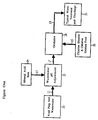
- this waste water is supplied to a holding tank from which it is conducted via a line 11 to a pH adjustment tank 12.
- Mineral acid or base sodium hydroxide
- the brown stock wash water having a pH of from 3.0 to 6.0 is passed through line 17 into an oxidation vessel or tower 18.
- Chlorine dioxide or chlorine dioxide containing small amounts of chlorine is supplied through line 15 into the oxidation vessel or tower 18 and color reduction allowed to take place.
- the treated wash water may then be recycled into the system for example for use in the brown stock washers or alternatively subjected to the conventional mill effluent waste treatment and then discharged.
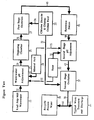
- a Kraft mill waste water stream is introduced through line 22 into a tank or receiving vessel 23 for pH adjustment.
- Mineral acid from supply tank 28, for example hydrochloric acid or sulfuric acid, is supplied through line 29 and/or base from supply tank 30 is supplied through line 31 for suitable adjustment of the pH.
- the pH variation of the waste water stream may require the intermittent addition of both acid and base to tightly control the reaction pH.
- Absolute reaction pH control is an integral and necessary step of the instant process.
- the waste water stream having a pH of from about 3.0 to about 6.0 is subjected to degassing and defoaming.
- the entrained air and evolving carbon dioxide from the pH adjustment step should be purged from the stream and following such treatment the purged stream is introduced into reaction vessel 27 for first stage oxidation. This is carried out in oxidation vessel or tower 27 by contacting the degassed and defoamed stream with an optimum dose of chlorine dioxide or chlorine dioxide and chlorine based on the required color reduction. After the oxidation is completed the treated stream is supplied via line 45 into a retention station 46 to allow the desired decolorizing reaction to go to completion. After 15-30 minutes have elapsed, the wastewater is subjected to a second pH adjustment with mineral acid from supply tank 28 and/or base from supply tank 30.
- the treated wastewater is introduced via line 43 into a vessel or tower 37 wherein it is contacted for the second time (second stage oxidation) with chlorine dioxide or chlorine dioxide and chlorine.
- the second stage oxidation is intended as a polishing stage and is included to ensure that the required final discharge color has been obtained.
- the treated stream from the second stage oxidation may be recycled for further use in the process for example as wash water or further treated as typical mill effluent.
- mill Eo filtrate is first passed through a solids removal stage 50.
- the removal of fiber and other suspended solids will reduce the competition for oxidant ClO2.
- filtrate is passed through conduit 51 into feed/surge tank 52.
- Filtrate from the feed tank 52 is also used as scrubbing medium for the off gas scrubber 54 and is for this purpose delivered to the off gas scrubber through conduit 53.
- the scrubber underflow is returned to the feed tank using conduit 55 or sent to the sewer 56.
- the Eo filtrate stream at approximately 150°F and pH 10 is adjusted to a pH of from 3 to 6 by acid and caustic (lines 57 and 58 respectively) and passed through a static in line mixer.
- the pH stream is then oxidized by either chlorine dioxide or a combination of chlorine dioxide and chlorine supplied via conduit 59.
- a heat exchanger 60 is located just before the oxidant injection point to ensure that the temperature is maintained at from 140 to 150°F and preferably at 150°F.
- treated filtrate enters a retention tower 62 where it is held for from 5 to 30 minutes of bulk liquid retention.
- Conduit 63 delivers oxidized filtrate to the off-gas scrubber 54.
- Conduit 64 delivers oxidized filtrate to a second stage oxidation which may be a polishing stage or a full oxidation stage similar to the one just described or in the alternative to the sewer or for recycle to the mill process.
- the oxidant feed rate is controlled based on inlet filtrate flow and color concentration in the effluent.
- Optimum Acceptable Range* Total oxidant dose (ppm as active Cl2/SCU) 0.20 0.15-0.30 Reaction Temperature (°F) 150 60-200 Reaction pH 4.5 3.0-6.0 *The total oxidant dose is dependent on the quantity of filtrate to be treated and the per cent color reduction that is required.
- the process parameters as above recited are based on a 90% reduction target.
- Example 2 a batchwise chemical oxidation of bleach plant caustic extraction stage filtrate (CEF) to reduce color was carried out.
- the treatment was carried out in a continuous stirred tank reactor (CSTR) having dimensions of 0.5 meters in height, and 0.25 meters in diameter.
- the CSTR was provided with means for continuous agitation, and reaction temperature and pH control.
- Approximately 11 liters of CEF was introduced into the reactor at a concentration of about 19,500 standard color units (SCU).
- SCU standard color units
- the CEF was pH adjusted to approximately 6.0.
- About 3.7 liters of chlorine dioxide/chlorine solution was introduced having concentration of approximately 12 grams as active chlorine/liter (that is 4.5 grams as chlorine dioxide/liter and 0.3 grams as active chlorine/liter).
- the solution and filtrate were well mixed and allowed to react for 15 minutes.
- Example Initial Color SCU
- Total Dose Cl2 Dose Cl02 Dose Reaction Temp. °F
- Final pH Color Reduction % CHCl3 lbs./M lb. SCU Reduced
- Softwood Bleaching Caustic Extraction Filtrate 3 19500 0.15 0.005 0.145 60 3.0 87 0.08 4 19500 0.15 0.005 0.145 180 6.0 87 0.08 5 19500 0.20 0.017 0.183 60 3.0 92 0.52 6 19500 0.20 0.017 0.183 180 6.0 92 0.52 7 19250 0.25 0.009 0.241 60 3.0 95 0.33 8 19250 0.25 0.009 0.241 180 6.0 95 0.33 9 19500 0.15 0.005 0.145 150 4.5 87 0.08 10 19500 0.15 0.012 0.138 150 4.5 89 0.53 11 19500 0.20 0.017 0.183 150 4.5 92 0.52 12 19250 0.25 0.009 0.241 150 4.5 95 0.33 Softwood Bleaching Oxidative-Extraction (Eo) Filtrate 13 6000 0.20 0.006 0.194 60 3.0 82 0.91 14 6000 0.20 0.006 0.194 180 3.0 82 0.91 15 6000 0.20 0.006 0.194
- a Kraft mill waste stream was pH adjusted with mineral acid and base to a pH as set out in the following table.
- the pH variation of the waste stream required the intermittent use of both acid (H2SO4 and base NaOH) to tightly control the reaction pH.
- the pH adjusted stream was degassed/stripped for removing the carbon dioxide and other gases created by the pH adjustment prior to oxidation.
- the degassed i.e., purged stream was contacted with the specified dose of chlorine dioxide and chlorine based on the required color reduction.
- the treated stream was exposed to retention to allow the reaction to go to completion prior to second stage pH adjustment with base and/or mineral acid and a second stage oxidation carried out.
Landscapes
- Life Sciences & Earth Sciences (AREA)
- Engineering & Computer Science (AREA)
- Hydrology & Water Resources (AREA)
- Environmental & Geological Engineering (AREA)
- Water Supply & Treatment (AREA)
- Chemical & Material Sciences (AREA)
- Organic Chemistry (AREA)
- Wood Science & Technology (AREA)
- Paper (AREA)
Applications Claiming Priority (2)
| Application Number | Priority Date | Filing Date | Title |
|---|---|---|---|
| US10479387A | 1987-10-05 | 1987-10-05 | |
| US104793 | 1998-06-25 |
Publications (2)
| Publication Number | Publication Date |
|---|---|
| EP0311013A2 true EP0311013A2 (fr) | 1989-04-12 |
| EP0311013A3 EP0311013A3 (fr) | 1989-09-27 |
Family
ID=22302411
Family Applications (1)
| Application Number | Title | Priority Date | Filing Date |
|---|---|---|---|
| EP88116401A Withdrawn EP0311013A3 (fr) | 1987-10-05 | 1988-10-04 | Décoloration d'effluents de la fabrication du papier par le dioxyde de chlore |
Country Status (6)
| Country | Link |
|---|---|
| EP (1) | EP0311013A3 (fr) |
| JP (1) | JP2651422B2 (fr) |
| BR (1) | BR8805132A (fr) |
| CA (1) | CA1326112C (fr) |
| FI (1) | FI884507L (fr) |
| NO (1) | NO884388L (fr) |
Families Citing this family (5)
| Publication number | Priority date | Publication date | Assignee | Title |
|---|---|---|---|---|
| JP4737020B2 (ja) * | 2006-09-29 | 2011-07-27 | ミツミ電機株式会社 | 電子装置 |
| JP4930475B2 (ja) * | 2008-08-29 | 2012-05-16 | 株式会社Jvcケンウッド | 製品分解時の部品保護構造 |
| BR112014000150B1 (pt) | 2011-07-18 | 2021-02-23 | Interdigital Ce Patent Holdings | Base de retenção para fixação e extração de carcaça em aparelhoeletrônico |
| EP2873312A4 (fr) | 2012-07-16 | 2016-03-16 | Thomson Licensing | Accessoire de retrait de couvercle |
| CN112759173B (zh) * | 2019-11-01 | 2023-04-18 | 湖南海利化工股份有限公司 | 肟菌酯生产废水的预处理方法 |
Family Cites Families (2)
| Publication number | Priority date | Publication date | Assignee | Title |
|---|---|---|---|---|
| CA975111A (en) * | 1971-01-22 | 1975-09-30 | Ralph J. Gall | Bleaching cellulosic pulp |
| CH567440A5 (fr) * | 1973-07-18 | 1975-10-15 | Blatter Max |
-
1988
- 1988-09-30 FI FI884507A patent/FI884507L/fi not_active IP Right Cessation
- 1988-10-04 NO NO88884388A patent/NO884388L/no unknown
- 1988-10-04 EP EP88116401A patent/EP0311013A3/fr not_active Withdrawn
- 1988-10-05 BR BR8805132A patent/BR8805132A/pt not_active Application Discontinuation
- 1988-10-05 JP JP63251727A patent/JP2651422B2/ja not_active Expired - Lifetime
- 1988-10-05 CA CA000579414A patent/CA1326112C/fr not_active Expired - Fee Related
Also Published As
| Publication number | Publication date |
|---|---|
| JPH01156586A (ja) | 1989-06-20 |
| FI884507A7 (fi) | 1989-04-06 |
| FI884507L (fi) | 1989-04-06 |
| FI884507A0 (fi) | 1988-09-30 |
| NO884388L (no) | 1989-04-06 |
| CA1326112C (fr) | 1994-01-18 |
| EP0311013A3 (fr) | 1989-09-27 |
| JP2651422B2 (ja) | 1997-09-10 |
| BR8805132A (pt) | 1989-05-16 |
| NO884388D0 (no) | 1988-10-04 |
Similar Documents
| Publication | Publication Date | Title |
|---|---|---|
| JP2825346B2 (ja) | リグノセルロース物質の環境上改良された漂白方法 | |
| US4661205A (en) | Method of bleaching lignocellulosic material with peroxide catalyzed with a salt of a metal | |
| US4451332A (en) | Method for delignification of ligno-cellulose containing fiber material with an alkali-oxygen extraction stage | |
| EP0456626B1 (fr) | Procédé de blanchiment de matériaux contenant de la lignocellulose | |
| US5853535A (en) | Process for manufacturing bleached pulp including recycling | |
| EP0395792B1 (fr) | Procédé de blanchiment de pâte | |
| US5693184A (en) | Reduction of salt scale precipitation by control of process stream pH and salt concentration | |
| EP0311013A2 (fr) | Décoloration d'effluents de la fabrication du papier par le dioxyde de chlore | |
| CA2040867C (fr) | Reduction des composes organiques halogenes dans un bain de blanchiment use | |
| EP0651832B1 (fr) | Procede de delignification de pate de bois en phase gazeuse | |
| US4537656A (en) | Method for delignifying or bleaching cellulose pulp wherein chlorine is added to recycle liquor to regenerate chlorine dioxide | |
| AU656658B2 (en) | Gas phase delignification of lignocellulosic material | |
| WO1991012366A1 (fr) | Blanchiment de pate a papier | |
| US5626717A (en) | Oxidative treatment of bleach plant effluent | |
| US3654071A (en) | Process for replacing sodium and sulfur losses and for controlling the sulfide content in sodium- and sulfur-containing cellulosic digesting liquors | |
| EP0720676A1 (fr) | Procede ameliore de blanchiment de pate lignocellulosique | |
| US4049490A (en) | Electrodialysis of bleaching effluent | |
| JP3275271B2 (ja) | 化学パルプの漂白方法 | |
| EP0225638B1 (fr) | Une méthode de délignification de pâte | |
| JP2002069879A (ja) | セルロース質繊維材料のパルプの漂白方法 | |
| EP0309998B1 (fr) | Procédé dans l'activation de matière lignocellulosique par un gaz contenant du dioxyde d'azote | |
| JP2008184719A (ja) | 漂白工程前に酸処理工程を有するクラフトパルプの製造工程における酸処理工程排水の再利用方法 | |
| AU642971B2 (en) | Bleaching of paper pulp | |
| WO2021038126A1 (fr) | Procédé de réduction du phosphore dans les effluents d'un procédé de mise en pâte | |
| JP2002266272A (ja) | セルロース質繊維材料パルプの漂白方法 |
Legal Events
| Date | Code | Title | Description |
|---|---|---|---|
| PUAI | Public reference made under article 153(3) epc to a published international application that has entered the european phase |
Free format text: ORIGINAL CODE: 0009012 |
|
| AK | Designated contracting states |
Kind code of ref document: A2 Designated state(s): AT BE CH DE ES FR GB GR IT LI LU NL SE |
|
| PUAL | Search report despatched |
Free format text: ORIGINAL CODE: 0009013 |
|
| AK | Designated contracting states |
Kind code of ref document: A3 Designated state(s): AT BE CH DE ES FR GB GR IT LI LU NL SE |
|
| 17P | Request for examination filed |
Effective date: 19900207 |
|
| 17Q | First examination report despatched |
Effective date: 19901123 |
|
| STAA | Information on the status of an ep patent application or granted ep patent |
Free format text: STATUS: THE APPLICATION IS DEEMED TO BE WITHDRAWN |
|
| 18D | Application deemed to be withdrawn |
Effective date: 19930326 |