EP0311416A2 - Système de communication à traduction comportant un appareil de traduction centrale - Google Patents
Système de communication à traduction comportant un appareil de traduction centrale Download PDFInfo
- Publication number
- EP0311416A2 EP0311416A2 EP88309362A EP88309362A EP0311416A2 EP 0311416 A2 EP0311416 A2 EP 0311416A2 EP 88309362 A EP88309362 A EP 88309362A EP 88309362 A EP88309362 A EP 88309362A EP 0311416 A2 EP0311416 A2 EP 0311416A2
- Authority
- EP
- European Patent Office
- Prior art keywords
- communication
- communication terminal
- translating
- data
- terminal means
- Prior art date
- Legal status (The legal status is an assumption and is not a legal conclusion. Google has not performed a legal analysis and makes no representation as to the accuracy of the status listed.)
- Withdrawn
Links
Images



Classifications
-
- G—PHYSICS
- G06—COMPUTING OR CALCULATING; COUNTING
- G06F—ELECTRIC DIGITAL DATA PROCESSING
- G06F17/00—Digital computing or data processing equipment or methods, specially adapted for specific functions
-
- H—ELECTRICITY
- H04—ELECTRIC COMMUNICATION TECHNIQUE
- H04M—TELEPHONIC COMMUNICATION
- H04M3/00—Automatic or semi-automatic exchanges
- H04M3/42—Systems providing special services or facilities to subscribers
-
- G—PHYSICS
- G06—COMPUTING OR CALCULATING; COUNTING
- G06F—ELECTRIC DIGITAL DATA PROCESSING
- G06F40/00—Handling natural language data
- G06F40/40—Processing or translation of natural language
- G06F40/55—Rule-based translation
-
- G—PHYSICS
- G06—COMPUTING OR CALCULATING; COUNTING
- G06F—ELECTRIC DIGITAL DATA PROCESSING
- G06F40/00—Handling natural language data
- G06F40/40—Processing or translation of natural language
- G06F40/58—Use of machine translation, e.g. for multi-lingual retrieval, for server-side translation for client devices or for real-time translation
-
- H—ELECTRICITY
- H04—ELECTRIC COMMUNICATION TECHNIQUE
- H04M—TELEPHONIC COMMUNICATION
- H04M2203/00—Aspects of automatic or semi-automatic exchanges
- H04M2203/20—Aspects of automatic or semi-automatic exchanges related to features of supplementary services
- H04M2203/2061—Language aspects
Definitions
- the present invention relates, in general, to communication systems.
- the invention relates to a translating communication system wherein an automatic translating communication can be carried out between communication terminals in different languages, e.g., English and Japanese.
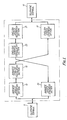
- FIGURE 1 shows one example of the translating communication system, each component of which is now available to be used.
- Japanese/English language translating communication may be carried out by this basic system.
- one of Japanese and English languages e.g., Japanese
- the input language is recognized in a Japanese speech recognition section 13, and Japanese language data are produced from Japanese speech recognition section 13.
- the Japanese language data are translated into English language data in a Japanese/English translation section 15.
- the English language data are converted to an English speech in an English speech synthesis section 17, and the English speech is finally outputted as a human language from the other telephone terminal 19.
- the other language i.e., English
- the input language is recognized in English speech recognition section 21, and an English language data are produced from English speech recognition section 21.
- the English language data are converted into Japanese language data in an English/Japanese translation section 23.
- the Japanese language data are converted to a Japanese speech in a Japanese speech synthesis section 25.
- the Japanese speech is outputted as a human language from one of the telephone terminals 11.
- a user of one of the telephone terminals 11 inputs communication data using Japanese language, and may listen to the communication data transmitted from the other telephone terminal 19 after it is converted into Japanese.
- a user of the other telephone terminal 19 inputs the other communication data in the English language, and may listen to the communication data transmitted from one of the telephone terminals 11 in English.
- various problems may occur when such a communication system is actually constructed and carried out. The most complicated problems are to recognize a speech inputted and to translate it into a suitable language. Similar data regarding to a specific item, e.g., phoneme, word, etc., to be selected in the recognition or translation process and inadequate recognition or translation caused by the similar data may occur while such operations are executed.
- Such problems may be improved by the progress of research and development of the machine translation function in future. However, in general, the improvement cost of such problems may become relatively high compared with the degree of improvement of the problems described above. If a translation task is limited to a specific field, systematized knowledge data of the specific field may be used to avoid an inadequate recognition or an inadequate translation, As a result, a speech based on an adequate translation along the intention of the user can be produced. Such a task limitation may be effective only for specific services, such as, e.g., data retrieval, data inquiry, etc.
- a translating communication system includes at least first and second communication terminals each having a human speech input-output device for selectively converting an input human language into output speech data or converting received speech data into a human language and having a format input device for generating a format signal indicating the format of the translating communication, and a central translating apparatus for receiving the format signal and the output speech data from the first and second communication terminals.
- the central translating apparatus selectively performs conversion function on the output speech data from one of the first and second communication terminals in accordance with the format signal from the other communication terminal to render the output speech data usable by the other communication terminal, and provides the output speech data to the other communication terminal where it is used to output a human language different from the human language input into one of the first and second communication terminals.
- the central translating apparatus may includes a speech analysis function, a speech segment recognition function, a word recognition function, and a translation function for converting a predetermined language of the output speech data into a prescribed language different from the predetermined language.
- the central translating apparatus may also include a rule synthesis function, and a speech synthesis function for rendering the output speech data usable by the other communication terminal.
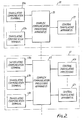
- a first communication group 31 of a translating communication system includes a plurality of translating communication terminals 33a, ..., 33n, a complex communication processing apparatus 35, and a central translating apparatus 37.
- the plurality of translating communication terminals 33a, ..., 33n are individually connected to complex communication processing apparatus 35.
- Central translating apparatus 37 also is connected to complex communication processing apparatus 35.
- a user may input speech data in a certain language through one of the translating communication terminals 33a.
- Complex communication processing apparatus 35 analyzes the speech data transmitted from one of the translating communication terminals 33a, and executes a suitable communicating operation based on the result of the analysis.
- a second communication group 41 of the translating communication system also includes a plurality of translating communication terminals 43a, 43b and 43c, a complex communication processing apparatus 45, and a plurality of central translating apparatus 47a, ..., 47n.
- Each translating communication terminal 43a, 43b, 43c is connected to complex communication processing apparatus 45.
- Each central translating apparatus 47a, ..., 47n also is connected to complex communication processing apparatus 45. Therefore, a user of one of the translating communication terminals 43a can communicate with a user of another translating communication terminal, e.g., terminal 43, through complex communication processing apparatus 45.
- First communication group 31 and second communication group 41 constitute individual communication network.
- complex communication processing apparatus 35 of first communication group 31 When complex communication processing apparatus 35 of first communication group 31 is connected to complex communication processing apparatus 45 of second communication group 41 through a suitable radio communication, the user of each translating communication terminal 33a, ..., 33n of first communication group 31 can communicate with the user of each translating communication terminal 43a, 43b, 43c of second communication group 41 through complex communication processing apparatus 35 and 45.
- each translating communication terminals 33a, ..., 33n, 43a, 43b, 43c basically constitutes the translating communication system, as shown in FIGURE 1, therebetween when communicating.
- each translating communication terminal 33a, ..., 33n, 43a, 43b, 43c may include different processing functions from one another in accordance with individual translating communication system specifications.
- an advanced translating communication terminal includes all the conversion functions of a speech translating communication system.
- a simple translating communication terminal includes a part of all the conversion functions of a speech translating communication system, e.g., probably only speech codec (coder-decoder).
- coder-decoder codec
- each complex communication processing apparatus 35, 45 individually constitutes a closed communication circuit.
- One of complex communication processing terminals 35 and 45 may be connected to the other complex communication processing terminal to constitute an open communication circuit, if necessary.
- each communication group 31, 41 may be a communication network of a business company, or a communication network existing in a specific area, e.g., country.
- central translating apparatus 37 is connected to complex communication processing apparatus 35 in first communication group 31, and central translating apparatus 47a, ..., and 47n are connected to complex communication processing apparatus 45 in second communication group 41.
- Each central translating apparatus 37, 47a, ..., 47n includes all the conversion functions of the speech translating communication system described hereafter to relay the speech translating communication between two translating communication terminals.
- the central translating apparatus compensates the translating communication terminal for certain conversion functions which are not enabled in the translating communication terminal in response to the construction or the translating communication mode of the translating communication terminal when communicating. If the translating communication terminal is provided with only a speech codec, the central translating apparatus recognizes the speech signals fed from the translating communication terminal, and carries out the translation on the basis of the result of the recognition.
- the central translating apparatus outputs the synthesized speech based on the translation in order to execute the translating communication.
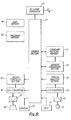
- a translating communication terminal 51 includes all the conversion functions necessary to carry out the speech translating communication. That is, translating communication terminal 51 includes a control section 53, a key-input section 55, and a display 57. A prescribed key-input operation is carried out through key-input section 55 before commencement of the speech translating communication. The input data from key-input section 55 is fed to control section 53, and is transmitted from a network terminator 59 to the communication network, as shown in FIGURE 2.
- the constitution of the translating communication terminal 51, the data mode of the communication (non-translating communication or translating communication), and the translation mode (designation of the translation language and the translation form) are set and transmitted to central translating apparatus, e.g., apparatus 37, through complex communication processing apparatus 35.
- complex communication processing apparatus 35 controls the connection of the communication network.
- message data necessary to the input operation may be outputted to display 57.
- Speech input from microphone 61 through an amplifier 62 is converted from analog speech data to digital speech data by an A/D converter 63.
- the digital speech data are stored in a data memory 65.
- the digital speech data are acoustically analyzed, e.g., filtering, etc., by a speech analysis section 67.
- segment data used for a speech recognition of VCV (Vowel Consonant Vowel) unit, phonemes or syllables are produced by a segment conversion section 69 with reference to standard pattern data from a standard pattern memory 71.
- VCV Vehicle Consonant Vowel
- the digital speech data are recognized by a speech recognition section 73 with reference to a recognition dictionary 75.
- This speech recognition operation is carried out by using the DP (Dynamic Programming) matching, or the transition network, etc.
- DP Dynamic Programming
- re-input of the speech is requested, if needed.
- the recognition results (language data) obtained by the above-described manner are divided into a suitable unit, e.g., clause unit, and the each unit is stored in data memory 65.
- a translation section 77 carries out the translation from the above-described language data into a prescribed language data with reference to a translation dictionary 79.
- the translation is directly carried out from one language into a prescribed language, e.g., from English into Japanese, and vice versa.
- the one language may be translated into a prescribed language through a predetermined intermediate language commonly registered in this translating communication system.
- the translating mode is preferably set at each translating communication terminal.
- the language data converted into a prescribed language is transmitted to the communication circuit through network terminator 59.
- a rule synthesis section 81 produces phonemic ⁇ prosodic parameter data for the language data in accordance with a rule synthesis dictionary 83.
- a speech synthesis section 85 Based on the phonemic ⁇ prosodic parameter data from rule synthesis section 81, a speech synthesis section 85 produces speech signals corresponding to the language data by the rule synthesis processing function, and outputs the speech signals to a D/A (digital/analog) converter 87.
- D/A converter 87 converts the speech signals (digital) into analog speech signals and outputs the analog speech signals to a speaker 89 through an amplifier 91.
- the synthesized speech is outputted from speaker 89.
- a program memory 93 shown in FIGURE 3 stores a control program, and control section 53 controls each processing section in accordance with the control program stored in program memory 93.
- each translating communication terminal carrying out the translating communication with one another is composed of the above-described processing sections, as shown in FIGURE 3, a speech of a certain language, e.g., Japanese, input to one of the translating communication terminals is converted into a prescribed language data, e.g., English data, and the prescribed language data are transmitted from one of the translating communication terminals to the other translating communication terminal.
- the prescribed language data are synthesized to the speech of the prescribed language, e.g., English, and the synthesized speech is outputted from the other translating communication terminal.
- a speech input to the other translating communication terminal in a certain language e.g., English
- a predetermined language data e.g., Japanese data
- the predetermined language data are synthesized to the speech of the predetermined language, e.g., Japanese
- the synthesized speech is outputted from one of the translating communication terminals.
- one of the translating communication terminals includes all the conversion sections required to the translating communication, as shown in FIGURE 3, and the other translating communication terminal includes a part of the conversion sections, such as, e.g., a speech codec 101 composed of A/D converter 101a and D/A converter 101b, as shown in FIGURE 4, central translating apparatus 37 operates to carry out the translating communication between one of the translating communication terminals and the other translating communication terminal. Central translating apparatus 37 assists the other translating communication terminal composed of only speech codec 101 to execute the translating communication with one of the translating communication terminals.
- Central translating apparatus 37 is composed of a speech analysis section 67, a segment conversion section 69, a standard pattern memory 71, a speech recognition section 73, a recognition dictionary 75, a translation section 77, a translation dictionary 79, a data memory 65, a program memory 93, a rule synthesis section 81, a rule synthesis dictionary 83, and a speech synthesis section 85, as shown in FIGURE 5, and selectively controls each coversion section described above.
- the central translating apparatus controls all the conversion functions required to execute the translating communication.
- the central translating apparatus decides in accordance with the input data which conversion sections are required to carry out the translating communication between the specific translating communication terminals.
- the central translating apparatus changes its processing mode and selectively controls each conversion section to provide the conversion sections which are not contained in each translating communication terminal. For example, if the translating communication terminal includes the speech codec, as shown in FIGURE 4, the central translating apparatus executes the speech recognition after analyzing the speech data from the translating communication terminal. The central translating apparatus further executes the conversion of the speech data into a prescribed language data for the other translating communication terminal.
- the central translating apparatus outputs the prescribed language data to the other translating communication terminal, e.g., including all the processing functions shown in FIGURE 3, through the complex communication processing apparatus.
- the central translating apparatus converts the language data to speech data by the rule synthesis processing function, and transmits the speech data to one of the translating communication terminals which is provided with only the speech codec.
- each translating communication terminal may carry out the translating communication even if a specific translating communication terminal includes only a speech codec. This is because that the central translating apparatus selectively provides translating communication processing functions which are not contained in the specific translating communication terminal.
- both translating communication terminals are equipped with only a speech codec shown in FIGURE 4
- two central translating apparatus individually constructed as shown in FIGURE 5 may be used, and the conversion functions of each translating communication terminal may be compensated by respective central translating apparatus.
- two central translating apparatus are combined with one another to achieve the translating communication.
- translating communication terminal 51 may be constructed such that translation processing function 77 including translation dictionary 79 is eliminated from the basic constitution of translating communication terminal 51 shown in FIGURE 3. As shown in FIGURE 7, translating communication terminal 51 may be constructed such that rule synthesis processing function 81 including rule synthesis dictionary 83 is further eliminated from the above-described construction of translating communication terminal 51 shown in FIGURE 6. Also, as shown in FIGURE 8, translating communication terminal 51 may be constructed such that speech recognition processing function 73 including recognition dictionary 75 is also eliminated from the construction of translating communication terminal 51 shown in FIGURE 7. Responding to each case described above, the central translating apparatus selectively changes processing mode, and relays the translating communication between each translating communication terminal constituted as described above.
- the central translating apparatus may include a first translation processing section 111 and a second translation processing section 113.
- First translation processing section 111 includes translation section 111a and translation dictionary 111b.
- Second translation processing section 113 also includes translating section 113a and translation dictionary 113b.
- Translation dictionary 111b of first translation processing section 111 and translation dictionary 113b of second translation processing section 113 are different from one the other.
- the central translating apparatus includes a Japanese/English translation processing section and an English/French translation processing section
- Japanese language data are temporarily translated into English language data (intermediate language data)
- the English language data are translated into French language data.
- central translating apparatus 37 including the above-described processing functions
- central translating apparatus 37 translates the Japanese language data into English language data, and transmits the English language data to another complex communication processing apparatus 45, as shown in FIGURE 1.
- the English language data transmitted from complex communication processing apparatus 35 through another complex communication processing apparatus 45 are translated into French language data by one of the central translating apparatus 47a, and the French language data finally are outputted to one of the translating communication terminals 43a.
- the above-described translation processing operation is reciprocally carried out. Therefore, first and second communication groups 31 and 41 may individually be operated, and may be combined with one the other to carry out the translating communication therebetween.
- a central translating apparatus assists each translating communication terminal to execute the translating communication therebetween even if each translating communication has different translation processing functions. Therefore, a complete translating communication may be carried out between the translating communication terminals. Furthermore, since the central translating apparatus may include all the complicated processing functions necessary to carry out the translating communication, each translating communication terminal may include only the speech input-output device having the speech codec, resulting in a simplified construction of translating communication terminal.
- display 57 of translating communication terminal 51 may output the language data transmitted from another translating communication terminal through the central translating apparatus.
- the translating communication system may use not only the above-described languages but also any other languages to carry out the translating communication.
- the translating communication may be simultaneously carried out between more than three different languages.
- the input speech recognition processing method, the translation processing method, or the speech synthesis method may be changed to another well known method in accordance with specific system specifications.
Landscapes
- Engineering & Computer Science (AREA)
- Theoretical Computer Science (AREA)
- Physics & Mathematics (AREA)
- General Physics & Mathematics (AREA)
- General Engineering & Computer Science (AREA)
- Computational Linguistics (AREA)
- General Health & Medical Sciences (AREA)
- Health & Medical Sciences (AREA)
- Audiology, Speech & Language Pathology (AREA)
- Artificial Intelligence (AREA)
- Signal Processing (AREA)
- Data Mining & Analysis (AREA)
- Databases & Information Systems (AREA)
- Mathematical Physics (AREA)
- Software Systems (AREA)
- Machine Translation (AREA)
- Computer And Data Communications (AREA)
- Information Transfer Between Computers (AREA)
Applications Claiming Priority (2)
| Application Number | Priority Date | Filing Date | Title |
|---|---|---|---|
| JP62254141A JP2667408B2 (ja) | 1987-10-08 | 1987-10-08 | 翻訳通信システム |
| JP254141/87 | 1987-10-08 |
Publications (1)
| Publication Number | Publication Date |
|---|---|
| EP0311416A2 true EP0311416A2 (fr) | 1989-04-12 |
Family
ID=17260789
Family Applications (1)
| Application Number | Title | Priority Date | Filing Date |
|---|---|---|---|
| EP88309362A Withdrawn EP0311416A2 (fr) | 1987-10-08 | 1988-10-07 | Système de communication à traduction comportant un appareil de traduction centrale |
Country Status (3)
| Country | Link |
|---|---|
| EP (1) | EP0311416A2 (fr) |
| JP (1) | JP2667408B2 (fr) |
| KR (1) | KR890007179A (fr) |
Cited By (13)
| Publication number | Priority date | Publication date | Assignee | Title |
|---|---|---|---|---|
| EP0448038A3 (en) * | 1990-03-19 | 1993-06-02 | Fujitsu Limited | Apparatus for registering private-use words in machine translation/electronic-mail system |
| EP0449230A3 (fr) * | 1990-03-27 | 1994-01-12 | Hitachi Ltd | |
| EP0519049A4 (fr) * | 1990-12-31 | 1994-01-19 | Trans-Link International Corporation | |
| EP0585480A1 (fr) * | 1992-08-31 | 1994-03-09 | Siemens Aktiengesellschaft | Méthode et dispositif pour établir des connexions de conférence dans un central téléphonique commandé par calculation |
| DE4228997A1 (de) * | 1992-08-31 | 1994-03-10 | Siemens Ag | Verfahren und Anordnung zur Herstellung von Fernsprechverbindungen in einem Fernsprechvermittlungssystem |
| EP0590332A1 (fr) * | 1992-09-28 | 1994-04-06 | Siemens Aktiengesellschaft | Méthode de réalisation d'une liaison entre des langues internationales dans un réseau de communication international |
| FR2713800A1 (fr) * | 1993-12-15 | 1995-06-16 | Gachot Jean | Procédé et dispositif pour transformer un premier message vocal dans une première langue, en un second message vocal prononcé dans une seconde langue prédéterminée. |
| WO1999016257A3 (fr) * | 1997-09-19 | 1999-05-20 | Siemens Ag | Procede et dispositif pour la traduction automatique de messages dans un systeme de communication |
| EP0973312A1 (fr) * | 1998-07-11 | 2000-01-19 | Matthias Stöffler | Méthode et appareil de traduction simultanée de conversations téléphoniques |
| WO2001075661A3 (fr) * | 2000-03-31 | 2002-10-24 | Nedim Yazgan | Procede de traduction automatique lors de la transmission de donnees et systeme correspondant |
| EP1335620A1 (fr) * | 2002-02-07 | 2003-08-13 | AT&T Corp. | Système et procédé de traduction de la parole ubiquiste pour dispositifs sans fil |
| EP1430630A4 (fr) * | 2001-08-31 | 2005-12-07 | Philip Bravin | Systeme de communications a modes multiples |
| EP2455936A4 (fr) * | 2009-07-16 | 2018-01-10 | National Institute of Information and Communication Technology | Système de traduction vocale, dispositif de serveur de dictionnaire et programme |
Families Citing this family (1)
| Publication number | Priority date | Publication date | Assignee | Title |
|---|---|---|---|---|
| JP3473204B2 (ja) * | 1995-08-21 | 2003-12-02 | 株式会社日立製作所 | 翻訳装置及び携帯端末装置 |
Family Cites Families (2)
| Publication number | Priority date | Publication date | Assignee | Title |
|---|---|---|---|---|
| JPS58191068A (ja) * | 1982-05-03 | 1983-11-08 | Noriko Ikegami | 翻訳装置を有する通信装置 |
| JPS5875361A (ja) * | 1982-10-04 | 1983-05-07 | Noriko Ikegami | 翻訳装置および翻訳装置を備えた通信装置 |
-
1987
- 1987-10-08 JP JP62254141A patent/JP2667408B2/ja not_active Expired - Lifetime
-
1988
- 1988-10-07 KR KR1019880013080A patent/KR890007179A/ko not_active Abandoned
- 1988-10-07 EP EP88309362A patent/EP0311416A2/fr not_active Withdrawn
Cited By (17)
| Publication number | Priority date | Publication date | Assignee | Title |
|---|---|---|---|---|
| EP0448038A3 (en) * | 1990-03-19 | 1993-06-02 | Fujitsu Limited | Apparatus for registering private-use words in machine translation/electronic-mail system |
| US5295068A (en) * | 1990-03-19 | 1994-03-15 | Fujitsu Limited | Apparatus for registering private-use words in machine-translation/electronic-mail system |
| EP0449230A3 (fr) * | 1990-03-27 | 1994-01-12 | Hitachi Ltd | |
| EP0519049A4 (fr) * | 1990-12-31 | 1994-01-19 | Trans-Link International Corporation | |
| EP0585480A1 (fr) * | 1992-08-31 | 1994-03-09 | Siemens Aktiengesellschaft | Méthode et dispositif pour établir des connexions de conférence dans un central téléphonique commandé par calculation |
| DE4228997A1 (de) * | 1992-08-31 | 1994-03-10 | Siemens Ag | Verfahren und Anordnung zur Herstellung von Fernsprechverbindungen in einem Fernsprechvermittlungssystem |
| EP0590332A1 (fr) * | 1992-09-28 | 1994-04-06 | Siemens Aktiengesellschaft | Méthode de réalisation d'une liaison entre des langues internationales dans un réseau de communication international |
| WO1995016968A1 (fr) * | 1993-12-15 | 1995-06-22 | Jean Gachot | Procede et dispositif pour transformer un premier message vocal dans une premiere langue, en un second message dans une seconde langue predeterminee |
| FR2713800A1 (fr) * | 1993-12-15 | 1995-06-16 | Gachot Jean | Procédé et dispositif pour transformer un premier message vocal dans une première langue, en un second message vocal prononcé dans une seconde langue prédéterminée. |
| WO1999016257A3 (fr) * | 1997-09-19 | 1999-05-20 | Siemens Ag | Procede et dispositif pour la traduction automatique de messages dans un systeme de communication |
| US7123694B1 (en) | 1997-09-19 | 2006-10-17 | Siemens Aktiengesellschaft | Method and system for automatically translating messages in a communication system |
| EP0973312A1 (fr) * | 1998-07-11 | 2000-01-19 | Matthias Stöffler | Méthode et appareil de traduction simultanée de conversations téléphoniques |
| WO2001075661A3 (fr) * | 2000-03-31 | 2002-10-24 | Nedim Yazgan | Procede de traduction automatique lors de la transmission de donnees et systeme correspondant |
| EP1430630A4 (fr) * | 2001-08-31 | 2005-12-07 | Philip Bravin | Systeme de communications a modes multiples |
| EP1335620A1 (fr) * | 2002-02-07 | 2003-08-13 | AT&T Corp. | Système et procédé de traduction de la parole ubiquiste pour dispositifs sans fil |
| US7689245B2 (en) | 2002-02-07 | 2010-03-30 | At&T Intellectual Property Ii, L.P. | System and method of ubiquitous language translation for wireless devices |
| EP2455936A4 (fr) * | 2009-07-16 | 2018-01-10 | National Institute of Information and Communication Technology | Système de traduction vocale, dispositif de serveur de dictionnaire et programme |
Also Published As
| Publication number | Publication date |
|---|---|
| JPH0195650A (ja) | 1989-04-13 |
| KR890007179A (ko) | 1989-06-19 |
| JP2667408B2 (ja) | 1997-10-27 |
Similar Documents
| Publication | Publication Date | Title |
|---|---|---|
| EP0311416A2 (fr) | Système de communication à traduction comportant un appareil de traduction centrale | |
| US20020046035A1 (en) | Method for speech interpretation service and speech interpretation server | |
| US20040122678A1 (en) | Device and method for translating language | |
| EP0751467A2 (fr) | Dispositif et méthode de traduction | |
| CN110909879A (zh) | 自回归神经网络消歧模型、训练及使用方法、装置、系统 | |
| EP0472193A2 (fr) | Dispositif de traduction avec reconnaissance et synthèse de la parole | |
| JPH07129594A (ja) | 自動通訳システム | |
| CA2149012C (fr) | Poste telephonique commande par la voix | |
| US7194410B1 (en) | Generation of a reference-model directory for a voice-controlled communications device | |
| EP1187441B1 (fr) | Méthode et appareil pour la reconnaissance audio d'une séquence de numéros | |
| KR20020076044A (ko) | 대화 모델을 이용한 자동 통역 장치 및 방법 | |
| KR19990037776A (ko) | 음성인식자동번역및통역장치 | |
| JPH11120176A (ja) | 通訳装置及び方法並びに通訳装置制御プログラムを記憶した媒体 | |
| KR0175251B1 (ko) | 문음변환 방식을 이용한 자동 응답 시스템 | |
| CN1629933B (zh) | 用于语音合成的设备、方法和转换器 | |
| Olson et al. | Phonetic typewriter III | |
| JPH07175495A (ja) | 音声認識方式 | |
| CN112270930A (zh) | 一种语音识别转换的方法 | |
| JP2000242642A (ja) | 翻訳処理方法及び翻訳処理装置 | |
| Kacic | Advances in spoken dialogue systems development | |
| JPH01160249A (ja) | 翻訳通信方式 | |
| JP2000047684A (ja) | 音声認識方法および音声サービス装置 | |
| JPH0950290A (ja) | 音声認識装置および該装置を用いた通信装置 | |
| JPH01147774A (ja) | 翻訳通信システム | |
| JP2003330923A (ja) | 自動対話装置 |
Legal Events
| Date | Code | Title | Description |
|---|---|---|---|
| PUAI | Public reference made under article 153(3) epc to a published international application that has entered the european phase |
Free format text: ORIGINAL CODE: 0009012 |
|
| 17P | Request for examination filed |
Effective date: 19881017 |
|
| AK | Designated contracting states |
Kind code of ref document: A2 Designated state(s): DE FR GB IT |
|
| STAA | Information on the status of an ep patent application or granted ep patent |
Free format text: STATUS: THE APPLICATION HAS BEEN WITHDRAWN |
|
| 18W | Application withdrawn |
Withdrawal date: 19901204 |