EP0312350A2 - Verfahren zum Endlosmachen eines Filzes in einer Papiermaschine - Google Patents
Verfahren zum Endlosmachen eines Filzes in einer Papiermaschine Download PDFInfo
- Publication number
- EP0312350A2 EP0312350A2 EP88309593A EP88309593A EP0312350A2 EP 0312350 A2 EP0312350 A2 EP 0312350A2 EP 88309593 A EP88309593 A EP 88309593A EP 88309593 A EP88309593 A EP 88309593A EP 0312350 A2 EP0312350 A2 EP 0312350A2
- Authority
- EP
- European Patent Office
- Prior art keywords
- pintle
- elements
- seam
- tapered
- unit
- Prior art date
- Legal status (The legal status is an assumption and is not a legal conclusion. Google has not performed a legal analysis and makes no representation as to the accuracy of the status listed.)
- Withdrawn
Links
Images

Classifications
-
- D—TEXTILES; PAPER
- D21—PAPER-MAKING; PRODUCTION OF CELLULOSE
- D21F—PAPER-MAKING MACHINES; METHODS OF PRODUCING PAPER THEREON
- D21F7/00—Other details of machines for making continuous webs of paper
- D21F7/08—Felts
- D21F7/10—Seams thereof
-
- D—TEXTILES; PAPER
- D21—PAPER-MAKING; PRODUCTION OF CELLULOSE
- D21F—PAPER-MAKING MACHINES; METHODS OF PRODUCING PAPER THEREON
- D21F1/00—Wet end of machines for making continuous webs of paper
- D21F1/0027—Screen-cloths
- D21F1/0054—Seams thereof
-
- Y—GENERAL TAGGING OF NEW TECHNOLOGICAL DEVELOPMENTS; GENERAL TAGGING OF CROSS-SECTIONAL TECHNOLOGIES SPANNING OVER SEVERAL SECTIONS OF THE IPC; TECHNICAL SUBJECTS COVERED BY FORMER USPC CROSS-REFERENCE ART COLLECTIONS [XRACs] AND DIGESTS
- Y10—TECHNICAL SUBJECTS COVERED BY FORMER USPC
- Y10S—TECHNICAL SUBJECTS COVERED BY FORMER USPC CROSS-REFERENCE ART COLLECTIONS [XRACs] AND DIGESTS
- Y10S162/00—Paper making and fiber liberation
- Y10S162/904—Paper making and fiber liberation with specified seam structure of papermaking belt
-
- Y—GENERAL TAGGING OF NEW TECHNOLOGICAL DEVELOPMENTS; GENERAL TAGGING OF CROSS-SECTIONAL TECHNOLOGIES SPANNING OVER SEVERAL SECTIONS OF THE IPC; TECHNICAL SUBJECTS COVERED BY FORMER USPC CROSS-REFERENCE ART COLLECTIONS [XRACs] AND DIGESTS
- Y10—TECHNICAL SUBJECTS COVERED BY FORMER USPC
- Y10T—TECHNICAL SUBJECTS COVERED BY FORMER US CLASSIFICATION
- Y10T24/00—Buckles, buttons, clasps, etc.
- Y10T24/16—Belt fasteners
- Y10T24/1608—Hinged
- Y10T24/162—Pintle pin connected belt ends
-
- Y—GENERAL TAGGING OF NEW TECHNOLOGICAL DEVELOPMENTS; GENERAL TAGGING OF CROSS-SECTIONAL TECHNOLOGIES SPANNING OVER SEVERAL SECTIONS OF THE IPC; TECHNICAL SUBJECTS COVERED BY FORMER USPC CROSS-REFERENCE ART COLLECTIONS [XRACs] AND DIGESTS
- Y10—TECHNICAL SUBJECTS COVERED BY FORMER USPC
- Y10T—TECHNICAL SUBJECTS COVERED BY FORMER US CLASSIFICATION
- Y10T24/00—Buckles, buttons, clasps, etc.
- Y10T24/16—Belt fasteners
- Y10T24/1608—Hinged
- Y10T24/1636—Wire knuckles, common pintle
Definitions
- the present invention relates to the field of papermaking machine felts, and more particularly to methods of forming a seam in a papermakers felt.
- an endless felt structure is supported on and advanced by various machine rolls during the papermaking process.
- endless felts are employed in a number of capacities such as forming fabrics, as wet press felts and as drying felts.
- the felts may be woven as endless felts, however, the use of a seam to join the ends of a flat felt into an endless felt is often desirable.
- seams typically include loops or hooks on the end of the felt which are aligned in an alternating-intermeshing relationship and a pintle connector which is inserted through the aligned loops or hooks to close the seam.
- the present invention provides an improved method of closing the seam of a papermaker's felt and an improved pintle design which provides a seam having improved strength, marking resistance and resistance to wear.
- the seam is produced by forming a series of intregal loops in the ends of a flat felt which are to be joined.
- the intregal loops are formed such that the loops of the two ends to be joined will alternately intermesh when the ends are mated.
- the intermeshed loops form an opening through which a connecting pintle may be inserted. This formation of intermeshed loops is known in the art.
- the pintle of the present invention comprises two complementary pintle elements which are shaped, in cross section, so as to interfit within the opening through which the pintle elements are inserted to form a pintle unit. The elements are inserted so as to interact within the opening and work as a pintle unit when fully inserted.
- the pintle elements are shaped so that they may be inserted through a seam and brought into increasing complementary contact to securely close the seam as a pintle unit.
- the use of shaped complementary pintle elements which interact within the seam allows for a tight fit between the pintle unit and the loops and provides a relatively easy pintle unit to insert.
- the improved method of seaming a papermaker's fabric of the present invention is intended primarily for use in joining the ends of a papermaker's wet felt to form an endless felt.
- a typical papermaker's wet felt is constructed of a base fabric, either single or multiple ply onto which a layer or layers of non-woven batts are needled.
- the various configurations of the base fabric and the manner by which the batts are needled thereto are well known in the art and form no part of the present invention. While the present invention is described with respect to a single layer base fabric having intregal loops formed at the ends to be joined, the present invention can be easily adapted for use with multi-layer base fabric and in combination with base fabrics to which loops have been added to the ends to be joined.
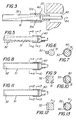
- the papermaker's felt 10 is formed in a conventional manner of a base fabric 11 having a first end 12 and a second end 14. Spaced apart loops 13 are formed at end 12 so as to alternately intermesh with loop 15 formed at end 14 when the ends 12 and 14 are aligned adjacent each other to form an endless felt.
- Orientation of loops 13 and 15 in this alternating intermeshing arrangement forms a substantially tubular passageway 20 through which a locking element or pintle may be inserted. Insertion of a pintle through passageway 20 effectively closes the seam and provides the desired endless felt.
- the pintle unit 30 is made up of two independent-complementary pintle elements 31 and 32.
- the pintle elements 31 and 32 are tapered or shaped for at least a portion of their length.
- the tapered portion of pintle elements 31 and 32 may be conical in cross section, Figure 5, or include a flat or geometric surface which is tapered, Figures 2, 4, 9, and 12.
- the pintle elements 31 and 32 are shaped to interfit and are oppositely tapered along their longitudinal axis.
- the complementary shape serves to unite the pintle elements and the tapered configuration serves to tighten the seam as will be described hereinafter.
- the pintle elements 31 and 32 are preferable inserted by affixing a swedge 40 to ends 32a and end 31b of pintle elements 31 and 32 respectively.
- An insertion wire or lead 42 is also joined to swedge 40. Insertion wire 42 is inserted through the seam, arrow 44, and used to pull pintle elements 31 and 32 through the seam, Figure 3.
- the orientation of pintle elements when joined by swedge 40 is such that the pintle unit 30 is of a diameter which is less than the diameter of seam passageway 20, fig 3, and may be easily pulled through the seam passageway 20.
- pintle elements 31 and 32 are inserted simultaneously through the passageway 20.
- pintle elements 31 and 32 may be inserted separately from opposite edges of the papermaker's felt.
- the pintle between elements 31 and 32 are tapered from a first relatively thin first end 31a and 32a respectively to a relatively thick body portion 31b and 32b respectively.
- the length of the tapered portion of each pintle element 31 and 32 is preferably wider than the width of the felt 10 to be seamed.
- pintle elements 31 and 32 By providing the pintle elements 31 and 32 with a taper which is longer than the width of the seam to be closed, a tight closure can be provided. In order to control twisting movement of the pintle unit in the seam, a tight fit between the pintle unit and the loops 13 and 15 along the full length of the seam is desired.
- the pintle units 31 and 32 are provided with a long, relatively gradual taper so that a tight fit along the complete length of the pintle unit can be provided. For a typical seam in a papermaker's fabric having an internal void diameter of about 50 mils, a pintle unit having a taper of about 0.075 mil/inch is effective for felts up to about 300 inches in width.
- the long, gradual taper provides a pintle unit with a relatively constant size and wedging action to provide a tight fit, all along the seam, even if the pintle elements 31 and 32 are not each pulled into the seam in equal amounts or length.
- the taper provided on pintle elements 31 and 32 also facilitates insertion of the elements through passageway 20.
- the pintle elements are oriented so that the diameter of pintle unit 30 is less than the diameter of passageway 20 so that they may easily fit through passageway 20. After orientation in passageway 20, swedge 40 is removed and ends 31a and 32a pulled in opposite directions to cause the diameter of pintle unit to increase, filling passageway 20 and locking the seam.
- the relatively thin insertion ends 31a and 32a allow for the the elements 31 and 32 to oriented so as to be easily inserted simultaneously from opposite edges of the felt 10 if desired.
- the taper of the elements 31 and 32 further provides a wedging action when the elements 31 and 32 are pulled in opposite directions as indicated by arrows 41 and 43.
- the tapered portion of each element 31 and 32 may comprise a flat face 37 and 38, Figure 2, formed on the pintle elements 31 and 32 respectively.
- flat faces 37 and 38, figure 2 are preferably oriented toward each other so that as the elements 31 and 32 are pulled through passageway 20 (arrows 41 and 43 of figure 1) the desired wedging action across the width of the seam is provided.
- Tightly wedging a pair of pintle elements 31 and 32 into passageway 20 provides a seam which is stronger than that provided by the use of a single pintle due to the locking force provided by the wedging action.
- the pintle elements are easy to insert into the passageway 20 due to the relationship which allows the pintle elements to be oriented in the passageway 20 and then pulled in opposite direction to interact and lock the seam in a wedging action.
- a wire lead is preferably attached to swedge 40 and ends 31b and 32a of elements 31 and 32 in a manner known in the art.
- the pintle elements 31 and 32 are severed at each edge 17 and 19 of the felt 10.
- the severed ends of the pintle elements 31 and 32 are then trimmed and fixed as by glueing, tying off, loop back insertion or heat staking to seal the seam and provide further control of the pintle in the felt 10 at the seam.
- the tapered portion of the pintle elements 51 and 52 may be provided with a tongue and groove formation.
- first tapered pintle element 51 is provided with a groove 53 along the tapered surface 55.
- the second tapered pintle element 52 is provided with a corresponding tongue 54 along the tapered surface 56 adapted to fit within groove 53.
- the tongue 56 is oriented within a groove 55 as the ends 51 and 52 are pulled in opposite directions into a wedging engagement within passageway 20.
- the cross sectional configuration of the pintle elements 31 and 32 is altered.
- the tapered portion of the pintle elements 31 and 32 comprise concical tapered portions, figure 6.
- the tapered portions may be flat, figure 12 or zig-zagged figure 9 respectively and the pintle unit shaped so as to have a relatively square cross-sectional shape, figures 9 and 12, while the insertion end is forced into a substantially round cross-section by swedge 40, figures 7, 10 and 13.
- the rounded cross-section of the insertion end eases orientation of the pintle unit and swedge assembly in the passageway 20.
- the wedging or locking action provided by the pintle element of the present invention provides a tight closing of the seam across the full width of the seam which reduces the potential for seam marks on the paper produced and also reduces seam bounce as the endless felt travels through the papermaking machine.
- two pintle elements having tapered insertion ends are employed in closing a seam on a papermaker's felt.
- the tapered end of each element preferably extends for at least the width of the papermaker's felt to be seamed.
- the tapered end of each pintle element is attached to a lead or insertion wire with a swedge or by other suitable means to aid in insertion.
- the lead wire of a pintle unit, or two such pintle elements are inserted through a passageway formed by alternating, intermeshing loops on the ends of the felt base fabric.
- the tapered pintle elements are pulled through the seam to tightly close the seam by filling the loops of the seam in a wedging action.
- the pintle elements are severed, trimmed and fixed after insertion to seal the seam.
Landscapes
- Paper (AREA)
- Treatment Of Fiber Materials (AREA)
Applications Claiming Priority (2)
| Application Number | Priority Date | Filing Date | Title |
|---|---|---|---|
| US07/108,376 US4806208A (en) | 1987-10-14 | 1987-10-14 | Method of seaming a seamed felt on a papermaking machine with oppositely tapered pintle elements |
| US108376 | 1987-10-14 |
Publications (2)
| Publication Number | Publication Date |
|---|---|
| EP0312350A2 true EP0312350A2 (de) | 1989-04-19 |
| EP0312350A3 EP0312350A3 (de) | 1991-01-16 |
Family
ID=22321864
Family Applications (1)
| Application Number | Title | Priority Date | Filing Date |
|---|---|---|---|
| EP19880309593 Withdrawn EP0312350A3 (de) | 1987-10-14 | 1988-10-13 | Verfahren zum Endlosmachen eines Filzes in einer Papiermaschine |
Country Status (5)
| Country | Link |
|---|---|
| US (1) | US4806208A (de) |
| EP (1) | EP0312350A3 (de) |
| JP (1) | JPH01132894A (de) |
| CA (1) | CA1329031C (de) |
| FI (1) | FI884702L (de) |
Families Citing this family (17)
| Publication number | Priority date | Publication date | Assignee | Title |
|---|---|---|---|---|
| US5713396A (en) * | 1990-06-06 | 1998-02-03 | Asten, Inc. | Papermakers fabric with stacked machine and cross machine direction yarns |
| US5199467A (en) * | 1990-06-06 | 1993-04-06 | Asten Group, Inc. | Papermakers fabric with stacked machine direction yarns |
| US5089324A (en) * | 1990-09-18 | 1992-02-18 | Jwi Ltd. | Press section dewatering fabric |
| US5480604A (en) * | 1991-01-23 | 1996-01-02 | Asten, Inc. | Molded seam for papermakers fabric and method |
| US5503195A (en) * | 1994-11-15 | 1996-04-02 | Albany International Corp | Combination-type seaming pintles with wire leader |
| US5657797A (en) * | 1996-02-02 | 1997-08-19 | Asten, Inc. | Press felt resistant to nip rejection |
| AU9503098A (en) * | 1998-09-24 | 2000-04-10 | Weavexx Corporation | Pin seamed papermaker's press felt with low melt material band in laminated basefabric |
| US6353976B1 (en) | 1999-09-28 | 2002-03-12 | Astenjohnson, Inc. | Expandable seamed felt pintle |
| US6880583B2 (en) * | 2002-05-29 | 2005-04-19 | Albany International Corp. | Papermaker's and industrial fabric seam |
| US20060068665A1 (en) * | 2004-09-29 | 2006-03-30 | Heinz Pernegger | Seamed felt for forming fiber cement articles and related methods |
| US8640862B2 (en) * | 2006-04-10 | 2014-02-04 | Albany International Corp. | Seam-on laminated belt |
| US7513277B2 (en) * | 2007-05-23 | 2009-04-07 | Voith Patent Gmbh | Low tensile creep belt |
| JP5628285B2 (ja) | 2009-03-26 | 2014-11-19 | ウェイン シェープリー,サンダー | 磁気軸受け構造を使用した搬送のための方法及びシステム |
| US8850989B2 (en) | 2010-12-03 | 2014-10-07 | Sandor Wayne Shapery | Magnetic levitation assembly |
| US20130008552A1 (en) | 2011-07-06 | 2013-01-10 | Hans Peter Breuer | Felt for forming fiber cement articles and related methods |
| DE102018105956A1 (de) | 2018-03-15 | 2019-09-19 | Voith Patent Gmbh | Bespannung |
| WO2020076534A1 (en) * | 2018-10-10 | 2020-04-16 | Astenjohnson, Inc. | Pintle insertion tool |
Family Cites Families (24)
| Publication number | Priority date | Publication date | Assignee | Title |
|---|---|---|---|---|
| US1404595A (en) * | 1921-06-04 | 1922-01-24 | Felix A Gibson | Coupling |
| US1723114A (en) * | 1928-04-10 | 1929-08-06 | Young John Richard | Belt clamp |
| US1975862A (en) * | 1933-04-26 | 1934-10-09 | Flexible Steel Lacing Co | Hinged fastening |
| US2012071A (en) * | 1934-01-17 | 1935-08-20 | Dayton Rubber Mfg Co | Belt connecter |
| US2020542A (en) * | 1934-02-12 | 1935-11-12 | Dayton Rubber Mfg Co | Belt connecter |
| US2002897A (en) * | 1934-02-13 | 1935-05-28 | Dayton Rubber Mfg Co | Belt connecter |
| US1998135A (en) * | 1934-04-04 | 1935-04-16 | Kohnstamm & Co Inc H | Belt apron fastener |
| US2034828A (en) * | 1935-03-09 | 1936-03-24 | Flexible Steel Lacing Co | Belt fastener |
| US2084490A (en) * | 1937-01-16 | 1937-06-22 | William E Hooper And Sons Comp | Drier felt |
| US2145455A (en) * | 1937-10-05 | 1939-01-31 | Flexible Steel Lacing Co | Flexible belt fastener |
| US2587053A (en) * | 1948-10-21 | 1952-02-26 | Charles M Lopez | Joint construction for endless belts |
| US2629909A (en) * | 1950-04-15 | 1953-03-03 | Morey Paper Mill Supply Co | Pintle or the like structural element for hinged seams |
| US2883734A (en) * | 1955-11-10 | 1959-04-28 | Draper Brothers Company | Paper-maker's wet felt |
| GB1114602A (en) * | 1965-07-07 | 1968-05-22 | Scapa Dryers Ltd | Improvements relating to hinge seams for dryer felts and the like |
| GB1187318A (en) * | 1968-07-12 | 1970-04-08 | Scapa Dryers Ltd | Pintle Wires for Clipper Seams |
| DE6929255U (de) * | 1969-07-23 | 1969-12-11 | Heimbach Gmbh Thomas Josef | Kupplungselement fuer nahtverbinder |
| US4007303A (en) * | 1970-10-30 | 1977-02-08 | Fitztuchverwaltungs-Gesellschaft Mit Beschrankter Haftung | Method of making pintle wire for high load hinge connections |
| US3735451A (en) * | 1971-10-14 | 1973-05-29 | Seapa Dryers Inc | Seam for paper felts |
| US3831297A (en) * | 1973-06-27 | 1974-08-27 | Caterpillar Tractor Co | Replaceable cutting edge assembly with wedge means |
| US4138864A (en) * | 1977-06-13 | 1979-02-13 | Bennett Dorothy L | Cable stitch holder for knitting |
| US4364421A (en) * | 1977-08-30 | 1982-12-21 | Wangner Systems Corporation | Woven textile dryer fabric and seam and weaving method |
| US4344209A (en) * | 1979-10-22 | 1982-08-17 | Scapa Dryers, Inc. | In-line clipper seam |
| US4250822A (en) * | 1979-12-06 | 1981-02-17 | Asten Group, Inc. | Low bulk, pin-type seam for use in paper making equipment fabrics, such as dryer felts |
| US4418726A (en) * | 1981-01-12 | 1983-12-06 | Albany International Corp. | Double loop seam for corrugator belts |
-
1987
- 1987-10-14 US US07/108,376 patent/US4806208A/en not_active Expired - Lifetime
-
1988
- 1988-10-12 FI FI884702A patent/FI884702L/fi not_active IP Right Cessation
- 1988-10-12 CA CA000579930A patent/CA1329031C/en not_active Expired - Fee Related
- 1988-10-13 EP EP19880309593 patent/EP0312350A3/de not_active Withdrawn
- 1988-10-14 JP JP63259298A patent/JPH01132894A/ja active Granted
Also Published As
| Publication number | Publication date |
|---|---|
| JPH01132894A (ja) | 1989-05-25 |
| US4806208A (en) | 1989-02-21 |
| FI884702A7 (fi) | 1989-04-15 |
| JPH0375675B2 (de) | 1991-12-02 |
| FI884702L (fi) | 1989-04-15 |
| EP0312350A3 (de) | 1991-01-16 |
| FI884702A0 (fi) | 1988-10-12 |
| CA1329031C (en) | 1994-05-03 |
Similar Documents
| Publication | Publication Date | Title |
|---|---|---|
| US4806208A (en) | Method of seaming a seamed felt on a papermaking machine with oppositely tapered pintle elements | |
| US4911683A (en) | Seam for work fabric and method of manufacture thereof | |
| DE69509983T2 (de) | Dreischichtige Papiermaschinegewebe mit verbesserter Faserunterstützung | |
| US5015220A (en) | Seam for work fabric and method of manufacture thereof | |
| EP2585634B1 (de) | Industrielles gewebe mit einem fadenförmigen nahtelement | |
| KR100352025B1 (ko) | 기계위에서이음가능한다축압착직물 | |
| US4865083A (en) | Seamed multi-layered papermaker's fabric | |
| EP0984098A3 (de) | Kettelnaht | |
| US5787936A (en) | Laminated papermaker's fabric having projecting seaming loops | |
| KR20000075783A (ko) | 제지기용 다중 축핀 이음형 프레스 펠트 | |
| US4991630A (en) | Single layer pin seam fabric having perpendicular seaming loops and method | |
| US4539730A (en) | Seaming means and a tool for forming the seam | |
| US4938269A (en) | Papermaker's felt seam with different loops | |
| CA1320066C (en) | Shaped monofilament coil seam and fabrics | |
| WO2000009802A1 (en) | Laminated multi-layered seam product with formed loops | |
| CA2505184C (en) | Seamed multi-layered fabric having different sized attachment mechanisms | |
| CN100549291C (zh) | 缝合多轴造纸织物以防止纱线游移的方法以及相应的造纸织物 | |
| EP1896652B1 (de) | Multiaxialer papiermaschinenbespannstoff mit vierschichtiger naht | |
| US4939025A (en) | Papermaker's felt with flex joint seam for pin | |
| US4649619A (en) | Method of forming a locked seam | |
| EP3962727B1 (de) | Gesäumter pressfilz mit teilweise verankertem füllgarn | |
| CA1329502C (en) | Pintle wire for a seam in a papermaker's fabric | |
| EP0341041A2 (de) | Nähte für einlagiges Gewebe mit senkrechten Verbindungsösen und Verfahren zu dessen Herstellung | |
| US4913947A (en) | Seam for papermaker's felt | |
| JPH0538079Y2 (de) |
Legal Events
| Date | Code | Title | Description |
|---|---|---|---|
| PUAI | Public reference made under article 153(3) epc to a published international application that has entered the european phase |
Free format text: ORIGINAL CODE: 0009012 |
|
| AK | Designated contracting states |
Kind code of ref document: A2 Designated state(s): AT BE CH DE ES FR GB GR IT LI LU NL SE |
|
| PUAL | Search report despatched |
Free format text: ORIGINAL CODE: 0009013 |
|
| AK | Designated contracting states |
Kind code of ref document: A3 Designated state(s): AT BE CH DE ES FR GB GR IT LI LU NL SE |
|
| STAA | Information on the status of an ep patent application or granted ep patent |
Free format text: STATUS: THE APPLICATION IS DEEMED TO BE WITHDRAWN |
|
| 18D | Application deemed to be withdrawn |
Effective date: 19910717 |