EP0313161A2 - Fühler mit einer immunochemischen Membran, die mit einem Halbleiter chemisch verbunden ist - Google Patents
Fühler mit einer immunochemischen Membran, die mit einem Halbleiter chemisch verbunden ist Download PDFInfo
- Publication number
- EP0313161A2 EP0313161A2 EP88202319A EP88202319A EP0313161A2 EP 0313161 A2 EP0313161 A2 EP 0313161A2 EP 88202319 A EP88202319 A EP 88202319A EP 88202319 A EP88202319 A EP 88202319A EP 0313161 A2 EP0313161 A2 EP 0313161A2
- Authority
- EP
- European Patent Office
- Prior art keywords
- antibody
- sensor
- immunochemical
- protein
- membrane
- Prior art date
- Legal status (The legal status is an assumption and is not a legal conclusion. Google has not performed a legal analysis and makes no representation as to the accuracy of the status listed.)
- Granted
Links
- 230000000984 immunochemical effect Effects 0.000 title claims abstract description 40
- 239000012528 membrane Substances 0.000 title claims abstract description 38
- 239000004065 semiconductor Substances 0.000 title description 3
- 102000004169 proteins and genes Human genes 0.000 claims abstract description 36
- 108090000623 proteins and genes Proteins 0.000 claims abstract description 36
- 238000000034 method Methods 0.000 claims abstract description 34
- -1 polysiloxane Polymers 0.000 claims abstract description 31
- 229920001296 polysiloxane Polymers 0.000 claims abstract description 31
- 229920001222 biopolymer Polymers 0.000 claims abstract description 19
- 239000011159 matrix material Substances 0.000 claims abstract description 18
- 125000000217 alkyl group Chemical group 0.000 claims abstract description 15
- 239000007822 coupling agent Substances 0.000 claims abstract description 14
- 230000001588 bifunctional effect Effects 0.000 claims abstract description 12
- VYPSYNLAJGMNEJ-UHFFFAOYSA-N Silicium dioxide Chemical compound O=[Si]=O VYPSYNLAJGMNEJ-UHFFFAOYSA-N 0.000 claims abstract description 11
- 125000003545 alkoxy group Chemical group 0.000 claims abstract description 11
- 229910052814 silicon oxide Inorganic materials 0.000 claims abstract description 11
- 125000004432 carbon atom Chemical group C* 0.000 claims abstract description 9
- 150000001282 organosilanes Chemical class 0.000 claims abstract description 8
- 125000002877 alkyl aryl group Chemical group 0.000 claims abstract description 3
- 125000004103 aminoalkyl group Chemical group 0.000 claims abstract description 3
- 125000003118 aryl group Chemical group 0.000 claims abstract description 3
- 239000000427 antigen Substances 0.000 claims description 25
- 102000036639 antigens Human genes 0.000 claims description 25
- 108091007433 antigens Proteins 0.000 claims description 25
- 238000000151 deposition Methods 0.000 claims description 15
- 108010015776 Glucose oxidase Proteins 0.000 claims description 14
- 239000004366 Glucose oxidase Substances 0.000 claims description 13
- 230000008021 deposition Effects 0.000 claims description 13
- 229940088598 enzyme Drugs 0.000 claims description 13
- 229940116332 glucose oxidase Drugs 0.000 claims description 13
- 235000019420 glucose oxidase Nutrition 0.000 claims description 13
- 108090000790 Enzymes Proteins 0.000 claims description 12
- 102000004190 Enzymes Human genes 0.000 claims description 12
- 125000003277 amino group Chemical group 0.000 claims description 9
- KPUWHANPEXNPJT-UHFFFAOYSA-N disiloxane Chemical class [SiH3]O[SiH3] KPUWHANPEXNPJT-UHFFFAOYSA-N 0.000 claims description 9
- 229910000077 silane Inorganic materials 0.000 claims description 7
- 238000001029 thermal curing Methods 0.000 claims description 7
- SXRSQZLOMIGNAQ-UHFFFAOYSA-N Glutaraldehyde Chemical group O=CCCCC=O SXRSQZLOMIGNAQ-UHFFFAOYSA-N 0.000 claims description 6
- 125000002887 hydroxy group Chemical group [H]O* 0.000 claims description 5
- 238000006116 polymerization reaction Methods 0.000 claims description 5
- 108010039918 Polylysine Proteins 0.000 claims description 4
- 229910008051 Si-OH Inorganic materials 0.000 claims description 4
- 229910006358 Si—OH Inorganic materials 0.000 claims description 4
- 230000003213 activating effect Effects 0.000 claims description 4
- 125000001931 aliphatic group Chemical group 0.000 claims description 4
- 125000000524 functional group Chemical group 0.000 claims description 4
- 230000007062 hydrolysis Effects 0.000 claims description 4
- 238000006460 hydrolysis reaction Methods 0.000 claims description 4
- 229920000656 polylysine Polymers 0.000 claims description 4
- 230000000379 polymerizing effect Effects 0.000 claims description 4
- 108010088751 Albumins Proteins 0.000 claims description 3
- 102000009027 Albumins Human genes 0.000 claims description 3
- 239000004372 Polyvinyl alcohol Substances 0.000 claims description 3
- BLRPTPMANUNPDV-UHFFFAOYSA-N Silane Chemical compound [SiH4] BLRPTPMANUNPDV-UHFFFAOYSA-N 0.000 claims description 3
- 108010046334 Urease Proteins 0.000 claims description 3
- 229920000249 biocompatible polymer Polymers 0.000 claims description 3
- 239000007853 buffer solution Substances 0.000 claims description 3
- 125000005442 diisocyanate group Chemical group 0.000 claims description 3
- 235000019422 polyvinyl alcohol Nutrition 0.000 claims description 3
- 229920002451 polyvinyl alcohol Polymers 0.000 claims description 3
- DVKJHBMWWAPEIU-UHFFFAOYSA-N toluene 2,4-diisocyanate Chemical group CC1=CC=C(N=C=O)C=C1N=C=O DVKJHBMWWAPEIU-UHFFFAOYSA-N 0.000 claims description 2
- ZNZYKNKBJPZETN-WELNAUFTSA-N Dialdehyde 11678 Chemical compound N1C2=CC=CC=C2C2=C1[C@H](C[C@H](/C(=C/O)C(=O)OC)[C@@H](C=C)C=O)NCC2 ZNZYKNKBJPZETN-WELNAUFTSA-N 0.000 claims 1
- 238000011534 incubation Methods 0.000 claims 1
- 238000002360 preparation method Methods 0.000 abstract description 4
- 239000008363 phosphate buffer Substances 0.000 description 9
- 239000000243 solution Substances 0.000 description 8
- 238000010521 absorption reaction Methods 0.000 description 7
- 230000002255 enzymatic effect Effects 0.000 description 5
- PHQOGHDTIVQXHL-UHFFFAOYSA-N n'-(3-trimethoxysilylpropyl)ethane-1,2-diamine Chemical compound CO[Si](OC)(OC)CCCNCCN PHQOGHDTIVQXHL-UHFFFAOYSA-N 0.000 description 5
- 230000004044 response Effects 0.000 description 5
- 239000002904 solvent Substances 0.000 description 5
- 239000000758 substrate Substances 0.000 description 5
- 238000006243 chemical reaction Methods 0.000 description 4
- VYFOAVADNIHPTR-UHFFFAOYSA-N isatoic anhydride Chemical compound NC1=CC=CC=C1CO VYFOAVADNIHPTR-UHFFFAOYSA-N 0.000 description 4
- QTBSBXVTEAMEQO-UHFFFAOYSA-N Acetic acid Chemical compound CC(O)=O QTBSBXVTEAMEQO-UHFFFAOYSA-N 0.000 description 3
- 108091003079 Bovine Serum Albumin Proteins 0.000 description 3
- 239000000872 buffer Substances 0.000 description 3
- 238000006555 catalytic reaction Methods 0.000 description 3
- 150000002500 ions Chemical class 0.000 description 3
- QYSGYZVSCZSLHT-UHFFFAOYSA-N octafluoropropane Chemical compound FC(F)(F)C(F)(F)C(F)(F)F QYSGYZVSCZSLHT-UHFFFAOYSA-N 0.000 description 3
- FZHAPNGMFPVSLP-UHFFFAOYSA-N silanamine Chemical class [SiH3]N FZHAPNGMFPVSLP-UHFFFAOYSA-N 0.000 description 3
- XLYOFNOQVPJJNP-UHFFFAOYSA-N water Substances O XLYOFNOQVPJJNP-UHFFFAOYSA-N 0.000 description 3
- WQZGKKKJIJFFOK-GASJEMHNSA-N Glucose Natural products OC[C@H]1OC(O)[C@H](O)[C@@H](O)[C@@H]1O WQZGKKKJIJFFOK-GASJEMHNSA-N 0.000 description 2
- 230000008901 benefit Effects 0.000 description 2
- 238000006073 displacement reaction Methods 0.000 description 2
- 239000008103 glucose Substances 0.000 description 2
- 238000005259 measurement Methods 0.000 description 2
- 238000000926 separation method Methods 0.000 description 2
- WYTZZXDRDKSJID-UHFFFAOYSA-N (3-aminopropyl)triethoxysilane Chemical compound CCO[Si](OCC)(OCC)CCCN WYTZZXDRDKSJID-UHFFFAOYSA-N 0.000 description 1
- RGHNJXZEOKUKBD-UHFFFAOYSA-N D-gluconic acid Natural products OCC(O)C(O)C(O)C(O)C(O)=O RGHNJXZEOKUKBD-UHFFFAOYSA-N 0.000 description 1
- 238000002965 ELISA Methods 0.000 description 1
- LFQSCWFLJHTTHZ-UHFFFAOYSA-N Ethanol Chemical compound CCO LFQSCWFLJHTTHZ-UHFFFAOYSA-N 0.000 description 1
- RGHNJXZEOKUKBD-SQOUGZDYSA-N Gluconic acid Natural products OC[C@@H](O)[C@@H](O)[C@H](O)[C@@H](O)C(O)=O RGHNJXZEOKUKBD-SQOUGZDYSA-N 0.000 description 1
- 108060003951 Immunoglobulin Proteins 0.000 description 1
- 229920002684 Sepharose Polymers 0.000 description 1
- 238000002835 absorbance Methods 0.000 description 1
- 238000000862 absorption spectrum Methods 0.000 description 1
- 239000002253 acid Substances 0.000 description 1
- 230000009471 action Effects 0.000 description 1
- 238000013019 agitation Methods 0.000 description 1
- 150000001298 alcohols Chemical class 0.000 description 1
- XAGFODPZIPBFFR-UHFFFAOYSA-N aluminium Chemical compound [Al] XAGFODPZIPBFFR-UHFFFAOYSA-N 0.000 description 1
- 229910052782 aluminium Inorganic materials 0.000 description 1
- 239000004411 aluminium Substances 0.000 description 1
- 239000012491 analyte Substances 0.000 description 1
- 150000004982 aromatic amines Chemical class 0.000 description 1
- 239000008366 buffered solution Substances 0.000 description 1
- 239000003054 catalyst Substances 0.000 description 1
- 210000002421 cell wall Anatomy 0.000 description 1
- 239000007795 chemical reaction product Substances 0.000 description 1
- 239000013626 chemical specie Substances 0.000 description 1
- 238000003759 clinical diagnosis Methods 0.000 description 1
- 238000010276 construction Methods 0.000 description 1
- ZBCBWPMODOFKDW-UHFFFAOYSA-N diethanolamine Chemical compound OCCNCCO ZBCBWPMODOFKDW-UHFFFAOYSA-N 0.000 description 1
- 239000012153 distilled water Substances 0.000 description 1
- 230000000694 effects Effects 0.000 description 1
- 238000005516 engineering process Methods 0.000 description 1
- 150000002148 esters Chemical class 0.000 description 1
- 238000001704 evaporation Methods 0.000 description 1
- 230000008020 evaporation Effects 0.000 description 1
- 230000005669 field effect Effects 0.000 description 1
- 239000000174 gluconic acid Substances 0.000 description 1
- 235000012208 gluconic acid Nutrition 0.000 description 1
- 239000007973 glycine-HCl buffer Substances 0.000 description 1
- PCHJSUWPFVWCPO-UHFFFAOYSA-N gold Chemical compound [Au] PCHJSUWPFVWCPO-UHFFFAOYSA-N 0.000 description 1
- 239000010931 gold Substances 0.000 description 1
- 229910052737 gold Inorganic materials 0.000 description 1
- 239000005556 hormone Substances 0.000 description 1
- 229940088597 hormone Drugs 0.000 description 1
- 102000018358 immunoglobulin Human genes 0.000 description 1
- 229940072221 immunoglobulins Drugs 0.000 description 1
- INJVFBCDVXYHGQ-UHFFFAOYSA-N n'-(3-triethoxysilylpropyl)ethane-1,2-diamine Chemical compound CCO[Si](OCC)(OCC)CCCNCCN INJVFBCDVXYHGQ-UHFFFAOYSA-N 0.000 description 1
- MQWFLKHKWJMCEN-UHFFFAOYSA-N n'-[3-[dimethoxy(methyl)silyl]propyl]ethane-1,2-diamine Chemical compound CO[Si](C)(OC)CCCNCCN MQWFLKHKWJMCEN-UHFFFAOYSA-N 0.000 description 1
- 239000008055 phosphate buffer solution Substances 0.000 description 1
- 239000000047 product Substances 0.000 description 1
- 230000009257 reactivity Effects 0.000 description 1
- 230000009467 reduction Effects 0.000 description 1
- 230000035945 sensitivity Effects 0.000 description 1
- 150000004756 silanes Chemical class 0.000 description 1
- 239000007787 solid Substances 0.000 description 1
- 238000003756 stirring Methods 0.000 description 1
- 238000003786 synthesis reaction Methods 0.000 description 1
- ROWWCTUMLAVVQB-UHFFFAOYSA-N triethoxysilylmethanamine Chemical compound CCO[Si](CN)(OCC)OCC ROWWCTUMLAVVQB-UHFFFAOYSA-N 0.000 description 1
- 238000005406 washing Methods 0.000 description 1
- 238000005303 weighing Methods 0.000 description 1
Images

Classifications
-
- G—PHYSICS
- G01—MEASURING; TESTING
- G01N—INVESTIGATING OR ANALYSING MATERIALS BY DETERMINING THEIR CHEMICAL OR PHYSICAL PROPERTIES
- G01N27/00—Investigating or analysing materials by the use of electric, electrochemical, or magnetic means
- G01N27/26—Investigating or analysing materials by the use of electric, electrochemical, or magnetic means by investigating electrochemical variables; by using electrolysis or electrophoresis
- G01N27/403—Cells and electrode assemblies
- G01N27/414—Ion-sensitive or chemical field-effect transistors, i.e. ISFETS or CHEMFETS
- G01N27/4145—Ion-sensitive or chemical field-effect transistors, i.e. ISFETS or CHEMFETS specially adapted for biomolecules, e.g. gate electrode with immobilised receptors
Definitions
- This invention relates to an antibody device (immunosensor) sensitive to the antigen towards which the antibody is specific, and its methods of preparation, it containing an immunochemical membrane formed from a polymeric multilayer consisting of an antibody or protein A bound to support biopolymers, a polysiloxane matrix and an EOS (electrolytic oxide semiconductor) or CHEMFET device.
- an antibody device immunosensor sensitive to the antigen towards which the antibody is specific
- an immunochemical membrane formed from a polymeric multilayer consisting of an antibody or protein A bound to support biopolymers, a polysiloxane matrix and an EOS (electrolytic oxide semiconductor) or CHEMFET device.
- the hematic concentration of metabolytes, hormones or proteins is currently determined by various methods employing immunofluorescent systems (FIE etc.), immunoradiometric systems (RIA, IRMA etc>) or immunoenzymatic systems (ELISA etc.).
- FIE etc. immunofluorescent systems
- RIA, IRMA etc> immunoradiometric systems
- ELISA etc. immunoenzymatic systems
- the immunochemical membrane constructed in this manner is rather unstable and in particular suffers interference from other chemical species such as ions or proteins present in solution. It has been surprisingly found that by constructing an immunochemical membrane consisting of protein A or an antibody directed towards the antigen to be determined, which is polymerized together with support biopolymers and bound chemically to the surface silicon oxide of the device by means of a polysiloxane matrix, the membrane maintains constant biological functionality for more than one month if preserved in a pH 7 buffered solution.
- polysiloxane matrices used can be aminoethylaminopropyltrimethoxysilane (AEAPS) or anthranilamidepropyltriethoxysilane (AAPS).
- AEAPS aminoethylaminopropyltrimethoxysilane
- AAPS anthranilamidepropyltriethoxysilane
- the EOS device Besides containing silicon oxide on its surface, the EOS device must contain in the part below the silicon oxide a layer of aluminium or gold deposited by evaporation.
- a functional organosilane of formula (2) its preparation involves reacting isatoic anhydride or its derivatives with amino silanes of type in accordance with the following scheme:
- silanes preferred in practice for preparing the functional organosilane in accordance with the objects of the present invention are: 3-aminopropyltriethoxysilane H2N-(CH2)3-Si-(OC2H5)3 aminomethyltriethoxysilane H2N-CH2-Si-(OC2H5)3 2-aminoethylaminopropyltrimethoxysilane H2N-(CH2)2-NH-(CH2)3-Si-(OCH3)3 2-aminoethylaminopropyltriethoxysilane H2N-(CH2)2-NH-(CH2)3-Si-(OC2H5)3 2-aminoethylaminopropylmethyldimethoxysilane
- the synthesis reaction is effected by gradually adding the isatoic anhydride to the aminosilane in the presence or absence of solvent. If the reaction is effected in a solvent, this must obviously not react with isatoic anhydride. In the case of hydroxyl solvents mild reaction conditions must for example be used, with no catalyst present.
- Alcohols, esters, chlorinated solvents etc. can be used as solvent. No water must be present, as this would obviously hydrolyze the alkoxy groups.
- the reaction can also be effected by adding the isatoic anhydride altogether rather than gradually, by virtue of the slight exothermicity of the reaction (it m ust then be cooled), and the fact that in spite of the considerable difference in reactivity between the aliphatic amine (aminosilane) and the aromatic amine (reaction product) a minimum quantity of oligomer products could form, of type:
- Enzyme types which produce electrical charges during the catalyzed reaction can be introduced into said device.
- the support biopolymers can be proteins (such as albumin), biopolymers with functional groups (such as polylysine) or functionalized biocompatible polymers (such as polyvinylalcohol). If the immunochemical membrane is formed from a polymeric multilayer consisting of protein A, the protein A being polymerized together with support biopolymers, an antibody directed against the antigen to be determined is made to adhere to it.
- the present invention also provides a method for forming the immunochemical membrane device.
- a first method for forming the sensor, in which the immunochemical membrane contains an antibody comprises the following stages: - preparing a siloxane prepolymer and then effecting one or more depositions of it on an EOS or CHEMFET device, followed by thermal curing in which complete polymerization takes place by hydrolysis of the silane alkoxy groups, to obtain a polysiloxane matrix which is then made to adhere chemically to the silicon oxide by reacting other alkoxy groups with the Si-OH hydroxyls present on the oxidised surface; - activating the aliphatic amino groups present on the polysiloxane layer with bifunctional coupling agents; - partially polymerizing the antibody with a support biopolymer using bifunctional coupling agents; - reacting the immunochemical prepolymer with the activated amino groups of the polysiloxane layer.
- a further method for forming the sensor in which the immunochemical membrane contains protein A comprises the following stages: - preparing a siloxane prepolymer and then effecting one or more depositions of it on an EOS or CHEMFET device, followed by thermal curing in which complete polymerization takes place by hydrolysis of the silane alkoxy groups, to obtain a polysiloxane matrix which is then made to adhere chemically to the silicon oxide by reacting other alkoxy groups with the Si-OH hydroxyls present on the oxidised surface; - activating the aliphatic amino groups present on the polysiloxane layer with bifunctional coupling agents; - partially polymerizing the protein A with a support biopolymer using bifunctional coupling agents; - reacting the immunochemical prepolymer with the activated amino groups of the polysiloxane layer.
- the bifunctional coupling agents used in the aforesaid method can be chosen from dialdehydes (such as glutaraldehyde) or from diisocyanates (such as toluene 2, 4-diisocyanate).
- the support biopolymers can be chosen from proteins (such as albumin), from biopolymers having functional groups (such as polylysine) or from functionalized biocompatible polymers (such as polyvinylalcohol).
- Depositing the siloxane prepolymer in the aforesaid methods is done by spin-on techniques, whereas the polysiloxane layer is activated and reacted with the partially polymerized antibody or protein A on an oscillating plate.
- Thermal curing of the silane prepolymer is done at a temperature of 80-140°C, and the subsequent immunochemical immobilization treatment at 25-37°C.
- the thickness of the deposited siloxane prepolymer must be between 0.5 and 3 ⁇ , and the immunochemical membrane must have a thickness of between 0.5 and 2 ⁇ .
- the rotary disc apparatus In forming the polysiloxane layer the rotary disc apparatus must operate for deposition purposes preferably at a speed of between 400 and 4500 rpm.
- the antibody is made to adhere to the immunochemical membrane by incubating the sensor in the presence of the antibody preferably at a concentration of between 0.5 and 1.5 mg/gl of pH 6.5-7.5 buffer solution for a time preferably of 0.5-1.5 hours at ambient temperature.
- the antibody which has been made to adhere to the immunochemical membrane can be removed (possibly to replace it with another antibody) by a buffer solution of acid pH, preferably pH 1.5-2.5, for a time preferably of 0.5-1.5 hours at ambient temperature.
- the present invention further provides a method for measuring the unknown concentration of the antigen (against which the antibody is directed) using electronic MOS or MOSFET devices as transducers.
- the antibody concentration is determined by tagging the antigen or an antibody directed against said antigen, with an enzyme such as glucoseoxidase, urease or the like, which during the catalyzed reaction produces electrical charges measured by the transducer (MOS or FET).
- an enzyme such as glucoseoxidase, urease or the like, which during the catalyzed reaction produces electrical charges measured by the transducer (MOS or FET).
- the antigen-enzyme conjugate is made to compete with the antigen under determination for the binding sites of the antibody immobilized on the device.
- the quantity of tagged antigen bound to the immunochemical membrane present on the device can be determined by the electrical response of the enzyme in the presence of its substrate. This quantity will then be inversely proportional to the quantity of the antigen under determination present in solution.
- the antibody tagged with the enzyme is added.
- the antigen concentration to be determined will thus be directly proportional to quantity of tagged antibody bound to the antigen, and determined by the electrical response of the enzyme recorded by the transducer.
- An immunosensor was prepared for the purpose of obtaining an immunochemical membrane formed from a polymeric multilayer consisting of an antibody chemically bound to the polysiloxane matrix.
- a solution of polysiloxane partially hydrolyzed in a hydro-alcoholic environment was deposited on 1 cm x 1 cm bars of an EOS device, the solution consisting of: 21% of amino-ethylaminopropyltrimethoxysilane (AEAPS) 3% of acetic acid 1% of H2O in absolute ethanol.
- AEAPS amino-ethylaminopropyltrimethoxysilane
- Three depositions were made by means of a rotary disc apparatus rotating at 3500 rpm for 20 seconds.
- the excess oligomer solution depositing on the EOS was removed by the centrifugal action generated by the rotation of the supporting plate. After thermal curing for 16 hours at 120°C the bars were cooled and placed in a weighing bottle in a 0.02M pH 7 phosphate buffer solution containing a 1% concentration of glutaraldehyde, and were put under agitation on an oscillating plate for 1.5 hours at ambient temperature, after which they were washed with the phosphate buffer and with distilled water.
- An immunosensor was prepared for the purpose of obtaining an immunochemical membrane formed from a polymeric multilayer consisting of protein A chemically bound to the polysiloxane matrix.
- Example 2 The method was similar to that of Example 1 but with the difference that 1 mg of protein A was reacted instead of the antibody and 4 mg of polylysine instead of the bovine albumin. Additionally to Example 1, the antibody must then be added to the immunochemical device.
- This example demonstrates the method for determining the concentration of the human IgG (HIgG) antigen by tagging the antigen with the enzyme glucose-oxidase (GOD).
- HgG human IgG
- GOD glucose-oxidase
- HIgG human IgG
- GOD glucose-oxidase
- the conjugate is then passed through a protein A/sepharose column, and washed repeatedly with 0.02 M pH 7 phosphate buffer until eluate 280 nm absorption becomes negligible.
- the conjugate bound to the column is then eluted with 0.1 M pH 2.2 glycine-HCl buffer and dialyzed against 0.02 M pH 7 phosphate buffer.
- the conjugate GOD absorption at 280 nm is calculated, it being 10 times greater than that measured at 450 nm, a region in which there is no appreciable absorption of human immunoglobulins (HIgG).
- the HIgG absorption is then obtained as the difference between the total conjugate absorption and the GOD absorption.
- the final molar ratio of enzyme (GOD) to HIgG varies between about 1:1 and 2:1.
- the samples are incubated in 1 ml of a solution containing 0.5 mg/ml of the HIgG-GOD conjugate in 0.02 M pH 7 phosphate buffer for 2 hours at 25°C.
- the samples are washed and the enzymatic activity of the conjugate GOD is measured by measuring the reduction in substrate (glucose) with the commerical Boehringer kit.
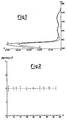
- Separation of the conjugate from the protein A is effected by means of a glycine-0.1 M pH 2.2 HCl buffer and is verified by measuring the enzymatic activity, represented by a white square.
- good separation of the HIgG-GOD conjugate and restoration of the bond with the protein A is indicated (the vertical axis represents enzymatic activity in ⁇ g/min/cm2 and the horizontal axis represents the number of tests carried out on the same sample).
- Capacitance/voltage curves are generally used in semiconductor technology to study the silicon oxide characteristics during the construction of field effect transistors (FET).
- the activity of the enzyme produces electrical charges on the surface of the device (gluconic acid in the case of glucose-oxidase) which determine displacement of the capacitance minimum.
Landscapes
- Health & Medical Sciences (AREA)
- Life Sciences & Earth Sciences (AREA)
- Chemical & Material Sciences (AREA)
- Molecular Biology (AREA)
- Physics & Mathematics (AREA)
- Analytical Chemistry (AREA)
- General Health & Medical Sciences (AREA)
- Engineering & Computer Science (AREA)
- Chemical Kinetics & Catalysis (AREA)
- Electrochemistry (AREA)
- Spectroscopy & Molecular Physics (AREA)
- Biochemistry (AREA)
- Microelectronics & Electronic Packaging (AREA)
- General Physics & Mathematics (AREA)
- Immunology (AREA)
- Pathology (AREA)
- Medicines Containing Antibodies Or Antigens For Use As Internal Diagnostic Agents (AREA)
- Peptides Or Proteins (AREA)
- Heterocyclic Carbon Compounds Containing A Hetero Ring Having Oxygen Or Sulfur (AREA)
- Apparatus Associated With Microorganisms And Enzymes (AREA)
Priority Applications (1)
| Application Number | Priority Date | Filing Date | Title |
|---|---|---|---|
| AT88202319T ATE100201T1 (de) | 1987-10-23 | 1988-10-18 | Fuehler mit einer immunochemischen membran, die mit einem halbleiter chemisch verbunden ist. |
Applications Claiming Priority (2)
| Application Number | Priority Date | Filing Date | Title |
|---|---|---|---|
| IT2239087 | 1987-10-23 | ||
| IT22390/87A IT1223320B (it) | 1987-10-23 | 1987-10-23 | Sensore con membrana immunochimica legata chimicamente a un dispositivo semiconduttore |
Publications (3)
| Publication Number | Publication Date |
|---|---|
| EP0313161A2 true EP0313161A2 (de) | 1989-04-26 |
| EP0313161A3 EP0313161A3 (en) | 1990-02-07 |
| EP0313161B1 EP0313161B1 (de) | 1994-01-12 |
Family
ID=11195640
Family Applications (1)
| Application Number | Title | Priority Date | Filing Date |
|---|---|---|---|
| EP88202319A Expired - Lifetime EP0313161B1 (de) | 1987-10-23 | 1988-10-18 | Fühler mit einer immunochemischen Membran, die mit einem Halbleiter chemisch verbunden ist |
Country Status (5)
| Country | Link |
|---|---|
| EP (1) | EP0313161B1 (de) |
| AT (1) | ATE100201T1 (de) |
| DE (1) | DE3887074T2 (de) |
| ES (1) | ES2061635T3 (de) |
| IT (1) | IT1223320B (de) |
Cited By (2)
| Publication number | Priority date | Publication date | Assignee | Title |
|---|---|---|---|---|
| WO1991008482A1 (en) * | 1989-12-01 | 1991-06-13 | Unilever Plc | Antibody variable domain conjugates |
| DE4027728A1 (de) * | 1990-08-31 | 1992-03-05 | Bayer Ag | Immobilisierung von organischen makromolekuelen oder biopolymeren in einer polymermembran |
Families Citing this family (1)
| Publication number | Priority date | Publication date | Assignee | Title |
|---|---|---|---|---|
| DE10041809A1 (de) * | 2000-08-25 | 2002-03-07 | Giesing Michael | Arrays immobilisierter Biomoleküle, deren Herstellung und Verwendung |
Family Cites Families (2)
| Publication number | Priority date | Publication date | Assignee | Title |
|---|---|---|---|---|
| JPS5825221B2 (ja) * | 1977-12-12 | 1983-05-26 | 株式会社クラレ | Fet比較電極 |
| IT1198226B (it) * | 1986-12-04 | 1988-12-21 | Eniricerche Spa | Dispositivo sensibile agli ioni |
-
1987
- 1987-10-23 IT IT22390/87A patent/IT1223320B/it active
-
1988
- 1988-10-18 EP EP88202319A patent/EP0313161B1/de not_active Expired - Lifetime
- 1988-10-18 AT AT88202319T patent/ATE100201T1/de not_active IP Right Cessation
- 1988-10-18 DE DE88202319T patent/DE3887074T2/de not_active Expired - Fee Related
- 1988-10-18 ES ES88202319T patent/ES2061635T3/es not_active Expired - Lifetime
Cited By (2)
| Publication number | Priority date | Publication date | Assignee | Title |
|---|---|---|---|---|
| WO1991008482A1 (en) * | 1989-12-01 | 1991-06-13 | Unilever Plc | Antibody variable domain conjugates |
| DE4027728A1 (de) * | 1990-08-31 | 1992-03-05 | Bayer Ag | Immobilisierung von organischen makromolekuelen oder biopolymeren in einer polymermembran |
Also Published As
| Publication number | Publication date |
|---|---|
| DE3887074T2 (de) | 1994-05-11 |
| EP0313161A3 (en) | 1990-02-07 |
| IT8722390A0 (it) | 1987-10-23 |
| EP0313161B1 (de) | 1994-01-12 |
| ATE100201T1 (de) | 1994-01-15 |
| ES2061635T3 (es) | 1994-12-16 |
| DE3887074D1 (de) | 1994-02-24 |
| IT1223320B (it) | 1990-09-19 |
Similar Documents
| Publication | Publication Date | Title |
|---|---|---|
| EP0395137B1 (de) | Sensor mit einem Antigen, das chemisch an eine Halbleitervorrichtung gebunden ist | |
| EP0291130A2 (de) | Biosensor mit an eine Halbleiter-Vorrichtung chemisch gebundene Enzym-Membran | |
| US5955335A (en) | Biomaterial immobilization on an Si3 N4 surface containing Si-NH2 groups with a heterobifunctional cross-linking agent | |
| US6586232B2 (en) | Substrate preparation for chemical-species-specific binding | |
| US5407818A (en) | Biosensor containing a biochemical substance immobilized on a layer of olefinic-unsaturated, epoxy functional cross-linked polysiloxane | |
| EP0700520B1 (de) | Sensoren beruhend auf polymerumwandlung | |
| EP0408578B1 (de) | Enzymatisch verstärkter, piezoelektrischer, spezifischer bindungstest | |
| US5389534A (en) | Biosensor containing a biochemical substance immobilized on a layer of an olefinic-unsaturated, epoxyfunctional polyether | |
| JP4713155B2 (ja) | コーティング | |
| Sergeyeva et al. | β-Lactamase label-based potentiometric biosensor for α-2 interferon detection | |
| US20060160207A1 (en) | Cucurbituril derivative-bonded solid substrate and biochip using the same | |
| EP0313161B1 (de) | Fühler mit einer immunochemischen Membran, die mit einem Halbleiter chemisch verbunden ist | |
| EP0416730A2 (de) | Herstellung einer Festphase, geeignet für spezifische Bindung chemischer Substanzen | |
| JPS60166700A (ja) | ペニシロ酸抗体、その製法および用途 | |
| Geckeler et al. | Polymer materials in biosensors | |
| EP0784791B1 (de) | Biosensor mit auf einer signalaktiven oberfläche kovalent fixiertem biomaterial | |
| Colapicchioni et al. | Fabrication and characterization of ENFET devices for biomedical applications and environmental monitoring | |
| JP2003286342A (ja) | 過分枝シラン官能性ポリアミドウレタン、その使用、これで表面コーテイングされた装置及びこの装置の使用 | |
| DE4435998C1 (de) | Verfahren zur Immobilisierung von Biomaterial auf einer Unterlage | |
| JPH0564732B2 (de) | ||
| JPH01119753A (ja) | 免疫センサおよびその製造法 | |
| JPS62288560A (ja) | バイオセンサ− | |
| JPH05344885A (ja) | 生理活性物質固定化材料 | |
| JPS63231257A (ja) | バイオセンサ及びその製法 | |
| JPH0617893B2 (ja) | 生理活性物質の分析方法 |
Legal Events
| Date | Code | Title | Description |
|---|---|---|---|
| PUAI | Public reference made under article 153(3) epc to a published international application that has entered the european phase |
Free format text: ORIGINAL CODE: 0009012 |
|
| AK | Designated contracting states |
Kind code of ref document: A2 Designated state(s): AT BE CH DE ES FR GB GR LI LU NL SE |
|
| PUAL | Search report despatched |
Free format text: ORIGINAL CODE: 0009013 |
|
| AK | Designated contracting states |
Kind code of ref document: A3 Designated state(s): AT BE CH DE ES FR GB GR LI LU NL SE |
|
| 17P | Request for examination filed |
Effective date: 19900725 |
|
| 17Q | First examination report despatched |
Effective date: 19910902 |
|
| GRAA | (expected) grant |
Free format text: ORIGINAL CODE: 0009210 |
|
| AK | Designated contracting states |
Kind code of ref document: B1 Designated state(s): AT BE CH DE ES FR GB GR LI LU NL SE |
|
| REF | Corresponds to: |
Ref document number: 100201 Country of ref document: AT Date of ref document: 19940115 Kind code of ref document: T |
|
| REF | Corresponds to: |
Ref document number: 3887074 Country of ref document: DE Date of ref document: 19940224 |
|
| ET | Fr: translation filed | ||
| REG | Reference to a national code |
Ref country code: GR Ref legal event code: FG4A Free format text: 3010860 |
|
| PLBE | No opposition filed within time limit |
Free format text: ORIGINAL CODE: 0009261 |
|
| STAA | Information on the status of an ep patent application or granted ep patent |
Free format text: STATUS: NO OPPOSITION FILED WITHIN TIME LIMIT |
|
| REG | Reference to a national code |
Ref country code: ES Ref legal event code: FG2A Ref document number: 2061635 Country of ref document: ES Kind code of ref document: T3 |
|
| 26N | No opposition filed | ||
| EAL | Se: european patent in force in sweden |
Ref document number: 88202319.5 |
|
| PGFP | Annual fee paid to national office [announced via postgrant information from national office to epo] |
Ref country code: GB Payment date: 19971009 Year of fee payment: 10 Ref country code: FR Payment date: 19971009 Year of fee payment: 10 |
|
| PGFP | Annual fee paid to national office [announced via postgrant information from national office to epo] |
Ref country code: AT Payment date: 19971014 Year of fee payment: 10 |
|
| PGFP | Annual fee paid to national office [announced via postgrant information from national office to epo] |
Ref country code: SE Payment date: 19971015 Year of fee payment: 10 |
|
| PGFP | Annual fee paid to national office [announced via postgrant information from national office to epo] |
Ref country code: ES Payment date: 19971017 Year of fee payment: 10 |
|
| PGFP | Annual fee paid to national office [announced via postgrant information from national office to epo] |
Ref country code: GR Payment date: 19971021 Year of fee payment: 10 |
|
| PGFP | Annual fee paid to national office [announced via postgrant information from national office to epo] |
Ref country code: DE Payment date: 19971024 Year of fee payment: 10 |
|
| PGFP | Annual fee paid to national office [announced via postgrant information from national office to epo] |
Ref country code: NL Payment date: 19971029 Year of fee payment: 10 |
|
| PGFP | Annual fee paid to national office [announced via postgrant information from national office to epo] |
Ref country code: LU Payment date: 19971030 Year of fee payment: 10 |
|
| PGFP | Annual fee paid to national office [announced via postgrant information from national office to epo] |
Ref country code: CH Payment date: 19971105 Year of fee payment: 10 |
|
| PGFP | Annual fee paid to national office [announced via postgrant information from national office to epo] |
Ref country code: BE Payment date: 19971211 Year of fee payment: 10 |
|
| PG25 | Lapsed in a contracting state [announced via postgrant information from national office to epo] |
Ref country code: LU Free format text: LAPSE BECAUSE OF NON-PAYMENT OF DUE FEES Effective date: 19981018 Ref country code: GB Free format text: LAPSE BECAUSE OF NON-PAYMENT OF DUE FEES Effective date: 19981018 Ref country code: AT Free format text: LAPSE BECAUSE OF NON-PAYMENT OF DUE FEES Effective date: 19981018 |
|
| PG25 | Lapsed in a contracting state [announced via postgrant information from national office to epo] |
Ref country code: SE Free format text: LAPSE BECAUSE OF NON-PAYMENT OF DUE FEES Effective date: 19981019 Ref country code: ES Free format text: LAPSE BECAUSE OF THE APPLICANT RENOUNCES Effective date: 19981019 |
|
| PG25 | Lapsed in a contracting state [announced via postgrant information from national office to epo] |
Ref country code: LI Free format text: LAPSE BECAUSE OF NON-PAYMENT OF DUE FEES Effective date: 19981031 Ref country code: GR Free format text: LAPSE BECAUSE OF NON-PAYMENT OF DUE FEES Effective date: 19981031 Ref country code: CH Free format text: LAPSE BECAUSE OF NON-PAYMENT OF DUE FEES Effective date: 19981031 Ref country code: BE Free format text: LAPSE BECAUSE OF NON-PAYMENT OF DUE FEES Effective date: 19981031 |
|
| BERE | Be: lapsed |
Owner name: ENIRICERCHE S.P.A. Effective date: 19981031 |
|
| PG25 | Lapsed in a contracting state [announced via postgrant information from national office to epo] |
Ref country code: NL Free format text: LAPSE BECAUSE OF NON-PAYMENT OF DUE FEES Effective date: 19990501 |
|
| GBPC | Gb: european patent ceased through non-payment of renewal fee |
Effective date: 19981018 |
|
| REG | Reference to a national code |
Ref country code: CH Ref legal event code: PL |
|
| EUG | Se: european patent has lapsed |
Ref document number: 88202319.5 |
|
| PG25 | Lapsed in a contracting state [announced via postgrant information from national office to epo] |
Ref country code: FR Free format text: LAPSE BECAUSE OF NON-PAYMENT OF DUE FEES Effective date: 19990630 |
|
| NLV4 | Nl: lapsed or anulled due to non-payment of the annual fee |
Effective date: 19990501 |
|
| REG | Reference to a national code |
Ref country code: FR Ref legal event code: ST |
|
| PG25 | Lapsed in a contracting state [announced via postgrant information from national office to epo] |
Ref country code: DE Free format text: LAPSE BECAUSE OF NON-PAYMENT OF DUE FEES Effective date: 19990803 |
|
| REG | Reference to a national code |
Ref country code: ES Ref legal event code: FD2A Effective date: 20001102 |