EP0314213A2 - Anzeigegerät - Google Patents
Anzeigegerät Download PDFInfo
- Publication number
- EP0314213A2 EP0314213A2 EP19880202228 EP88202228A EP0314213A2 EP 0314213 A2 EP0314213 A2 EP 0314213A2 EP 19880202228 EP19880202228 EP 19880202228 EP 88202228 A EP88202228 A EP 88202228A EP 0314213 A2 EP0314213 A2 EP 0314213A2
- Authority
- EP
- European Patent Office
- Prior art keywords
- display
- displayed
- specific order
- subset
- actuation
- Prior art date
- Legal status (The legal status is an assumption and is not a legal conclusion. Google has not performed a legal analysis and makes no representation as to the accuracy of the status listed.)
- Granted
Links
Images

Classifications
-
- G—PHYSICS
- G09—EDUCATION; CRYPTOGRAPHY; DISPLAY; ADVERTISING; SEALS
- G09G—ARRANGEMENTS OR CIRCUITS FOR CONTROL OF INDICATING DEVICES USING STATIC MEANS TO PRESENT VARIABLE INFORMATION
- G09G3/00—Control arrangements or circuits, of interest only in connection with visual indicators other than cathode-ray tubes
- G09G3/04—Control arrangements or circuits, of interest only in connection with visual indicators other than cathode-ray tubes for presentation of a single character by selection from a plurality of characters, or by composing the character by combination of individual elements, e.g. segments using a combination of such display devices for composing words, rows or the like, in a frame with fixed character positions
-
- G—PHYSICS
- G04—HOROLOGY
- G04G—ELECTRONIC TIME-PIECES
- G04G9/00—Visual time or date indication means
- G04G9/08—Visual time or date indication means by building-up characters using a combination of indicating elements, e.g. by using multiplexing techniques
- G04G9/087—Visual time or date indication means by building-up characters using a combination of indicating elements, e.g. by using multiplexing techniques provided with means for displaying at will a time indication or a date or a part thereof
-
- G—PHYSICS
- G05—CONTROLLING; REGULATING
- G05B—CONTROL OR REGULATING SYSTEMS IN GENERAL; FUNCTIONAL ELEMENTS OF SUCH SYSTEMS; MONITORING OR TESTING ARRANGEMENTS FOR SUCH SYSTEMS OR ELEMENTS
- G05B2219/00—Program-control systems
- G05B2219/20—Pc systems
- G05B2219/23—Pc programming
- G05B2219/23016—Accelerate input, exponent as function of pressure, time, turning speed, keys for 10-to-1
Definitions
- This invention relates to display apparatus comprising display means for a combination of first and second digits, displayed digit value control means coupled to said display means for controlling said display means to display respective members of a set of values of said combination, and a manually actuable control device for said control means, said control means being arranged to respond to each new actuation of said control device by controlling the display means to display the next member (if present) of said set, taken in a specific order, to that member which is currently being displayed, said specific order being an order in which subsets of said set having respective values of said first digit follow each other in a specific sequence.
- Apparatuses of the above kind are known, for example, from GB-B-2 020 860 and GB-B-2 051 426.
- the display is a numerical one, the displayed value being incremented by unity upon each new actuation of the control device.
- prolongation of a given actuation results in the repeated incrementation of the displayed value by unity until one of a set of reference values is displayed, after which repeated incrementation continues to take place (so long as the actuation is continued) but now by values larger than unity.
- Another environment in which it is often required to set a display to a new value lies in the area of mobile radio communication equipment, in which the channel to which the equipment is currently tuned is indicated by a digital display, retuning being effected using the display to indicate the instantaneous tuning situation. If the equipment is installed, for example, in a road vehicle, and is operated by the driver thereof, it is obviously highly desirable that any retuning process be made as simple and rapid as possible. It is an object of the present invention to provide display apparatus in which the displayed value can be set to a new one more rapidly in many cases than is possible with the known apparatuses discussed above.
- display apparatus of the kind defined in the first paragraph is characterised in that said control means is arranged to respond to prolongation of each said actuation of said control device for respective periods of time after the display of the next member of the set by controlling the display means to next display, in direct succession and in an order corresponding to said specific order, the first member, taken in said specific order, of each said subset (if present) which succeeds in the specific order that subset to which the member currently displayed belongs.
- display apparatus of the kind defined in the first paragraph is characterised in that said control means is arranged to respond to prolongation of each said actuation of said control device for respective periods of time after the display of the next member of the set by controlling the display means to next display, in direct succession and in an order corresponding to said specific order, (a) the last member, taken in said specific order, of the subset to which the member currently being displayed belongs if this member is not already being displayed and (b) the last member, taken in said specific order, of each said subset (if present) which succeeds in the specific order that subset to which the member currently being displayed belongs.
- the known apparatuses exploit different modes of response by the control means to prolonged actuation of the control device as compared to repeated comparatively short actuations thereof, they do not exploit the possible differences between these modes as much as they might.
- the unity increments to a reference value given by the known apparatuses on prolongation of the activation of the control device can be obtained in any case by repeated short actuations of the control device.
- a single unity increment is necessary on each new actuation of the control device, a reduction in the time required to set the display to a new value can be obtained in many cases if larger increments are employed substantially immediately thereafter, if the current actuation of the control device is maintained.
- control means is arranged to respond to a new prolonged actuation of the control device by first causing the displayed value to be incremented by unity and then the first number in each succeeding decade to be displayed.
- control means is arranged to respond to a new prolonged actuation of the control device by first causing the display value to be decremented by unity, then the first number in the current decade to be displayed, and then the first number in each decade of successively lower rank to be displayed. (If the unity decrement had resulted already in the first number of the current decade being displayed then obviously the display of the first number in each decade of successively lower rank would be commenced immediately).
- the display may of course include at least one further digit the displayed value of which is settable by means of the control device. If this is the case, as a modification, the aforesaid first digit may be replaced by a pair of digits.
- the invention provides display apparatus comprising display means for a combination of first, second and third digits, displayed digit value control means coupled to said display means for controlling said display means to display respective members of a set of values of said combination, and a manually actuable control device for said control means, said control means being arranged to respond to each new actuation of said control device by controlling the display means to display the next member (if present) of said set, taken in a specific order, to that member which is currently being displayed, said specific order being one in which first subsets of said set having respective values of said first digit follow each other in a specific sequence and further subsets (if present) of said first subsets having respective values of said second digit follow each other within the corresponding first subset in a specific sequence
- the invention provides display apparatus comprising display means for a combination of first, second and third digits, displayed digit value control means coupled to said display means for controlling said display means to display respective members of a set of values of said combination, and a manually actuable control device for said control means, said control means being arranged to respond to each new actuation of said control device by controlling the display means to display the next member (if present) of said set, taken in a specific order, to that member which is currently being displayed, said specific order being an order in which first subsets of said set having respective values of said first digit follow each other in a specific sequence and further subsets (if present) of said first subsets having respective values of said second digit follow each other within the corresponding first subset in a specific sequence, characterised in that said control means is arranged to respond to prolongation of each said actuation of said control device for respective periods of time after the display of the next member of the set by controlling the display means to next display, in direct succession and in an order
- display apparatus comprises display means 1 in the form of a display unit 2 for displaying, inter alia, a two-digit number, and a pair of driver circuits 3A and 3B for the unit 2.
- the driver circuits 3 may, for example, each be integrated circuits of the kind available under the type number PCF2112T.
- the driver circuits 3, and hence the display unit 2 are controlled by control means 4 which in the present example is in the form of a suitably programmed microcontroller integrated circuit, for example of the kind available under the type number PCF80C51, provided with a clock pulse generator frequency controlling crystal 61.
- Two manually actuable control devices in the form of push-button switches 5 and 6 are connected to first and second (inverting) interrupt signal inputs 7 and 8 respectively of the microcontroller 4, switch 5 being connected between a resistor 9 and ground (logic "0" level) and switch 6 being connected between a resistor 10 and ground.
- the other ends of the resistors 9 an 10 are connected to logic "1" level (+).
- Switches 5 and 6 are normally open, so that the interrupt signal inputs 7 and 8 of microcontroller 4 are normally at logic "1" level.
- Communication between the micrcontroller 4 and the display drivers 3A and 3B utilises the so-called "CBUS" principle, for which reference may be made to the PCF2112T data sheet, and microcontroller 4 generates the requisite signals on outputs 11, 12, 13 and 14 thereof when data has to be transmitted to the driver circuits 3A and 3B.
- Outputs 11 and 12 are connected to the data line enable (DLEN) inputs 15 and 16 of the driver circuits 3A and 3B respectively, output 13 is connected to the data line (DATA) inputs 17 and 18 of the driver circuits 3A and 3B respectively, and output 14 is connected to the clock burst inputs 19 and 20 of the driver circuits 3A and 3B respectively.
- DLEN data line enable
- DATA data line
- Output 13 may be the serial data input/output port of the microcontroller 4, and outputs 11, 12 and 14 may be respective bit lines of a parallel input/output port thereof.
- the microcontroller transfers data (32 bits each time) to the driver circuit 3A or 3B it is programmed to raise its output 11 or 12 respectively to logic "1", generate the thirty-two bits, framed by framing bits, serially on its output 13, and generate a corresponding burst of clock pulses on its output 14.
- the thirty-two bit data word becomes stored in latches in the relevant driver circuit and thereafter governs the display accordingly until a new 32-bit word is loaded.
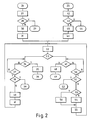
- Microcontroller 4 includes, in addition to the usual central processing unit and program and data memories (not shown), a register 21 for storing a representation of the two-digit number a coded version of which was last transmitted to the driver circuits 3 from the output 13, i.e. for storing a representation of the two-digit number N currently being displayed by unit 2, a pair of timers 22 and 23, and a memory location for a flag bit F. It is programmed to carry out the operations indicated in the flow-chart of Figure 2 in response to actuation (closure) of the switch 5 or 6, i.e. in response to the presentation of an interrupt signal to its input 7 or 8. The content of register 21 is set to zero in the course of the initialisation process carried out on power-up.
- reference numerals 24 and 25 denote the starting points of the interrupt routines carried out in response to closure of the switches 7 and 8 respectively, i.e. in response to a transition from logic "1" to logic "0" at the interrupt signal inputs 7 and 8 respectively.
- the further blocks in Figure 2 have the following significances.
- test 34 and 35 a test is made (38) to determine if incrementation of the tens digit of the displayed number N is possible. If it is the tens digit is incremented by unity and the units digit is set to zero (if it is not already zero) in step 40 and the timer 22 is reset and restarted (step 41). The new number is then displayed, after which the operations 32-34 and 37-41 are repeated for as long as the switch 5 remains actuated or until test 38 gives a positive result.
- each new actuation of switch 5 results in incrementation of the displayed number by unity (if possible), and provided the actuation is maintained for a subsequent period or periods of time corresponding to the time-out period of timer 22, the displayed number is changed (if possible) to the start of the next higher decade, the start of the decade which is next higher still, and so on until switch 5 is released.
- the displayed number is decremented by unity (if possible) in steps 45 and 32 and the "decrement” timer 23 is started. If the actuation of switch 6 is maintained for one or more periods corresponding to the time-out period of timer 23 (tests 47 and 50) the displayed number is then replaced (if possible) by the number at the bottom of the current decade if it is not already there (tests 51 and 53 and steps 54 and 32) and timer 23 is reset and restarted. If the displayed number is already at the bottom of a decade, however, it is replaced (if possible) by the number at the bottom of the next lower decade in steps 56 and 32, and timer 23 is reset and restarted.
- the time-out periods of the timers 22 and 23 may be the same or different; a suitable value is one second.
- the apparatus ceases to respond to new actuations of the increment switch 5 if the display is currently "99” or to prolongation of an actuation of switch 5 if the displayed number already lies in the "nineties” decade it will be appreciated that this is not necessarily the case.
- the programme may be easily modified so that in these circumstances the displayed number "overflows” back to zero.
- the programme can be modified so that a new actuation of switch 6 when the display is currently zero results in the display of "99” and a prolonged actuation of switch 6 when the display is currently zero results in the display of "90".
- the set of two-digit numbers which can be displayed upon actuation of the switch 5 and/or the switch 6 comprises all numbers from zero to ninety-nine, it will be appreciated that this is not necessarily the case.
- the available channels may be those numbered 00, 15, 19, 24, 27, 40, 55, 56, 57, 58 and 99.
- repeated short actuations of the switch 5 and/or the switch 6 may be arranged to step the display through these numbers only, whereas prolonged actuation of the switch 5 may be arranged to step the display to the first channel number in the next higher decade containing such a channel number.
- prolonged actuation of the switch 6 may be arranged to step the display to the first channel number in the current decade (if this is not already being displayed) and subsequently in succession to the first channel number in each decade of successively lower rank.
- actuation of the switches 5 and 6 adjusts the display at just two digit positions. If desired it can be arranged that the display is adjustable at more than two digit positions. For example, it may be the case that the channel numbers required in the mobile radio application quoted run into the hundreds. If this is so then it may be arranged that continuation of a prolonged actuation of switch 5 which results in the displayed number being incremented in the sequence ... 70, 80, 90 results in further incrementation in the sequence 100, 110, 120, ... until the required decade is reached, after which the units digit can be adjusted to the desired value by further short actuations.
Landscapes
- Physics & Mathematics (AREA)
- General Physics & Mathematics (AREA)
- Engineering & Computer Science (AREA)
- Computer Hardware Design (AREA)
- Theoretical Computer Science (AREA)
- Control Of Indicators Other Than Cathode Ray Tubes (AREA)
- Calculators And Similar Devices (AREA)
Applications Claiming Priority (2)
| Application Number | Priority Date | Filing Date | Title |
|---|---|---|---|
| GB8725489A GB2211962A (en) | 1987-10-30 | 1987-10-30 | Display apparatus |
| GB8725489 | 1987-10-30 |
Publications (3)
| Publication Number | Publication Date |
|---|---|
| EP0314213A2 true EP0314213A2 (de) | 1989-05-03 |
| EP0314213A3 EP0314213A3 (de) | 1991-07-10 |
| EP0314213B1 EP0314213B1 (de) | 1994-12-28 |
Family
ID=10626195
Family Applications (1)
| Application Number | Title | Priority Date | Filing Date |
|---|---|---|---|
| EP88202228A Expired - Lifetime EP0314213B1 (de) | 1987-10-30 | 1988-10-06 | Anzeigegerät |
Country Status (7)
| Country | Link |
|---|---|
| US (1) | US5003492A (de) |
| EP (1) | EP0314213B1 (de) |
| JP (1) | JP2897998B2 (de) |
| KR (1) | KR970005121B1 (de) |
| DE (1) | DE3852612T2 (de) |
| GB (1) | GB2211962A (de) |
| HK (1) | HK67496A (de) |
Families Citing this family (2)
| Publication number | Priority date | Publication date | Assignee | Title |
|---|---|---|---|---|
| WO1992006463A1 (en) * | 1990-09-28 | 1992-04-16 | Rodger Alan Reinhart | Method and apparatus for adjusting a display |
| FR2835041B1 (fr) * | 2002-01-24 | 2004-03-19 | Seb Sa | Kit de vidange et de nettoyage pour generateur de vapeur electrodomestique |
Family Cites Families (13)
| Publication number | Priority date | Publication date | Assignee | Title |
|---|---|---|---|---|
| GB1449193A (en) * | 1973-11-19 | 1976-09-15 | Citizen Watch Co Ltd | Electronic timepiece |
| GB1498700A (en) * | 1974-11-21 | 1978-01-25 | Tokyo Shibaura Electric Co | Time correction circuits for electronic timepieces |
| GB1512351A (en) * | 1976-02-23 | 1978-06-01 | Suisse Horlogerie | Timesetting arrangement for electrical timepieces |
| US4284988A (en) * | 1977-09-26 | 1981-08-18 | Burroughs Corporation | Control means to provide slow scrolling positioning and spacing in a digital video display system |
| US4445114A (en) * | 1979-01-15 | 1984-04-24 | Atari, Inc. | Apparatus for scrolling a video display |
| CH624542B (fr) * | 1979-04-17 | Ebauches Sa | Procede et dispositif de modification d'un nombre affiche, application de ce procede. | |
| CH637804B (fr) * | 1979-12-20 | Suisse Horlogerie | Dispositif d'entree de donnees pour instrument de petit volume, notamment pour piece d'horlogerie. | |
| CH631318B (fr) * | 1980-02-18 | Ebauches Electroniques Sa | Dispositif de commande des corrections d'un affichage de temps. | |
| US4536759A (en) * | 1981-02-26 | 1985-08-20 | General Electric Company | Multi-format data display |
| JPH0642137B2 (ja) * | 1982-11-22 | 1994-06-01 | 株式会社日立製作所 | 表示情報処理装置 |
| GB8502597D0 (en) * | 1985-02-01 | 1985-03-06 | Turnright Controls | Recording & displaying control data |
| DE3622681A1 (de) * | 1986-07-05 | 1988-01-21 | Diehl Gmbh & Co | Elektronische uhr mit einer digitalanzeige |
| US4814757A (en) * | 1987-06-11 | 1989-03-21 | Ametek, Inc. | Electrical, scrolling digit display |
-
1987
- 1987-10-30 GB GB8725489A patent/GB2211962A/en not_active Withdrawn
-
1988
- 1988-10-06 DE DE3852612T patent/DE3852612T2/de not_active Expired - Fee Related
- 1988-10-06 EP EP88202228A patent/EP0314213B1/de not_active Expired - Lifetime
- 1988-10-07 US US07/255,071 patent/US5003492A/en not_active Expired - Fee Related
- 1988-10-27 KR KR1019880014009A patent/KR970005121B1/ko not_active Expired - Fee Related
- 1988-10-27 JP JP63269611A patent/JP2897998B2/ja not_active Expired - Lifetime
-
1996
- 1996-04-18 HK HK67496A patent/HK67496A/en not_active IP Right Cessation
Also Published As
| Publication number | Publication date |
|---|---|
| US5003492A (en) | 1991-03-26 |
| JP2897998B2 (ja) | 1999-05-31 |
| KR890007058A (ko) | 1989-06-17 |
| HK67496A (en) | 1996-04-26 |
| KR970005121B1 (ko) | 1997-04-12 |
| GB8725489D0 (en) | 1987-12-02 |
| GB2211962A (en) | 1989-07-12 |
| JPH01154090A (ja) | 1989-06-16 |
| DE3852612D1 (de) | 1995-02-09 |
| EP0314213A3 (de) | 1991-07-10 |
| EP0314213B1 (de) | 1994-12-28 |
| DE3852612T2 (de) | 1995-07-13 |
Similar Documents
| Publication | Publication Date | Title |
|---|---|---|
| US4646081A (en) | Radio paging receiver operable on a word scrolling basis | |
| US4122395A (en) | Radio control circuit with microprocessor | |
| GB2056730A (en) | Data input device for an electronic diary watch | |
| CA1044025A (en) | Solid-state electronic timepiece | |
| US5377130A (en) | Method and apparatus for solving terms of a numerical sequence | |
| US5003492A (en) | Display apparatus having data reset arrangement for fast changing of digital display | |
| US4232301A (en) | Apparatus for automatically selectively displaying information of a plurality of kinds | |
| JPS5919496B2 (ja) | 周波数カウンタ | |
| US4182108A (en) | Electronic timepiece correction circuit | |
| US5301106A (en) | Action item docketing device | |
| US4707145A (en) | Electronic timepiece | |
| US3946363A (en) | Variable time axis controller in simulation computer | |
| US4277785A (en) | Radio control circuit with microprocessor | |
| US4192993A (en) | Static digital data entry method and apparatus for a timer or clock | |
| JP2938482B2 (ja) | 回線入力データの画面表示更新制御方式 | |
| JP2701264B2 (ja) | 数値設定器 | |
| JP2560279B2 (ja) | デ−タ記憶装置 | |
| JPS60178720A (ja) | 通信機 | |
| JPH0140992B2 (de) | ||
| JPH0586688B2 (de) | ||
| JPS6236550B2 (de) | ||
| JPH03100489A (ja) | 世界時計 | |
| JPH026996A (ja) | 表示装置 | |
| JPS637489B2 (de) | ||
| JPS6314218A (ja) | 表示制御装置 |
Legal Events
| Date | Code | Title | Description |
|---|---|---|---|
| PUAI | Public reference made under article 153(3) epc to a published international application that has entered the european phase |
Free format text: ORIGINAL CODE: 0009012 |
|
| AK | Designated contracting states |
Kind code of ref document: A2 Designated state(s): DE FR GB |
|
| RHK1 | Main classification (correction) |
Ipc: H03K 9/06 |
|
| RHK1 | Main classification (correction) |
Ipc: H03K 9/06 |
|
| PUAL | Search report despatched |
Free format text: ORIGINAL CODE: 0009013 |
|
| AK | Designated contracting states |
Kind code of ref document: A3 Designated state(s): DE FR GB |
|
| RHK1 | Main classification (correction) |
Ipc: G04G 5/02 |
|
| 17P | Request for examination filed |
Effective date: 19920108 |
|
| RAP3 | Party data changed (applicant data changed or rights of an application transferred) |
Owner name: N.V. PHILIPS' GLOEILAMPENFABRIEKEN Owner name: PHILIPS ELECTRONICS UK LIMITED |
|
| 17Q | First examination report despatched |
Effective date: 19921110 |
|
| GRAA | (expected) grant |
Free format text: ORIGINAL CODE: 0009210 |
|
| AK | Designated contracting states |
Kind code of ref document: B1 Designated state(s): DE FR GB |
|
| REF | Corresponds to: |
Ref document number: 3852612 Country of ref document: DE Date of ref document: 19950209 |
|
| ET | Fr: translation filed | ||
| PLBE | No opposition filed within time limit |
Free format text: ORIGINAL CODE: 0009261 |
|
| STAA | Information on the status of an ep patent application or granted ep patent |
Free format text: STATUS: NO OPPOSITION FILED WITHIN TIME LIMIT |
|
| 26N | No opposition filed | ||
| REG | Reference to a national code |
Ref country code: FR Ref legal event code: CD |
|
| REG | Reference to a national code |
Ref country code: FR Ref legal event code: TP |
|
| REG | Reference to a national code |
Ref country code: GB Ref legal event code: IF02 |
|
| PGFP | Annual fee paid to national office [announced via postgrant information from national office to epo] |
Ref country code: GB Payment date: 20020404 Year of fee payment: 14 |
|
| PGFP | Annual fee paid to national office [announced via postgrant information from national office to epo] |
Ref country code: FR Payment date: 20020416 Year of fee payment: 14 |
|
| PGFP | Annual fee paid to national office [announced via postgrant information from national office to epo] |
Ref country code: DE Payment date: 20020426 Year of fee payment: 14 |
|
| PG25 | Lapsed in a contracting state [announced via postgrant information from national office to epo] |
Ref country code: FR Free format text: LAPSE BECAUSE OF NON-PAYMENT OF DUE FEES Effective date: 20020628 |
|
| REG | Reference to a national code |
Ref country code: FR Ref legal event code: ST |
|
| PG25 | Lapsed in a contracting state [announced via postgrant information from national office to epo] |
Ref country code: GB Free format text: LAPSE BECAUSE OF NON-PAYMENT OF DUE FEES Effective date: 20021006 |
|
| PG25 | Lapsed in a contracting state [announced via postgrant information from national office to epo] |
Ref country code: DE Free format text: LAPSE BECAUSE OF NON-PAYMENT OF DUE FEES Effective date: 20030501 |
|
| GBPC | Gb: european patent ceased through non-payment of renewal fee |
Effective date: 20021006 |