EP0314598A2 - Mécanisme de commande pour tête d'impression thermique - Google Patents
Mécanisme de commande pour tête d'impression thermique Download PDFInfo
- Publication number
- EP0314598A2 EP0314598A2 EP88480042A EP88480042A EP0314598A2 EP 0314598 A2 EP0314598 A2 EP 0314598A2 EP 88480042 A EP88480042 A EP 88480042A EP 88480042 A EP88480042 A EP 88480042A EP 0314598 A2 EP0314598 A2 EP 0314598A2
- Authority
- EP
- European Patent Office
- Prior art keywords
- carrier
- printhead
- thermal
- link
- printing position
- Prior art date
- Legal status (The legal status is an assumption and is not a legal conclusion. Google has not performed a legal analysis and makes no representation as to the accuracy of the status listed.)
- Withdrawn
Links
Images

Classifications
-
- B—PERFORMING OPERATIONS; TRANSPORTING
- B41—PRINTING; LINING MACHINES; TYPEWRITERS; STAMPS
- B41J—TYPEWRITERS; SELECTIVE PRINTING MECHANISMS, i.e. MECHANISMS PRINTING OTHERWISE THAN FROM A FORME; CORRECTION OF TYPOGRAPHICAL ERRORS
- B41J25/00—Actions or mechanisms not otherwise provided for
- B41J25/304—Bodily-movable mechanisms for print heads or carriages movable towards or from paper surface
- B41J25/316—Bodily-movable mechanisms for print heads or carriages movable towards or from paper surface with tilting motion mechanisms relative to paper surface
Definitions
- This invention relates to an actuator for moving a thermal printhead into and out of its printing position and, more particularly, to a mechanical actuator for moving the thermal printhead into and out of its printing position in response to actuation of drive means for a carrier on which the thermal printhead is mounted.
- a printhead of a low impact or non-impact printer such as a thermal printer, and particularly a resistive ribbon printer, must be moved into engagement with a platen prior to beginning print in one direction and must be removed from its printing position prior to returning the printhead to the start of another print line.
- the resistive ribbon printhead which has electrodes for engaging a resistive ribbon to cause printing on a sheet of paper passed around a platen, is in its printing position, its electrodes must engage the resistive ribbon to apply heat thereto when selected electrodes are energized. Therefore, it is necessary for a force to be applied to the printhead in its printing position to hold the electrodes against the resistive ribbon.
- US-A- 4,329,075 discloses a resistive ribbon printhead being moved into its printing position by activation of a solenoid. This requires the solenoid to be continuously activated when the resistive ribbon printhead is in its printing position. While this arrangement is satisfactory, the solenoid and its energization increase the cost of the printer and the cost of operation.
- the present invention reduces the cost for moving a resistive ribbon printhead into its printing position and retaining it therein by using a mechanical actuator, which is less expensive than a solenoid and has no energization expense. This is accomplished through the actuator having means which enables movement of the printhead into and out of its printing position, responsive to the initial activation of carrier drive or motive means for advancing a carrier, which has the printhead mounted thereon.
- the actuator of the present invention preferably becomes effective before the carrier starts to move in either direction.
- the printhead is either in or out of its printing position depending upon its direction of motion before the printhead is moved axially relative to the resistive ribbon, the paper, and the platen.
- the actuator includes a four bar linkage and a spring that becomes effective when the linkage has reached the position in which the carrier motive or drive means begins to drive the carrier with this spring having a sufficient force to hold the electrodes in engagement with the resistive ribbon during printing. This spring does not become effective until after the resistive ribbon printhead is in its printing position.
- the printhead is subjected to a continuous force of a spring holding the printhead against the resistive ribbon.
- This embodiment requires a much larger driving force than the embodiment in which the spring does not become effective until after the electrodes of the printhead engage the resistive ribbon in its printing position.
- An object of this invention is to provide a mechanical actuator for moving a thermal printhead into and out of its printing position.
- Another object of this invention is to provide a thermal printhead actuator which automatically responds to the initial motion of the carrier motive or drive means in the opposite direction from that in which it was moving.
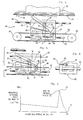
- a thermal printer 10 having a carrier 11 for sliding movement along a pair of substantially parallel rails 12 and 13.
- the carrier has a shoe 14 sliding along the round rail 12 and bearings 15 and 16 sliding along the round rail 13.
- a thermal printhead assembly 17 is pivotally supported on the carrier 11 by a shaft 18, which is rotatably supported by the carrier 11.
- the thermal printhead assembly 17 includes a thermal printhead 19 having a plurality of electrodes arranged in a single column in the manner more particularly shown and described in the aforesaid prior art document.
- the electrodes in the thermal printhead 19 are selectively energized to apply heat to a resistive ribbon 20 to produce printing on a sheet 21 of paper.
- the sheet 21 of paper is supported on a platen 22.
- the thermal printhead 19 is moved from the position of Figure 1 to the position of Figure 2 when a nut 23 begins to move from left to right to initiate a print line.
- the nut 23 is moved by rotation of a leadscrew 24, which is driven from suitable driving means (not shown) in the well-known manner.
- the rotary motion of the leadscrew 24 is changed into linear motion of the carrier 11 through the nut 23, which has a guide 25 extending therefrom with bifurcated end 26 disposed on opposite sides of the round rail 12.
- the guide 25 prevents the nut 23 from rotating when the leadscrew 24 is rotated so that the nut 23 moves linearly when the leadscrew 24 rotates.
- the nut 23 has a pair of spaced and substantially parallel bars 27 and 28 extending upwardly therefrom into an opening 29 in the carrier 11.
- a pivot pin 32 which pivotally connects one end of a first link 33 to one end of a second link 34, moves horizontally with the horizontal motion of the nut 23 as the pivot pin 32 is retained between the bars 27 and 28.
- the first link 33 has its other end pivotally connected to the carrier 11 by a pivot pin 35.
- the second link 34 has its other end pivotally connected by a pivot pin 36 to a portion 37 of an actuating arm 38.
- the actuating arm 38 is pivotally mounted on the shaft 18 so that movement of the nut 23 from left to right from the position of Figure 1 eventually causes the links 33 and 34 to become vertical and aligned as shown in Figure 2. As the links 33 and 34 move towards the vertical and aligned position of Figure 2, the actuating arm 38 pivots clockwise about the shaft 18.
- the actuating arm 38 pivots clockwise about the shaft 18.
- the tension spring 40 causes the thermal printhead assembly 17 to follow this pivoting of the actuating arm 38 until the thermal printhead 19 engages the platen 22 through the ribbon 20 and the sheet 21 of paper.
- the actuating arm 38 continues to pivot clockwise about the shaft 18 as the links 33 and 34 move towards the vertical and aligned position of Figure 2. This stretches the spring 40, creating the necessary force of the thermal printhead 19 against the platen 22. There is no horizontal actuating force required to keep the thermal printhead 19 is its printing position of Figure 2.
- the actuating arm 38 has a metering roller 45 rotatably supported thereon through a shaft 46.
- a timing belt 47 connects the metering roller 45 to a roller 48, which is fixed to the shaft 18 for rotation therewith.
- the shaft 18 is rotated by a drive roller 49, which is secured to the shaft 18, rotating along the rail 13 as the carrier 11 is advanced from left to right. Since the metering roller 45 engages the ribbon 20 and holds it against a metering roller 50, which is supported on the bearing 16 by a leaf spring 51, the motion of the carrier 11 from left to right causes the ribbon 20 to be advanced from right to left by the rotation of the metering roller 45 in cooperation with the metering roller 50.
- the initial rotation of the leadscrew 24 causes only the nut 23 to move to the left, not the carrier 11. This right to left motion of the nut 23 moves the pivot pin 32 therewith to break the alignment of the links 33 and 34. This initially causes the actuating arm 38 to pivot counterclockwise about the shaft 18 to withdraw the metering roller 45 from engagement with the metering roller 50.
- the carrier 11 has a plunger housing 52 in which a plunger 53 is slidably supported.
- a spring 54 within the plunger housing 52 continuously urges the plunger 53 against the rail 13.
- the force of the spring 54 is selected so that the force produced by the total friction between the carrier 11 and the rails 12 and 13 exceeds the force required to move the thermal printhead 19 from the position of Figure 1 to its printing position of Figure 2. Otherwise, the carrier 11 would begin to move before completion of motion of the thermal printhead 19 to its printing position of Figure 2 from the position of Figure 1.
- the four links are the first link 33, the second link 34, the portion of the actuating arm 38 between the pivot pin 36 and the shaft 18, and the portion of the carrier 11 between the shaft 18 and the pivot pin 35.
- R1 is the horizontal component of the reaction force from the carrier 11 on the pivot pin 35 when the links 33 and 34 are moved towards the vertical alignment of Figure 2
- R2 is the vertical component of the reaction force from the carrier 11 on the pivot pin 35 when the links 33 and 34 are moved towards the vertical alignment of Figure 2.
- the vertical component of the reaction force from the carrier 11 at the shaft 18 is R3 while R4 is the horizontal component of the reaction force from the carrier 11 at the shaft 18; these are when the links 33 and 34 are moved towards the vertical alignment of Figure 2.
- the magnitudes of R1 (see Figure 1) and R2 are determined in part by the angle of the link 33 to the vertical at any time.
- the angle of the link 34 determines in part the magnitudes of R3 and R4. It is desired to increase R2 and R3 while minimizing R1 and R4, and this occurs when the angles of the links 33 and 34 to the vertical are close to zero.
- R1 and R4 Minimizing the magnitudes of R1 and R4 is important because the required force to actuate the thermal printhead 19 equals the sum of R1 and R4. The lower this sum of R1 and R4, the less frictional drag is required of the plunger 53 and the less power is required to move the carrier 11.
- a thermal printer 60 including a carrier 61, which is slidably mounted on round rails 62 and 63 for linear motion relative to a platen 64.
- the carrier 61 has shoes (not shown) or the like for slidably mounting the carrier 61 on the rails 62 and 63.
- the carrier 61 is driven in opposite directions from a drive roller 65, which is rotated by suitable drive means (not shown).
- the drive roller 65 drives a timing belt 66, which also passes around an idler roller 67, in the direction in which it is desired for the carrier 61 to move. Printing occurs when the carrier 61 moves from left to right in Figures 4 and 5.
- a portion of the timing belt 66 is fixed to a clamp 68 on one end of a first link 69, which is pivotally mounted on the carrier 61 by a pivot pin 70.
- first link 69 pivots clockwise about the pivot pin 70.
- the first link 69 has its other end pivotally connected by a pivot pin 71 to one end of a second link 72, which has a slot 73 therein to receive a pin 74 on a thermal printhead 75.
- the end of the thermal printhead 75 would have electrodes arranged in a single column in the same manner as shown and described in the aforesaid prior art document for example.
- the thermal printhead 75 is pivotally mounted on the carrier 61 by a pivot pin 76.
- a spring 77 which has one end fixed to a stud 78 extending upwardly from the carrier 61 and its other end attached to the thermal printhead 75, continuously urges the thermal printhead 75 clockwise about the pivot pin 76 to its printing position. In its printing position, the thermal printhead 75 holds a resistive ribbon 79 against a sheet 80 of paper on the platen 64.
- the carrier 61 has a portion 82, which is formed of a suitable plastic such as an acetal resin sold, for example, riding on the rail 63.
- An Allen screw 83 (see Figure 6) connects an end 84 of the portion 82 of the carrier 61 (see Figure 5) to an end 85 (see Figure 6) of the portion 82 of the carrier 61 (see Figure 5).
- the spacing between the ends 84 (see Figure 6) and 85 of the portion 82 of the carrier 61 (see Figure 5) determines the friction between the carrier 61 and the rail 63 so that the force created by the total friction between the carrier 61 and the rails 62 and 63 is greater than the force required to move the thermal printhead 75 into or out of its printing position. Otherwise, the carrier 61 would move before the thermal printhead 75 is in or out of its printing position.
- the thermal printer 60 has a four bar linkage in the same manner as the thermal printer 10 (see Figure 1).
- the four pivot connections are the pivot pins 70 (see Figure 4), 71, and 76 and the pin 74.
- the four links are the first link 69, the second link 72, the portion of the thermal printhead 75 between the pin 74 and the pivot pin 76, and the portion of the carrier 61 between the pivot pins 70 and 76.
- thermal printhead 19 (see Figure 1) and 75 (see Figure 4) has been shown as being pivotaly mounted, it should be understood that such is not a requisite for satisfactory operation. That is, the thermal printhead 19 (see Figure 1) or 75 (see Figure 4) could be mounted on the carrier 11 (see Figure 1) or 61 (see Figure 4) for linear movement, fox example.
- the inertia of the forces on the carrier 11 (see Figure 1) or 61 (see Figure 4) is insufficient to overcome the frictional forces after the nut 23 (see Figure 1) or the drive roller 65 (see Figure 4) is stopped.
Landscapes
- Electronic Switches (AREA)
- Common Mechanisms (AREA)
Applications Claiming Priority (2)
| Application Number | Priority Date | Filing Date | Title |
|---|---|---|---|
| US07/114,176 US4775252A (en) | 1987-10-28 | 1987-10-28 | Thermal printhead actuator responsive to carriage drive and including a four bar linkage and spring |
| US114176 | 1987-10-28 |
Publications (2)
| Publication Number | Publication Date |
|---|---|
| EP0314598A2 true EP0314598A2 (fr) | 1989-05-03 |
| EP0314598A3 EP0314598A3 (fr) | 1989-11-08 |
Family
ID=22353759
Family Applications (1)
| Application Number | Title | Priority Date | Filing Date |
|---|---|---|---|
| EP88480042A Withdrawn EP0314598A3 (fr) | 1987-10-28 | 1988-09-27 | Mécanisme de commande pour tête d'impression thermique |
Country Status (3)
| Country | Link |
|---|---|
| US (1) | US4775252A (fr) |
| EP (1) | EP0314598A3 (fr) |
| JP (1) | JPH01115655A (fr) |
Families Citing this family (2)
| Publication number | Priority date | Publication date | Assignee | Title |
|---|---|---|---|---|
| US5241325A (en) * | 1991-10-31 | 1993-08-31 | Hewlett-Packard Company | Print cartridge cam actuator linkage |
| JP6508720B2 (ja) * | 2015-08-31 | 2019-05-08 | セイコーソリューションズ株式会社 | 印字ユニット及びプリンタ |
Family Cites Families (9)
| Publication number | Priority date | Publication date | Assignee | Title |
|---|---|---|---|---|
| US4372698A (en) * | 1980-03-11 | 1983-02-08 | Akira Matsushima | Driving device for a print head of a printer |
| US4329075A (en) * | 1980-06-27 | 1982-05-11 | International Business Machines Corporation | Printhead assembly for typewriters or the like |
| IT1129478B (it) * | 1980-12-23 | 1986-06-04 | Olivetti & Co Spa | Stampante termica seriale a punti |
| JPS5942978A (ja) * | 1982-09-06 | 1984-03-09 | Alps Electric Co Ltd | サ−マルプリンタのヘツド加圧装置 |
| US4609299A (en) * | 1983-10-20 | 1986-09-02 | Brother Kogyo Kabushiki Kaisha | Printing apparatus |
| JPS60139950A (ja) * | 1983-12-27 | 1985-07-24 | Seiko Epson Corp | 動力伝達装置 |
| US4657417A (en) * | 1984-03-09 | 1987-04-14 | Alps Electric Co., Ltd. | Thermal printer |
| JPS60196369A (ja) * | 1984-03-19 | 1985-10-04 | Fujitsu Ltd | サ−マルプリンタ |
| US4641150A (en) * | 1984-08-03 | 1987-02-03 | Alps Electric Co., Ltd. | Thermal printer |
-
1987
- 1987-10-28 US US07/114,176 patent/US4775252A/en not_active Expired - Fee Related
-
1988
- 1988-08-19 JP JP63204866A patent/JPH01115655A/ja active Pending
- 1988-09-27 EP EP88480042A patent/EP0314598A3/fr not_active Withdrawn
Also Published As
| Publication number | Publication date |
|---|---|
| US4775252A (en) | 1988-10-04 |
| EP0314598A3 (fr) | 1989-11-08 |
| JPH01115655A (ja) | 1989-05-08 |
Similar Documents
| Publication | Publication Date | Title |
|---|---|---|
| US4420269A (en) | Device for lifting the printing head off the platen | |
| EP0216394B1 (fr) | Mécanisme de chargement en papier pour une imprimante | |
| US4752786A (en) | Single motor multi-function drive control recorder | |
| US5296872A (en) | Cutting device for a plotter | |
| EP0336870B1 (fr) | Imprimante comportant un mécanisme pour régler l'espacement de la tête d'impression | |
| US4411542A (en) | Error ribbon elevation and transport mechanism for typewriters and similar machines | |
| US5135321A (en) | Unified paper path printer with automatic parking feature | |
| EP0314598A2 (fr) | Mécanisme de commande pour tête d'impression thermique | |
| US4913567A (en) | Head-pressure mechanism in thermal printer | |
| US4256408A (en) | Dot matrix print head | |
| US4397576A (en) | Print head actuator | |
| US5106213A (en) | Thermal print head control mechanism | |
| US4609297A (en) | Print and correction ribbon drive system | |
| US4657417A (en) | Thermal printer | |
| US4798487A (en) | Thermal printer having ribbon take-up mechanism utilizing carriage movement | |
| US4398838A (en) | Typewriter ribbon lifting and transporting device | |
| US5244289A (en) | Printer having device for adjusting print hammer stroke | |
| KR860001246B1 (ko) | 전자식 2열 프린트휠의 상하 구동장치 | |
| EP0042949B1 (fr) | Mécanisme de transport forcé pour cylindre de machine à écrire à blocage amélioré | |
| US5207796A (en) | Electronic typewriter | |
| JP2685604B2 (ja) | 熱転写プリンタの駆動制御方法 | |
| JP2531761B2 (ja) | サ―マルヘッドの接離駆動機構 | |
| US5195833A (en) | Typewriter or similar machine | |
| JP3042002B2 (ja) | プリンタ | |
| US4932799A (en) | Typewriter or similar machine |
Legal Events
| Date | Code | Title | Description |
|---|---|---|---|
| PUAI | Public reference made under article 153(3) epc to a published international application that has entered the european phase |
Free format text: ORIGINAL CODE: 0009012 |
|
| AK | Designated contracting states |
Kind code of ref document: A2 Designated state(s): DE FR GB |
|
| PUAL | Search report despatched |
Free format text: ORIGINAL CODE: 0009013 |
|
| 17P | Request for examination filed |
Effective date: 19890809 |
|
| AK | Designated contracting states |
Kind code of ref document: A3 Designated state(s): DE FR GB |
|
| 17Q | First examination report despatched |
Effective date: 19910312 |
|
| RAP1 | Party data changed (applicant data changed or rights of an application transferred) |
Owner name: LEXMARK INTERNATIONAL, INC. |
|
| 111Z | Information provided on other rights and legal means of execution |
Free format text: DE FR GB |
|
| STAA | Information on the status of an ep patent application or granted ep patent |
Free format text: STATUS: THE APPLICATION IS DEEMED TO BE WITHDRAWN |
|
| 18D | Application deemed to be withdrawn |
Effective date: 19920604 |