EP0314650A2 - Verfahren zur optimierten "Rete"-Musteranpassung in mustergeführten, regelbasierten, künstlichen Intelligenz-Produktionssystemen - Google Patents
Verfahren zur optimierten "Rete"-Musteranpassung in mustergeführten, regelbasierten, künstlichen Intelligenz-Produktionssystemen Download PDFInfo
- Publication number
- EP0314650A2 EP0314650A2 EP88850343A EP88850343A EP0314650A2 EP 0314650 A2 EP0314650 A2 EP 0314650A2 EP 88850343 A EP88850343 A EP 88850343A EP 88850343 A EP88850343 A EP 88850343A EP 0314650 A2 EP0314650 A2 EP 0314650A2
- Authority
- EP
- European Patent Office
- Prior art keywords
- node
- nodes
- pattern
- rule
- token
- Prior art date
- Legal status (The legal status is an assumption and is not a legal conclusion. Google has not performed a legal analysis and makes no representation as to the accuracy of the status listed.)
- Granted
Links
Images

Classifications
-
- G—PHYSICS
- G06—COMPUTING OR CALCULATING; COUNTING
- G06N—COMPUTING ARRANGEMENTS BASED ON SPECIFIC COMPUTATIONAL MODELS
- G06N5/00—Computing arrangements using knowledge-based models
- G06N5/04—Inference or reasoning models
- G06N5/046—Forward inferencing; Production systems
- G06N5/047—Pattern matching networks; Rete networks
-
- Y—GENERAL TAGGING OF NEW TECHNOLOGICAL DEVELOPMENTS; GENERAL TAGGING OF CROSS-SECTIONAL TECHNOLOGIES SPANNING OVER SEVERAL SECTIONS OF THE IPC; TECHNICAL SUBJECTS COVERED BY FORMER USPC CROSS-REFERENCE ART COLLECTIONS [XRACs] AND DIGESTS
- Y10—TECHNICAL SUBJECTS COVERED BY FORMER USPC
- Y10S—TECHNICAL SUBJECTS COVERED BY FORMER USPC CROSS-REFERENCE ART COLLECTIONS [XRACs] AND DIGESTS
- Y10S706/00—Data processing: artificial intelligence
- Y10S706/902—Application using ai with detail of the ai system
- Y10S706/903—Control
- Y10S706/904—Manufacturing or machine, e.g. agricultural machinery, machine tool
Definitions
- the invention relates to artificial intelligence (AI) production systems, and more particularly, to a method for optimizing the pattern-matching phase of a cyclic, rule-based, data-sensitive AI production system.
- AI artificial intelligence
- a rewrite or production system includes an alphabet, an initial set of strings (axioms) defined over the alphabet, and a set of production or rewrite rules from which new strings (theorems) can be obtained.
- an AI production system comprises a rule set (sometimes called production memory), a rule interpreter that decides how and when to apply the rules, and a working memory that holds data, goals, and intermediate results.
- Brownston et al "Programming Expert Systems in OPS5", Addison-Wesley Publishing Co., copyright 1985, pp. 4-31, contrast a rule-based production computational model with that of a procedural model. More particularly, Brownston describes a production system as an executable set of production rules in which each rule in such a system represents an ordered pair of a condition (state set) and action statements. This leads to Brownston's characterization of a production system as an unordered finite sequence of data-sensitive production rules.
- Brownston, Miranker, Forgey, and Schor describe pattern-driven, forward-chaining production systems using a matching-rule, select-rule, execute-rule cycle based on the OPS5 AI language. Furthermore, these references point out that the process of many data-object/many pattern matching is the most computationally intensive phase in the production system control cycle.
- the references teach several techniques for reducing the computational intensity of the pattern-matching phase.
- advantage can be taken of the temporal redundancy of the data objects resident in working memory. That is, the set of objects over which the pattern portions of the rules are compared can be limited to those objects in working memory which have been either created or modified since the last cycle.
- Second, the many object/many pattern comparison can be systematized through use of sorting or dataflow-like processing networks. While there are other comparison algorithms, such as Miranker's TREAT, the best known comparison method having these attributes is the RETE algorithm ascribed to Forgey.
- MAKE and CREATE, MODIFY and UPDATE, and REMOVE and DELETE will be used interchangeably.
- RECOGNIZE, RESOLVE, and ACT phases of the AI production system control cycle serve as synonyms for MATCH, SELECT, and EXECUTE.
- the aforementioned objects are satisfied by the method steps executed during the pattern-matching portion of the matching, selection, and execute cycle of an AI production system comprising: (a) compiling a RETE network of the condition elements of the pattern portion of the rule being matched, the join nodes of said network being grouped in a pattern-determined associative manner; and (b) applying those data objects created or modified in the immediately preceding cycle to said RETE network.
- the method includes the further steps at each node of: (b1) maintaining a list of instantiations satisfying the match conditions expressed at that node, (b2) passing tokens to descendant nodes upon an object/pattern comparison match, (b3) maintaining pointers to all ancestor nodes through which the token for each object passed, and (b4) traversing said pointers as a path for avoiding those RETE node pattern/object matchings redundant between a previously matched object and an object being processed.
- type and state are attributes or fields in the machine record.
- Type may have the value “A” or the value “B” - representing the type of machine, and “state” may have the value “AVAILABLE” or “BUSY” - representing the current availability of the machine to accept a part to begin processing.
- type can have the values "P” or "(Q)”, while “state” must be “in-process”, “waiting”, or “complete”, representing that a part must at any instant be either in the process of being machined, or waiting for a machine, or through with all needed machining.
- one rule in the computer program might look like the following when paraphrased in English:
- LHS left-hand side
- RHS right-hand side
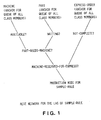
- RETE network for the LHS of the Sample-Rule. All arcs are directed and are considered as pointing down in the above picture. RETE processing starts at the top nodes (class anchors) and flows downward through the network.
- the nodes marked MACHINE, PART, and EXPRESS-ORDER are, respectively, anchors for queues of all machine, part, and express-order class members that exist in the program at that point in time.
- Changes to machine, part, or express-order class members can be of several kinds. New members can be created, representing new objects that the system should consider in routing parts to machines. Class members can be destroyed, representing the deletion of some object from participation in the system. For example, when a part is shipped to a purchaser, it might be natural to delete the class member representing that part from the system, as it should no longer be considered in any decisions about scheduling. Changes can also be made to existing class members. Different values are assigned to the attributes of the class member. This is done to represent changes in state, etc.
- the central nodes of the network fragment in Figure 1 correspond to tests that must be performed to determine what lists of class members satisfy all the conditions in the LHS of the Sample-Rule above. Class members arranged in lists are tested at a node to determine which lists satisfy the corresponding conditions and, for each node, summary information is retained in a queue based at that node. Usually, the retained information indicates which lists of class members passed the test associated with the node.
- alpha-nodes correspond to tests that only mention a single class member. These nodes have only one incoming arc in the RETE network.
- the nodes labelled PART-NEEDS-MACHINE? and MACHINE-RESERVED-FOR-EXPRESS? are called beta-nodes.
- the beta-nodes all have two incoming arcs and correspond to tests that determine whether a list of several class members satisfies a condition.
- the node labelled PART-NEEDS-MACHINE? corresponds to a test that determines whether a pair of class members, the first a part and the second a machine, is such that the next-machine-needed field on the part class member is identical to the type filed of the machine class member. In other words, when given a part and a machine, the node determines whether the part needs to go to that machine next.
- SB Satisfaction Block
- a node with only one incoming arc is always viewed as having its one ancestor as a left ancestor.
- a node has two ancestors (a beta-node) and each ancestor is an alpha-node or is an anchor to a class, then one ancestor can be arbitrarily picked as the left ancestor, while the other will be the right.
- beta-node has one ancestor that is a beta-node
- that ancestor shall be called the left ancestor
- the other ancestor (which in the example and in most implementations must be an anchor or alpha-node) becomes the right ancestor.
- a token For each successor in the RETE network of the machine anchor node, a token would be created that contains a list of one class member - the new machine class member - in its list-of-class-members field. In the current example, there is only one node that is a successor of the machine anchor node. Thus, only one token would be generated, and it would point to the new machine for its list-of-class-members field. It would point to the AVAILABLE? node for its node field, and it would specify that the token arrived at the AVAILABLE? node from a LEFT ancestor. The token would contain MAKE in its CHANGE-TYPE field, indicating that the new class member was just created.
- This processing done at the node would include executing the test associated with the node for the machine (class member) in the token.
- the newly created machine would be tested to see whether its state field listed it as available - which it would be.
- the test associated with the node would be passed and several actions would be taken.
- a Satisfaction Block would be created to record that the list of class members in the token passed the test.
- the new SB would point to the one new machine class member.
- new tokens with change-type of MAKE would be generated, one for each successor of the AVAILABLE? node. Again, in this simple case, there is only one successor to the AVAILABLE? node so a token is stacked that specifies (a) machine A, (b) the PART-NEEDS-MACHINE? node, and (c) LEFT.
- next action taken by the application during this initialization phase is to create the second machine; namely, machine B.
- a token would be generated to cause testing at the AVAILABLE? node to determine whether this machine is available - which it would be.
- An SB is created so that there are now two SBs in the queue off the AVAILABLE? node. Since nothing more can be done, control (as before) returns to the application.
- the application makes a part class member to represent the existence of the first part, a type P part that is waiting to be machined. Since type P parts must first be machined by machine A, the part's NEEDS-MACHINE field is set to A. Again, a token with change-type of MAKE is generated, indicating this change. The token would point to the new part, specify the WAITING? node, and the left direction.
- the test is performed at the PART-NEEDS-MACHINE? node to determine if the new part (of type P) needs the machine in the SB for its next machining step. If the test (PART-NEEDS-MACHINE?) fails, then no additional action is taken. If the test passes, then a new SB is created and enqueued off the PART-NEEDS-MACHINE? node. In this case, the test of the type P part with machine B fails, and the test with machine A passes. Thus, an SB with a list of class members comprised of machine A and the new type P part is enqueued off the PART-NEEDS-MACHINE?
- a token representing this change to PART-NEEDS-MACHINES?'s SB queue is generated for the one successor of this node.
- the change made to PART-NEEDS-MACHINE?'s SB queue is the creation of a new SB.
- the new token is a MAKE token, and its list of class members includes the A machine and the new P part.
- PART-NEEDS-MACHINE? is an example of a positive beta-node.
- the list of class members in the token is successively augmented with the list of class members from each SB off the predecessor node in the opposite direction.
- the test for the current node is performed using the augmented class member list.
- a passed test causes more tokens to be generated - one for each successor node.
- This token is popped off the stack, having arrived at the MACHINE-RESERVED-FOR-EXPRESS? node from the left.
- This node is a negative beta-node.
- the output of a negative beta-node is not an augmented token.
- a token arriving at a negative beta-node from the left includes a list of class members. This same list is either passed intact to all successor nodes, or it is stopped altogether.
- the list is passed on (in tokens) if no test passes at this node involving this class member list augmented by any one of the lists in the right ancestor's SB queue. This list is stopped and not passed to any successor if some test passes at this node when the arriving list is augmented in turn by each of the lists from the right ancestor's SB queue.
- Negative beta-nodes are often discussed in the following terms. Class member lists that arrive from the right will stop class member lists arriving from the left from passing through. Thus, a negative beta-node is much like a gate, where the things arriving from the right (according to what tests pass and fail) determine whether things arriving from the left will pass through.
- the arrival from the right of a DELETE token (indicating the deletion of an SB from the right ancestor's queue) at a negative beta-node can cause creation of a new SB at the negative beta-node and the corresponding generation of MAKE tokens for all successors of the negative beta-node. This happens when the arriving token indicates deletion of the only SB in the right ancestor's queue that was stopping some SB in the left ancestor's queue. Likewise, a MAKE token arriving from the right can stop an SB that is in the negative beta-node's SB queue, and the MAKE token can cause the removal of an SB and the generation of DELETE tokens for all successors.
- the right ancestor of the MACHINE-RESERVED-FOR-EXPRESS? node is the NOT-COMPLETE? node.
- arrival of a MAKE token from the left causes a new MAKE token to be generated and passed to the production node.
- the arrival of the MAKE token at the production node indicates that a new instantiation should be made.
- the pair of class members con sisting of machine A and the one part of type P satisfies the conditions of the Sample-Rule based on all the class members that exist at this time.
- this one instantiation would normally become a candidate for firing with all other instantiations of other rules.
- the action part of the rule would change the status of both the P type part and of machine A. Those changes, when pushed through the RETE network, would invalidate this one instantiation to Sample-Rule.
- a DELETE token is created for the AVAILABLE? node with the token pointing to the machine A class member. As always, the token is stacked with any other tokens.
- the test associated with the AVAILABLE? node is repeated to determine whether the class member passed or failed the test when it was created. If the current test passes (or fails), then the original test must have likewise passed (or failed, respectively) when the MAKE token was processed.
- processing for a DELETE token exactly follows in the footsteps of an immediately preceding MAKE token. All tests are repeated. When a test is passed, there is an additional expense of searching for the right SB to excise.
- a DELETE token arrives at a positive beta-node from one direction, it must be paired with all class member lists from SBs enqueued off the opposite ancestor. For each test that passes, the SB in the current block must be found and excised, and new tokens must be sent to successors. Processing of a DELETE token at a negative beta-node likewise undoes the work of a MAKE token.
- the algorithm can be implemented so that no test is ever repeated. This reduction in the total number of tests to execute RETE processing is especially important when tests are slow to execute; for example, when class members are stored on a slower storage medium, and accessing class members for testing is computationally expensive. Also, with the invention described herein, no searching of SB queues is required to find the SBs to be excised. This can markedly speed up execution of RETE processing, depending on the length of the SB queues.
- an SB might have the following declaration:
- node N is a successor of node M in a RETE network (i.e., there is an arc from M to N)
- X is an SB queued off M
- Y is an SB queued off N so that the class member list in X is an initial or terminal segment of the list in Y - so that the deletion of X would cause (using classic RETE processing techniques) tokens to be generated that would result in the deletion of Y
- Y is an immediate descendant or a successor of X
- X is an immediate ancestor or a predecessor of Y.
- N is a beta-node
- SBs enqueued off N that are all immediate descendants of the same SB enqueued off M.
- a given SB can have at most one left and at most one right immediate ancestor.
- Fields similar to those added to the SB declaration in order to arrive at the improved SB declaration can be associated with each class member.
- a class member itself can be treated like an SB insofar as handling creations and deletions.
- fields similar to those in an improved SB can be added to instantiations, as instantiations record what lists of class members pass through production nodes and they are similar to and treated like SBs.
- the sibling fields in an improved satisfaction block are used to form a doubly-linked (usually circular) list of all SBs that have a common immediate ancestor.
- the left and right descendant fields point respectively to any left/right descendant.
- the left and right ancestor fields are each either set to point to the appropriate ancestor SB if such exists, or are set to a null value if no such ancestor SB exists.
- Processing at negative beta-nodes can be done in several ways. However, it is not possible to simply follow an immediate translation of the above-described techniques into the world of negative beta-nodes.
- the problem in using the classic approach to processing at negative beta-nodes is that a complete record is not maintained of the result of every test performed at a negative beta-node.
- every passing test is recorded in an SB.
- a failing test is recorded by the nonexistence of an SB.
- the SB queue for a negative beta-node is a subset of the SB queue for the left ancestor node.
- An SB is created and kept (off the negative beta-node) exactly in those cases where no SB in the right ancestor's queue passes the test when paired with the SB from the left ancestor.
- the results of all tests involving SBs that appear in the negative beta-node's SB queue are known; namely, all such tests failed.
- negative beta-nodes tend to be significantly less common than positive beta-nodes, it is possible to treat them using an approach similar to that in the classic RETE processing while still obtaining marked speed improvements for most applications.
- the elimination of an SB from a node that is a right ancestor of a negative beta-node would trigger the spawning of DELETE tokens that would be passed on to the negative beta-node and processed in the classical way.
- RETE algorithm One use of the RETE algorithm and of the method of this invention is in the implementation of the pattern matching for data-driven production systems.
- the control cycle for such a system is shown with reference to Figure 2.
- the RETE network for the set of rules in the application must be built.
- the invention relates to modifications to a RETE network once built, and the following discussion assumes that one has already been compiled.
- the heart of the RETE processing is thus in the routines MAKE, DELETE, and MODIFY. These routines are notified of changes to working memory, and they push those changes through the RETE network and thereby compute the corresponding changes to the conflict set. An outline of these routines follows.
- tokens will only be used for MAKE-type actions in the outlined implementation; thus, there is no change-type field in this declaration of a token.
- SB Satisfaction Block
- Stopped SB Block consists of:
- MAKE is passed a pointer to a just created class member and an identifier of the class. It computes the corresponding changes to the conflict set.
- DELETE is passed a pointer to the class member that is to be deleted. DELETE computes the corresponding changes to the conflict set. Thereafter, it frees up the storage being used by the class member.
- MODIFY is passed a pointer to the class member that is to be changed. It is also passed a description of the field that is to change, and it is passed the new value that is to be assigned to the field. MODIFY will delete the old copy of the class member insofar as the RETE algorithm is concerned. Then it makes the indicated change to the class member, and does the RETE processing to reflect the creation of a new class member replacing the old one, but with the one field changed.
- MAKE-PROCESS the input to MAKE-PROCESS is the token stack, and MAKE-PROCESS is driven by the token stack. When that stack is empty, then MAKE-PROCESS's work is complete and it returns to the caller.
- This routine accepts a node, a list of pointers to class members, a pointer to a left ancestor (possibly null), and a pointer to a right ancestor (possibly null). It does two things. First, it creates an SB from the list of pointers to class members, and it enqueues that SB off the passed node. Second, it loops through each successor node in the RETE network of the passed node, and for each it creates and pushes a token.
- a pseudo-code description follows:
- DELETE-PROCESS This is called to delete all references in the RETE network to an SB, an SSBB, an instantiation, or a class member - which, for the purposes of the RETE algorithm, is a special kind of SB.
- DELETE-PROCESS is called and passed either a pointer to a class member or a pointer to an SB. If a class member is passed, then that class member is deleted from its class queue. If an SB is passed, then that SB is deleted from the SB queue in which it resided - while the integrity of all SB queues is maintained. Whether an SB or a class member is passed, DELETE-PROCESS proceeds to call itself recursively in order to eliminate all left and right descendant SBs.
Landscapes
- Engineering & Computer Science (AREA)
- Theoretical Computer Science (AREA)
- Physics & Mathematics (AREA)
- Computational Linguistics (AREA)
- Data Mining & Analysis (AREA)
- Evolutionary Computation (AREA)
- Artificial Intelligence (AREA)
- Computing Systems (AREA)
- General Engineering & Computer Science (AREA)
- General Physics & Mathematics (AREA)
- Mathematical Physics (AREA)
- Software Systems (AREA)
- Computer Vision & Pattern Recognition (AREA)
- Information Retrieval, Db Structures And Fs Structures Therefor (AREA)
- Devices For Executing Special Programs (AREA)
Applications Claiming Priority (2)
| Application Number | Priority Date | Filing Date | Title |
|---|---|---|---|
| US114485 | 1987-10-28 | ||
| US07/114,485 US4849905A (en) | 1987-10-28 | 1987-10-28 | Method for optimized RETE pattern matching in pattern-directed, rule-based artificial intelligence production systems |
Publications (3)
| Publication Number | Publication Date |
|---|---|
| EP0314650A2 true EP0314650A2 (de) | 1989-05-03 |
| EP0314650A3 EP0314650A3 (de) | 1992-04-29 |
| EP0314650B1 EP0314650B1 (de) | 1996-01-24 |
Family
ID=22355518
Family Applications (1)
| Application Number | Title | Priority Date | Filing Date |
|---|---|---|---|
| EP88850343A Expired - Lifetime EP0314650B1 (de) | 1987-10-28 | 1988-10-14 | Verfahren zur optimierten "Rete"-Musteranpassung in mustergeführten, regelbasierten, künstlichen Intelligenz-Produktionssystemen |
Country Status (4)
| Country | Link |
|---|---|
| US (1) | US4849905A (de) |
| EP (1) | EP0314650B1 (de) |
| JP (1) | JPH01147725A (de) |
| DE (1) | DE3854936D1 (de) |
Cited By (2)
| Publication number | Priority date | Publication date | Assignee | Title |
|---|---|---|---|---|
| EP0454294A3 (en) * | 1990-03-26 | 1993-07-21 | Digital Equipment Corporation | A reticular discrimination network for specifying real-time conditions |
| EP0624841A1 (de) * | 1993-05-14 | 1994-11-17 | Alcatel N.V. | Mechanismus zur Filterung von Produktionsregeln und Inferenzmaschine für Expertensystem mit einem solchen Mechanismus |
Families Citing this family (46)
| Publication number | Priority date | Publication date | Assignee | Title |
|---|---|---|---|---|
| JP2536567B2 (ja) * | 1987-12-17 | 1996-09-18 | 株式会社日立製作所 | 双方向推論の高速処理方式 |
| JPH01284928A (ja) * | 1988-05-12 | 1989-11-16 | Toshiba Corp | 推論処理装置 |
| US5245699A (en) * | 1988-05-12 | 1993-09-14 | Kabushiki Kaisha Toshiba | Inference processor using metal knowledge |
| US5228116A (en) * | 1988-07-15 | 1993-07-13 | Aicorp., Inc. | Knowledge base management system |
| US5121496A (en) * | 1988-07-25 | 1992-06-09 | Westinghouse Electric Corp. | Method for creating, maintaining and using an expert system by recursively modifying calibration file and merging with standard file |
| US4937760A (en) * | 1988-09-19 | 1990-06-26 | International Business Machines Corporation | Method for sharing common values implicitly among communicating generative objects |
| US5023807A (en) * | 1988-10-31 | 1991-06-11 | Digital Equipment Corporation | System and method for producing discrimination nets for expert systems |
| US5072405A (en) * | 1988-10-31 | 1991-12-10 | Digital Equipment Corporation | RETE network with provisional satisfaction of node conditions |
| US4951225A (en) * | 1988-11-14 | 1990-08-21 | International Business Machines Corp. | Updating pattern-matching networks |
| US4956791A (en) * | 1988-11-14 | 1990-09-11 | International Business Machines Corp. | Merging pattern-matching networks including retes |
| GB8902414D0 (en) * | 1989-02-03 | 1989-03-22 | Bang & Olufsen As | Signal processing apparatus and method |
| US5241652A (en) * | 1989-06-08 | 1993-08-31 | Digital Equipment Corporation | System for performing rule partitioning in a rete network |
| US5159662A (en) * | 1990-04-27 | 1992-10-27 | Ibm Corporation | System and method for building a computer-based rete pattern matching network |
| US5179633A (en) * | 1990-06-29 | 1993-01-12 | Digital Equipment Corporation | Method and apparatus for efficiently implementing read-type procedural attachments in rete-like pattern matching environment |
| US5249274A (en) * | 1990-10-24 | 1993-09-28 | Vanderbilt University | Simultaneous data-driven and demand-driven computational model for dynamically configured systems |
| US5615309A (en) * | 1990-11-13 | 1997-03-25 | International Business Machines Corporation | Inferencing production control computer system |
| US5226110A (en) * | 1991-03-29 | 1993-07-06 | The United States Of America As Represened By The Administrator Of The National Aeronautics And Space Administration | Parallel inferencing method and apparatus for rule-based expert systems |
| US5423040A (en) * | 1991-07-24 | 1995-06-06 | International Business Machines Corporation | System and method for efficiently executing directed acyclic graphs |
| US5265193A (en) * | 1992-04-30 | 1993-11-23 | International Business Machines Corporation | Efficiently organizing objects in a rete pattern matching network |
| US5418888A (en) * | 1992-06-04 | 1995-05-23 | Alden; John L. | System for revelance criteria management of actions and values in a rete network |
| US5510596A (en) * | 1993-04-27 | 1996-04-23 | American Welding Institute | Penetration sensor/controller arc welder |
| US5720009A (en) * | 1993-08-06 | 1998-02-17 | Digital Equipment Corporation | Method of rule execution in an expert system using equivalence classes to group database objects |
| US5521844A (en) * | 1993-09-10 | 1996-05-28 | Beloit Corporation | Printing press monitoring and advising system |
| DE10104831A1 (de) * | 2001-02-01 | 2002-08-08 | Sap Ag | Datenstruktur für Informationssysteme |
| DE60330955D1 (de) * | 2003-07-08 | 2010-03-04 | Sap Ag | Verfahren und Computersystem zur Abfrageverarbeitung |
| US20050010606A1 (en) * | 2003-07-11 | 2005-01-13 | Martin Kaiser | Data organization for database optimization |
| US7310719B2 (en) * | 2003-07-24 | 2007-12-18 | Sap Aktiengesellschaft | Memory management tile optimization |
| US7337295B2 (en) * | 2003-07-24 | 2008-02-26 | Sap Aktiengesellschaft | Memory management frame handler |
| US20050076018A1 (en) * | 2003-10-07 | 2005-04-07 | Neidecker-Lutz Burkhard K. | Sorting result buffer |
| US7644055B2 (en) * | 2005-05-02 | 2010-01-05 | Sap, Ag | Rule-based database object matching with comparison certainty |
| US7433854B2 (en) * | 2005-07-21 | 2008-10-07 | Honeywell International Inc. | Backward chaining with extended knowledge base network |
| US7809666B2 (en) * | 2006-12-07 | 2010-10-05 | International Business Machines Corporation | Method and system for sequential compilation and execution of rules |
| US20090249129A1 (en) * | 2007-10-12 | 2009-10-01 | David Femia | Systems and Methods for Managing Multi-Component Systems in an Infrastructure |
| US7958076B2 (en) * | 2007-11-30 | 2011-06-07 | Stratus Technologies Bermuda Ltd. | System and methods for managing rules and detecting reciprocal dependencies |
| US8001070B2 (en) * | 2007-12-17 | 2011-08-16 | Honeywell International Inc. | Object oriented rule-based system and method |
| US8271416B2 (en) * | 2008-08-12 | 2012-09-18 | Stratus Technologies Bermuda Ltd. | Method for dynamically determining a predetermined previous condition of a rule-based system |
| US8401992B2 (en) * | 2009-02-06 | 2013-03-19 | IT Actual, Sdn. Bhd. | Computing platform based on a hierarchy of nested data structures |
| US8332348B1 (en) | 2009-07-10 | 2012-12-11 | United Services Automobile Association (Usaa) | Knowledge extraction and prediction |
| US20110153519A1 (en) * | 2009-12-22 | 2011-06-23 | Sap Ag | Systems and methods for generating trigger networks corresponding to event-condition-action rules |
| US9330148B2 (en) | 2011-06-30 | 2016-05-03 | International Business Machines Corporation | Adapting data quality rules based upon user application requirements |
| US8930285B2 (en) | 2011-10-21 | 2015-01-06 | International Business Machines Corporation | Composite production rules |
| JP6315980B2 (ja) | 2013-12-24 | 2018-04-25 | 株式会社東芝 | デコーダ、デコード方法およびプログラム |
| US9965723B2 (en) * | 2014-04-04 | 2018-05-08 | Ca, Inc. | Leveraging unique object references to enhance performance of RETE-based rule engines |
| CN106649650B (zh) * | 2016-12-10 | 2020-08-18 | 宁波财经学院 | 一种需求信息双向匹配方法 |
| US11379744B1 (en) * | 2017-07-13 | 2022-07-05 | NortonLifeLock Inc. | Optimizing networks of decision nodes |
| US12346432B2 (en) * | 2018-12-31 | 2025-07-01 | Intel Corporation | Securing systems employing artificial intelligence |
Family Cites Families (4)
| Publication number | Priority date | Publication date | Assignee | Title |
|---|---|---|---|---|
| US4599692A (en) * | 1984-01-16 | 1986-07-08 | Itt Corporation | Probabilistic learning element employing context drive searching |
| JPS619729A (ja) * | 1984-06-26 | 1986-01-17 | Toshiba Corp | 推論システム |
| US4670848A (en) * | 1985-04-10 | 1987-06-02 | Standard Systems Corporation | Artificial intelligence system |
| JPH0690666B2 (ja) * | 1985-09-06 | 1994-11-14 | 株式会社日立製作所 | 弁別ネツトワ−クの動的変形方法 |
-
1987
- 1987-10-28 US US07/114,485 patent/US4849905A/en not_active Expired - Fee Related
-
1988
- 1988-10-14 DE DE3854936T patent/DE3854936D1/de not_active Expired - Lifetime
- 1988-10-14 EP EP88850343A patent/EP0314650B1/de not_active Expired - Lifetime
- 1988-10-27 JP JP63269653A patent/JPH01147725A/ja active Pending
Non-Patent Citations (3)
| Title |
|---|
| 13TH ANNUAL INTERNATIONAL SYMPOSIUM ON COMPUTER ARCHITECTURE 2 June 1986, TOKYO, JAPAN pages 28 - 37; GUPTA, FORGY, NEWELL AND WEDIG: 'Parallel Algorithms for Architectures for Rule-Based Systems' * |
| 7TH DIGITAL AVIONICS SYSTEMS CONFERENCE 13 October 1986, FORT WORTH, TEXAS pages 601 - 607; SILBERT ET AL: 'A tool for development of AI hybrid systems' * |
| ARTIFICIAL INTELLIGENCE vol. 19, no. 1, September 1982, AMSTERDAM pages 17 - 37; FORGY: 'RETE: A fast algorithm for the many pattern/many object pattern match problem' * |
Cited By (4)
| Publication number | Priority date | Publication date | Assignee | Title |
|---|---|---|---|---|
| EP0454294A3 (en) * | 1990-03-26 | 1993-07-21 | Digital Equipment Corporation | A reticular discrimination network for specifying real-time conditions |
| EP0624841A1 (de) * | 1993-05-14 | 1994-11-17 | Alcatel N.V. | Mechanismus zur Filterung von Produktionsregeln und Inferenzmaschine für Expertensystem mit einem solchen Mechanismus |
| FR2705476A1 (fr) * | 1993-05-14 | 1994-11-25 | Alcatel Nv | Mécanisme de filtrage de règles de production et moteur d'inférence pour système expert comportant un tel mécanisme. |
| US5642471A (en) * | 1993-05-14 | 1997-06-24 | Alcatel N.V. | Production rule filter mechanism and inference engine for expert systems |
Also Published As
| Publication number | Publication date |
|---|---|
| US4849905A (en) | 1989-07-18 |
| EP0314650A3 (de) | 1992-04-29 |
| EP0314650B1 (de) | 1996-01-24 |
| DE3854936D1 (de) | 1996-03-07 |
| JPH01147725A (ja) | 1989-06-09 |
Similar Documents
| Publication | Publication Date | Title |
|---|---|---|
| EP0314650B1 (de) | Verfahren zur optimierten "Rete"-Musteranpassung in mustergeführten, regelbasierten, künstlichen Intelligenz-Produktionssystemen | |
| EP0360423B1 (de) | Vereinigte Variationen in mustergesteuerten, regelbasierten Produktionssystemen für künstliche Intelligenz | |
| US5276776A (en) | System and method for building a computer-based Rete pattern matching network | |
| Spector | Genetic programming and AI planning system | |
| CN100454259C (zh) | 用于保留部分冗余移去的运行时间行为的方法和系统 | |
| JPH07168716A (ja) | 意思決定装置とその動作自動的最適化法 | |
| van Emden | An Interpreting Algorithm for Prolog Programs. | |
| Szpyrka et al. | Alvis–modelling language for concurrent systems | |
| Lah et al. | Tree compaction of microprograms | |
| Białek et al. | A paraconsistent approach to actions in informationally complex environments | |
| Kambhampati | On the relations between intelligent backtracking and failure-driven explanation-based learning in constraint satisfaction and planning | |
| Davison | Blackboard systems in Polka | |
| Hendler | Massively-parallel marker-passing in semantic networks | |
| US5146537A (en) | Method for judging whether conditions are satisfied by using a network having a plurality of nodes representing the conditions | |
| de Boer et al. | A paradigm for asynchronous communication and its application to concurrent constraint programming | |
| CN112506566A (zh) | 信息处理设备、计算机可读存储介质以及信息处理方法 | |
| CN120234135A (zh) | 一种节点调度的减少节点规模的优化方法 | |
| Bañares et al. | Taking advantages of temporal redundancy in high level petri nets implementations | |
| Hoffmann | Abstraction and control for shapely nested graph transformation | |
| Chauvet | Multiway Storage Modification Machines | |
| Mrena et al. | Experimental Survey of Algorithms for the Calculation of Node Traversal Probabilities in Multi-valued Decision Diagrams | |
| CN121455630A (zh) | 基于全局排序和迭代切分的神经网络异构调度方法 | |
| Lee et al. | A topological sorting and loop cleansing algorithm for a constrained MIMD compiler of shift-invariant flow graphs | |
| JPH10143370A (ja) | 知識格納・照合方法 | |
| Miroslav et al. | Neural networks for real time control systems |
Legal Events
| Date | Code | Title | Description |
|---|---|---|---|
| PUAI | Public reference made under article 153(3) epc to a published international application that has entered the european phase |
Free format text: ORIGINAL CODE: 0009012 |
|
| AK | Designated contracting states |
Kind code of ref document: A2 Designated state(s): DE FR GB |
|
| 17P | Request for examination filed |
Effective date: 19890809 |
|
| PUAL | Search report despatched |
Free format text: ORIGINAL CODE: 0009013 |
|
| AK | Designated contracting states |
Kind code of ref document: A3 Designated state(s): DE FR GB |
|
| 17Q | First examination report despatched |
Effective date: 19940520 |
|
| GRAA | (expected) grant |
Free format text: ORIGINAL CODE: 0009210 |
|
| AK | Designated contracting states |
Kind code of ref document: B1 Designated state(s): DE FR GB |
|
| PG25 | Lapsed in a contracting state [announced via postgrant information from national office to epo] |
Ref country code: FR Effective date: 19960124 |
|
| REF | Corresponds to: |
Ref document number: 3854936 Country of ref document: DE Date of ref document: 19960307 |
|
| PG25 | Lapsed in a contracting state [announced via postgrant information from national office to epo] |
Ref country code: DE Effective date: 19960425 |
|
| EN | Fr: translation not filed | ||
| PG25 | Lapsed in a contracting state [announced via postgrant information from national office to epo] |
Ref country code: GB Effective date: 19961014 |
|
| PLBE | No opposition filed within time limit |
Free format text: ORIGINAL CODE: 0009261 |
|
| STAA | Information on the status of an ep patent application or granted ep patent |
Free format text: STATUS: NO OPPOSITION FILED WITHIN TIME LIMIT |
|
| 26N | No opposition filed | ||
| GBPC | Gb: european patent ceased through non-payment of renewal fee |
Effective date: 19961014 |