EP0315054A2 - Verfahren zum Überwachen eines einen Mikroprozessor überwachenden Watchdog-Timers und Vorrichtung zur Durchführung des Verfahrens - Google Patents
Verfahren zum Überwachen eines einen Mikroprozessor überwachenden Watchdog-Timers und Vorrichtung zur Durchführung des Verfahrens Download PDFInfo
- Publication number
- EP0315054A2 EP0315054A2 EP88117906A EP88117906A EP0315054A2 EP 0315054 A2 EP0315054 A2 EP 0315054A2 EP 88117906 A EP88117906 A EP 88117906A EP 88117906 A EP88117906 A EP 88117906A EP 0315054 A2 EP0315054 A2 EP 0315054A2
- Authority
- EP
- European Patent Office
- Prior art keywords
- time
- microprocessor
- pulses
- watchdog timer
- line
- Prior art date
- Legal status (The legal status is an assumption and is not a legal conclusion. Google has not performed a legal analysis and makes no representation as to the accuracy of the status listed.)
- Granted
Links
Images

Classifications
-
- G—PHYSICS
- G06—COMPUTING OR CALCULATING; COUNTING
- G06F—ELECTRIC DIGITAL DATA PROCESSING
- G06F11/00—Error detection; Error correction; Monitoring
- G06F11/22—Detection or location of defective computer hardware by testing during standby operation or during idle time, e.g. start-up testing
- G06F11/2205—Detection or location of defective computer hardware by testing during standby operation or during idle time, e.g. start-up testing using arrangements specific to the hardware being tested
- G06F11/2215—Detection or location of defective computer hardware by testing during standby operation or during idle time, e.g. start-up testing using arrangements specific to the hardware being tested to test error correction or detection circuits
-
- G—PHYSICS
- G06—COMPUTING OR CALCULATING; COUNTING
- G06F—ELECTRIC DIGITAL DATA PROCESSING
- G06F11/00—Error detection; Error correction; Monitoring
- G06F11/07—Responding to the occurrence of a fault, e.g. fault tolerance
- G06F11/0703—Error or fault processing not based on redundancy, i.e. by taking additional measures to deal with the error or fault not making use of redundancy in operation, in hardware, or in data representation
- G06F11/0751—Error or fault detection not based on redundancy
- G06F11/0754—Error or fault detection not based on redundancy by exceeding limits
- G06F11/0757—Error or fault detection not based on redundancy by exceeding limits by exceeding a time limit, i.e. time-out, e.g. watchdogs
Definitions
- the present invention relates to a method for monitoring a watchdog timer monitoring a microprocessor and to an apparatus for carrying out the method according to the preambles of independent claims 1 and 4.
- a watchdog timer to a microcomputer, for example for controlling a fuel-heated heat source, which monitors the function of the microprocessor. This is usually done with the help of a retriggerable monostable multivibrator, which receives retrigger pulses cyclically from the program of the microcomputer and, in the absence of these pulses, causes the microcomputer to reset, so that the microcomputer the device monitored by him must be put into operation again.
- a microcomputer control for example in a circulating water heater, is also to take over safety-related functions, for example that of the automatic firing unit, then the functionality of the watchdog timer must be monitored.
- the present invention is therefore based on the object of specifying a method with which this monitoring is possible.
- a device is to be shown which carries out this monitoring.
- the object of the invention is that the watchdog timer is tested cyclically by suppressing the pulses of the microprocessor and measuring the time from the suppression until the monostable multivibrator issues a reset pulse and that this time is compared with a tolerance time band, the shortest time is equal to or greater than the duration between two pulses of the microprocessor and the longer time is selected depending on the fault tolerance time of the system controlled by the microprocessor.
- This configuration provides the advantage that a watchdog timer of relatively simple construction can also be used safety-related controls can be used. There is the possibility of building up the microprocessor control in a two-channel design, because a self-test at longer intervals is sufficient. A single-channel design is practically impossible because the microprocessor would then only be engaged in the permanent self-test.
- bistable multivibrator which could be designed as an RC element in analog technology, but also be part of a microprocessor itself could.
- the bistable flip-flop could, for example, be represented as a counter that begins to count with the trigger pulse and, after reaching its set switching threshold, resets itself and emits the reset pulse.
- a circulating water heater 1 essentially has a heat exchanger 3 heated by a burner 2, which is connected to a return line 4 and a flow line 6 provided with a temperature sensor 5.
- the burner 2 is fed from a gas line 7 provided with a solenoid valve 6.
- a coil 8 of the solenoid valve is controlled via an output line 9 of a control and regulating unit 10, the latter being part of a microprocessor unit 11.
- the microprocessor unit has a watchdog timer 12 and a watchdog timer monitoring unit 13, both of which are connected to one another via a line 14.
- the watchdog timer is connected to the control and regulating unit via a line 15. In parallel with this there is a line 16 which connects line 15 back to the watchdog monitoring unit.
- a line bundle 17 is provided as a connection from the control and regulating unit to the watchdog monitoring unit, another line 18 back from the watchdog monitoring unit to the control and regulating unit.
- Figure 2 be is the line bundle 17 from at least two lines 20 and 21, which lead to two inputs 22 and 23 (negated) of an AND element 24, the output of which forms the line 14.
- the line 21 leading to the negated input 23 is connected via a line 25 to a negated clearing input 26 of a counter 27.
- An oscillator 28 is connected to the counter via a line 29.
- the counter is assigned two comparison stages V1 and V2 with the reference numerals 30 and 31. Outputs 32 and 33 of the comparison stages V1 and V2 are provided.
- the output 32 leads to a branch point 34, from which the line 18 branches.
- the line 16 is led together with the output 33 to two inputs of an AND gate 35, the output 36 of which is connected to the branch 34.
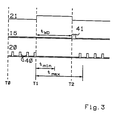
- FIG. 3 shows a diagram.
- Voltage curves are plotted on lines 15, 20, 21 as a function of time.
- the microprocessor unit 11 monitors the circulating water heater 1 in all its functions. These include, in particular, the task of being a flame monitor, an igniter and a temperature control and regulation device.
- the watchdog timer 12 is also to be monitored, specifically by the watchdog monitoring unit 13.
- the control and regulation unit 10 continuously generates pulses 40 which have a certain distance from each other. The distance between these pulses 40 depends on the program. These pulses appear on line 20 and are fed to the AND gate 24 via the input 22.
- the control and regulating unit 10 emits test pulses on the line 21 at certain intervals, which appear on the line 21. These impulses include a time of almost 24 hours between them.
- the expiry time of the monostable multivibrator is designated t WD , it corresponds to the period between the times T1 and T2.
- the watchdog timer After this time has elapsed, the watchdog timer generates a reset signal on line 15, which is fed to both the watchdog monitoring unit 13 and the control and regulating unit 10. As a result of the latter, the entire control and regulating unit 10 is reset, which means that the fuel-heated heat source 1 goes out of operation and, within the framework of a new program cycle, it will go back into operation immediately if a heat request signal is present.
- the expiry time of the monostable multivibrator is compared with a time tolerance band, which is composed of a minimum time and a maximum time.
- the two times are shown as T min and T max , starting from time T 1 in FIG. 3.
- the size of the minimum time T min is selected so that it is greater than the distance between two pulses 40.
- the maximum time T max is selected as a function of the fault tolerance time of the system controlled by the microprocessor. In the case of a circulation water heater, this time corresponds to the time by which the The maximum safety time of 10 seconds can be extended.
- the safety time is understood to mean the time for which the gas valve 6 is released to the maximum during an ignition attempt if no flame is reported. In draft standards, efforts are made to fix the fault tolerance time to 1 to 2 seconds.
- the interval between two pulses 40 is 100 ms, the time T min has been chosen to be 200 ms.
- the counter 27 is released via line 25 so that it starts counting. It was reset to zero earlier. It now counts the pulses emitted by line 28 from oscillator 28.
- the times T min and T max are stored as counter readings.
- the comparator V1 compares whether the time set in it is greater than the time corresponding to the counter reading of the counter 27, and the comparison stage V2 compares whether the time set in it corresponds to a counter reading of the counter 27 which is less than the time present there .
- the time T max corresponds to the counter reading of the comparison stage V 1, the time T min to the counter reading of the comparison stage V 2.
- the time of the monostable multivibrator can be determined at the time T2 whether the prevailing counter reading of the counter 27 is equal to or greater than T min or is equal to or less than T max .
- the reset time of the monostable multivibrator is greater than the time T min but less than the time T max , no output pulse appears. If, on the other hand, the time is less than T min , the AND gate 35 is activated when a reset pulse 41 has also been given on line 16. A fault message is then sent via line 18. In this case the reset message was given too early. If, on the other hand, the reset time of the monostable multivibrator is greater than the maximum time T max , the fault is reported on line 18 to the control and regulating unit 10, in connection with switching off the fuel-heated heat source 1.
- the watchdog timer is the monitoring circuit that checks at regular intervals whether a circuit it monitors is working or whether a program is running.
Landscapes
- Engineering & Computer Science (AREA)
- Theoretical Computer Science (AREA)
- General Engineering & Computer Science (AREA)
- Quality & Reliability (AREA)
- Physics & Mathematics (AREA)
- General Physics & Mathematics (AREA)
- Computer Hardware Design (AREA)
- Debugging And Monitoring (AREA)
- Regulation And Control Of Combustion (AREA)
Abstract
Description
- Die vorliegende Erfindung bezieht sich auf ein Verfahren zum Überwachen eines einen Mikroprozessor überwachenden Watchdog-Timers sowie auf eine Vorrichtung zur Durchführung des Verfahrens gemäß den Oberbegriffen der unabhängigen Ansprüche 1 und 4.
- Es ist bekannt, einem Mikrocomputer beispielsweise zur Steuerung einer brennstoffbeheizten Wärmequelle einen Watchdog-Timer zuzuordnen, der die Funktion des Mikroprozessors überwacht. Dies geschieht normalerweise mit Hilfe einer retriggerbaren monostabilen Kippstufe, die vom Programm des Mikrocomputers zyklisch Retrigger-Impulse erhält und im Falle des Ausbleibens dieser Impulse ein Rücksetzen des Mikrocomputers bewirkt, so daß dieser das von ihm überwachte Gerät neu in Betrieb nehmen muß.
- Soll nun eine Mikrocomputersteuerung zum Beispiel in einem Umlaufwasserheizer auch sicherheitsrelevante Funktionen übernehmen, zum Beispiel die des Feuerungsautomaten, so ist eine Überwachung der Funktionstüchtigkeit des Watchdog-Timers erforderlich.
- Der vorliegenden Erfindung liegt daher die Aufgabe zugrunde, ein Verfahren anzugeben, mit dem diese Überwachung möglich ist. Darüber hinaus soll eine Vorrichtung aufgezeigt werden, die diese Überwachung durchführt.
- Die Lösung der Aufgabe liegt erfindungsgemäß darin, daß der Watchdog-Timer zyklisch getestet wird, indem die Impulse des Mikroprozessors unterdrückt und die Zeit ab der Unterdrückung gemessen wird, bis die monostabile Kippstufe einen Resetimpuls abgibt, und daß diese Zeit mit einem Toleranzzeitband verglichen wird, dessen kürzeste Zeit gleich oder größer ist als die Dauer zwischen zwei Impulsen des Mikroprozessors und dessen längere Zeit in Abhängigkeit der Fehlertoleranzzeit des von dem Mikroprozessor gesteuerten Systems gewählt ist.
- Durch diese Ausgestaltung erreicht man den Vorteil, daß ein relativ einfach aufgebauter Watchdog-Timer auch in sicherheitsrelevanten Steuerungen eingesetzt werden kann. Es ergibt sich die Möglichkeit, die Mikroprozessorsteuerung in Zweikanalbauweise aufzubauen, weil hierbei ein Selbsttest in größeren Zeitabständen ausreicht. Ein Aufbau in Einkanalbauweise ist praktisch unmöglich, weil dann der Mikroprozessor mit dem permanenten Selbsttest ausschließlich beschäftigt wäre.
- Weitere Ausgestaltungen und besonders vorteilhafte Weiterbildungen der Erfindung sind aus den übrigen Unteransprüchen ersichtlich.
- Anhand der Figuren 1 bis 3 der Zeichnung wird im folgenden ein Ausführungsbeispiel des erfindungsgemäßen Verfahrens und der Vorrichtung näher erläutert.
- Es zeigen:
- Figur 1 ein Prinzipschaltbild eines Umlaufwasserheizers,
- Figur 2 ein Blockschaltbild und
- Figur 3 ein Diagramm.
- Vorab soll darauf hingewiesen werden, daß die erwähnten Bauelemente sowohl Einzelbauelemente in Digital- oder Analogtechnik sein könnten, Beispiel: die bistabile Kippstufe, die in Analogtechnik als RC-Glied ausgebildet sein könnte, aber auch Teile eines Mikroprozessors selbst sein könnten. Die bistabile Kippstufe könnte beispielsweise als Zähler dargestellt werden, der mit dem Anstoßimpuls zu zählen beginnt und nach Erreichen seiner eingestellten Schaltschwelle sich selbst wieder zurücksetzt und den Resetimpuls abgibt.
- Ein Umlaufwasserheizer 1 weist im wesentlichen einen von einem Brenner 2 beheizten Wärmetauscher 3 auf, der an eine Rücklaufleitung 4 und eine mit einem Temperaturfühler 5 versehene Vorlaufleitung 6 angeschlossen ist. Der Brenner 2 wird aus einer mit einem Magnetventil 6 versehenen Gasleitung 7 gespeist. Eine Spule 8 des Magnetventils wird über eine Ausgangsleitung 9 einer Steuer- und Regeleinheit 10 gesteuert, wobei letztere Teil einer Mikroprozessoreinheit 11 ist. Die Mikroprozessoreinheit weist neben der Steuer- und Regeleinheit einen Watchdog-Timer 12 und eine Watchdog-Timer-Überwachungseinheit 13 auf, die beide über eine Leitung 14 miteinander verbunden sind. Der Watchdog-Timer ist über eine Leitung 15 mit der Steuer- und Regeleinheit verbunden. Parallel hierzu besteht eine Leitung 16, die die Leitung 15 zurück mit der Watchdog-Überwachungseinheit verbindet. Es ist ein Leitungsbündel 17 als Verbindung von der Steuer- und Regeleinheit zur Watchdog-Überwachungseinheit vorgesehen, eine weitere Leitung 18 zurück von der Watchdog-Überwachungseinheit zur Steuer- und Regeleinheit. Gemäß Figur 2 be steht das Leitungsbündel 17 aus wenigstens zwei Leitungen 20 und 21, die zu zwei Eingängen 22 und 23 (negiert) eines Und-Gliedes 24 führen, dessen Ausgang die Leitung 14 bildet. Die zu dem negierten Einang 23 führende Leitung 21 ist über eine Leitung 25 mit einem negierten Löscheingang 26 eines Zählers 27 verbunden. An den Zähler ist ein Oszillator 28 über eine Leitung 29 angeschlossen. Dem Zähler zugeordnet sind zwei Vergleichsstufen V₁ beziehungsweise V₂ mit den Bezugszeichen 30 und 31. Ausgänge 32 und 33 der Vergleichsstufen V₁ und V₂ sind vorgesehen. Der Ausgang 32 führt zu einem Verzweigungspunkt 34, von dem die Leitung 18 abgeht. Die Leitung 16 ist zusammen mit dem Ausgang 33 auf zwei Eingänge eines Und-Gliedes 35 geführt, dessen Ausgang 36 mit der Verzweigung 34 verbunden ist.
- Zur Funktion der Anordnung nach den Figuren 1 und 2 ist nunmehr die Figur 3 zu vergleichen, die ein Diagramm zeigt.
- Es sind Spannungsverläufe auf den Leitungen 15, 20, 21 als Funktion der Zeit aufgetragen.
- Die Mikroprozessoreinheit 11 überwacht den Umlaufwasserheizer 1 in allen seinen Funktionen. Hierzu zählen insbesondere die Aufgabe als Flammenwächter, als Zünder und als Temperaturregel- und -steuereinrichtung. Neben der Steuer- und Regeleinheit 10, in die diese Funktionen alle integriert sind, ist auch der Watchdog-Timer 12 zu überwachen, und zwar von der Watchdog-Überwachungseinheit 13. Hierzu ist vorgesehen, daß die Steuer- und Regeleinheit 10 fortlaufend Impulse 40 erzeugt, die einen bestimmten Abstand voneinander aufweisen. Der Abstand dieser Impulse 40 hängt vom Programm ab. Diese Impulse erscheinen auf der Leitung 20 und werden über den Eingang 22 dem Und-Glied 24 zugeführt. Auf der Leitung 21 werden von der Steuer- und Regeleinheit 10 in bestimmten Abständen Testimpulse abgegeben, die auf der Leitung 21 erscheinen. Diese Impulse schließen zwischen sich eine Zeit von nahezu 24 Stunden ein. Diese Zeit beruht darauf, daß bei einem fortlaufenden Betrieb der Wärmequelle 1 über 24 Stunden hinaus definitionsgemäß ein Dauerbetrieb vorliegt, der zu unterbrechen ist, will man nicht besondere Sicherheits- und Überwachungsfunktionen auf sich nehmen. Immer wenn auf der Leitung 21 kein Impuls vorliegt, läßt das Und-Glied 24 infolge des negierten Eingangs 23 die Impulse auf der Leitung 20 durch und gibt sie auf die Leitung 14, das heißt, der Watchdog-Timer wird mit diesen Impulsen beaufschlagt. Dieser Zustand ist zwischen den Zeitpunkten T₀ und T₁ dargestellt. Zum Zeitpunkt T₁ wird der eben erwähnte Testimpuls auf der Leitung 21 erzeugt, das heißt, die Weitergabe der Impulse 40 auf der Leitung 14 an den Watchdog-Timer unterbleibt. Damit läuft die im Watchdog-Timer 12 vorgesehene monostabile Kippstufe weiter, bis die in ihr eingestellte Zeit abgelaufen ist. Das ist zum Zeitpunkt T₂ der Fall, die Ablaufzeit der monostabilen Kippstufe ist mit tWD bezeichnet, sie entspricht dem Zeitraum zwischen den Zeitpunkten T₁ und T₂. Nach Ablauf dieser Zeit erzeugt der Watchdog-Timer auf der Leitung 15 ein Resetsignal, was sowohl der Watchdog-Überwachungseinheit 13 wie auch der Steuer- und Regeleinheit 10 zugeführt ist. Als Folge von letzterem wird die gesamte Steuer- und Regeleinheit 10 zurückgesetzt, das bedeutet, daß die brennstoffbeheizte Wärmequelle 1 außer Betrieb geht und im Rahmen eines neuen Programmzyklus wird sie bei Bestehen eines Wärmeanforderungssignals sofort wieder in Betrieb gehen. Parallel hierzu wird die Ablaufzeit der monostabilen Kippstufe mit einem Zeittoleranzband verglichen, was aus einer Mindestzeit und einer Maximumzeit zusammengesetzt ist. Die beiden Zeiten sind als Tmin und Tmax, beginnend vom Zeitpunkt T₁, in der Figur 3 dargestellt. Die Größe der Minimalzeit Tmin ist so gewählt, daß sie größer ist als der Abstand zweier Impulse 40. Die maximale Zeit Tmax ist in Abhängigkeit von der Fehlertoleranzzeit des von dem Mikroprozessor gesteuerten Systems gewählt. Im Falle eines Umlaufwasserheizers entspricht diese Zeit der Zeit, um die die Sicherheitszeit von 10 Sekunden maximal verlängert werden darf. Unter Sicherheitszeit wird die Zeit verstanden, für die das Gasventil 6 bei einem Zündversuch im Maximum freigegeben wird, wenn keine Flamme gemeldet wird. In Normungsentwürfen ist man bestrebt, die Fehlertoleranzzeit auf 1 bis 2 Sekunden festzuschreiben. Der Abstand zweier Impulse 40 beträgt 100 ms, die Zeit Tmin ist zu 200 ms gewählt worden.
- Der Vergleich geschieht wie folgt:
- Im Moment T₁ wird über die Leitung 25 der Zähler 27 freigegeben, so daß er mit dem Zählen beginnt. Seine Rücksetzung auf Null erfolgte früher. Er zählt nunmehr die über die Leitung 29 vom Oszillator 28 ausgesendeten Impulse. In den Vergleichsstufen V₁ und V₂ sind die Zeiten Tmin und Tmax als Zählerstände gespeichert. Der Vergleicher V₁ vergleicht, ob die in ihm eingestellte Zeit größer als die dem Zählerstand des Zählers 27 entsprechende Zeit ist, und die Vergleichsstufe V₂ vergleicht, ob die in ihr eingestellte Zeit einem Zählerstand des Zählers 27 entspricht, die kleiner als die dort vorliegende Zeit ist. Die Zeit Tmax entspricht dem Zählerstand der Vergleichsstufe V₁, die Zeit Tmin dem Zählerstand der Vergleichsstufe V₂. Nunmehr kann nach Ablauf der Zeit der monostabilen Kippstufe im Zeitpunkt T₂ festgestellt wer den, ob der zu diesem Zeitpunkt herrschende Zählerstand des Zählers 27 gleich oder größer Tmin ist beziehungsweise gleich oder kleiner als Tmax ist. Als Ergebnis dieses Vergleichs erscheint, wenn die Rücksetzzeit der monostabilen Kippstufe größer ist als die Zeit Tmin, aber kleiner ist als die Zeit Tmax, kein Ausgangsimpuls. Ist die Zeit hingegen kleiner als Tmin, wird das Und-Glied 35 dann aktiviert, wenn zugleich auf der Leitung 16 ein Resetimpuls 41 gegeben wurde. Dann erfolgt über die Leitung 18 eine Störungsmeldung. In diesem Fall erfolgte die Resetmeldung zu früh. Ist die Rückstellzeit der monostabilen Kippstufe hingegen größer als die Maximumzeit Tmax, dann erfolgt die Störungsmeldung auf der Leitung 18 an die Steuer- und Regeleinheit 10, verbunden mit einem Abschalten der brennstoffbeheizten Wärmequelle 1.
- Abschließend soll darauf hingewiesen werden, daß die Funktion gemäß dem Blockschaltbild der Figur 2 auch als Software-Programm im Mikroprozessor implementiert werden kann.
- Als Watchdog-Timer ist die Überwachungsschaltung anzusehen, die in regelmäßigen Zeitabständen prüft, ob eine von ihr überwachte Schaltung arbeitet beziehungsweise ob ein Programmablauf erfolgt.
Claims (4)
Applications Claiming Priority (4)
| Application Number | Priority Date | Filing Date | Title |
|---|---|---|---|
| DE3737765 | 1987-11-06 | ||
| DE3737765 | 1987-11-06 | ||
| DE3827021 | 1988-08-05 | ||
| DE3827021 | 1988-08-05 |
Publications (3)
| Publication Number | Publication Date |
|---|---|
| EP0315054A2 true EP0315054A2 (de) | 1989-05-10 |
| EP0315054A3 EP0315054A3 (de) | 1990-10-17 |
| EP0315054B1 EP0315054B1 (de) | 1996-10-09 |
Family
ID=25861547
Family Applications (1)
| Application Number | Title | Priority Date | Filing Date |
|---|---|---|---|
| EP88117906A Expired - Lifetime EP0315054B1 (de) | 1987-11-06 | 1988-10-27 | Verfahren zum Überwachen eines einen Mikroprozessor überwachenden Watchdog-Timers und Vorrichtung zur Durchführung des Verfahrens |
Country Status (3)
| Country | Link |
|---|---|
| EP (1) | EP0315054B1 (de) |
| AT (1) | ATE144056T1 (de) |
| DE (1) | DE3855601D1 (de) |
Cited By (2)
| Publication number | Priority date | Publication date | Assignee | Title |
|---|---|---|---|---|
| WO2000020969A1 (de) * | 1998-10-01 | 2000-04-13 | Robert Bosch Gmbh | Verfahren und vorrichtung zur synchronisation und überprüfung von prozessor und überwachungsschaltung |
| FR2844892A1 (fr) * | 2002-09-24 | 2004-03-26 | St Microelectronics Sa | Horloge de surveillance de microcontroleur |
Families Citing this family (1)
| Publication number | Priority date | Publication date | Assignee | Title |
|---|---|---|---|---|
| DE102006008475A1 (de) * | 2006-02-23 | 2007-08-30 | Siemens Building Technologies Hvac Products Gmbh | Verfahren zur sicherheitsgerichteten Ansteuerung eines Stellgliedes |
Family Cites Families (2)
| Publication number | Priority date | Publication date | Assignee | Title |
|---|---|---|---|---|
| US3749897A (en) * | 1971-09-03 | 1973-07-31 | Collins Radio Co | System failure monitor title |
| US4598355A (en) * | 1983-10-27 | 1986-07-01 | Sundstrand Corporation | Fault tolerant controller |
-
1988
- 1988-10-27 DE DE3855601T patent/DE3855601D1/de not_active Expired - Fee Related
- 1988-10-27 AT AT88117906T patent/ATE144056T1/de not_active IP Right Cessation
- 1988-10-27 EP EP88117906A patent/EP0315054B1/de not_active Expired - Lifetime
Cited By (3)
| Publication number | Priority date | Publication date | Assignee | Title |
|---|---|---|---|---|
| WO2000020969A1 (de) * | 1998-10-01 | 2000-04-13 | Robert Bosch Gmbh | Verfahren und vorrichtung zur synchronisation und überprüfung von prozessor und überwachungsschaltung |
| FR2844892A1 (fr) * | 2002-09-24 | 2004-03-26 | St Microelectronics Sa | Horloge de surveillance de microcontroleur |
| US6961866B2 (en) | 2002-09-24 | 2005-11-01 | Stmicroelectronics Sa | Watchdog timer for microcontroller |
Also Published As
| Publication number | Publication date |
|---|---|
| EP0315054A3 (de) | 1990-10-17 |
| EP0315054B1 (de) | 1996-10-09 |
| DE3855601D1 (de) | 1996-11-14 |
| ATE144056T1 (de) | 1996-10-15 |
Similar Documents
| Publication | Publication Date | Title |
|---|---|---|
| DE3783125T2 (de) | Kontrollsystem fuer ein kochgeraet. | |
| DE4136415C2 (de) | Verfahren und Vorrichtung zum Prüfen des Betriebs eiens Elektromagneten | |
| DE3508608C2 (de) | ||
| DE2444455C3 (de) | Steuersystem für eine Brenneranlage | |
| DE2917319A1 (de) | Verfahren und vorrichtung zum pruefen des zustandes einer batterie | |
| DE3513937A1 (de) | Verfahren zur ueberwachung eines drehzahlgeber-signals | |
| EP1277095B1 (de) | System und verfahren zur überwachung einer einrichtung zum messen, steuern und regeln | |
| CH659672A5 (de) | Schussfadenwaechter. | |
| EP0315054B1 (de) | Verfahren zum Überwachen eines einen Mikroprozessor überwachenden Watchdog-Timers und Vorrichtung zur Durchführung des Verfahrens | |
| WO1988005570A1 (fr) | Procede et dispositif de surveillance d'organes de commande terminaux commandes par un ordinateur | |
| DE3836870A1 (de) | Verfahren zum ueberwachen eines einen mikroprozessor ueberwachenden watchdog-timer und vorrichtung zur durchfuehrung des verfahrens | |
| DE4004427C2 (de) | Diagnostisches Störungsmeldesystem | |
| DE3126236A1 (de) | "verfahren und schaltungsanordnung zur steuerung von bestrahlungsgeraeten" | |
| DE4403156B4 (de) | Verfahren und Vorrichtung zur Durchführung des Verfahrens zur Ansteuerung eines Verbrauchers | |
| DE3301645C2 (de) | Digitale Steuerung | |
| EP0508081B1 (de) | Schaltungsanordnung und Verfahren zum Überwachen eines brennstoffbeheizten Gerätes | |
| DE2831771B2 (de) | Statischer Rundsteuerempfänger | |
| DE4313532A1 (de) | Verfahren zur Überprüfung einer Endstufe | |
| DE102004020538A1 (de) | Elektronische Steuereinrichtung und Verfahren zur Steuerung des Betriebs von Kraftfahrzeugkomponenten | |
| DE2318072C3 (de) | System zur Überwachung und Fehlermeldung in sicherheitstechnischen Anlagen | |
| DE3410257C2 (de) | ||
| EP0590181A1 (de) | Verfahren zur Ermittlung der Schliessdauer des Primärkreises in einer Zündanlage einer Brennkraftmaschine | |
| DE4402017C2 (de) | Verfahren zum fehlersicheren Überwachen einer Versorgungsspannung und Einrichtung zur Durchführung des Verfahrens | |
| DE19703890C1 (de) | Watchdog-Bedienung | |
| DE3325497C2 (de) |
Legal Events
| Date | Code | Title | Description |
|---|---|---|---|
| PUAI | Public reference made under article 153(3) epc to a published international application that has entered the european phase |
Free format text: ORIGINAL CODE: 0009012 |
|
| AK | Designated contracting states |
Kind code of ref document: A2 Designated state(s): AT BE CH DE ES FR GB GR IT LI LU NL SE |
|
| PUAL | Search report despatched |
Free format text: ORIGINAL CODE: 0009013 |
|
| AK | Designated contracting states |
Kind code of ref document: A3 Designated state(s): AT BE CH DE ES FR GB GR IT LI LU NL SE |
|
| 17P | Request for examination filed |
Effective date: 19901212 |
|
| 17Q | First examination report despatched |
Effective date: 19931005 |
|
| GRAH | Despatch of communication of intention to grant a patent |
Free format text: ORIGINAL CODE: EPIDOS IGRA |
|
| RAP1 | Party data changed (applicant data changed or rights of an application transferred) |
Owner name: VAILLANT GES.M.B.H Owner name: VAILLANT S.A.R.L Owner name: VAILLANT B.V. Owner name: JOH. VAILLANT GMBH U. CO. Owner name: VAILLANT GMBH Owner name: VAILLANT LTD. Owner name: N.V. VAILLANT S.A. |
|
| GRAH | Despatch of communication of intention to grant a patent |
Free format text: ORIGINAL CODE: EPIDOS IGRA |
|
| GRAA | (expected) grant |
Free format text: ORIGINAL CODE: 0009210 |
|
| AK | Designated contracting states |
Kind code of ref document: B1 Designated state(s): AT BE CH DE ES FR GB GR IT LI LU NL SE |
|
| PG25 | Lapsed in a contracting state [announced via postgrant information from national office to epo] |
Ref country code: IT Free format text: LAPSE BECAUSE OF FAILURE TO SUBMIT A TRANSLATION OF THE DESCRIPTION OR TO PAY THE FEE WITHIN THE PRESCRIBED TIME-LIMIT;WARNING: LAPSES OF ITALIAN PATENTS WITH EFFECTIVE DATE BEFORE 2007 MAY HAVE OCCURRED AT ANY TIME BEFORE 2007. THE CORRECT EFFECTIVE DATE MAY BE DIFFERENT FROM THE ONE RECORDED. Effective date: 19961009 Ref country code: FR Effective date: 19961009 Ref country code: ES Free format text: THE PATENT HAS BEEN ANNULLED BY A DECISION OF A NATIONAL AUTHORITY Effective date: 19961009 Ref country code: NL Free format text: LAPSE BECAUSE OF FAILURE TO SUBMIT A TRANSLATION OF THE DESCRIPTION OR TO PAY THE FEE WITHIN THE PRESCRIBED TIME-LIMIT Effective date: 19961009 Ref country code: GB Effective date: 19961009 Ref country code: GR Free format text: LAPSE BECAUSE OF FAILURE TO SUBMIT A TRANSLATION OF THE DESCRIPTION OR TO PAY THE FEE WITHIN THE PRESCRIBED TIME-LIMIT Effective date: 19961009 |
|
| REF | Corresponds to: |
Ref document number: 144056 Country of ref document: AT Date of ref document: 19961015 Kind code of ref document: T |
|
| PG25 | Lapsed in a contracting state [announced via postgrant information from national office to epo] |
Ref country code: LU Free format text: LAPSE BECAUSE OF NON-PAYMENT OF DUE FEES Effective date: 19961031 Ref country code: BE Effective date: 19961031 |
|
| REF | Corresponds to: |
Ref document number: 3855601 Country of ref document: DE Date of ref document: 19961114 |
|
| PG25 | Lapsed in a contracting state [announced via postgrant information from national office to epo] |
Ref country code: SE Effective date: 19970109 |
|
| NLV1 | Nl: lapsed or annulled due to failure to fulfill the requirements of art. 29p and 29m of the patents act | ||
| EN | Fr: translation not filed | ||
| GBV | Gb: ep patent (uk) treated as always having been void in accordance with gb section 77(7)/1977 [no translation filed] |
Effective date: 19961009 |
|
| PLBE | No opposition filed within time limit |
Free format text: ORIGINAL CODE: 0009261 |
|
| STAA | Information on the status of an ep patent application or granted ep patent |
Free format text: STATUS: NO OPPOSITION FILED WITHIN TIME LIMIT |
|
| 26N | No opposition filed | ||
| PGFP | Annual fee paid to national office [announced via postgrant information from national office to epo] |
Ref country code: AT Payment date: 20030912 Year of fee payment: 16 |
|
| PGFP | Annual fee paid to national office [announced via postgrant information from national office to epo] |
Ref country code: DE Payment date: 20031111 Year of fee payment: 16 |
|
| PGFP | Annual fee paid to national office [announced via postgrant information from national office to epo] |
Ref country code: CH Payment date: 20040128 Year of fee payment: 16 |
|
| PG25 | Lapsed in a contracting state [announced via postgrant information from national office to epo] |
Ref country code: AT Free format text: LAPSE BECAUSE OF NON-PAYMENT OF DUE FEES Effective date: 20041027 |
|
| PG25 | Lapsed in a contracting state [announced via postgrant information from national office to epo] |
Ref country code: CH Free format text: LAPSE BECAUSE OF NON-PAYMENT OF DUE FEES Effective date: 20041031 Ref country code: LI Free format text: LAPSE BECAUSE OF NON-PAYMENT OF DUE FEES Effective date: 20041031 |
|
| PG25 | Lapsed in a contracting state [announced via postgrant information from national office to epo] |
Ref country code: DE Free format text: LAPSE BECAUSE OF NON-PAYMENT OF DUE FEES Effective date: 20050503 |
|
| REG | Reference to a national code |
Ref country code: CH Ref legal event code: PL |