EP0315510A2 - Membran für selektiven Ionentransport - Google Patents
Membran für selektiven Ionentransport Download PDFInfo
- Publication number
- EP0315510A2 EP0315510A2 EP88402720A EP88402720A EP0315510A2 EP 0315510 A2 EP0315510 A2 EP 0315510A2 EP 88402720 A EP88402720 A EP 88402720A EP 88402720 A EP88402720 A EP 88402720A EP 0315510 A2 EP0315510 A2 EP 0315510A2
- Authority
- EP
- European Patent Office
- Prior art keywords
- ions
- membrane
- selective
- group
- nitrate
- Prior art date
- Legal status (The legal status is an assumption and is not a legal conclusion. Google has not performed a legal analysis and makes no representation as to the accuracy of the status listed.)
- Withdrawn
Links
Images
Classifications
-
- B—PERFORMING OPERATIONS; TRANSPORTING
- B01—PHYSICAL OR CHEMICAL PROCESSES OR APPARATUS IN GENERAL
- B01D—SEPARATION
- B01D61/00—Processes of separation using semi-permeable membranes, e.g. dialysis, osmosis or ultrafiltration; Apparatus, accessories or auxiliary operations specially adapted therefor
- B01D61/42—Electrodialysis; Electro-osmosis ; Electro-ultrafiltration; Membrane capacitive deionization
- B01D61/44—Ion-selective electrodialysis
-
- C—CHEMISTRY; METALLURGY
- C08—ORGANIC MACROMOLECULAR COMPOUNDS; THEIR PREPARATION OR CHEMICAL WORKING-UP; COMPOSITIONS BASED THEREON
- C08J—WORKING-UP; GENERAL PROCESSES OF COMPOUNDING; AFTER-TREATMENT NOT COVERED BY SUBCLASSES C08B, C08C, C08F, C08G or C08H
- C08J5/00—Manufacture of articles or shaped materials containing macromolecular substances
- C08J5/20—Manufacture of shaped structures of ion-exchange resins
- C08J5/22—Films, membranes or diaphragms
- C08J5/2206—Films, membranes or diaphragms based on organic and/or inorganic macromolecular compounds
- C08J5/2212—Natural macromolecular compounds
-
- C—CHEMISTRY; METALLURGY
- C08—ORGANIC MACROMOLECULAR COMPOUNDS; THEIR PREPARATION OR CHEMICAL WORKING-UP; COMPOSITIONS BASED THEREON
- C08J—WORKING-UP; GENERAL PROCESSES OF COMPOUNDING; AFTER-TREATMENT NOT COVERED BY SUBCLASSES C08B, C08C, C08F, C08G or C08H
- C08J2301/00—Characterised by the use of cellulose, modified cellulose or cellulose derivatives
- C08J2301/08—Cellulose derivatives
Definitions
- the present invention relates to ion transport selective membranes having a low electrical resistance.
- the purity of the products can be controlled to a large degree.
- the selective separation of charged species having the same electric charge is of great potential use for isolation and purification.
- High membrane selectivity demonstrated in the present invention, has been thought to occur because of a selective ion dissociation mechanism induced in hydrophobic charged membranes.
- selectivity has been previously associated with relatively high membrane resistance.
- the ultrathin membranes are susceptible to mechanical damage, and have a relatively short life.
- the membrane is described as a polymer matrix with covalently-attached ionizable groups.
- the polymers used to make such a membrane are generally modified to incorporate such groups, in a predetermined quantity, so that the membrane possesses dielectric and ion dissociation constants which optimally induce selective ion dissociation of the first group of charged ions, so as to effect a substantial ionic migration thereof and consequential transfer across the membrane in a proportion higher than its relative concentration in the solution.
- membrane matrices containing non- polymeric or polymeric additives embedded therein-or physically mixed therewith suffer from disadvantages such as (i) elution of low molecular weight species in an electric field, and (ii) incompatibility of polymer additives with the membrane matrix leading to poor mechanical integrity and low selectivity and/or permeability.
- Such incompatibility is due to the mixing of a relatively hydrophobic matrix with a hydrophilic material containing ionizable groups needed for selectivity.
- the invention accordingly provides a membrane which comprises:
- polymer (b) is effective to reduce the electrical resistance per micron thickness of film (a) by at least one full of an order of magnitude.
- Polymer (b) either may or may not impart selective ion transport properties to the film matrix.
- Component (b) may, for example be a polymer derived from monomers comprising heterocyclic nitrogen-containing rings of aromatic character, and especially from such monomers comprising members selected from the group consisting of 2-and 4-vinylpyridines and mixtures thereof.
- component (b) may be for example, a polymer derived from monomers comprising both aromatic carbocyclic rings and tertiary amino groups.
- Component (b) may also be e.g. a polymer derived from monomers comprising both aromatic carbocyclic rings and primary and/or secondary and/or tertiary amino groups. Amino groups of any kind in component (b) may be bound to aromatic or acyclic (linear or branched-chain) moieties.
- the invention also provides a process for the separation of preselected ions from other ions in the same solution which possess the same sign, which comprises subjecting the solution to the action of a membrane in accordance with the invention.
- the preselected ions and the other ions bear negative charges, particularly identical unit negative charges.
- the invention may for example be used to separate nitrate ions from other monovalent anions.
- the invention moreover provides a method for the performance of selective electrodialytic separation of preselected ions from other ions in the same solution which possess the same sign, which comprises applying a current to an electrodialysis unit comprising at least one membrane in accordance with the present invention.
- the invention provides a selective electrodialysis unit for the performance of selective electrodialytic separation of a first group of charged ions from a solution containing other charged ions having the same sign as said first group comprising at least one thin, dense non-porous charged electrodialysis membrane made of water-insoluble hydrophobic polymeric material containing covalently bound ionizable groups, wherein the membrane separates at least one diluting compartment from at least one concentrating compartment in the unit and wherein the membrane is in the form of a polymeric matrix optionally supported on a porous support and having a dielectric constant and composition preselected to induce selective ion dissociation of the first group of charged ions upon the passage of current therethrough, and thereby to effect a substantial ion migration of the selected ion group from at least one diluting compartment to at least one concentrating compartment in the unit and its preferential transference across said membrane at a fraction larger than its relative concentration in solution; the membrane being further characterized in that it comprises:
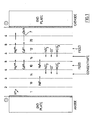
- Fig. 1 illustrates an electrodialysis stack which utilizes the membranes in accordance with the present invention.
- polymers could be added to the membrane, which were compatible with the matrix polymeric material containing the ionizable radicals.
- the added polymers and the matrix polymeric material could be mixed over a broad range with good compatibility, without loss of membrane strength.
- these polymer additives could be optionally covalently bound to the membrane matrix and possibly also crosslinked with itself to form a three-dimensional matrix. Such reactions fix the additive to the matrix, and thus prevent leaching and phase separation, so that the life of the membrane is extended.
- Three types of membranes with the polymer additive may be prepared:
- the transport process makes use of the concept of association of ions within media of low and medium dielectric constants.
- the major fraction of the ions will be in the form of ion pairs, and as such, will not participate in electrical transport processes such as electrical conductance; these transport processes will be governed mainly by the dissociated ions only.
- the extent of the dissociation of the two ion groups having the same electric charge from a common and oppositely charged counter ion will depend upon specific properties of the ions (such as ionic radii) and on the specific interactions which these ions may undergo with the solvent or matrix molecules.
- ionizable radicals are bound to the matrix. Without these ionic or polar radicals, the extent of salt-matrix interaction will be too low, as the latter are of medium or low dielectric constant. Thus, the combination of hydrophobic matrix and charged moieties leads to the selective dissociation of one salt over another. This combination leads to selective transport of a selected charged ion upon the application of an electric field. However, the amount of ionizable radicals in the matrix must be limited to minimize water uptake.
- hydrophobic polymers we include polymers which may contain only small amounts of absorbed water; water in relatively larger amounts significantly increases the dielectric constant of the matrix, destroying or decreasing selectivity.
- Suitable materials for the matrix may be, for example, polymers selected from the group consisting of cellulose esters, cellulose ethers, aromatic polysulfones, acrylonitrile homo- and co-polymers, polyamides, vinyl chloride homo- and co-polymers, vinylidene chloride homo- and co-polymers, epoxy resins, polyarylene oxides (e.g. poly[2,6-dimethyl- ]phenylene oxide), polycarbonates, homo- and co- polymers derived from monomers comprising heterocyclic rings, polyvinylidene fluoride, polytetrafluoroethylene, polyesters, polyelectrolyte complexes, polyolefins (e.g. polyethylene and polypropylene), homo- and co- polymers formed from monomers comprising polystyrene or derivatives thereof, polyetherimides, polyether ketones, polyamide imides, polyimides and mixtures thereof.
- Cellulosic membranes are one preferred group of membranes in the case of nitrate selective transport in the presence of e.g. chloride and/or sulfate ions.
- Another preferred group consists of membranes prepared from haloalkylated (e.g. halo- methylated or haloethylated) aromatic polysulfones, polyphenyleneoxides, aromatic polyepoxides and styrene homo- and co-polymers.
- radicals With respect to covalently bound radicals, the choice is even wider.
- the role of the charged radical is to introduce into the membrane permselectivity.
- the basic requirement is that such radicals do not lead to excessive water absorption and to a consequent excessive increase of the membrane's hydrophilicity. This can be evenly controlled by either keeping the concentration of the charged radicals low, or by using bulky hydrophobic radicals with low hydration numbers.
- the essence of the present invention resides in the covalent binding of an ionizable radical, rather than in the nature or identity of a specific ionizable radical, bearing in mind of course that different radicals will preferably be chosen in relation to the choice to be made, of the ions to be separated, as the optimal desired separation of ions will depend on the specific interactions, such as specific binding of one ion class compared to another.
- a polymer membrane and more particularly a membrane prepared from a cellulose ester such as cellulose acetate), with bound quaternary ammonium radicals is preferred.
- radicals have the formula wherein X is an anion and R 1 , R 2 and R 3 are the same or different linear or branched alkyls containing at least five carbon atoms, such as pentyl, hexyl, heptyl, octyl, nonyl, decyl, undecyl or dodecyl.
- R 1 , R 2 and R 3 may represent identical alkyls.
- alkyls such as butyl, propyl, ethyl and methyl do not give the same high selectivity towards nitrates as do the higher molecular weight chains, but may be utilized as one of R 1 , R 2 and R 3 , the other two of R 1 , R 2 and R 3 being the same or different alkyls containing at least five carbon atoms.
- heterocyclic ammoniums such as pyridinium. quinolinium and isoquinolinium were also found to give good selectivity.
- quaternary ammonium radicals are bound to a cellulose ester or ether, they are bound through nitrogen to carbon atoms of the cellulose backbone; however, in this case, it was found that trimethyl, triethyl and tripropyl quaternary ammonium radicals did not give good selectivity.
- These lower molecular weight radicals can however be utilized in conjunction with the other matrix materials mentioned above, in which case they are bound to the carbon atoms of an aliphatic or aromatic backbone, or they may be removed from the backbone and attached thereto via aliphatic radicals such as C n H 2n (linear or branched. where n is 1 to 8.
- Z is and Z' are each a valence bond or C n H2n (linear or branched, where n is 1 to 8, preferably 1 or 2), or Z' may also be N, O or S.
- any method which can also reduce electrical resistance while maintaining selectivity is important. It was thus both significant and surprising to find that the addition of a polymer such as polyvinylpyridine to the charged matrix decreases resistance by at least an order of magnitude without reducing selectivity. It was surprising that this should happen with a relatively hydrophilic polymer without loss of selectivity, and without loss of physical integrity of the resulting membrane.
- polystyrene resin poly-(4-vinyl)pyridine
- P4VP poly-(4-vinyl)pyridine
- Other polymers are poly-(2-vinyl)pyridine and bi- or ter- or higher order multi-polymers of 2- and/or 4-vinylpyridine with one or more other monomers selected e.g.
- alkyl acrylate or methacrylate such as methyl or butyl acrylate, or methyl methacrylate
- styrene and substituted derivatives thereof such as dichlorostyrene
- vinyl acetate acrylonitrile
- vinyl chloride vinylidene chloride
- 2-chloro-1,3-butadiene 2-chloro-1,3-butadiene
- isoprene Other polymers may be chosen from materials containing primary, secondary and especially tertiary amine radicals either as side-chains or as part of a main chain, such that the polymers are water-insoluble under basic conditions. These polymers may be copolymers or homopolymers.
- the membranes according to the present invention may be prepared by one of the following methods:
- the reactive polymer used to bind the ionizable radical should have enough reactive radicals to bind a sufficient number of ionizable radicals for selectivity. This number usually varies between 0.05 and 0.6 equivalents per kg. of polymer; however, cellulose diacetate (e.g. Eastman Kodak CA 346, 24) the range is 0.1 to 0.7 eq./kg. Below and above this range selectivity is diminished. High values increase hydrophilicity, thus reducing selective dissociation and giving low selectivity. Low values limit dissociation and mobility, and selectivity is lost through lack of transport under an electric field.
- cellulose diacetate e.g. Eastman Kodak CA 346, 24
- the first group of charged ions may be nitrate ions, or alternatively the first group may be selected from the group consisting of positively or negatively charged organic molecules.
- the unit may for example be adapted for the treatment of an aqueous stream containing nitrate, bicarbonate and sulfate ions, and for the selective transportation of nitrate ions from the diluting to the concentrating compartments of the unit without accompanying transport of said bicarbonate and sulfate ions, whereby the problem of scale formation on said unit is substantially reduced.
- the unit may also be adapted for the treatment of an aqueous stream containing nitrate, bicarbonate, chloride and sulfate ions, and for the selective transportation of nitrate ions from the diluting to the concentrating compartments of the unit without accompanying transport of bicarbonate, chloride and sulfate ions, for producing a concentrated brine rich in nitrate ions which can be used for fertilization purposes.
- the membrane in the selective electrodialysis unit of the invention be selected from the group consisting of asymmetric, composite and thin supported charged membranes. It is further preferred that the membrane is characterized by a low dielectric constant in the range of about 2 to about 7.
- a convenient property for characterizing the membranes of the present invention is the fraction of the ionic current carried across the membrane by a given ionic species, i, called the transport number (i; )
- ⁇ i J i (F/I) for zero chemical gradients (u;) and volume flow (Jv).1 is the electric current
- J i is the flow of species i
- F Faraday's constant (96500 coulombs).
- Transport numbers were calculated from membrane potentials determined in a setup wherein the membrane is inserted between the two halves of a Perspex cell and filled with testing solution into which two calomel electrodes were immersed.
- the potential ( ⁇ ) established between the electrodes is measured by means of a millivoltmeter.
- the activity coefficients for the calculation of the activity were taken from M.Gazith "Activity Coefficients of Various Electrolytes", Israel Atomic Energy Commission, Soreg Research Establishment, Feb, 1964.
- Membrane conductance was determined in an experimental setup described in detail in Research and Development Report No. 77, test manual for permselective membranes, OSW PB 181575,1964. A Wayne Kerr impedance bridge was used in all these measurements. The temperature was controlled within +/- 0.10/ 0 . Membrane thickness was measured using a mechanical micrometer with an accuracy of +/- 1 micron.
- Membranes were equilibrated in 1 M NaNOa overnight, rinsed with distilled water for several hours, and then left overnight in a known minimal volume of 1M NaCl. Knowing the concentration of the exchanged nitrate ion and the weight of the wet membrane, the charge density could be calculated in mMoles/kg. membrane. This data was compared to the total amount of nitrogen due to quaternary ammonium groups obtained by elemental analysis.
- the ED stack used in these experiments consists of two PVC end plates and rubber gaskets.
- a stainless steel press was designed for the easy and frequent replacement of the solutions and membranes.
- Rubber gaskets of a sheet flow type enable a separate supply and circulation of various solutions and the analysis of their compositions during the experiments.
- Each of the gaskets incorporate a polypropylene turbulence-promoting spacer.
- Two electrodes which may be made e.g. of platinum net, and having an area of 10 cm. x 3 cm., are incorporated into the gaskets adjacent to the end plates.
- the sequence of various gaskets and membranes is described in Fig. 1.
- the anions are transported through anion exchange membranes 2 (e.g.
- an intermediate trap 18 containing 0.1 M NaCI is introduced between the anode and concentrate cells. Sodium ions are transported from this cell into the adjacent concentrate cell 14.
- the trap 20 containing 0.1 M NaCI is introduced in order to eliminate the diffusion of hydroxyl ions from the cathode towards the nitrate selective membrane.
- the stream velocity in the diluted cell is varied between 3 and 13 cm./sec. It was noted that the selectivity is significantly reduced when the linear flow velocity is kept in the lower part of this range.
- the transport number of nitrate ions for calculting selectivity are obtained in mixed solutions of sodium nitrate and sodium chloride.
- concentration of NaCI was equal on both sides of the membrane (typically 5mM/1.), while the ratio of sodium nitrate between te two solutions was kept at two (e.g. 2 mM/1. to 1 mM/1.)
- a two-fold ratio of sodium nitrate concentrations typically 100 mM/1. to 50 mM/1., were used.
- conductivity 100 mM./1. sodium nitrate solution was used on both sides of the membrane.
- the electrodes at each end of the electrical stage within the stack distribute the current over the membranes.
- These electrodes may be in general flat plates of metal (such as niobium or titanium) or carbon and are usually plated with platinum or (in the case of cathodes) stainless steel.
- metal such as niobium or titanium
- platinum in the case of cathodes
- both electrodes are platinum-plated since both alternate in being the cathode and anode.
- the example of platinum net electrodes has already been mentioned.
- the electrodes are exposed to separate rinse water streams (1, 7) of e.g. 0.1M NaCI (but see below) to make electrical contact and to carry away electrochemical products of the electrode reactions.
- oxidation and reduction reactions take place at the anode and cathode, respectively.
- These reactions create problems which result in (i) degradation of the electrodes, especially at the anode, where oxidation can result in erosion of the metal, and (ii) the production of chlorine and/or oxygen, depending on the pH of the constituents of the rinse stream.
- the effect on the cathode is not quite so severe and usually results in the formation of hydrogen gas. This in turn could create a high pH that may favor the formation of scale.
- the rinse streams are usually acidified to inhibit scaling; by combining and recycling these streams from the anode and cathode compartments, the amount of acid additive necessary may be reduced.
- the rinse solutions usually contain electrolytes such as sodium sulfate or nitrate, and less preferably sodium chloride.
- the electrodes must be replaced periodically. In the electrodialysis reversal process, each electrode alternates between being cathode and anode, several times per hour. This alternation serves to equalize the wear on the electrodes and chemically removes scale formed during the cathode operation by means of acid generated during its anodic cycle.
- Cellulose acetate (80 g. Eastman 398-10) and tosyl chloride (420 g.) were separately dissolved in 400 and 950 ml. dry pyridine, respectively.
- the solutions were mixed and left at room temperature for 20 hours with stirring. After this time, the mixture was cooled to 0°C and mixed with an equal volume of ice-cold acetone to decompose the excess of tosyl chloride. After 10 minutes mixing in a bath at 0°C, the polymer was precipitated by vigorous stirring with at least 10 vols. distilled water, the mixture stirred for 30 minutes, filtered and washed well with water. The polymer was dried at 60° C for 48 hours (minimum).
- Cellulose acetate tosylate (100 g.) was dissolved in dibromomethane (800 ml.) by stirring and heating, and a solution of trioctylamine (200 ml.) in dibromomethane (100 ml.) was added thereto in small portions. The temperature was then raised to 80° C and the mixture was stirred at this temperature for 20 hours. The solution was cooled to room temperature and the resulting polymer was precipitated with 2.5 I,. ethyl alcohol, stirred for 15 minutes, filtered, washed well with additional portions of ethanol and dried at 50-55°C for 24 hours. The polymer was redissolved in 800 ml, methylene chloride and reprecipitated with ethanol.
- CA-N[OCT] 3 -TOS/ P4VP in a concentration ratio of 1:0.1 gives a membrane with a selectivity of 0.77 and a resistance of 66.6 ohms/micron. This represents a reduction in resistance of 6.7 x and such membranes may be of practical use.
- Example I is carried out, but instead of CAN[OCT] 3 -TOS, the tridodecylamine analogue is prepared (in effect CA-N[DODEC] 3 -TOS).
- a solution of cellulose acetate tosylate (100 g.) in dibromomethane (800 ml.) is reacted with a solution of tridodecylamine (200 ml.) in the same solvent (200 ml.), the subsequent operations being carried out as in Example I.
- Membranes made from this polymer without P4VP in dibromomethane had a nitrate selectivity, permselectivity and resistance of 0.94, 0.60 and 655 ohms/micron, respectively.
- a membrane containing CA-N[DODEC] 3 -TOS/P4VP in the ratio of 1:0.5 had a nitrate selectivity, permselectivity and resistance of 0.67, 0.78 and 30 ohms/micron, respectively.
- Example I is repeated using triheptylamine instead of trioctylamine.
- the nitrate selectivity, permselectivity and resistance of a membrane without and with P4VP were 0.73, 0.78 and 303 ohms/micron, respectively, as compared with 0.68, 0.75 and 18 ohms/micron respectively.
- Example III is repeated using poly-(2-vinyl)pyridine (P2VP) instead of P4VP, to give a reduction in resistance from 420 to 16 ohms/micron, without and with the addition of P2VP, respectively.
- P2VP poly-(2-vinyl)pyridine
- Example I is repeated using a 4-vinylpyridine/ methyl methacrylate copolymer instead of P4VP, to give a reduction in resistance from 750 to 30 ohms/micron, without and with the addition of copolymer, respectively.
- Example I is repeated using a copolymer as stated below instead of P4VP, to give a reduction in resistance from 625 to 46 ohms/micron, without and with the addition of copolymer, respectively.
- the copolymer used in this example was derived from vinyl chloride and 2-(triheptylammonium)ethyl acrylate [tosylate].
- Example I is repeated using instead of P4VP, a polyepichlorohydrin polymer which has been partly derivatized with pyridine giving 0.7 meq./g. pyridinium chloride pendents, to give a reduction in resistance from 625 to 16 ohms/micron, without and with the addition of copolymer, respectively, with only a 10 0 / 0 loss of selectivity.
- P4VP a polyepichlorohydrin polymer which has been partly derivatized with pyridine giving 0.7 meq./g. pyridinium chloride pendents, to give a reduction in resistance from 625 to 16 ohms/micron, without and with the addition of copolymer, respectively, with only a 10 0 / 0 loss of selectivity.
- Example I is repeated using poly(p-tributy- lamino)styrene instead of P4VP, to give a reduction in resistance from 825 to 36 ohms/micron, without and with the addition of this polymer, respectively.
- Example I is repeated using vinyl chloride/N-vinylimidazole copolymer instead of P4VP, to give a reduction in resistance from 760 to 18 ohms/micron, without and with the addition of this copolymer, respectively.
- Example I is repeated using poly(p-chloromethyl)styrene instead of cellulose acetate tosylate.
- the resulting membranes had a selectivity, permselectivity and resistance of 0.85, 0.82 and 1200 ohms/micron.
- P4VP was added as in Example I, the resistance was reduced to 82 ohms/micron, with a nitrate selectivity of 0.79.
Landscapes
- Chemical & Material Sciences (AREA)
- Engineering & Computer Science (AREA)
- Chemical Kinetics & Catalysis (AREA)
- Manufacturing & Machinery (AREA)
- Health & Medical Sciences (AREA)
- Water Supply & Treatment (AREA)
- Materials Engineering (AREA)
- Inorganic Chemistry (AREA)
- Medicinal Chemistry (AREA)
- Polymers & Plastics (AREA)
- Organic Chemistry (AREA)
- Urology & Nephrology (AREA)
- Separation Using Semi-Permeable Membranes (AREA)
- Manufacture Of Macromolecular Shaped Articles (AREA)
Applications Claiming Priority (2)
| Application Number | Priority Date | Filing Date | Title |
|---|---|---|---|
| IL84348A IL84348A (en) | 1987-11-02 | 1987-11-02 | Ion-transport selective membranes |
| IL84348 | 1987-11-02 |
Publications (2)
| Publication Number | Publication Date |
|---|---|
| EP0315510A2 true EP0315510A2 (de) | 1989-05-10 |
| EP0315510A3 EP0315510A3 (de) | 1989-09-27 |
Family
ID=11058289
Family Applications (1)
| Application Number | Title | Priority Date | Filing Date |
|---|---|---|---|
| EP88402720A Withdrawn EP0315510A3 (de) | 1987-11-02 | 1988-10-28 | Membran für selektiven Ionentransport |
Country Status (2)
| Country | Link |
|---|---|
| EP (1) | EP0315510A3 (de) |
| IL (1) | IL84348A (de) |
Cited By (3)
| Publication number | Priority date | Publication date | Assignee | Title |
|---|---|---|---|---|
| EP0394858A1 (de) * | 1989-04-28 | 1990-10-31 | OTTO OEKO-TECH GMBH & CO. KG | Verfahren und Vorrichtung zur Entfernung von Nitraten aus einem Wasserstrom im Rahmen der Gebrauchswasser-Aufbereitung |
| EP0604968A3 (de) * | 1992-12-28 | 1994-12-14 | Asahi Glass Co Ltd | Verfahren zur Herstellung von Wasser mit einem verringerten Salzgehalt. |
| JP2014198298A (ja) * | 2013-03-29 | 2014-10-23 | 株式会社クラレ | 硝酸イオンの分離方法 |
Family Cites Families (3)
| Publication number | Priority date | Publication date | Assignee | Title |
|---|---|---|---|---|
| US2820756A (en) * | 1953-12-29 | 1958-01-21 | Gulf Research Development Co | Ion-exchange memberanes |
| IL38500A (en) * | 1972-01-03 | 1976-03-31 | State Of Il Prime Ministers Of | Neutral membranes |
| IL53764A (en) * | 1978-01-08 | 1981-06-29 | Res Prod Rehovot Ltd | Method and apparatus for the performance of selective electrodialysis |
-
1987
- 1987-11-02 IL IL84348A patent/IL84348A/xx unknown
-
1988
- 1988-10-28 EP EP88402720A patent/EP0315510A3/de not_active Withdrawn
Cited By (5)
| Publication number | Priority date | Publication date | Assignee | Title |
|---|---|---|---|---|
| EP0394858A1 (de) * | 1989-04-28 | 1990-10-31 | OTTO OEKO-TECH GMBH & CO. KG | Verfahren und Vorrichtung zur Entfernung von Nitraten aus einem Wasserstrom im Rahmen der Gebrauchswasser-Aufbereitung |
| CH677325A5 (de) * | 1989-04-28 | 1991-05-15 | Asea Brown Boveri | |
| US5094732A (en) * | 1989-04-28 | 1992-03-10 | Asea Brown Boveri Ltd. | Process and apparatus for removing nitrates from a water stream during the treatment of process water |
| EP0604968A3 (de) * | 1992-12-28 | 1994-12-14 | Asahi Glass Co Ltd | Verfahren zur Herstellung von Wasser mit einem verringerten Salzgehalt. |
| JP2014198298A (ja) * | 2013-03-29 | 2014-10-23 | 株式会社クラレ | 硝酸イオンの分離方法 |
Also Published As
| Publication number | Publication date |
|---|---|
| IL84348A0 (en) | 1988-04-29 |
| EP0315510A3 (de) | 1989-09-27 |
| IL84348A (en) | 1991-08-16 |
Similar Documents
| Publication | Publication Date | Title |
|---|---|---|
| EP2627436B1 (de) | Verfahren zur herstellung einer monomerlösung zur herstellung von kationenaustauschmembranen | |
| US3510417A (en) | Electrodialysis process for selectively transferring ions of the same charge | |
| US3562139A (en) | Cationic-anionic ion-exchange membrane | |
| EP3626341B1 (de) | Anionenaustauschmembranen und herstellungsverfahren dafür | |
| US4042496A (en) | Process for preparing improved cation-exchange membranes | |
| Rubinstein et al. | Elimination of acid-base generation (‘water-splitting’) in electrodialysis | |
| Strathmann | Electrodialysis and its application in the chemical process industry | |
| Sata et al. | Modification of the transport properties of ion exchange membranes. XII. Ionic composition in cation exchange membranes with and without a cationic polyelectrolyte layer at equilibrium and during electrodialysis | |
| Sata et al. | Modification of properties of ion exchange membranes V. Structure of cationic polyelectrolyte on the surface of cation exchange membranes | |
| EP0330772B1 (de) | Doppeltzerlegungsmethode eines neutralen Salzes | |
| EP0315510A2 (de) | Membran für selektiven Ionentransport | |
| Narebska et al. | Diffusion dialysis. Effect of membrane composition on acid/salt separation | |
| US4585536A (en) | Ion exchange membranes consisting of pyrrole polymers | |
| Gavach et al. | Selectivity of ion transfer in carboxylic ion exchange membranes: Part I. Transport numbers of K+, Na+ and Cl− in the S18 saft membrane | |
| EP0382440A1 (de) | Kationenaustauschermembranen | |
| Nishimura et al. | Preparation and characterization of anion-exchange membranes with a semi-interpenetrating network structure of poly (vinyl alcohol) and poly (allyl amine) | |
| US3004909A (en) | Electropositive selective permeable membrane and method of production | |
| Juang et al. | Enhanced flux and selectivity of metals through a dialysis membrane by addition of complexing agents to receiving phase | |
| Poźniak et al. | Tubular interpolymer ion-exchange membranes. Donnan dialysis through strong-base membranes | |
| McRae | Electrodialysis | |
| WO1992005863A1 (en) | Guard membranes for use in electrodialysis cells | |
| Ahmad | Selective ion dialysis through ion-exchange membranes coated with polyelectrolyte multilayers | |
| US3463713A (en) | Electrodialysis process using inorganic ion exchange membranes | |
| JP3497619B2 (ja) | 陽イオン交換膜 | |
| Martin et al. | Irradiation-grafted polymeric films. III. Development of improved anion-selective membranes for desalting water |
Legal Events
| Date | Code | Title | Description |
|---|---|---|---|
| PUAI | Public reference made under article 153(3) epc to a published international application that has entered the european phase |
Free format text: ORIGINAL CODE: 0009012 |
|
| AK | Designated contracting states |
Kind code of ref document: A2 Designated state(s): AT BE CH DE ES FR GB GR IT LI LU NL SE |
|
| PUAL | Search report despatched |
Free format text: ORIGINAL CODE: 0009013 |
|
| 17P | Request for examination filed |
Effective date: 19890727 |
|
| AK | Designated contracting states |
Kind code of ref document: A3 Designated state(s): AT BE CH DE ES FR GB GR IT LI LU NL SE |
|
| R17P | Request for examination filed (corrected) |
Effective date: 19890704 |
|
| 17Q | First examination report despatched |
Effective date: 19910516 |
|
| STAA | Information on the status of an ep patent application or granted ep patent |
Free format text: STATUS: THE APPLICATION IS DEEMED TO BE WITHDRAWN |
|
| 18D | Application deemed to be withdrawn |
Effective date: 19910927 |