EP0315633B1 - Gebundene stationäre phase für chromatographie - Google Patents
Gebundene stationäre phase für chromatographie Download PDFInfo
- Publication number
- EP0315633B1 EP0315633B1 EP87904719A EP87904719A EP0315633B1 EP 0315633 B1 EP0315633 B1 EP 0315633B1 EP 87904719 A EP87904719 A EP 87904719A EP 87904719 A EP87904719 A EP 87904719A EP 0315633 B1 EP0315633 B1 EP 0315633B1
- Authority
- EP
- European Patent Office
- Prior art keywords
- precursor
- reaction
- bonded
- support
- bed
- Prior art date
- Legal status (The legal status is an assumption and is not a legal conclusion. Google has not performed a legal analysis and makes no representation as to the accuracy of the status listed.)
- Expired - Lifetime
Links
- 230000005526 G1 to G0 transition Effects 0.000 title claims abstract description 31
- 238000006243 chemical reaction Methods 0.000 claims abstract description 54
- 238000000034 method Methods 0.000 claims abstract description 51
- VYPSYNLAJGMNEJ-UHFFFAOYSA-N Silicium dioxide Chemical compound O=[Si]=O VYPSYNLAJGMNEJ-UHFFFAOYSA-N 0.000 claims abstract description 48
- 239000000741 silica gel Substances 0.000 claims abstract description 35
- 229910002027 silica gel Inorganic materials 0.000 claims abstract description 35
- 239000002243 precursor Substances 0.000 claims abstract description 30
- 239000002245 particle Substances 0.000 claims abstract description 24
- 150000002894 organic compounds Chemical group 0.000 claims abstract description 8
- 125000000217 alkyl group Chemical group 0.000 claims abstract description 7
- 239000007787 solid Substances 0.000 claims abstract description 7
- 125000004432 carbon atom Chemical group C* 0.000 claims abstract description 5
- 150000001875 compounds Chemical class 0.000 claims abstract 2
- 239000000463 material Substances 0.000 claims description 19
- 239000007789 gas Substances 0.000 claims description 16
- 239000011148 porous material Substances 0.000 claims description 9
- DBKNGKYVNBJWHL-UHFFFAOYSA-N chloro-dimethyl-octylsilane Chemical group CCCCCCCC[Si](C)(C)Cl DBKNGKYVNBJWHL-UHFFFAOYSA-N 0.000 claims description 7
- 239000000377 silicon dioxide Substances 0.000 claims description 6
- GWEVSGVZZGPLCZ-UHFFFAOYSA-N Titan oxide Chemical compound O=[Ti]=O GWEVSGVZZGPLCZ-UHFFFAOYSA-N 0.000 claims description 4
- MCMNRKCIXSYSNV-UHFFFAOYSA-N Zirconium dioxide Chemical compound O=[Zr]=O MCMNRKCIXSYSNV-UHFFFAOYSA-N 0.000 claims description 4
- 125000003545 alkoxy group Chemical group 0.000 claims description 3
- YGHUUVGIRWMJGE-UHFFFAOYSA-N chlorodimethylsilane Chemical compound C[SiH](C)Cl YGHUUVGIRWMJGE-UHFFFAOYSA-N 0.000 claims description 3
- 239000001257 hydrogen Substances 0.000 claims description 3
- 229910052739 hydrogen Inorganic materials 0.000 claims description 3
- 125000000547 substituted alkyl group Chemical group 0.000 claims description 3
- SJECZPVISLOESU-UHFFFAOYSA-N 3-trimethoxysilylpropan-1-amine Chemical compound CO[Si](OC)(OC)CCCN SJECZPVISLOESU-UHFFFAOYSA-N 0.000 claims description 2
- PNEYBMLMFCGWSK-UHFFFAOYSA-N aluminium oxide Inorganic materials [O-2].[O-2].[O-2].[Al+3].[Al+3] PNEYBMLMFCGWSK-UHFFFAOYSA-N 0.000 claims description 2
- 125000003118 aryl group Chemical group 0.000 claims description 2
- CETPSERCERDGAM-UHFFFAOYSA-N ceric oxide Chemical compound O=[Ce]=O CETPSERCERDGAM-UHFFFAOYSA-N 0.000 claims description 2
- 229910000422 cerium(IV) oxide Inorganic materials 0.000 claims description 2
- 125000005843 halogen group Chemical group 0.000 claims description 2
- 125000002347 octyl group Chemical group [H]C([*])([H])C([H])([H])C([H])([H])C([H])([H])C([H])([H])C([H])([H])C([H])([H])C([H])([H])[H] 0.000 claims description 2
- MSRJTTSHWYDFIU-UHFFFAOYSA-N octyltriethoxysilane Chemical compound CCCCCCCC[Si](OCC)(OCC)OCC MSRJTTSHWYDFIU-UHFFFAOYSA-N 0.000 claims description 2
- 229960003493 octyltriethoxysilane Drugs 0.000 claims description 2
- 125000004079 stearyl group Chemical group [H]C([*])([H])C([H])([H])C([H])([H])C([H])([H])C([H])([H])C([H])([H])C([H])([H])C([H])([H])C([H])([H])C([H])([H])C([H])([H])C([H])([H])C([H])([H])C([H])([H])C([H])([H])C([H])([H])C([H])([H])C([H])([H])[H] 0.000 claims description 2
- 125000001424 substituent group Chemical group 0.000 claims description 2
- 125000003107 substituted aryl group Chemical group 0.000 claims description 2
- PYJJCSYBSYXGQQ-UHFFFAOYSA-N trichloro(octadecyl)silane Chemical compound CCCCCCCCCCCCCCCCCC[Si](Cl)(Cl)Cl PYJJCSYBSYXGQQ-UHFFFAOYSA-N 0.000 claims description 2
- NMEPHPOFYLLFTK-UHFFFAOYSA-N trimethoxy(octyl)silane Chemical compound CCCCCCCC[Si](OC)(OC)OC NMEPHPOFYLLFTK-UHFFFAOYSA-N 0.000 claims description 2
- 229910000077 silane Inorganic materials 0.000 claims 2
- 150000004756 silanes Chemical class 0.000 claims 2
- 125000004104 aryloxy group Chemical group 0.000 claims 1
- 125000004435 hydrogen atom Chemical group [H]* 0.000 claims 1
- OKTJSMMVPCPJKN-UHFFFAOYSA-N Carbon Chemical group [C] OKTJSMMVPCPJKN-UHFFFAOYSA-N 0.000 abstract description 5
- 239000006227 byproduct Substances 0.000 abstract description 2
- 239000000843 powder Substances 0.000 abstract 2
- 239000012254 powdered material Substances 0.000 abstract 1
- 239000012071 phase Substances 0.000 description 32
- IJGRMHOSHXDMSA-UHFFFAOYSA-N Atomic nitrogen Chemical compound N#N IJGRMHOSHXDMSA-UHFFFAOYSA-N 0.000 description 26
- OKKJLVBELUTLKV-UHFFFAOYSA-N Methanol Chemical compound OC OKKJLVBELUTLKV-UHFFFAOYSA-N 0.000 description 15
- WYURNTSHIVDZCO-UHFFFAOYSA-N Tetrahydrofuran Chemical compound C1CCOC1 WYURNTSHIVDZCO-UHFFFAOYSA-N 0.000 description 14
- 229910052757 nitrogen Inorganic materials 0.000 description 13
- XKRFYHLGVUSROY-UHFFFAOYSA-N Argon Chemical compound [Ar] XKRFYHLGVUSROY-UHFFFAOYSA-N 0.000 description 12
- IMNFDUFMRHMDMM-UHFFFAOYSA-N N-Heptane Chemical compound CCCCCCC IMNFDUFMRHMDMM-UHFFFAOYSA-N 0.000 description 12
- XLYOFNOQVPJJNP-UHFFFAOYSA-N water Substances O XLYOFNOQVPJJNP-UHFFFAOYSA-N 0.000 description 12
- 239000005046 Chlorosilane Substances 0.000 description 11
- KOPOQZFJUQMUML-UHFFFAOYSA-N chlorosilane Chemical class Cl[SiH3] KOPOQZFJUQMUML-UHFFFAOYSA-N 0.000 description 11
- 238000009826 distribution Methods 0.000 description 10
- 238000012360 testing method Methods 0.000 description 9
- 238000010335 hydrothermal treatment Methods 0.000 description 8
- 239000000203 mixture Substances 0.000 description 7
- 238000002360 preparation method Methods 0.000 description 7
- 239000000047 product Substances 0.000 description 7
- 239000000376 reactant Substances 0.000 description 7
- 239000002904 solvent Substances 0.000 description 7
- YLQBMQCUIZJEEH-UHFFFAOYSA-N tetrahydrofuran Natural products C=1C=COC=1 YLQBMQCUIZJEEH-UHFFFAOYSA-N 0.000 description 7
- 229910052786 argon Inorganic materials 0.000 description 6
- 239000011261 inert gas Substances 0.000 description 6
- 238000012856 packing Methods 0.000 description 6
- 238000009835 boiling Methods 0.000 description 5
- 229910052799 carbon Inorganic materials 0.000 description 5
- 238000005243 fluidization Methods 0.000 description 5
- 230000002829 reductive effect Effects 0.000 description 5
- 238000010992 reflux Methods 0.000 description 5
- NKTOLZVEWDHZMU-UHFFFAOYSA-N 2,5-xylenol Chemical compound CC1=CC=C(C)C(O)=C1 NKTOLZVEWDHZMU-UHFFFAOYSA-N 0.000 description 4
- CSCPPACGZOOCGX-UHFFFAOYSA-N Acetone Chemical compound CC(C)=O CSCPPACGZOOCGX-UHFFFAOYSA-N 0.000 description 4
- 238000013375 chromatographic separation Methods 0.000 description 4
- 239000011521 glass Substances 0.000 description 4
- 125000002887 hydroxy group Chemical group [H]O* 0.000 description 4
- 238000004519 manufacturing process Methods 0.000 description 4
- 238000002203 pretreatment Methods 0.000 description 4
- 239000011541 reaction mixture Substances 0.000 description 4
- 238000000926 separation method Methods 0.000 description 4
- 125000005372 silanol group Chemical group 0.000 description 4
- 230000004580 weight loss Effects 0.000 description 4
- 239000003153 chemical reaction reagent Substances 0.000 description 3
- GZGREZWGCWVAEE-UHFFFAOYSA-N chloro-dimethyl-octadecylsilane Chemical compound CCCCCCCCCCCCCCCCCC[Si](C)(C)Cl GZGREZWGCWVAEE-UHFFFAOYSA-N 0.000 description 3
- 238000010438 heat treatment Methods 0.000 description 3
- 239000007791 liquid phase Substances 0.000 description 3
- IWDCLRJOBJJRNH-UHFFFAOYSA-N p-cresol Chemical compound CC1=CC=C(O)C=C1 IWDCLRJOBJJRNH-UHFFFAOYSA-N 0.000 description 3
- 238000004366 reverse phase liquid chromatography Methods 0.000 description 3
- 238000004062 sedimentation Methods 0.000 description 3
- 239000007858 starting material Substances 0.000 description 3
- VEXZGXHMUGYJMC-UHFFFAOYSA-N Hydrochloric acid Chemical compound Cl VEXZGXHMUGYJMC-UHFFFAOYSA-N 0.000 description 2
- ISWSIDIOOBJBQZ-UHFFFAOYSA-N Phenol Chemical compound OC1=CC=CC=C1 ISWSIDIOOBJBQZ-UHFFFAOYSA-N 0.000 description 2
- 239000002253 acid Substances 0.000 description 2
- RDOXTESZEPMUJZ-UHFFFAOYSA-N anisole Chemical compound COC1=CC=CC=C1 RDOXTESZEPMUJZ-UHFFFAOYSA-N 0.000 description 2
- 239000011324 bead Substances 0.000 description 2
- QABCGOSYZHCPGN-UHFFFAOYSA-N chloro(dimethyl)silicon Chemical compound C[Si](C)Cl QABCGOSYZHCPGN-UHFFFAOYSA-N 0.000 description 2
- 230000000052 comparative effect Effects 0.000 description 2
- 238000001035 drying Methods 0.000 description 2
- 230000000694 effects Effects 0.000 description 2
- 238000004128 high performance liquid chromatography Methods 0.000 description 2
- IXCSERBJSXMMFS-UHFFFAOYSA-N hydrogen chloride Substances Cl.Cl IXCSERBJSXMMFS-UHFFFAOYSA-N 0.000 description 2
- 229910000041 hydrogen chloride Inorganic materials 0.000 description 2
- 238000004811 liquid chromatography Methods 0.000 description 2
- DLRJIFUOBPOJNS-UHFFFAOYSA-N phenetole Chemical compound CCOC1=CC=CC=C1 DLRJIFUOBPOJNS-UHFFFAOYSA-N 0.000 description 2
- BDERNNFJNOPAEC-UHFFFAOYSA-N propan-1-ol Chemical compound CCCO BDERNNFJNOPAEC-UHFFFAOYSA-N 0.000 description 2
- 239000002699 waste material Substances 0.000 description 2
- YYGNTYWPHWGJRM-UHFFFAOYSA-N (6E,10E,14E,18E)-2,6,10,15,19,23-hexamethyltetracosa-2,6,10,14,18,22-hexaene Chemical compound CC(C)=CCCC(C)=CCCC(C)=CCCC=C(C)CCC=C(C)CCC=C(C)C YYGNTYWPHWGJRM-UHFFFAOYSA-N 0.000 description 1
- RZVAJINKPMORJF-UHFFFAOYSA-N Acetaminophen Chemical compound CC(=O)NC1=CC=C(O)C=C1 RZVAJINKPMORJF-UHFFFAOYSA-N 0.000 description 1
- 238000004438 BET method Methods 0.000 description 1
- LFQSCWFLJHTTHZ-UHFFFAOYSA-N Ethanol Chemical compound CCO LFQSCWFLJHTTHZ-UHFFFAOYSA-N 0.000 description 1
- UFHFLCQGNIYNRP-UHFFFAOYSA-N Hydrogen Chemical compound [H][H] UFHFLCQGNIYNRP-UHFFFAOYSA-N 0.000 description 1
- BHEOSNUKNHRBNM-UHFFFAOYSA-N Tetramethylsqualene Natural products CC(=C)C(C)CCC(=C)C(C)CCC(C)=CCCC=C(C)CCC(C)C(=C)CCC(C)C(C)=C BHEOSNUKNHRBNM-UHFFFAOYSA-N 0.000 description 1
- 230000003213 activating effect Effects 0.000 description 1
- 230000002411 adverse Effects 0.000 description 1
- 238000005054 agglomeration Methods 0.000 description 1
- 230000002776 aggregation Effects 0.000 description 1
- 125000000278 alkyl amino alkyl group Chemical group 0.000 description 1
- 125000004103 aminoalkyl group Chemical group 0.000 description 1
- 150000001721 carbon Chemical group 0.000 description 1
- 238000012512 characterization method Methods 0.000 description 1
- 238000004587 chromatography analysis Methods 0.000 description 1
- 238000001816 cooling Methods 0.000 description 1
- 239000013078 crystal Substances 0.000 description 1
- 125000004966 cyanoalkyl group Chemical group 0.000 description 1
- 238000007865 diluting Methods 0.000 description 1
- 239000003085 diluting agent Substances 0.000 description 1
- KPUWHANPEXNPJT-UHFFFAOYSA-N disiloxane Chemical class [SiH3]O[SiH3] KPUWHANPEXNPJT-UHFFFAOYSA-N 0.000 description 1
- 239000012153 distilled water Substances 0.000 description 1
- PRAKJMSDJKAYCZ-UHFFFAOYSA-N dodecahydrosqualene Natural products CC(C)CCCC(C)CCCC(C)CCCCC(C)CCCC(C)CCCC(C)C PRAKJMSDJKAYCZ-UHFFFAOYSA-N 0.000 description 1
- 230000008030 elimination Effects 0.000 description 1
- 238000003379 elimination reaction Methods 0.000 description 1
- 239000012467 final product Substances 0.000 description 1
- 150000002431 hydrogen Chemical group 0.000 description 1
- 239000012433 hydrogen halide Substances 0.000 description 1
- 229910000039 hydrogen halide Inorganic materials 0.000 description 1
- 230000002209 hydrophobic effect Effects 0.000 description 1
- 239000012535 impurity Substances 0.000 description 1
- 238000011065 in-situ storage Methods 0.000 description 1
- 230000002401 inhibitory effect Effects 0.000 description 1
- 230000002452 interceptive effect Effects 0.000 description 1
- 239000003446 ligand Substances 0.000 description 1
- 239000007788 liquid Substances 0.000 description 1
- 230000014759 maintenance of location Effects 0.000 description 1
- 229910044991 metal oxide Inorganic materials 0.000 description 1
- 150000004706 metal oxides Chemical class 0.000 description 1
- UZKWTJUDCOPSNM-UHFFFAOYSA-N methoxybenzene Substances CCCCOC=C UZKWTJUDCOPSNM-UHFFFAOYSA-N 0.000 description 1
- 238000012986 modification Methods 0.000 description 1
- 230000004048 modification Effects 0.000 description 1
- 230000000704 physical effect Effects 0.000 description 1
- 230000000750 progressive effect Effects 0.000 description 1
- 230000002035 prolonged effect Effects 0.000 description 1
- 230000001737 promoting effect Effects 0.000 description 1
- 102000004169 proteins and genes Human genes 0.000 description 1
- 108090000623 proteins and genes Proteins 0.000 description 1
- 238000010926 purge Methods 0.000 description 1
- 239000005297 pyrex Substances 0.000 description 1
- 238000004064 recycling Methods 0.000 description 1
- 238000012216 screening Methods 0.000 description 1
- 238000007086 side reaction Methods 0.000 description 1
- SCPYDCQAZCOKTP-UHFFFAOYSA-N silanol Chemical compound [SiH3]O SCPYDCQAZCOKTP-UHFFFAOYSA-N 0.000 description 1
- 150000004819 silanols Chemical class 0.000 description 1
- 239000011343 solid material Substances 0.000 description 1
- 229940031439 squalene Drugs 0.000 description 1
- TUHBEKDERLKLEC-UHFFFAOYSA-N squalene Natural products CC(=CCCC(=CCCC(=CCCC=C(/C)CCC=C(/C)CC=C(C)C)C)C)C TUHBEKDERLKLEC-UHFFFAOYSA-N 0.000 description 1
- 229910001220 stainless steel Inorganic materials 0.000 description 1
- 239000010935 stainless steel Substances 0.000 description 1
- 239000000126 substance Substances 0.000 description 1
- 239000000758 substrate Substances 0.000 description 1
- 239000000725 suspension Substances 0.000 description 1
- 238000002411 thermogravimetry Methods 0.000 description 1
- 238000013022 venting Methods 0.000 description 1
Images



Classifications
-
- B—PERFORMING OPERATIONS; TRANSPORTING
- B01—PHYSICAL OR CHEMICAL PROCESSES OR APPARATUS IN GENERAL
- B01J—CHEMICAL OR PHYSICAL PROCESSES, e.g. CATALYSIS OR COLLOID CHEMISTRY; THEIR RELEVANT APPARATUS
- B01J20/00—Solid sorbent compositions or filter aid compositions; Sorbents for chromatography; Processes for preparing, regenerating or reactivating thereof
- B01J20/02—Solid sorbent compositions or filter aid compositions; Sorbents for chromatography; Processes for preparing, regenerating or reactivating thereof comprising inorganic material
- B01J20/06—Solid sorbent compositions or filter aid compositions; Sorbents for chromatography; Processes for preparing, regenerating or reactivating thereof comprising inorganic material comprising oxides or hydroxides of metals not provided for in group B01J20/04
-
- B—PERFORMING OPERATIONS; TRANSPORTING
- B01—PHYSICAL OR CHEMICAL PROCESSES OR APPARATUS IN GENERAL
- B01J—CHEMICAL OR PHYSICAL PROCESSES, e.g. CATALYSIS OR COLLOID CHEMISTRY; THEIR RELEVANT APPARATUS
- B01J20/00—Solid sorbent compositions or filter aid compositions; Sorbents for chromatography; Processes for preparing, regenerating or reactivating thereof
- B01J20/02—Solid sorbent compositions or filter aid compositions; Sorbents for chromatography; Processes for preparing, regenerating or reactivating thereof comprising inorganic material
- B01J20/06—Solid sorbent compositions or filter aid compositions; Sorbents for chromatography; Processes for preparing, regenerating or reactivating thereof comprising inorganic material comprising oxides or hydroxides of metals not provided for in group B01J20/04
- B01J20/08—Solid sorbent compositions or filter aid compositions; Sorbents for chromatography; Processes for preparing, regenerating or reactivating thereof comprising inorganic material comprising oxides or hydroxides of metals not provided for in group B01J20/04 comprising aluminium oxide or hydroxide; comprising bauxite
-
- B—PERFORMING OPERATIONS; TRANSPORTING
- B01—PHYSICAL OR CHEMICAL PROCESSES OR APPARATUS IN GENERAL
- B01J—CHEMICAL OR PHYSICAL PROCESSES, e.g. CATALYSIS OR COLLOID CHEMISTRY; THEIR RELEVANT APPARATUS
- B01J20/00—Solid sorbent compositions or filter aid compositions; Sorbents for chromatography; Processes for preparing, regenerating or reactivating thereof
- B01J20/02—Solid sorbent compositions or filter aid compositions; Sorbents for chromatography; Processes for preparing, regenerating or reactivating thereof comprising inorganic material
- B01J20/10—Solid sorbent compositions or filter aid compositions; Sorbents for chromatography; Processes for preparing, regenerating or reactivating thereof comprising inorganic material comprising silica or silicate
- B01J20/103—Solid sorbent compositions or filter aid compositions; Sorbents for chromatography; Processes for preparing, regenerating or reactivating thereof comprising inorganic material comprising silica or silicate comprising silica
-
- B—PERFORMING OPERATIONS; TRANSPORTING
- B01—PHYSICAL OR CHEMICAL PROCESSES OR APPARATUS IN GENERAL
- B01J—CHEMICAL OR PHYSICAL PROCESSES, e.g. CATALYSIS OR COLLOID CHEMISTRY; THEIR RELEVANT APPARATUS
- B01J20/00—Solid sorbent compositions or filter aid compositions; Sorbents for chromatography; Processes for preparing, regenerating or reactivating thereof
- B01J20/28—Solid sorbent compositions or filter aid compositions; Sorbents for chromatography; Processes for preparing, regenerating or reactivating thereof characterised by their form or physical properties
- B01J20/28002—Solid sorbent compositions or filter aid compositions; Sorbents for chromatography; Processes for preparing, regenerating or reactivating thereof characterised by their form or physical properties characterised by their physical properties
- B01J20/28004—Sorbent size or size distribution, e.g. particle size
-
- B—PERFORMING OPERATIONS; TRANSPORTING
- B01—PHYSICAL OR CHEMICAL PROCESSES OR APPARATUS IN GENERAL
- B01J—CHEMICAL OR PHYSICAL PROCESSES, e.g. CATALYSIS OR COLLOID CHEMISTRY; THEIR RELEVANT APPARATUS
- B01J20/00—Solid sorbent compositions or filter aid compositions; Sorbents for chromatography; Processes for preparing, regenerating or reactivating thereof
- B01J20/28—Solid sorbent compositions or filter aid compositions; Sorbents for chromatography; Processes for preparing, regenerating or reactivating thereof characterised by their form or physical properties
- B01J20/28054—Solid sorbent compositions or filter aid compositions; Sorbents for chromatography; Processes for preparing, regenerating or reactivating thereof characterised by their form or physical properties characterised by their surface properties or porosity
- B01J20/28078—Pore diameter
- B01J20/28083—Pore diameter being in the range 2-50 nm, i.e. mesopores
-
- B—PERFORMING OPERATIONS; TRANSPORTING
- B01—PHYSICAL OR CHEMICAL PROCESSES OR APPARATUS IN GENERAL
- B01J—CHEMICAL OR PHYSICAL PROCESSES, e.g. CATALYSIS OR COLLOID CHEMISTRY; THEIR RELEVANT APPARATUS
- B01J20/00—Solid sorbent compositions or filter aid compositions; Sorbents for chromatography; Processes for preparing, regenerating or reactivating thereof
- B01J20/281—Sorbents specially adapted for preparative, analytical or investigative chromatography
- B01J20/286—Phases chemically bonded to a substrate, e.g. to silica or to polymers
- B01J20/287—Non-polar phases; Reversed phases
-
- B—PERFORMING OPERATIONS; TRANSPORTING
- B01—PHYSICAL OR CHEMICAL PROCESSES OR APPARATUS IN GENERAL
- B01J—CHEMICAL OR PHYSICAL PROCESSES, e.g. CATALYSIS OR COLLOID CHEMISTRY; THEIR RELEVANT APPARATUS
- B01J20/00—Solid sorbent compositions or filter aid compositions; Sorbents for chromatography; Processes for preparing, regenerating or reactivating thereof
- B01J20/281—Sorbents specially adapted for preparative, analytical or investigative chromatography
- B01J20/291—Gel sorbents
-
- B—PERFORMING OPERATIONS; TRANSPORTING
- B01—PHYSICAL OR CHEMICAL PROCESSES OR APPARATUS IN GENERAL
- B01J—CHEMICAL OR PHYSICAL PROCESSES, e.g. CATALYSIS OR COLLOID CHEMISTRY; THEIR RELEVANT APPARATUS
- B01J20/00—Solid sorbent compositions or filter aid compositions; Sorbents for chromatography; Processes for preparing, regenerating or reactivating thereof
- B01J20/30—Processes for preparing, regenerating, or reactivating
- B01J20/3078—Thermal treatment, e.g. calcining or pyrolizing
-
- B—PERFORMING OPERATIONS; TRANSPORTING
- B01—PHYSICAL OR CHEMICAL PROCESSES OR APPARATUS IN GENERAL
- B01J—CHEMICAL OR PHYSICAL PROCESSES, e.g. CATALYSIS OR COLLOID CHEMISTRY; THEIR RELEVANT APPARATUS
- B01J20/00—Solid sorbent compositions or filter aid compositions; Sorbents for chromatography; Processes for preparing, regenerating or reactivating thereof
- B01J20/30—Processes for preparing, regenerating, or reactivating
- B01J20/3092—Packing of a container, e.g. packing a cartridge or column
-
- B—PERFORMING OPERATIONS; TRANSPORTING
- B01—PHYSICAL OR CHEMICAL PROCESSES OR APPARATUS IN GENERAL
- B01J—CHEMICAL OR PHYSICAL PROCESSES, e.g. CATALYSIS OR COLLOID CHEMISTRY; THEIR RELEVANT APPARATUS
- B01J20/00—Solid sorbent compositions or filter aid compositions; Sorbents for chromatography; Processes for preparing, regenerating or reactivating thereof
- B01J20/30—Processes for preparing, regenerating, or reactivating
- B01J20/32—Impregnating or coating ; Solid sorbent compositions obtained from processes involving impregnating or coating
- B01J20/3202—Impregnating or coating ; Solid sorbent compositions obtained from processes involving impregnating or coating characterised by the carrier, support or substrate used for impregnation or coating
- B01J20/3204—Inorganic carriers, supports or substrates
-
- B—PERFORMING OPERATIONS; TRANSPORTING
- B01—PHYSICAL OR CHEMICAL PROCESSES OR APPARATUS IN GENERAL
- B01J—CHEMICAL OR PHYSICAL PROCESSES, e.g. CATALYSIS OR COLLOID CHEMISTRY; THEIR RELEVANT APPARATUS
- B01J20/00—Solid sorbent compositions or filter aid compositions; Sorbents for chromatography; Processes for preparing, regenerating or reactivating thereof
- B01J20/30—Processes for preparing, regenerating, or reactivating
- B01J20/32—Impregnating or coating ; Solid sorbent compositions obtained from processes involving impregnating or coating
- B01J20/3231—Impregnating or coating ; Solid sorbent compositions obtained from processes involving impregnating or coating characterised by the coating or impregnating layer
- B01J20/3242—Layers with a functional group, e.g. an affinity material, a ligand, a reactant or a complexing group
- B01J20/3244—Non-macromolecular compounds
- B01J20/3246—Non-macromolecular compounds having a well defined chemical structure
-
- B—PERFORMING OPERATIONS; TRANSPORTING
- B01—PHYSICAL OR CHEMICAL PROCESSES OR APPARATUS IN GENERAL
- B01J—CHEMICAL OR PHYSICAL PROCESSES, e.g. CATALYSIS OR COLLOID CHEMISTRY; THEIR RELEVANT APPARATUS
- B01J20/00—Solid sorbent compositions or filter aid compositions; Sorbents for chromatography; Processes for preparing, regenerating or reactivating thereof
- B01J20/30—Processes for preparing, regenerating, or reactivating
- B01J20/32—Impregnating or coating ; Solid sorbent compositions obtained from processes involving impregnating or coating
- B01J20/3231—Impregnating or coating ; Solid sorbent compositions obtained from processes involving impregnating or coating characterised by the coating or impregnating layer
- B01J20/3242—Layers with a functional group, e.g. an affinity material, a ligand, a reactant or a complexing group
- B01J20/3244—Non-macromolecular compounds
- B01J20/3246—Non-macromolecular compounds having a well defined chemical structure
- B01J20/3257—Non-macromolecular compounds having a well defined chemical structure the functional group or the linking, spacer or anchoring group as a whole comprising at least one of the heteroatoms nitrogen, oxygen or sulfur together with at least one silicon atom, these atoms not being part of the carrier as such
-
- B—PERFORMING OPERATIONS; TRANSPORTING
- B01—PHYSICAL OR CHEMICAL PROCESSES OR APPARATUS IN GENERAL
- B01J—CHEMICAL OR PHYSICAL PROCESSES, e.g. CATALYSIS OR COLLOID CHEMISTRY; THEIR RELEVANT APPARATUS
- B01J2220/00—Aspects relating to sorbent materials
- B01J2220/50—Aspects relating to the use of sorbent or filter aid materials
- B01J2220/54—Sorbents specially adapted for analytical or investigative chromatography
-
- B—PERFORMING OPERATIONS; TRANSPORTING
- B01—PHYSICAL OR CHEMICAL PROCESSES OR APPARATUS IN GENERAL
- B01J—CHEMICAL OR PHYSICAL PROCESSES, e.g. CATALYSIS OR COLLOID CHEMISTRY; THEIR RELEVANT APPARATUS
- B01J2220/00—Aspects relating to sorbent materials
- B01J2220/50—Aspects relating to the use of sorbent or filter aid materials
- B01J2220/58—Use in a single column
Definitions
- This invention relates to an improved chromatographic stationary phase suitable for use in liquid chromatography and, in particular, reversed phase chromatography, its manufacture and its use in analytical and preparative chromatographic separations. Particularly, but not exclusively, the invention relates to silica-bonded stationary phases.
- Silica-bonded stationary phases for use in normal or reversed phase chromatography are known. Such materials are prepared by chemical reaction between active groups on an organic stationary phase precursor and surface-residing hydroxyl groups on pulverulent or granular silica gel support material.
- the stationary phase precursor is an organically substituted chlorosilane which reacts with the surface silanols on the silica gel, with elimination of hydrogen chloride, to form a siloxane link between the stationary phase and the support.
- the reaction is carried out by suspension of the finely divided silica gel in an anhydrous solvent solution of the chlorosilane. Following reaction the silica-bonded stationary phase has to be freed of solvent traces.
- a disadvantage of the solvent reaction is that reaction sites may be shielded by the solvent molecules thus preventing the reactant from reacting with the surface hydroxyl groups and thus inhibiting the maximisation of the number of reactant molecules which can be linked to the support. Also agglomeration and other forms of uneven distribution of the particles of powdered substrate within the solvent phase leads to non-reproducibility and non-repeatability of the bonded phase product. The separative ability of the stationary phase in use is adversely affected by this non-uniformity in preparation. Additional disadvantages of the solvent phase reaction are that there is waste of the expensive chlorosilane precursor and a waste of time and energy in removing and, isolating the pure product from the reaction mixture. Also, the chlorosilane precursor has, of necessity, to be relatively pure to minimise undesirable side-reactions between impurities in the chlorosilane and the support.
- the surface area of the stationary phase presented to the mixture be as large as is practically possible and this is achieved using small particles of narrow size distribution of a highly porous nature.
- Commercially available bonded stationary phases of this type may have particle sizes in the range of from 3 to 50 micrometres and pore sizes in the range of from 5 to 35nm (50 to 350 Angstrom units).
- An object of the present invention is to provide a method for bonding suitable organic compounds to solid pulverulent or granular supports.
- a further object of the present invention is to provide an improved bonded stationary phase for use in reversed phase chromatography.
- a method of bonding an organic compound to a pulverulent solid support comprising selecting a precursor of the organic compound which includes an active group capable of reacting under anhydrous conditions with a surface group on the support with concomitant gas or vapour evolution, introducing said precursor to a bed of pulverulent solid supportof a material having accessible surface groups for reaction and permitting the gas or vapour evolved by the reaction between the precursor and the support to fluidise the bed.
- the support is silica gel.
- other materials such as metal oxides, for example alumina, titania, zirconia and ceria.
- any solid material which possesses the surface groups necessary for reaction with the active group on the precursor may be bonded to an organic compound by the method of this invention, provided, of course, that it is not otherwise degraded by the reaction conditions.
- Silica gel is the most preferred support material for use in this invention and the organic compound is desirably an organically substituted chlorosilane which on reaction by the method of the invention produces a silica-bonded stationary phase for use in analytical or preparative bonded phase chromatographic separations.
- the present invention is not principally concerned with the chemistry involved in the bonding reaction or the selection of the two materials concerned but rather with the technique for handling the reactants.
- the invention may utilise as stationary phase precursor an organically substituted chlorosilane which may be represented by the general formula (R) n SD( 4- , or, more preferably, R(CH 3 ) 2 SiX, where R is hydrogen, an alkyl group or a substituted alkyl group examples of which are aminoalkyl, alkylaminoalkyl and cyanoalkyl, an aryl group or a substituted aryl group, or the group RO; and X is an hydroxyl-reactive substituent such as a halogen atom or an alkoxy group which, on reaction with hydroxyl produces, under reaction conditions, as gaseous by-product hydrogen halide or alcohol at the temperature of the reaction.
- R is hydrogen, an alkyl group or a substituted alkyl group examples of which are aminoalkyl, alkylaminoalkyl and cyanoalkyl, an aryl group or a substituted aryl group, or the group RO
- X is an hydroxyl-re
- the alkyl group may have up to 24 or more carbon atoms although, from the point of view of the chromatographic separative property of the final product, there appears to be no great advantage in chain lengths exceeding about 18 carbons.
- the preferred alkyl range is from one to 18 carbon atoms in straight or branched chain configuration and the groups most preferred by users are octyl and octadecyl groups.
- the chain length is, of course, chosen having regard to the end use: for example, for the separation of delicate biomolecules, such as proteins, which may be denatured by long chain bonded phases, alkyl groups of from 3 to 5 carbon atom are indicated.
- alkylchlorosilanes such as octyldimethylchlorosilane
- alkyltrichlorosilanes such as octadecyltrichlorosilane
- trialkoxyalkylsilanes such as octyltrimethoxysilane and octyltriethoxysilane
- trialkoxysilylalkylamines such as 3-aminopropyltrimethoxysilane.
- the present invention is intended primarily for the production of the so-called "brush-type" bonded phases.
- British Patent Number 1,310,872 relates to such materials and also exemplifies many stationary phases of advantage in chromatography and which may be applied equally in the context of the present invention.
- the present invention may also be used with advantage for the production of polymeric bonded phases.
- the stationary phase component may comprise from 1.5% to 20%, preferably from 3 to 20% by weight of the bonded product.
- the silica gel preferably has as small a particle size distribution of a size appropriate to the intended application. In practical terms this would mean a particle size in the region of from 1 to 50 micrometres and more preferably from 3 to 35 micrometres.
- the pore size is preferably large to permit free flow of large molecular species and thus maximise contact with the stationary phase and distribution between the stationary phase and the mobile phase when used for chromatographic separation. Preferred pore sizes are from 5 to 50 (50 to 500) Angstrom units.
- the silica gel starting material be preconditioned to a desired standard condition.
- the silica gel may be preconditioned in the fluidisation tower by steam treatment in the fluidised state at a suitable elevated temperature in order to produce a consistent level of surface silanol groups for reaction with the precursor.
- the preferred hydrothermal treatment parameters are a temperature of from 100 to 400°C for a period of from 3 to 24 hours but both the temperature and time may be increased or reduced according to the intended application.
- the silica gel may be preconditioned by heat treatment in a stream of pure, dry inert gas but, however, under this condition the bed is not truely fluidised.
- Fluidised bed techniques and the physical properties of fluidised beds are, of course, well known. Such procedures are known to give uniform enveloping of the fluidised material by the fluidising gas flow.
- gas-phase fluidised beds is restricted to materials of particle sizes no smaller than about 50 micrometres below which fluidisation cannot be maintained. Attempts to fluidise beds of materials of less than about 50 micrometres results in channelling of the fluidising gas through the bed or expulsion of the particles from the bed in the gas flow and thus the uniformity of exposure of the particles to the gas phase which is the main object of the process is not achieved.
- FIG.1 of the accompanying drawing illustrates schematically apparatus suitable for the performance of this invention.
- an upright elongate fluidising tower 1 is fitted with integral fritted glass gas distributor plate 2 of Grade 2 porosity and an externally wound electric resistance heater 3.
- a bed 4 of pulverulent silica gel is located in the fluidising tower and is supported by the gas distributor plate 2. It may be necessary or desirable to choose the porosity of the distributor plate 2 with regard to the particle size and density of the solid support The porosity may be altered by changing the plate or by interposing a lager of glass beads between two plates. The aim is, of course, to establish a uniform pressure drop across the entire surface of the plate and hence a uniform gas-flow pattern.
- Inlet pipe 5 leading into the base of the fluidising tower 1 communicates with a gas inlet manifold 6 which has an externally wound electric resistance heater 7.
- a vaporiser vessel 8 is heated by an electrical heating mantle 9 and communicates by pipework with the gas inlet manifold 6 and thence to the base of the fluidising tower 1.
- Recycle pipeline 10 leads from the top of the fluidising tower 1 via a water condenser 11 back to the vaporiser 8.
- the fluidising tower 1 is provided, via condenser 11, with an atmospheric vent line 12.
- Reference numerals 13 and 14 represent reservoirs of materials such as inert gas, steam and other reactants and are connected via the manifold 6 by valving arrangements.
- the bed of pulverulent silica gel 4 is purged with a flow of dry inert gas passed into the fluidising tower 1 via one of the manifold inlets 6. This initial purging with inert gas sweeps unwanted fines from the bed 4, the flow of gas bearing the fines being diverted to atmosphere by vent 12 as it leaves the top of the fluidising tower 1.
- hydrothermal treatement of the silica gel may be accomplished by introducing steam through the distributor plate 2 and venting to atmosphere. After treatment it is usual to allow the bed to rest for a short period to stabilise and to remove the steam.
- Liquid chlorosilane stationary phase precursor is vaporised in the vaporiser 8 and the vapour flows to the inlet manifold 6, which is heated by heater 7 to a temperature sufficient to maintain the chlorosilane in the vapour phase, and thence to the fluidising tower 1, which is also heated to the required reaction temperature, entering beneath the distributor plate 2.
- the vaporous chlorosilane contacts the silica gel within the fluidising tower 1 reaction with hydroxyl groups on the silica gel occurs with evolution of hydrogen chloride gas.
- the evolved gas fluidises the bed of pulverulent silica gel promoting even distribution of the reaction around the silica gel particles and uniform heat distribution.
- a gaseous inert gas diluent may be pass from the reservoir 14 via 8, and entrains and dilutes the reactant precursor through to the manifold 6 and thence to the bed 4 in the tower 1.
- silica-bonded stationary phase may be removed from the fluidising tower 1, or, should second or subsequent reactions be necessary or desirable, these may be carried out in a similar fashion as the main bonding process by delivering successive reactants to the bed 4 of prepared stationary phase in the fluidising tower 1 via the manifold 6.
- silica gel of particle size 25 micrometres and nominal pore size of 30nm (300 Angstroms), was placed in a fluidising tower (about 45 mm i.d.) to give a bed depth of about 50mm.
- Dry nitrogen was passed through the bed at 100mi/min for about 3 tours at a bed temperature of 200°C, when there was no longer any water vapour being evolved.
- a water condenser was then attached to the top of the fluidising tower.
- About 35-50ml of octyldimethylchlorosilane was placed in the vaporiser and heated to near its boiling point of about 200°C.
- a valve connecting the reservoir in the fluidising tower was then opened, allowing the vapour of precursor to flow to the bed (which was maintained at about 200°C after the initial heat pre-treatment). Reaction temperature was maintained in the region of 200°C.
- Excess octyldimethylchlorosilane was condensed on leaving the top of the fluidising tower and recycled to the reservoir.
- reaction was stopped after 4 hours and the valve connecting the reservoir to the fluidising tower was closed. Simultaneously, dry nitrogen was allowed to flow to the bed with a flow rate of about 150-200mi/min, thereby maintaining fluidisation. When no excess reagent was observed to condense from the effluent nitrogen flow, the bed was reduced to room temperature whilst maintaining the nitrogen flow. When room temperature was reached the nitrogen flow was discontinued.
- silica gel of particle size 25 micrometres and nominal pore size of 30nm (300 Angstroms), was placed in an oven for 24 hours, at a temperature of about 200°C.
- the bonded phase was then filtered through a no. 3 porosity sinter and washed successively in 25ml each of tetrahydrofuran (THF), n-heptane, THF, methanol and finally THF. It was then vacuum dried in a desiccator overnight before being stored in a dry bottle, in a state ready for column packing. Performance and analytical data are given in Tables 1 and 2 respectively.
- Example 2 As described in Example 1 but, about 25 grams of the bonded phase prepared in Example 3 (C8-liq) was placed in a fluidising tower (about 45mm i.d.) to give a bed depth of about 50mm. A water condenser was then attached to the top of the fluidising tower. About 35-50ml of octyldimethylchlorosilane was placed in the vaporiser and heated to near its boiling point of about 200°C. The bed was heated up to about 200°C before a valve connecting the reservoir to the fluidising tower was opened, allowing the vapour of the precursor to flow to the bed. Reaction temperature was maintained in the region of 200°C. Excess octyldimethylchlorosilane was condensed on leaving the top of the fluidising tower and recycled to the reservoir. The reaction was carried out for 4 hours.
- silica gel of particles size 25 micrometres and nominal pore size of 30nm (300 Angstroms), was placed in a fluidising tower (about 45mm i.d.) to give a bed depth of about 50mm.
- Dry nitrogen was passed through the bed at 100ml/min, for about 3 hours at a bed temperature of 200°C, when there was no longer any water vapour being evolved. The temperature was then reduced to about 60°C.
- a water condenser was attached to the top of the fluidising tower. About 35-50ml of dimethylchlorosilane was placed in the vaporiser and heated to near its boiling point of about 47-50°C. Avalve connecting the reservoir to the fluidising towerwas then opened, allowing the vapour of the precursor to flow to the bed. The reaction temperature was maintained in the region of 60-70°C. Excess dimethylchlorosilane was condensed on leaving the top of the fluidising tower and recycled to the reservoir.
- the reaction was stopped; the valve connecting the reservoir to the fluidising tower was dosed. Simultaneously dry nitrogen was allowed to flow to the bed with a flow rate of about 150-200mi/min, thereby maintaining fluidisation. When no excess reagent was observed to condense from the effluent nitrogen flow, the bed was reduced to room temperature while maintaining the nitrogen flow. When room temperature was reached the nitrogen flow was discontinued.
- the bonded phase was then removed and placed in a 1-litre Quickfit (Trade Mark) 3-necked round bottomed flaskwith three pieces of porous pot. About 500ml of sodium-dried n-heptane and 25ml of squalene were added. A crystal of chloroplatinic acid, about 10mg, was dissolved in minimum of n-propanol, about 3ml. The chloroplatinic acid solution was added to the reaction mixture. A reflux condenser with a drying tube was fitted. The apparatus was purged with dry nitrogen before reaction. The reaction was continued under reflux for about 6 hours.
- the bonded phase was then filtered through a No. 3 porosity sinter and washed in 25ml each of THF, n-heptane, THF, methanol and finally THF. It was then vacuum dried in a dessicator overnight The bonded phase was then removed and stored in a dry bottle, in state ready for column packing. Performance and analytical data are given in Tables 1 and 2 respectively.
- silica gel of particle size 7 micrometers and nominal pore size of 100 Angstrom units, was placed in the fluidising tower (about 45mm intemal diameter) to give a bed depth of about 50mm.
- the fluidising tower employed was fitted with a "packed sandwich” distributor consisting of two sintered glass frits and glass Pyrex (Trade Mark) beads.
- the silica gel was activated, by hydrothermal treatment, i.e. by passage of steam through the bed at 200°C.
- the steam was carried up the bed by a flow of dried argon at about 100 mllmin. This treatment was continued
- Tables IV and V below give a comparison ofoctylsilyl bonded high density (Table IV) and low density (Table V) silica stationary phase produced by the process of this invention with a similar product made by a liquid phase process. The mean, and the standard deviation, are given for several replicates. It is to be noted that the product produced by the process of the invention has higher loading (expressed as % by weight of carbon) and higher coverage (expressed both as number of ligands per square nm and as mmol per square meter). In both cases the reproducibility (as seen from the standard deviation) is improved. Table V also includes comparative figures for material produced by the fluidised bed process of the invention but without the hydrothermal pretreatment.
- a water condenser with both cooling and heating facilities, was then attached to the top of the fluidising tower.
- About 35 to 50 ml of octadecyldimethylchlorosilane was placed in the vaporiser and heated to near its boiling point of about 340°C.
- Avalve connecting the reservoir to the tower was then opened, allowing the vapour of the precursor to flow to the bed which was maintained at about 340°C after the initial hydrothermal pre-treatment Reaction temperature was maintained in the region of 340°C.
- Excess octadecyldimethylchlorosilane was condensed and solidified on leaving the top of the tower.
- the water condenser was cyclically heated allowing the octadecyldimethylchlorosilane to liquefy for recycle to the reservoir.
- the reaction was stopped after about 8 hours and the valve connecting the reservoir to the tower was dosed. Simultaneously dry argon was allowed to flow to the bed with a flow rate of about 150-200 ml/min, thereby maintaining fluidisation. When no excess reagent was observed to condense from the effluent argon flow, the bed was reduced to room temperature whilst maintaining the argon flow. At room temperature the argon flow was discontinued.
- the bonded phase was removed from the tower and stored in a dry bottle in a state ready for column packing. Chromatograms of this packing material were compared with commercially available column packings derived from the same base silica gel (as will be described later).
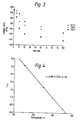
- Fig.3 shows a graphical representation of the effect of the duration of hydrothermal treatment on the surface area of the identical samples of silica gel at three hydrothermal treatment temperatures (150, 200 and 250°C).
- the surface area was measured by the BET method [Brunauer, Emmett & Teller, JACS (1938) 60, 309]. It is noted that (a) the surface area diminishes minimally even after 108 hours (when compared with true hydrothermal treatment in autoclaves at high pressure etc. for which one would expect figures of 30 to 50 m 2 /g after 108 hours), and (b) the decrease in surface area is minimal after 6 to 8 hours, the preferred treatment time for the process of this invention.
- Table III reports thermogravimetric analysis of bonded phase products prepared by a variety of methods, the weight loss over the temperature range indicated by asterisks representing the concentration of silanol groups.
- start silica refers to the raw silica gel without any treatment whatever.
- Kovats method referred to HPLC grade silica was heated to 900°C then rehydrated in boiling water for 120 hours (J.Gobet & E. fz Kovats, Adsorp. Sci. & T echnol (1984) 1, 77-92]
- the weight loss, representing silanol groups was extremely low (0.2%).
- MK2P41 @ 200°C refers to hydrothermal treatment at that temperature. It will be noted that it is this treatment which gives the greatest number of silanol groups (1.6% weight loss)
- MK2P43 @ 300°C refers to hydrothermal treatment at that temperature and gives a weight loss, representative of the silanol concentration, of 1.2%.
- 'start silica @ 200°C the silica gel was heated in an oven at that temperature for 24 hours (the usual manner of activating silica gel).
- Table VI reports the carbon loading and coverage values obtained for a C 3 bonded phase prepared by the process of the invention from high density silica gel of particle size 20 micrometers at various reaction temperatures.
- Fig.4 is a graphical representation of the carbon loading against reaction temperature from the data presented in Table VI.
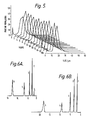
- Fig.5 is a graph of the variation in particle size distribution with duration of hydrothermal treatment at 150°C. It is to be noted that as the duration increases there is a sharpening of the size distribution curve indicating an increasing uniformity of the material. The peak showing the presence of extremely fine (under 5 micrometers) particles progressive reduces with time. Although a proportion of fines reappears after a prolonged period (after 84 hours), this does not represent a problem as it is quite unecessary for the treatment to be continued for so long.
- Figs. 6 and 7 are chromatograms of a test mixture, the components of which are indicated on the chromatograms as follows:
- the mobile phase used was methanol:water (1:1 v/v) and the temperature was 20°C.
- the stationary phase was a commercially available material of 7 micrometers particle size having a C 18 bonded phase.
- Fig.6B the same basic silica and the same C 18 bonded phase were used but the bonding was effected by the fluidised bed process of the invention, including hydrothermal pretreatment.
- the flow rate used for the chromatograms in Figs 6A and 6B was 2 ml/min.
- Fig.7 the silica gel was also of 7 micrometers particle size but the bonded phase was C s , Fig.7A showing the result using a commercially available material, Fig.7B material produced according to this invention without hydrothermal pretreatment and Fig.7C with hydrothermal pre- treatment.
- the flow rate used for the chromatograms in Figs 7A and 7B was 1 mi/min.
- a distinct sharpening of the peaks of the chromatograms is to be observed in Fig.6B compared with 6A and in Fig.7B compared with 7A. Improved separation of the peaks can clearly be seen by comparing Fig.6B with 6A and Fig.7C with both 7A and 7B.
- Bonded stationary phases which have been prepared by the method of this invention are characterised by much improved uniformity of distribution of the bonded phase throughout the accessible surface bonding sites on the silica gel. This uniformitg is believed, but we do not wish to be bound by this explanation, to be responsible for a sedimentation effect which may be used as a rough screening test to identify bonded stationary phases likely to have been produced by the process of this invention rather than by other methods.
- the theoretical basis for this test is not fully understood but it presents a practical method of detecting materials made according to the invention. Since the test must involve parameters such as particle size and density it may be that some combinations of these parameters will interfere and produce spurious indications. In such circumstances it may be possible to modify the test to accomodate parameters in the interfering ranges. However, with this reservation, the test is practical and useful as, at least, an initial screen.
- the starting material for all the bonded phase was Grace HPLC grade silica gel of average particle size 20 micrometre and nominal pore size of 6 nm (60 Angstroms). All the reactions were carried out for about 6 hours with the following conditions,
Landscapes
- Chemical & Material Sciences (AREA)
- Analytical Chemistry (AREA)
- Chemical Kinetics & Catalysis (AREA)
- Organic Chemistry (AREA)
- Inorganic Chemistry (AREA)
- Physics & Mathematics (AREA)
- Nanotechnology (AREA)
- Dispersion Chemistry (AREA)
- Engineering & Computer Science (AREA)
- Thermal Sciences (AREA)
- Solid-Sorbent Or Filter-Aiding Compositions (AREA)
- Silicon Compounds (AREA)
- Treatment Of Liquids With Adsorbents In General (AREA)
- Adhesives Or Adhesive Processes (AREA)
- Other Investigation Or Analysis Of Materials By Electrical Means (AREA)
- Photoreceptors In Electrophotography (AREA)
- Developing Agents For Electrophotography (AREA)
Claims (18)
Priority Applications (1)
| Application Number | Priority Date | Filing Date | Title |
|---|---|---|---|
| AT87904719T ATE68721T1 (de) | 1986-07-28 | 1987-07-22 | Gebundene stationaere phase fuer chromatographie. |
Applications Claiming Priority (2)
| Application Number | Priority Date | Filing Date | Title |
|---|---|---|---|
| GB868618322A GB8618322D0 (en) | 1986-07-28 | 1986-07-28 | Bonded chromotographic stationary phase |
| GB8618322 | 1986-07-28 |
Publications (2)
| Publication Number | Publication Date |
|---|---|
| EP0315633A1 EP0315633A1 (de) | 1989-05-17 |
| EP0315633B1 true EP0315633B1 (de) | 1991-10-23 |
Family
ID=10601782
Family Applications (1)
| Application Number | Title | Priority Date | Filing Date |
|---|---|---|---|
| EP87904719A Expired - Lifetime EP0315633B1 (de) | 1986-07-28 | 1987-07-22 | Gebundene stationäre phase für chromatographie |
Country Status (9)
| Country | Link |
|---|---|
| US (1) | US5154822A (de) |
| EP (1) | EP0315633B1 (de) |
| JP (1) | JPH02500045A (de) |
| AT (1) | ATE68721T1 (de) |
| CA (1) | CA1308613C (de) |
| DE (1) | DE3774128D1 (de) |
| DK (1) | DK170988D0 (de) |
| GB (1) | GB8618322D0 (de) |
| WO (1) | WO1988000860A1 (de) |
Cited By (2)
| Publication number | Priority date | Publication date | Assignee | Title |
|---|---|---|---|---|
| CN103370128A (zh) * | 2011-02-14 | 2013-10-23 | 迪奥内克斯公司 | 纳米大小化学改性材料和用途 |
| US8685240B2 (en) | 2001-03-09 | 2014-04-01 | University Of South Florida | High efficiency sol-gel gas chromatography column |
Families Citing this family (41)
| Publication number | Priority date | Publication date | Assignee | Title |
|---|---|---|---|---|
| JP2603017B2 (ja) * | 1991-12-16 | 1997-04-23 | 松下電器産業株式会社 | 化学吸着膜の製造方法 |
| US5599625A (en) * | 1992-06-17 | 1997-02-04 | Research Corporation Technologies, Inc. | Products having multiple-substituted polysiloxane monolayer |
| WO1993025307A1 (en) * | 1992-06-17 | 1993-12-23 | Research Corporation Technologies, Inc. | Products having multiple-substituted polysiloxane monolayer |
| US5695882A (en) * | 1995-08-17 | 1997-12-09 | The University Of Montana | System for extracting soluble heavy metals from liquid solutions |
| FI107533B (fi) * | 1996-04-03 | 2001-08-31 | Fortum Oil & Gas Oy | Kemiallisten reaktioiden suorittamiseen tarkoitetut funktionaaliset pinnat ja menetelmä niiden valmistamiseksi |
| JP2002523742A (ja) * | 1998-08-21 | 2002-07-30 | ユニバーシティ オブ サウス フロリダ | キャピラリーカラムおよび作製方法 |
| JP2000193648A (ja) * | 1998-12-24 | 2000-07-14 | Nomura Kagaku Kk | 逆相液体クロマトグラフィー固定相の使用方法およびその固定相を備えた逆相液体クロマトグラフ装置 |
| US6686035B2 (en) | 1999-02-05 | 2004-02-03 | Waters Investments Limited | Porous inorganic/organic hybrid particles for chromatographic separations and process for their preparation |
| US6528167B2 (en) * | 2001-01-31 | 2003-03-04 | Waters Investments Limited | Porous hybrid particles with organic groups removed from the surface |
| JP4216716B2 (ja) * | 2001-08-09 | 2009-01-28 | ウォーターズ・インヴェストメンツ・リミテッド | クロマトグラフィー分離用多孔質有機・無機ハイブリッドモノリス状物質、およびその製造方法 |
| JP3920177B2 (ja) * | 2001-08-31 | 2007-05-30 | 株式会社資生堂 | カラム充填剤及びその製造方法 |
| DE10393599T5 (de) * | 2002-10-30 | 2005-10-27 | Waters Investments Ltd., New Castle | Poröse anorganische/organische Homogene copolymerische Hybridmaterialien für chromatographische Auftrennungen und Verfahren für deren Herstellung |
| AU2003300295A1 (en) * | 2002-12-20 | 2004-07-22 | Cardiac Inventions Unlimited, Inc. | Left ventricular pacing lead and implantation method |
| JP2006522328A (ja) * | 2003-03-07 | 2006-09-28 | ユニバーシティ・カレッジ・コークーナショナル・ユニバーシティ・オブ・アイルランド,コーク | クロマトグラフ相の合成のための方法 |
| US7166212B2 (en) * | 2003-09-30 | 2007-01-23 | Chromba, Inc. | Multicapillary column for chromatography and sample preparation |
| US20070017870A1 (en) * | 2003-09-30 | 2007-01-25 | Belov Yuri P | Multicapillary device for sample preparation |
| US20050205102A1 (en) * | 2004-01-30 | 2005-09-22 | Philip Morris Usa Inc. | Method of making surface modified silica gel |
| DE112005000269T5 (de) * | 2004-02-17 | 2007-01-25 | Waters Investments Ltd., New Castle | Poröse Hybridmonolithmaterialien mit von der Oberfläche entfernten organischen Gruppen |
| GB2433937B (en) | 2004-07-30 | 2009-09-02 | Waters Investments Ltd | Porous inorganic/organic hybrid materials with ordered domains for chromatographic separations and processes for their preparation |
| US10773186B2 (en) | 2004-07-30 | 2020-09-15 | Waters Technologies Corporation | Porous inorganic/organic hybrid materials with ordered domains for chromatographic separations and processes for their preparation |
| WO2007114144A1 (ja) * | 2006-03-29 | 2007-10-11 | Daiso Co., Ltd. | 修飾シリカゲル及びその利用 |
| JP2010515804A (ja) | 2007-01-12 | 2010-05-13 | ウオーターズ・テクノロジーズ・コーポレイシヨン | クロマトグラフ分離用多孔質炭素−ヘテロ原子−ケイ素ハイブリッド無機/有機材料およびその調製のための方法 |
| JP5504513B2 (ja) * | 2008-02-19 | 2014-05-28 | 株式会社タニタ | カラム充填剤、これを用いたカラムおよび分離方法 |
| US20090221773A1 (en) * | 2008-02-28 | 2009-09-03 | Brigham Young University | Methods for direct attachment of polymers to diamond surfaces and diamond articles |
| US20090218276A1 (en) * | 2008-02-29 | 2009-09-03 | Brigham Young University | Functionalized diamond particles and methods for preparing the same |
| WO2009121034A2 (en) * | 2008-03-28 | 2009-10-01 | Pelican Group Holdings, Inc. | Multicapillary sample preparation devices and methods for processing analytes |
| EP3095515A1 (de) * | 2008-05-10 | 2016-11-23 | Brigham Young University | Poröse partikelförmige verbundmaterialien, verfahren zu ihrer herstellung und verwendung sowie zugehörige geräte |
| US9192915B2 (en) * | 2008-05-10 | 2015-11-24 | Brigham Young University | Porous composite particulate materials, methods of making and using same, and related apparatuses |
| US8268046B2 (en) | 2008-05-16 | 2012-09-18 | Matheson Tri-Gas | Removal of impurities from hydrogen-containing materials |
| WO2010033903A1 (en) * | 2008-09-22 | 2010-03-25 | Brigham Young University | Functionalized graphitic stationary phase and methods for making and using same |
| US11439977B2 (en) | 2009-06-01 | 2022-09-13 | Waters Technologies Corporation | Hybrid material for chromatographic separations comprising a superficially porous core and a surrounding material |
| WO2010141426A1 (en) | 2009-06-01 | 2010-12-09 | Waters Technologies Corporation | Hybrid material for chromatographic separations |
| WO2011106685A1 (en) * | 2010-02-26 | 2011-09-01 | Brigham Young University | Gas phase approach to in-situ/ex-situ functionalization of porous graphitic carbon via radical-generated molecules |
| US12623205B2 (en) | 2010-07-26 | 2026-05-12 | Waters Technologies Corporation | Superficially porous materials comprising a substantially nonporous hybrid core having narrow particle size distribution |
| JP6199184B2 (ja) | 2010-07-26 | 2017-09-20 | ウオーターズ・テクノロジーズ・コーポレイシヨン | 粒度分布の狭い実質的に非多孔質のコアを含む表面多孔質材料、その製造方法及びクロマトグラフィー分離用としてのその使用 |
| CA2818490A1 (en) | 2010-11-17 | 2012-05-24 | Brigham Young University | Sonication for improved particle size distribution of core-shell particles |
| JP6268167B2 (ja) * | 2012-05-31 | 2018-01-24 | エイジェンシー フォー サイエンス,テクノロジー アンド リサーチ | タンパク質製剤中の凝集物含量を低減するために混合型多官能表面を使用する方法 |
| JP6834132B2 (ja) * | 2016-01-15 | 2021-02-24 | 昭和電工マテリアルズ株式会社 | 分離材及びカラム |
| US20190015815A1 (en) | 2016-03-06 | 2019-01-17 | Waters Technologies Corporation | Superficially porous materials comprising a coated core having narrow particle size distribution; process for the preparation thereof; and use thereof for chromatographic separations |
| MX2022008571A (es) * | 2020-01-10 | 2022-11-30 | Real Isolates Llc | Metodos para la obtencion de compuestos a partir de un material vegetal o de hongos, composiciones respectivas y usos de los mismos. |
| CN113694907A (zh) * | 2020-05-22 | 2021-11-26 | 中国科学院大连化学物理研究所 | 一种耐纯水色谱固定相及其制备方法和应用 |
Family Cites Families (13)
| Publication number | Priority date | Publication date | Assignee | Title |
|---|---|---|---|---|
| DE1163784C2 (de) * | 1962-03-30 | 1973-05-03 | Degussa | Verfahren zur Oberflaechenbehandlung von hochdispersen Oxyden |
| GB1310872A (en) * | 1969-01-13 | 1973-03-21 | Simpson C F | Liquid partition chromatography |
| US3722181A (en) * | 1970-05-22 | 1973-03-27 | Du Pont | Chromatographic packing with chemically bonded organic stationary phases |
| US3716502A (en) * | 1970-11-27 | 1973-02-13 | Inmont Corp | Elastomeric thermoplastic polyester polyurethane compositions stabilized against hydrolysis |
| US3983299A (en) * | 1974-03-04 | 1976-09-28 | Purdue Research Foundation | Bonded carbohydrate stationary phases for chromatography |
| US4029583A (en) * | 1975-02-28 | 1977-06-14 | Purdue Research Foundation | Chromatographic supports and methods and apparatus for preparing the same |
| SU612170A1 (ru) * | 1976-04-26 | 1978-06-25 | Институт Нефтехимического Синтеза Им. А.В.Топчиева Ан Ссср | Способ получени модифицированных адсорбентов и твердых носителей дл хроматографии |
| US4108218A (en) * | 1976-06-25 | 1978-08-22 | Texaco Inc. | Method of preparing a reaction chamber |
| SU1033180A1 (ru) * | 1978-08-07 | 1983-08-07 | Предприятие П/Я В-8644 | Способ получени модифицированного кремнеземсодержащего адсорбента дл жидкостной хроматографии |
| US4324689A (en) * | 1980-02-26 | 1982-04-13 | Shah Ramesh M | High carbon content chromatographic packing and method for making same |
| DE3070463D1 (en) * | 1980-10-20 | 1985-05-15 | Dow Chemical Co | Process for making a chromatographic-column packing having a bonded organosiloxane coating, and process for making a chromatographic separation |
| GB2103196A (en) * | 1981-07-21 | 1983-02-16 | Efraim Mendelovici | Producing highly-stable hydrophobic silicates |
| DE3237079A1 (de) * | 1982-10-07 | 1984-04-12 | Manfred Prof. Dr. 4630 Bochum Baerns | Verfahren zur herstellung von ethan und bzw. oder ethylen aus methan |
-
1986
- 1986-07-28 GB GB868618322A patent/GB8618322D0/en active Pending
-
1987
- 1987-07-22 EP EP87904719A patent/EP0315633B1/de not_active Expired - Lifetime
- 1987-07-22 WO PCT/GB1987/000523 patent/WO1988000860A1/en not_active Ceased
- 1987-07-22 DE DE8787904719T patent/DE3774128D1/de not_active Expired - Fee Related
- 1987-07-22 AT AT87904719T patent/ATE68721T1/de not_active IP Right Cessation
- 1987-07-22 JP JP62504374A patent/JPH02500045A/ja active Pending
- 1987-07-28 CA CA000543128A patent/CA1308613C/en not_active Expired - Lifetime
-
1988
- 1988-03-28 DK DK170988A patent/DK170988D0/da active IP Right Grant
-
1992
- 1992-02-26 US US07/839,291 patent/US5154822A/en not_active Expired - Fee Related
Non-Patent Citations (3)
| Title |
|---|
| Anal. Chem. 1982, 54, 2447-2456. Jonker et al. * |
| J. Chrom. 112 (1978) 377-388. Huber et al. * |
| J: Chrom.132 (1977) 1-16 * |
Cited By (3)
| Publication number | Priority date | Publication date | Assignee | Title |
|---|---|---|---|---|
| US8685240B2 (en) | 2001-03-09 | 2014-04-01 | University Of South Florida | High efficiency sol-gel gas chromatography column |
| CN103370128A (zh) * | 2011-02-14 | 2013-10-23 | 迪奥内克斯公司 | 纳米大小化学改性材料和用途 |
| CN103370128B (zh) * | 2011-02-14 | 2015-12-23 | 迪奥内克斯公司 | 纳米大小化学改性材料和用途 |
Also Published As
| Publication number | Publication date |
|---|---|
| DK170988A (da) | 1988-03-28 |
| US5154822A (en) | 1992-10-13 |
| WO1988000860A1 (en) | 1988-02-11 |
| ATE68721T1 (de) | 1991-11-15 |
| DK170988D0 (da) | 1988-03-28 |
| GB8618322D0 (en) | 1986-09-03 |
| DE3774128D1 (en) | 1991-11-28 |
| CA1308613C (en) | 1992-10-13 |
| EP0315633A1 (de) | 1989-05-17 |
| JPH02500045A (ja) | 1990-01-11 |
Similar Documents
| Publication | Publication Date | Title |
|---|---|---|
| US5154822A (en) | Bonded chromatographic stationary phase | |
| Nawrocki | Silica surface controversies, strong adsorption sites, their blockage and removal. Part II | |
| Kirkland | Microparticles with bonded hydrocarbon phases for high-performance reverse-phase liquid chromatography | |
| EP0269447B1 (de) | Mit Bidentatsilanen modifizierte Strukturoberflächen | |
| US4874518A (en) | Porous silica microspheres having a silanol enriched surface | |
| US4705725A (en) | Substrates with sterically-protected, stable, covalently-bonded organo-silane films | |
| US5108595A (en) | Porous silica microspheres having silanol-enriched and silanized surfaces | |
| Boudreau et al. | Analysis of thermally and chemically modified silica gels by heterogeneous gas-solid chromatography and infrared spectroscopy | |
| Köhler et al. | Comprehensive characterization of some silica-based stationary phase for high-performance liquid chromatography | |
| JP4943396B2 (ja) | クロマトグラフィー分離のための多孔質有機・無機ハイブリッド粒子、及びそれらの製造法 | |
| JP4962490B2 (ja) | 修飾シリカゲル及びその利用 | |
| US5032266A (en) | Porous silica microspheres having silanol-enriched and silanized surfaces | |
| Wikström et al. | Gas phase silylation, a rapid method for preparation of high-performance liquid chromatography supports | |
| US20030219597A1 (en) | Silica-based materials and methods | |
| Sagliano Jr et al. | Studies on the stabilization of reversed phases for liquid chromatography | |
| Pesek et al. | New alumina-based stationary phases for high-performance liquid chromatography: Synthesis by olefin hydrosilation on a silicon hydride-modified alumina intermediate | |
| US5948531A (en) | Propylene-bridged bidentate silanes | |
| US20060000773A1 (en) | Process for the synthesis of a chromatographic phase | |
| Van de Venne et al. | Synthesis of a nonpolar, chemically bonded stationary phase with low residual hydroxyl group content | |
| Buszewski et al. | Study on the structure of chemically bonded C18 phase for HPLC | |
| EP0221780B1 (de) | Poröse Mikrokügelchen aus Siliziumdioxyd mit Silanol angereicherten und silanisierten Oberflächen | |
| WO2013054129A1 (en) | Novel chromatography method using mesoporous silicon imide derivatives as the stationary phase | |
| Ali et al. | A simple and cost-effective hybrid stationary phase for the separation of peptides, proteins and benzene derivatives through liquid chromatography | |
| Khong et al. | Novel method for the preparation of chemically bonded phases and studies of their chromatographic performance | |
| Buszewski | High-density chemically bonded octadecyl phases on silica gels and their application in high-performance liquid chromatography |
Legal Events
| Date | Code | Title | Description |
|---|---|---|---|
| PUAI | Public reference made under article 153(3) epc to a published international application that has entered the european phase |
Free format text: ORIGINAL CODE: 0009012 |
|
| 17P | Request for examination filed |
Effective date: 19890126 |
|
| AK | Designated contracting states |
Kind code of ref document: A1 Designated state(s): AT BE CH DE FR GB IT LI LU NL SE |
|
| RAP1 | Party data changed (applicant data changed or rights of an application transferred) |
Owner name: 3I RESEARCH EXPLOITATION LIMITED |
|
| 17Q | First examination report despatched |
Effective date: 19900122 |
|
| GRAA | (expected) grant |
Free format text: ORIGINAL CODE: 0009210 |
|
| AK | Designated contracting states |
Kind code of ref document: B1 Designated state(s): AT BE CH DE FR GB IT LI LU NL SE |
|
| PG25 | Lapsed in a contracting state [announced via postgrant information from national office to epo] |
Ref country code: IT Free format text: LAPSE BECAUSE OF FAILURE TO SUBMIT A TRANSLATION OF THE DESCRIPTION OR TO PAY THE FEE WITHIN THE PRE;WARNING: LAPSES OF ITALIAN PATENTS WITH EFFECTIVE DATE BEFORE 2007 MAY HAVE OCCURRED AT ANY TIME BEFORE 2007. THE CORRECT EFFECTIVE DATE MAY BE DIFFERENT FROM THE ONE RECORDED.SCRIBED TIME-LIMIT Effective date: 19911023 Ref country code: AT Effective date: 19911023 Ref country code: SE Effective date: 19911023 |
|
| REF | Corresponds to: |
Ref document number: 68721 Country of ref document: AT Date of ref document: 19911115 Kind code of ref document: T |
|
| ET | Fr: translation filed | ||
| REF | Corresponds to: |
Ref document number: 3774128 Country of ref document: DE Date of ref document: 19911128 |
|
| PGFP | Annual fee paid to national office [announced via postgrant information from national office to epo] |
Ref country code: FR Payment date: 19920624 Year of fee payment: 6 |
|
| PGFP | Annual fee paid to national office [announced via postgrant information from national office to epo] |
Ref country code: CH Payment date: 19920626 Year of fee payment: 6 |
|
| PGFP | Annual fee paid to national office [announced via postgrant information from national office to epo] |
Ref country code: BE Payment date: 19920629 Year of fee payment: 6 |
|
| PGFP | Annual fee paid to national office [announced via postgrant information from national office to epo] |
Ref country code: GB Payment date: 19920713 Year of fee payment: 6 |
|
| PGFP | Annual fee paid to national office [announced via postgrant information from national office to epo] |
Ref country code: DE Payment date: 19920730 Year of fee payment: 6 |
|
| PG25 | Lapsed in a contracting state [announced via postgrant information from national office to epo] |
Ref country code: LU Free format text: LAPSE BECAUSE OF NON-PAYMENT OF DUE FEES Effective date: 19920731 |
|
| PGFP | Annual fee paid to national office [announced via postgrant information from national office to epo] |
Ref country code: NL Payment date: 19920731 Year of fee payment: 6 |
|
| PLBE | No opposition filed within time limit |
Free format text: ORIGINAL CODE: 0009261 |
|
| STAA | Information on the status of an ep patent application or granted ep patent |
Free format text: STATUS: NO OPPOSITION FILED WITHIN TIME LIMIT |
|
| 26N | No opposition filed | ||
| PG25 | Lapsed in a contracting state [announced via postgrant information from national office to epo] |
Ref country code: GB Effective date: 19930722 |
|
| PG25 | Lapsed in a contracting state [announced via postgrant information from national office to epo] |
Ref country code: LI Effective date: 19930731 Ref country code: CH Effective date: 19930731 Ref country code: BE Effective date: 19930731 |
|
| BERE | Be: lapsed |
Owner name: 3I RESEARCH EXPLOITATION LTD Effective date: 19930731 |
|
| PG25 | Lapsed in a contracting state [announced via postgrant information from national office to epo] |
Ref country code: NL Effective date: 19940201 |
|
| NLV4 | Nl: lapsed or anulled due to non-payment of the annual fee | ||
| GBPC | Gb: european patent ceased through non-payment of renewal fee |
Effective date: 19930722 |
|
| PG25 | Lapsed in a contracting state [announced via postgrant information from national office to epo] |
Ref country code: FR Effective date: 19940331 |
|
| REG | Reference to a national code |
Ref country code: CH Ref legal event code: PL |
|
| PG25 | Lapsed in a contracting state [announced via postgrant information from national office to epo] |
Ref country code: DE Effective date: 19940401 |
|
| REG | Reference to a national code |
Ref country code: FR Ref legal event code: ST |