EP0315829A2 - Material für Bohrunterlagen zum Bohren von kleinen Löchern in Leiterplatten - Google Patents
Material für Bohrunterlagen zum Bohren von kleinen Löchern in Leiterplatten Download PDFInfo
- Publication number
- EP0315829A2 EP0315829A2 EP88117816A EP88117816A EP0315829A2 EP 0315829 A2 EP0315829 A2 EP 0315829A2 EP 88117816 A EP88117816 A EP 88117816A EP 88117816 A EP88117816 A EP 88117816A EP 0315829 A2 EP0315829 A2 EP 0315829A2
- Authority
- EP
- European Patent Office
- Prior art keywords
- sheet
- epoxy resin
- hardener
- laminate
- phenol
- Prior art date
- Legal status (The legal status is an assumption and is not a legal conclusion. Google has not performed a legal analysis and makes no representation as to the accuracy of the status listed.)
- Ceased
Links
Images


Classifications
-
- H—ELECTRICITY
- H05—ELECTRIC TECHNIQUES NOT OTHERWISE PROVIDED FOR
- H05K—PRINTED CIRCUITS; CASINGS OR CONSTRUCTIONAL DETAILS OF ELECTRIC APPARATUS; MANUFACTURE OF ASSEMBLAGES OF ELECTRICAL COMPONENTS
- H05K3/00—Apparatus or processes for manufacturing printed circuits
- H05K3/0011—Working of insulating substrates or insulating layers
- H05K3/0044—Mechanical working of the substrate, e.g. drilling or punching
- H05K3/0047—Drilling of holes
-
- B—PERFORMING OPERATIONS; TRANSPORTING
- B23—MACHINE TOOLS; METAL-WORKING NOT OTHERWISE PROVIDED FOR
- B23B—TURNING; BORING
- B23B35/00—Methods for boring or drilling, or for working essentially requiring the use of boring or drilling machines; Use of auxiliary equipment in connection with such methods
- B23B35/005—Measures for preventing splittering
-
- H—ELECTRICITY
- H05—ELECTRIC TECHNIQUES NOT OTHERWISE PROVIDED FOR
- H05K—PRINTED CIRCUITS; CASINGS OR CONSTRUCTIONAL DETAILS OF ELECTRIC APPARATUS; MANUFACTURE OF ASSEMBLAGES OF ELECTRICAL COMPONENTS
- H05K2203/00—Indexing scheme relating to apparatus or processes for manufacturing printed circuits covered by H05K3/00
- H05K2203/02—Details related to mechanical or acoustic processing, e.g. drilling, punching, cutting, using ultrasound
- H05K2203/0214—Back-up or entry material, e.g. for mechanical drilling
Definitions
- the present invention relates to drill entry or back-up materials for drilling small holes in substrates and more particularly to improved drill back-up materials for use in small bore drilling of circuit boards.
- PWB Printing wiring board
- SMT Surface mount technology
- MLPWBs typically are constructed from a series of individual PWBs having insulative layers separating each PWB.
- Standard multi-layer boards can range from about 2 to 20 layers, each laminant ranging in dielectric thickness from about 1 to 250 mils.
- PTHs and vias for example
- MLPWBs have resorted to a variety of exotic materials in order to meet the increasing demands made upon them.
- the pad on each layer of the MLPWB has to have the hole precisely centered therethrough, especially as chip density increases. It will be appreciated that some manufacturers require an accuracy of about 0.0002 inch. Wandering of the drill can result in an off-centered hole through the pad, thus compromising the efficacy of the board, or can result in breakage of the drill.
- the present invention is addressed to a back-up sheet for backing a workpiece during a small bore drilling process.
- the improvement comprises said back-up sheet comprising the cured residue of: (a) polyphenylene oxide, (b) bisphenol-A type epoxy resin, and (c) an amine hardener for said epoxy resin.
- the weight ratio of a:b+c ranges from about 1:10 to about 1:2.
- the back-up sheet contains no reinforcing or other filler materials.
- the improved process comprises placing a back-up sheet on both sides of the workpiece to be drilled and drilling the workpiece through the back-up sheets.
- the back-up sheet comprises the cured residue described above.
- Advantages of the present invention include a back-up sheet which provides good dimensional stability during the small bore drilling process. Another advantage is that the improved back-up sheet in uncured form possesses excellent shelf life. A further advantage is that the uncured composition can be readily prepared and cast as a film utilizing conventional techniques. Another advantage is a composition possessing a low dielectric constant, thus making it a candidate for reinforcement and use in MLPWB construction.
- Fig. 1 a conventional eight-layer MLPWB is set forth in cross-sectional elevational view. It will be observed that upper conductive layer 12 is followed by conductive layers 14-24, and finally lower conductive layer 26.
- the reinforced dielectric material bearing the noted conductive layers merely is represented as 28, though it will be appreciated that a homogeneous composition throughout is not a limitation on the laminate set forth at Fig. 1.
- hole 30 is drilled through the laminate construction. Thereafter, copper or other conductive layer 32 is plated through the walls of the hole 30 in conventional fashion. Aspect ratios of PTH or via 30 often range from about 1:1 to 1:10 (diameter to height) in accordance with modern MLPWB technology.
- the pad of copper or other conductive layer has been aligned quite precisely in order that hole 30, often only 4 mils in diameter, is drilled true with respect to each conductive layer. Close tolerances, often to 0.0002 inch accuracy, are required in modern MLPWB technology. If hole 30 is not drilled true, MLPWB 10 itself may need to be discarded, often resulting in the waste of many hours of construction time and effort. Moreover, due to the exotic nature of materials currently used and contemplated in MLPWB construction, drill breakage is another problem to be avoided, both in terms of the cost in drill replacement as well as the loss of productivity occasioned thereby.
- laminate 34 has drill entry sheet 36 and drill back-up sheet 38 placed on either side thereof.
- sheet 36 acts as a bushing to ensure alignment of the drill bit as it enters hole 42 in laminate 34.
- the location and angle of the bit as it contacts laminate 34 for production of hole 42 needs to be precise and true.
- Sheet 38 acts as a run-out sheet into which the drill bit enters as the whole diameter of the bit is needed in forming hole 42, typically. It will be appreciated that the thickness of the back-up sheet is not particularly critical, with cost being an important factor. Nevertheless, the drill bit should not be swayed off course by back-up sheet 38 lest drill breakage and compromise of the integrity of hole 42 result thereby.
- a minimum thickness in entry sheet 36 typically is required in order for the bushing affect to be prominent.
- the thickness will be at least about 1 mil and can range on up to 15 mils or higher, with greater thicknesses often resulting in waste of material without corresponding benefit occasioned thereby.
- the thickness will be from about 3 to 10 mils and preferably about 8 mils.
- the back-up sheet composition is formulated from polyphenylene oxide ranging in molecular weight from about 5,000 to 30,000 and an intrinsic viscosity (in toluene) of about 0.2 to 0.8 and preferably about 0.4 to 0.5.
- the thermoplastic PPO is soluble in a variety of organic solvents, including toluene, tetrahydrofuran (THF), and C2-C3 chlorinated organic solvents (e.g. carbon tetrachloride, chloroform, methylene chloride, etc.).
- the thermoset portion of the composition comprises a mixture of a bisphenol-A type epoxy resin and a hardener therefor.
- the epoxy/hardener composition is soluble in a variety of solvents including acetone, methyl cellosolve, dimethyl formamide (DMF), toluene, and most ketones. Often, a single solvent will not solvate both the PPO and the epoxy/amine hardener.
- Particular bisphenol-A type epoxy resins including brominated derivatives, are well known in the art and can be selected from a variety of commercial resins including various Epon resins (Shell Chemical Company) and DER resins (Dow Chemical Company), as those skilled in the art will appreciate. Bromine contents can range up to about 45 percent, for example, for such resins.
- “Amine hardeners” include simple polyamines, such as diethylene triamine, triethylene tetraamine, or the like, or can be an amidoamine from the reaction product of a dimer acid or a fatty acid with a polyamine.
- a bismaleimide-triazine hardener is used.
- the proportion of hardener is adjusted and maintained in accordance with the epoxy functionality of the epoxy resin.
- the weight ratio of the PPO to epoxy/hardener combination ranges from about 1:10 to about 1:2, and still efficacious drill sheets being formed thereby.
- the solution of PPO is blended with the solution of epoxy/amine hardener under agitation. Since the solvent for each portion of the composition is not a solvent for the other portion, but rather acts more as a thet solvent, a thixotropic, lumpy, uncured product, resembling mud, results. Heating and agitation assist in maintaining the fluidity of the composition. Some epoxy resins evidence short shelf lives, and others do not, this characteristic being within the expertise of those skilled in this art.
- the mixture of dispersion preferably is stirred to fluidity and then permitted to thicken. It has been determined that processing and handling characteristics are optimized by conducting the coating operation just prior to the mixture gelling.
- the mixture can be cast as a film by a variety of conventional techniques, either as a free film or with a backing, such as metal, which later can be removed. In either event, the cast film then is dried for solvent expulsion under moderate heating. Thereafter, the final sheet can be formed by heating the composition to a temperature ranging from about 80° to 230°C in a press with pressures of between about 25 and 2,500 psi being applied. Full cure of the thermoset comopnents of the sheet is not always necessary in order for advantageous properties to be realized. The cooled sheet then is removed and cut to size for use in small bore drilling operations.
- the first point is that small bore testing revealed that the composition preferably should be "under cured".
- it is conventional to bake the sheet after it has been pressed. Such post press baking is preferably omitted in the sheet preparation for use as a drill entry/back-up material.
- a second way envisioned for "under curing" the composition involves starving the epoxy/hardener portion of the composition in hardener content. By having less than a stoichiometric proportion of hardener, the epoxy thermoset portion of the composition would not be fully cured.
- full cure should be practiced.
- the second point involving the preparation of the PPO/epoxy/hardener film as a drill entry/back-up sheet involves a preferred technique discovered in the preparation of the sheet.
- the liquid PPO/epoxy/hardener blend is cast on the matte side of electrodeposited copper foil.
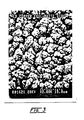
- Fig. 3 is a scanning electron microscope photomicrograph at 2,000 magnification taken of the matte side of electrodeposited copper foil. It will be observed that the matte side of the copper foil exhibits a distinct topography reminiscent of mountains or peaks having rounded apexes.
- the blend is cast on this matte side of the electrodeposited copper foil, pressed, and partially cured, thereafter, the copper is etched away to leave a sheet having a corresponding surface topography as depicted at Fig. 4 which is a scanning electron microscope photograph at 2,000 magnification taken of the etched surface of the drill back-up sheet.
- the surface exhibits a relief corresponding to the negative of the topography of the surface of the matte side of the copper foil. It is believed that the multiplicity of valleys or recesses each are capable of receiving the drill bit and acting as a bushing during the drilling operation to focus the drill at the desired site for creation of the bore with less drill wander being evidenced.
- the composition is an ideal candidate for reinforcement in the production of reinforced laminates for circuit board and other electrical/electronic utilization.
- Representative reinforcing fibers and fabric include, for example, poly-p-phenylene terephthalamide (e.g. Kevlar brand, E.I. duPont de Nemours and Co.), E glass, S glass, quartz fiber, metal fiber, ceramic fiber, and the like. Reinforcing fiber can be used in fiber form, or as a mat, cloth or other conventional form.
- the general procedure in making the inventive back-up sheets involved the agitation of PPO in toluene solvent under heating to 70°-80°C until the PPO had dissolved.
- a solution of bismaleimide-triazine resin dissolved in acetone solvent was added to the brominated epoxy resin solution (acetone solvent) and cure adjusted to 200-220 sec. at 171°C with 10% solution of zinc octoate catalyst.
- the epoxy/amine hardener solution was added thereto. Haze formation was evident, indicating the incompatibility of the two resinous systems. This mixture was reheated to 65°-75°C and cooled. Just before use, the mixture was agitated vigorously.
- Base mix cure relied on about 0.25 g of zinc octoate catalyst as described above.
- Each formulation was applied onto the matte side of electrodeposited copper foil using a knife-over-roll spreader and passed into a horizontal oven for solvent removal and flow control (e.g. 5 minutes at 100°C, 5 minutes at 130°C, and 2 minutes at 150°C). Cure was achieved at 300 psi for 40 minutes at 168°-172°C in a laboratory press. Upon cooling, the copper was etched to produce the drill entry/back-up sheet.
- each of the formulation sheets make excellent drill back-up sheets. Moreover, because of the good electrical properties of the sheets, circuit board laminates or other similar uses can be envisioned.
- preferred formulation C was subjected to dielectric constant and dissipation factor measurements (Hewlet-Packard HP 4149A impedence analyzer) with the following results being recorded. TABLE 2 Frequency (MHz) Dielectric Constant Dissipation Factor 10 2.7 0.01 100 2.8 0.007 200 2.8 0.0084 500 2.8 0.010 750 2.9 0.0125 1000 2.9 0.0137
- formulation C was reinforced with glass mat, glass cloth, Kevlar brand mat, and Kevlar brand cloth.
- the resulting reinforced sheets were subjected to a variety of tests in order to evaluate the dielectric properties of the resulting reinforced sheets. The results recorded are set forth below.
Landscapes
- Engineering & Computer Science (AREA)
- Mechanical Engineering (AREA)
- Manufacturing & Machinery (AREA)
- Microelectronics & Electronic Packaging (AREA)
- Laminated Bodies (AREA)
- Drilling And Boring (AREA)
- Perforating, Stamping-Out Or Severing By Means Other Than Cutting (AREA)
- Compositions Of Macromolecular Compounds (AREA)
- Epoxy Resins (AREA)
- Production Of Multi-Layered Print Wiring Board (AREA)
Applications Claiming Priority (2)
| Application Number | Priority Date | Filing Date | Title |
|---|---|---|---|
| US11899087A | 1987-11-10 | 1987-11-10 | |
| US118990 | 1987-11-10 |
Publications (2)
| Publication Number | Publication Date |
|---|---|
| EP0315829A2 true EP0315829A2 (de) | 1989-05-17 |
| EP0315829A3 EP0315829A3 (de) | 1991-04-03 |
Family
ID=22381985
Family Applications (1)
| Application Number | Title | Priority Date | Filing Date |
|---|---|---|---|
| EP19880117816 Ceased EP0315829A3 (de) | 1987-11-10 | 1988-10-26 | Material für Bohrunterlagen zum Bohren von kleinen Löchern in Leiterplatten |
Country Status (2)
| Country | Link |
|---|---|
| EP (1) | EP0315829A3 (de) |
| JP (1) | JPH01258487A (de) |
Cited By (2)
| Publication number | Priority date | Publication date | Assignee | Title |
|---|---|---|---|---|
| US5352745A (en) * | 1991-01-11 | 1994-10-04 | Asahi Kasei Kogyo Kabushiki Kaisha | Curable polyphenylene ether and cyanurate resin composition and a cured resin composition obtainable therefrom |
| US8802237B2 (en) | 2007-09-28 | 2014-08-12 | Tri-Star Laminates, Inc. | Entry sheet for drilling holes in printed circuit boards |
Families Citing this family (1)
| Publication number | Priority date | Publication date | Assignee | Title |
|---|---|---|---|---|
| CN108601226A (zh) * | 2018-04-25 | 2018-09-28 | 星河电路(福建)有限公司 | 一种超高厚径比微孔的琢钻加工方法 |
Family Cites Families (1)
| Publication number | Priority date | Publication date | Assignee | Title |
|---|---|---|---|---|
| FR2527956A1 (fr) * | 1982-06-08 | 1983-12-09 | Limours Const Meca Elect Elect | Contreplaque de percage stratifiee et procede de fabrication et d'utilisation de celle-ci |
-
1988
- 1988-10-26 EP EP19880117816 patent/EP0315829A3/de not_active Ceased
- 1988-11-09 JP JP28152788A patent/JPH01258487A/ja active Pending
Cited By (2)
| Publication number | Priority date | Publication date | Assignee | Title |
|---|---|---|---|---|
| US5352745A (en) * | 1991-01-11 | 1994-10-04 | Asahi Kasei Kogyo Kabushiki Kaisha | Curable polyphenylene ether and cyanurate resin composition and a cured resin composition obtainable therefrom |
| US8802237B2 (en) | 2007-09-28 | 2014-08-12 | Tri-Star Laminates, Inc. | Entry sheet for drilling holes in printed circuit boards |
Also Published As
| Publication number | Publication date |
|---|---|
| EP0315829A3 (de) | 1991-04-03 |
| JPH01258487A (ja) | 1989-10-16 |
Similar Documents
| Publication | Publication Date | Title |
|---|---|---|
| EP1233663B1 (de) | Zusammensetzungen zum Füllen von Durchkontaktierungslöchern zur direkten Befestigung von Vorrichtungen und Verfahren zu ihrer Anwendung | |
| EP0651602A1 (de) | Leitfähige Pastenzusammensetzung zum Füllen von Kontaktlöchern, Leiterplatte unter Anwendung dieser leifähigen Paste und Verfahren zur Herstellung | |
| EP0955795A2 (de) | Leitfähige Paste zum Füllen von Kontaktlöchern, doppelseitige und mehrschichtige Leiterplatten unter deren Verwendung, und Verfahren zu ihrer Herstellung | |
| EP0645950A1 (de) | Verbindungsteil eines Schaltungssubstrats und Verfahren zur Herstellung mehrschichtiger Schaltungssubstrate unter Verwendung dieses Teils | |
| EP1035760B1 (de) | Interlaminarer isolierender Klebstoff für mehrschichtige gedruckte Leiterplatte | |
| US7438969B2 (en) | Filling material, multilayer wiring board, and process of producing multilayer wiring board | |
| US4954200A (en) | Method of making drill back-up material for small bore drilling of circuit boards | |
| KR100870652B1 (ko) | 반도체 패키지 및 그 제조방법 | |
| US4559395A (en) | Flame retardent epoxy resin composition | |
| EP0315829A2 (de) | Material für Bohrunterlagen zum Bohren von kleinen Löchern in Leiterplatten | |
| EP1353541A1 (de) | Leiterplatte und verfahren zu ihrer herstellung | |
| JP2692508B2 (ja) | 積層板の製造法 | |
| US7910202B2 (en) | Reducing dusting of epoxy laminates | |
| KR101420542B1 (ko) | 절연필름용 에폭시수지 조성물, 인쇄회로기판용 절연필름 및 이의 제조방법, 및 이를 구비한 인쇄회로기판 | |
| JP2003037362A (ja) | 多層プリント配線板の製造方法 | |
| KR100994629B1 (ko) | 수지층피복 구리박을 사용한 다층 프린트배선판의 제조방법 | |
| EP0395250A2 (de) | Epoxyharzzusammensetzung und mehrschichtige gedruckte Leiterplatte mit einer daraus hergestellten Isolationsschicht. | |
| JPH09254308A (ja) | 樹脂付き金属箔 | |
| KR100833528B1 (ko) | 경-연성 회로기판용 에폭시 수지 조성물 및 이의 용도 | |
| JP2005002226A (ja) | 難燃性エポキシ樹脂組成物及びそれを用いた積層板関連製品 | |
| JPH05105778A (ja) | 積層板の製造法 | |
| JPS61138621A (ja) | エポキシ樹脂積層板の製造方法 | |
| JP2000336242A (ja) | エポキシ樹脂組成物、プリプレグ、樹脂付き金属箔、積層板 | |
| JP3514146B2 (ja) | プリプレグ及び積層板 | |
| JP2633287B2 (ja) | 電気積層板の製造方法 |
Legal Events
| Date | Code | Title | Description |
|---|---|---|---|
| PUAI | Public reference made under article 153(3) epc to a published international application that has entered the european phase |
Free format text: ORIGINAL CODE: 0009012 |
|
| AK | Designated contracting states |
Kind code of ref document: A2 Designated state(s): DE FR GB IT SE |
|
| PUAL | Search report despatched |
Free format text: ORIGINAL CODE: 0009013 |
|
| AK | Designated contracting states |
Kind code of ref document: A3 Designated state(s): DE FR GB IT SE |
|
| 17P | Request for examination filed |
Effective date: 19910925 |
|
| 17Q | First examination report despatched |
Effective date: 19930514 |
|
| STAA | Information on the status of an ep patent application or granted ep patent |
Free format text: STATUS: THE APPLICATION HAS BEEN REFUSED |
|
| 18R | Application refused |
Effective date: 19940616 |