EP0316024A2 - Fungizide Mittel - Google Patents
Fungizide Mittel Download PDFInfo
- Publication number
- EP0316024A2 EP0316024A2 EP88121652A EP88121652A EP0316024A2 EP 0316024 A2 EP0316024 A2 EP 0316024A2 EP 88121652 A EP88121652 A EP 88121652A EP 88121652 A EP88121652 A EP 88121652A EP 0316024 A2 EP0316024 A2 EP 0316024A2
- Authority
- EP
- European Patent Office
- Prior art keywords
- formula
- derivative
- active ingredient
- active
- fungicidal
- Prior art date
- Legal status (The legal status is an assumption and is not a legal conclusion. Google has not performed a legal analysis and makes no representation as to the accuracy of the status listed.)
- Granted
Links
- 0 CON=Cc1ccc(*)cc1 Chemical compound CON=Cc1ccc(*)cc1 0.000 description 1
Classifications
-
- A—HUMAN NECESSITIES
- A01—AGRICULTURE; FORESTRY; ANIMAL HUSBANDRY; HUNTING; TRAPPING; FISHING
- A01N—PRESERVATION OF BODIES OF HUMANS OR ANIMALS OR PLANTS OR PARTS THEREOF; BIOCIDES, e.g. AS DISINFECTANTS, AS PESTICIDES OR AS HERBICIDES; PEST REPELLANTS OR ATTRACTANTS; PLANT GROWTH REGULATORS
- A01N43/00—Biocides, pest repellants or attractants, or plant growth regulators containing heterocyclic compounds
- A01N43/64—Biocides, pest repellants or attractants, or plant growth regulators containing heterocyclic compounds having rings with three nitrogen atoms as the only ring hetero atoms
- A01N43/647—Triazoles; Hydrogenated triazoles
- A01N43/653—1,2,4-Triazoles; Hydrogenated 1,2,4-triazoles
Definitions
- the present invention relates to new fungicidal active ingredient combinations of a known, substituted 1-hydroxyethyl-triazolyl derivative and other known fungicidal active ingredients.
- the fungicidal action of the active compound combination according to the invention is considerably higher than the action of the individual components and, if appropriate, also as the sum of the individual components (synergistic effect).
- the discovery of these combinations of the special compound of the formula (I) and the active compounds of the groups (A), (B), (C), (D), (E), (F) and (G) given above thus constitutes one valuable enrichment of technology.
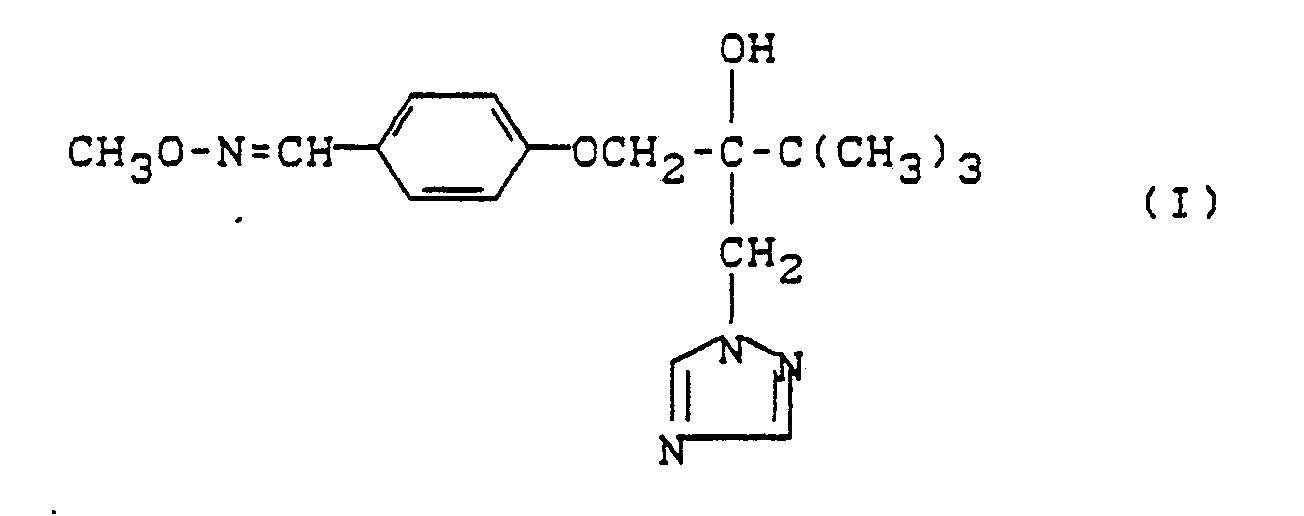
- the substituted 1-hydroxyethyltriazolyl derivative to be used specifically for the combination according to the invention is clearly defined by the above formula (I).
- the connection is known from DE-A 32 37 400.
- the weight ratios of the active ingredient groups in the active ingredient combinations can fluctuate in relatively large ranges.
- the active compound combinations according to the invention have a strong microbicidal action and can be used practically to combat unwanted microorganisms; they are suitable for use as pesticides.
- Fungicidal agents in crop protection are used to combat plasmadiophoromycetes, Oomycetes, Chytridiomycetes, Zygomycetes, Ascomycetes, Basidiomycetes, Deuteromycetes.
- the good plant tolerance of the active ingredient combinations in the concentrations required to combat plant diseases allows treatment of above-ground parts of plants, of propagation stock and seeds, and of the soil.
- the active compound combinations according to the invention have a very broad spectrum of activity and can be used against parasitic fungi which attack above-ground parts of plants or attack the plants from the ground, and seed-borne pathogens.
- Such active ingredient combinations are of particular practical importance as seed dressings against phytopathogenic fungi which are transmitted with the seed or occur in the soil and attack the crop plants from there.
- These are seedling diseases, root rot, stem, stem, leaf, flower, fruit and seed diseases, which are caused in particular by Tilletia, Urocycstis, Ustilago, Septoria, Typhula, Rynchosporium, Helminthosporium and Fusarium Species are evoked.
- the plants are often protected from pathogens that can attack various parts of the sprout, for example real powdery mildew and rust fungi, even long after pickling.
- the active ingredient combinations can also be used as soil treatment agents against phytopathogenic fungi and act against root rot and tracheomycosis, which are caused, for example, by pathogens of the genera Pythium, Verticillium, Phialophora, Rhizoctonia, Fusarium and Thielaviopsis.
- the active compound combinations according to the invention also show outstanding action when applied directly to the aerial parts of plants against pathogens on various crop plants, such as powdery mildew fungi (Erysiphe, Uncinula, Sphaerotheca, Podosphaera species, Leveillula taurica), rust fungi, Venturia species, Cercospora Species, Alternaria species, Botrytis species, Phytophthora species, Peronospora species, Fusarium species, Pyrenophora species, Cochliobolus species, Septoria species, Pseudocercosporella herpotrichoides, Pyricularia oryzae, Pellicularia sasakii.
- powdery mildew fungi Errysiphe, Uncinula, Sphaerotheca, Podosphaera species, Leveillula taurica
- rust fungi Venturia species
- Cercospora Species Alternaria
- the active ingredients can be converted into the customary formulations, such as solutions, emulsions, suspensions, powders, foams, pastes, granules, aerosols, active ingredient-impregnated natural and synthetic substances, very fine encapsulations in polymeric substances and in coating compositions for seeds, and also in formulations with Fuel sets, such as smoking cartridges, cans, spirals, etc. as well as ULV cold and warm fog formulations.
- customary formulations such as solutions, emulsions, suspensions, powders, foams, pastes, granules, aerosols, active ingredient-impregnated natural and synthetic substances, very fine encapsulations in polymeric substances and in coating compositions for seeds, and also in formulations with Fuel sets, such as smoking cartridges, cans, spirals, etc. as well as ULV cold and warm fog formulations.
- formulations are prepared in a known manner, for example by mixing the active ingredients with extenders, that is to say liquid solvents, pressurized liquefied gases and / or solid carriers, optionally using surface-active agents, that is to say emulsifiers and / or dispersants and / or foam-generating agents. If water is used as an extender, organic solvents can, for example, also be used as auxiliary solvents.
- extenders that is to say liquid solvents, pressurized liquefied gases and / or solid carriers, optionally using surface-active agents, that is to say emulsifiers and / or dispersants and / or foam-generating agents.
- surface-active agents that is to say emulsifiers and / or dispersants and / or foam-generating agents.
- organic solvents can, for example, also be used as auxiliary solvents.
- liquid solvents aromatics such as xylene, toluene or alkylnaphthalenes, chlorinated aromatics or chlorinated aliphatic hydrocarbons such as chlorobenzenes, chlorethylenes or methylene chloride, aliphatic hydrocarbons such as cyclohexane or paraffins, for example petroleum fractions, alcohols such as butanol or glycol and their ethers and esters , Ketones such as acetone, methyl ethyl ketone, methyl isobutyl ketone or cyclohexanone, strongly polar solvents such as dimethylformamide and dimethyl sulfoxide and water;
- Liquefied gaseous extenders or carriers mean liquids which are gaseous at normal temperature and under normal pressure, for example aerosol propellants such as halogenated hydrocarbons and butane, propane, nitrogen and carbon dioxide;
- Solid carrier materials are suitable: for example natural rock meals such as kaolins, clays
- Adhesives such as carboxymethyl cellulose, natural and synthetic polymers in the form of powders, granules or latices, such as gum arabic, polyvinyl alcohol, polyvinyl acetate and natural phospholipids such as cephalins and lecithins and synthetic phospholipids, can be used in the formulations.
- Other additives can be mineral and vegetable oils.
- Dyes such as inorganic pigments, e.g. Iron oxide, titanium oxide, ferrocyan blue and organic dyes such as alizarin, azo and metal phthalocyanine dyes and trace nutrients such as salts of iron, manganese, boron, copper, cobalt, molybdenum and zinc can be used.
- the formulations generally contain between 0.1 and 95 percent by weight of active compound, preferably between 0.5 and 90%.
- the active compounds according to the invention can be present in the formulations or in the various use forms in a mixture with other known active compounds, such as fungicides, bactericides, insecticides, acaricides, nematicides, herbicides, bird repellants, growth agents, plant nutrients and agents which improve soil structure.
- active compounds such as fungicides, bactericides, insecticides, acaricides, nematicides, herbicides, bird repellants, growth agents, plant nutrients and agents which improve soil structure.
- the active compounds can be used as such, in the form of their formulations or in the use forms prepared therefrom by further dilution, such as ready-to-use solutions, emulsions, suspensions, powders, pastes and granules.
- the active compound concentrations in the use forms can be varied within a substantial range. They are generally between 1 and 0.0001% by weight, preferably between 0.5 and 0.001%.
- active ingredient 0.001 to 50 g per kilogram of seed, preferably 0.01 to 10 g, are generally required.
- active ingredient concentrations of 0.00001 to 0.1% by weight, preferably 0.0001 to 0.02% by weight, are required at the site of action.
- active compound 1 part by weight of active compound is mixed with the stated amounts of solvent and emulsifier and the concentrate is diluted with water to the desired concentration.
- the plants are placed in a greenhouse at a temperature of approx. 20 ° C and a relative air humidity of approx. 80% in order to promote the development of mildew pustules.
- Evaluation is carried out 7 days after the inoculation.
- active compound 1 part by weight of active compound is mixed with the stated amounts of solvent and emulsifier and the concentrate is diluted with water to the desired concentration.
- the plants are placed in a greenhouse at a temperature of approx. 15 ° C and a relative humidity of approx. 80%.
- Evaluation is carried out 10 days after the inoculation.
Landscapes
- Life Sciences & Earth Sciences (AREA)
- Agronomy & Crop Science (AREA)
- Pest Control & Pesticides (AREA)
- Plant Pathology (AREA)
- Health & Medical Sciences (AREA)
- Engineering & Computer Science (AREA)
- Dentistry (AREA)
- General Health & Medical Sciences (AREA)
- Wood Science & Technology (AREA)
- Zoology (AREA)
- Environmental Sciences (AREA)
- Agricultural Chemicals And Associated Chemicals (AREA)
Abstract
- dem bekannten substituierten 1-Hydroxyethyl-triazolyl-Derivat der Formel
und
- einem bekannten fungiziden Wirkstoff, aus den in der Beschreibung angegebenen Wirkstoffklassen (A) bis (G) als Zweitkomponente.
Description
- Die vorliegende Erfindung betrifft neue fungizide Wirkstoffkombinationen aus einem bekannten, substituierten 1-Hydroxyethyl-triazolyl-Derivat und anderen bekannten fungiziden Wirkstoffen.
- Es ist bereits allgemein bekannt, daß Mischungen enthaltend 1,2,4-Triazol-Derivate, wie z.B. das 1- (4-Chlorphenoxy)-3,3-dimethyl-1-(1,2,4-triazol-1-yl)-2-butanon, in Kombination mit anderen bekannten Fungiziden eine beachtlich hohere Wirkung als die Einzelkomponenten aufweisen (vgl. z.B. die Deutsche Offenlegungsschrift 25 52 967. Die Wirksamkeit dieser Wirkstoffmischungen ist jedoch nicht auf allen Anwendungsgebieten voll befriedigend.
- Es wurde gefunden, daß neue Wirkstoffkombinationen aus
- dem substituierten 1-Hydroxyethyl-triazolyl-Derivat der Formel
- A) einem aromatischen Carbonsäure-Derivat der Formel
-

- B) Dithiocarbamaten der Formeln
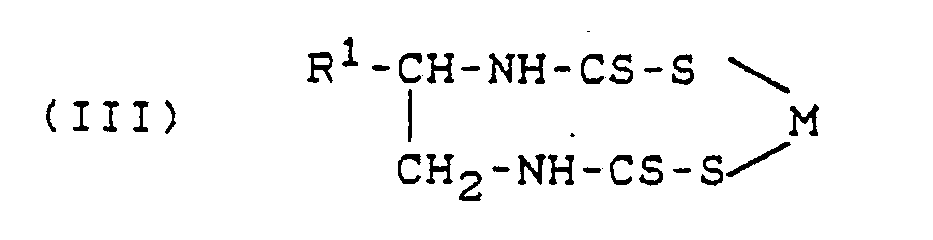
(IIIb) R¹ = H, M = Mn (MANEB)
(IIIc) Mischung aus (IIIa) und (IIIb) (MANCOZEB)
(IIId) R¹ = CH₃, M = Zn (PROPINEB)
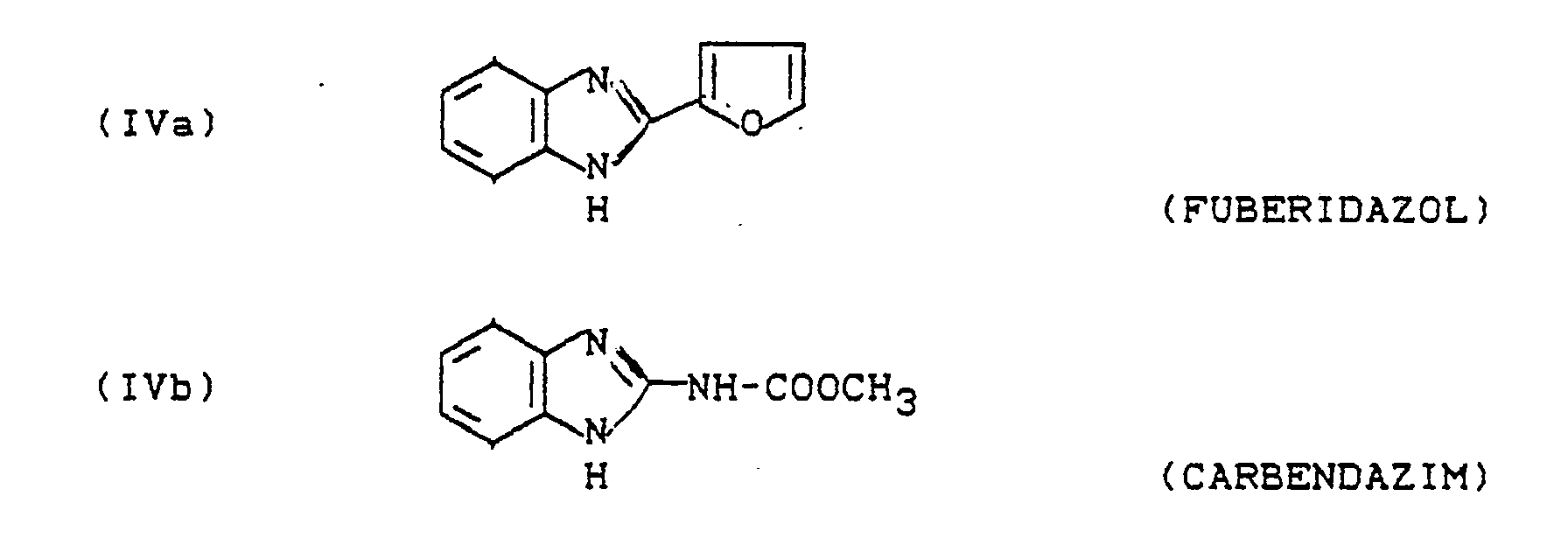
und/oder - C) Benzimidazol-Derivaten der Formeln
- D) einem Harnstoff-Derivat der Formel

- E) einem Triazin-Derivat der Formel

- F) einem Chinoxalin-Derivat der Formel

- G) einem Dicarboximid-Derivat der Formel

- Überraschenderweise ist die fungizide Wirkung der erfindungsgemäßen Wirkstoffkombination wesentlich höher als die Wirkung der Einzelkomponenten und gegebenenfalls auch als die Summe der Einzelkomponenten (synergistischer Effekt). Die Auffindung dieser Kombinationen aus der speziellen Verbindung der Formel (I) und den Wirkstoffen der oben angegebenen Gruppen (A), (B), (C), (D), (E), (F)und (G)stellt somit eine wertvolle Bereicherung der Technik dar.
- Das für die erfindungsgemäße Kombination speziell zu verwendende substituierte 1-Hydroxyethyl-triazolyl-Derivat ist durch die obige Formel (I) eindeutig definiert. Die Verbindung ist bekannt aus der DE-A 32 37 400.
- Die als Mischungskomponenten zu verwendenden Verbindungen der oben aufgeführten Gruppen (A), (B), (C), (D), (E), (F) und (G) sind in der Literatur bereits beschrieben; vgl. hierzu folgende Angaben:
- (A) : K.H. Büchel, "Pflanzenschutz und Schädlingsbekämpfung", Seite 146, Georg Thieme Verlag, Stuttgart, 1977,
- (B) : R. Wegler, "Chemie der Pflanzenschutz- und Schädlingsbekämpfungsmittel", Band 2, Seiten 65 und 66, Springer Verlag, Berlin/Heidelberg/New York, 1970,
- (C) : DE-AS 12 09 799, DE-0S 19 32 297, US-PS 30 10 968;
- (D) : DE-0S 27 32 257;
- (E) : R. Wegler, loc. cit., Seite 120;
- (F) : R. Wegler, loc. cit., Seite 128 und
- (G) : K.H. Büchel, loc. cit., Seite 148.
- Bevorzugt sind Wirkstoffkombinationen aus dem substituierten 1-Hydroxyethyl-triazolyl-Derivat der Formel (I) und einem Wirkstoff der Formel (II) und/oder einem Wirkstoff der Formeln (IIIa), (IIIb), (IIIc) oder (IIId) und/oder einem Wirkstoff der Formel (V).
- Die Gewichtsverhältnisse der Wirkstoffgruppen in den Wirkstoffkombinationen können in relativ großen Bereichen schwanken. Im allgemeinen entfallen auf 1 Gew.-Teil an Verbindung der Formel (I) 0,01 bis 500 Gew.-Teile Wirkstoffklassen (A) bis (G), vorzugsweise 0,02 bis 200 Gew.-Teile aus den Letzteren, besonders bevorzugt 0,1 bis 50 Gew.-Teile.
- Die erfindungsgemäßen Wirkstoffkombinationen weisen eine starke mikrobizide Wirkung auf und können zur Bekämpfung von unerwünschten Mikroorganismen praktisch eingesetzt werden; sie sind für den Gebrauch als Pflanzenschutzmittel geeignet.
- Fungizide Mittel im Pflanzenschutz werden eingesetzt zur Bekämpfung von Plasmadiophoromycetes, Oomycetes, Chytridiomycetes, Zygomycetes, Ascomycetes, Basidiomycetes, Deuteromycetes.
- Die gute Pflanzenverträglichkeit der Wirkstoffkombinationen in den zur Bekämpfung von Pflanzenkrankheiten notwendigen Konzentrationen erlaubt eine Behandlung von oberirdischen Pflanzenteilen, von Pflanz- und Saatgut und des Bodens.
- Die erfindungsgemäßen Wirkstoffkombinationen haben ein sehr breites Wirkungsspektrum und können angewandt werden gegen parasitäre Pilze, die oberirdische Pflanzenteile befallen oder die Pflanzen vom Boden her angreifen, sowie samenübertragbare Krankheitserreger. Besonders praktische Bedeutung haben solche Wirkstoffkombinationen als Saatgutbeizmittel gegen phytopathogene Pilze, die mit dem Saatgut übertragen werden oder im Boden vorkommen und von dort die Kulturpflanzen befallen. Dabei handelt es sich um Keimlingskrankheiten, Wurzelfäulen, Stengel-, Halm-, Blatt-, Blüten-, Frucht- und Samenkrankheiten, die insbesondere durch Tilletia- Urocycstis-, Ustilago-, Septoria-, Typhula-, Rynchosporium-, Helminthosporium- und Fusarium-Arten hervorgerufen werden. Durch die systemische Wirkung des einen Mischungspartners werden die Pflanzen auch oft längere Zeit nach der Beizung noch vor Krankheitserregern geschützt, die verschiedene Teile des Sprosses angreifen können, z.B. echte Mehltaupilze und Rostpilze. Die Wirkstoffkombinationen können daneben auch als Bodenbehandlungsmittel gegen phytopathogene Pilze eingesetzt werden und wirken gegen Wurzelfäulen und Tracheomykosen, die z.B. durch Krankheitserreger der Gattungen Pythium, Verticillium, Phialophora, Rhizoctonia, Fusarium und Thielaviopsis verursacht werden.
- Die erfindungsgemäßen Wirkstoffkombinationen zeigen aber auch hervorragende Wirkung bei direkter Applikation auf die oberirdischen Pflanzenteile gegen Krankheitserreger auf verschiedenen Kulturpflanzen, wie echte Mehltaupilze (Erysiphe-, Uncinula-, Sphaerotheca-, Podosphaera-Arten, Leveillula taurica), Rostpilze, Venturia-Arten, Cercospora-Arten, Alternaria-Arten, Botrytis-Arten, Phytophthora-Arten, Peronospora-Arten, Fusarium-Arten, Pyrenophora-Arten, Cochliobolus-Arten, Septoria-Arten, Pseudocercosporella herpotrichoides, Pyricularia oryzae, Pellicularia sasakii.
- Die Wirkstoffe können in die üblichen Formulierungen übergeführt werden, wie Lösungen, Emulsionen, Suspensionen, Pulver, Schäume, Pasten, Granulate, Aerosole, Wirkstoff-imprägnierte Natur- und synthetische Stoffe, Feinstverkapselungen in polymeren Stoffen und in Hüllmassen für Saatgut, ferner in Formulierungen mit Brennsätzen, wie Räucherpatronen, -dosen, -spiralen u.ä. sowie ULV-Kalt- und Warmnebel-Formulierungen.
- Diese Formulierungen werden in bekannter Weise hergestellt, z.B. durch Vermischen der Wirkstoffe mit Streckmitteln, also flüssigen Lösungsmitteln, unter Druck stehenden verflüssigten Gasen und/oder festen Trägerstoffen, gegebenenfalls unter Verwendung von oberflächenaktiven Mitteln, also Emulgiermitteln und/oder Dispergiermitteln und/oder schaumerzeugenden Mitteln. Im Falle der Benutzung von Wasser als Streckmittel können z.B. auch organische Lösungsmittel als Hilfslösungsmittel verwendet werden.
- Als flüssige Lösungsmittel kommen im wesentlichen in Frage: Aromaten wie Xylol, Toluol oder Alkylnaphthaline, chlorierte Aromaten oder chlorierte aliphatische Kohlenwasserstoffe wie Chlorbenzole, Chlorethylene oder Methylenchlorid, aliphatische Kohlenwasserstoffe wie Cyclohexan oder Paraffine, z.B. Erdölfraktionen, Alkohole wie Butanol oder Glycol sowie deren Ether und Ester, Ketone wie Aceton, Methylethylketon, Methylisobutylketon oder Cyclohexanon, stark polare Lösungsmittel wie Dimethylformamid und Dimethylsulfoxid sowie Wasser; mit verflüssigten gasförmigen Streckmitteln oder Trägerstoffen sind solche Flüssigkeiten gemeint, welche bei normaler Temperatur und unter Normaldruck gasförmig sind, z.B. Aerosol-Treibgas wie Halogenkohlenwasserstoffe sowie Butan, Propan, Stickstoff und Kohlendioxid; als feste Trägerstoffe kommen in Frage: z.B. natürliche Gesteinsmehle wie Kaoline, Tonerden, Talkum, Kreide, Quarz, Attapulgit, Montmorillonit oder Diatomeenerde und synthetische Gesteinsmehle wie hochdisperse Kieselsäure, Aluminiumoxid und Silikate; als feste Trägerstoffe für Granulate kommen in Frage: z.B. gebrochene und fraktionierte natürliche Gesteine wie Calcit, Marmor, Bims, Sepiolith, Dolomit sowie synthetische Granulate aus anorganischen und organischen Mehlen sowie Granulate aus organischem Material wie Sägemehl, Kokosnußschalen, Maiskolben und Tabakstengel; als Emulgier- und/oder schaumerzeugende Mittel kommen in Frage: z.B. nichtionogene und anionische Emulgatoren wie Polyoxyethylen-Fettsäure-Ester, Polyoxyethylen-Fettalkohol-Ether, z.B. Alkylarylpolyglykol-Ether, Alkylsulfonate, Alkylsulfate, Arylsulfonate sowie Eiweißhydrolysate; als Dispergiermittel kommen in Frage: z.B. Lignin-Sulfitablaugen und Methylcellulose.
- Es können in den Formulierungen Haftmittel wie Carboxymethylcellulose, natürliche und synthetische pulverige, körnige oder latexförmige Polymere verwendet werden wie Gummiarabicum, Polyvinylalkohol, Polyvinylacetat sowie natürliche Phospholipide wie Kephaline und Lecithine und synthetische Phospholipide. Weitere Additive können mineralische und vegetatible Öle sein.
- Es können Farbstoffe wie anorganische Pigmente, z.B. Eisenoxid, Titanoxid, Ferrocyanblau und organische Farbstoffe wie Alizarin-, Azo- und Metallphthalocyaninfarbstoffe und Spurennährstoffe wie Salze von Eisen, Mangan, Bor, Kupfer, Kobalt, Molybdän und Zink verwendet werden.
- Die Formulierungen enthalten im allgemeinen zwischen 0,1 und 95 Gewichtsprozent Wirkstoff, vorzugsweise zwischen 0,5 und 90 %.
- Die erfindungsgemäßen Wirkstoffe können in den Formulierungen oder in den verschiedenen Anwendungsformen in Mischung mit anderen bekannten Wirkstoffen vorliegen, wie Fungiziden, Bakteriziden, Insektiziden, Akariziden, Nematiziden, Herbiziden, Schutzstoffen gegen Vogelfraß, Wuchsstoffen, Pflanzennährstoffen und Bodenstrukturverbesserungsmitteln.
- Die Wirkstoffe können als solche, in Form ihrer Formulierungen oder der daraus durch weiteres Verdünnen bereiteten Anwendungsformen, wie gebrauchsfertige Lösungen, Emulsionen, Suspensionen, Pulver, Pasten und Granulate angewendet werden.
- Die Anwendung geschieht in üblicher Weise, z.B. durch Gießen, Tauchen, Spritzen, Sprühen, Vernebeln, Verdampfen, Injizieren, Verschlämmen, Verstreichen, Stäuben, Streuen, Trockenbeizen, Feuchtbeizen, Naßbeizen, Schlämmbeizen oder Inkrustieren.
- Bei der Behandlung von Pflanzenteilen können die Wirkstoffkonzentrationen in den Anwendungsformen in einem größeren Bereich variiert werden. Sie liegen im allgemeinen zwischen 1 und 0,0001 Gew-%., vorzugsweise zwischen 0,5 und 0,001 %.
- Bei der Saatgutbehandlung werden im allgemeinen Wirkstoffmengen von 0,001 bis 50 g je Kilogramm Saatgut, vorzugsweise 0,01 bis 10 g benötigt.
- Bei Behandlung des Bodens sind Wirkstoffkonzentrationen von 0,00001 bis 0,1 Gew.-%, vorzugsweise von 0,0001 bis 0,02 Gew-%., am Wirkungsort erforderlich.
- Zur Erläuterung dienen die nachfolgenden Anwendungsbeispiele.
- Lösungsmittel: 100 Gewichtsteile Dimethylformamid
Emulgator: 0,25 Gewichtsteile Alkylarylpolyglykolether
- Zur Herstellung einer zweckmäßigen Wirkstoffzubereitung vermischt man 1 Gewichtsteil Wirkstoff mit den angegebenen Mengen Lösungsmittel und Emulgator und verdünnt das Konzentrat mit wasser auf die gewünschte Konzentration.
- Zur Prüfung auf protektive Wirksamkeit besprüht man junge Pflanzen mit der Wirkstoffzubereitung taufeucht. Nach Antrocknen des Spritzbelages werden die Pflanzen mit Sporen von Erysiphe graminis f.sp. hordei bestäubt.
- Die Pflanzen werden in einem Gewächshaus bei einer Temperatur von ca. 20° C und einer relativen Luftfeuchtigkeit von ca. 80 % aufgestellt, um die Entwicklung von Mehltaupusteln zu begünstigen.
- 7 Tage nach der Inokulation erfolgt die Auswertung.
- Um Synergismus zwischen den in diesem Versuch verwendeten Wirkstoffen aufzuzeigen, wurden die Resultate nach der von R.S. Colby beschriebenen Methode (Calculating Synergistic and Antagonistic Responses of Herbicide Combinations; Weeds 15, 20-22, 1967) ausgewertet. Der erwartete Befall in % der unbehandelten Kontrolle wurde gemäß der Gleichung

Tabelle A Erysiphe-Test (Gerste) / protektiv Wirkstoff Wirkstoffkonzentration in der Spritzbrühe in Gew.-% Krankheitsbefall in % der unbehanhandelten Kontrolle (I) (bekannt) 0,00025 100 (IIId) (bekannt) (PROPINEB) 0,025 51,9 beobachteter Befall erwarteter Befall (E) nach Anwendung der Mischung in % der unbehandelten Kontrolle Mischung aus (I) 0,0025 und (IIId) + 0,025 16,2 51,9 (Mischungsverhältnis 1 : 100) - Lösungsmittel: 100 Gewichtsteile Dimethylformamid
Emulgator: 0,25 Gewichtsteile Alkylarylpolyglykolether
- Zur Herstellung einer zweckmäßigen Wirkstoffzubereitung vermischt man 1 Gewichtsteil Wirkstoff mit den angegebenen Mengen Lösungsmittel und Emulgator und verdünnt das Konzentrat mit Wasser auf die gewünschte Konzentration.
- Zur Prüfung auf protektive Wirksamkeit besprüht man junge Pflanzen mit der Wirkstoffzubereitung taufeucht. Nach Antrocknen des Spritzbelages werden die Pflanzen mit einer Konidiensuspension von Leptosphaeria nodorum besprüht. Die Pflanzen verbleiben 48 Stunden bei 20° C und 100 % relativer Luftfeuchtigkeit in einer Inkubationskabine.
- Die Pflanzen werden in einem Gewächshaus bei einer Temperatur von ca. 15° C und einer relativen Luftfeuchtigkeit von ca. 80 % aufgestellt.
- 10 Tage nach der Inokulation erfolgt die Auswertung.
- Um Synergismus zwischen den in diesem Versuch verwendeten Wirkstoffen aufzuzeigen, wurden die Resultate nach der von R.S. Colby beschriebenen Methode (Calculating Synergistic and Antagonistic Responses of Herbicide Combinations; Weeds 15, 20-22, 1967) ausgewertet. Der erwartete Befall in der % unbehandelten Kontrolle wurde gemäß der Gleichung

Tabelle B Leptosphaeria nodorum-Test (Weizen) / protektiv Wirkstoff Wirkstoffkonzentration in der Spritzbrühe in Gew.-% Krankheitsbefall in % der unbehanhandelten Kontrolle (I) (bekannt) 0,01 50,0 (VI) (bekannt) (ANILAZIN) 0,005 64,8 beobachteter Befall erwarteter Befall nach Anwendung der Mischung in % der unbehandelten Kontrolle Mischung aus (I) 0,01 und (VI) + 0,005 25,0 32,4 (Mischungsverhältnis 2 : 1)
Claims (6)
- dem substituierten 1-Hydroxyethyl-triazolyl-Derivat der Formel


(IIIb) R¹ = H, M = Mn (MANEB)
(IIIc) Mischung aus (IIIa) und (IIIb) (MANCOZEB)
(IIId) R¹ = CH₃, M = Zn (PROPINEB)
und/oder


Priority Applications (1)
| Application Number | Priority Date | Filing Date | Title |
|---|---|---|---|
| EP19880121652 EP0316024B1 (de) | 1983-09-16 | 1984-09-04 | Fungizide Mittel |
Applications Claiming Priority (3)
| Application Number | Priority Date | Filing Date | Title |
|---|---|---|---|
| DE3333412 | 1983-09-16 | ||
| DE3333412A DE3333412A1 (de) | 1983-09-16 | 1983-09-16 | Fungizide mittel |
| EP19880121652 EP0316024B1 (de) | 1983-09-16 | 1984-09-04 | Fungizide Mittel |
Related Parent Applications (1)
| Application Number | Title | Priority Date | Filing Date |
|---|---|---|---|
| EP84110479.7 Division | 1984-09-04 |
Publications (3)
| Publication Number | Publication Date |
|---|---|
| EP0316024A2 true EP0316024A2 (de) | 1989-05-17 |
| EP0316024A3 EP0316024A3 (en) | 1989-06-07 |
| EP0316024B1 EP0316024B1 (de) | 1991-08-07 |
Family
ID=25814044
Family Applications (1)
| Application Number | Title | Priority Date | Filing Date |
|---|---|---|---|
| EP19880121652 Expired - Lifetime EP0316024B1 (de) | 1983-09-16 | 1984-09-04 | Fungizide Mittel |
Country Status (1)
| Country | Link |
|---|---|
| EP (1) | EP0316024B1 (de) |
Cited By (1)
| Publication number | Priority date | Publication date | Assignee | Title |
|---|---|---|---|---|
| EP0511167A1 (de) * | 1991-04-24 | 1992-10-28 | Sandoz Ltd. | Bekämpfung von Mehltau und Phytophthora mittels Cyproconazol und Dithiocarbamat Fungiziden |
Family Cites Families (2)
| Publication number | Priority date | Publication date | Assignee | Title |
|---|---|---|---|---|
| GB2110934A (en) * | 1981-11-17 | 1983-06-29 | Ici Plc | Fungicidal compositions |
| DE3237400A1 (de) * | 1982-10-08 | 1984-04-12 | Bayer Ag, 5090 Leverkusen | Substituierte 1-hydroxyethyl-triazolyl-derivate |
-
1984
- 1984-09-04 EP EP19880121652 patent/EP0316024B1/de not_active Expired - Lifetime
Cited By (2)
| Publication number | Priority date | Publication date | Assignee | Title |
|---|---|---|---|---|
| EP0511167A1 (de) * | 1991-04-24 | 1992-10-28 | Sandoz Ltd. | Bekämpfung von Mehltau und Phytophthora mittels Cyproconazol und Dithiocarbamat Fungiziden |
| FR2675663A1 (fr) * | 1991-04-24 | 1992-10-30 | Sandoz Agro | Procede ameliore pour combattre les mildious des vegetaux. |
Also Published As
| Publication number | Publication date |
|---|---|
| EP0316024B1 (de) | 1991-08-07 |
| EP0316024A3 (en) | 1989-06-07 |
Similar Documents
| Publication | Publication Date | Title |
|---|---|---|
| EP0135854B1 (de) | Fungizide Mittel | |
| EP0944318B1 (de) | Fungizide wirkstoffkombinationen | |
| EP0975219B1 (de) | Fungizide wirkstoffkombinationen | |
| EP0626135B1 (de) | Fungizide Wirkstoffkombinationen | |
| DE2552967C2 (de) | ||
| DE10333371A1 (de) | Fungizide Wirkstoffkombinationen | |
| EP0135855B1 (de) | Fungizide Mittel | |
| EP0096658B1 (de) | Mittel zur Bekämpfung von Pflanzenkrankheiten, dessen Herstellung und dessen Verwendung im Pflanzenschutz | |
| EP0166463B1 (de) | Fungizide Mittel | |
| DE3605551A1 (de) | Fungizide mittel | |
| EP0437744B1 (de) | Fungizide Wirkstoffkombinationen | |
| EP0438712B1 (de) | Fungizide Wirkstoffkombinationen | |
| EP1235484B1 (de) | Fungizide wirkstoffkombinationen | |
| EP0833561B1 (de) | Fungizide wirkstoffkombinationen | |
| EP0276666A2 (de) | Fungizide Wirkstoffkombinationen | |
| EP0106105B1 (de) | Fungizide Mittel | |
| EP0423566B1 (de) | Fungizide Wirkstoffkombinationen | |
| EP0316024B1 (de) | Fungizide Mittel | |
| EP0275013B1 (de) | Fungizide Wirkstoffkombinationen | |
| EP0588165A1 (de) | Fungizide Wirkstoffkombinationen | |
| EP1202627A2 (de) | Fungizide wirkstoffkombinationen | |
| DE3333449A1 (de) | Fungizide mittel | |
| DE2560673C2 (de) |
Legal Events
| Date | Code | Title | Description |
|---|---|---|---|
| PUAI | Public reference made under article 153(3) epc to a published international application that has entered the european phase |
Free format text: ORIGINAL CODE: 0009012 |
|
| PUAL | Search report despatched |
Free format text: ORIGINAL CODE: 0009013 |
|
| 17P | Request for examination filed |
Effective date: 19881224 |
|
| AC | Divisional application: reference to earlier application |
Ref document number: 135855 Country of ref document: EP |
|
| AK | Designated contracting states |
Kind code of ref document: A2 Designated state(s): BE CH DE FR GB IT LI NL |
|
| AK | Designated contracting states |
Kind code of ref document: A3 Designated state(s): BE CH DE FR GB IT LI NL |
|
| 17Q | First examination report despatched |
Effective date: 19900605 |
|
| GRAA | (expected) grant |
Free format text: ORIGINAL CODE: 0009210 |
|
| AC | Divisional application: reference to earlier application |
Ref document number: 135855 Country of ref document: EP |
|
| AK | Designated contracting states |
Kind code of ref document: B1 Designated state(s): BE CH DE FR GB IT LI NL |
|
| REF | Corresponds to: |
Ref document number: 3484907 Country of ref document: DE Date of ref document: 19910912 |
|
| ET | Fr: translation filed | ||
| GBT | Gb: translation of ep patent filed (gb section 77(6)(a)/1977) | ||
| ITF | It: translation for a ep patent filed | ||
| PLBE | No opposition filed within time limit |
Free format text: ORIGINAL CODE: 0009261 |
|
| STAA | Information on the status of an ep patent application or granted ep patent |
Free format text: STATUS: NO OPPOSITION FILED WITHIN TIME LIMIT |
|
| 26N | No opposition filed | ||
| PGFP | Annual fee paid to national office [announced via postgrant information from national office to epo] |
Ref country code: DE Payment date: 19930813 Year of fee payment: 10 |
|
| PGFP | Annual fee paid to national office [announced via postgrant information from national office to epo] |
Ref country code: GB Payment date: 19930825 Year of fee payment: 10 |
|
| PGFP | Annual fee paid to national office [announced via postgrant information from national office to epo] |
Ref country code: CH Payment date: 19930903 Year of fee payment: 10 |
|
| PGFP | Annual fee paid to national office [announced via postgrant information from national office to epo] |
Ref country code: FR Payment date: 19930917 Year of fee payment: 10 |
|
| PGFP | Annual fee paid to national office [announced via postgrant information from national office to epo] |
Ref country code: BE Payment date: 19930922 Year of fee payment: 10 |
|
| PGFP | Annual fee paid to national office [announced via postgrant information from national office to epo] |
Ref country code: NL Payment date: 19930930 Year of fee payment: 10 |
|
| PG25 | Lapsed in a contracting state [announced via postgrant information from national office to epo] |
Ref country code: GB Effective date: 19940904 |
|
| PG25 | Lapsed in a contracting state [announced via postgrant information from national office to epo] |
Ref country code: LI Effective date: 19940930 Ref country code: CH Effective date: 19940930 Ref country code: BE Effective date: 19940930 |
|
| BERE | Be: lapsed |
Owner name: BAYER A.G. Effective date: 19940930 |
|
| PG25 | Lapsed in a contracting state [announced via postgrant information from national office to epo] |
Ref country code: NL Effective date: 19950401 |
|
| GBPC | Gb: european patent ceased through non-payment of renewal fee |
Effective date: 19940904 |
|
| NLV4 | Nl: lapsed or anulled due to non-payment of the annual fee | ||
| PG25 | Lapsed in a contracting state [announced via postgrant information from national office to epo] |
Ref country code: FR Effective date: 19950531 |
|
| REG | Reference to a national code |
Ref country code: CH Ref legal event code: PL |
|
| PG25 | Lapsed in a contracting state [announced via postgrant information from national office to epo] |
Ref country code: DE Effective date: 19950601 |
|
| REG | Reference to a national code |
Ref country code: FR Ref legal event code: ST |