EP0316355B1 - Pyrolyse de biomasse pour obtenir des rendements maximum de production de liquide - Google Patents
Pyrolyse de biomasse pour obtenir des rendements maximum de production de liquide Download PDFInfo
- Publication number
- EP0316355B1 EP0316355B1 EP87905371A EP87905371A EP0316355B1 EP 0316355 B1 EP0316355 B1 EP 0316355B1 EP 87905371 A EP87905371 A EP 87905371A EP 87905371 A EP87905371 A EP 87905371A EP 0316355 B1 EP0316355 B1 EP 0316355B1
- Authority
- EP
- European Patent Office
- Prior art keywords
- water
- pyrolysis
- liquid
- biomass
- weight
- Prior art date
- Legal status (The legal status is an assumption and is not a legal conclusion. Google has not performed a legal analysis and makes no representation as to the accuracy of the status listed.)
- Expired - Lifetime
Links
- 239000007788 liquid Substances 0.000 title claims abstract description 58
- 238000000197 pyrolysis Methods 0.000 title claims abstract description 52
- 239000002028 Biomass Substances 0.000 title claims abstract description 23
- 238000000034 method Methods 0.000 claims abstract description 52
- XLYOFNOQVPJJNP-UHFFFAOYSA-N water Substances O XLYOFNOQVPJJNP-UHFFFAOYSA-N 0.000 claims abstract description 38
- WGCNASOHLSPBMP-UHFFFAOYSA-N Glycolaldehyde Chemical compound OCC=O WGCNASOHLSPBMP-UHFFFAOYSA-N 0.000 claims abstract description 19
- 239000000295 fuel oil Substances 0.000 claims abstract description 10
- AIJULSRZWUXGPQ-UHFFFAOYSA-N Methylglyoxal Chemical compound CC(=O)C=O AIJULSRZWUXGPQ-UHFFFAOYSA-N 0.000 claims abstract description 8
- LEQAOMBKQFMDFZ-UHFFFAOYSA-N glyoxal Chemical compound O=CC=O LEQAOMBKQFMDFZ-UHFFFAOYSA-N 0.000 claims abstract description 6
- XLSMFKSTNGKWQX-UHFFFAOYSA-N hydroxyacetone Chemical compound CC(=O)CO XLSMFKSTNGKWQX-UHFFFAOYSA-N 0.000 claims abstract description 6
- TWNIBLMWSKIRAT-VFUOTHLCSA-N levoglucosan Chemical compound O[C@@H]1[C@@H](O)[C@H](O)[C@H]2CO[C@@H]1O2 TWNIBLMWSKIRAT-VFUOTHLCSA-N 0.000 claims abstract description 4
- 229940015043 glyoxal Drugs 0.000 claims abstract description 3
- 239000002023 wood Substances 0.000 claims description 13
- 229920005610 lignin Polymers 0.000 claims description 9
- 239000000463 material Substances 0.000 claims description 8
- 150000001720 carbohydrates Chemical class 0.000 claims description 6
- 125000003118 aryl group Chemical group 0.000 claims description 5
- 235000014633 carbohydrates Nutrition 0.000 claims description 5
- 239000002245 particle Substances 0.000 claims description 5
- YLQBMQCUIZJEEH-UHFFFAOYSA-N Furan Chemical class C=1C=COC=1 YLQBMQCUIZJEEH-UHFFFAOYSA-N 0.000 claims description 4
- 239000002253 acid Substances 0.000 claims description 4
- 239000007787 solid Substances 0.000 claims description 4
- 150000007513 acids Chemical class 0.000 claims description 3
- 239000001913 cellulose Substances 0.000 claims description 3
- 229920002678 cellulose Polymers 0.000 claims description 3
- 238000007865 diluting Methods 0.000 claims description 3
- 239000011121 hardwood Substances 0.000 claims description 3
- 238000000605 extraction Methods 0.000 claims description 2
- 150000002894 organic compounds Chemical class 0.000 claims description 2
- 239000011122 softwood Substances 0.000 claims description 2
- 238000001914 filtration Methods 0.000 claims 2
- 238000001035 drying Methods 0.000 claims 1
- 238000001179 sorption measurement Methods 0.000 claims 1
- 238000005406 washing Methods 0.000 claims 1
- 238000006243 chemical reaction Methods 0.000 abstract description 5
- 239000000796 flavoring agent Substances 0.000 abstract 1
- 235000019634 flavors Nutrition 0.000 abstract 1
- 235000013305 food Nutrition 0.000 abstract 1
- 235000013372 meat Nutrition 0.000 abstract 1
- 239000000779 smoke Substances 0.000 abstract 1
- 239000000047 product Substances 0.000 description 9
- 241000219000 Populus Species 0.000 description 8
- 239000000126 substance Substances 0.000 description 6
- 239000012071 phase Substances 0.000 description 5
- QTBSBXVTEAMEQO-UHFFFAOYSA-N Acetic acid Chemical compound CC(O)=O QTBSBXVTEAMEQO-UHFFFAOYSA-N 0.000 description 3
- LYCAIKOWRPUZTN-UHFFFAOYSA-N Ethylene glycol Chemical compound OCCO LYCAIKOWRPUZTN-UHFFFAOYSA-N 0.000 description 3
- 238000004880 explosion Methods 0.000 description 3
- 239000012263 liquid product Substances 0.000 description 3
- 239000000203 mixture Substances 0.000 description 3
- 238000000655 nuclear magnetic resonance spectrum Methods 0.000 description 3
- 235000011054 acetic acid Nutrition 0.000 description 2
- 239000007864 aqueous solution Substances 0.000 description 2
- 238000002485 combustion reaction Methods 0.000 description 2
- -1 components present Chemical compound 0.000 description 2
- 238000004821 distillation Methods 0.000 description 2
- 235000019253 formic acid Nutrition 0.000 description 2
- 238000010438 heat treatment Methods 0.000 description 2
- BDAGIHXWWSANSR-UHFFFAOYSA-N methanoic acid Natural products OC=O BDAGIHXWWSANSR-UHFFFAOYSA-N 0.000 description 2
- 239000003921 oil Substances 0.000 description 2
- 238000010587 phase diagram Methods 0.000 description 2
- 238000011084 recovery Methods 0.000 description 2
- 238000000638 solvent extraction Methods 0.000 description 2
- 235000000346 sugar Nutrition 0.000 description 2
- LTYZUJSCZCPGHH-QRZGKKJRSA-N (2s,3r,4s,5s,6r)-2-[[(1r,2s,3r,4r,5r)-3,4-dihydroxy-6,8-dioxabicyclo[3.2.1]octan-2-yl]oxy]-6-(hydroxymethyl)oxane-3,4,5-triol Chemical compound O[C@@H]1[C@@H](O)[C@H](O)[C@@H](CO)O[C@H]1O[C@H]1[C@H](O)[C@@H](O)[C@@H]2OC[C@H]1O2 LTYZUJSCZCPGHH-QRZGKKJRSA-N 0.000 description 1
- OSWFIVFLDKOXQC-UHFFFAOYSA-N 4-(3-methoxyphenyl)aniline Chemical compound COC1=CC=CC(C=2C=CC(N)=CC=2)=C1 OSWFIVFLDKOXQC-UHFFFAOYSA-N 0.000 description 1
- 229930091371 Fructose Natural products 0.000 description 1
- RFSUNEUAIZKAJO-ARQDHWQXSA-N Fructose Chemical compound OC[C@H]1O[C@](O)(CO)[C@@H](O)[C@@H]1O RFSUNEUAIZKAJO-ARQDHWQXSA-N 0.000 description 1
- 239000005715 Fructose Substances 0.000 description 1
- WQZGKKKJIJFFOK-GASJEMHNSA-N Glucose Natural products OC[C@H]1OC(O)[C@H](O)[C@@H](O)[C@@H]1O WQZGKKKJIJFFOK-GASJEMHNSA-N 0.000 description 1
- NINIDFKCEFEMDL-UHFFFAOYSA-N Sulfur Chemical compound [S] NINIDFKCEFEMDL-UHFFFAOYSA-N 0.000 description 1
- 150000001243 acetic acids Chemical class 0.000 description 1
- 238000005903 acid hydrolysis reaction Methods 0.000 description 1
- 239000003463 adsorbent Substances 0.000 description 1
- 239000003610 charcoal Substances 0.000 description 1
- 238000003889 chemical engineering Methods 0.000 description 1
- 239000013065 commercial product Substances 0.000 description 1
- 150000001875 compounds Chemical class 0.000 description 1
- 238000010790 dilution Methods 0.000 description 1
- 239000012895 dilution Substances 0.000 description 1
- 238000000855 fermentation Methods 0.000 description 1
- 230000004151 fermentation Effects 0.000 description 1
- 239000012530 fluid Substances 0.000 description 1
- 150000004674 formic acids Chemical class 0.000 description 1
- 238000009689 gas atomisation Methods 0.000 description 1
- 239000008103 glucose Substances 0.000 description 1
- ORTFAQDWJHRMNX-UHFFFAOYSA-N hydroxidooxidocarbon(.) Chemical class O[C]=O ORTFAQDWJHRMNX-UHFFFAOYSA-N 0.000 description 1
- 239000002198 insoluble material Substances 0.000 description 1
- 238000005342 ion exchange Methods 0.000 description 1
- 239000002029 lignocellulosic biomass Substances 0.000 description 1
- 238000004519 manufacturing process Methods 0.000 description 1
- 238000006386 neutralization reaction Methods 0.000 description 1
- 229920001542 oligosaccharide Polymers 0.000 description 1
- 150000002482 oligosaccharides Chemical class 0.000 description 1
- 239000011368 organic material Substances 0.000 description 1
- 239000012074 organic phase Substances 0.000 description 1
- 239000013618 particulate matter Substances 0.000 description 1
- 238000000926 separation method Methods 0.000 description 1
- 238000010591 solubility diagram Methods 0.000 description 1
- 239000002904 solvent Substances 0.000 description 1
- 150000008163 sugars Chemical class 0.000 description 1
- 229910052717 sulfur Inorganic materials 0.000 description 1
- 239000011593 sulfur Substances 0.000 description 1
- 230000002459 sustained effect Effects 0.000 description 1
Images

Classifications
-
- C—CHEMISTRY; METALLURGY
- C07—ORGANIC CHEMISTRY
- C07C—ACYCLIC OR CARBOCYCLIC COMPOUNDS
- C07C45/00—Preparation of compounds having >C = O groups bound only to carbon or hydrogen atoms; Preparation of chelates of such compounds
- C07C45/78—Separation; Purification; Stabilisation; Use of additives
-
- A—HUMAN NECESSITIES
- A23—FOODS OR FOODSTUFFS; TREATMENT THEREOF, NOT COVERED BY OTHER CLASSES
- A23B—PRESERVATION OF FOODS, FOODSTUFFS OR NON-ALCOHOLIC BEVERAGES; CHEMICAL RIPENING OF FRUIT OR VEGETABLES
- A23B4/00—Preservation of meat, sausages, fish or fish products
- A23B4/044—Smoking; Smoking devices
- A23B4/052—Smoke generators ; Smoking apparatus
- A23B4/0526—Smoke generators or smoking apparatus using liquid smoke in gaseous or liquid form
-
- C—CHEMISTRY; METALLURGY
- C10—PETROLEUM, GAS OR COKE INDUSTRIES; TECHNICAL GASES CONTAINING CARBON MONOXIDE; FUELS; LUBRICANTS; PEAT
- C10C—WORKING-UP PITCH, ASPHALT, BITUMEN, TAR; PYROLIGNEOUS ACID
- C10C5/00—Production of pyroligneous acid distillation of wood, dry distillation of organic waste
-
- Y—GENERAL TAGGING OF NEW TECHNOLOGICAL DEVELOPMENTS; GENERAL TAGGING OF CROSS-SECTIONAL TECHNOLOGIES SPANNING OVER SEVERAL SECTIONS OF THE IPC; TECHNICAL SUBJECTS COVERED BY FORMER USPC CROSS-REFERENCE ART COLLECTIONS [XRACs] AND DIGESTS
- Y02—TECHNOLOGIES OR APPLICATIONS FOR MITIGATION OR ADAPTATION AGAINST CLIMATE CHANGE
- Y02E—REDUCTION OF GREENHOUSE GAS [GHG] EMISSIONS, RELATED TO ENERGY GENERATION, TRANSMISSION OR DISTRIBUTION
- Y02E50/00—Technologies for the production of fuel of non-fossil origin
- Y02E50/10—Biofuels, e.g. bio-diesel
Definitions
- This invention relates to a process for producing maximum liquid yields from the pyrolysis of biomass and in particular to the manner in which the reaction conditions can be controlled to produce such products as fuel oil, hydroxyacetaldehyde and many other products through the rapid pyrolysis of biomass.
- biomass For the purposes of the process embodying the present invention, it is important that the pyrolysis of biomass be conducted rapidly in an appropriate device. Otherwise, the high yields of pyrolysis liquids of the desired composition necessary for economical processing will not be obtained.
- biomass When the term biomass is used in this specification, it shall be deemed to refer to ligno-cellulosic biomass. All references to percentage in this application are by weight unless otherwise specified.
- the gas and vapor residence times are less than ten seconds and, preferably, equal to or less than approximately two seconds.
- the solid particle residence time is equal to or greater than the gas residence time.
- Particle size is less than 5 mm and, preferably, equal to or less than approximately 2 mm in its smallest dimension.
- the temperature of pyrolysis is in the range from substantially 400°C to substantially 650°C and, preferably, in the range from substantially 450°C to substantially 550°C. Atmospheric pressure is satisfactory but pressure significantly above atmospheric can be used also.
- the process of the present invention can be used to produce a pyrolysis liquid containing 10% to 30% water with the balance of said liquid being organic compounds including a majority of the lignin type material present in the original biomass together with carbohydrates derived from cellulose.
- the moisture content of the biomass feed ranges from 5% to 15% and the total liquid yield ranges from 50% to 90% and, still more preferably, from 60% to 90%.
- a maximum yield of liquid products can be obtained and the liquid can be separated into two fractions. These two fractions can then be further processed to yield valuable products.
- a pyrolysis liquid can be produced in accordance with the present invention having properties that make it suitable for use as a fuel oil.
- the two fractions are created by diluting the pyrolysis liquid obtained by the process with water to a water content of at least 50% and, preferably, at least 55%, at temperatures near ambient. This causes the two fractions to separate and the water-poor fraction can then be filtered off from the water-rich fraction.
- a pyrolysis liquid that can be used as a substitute for fuel oil
- such a liquid can be obtained from the rapid pyrolysis of a hardwood, for example, poplar wood.
- the poplar wood preferably contains 5% to 10% moisture although moisture contents as fed up to 30% can be used.
- the pyrolysis liquid obtained will typically have a composition of approximately 75% to 85% organic liquid and 15% to 25% water depending on the operating conditions.
- the yield of pyrolysis liquid will be 65% to 75% of the dry wood fed.
- the liquid will typically have a density ranging from 1,150 kg/m3 to 1,200 kg/m3 and a pH ranging from 2.3 to 3.5.
- the pyrolysis liquid is a single phase homogeneous liquid in which the water is dissolved in the organic phase.
- the liquid will have certain significant quantities of chemicals or classes of chemicals if the liquid has been prepared in accordance with the process of the present invention.
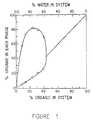
- Figure 1 there is shown a typical solubility diagram for a liquid obtained from poplar wood. Pyrolytic liquids prepared by other methods from wood, which do not meet the process requirements of rapid pyrolysis for maximum liquid production will not show similar solubility behaviour because their chemical composition will be quite different.
- the phase diagram of Figure 1 shows that if the pyrolysis liquid as produced is diluted with water to a water content of 55% or more at temperatures near ambient, with no further treatment, a water-poor phase will separate and can be filtered off from a water-rich phase.
- the water-poor phase contains insoluble material that can be dried at temperatures preferably not exceeding 110°C and then easily ground to give a fine free flowing material.
- the crude pyrolysis liquid can also be heated for a period if desired, before or after dilution with water, in order to cause acid hydrolysis of oligosaccharides or of anhydrosaccharides to occur to increase the yield of monomeric sugar-related carbohydrates.
- this step is not essential to the separation.
- the water-poor fraction is primarily derived from the lignin content of the biomass and is largely aromatic in character. Depending on the biomass feed, the water-poor fraction will be 10% to 30% of the dry wood fed, or 15% to 40% of the pyrolysis liquid. Further, it is only under the previously described conditions of rapid pyrolysis that these yields of lignin related materials can be recovered in the pyrolysis liquid and can be readily separated from this liquid.
- the water-rich fraction -contains a high proportion of hydroxy carbonyl compounds related to sugars.
- the water-rich fraction can be further treated so that acids are first removed by any suitable method. Primarily formic and acetic acids will be removed through distillation, neutralization, solvent extraction or ion exchange. However, because yields of these acids are substantial, methods such as distillation or solvent extraction are preferred if the acid is to be recovered as a commercial product. If desirable, treatment with charcoal, or other adsorbent, or extraction with a suitable solvent will largely remove residual amounts of aromatic or furanoid compounds from the aqueous solution. The treated aqueous solution can then be used as a source of carbohydrates for fermentation processes.
- specific chemicals in particular, the product hydroxyacetaldehyde (glycolaldehyde or 2-hydroxy ethanal), as well as other components present, for example, levoglucosan, acetol, glyoxal, methyl glyoxal and numerous other components.
- the amount of a particular component will not be sufficient to justify its recovery. However, usually the reaction conditions can be varied so that the yield of a particular desirable component will be increased.
- Table 1 there is shown the results for a typical pyrolysis process in an atmospheric pressure fluidised bed reactor of the type described in the papers by Donald S. Scott, et al referred to previously.
- the letters "m.f.” in Table 1 mean moisture free and the yields are provided on a moisture free basis after deducting for the moisture in the feed.
- Table 2 there are set out typical yields of the more important compounds present in the water-rich fraction at a particular temperature. The yield of any given component can be maximized by the variation of temperature and residence time in the reactor. Of course, the yield can also be varied with the type of feed stock. It is to be noted particularly in Table 2 the high yield of hydroxyacetaldehyde.
- the water content When it is desired to produce a pyrolysis liquid that can be used as a fuel oil, the water content must be adjusted to between 10% and 30% and, preferably, between 15% and 25%. This amount of water, when referring to the phase diagram of Figure 1, dissolves in the organic material. Also, this concentration of water reduces the viscosity of the liquid so that it remains fluid and pumpable (i.e. 40 centipoises at 40°C). The water content also gives the liquid a very low pour point (-24°C for liquid from poplar wood). Further, the water content stabilizes the liquid in storage and storage of liquid in sealed containers shows little change over eighteen months at room temperature.
- the pyrolysis liquid from wood can be burned with appropriate ignition devices in the same combustion equipment as that used for fuel oils with either pressure atomizing or gas atomizing burners.
- the fuel oil obtained from the process of the present invention contains essentially no ash and is very low in sulfur content.
- the water-poor fraction is essentially identical to the lignin fraction produced in steam explosion processes. Steam explosion processes are very different and less economical than the process of the present invention. Comparison of the water-poor fraction of the present invention with the lignin derived material from steam explosion processes using nuclear magnetic resonance spectra, shows the two materials are similar.
- Figure 2 is a NMR spectra of pyrolytic lignin resulting from fast pyrolysis of poplar wood in accordance with the process of the present invention.
Landscapes
- Chemical & Material Sciences (AREA)
- Organic Chemistry (AREA)
- Engineering & Computer Science (AREA)
- Life Sciences & Earth Sciences (AREA)
- Wood Science & Technology (AREA)
- Zoology (AREA)
- Food Science & Technology (AREA)
- Polymers & Plastics (AREA)
- Materials Engineering (AREA)
- Oil, Petroleum & Natural Gas (AREA)
- Production Of Liquid Hydrocarbon Mixture For Refining Petroleum (AREA)
- Organic Low-Molecular-Weight Compounds And Preparation Thereof (AREA)
Claims (15)
- Procédé pour obtenir des productions maximales de liquides à partir de la pyrolyse de biomasse contenant un matériau du type lignine et de la cellulose, en utilisant un réacteur capable d'échange thermique rapide et de courts temps de séjour de gaz, ledit procédé comprenant d'introduire ladite biomasse dans ledit réacteur, ladite biomasse ayant un taux d'humidité de 5 à 15% en poids, introduire un gaz dans ledit réacteur, introduire de la chaleur dans ledit réacteur et d'effectuer un procédé de pyrolyse de ladite biomasse pour obtenir des produits solides, liquides et vapeurs dans les conditions suivantes :(a) le temps de séjour du gaz et de la vapeur est inférieur à 10 secondes ;(b) le temps de séjour des particules solides est égal ou supérieur au temps de séjour du gaz et de la vapeur ;(c) la taille des particules solides n'excède pas 5 mm ;(d) le procédé de pyrolyse est effectué à une température comprise entre sensiblement 400°C à sensiblement 650°C ; et(e) la pression est proche d'une atmosphère ;produisant un liquide de pyrolyse monophasique contenant 10% à 30% en poids d'eau avec le restant dudit liquide étant des composés organiques comprenant une majorité de matériau du type lignine présent dans la biomasse de départ ensemble avec des hydrates de carbone derivés de la cellulose, la production totale de liquide est comprise entre sensiblement 56% et sensiblement 90% en poids, ledit procédé étant caractérisé en ce que ledit liquide de pyrolyse monophasique est traité pour diviser ledit liquide en deux fractions, notamment une fraction riche et eau et une fraction pauvre en eau, en diluant le liquide de pyrolyse obtenu à partir du procédé avec de l'eau jusqu'à une teneur en eau d'au moins 50% en poids, à des températures proches de la température ambiante, causant la séparation des deux fractions, et en extrayant par filtration la fraction pauvre en eau de la fraction riche en eau.
- Procédé selon la revendication 1, dans lequel le temps de séjour du gaz et de la vapeur n'excède pas deux secondes environ.
- Procédé selon la revendication 2, dans lequel la taille des particules de la biomasse n'excède pas 2 mm environ.
- Procédé selon la revendication 3, dans lequel le procédé est effectué à une température comprise entre sensiblement 450°C et sensiblement 550°C.
- Procédé selon la revendication 4, dans lequel les deux fractions sont créées en diluant le liquide de pyrolyse obtenu à partir du procédé avec de l'eau jusqu'à une teneur en eau d'au moins 55% en poids.
- Procédé selon la revendication 1, dans lequel la fraction pauvre en eau comprend de 10% à 30% en poids du bois sec alimenté et de 15% à 40% en poids du liquide de pyrolyse.
- Procédé selon l'une quelconque des revendications 1 à 5, comprenant de récupérer les phases pauvres en eau par filtration, lavage et séchage pour produire un matériau dérivé de la lignine.
- Procédé selon la revendication 6, dans lequel la fraction riche en eau est en outre traitée pour éliminer les acides, et la fraction est ensuite traitée pour éliminer les quantités résiduelles de composés aromatiques ou furanoïdes, le produit ainsi formé étant une source d'hydrates de carbone.
- Procédé selon la revendication 8, dans lequel les composés aromatiques ou furanoïdes sont éliminés par adsorption.
- Procédé selon la revendication 8, dans lequel les composés aromatiques ou furanoïdes sont éliminés par extraction.
- Procédé selon la revendication 8, dans lequel un ou plusieurs des produits suivants sont récupérés du produit restant de la phase riche en eau, notamment l'hydroxyacetaldehyde, le levoglucosan, l'acétol, le glyoxal ou le glyoxal de méthyle.
- Procédé selon l'une quelconque des revendications 1, 5 ou 9, dans lequel l'hydroxyacetaldehyde est récupéré de la phase riche en eau.
- Procédé selon la revendication 4, dans lequel le liquide de pyrolyse résultant du procédé de pyrolyse est dilué avec de l'eau, de sorte que la teneur en eau est comprise entre 10% et 30% en poids, ledit liquide de pyrolyse étant adapté à l'utilisation en tant que fuel.
- Procédé selon la revendication 4, dans lequel le liquide de pyrolyse est dilué avec de l'eau de sorte que la teneur en eau est comprise entre 15% et 25% en poids, rendant le liquide de pyrolyse apte à l'utilisation en tant que fuel.
- Procédé selon la revendication 4, dans lequel la biomasse est un bois dur ou un bois tendre et la production de liquide de pyrolyse se situe entre 70% et 75% en poids.
Applications Claiming Priority (3)
| Application Number | Priority Date | Filing Date | Title |
|---|---|---|---|
| CA514974 | 1986-07-30 | ||
| CA000514974A CA1332580C (fr) | 1986-07-30 | 1986-07-30 | Procede de pyrolyse de biomasse permettant d'optimiser la fraction liquide |
| PCT/US1987/001852 WO1988000935A1 (fr) | 1986-07-30 | 1987-07-29 | Pyrolyse de biomasse pour obtenir des rendements maximum de production de liquide |
Publications (3)
| Publication Number | Publication Date |
|---|---|
| EP0316355A1 EP0316355A1 (fr) | 1989-05-24 |
| EP0316355A4 EP0316355A4 (fr) | 1989-11-07 |
| EP0316355B1 true EP0316355B1 (fr) | 1994-10-26 |
Family
ID=4133654
Family Applications (1)
| Application Number | Title | Priority Date | Filing Date |
|---|---|---|---|
| EP87905371A Expired - Lifetime EP0316355B1 (fr) | 1986-07-30 | 1987-07-29 | Pyrolyse de biomasse pour obtenir des rendements maximum de production de liquide |
Country Status (5)
| Country | Link |
|---|---|
| EP (1) | EP0316355B1 (fr) |
| AT (1) | ATE113268T1 (fr) |
| CA (1) | CA1332580C (fr) |
| DE (1) | DE3750695T2 (fr) |
| WO (1) | WO1988000935A1 (fr) |
Families Citing this family (13)
| Publication number | Priority date | Publication date | Assignee | Title |
|---|---|---|---|---|
| US5039537A (en) * | 1989-04-26 | 1991-08-13 | Red Arrow Products Co. Inc. | High browning liquid smoke composition and method of making a high browning liquid smoke composition |
| US4994297A (en) * | 1987-11-12 | 1991-02-19 | Ensyn Engineering Associates, Inc. | Method of using fast pyrolysis liquids as liquid smoke |
| US4876108A (en) * | 1987-11-12 | 1989-10-24 | Ensyn Engineering Associates Inc. | Method of using fast pyrolysis liquids as liquid smoke |
| US4959232A (en) * | 1989-04-26 | 1990-09-25 | Red Arrow Products Company, Inc. | Process for making liquid smoke compositions and resin treated liquid smoke compositions |
| US4880473A (en) * | 1988-04-01 | 1989-11-14 | Canadian Patents & Development Ltd. | Process for the production of fermentable sugars from biomass |
| US5397582A (en) * | 1989-05-26 | 1995-03-14 | Red Arrow Products Company Inc. | Flavoring and browning materials by pyrolysis of sugars and starches |
| US5292541A (en) * | 1989-05-26 | 1994-03-08 | Red Arrow Products Company Inc. | Browning materials derived from the pyrolysis of sugars and starches |
| US5135770A (en) * | 1989-10-04 | 1992-08-04 | Red Arrow Products Co. Inc. | High browning liquid smoke composition and method of making a high browning liquid smoke composition |
| US5252188A (en) * | 1990-03-26 | 1993-10-12 | Red Arrow Products Company, Inc. | Process for producing hydroxyacetaldehyde |
| AUPP729098A0 (en) | 1998-11-24 | 1998-12-17 | University Of Melbourne, The | Process for the recovery of low molecular weight phenols and/or cellulose or cellulose-rich residue |
| IT1400225B1 (it) * | 2010-04-15 | 2013-05-24 | Eni Spa | Procedimento per la produzione di bio-olio da rifiuti solidi urbani |
| NL2004898C2 (en) | 2010-06-16 | 2011-12-20 | Stichting Energie | Pyrolysis of lignin. |
| US20140221688A1 (en) * | 2013-02-07 | 2014-08-07 | Kior, Inc. | Organics recovery from the aqueous phase of biomass catalytic pyrolysis |
Citations (1)
| Publication number | Priority date | Publication date | Assignee | Title |
|---|---|---|---|---|
| US3298928A (en) * | 1963-11-22 | 1967-01-17 | Weyerhaeuser Co | Pyrolysis of cellulosic material in concurrent gaseous flow |
Family Cites Families (9)
| Publication number | Priority date | Publication date | Assignee | Title |
|---|---|---|---|---|
| US2791523A (en) * | 1952-06-11 | 1957-05-07 | Masonite Corp | Carbohydrate foaming agent and process for its preparation |
| GB1398858A (en) * | 1972-08-02 | 1975-06-25 | Occidental Petroleum Corp | Production and recovery of chemical values from waste solids |
| US4260473A (en) * | 1979-05-03 | 1981-04-07 | Occidental Research Corporation | Removal of particulates from pyrolytic oil |
| CA1100532A (fr) * | 1980-08-21 | 1981-05-05 | David L. Granatstein | Production d'hydrocarbures liquides a partir de charbons |
| US4364745A (en) * | 1981-06-26 | 1982-12-21 | Standard Oil Company (Indiana) | Plant hydrocarbon recovery process |
| US4578176A (en) * | 1982-06-09 | 1986-03-25 | Institute Of Gas Technology | Fuel production by free fall countercurrent flow |
| US4592918A (en) * | 1982-09-14 | 1986-06-03 | Union Carbide Corporation | Tar-depleted aqueous liquid smoke composition |
| US4463210A (en) * | 1983-06-01 | 1984-07-31 | The United States Of America As Represented By The United States Department Of Energy | Production of chemical feedstock by the methanolysis of wood |
| GB8511587D0 (en) * | 1985-05-08 | 1985-06-12 | Shell Int Research | Producing hydrocarbon-containing liquids |
-
1986
- 1986-07-30 CA CA000514974A patent/CA1332580C/fr not_active Expired - Fee Related
-
1987
- 1987-07-29 AT AT87905371T patent/ATE113268T1/de not_active IP Right Cessation
- 1987-07-29 EP EP87905371A patent/EP0316355B1/fr not_active Expired - Lifetime
- 1987-07-29 WO PCT/US1987/001852 patent/WO1988000935A1/fr not_active Ceased
- 1987-07-29 DE DE3750695T patent/DE3750695T2/de not_active Expired - Fee Related
Patent Citations (1)
| Publication number | Priority date | Publication date | Assignee | Title |
|---|---|---|---|---|
| US3298928A (en) * | 1963-11-22 | 1967-01-17 | Weyerhaeuser Co | Pyrolysis of cellulosic material in concurrent gaseous flow |
Non-Patent Citations (2)
| Title |
|---|
| Canadian Journal of Chemical Engineering, 1984, 62, 404-412 * |
| Industrial and Engineering Chemistry Process Design and Development, 1985, 24, 581-588. * |
Also Published As
| Publication number | Publication date |
|---|---|
| DE3750695D1 (de) | 1994-12-01 |
| EP0316355A1 (fr) | 1989-05-24 |
| ATE113268T1 (de) | 1994-11-15 |
| DE3750695T2 (de) | 1995-03-16 |
| EP0316355A4 (fr) | 1989-11-07 |
| WO1988000935A1 (fr) | 1988-02-11 |
| CA1332580C (fr) | 1994-10-18 |
Similar Documents
| Publication | Publication Date | Title |
|---|---|---|
| US4880473A (en) | Process for the production of fermentable sugars from biomass | |
| EP0316355B1 (fr) | Pyrolyse de biomasse pour obtenir des rendements maximum de production de liquide | |
| US4964995A (en) | Supercritical separation process for complex organic mixtures | |
| US5397582A (en) | Flavoring and browning materials by pyrolysis of sugars and starches | |
| JP2790375B2 (ja) | 褐色着色材料およびその製造方法 | |
| Gao et al. | A biorefinery strategy for spent industrial ginger waste | |
| EP2513080B1 (fr) | Procédé de production de furfural à partir d'un matériau biomassique lignocellulosique | |
| US3298928A (en) | Pyrolysis of cellulosic material in concurrent gaseous flow | |
| US3309356A (en) | Separating levoglucosan and carbohydrate acids from aqueous mixtures containing the same-by solvent extraction | |
| Biermann et al. | Rapid steam hydrolysis/extraction of mixed hardwoods as a biomass pretreatment | |
| Meier et al. | Direct liquefaction of different lignocellulosics and their constituents: 1. Fractionation, elemental composition | |
| Guo et al. | Characterization of tobacco stalk lignin using nuclear magnetic resonance spectrometry and its pyrolysis behavior at different temperatures | |
| RU2165416C1 (ru) | Способ переработки древесины лиственницы и способ выделения нативных биофлавоноидов, полученных в процессе переработки | |
| Demirbas et al. | Conversion of olive husk to liquid fuel by pyrolysis and catalytic liquefaction | |
| Monteiro et al. | Evaluation of hydrothermal sugarcane bagasse treatment for the production of xylooligosaccharides in different pressures | |
| Derairbas | Catalytic conversion of residual lignocellulosic materials to an acetone-soluble oil | |
| Osorio Arias et al. | A novel process line for the valorization of industrial spent coffee grounds through coffee roasting technology and ultrasonic‐assisted extraction | |
| US3926947A (en) | Controlled pyrolysis of cellulosic materials for production of chemicals | |
| WO2000031213A1 (fr) | Procede de recuperation de phenols a faible poids moleculaire, de furfural, d'alcool furfurylique et/ou de cellulose ou de residus a forte teneur en cellulose | |
| US11878983B2 (en) | Thermochemical treatment of cellulosic materials | |
| US3309355A (en) | Levoglucosan production by pyrolysis of cellulosic material | |
| WO1989007480A1 (fr) | Procede de separation surcritique pour melanges organiques complexes | |
| US2334620A (en) | Method for recovering by-products from pulp waste liquor residues | |
| Chen et al. | Biochemicals distribution and the collaborative pyrolysis study from three main components of Helianthus annuus stems based on PY-GC/MS | |
| KR20180083792A (ko) | 레보글루코세논 생산 방법 |
Legal Events
| Date | Code | Title | Description |
|---|---|---|---|
| PUAI | Public reference made under article 153(3) epc to a published international application that has entered the european phase |
Free format text: ORIGINAL CODE: 0009012 |
|
| 17P | Request for examination filed |
Effective date: 19890131 |
|
| AK | Designated contracting states |
Kind code of ref document: A1 Designated state(s): AT BE CH DE FR GB IT LI NL SE |
|
| A4 | Supplementary search report drawn up and despatched |
Effective date: 19891107 |
|
| R17P | Request for examination filed (corrected) |
Effective date: 19890127 |
|
| 17Q | First examination report despatched |
Effective date: 19911230 |
|
| GRAA | (expected) grant |
Free format text: ORIGINAL CODE: 0009210 |
|
| RAP1 | Party data changed (applicant data changed or rights of an application transferred) |
Owner name: SCOTT, DONALD S. |
|
| AK | Designated contracting states |
Kind code of ref document: B1 Designated state(s): AT BE CH DE FR GB IT LI NL SE |
|
| PG25 | Lapsed in a contracting state [announced via postgrant information from national office to epo] |
Ref country code: NL Effective date: 19941026 Ref country code: BE Effective date: 19941026 |
|
| REF | Corresponds to: |
Ref document number: 113268 Country of ref document: AT Date of ref document: 19941115 Kind code of ref document: T |
|
| REF | Corresponds to: |
Ref document number: 3750695 Country of ref document: DE Date of ref document: 19941201 |
|
| ET | Fr: translation filed | ||
| ITF | It: translation for a ep patent filed | ||
| EAL | Se: european patent in force in sweden |
Ref document number: 87905371.8 |
|
| NLV1 | Nl: lapsed or annulled due to failure to fulfill the requirements of art. 29p and 29m of the patents act | ||
| PG25 | Lapsed in a contracting state [announced via postgrant information from national office to epo] |
Ref country code: AT Effective date: 19950729 |
|
| PLBE | No opposition filed within time limit |
Free format text: ORIGINAL CODE: 0009261 |
|
| STAA | Information on the status of an ep patent application or granted ep patent |
Free format text: STATUS: NO OPPOSITION FILED WITHIN TIME LIMIT |
|
| 26N | No opposition filed | ||
| PG25 | Lapsed in a contracting state [announced via postgrant information from national office to epo] |
Ref country code: FR Effective date: 19960430 |
|
| REG | Reference to a national code |
Ref country code: FR Ref legal event code: ST |
|
| REG | Reference to a national code |
Ref country code: FR Ref legal event code: ST |
|
| REG | Reference to a national code |
Ref country code: FR Ref legal event code: ST |
|
| REG | Reference to a national code |
Ref country code: GB Ref legal event code: IF02 |
|
| PGFP | Annual fee paid to national office [announced via postgrant information from national office to epo] |
Ref country code: SE Payment date: 20040706 Year of fee payment: 18 |
|
| PGFP | Annual fee paid to national office [announced via postgrant information from national office to epo] |
Ref country code: GB Payment date: 20040728 Year of fee payment: 18 |
|
| PGFP | Annual fee paid to national office [announced via postgrant information from national office to epo] |
Ref country code: CH Payment date: 20040729 Year of fee payment: 18 |
|
| PGFP | Annual fee paid to national office [announced via postgrant information from national office to epo] |
Ref country code: DE Payment date: 20040806 Year of fee payment: 18 |
|
| PG25 | Lapsed in a contracting state [announced via postgrant information from national office to epo] |
Ref country code: IT Free format text: LAPSE BECAUSE OF NON-PAYMENT OF DUE FEES;WARNING: LAPSES OF ITALIAN PATENTS WITH EFFECTIVE DATE BEFORE 2007 MAY HAVE OCCURRED AT ANY TIME BEFORE 2007. THE CORRECT EFFECTIVE DATE MAY BE DIFFERENT FROM THE ONE RECORDED. Effective date: 20050729 Ref country code: GB Free format text: LAPSE BECAUSE OF NON-PAYMENT OF DUE FEES Effective date: 20050729 |
|
| PG25 | Lapsed in a contracting state [announced via postgrant information from national office to epo] |
Ref country code: SE Free format text: LAPSE BECAUSE OF NON-PAYMENT OF DUE FEES Effective date: 20050730 |
|
| PG25 | Lapsed in a contracting state [announced via postgrant information from national office to epo] |
Ref country code: LI Free format text: LAPSE BECAUSE OF NON-PAYMENT OF DUE FEES Effective date: 20050731 Ref country code: CH Free format text: LAPSE BECAUSE OF NON-PAYMENT OF DUE FEES Effective date: 20050731 |
|
| PG25 | Lapsed in a contracting state [announced via postgrant information from national office to epo] |
Ref country code: DE Free format text: LAPSE BECAUSE OF NON-PAYMENT OF DUE FEES Effective date: 20060201 |
|
| REG | Reference to a national code |
Ref country code: CH Ref legal event code: PL |
|
| EUG | Se: european patent has lapsed | ||
| GBPC | Gb: european patent ceased through non-payment of renewal fee |
Effective date: 20050729 |