EP0316512A2 - Stratifié plié en forme d'accordéon, comprenant une couche de fibres renforcée par un film thermoplastique - Google Patents
Stratifié plié en forme d'accordéon, comprenant une couche de fibres renforcée par un film thermoplastique Download PDFInfo
- Publication number
- EP0316512A2 EP0316512A2 EP88110410A EP88110410A EP0316512A2 EP 0316512 A2 EP0316512 A2 EP 0316512A2 EP 88110410 A EP88110410 A EP 88110410A EP 88110410 A EP88110410 A EP 88110410A EP 0316512 A2 EP0316512 A2 EP 0316512A2
- Authority
- EP
- European Patent Office
- Prior art keywords
- sheet
- adhesive
- temperature
- folds
- polyester
- Prior art date
- Legal status (The legal status is an assumption and is not a legal conclusion. Google has not performed a legal analysis and makes no representation as to the accuracy of the status listed.)
- Withdrawn
Links
Images

Classifications
-
- B—PERFORMING OPERATIONS; TRANSPORTING
- B29—WORKING OF PLASTICS; WORKING OF SUBSTANCES IN A PLASTIC STATE IN GENERAL
- B29C—SHAPING OR JOINING OF PLASTICS; SHAPING OF MATERIAL IN A PLASTIC STATE, NOT OTHERWISE PROVIDED FOR; AFTER-TREATMENT OF THE SHAPED PRODUCTS, e.g. REPAIRING
- B29C53/00—Shaping by bending, folding, twisting, straightening or flattening; Apparatus therefor
- B29C53/22—Corrugating
- B29C53/24—Corrugating of plates or sheets
-
- A—HUMAN NECESSITIES
- A47—FURNITURE; DOMESTIC ARTICLES OR APPLIANCES; COFFEE MILLS; SPICE MILLS; SUCTION CLEANERS IN GENERAL
- A47K—SANITARY EQUIPMENT; ACCESSORIES THEREFOR, e.g. TOILET ACCESSORIES
- A47K3/00—Baths; Showers; Appurtenances therefor
- A47K3/28—Showers or bathing douches
- A47K3/38—Arrangements for curtains
-
- B—PERFORMING OPERATIONS; TRANSPORTING
- B29—WORKING OF PLASTICS; WORKING OF SUBSTANCES IN A PLASTIC STATE IN GENERAL
- B29C—SHAPING OR JOINING OF PLASTICS; SHAPING OF MATERIAL IN A PLASTIC STATE, NOT OTHERWISE PROVIDED FOR; AFTER-TREATMENT OF THE SHAPED PRODUCTS, e.g. REPAIRING
- B29C53/00—Shaping by bending, folding, twisting, straightening or flattening; Apparatus therefor
- B29C53/02—Bending or folding
- B29C53/04—Bending or folding of plates or sheets
-
- B—PERFORMING OPERATIONS; TRANSPORTING
- B29—WORKING OF PLASTICS; WORKING OF SUBSTANCES IN A PLASTIC STATE IN GENERAL
- B29C—SHAPING OR JOINING OF PLASTICS; SHAPING OF MATERIAL IN A PLASTIC STATE, NOT OTHERWISE PROVIDED FOR; AFTER-TREATMENT OF THE SHAPED PRODUCTS, e.g. REPAIRING
- B29C71/00—After-treatment of articles without altering their shape; Apparatus therefor
- B29C71/02—Thermal after-treatment
-
- B—PERFORMING OPERATIONS; TRANSPORTING
- B29—WORKING OF PLASTICS; WORKING OF SUBSTANCES IN A PLASTIC STATE IN GENERAL
- B29D—PRODUCING PARTICULAR ARTICLES FROM PLASTICS OR FROM SUBSTANCES IN A PLASTIC STATE
- B29D16/00—Producing articles with corrugations
-
- B—PERFORMING OPERATIONS; TRANSPORTING
- B29—WORKING OF PLASTICS; WORKING OF SUBSTANCES IN A PLASTIC STATE IN GENERAL
- B29L—INDEXING SCHEME ASSOCIATED WITH SUBCLASS B29C, RELATING TO PARTICULAR ARTICLES
- B29L2031/00—Other particular articles
- B29L2031/719—Curtains; Blinds; Shades
-
- Y—GENERAL TAGGING OF NEW TECHNOLOGICAL DEVELOPMENTS; GENERAL TAGGING OF CROSS-SECTIONAL TECHNOLOGIES SPANNING OVER SEVERAL SECTIONS OF THE IPC; TECHNICAL SUBJECTS COVERED BY FORMER USPC CROSS-REFERENCE ART COLLECTIONS [XRACs] AND DIGESTS
- Y10—TECHNICAL SUBJECTS COVERED BY FORMER USPC
- Y10T—TECHNICAL SUBJECTS COVERED BY FORMER US CLASSIFICATION
- Y10T428/00—Stock material or miscellaneous articles
- Y10T428/23907—Pile or nap type surface or component
- Y10T428/23943—Flock surface
-
- Y—GENERAL TAGGING OF NEW TECHNOLOGICAL DEVELOPMENTS; GENERAL TAGGING OF CROSS-SECTIONAL TECHNOLOGIES SPANNING OVER SEVERAL SECTIONS OF THE IPC; TECHNICAL SUBJECTS COVERED BY FORMER USPC CROSS-REFERENCE ART COLLECTIONS [XRACs] AND DIGESTS
- Y10—TECHNICAL SUBJECTS COVERED BY FORMER USPC
- Y10T—TECHNICAL SUBJECTS COVERED BY FORMER US CLASSIFICATION
- Y10T428/00—Stock material or miscellaneous articles
- Y10T428/24—Structurally defined web or sheet [e.g., overall dimension, etc.]
- Y10T428/2419—Fold at edge
-
- Y—GENERAL TAGGING OF NEW TECHNOLOGICAL DEVELOPMENTS; GENERAL TAGGING OF CROSS-SECTIONAL TECHNOLOGIES SPANNING OVER SEVERAL SECTIONS OF THE IPC; TECHNICAL SUBJECTS COVERED BY FORMER USPC CROSS-REFERENCE ART COLLECTIONS [XRACs] AND DIGESTS
- Y10—TECHNICAL SUBJECTS COVERED BY FORMER USPC
- Y10T—TECHNICAL SUBJECTS COVERED BY FORMER US CLASSIFICATION
- Y10T428/00—Stock material or miscellaneous articles
- Y10T428/24—Structurally defined web or sheet [e.g., overall dimension, etc.]
- Y10T428/24628—Nonplanar uniform thickness material
- Y10T428/24636—Embodying mechanically interengaged strand[s], strand-portion[s] or strand-like strip[s] [e.g., weave, knit, etc.]
- Y10T428/24645—Embodying mechanically interengaged strand[s], strand-portion[s] or strand-like strip[s] [e.g., weave, knit, etc.] with folds in parallel planes
-
- Y—GENERAL TAGGING OF NEW TECHNOLOGICAL DEVELOPMENTS; GENERAL TAGGING OF CROSS-SECTIONAL TECHNOLOGIES SPANNING OVER SEVERAL SECTIONS OF THE IPC; TECHNICAL SUBJECTS COVERED BY FORMER USPC CROSS-REFERENCE ART COLLECTIONS [XRACs] AND DIGESTS
- Y10—TECHNICAL SUBJECTS COVERED BY FORMER USPC
- Y10T—TECHNICAL SUBJECTS COVERED BY FORMER US CLASSIFICATION
- Y10T428/00—Stock material or miscellaneous articles
- Y10T428/24—Structurally defined web or sheet [e.g., overall dimension, etc.]
- Y10T428/24628—Nonplanar uniform thickness material
- Y10T428/24669—Aligned or parallel nonplanarities
- Y10T428/24686—Pleats or otherwise parallel adjacent folds
Definitions
- This invention relates to window shades, shower curtains and other sheet material that is formed of accordion folded laminates of fiber which is reinforced by thermoplastic film, such as polyester film, with an adhesive dispersed between the layers of the laminate, such as low melt polyester adhesive powder.
- Window shades and shower curtains formed of the accordion folded laminate tend to hold their shape so that the folds do not tend to disappear under the weight of the window shade, and the laminate tends to resume a folded configuration after having been extended.
- Accordion folded sheet material has been extensively used in the past as decorative curtains and other items having the folds extending vertically, and also as window shades and similar items that have the folds extending horizontally.
- the sheet material which is formed in the folded configuration has included various decorative patterns on its surface and provides a very pleasing visual effect.
- This fabric has traditionally been polyester (only).
- This fabric may have been woven, knitted, or non-woven (such as "stitch-bonded” non-woven).
- the yarns may have been spun staple or continuous filament yarns.
- the resin-stiffened fabrics may have been finished with either thermoplastic or thermoset resins or combinations of both types of resins.
- the resins have generally been selected from acrylic or melamine resins.
- the folds of an accordion folded sheet material be maintained in a substantially uniform fold configuration across the entire length or width of the sheet material. This not only provides a uniformity of folds but also tends to present the pattern on the surface of the sheet material in a uniform manner. For example, if a pattern on the surface of the sheet material has a uniform repeat of a visual design and the folds of the accordion folded sheet are not uniformly open, the pattern will not be uniformly presented.
- the present invention comprises an accordion folded laminate formed of fiber which is reinforced with a sheet of thermoplastic bonded thereto, and the method of forming the laminate.
- the accordion folded laminate comprises a window shade having its folds extending horizontally, and in other embodiments the laminate comprises a shower curtain or other portal covering with its folds extending vertically.
- the thermoplastic sheet preferably will comprise polyester, and the adhesive that bonds the thermoplastic sheet to the fiber sheet comprises a low melt adhesive. The adhesive is dispersed on one of the sheets and heated to a temperature above its melt temperature. The sheets are pressed together about the adhesive and after being joined together the sheets are permitted to cool.
- the bonded laminate is moved through a pleater apparatus, whereby the laminate is progressively folded into a compressed accordion folded configuration and panels of uniform widths are formed and the folds at the opposite edges of each panel of the laminated sheet material are again heated to a temperature higher than the melting temperature of the low melt adhesive.
- the thermoplastic sheet undergoes molecular rearrangement under the thermal and mechanical conditions imposed by this process and the thermoplastic sheet assumes a high degree of crease retention.
- the adhesive tends to lock the folds in a heat set configuration, such that the final product in the form of a window shade, shower curtain or other end use device has a fold memory that urges the panels between the folds away from a fully stretched configuration back toward a relaxed accordion folded configuration.
- the fiber sheet may have thermoplastic properties (such as standard polyester), these fibers may also undergo molecular rearrangement similarly to that of the thermoplastic sheet, and thereby contribute to the overall resiliency of the final creases.
- an object of this invention to provide an accordion folded sheet which is formed of a laminate of a thermoplastic sheet and a fiber sheet and an intermediate adhesive, with the folds of the laminate having a memory that tends to return the folds from an outstretched configuration to an intermediate relaxed configuration.
- Another object of this invention is to provide an accordion folded laminate of fiber which is reinforced with a polyester film which is visually distinctive, durable and which is inexpensive to produce.
- Another object of this invention is to provide an accordion folded laminate of a fiber sheet containing non-thermoplastic fibers reinforced with a polyester film, with the fiber sheet and polyester film bonded to each other with a low melt adhesive, with the final product providing a distinctive accordion folded appearance even when the product has been radically stretched from its accordion folded configuration to a substantially flat configuration.
- Another object of this invention is to provide an accordion folded laminate of fiber and polyester which is suitable for use as window shade material having the folds of the laminate extending horizontally and suitable for use as a shower curtain having the folds of the laminate extending vertically.
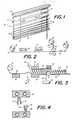
- Fig. 1 illustrates a window shade 10 formed from an accordion folded laminate 11, an upper support housing 12, a lower base 14 and a draw string arrangement 15.
- the accordion folded laminate 11 is formed with oppositely directed folds 16 and 18 at opposite edges of panels 19 and has its folds 16 and 18 extending horizontally, with the lowermost of its panels 19 clamped in the lower base 14 and the uppermost one of its panels 19 clamped in the upper support housing 12.
- Holes 20 and 21 are formed in each panel 19, adjacent opposite ends of each panel, with the holes 20 being aligned with one another and with holes 21 being aligned with one another.
- the draw string 15 is connected appropriately to the lower base 14, and the draw string extends from the lower base 14 upwardly through the holes 20 and 21, through the upper support housing 12, and out one end portion of the upper support housing.
- the draw string 15, upper support housing 12 and lower base 14, function in the conventional manner, so that when the draw string 15 is pulled or released the lower base is raised or lowered
- the accordion folded laminate also can be used as a shower curtain 25, with the folds 26 and 28 extending vertically with the folds formed at the opposite edges of the panels 29.
- Holes 30 are formed at the upper end of each panel 29, and conventional hangers 31 extend through some or all of the holes 30 and support the shower curtain from the shower rod 32.
- the shower curtain 25 is arranged to hang over the rim 33 of a tub, and an L-shaped bar 34 or U-shaped bar may be mounted on the rim of the tub.
- the upper flange of the L-shaped bar 34 is placed generally parallel to and below the shower rod 32, and the shower curtain 25 is long enough so that its lower edge will extend below the upper edge of the L-shaped bar 34.
- the L-shaped bar 34 prevents the shower curtain from drifting outside the tub enclosure, and it prevents water-spillage outside the tube enclosure.
- the shower curtain 25 of Fig. 6 is hung in a conventional manner, there are times when it is desirable to use very thin accordion folded laminate material in the shower curtain, and the holes 30 may not be able to withstand abrupt pulling forces that could be applied to the holes by a vigorous urging of the shower curtain to an opened or closed configuration. Further, the conventional hangers 31 sometime do not slide very easily along the upper surface of the shower rod 32, which tends to require more force to be applied to the shower curtain to open or close the shower curtain.
- the shower curtain 35 includes vertical folds 38 and intermediate panels 39, a hem 41 formed along the upper edge thereof, and holes 40 formed in the upper edge of the hem.
- Especially designed hangers 44 are inserted in the holes 40 and function to support the shower curtain from shower rod 42.
- Each hanger 44 is approximately of inverted T configuration, including a head 45, upper and lower stems 46 and 48, C-shaped clamp 49 positioned between the upper and lower stems 46 and 48, and lower hanger bar 50.
- Lower hanger bar 50 comprises three hanger legs 51, 52 and 53, with upper hanger leg 51 connected at one end to the lower end portion of stem 48 and extending horizontally therefrom, lower hanger leg 52 which returns parallel to upper hanger leg 51, and opposite hanger leg 53 which is coextensive with hanger leg 51.
- a slot 55 is formed between upper hanger leg 51 and lower hanger leg 52, and a slug 56 is formed at the distal end of hanger leg 53.
- the hangers 44 are suspended from the shower rod 42.
- the shower rod comprises a channel bar with a downwardly facing lower slot 58.
- the hanger 44 is inserted into the slot 58 from the end of the shower rod, by placing the enlarged head 45 in the cavity of the shower rod and passing the upper stem 46 through the slot 58.
- the C-shaped clamp 49 is suspended just below the shower rod 42.
- the slug 56 is first inserted through a hole 40 at the upper edge of the hem, the vertical fold 38 between the adjacent panels is flattened so as to permit the distal end of the hanger to protrude into the hem above the next adjacent panel, the upper edge of the hem is received in the slot 55 (Fig. 8), the bend between hanger leg 51 and lower hanger leg 52 is then urged down into the hole, and then the hanger is pulled rearwardly until the hanger leg 51 is fully received within the hem (Fig. 9). This places the lower stem 48 in the vicinity of the hole 40.
- the shape of the upper edge portion of the shower curtain tends to confine the hanger in its panel.
- the slug 56 at one end and the bend between hanger leg 51 and lower hanger leg 52 at the other end tend to reduce any likelihood of the hanger 44 from puncturing the material of the shower curtain.
- each hanger 44 limits the vertical motion of upper stem 46 through the slot 58 so that the enlarged heads 45 cannot become tangled within the cavity of slot 58.
- Clamp 49 also can be used to receive a spacer cord 60.
- the spacer cord 60 comprises a flexible plastic cord with protrusions 61 formed thereon. When the shower curtain is stretched so as to open its panels, the spacer cord 60 will limit the distance between adjacent ones of the hangers 44. If the hangers 44 are relatively closely spaced along the length of the spacer cord 60 at a distance which is less than the widths of the intervening panels, the spacer cord will not permit the upper portion of the shower curtain to be completely stretched to a flat configuration, but will permit the shower curtain to open only to a desired configuration.
- the accordion folded laminate which forms the window shade material of Fig. 1 or the shower curtain material of Fig. 6 is formed of a thermoplastic sheet 66 and a fabric sheet 65, with the sheets forming a laminate 68 that becomes the laminate 11 of the window shade or the laminate 25 of the shower curtain.
- the thermoplastic material 66 preferably is a polyester film having a thickness of 1.42 mil, a nominal thickness of 1.5 mil.
- a suitable brand of material is Type 329 Melinex® Polyester Film sold by ICI Americas Corporation of Wilmington, Delaware, USA. This is a white, opaque film.
- Other polyester films comprise Mylar® Type A from E. I. DuPont de Nemours Corporation, Wilmington, Delaware, USA.
- Mylar EB-11 produced by DuPont is a surface engraved film. Both of the DuPont films are clear, translucent films.
- the polyester films described above have a stiffness or flex modulus sufficient so that the film does not collapse during the lamination and accordion fold manufacturing processes and in subsequent use in the laminate form.
- thermoplastic sheet materials that might find acceptance in other end use products, such as polypropylene, polyethylene, polyvinylchloride.
- the fabric sheet material 65 is taken from a supply 69 and advanced along its length through a processing path at a rate of between about 75 to 300 feet per minute.
- An adhesive 70 is applied to the upper face of the fabric sheet 65.
- the adhesive comprises low melt polyester adhesive powder which is uniformly sprinkled onto the upper face of the fabric sheet 65.
- the adhesive 70 is heated by radiant heater 71 which is placed above and adjacent to the upper face of the fabric sheet 65.
- the fabric sheet material 65 has a melting point or scorching temperature higher than 450° F.
- the low melt polyester adhesive powder has a melting point of about 250° F. Therefore, the radiant heater 71 is adjusted so as to apply that amount of heat necessary to raise the low melt polyester adhesive powder to a melted configuration, but to maintain the temperature of the fabric sheet material 65 low enough so as to avoid reaching its melting temperature.
- the fabric sheet material 65 emerges from radiant heater 71, its low melt adhesive powder will have been heated to the temperature necessary for melting the powder into liquid form.
- thermoplastic sheet 66 will be overlaid onto the upper face of the fabric sheet material 65 by advancing the thermoplastic sheet from a supply 72 about heated roll 74, and then downwardly about the roll 74 between the upper roll 74 and lower roll 75, so that the sheets 65 and 66 are pressed together by upper and lower rolls 74 and 75.
- the amount of pressure applied by the rolls to the sheets is adjustable (not shown) in the conventional manner.
- upper roll 74 is treated with steam at approximately 212° F, so that the roll maintains a temperature slightly above 200° F.
- thermoplastic sheet 66 is preheated as it makes contact with the upper roll 74 under the influence of an optional idler roll 78, whereas the lower roll 75, being at a temperature lower than the preheated fabric sheet material 65 tends to cool the fabric sheet material 65.
- the sheets, after having passed between upper and lower rolls 74 and 75 tend to rapidly equalize in temperature and pass together to a take-up roll 79.
- the resulting laminated sheet material 68 has one decorative side formed by the fabric and one fluid impervious side formed by the thermoplastic sheet material.
- the laminate 68 is advanced from its roll 79 across a preheater 80 through a pleater 81.
- Pleater 81 is of conventional construction and comprises a pair of fold blades 82 and 84 that reach into the laminate 68 and alternately form the adjacent folds of what becomes the accordion folded laminated sheet.
- Upper and lower heating blocks 85 and 86 apply heat to the folds of the accordion folded laminate, so as to raise the temperature of the adhesive above its melt temperature.
- a compression bar 88 is placed at the leading end of the laminate material, and a weight assembly 89 includes, at opposite ends of the compression bar 88 cords 90 attached at one end to the compression bar 88 and extending around a pulley 91 and extending vertically therefrom to lower weights 92.
- the upper and lower heating blocks 85 and 86 are heated by heated liquid flowing through circulation pipes or other conventional means to temperatures above the approximately 250° melting temperature of the adhesive that bonds the thermoplastic sheet and the fabric sheet of the laminated sheet material.
- the temperature of heating blocks 85 and 86 are maintained low enough so as not to cause melting or scorching of thermoplastic sheet 66 or fabric sheet 65.
- the temperature of heating blocks 85 and 86 is set as high as practical to encourage molecular rearrangement of thermoplastic sheet 66 and any thermoplastic fibers contained in fabric sheet 65.
- the folds 16 on one side of the accordion folded laminate have the fabric 65 in direct contact with the upper heating block 85 whereas the folds 18 have the thermoplastic sheet material 66 in direct contact with the lower heating block 86.
- the folds of the accordion folded laminate are directly heated primarily by conduction heat transfer from the heating blocks 85 and 86.
- the remaining surfaces of the accordion folded laminate are not directly heated but there is heat transfer from the tips of folds 16 and 18 toward the center of the accordion folded, compressed laminate.
- the laminate When the laminate is first folded by the folding blades 82 and 84, bending stress is formed at each fold. However, when the heat is applied by the upper and lower heating blocks 85 and 86, the stress in the adhesive is removed when the temperature of the adhesive exceeds the melting point of the adhesive. Further, the temperature applied by the heating blocks 85 and 86 can be increased to that temperature necessary to further relieve the stress of the thermoplastic sheet material 66.
- the fabric 65 of upper folds 16 tends to be stretched about the thermoplastic sheet material 66, but the application of heat to the upper folds tends to permit the thermoplastic sheet 66 to shrink inwardly and thereby reduce the stress of the composite.
- the thermoplastic sheet 66 tends to stretch about the fabric 65 along the lower folds 18, but the application of heat to the thermoplastic sheet 66 permits the sheet to stretch and relieve the stress of the composite.
- the hot adhesive tends to flow at the folds between the thermoplastic sheet and fabric sheet, thereby accommodating the new fold configuration.
- the accordion folded laminate After the accordion folded laminate has been permitted to cool, it has a fold memory and tends to retain its compressed accordion folded configuration. As illustrated in Fig. 5, when the panels of the laminated sheet material are stretched apart from one another, the folds 16 and 18 tend to retain their creased or sharply folded configuration, and the intermediate panels 19 tend to assume a shallow S-shape with the edges of the panels merging into the folds 16 and 18. Thus, the fold memory tends to cause the stretched out accordion folded laminate to assume a visual appearance whereby the edges of the panels are visually discernible even when the laminate has been substantially stretched away from its accordion folded configuration.
- This characteristic of the sheet material is highly desirable with respect to the visual appearance of a window shade, particularly at the upper portion of the window shade when the weight of the lower portion of the window shade has stretched the upper portion toward a more flat configuration. Even the upper, expanded portion of the window shade has a discernible accordion folded visual appearance because of the sharper creases of the folds.
- Figs. 2 and 3 of the drawing disclose the fabrication of the laminate and then the separate arrangement of the laminate into an accordion folded configuration
- the processes of Figs. 2 and 3 could be made continuous, so that the laminate formed in Fig. 2 could be moved directly into the pleater of Fig. 3 without an intermediate accumulation of the laminate in a take-up roll and a subsequent advancing of the laminate out of the take-up roll.
- the springiness of the accordion folded laminate is calculated as follows. A sample comprising six panels (a panel comprising the sections of the accordion folded laminate between adjacent folds) plus half panels at each end are cut from the material. The half panels at the opposite ends are grasped by the jaws of an Instron tension meter.
- the folds of the sample extend horizontally and the width of the sample is cut to a width which will produce a tension force in the range of the load cell of the Instron tension meter.
- the tension detected determines the weight of the sample.
- the upper clamp is raised until the panels of the accordion folded laminate are extended to 80% of their full extension (full extension equals the distance across each panel face times the number of panels).
- the sample is left extended in this matter for five minutes at 80% extension.
- the tension at 80% extension is calibrated so as to determine a decay factor over five minutes.
- a pleated substrate with fabric adhered thereto as described above is considered suitable for use in window shades and will provide a pleasing visual appearance if the tension at 80% extension remains at a ratio of above 1.0 when the dimensions and test parameters are stated using the centimeter-gram-second system of measurement. Those with a ratio of below 1 are considered to be "too loose" to provide the visual results desired.
- Polyester film of 1.42 mil was joined by Eastobond Type 252 powder adhesive (Eastman Chemical Products, Kingsport, Tennessee, USA) to a woven cloth of a blend of cotton and synthetic fibers (polyester).
- the sample after having been accordion folded, as described above, was cut to a width of 20.3 centimeter and included six panels with half panels at each end.
- the thermoplastic sheet material can be a colored translucent material so as to provide an attractive backing color for the fabric sheet.
- the fabric sheet can be relatively thin and can permit light to pass therethrough, and the thermoplastic sheet, being of a selected color, will impart a background color to the fabric sheet.
- the fabric sheet can be of a woven, nonwoven, knitted or leno weave, of organic fiber, such as cotton, or of rayon or cellulosic materials.
- the thermoplastic sheet, particularly polyester sheet material receives and retains the pleated configuration and tends to hold the fiber sheet in the desired configuration.
- the adhesive which is used to hold the layers of fabric and thermoplastic together also can comprise: low melt polyester adhesive powder, low melt polyvinylchloride powder, low melt polyvinylidenechloride powder, low melt acrylic powder, low melt polyolefin powder, webs made from similar polymers, thin films made from similar polymers, thin coatings deposited onto the surface of the thermoplastic sheet itself, thin layers of similarly behaving polymers coextruded intimately with the thermoplastic sheet, webs of coextruded fibers having a low melting component at its surface with the low melting component of the total fiber-cross-section having adhesive properties when subjected to this same general processing.
- the shower curtain of Fig. 6 can utilize a rigid member (not shown) at one or both of the opposite vertical side edges of the curtain material, so that the rigid member can function as a handle to uniformly move the end panel of the shower curtain.
- the rigid member can be attached to the shower stall by a conventional latch, or by other attachment means.
- a finish can be applied to the fabric of the window shade or shower curtain so as to enhance its appearance as well as to retard the formation of mold or mildew thereon.
Landscapes
- Engineering & Computer Science (AREA)
- Mechanical Engineering (AREA)
- Health & Medical Sciences (AREA)
- Public Health (AREA)
- Epidemiology (AREA)
- General Health & Medical Sciences (AREA)
- Physics & Mathematics (AREA)
- Thermal Sciences (AREA)
- Blinds (AREA)
- Laminated Bodies (AREA)
- Curtains And Furnishings For Windows Or Doors (AREA)
Applications Claiming Priority (2)
| Application Number | Priority Date | Filing Date | Title |
|---|---|---|---|
| US07/120,864 US4931342A (en) | 1987-11-16 | 1987-11-16 | Accordion folded laminate of fiber sheet reinforced with thermoplastic film |
| US120864 | 1987-11-16 |
Publications (2)
| Publication Number | Publication Date |
|---|---|
| EP0316512A2 true EP0316512A2 (fr) | 1989-05-24 |
| EP0316512A3 EP0316512A3 (fr) | 1990-10-03 |
Family
ID=22392990
Family Applications (1)
| Application Number | Title | Priority Date | Filing Date |
|---|---|---|---|
| EP19880110410 Withdrawn EP0316512A3 (fr) | 1987-11-16 | 1988-06-29 | Stratifié plié en forme d'accordéon, comprenant une couche de fibres renforcée par un film thermoplastique |
Country Status (3)
| Country | Link |
|---|---|
| US (1) | US4931342A (fr) |
| EP (1) | EP0316512A3 (fr) |
| JP (1) | JPH01154987A (fr) |
Cited By (4)
| Publication number | Priority date | Publication date | Assignee | Title |
|---|---|---|---|---|
| EP0429805A3 (en) * | 1989-11-27 | 1992-02-12 | Hanspeter Seiler | Method and device for making pleated filter inserts |
| EP0614642A1 (fr) * | 1993-02-13 | 1994-09-14 | Johann Kiesl | Cabine de douche où de protection flexible |
| NL1024640C2 (nl) * | 2003-10-28 | 2005-05-02 | Toko Architects & Products | Samenstel van een ophangstructuur en een geplisseerd gordijn, geplisseerd gordijn en ophangstructuur. |
| EP1923502A1 (fr) * | 2006-11-14 | 2008-05-21 | Junkers & Müllers GmbH | Procédé et dispositif destinés au plissage d'une structure textile plate |
Families Citing this family (24)
| Publication number | Priority date | Publication date | Assignee | Title |
|---|---|---|---|---|
| US5194310A (en) * | 1990-02-20 | 1993-03-16 | Lenderink Thomas A | Wood surfaced foldable flexible sheet |
| US5436064A (en) * | 1990-06-18 | 1995-07-25 | Burlington Industries, Inc. | Stiff fabric composite |
| FI89894C (fi) * | 1992-09-08 | 1993-12-10 | Kone Oy | Saekerhetsanordning foer doerroeppningen till en hiss |
| CA2093308C (fr) * | 1993-04-02 | 1996-06-11 | Josef Hindel | Store et procede de fabrication |
| US5566734A (en) * | 1995-02-23 | 1996-10-22 | Levy; Arnold | Pleated window shade |
| US5593755A (en) * | 1995-03-07 | 1997-01-14 | Free-Flow Packaging Corporation | Accordion-folded paper sheet packing material and method |
| US6326073B1 (en) | 1999-04-23 | 2001-12-04 | Armstrong World Industries, Inc. | Preseamed sheet flooring product |
| AU2002239731A1 (en) | 2000-11-13 | 2002-06-03 | Imaging Alternatives, Inc. | Wood surface inkjet receptor medium and method of making and using same |
| US6488070B1 (en) * | 2001-08-06 | 2002-12-03 | Rochelle Cox | Shower curtain assembly |
| US7122232B2 (en) | 2002-06-11 | 2006-10-17 | Hewlett-Packard Development Company, L.P. | Expandable print medium |
| US20090032171A1 (en) * | 2007-08-02 | 2009-02-05 | R.L. Adams Plastics, Inc. | Fanfold thermal insulation and method of manufacture |
| US8967224B2 (en) * | 2009-05-15 | 2015-03-03 | Newell Window Furnishings, Inc. | Shade construction |
| WO2011119333A1 (fr) | 2010-03-23 | 2011-09-29 | Hunter Douglas Inc. | Système pour faire froncer un tissu dans une direction prédéterminée |
| US9510711B2 (en) | 2012-10-11 | 2016-12-06 | Roman Tsibulevskiy | Partition technologies |
| US9955825B2 (en) * | 2012-10-11 | 2018-05-01 | Roman Tsibulevskiy | Partition technologies |
| US10292538B2 (en) | 2012-10-11 | 2019-05-21 | Roman Tsibulevskiy | Partition technologies |
| US11083344B2 (en) | 2012-10-11 | 2021-08-10 | Roman Tsibulevskiy | Partition technologies |
| US9192267B2 (en) | 2012-10-11 | 2015-11-24 | Roman Tsibulevskiy | Shower curtain technologies |
| US9949597B2 (en) | 2012-10-11 | 2018-04-24 | Roman Tsibulevskiy | Partition technologies |
| DE102012022992B3 (de) * | 2012-11-26 | 2013-09-26 | Christian Hoof | Verfahren zum Herstellen eines Faltrollos |
| US9788692B2 (en) * | 2013-04-09 | 2017-10-17 | Thomas C. Chenoweth | Dual panel shower curtain |
| USD743183S1 (en) * | 2013-06-27 | 2015-11-17 | Oceanair Marine Ltd | Extendable window blind |
| US9567175B2 (en) | 2014-12-11 | 2017-02-14 | Hunter Douglas, Inc. | Methods for manufacturing continuous sheets for roller shades |
| US11871882B2 (en) | 2017-12-29 | 2024-01-16 | Patrick Raymond | Space creating shower liner with pleated window |
Family Cites Families (20)
| Publication number | Priority date | Publication date | Assignee | Title |
|---|---|---|---|---|
| US1632761A (en) * | 1926-02-12 | 1927-06-14 | William E Clark | Retainer |
| US1927272A (en) * | 1932-05-24 | 1933-09-19 | Patt Morris | Shade |
| GB485644A (en) * | 1935-08-20 | 1938-05-20 | Aladdin Ind Ltd | Improvements in arcuately plaited products and processes of making the same |
| NL46514C (fr) * | 1936-10-21 | |||
| US2556011A (en) * | 1947-05-05 | 1951-06-05 | Chrysler Corp | Method of making a cellular structural panel and product |
| US2939509A (en) * | 1952-11-20 | 1960-06-07 | Fiber Glass Plastic Inc | Plastic corrugating process and machine |
| US3055419A (en) * | 1960-11-18 | 1962-09-25 | Arnold D Rubin | Tracked accordion window shade |
| US3443860A (en) * | 1962-06-06 | 1969-05-13 | Sergius N Ferris Luboshez | Pleated shade for controlling heat and light |
| GB1202288A (en) * | 1966-11-21 | 1970-08-12 | Bofors Ab | A method and apparatus for manufacturing a bellows-like structure |
| US4015653A (en) * | 1976-04-08 | 1977-04-05 | General Dynamics Corporation | Panel deployment system |
| US4272235A (en) * | 1978-11-24 | 1981-06-09 | Three Phoenix Company | Method and apparatus for folding and sealing a floppy disc envelope |
| US4335774A (en) * | 1980-01-14 | 1982-06-22 | Price Timothy K | Thermal window barrier of soft fabric |
| US4361914A (en) * | 1980-02-05 | 1982-12-07 | Oliver Earl P | Shower curtain holder |
| US4397346A (en) * | 1981-06-01 | 1983-08-09 | Warm Window, Inc. | Insulated window shade |
| US4450027A (en) * | 1982-08-09 | 1984-05-22 | Colson Wendell B | Method and apparatus for fabricating honeycomb insulating material |
| US4582109A (en) * | 1984-07-23 | 1986-04-15 | Custom Shade And Awning Corporation | Accordian fold type decorative fabric drapery system |
| NL8502591A (nl) * | 1985-09-20 | 1987-04-16 | Schoen Siegfried Joachim | Vouwgordijn. |
| CA1281992C (fr) * | 1985-10-17 | 1991-03-26 | Andrew J. Toti | Draperies de fenetres |
| FR2604506B1 (fr) * | 1985-12-30 | 1989-04-28 | Inst Francais Du Petrole | Structure tubulaire comportant une bande droite pliee ou ondulee et son procede de fabrication |
| US4753281A (en) * | 1987-02-05 | 1988-06-28 | Graber Industries, Inc. | Adjustable shade |
-
1987
- 1987-11-16 US US07/120,864 patent/US4931342A/en not_active Expired - Fee Related
-
1988
- 1988-06-29 EP EP19880110410 patent/EP0316512A3/fr not_active Withdrawn
- 1988-11-15 JP JP63286919A patent/JPH01154987A/ja active Pending
Cited By (4)
| Publication number | Priority date | Publication date | Assignee | Title |
|---|---|---|---|---|
| EP0429805A3 (en) * | 1989-11-27 | 1992-02-12 | Hanspeter Seiler | Method and device for making pleated filter inserts |
| EP0614642A1 (fr) * | 1993-02-13 | 1994-09-14 | Johann Kiesl | Cabine de douche où de protection flexible |
| NL1024640C2 (nl) * | 2003-10-28 | 2005-05-02 | Toko Architects & Products | Samenstel van een ophangstructuur en een geplisseerd gordijn, geplisseerd gordijn en ophangstructuur. |
| EP1923502A1 (fr) * | 2006-11-14 | 2008-05-21 | Junkers & Müllers GmbH | Procédé et dispositif destinés au plissage d'une structure textile plate |
Also Published As
| Publication number | Publication date |
|---|---|
| JPH01154987A (ja) | 1989-06-16 |
| US4931342A (en) | 1990-06-05 |
| EP0316512A3 (fr) | 1990-10-03 |
Similar Documents
| Publication | Publication Date | Title |
|---|---|---|
| US4931342A (en) | Accordion folded laminate of fiber sheet reinforced with thermoplastic film | |
| AU660583B2 (en) | A window covering | |
| US4108698A (en) | Roman shade and method for making same | |
| KR920001433B1 (ko) | 열-탄성화 시이트 물질, 그 제품 및 제조방법 | |
| EP0528563B1 (fr) | Ruban adhésif sensible à la pression | |
| AU665066B2 (en) | Method and apparatus of making fabric light control window covering | |
| US5718799A (en) | Fabric light control window covering | |
| CA2029405C (fr) | Stores romains | |
| US2502772A (en) | Ruffled sheeting and the method of producing the same | |
| US20220127904A1 (en) | Fabric having a backing material for a covering for an architectural opening | |
| JPH07508811A (ja) | セル状遮閉体 | |
| CA2866847C (fr) | Ecran stratifie pour store | |
| CA2686605A1 (fr) | Lame tubulaire destinee a recouvrir des ouvertures architecturales | |
| US5390720A (en) | Tubular cell window covering with undulations along the length of the cells | |
| GB2389074A (en) | Blind fabric | |
| JPH0814070B2 (ja) | 装飾用リボンおよびシ−ト材料 | |
| US6497266B1 (en) | Window covering slat | |
| GB2054682A (en) | Decorative textile element a method for its manufacture and its applications | |
| AU773064B2 (en) | Pressure laminator apparatus and non-woven fabric formed thereby | |
| US2113953A (en) | Drapery clip | |
| US3962510A (en) | Wall coverings and method of making the same | |
| US6051177A (en) | Thermo-mechanical modification of nonwoven webs | |
| US20070077843A1 (en) | Fabric for coverings for architectural openings and method and apparatus for manufacturing same | |
| DE2107887A1 (de) | Verfahren zur Herstellung eines reliefartig strukturierten Faserverbund stoffes und nach dem Verfahren herge stellter Faserverbundstoff | |
| GB2218674A (en) | Decorative sheet material |
Legal Events
| Date | Code | Title | Description |
|---|---|---|---|
| PUAI | Public reference made under article 153(3) epc to a published international application that has entered the european phase |
Free format text: ORIGINAL CODE: 0009012 |
|
| AK | Designated contracting states |
Kind code of ref document: A2 Designated state(s): AT BE CH DE ES FR GB GR IT LI LU NL SE |
|
| PUAL | Search report despatched |
Free format text: ORIGINAL CODE: 0009013 |
|
| AK | Designated contracting states |
Kind code of ref document: A3 Designated state(s): AT BE CH DE ES FR GB GR IT LI LU NL SE |
|
| STAA | Information on the status of an ep patent application or granted ep patent |
Free format text: STATUS: THE APPLICATION IS DEEMED TO BE WITHDRAWN |
|
| 18D | Application deemed to be withdrawn |
Effective date: 19910404 |