EP0316907A2 - Inhibiteur d'enzyme et méthode pour son obtention - Google Patents
Inhibiteur d'enzyme et méthode pour son obtention Download PDFInfo
- Publication number
- EP0316907A2 EP0316907A2 EP88119126A EP88119126A EP0316907A2 EP 0316907 A2 EP0316907 A2 EP 0316907A2 EP 88119126 A EP88119126 A EP 88119126A EP 88119126 A EP88119126 A EP 88119126A EP 0316907 A2 EP0316907 A2 EP 0316907A2
- Authority
- EP
- European Patent Office
- Prior art keywords
- agar medium
- none
- kitasatosporia
- reverse side
- side color
- Prior art date
- Legal status (The legal status is an assumption and is not a legal conclusion. Google has not performed a legal analysis and makes no representation as to the accuracy of the status listed.)
- Granted
Links
Images




Classifications
-
- C—CHEMISTRY; METALLURGY
- C07—ORGANIC CHEMISTRY
- C07K—PEPTIDES
- C07K5/00—Peptides containing up to four amino acids in a fully defined sequence; Derivatives thereof
- C07K5/02—Peptides containing up to four amino acids in a fully defined sequence; Derivatives thereof containing at least one abnormal peptide link
- C07K5/0205—Peptides containing up to four amino acids in a fully defined sequence; Derivatives thereof containing at least one abnormal peptide link containing the structure -NH-(X)3-C(=0)-, e.g. statine or derivatives thereof
-
- A—HUMAN NECESSITIES
- A61—MEDICAL OR VETERINARY SCIENCE; HYGIENE
- A61P—SPECIFIC THERAPEUTIC ACTIVITY OF CHEMICAL COMPOUNDS OR MEDICINAL PREPARATIONS
- A61P1/00—Drugs for disorders of the alimentary tract or the digestive system
- A61P1/04—Drugs for disorders of the alimentary tract or the digestive system for ulcers, gastritis or reflux esophagitis, e.g. antacids, inhibitors of acid secretion, mucosal protectants
-
- A—HUMAN NECESSITIES
- A61—MEDICAL OR VETERINARY SCIENCE; HYGIENE
- A61P—SPECIFIC THERAPEUTIC ACTIVITY OF CHEMICAL COMPOUNDS OR MEDICINAL PREPARATIONS
- A61P13/00—Drugs for disorders of the urinary system
- A61P13/02—Drugs for disorders of the urinary system of urine or of the urinary tract, e.g. urine acidifiers
-
- A—HUMAN NECESSITIES
- A61—MEDICAL OR VETERINARY SCIENCE; HYGIENE
- A61P—SPECIFIC THERAPEUTIC ACTIVITY OF CHEMICAL COMPOUNDS OR MEDICINAL PREPARATIONS
- A61P15/00—Drugs for genital or sexual disorders; Contraceptives
-
- A—HUMAN NECESSITIES
- A61—MEDICAL OR VETERINARY SCIENCE; HYGIENE
- A61P—SPECIFIC THERAPEUTIC ACTIVITY OF CHEMICAL COMPOUNDS OR MEDICINAL PREPARATIONS
- A61P43/00—Drugs for specific purposes, not provided for in groups A61P1/00-A61P41/00
-
- A—HUMAN NECESSITIES
- A61—MEDICAL OR VETERINARY SCIENCE; HYGIENE
- A61P—SPECIFIC THERAPEUTIC ACTIVITY OF CHEMICAL COMPOUNDS OR MEDICINAL PREPARATIONS
- A61P9/00—Drugs for disorders of the cardiovascular system
- A61P9/12—Antihypertensives
-
- Y—GENERAL TAGGING OF NEW TECHNOLOGICAL DEVELOPMENTS; GENERAL TAGGING OF CROSS-SECTIONAL TECHNOLOGIES SPANNING OVER SEVERAL SECTIONS OF THE IPC; TECHNICAL SUBJECTS COVERED BY FORMER USPC CROSS-REFERENCE ART COLLECTIONS [XRACs] AND DIGESTS
- Y10—TECHNICAL SUBJECTS COVERED BY FORMER USPC
- Y10S—TECHNICAL SUBJECTS COVERED BY FORMER USPC CROSS-REFERENCE ART COLLECTIONS [XRACs] AND DIGESTS
- Y10S435/00—Chemistry: molecular biology and microbiology
- Y10S435/8215—Microorganisms
- Y10S435/822—Microorganisms using bacteria or actinomycetales
- Y10S435/826—Actinomyces
Definitions
- the present invention relates to novel biologically active compounds which exhibit an inhibitory activity against enzymes such as aspartic proteinases, e.g., pepsin, renin and the like, as well as to a microorganism of the genus Kitasatosporia having the ability to produce said compounds, and a method of producing the compound using the microorganism.
- enzymes such as aspartic proteinases, e.g., pepsin, renin and the like
- aspartic proteinase which is known to exist in living organisms include pepsin, which is found in the stomach, renin, which is found in the liver, and so forth.
- Pepstatin Umezawa et al., J. Antibiotics, 23 , 259 (1970) or Japanese Patent Laid-Open 29582/1972
- pepstanone Miyano et al., J. Antibiotics, 25 , 489 (1972) or Japanese Patent Laid-Open No. 88281/1973
- low-molecular weight peptide inhibitors which act on such aspartic proteinase.
- pepstatin analogues examples include hydroxypepstatin (Umezawa et al., J. Antibiotics, 27 , 615 (1973)) in which the alanine residue is replaced by a serine residue and analogues in which the acyl group at the N-terminal is a straight chain group having 2 (acetic acid) to 20 (alginic acid) carbon atoms or a branched aliphatic group (isolated by Aoyagi et al., J. Antibiotics, 26 , 539 (1973)). SP-1 (Murao et al, Agric. Biol.
- pepsinostreptin (Kakinuma et al., J. Takeda Res. Lab., 35 , 123 (1976)) are identical to the substances included in this classification of pepstatin compounds.
- All of such compounds are characterized by being pentapeptides in which the third residue from the N-terminal and the C-terminal contains an abnormal amino acid statin ((3S, 4S)-4-amino-3-hydroxy-6-methyheptanoic acid) or, in the case of pepstanone, the C-terminal contains stanone ((3S)-3-amino-5-methyl-hexane-2-one), and in which a straight or branched aclyl group is bonded to the N-terminal.
- an abnormal amino acid statin ((3S, 4S)-4-amino-3-hydroxy-6-methyheptanoic acid) or, in the case of pepstanone, the C-terminal contains stanone ((3S)-3-amino-5-methyl-hexane-2-one), and in which a straight or branched aclyl group is bonded to the N-terminal.
- the object of the present invention is to provide novel biologically active compounds which exhibit inhibitory activity against aspartic proteinases such as pepsin, renin and the like.
- a further object of the present invention is to provide novel statin analogues which have inhibitory activity against aspartic proteinases as well as good compatibility with various solvents such as methanol, ethanol, dimethyl sulfoxide and butanol etc., and hence can be expected to have good permeability through biological systems.
- a still further object of the present invention is to provide Kitasatosporia kyotoensis , a novel actinomycetous species of the genus Kitasatosporia , which is capable of producing novel statin analogues having inhibitory activity against aspartic proteinases as well as having good compatibility with various solvents.
- a yet further object of the present invention is to provide a method for producing novel statin analogues of the invention by cultivation of a strain of Kitasatosporia Kyotoensis followed by isolation and purification of said analogues from the culture medium.
- Still another object of the invention is to provide a pharmaceutical composition which comprises at least one compound of the general formula I, together with a pharmaceutically acceptable carrier.
- the compounds of the present invention which have inhibitory activity against the enzyme function of aspartic proteinases have a structure represented by the general formula I:
- Kitasatosporia kyotoensis SAM0107 which is a novel microorganism capable of producing the biologically active substances of the general formula I has the following morphology and cultural characteristics:
- the SAM0107 strain forms a straight chain with a spiral end at the end of an aerial hypha which is not so long.
- the straight chain of mature spore comprises 20 to 50 or more spores.
- Each of the spores has a size of (0.4 to 0.8) ⁇ m x (0.8 to 1.2) ⁇ m and a smooth surface. No fragmentation is to be observed in substrate micerium.
- Glycerin-asparagine agar medium Glycerin-asparagine agar medium:
- Inorganic salts-starch agar medium Inorganic salts-starch agar medium:
- Tyrosine agar medium
- Yeast extract-malt extract agar medium Yeast extract-malt extract agar medium
- Peptone-yeast extract-iron agar medium Peptone-yeast extract-iron agar medium
- Viable temperature 18 to 31°C
- Optimum growth temperature 21 to 24.5°C
- Negative Tyrosine agar medium (0.2% glucose, 1.0% yeast extract (Difco), 0.05% L-tyrosine, 0.5% NaCl, 2.0% agar, pH 7.0 Negative Trypton-yeast extract agar medium Negative
- Ribose, mannose, glucose and galactose exist in the hydrolysate of whole cells.
- Aerial hyphae of the SAM0107 strain are relatively short and have spore chains which are straight and have a spiral end.
- the spore chain comprises 20 to 50 or more spores and has a smooth surface.
- Aerial hyphae which are white to yellowish grey adhere to substrate hyphae which are light yellow to brown, in various mediums. Soluble pigments of dark brown are produced in tyrosine agar medium but no melanoid pigment is produced.
- the quinone system has MK-9(H6) and MK-9(H8) as major components.
- strain SAM0107 belongs to the genus Kitasatosporia (J. Antibiotics, 35 , 1013 (1982); The actinomycetologyst (The society for Actinomycetes, Japan), 45 , 12, 1984).
- Kitasatosporia examples include Kitasatosporia setalba KM-6054 reported by O MURA et al. in J. Antibiotics, 35 , 1013 (1982); Kitasatosporia phosalacinea KA-338 and Kitasatosporia griseola AM-9660 reported by TAKAHASHI et al. in J. Gen. Appl. Microbiol., 30 , 377 (1984); Kitasatosporia melanogena K-55-G-32 reported by SHIMAZU et al.
- Kitasatosporia sp. SANK60684 reported by INAOKA et al in Japanese Patent Laid-Open No. 088884/1986; Kitasatosporia sp. RK-419 reported by ISONO et al. in Japanese Patent Laid-Open No. 146188/1986; Kitasatosporia setae MF730-N6 reported by UMEZAWA et al. in Japanese Patent Laid-Open No. 285992/1986; Kitasatosporia kifnense 9482 reported by IWAMI et al. in J. Antibiotics, 40, 612 (1987) and Kitasatosporia clausa 33 ⁇ 35-1 reported by Liu, Z. et al. in Acta Microbiologica Sinica, 26 , 87 (1986).
- the SAM0107 strain is clearly different from these strains in the fact that the SAM0107 strain forms spore chains having ends with a spiral form, while Kitasatosporia setalba KM-6054, Kitasatosporia phosalacinea KA-338, Kitasatosporia griseola KM-9660, Kitasatosporia melanogena K55-G-32 and Kitasatosporia setae MF-730-N6 displays spore chains having an end with a rectus-flexibilis form and the spore chains of Kitasatosporia sp. SANK60684 have a straight or curved form.
- Kitasatosporia kifnense 9482 forms spore chains with ends having a hooked or spiral form
- this strain is clearly distinguishable from the strain SAM0107 of the present invention with respect to the production of soluble pigments in a glycerin-asparagine agar medium, the reduction of a nitrate and the utilization of D-xylose and D-mannitol.
- the Kitasatosporia sp. RK-419 forms spore chains having ends with an open spiral form but is clearly distinguished from the strain SAM0107 of the present invention with respect to the formation of aerial mycelium in a sucrose-nitrate agar medium, the production of soluble pigments in a glycerin-asparagine agar medium and in a tyrosine agar medium, the formation of aerial mycelium in a nutrient agar medium, growth in a peptone-yeast extract-iron agar medium, utilization of D-xylose, L-arabinose and raffinose, coagulation of milk, peptonization of milk and the sugar composition of the hydrolytic product of whole cells.
- the Kitasatosporia clausa 33 ⁇ 35-1 is clearly distinguished from the strain SAM0107 with respect to the fact that the substrate hyphae are fragmented.
- the inventors concluded that the strain SAM0107 belongs to a new species of the genus Kitasatosporia and named the species Kitasatosporia kyotoensis .
- the biologically active compounds of the present invention can be produced by a person skilled in the art using a known method of synthesizing peptides. Although the compounds synthesized by such synthetic methods are intended to be included in the present invention, the biologically active compound can be more conveniently produced on a commercial scale by culturing actinomycetous microorganisms belonging to the genus Kitasatosporia and having the ability to produce biologically active compounds of the formula I in an appropriate medium, followed by separation of the compounds from the culture medium and purification thereof.
- the medium used for producing the biologically active compounds in the present invention may be either liquid or solid, but shaking culture or aerobic agitating culture in a liquid medium is generally convenient. Any medium which allows the growth of the microorganism producing the compounds of the present invention and accumulation of the product therein may also be used.
- glucose, lactose, glycerin, starch, sucrose, dextrin, molasses and organic acids are used as carbon sources, and protein hydrolysate such as peptone and casamino acid, meat extract, yeast extract, soybean meal, corn steep liquor, amino acids, ammonium salts, nitrates and other organic and inorganic nitrogen compounds are used as nitrogen sources.
- phosphates, magnesium sulfate or sodium chloride may be added as an inorganic salt to the medium, and vitamins and compounds relevant to nucleic acids may be added thereto for the purpose of accelerating the growth of the microorganism.
- the addition of silicone, polypropylene glycol derivatives or soybean oil which all serve as an antifoamer to the medium is in some cases effective for increasing the amount of the compounds accumulated in the medium in accordance with the present invention.
- pre-culture on a small scale is first performed and the pre-cultured organisms are then inoculated in the medium rather than starting the production culture directly.
- the conditions such as the culture temperature, culture period and the properties of the culture solution are appropriately selected and adjusted so that the accumulation of the compounds of the invention will be the maximum possible
- the culture in many cases is preferably performed at 25°C to 35°C for 1 to 3 days under aerobic conditions, with the pH value of the culture solution being kept at 4.0 to 9.5.
- Such culture enables the compounds of the invention to be accumulated in the culture mixture.
- the desired compounds are mainly accumulated in the liquid portion, and it is hence preferable that the culture mixture is first filtered or centrifuged so that the microorganism is removed, and the desired compounds are then separated from the filtrate or supernatant.
- the compounds can also be isolated directly from the culture mixture without the microorganisms being removed. The compounds can be separated from the culture mixture and purified by using various methods based on the chemical characteristics of the compounds of the present invention.
- Examples of methods that may be effectively used include precipitation by addition of ammonium sulfate or the like; extraction with an organic solvent such as n-butanol which does not freely mix with water and which is capable of dissolving the compounds of the invention therein; dissolution in polar solvents such as methanol and ethanol; removal of impurities by treatment with hexane; gel filtration using a matrix of Sephadex types; ion exchange chromatography using various types of iron exchangers such as ion-exchange resin, ion-exchange cellulose and ion-exchange Sephadex; and adsorption chromatography using adsorbents such as activated charcoal, alumina, silica gel, Amberlite XAD-1 or 2.
- the compounds of the invention can be isolated in a white amorphous form by appropriately combining these methods. Any other methods which appropriately utilize the characteristics of the compounds of the invention may also be suitably used. Examples of particularly preferred adsorbents include Diaion HP-20, Sephadex LH-20, TSKG-3000S, Cosmosil 10C18 and DEAE-cellulose.
- the biologically active compounds produced by the method of the present invention exhibit the ability to inhibit aspartic proteinases such as pepsin. For example, as shown in the examples described below, it was confirmed that the degradation of hemoglobin by pepsin is inhibited by the compounds of the present invention.
- Kitasatosporia kyotoensis strain SAM0107 was inoculated in 3 l of a synthetic medium (pH 7.0) comprising glucose, peptone, corn starch, yeast extract, dry yeast and dipotassium phosphate, followed by aerobic culture under agitation in a small fermentor for 24 hours at 28°C, an aeration rate of 3 l/min and a speed of 300 revolutions/min.
- the pre-culture (two batches in small fermentors) was inoculated in 300 l of the same synthetic medium as that described above, followed by aerobic culture under agitation in a tank for 17 hours at 28°C, an aeration rate of 210 l/min and a speed of 100 revolutions/min.
- the culture mixture was centrifuged, and the supernatant (250 l) was adsorbed on a column (25 l) of Diaion HP-20 (Mitsubishi Chemical Industries Co., Ltd.).
- the column was washed with 100 l of water and then eluted with 150 l of methanol whereby the fractions having antipepsin activity were collected.
- the active fractions were pooled, concentrated under reduced pressure and then again adsorbed on a column of the same type (4 l) as that described above. This column was washed with 20 l of water and then subjected to elution with 8 l of each of 40%, 60% and 80% methanol.
- Fraction Nos. 119 to 176 contained compounds I, III and IV and Fraction Nos. 140 to 176 contained compounds V and VI.
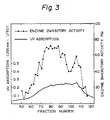
- Fraction Nos. 146 to 176 The fractions (Fraction Nos. 146 to 176) containing the compounds V and VI were concentrated under reduced pressure, the dry residue was dissolved in 100 ml of 20% methanol and then adsorbed on a HP-20 column (30 mm x 300 mm) which had previously been equilibrated with 20% methanol. This column was washed with 600 ml of 20% methanol and then subjected to elution using a linear gradient changing from 20 to 80% methanol (a total volume of 1200 l). As a result of fractionation into fractions of 10 ml each, the enzyme inhibitors were recovered in Fraction Nos. 71 to 111 (Fig. 3).
- the pure compounds I to VI which were isolated from the culture of Kitasatosporia kyotoensis and purified in the above-described steps were respectively named SUAM-20007, SUAM-20008, SUAM-20009, SUAM-20010, SUAM-200ll and SUAM-20012.
- the enzyme inhibitory activity of each of the compounds SUAM-20007, 20008, 20009, 20010, 20011 and 20012 of the present invention was measured by the following method:
- a given yl aliquot (a ⁇ l), which ranged from 0 - 50 ⁇ l, was taken from an aqueous solution of each of the compounds prepared in Example 1 at various set concentrations and was mixed with an aqueous solution of pepsin (50 ⁇ g/50 ⁇ l). To this mixture was added (150 - a) ⁇ l of 0.06 N-hydrochloric acid to adjust the pH value of the mixture to 3 to 5. Each of the solutions was then mixed with a substrate solution to start the reaction.
- the substrate for the reaction comprised 2.0% hemoglobin in 800 ⁇ l of 0.06 N-hydrochloric acid and the reaction was conducted at 35°C for 10 minutes, the total volume of the reaction mixture being 1 ml.
- the biologically active compounds of the present invention have a characteristic structure on the N-terminal side thereof and are highly soluble in solvents (particularly methanol) and thus can be easily purified. Since the compounds also have enzyme inhibitory activity against aspartic proteinases such as pepsin and the like, they will be useful for inhibiting the occurrence of gastric ulcer which is thought to be caused by aspartic proteinase, shortening the time of recovery therefrom, preventing proliferation of granuloma, preventing hepatic hypertension and preventing formation of virus disease lesion. Since the compounds of the present invention can also be used as ligands to form affinity columns, they are useful in application as reagents for purifying aspartic proteinases and for research on the mechanism of enzyme reactions.
Landscapes
- Health & Medical Sciences (AREA)
- Chemical & Material Sciences (AREA)
- Organic Chemistry (AREA)
- Medicinal Chemistry (AREA)
- General Health & Medical Sciences (AREA)
- Life Sciences & Earth Sciences (AREA)
- Veterinary Medicine (AREA)
- Nuclear Medicine, Radiotherapy & Molecular Imaging (AREA)
- General Chemical & Material Sciences (AREA)
- Pharmacology & Pharmacy (AREA)
- Chemical Kinetics & Catalysis (AREA)
- Animal Behavior & Ethology (AREA)
- Bioinformatics & Cheminformatics (AREA)
- Public Health (AREA)
- Engineering & Computer Science (AREA)
- Biophysics (AREA)
- Biochemistry (AREA)
- Proteomics, Peptides & Aminoacids (AREA)
- Molecular Biology (AREA)
- Genetics & Genomics (AREA)
- Crystallography & Structural Chemistry (AREA)
- Urology & Nephrology (AREA)
- Cardiology (AREA)
- Heart & Thoracic Surgery (AREA)
- Reproductive Health (AREA)
- Endocrinology (AREA)
- Preparation Of Compounds By Using Micro-Organisms (AREA)
- Peptides Or Proteins (AREA)
- Medicines That Contain Protein Lipid Enzymes And Other Medicines (AREA)
- Enzymes And Modification Thereof (AREA)
Priority Applications (1)
| Application Number | Priority Date | Filing Date | Title |
|---|---|---|---|
| AT88119126T ATE92077T1 (de) | 1987-11-17 | 1988-11-17 | Enzymhemmer und methode zu dessen herstellung. |
Applications Claiming Priority (2)
| Application Number | Priority Date | Filing Date | Title |
|---|---|---|---|
| JP289995/87 | 1987-11-17 | ||
| JP62289995A JP2625129B2 (ja) | 1987-11-17 | 1987-11-17 | 酵素活性阻害剤及びその製造法 |
Publications (3)
| Publication Number | Publication Date |
|---|---|
| EP0316907A2 true EP0316907A2 (fr) | 1989-05-24 |
| EP0316907A3 EP0316907A3 (en) | 1990-09-12 |
| EP0316907B1 EP0316907B1 (fr) | 1993-07-28 |
Family
ID=17750417
Family Applications (1)
| Application Number | Title | Priority Date | Filing Date |
|---|---|---|---|
| EP88119126A Expired - Lifetime EP0316907B1 (fr) | 1987-11-17 | 1988-11-17 | Inhibiteur d'enzyme et méthode pour son obtention |
Country Status (5)
| Country | Link |
|---|---|
| US (1) | US5087614A (fr) |
| EP (1) | EP0316907B1 (fr) |
| JP (1) | JP2625129B2 (fr) |
| AT (1) | ATE92077T1 (fr) |
| DE (1) | DE3882654T2 (fr) |
Cited By (2)
| Publication number | Priority date | Publication date | Assignee | Title |
|---|---|---|---|---|
| WO2006050861A3 (fr) * | 2004-11-10 | 2006-08-10 | Boehringer Ingelheim Int | Dérivés de statine pour traiter la maladie d'alzheimer ii |
| US7238774B2 (en) | 2004-11-10 | 2007-07-03 | Boehringer Ingelheim International Gmbh | Statine derivatives for the treatment of Alzheimer's disease III |
Family Cites Families (5)
| Publication number | Priority date | Publication date | Assignee | Title |
|---|---|---|---|---|
| EP0040435B1 (fr) * | 1980-05-20 | 1983-07-20 | Eisai Co., Ltd. | Dérivés de peptides et procédé pour leur préparation |
| US4479941A (en) * | 1981-12-10 | 1984-10-30 | Merck & Co., Inc. | Renin inhibitory peptides having PHE13 delection |
| EP0184855A3 (fr) * | 1984-12-14 | 1989-05-03 | Abbott Laboratories | Composés inhibiteurs de rénine |
| US4735933A (en) * | 1986-12-15 | 1988-04-05 | Warner-Lambert Company | Renin inhibitors III |
| US4874745A (en) * | 1987-10-01 | 1989-10-17 | Merck & Co., Inc. | Renin-inhibitory pepstatin phenyl derivatives |
-
1987
- 1987-11-17 JP JP62289995A patent/JP2625129B2/ja not_active Expired - Lifetime
-
1988
- 1988-11-16 US US07/271,965 patent/US5087614A/en not_active Expired - Fee Related
- 1988-11-17 DE DE88119126T patent/DE3882654T2/de not_active Expired - Fee Related
- 1988-11-17 AT AT88119126T patent/ATE92077T1/de active
- 1988-11-17 EP EP88119126A patent/EP0316907B1/fr not_active Expired - Lifetime
Cited By (2)
| Publication number | Priority date | Publication date | Assignee | Title |
|---|---|---|---|---|
| WO2006050861A3 (fr) * | 2004-11-10 | 2006-08-10 | Boehringer Ingelheim Int | Dérivés de statine pour traiter la maladie d'alzheimer ii |
| US7238774B2 (en) | 2004-11-10 | 2007-07-03 | Boehringer Ingelheim International Gmbh | Statine derivatives for the treatment of Alzheimer's disease III |
Also Published As
| Publication number | Publication date |
|---|---|
| EP0316907A3 (en) | 1990-09-12 |
| JPH01132599A (ja) | 1989-05-25 |
| US5087614A (en) | 1992-02-11 |
| EP0316907B1 (fr) | 1993-07-28 |
| DE3882654D1 (de) | 1993-09-02 |
| JP2625129B2 (ja) | 1997-07-02 |
| DE3882654T2 (de) | 1993-12-16 |
| ATE92077T1 (de) | 1993-08-15 |
Similar Documents
| Publication | Publication Date | Title |
|---|---|---|
| EP0177366B1 (fr) | Inhibiteurs d'enkephalinase B, leur préparation et compositions pharmaceutiques les contenant | |
| EP0885957B1 (fr) | Processus de deacylation de lipopeptides cycliques | |
| JPWO1997032975A1 (ja) | 環状リポペプチド物質の脱アシル化法 | |
| EP0315147A2 (fr) | Antibiotiques, bénanomicines A et B et déxylosylbenanomicine B, leur fabrication et utilisation | |
| EP0298640B1 (fr) | Agents antimicrobien, FR 109 615, et sa production | |
| US4492650A (en) | A54556 Antibiotics and process for production thereof | |
| EP0316907B1 (fr) | Inhibiteur d'enzyme et méthode pour son obtention | |
| CZ281418B6 (cs) | 2-amino-4-(hydroxymethyl)-3a,5,6,6a-tetrahydro-4H-cyklopent/d/oxazol-4,5,6-triol,způsob výroby a produkční mikroorganismy | |
| US5271935A (en) | Antibiotic, cammunocin, a process for the preparation thereof, and the use thereof as a pharmaceutical | |
| EP0387712B1 (fr) | Substance WS 7622 A,B,C et D, leurs dérivés, procédés pour leur préparation et leur utilisation | |
| KR100271997B1 (ko) | Fa-70d물질, 이를 생산하기 위한 방법 및 그 용도 | |
| US4764602A (en) | Antibiotics, and their production | |
| US5061730A (en) | Carboxylic acid derivatives | |
| US4526866A (en) | Angiotensin I-converting enzyme inhibitor and preparation of the same | |
| KR0155403B1 (ko) | 신규한 생리 활성 물질 엠알-387 에이, 엠알-387 비 및 그의 제조방법 | |
| US4292309A (en) | Antibiotics C-14482 B1, B2 and B3 | |
| JPWO1997031122A1 (ja) | Fa−70d物質、その製造法及びその用途 | |
| EP0310238B1 (fr) | Substances actives physiologiquement, la probestine et la prostatine, et leur production | |
| US4686308A (en) | Novel physiologically active substance MH435 | |
| CA2461033C (fr) | Coniosulfures et derives, leurs procedes de production et leur utilisation en tant que produits pharmaceutiques | |
| US4939241A (en) | Amino acid derivatives of antitumor activity | |
| JPH01228495A (ja) | 酵素阻害剤、その製法並びに用途 | |
| KR0122427B1 (ko) | 아미노펩티데이스 m 저해물질, 그의 제조방법 및 그를 생성하는 미생물 | |
| JP3068700B2 (ja) | 新規トレハゾリン誘導体およびその製造法 | |
| US4167448A (en) | Process for preparation of physiologically active peptides |
Legal Events
| Date | Code | Title | Description |
|---|---|---|---|
| PUAI | Public reference made under article 153(3) epc to a published international application that has entered the european phase |
Free format text: ORIGINAL CODE: 0009012 |
|
| AK | Designated contracting states |
Kind code of ref document: A2 Designated state(s): AT BE CH DE ES FR GB GR IT LI LU NL SE |
|
| RAP1 | Party data changed (applicant data changed or rights of an application transferred) |
Owner name: SUNTORY LIMITED |
|
| PUAL | Search report despatched |
Free format text: ORIGINAL CODE: 0009013 |
|
| AK | Designated contracting states |
Kind code of ref document: A3 Designated state(s): AT BE CH DE ES FR GB GR IT LI LU NL SE |
|
| 17P | Request for examination filed |
Effective date: 19901219 |
|
| 17Q | First examination report despatched |
Effective date: 19920904 |
|
| GRAA | (expected) grant |
Free format text: ORIGINAL CODE: 0009210 |
|
| AK | Designated contracting states |
Kind code of ref document: B1 Designated state(s): AT BE CH DE ES FR GB GR IT LI LU NL SE |
|
| PG25 | Lapsed in a contracting state [announced via postgrant information from national office to epo] |
Ref country code: IT Free format text: LAPSE BECAUSE OF FAILURE TO SUBMIT A TRANSLATION OF THE DESCRIPTION OR TO PAY THE FEE WITHIN THE PRE;WARNING: LAPSES OF ITALIAN PATENTS WITH EFFECTIVE DATE BEFORE 2007 MAY HAVE OCCURRED AT ANY TIME BEFORE 2007. THE CORRECT EFFECTIVE DATE MAY BE DIFFERENT FROM THE ONE RECORDED.SCRIBED TIME-LIMIT Effective date: 19930728 Ref country code: SE Effective date: 19930728 Ref country code: NL Effective date: 19930728 Ref country code: ES Free format text: THE PATENT HAS BEEN ANNULLED BY A DECISION OF A NATIONAL AUTHORITY Effective date: 19930728 Ref country code: GR Free format text: LAPSE BECAUSE OF FAILURE TO SUBMIT A TRANSLATION OF THE DESCRIPTION OR TO PAY THE FEE WITHIN THE PRESCRIBED TIME-LIMIT Effective date: 19930728 Ref country code: BE Effective date: 19930728 Ref country code: AT Effective date: 19930728 |
|
| REF | Corresponds to: |
Ref document number: 92077 Country of ref document: AT Date of ref document: 19930815 Kind code of ref document: T |
|
| REF | Corresponds to: |
Ref document number: 3882654 Country of ref document: DE Date of ref document: 19930902 |
|
| ET | Fr: translation filed | ||
| PG25 | Lapsed in a contracting state [announced via postgrant information from national office to epo] |
Ref country code: LU Free format text: LAPSE BECAUSE OF NON-PAYMENT OF DUE FEES Effective date: 19931130 |
|
| NLV1 | Nl: lapsed or annulled due to failure to fulfill the requirements of art. 29p and 29m of the patents act | ||
| PLBE | No opposition filed within time limit |
Free format text: ORIGINAL CODE: 0009261 |
|
| STAA | Information on the status of an ep patent application or granted ep patent |
Free format text: STATUS: NO OPPOSITION FILED WITHIN TIME LIMIT |
|
| 26N | No opposition filed | ||
| PGFP | Annual fee paid to national office [announced via postgrant information from national office to epo] |
Ref country code: CH Payment date: 19991022 Year of fee payment: 12 |
|
| PGFP | Annual fee paid to national office [announced via postgrant information from national office to epo] |
Ref country code: FR Payment date: 19991029 Year of fee payment: 12 |
|
| PGFP | Annual fee paid to national office [announced via postgrant information from national office to epo] |
Ref country code: GB Payment date: 19991109 Year of fee payment: 12 |
|
| PGFP | Annual fee paid to national office [announced via postgrant information from national office to epo] |
Ref country code: DE Payment date: 19991216 Year of fee payment: 12 |
|
| PG25 | Lapsed in a contracting state [announced via postgrant information from national office to epo] |
Ref country code: GB Free format text: LAPSE BECAUSE OF NON-PAYMENT OF DUE FEES Effective date: 20001117 |
|
| PG25 | Lapsed in a contracting state [announced via postgrant information from national office to epo] |
Ref country code: LI Free format text: LAPSE BECAUSE OF NON-PAYMENT OF DUE FEES Effective date: 20001130 Ref country code: CH Free format text: LAPSE BECAUSE OF NON-PAYMENT OF DUE FEES Effective date: 20001130 |
|
| GBPC | Gb: european patent ceased through non-payment of renewal fee |
Effective date: 20001117 |
|
| REG | Reference to a national code |
Ref country code: CH Ref legal event code: PL |
|
| PG25 | Lapsed in a contracting state [announced via postgrant information from national office to epo] |
Ref country code: FR Free format text: LAPSE BECAUSE OF NON-PAYMENT OF DUE FEES Effective date: 20010731 |
|
| PG25 | Lapsed in a contracting state [announced via postgrant information from national office to epo] |
Ref country code: DE Free format text: LAPSE BECAUSE OF NON-PAYMENT OF DUE FEES Effective date: 20010801 |
|
| REG | Reference to a national code |
Ref country code: FR Ref legal event code: ST |