EP0316968A2 - Procédé pour la production de systèmes actifs pour l'emmagasinage de l'hydrogène par hydrures de magnésium - Google Patents
Procédé pour la production de systèmes actifs pour l'emmagasinage de l'hydrogène par hydrures de magnésium Download PDFInfo
- Publication number
- EP0316968A2 EP0316968A2 EP88121553A EP88121553A EP0316968A2 EP 0316968 A2 EP0316968 A2 EP 0316968A2 EP 88121553 A EP88121553 A EP 88121553A EP 88121553 A EP88121553 A EP 88121553A EP 0316968 A2 EP0316968 A2 EP 0316968A2
- Authority
- EP
- European Patent Office
- Prior art keywords
- magnesium
- hydrogenation
- sample
- nickel
- hydrogen
- Prior art date
- Legal status (The legal status is an assumption and is not a legal conclusion. Google has not performed a legal analysis and makes no representation as to the accuracy of the status listed.)
- Granted
Links
Images



Classifications
-
- C—CHEMISTRY; METALLURGY
- C01—INORGANIC CHEMISTRY
- C01B—NON-METALLIC ELEMENTS; COMPOUNDS THEREOF; METALLOIDS OR COMPOUNDS THEREOF NOT COVERED BY SUBCLASS C01C
- C01B3/00—Hydrogen; Gaseous mixtures containing hydrogen; Separation of hydrogen from mixtures containing it; Purification of hydrogen; Reversible storage of hydrogen
- C01B3/0005—Reversible storage of hydrogen, e.g. by hydrogen getters or electrodes
- C01B3/001—Reversible storage of hydrogen, e.g. by hydrogen getters or electrodes characterised by the uptaking media; Treatment thereof
- C01B3/0018—Inorganic elements or compounds, e.g. oxides, nitrides, borohydrides or zeolites; Solutions thereof
- C01B3/0026—Metals or metal hydrides
-
- C—CHEMISTRY; METALLURGY
- C01—INORGANIC CHEMISTRY
- C01B—NON-METALLIC ELEMENTS; COMPOUNDS THEREOF; METALLOIDS OR COMPOUNDS THEREOF NOT COVERED BY SUBCLASS C01C
- C01B3/00—Hydrogen; Gaseous mixtures containing hydrogen; Separation of hydrogen from mixtures containing it; Purification of hydrogen; Reversible storage of hydrogen
- C01B3/0005—Reversible storage of hydrogen, e.g. by hydrogen getters or electrodes
- C01B3/001—Reversible storage of hydrogen, e.g. by hydrogen getters or electrodes characterised by the uptaking media; Treatment thereof
- C01B3/0078—Composite solid storage media, e.g. mixtures of polymers and metal hydrides, coated solid compounds or structurally heterogeneous solid compounds
-
- Y—GENERAL TAGGING OF NEW TECHNOLOGICAL DEVELOPMENTS; GENERAL TAGGING OF CROSS-SECTIONAL TECHNOLOGIES SPANNING OVER SEVERAL SECTIONS OF THE IPC; TECHNICAL SUBJECTS COVERED BY FORMER USPC CROSS-REFERENCE ART COLLECTIONS [XRACs] AND DIGESTS
- Y02—TECHNOLOGIES OR APPLICATIONS FOR MITIGATION OR ADAPTATION AGAINST CLIMATE CHANGE
- Y02E—REDUCTION OF GREENHOUSE GAS [GHG] EMISSIONS, RELATED TO ENERGY GENERATION, TRANSMISSION OR DISTRIBUTION
- Y02E60/00—Enabling technologies; Technologies with a potential or indirect contribution to GHG emissions mitigation
- Y02E60/30—Hydrogen technology
- Y02E60/32—Hydrogen storage
Definitions
- the present invention relates to a method for producing active magnesium hydride-magnesium systems (MgH2-Mg systems) which can be used as reversible hydrogen storage systems.
- MgH2-Mg systems active magnesium hydride-magnesium systems
- the MgH2-Mg system is characterized by the highest proportion by weight of reversibly bound hydrogen (7.65% by weight) and thus the highest energy density per unit weight of the storage material from (2332 Wh / kg; Reilly and Sandrock, Spektrum dermaschine, April 1980, 53).
- the MgH2-Mg system appears as an optimal hydrogen storage system for mobile purposes, for example for hydrogen-powered vehicles, the unsatisfactory kinetics of this system has hindered such an application. It is known that pure magnesium can only be hydrogenated under drastic conditions and then only very slowly and incompletely. The dehydrogenation rate of the magnesium hydride produced in this way is also unacceptable for a hydrogen storage (see, for example, Genossar and Rudman, ZF Phys. Chem., Neue Episode 116 , 215 (1979) and the literature cited therein).
- the process according to the invention consists in doping magnesium hydride or metallic magnesium in finely divided form by contact with a solution of a suitable transition metal complex or a suitable transition metal-organic compound.
- the respective transition metal is excreted in an extremely fine distribution on the surface of the magnesium hydride or magnesium particles and takes on the role of the catalyst in dehydrogenation and hydrogenation processes.
- a particular advantage of the process according to the invention using soluble transition metal complexes or organic transition metal compounds lies in the fact that even small amounts of the applied transition metals produce a strong catalytic effect immediately or after a few dehydrogenation-hydrogenation cycles, and that this catalytic effect continues Dehydrogenation-hydrogenation is maintained; in the case of nickel which has been electrolytically precipitated from magnesium (Eisenberg, Zagnoli and Sheridan, Journ. Less-Common Metals, 74 , 323 (1980), on the other hand, the catalytic effect of nickel has decreased considerably after just a few hydrogenation-dehydrogenation cycles. In general the present A maximum of 3% by weight of the transition metal in question, based on magnesium hydride or magnesium, is sufficient for the desired catalytic effect to occur, and the H2 storage capacity of the systems thus obtainable is therefore relatively high.
- the process according to the invention using elementary transition metals in finely divided form consists in intimately contacting magnesium metal in finely divided form and a suitable transition metal in finely divided form by mechanical means, for example by dry milling or by grinding in the presence of an organic solvent. whereby magnesium is doped with the relevant transition metal.
- Suitable transition metals are the elements of IV to VII. Subgroup of the periodic system, e.g. Ti, V, Cr, Mo, W, Fe, Ru, Co, Rh, Ir, Ni, Pd and / or Pt.
- the preferred transition metal complexes or transition metal organic compounds according to the present process are complex or metal organic compounds of nickel, palladium and iron; of these, bis (1,5-cyclooctadiene) nickel (COD2Ni), bis ( ⁇ 3-allyl) nickel, bis (acetylacetonato) nickel, bis (ethylato) nickel, phosphine-nickel complexes and tetracarbonyl nickel are particularly preferably used.
- the transition metals palladium and iron are preferably used in the form of ⁇ 3-allyl, ⁇ 5-cyclopentadienyl, olefin, phosphine, acetylacetonato or carbonyl complexes as dopants.
- complexes or organometallic compounds of the metals Pt, Co, Rh, Ir, Fe, Ru, Cr, Mo, W, Ti and V can also be used for doping the magnesium or magnesium hydride.
- the preferred transition metals for the direct doping of magnesium with elemental transition metal are nickel, palladium and iron; of these, nickel is particularly preferred.
- the metals Pt, Co, Rh, Ir, Ru, Cr, Mo, W, Ti and V can also be used for doping magnesium.
- magnesium hydride can also be used, which can be obtained by doping with a transition metal complex, e.g. Bis-COD-nickel (Example 9) can be converted to a magnesium hydride with good kinetic properties of dehydrogenation / hydrogenation.
- a transition metal complex e.g. Bis-COD-nickel (Example 9)
- Doping using transition metal complexes or transition metal organic compounds can be in an aliphatic, cycloaliphatic or aromatic hydrocarbon or in an aliphatic, aromatic or cyclic ether such as e.g. Tetrahydrofuran (THF) in which the transition metal complex or the transition metal organic compound in question is soluble or partially soluble.
- THF Tetrahydrofuran
- the doping of the homogeneously catalyzed magnesium hydride with COD2Ni in THF can be carried out in situ in the presence of the homogeneous hydrogenation catalyst, or the doping can be separated from the catalyst and THF in another solvent, e.g. in toluene.
- the doping using elemental transition metals is preferably carried out in an aliphatic, cycloaliphatic or aromatic hydrocarbon.
- thermovolumetric apparatus developed for this purpose was used to carry out normal pressure tests (Bogdanovic and Spliethoff, Chem.-Ing.-Tech. 1983, in press).
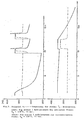
- the curves a in FIG. 1 show the course of a dehydrogenation-hydrogenation cycle of a MgH 2 sample (0.69 g) produced by the same method (Ti catalyst) but not doped (dehydrogenation: 329 ° C./ 1 bar, hydrogenation: 230 ° C / 1 bar).
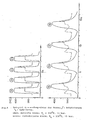
- a 19.09 g sample of the nickel-doped magnesium hydride was taken from a series of 42 dehydrogenation-hydrogenation cycles thrown, the hydrogenation pressure and hydrogenation times (Z h ) being varied.
- the outside temperature for the dehydrogenation (T d ) was 367 ° C. in each case and for the hydrogenation (T h ) 267 ° C.
- the information on the pressure test carried out is given in Table I; Fig. 2 above shows the characteristic hydrogen emission and absorption curves of the cycles carried out at 10, 5, 3 and 2 bar H2 pressure, as well as the associated temperature curves of the sample.
- Example 4 4 samples of 21-23 g each of the magnesium hydride thus obtained (samples a - d) were suspended in 300 ml of toluene, the toluene suspensions were mixed with various amounts of solid COD2Ni (Table II) and the batches were stirred at 100 ° C. for 15 h. The doped MgH2 samples were then filtered off, washed with toluene and pentane and dried in vacuo (0.2 mbar). A sample of undoped MgH2 was treated in the same way in toluene at 100 ° C in the same way without addition of COD2Ni (sample e).
- the nickel-doped MgH2 samples a - d was, as described in Example 1, subjected to a dehydrogenation-hydrogenation cycle.
- the results of the normal pressure test show that a substantial improvement in the hydrogenation kinetics is achieved by doping with 0.8% Ni (sample c). When doping with even larger amounts of Ni (sample a or b), this leads to an insignificant further improvement in the hydrogenation kinetics.
- sample b 0.79 g of sample b (3.3% Ni) and 0.65 g of the undoped MgH2 sample (sample e) were dehydrated at 330 ° C. and normal pressure.
- the samples of "active magnesium" thus obtained were hydrogenated in the temperature range from 100 to 283 ° C and 1 bar (H2 pressure).
- H2 pressure 1 bar
- both samples can be hydrogenated at a noticeable rate from about 150 ° C at normal pressure.
- the hydrogenation rates increase with increasing temperature and reach a maximum at 250 255 ° C in both samples. If the temperature rises further, the hydrogenation rates naturally decrease because the systems approach their equilibrium state (284 ° C, 1 bar).
- the comparison of the two samples shows that the doped sample has significantly better hydrogenation kinetics in the entire temperature range examined.
- Sample b (3.3% Ni) was dehydrated at 330 ° C / 1 bar.
- Each 11.0 g of the "active magnesium" thus obtained were hydrogenated in a 300 ml autoclave at various H2 pressures.
- the autoclave was heated at a constant rate of 2 ° C / min. heated and the temperature measured inside the respective sample.
- the "ignition temperature" of the sample is approx. 150 ° C.
- the sample heats up briefly to 380 - 390 ° C due to the heat of hydrogenation, and after a further 10 min. the hydrogenation process is practically complete.
- the ignition temperature is naturally higher (190 - 200 ° C) and during the hydrogenation a temperature of at most 270 - 290 ° C is reached.
- the maximum achievable hydrogenation temperature can thus be preset by specifying the H2 pressure, since it cannot exceed the equilibrium temperature corresponding to the H2 pressure.
- a 15.0 g sample of the Ni-doped magnesium powder was subjected to a series of 66 hydrogenation-dehydrogenation cycles, the hydrogenation pressure, hydrogenation temperature (T h ) and hydrogenation time (Z h ) being varied.
- the autoclave temperature during the dehydrogenation (T d ) was 366 ° C. in each case and the dehydrogenation time (Z d ) was 1 hour.
- Table III contains information on the pressure test carried out.
- Composition of the Fe-doped magnesium hydride C 9.45, H 7.13, Mg 78.19, Fe 1.98, Cr 0.45 and Cl 2.56%.
- the iron-doped MgH2 sample shows improved kinetic properties in the normal pressure test compared to the undoped sample (sample h).
- the suspension was filtered, the doped magnesium hydride washed with toluene and pentane and dried in a high vacuum. 19.90 g of product of the composition C 0.39, H 4.95, Mg 84.02 and Ni 1.89% were obtained.
- the doped MgH2 sample showed significantly improved kinetic properties in the normal pressure test and pressure test compared to the undoped MgH2 sample (Alpha Products).
- the "effective hydrogenation times" (the time until the respective H2 uptake came to a standstill by the active magnesium) came to an end 1, 2, 3, 5 or 15 bar (H2 overpressure) 1.2, 0.9, 0.8, 0.6 or 0.4 h, the temperature in the interior of the sample being up to that predetermined H2 pressure corresponding equilibrium temperature rose.
- the effective dehydration times for the dehydrogenations were 0.6 h, the temperature inside the sample dropping below 300 ° C.
- the reversible hydrogen content in the hydrogenation-dehydrogenation cycles was 11.3-12.6 l (20 ° C./1 bar), corresponding to 6.0-6.6% by weight, based on MgH2.
- a 22 cycle pressure test under the same conditions was also performed on a 15.0 g sample of the undoped magnesium powder (Alfa Products, 325 mesh). The comparison of the two tests showed drastic differences in the kinetic behavior of the two samples in favor of the Ni-doped sample: the initial hydrogenation was one Factor of at least 3 and the subsequent hydrogenations at 5 or 3 bar by a factor of at least 10 or 15 faster than the hydrogenation of the undoped sample.
- the reversible hydrogen content of the undoped sample was, depending on the hydrogenation pressure and duration, 6.3-6.8% by weight, based on MgH2.
- a process for the production of active, reversible H2-absorbing magnesium hydride-magnesium hydrogen storage systems characterized in that magnesium hydride or metallic magnesium in finely divided form by contact with a solution of a metal complex and / or an organometallic compound of a metal of subgroup IV.
- a metal complex characterized in that magnesium hydride or metallic magnesium in finely divided form by contact with a solution of a metal complex and / or an organometallic compound of a metal of subgroup IV.
- To VIII periodic systems if necessary in the presence of hydrogen, the respective transition metal being precipitated on the surface of the magnesium hydride and / or the magnesium particles.
- magnesium metal with grain sizes of 0.3 to 0.045 mm (50 - 325 mesh), preferably with 0.045 mm (325 mesh), if necessary is brought into contact with a solution of a transition metal complex or a transition metal organic compound in the presence of hydrogen.
- Nickel complexes and / or organo-nickel compounds bis (cyclooctadiene-1,5) nickel (COD2Ni), tetracarbonyl nickel, phosphane-nickel (0) complexes, bis (acetylacetonato) nickel, bis (ethylato) nickel or bis as the excretion agent ( ⁇ 3-allyl) nickel can be used.
Landscapes
- Chemical & Material Sciences (AREA)
- Organic Chemistry (AREA)
- Chemical Kinetics & Catalysis (AREA)
- Engineering & Computer Science (AREA)
- Combustion & Propulsion (AREA)
- Inorganic Chemistry (AREA)
- Life Sciences & Earth Sciences (AREA)
- Environmental & Geological Engineering (AREA)
- General Life Sciences & Earth Sciences (AREA)
- Geology (AREA)
- Organic Low-Molecular-Weight Compounds And Preparation Thereof (AREA)
- Catalysts (AREA)
- Solid-Sorbent Or Filter-Aiding Compositions (AREA)
- Hydrogen, Water And Hydrids (AREA)
Priority Applications (2)
| Application Number | Priority Date | Filing Date | Title |
|---|---|---|---|
| EP88121553A EP0316968B1 (fr) | 1982-12-22 | 1983-12-20 | Procédé pour la production de systèmes actifs pour l'emmagasinage de l'hydrogène par hydrures de magnésium |
| AT88121553T ATE77602T1 (de) | 1982-12-22 | 1983-12-20 | Verfahren zur herstellung aktiver magnesiumhydrid-magnesium-wasserstoffspeichersy teme. |
Applications Claiming Priority (3)
| Application Number | Priority Date | Filing Date | Title |
|---|---|---|---|
| DE3247360 | 1982-12-22 | ||
| DE19823247360 DE3247360A1 (de) | 1982-12-22 | 1982-12-22 | Verfahren zur herstellung aktiver magnetsiumhdrid-magnesium-wasserstoffspeichersysteme |
| EP88121553A EP0316968B1 (fr) | 1982-12-22 | 1983-12-20 | Procédé pour la production de systèmes actifs pour l'emmagasinage de l'hydrogène par hydrures de magnésium |
Related Parent Applications (1)
| Application Number | Title | Priority Date | Filing Date |
|---|---|---|---|
| EP83112833.5 Division | 1983-12-20 |
Publications (3)
| Publication Number | Publication Date |
|---|---|
| EP0316968A2 true EP0316968A2 (fr) | 1989-05-24 |
| EP0316968A3 EP0316968A3 (en) | 1990-07-25 |
| EP0316968B1 EP0316968B1 (fr) | 1992-06-24 |
Family
ID=25806745
Family Applications (1)
| Application Number | Title | Priority Date | Filing Date |
|---|---|---|---|
| EP88121553A Expired - Lifetime EP0316968B1 (fr) | 1982-12-22 | 1983-12-20 | Procédé pour la production de systèmes actifs pour l'emmagasinage de l'hydrogène par hydrures de magnésium |
Country Status (2)
| Country | Link |
|---|---|
| EP (1) | EP0316968B1 (fr) |
| AT (1) | ATE77602T1 (fr) |
Cited By (4)
| Publication number | Priority date | Publication date | Assignee | Title |
|---|---|---|---|---|
| DE4027976A1 (de) * | 1990-09-04 | 1992-03-05 | Goldschmidt Ag Th | Verfahren zur herstellung aktiver magnesiumhydrid-magnesium-wasserstoff-speichersysteme und vorrichtung zur durchfuehrung des verfahrens |
| US6193929B1 (en) * | 1999-11-06 | 2001-02-27 | Energy Conversion Devices, Inc. | High storage capacity alloys enabling a hydrogen-based ecosystem |
| CN100431945C (zh) * | 2007-01-23 | 2008-11-12 | 太原理工大学 | 一种镁基储氢材料的制备方法 |
| CN116143077A (zh) * | 2023-04-19 | 2023-05-23 | 烟台大学 | 一种作为氢气储存介质的氢化镁的制备方法 |
Families Citing this family (1)
| Publication number | Priority date | Publication date | Assignee | Title |
|---|---|---|---|---|
| DE102004002120A1 (de) * | 2004-01-14 | 2005-08-18 | Gkss-Forschungszentrum Geesthacht Gmbh | Metallhaltiger, wasserstoffspeichernder Werkstoff und Verfahren zu seiner Herstellung |
Family Cites Families (3)
| Publication number | Priority date | Publication date | Assignee | Title |
|---|---|---|---|---|
| FR2407169A1 (fr) * | 1977-10-27 | 1979-05-25 | Raffinage Cie Francaise | Procede de preparation d'une reserve d'hydrogene et applications de ce procede. |
| CH634015A5 (fr) * | 1978-11-14 | 1983-01-14 | Battelle Memorial Institute | Composition a base de magnesium pour le stockage de l'hydrogene et procede de preparation de cette composition. |
| US4389326A (en) * | 1979-08-27 | 1983-06-21 | Agence Nationale De Valorization De La Recherche | Method of storing hydrogen in intimate mixtures of hydrides of magnesium and other metals or alloys |
-
1983
- 1983-12-20 EP EP88121553A patent/EP0316968B1/fr not_active Expired - Lifetime
- 1983-12-20 AT AT88121553T patent/ATE77602T1/de not_active IP Right Cessation
Cited By (5)
| Publication number | Priority date | Publication date | Assignee | Title |
|---|---|---|---|---|
| DE4027976A1 (de) * | 1990-09-04 | 1992-03-05 | Goldschmidt Ag Th | Verfahren zur herstellung aktiver magnesiumhydrid-magnesium-wasserstoff-speichersysteme und vorrichtung zur durchfuehrung des verfahrens |
| EP0474043A1 (fr) * | 1990-09-04 | 1992-03-11 | Th. Goldschmidt AG | Procédé de fabrication de systèmes actifs de stockage à base de hydrure de magnésium-magnésium hydrogène et dispositif à cet effet |
| US6193929B1 (en) * | 1999-11-06 | 2001-02-27 | Energy Conversion Devices, Inc. | High storage capacity alloys enabling a hydrogen-based ecosystem |
| CN100431945C (zh) * | 2007-01-23 | 2008-11-12 | 太原理工大学 | 一种镁基储氢材料的制备方法 |
| CN116143077A (zh) * | 2023-04-19 | 2023-05-23 | 烟台大学 | 一种作为氢气储存介质的氢化镁的制备方法 |
Also Published As
| Publication number | Publication date |
|---|---|
| ATE77602T1 (de) | 1992-07-15 |
| EP0316968B1 (fr) | 1992-06-24 |
| EP0316968A3 (en) | 1990-07-25 |
Similar Documents
| Publication | Publication Date | Title |
|---|---|---|
| EP0112548B1 (fr) | Procédé pour la production de systèmes actifs pour l'emmagasinage de l'hydrogène par hydrures de magnésium | |
| DE69801837T2 (de) | Nanokomposite mit aktivierten grenzflächen hergestellt durch mechanische zermahlung von magnesiumhydriden und deren verwendung zur wasserstoffspeicherung | |
| EP0490156B1 (fr) | Procédé de préparation d'un système de stockage hydrure de magnésium-magnésium-hydrogène, accepteur d'hydrogène, actif et réversible | |
| DE69807320T2 (de) | Gelaugte nanokrristalline materialien, verfahren zu deren herstellung und verwendung im energiesektor | |
| DE69704547T2 (de) | Nanokristalliner verbundstoff zur wasserstoffspeicherung | |
| EP0840707B1 (fr) | Procede de stockage reversible d'hydrogene | |
| DE69113966T2 (de) | Verbundpulver aus aluminiumoxyd/metall, cermets daraus und verfahren zu ihrer herstellung. | |
| EP0423627B1 (fr) | Procédé de préparation de poudre d'un métal ou d'un alliage microcristallin à amorphe, ainsi que des métaux ou alliages dissous dans des solvants organiques sans colloide protecteur | |
| EP1263676A1 (fr) | Procede d'accumulation reversible d'hydrogene fonde sur l'utilisation de metaux alcalins et d'aluminium | |
| EP1042218B1 (fr) | Procede pour la production d'hydrures metalliques nanocristallins | |
| DE2719932A1 (de) | Verfahren zur herstellung eines hochdispersen nickeltraegerkatalysators | |
| DE69933184T2 (de) | Kupferhaltiger Katalysator, dessen Verfahren zur Herstellung und seine Verwendung | |
| DE102005037893A1 (de) | Verfahren zur Herstellung hochaktiver Metall/Metalloxid-Katalysatoren | |
| DE19836585C1 (de) | Au/Fe¶2¶0¶3¶-Katalysatormaterialien, Verfahren zu deren Herstellung und deren Verwendung | |
| US4554152A (en) | Method of preparing active magnesium-hydride or magnesium hydrogen-storer systems | |
| US5199972A (en) | Method of preparing active magnesium-hydride or magnesium hydrogen-storer systems | |
| EP0685425A1 (fr) | Procédé pour la préparation d'hydrure de magnésium | |
| DE69917178T2 (de) | Ternäre Wasserstoffspeichernde Legierung und Verfahren zu deren Herstellung | |
| EP0316968B1 (fr) | Procédé pour la production de systèmes actifs pour l'emmagasinage de l'hydrogène par hydrures de magnésium | |
| DE3687447T2 (de) | Verfahren zur herstellung von feinverteilten metallpulvern. | |
| EP0111923A2 (fr) | Procédé pour la séparation et purification de l'hydrogène | |
| DE69024884T2 (de) | Verfahren zur Herstellung von feinem Kupferpulver | |
| EP1299191B1 (fr) | Catalyseurs de nickel metalliques d'hydrogenation, leur production et leur utilisation | |
| EP0177768B1 (fr) | Procédé pour la production catalytique d'alcoolats de métaux alcalins | |
| DE3780852T2 (de) | Intermetallische verbindungen, deren hydriden und verfahren zu deren herstellung. |
Legal Events
| Date | Code | Title | Description |
|---|---|---|---|
| PUAI | Public reference made under article 153(3) epc to a published international application that has entered the european phase |
Free format text: ORIGINAL CODE: 0009012 |
|
| 17P | Request for examination filed |
Effective date: 19881223 |
|
| AC | Divisional application: reference to earlier application |
Ref document number: 112548 Country of ref document: EP |
|
| AK | Designated contracting states |
Kind code of ref document: A2 Designated state(s): AT BE CH DE FR GB IT LI LU NL |
|
| PUAL | Search report despatched |
Free format text: ORIGINAL CODE: 0009013 |
|
| AK | Designated contracting states |
Kind code of ref document: A3 Designated state(s): AT BE CH DE FR GB IT LI LU NL |
|
| 17Q | First examination report despatched |
Effective date: 19910128 |
|
| GRAA | (expected) grant |
Free format text: ORIGINAL CODE: 0009210 |
|
| AC | Divisional application: reference to earlier application |
Ref document number: 112548 Country of ref document: EP |
|
| AK | Designated contracting states |
Kind code of ref document: B1 Designated state(s): AT BE CH DE FR GB IT LI LU NL |
|
| REF | Corresponds to: |
Ref document number: 77602 Country of ref document: AT Date of ref document: 19920715 Kind code of ref document: T |
|
| ITF | It: translation for a ep patent filed | ||
| REF | Corresponds to: |
Ref document number: 3382583 Country of ref document: DE Date of ref document: 19920730 |
|
| GBT | Gb: translation of ep patent filed (gb section 77(6)(a)/1977) | ||
| ET | Fr: translation filed | ||
| PLBE | No opposition filed within time limit |
Free format text: ORIGINAL CODE: 0009261 |
|
| STAA | Information on the status of an ep patent application or granted ep patent |
Free format text: STATUS: NO OPPOSITION FILED WITHIN TIME LIMIT |
|
| 26N | No opposition filed | ||
| EPTA | Lu: last paid annual fee | ||
| PGFP | Annual fee paid to national office [announced via postgrant information from national office to epo] |
Ref country code: GB Payment date: 19971113 Year of fee payment: 15 Ref country code: FR Payment date: 19971113 Year of fee payment: 15 |
|
| PGFP | Annual fee paid to national office [announced via postgrant information from national office to epo] |
Ref country code: CH Payment date: 19971124 Year of fee payment: 15 |
|
| PGFP | Annual fee paid to national office [announced via postgrant information from national office to epo] |
Ref country code: AT Payment date: 19971126 Year of fee payment: 15 |
|
| PGFP | Annual fee paid to national office [announced via postgrant information from national office to epo] |
Ref country code: LU Payment date: 19971128 Year of fee payment: 15 Ref country code: DE Payment date: 19971128 Year of fee payment: 15 |
|
| PGFP | Annual fee paid to national office [announced via postgrant information from national office to epo] |
Ref country code: NL Payment date: 19971130 Year of fee payment: 15 |
|
| PGFP | Annual fee paid to national office [announced via postgrant information from national office to epo] |
Ref country code: BE Payment date: 19971208 Year of fee payment: 15 |
|
| PG25 | Lapsed in a contracting state [announced via postgrant information from national office to epo] |
Ref country code: LU Free format text: LAPSE BECAUSE OF NON-PAYMENT OF DUE FEES Effective date: 19981220 Ref country code: GB Free format text: LAPSE BECAUSE OF NON-PAYMENT OF DUE FEES Effective date: 19981220 Ref country code: AT Free format text: LAPSE BECAUSE OF NON-PAYMENT OF DUE FEES Effective date: 19981220 |
|
| PG25 | Lapsed in a contracting state [announced via postgrant information from national office to epo] |
Ref country code: LI Free format text: LAPSE BECAUSE OF NON-PAYMENT OF DUE FEES Effective date: 19981231 Ref country code: CH Free format text: LAPSE BECAUSE OF NON-PAYMENT OF DUE FEES Effective date: 19981231 Ref country code: BE Free format text: LAPSE BECAUSE OF NON-PAYMENT OF DUE FEES Effective date: 19981231 |
|
| BERE | Be: lapsed |
Owner name: STUDIEN G.- KOHLE M.B.H. Effective date: 19981231 |
|
| PG25 | Lapsed in a contracting state [announced via postgrant information from national office to epo] |
Ref country code: NL Free format text: LAPSE BECAUSE OF NON-PAYMENT OF DUE FEES Effective date: 19990701 |
|
| GBPC | Gb: european patent ceased through non-payment of renewal fee |
Effective date: 19981220 |
|
| REG | Reference to a national code |
Ref country code: CH Ref legal event code: PL |
|
| PG25 | Lapsed in a contracting state [announced via postgrant information from national office to epo] |
Ref country code: FR Free format text: LAPSE BECAUSE OF NON-PAYMENT OF DUE FEES Effective date: 19990831 |
|
| NLV4 | Nl: lapsed or anulled due to non-payment of the annual fee |
Effective date: 19990701 |
|
| REG | Reference to a national code |
Ref country code: FR Ref legal event code: ST |
|
| PG25 | Lapsed in a contracting state [announced via postgrant information from national office to epo] |
Ref country code: DE Free format text: LAPSE BECAUSE OF NON-PAYMENT OF DUE FEES Effective date: 19991001 |