EP0317723A2 - Vorrichtung zum Aufbewahren von Geschirr oder dergleichen in mehreren Stapeln - Google Patents
Vorrichtung zum Aufbewahren von Geschirr oder dergleichen in mehreren Stapeln Download PDFInfo
- Publication number
- EP0317723A2 EP0317723A2 EP88115232A EP88115232A EP0317723A2 EP 0317723 A2 EP0317723 A2 EP 0317723A2 EP 88115232 A EP88115232 A EP 88115232A EP 88115232 A EP88115232 A EP 88115232A EP 0317723 A2 EP0317723 A2 EP 0317723A2
- Authority
- EP
- European Patent Office
- Prior art keywords
- receiving region
- partitions
- pair
- slits
- region
- Prior art date
- Legal status (The legal status is an assumption and is not a legal conclusion. Google has not performed a legal analysis and makes no representation as to the accuracy of the status listed.)
- Granted
Links
- 238000005192 partition Methods 0.000 claims abstract description 154
- 238000000638 solvent extraction Methods 0.000 claims abstract description 63
- 230000000087 stabilizing effect Effects 0.000 claims description 26
- 230000015572 biosynthetic process Effects 0.000 abstract description 2
- 239000004698 Polyethylene Substances 0.000 description 5
- -1 polyethylene Polymers 0.000 description 5
- 229920000573 polyethylene Polymers 0.000 description 5
- 239000002184 metal Substances 0.000 description 4
- 238000001175 rotational moulding Methods 0.000 description 2
- 238000000071 blow moulding Methods 0.000 description 1
- KVFIJIWMDBAGDP-UHFFFAOYSA-N ethylpyrazine Chemical compound CCC1=CN=CC=N1 KVFIJIWMDBAGDP-UHFFFAOYSA-N 0.000 description 1
- 238000010097 foam moulding Methods 0.000 description 1
- 238000004519 manufacturing process Methods 0.000 description 1
- 239000000463 material Substances 0.000 description 1
- 238000000034 method Methods 0.000 description 1
- 238000012986 modification Methods 0.000 description 1
- 230000004048 modification Effects 0.000 description 1
- 238000010107 reaction injection moulding Methods 0.000 description 1
- 102220321320 rs202148988 Human genes 0.000 description 1
- 239000004616 structural foam Substances 0.000 description 1
Images




Classifications
-
- A—HUMAN NECESSITIES
- A47—FURNITURE; DOMESTIC ARTICLES OR APPLIANCES; COFFEE MILLS; SPICE MILLS; SUCTION CLEANERS IN GENERAL
- A47J—KITCHEN EQUIPMENT; COFFEE MILLS; SPICE MILLS; APPARATUS FOR MAKING BEVERAGES
- A47J47/00—Kitchen containers, stands or the like, not provided for in other groups of this subclass; Cutting-boards, e.g. for bread
- A47J47/16—Stands, or holders for kitchen articles
-
- A—HUMAN NECESSITIES
- A47—FURNITURE; DOMESTIC ARTICLES OR APPLIANCES; COFFEE MILLS; SPICE MILLS; SUCTION CLEANERS IN GENERAL
- A47F—SPECIAL FURNITURE, FITTINGS, OR ACCESSORIES FOR SHOPS, STOREHOUSES, BARS, RESTAURANTS OR THE LIKE; PAYING COUNTERS
- A47F7/00—Show stands, hangers, or shelves, adapted for particular articles or materials
- A47F7/0007—Show stands, hangers, or shelves, adapted for particular articles or materials for stacked articles; Stabilising means therefor
-
- A—HUMAN NECESSITIES
- A47—FURNITURE; DOMESTIC ARTICLES OR APPLIANCES; COFFEE MILLS; SPICE MILLS; SUCTION CLEANERS IN GENERAL
- A47B—TABLES; DESKS; OFFICE FURNITURE; CABINETS; DRAWERS; GENERAL DETAILS OF FURNITURE
- A47B31/00—Service or tea tables, trolleys, or wagons
- A47B2031/007—Service or tea tables, trolleys, or wagons for carrying plates
Definitions
- the present invention relates to a device for storing a plurality of dishes or the like in a plurality of stacks.
- This device has particular utility as a dish dolly or cart for storing and transporting dishes of various sizes in institutions, such as hospitals or restaurants.
- this device may be utilized to store and transport other dish or saucer-shaped objects which are stackable in "poker-chip" fashion.
- Devices for storing and transporting objects such as dishes.
- objects such as dishes.
- InterMetro Industries Corporation the assignee of the subject invention, makes and sells various types of such devices.
- a number of partitions project vertically from a base to form a plurality of vertically extending column-like regions in which stacks of dishes can be confined.
- Models identified by numbers T17A44P, T17A24P, T17A40P, T17B44P, T17B24P, T17B40P, T1AN, T1BN, T2AN, T2BN, T3N, T4N, T5N, 18C04P, and T16A in these series may be designed to store, for example, four, eight, ten, or twelve stacks of dishes, depending on the specific model chosen.
- Another disadvantage of these dollies is that a certain amount of space is wasted because a partition is placed at the center of the dolly, thereby preventing dishes from being stacked in that region.
- model number T4N discussed above is partitioned into nine areas; however, only eight of these areas are used for stacking dishes. The ninth area is taken up by a partition at the center of the cart.
- This central partition wastes valuable space that could otherwise be used to store dishes. Consequently, a larger number of dollies must be used than would otherwise be necessary when the number of stacks of dishes exceeds the number of vertically extending column-like regions in the dolly by one. This is particularly disadvantageous in many settings such as hospitals and restaurants, where floor space is at a premium.
- Cambro Dish Cart Model DC 975 is a one piece double-wall polyethylene dish cart that can accommodate four stacks of dishes. Each stack has only one relatively large slit therein.
- Precision Metal Products, Inc. models DC-226, DC-231, DC-126, and DC-131 are dollies with one or two compartments adapted to hold three stacks of dishes each without partitions between the three stacks. One side of the compartment is completely open.
- Model DCAS-4 from Precision Metal Products, Inc.
- Dish dollies in the 501 series from Crescent Metal Products comprise a number of different dish carts, each using a central partition. Some of the dollies in the 501 series also use, in addition, adjustable partitions for accommodating different number of stacks of dishes.
- each of these models include a central partition that extends through the center of the cart, thereby preventing an additional stack of dishes from being placed at the center of the dolly.
- partitioned containers such as those described in U.S. Patent Nos. 3,661,268 and 2,454,858 directed to storage stands for garment hangers and U.S. Patent No. 943,714 relating to a partitioned drawer, are even less well adapted to hold stacks of objects, such as dishes.
- a dolly for storing a plurality of dishes or similar objects in a plurality of object-receiving regions that permits easy access to the dishes while simultaneously providing maximum protection for the dishes.
- a dolly that uses its central portion to accommodate a stack of dishes.
- the present invention is a device for storing a plurality of dishes or similar objects.
- the device includes a structure such as a base for supporting the plurality of objects, and a structure for partitioning the space extending above the base into a plurality of object-receiving regions.
- the partitioning structure has one pair of slits in each object-receiving region. The slits in each pair are spaced substantially diametrically opposite from each other in each object-receiving region.
- the partitioning structure includes four spaced-apart generally T-shaped partitions, each having two surfaces which form the periphery of different object-receiving regions.
- the four partitions together form four object-receiving regions, each bounded by a pair of spaced apart surfaces from different partitions.
- the spaces between the pair of surfaces defining each object-receiving region form two slits on substantially diametrically opposite sides of each object-receiving region.
- the partitions are spaced apart so that one slit in each pair in each object-receiving region extends directly above one corner of the base.
- each partition is spaced from an axis extending through and perpendicular to the center of the base so as to form a central open region in the center of the device. The other slit in each object-receiving region opens onto this central open region.
- each object-receiving region is substantially diametrically opposite each other, it is easy for the operator to load and unload dishes into the object-receiving regions by grasping the dishes from opposite sides.
- This easy accessibility of the dishes in each object-receiving region permits the slits to occupy a relatively small proportion of the total lateral periphery of the object-receiving regions.
- the partitions it is possible for the partitions to enclose at least 60% of the lateral periphery of the object-receiving regions, with the slits together occupying no more than 40% of the lateral periphery of the object-receiving regions.
- the partitions extend over at least 75% of the lateral periphery of the object-receiving regions, with the slits together occupying no more than 25% of the lateral periphery of the object-receiving regions. Therefore, the objects stored in the device are protected to a great extent from abuse, due to the relatively small portion of the lateral periphery of the object-receiving regions that are open to the exterior through the slits.
- the partitioning structure partitions the space extending above the base into nine object-receiving regions, one of which extends through and surrounds an axis perpendicular to the base and extending through the center of the base.
- Each object-receiving region has a pair of slits, with the characteristics noted above.
- Each object-receiving region also has substantially the same size and shape and is formed by two object-receiving region-defining surfaces from different partitions.
- the partitioning structure in this embodiment comprises six exterior partitions, which define the exterior walls of the device. Two of the exterior partitions are corner partitions which extend upwardly from opposite corners of the base and comprise one object-receiving region-defining surface. Four of the exterior partitions are spaced from the other corners of the base and each comprises two object-receiving region-defining surfaces. Also provided are two generally cross-shaped interior partitions. Each interior partition comprises four object-receiving region-defining surfaces. Because each object-receiving region is defined by two object-receiving region-defining surfaces of different partitions and because this embodiment has eighteen such surfaces, the partitioning structure forms nine object-receiving regions. One of these regions is central and open, extending above the center of the base.
- each of the embodiments noted above may also include means for stabilizing the plurality of dishes stacked in the object-receiving regions.
- This stabilizing means can comprise a plurality of vertical stabilizing fins projecting from each object-receiving region-defining surface toward the center of each object-receiving region.
- the device of the present invention provides a simple and elegant, yet significant improvement over known dish dolly devices.
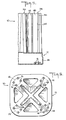
- Figures 1 to 6 illustrate a first preferred embodiment, in which the device is designed to accommodate four stacks of objects, such as dishes or the like, that are of equal size and shape
- Figures 7 to 13 illustrate a second embodiment in which the device is designed to accommodate nine stacks of objects that are of equal size and shape
- Figure 12 illustrates a wheel structure for the second embodiment that may be utilized in the first.
- This device has particular utility in hotels, restaurants, and other institutions, but may be used with equal advantage to store other dish or saucer-like objects that are round, oval, or a large number of other shapes.
- dish or saucer-like objects that are round, oval, or a large number of other shapes.
- the preferred embodiment of the present invention will be described with reference to the storage of dishes.
- the device of the present invention is generally indicated at 10 and includes a square, flat, horizontally extending base 12 with rounded corners.
- Cart 10 comprises one unitary piece that can be composed, for example, of a seamless one-piece double-wall unit of polyethylene with a foamed-in-place core for structural strength.
- the cart in the preferred embodiment is produced by rotational molding of polyethylene.
- rotationally mold the device out of another material, or to produce the unitary structure by a method other than rotational molding it is within the scope of the present invention to produce the cart 10 as a non-unitary but integral structure in which base 12 is attached by suitable means to the partitions discussed in detail below.
- the outer surface of the base includes a portion that is recessed to form a band 24 which extends completely around the base periphery. Because the portion above the base is recessed with respect to the base, base 12 forms two projecting bands above and below recess band 24 as illustrated in Figures 1 and 2.
- Base 12 has four triangular recesses 25 in the bottom thereof, and a T-shaped recess extending between the four triangular recesses that are illustrated in Figures 4 and 6.
- the top surface 27 of base 12 forms a floor for supporting the objects such as dishes, which are stacked thereon. The structure defining the regions adapted to receive the separate stacks of dishes will now be described.
- the cart 10 further includes structure 26 for partitioning the space extending above base 12 into a plurality of substantially vertically extending object-receiving regions 28.
- Partitioning structure 26 forms one unitary body with base 12.
- each object-receiving region 28 has substantially the same size and shape, i.e. cylindrical, with a substantially circular horizontal cross-sectional shape.
- These object-receiving regions are adapted to receive a plurality of stacked objects. such as dishes, which will rest on the floor 27 of base 12.
- Partitioning structure 26 comprises four generally T-shaped partitions 30 that extend generally perpendicularly but taper upwardly and inwardly from base 12.
- Rack retaining structures 38 on the top surface of each partition for retaining a plurality of stacked racks, which are shown in dashed lines at the top of Figure 2, positioned on top of the device.
- Rack retaining structure 38 comprises the top surfaces of a first portion 42 and a second portion 44 of each partition.
- First portion 42 is raised with respect to second portion 44, and can be clearly seen in Figures 1, 2, and 4.
- First portion 42 comprises one outer wall of device 10.
- Each first portion 42 of each partition 30 also includes a handle 46 of sufficient size to accommodate the user's hand thereon so that the cart may be lifted or otherwise manipulated for movement.
- Handle 46 is a recess in first portion 42.
- the recess is formed by a wall which is inclined at 60° with respect to the plane passing through the outer wall of first portion 42 to provide for mold clearances.
- Portion 44 of each generally T-shaped partition 30 projects inwardly from the first portion 42 toward an axis extending through the center of and perpendicular to base 12 and comprises two object-receiving region-defining surfaces 48 and 50.
- Surface 48 defines a portion of the boundary of one region 28 and surface 50 of the same partition defines a portion of the boundary of an adjacent region 28.
- the boundary of each object-receiving region is defined by a pair of object-receiving region-defining surfaces from different partitions, as 30 illustrated in Figures 1 and 3.
- the horizontal cross-section of surfaces 48 and 50 has the shape of a partial circle.
- partitions 30 extend upwardly, substantially perpendicular to base 12 and the outer walls of adjacent first portions 42 of partitions 30 extend substantially perpendicular to each other.
- Each second portion 44 comprises an end 52 connecting surfaces 48 and 50. Ends 52 face but are spaced from the above-mentioned axis.
- a central open region 54 is formed that is clearly illustrated in Figure 3 and the axis is a longitudinal axis of symmetry of region 54.
- Each object-receiving region-defining surface 48 and 50 also comprises an outer end 56 adjacent the outer wall, and an inner end 58 spaced inwardly from the outer end and adjacent end 52.
- Each object-receiving region 28 is defined by and comprises a pair of object-receiving region-defining surfaces of different partitions whose out ends 56 are spaced apart to define a first slit 60.
- the inner ends 58 of each pair of object-receiving region-defining surfaces defining one region 28 are also spaced apart to define a second slit 62. This second slit 62 borders and opens onto central open region 54.
- Central open region 54 and slits 62 are large enough to accommodate a person's arm and hand to permit her or him to grasp a dish or a stack of dishes stacked in any object-receiving region 28.
- each slit 60 extends directly above a different corner of base 12.
- the slits in each object-receiving region 28 are substantially diametrically opposite from each other.
- the slits into each object-defining region extend substantially symmetrically on either side of a vertical plane extending through the center of each slit and through the center of the object-receiving region, for example, as illustrated by plane 5-5 in Figure 3.
- each object-receiving region 28 are diametrically opposite each other, dishes stacked in such region can easily be removed by the operator by reaching with one hand down through central open region 54 and slot 62 to grasp the stack of dishes on one side, while the other hand grasps stack of dishes on the opposite side through slot 60. Because the use of a pair of diametrically opposed slits renders it easy to remove a stack of dishes, the slits 60 and 62 can be made relatively narrow, thus increasing the protection for the dishes.
- the object-receiving region-defining surfaces 48, 50 preferably enclose about 75% of the lateral periphery of each object-receiving region 28, with each pair of slits 60 and 62 together extending over not more than about 25% of the lateral periphery of the object-receiving region 28.
- each region 28 has six such fins 64. These fins 64 stabilize the dishes stacked in each region 28 and, in each region 28, the three fins on each object-receiving region-defining surface are spaced apart by substantially equal distances. Further, the stabilizing fins 64 are substantially parallel to one another and have a substantially triangular cross-sectional shape, in which each lateral side of each fin preferably forms a 45 degree angle with respect to surfaces 48 or 50.
- Base 12 as more clearly seen in Figure 6, also has four molded-in mounting base plates 14 that can be composed of metal.
- Each base plate 14 includes four threaded anchors 16 each adapted to receive a threaded bolt 18 that extends through openings in a caster plate 20 as illustrated in Figure 12, which shows structure utilized with equal advantage in the first embodiment described above and the second embodiment described below.
- Each caster plate 20 has secured thereto one caster wheel 22 for supporting the cart for movement along a floor.
- a second embodiment of the present invention is illustrated in Figures 7 to 13. All of the features noted above with respect to the first embodiment illustrated in Figures 1 to 6, are also found in this embodiment except for the number and placement of object-receiving regions, the number and shape of the partitions.
- the second embodiment has stabilizing fins, two diametrically opposed slits in each object-receiving region, partitions which form one unitary body with a base, four caster plates and a four base plates, rack retaining means, and a central open column.
- each outer wall of the cart has recess which functions as a handle to accommodate the user's hand therein; however, rather than being inclined by 60° with respect to the outer wall of the cart, as is the case in the first embodiment, the recess is inclined by 70° with respect to the outer walls of the cart in the second embodiment.
- the embodiment illustrated in Figures 7 to 13 comprises a cart 110 having a square, flat, horizontally extending base 112 with rounded edges.
- Base 112 as clearly seen in Figures 11 and 13, has four molded-in mounting base plates 114, each with four threaded anchors 116.
- the structural arrangement and mounting of casters 22 is the same as that described with respect to the embodiment illustrated in Figures 1 to 6.
- Cart 110 is a unitary piece which can be composed, for example, of a seamless one-piece double-wall unit of polyethylene with a foamed-in-placed core for structural strength.
- the cart in this embodiment is also preferably produced by rotational moldin of polyethylene.
- the outer surface of base 112 includes a portion which is recessed in a band 124 which extends completely around the periphery of the base, as illustrated in Figures 7 and 8.
- Base 112 has four triangular recesses in the bottom thereof, and a T-shaped recess extending between the triangular recesses, which are illustrated in Figures 10 and 13.
- the top surface of base 112 forms a floor for supporting dishes that are stacked thereon in nine object-receiving regions.
- a stack of dishes in one region is represented by horizontal lines in Figure 8. The structure which defines each of these object-receiving regions will now be described.
- a structure 126 partitions the space extending above base 112 into nine substantially vertically extending object-receiving regions 128.
- Each object-receiving region 128 has substantially the same size and shape, and substantially the same cross-sectional shape. However, it is within the scope of the present invention for these regions to have any other shape, and to be different sizes and shapes from each other. Regions 128 are adapted to receive a plurality of stacked objects that rest on the floor, i.e. the top surface, of base 112.
- Partition-defining structure 126 comprises eight partitions that extend upwardly, substantially perpendicular to base 112. Unlike the embodiment illustrated in Figures 1 to 6, these partitions do not all have the same shape. Rather, the partitions comprise six exterior partitions and two interior partitions. The six exterior partitions together form the outer walls of device 110.
- the exterior partitions include four generally T-shaped partitions 134 and two corner partitions 136. Corner partitions 136 extend upwardly from opposite corners of base 112.
- the generally T-shaped partitions 134 each comprise a first portion constituting an outer wall of cart 110 and a second portion constituting two object-receiving region-defining surfaces 148 and 150, each of which defines a portion of a different object-receiving region 128. In the second embodiment these object-receiving surfaces have partially circular a cross-section.
- the invention is not limited to such cross-sectionally shaped object-receiving region-defining surfaces, but includes surfaces of any shape.
- Each object-receiving region-defining surface of each generally T-shaped partition 134 has an outer end 156 and an inner end 158, as illustrated in Figure 9. Outer end 156 is adjacent the outer wall of the T-shaped partition, and inner end 158 is adjacent an end 152 of partition 134 which connects surfaces 148 and 150. In contrast, the two corner partitions 136 each comprise one object-receiving region-defining surface 140 having two outer ends 141.
- Each interior partition 138 is spaced from the outer edge of base 112, and is generally cross-shaped so as to define four object-receiving region-defining surfaces 139. Each inner partition 138 also comprises four ends 152 which separate two adjacent object-receiving region-defining surfaces.
- each of the eight partitions are spaced apart from each other in such a way that each region 128 comprises two diametrically opposed slits so as to permit easy access to the stacked dishes.
- the four generally T-shaped exterior partitions 134 are grouped in pairs so that each pair is spaced on either side of one corner of base 112.
- one partition 134 in the pair of partitions has one of its outer ends 156 spaced from the outer end 156 of the other partition 134 in the pair so as to form a slit extending vertically directly above one corner of base 112.
- each partition in each pair of generally T-shaped partitions 134 is spaced from an end 152 of an interior partition 138, so as to form another slit for another object-receiving region 128.
- ends 141 of each corner partition 136 are spaced from ends 152 of an interior partition 138 so as to form two slits in the object-receiving regions defined by partitions 136 and 138.
- each object-receiving region 128 is bordered by and is defined by two object-receiving region-defining surfaces of different partitions. Further, each object-receiving region comprises a pair of slits which are on diametrically opposite sides thereof, and which extend symmetrically on either side of one vertical plane extending through the center of each slit in the pair and through the center of the object-receiving region associated with the pair.
- partitions comprising four generally T-shaped partitions positioned in pairs on either side of two corners and having two object-receiving region-defining surfaces, two interior cross-shaped partitions having four object-receiving region-defining surfaces, and two corner partitions each having one object-receiving region-defining surface, permits the formation of nine object-receiving regions, with one region 128 centered on an axis perpendicular to base 12 and extending through the center of base 12. In other words, this central object-receiving region 128 doubles as the central open region of the device. Because this second embodiment permits the use of nine separate object-receiving regions, a large number of stacks can be accommodated in device 110 in a minimum amount of space.
- the object-receiving region-defining surfaces can preferably enclose about 60% of the lateral periphery of each object-receiving region, with the pair of slits together extending over no more than about 40% of the lateral periphery of each object-receiving region.
- the present invention provides an efficient and convenient means for storing dishes in a minimum amount of space while simultaneously providing maximum protection and easy access to the dishes.
- the present invention provides significant advantages over known prior devices from many points of view.
Landscapes
- Engineering & Computer Science (AREA)
- Food Science & Technology (AREA)
- Stackable Containers (AREA)
- Details Of Rigid Or Semi-Rigid Containers (AREA)
- Buffer Packaging (AREA)
- Warehouses Or Storage Devices (AREA)
Applications Claiming Priority (2)
| Application Number | Priority Date | Filing Date | Title |
|---|---|---|---|
| US9783687A | 1987-09-17 | 1987-09-17 | |
| US97836 | 1987-09-17 |
Publications (3)
| Publication Number | Publication Date |
|---|---|
| EP0317723A2 true EP0317723A2 (de) | 1989-05-31 |
| EP0317723A3 EP0317723A3 (en) | 1990-01-10 |
| EP0317723B1 EP0317723B1 (de) | 1994-02-02 |
Family
ID=22265377
Family Applications (1)
| Application Number | Title | Priority Date | Filing Date |
|---|---|---|---|
| EP19880115232 Expired - Lifetime EP0317723B1 (de) | 1987-09-17 | 1988-09-16 | Vorrichtung zum Aufbewahren von Geschirr oder dergleichen in mehreren Stapeln |
Country Status (4)
| Country | Link |
|---|---|
| EP (1) | EP0317723B1 (de) |
| JP (1) | JP2878693B2 (de) |
| CA (1) | CA1312637C (de) |
| DE (1) | DE3887645T2 (de) |
Cited By (1)
| Publication number | Priority date | Publication date | Assignee | Title |
|---|---|---|---|---|
| CN113859723A (zh) * | 2021-08-27 | 2021-12-31 | 智新半导体有限公司 | 崩环回收架 |
Families Citing this family (4)
| Publication number | Priority date | Publication date | Assignee | Title |
|---|---|---|---|---|
| US20020184196A1 (en) * | 2001-06-04 | 2002-12-05 | Lehmeier Michelle R. | System and method for combining voice annotation and recognition search criteria with traditional search criteria into metadata |
| JP6207194B2 (ja) * | 2013-03-27 | 2017-10-04 | キヤノン株式会社 | 部品積載用トレイ |
| US10654504B1 (en) | 2019-03-07 | 2020-05-19 | Dishcraft Robotics, Inc. | Dish stacking cart |
| JP7489692B2 (ja) * | 2019-10-28 | 2024-05-24 | 岐阜プラスチック工業株式会社 | 収容容器 |
Family Cites Families (8)
| Publication number | Priority date | Publication date | Assignee | Title |
|---|---|---|---|---|
| US1916238A (en) * | 1930-01-03 | 1933-07-04 | Alberta L Soffel | Display cabinet |
| US2544053A (en) * | 1946-03-27 | 1951-03-06 | Sharaf Nathan | Dish holder |
| LU30094A1 (de) * | 1950-04-29 | |||
| US3173546A (en) * | 1963-07-01 | 1965-03-16 | Serv O Lift Corp | Dish cart |
| US3512826A (en) * | 1967-10-04 | 1970-05-19 | Arthur Hahn | Mobile food service wagon |
| US4183852A (en) * | 1977-07-18 | 1980-01-15 | Kaiser Emil T | Process for preparing 25-hydroxycholesterol |
| JPS6076635U (ja) * | 1983-10-28 | 1985-05-29 | 三菱樹脂株式会社 | 運搬用容器 |
| JPS6130658U (ja) * | 1984-07-30 | 1986-02-24 | 株式会社 コバヤシ | 保冷型搬送容器 |
-
1988
- 1988-09-09 CA CA000576980A patent/CA1312637C/en not_active Expired - Fee Related
- 1988-09-16 DE DE19883887645 patent/DE3887645T2/de not_active Expired - Fee Related
- 1988-09-16 EP EP19880115232 patent/EP0317723B1/de not_active Expired - Lifetime
- 1988-09-17 JP JP63231503A patent/JP2878693B2/ja not_active Expired - Lifetime
Cited By (1)
| Publication number | Priority date | Publication date | Assignee | Title |
|---|---|---|---|---|
| CN113859723A (zh) * | 2021-08-27 | 2021-12-31 | 智新半导体有限公司 | 崩环回收架 |
Also Published As
| Publication number | Publication date |
|---|---|
| DE3887645T2 (de) | 1994-08-25 |
| DE3887645D1 (de) | 1994-03-17 |
| CA1312637C (en) | 1993-01-12 |
| JPH01167121A (ja) | 1989-06-30 |
| JP2878693B2 (ja) | 1999-04-05 |
| EP0317723B1 (de) | 1994-02-02 |
| EP0317723A3 (en) | 1990-01-10 |
Similar Documents
| Publication | Publication Date | Title |
|---|---|---|
| US4957206A (en) | Device for storing a plurality of dishes or the like in a plurality of stacks | |
| US5465843A (en) | Nestable display crate for bottles or the like | |
| US5855277A (en) | Nestable display crate for bottles with handle feature | |
| US4648524A (en) | Compartmented storage container | |
| US5979654A (en) | Nestable display crate for bottle carriers | |
| US4254873A (en) | Pallet | |
| EP0299657A1 (de) | Behälter | |
| JPH05168650A (ja) | 自在ケース | |
| US6112896A (en) | Tooling utility system | |
| US5950828A (en) | Tooling utility system | |
| EP0317723A2 (de) | Vorrichtung zum Aufbewahren von Geschirr oder dergleichen in mehreren Stapeln | |
| US7503455B2 (en) | Cross-stacking container | |
| CN1070804C (zh) | 可套合的展示陈列板条箱 | |
| JPH0319840U (de) | ||
| US20030155357A1 (en) | Freezer organization system | |
| JPH0410143Y2 (de) | ||
| EP0207237A1 (de) | Aufbewahrungs-, Transport- und Ausgabesystem für Magnetkassetten | |
| JPH033471Y2 (de) | ||
| JP2587963Y2 (ja) | 運搬用容器 | |
| JPH10119968A (ja) | コンテナ | |
| JPH0333643Y2 (de) | ||
| JP2587964Y2 (ja) | 運搬用容器 | |
| JPH0318357Y2 (de) | ||
| JPH01110297A (ja) | 固体廃棄物輸送容器用バスケット | |
| RU2127213C1 (ru) | Вставляемая ячеистая тара для бутылок |
Legal Events
| Date | Code | Title | Description |
|---|---|---|---|
| PUAI | Public reference made under article 153(3) epc to a published international application that has entered the european phase |
Free format text: ORIGINAL CODE: 0009012 |
|
| AK | Designated contracting states |
Kind code of ref document: A2 Designated state(s): DE FR GB IT |
|
| PUAL | Search report despatched |
Free format text: ORIGINAL CODE: 0009013 |
|
| AK | Designated contracting states |
Kind code of ref document: A3 Designated state(s): DE FR GB IT |
|
| 17P | Request for examination filed |
Effective date: 19900626 |
|
| 17Q | First examination report despatched |
Effective date: 19911128 |
|
| GRAA | (expected) grant |
Free format text: ORIGINAL CODE: 0009210 |
|
| AK | Designated contracting states |
Kind code of ref document: B1 Designated state(s): DE FR GB IT |
|
| PG25 | Lapsed in a contracting state [announced via postgrant information from national office to epo] |
Ref country code: IT Free format text: LAPSE BECAUSE OF FAILURE TO SUBMIT A TRANSLATION OF THE DESCRIPTION OR TO PAY THE FEE WITHIN THE PRE;WARNING: LAPSES OF ITALIAN PATENTS WITH EFFECTIVE DATE BEFORE 2007 MAY HAVE OCCURRED AT ANY TIME BEFORE 2007. THE CORRECT EFFECTIVE DATE MAY BE DIFFERENT FROM THE ONE RECORDED.SCRIBED TIME-LIMIT Effective date: 19940202 |
|
| REF | Corresponds to: |
Ref document number: 3887645 Country of ref document: DE Date of ref document: 19940317 |
|
| ET | Fr: translation filed | ||
| PLBE | No opposition filed within time limit |
Free format text: ORIGINAL CODE: 0009261 |
|
| STAA | Information on the status of an ep patent application or granted ep patent |
Free format text: STATUS: NO OPPOSITION FILED WITHIN TIME LIMIT |
|
| 26N | No opposition filed | ||
| PGFP | Annual fee paid to national office [announced via postgrant information from national office to epo] |
Ref country code: GB Payment date: 19990826 Year of fee payment: 12 |
|
| PGFP | Annual fee paid to national office [announced via postgrant information from national office to epo] |
Ref country code: FR Payment date: 19990917 Year of fee payment: 12 |
|
| PGFP | Annual fee paid to national office [announced via postgrant information from national office to epo] |
Ref country code: DE Payment date: 19991129 Year of fee payment: 12 |
|
| PG25 | Lapsed in a contracting state [announced via postgrant information from national office to epo] |
Ref country code: GB Free format text: LAPSE BECAUSE OF NON-PAYMENT OF DUE FEES Effective date: 20000916 |
|
| GBPC | Gb: european patent ceased through non-payment of renewal fee |
Effective date: 20000916 |
|
| PG25 | Lapsed in a contracting state [announced via postgrant information from national office to epo] |
Ref country code: FR Free format text: LAPSE BECAUSE OF NON-PAYMENT OF DUE FEES Effective date: 20010531 |
|
| PG25 | Lapsed in a contracting state [announced via postgrant information from national office to epo] |
Ref country code: DE Free format text: LAPSE BECAUSE OF NON-PAYMENT OF DUE FEES Effective date: 20010601 |
|
| REG | Reference to a national code |
Ref country code: FR Ref legal event code: ST |