EP0318202A2 - Catalysts and their use in the hydrolysis of nitriles - Google Patents
Catalysts and their use in the hydrolysis of nitriles Download PDFInfo
- Publication number
- EP0318202A2 EP0318202A2 EP88310819A EP88310819A EP0318202A2 EP 0318202 A2 EP0318202 A2 EP 0318202A2 EP 88310819 A EP88310819 A EP 88310819A EP 88310819 A EP88310819 A EP 88310819A EP 0318202 A2 EP0318202 A2 EP 0318202A2
- Authority
- EP
- European Patent Office
- Prior art keywords
- catalyst
- copper
- process according
- compound
- vanadium
- Prior art date
- Legal status (The legal status is an assumption and is not a legal conclusion. Google has not performed a legal analysis and makes no representation as to the accuracy of the status listed.)
- Granted
Links
Classifications
-
- C—CHEMISTRY; METALLURGY
- C07—ORGANIC CHEMISTRY
- C07C—ACYCLIC OR CARBOCYCLIC COMPOUNDS
- C07C231/00—Preparation of carboxylic acid amides
- C07C231/06—Preparation of carboxylic acid amides from nitriles by transformation of cyano groups into carboxamide groups
-
- C—CHEMISTRY; METALLURGY
- C07—ORGANIC CHEMISTRY
- C07C—ACYCLIC OR CARBOCYCLIC COMPOUNDS
- C07C233/00—Carboxylic acid amides
- C07C233/01—Carboxylic acid amides having carbon atoms of carboxamide groups bound to hydrogen atoms or to acyclic carbon atoms
- C07C233/02—Carboxylic acid amides having carbon atoms of carboxamide groups bound to hydrogen atoms or to acyclic carbon atoms having nitrogen atoms of carboxamide groups bound to hydrogen atoms or to carbon atoms of unsubstituted hydrocarbon radicals
- C07C233/09—Carboxylic acid amides having carbon atoms of carboxamide groups bound to hydrogen atoms or to acyclic carbon atoms having nitrogen atoms of carboxamide groups bound to hydrogen atoms or to carbon atoms of unsubstituted hydrocarbon radicals with carbon atoms of carboxamide groups bound to carbon atoms of an acyclic unsaturated carbon skeleton
Definitions
- catalysts have been proposed, including catalysts based primarily on a single metal or metal compound and catalysts based on blends of metals or metal compounds. Examples include the disclosures in GB 1,347,160 and 1,459,685 and U.S. 3,597,481, 3,631,104 and 4,056,565.
- the catalysts that have been found most successful in commercial practice, and which are therefore widely discussed in the literature, are the black copper catalysts.
- Raney copper has been found to be particularly suitable but others include Ullmann copper and reduced copper catalysts.
- These reduced copper catalysts may be made by reduction of a solid compound, such as copper oxide, or by precipitation, under reducing conditions, from a solution of a soluble compound such as a copper salt or a soluble complex of copper compound.
- the black copper catalyst is, in practice, made by precipitation and reduction from a soluble form of copper, and the vanadium compound is incorporated into the black copper catalyst by co-precipitation during the initial formation of the black copper precipitate.
- the amount of vanadium, based on copper can be in the range 0.5 to 6% on an atomic basis, in many of the examples relatively large amounts of vanadium compound are used.
- a vanadium-containing catalyst can be obtained by reacting metallic copper with a vanadium-containing compound in an aqueous medium.
- the disclosure includes a long list of suitable forms of copper including various reduced coppers as well as Raney copper, copper powder and Ullmann copper, and alloys with other metals.
- the disclosure also includes a long list of vanadium compounds that can be used for the process.
- vanadium compounds that can be used for the process.
- the catalyst is made by coprecipitation in the presence of a reducing agent.
- the coprecipitation is brought about by adding ammonium metavanadate to an aqueous solution of reducing agent and copper compound.
- Increased conversion would be very desirable as it would allow an increased rate of production using the same apparatus and/or energy input and/or catalyst amount, or it would allow an equivalent rate of production using a smaller apparatus and/or lower energy input and/or lower catalyst amount.
- Reduced by-product formation would be desirable as it would eliminate or reduce the need for purification procedures.
- the catalyst should be rinsed free of soluble vanadium compound before it is introduced into the hydrolysis reaction, since the presence of soluble vanadium compounds in the reaction medium is undesirable, as is shown in EP 0246813.
- the black copper catalyst must have been preformed. Normally it has, before the treatment step of the invention, activity in the process in the sense that it can promote the hydrolysis of nitrile to amide. It must be black or very dark and can be any of the black coppers described in EP 0246813. Thus it can be a reduced copper catalyst or Ullman copper, but preferably it is Raney copper.
- the initial manufacture of the black copper catalyst can be by conventional techniques. For instance Raney copper can be made by leaching a copper-aluminium alloy with an alkali, followed by rinsing.
- the black copper catalyst that is provided for the process may be a conventional catalyst that is available commercially or may be manufactured on site for use in the process. Generally it has not previously been used, but an advantage of the invention is that a previously used black copper catalyst that has become partially deactivated during use can be reactivated by the treatment with the solution containing vanadium, followed bv rinsing. Thus a black copper catalyst can be recovered from the hydrolysis process at a stage when it has tended to become deactivated, reactivated by the treatment with vanadium followed by rinsing, and then re-used.
- the preferred vanadium compounds are those in which the vanadium is in the cationic state, and in particular the preferred compounds are vanadyl compounds, such as the sulphate or nitrate, vanadyl sulphate being preferred.
- soluble vanadium compounds that can be used include compounds in which the vanadium is in the anionic state, namely vanadates. These are generally supplied in the form of ammonium or alkali metal (especially sodium) vanadates.
- vanadium compound it is, of course, necessary to select a vanadium compound, and its conditions of application, such that the treatment results in an improvement in the activity of the catalyst and if it is found that any particular vanadium compound does not give a desired improvement then a different compound should be tried.
- metavanadates may tend to fail to give an improvement in activity in some application methods (despite their use in the coprecipitation technique of JP-B-56/20308) whereas orthovanadates, especially sodium orthovanadate, do give improvement even in conditions where metavanadate may not.
- the preferred vanadium compound is vanadyl sulphate.
- the concentration of the solution that is used to contact the Raney or other black metal catalyst should, calculated as vanadium metal, be at least 5ppm. Generally it is at least 0.01%, usually. at least 0.05%. It can be up to 20% but usually it is below 10%. For most purposes amounts in the range 0.1 to 5% are suitable. Generally it is preferred that the concentration should be above 0.2% and often the concentration is not more than 1% or sometimes 2%. All percentages in this specification are by weight unless otherwise specified.
- the contact between the solution and the catalyst is preferably achieved by mixing the catalyst, generally in particulate form, with a volume of the solution that is substantially greater than the settled volume of the catalyst.
- the weight of black copper per millilitre of solution is usually 0.05 to 0.5 grams.
- the contact conditions are preferably such that the amount of vanadium (measured as metal) that is deposited on to the black copper is from about 0.01 to about 10% by weight based on the weight of black copper.
- the amount is usually at least 0.1% but below 5% and often below 2%. It is often preferred that the amount is above 0.2%. Amounts of below 1% are often preferred.
- the contact between the solution and the black copper should be at least 1 minute and usually is at least 0.1 hours, normally at least 0.25 hours. Best results are generally obtained when the contact is maintained for at least 0.5, or more usually at least 1 hour.
- the catalyst After performing the contact for the chosen period, the catalyst must then be rinsed with water sufficiently for the catalyst to be substantially free of water soluble vanadium compound, that is to say the rinse solution should be substantially free of dissolved vanadium compound.
- the rinse solution should be substantially free of dissolved vanadium compound.
- This washing also has the effect of rendering the catalyst substantially neutral.
- the catalyst Prior to the washing the catalyst will have been acidic (if the contact was with a vanadyl solution) or alkaline (if the contact was with a vanadate solution).
- the rinsing may be by repeated decantation with water.
- the water is usually deionised water, at least in the later stages of decantation.
- the black copper catalyst must be protected from oxidation or other deactivation conditions before, during and after the activation process and during the hydrolysis process, as is conventional for catalysts of this type for the hydrolysis reaction. Accordingly the activation and hydrolysis processes are normally conducted using deoxygenated solutions under an atmosphere that does not cause oxidation.
- the black copper catalyst is normally provided initially as a deoxygenated aqueous suspension, and the catalyst should be maintained throughout the activation process and up to its incorporation into the aqueous medium as a deoxygenated aqueous suspension, and the resultant suspension is then introduced into the deoxygenated aqueous medium.
- the black copper catalyst is normally particulate, for instance as described in EP 246813.
- the activated catalyst (or the initial black copper oxide catalyst) may be subjected to controlled preoxidation as described in EP 78178.
- the hydrolysis medium may be of known content. It must however be substantially free of dissolved vanadium compound. Preferably it consists essentially of water, the nitrile, the amide that is formed, optionally polymerisation inhibitor such as monovalent copper, activastor such as copper nitrate or other materials known for this, and optionally reagent that reduces by-product formation, as described in W086/00614.
- the starting nitrile, the amide end product and the hydrolysis conditions may be as described in that or, in particular, as described in EP 246813.
- a preferred process comprises hydrolysis of acrylonitrile to acrylamide using Raney copper that has been activated by contact with vanadyl sulphate or sodium orthovanadate, followed by rinsing, the hydrolysis being conducted in the presence of copper nitrate as accelerator and of copper acetate or acetic acid as agent for reducing by-product formation.
- ACM acrylamide
- ECNH ethylene cyanohydrin ( ⁇ -hydroxy propionitrile)
- the selectivity of the catalyst is defined as and should be as low as possible.
- a solution of 0.19% vanadium, as vanadyl (IV) sulphate was made in freshly deoxygenated, deionised water and added to a Raney copper catalyst such that 0.95g of vanadium was present per gram of Raney copper.
- the concentration of vanadium in the supernatant liquor was 950ppm.
- Raney copper catalyst was mixed with varying amounts of vanadyl sulphate (5, 10 and 19% measured as V based on catalyst) and water and acrylonitrile added. The mixture was reacted at 90°C for 1 hour. Substantially no acrylamide was formed.
- Raney copper was treated with sulphuric acid to reduce the pH to 3. This is the pH that exists when the Raney copper is treated with a vanadyl sulphate solution to give 19%V based on catalyst. This was also reacted with acrylonitrile and water. The yield was marginally improved (11.93% compared to 9.42%) but the selectivity was worse (0.29 compared to 0.1) relative to the results with the untreated Raney copper catalyst.
- Sodium orthovanadate (Na3VO4) and sodium metavanadate (NaVO3) were used to treat a Raney copper catalyst at 5% V on catalyst as a 5000ppm V solution in water. After a two hour reaction period the catalysts were isolated and rinsed, and then used as the catalyst in teh hydrolysis reaction.
Landscapes
- Chemical & Material Sciences (AREA)
- Organic Chemistry (AREA)
- Catalysts (AREA)
- Organic Low-Molecular-Weight Compounds And Preparation Thereof (AREA)
- Low-Molecular Organic Synthesis Reactions Using Catalysts (AREA)
Abstract
Description
- It is known to make amides by hydrolysis of the corresponding nitrile in an aqueous medium containing a solid catalyst. The process is of particular value in the manufacture of acrylamide from acrylonitrile.
- A wide variety of catalysts have been proposed, including catalysts based primarily on a single metal or metal compound and catalysts based on blends of metals or metal compounds. Examples include the disclosures in GB 1,347,160 and 1,459,685 and U.S. 3,597,481, 3,631,104 and 4,056,565.
- The catalysts that have been found most successful in commercial practice, and which are therefore widely discussed in the literature, are the black copper catalysts. Of these, Raney copper has been found to be particularly suitable but others include Ullmann copper and reduced copper catalysts. These reduced copper catalysts may be made by reduction of a solid compound, such as copper oxide, or by precipitation, under reducing conditions, from a solution of a soluble compound such as a copper salt or a soluble complex of copper compound.
- There are many proposals in the literature to try to improve the performance of various of these catalysts by the incorporation of other materials in the black copper. Typical examples are in U.S. 3,696,152, GB 1,404,532, 1,417,026 and JP-B-59/18383. Included amongst the numerous additives that have been proposed are vanadium compounds, and such a compound is also exemplified in JP-B-59/18383.
- The are also several publications that relate to the production of amides by hydrolysis of nitrile and that specifically recommend that the copper catalyst should contain a vanadium compound. In all of these publications, the black copper catalyst is, in practice, made by precipitation and reduction from a soluble form of copper, and the vanadium compound is incorporated into the black copper catalyst by co-precipitation during the initial formation of the black copper precipitate. Thus in BR 8305831 and EP 145553 an alkaline solution of a divalent copper compound and a complexing agent is formed, a vanadium compound is dissolved into the solution, and a reducing agent is added to cause co-precipitation of the black copper catalyst which is then washed. Although it is stated that the amount of vanadium, based on copper, can be in the range 0.5 to 6% on an atomic basis, in many of the examples relatively large amounts of vanadium compound are used.
- In JP-B-56/20308 it is stated that a vanadium-containing catalyst can be obtained by reacting metallic copper with a vanadium-containing compound in an aqueous medium. The disclosure includes a long list of suitable forms of copper including various reduced coppers as well as Raney copper, copper powder and Ullmann copper, and alloys with other metals. The disclosure also includes a long list of vanadium compounds that can be used for the process. There are numerous examples but each and every example demonstrates a process in which the catalyst is made by coprecipitation in the presence of a reducing agent. In particular, in most of the examples the coprecipitation is brought about by adding ammonium metavanadate to an aqueous solution of reducing agent and copper compound. There is no suggestion in JP-B-56/20308 how the final catalyst could be made except by coprecipitation.
- In Khim Tekhnol (Kiev) 1985, 6, 22-3 and Chemical Abstracts Volume 104 No.130293Z a process is described in which metallic copper, copper salt and vanadium salt are combined to provide an aqueous medium that contains catalyst and that is used for nitrile hydrolysis. It is shown that best results are achieved when the amount of vanadium is in the range 25 to 50% based on copper. It is warned that the operating life of the catalyst is short.
- It appears that the described process requires the presence of soluble vanadium in solution in the aqueous medium in which the nitrile is being hydrolysed. Another disclosure of such a process is in GB 1,562,323. The amount of vanadate is preferably from 10% to 1000% based on copper.
- It is known from DE-C-1046586 to make an oxidation catalyst by impregnating Raney copper with an aqueous solution of vanadyl sulphate followed by drying of the catalyst. Since the catalyst is to be an oxidation catalyst it is inevitable that the vanadium, and probably also the copper, would be in a highly oxidised form during use, and probably also during the drying step, but this is satisfactory since vanadium pentoxide is known to be a good oxidation catalyst. However it is also known that oxidation of a black copper catalyst will deactivate the catalyst if it is to be used for hydration of a nitrile and so this disclosure is of no relevance to improving the production of amide by hydrolysis of nitrile.
- Many of the disclosures in the literature of modifications of copper catalysts for this process are concerned with maximising the conversion of nitrile to amide. Conversion tends to be increased by increasing the temperature of reaction. This is why it is normal in commercial practice to perform the reaction at above 100°C under pressure, even though some patents suggest that lower temperatures are satisfactory. Unfortunately increased conversion of acrylonitrile is generally accompanied by increased formation of undesirable by-products such as ethylene cyanohydrin.
- Increased conversion would be very desirable as it would allow an increased rate of production using the same apparatus and/or energy input and/or catalyst amount, or it would allow an equivalent rate of production using a smaller apparatus and/or lower energy input and/or lower catalyst amount. Reduced by-product formation would be desirable as it would eliminate or reduce the need for purification procedures.
- Attainment of these objectives using copper catalyst technology of the same type as is already in use, and in particular Raney copper technology, would be desirable as it would permit maximum utilisation of existing capital equipment and know-how.
- It would therefore be desirable to be able to modify a black copper catalyst, especially a Raney copper catalyst, system so as to improve the conversion and/or to reduce the by-product formation and/or to permit good conversion at much lower temperatures than have previously been commercially satisfactory, and in particular under atmospheric pressure. In particular it would be desirable to be able to modify a Raney copper catalyst system so as simultaneously to improve the conversion (or permit a lower reaction temperature) and reduce the by-product formation.
- In EP-A-246813 (published 25th November 1987, after the priority date of this application) we described how this objective could be achieved by including vanadium metal, in an amount of 0.01 to 10% by weight, in the black copper metal catalyst.
- We stated in that application that it appeared that the vanadium remained in the metallic form throughout the process. We stated that the use of compounds of vanadium (and we named vanadium oxide and copper vanadate) does not give the advantages of the invention. We showed in example 14 that poor results were obtained when the hydrolysis was conducted in the presence of Raney copper and vanadyl nitrate, in contrast to Raney copper and metallic vanadium. In example 15 we showed various catalysts made by reduction of a mixture of copper compounds and vanadium compounds were inferior to catalysts based on Raney copper.
- Although these statements are all correct, we have found one particular way of incorporating vanadium into a black copper catalyst and that does, despite the poor results discussed above, give useful improvements in activity of the catalyst for the hydrolysis of nitrile to amide.
- In the invention we make an amide of the formula RCONH₂ where R is a hydrocarbon group of 1 to 10 carbon atoms by hydrolysis of the corresponding nitrile RCN in an aqueous medium containing a copper catalyst containing vanadium, and the process is characterised in that the catalyst has been made by forming a black copper catalyst and then improving the activity of the catalyst by contacting it with an aqueous solution of a water soluble vanadium compound and then rinsing it with water until the catalyst is substantially free of water soluble vanadium compound.
- By this technique, it is possible to achieve a very useful increase in the activity of the black copper catalyst, for instance in terms of increased rate of production and/or reduced by-product formation.
- Although the mechanism is unclear, it appears that the contact with the vanadium solution causes beneficial modification of the surface properties of the black copper catalyst. Such a catalyst is, in any event, a catalyst for the hydrolysis reaction. This method is in complete contrast to the coprecipitation techniques that have always been used in the prior art and that involve vanadium being trapped within the catalyst.
- Another essential feature of the process is that the catalyst should be rinsed free of soluble vanadium compound before it is introduced into the hydrolysis reaction, since the presence of soluble vanadium compounds in the reaction medium is undesirable, as is shown in EP 0246813.
- The black copper catalyst must have been preformed. Normally it has, before the treatment step of the invention, activity in the process in the sense that it can promote the hydrolysis of nitrile to amide. It must be black or very dark and can be any of the black coppers described in EP 0246813. Thus it can be a reduced copper catalyst or Ullman copper, but preferably it is Raney copper. The initial manufacture of the black copper catalyst can be by conventional techniques. For instance Raney copper can be made by leaching a copper-aluminium alloy with an alkali, followed by rinsing.
- The black copper catalyst that is provided for the process may be a conventional catalyst that is available commercially or may be manufactured on site for use in the process. Generally it has not previously been used, but an advantage of the invention is that a previously used black copper catalyst that has become partially deactivated during use can be reactivated by the treatment with the solution containing vanadium, followed bv rinsing. Thus a black copper catalyst can be recovered from the hydrolysis process at a stage when it has tended to become deactivated, reactivated by the treatment with vanadium followed by rinsing, and then re-used.
- The preferred vanadium compounds are those in which the vanadium is in the cationic state, and in particular the preferred compounds are vanadyl compounds, such as the sulphate or nitrate, vanadyl sulphate being preferred.
- Other soluble vanadium compounds that can be used include compounds in which the vanadium is in the anionic state, namely vanadates. These are generally supplied in the form of ammonium or alkali metal (especially sodium) vanadates.
- It is, of course, necessary to select a vanadium compound, and its conditions of application, such that the treatment results in an improvement in the activity of the catalyst and if it is found that any particular vanadium compound does not give a desired improvement then a different compound should be tried. For instance there is some evidence that metavanadates may tend to fail to give an improvement in activity in some application methods (despite their use in the coprecipitation technique of JP-B-56/20308) whereas orthovanadates, especially sodium orthovanadate, do give improvement even in conditions where metavanadate may not. In general, however, the preferred vanadium compound is vanadyl sulphate.
- The concentration of the solution that is used to contact the Raney or other black metal catalyst should, calculated as vanadium metal, be at least 5ppm. Generally it is at least 0.01%, usually. at least 0.05%. It can be up to 20% but usually it is below 10%. For most purposes amounts in the range 0.1 to 5% are suitable. Generally it is preferred that the concentration should be above 0.2% and often the concentration is not more than 1% or sometimes 2%. All percentages in this specification are by weight unless otherwise specified.
- The contact between the solution and the catalyst is preferably achieved by mixing the catalyst, generally in particulate form, with a volume of the solution that is substantially greater than the settled volume of the catalyst. The weight of black copper per millilitre of solution is usually 0.05 to 0.5 grams.
- The contact conditions are preferably such that the amount of vanadium (measured as metal) that is deposited on to the black copper is from about 0.01 to about 10% by weight based on the weight of black copper. The amount is usually at least 0.1% but below 5% and often below 2%. It is often preferred that the amount is above 0.2%. Amounts of below 1% are often preferred.
- The contact between the solution and the black copper should be at least 1 minute and usually is at least 0.1 hours, normally at least 0.25 hours. Best results are generally obtained when the contact is maintained for at least 0.5, or more usually at least 1 hour.
- There is usually no advantage in maintaining the contact for longer than 24 hours or even for longer than 12 hours. Indeed there can be some disadvantage, in some instances, in maintaining the contact for too long, for instance above about 4 hours or, at the most, above about 6 hours, since longer contact appears to result in reduction in performance and possibly even in deactivation of the catalyst. The preferred period of contact is therefore 0.5 or 1 hour up to 4 hours. Around 2 hours is often optimum.
- We observe that copper is dissolved into the treatment solution during the process.
- After performing the contact for the chosen period, the catalyst must then be rinsed with water sufficiently for the catalyst to be substantially free of water soluble vanadium compound, that is to say the rinse solution should be substantially free of dissolved vanadium compound. The reason for this is that significant amounts of soluble vanadium compound in the subsequent hydrolysis aqueous medium interfere with the reaction and so the amount of soluble vanadium compound that can be washed from the catalyst by the hydrolysis aqueous medium must be reduced to such a low amount that it does not significantly interfere with the hydrolysis reaction. This washing also has the effect of rendering the catalyst substantially neutral. Prior to the washing the catalyst will have been acidic (if the contact was with a vanadyl solution) or alkaline (if the contact was with a vanadate solution). The rinsing may be by repeated decantation with water. The water is usually deionised water, at least in the later stages of decantation.
- The black copper catalyst must be protected from oxidation or other deactivation conditions before, during and after the activation process and during the hydrolysis process, as is conventional for catalysts of this type for the hydrolysis reaction. Accordingly the activation and hydrolysis processes are normally conducted using deoxygenated solutions under an atmosphere that does not cause oxidation. The black copper catalyst is normally provided initially as a deoxygenated aqueous suspension, and the catalyst should be maintained throughout the activation process and up to its incorporation into the aqueous medium as a deoxygenated aqueous suspension, and the resultant suspension is then introduced into the deoxygenated aqueous medium.
- The black copper catalyst is normally particulate, for instance as described in EP 246813.
- Despite the need to avoid uncontrolled oxidation of the catalyst prior to introduction into the aqueous hydrolysis medium, the activated catalyst (or the initial black copper oxide catalyst) may be subjected to controlled preoxidation as described in EP 78178.
- The hydrolysis medium may be of known content. It must however be substantially free of dissolved vanadium compound. Preferably it consists essentially of water, the nitrile, the amide that is formed, optionally polymerisation inhibitor such as monovalent copper, activastor such as copper nitrate or other materials known for this, and optionally reagent that reduces by-product formation, as described in W086/00614. The starting nitrile, the amide end product and the hydrolysis conditions may be as described in that or, in particular, as described in EP 246813. Thus a preferred process comprises hydrolysis of acrylonitrile to acrylamide using Raney copper that has been activated by contact with vanadyl sulphate or sodium orthovanadate, followed by rinsing, the hydrolysis being conducted in the presence of copper nitrate as accelerator and of copper acetate or acetic acid as agent for reducing by-product formation.
- Despite references in the literature to performing the hydrolysis process at temperatures below 100°C, in practice the processes were normally conducted at temperatures above 120°C. In the invention it is particularly preferred to conduct the process at temperatures of not more than 115°C, for instance 100 to 110°C although lower temperatures, down to 95°C or even down to 75°C can be used while still maintaining a useful yield of acrylamide.
- The following are some examples. In each of these,
ACM = acrylamide
ECNH = ethylene cyanohydrin (β-hydroxy propionitrile) - An ACM concentration of 46.6% would represent complete conversion of the acrylonitrile.
- The selectivity of the catalyst is defined as
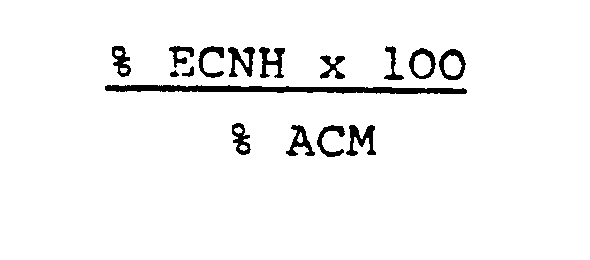
- In each example a closed tube test was conducted as described on page 16 of EP 246813 at 90°C.
- A solution of 0.19% vanadium, as vanadyl (IV) sulphate was made in freshly deoxygenated, deionised water and added to a Raney copper catalyst such that 0.95g of vanadium was present per gram of Raney copper. The concentration of vanadium in the supernatant liquor was 950ppm.
- Samples of catalyst were removed at regular intervals and washed down before reacting with acrylonitrile and water. The following results were obtained.

- 12.5g Raney copper was washed with 100g vanadyl sulphate solution (containing 1.72% vanadium). It was allowed to settle and one sample was immediately removed (t=0) and other samples were removed at 1, 2 and 4 hours, and after standing overnight. The results were as follows.

- Varying amounts of a solution of vanadyl (IV) sulphate in deoxygenated, deionised water were added to Raney copper catalyst such that the level of vanadium relative to catalyst was from 38ppm to 9.5%. After regular agitation over a two hour period the catalysts were isolated and tested as in Example 1. The following results were obtained.

- Raney copper catalyst was mixed with varying amounts of vanadyl sulphate (5, 10 and 19% measured as V based on catalyst) and water and acrylonitrile added. The mixture was reacted at 90°C for 1 hour. Substantially no acrylamide was formed.
- A sample of Raney copper was treated with sulphuric acid to reduce the pH to 3. This is the pH that exists when the Raney copper is treated with a vanadyl sulphate solution to give 19%V based on catalyst. This was also reacted with acrylonitrile and water. The yield was marginally improved (11.93% compared to 9.42%) but the selectivity was worse (0.29 compared to 0.1) relative to the results with the untreated Raney copper catalyst.
- This demonstrates that pretreatment merely with acidic sulphate-containing solution is ineffective, and that the presence of dissolved vanadyl cation during the hydrolysis is very undesirable.
- Sodium orthovanadate (Na₃VO₄) and sodium metavanadate (NaVO₃) were used to treat a Raney copper catalyst at 5% V on catalyst as a 5000ppm V solution in water. After a two hour reaction period the catalysts were isolated and rinsed, and then used as the catalyst in teh hydrolysis reaction.
- As a comparison, hydrolysis was conducted using untreated Raney copper catalysts but with a reaction medium to which 1% NaVO₃ and Na₃VO₄ respectively had been added. The following results were obtained.

- These examples demonstrate that it is possible to improve yield of acrylamide whilst maintaining selectivity and/or to improve selectivity whilst maintaining yield as a result of treating the preformed black catalyst with the vanadium compound in the manner defined herein. These results, coupled with the results in examples 14 and 15 of EP 246813, demonstrate the benefits that are obtainable from the invention compared to the coprecipitation techniques of the prior art and the processes in which soluble vanadium compound is included in the aqueous hydrolysis medium.
Claims (12)
Applications Claiming Priority (2)
| Application Number | Priority Date | Filing Date | Title |
|---|---|---|---|
| GB878727379A GB8727379D0 (en) | 1987-11-23 | 1987-11-23 | Catalysts |
| GB8727379 | 1987-11-23 |
Publications (3)
| Publication Number | Publication Date |
|---|---|
| EP0318202A2 true EP0318202A2 (en) | 1989-05-31 |
| EP0318202A3 EP0318202A3 (en) | 1990-07-04 |
| EP0318202B1 EP0318202B1 (en) | 1993-04-14 |
Family
ID=10627400
Family Applications (1)
| Application Number | Title | Priority Date | Filing Date |
|---|---|---|---|
| EP88310819A Expired - Lifetime EP0318202B1 (en) | 1987-11-23 | 1988-11-16 | Catalysts and their use in the hydrolysis of nitriles |
Country Status (5)
| Country | Link |
|---|---|
| US (1) | US4959502A (en) |
| EP (1) | EP0318202B1 (en) |
| JP (1) | JP2546710B2 (en) |
| DE (1) | DE3880272T2 (en) |
| GB (1) | GB8727379D0 (en) |
Cited By (1)
| Publication number | Priority date | Publication date | Assignee | Title |
|---|---|---|---|---|
| EP0418646A3 (en) * | 1989-09-18 | 1991-09-25 | Mta Koezponti Kemiai Kutato Intezete | Process for the preparation of acyl amides by subjecting nitriles to catalytic hydration |
Families Citing this family (1)
| Publication number | Priority date | Publication date | Assignee | Title |
|---|---|---|---|---|
| JPH07263544A (en) * | 1994-03-17 | 1995-10-13 | Fujitsu Ltd | Semiconductor device and manufacture thereof |
Family Cites Families (10)
| Publication number | Priority date | Publication date | Assignee | Title |
|---|---|---|---|---|
| DE875519C (en) * | 1951-06-14 | 1953-05-04 | Basf Ag | Process for the production of copper catalysts |
| DE1046586B (en) * | 1955-04-25 | 1958-12-18 | Wilhelm Schemuth | Process for the production of highly active catalysts |
| BE753365A (en) * | 1969-07-24 | 1970-12-16 | Mitsui Toatsu Chemicals | ACRYLAMIDE AND METHACRYLAMIDE PRODUCTION PROCESS |
| US3696152A (en) * | 1970-06-17 | 1972-10-03 | Dow Chemical Co | Hydration of nitriles to amides using heterogeneous cupreous catalysts |
| US4178310A (en) * | 1975-03-17 | 1979-12-11 | American Cyanamid Company | Catalyst for hydration of nitriles |
| US4096184A (en) * | 1976-01-19 | 1978-06-20 | Sumitomo Chemical Company, Limited | Process for preparing acid amides |
| US4250111A (en) * | 1976-07-12 | 1981-02-10 | Nalco Chemical Company | Mixed catalyst for the hydrolysis of nitriles to amides |
| DE2751336A1 (en) * | 1977-11-17 | 1979-05-23 | Basf Ag | PROCESS FOR THE PRODUCTION OF CARBONIC ACID AMIDES |
| BR8306403A (en) * | 1983-11-17 | 1985-06-25 | Rhodia | BATTERY PROCESS FOR OBTAINING AQUEOUS SOLUTIONS OF ACRYLAMIDE MONOMER 50% BY WEIGHT FROM ACRYLONITRILLA / WATER MIXTURES |
| EP0246813B1 (en) * | 1986-05-21 | 1991-01-16 | Ciba Specialty Chemicals Water Treatments Limited | Catalysts and their use in the hydrolysis of nitriles |
-
1987
- 1987-11-23 GB GB878727379A patent/GB8727379D0/en active Pending
-
1988
- 1988-11-16 EP EP88310819A patent/EP0318202B1/en not_active Expired - Lifetime
- 1988-11-16 DE DE8888310819T patent/DE3880272T2/en not_active Expired - Fee Related
- 1988-11-22 JP JP63295920A patent/JP2546710B2/en not_active Expired - Lifetime
- 1988-11-22 US US07/275,529 patent/US4959502A/en not_active Expired - Fee Related
Cited By (1)
| Publication number | Priority date | Publication date | Assignee | Title |
|---|---|---|---|---|
| EP0418646A3 (en) * | 1989-09-18 | 1991-09-25 | Mta Koezponti Kemiai Kutato Intezete | Process for the preparation of acyl amides by subjecting nitriles to catalytic hydration |
Also Published As
| Publication number | Publication date |
|---|---|
| DE3880272T2 (en) | 1993-08-12 |
| EP0318202A3 (en) | 1990-07-04 |
| EP0318202B1 (en) | 1993-04-14 |
| DE3880272D1 (en) | 1993-05-19 |
| US4959502A (en) | 1990-09-25 |
| JP2546710B2 (en) | 1996-10-23 |
| GB8727379D0 (en) | 1987-12-23 |
| JPH02139A (en) | 1990-01-05 |
Similar Documents
| Publication | Publication Date | Title |
|---|---|---|
| US4666635A (en) | Nickel-based catalyst, its preparation and its application | |
| US6156920A (en) | Molybdenum promoted vanadium-antimony-oxide based catalyst for selective paraffin ammoxidation | |
| DE69408662T3 (en) | METHOD FOR PRODUCING AMINO ACID SALTS | |
| DE69324956T2 (en) | Process for the preparation of a catalyst containing vanadium, antimony and tin | |
| EP0318202B1 (en) | Catalysts and their use in the hydrolysis of nitriles | |
| EP0187805B1 (en) | Process for hydrolysing nitriles | |
| US4250111A (en) | Mixed catalyst for the hydrolysis of nitriles to amides | |
| WO2002049963A1 (en) | Titanium compound, aqueous solution containing titanium, and process for producing the same | |
| DE1290132B (en) | Process for the purification of olefins having 2 to 4 carbon atoms | |
| US3954857A (en) | Process for preparing acetic acid by gas-phase oxidation | |
| JPH0316177B2 (en) | ||
| US3346513A (en) | Activation of antimony oxide-tin oxide catalysts using water acid or base | |
| DE2543520A1 (en) | CATALYST COMPOSITIONS | |
| KR0164921B1 (en) | Productor of acrylamide | |
| DE69718777T2 (en) | Process for the preparation of improved vanadium antimony oxide oxidation and ammoxidation catalysts | |
| EP1035098B1 (en) | Process for the preparation of sorbic acid | |
| EP0405486B1 (en) | Catalyst for selective oxidation reactions | |
| JP3089023B2 (en) | Regeneration method of Raney copper catalyst | |
| US3439029A (en) | Process for the production of acetic acid by catalytic gas-phase oxidation of n-butenes | |
| EP0194059B1 (en) | Process for production of adiponitrile | |
| US4363752A (en) | Catalyst of activated copper-zinc alloy and its use in hydrating acrylonitrile | |
| BG100613A (en) | Paraffin ammoxidation by using catalysts based on vanadium-antimony oxide with halide promoters | |
| JPH0491063A (en) | Production of acrylamide | |
| US2614905A (en) | Method of coagulating polyvanadic acid salts | |
| SU420607A1 (en) | METHOD OF OBTAINING ACETALDEHYDE |
Legal Events
| Date | Code | Title | Description |
|---|---|---|---|
| PUAI | Public reference made under article 153(3) epc to a published international application that has entered the european phase |
Free format text: ORIGINAL CODE: 0009012 |
|
| AK | Designated contracting states |
Kind code of ref document: A2 Designated state(s): BE DE FR GB IT NL |
|
| PUAL | Search report despatched |
Free format text: ORIGINAL CODE: 0009013 |
|
| AK | Designated contracting states |
Kind code of ref document: A3 Designated state(s): BE DE FR GB IT NL |
|
| 17P | Request for examination filed |
Effective date: 19901207 |
|
| 17Q | First examination report despatched |
Effective date: 19920616 |
|
| GRAA | (expected) grant |
Free format text: ORIGINAL CODE: 0009210 |
|
| AK | Designated contracting states |
Kind code of ref document: B1 Designated state(s): BE DE FR GB IT NL |
|
| REF | Corresponds to: |
Ref document number: 3880272 Country of ref document: DE Date of ref document: 19930519 |
|
| ITF | It: translation for a ep patent filed | ||
| ET | Fr: translation filed | ||
| PLBI | Opposition filed |
Free format text: ORIGINAL CODE: 0009260 |
|
| 26 | Opposition filed |
Opponent name: SNF Effective date: 19940112 |
|
| NLR1 | Nl: opposition has been filed with the epo | ||
| APAC | Appeal dossier modified |
Free format text: ORIGINAL CODE: EPIDOS NOAPO |
|
| PLBN | Opposition rejected |
Free format text: ORIGINAL CODE: 0009273 |
|
| STAA | Information on the status of an ep patent application or granted ep patent |
Free format text: STATUS: OPPOSITION REJECTED |
|
| 27O | Opposition rejected |
Effective date: 19960112 |
|
| NLR2 | Nl: decision of opposition | ||
| PGFP | Annual fee paid to national office [announced via postgrant information from national office to epo] |
Ref country code: FR Payment date: 19981110 Year of fee payment: 11 |
|
| PGFP | Annual fee paid to national office [announced via postgrant information from national office to epo] |
Ref country code: GB Payment date: 19981120 Year of fee payment: 11 Ref country code: DE Payment date: 19981120 Year of fee payment: 11 |
|
| PGFP | Annual fee paid to national office [announced via postgrant information from national office to epo] |
Ref country code: NL Payment date: 19981126 Year of fee payment: 11 |
|
| PGFP | Annual fee paid to national office [announced via postgrant information from national office to epo] |
Ref country code: BE Payment date: 19990119 Year of fee payment: 11 |
|
| PG25 | Lapsed in a contracting state [announced via postgrant information from national office to epo] |
Ref country code: GB Free format text: LAPSE BECAUSE OF NON-PAYMENT OF DUE FEES Effective date: 19991116 |
|
| PG25 | Lapsed in a contracting state [announced via postgrant information from national office to epo] |
Ref country code: BE Free format text: LAPSE BECAUSE OF NON-PAYMENT OF DUE FEES Effective date: 19991130 |
|
| BERE | Be: lapsed |
Owner name: ALLIED COLLOIDS LTD Effective date: 19991130 |
|
| PG25 | Lapsed in a contracting state [announced via postgrant information from national office to epo] |
Ref country code: NL Free format text: LAPSE BECAUSE OF NON-PAYMENT OF DUE FEES Effective date: 20000601 |
|
| GBPC | Gb: european patent ceased through non-payment of renewal fee |
Effective date: 19991116 |
|
| PG25 | Lapsed in a contracting state [announced via postgrant information from national office to epo] |
Ref country code: FR Free format text: LAPSE BECAUSE OF NON-PAYMENT OF DUE FEES Effective date: 20000731 |
|
| NLV4 | Nl: lapsed or anulled due to non-payment of the annual fee |
Effective date: 20000601 |
|
| PG25 | Lapsed in a contracting state [announced via postgrant information from national office to epo] |
Ref country code: DE Free format text: LAPSE BECAUSE OF NON-PAYMENT OF DUE FEES Effective date: 20000901 |
|
| REG | Reference to a national code |
Ref country code: FR Ref legal event code: ST |
|
| APAH | Appeal reference modified |
Free format text: ORIGINAL CODE: EPIDOSCREFNO |
|
| PG25 | Lapsed in a contracting state [announced via postgrant information from national office to epo] |
Ref country code: IT Free format text: LAPSE BECAUSE OF NON-PAYMENT OF DUE FEES Effective date: 20051116 |