EP0318305A2 - Refractory material produced from red mud - Google Patents
Refractory material produced from red mud Download PDFInfo
- Publication number
- EP0318305A2 EP0318305A2 EP88311165A EP88311165A EP0318305A2 EP 0318305 A2 EP0318305 A2 EP 0318305A2 EP 88311165 A EP88311165 A EP 88311165A EP 88311165 A EP88311165 A EP 88311165A EP 0318305 A2 EP0318305 A2 EP 0318305A2
- Authority
- EP
- European Patent Office
- Prior art keywords
- red mud
- process according
- binder
- product
- mixture
- Prior art date
- Legal status (The legal status is an assumption and is not a legal conclusion. Google has not performed a legal analysis and makes no representation as to the accuracy of the status listed.)
- Granted
Links
Classifications
-
- C—CHEMISTRY; METALLURGY
- C04—CEMENTS; CONCRETE; ARTIFICIAL STONE; CERAMICS; REFRACTORIES
- C04B—LIME, MAGNESIA; SLAG; CEMENTS; COMPOSITIONS THEREOF, e.g. MORTARS, CONCRETE OR LIKE BUILDING MATERIALS; ARTIFICIAL STONE; CERAMICS; REFRACTORIES; TREATMENT OF NATURAL STONE
- C04B35/00—Shaped ceramic products characterised by their composition; Ceramics compositions; Processing powders of inorganic compounds preparatory to the manufacturing of ceramic products
- C04B35/66—Monolithic refractories or refractory mortars, including those whether or not containing clay
-
- C—CHEMISTRY; METALLURGY
- C04—CEMENTS; CONCRETE; ARTIFICIAL STONE; CERAMICS; REFRACTORIES
- C04B—LIME, MAGNESIA; SLAG; CEMENTS; COMPOSITIONS THEREOF, e.g. MORTARS, CONCRETE OR LIKE BUILDING MATERIALS; ARTIFICIAL STONE; CERAMICS; REFRACTORIES; TREATMENT OF NATURAL STONE
- C04B33/00—Clay-wares
- C04B33/02—Preparing or treating the raw materials individually or as batches
- C04B33/13—Compounding ingredients
- C04B33/132—Waste materials; Refuse ; Residues
- C04B33/1321—Waste slurries, e.g. harbour sludge, industrial muds
- C04B33/1322—Red mud
-
- C—CHEMISTRY; METALLURGY
- C04—CEMENTS; CONCRETE; ARTIFICIAL STONE; CERAMICS; REFRACTORIES
- C04B—LIME, MAGNESIA; SLAG; CEMENTS; COMPOSITIONS THEREOF, e.g. MORTARS, CONCRETE OR LIKE BUILDING MATERIALS; ARTIFICIAL STONE; CERAMICS; REFRACTORIES; TREATMENT OF NATURAL STONE
- C04B33/00—Clay-wares
- C04B33/02—Preparing or treating the raw materials individually or as batches
- C04B33/20—Preparing or treating the raw materials individually or as batches for dry-pressing
-
- C—CHEMISTRY; METALLURGY
- C04—CEMENTS; CONCRETE; ARTIFICIAL STONE; CERAMICS; REFRACTORIES
- C04B—LIME, MAGNESIA; SLAG; CEMENTS; COMPOSITIONS THEREOF, e.g. MORTARS, CONCRETE OR LIKE BUILDING MATERIALS; ARTIFICIAL STONE; CERAMICS; REFRACTORIES; TREATMENT OF NATURAL STONE
- C04B33/00—Clay-wares
- C04B33/30—Drying methods
-
- C—CHEMISTRY; METALLURGY
- C04—CEMENTS; CONCRETE; ARTIFICIAL STONE; CERAMICS; REFRACTORIES
- C04B—LIME, MAGNESIA; SLAG; CEMENTS; COMPOSITIONS THEREOF, e.g. MORTARS, CONCRETE OR LIKE BUILDING MATERIALS; ARTIFICIAL STONE; CERAMICS; REFRACTORIES; TREATMENT OF NATURAL STONE
- C04B35/00—Shaped ceramic products characterised by their composition; Ceramics compositions; Processing powders of inorganic compounds preparatory to the manufacturing of ceramic products
- C04B35/01—Shaped ceramic products characterised by their composition; Ceramics compositions; Processing powders of inorganic compounds preparatory to the manufacturing of ceramic products based on oxide ceramics
- C04B35/16—Shaped ceramic products characterised by their composition; Ceramics compositions; Processing powders of inorganic compounds preparatory to the manufacturing of ceramic products based on oxide ceramics based on silicates other than clay
- C04B35/18—Shaped ceramic products characterised by their composition; Ceramics compositions; Processing powders of inorganic compounds preparatory to the manufacturing of ceramic products based on oxide ceramics based on silicates other than clay rich in aluminium oxide
-
- C—CHEMISTRY; METALLURGY
- C04—CEMENTS; CONCRETE; ARTIFICIAL STONE; CERAMICS; REFRACTORIES
- C04B—LIME, MAGNESIA; SLAG; CEMENTS; COMPOSITIONS THEREOF, e.g. MORTARS, CONCRETE OR LIKE BUILDING MATERIALS; ARTIFICIAL STONE; CERAMICS; REFRACTORIES; TREATMENT OF NATURAL STONE
- C04B35/00—Shaped ceramic products characterised by their composition; Ceramics compositions; Processing powders of inorganic compounds preparatory to the manufacturing of ceramic products
- C04B35/622—Forming processes; Processing powders of inorganic compounds preparatory to the manufacturing of ceramic products
- C04B35/62204—Forming processes; Processing powders of inorganic compounds preparatory to the manufacturing of ceramic products using waste materials or refuse
-
- C—CHEMISTRY; METALLURGY
- C04—CEMENTS; CONCRETE; ARTIFICIAL STONE; CERAMICS; REFRACTORIES
- C04B—LIME, MAGNESIA; SLAG; CEMENTS; COMPOSITIONS THEREOF, e.g. MORTARS, CONCRETE OR LIKE BUILDING MATERIALS; ARTIFICIAL STONE; CERAMICS; REFRACTORIES; TREATMENT OF NATURAL STONE
- C04B35/00—Shaped ceramic products characterised by their composition; Ceramics compositions; Processing powders of inorganic compounds preparatory to the manufacturing of ceramic products
- C04B35/622—Forming processes; Processing powders of inorganic compounds preparatory to the manufacturing of ceramic products
- C04B35/626—Preparing or treating the powders individually or as batches ; preparing or treating macroscopic reinforcing agents for ceramic products, e.g. fibres; mechanical aspects section B
- C04B35/62605—Treating the starting powders individually or as mixtures
- C04B35/62625—Wet mixtures
- C04B35/6263—Wet mixtures characterised by their solids loadings, i.e. the percentage of solids
-
- C—CHEMISTRY; METALLURGY
- C04—CEMENTS; CONCRETE; ARTIFICIAL STONE; CERAMICS; REFRACTORIES
- C04B—LIME, MAGNESIA; SLAG; CEMENTS; COMPOSITIONS THEREOF, e.g. MORTARS, CONCRETE OR LIKE BUILDING MATERIALS; ARTIFICIAL STONE; CERAMICS; REFRACTORIES; TREATMENT OF NATURAL STONE
- C04B35/00—Shaped ceramic products characterised by their composition; Ceramics compositions; Processing powders of inorganic compounds preparatory to the manufacturing of ceramic products
- C04B35/622—Forming processes; Processing powders of inorganic compounds preparatory to the manufacturing of ceramic products
- C04B35/626—Preparing or treating the powders individually or as batches ; preparing or treating macroscopic reinforcing agents for ceramic products, e.g. fibres; mechanical aspects section B
- C04B35/62605—Treating the starting powders individually or as mixtures
- C04B35/62645—Thermal treatment of powders or mixtures thereof other than sintering
- C04B35/62655—Drying, e.g. freeze-drying, spray-drying, microwave or supercritical drying
-
- C—CHEMISTRY; METALLURGY
- C04—CEMENTS; CONCRETE; ARTIFICIAL STONE; CERAMICS; REFRACTORIES
- C04B—LIME, MAGNESIA; SLAG; CEMENTS; COMPOSITIONS THEREOF, e.g. MORTARS, CONCRETE OR LIKE BUILDING MATERIALS; ARTIFICIAL STONE; CERAMICS; REFRACTORIES; TREATMENT OF NATURAL STONE
- C04B35/00—Shaped ceramic products characterised by their composition; Ceramics compositions; Processing powders of inorganic compounds preparatory to the manufacturing of ceramic products
- C04B35/622—Forming processes; Processing powders of inorganic compounds preparatory to the manufacturing of ceramic products
- C04B35/626—Preparing or treating the powders individually or as batches ; preparing or treating macroscopic reinforcing agents for ceramic products, e.g. fibres; mechanical aspects section B
- C04B35/63—Preparing or treating the powders individually or as batches ; preparing or treating macroscopic reinforcing agents for ceramic products, e.g. fibres; mechanical aspects section B using additives specially adapted for forming the products, e.g.. binder binders
- C04B35/6303—Inorganic additives
-
- C—CHEMISTRY; METALLURGY
- C04—CEMENTS; CONCRETE; ARTIFICIAL STONE; CERAMICS; REFRACTORIES
- C04B—LIME, MAGNESIA; SLAG; CEMENTS; COMPOSITIONS THEREOF, e.g. MORTARS, CONCRETE OR LIKE BUILDING MATERIALS; ARTIFICIAL STONE; CERAMICS; REFRACTORIES; TREATMENT OF NATURAL STONE
- C04B35/00—Shaped ceramic products characterised by their composition; Ceramics compositions; Processing powders of inorganic compounds preparatory to the manufacturing of ceramic products
- C04B35/622—Forming processes; Processing powders of inorganic compounds preparatory to the manufacturing of ceramic products
- C04B35/626—Preparing or treating the powders individually or as batches ; preparing or treating macroscopic reinforcing agents for ceramic products, e.g. fibres; mechanical aspects section B
- C04B35/63—Preparing or treating the powders individually or as batches ; preparing or treating macroscopic reinforcing agents for ceramic products, e.g. fibres; mechanical aspects section B using additives specially adapted for forming the products, e.g.. binder binders
- C04B35/6303—Inorganic additives
- C04B35/6316—Binders based on silicon compounds
-
- C—CHEMISTRY; METALLURGY
- C04—CEMENTS; CONCRETE; ARTIFICIAL STONE; CERAMICS; REFRACTORIES
- C04B—LIME, MAGNESIA; SLAG; CEMENTS; COMPOSITIONS THEREOF, e.g. MORTARS, CONCRETE OR LIKE BUILDING MATERIALS; ARTIFICIAL STONE; CERAMICS; REFRACTORIES; TREATMENT OF NATURAL STONE
- C04B2111/00—Mortars, concrete or artificial stone or mixtures to prepare them, characterised by specific function, property or use
- C04B2111/00474—Uses not provided for elsewhere in C04B2111/00
- C04B2111/0087—Uses not provided for elsewhere in C04B2111/00 for metallurgical applications
- C04B2111/00879—Non-ferrous metallurgy
-
- C—CHEMISTRY; METALLURGY
- C04—CEMENTS; CONCRETE; ARTIFICIAL STONE; CERAMICS; REFRACTORIES
- C04B—LIME, MAGNESIA; SLAG; CEMENTS; COMPOSITIONS THEREOF, e.g. MORTARS, CONCRETE OR LIKE BUILDING MATERIALS; ARTIFICIAL STONE; CERAMICS; REFRACTORIES; TREATMENT OF NATURAL STONE
- C04B2235/00—Aspects relating to ceramic starting mixtures or sintered ceramic products
- C04B2235/02—Composition of constituents of the starting material or of secondary phases of the final product
- C04B2235/30—Constituents and secondary phases not being of a fibrous nature
- C04B2235/32—Metal oxides, mixed metal oxides, or oxide-forming salts thereof, e.g. carbonates, nitrates, (oxy)hydroxides, chlorides
- C04B2235/3201—Alkali metal oxides or oxide-forming salts thereof
-
- C—CHEMISTRY; METALLURGY
- C04—CEMENTS; CONCRETE; ARTIFICIAL STONE; CERAMICS; REFRACTORIES
- C04B—LIME, MAGNESIA; SLAG; CEMENTS; COMPOSITIONS THEREOF, e.g. MORTARS, CONCRETE OR LIKE BUILDING MATERIALS; ARTIFICIAL STONE; CERAMICS; REFRACTORIES; TREATMENT OF NATURAL STONE
- C04B2235/00—Aspects relating to ceramic starting mixtures or sintered ceramic products
- C04B2235/02—Composition of constituents of the starting material or of secondary phases of the final product
- C04B2235/30—Constituents and secondary phases not being of a fibrous nature
- C04B2235/32—Metal oxides, mixed metal oxides, or oxide-forming salts thereof, e.g. carbonates, nitrates, (oxy)hydroxides, chlorides
- C04B2235/3205—Alkaline earth oxides or oxide forming salts thereof, e.g. beryllium oxide
- C04B2235/3208—Calcium oxide or oxide-forming salts thereof, e.g. lime
-
- C—CHEMISTRY; METALLURGY
- C04—CEMENTS; CONCRETE; ARTIFICIAL STONE; CERAMICS; REFRACTORIES
- C04B—LIME, MAGNESIA; SLAG; CEMENTS; COMPOSITIONS THEREOF, e.g. MORTARS, CONCRETE OR LIKE BUILDING MATERIALS; ARTIFICIAL STONE; CERAMICS; REFRACTORIES; TREATMENT OF NATURAL STONE
- C04B2235/00—Aspects relating to ceramic starting mixtures or sintered ceramic products
- C04B2235/02—Composition of constituents of the starting material or of secondary phases of the final product
- C04B2235/30—Constituents and secondary phases not being of a fibrous nature
- C04B2235/32—Metal oxides, mixed metal oxides, or oxide-forming salts thereof, e.g. carbonates, nitrates, (oxy)hydroxides, chlorides
- C04B2235/3217—Aluminum oxide or oxide forming salts thereof, e.g. bauxite, alpha-alumina
-
- C—CHEMISTRY; METALLURGY
- C04—CEMENTS; CONCRETE; ARTIFICIAL STONE; CERAMICS; REFRACTORIES
- C04B—LIME, MAGNESIA; SLAG; CEMENTS; COMPOSITIONS THEREOF, e.g. MORTARS, CONCRETE OR LIKE BUILDING MATERIALS; ARTIFICIAL STONE; CERAMICS; REFRACTORIES; TREATMENT OF NATURAL STONE
- C04B2235/00—Aspects relating to ceramic starting mixtures or sintered ceramic products
- C04B2235/02—Composition of constituents of the starting material or of secondary phases of the final product
- C04B2235/30—Constituents and secondary phases not being of a fibrous nature
- C04B2235/32—Metal oxides, mixed metal oxides, or oxide-forming salts thereof, e.g. carbonates, nitrates, (oxy)hydroxides, chlorides
- C04B2235/3217—Aluminum oxide or oxide forming salts thereof, e.g. bauxite, alpha-alumina
- C04B2235/3218—Aluminium (oxy)hydroxides, e.g. boehmite, gibbsite, alumina sol
-
- C—CHEMISTRY; METALLURGY
- C04—CEMENTS; CONCRETE; ARTIFICIAL STONE; CERAMICS; REFRACTORIES
- C04B—LIME, MAGNESIA; SLAG; CEMENTS; COMPOSITIONS THEREOF, e.g. MORTARS, CONCRETE OR LIKE BUILDING MATERIALS; ARTIFICIAL STONE; CERAMICS; REFRACTORIES; TREATMENT OF NATURAL STONE
- C04B2235/00—Aspects relating to ceramic starting mixtures or sintered ceramic products
- C04B2235/02—Composition of constituents of the starting material or of secondary phases of the final product
- C04B2235/30—Constituents and secondary phases not being of a fibrous nature
- C04B2235/32—Metal oxides, mixed metal oxides, or oxide-forming salts thereof, e.g. carbonates, nitrates, (oxy)hydroxides, chlorides
- C04B2235/3217—Aluminum oxide or oxide forming salts thereof, e.g. bauxite, alpha-alumina
- C04B2235/3222—Aluminates other than alumino-silicates, e.g. spinel (MgAl2O4)
-
- C—CHEMISTRY; METALLURGY
- C04—CEMENTS; CONCRETE; ARTIFICIAL STONE; CERAMICS; REFRACTORIES
- C04B—LIME, MAGNESIA; SLAG; CEMENTS; COMPOSITIONS THEREOF, e.g. MORTARS, CONCRETE OR LIKE BUILDING MATERIALS; ARTIFICIAL STONE; CERAMICS; REFRACTORIES; TREATMENT OF NATURAL STONE
- C04B2235/00—Aspects relating to ceramic starting mixtures or sintered ceramic products
- C04B2235/02—Composition of constituents of the starting material or of secondary phases of the final product
- C04B2235/30—Constituents and secondary phases not being of a fibrous nature
- C04B2235/32—Metal oxides, mixed metal oxides, or oxide-forming salts thereof, e.g. carbonates, nitrates, (oxy)hydroxides, chlorides
- C04B2235/3231—Refractory metal oxides, their mixed metal oxides, or oxide-forming salts thereof
- C04B2235/3232—Titanium oxides or titanates, e.g. rutile or anatase
-
- C—CHEMISTRY; METALLURGY
- C04—CEMENTS; CONCRETE; ARTIFICIAL STONE; CERAMICS; REFRACTORIES
- C04B—LIME, MAGNESIA; SLAG; CEMENTS; COMPOSITIONS THEREOF, e.g. MORTARS, CONCRETE OR LIKE BUILDING MATERIALS; ARTIFICIAL STONE; CERAMICS; REFRACTORIES; TREATMENT OF NATURAL STONE
- C04B2235/00—Aspects relating to ceramic starting mixtures or sintered ceramic products
- C04B2235/02—Composition of constituents of the starting material or of secondary phases of the final product
- C04B2235/30—Constituents and secondary phases not being of a fibrous nature
- C04B2235/32—Metal oxides, mixed metal oxides, or oxide-forming salts thereof, e.g. carbonates, nitrates, (oxy)hydroxides, chlorides
- C04B2235/327—Iron group oxides, their mixed metal oxides, or oxide-forming salts thereof
- C04B2235/3272—Iron oxides or oxide forming salts thereof, e.g. hematite, magnetite
-
- C—CHEMISTRY; METALLURGY
- C04—CEMENTS; CONCRETE; ARTIFICIAL STONE; CERAMICS; REFRACTORIES
- C04B—LIME, MAGNESIA; SLAG; CEMENTS; COMPOSITIONS THEREOF, e.g. MORTARS, CONCRETE OR LIKE BUILDING MATERIALS; ARTIFICIAL STONE; CERAMICS; REFRACTORIES; TREATMENT OF NATURAL STONE
- C04B2235/00—Aspects relating to ceramic starting mixtures or sintered ceramic products
- C04B2235/02—Composition of constituents of the starting material or of secondary phases of the final product
- C04B2235/30—Constituents and secondary phases not being of a fibrous nature
- C04B2235/34—Non-metal oxides, non-metal mixed oxides, or salts thereof that form the non-metal oxides upon heating, e.g. carbonates, nitrates, (oxy)hydroxides, chlorides
- C04B2235/3418—Silicon oxide, silicic acids or oxide forming salts thereof, e.g. silica sol, fused silica, silica fume, cristobalite, quartz or flint
-
- C—CHEMISTRY; METALLURGY
- C04—CEMENTS; CONCRETE; ARTIFICIAL STONE; CERAMICS; REFRACTORIES
- C04B—LIME, MAGNESIA; SLAG; CEMENTS; COMPOSITIONS THEREOF, e.g. MORTARS, CONCRETE OR LIKE BUILDING MATERIALS; ARTIFICIAL STONE; CERAMICS; REFRACTORIES; TREATMENT OF NATURAL STONE
- C04B2235/00—Aspects relating to ceramic starting mixtures or sintered ceramic products
- C04B2235/02—Composition of constituents of the starting material or of secondary phases of the final product
- C04B2235/30—Constituents and secondary phases not being of a fibrous nature
- C04B2235/34—Non-metal oxides, non-metal mixed oxides, or salts thereof that form the non-metal oxides upon heating, e.g. carbonates, nitrates, (oxy)hydroxides, chlorides
- C04B2235/3427—Silicates other than clay, e.g. water glass
-
- C—CHEMISTRY; METALLURGY
- C04—CEMENTS; CONCRETE; ARTIFICIAL STONE; CERAMICS; REFRACTORIES
- C04B—LIME, MAGNESIA; SLAG; CEMENTS; COMPOSITIONS THEREOF, e.g. MORTARS, CONCRETE OR LIKE BUILDING MATERIALS; ARTIFICIAL STONE; CERAMICS; REFRACTORIES; TREATMENT OF NATURAL STONE
- C04B2235/00—Aspects relating to ceramic starting mixtures or sintered ceramic products
- C04B2235/02—Composition of constituents of the starting material or of secondary phases of the final product
- C04B2235/30—Constituents and secondary phases not being of a fibrous nature
- C04B2235/34—Non-metal oxides, non-metal mixed oxides, or salts thereof that form the non-metal oxides upon heating, e.g. carbonates, nitrates, (oxy)hydroxides, chlorides
- C04B2235/3427—Silicates other than clay, e.g. water glass
- C04B2235/3463—Alumino-silicates other than clay, e.g. mullite
- C04B2235/3472—Alkali metal alumino-silicates other than clay, e.g. spodumene, alkali feldspars such as albite or orthoclase, micas such as muscovite, zeolites such as natrolite
-
- C—CHEMISTRY; METALLURGY
- C04—CEMENTS; CONCRETE; ARTIFICIAL STONE; CERAMICS; REFRACTORIES
- C04B—LIME, MAGNESIA; SLAG; CEMENTS; COMPOSITIONS THEREOF, e.g. MORTARS, CONCRETE OR LIKE BUILDING MATERIALS; ARTIFICIAL STONE; CERAMICS; REFRACTORIES; TREATMENT OF NATURAL STONE
- C04B2235/00—Aspects relating to ceramic starting mixtures or sintered ceramic products
- C04B2235/02—Composition of constituents of the starting material or of secondary phases of the final product
- C04B2235/30—Constituents and secondary phases not being of a fibrous nature
- C04B2235/44—Metal salt constituents or additives chosen for the nature of the anions, e.g. hydrides or acetylacetonate
- C04B2235/444—Halide containing anions, e.g. bromide, iodate, chlorite
- C04B2235/445—Fluoride containing anions, e.g. fluosilicate
-
- C—CHEMISTRY; METALLURGY
- C04—CEMENTS; CONCRETE; ARTIFICIAL STONE; CERAMICS; REFRACTORIES
- C04B—LIME, MAGNESIA; SLAG; CEMENTS; COMPOSITIONS THEREOF, e.g. MORTARS, CONCRETE OR LIKE BUILDING MATERIALS; ARTIFICIAL STONE; CERAMICS; REFRACTORIES; TREATMENT OF NATURAL STONE
- C04B2235/00—Aspects relating to ceramic starting mixtures or sintered ceramic products
- C04B2235/02—Composition of constituents of the starting material or of secondary phases of the final product
- C04B2235/50—Constituents or additives of the starting mixture chosen for their shape or used because of their shape or their physical appearance
- C04B2235/54—Particle size related information
- C04B2235/5418—Particle size related information expressed by the size of the particles or aggregates thereof
- C04B2235/5427—Particle size related information expressed by the size of the particles or aggregates thereof millimeter or submillimeter sized, i.e. larger than 0,1 mm
-
- C—CHEMISTRY; METALLURGY
- C04—CEMENTS; CONCRETE; ARTIFICIAL STONE; CERAMICS; REFRACTORIES
- C04B—LIME, MAGNESIA; SLAG; CEMENTS; COMPOSITIONS THEREOF, e.g. MORTARS, CONCRETE OR LIKE BUILDING MATERIALS; ARTIFICIAL STONE; CERAMICS; REFRACTORIES; TREATMENT OF NATURAL STONE
- C04B2235/00—Aspects relating to ceramic starting mixtures or sintered ceramic products
- C04B2235/02—Composition of constituents of the starting material or of secondary phases of the final product
- C04B2235/50—Constituents or additives of the starting mixture chosen for their shape or used because of their shape or their physical appearance
- C04B2235/54—Particle size related information
- C04B2235/5463—Particle size distributions
-
- C—CHEMISTRY; METALLURGY
- C04—CEMENTS; CONCRETE; ARTIFICIAL STONE; CERAMICS; REFRACTORIES
- C04B—LIME, MAGNESIA; SLAG; CEMENTS; COMPOSITIONS THEREOF, e.g. MORTARS, CONCRETE OR LIKE BUILDING MATERIALS; ARTIFICIAL STONE; CERAMICS; REFRACTORIES; TREATMENT OF NATURAL STONE
- C04B2235/00—Aspects relating to ceramic starting mixtures or sintered ceramic products
- C04B2235/60—Aspects relating to the preparation, properties or mechanical treatment of green bodies or pre-forms
- C04B2235/604—Pressing at temperatures other than sintering temperatures
-
- C—CHEMISTRY; METALLURGY
- C04—CEMENTS; CONCRETE; ARTIFICIAL STONE; CERAMICS; REFRACTORIES
- C04B—LIME, MAGNESIA; SLAG; CEMENTS; COMPOSITIONS THEREOF, e.g. MORTARS, CONCRETE OR LIKE BUILDING MATERIALS; ARTIFICIAL STONE; CERAMICS; REFRACTORIES; TREATMENT OF NATURAL STONE
- C04B2235/00—Aspects relating to ceramic starting mixtures or sintered ceramic products
- C04B2235/70—Aspects relating to sintered or melt-casted ceramic products
- C04B2235/74—Physical characteristics
- C04B2235/77—Density
-
- C—CHEMISTRY; METALLURGY
- C04—CEMENTS; CONCRETE; ARTIFICIAL STONE; CERAMICS; REFRACTORIES
- C04B—LIME, MAGNESIA; SLAG; CEMENTS; COMPOSITIONS THEREOF, e.g. MORTARS, CONCRETE OR LIKE BUILDING MATERIALS; ARTIFICIAL STONE; CERAMICS; REFRACTORIES; TREATMENT OF NATURAL STONE
- C04B2235/00—Aspects relating to ceramic starting mixtures or sintered ceramic products
- C04B2235/70—Aspects relating to sintered or melt-casted ceramic products
- C04B2235/80—Phases present in the sintered or melt-cast ceramic products other than the main phase
-
- C—CHEMISTRY; METALLURGY
- C04—CEMENTS; CONCRETE; ARTIFICIAL STONE; CERAMICS; REFRACTORIES
- C04B—LIME, MAGNESIA; SLAG; CEMENTS; COMPOSITIONS THEREOF, e.g. MORTARS, CONCRETE OR LIKE BUILDING MATERIALS; ARTIFICIAL STONE; CERAMICS; REFRACTORIES; TREATMENT OF NATURAL STONE
- C04B2235/00—Aspects relating to ceramic starting mixtures or sintered ceramic products
- C04B2235/70—Aspects relating to sintered or melt-casted ceramic products
- C04B2235/96—Properties of ceramic products, e.g. mechanical properties such as strength, toughness, wear resistance
-
- C—CHEMISTRY; METALLURGY
- C04—CEMENTS; CONCRETE; ARTIFICIAL STONE; CERAMICS; REFRACTORIES
- C04B—LIME, MAGNESIA; SLAG; CEMENTS; COMPOSITIONS THEREOF, e.g. MORTARS, CONCRETE OR LIKE BUILDING MATERIALS; ARTIFICIAL STONE; CERAMICS; REFRACTORIES; TREATMENT OF NATURAL STONE
- C04B2235/00—Aspects relating to ceramic starting mixtures or sintered ceramic products
- C04B2235/70—Aspects relating to sintered or melt-casted ceramic products
- C04B2235/96—Properties of ceramic products, e.g. mechanical properties such as strength, toughness, wear resistance
- C04B2235/9607—Thermal properties, e.g. thermal expansion coefficient
-
- C—CHEMISTRY; METALLURGY
- C04—CEMENTS; CONCRETE; ARTIFICIAL STONE; CERAMICS; REFRACTORIES
- C04B—LIME, MAGNESIA; SLAG; CEMENTS; COMPOSITIONS THEREOF, e.g. MORTARS, CONCRETE OR LIKE BUILDING MATERIALS; ARTIFICIAL STONE; CERAMICS; REFRACTORIES; TREATMENT OF NATURAL STONE
- C04B2235/00—Aspects relating to ceramic starting mixtures or sintered ceramic products
- C04B2235/70—Aspects relating to sintered or melt-casted ceramic products
- C04B2235/96—Properties of ceramic products, e.g. mechanical properties such as strength, toughness, wear resistance
- C04B2235/9669—Resistance against chemicals, e.g. against molten glass or molten salts
-
- C—CHEMISTRY; METALLURGY
- C04—CEMENTS; CONCRETE; ARTIFICIAL STONE; CERAMICS; REFRACTORIES
- C04B—LIME, MAGNESIA; SLAG; CEMENTS; COMPOSITIONS THEREOF, e.g. MORTARS, CONCRETE OR LIKE BUILDING MATERIALS; ARTIFICIAL STONE; CERAMICS; REFRACTORIES; TREATMENT OF NATURAL STONE
- C04B2235/00—Aspects relating to ceramic starting mixtures or sintered ceramic products
- C04B2235/70—Aspects relating to sintered or melt-casted ceramic products
- C04B2235/96—Properties of ceramic products, e.g. mechanical properties such as strength, toughness, wear resistance
- C04B2235/9669—Resistance against chemicals, e.g. against molten glass or molten salts
- C04B2235/9676—Resistance against chemicals, e.g. against molten glass or molten salts against molten metals such as steel or aluminium
-
- Y—GENERAL TAGGING OF NEW TECHNOLOGICAL DEVELOPMENTS; GENERAL TAGGING OF CROSS-SECTIONAL TECHNOLOGIES SPANNING OVER SEVERAL SECTIONS OF THE IPC; TECHNICAL SUBJECTS COVERED BY FORMER USPC CROSS-REFERENCE ART COLLECTIONS [XRACs] AND DIGESTS
- Y02—TECHNOLOGIES OR APPLICATIONS FOR MITIGATION OR ADAPTATION AGAINST CLIMATE CHANGE
- Y02P—CLIMATE CHANGE MITIGATION TECHNOLOGIES IN THE PRODUCTION OR PROCESSING OF GOODS
- Y02P40/00—Technologies relating to the processing of minerals
- Y02P40/60—Production of ceramic materials or ceramic elements, e.g. substitution of clay or shale by alternative raw materials, e.g. ashes
Definitions
- This invention relates to refractory materials and to a process for producing such materials from red mud. More particularly, the invention relates to such refractory materials which are suitable for use as cell linings in aluminum production cells.
- Red mud is a by-product of alumina production processes and it is often discarded as waste, but this is economic strictlyally and environmentally disadvantageous. Many attempts have been made over the years to find a use for red mud but none has proved to be particularly satisfactory. For example, since red mud contains a large proportion of iron oxide, attempts have been made to smelt the mud for the recovery of iron but without commercial success.
- a process for producing a refractory material which comprises: calcining red mud; grinding he product following calcination to the -4 Tyler mesh range; mixing the ground product with a binder and sufficient water to produce a formable mixture; forming the mixture into a desired shape; and firing he shaped product to produce said refractory material.
- the invention also relates to the refractory materials produced by the process and to the formable mixtures produced as intermediate products.
- Particle sizes are defined in terms of Tyler mesh size which is a widely known and accepted standard. It will be understood that by -4 Tyler mesh it is meant that the particles are of a size to pass through a mesh having 4.76 mm mesh openings and by -10, -28 and -65 Tyler mesh it is meant that the particles are of a size to pass through a mesh having 1.68 mm, 0.595 mm and 0.210 mm mesh openings. Similarly it will be understood that by +10, +28 and +65 Tyler mesh it is meant that the particles are of a size such that they are retained by a mesh having 1.68 mm, 0.595 mm and 0.210 mm mesh openings.
- the binder is normally a silica- and/or aluminia- containing particulate material that is capable of producing a formable mixture of satisfactory rheology and good binding properties when mixed with the calcined red mud particles and water. Moreover, the binder should also be such that suitable stable cryolite-resistant mineral phases are produced in the final fired product. Desirably, the binder is somewhat acidic because this advantageously reduces the basicity of the calcined red mud and improves the bonding properties of the mixture upon firing. If necessary, an acid or a base may be added to adjust the pH to the desired level.
- Suitable binders include colloidal silica, colloidal alumina, sodium silicate and sodium aluminate. These materials are all readily commerically available and any commercial product may be employed. In the case of colloidal silica, the product produced from fume silica is preferred and SKW produces a suitable form of fume silica for this purpose.
- Colloidal alumina in the form of a liquid suspension (20 wt % alumina in about 80 wt % water) can be obtained from Nyacol of Valley Forge, PA under the trade mark NYACOL Al/20.
- Colloidal alumina in the form of dry powder can be obtained from Vesta Chemical Co. of Ponca City, OK under the trade mark CATAPAL.
- Sodium silicate of various Na2O/SiO2 ratios can be obtained from numerous suppliers, as can sodium aluminate.
- the refractory products produced by at least the preferred forms of the inventive process are resistant at high temperatures to corrosion by alkaline materials and fluorides in oxidizing or reducing conditions. Indeed, as will be explained more fully later, certain forms of the products densify when exposed to such corrosive compounds (mainly sodium compounds) instead of being deteriorated. After such densification, the products are particularly resistant to dissolution by cryolite, mainly because of their low porosities.
- red mud varies somewhat depending upon the source of bauxite and the processing conditions, a wide range of Bayer red muds can be used in the present invention. As will be explained more fully later, some of the red muds may benefit from the addition of compounds (e.g. alumina) so that nepheline (NaAlSiO4) will be the main silicate phase produced on firing.
- compounds e.g. alumina
- nepheline NaAlSiO4
- some pre-treatment of the red mud may be desirable, although the need for such a pre-treatment and the type of pre-treatment to be carried out depends on the red mud composition, the type of binder used and the product properties to be achieved.
- Red mud normally contains sand (mainly silica) and soluble materials (e.g. NaOH, Na2CO3 and Na2SO4) which contribute to the material basicity, and pre-treatment may be required to vary the contents of these materials.
- sand mainly silica
- soluble materials e.g. NaOH, Na2CO3 and Na2SO4
- pre-treatment may be required to vary the contents of these materials.
- sand mainly silica
- soluble materials e.g. NaOH, Na2CO3 and Na2SO4
- the quantity of soluble materials in red mud contributing to material basicity is referred to as the "TTS" (total titrable soda) content.
- TTS total titrable soda
- the TTS content of red muds is up to 10 % by wt (on a dry basis).
- binders such as colloidal silica (fume silica) or colloidal alumina
- washing of the red md may be required in order to reduce the basicity of the mixture sufficiently to permit the gelling of the binder necessary for the formation of a shapable intermediate product prior to firing.
- red muds of high TTS content e.g.
- binders such as colloidal silica or colloidal alumina cementing compounds such as sodium silicate or sodium aluminate, respectively.
- the steps of calcining and grinding the red mud result in the formation, after the firing step, of refractory products which can resist harsh environments, such as those encountered in aluminum production cells, and which are resistant to cracking.
- the grinding step has the effect of providing fired products of desirable specific surface areas and densities.
- the calcination step has the effect of pre-shrinking the red mud so that, during the firing step, shrinkage is generally less than 1% by volume and cracking is reduced.
- the calcination step also has the effect of removing the combined water and of modifying the sodium salts included in the Bayer sodalite (which is a main constituent of red muds and is a compound consisting mainly of Al2O3, SiO2 and Na2O, but sometimes also containing Na2CO3 and Na2SO4).
- the red mud particles include nepheline (NaAlSiO4) which is the main silicate phase so produced.
- reaction products of nepheline and Na2O (the major source of corrosion of the potlining in aluminum production cells) lead to the formation of eutectic compounds having melting points higher than 915°C.
- a red mud of a sufficiently high alumina content i.e. one containing at least abot 10% more than the quantity of alumina which becomes combined in the nepheline in the calcined product
- alumina content of low-alumina red mud to form a starting material of similar high alumina content
- the added alumina when employed, is preferably in the form of particles of -65 Tyler mesh and can be added to the red mud either before or after the calcination step. In the latter case, the alumina becomes incorporated into the nepheline during the final firing step.
- the calcination is generally carried out in air at a temperature and for a time suitable to bring about the changes indicated above.
- the calcination is carried out at a temperature in the range of about 900-1400°C and more preferably 1,000 to 1,200°C, for a time of about 5 to 10 hours.
- the red mud is cooled and then ground to the -4 Tyler mesh range.
- the particular granulometry within this range cn be selected (e.g. by screening) to produce a product after firing of the density and specific surface area desired for the purposes which will be apparent later.
- the particulate product is mixed with the binder, and preferably sufficient water, to produce a formable mixture.
- the binder can be added to the calcined red mud as a dry powder followed by water addition, or the binder may be premixed with water and then mixed with the red mud particles. In the latter case, further water addition may or may not be necessary in order to give a product of the desired formability.
- the amount of binder employed usually falls within the range of 2 to 8% solids by weight based on the dry weight of the calcined product.
- the amount of binder employed controls the mechanical properties of the final product (see Example 5 below).
- the amount of water employed depends upon the forming process to be employed and should be just enough to give the mixture the proper consistency required for the forming process.
- additives may be mixed with the calcined red mud.
- alumina it may be desirable to add alumina to increase the overall alumina content of the product to at least about 10% more than that which becomes combined in the nepheline in the fired product. This may be achieved simply by using colloidal alumina as a binder, but further alumina may be added (not necessarily in colloidal form but generally of -65 Tyler mesh size) if desired.
- Other additives may be used to improve sintering on firing or resistance to chemicals. Examples of such other additives are sodium oxide, aluminum fluoride, sodium fluoride, sodium carbonate and sodium sulfate. Sodim carbonate and sodium sulfate can improve sintering during firing and also act as a source of Na2O which may be required for reasons explained later.
- the resulting mixture should contain at least (and preferably more than) 90% by weight of red mud. That is, the amount of binder and additives (excluding water) mixed with the red mud should preferably total no more than 10% by weight of the mixture (on a solids basis) prepared for firing.
- the resulting mixture can be formed prior to firing into any desired shape (e.g. tiles, bricks or slabs) by well-known means such as pressing, casting (with or without vibrating), extrusion or injection moulding.
- the product is preferably cured at room temperature for up to about 24 hours, dried e.g. by heating to 110-120°C for about 24 to 48 hours and is finally fired at 900-1400°C, and preferably at 1000°C - 1200°C, for about 5 to 10 hours.
- the mixtures of ground calcined red mud and binder may be produced and sold as monolithics, which include mortars and castables.
- the purchaser may then use the monolithics by ramming or tamping them into place, or by casting them into desired shapes, followed by curing, drying and firing the mixture in the manner indicated above.
- the mixtures sold for this purpose need not contain water since the purchaser can add water immediately prior to their use.
- the fired products produced by the invention can be used for a variety of purposes requiring high temperature resistant materials, but are particularly suited for use in the linings of aluminum production cells because of their high resistance to the extremely corrosive cryolitic species present in such cells.
- Improved insulating properties can be imparted to the fired products of the invention by including heat-consumable particles, e.g. polystyrene spheres, etc., into the mixtures of calcined red mud particles and binder. During the firing step, the particles are consumed, leaving a foam-like insulating, light-weight refractory structure.
- the thermal conductivity of the product may be reduced to around 0.15 w/m°C by adding less than 5% by weight of polystyrene spheres to the starting raw materials.
- a particular group of the fired products of the invention exhibit "self-densification” (i.e. a substantial reduction of porosity) when exposed to solid cryolite, cryolite-NaF mixtures or other source of sodium such as NaCl at a temperature of around 850°C or above, e.g. when used in an aluminum production cell.
- the particular group of the fired products includes all those having the following ratio between 0.05 and 1, exclusively (i.e.
- Na2O the molar fraction of Na2O in the product originating from the decomposition of the soluble salts in the red mud during calcination (which is approximately 0.8 TTS wt % of the calcined red mud fraction in the product) and from the binder (e.g. if sodium silicate is used) and/or from additives such as Na2CO3 and Na2SO4.
- SiO2 the molar fraction of SiO2 in the product originating from the binder when a siliceous binder is used (e.g.
- products of the invention having an R ratio equal to 0.05 or less or 1 or more do not self-densify at any temperature.
- the ratio R can be adjusted as required by controlling the specific surface area (SSA) of the calcined red mud particles.
- SSA specific surface area
- the maximum SSA is achieved by using only -65 Tyler mesh calcined red mud particles.
- Lower SSA are achieved from a granulometric distribution of calcined red mud including coarser particles (e.g. a mixture of the following fractions : -4 + 10, -10 + 28, -28 + 65 and -65 Tyier mesh).
- the R ratio can be adjusted by varying the amount of binder (SiO2) and/or by adding Na2O-rich additives (e.g. Na2CO3, Na2SO4 etc) to the red mud before or after calcination.
- R ratio is for those cases in which a siliceous binder is used.
- colloidal alumina is used as the binder, it is believed that self-densifying products can also be formed but the values of the corresponding R ratio and the temperature at which self densification takes place may be different.
- Self-densification appears to result from a filling of the pores of the product by sodium components. These sodium components then appear to become linked to the nepheline (NaAlSiO4) matrix of the product and thus increase the density of the product without causing any shrinkage.
- the self-densification effect reduces the porosity of the product, which is particularly advantageous when the refractory product is used in aluminum production cells because attack by the cell contents is thereby substantially reduced.
- the products of the invention can be used to line the entire cell (or "pot") of aluminum production cells, including the protectve barrier, the intermediate and the insulating layers.
- the protective barrier may utilize the products for which 0.05 ⁇ R ⁇ 1 which will self-densify upon sodim absorption (mainly NaF) from the cryolitic bath. If desired, those products could be densified prior to installation by pre-exposing them to solid cryolite (or other source of sodium) at more than about 850°C.
- the intermediate and insulating layers may involve the products for which R ⁇ 0.05 or R ⁇ 1. Those products cannot densify upon sodium component absorption, at any temperature, and could give a thermal conductivity of both layers of around 0.35 to 0.55 w/m°C (about 3 times less than the densified products).
- the insulating layer may comprise the products for which 0.05 ⁇ R ⁇ 1 if they are not exposed to temperatures above about 850°C. In such cases, densification will not proceed in that layer and thermal conductivity of the products will still fall in the above range. If required, the insulating layer can involve the light-weight modified products, for even better insulation.
- Samples were prepared by removing sand from red mud, washing the mud to reduce the TTS content to 0.5 wt % (on a dry basis) filtering it, calcining it at 1000°C for five hours (which gave the chemical and mineralogical composition shown in Table 2 below), grinding it to specific particle sizes and then mixing it with 4% by weight of fume silica (-65 Tyler mesh) and water to form a mixture containing about 34% by weight of water.
- the mixture was shaped by pressing at 4000 psi small cylindrical pieces having a diameter of about 3.84 cm and a height of about 2.5 cm, dried and then fired at 1000°C for five hours.
- Samples were prepared by removing sand from red mud but without washing it to keep its original TTS content after the Bayer circuit (varying between 2.5 and 2.9 wt % (on a dry basis)). Then the mud was filtered, calcined at 1000 to 1100°C for 5 to around 10 hours, ground to obtain specific particles sizes and finally mixed with 2 to 6 wt % fume silica (-65 Tyler mesh) and enough water (between 20 to 30 wt % of the dry mixture) to be shaped by vibration casting into molds. The samples were exposed to the same cryolithic mixture than in Example 1, at 880°C for 24 hours.
- each of the red mud composition given in Table 6 already contains at least 10% more than the amount of alumina required to generate Nepheline (NaAl SiO4) on firing as the main silicate phase (no free silica).
- NaAl SiO4 Nepheline
- TABLE 6 Component Red mud from one Brazilian Plant, % by wt Red mud from one Japanese Plant, % by wt Red mud from one Australian Plant, % by wt Al2O3 17 21 23 Fe2O3 50 35 35 TiO2 6 2 8 SiO2 10 15 16 Na2O 4 9 9 CaO 3 0.5 2 Loss on ignition at 1000°C 8 15 7 Other 2 2.5 0
Landscapes
- Chemical & Material Sciences (AREA)
- Engineering & Computer Science (AREA)
- Ceramic Engineering (AREA)
- Manufacturing & Machinery (AREA)
- Organic Chemistry (AREA)
- Materials Engineering (AREA)
- Structural Engineering (AREA)
- Inorganic Chemistry (AREA)
- Dispersion Chemistry (AREA)
- Environmental & Geological Engineering (AREA)
- Physics & Mathematics (AREA)
- Thermal Sciences (AREA)
- Compositions Of Oxide Ceramics (AREA)
- Preparation Of Clay, And Manufacture Of Mixtures Containing Clay Or Cement (AREA)
- Devices For Post-Treatments, Processing, Supply, Discharge, And Other Processes (AREA)
Abstract
Description
- This invention relates to refractory materials and to a process for producing such materials from red mud. More particularly, the invention relates to such refractory materials which are suitable for use as cell linings in aluminum production cells.
- Red mud is a by-product of alumina production processes and it is often discarded as waste, but this is economically and environmentally disadvantageous. Many attempts have been made over the years to find a use for red mud but none has proved to be particularly satisfactory. For example, since red mud contains a large proportion of iron oxide, attempts have been made to smelt the mud for the recovery of iron but without commercial success.
- British patent 1,491,432 published on November 9, 1977 in the name of Chemokomplex Vegyipari Gép-És Berendezés Export-Import Vállalat et al, discloses the use of red mud for the production of shaped ceramic products. This is achieved by mixing the red mud with silica, silicates or similar materials, or dolomite to the extent of 10-49% by weight (on a dry weight basis), shaping the resulting mixture and then firing it at 950-1250°C. However, the resulting materials are not satisfactory for applications involving alkaline and fluorine corrosion at high temperature, such as cell linings for aluminum production cells where cryolite components, mainly NaF, are involved. Moreover, the products have a tendency to shrink during firing and thus may crack.
- It is therefore an object of the present invention to utilize red muds to form high temperature and cryolite-resistant refractories suitable for use as linings in aluminum production cells.
- According to one aspect of the invention there is provided a process for producing a refractory material, which comprises: calcining red mud; grinding he product following calcination to the -4 Tyler mesh range; mixing the ground product with a binder and sufficient water to produce a formable mixture; forming the mixture into a desired shape; and firing he shaped product to produce said refractory material.
- The invention also relates to the refractory materials produced by the process and to the formable mixtures produced as intermediate products.
- Particle sizes are defined in terms of Tyler mesh size which is a widely known and accepted standard. It will be understood that by -4 Tyler mesh it is meant that the particles are of a size to pass through a mesh having 4.76 mm mesh openings and by -10, -28 and -65 Tyler mesh it is meant that the particles are of a size to pass through a mesh having 1.68 mm, 0.595 mm and 0.210 mm mesh openings. Similarly it will be understood that by +10, +28 and +65 Tyler mesh it is meant that the particles are of a size such that they are retained by a mesh having 1.68 mm, 0.595 mm and 0.210 mm mesh openings.
- The binder is normally a silica- and/or aluminia- containing particulate material that is capable of producing a formable mixture of satisfactory rheology and good binding properties when mixed with the calcined red mud particles and water. Moreover, the binder should also be such that suitable stable cryolite-resistant mineral phases are produced in the final fired product. Desirably, the binder is somewhat acidic because this advantageously reduces the basicity of the calcined red mud and improves the bonding properties of the mixture upon firing. If necessary, an acid or a base may be added to adjust the pH to the desired level.
- Suitable binders include colloidal silica, colloidal alumina, sodium silicate and sodium aluminate. These materials are all readily commerically available and any commercial product may be employed. In the case of colloidal silica, the product produced from fume silica is preferred and SKW produces a suitable form of fume silica for this purpose. Colloidal alumina in the form of a liquid suspension (20 wt % alumina in about 80 wt % water) can be obtained from Nyacol of Valley Forge, PA under the trade mark NYACOL Al/20. Colloidal alumina in the form of dry powder can be obtained from Vesta Chemical Co. of Ponca City, OK under the trade mark CATAPAL. Sodium silicate of various Na₂O/SiO₂ ratios can be obtained from numerous suppliers, as can sodium aluminate.
- The refractory products produced by at least the preferred forms of the inventive process are resistant at high temperatures to corrosion by alkaline materials and fluorides in oxidizing or reducing conditions. Indeed, as will be explained more fully later, certain forms of the products densify when exposed to such corrosive compounds (mainly sodium compounds) instead of being deteriorated. After such densification, the products are particularly resistant to dissolution by cryolite, mainly because of their low porosities.
- Although the composition of red mud varies somewhat depending upon the source of bauxite and the processing conditions, a wide range of Bayer red muds can be used in the present invention. As will be explained more fully later, some of the red muds may benefit from the addition of compounds (e.g. alumina) so that nepheline (NaAlSiO₄) will be the main silicate phase produced on firing.
- The analyses (on a dry weight basis) of some typical Bayer red muds are given in Table 1 below:
TABLE 1 COMPONENT Red Mud from mixed BOKE and TROMBETAS bauxite % by wt Red Mud from JAMAICAN bauxite % by wt Red Mud from BOKÉ bauxite % by wt Al₂O₃ 20 12 20 Fe₂O₃ 33 48 24 TiO₂ 6 7 18 SiO₂ 17 5 7 Na₂O 9 3 4 CaO 5 6 6 Loss on ignition at 1000°C 9 8 10 Other 1 11 11 - Before use in the process described above, some pre-treatment of the red mud may be desirable, although the need for such a pre-treatment and the type of pre-treatment to be carried out depends on the red mud composition, the type of binder used and the product properties to be achieved.
- Red mud normally contains sand (mainly silica) and soluble materials (e.g. NaOH, Na₂CO₃ and Na₂SO₄) which contribute to the material basicity, and pre-treatment may be required to vary the contents of these materials. For example, for red muds having an Al₂O₃ to SiO₂ ratio lower than abot 1-1.5:1 (on a weight basis), it may be necessary to remove at least some of the sand (e.g. by filtering the red mud) to avoid the generation of free silica during the firing step and hence to provide good resistance to cryolite. It may also be necessary to wash the red mud in order to remove some of the soluble basic materials, for the following reasons.
- The quantity of soluble materials in red mud contributing to material basicity is referred to as the "TTS" (total titrable soda) content. Typically, the TTS content of red muds is up to 10 % by wt (on a dry basis). When employing red muds of low TTS content (e.g. below 1.5 % by wt), and using binders such as colloidal silica (fume silica) or colloidal alumina, washing of the red md may be required in order to reduce the basicity of the mixture sufficiently to permit the gelling of the binder necessary for the formation of a shapable intermediate product prior to firing. On the other hand, when employing red muds of high TTS content (e.g. 1.5 to 10% by wt), no washing may be required because the calcined red mud may then contain sufficient reactive Na₂O to produce from binders such as colloidal silica or colloidal alumina cementing compounds such as sodium silicate or sodium aluminate, respectively.
- After the pre-treatment steps of sand removal and washing, if required, the main process steps are carried out.
- The steps of calcining and grinding the red mud result in the formation, after the firing step, of refractory products which can resist harsh environments, such as those encountered in aluminum production cells, and which are resistant to cracking. The grinding step has the effect of providing fired products of desirable specific surface areas and densities. The calcination step has the effect of pre-shrinking the red mud so that, during the firing step, shrinkage is generally less than 1% by volume and cracking is reduced. The calcination step also has the effect of removing the combined water and of modifying the sodium salts included in the Bayer sodalite (which is a main constituent of red muds and is a compound consisting mainly of Al₂O₃, SiO₂ and Na₂O, but sometimes also containing Na₂CO₃ and Na₂SO₄). After calcination, the red mud particles include nepheline (NaAlSiO₄) which is the main silicate phase so produced. Based on the ternary Na₂O-Al₂O₃-SiO₂ phase diagram, reaction products of nepheline and Na₂O (the major source of corrosion of the potlining in aluminum production cells) lead to the formation of eutectic compounds having melting points higher than 915°C. Moreover, it has been found that by starting with a red mud of a sufficiently high alumina content (i.e. one containing at least abot 10% more than the quantity of alumina which becomes combined in the nepheline in the calcined product), or by supplementing the alumina content of low-alumina red mud to form a starting material of similar high alumina content, it can be ensured that nepheline will be formed predominantly as the silicate phase and that the reaction products will then remain in the solid state until temperatures reach at least 955°C. The added alumina, when employed, is preferably in the form of particles of -65 Tyler mesh and can be added to the red mud either before or after the calcination step. In the latter case, the alumina becomes incorporated into the nepheline during the final firing step.
- The calcination is generally carried out in air at a temperature and for a time suitable to bring about the changes indicated above. Preferably, the calcination is carried out at a temperature in the range of about 900-1400°C and more preferably 1,000 to 1,200°C, for a time of about 5 to 10 hours. Following calcination, the red mud is cooled and then ground to the -4 Tyler mesh range. The particular granulometry within this range cn be selected (e.g. by screening) to produce a product after firing of the density and specific surface area desired for the purposes which will be apparent later.
- Following grinding, the particulate product is mixed with the binder, and preferably sufficient water, to produce a formable mixture.
- The binder can be added to the calcined red mud as a dry powder followed by water addition, or the binder may be premixed with water and then mixed with the red mud particles. In the latter case, further water addition may or may not be necessary in order to give a product of the desired formability.
- The amount of binder employed usually falls within the range of 2 to 8% solids by weight based on the dry weight of the calcined product. The amount of binder employed controls the mechanical properties of the final product (see Example 5 below). The amount of water employed depends upon the forming process to be employed and should be just enough to give the mixture the proper consistency required for the forming process.
- In addition to the binder, other additives may be mixed with the calcined red mud. As noted above, it may be desirable to add alumina to increase the overall alumina content of the product to at least about 10% more than that which becomes combined in the nepheline in the fired product. This may be achieved simply by using colloidal alumina as a binder, but further alumina may be added (not necessarily in colloidal form but generally of -65 Tyler mesh size) if desired. Other additives may be used to improve sintering on firing or resistance to chemicals. Examples of such other additives are sodium oxide, aluminum fluoride, sodium fluoride, sodium carbonate and sodium sulfate. Sodim carbonate and sodium sulfate can improve sintering during firing and also act as a source of Na₂O which may be required for reasons explained later.
- It is most desirable that the resulting mixture should contain at least (and preferably more than) 90% by weight of red mud. That is, the amount of binder and additives (excluding water) mixed with the red mud should preferably total no more than 10% by weight of the mixture (on a solids basis) prepared for firing.
- The resulting mixture can be formed prior to firing into any desired shape (e.g. tiles, bricks or slabs) by well-known means such as pressing, casting (with or without vibrating), extrusion or injection moulding. Following shaping in this way, the product is preferably cured at room temperature for up to about 24 hours, dried e.g. by heating to 110-120°C for about 24 to 48 hours and is finally fired at 900-1400°C, and preferably at 1000°C - 1200°C, for about 5 to 10 hours.
- As an alternative to the formation of fired refractory products of predetermined shapes, the mixtures of ground calcined red mud and binder may be produced and sold as monolithics, which include mortars and castables. The purchaser may then use the monolithics by ramming or tamping them into place, or by casting them into desired shapes, followed by curing, drying and firing the mixture in the manner indicated above. The mixtures sold for this purpose need not contain water since the purchaser can add water immediately prior to their use.
- The fired products produced by the invention can be used for a variety of purposes requiring high temperature resistant materials, but are particularly suited for use in the linings of aluminum production cells because of their high resistance to the extremely corrosive cryolitic species present in such cells.
- Improved insulating properties can be imparted to the fired products of the invention by including heat-consumable particles, e.g. polystyrene spheres, etc., into the mixtures of calcined red mud particles and binder. During the firing step, the particles are consumed, leaving a foam-like insulating, light-weight refractory structure. For example, the thermal conductivity of the product may be reduced to around 0.15 w/m°C by adding less than 5% by weight of polystyrene spheres to the starting raw materials.
- It has unexpectedly been found that a particular group of the fired products of the invention exhibit "self-densification" (i.e. a substantial reduction of porosity) when exposed to solid cryolite, cryolite-NaF mixtures or other source of sodium such as NaCl at a temperature of around 850°C or above, e.g. when used in an aluminum production cell. The particular group of the fired products includes all those having the following ratio between 0.05 and 1, exclusively (i.e. those products for which 0.05 < R < 1):

SiO₂ = the molar fraction of SiO₂ in the product originating from the binder when a siliceous binder is used (e.g. colloidal silica, fume silica or sodium silicate);
S = the ratio of specific surface area (SSA) of the calcined red mud particles to the maximum SSA value which is obtained from the -65 mesh material (the finer material in the product), i.e. S=1 if 100% of -65 mesh particles are used. - In contrast, products of the invention having an R ratio equal to 0.05 or less or 1 or more do not self-densify at any temperature.
- Those products for which 0.05 < R < 1 can achieve porosities of 10% or less upon exposure to solid cyrolite at temperatures around 850°C or higher. For given values of Na₂O and SiO₂, the ratio R can be adjusted as required by controlling the specific surface area (SSA) of the calcined red mud particles. The maximum SSA is achieved by using only -65 Tyler mesh calcined red mud particles. Lower SSA are achieved from a granulometric distribution of calcined red mud including coarser particles (e.g. a mixture of the following fractions : -4 + 10, -10 + 28, -28 + 65 and -65 Tyier mesh). Alternatively, the R ratio can be adjusted by varying the amount of binder (SiO₂) and/or by adding Na₂O-rich additives (e.g. Na₂CO₃, Na₂SO₄ etc) to the red mud before or after calcination.
- If it is desired to make R ≦ 0.05, this can normally be done by:
- (a) washing the mud
- (b) using coarse red mud particles
- (c) using higher silica binder contents.
- If it is desired to make R ≧ 1, this can normally be done by:
- (a) using unwashed high TTS content red muds or by using low TTS content red muds plus additives such as Na₂CO₃ and Na₂SO₄
- (b) using only -65 Tyler mesh particles (S=1)
- (c) using lower silica binder contents.
- It will be noted that the above definition of the R ratio is for those cases in which a siliceous binder is used. When colloidal alumina is used as the binder, it is believed that self-densifying products can also be formed but the values of the corresponding R ratio and the temperature at which self densification takes place may be different.
- Self-densification appears to result from a filling of the pores of the product by sodium components. These sodium components then appear to become linked to the nepheline (NaAlSiO₄) matrix of the product and thus increase the density of the product without causing any shrinkage. The self-densification effect reduces the porosity of the product, which is particularly advantageous when the refractory product is used in aluminum production cells because attack by the cell contents is thereby substantially reduced.
- The products of the invention can be used to line the entire cell (or "pot") of aluminum production cells, including the protectve barrier, the intermediate and the insulating layers. The protective barrier may utilize the products for which 0.05<R<1 which will self-densify upon sodim absorption (mainly NaF) from the cryolitic bath. If desired, those products could be densified prior to installation by pre-exposing them to solid cryolite (or other source of sodium) at more than about 850°C. The intermediate and insulating layers may involve the products for which R≦0.05 or R≧1. Those products cannot densify upon sodium component absorption, at any temperature, and could give a thermal conductivity of both layers of around 0.35 to 0.55 w/m°C (about 3 times less than the densified products). However, even the insulating layer may comprise the products for which 0.05<R<1 if they are not exposed to temperatures above about 850°C. In such cases, densification will not proceed in that layer and thermal conductivity of the products will still fall in the above range. If required, the insulating layer can involve the light-weight modified products, for even better insulation.
- The following Examples illustrate the invention in further detail, but should not be regarded as limiting the scope of the invention in any way.
- The following procedure was carried out to demonstrate the self-densification property of products made from red mud of low TTS content.
- Samples were prepared by removing sand from red mud, washing the mud to reduce the TTS content to 0.5 wt % (on a dry basis) filtering it, calcining it at 1000°C for five hours (which gave the chemical and mineralogical composition shown in Table 2 below), grinding it to specific particle sizes and then mixing it with 4% by weight of fume silica (-65 Tyler mesh) and water to form a mixture containing about 34% by weight of water. The mixture was shaped by pressing at 4000 psi small cylindrical pieces having a diameter of about 3.84 cm and a height of about 2.5 cm, dried and then fired at 1000°C for five hours.
- The samples were exposed to 60:40% by weight cryolite-NBF mixture for five hours at temperatures from 850°C to 880°C (the mixture being in the solid state at those temperatures).
TABLE 2 Chemical and mineralogical compositions of the calcined red mud used, after sand removal, washing and filtering COMPOSITION (in wt) Chemical Constituents Fe₂O₃ 30% Al₂O₃ 22% SiO₂ 19% TiO₂ 7% Na₂O 10% CaO 1% Others 11% Mineralogy Hematite (Fe₂O₃) Major* Nephenline (NaAlSiO₄) Mean* Pseudo Brookite (Fe₂TiO₃) Mean* Others Trace* * With respect to the relative peak intensities recorded on the spectrum from XRD analysis. - The results are summarized in Table 3 below.
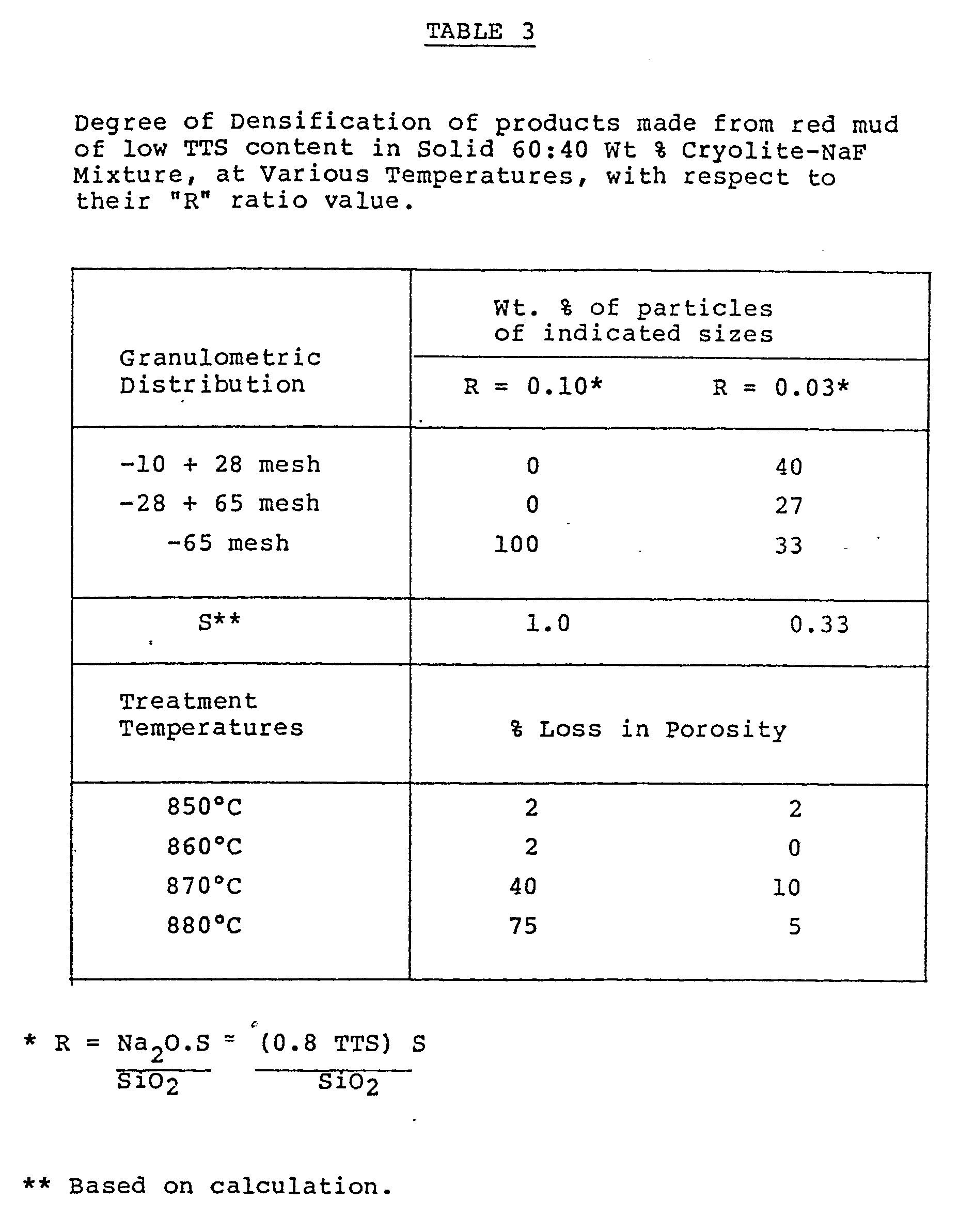
- The samples having the higher R ratio value (R = 0.1, which is in the range of 0.05<R<1), i.e. those produced from the finer particles, exhibited densification by sodium absorption at temperatures above 860°C. At 880°C, a 75% reduction in porosity took place in one sample. This resulted in a final porosity of less than 10%. This is lower than the porosity of most commercial refractories which is normally at least 15% and more generally between 20 and 25%.
- Samples having the R ratio value near 0 (R=0.03), i.e. those produced from coarser red mud particles, did not exhibit significant densification at any temperatures.
- The following procedure was carried out to demonstrate the self-densification property of products made from red mud of high TTS content.
- Samples were prepared by removing sand from red mud but without washing it to keep its original TTS content after the Bayer circuit (varying between 2.5 and 2.9 wt % (on a dry basis)). Then the mud was filtered, calcined at 1000 to 1100°C for 5 to around 10 hours, ground to obtain specific particles sizes and finally mixed with 2 to 6 wt % fume silica (-65 Tyler mesh) and enough water (between 20 to 30 wt % of the dry mixture) to be shaped by vibration casting into molds. The samples were exposed to the same cryolithic mixture than in Example 1, at 880°C for 24 hours.
- The results are summarized in Table 4. Self-densification took place for each sample, their "R" ratios being within the range 0.05<R<1.

- The same sample submitted to the test described in Example 1, showing the highest densification (e g. a reduction of 75% of the initial porosity after 5 hours at 1000°C) was then contacted with liquid cryolite and exhibited very good stability. Indeed, the corrosion was much less than for a medium duty firebrick subjected to the same conditions, and no eutectic liquids as reaction products were observed.
- Samples made by the same procedure as in Example 1, but shaped by vibration casting in 22.86 x 11.43 x 6.35 cm standard molds, were exposed to liquid aluminum for 5 hours at 900°C. Compared to a medium duty firebrick tested in the same conditions, the stability of the product was better.
- Also, similar samples were tested in Al-5 wt % Mg for 96 hours and compared to 18 aluminosilicate castables ranging from 38.61 to 82.50 wt % in alumina content. Based on the extent of wettability, penetration and chemial reactions by the alloy, the resistance to corrosion of the samples were classified from 1 to 6 (i.e. good resistance to no resistance, respectively). Only 26% of the overall samples tested were classified no. 1, including the red mud product.
- The following procedure was carried out to demonstrate the effect of binder content on the physical properties of the red mud products.
- Samples were prepared according to Example 2 and tested for their bulk density, apparent porosity, cold crushing strength and room temperature thermal conductivity. The results are summarized in Table 5.
- Upon increasing the amount of fume silica from 2 to 8 wt %, the product cold crushing strength and thermal conductivity increased from 6.7 to 26.1 MPa and from 0.46 to 0.63 W/mk, respectively.
TABLE 5 Effect of fume silica binder content on the physical properties of the red mud products Products Composition, wt % Red mud 98 96 94 92 Fume silica 2 4 6 8 Physical Properties Bulk density, g/cm³ 1.62 1.63 1.69 1.74 Porosity, % 45 40 38 37 Cold crushing strength, MPa 6.7 14.8 21.0 26.1 Room temperature thermal conductivity, W/mk 0.46 0.50 0.55 0.63 - During the dry mixing step of samples made by the same procedure as in Example 2, using 4 wt % fume silica, 1 wt % polystyrene spheres of less than 2 mm in diameter were added. The results of thermal conductivity tests showed a reduction of around 35 % compared to products free of that additive.
- The following gives some examples of red made from Brazilian, Japanese and Australian plants (see Table 6) that may not need sand removal nor alumina addition to convert them into refractory products which can meet the chemical requirements for use in potlining of alumina reduction cells at temperatures up to 955°C.
- Each of the red mud composition given in Table 6 already contains at least 10% more than the amount of alumina required to generate Nepheline (NaAl SiO₄) on firing as the main silicate phase (no free silica).
TABLE 6 Component Red mud from one Brazilian Plant, % by wt Red mud from one Japanese Plant, % by wt Red mud from one Australian Plant, % by wt Al₂O₃ 17 21 23 Fe₂O₃ 50 35 35 TiO₂ 6 2 8 SiO₂ 10 15 16 Na₂O 4 9 9 CaO 3 0.5 2 Loss on ignition at 1000°C 8 15 7 Other 2 2.5 0
Claims (19)
calcining red mud;
grinding the product following calcination to the -4 Tyier mesh range;
mixing the ground product with a binder and sufficient water to produce a formable mixture;
forming the mixture into a desired shape; and
firing the shaped product to produce said refractory material.

SiO₂ = the molar fraction of SiO₂ in the product originating from the binder;
S = the ratio of specific surface area (SSA) of the calcined red mud particles to the maximum SSA value which is obtained from -65 Tyler mesh material.
Applications Claiming Priority (2)
| Application Number | Priority Date | Filing Date | Title |
|---|---|---|---|
| CA000552914A CA1270863A (en) | 1987-11-26 | 1987-11-26 | Refractory material produced from red mud |
| CA552914 | 1987-11-26 |
Publications (3)
| Publication Number | Publication Date |
|---|---|
| EP0318305A2 true EP0318305A2 (en) | 1989-05-31 |
| EP0318305A3 EP0318305A3 (en) | 1990-05-23 |
| EP0318305B1 EP0318305B1 (en) | 1993-03-10 |
Family
ID=4136952
Family Applications (1)
| Application Number | Title | Priority Date | Filing Date |
|---|---|---|---|
| EP88311165A Expired - Lifetime EP0318305B1 (en) | 1987-11-26 | 1988-11-25 | Refractory material produced from red mud |
Country Status (8)
| Country | Link |
|---|---|
| US (1) | US5106797A (en) |
| EP (1) | EP0318305B1 (en) |
| AU (1) | AU616704B2 (en) |
| BR (1) | BR8806224A (en) |
| CA (1) | CA1270863A (en) |
| DE (1) | DE3879118D1 (en) |
| ES (1) | ES2053771T3 (en) |
| IN (1) | IN174242B (en) |
Cited By (6)
| Publication number | Priority date | Publication date | Assignee | Title |
|---|---|---|---|---|
| GB2271562A (en) * | 1992-10-01 | 1994-04-20 | Veitsch Radex Ag | Binding agent for ceramic materials |
| US5314599A (en) * | 1992-07-28 | 1994-05-24 | Alcan International Limited | Barrier layer against fluoride diffusion in linings of aluminum reduction cells |
| WO1997011041A1 (en) * | 1995-09-19 | 1997-03-27 | Universidade De Santiago De Compostela | Process for producing heat-accumulator ceramic blocks from red clays of the bayer process |
| EP0881200A1 (en) * | 1997-05-30 | 1998-12-02 | Salzschlacke Entsorgungsgesellschaft Lünen mbH | Lining for electrolytic cell |
| CN111635249A (en) * | 2020-06-29 | 2020-09-08 | 青岛海湾科技产业研究院有限公司 | Lightweight high-strength ceramsite and preparation method thereof |
| CN113087516A (en) * | 2021-03-31 | 2021-07-09 | 重庆上甲电子股份有限公司 | Low-temperature sintering method for preparing manganese-zinc ferrite by using industrial wastes |
Families Citing this family (21)
| Publication number | Priority date | Publication date | Assignee | Title |
|---|---|---|---|---|
| EP0399786A3 (en) * | 1989-05-25 | 1992-05-27 | Alcan International Limited | Refractory linings capable of resisting sodium and sodium salts |
| US5227106A (en) * | 1990-02-09 | 1993-07-13 | Tonawanda Coke Corporation | Process for making large size cast monolithic refractory repair modules suitable for use in a coke oven repair |
| KR100284110B1 (en) * | 1998-07-28 | 2001-04-02 | 김호성 | Manufacturing method of artificial reefs mainly from industrial by-products (waste) |
| JP2000051848A (en) * | 1998-08-05 | 2000-02-22 | Nippon Denshi Keiraku Kenkokai:Kk | Ceramic powders, yarns, fabrics, molded products, water quality improvers, and soil conditioners |
| KR100365866B1 (en) * | 2000-02-28 | 2003-01-09 | (주)서홍엔지니어링건축사사 | Sprayable fireproofing composition |
| CA2784249C (en) | 2006-02-09 | 2015-08-11 | Alcoa Inc. | Methods, apparatus and systems for polishing wastewater utilizing, natural media filtration |
| US20100276360A1 (en) * | 2007-02-08 | 2010-11-04 | Alcoa Inc. | Methods, apparatus and systems for polishing wastewater utilizing natural media filtration |
| AU2011267932B2 (en) | 2010-06-14 | 2015-09-17 | Arconic Inc. | Wastewater treatment system and method for removal of contaminants via mixed metal oxide beds |
| RU2588960C2 (en) | 2011-03-18 | 2016-07-10 | Орбит Элюминэ Инк. | Methods of extracting rare-earth elements from aluminium-containing materials |
| WO2012149642A1 (en) | 2011-05-04 | 2012-11-08 | Orbite Aluminae Inc. | Processes for recovering rare earth elements from various ores |
| RU2013157943A (en) | 2011-06-03 | 2015-07-20 | Орбит Элюминэ Инк. | HEMATITIS METHOD |
| EP2755918A4 (en) | 2011-09-16 | 2015-07-01 | Orbite Aluminae Inc | Processes for preparing alumina and various other products |
| AU2013202318B2 (en) | 2012-01-10 | 2015-11-05 | Aem Technologies Inc. | Processes for treating red mud |
| CA2862307C (en) | 2012-03-29 | 2015-12-01 | Orbite Aluminae Inc. | Processes for treating fly ashes |
| RU2597096C2 (en) | 2012-07-12 | 2016-09-10 | Орбит Алюминэ Инк. | Methods of producing titanium oxide and other products |
| BR112015006536A2 (en) | 2012-09-26 | 2017-08-08 | Orbite Aluminae Inc | processes for preparing alumina and magnesium chloride by hcl leaching of various materials. |
| US9534274B2 (en) | 2012-11-14 | 2017-01-03 | Orbite Technologies Inc. | Methods for purifying aluminium ions |
| CN105008289B (en) | 2013-01-11 | 2017-06-06 | 奥科宁克有限公司 | Waste Water Treatment and method |
| GB201522152D0 (en) * | 2015-12-15 | 2016-01-27 | Purgo Ltd | Improvements in and relating to waste treatment |
| CN112521180A (en) * | 2020-12-24 | 2021-03-19 | 深圳市宏通新材料有限公司 | Method for manufacturing red mud ceramic product |
| CN120309327B (en) * | 2025-06-12 | 2025-08-26 | 福建省德化新凯丰陶瓷有限公司 | Environment-friendly ceramic with high corrosion resistance and preparation method thereof |
Family Cites Families (5)
| Publication number | Priority date | Publication date | Assignee | Title |
|---|---|---|---|---|
| DE2063028C3 (en) * | 1970-12-22 | 1977-04-14 | Giulini Gmbh Geb | Process for the production of bricks from red mud |
| DE2150677A1 (en) * | 1971-10-12 | 1973-04-19 | Giulini Gmbh Geb | Process for the production of bricks from red mud |
| US3879211A (en) * | 1973-06-14 | 1975-04-22 | Joseph M Klotz | Ceramic product and method of making same |
| US3985567A (en) * | 1974-09-18 | 1976-10-12 | University Of Guyana | Method of treating bauxite waste red mud with acid and making construction bricks from the treated material |
| US4368273A (en) * | 1979-12-07 | 1983-01-11 | Chemokomplex Vegyipari Gep-Es Berendezes Export-Import Vallalat | Process for the utilization in the ceramics industry of red mud from alumina plants |
-
1987
- 1987-11-26 CA CA000552914A patent/CA1270863A/en not_active Expired - Fee Related
-
1988
- 1988-11-15 IN IN990DE1988 patent/IN174242B/en unknown
- 1988-11-25 AU AU25917/88A patent/AU616704B2/en not_active Ceased
- 1988-11-25 ES ES88311165T patent/ES2053771T3/en not_active Expired - Lifetime
- 1988-11-25 EP EP88311165A patent/EP0318305B1/en not_active Expired - Lifetime
- 1988-11-25 BR BR888806224A patent/BR8806224A/en not_active Application Discontinuation
- 1988-11-25 DE DE8888311165T patent/DE3879118D1/en not_active Expired - Lifetime
-
1991
- 1991-01-02 US US07/636,749 patent/US5106797A/en not_active Expired - Fee Related
Cited By (8)
| Publication number | Priority date | Publication date | Assignee | Title |
|---|---|---|---|---|
| US5314599A (en) * | 1992-07-28 | 1994-05-24 | Alcan International Limited | Barrier layer against fluoride diffusion in linings of aluminum reduction cells |
| GB2271562A (en) * | 1992-10-01 | 1994-04-20 | Veitsch Radex Ag | Binding agent for ceramic materials |
| WO1997011041A1 (en) * | 1995-09-19 | 1997-03-27 | Universidade De Santiago De Compostela | Process for producing heat-accumulator ceramic blocks from red clays of the bayer process |
| ES2099033A1 (en) * | 1995-09-19 | 1997-05-01 | Univ Santiago Compostela | Process for producing heat-accumulator ceramic blocks from red clays of the bayer process |
| EP0881200A1 (en) * | 1997-05-30 | 1998-12-02 | Salzschlacke Entsorgungsgesellschaft Lünen mbH | Lining for electrolytic cell |
| US6132574A (en) * | 1997-05-30 | 2000-10-17 | Aluminium-Salzschalcke Aufbereitungs Gmbh | Bottom lining for electrolytic cells and process for its manufacture |
| CN111635249A (en) * | 2020-06-29 | 2020-09-08 | 青岛海湾科技产业研究院有限公司 | Lightweight high-strength ceramsite and preparation method thereof |
| CN113087516A (en) * | 2021-03-31 | 2021-07-09 | 重庆上甲电子股份有限公司 | Low-temperature sintering method for preparing manganese-zinc ferrite by using industrial wastes |
Also Published As
| Publication number | Publication date |
|---|---|
| EP0318305B1 (en) | 1993-03-10 |
| IN174242B (en) | 1994-10-22 |
| DE3879118D1 (en) | 1993-04-15 |
| AU2591788A (en) | 1989-06-01 |
| ES2053771T3 (en) | 1994-08-01 |
| AU616704B2 (en) | 1991-11-07 |
| BR8806224A (en) | 1989-08-15 |
| EP0318305A3 (en) | 1990-05-23 |
| US5106797A (en) | 1992-04-21 |
| CA1270863A (en) | 1990-06-26 |
Similar Documents
| Publication | Publication Date | Title |
|---|---|---|
| EP0318305B1 (en) | Refractory material produced from red mud | |
| Ribeiro et al. | Recycling of Al-rich industrial sludge in refractory ceramic pressed bodies | |
| KR101497729B1 (en) | AZS refractory composition | |
| CA1077238A (en) | Process for producing magnesium aluminate spinel | |
| US3758318A (en) | Production of mullite refractory | |
| EP0399786A2 (en) | Refractory linings capable of resisting sodium and sodium salts | |
| JP3303221B2 (en) | Refractory brick as tin bath brick | |
| US5149412A (en) | Electrolysis cell and refractory material therefor | |
| CA2000193C (en) | Low cement refractory | |
| RU2140407C1 (en) | Refractory concrete mix | |
| US5206191A (en) | Method of producing refractory materials and their applications in the casting of corrosive alloys | |
| US20090227441A1 (en) | Refractory shaped body with increased alkali resistance | |
| JPS6110055A (en) | Fused chromium-alumina refractory brick, composition manufactured from granular fused material and manufacture | |
| US4349637A (en) | Alumina binder for fiber containing alumina | |
| CN101434492B (en) | Large-sized special-shaped composite magnesium aluminate spinel product and technique for producing the same | |
| CN101367663B (en) | Melt-out recombined composite aluminum oxide refractory materials | |
| CN1083814C (en) | Cryolite resistant refractory material | |
| SK3762001A3 (en) | Ceramic product based on lithium aluminium silicate | |
| CN120309322A (en) | A secondary aluminum ash-based silicon-aluminum refractory slurry and preparation method thereof | |
| CA1322009C (en) | Refractory material produced from red mud | |
| RU2055054C1 (en) | Concrete mix | |
| US2220412A (en) | Refractory and method of making same | |
| CN102992791A (en) | Baking-free refractory brick specially for preheating and cooling sections of lined heat-insulating layer of rotary kiln | |
| CA1274215A (en) | Use of magnesium aluminum spinel in light metal reduction cells | |
| CN114907110B (en) | Synthetic composite spinel Dan Xiabo and manufacturing method thereof |
Legal Events
| Date | Code | Title | Description |
|---|---|---|---|
| PUAI | Public reference made under article 153(3) epc to a published international application that has entered the european phase |
Free format text: ORIGINAL CODE: 0009012 |
|
| AK | Designated contracting states |
Kind code of ref document: A2 Designated state(s): DE ES FR GB IT |
|
| PUAL | Search report despatched |
Free format text: ORIGINAL CODE: 0009013 |
|
| AK | Designated contracting states |
Kind code of ref document: A3 Designated state(s): DE ES FR GB IT |
|
| 17P | Request for examination filed |
Effective date: 19901113 |
|
| 17Q | First examination report despatched |
Effective date: 19911021 |
|
| GRAA | (expected) grant |
Free format text: ORIGINAL CODE: 0009210 |
|
| AK | Designated contracting states |
Kind code of ref document: B1 Designated state(s): DE ES FR GB IT |
|
| PG25 | Lapsed in a contracting state [announced via postgrant information from national office to epo] |
Ref country code: IT Free format text: LAPSE BECAUSE OF FAILURE TO SUBMIT A TRANSLATION OF THE DESCRIPTION OR TO PAY THE FEE WITHIN THE PRE;WARNING: LAPSES OF ITALIAN PATENTS WITH EFFECTIVE DATE BEFORE 2007 MAY HAVE OCCURRED AT ANY TIME BEFORE 2007. THE CORRECT EFFECTIVE DATE MAY BE DIFFERENT FROM THE ONE RECORDED.SCRIBED TIME-LIMIT Effective date: 19930310 Ref country code: DE Effective date: 19930310 |
|
| REF | Corresponds to: |
Ref document number: 3879118 Country of ref document: DE Date of ref document: 19930415 |
|
| ET | Fr: translation filed | ||
| PGFP | Annual fee paid to national office [announced via postgrant information from national office to epo] |
Ref country code: FR Payment date: 19931011 Year of fee payment: 6 |
|
| PGFP | Annual fee paid to national office [announced via postgrant information from national office to epo] |
Ref country code: ES Payment date: 19931112 Year of fee payment: 6 |
|
| PG25 | Lapsed in a contracting state [announced via postgrant information from national office to epo] |
Ref country code: GB Effective date: 19931125 |
|
| PLBE | No opposition filed within time limit |
Free format text: ORIGINAL CODE: 0009261 |
|
| STAA | Information on the status of an ep patent application or granted ep patent |
Free format text: STATUS: NO OPPOSITION FILED WITHIN TIME LIMIT |
|
| 26N | No opposition filed | ||
| GBPC | Gb: european patent ceased through non-payment of renewal fee |
Effective date: 19931125 |
|
| REG | Reference to a national code |
Ref country code: ES Ref legal event code: FG2A Ref document number: 2053771 Country of ref document: ES Kind code of ref document: T3 |
|
| PG25 | Lapsed in a contracting state [announced via postgrant information from national office to epo] |
Ref country code: ES Free format text: LAPSE BECAUSE OF NON-PAYMENT OF DUE FEES Effective date: 19941126 |
|
| PG25 | Lapsed in a contracting state [announced via postgrant information from national office to epo] |
Ref country code: FR Effective date: 19950731 |
|
| REG | Reference to a national code |
Ref country code: FR Ref legal event code: ST |
|
| REG | Reference to a national code |
Ref country code: ES Ref legal event code: FD2A Effective date: 19951214 |