EP0318334B1 - Dispositif et procédé pour convertir un signal multiplexé en fréquence en un signal multiplexé temporellement - Google Patents
Dispositif et procédé pour convertir un signal multiplexé en fréquence en un signal multiplexé temporellement Download PDFInfo
- Publication number
- EP0318334B1 EP0318334B1 EP88311257A EP88311257A EP0318334B1 EP 0318334 B1 EP0318334 B1 EP 0318334B1 EP 88311257 A EP88311257 A EP 88311257A EP 88311257 A EP88311257 A EP 88311257A EP 0318334 B1 EP0318334 B1 EP 0318334B1
- Authority
- EP
- European Patent Office
- Prior art keywords
- signals
- signal
- division multiplex
- frequency
- reference frequency
- Prior art date
- Legal status (The legal status is an assumption and is not a legal conclusion. Google has not performed a legal analysis and makes no representation as to the accuracy of the status listed.)
- Expired - Lifetime
Links
Images

Classifications
-
- H—ELECTRICITY
- H04—ELECTRIC COMMUNICATION TECHNIQUE
- H04J—MULTIPLEX COMMUNICATION
- H04J14/00—Optical multiplex systems
- H04J14/08—Time-division multiplex systems
Definitions
- the invention relates to apparatus and methods for converting a frequency division multiplex (fdm) signal into a time division multiplex (tdm) signal. It finds particular but not exclusive application in a communication system comprising a primary station and a plurality of secondary stations, each of the stations having signal transmitting means and signal receiving means, a first communication link extending from the primary station to signal splitting means for supplying signals from the primary station to each of the secondary stations, and a second communication link extending from signal combining means, which receives signals from each of the secondary stations, to the primary station.
- fdm frequency division multiplex
- tdm time division multiplex
- Such communication systems find application in a variety of fields including local telephone networks and the like.
- One method of operating such a communication system is to distribute signals from the primary station (or exchange) as a multiplex, for example a common time division multiplex signal, to all the secondary stations. Each station then selects the time slots appropriate to it.
- a multiplex for example a common time division multiplex signal
- Each station selects the time slots appropriate to it.
- the signals transmitted from the secondary stations must be accurately timed to avoid signal "collisions" in the common path back to the primary station.
- the timing will depend principally on the path length and, in the case of optical communication systems using optical fibres, this path length can vary slightly with temperature effects.
- a ranging system must be built into each terminal.
- the signals transmitted between the stations will comprise optical signals and in this case the stations may be coupled by optical waveguides such as optical fibres.
- optical waveguides such as optical fibres.
- other media including air, could define the communication links.
- the signals could comprise electrical or radio frequency signals.
- a common transmission path is used, for example a common optical waveguide in the case of optical signals.
- the signal combining and splitting means are provided by a common element.
- the signals could be transmitted with the same or different wavelengths in the opposite directions.
- the primary station receiving means may include a splitting means to split the incoming frequency division multiplex signal into a plurality of subsidiary signals, one for each secondary station, and a plurality of demodulating circuits for receiving respective ones of the subsidiary signals and for regenerating the information associated with the signal from the corresponding secondary station.
- this arrangement needs separate demodulating circuits for each channel or secondary station.
- British Patent Specification No. 1297922 discloses amplitude modulating an optical carrier signal by several radio frequency sub-carriers each modulated with lower frequency information bearing signals.
- the incoming optical signal is divided amonst n optical fibres each leading to its own respective receiver comprising a combined mixer and demodulator, a local oscillator, and an intermediate frequency (IF) amplifier.
- the outputs of all the channels, i.e. the IF amplifiers, are fed to a baseband detector for recovery of the information bearing signals.
- apparatus including a plurality of channels, each channel having a known common data rate, for converting a frequency division multiplex signal into a time division multiplex signal
- a reference frequency signal generator for repeatedly generating a series of reference frequency signals in steps at a repetition rate synchronised to said known common data rate of the frequency division multiplex signal, the number of reference frequency signals being equal to the number of carrier signals in the frequency division multiplex signal
- mixing means for mixing the frequency division multiplex signal and the reference frequency signals to generate intermediate frequency signals, the combination of respective pairs of carrier signals and reference frequency signals generating respective intermediate frequency signals at a common frequency
- a bandpass filter for passing only the intermediate frequency signals at said common frequency from the output of the mixing means, the filter output thus constituting a time division multiplex signal in the form of a repeating corresponding series of respective intermediate frequency signals
- demodulating means responsive to the output from the bandpass filter for producing from the respective intermediate frequency signals corresponding channel data signals.
- the reference frequency signal generator will comprise a voltage controlled oscillator.
- the series of reference frequency signals may be generated in steps such that the repetition rate of the full staircase of reference frequency signals is preferably substantially twice the data rate. Other repetition rates are also possible.
- the generation of the intermediate frequency signals at a common frequency may be carried out in the electrical domain or in the optical domain, for example using a coherent optical heterodyne detection scheme in which the local optical oscillator is stepped through a staircase of optical reference frequency signals to be mixed with a received optical fdm signal.
- a method of converting a frequency division multiplex signal including a plurality of channels, each channel having a known common data rate, into a time division multiplex signal comprising repeatedly generating a series of reference frequency signals in steps at a repetition rate synchronised to said known common data rate, the number of reference frequency signals being equal to the number of carrier signals in the frequency division multiplex signal; mixing the frequency division multiplex signal and the reference frequency signals to generate respective intermediate frequency signals at a common frequency and demodulating the intermediate frequency signals at the common frequency to product corresponding channel data signals, which thus constitute a time division multiplex signal.
- a communications system comprising a primary station; and a plurality of secondary stations, each of the stations having signal transmitting means and signal receiving means, a first communication link extending from the primary station to signal splitting means for supplying signals from the primary station to each of the secondary stations, and a second communication link extending from signal combining means, which receives signals from each of the secondary stations, to the primary station wherein the signal transmitting means of the primary station and the signal receiving means of the secondary stations are adapted to transmit and receive respectively multiplex signals, the signal transmitting means of the secondary stations are adapted to transmit signals at respective carrier frequencies, the signal combining means combining these signals into a common frequency division multiplex signal and the receiving means of the primary station is adapted to receive the common frequency division multiplex signal, the primary station including apparatus for converting the common frequency division multiplex signal into a time division multiplex according to the first aspect of the invention.
- the communication system which is shown schematically in Figure 1 comprises a primary station or exchange 1 having an optical transmitter 2 and a receiver 12.
- the transmitter 2 is connected to an electrical signal multiplexer 4 which receives data signals on a plurality of channels 5, these signals being destined for respective ones of n terminals or secondary stations 6.
- the data signals received by the signal multiplexer 4 are multiplexed onto a common electrical signal in a time division manner and the time division multiplex signal is fed to an optical transmitter 2.
- the transmitter 2 is modulated in accordance with the incoming electrical signal to generate a time division multiplex optical signal which is fed along an optical fibre 9 to an optical fibre 10.
- the optical fibre 10 extends to an optical splitter 11 which splits the incoming signal into a number of subsidiary signals, one for each secondary station 6.
- Each station 6 includes conventional demultiplexing circuitry to enable it to read the correct data contained within the time slots associated with that station.
- a secondary station 6 When a secondary station 6 wishes to transmit information back to the exchange 1, it generates an optical carrier signal with a frequency (f i ) unique to that station which is modulated with the data.
- the modulated signal is fed along the same optical fibre as the incoming signal to the optical splitter 11 which acts as a combiner to combine the signals from the stations 6 to form a frequency division multiplex signal which is fed back along the optical fibre 10 to an optical receiver 12 in the exchange 1.
- the receiver 12 converts the incoming optical signal into an electrical signal which is then fed to a fdm to tdm converter 19 according to the present invention which will be now be described with reference to Figure 2.
- FIG. 2 illustrates the fdm to tdm convertor 19 of a receiver shown in Figure 1.
- the frequency division multiplex signal is received by the receiver 12, and fed to a mixer circuit 20.
- the other input of the mixer circuit 20 is connected to a voltage controlled oscillator 21 which is driven in a staircase manner, as shown in the drawing, so as to supply a series of different frequencies at stepped intervals to the mixer circuit 20.
- the transmitting circuit 2, 4 of the primary station will respond to a clock signal generated within the primary station. To assist in demodulating the time division multiplex signal, this clock signal will be transmitted also to each of the secondary stations 6. Furthermore, the secondary stations 6 will use the same clock signal when modulating their respective carrier signals to generate return signals and this enables the VCO 21 to be synchronised to the incoming signal.
- the time period of each step in the staircase of the reference frequency signals may be selected as shown in Figure 2 selected so that the sweep frequency (i.e. repetition rate) of the full staircase of signals is twice or a higher integral of the data rate of the incoming signal and this defines the time period of each time division of the resultant time division multiplex signal. It may be necessary to adjust the phase of the individual return channels at the secondary stations 6.
- the reference frequency signals generated by the VCO 21 are chosen such that the result of mixing each of these signals with a respective one only of the incoming carrier signals f1-f n is a respective signal at a common intermediate frequency.
- the mixing of each reference frequency signal with the other carrier signals of the incoming signal will result in respective signals at intermediate frequencies different from the common intermediate frequency.
- a bandpass filter 22 is positioned downstream of the mixer 20 to eliminate all signals but that at the common intermediate frequency which is then fed to a demodulator 23 whose output is fed to a lowpass filter 24.
- the output from the lowpass filter 24 is an n-channel time division multiplex signal which can then be analysed in a conventional manner.
- the primary station 1 may alternatively transmit frequency multiplexed signals to the secondary stations 6, the stations 6 being provided with appropriate demultiplexers to enable them to select the signal at the appropriate frequency associated with the station.
- apparatus for converting a fdm signal to a tdm signal can be employed with communications systems other than in the exemplary system shown in Figure 1.
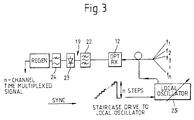
- the present invention is also applicable to fdm to tdm signal conversion in the optical domain, for example in an optical heterodyne coherent receiver, in which case the mixer comprises an optical detector which mixes a number of optical reference frequency signals from a variable local oscillator 25, a laser for example, with the received optical fdm signal from the secondary stations 6 - as shown in Figure 3.
- the mixer comprises an optical detector which mixes a number of optical reference frequency signals from a variable local oscillator 25, a laser for example, with the received optical fdm signal from the secondary stations 6 - as shown in Figure 3.
Landscapes
- Engineering & Computer Science (AREA)
- Computer Networks & Wireless Communication (AREA)
- Signal Processing (AREA)
- Optical Communication System (AREA)
- Time-Division Multiplex Systems (AREA)
- Ac-Ac Conversion (AREA)
- Transmitters (AREA)
- Stabilization Of Oscillater, Synchronisation, Frequency Synthesizers (AREA)
- Eye Examination Apparatus (AREA)
Claims (10)
- Appareil incluant une série de canaux, chaque canal présentant une fréquence commune connue de données, pour convertir un signal multiplex à division de fréquences en un signal multiplex à division de temps, comprenant un générateur (21; 25) de signaux à fréquence de référence pour engendrer de façon répétée par gradins une série de signaux de fréquence de reférence à une fréquence de répétition synchronisée avec une fréquence commune connue de données du signal multiplex à division de fréquences, le nombre des signaux de fréquence de référence étant égal au nombre de signaux porteurs dans le signal multiplex à division de fréquences; un moyen mélangeur (20; 12) pour mélanger le signal multiplex à division de fréquences et les signaux de fréquence de référence afin d'engendrer des signaux intermédiaires de référence, la combinaison de paires respectives de signaux porteurs et de signaux de fréquence de référence engendrant des signaux respectifs de fréquence intermédiaire à une fréquence commune; un filtre passe-bande (22) pour ne laisser passer de la sortie du moyen mélangeur que les signaux de fréquence intermédiaires à ladite fréquence commune, la sortie du filtre constituant ainsi un signal dudit multiplex à division de temps sous forme d'une série correspondante qui se répète de signaux respectifs à fréquence intermédiaire; et un moyen démodulateur (23) sensible à la sortie du filtre passe-bande pour produire, à partir des signaux respectifs de fréquence intermédiaire, des signaux correspondant de données de canaux.
- Appareil selon la revendication 1 dans lequel la fréquence de répétition de la série de signaux de fréquence de référence engendrée par le générateur (21; 25) de signaux de fréquence de référence est sensiblement double de la fréquence de données du signal entrant de multiplex à division de fréquences.
- Appareil selon la revendication 1 ou la revendication 2, dans lequel le générateur (25) de signaux de fréquence de référence engendre des signaux optiques de fréquence de référence.
- Appareil selon la revendication 1 ou la revendication 2, dans lequel le générateur (21) de signaux de fréquence de référence comprend un oscillateur commandé par tension.
- Procédé de conversion d'un signal multiplex à division de fréquences incluant une série de canaux, chaque canal présentant une fréquence commune connue de données, en un signal multiplex à division de temps, comprenant les étapes consistant à engendrer de façon répétée par gradins une série de signaux de fréquence de référence à une fréquence de répétition synchronisée avec ladite fréquence commune connue de données, le nombre des signaux de fréquence de référence étant égal au nombre de signaux porteurs dans le signal multiplex à division de fréquences; mélanger le signal multiplex à division de fréquences et les signaux de fréquence de référence afin d'engendrer des signaux intermédiaires de référence, la combinaison de paires respectives de signaux porteurs et de signaux de fréquence de référence engendrant des signaux respectifs de fréquence intermédiaire à une fréquence commune; et démoduler les signaux de fréquence intermédiaire à la fréquence commune afin de produire des signaux correspondants de données de canaux, qui constituent donc un signal à multiplex à division de temps.
- Un procédé selon la revendication 5, dans lequel la fréquence de répétition de la série des signaux de fréquence de référence est sensiblement double de la fréquence de données.
- Un procédé selon la revendication 5 ou la revendication 6 dans lequel le générateur de signaux de fréquence de référence engendre des signaux optiques de fréquence de référence et le mélange s'effectue dans le domaine optique.
- Un système de communications comprenant une station principale (1); et une série de stations secondaires (6), chacune des stations incluant un moyen émetteur (2) de signaux et un moyen récepteur (12, non représenté) de signaux, une première liaison de communications (9, 10) s'étendant depuis la station principale vers un moyen de division (11) de signaux pour envoyer des signaux depuis la station principale (1) vers chacune des stations secondaires (6), et une deuxième liaison de communications (10) s'étendant depuis un moyen de combinaison (11) de signaux, qui reçoit des signaux venant de chacune des stations secondaires, vers la station principale (6), dans lequel le moyen émetteur (2) de signaux de la station principale (1) et le moyen récepteur (non représenté) de signaux des stations secondaires (6) sont aptes à émettre et à recevoir respectivement des signaux en multiplex, les signaux émetteurs des stations secondaires (6) sont aptes à émettre des signaux à des fréquences de porteuses respectives, le moyen de combinaison (11) de signaux combinant ces signaux en un signal multiplex commun à division de fréquences, et le moyen récepteur (12) de la station principale (1) est adapté à recevoir le signal commun de multiplex à division de fréquences, la station principale incluant un appareil (19) de conversion du signal commun de multiplex à division de fréquences en un signal multiplex à division de temps selon une quelconque des revendication 1 à 4.
- Un système selon la revendication 8, dans lequel les liaisons de communications (9, 10) comprennent des guides d'ondes optiques.
- Un système selon la revendication 8 ou la revendication 9, dans lequel le moyen de division de signaux et le moyen de combinaison de signaux sont constitués par un élément commun (11), une liaison de communications (10) étant disposée entre l'élément commun et la station principale (1).
Applications Claiming Priority (2)
| Application Number | Priority Date | Filing Date | Title |
|---|---|---|---|
| GB8727847 | 1987-11-27 | ||
| GB878727847A GB8727847D0 (en) | 1987-11-27 | 1987-11-27 | Communication system |
Publications (2)
| Publication Number | Publication Date |
|---|---|
| EP0318334A1 EP0318334A1 (fr) | 1989-05-31 |
| EP0318334B1 true EP0318334B1 (fr) | 1994-11-30 |
Family
ID=10627658
Family Applications (1)
| Application Number | Title | Priority Date | Filing Date |
|---|---|---|---|
| EP88311257A Expired - Lifetime EP0318334B1 (fr) | 1987-11-27 | 1988-11-28 | Dispositif et procédé pour convertir un signal multiplexé en fréquence en un signal multiplexé temporellement |
Country Status (9)
| Country | Link |
|---|---|
| EP (1) | EP0318334B1 (fr) |
| JP (1) | JP2694987B2 (fr) |
| AT (1) | ATE114905T1 (fr) |
| CA (1) | CA1334114C (fr) |
| DE (1) | DE3852277T2 (fr) |
| ES (1) | ES2064362T3 (fr) |
| GB (1) | GB8727847D0 (fr) |
| HK (1) | HK138096A (fr) |
| WO (1) | WO1989005071A1 (fr) |
Families Citing this family (1)
| Publication number | Priority date | Publication date | Assignee | Title |
|---|---|---|---|---|
| GB8921341D0 (en) * | 1989-09-21 | 1989-11-08 | Smiths Industries Plc | Optical multiplexing |
Family Cites Families (5)
| Publication number | Priority date | Publication date | Assignee | Title |
|---|---|---|---|---|
| GB1297922A (fr) * | 1969-11-25 | 1972-11-29 | ||
| IT1159851B (it) * | 1978-06-20 | 1987-03-04 | Cselt Centro Studi Lab Telecom | Perfezionamenti ai sistemi di trasmissione a divisione di lunghezza d'onda |
| US4302835A (en) * | 1980-01-24 | 1981-11-24 | Sperry Corporation | Multiple terminal passive multiplexing apparatus |
| DE3507064A1 (de) * | 1985-02-28 | 1986-08-28 | Standard Elektrik Lorenz Ag, 7000 Stuttgart | Optisches nachrichtenuebertragungssystem im teilnehmeranschlussbereich |
| JPH0669175B2 (ja) * | 1986-04-30 | 1994-08-31 | シャープ株式会社 | 多周波信号波形の処理方式 |
-
1987
- 1987-11-27 GB GB878727847A patent/GB8727847D0/en active Pending
-
1988
- 1988-11-25 CA CA000584226A patent/CA1334114C/fr not_active Expired - Fee Related
- 1988-11-28 EP EP88311257A patent/EP0318334B1/fr not_active Expired - Lifetime
- 1988-11-28 WO PCT/GB1988/001039 patent/WO1989005071A1/fr not_active Ceased
- 1988-11-28 JP JP63509473A patent/JP2694987B2/ja not_active Expired - Lifetime
- 1988-11-28 ES ES88311257T patent/ES2064362T3/es not_active Expired - Lifetime
- 1988-11-28 AT AT88311257T patent/ATE114905T1/de not_active IP Right Cessation
- 1988-11-28 DE DE3852277T patent/DE3852277T2/de not_active Expired - Fee Related
-
1996
- 1996-07-25 HK HK138096A patent/HK138096A/en not_active IP Right Cessation
Also Published As
| Publication number | Publication date |
|---|---|
| GB8727847D0 (en) | 1987-12-31 |
| JPH03502751A (ja) | 1991-06-20 |
| DE3852277D1 (de) | 1995-01-12 |
| CA1334114C (fr) | 1995-01-24 |
| WO1989005071A1 (fr) | 1989-06-01 |
| ES2064362T3 (es) | 1995-02-01 |
| JP2694987B2 (ja) | 1997-12-24 |
| ATE114905T1 (de) | 1994-12-15 |
| HK138096A (en) | 1996-08-02 |
| EP0318334A1 (fr) | 1989-05-31 |
| DE3852277T2 (de) | 1995-04-06 |
Similar Documents
| Publication | Publication Date | Title |
|---|---|---|
| US5323255A (en) | Transceiver arrangement using TDM to transmit assigned subcarrier waveforms | |
| CA1199074A (fr) | Reseau de communications avec voies optiques | |
| US5546190A (en) | Carrier and clock recovery for lightwave systems | |
| US4754452A (en) | Optical local area network using a common optical carrier with separate user angle modulation | |
| JPS62206935A (ja) | 光通信機と光波信号送信方法 | |
| JP3000551B2 (ja) | 光電式周波数分割器回路及びその操作方法 | |
| US7151896B2 (en) | Burst optical communication apparatus | |
| CA1269159A (fr) | Methodes de commutation pour systemes de communication a multiplexage en frequence | |
| WO1986005343A1 (fr) | Systemes de transmission par ligne | |
| US4402076A (en) | Two wire F.D. multiplex system | |
| US4414663A (en) | Time division multiplex system having transmitted pulses in time channels distributed over and co-transmitted with a frame clock signal component | |
| US5406553A (en) | Apparatus and method for converting a frequency division multiplex to a time division multiplex | |
| JP3512580B2 (ja) | 光時分割多重伝送用光送信装置と光受信装置及びこれらを備えた光時分割多重光伝送装置 | |
| US3450841A (en) | Carrier frequency stabilization for carrier frequency systems with suppressed carrier waves | |
| JP3584072B2 (ja) | 通信ネットワーク及び通信局 | |
| JPH05344095A (ja) | 光通信ネットワークにおける波長・クロック同期方式およびそれを用いた波長多重光通信ネットワーク | |
| HK138096A (en) | Apparatus and method for converting a frequency division multiplex to a time division multiplex | |
| RU2124812C1 (ru) | Способ передачи сигналов синхронных цифровых волоконно-оптических систем методом спектрально-кодового мультиплексирования и устройство для его осуществления | |
| JP2738542B2 (ja) | コヒーレント光通信方式 | |
| AU606241B2 (en) | Apparatus and method for converting a frequency division multiplex to a time division multiplex | |
| JPH1032563A (ja) | ミリ波信号光多重伝送方式及び装置 | |
| JP3274873B2 (ja) | 光学的な周波数の相対的ポジショニング方法及び装置 | |
| JP2003037868A (ja) | 通信装置 | |
| RU97113107A (ru) | Способ передачи сигналов синхронных цифровых волоконно-оптических систем методом спектрально-кодового мультиплексирования и устройство для его осуществления | |
| JPS5813055B2 (ja) | デ−タとクロックの時分割多重伝送による光デ−タリンク方式 |
Legal Events
| Date | Code | Title | Description |
|---|---|---|---|
| PUAI | Public reference made under article 153(3) epc to a published international application that has entered the european phase |
Free format text: ORIGINAL CODE: 0009012 |
|
| AK | Designated contracting states |
Kind code of ref document: A1 Designated state(s): AT BE CH DE ES FR GB GR IT LI LU NL SE |
|
| 17P | Request for examination filed |
Effective date: 19891107 |
|
| 17Q | First examination report despatched |
Effective date: 19911024 |
|
| GRAA | (expected) grant |
Free format text: ORIGINAL CODE: 0009210 |
|
| AK | Designated contracting states |
Kind code of ref document: B1 Designated state(s): AT BE CH DE ES FR GB GR IT LI LU NL SE |
|
| PG25 | Lapsed in a contracting state [announced via postgrant information from national office to epo] |
Ref country code: AT Effective date: 19941130 Ref country code: LI Effective date: 19941130 Ref country code: GR Free format text: LAPSE BECAUSE OF FAILURE TO SUBMIT A TRANSLATION OF THE DESCRIPTION OR TO PAY THE FEE WITHIN THE PRESCRIBED TIME-LIMIT Effective date: 19941130 Ref country code: BE Effective date: 19941130 Ref country code: CH Effective date: 19941130 |
|
| REF | Corresponds to: |
Ref document number: 114905 Country of ref document: AT Date of ref document: 19941215 Kind code of ref document: T |
|
| REF | Corresponds to: |
Ref document number: 3852277 Country of ref document: DE Date of ref document: 19950112 |
|
| EAL | Se: european patent in force in sweden |
Ref document number: 88311257.5 |
|
| ITF | It: translation for a ep patent filed | ||
| REG | Reference to a national code |
Ref country code: ES Ref legal event code: FG2A Ref document number: 2064362 Country of ref document: ES Kind code of ref document: T3 |
|
| REG | Reference to a national code |
Ref country code: CH Ref legal event code: PL |
|
| ET | Fr: translation filed | ||
| PLBE | No opposition filed within time limit |
Free format text: ORIGINAL CODE: 0009261 |
|
| STAA | Information on the status of an ep patent application or granted ep patent |
Free format text: STATUS: NO OPPOSITION FILED WITHIN TIME LIMIT |
|
| 26N | No opposition filed | ||
| PG25 | Lapsed in a contracting state [announced via postgrant information from national office to epo] |
Ref country code: LU Free format text: LAPSE BECAUSE OF NON-PAYMENT OF DUE FEES Effective date: 19951130 |
|
| PGFP | Annual fee paid to national office [announced via postgrant information from national office to epo] |
Ref country code: SE Payment date: 20001016 Year of fee payment: 13 |
|
| PGFP | Annual fee paid to national office [announced via postgrant information from national office to epo] |
Ref country code: NL Payment date: 20001020 Year of fee payment: 13 |
|
| PGFP | Annual fee paid to national office [announced via postgrant information from national office to epo] |
Ref country code: ES Payment date: 20001107 Year of fee payment: 13 |
|
| PGFP | Annual fee paid to national office [announced via postgrant information from national office to epo] |
Ref country code: FR Payment date: 20011012 Year of fee payment: 14 |
|
| PGFP | Annual fee paid to national office [announced via postgrant information from national office to epo] |
Ref country code: DE Payment date: 20011029 Year of fee payment: 14 |
|
| PG25 | Lapsed in a contracting state [announced via postgrant information from national office to epo] |
Ref country code: ES Free format text: LAPSE BECAUSE OF NON-PAYMENT OF DUE FEES Effective date: 20011129 Ref country code: SE Free format text: LAPSE BECAUSE OF NON-PAYMENT OF DUE FEES Effective date: 20011129 |
|
| REG | Reference to a national code |
Ref country code: GB Ref legal event code: IF02 |
|
| PG25 | Lapsed in a contracting state [announced via postgrant information from national office to epo] |
Ref country code: NL Free format text: LAPSE BECAUSE OF NON-PAYMENT OF DUE FEES Effective date: 20020601 |
|
| EUG | Se: european patent has lapsed |
Ref document number: 88311257.5 |
|
| NLV4 | Nl: lapsed or anulled due to non-payment of the annual fee |
Effective date: 20020601 |
|
| PG25 | Lapsed in a contracting state [announced via postgrant information from national office to epo] |
Ref country code: DE Free format text: LAPSE BECAUSE OF NON-PAYMENT OF DUE FEES Effective date: 20030603 |
|
| PG25 | Lapsed in a contracting state [announced via postgrant information from national office to epo] |
Ref country code: FR Free format text: LAPSE BECAUSE OF NON-PAYMENT OF DUE FEES Effective date: 20030731 |
|
| REG | Reference to a national code |
Ref country code: FR Ref legal event code: ST |
|
| REG | Reference to a national code |
Ref country code: ES Ref legal event code: FD2A Effective date: 20021213 |
|
| PG25 | Lapsed in a contracting state [announced via postgrant information from national office to epo] |
Ref country code: IT Free format text: LAPSE BECAUSE OF NON-PAYMENT OF DUE FEES Effective date: 20051128 |
|
| PGFP | Annual fee paid to national office [announced via postgrant information from national office to epo] |
Ref country code: GB Payment date: 20071018 Year of fee payment: 20 |
|
| REG | Reference to a national code |
Ref country code: GB Ref legal event code: PE20 Expiry date: 20081127 |
|
| PG25 | Lapsed in a contracting state [announced via postgrant information from national office to epo] |
Ref country code: GB Free format text: LAPSE BECAUSE OF EXPIRATION OF PROTECTION Effective date: 20081127 |