EP0318792A2 - Voltage-stabilised insulation material - Google Patents
Voltage-stabilised insulation material Download PDFInfo
- Publication number
- EP0318792A2 EP0318792A2 EP88119374A EP88119374A EP0318792A2 EP 0318792 A2 EP0318792 A2 EP 0318792A2 EP 88119374 A EP88119374 A EP 88119374A EP 88119374 A EP88119374 A EP 88119374A EP 0318792 A2 EP0318792 A2 EP 0318792A2
- Authority
- EP
- European Patent Office
- Prior art keywords
- plastic insulation
- insulation according
- polymer
- base polymer
- group
- Prior art date
- Legal status (The legal status is an assumption and is not a legal conclusion. Google has not performed a legal analysis and makes no representation as to the accuracy of the status listed.)
- Withdrawn
Links
Classifications
-
- H—ELECTRICITY
- H01—ELECTRIC ELEMENTS
- H01B—CABLES; CONDUCTORS; INSULATORS; SELECTION OF MATERIALS FOR THEIR CONDUCTIVE, INSULATING OR DIELECTRIC PROPERTIES
- H01B3/00—Insulators or insulating bodies characterised by the insulating materials; Selection of materials for their insulating or dielectric properties
- H01B3/18—Insulators or insulating bodies characterised by the insulating materials; Selection of materials for their insulating or dielectric properties mainly consisting of organic substances
- H01B3/30—Insulators or insulating bodies characterised by the insulating materials; Selection of materials for their insulating or dielectric properties mainly consisting of organic substances plastics; resins; waxes
- H01B3/44—Insulators or insulating bodies characterised by the insulating materials; Selection of materials for their insulating or dielectric properties mainly consisting of organic substances plastics; resins; waxes vinyl resins; acrylic resins
-
- C—CHEMISTRY; METALLURGY
- C08—ORGANIC MACROMOLECULAR COMPOUNDS; THEIR PREPARATION OR CHEMICAL WORKING-UP; COMPOSITIONS BASED THEREON
- C08F—MACROMOLECULAR COMPOUNDS OBTAINED BY REACTIONS ONLY INVOLVING CARBON-TO-CARBON UNSATURATED BONDS
- C08F255/00—Macromolecular compounds obtained by polymerising monomers on to polymers of hydrocarbons as defined in group C08F10/00
- C08F255/02—Macromolecular compounds obtained by polymerising monomers on to polymers of hydrocarbons as defined in group C08F10/00 on to polymers of olefins having two or three carbon atoms
Definitions
- the invention relates to a plastic insulation which has molecular groups bonded to the base polymer of the plastic insulation for stabilization against voltage-induced defects.
- Plastic insulation can be hydrocarbon-based polymers that are used as electrical insulation in high-voltage systems, especially for sleeves and cables.
- the invention is based on the object of specifying a plastic insulation which has improved resistance to "water trees" and to which a crosslinking agent can easily be mixed.
- This object is achieved in a plastic insulation of the type mentioned according to the invention in that a substance is added to the base polymer, the molecules of which have several functional groups, at least one of which serves to bind to the polymer molecule, while another effects the crosslinking and another group - which has a stabilizing effect - is activated.
- the compound according to the invention has the advantage that it cannot diffuse out of the polymer, since the molecules are grafted onto the polymer, both serving to crosslink the polymer and to stabilize it against water trees.
- the molecular groups are mobile enough, in spite of the binding of the molecule to the polymer chain, to bring about the crosslinking reaction. After networking, the watertree-active group is activated.
- the invention is explained in more detail using the following exemplary embodiment.
- the substance with the multifunctional molecular groups has the following structure, for example:
- This molecule is grafted onto the polymer molecule with the vinyl group.
- the peroxy group serves as a crosslinker, an oxygen atom remaining attached to the molecule as an alcohol or keto group.
- the OH group is intended for wt stabilization.
- the released tertiary butanol is volatile in any case, i.e. it diffuses out of the plastic.
- the remaining molecule remains firmly bound to the polymer through the grafting. This could be demonstrated by the fact that aromatic products could not be removed by extraction, on the other hand the chemical binding to the polymer by IR analysis is considered to be proven.
- the watertree resistance was tested on a sample of cross-linked polyethylene (VPE) using the so-called needle test with a stroke length of 1.5 mm. With a peroxide content of 4% by weight, the mean growth length of the water trees was 120 ⁇ m. After tempering for 15 hours at 80 ° C, the length of the water trees was 145 ⁇ m on average. For comparison, the wt growth values for normal PE crosslinked with dicumyl peroxide were measured. The mean was 100 ⁇ m untempered and 290 ⁇ m annealed.
Landscapes
- Chemical & Material Sciences (AREA)
- Health & Medical Sciences (AREA)
- Chemical Kinetics & Catalysis (AREA)
- Medicinal Chemistry (AREA)
- Polymers & Plastics (AREA)
- Organic Chemistry (AREA)
- Physics & Mathematics (AREA)
- Spectroscopy & Molecular Physics (AREA)
- Organic Insulating Materials (AREA)
- Compositions Of Macromolecular Compounds (AREA)
Abstract
Bei einer Kunststoffisolierung, welche zur Stabilisierung gegen spannungsinduzierte Defekte an das Basispolymer der Kunststoffisolierung gebundene Molekülgruppen aufweist, ist vorgesehen, daß dem Basispolymer eine Substanz zugefügt ist, deren Moleküle mehrere funktionelle Gruppen aufweisen, von denen mindestens eine Gruppe der Bindung an das Polymermolekül dient, während eine andere die Vernetzung bewirkt und dabei eine weitere - stabilisierend wirkende - Gruppe aktiviert. In the case of plastic insulation, which has molecular groups bonded to the base polymer of the plastic insulation to stabilize against voltage-induced defects, it is provided that a substance is added to the base polymer, the molecules of which have several functional groups, at least one of which serves to bind to the polymer molecule, while another brings about networking and thereby activates another - stabilizing - group.
Description
Die Erfindung betrifft eine Kunststoffisolierung, welche zur Stabilisierung gegen spannungsinduzierte Defekte an das Basispolymer der Kunststoffisolierung gebundene Molekülgruppen aufweist.The invention relates to a plastic insulation which has molecular groups bonded to the base polymer of the plastic insulation for stabilization against voltage-induced defects.
Kunststoffisolierungen können Polymere auf der Basis von Kohlenwasserstoffen sein, die als elektrische Isolierung in Hochspannungsanlagen, insbesondere für Muffen und Kabel verwendet werden.Plastic insulation can be hydrocarbon-based polymers that are used as electrical insulation in high-voltage systems, especially for sleeves and cables.
Elektrisch beanspruchte Isolierungen zeigen nach einiger Zeit spannungsinduzierte Defekte, die als "electrochemical trees" (ECT) und bei zusätzlichem Wassereinfluß als "water trees" (WT) bezeichnet werden. Die Betriebssicherheit von Hochspannungsanlagen und -kabeln wird durch diese Phänomene beeinträchtigt, und so hat es nicht an Versuchen gefehlt, die Ausbreitung von water trees zu behindern, so daß es nicht zum elektrischen Durchschlag kommen kann.After some time, electrically stressed insulations show voltage-induced defects, which are referred to as "electrochemical trees" (ECT) and, with additional water influence, as "water trees" (WT). The operational safety of high-voltage systems and cables is impaired by these phenomena, and so there has been no shortage of attempts to prevent water trees from spreading, so that electrical breakdown cannot occur.
Um die Wachstumsrate von "water trees" zu behindern, sind verschiedene Stabilisatoren als Additive für Kunststoffisolierungen vorgeschlagen worden. Um wirksam zu sein, muß ein solcher Zusatz verschiedenen Bedingungen genügen: er muß die elektrischen Eigenschaften der Isolierung auf lange Zeit sichern; er muß chemisch und physikalisch mit dem Polymermaterial verträglich sein; außerdem darf er die Verarbeitbarkeit der Isolierung nicht herabsetzen und sollte die Standard-Eigenschaften der Isolierung nicht beeinträchtigen.In order to hinder the growth rate of "water trees", various stabilizers have been proposed as additives for plastic insulation. In order to be effective, such an addition must satisfy various conditions: it must ensure the electrical properties of the insulation for a long time; it must be chemically and physically compatible with the polymer material; furthermore, it must not reduce the processability of the insulation and should not impair the standard properties of the insulation.
Die Stabilisierung von VPE gegen spannungsinduzierte Defekte ist u.a. bereits in dem Konferenzbericht der IEEE Power Engineering Society, Winter Meeting, New York, Feb. 4-9, 1979, beschrieben. Dort wird als watertree-retardierender Zusatz auf die Hauptkette des Polyäthylen-Moleküls ein Oligomer aufgepfropft. Von Nachteil ist dabei, daß zum Vernetzen des Basis-Polymers eine zusätzliche Verbindung benötigt wird.The stabilization of VPE against voltage-induced defects has already been described in the conference report of the IEEE Power Engineering Society, Winter Meeting, New York, Feb. 4-9, 1979, among others. There is as watertree-retarding additive grafted an oligomer onto the main chain of the polyethylene molecule. The disadvantage here is that an additional connection is required to crosslink the base polymer.
Aus der DE-OS 29 35 224 ist es bekannt, Silanverbindungen auf die Makromoleküle des Basismaterials aufzupropfen. Mit diesen Silanen läßt sich jedoch die Stabilisierung gegen "water trees" und die Vernetzungswirkung nicht gleichzeitig bewirken.From DE-OS 29 35 224 it is known to graft silane compounds onto the macromolecules of the base material. With these silanes, however, the stabilization against "water trees" and the crosslinking effect cannot be effected simultaneously.
Der Erfindung leigt die Aufgabe zugrunde, eine Kunststoffisolierung anzugeben, welche eine verbesserte Resistenz gegen "water trees" aufweist und der sich ein Vernetzer leicht zumischen läßt. Diese Aufgabe wird bei einer Kunststoffisolierung der eingangs erwähnten Art nach der Erfindung dadurch gelöst, daß dem Basispolymer eine Substanz zugefügt ist, deren Moleküle mehrere funktionelle Gruppen aufweisen, von denen mindestens eine Gruppe der Bindung an das Polymermolekül dient, während eine andere die Vernetzung bewirkt und dabei eine weitere - stabilisierend wirkende - Gruppe aktiviert. Vorteilhafte Weiterbildungen der Erfindung sind in den Unteransprüchen gekennzeichnet.The invention is based on the object of specifying a plastic insulation which has improved resistance to "water trees" and to which a crosslinking agent can easily be mixed. This object is achieved in a plastic insulation of the type mentioned according to the invention in that a substance is added to the base polymer, the molecules of which have several functional groups, at least one of which serves to bind to the polymer molecule, while another effects the crosslinking and another group - which has a stabilizing effect - is activated. Advantageous developments of the invention are characterized in the subclaims.
Die erfindungsgemäße Verbindung hat den Vorteil, daß sie nicht aus dem Polymer heraus diffundieren kann, da die Moleküle auf das Polymer gepfropft sind, wobei sie sowohl der Vernetzung des Polymers als auch seiner Stabilisierung gegen water trees dienen. Die Molekülgruppen sind trotz der Bindung des Moleküls auf die Polymerkette beweglich genug, um die Vernetzungsreaktion zu bewirken. Nach der Vernetzung wird die watertree-wirksame Gruppe aktiviert.The compound according to the invention has the advantage that it cannot diffuse out of the polymer, since the molecules are grafted onto the polymer, both serving to crosslink the polymer and to stabilize it against water trees. The molecular groups are mobile enough, in spite of the binding of the molecule to the polymer chain, to bring about the crosslinking reaction. After networking, the watertree-active group is activated.
Die Erfindung wird anhand des folgenden Ausführungsbeispiels näher erläutert. Die Substanz mit den multifunktionellen Molekülgruppen hat beispielsweise folgende Struktur:
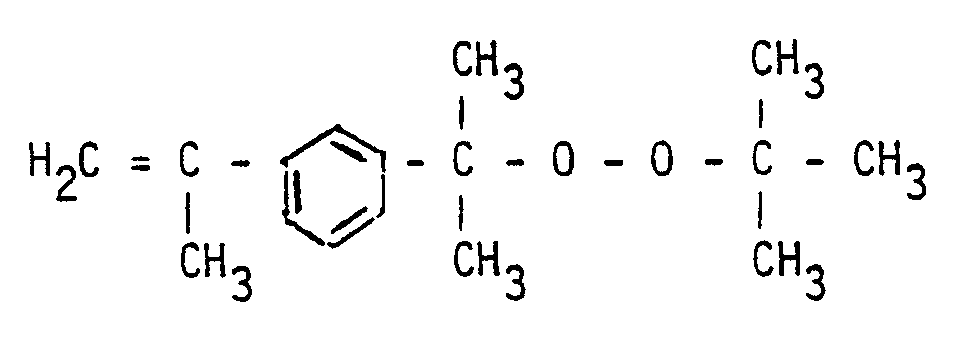
Dieses Molekül wird mit der Vinylgruppe auf das Polymermolekül aufgepfropft. Die Peroxigruppe dient als Vernetzer, wobei ein Sauerstoffatom als Alkohol- bzw. Ketogruppe am Molekül gebunden bleibt. Die OH-Gruppe ist für die wt-Stablisierung vorgesehen. Das freiwerdende Tertiär-Butanol ist in jedem Falle flüchtig, d.h. es diffundiert aus dem Kunststoff heraus. Das restliche Molekül bleibt an dem Polymer durch die Pfropfung fest gebunden. Dies konnte dadurch nachgewiesen werden, daß aromatische Produkte nicht durch Extraktion entfernt werden konnten, andererseits die chemische Bindung an das Polymer durch IR-Analyse als erwiesen gilt.This molecule is grafted onto the polymer molecule with the vinyl group. The peroxy group serves as a crosslinker, an oxygen atom remaining attached to the molecule as an alcohol or keto group. The OH group is intended for wt stabilization. The released tertiary butanol is volatile in any case, i.e. it diffuses out of the plastic. The remaining molecule remains firmly bound to the polymer through the grafting. This could be demonstrated by the fact that aromatic products could not be removed by extraction, on the other hand the chemical binding to the polymer by IR analysis is considered to be proven.
An einer Probe von vernetztem Polyethylen (VPE) wurde die watertree-Resistenz über den sogenannten Nadel-Test mit 1,5 mm Schlagweite überprüft. Dabei ergab sich bei einem Peroxidgehalt von 4 Gew. % ein Mittelwert der Wachstumslänge von 120 µm der water trees. Nach einer Temperung von 15 Stunden bei 80° C betrug die Länge der water trees 145 µm im Mittel. Zum Vergleich wurden die wt-Wachstumswerte für normales, mit Dicumylperoxid vernetztes PE gemessen. Der Mittelwert betrug ungetempert 100 µm und getempert 290 µm.The watertree resistance was tested on a sample of cross-linked polyethylene (VPE) using the so-called needle test with a stroke length of 1.5 mm. With a peroxide content of 4% by weight, the mean growth length of the water trees was 120 µm. After tempering for 15 hours at 80 ° C, the length of the water trees was 145 µm on average. For comparison, the wt growth values for normal PE crosslinked with dicumyl peroxide were measured. The mean was 100 µm untempered and 290 µm annealed.
Während also bei Dicumylperoxid-vernetztem LDPE durch Verlust der (temporär) stabilisierenden Peroxidspaltprodukte eine deutliche Verschlechterung des wt-Verhaltens eintritt, ist dies bei Vernetzung mit einem an das Polymer gebundenen Stabilisator in viel geringerem Maße der Fall.Thus, while with dicumyl peroxide-crosslinked LDPE, loss of the (temporarily) stabilizing peroxide cleavage products leads to a marked deterioration in the wt behavior, this is the case to a much lesser extent when crosslinking with a stabilizer bound to the polymer.
Claims (10)
dadurch gekennzeichnet, daß dem Basispolymer eine Substanz zugefügt ist, deren Moleküle mehrere funktionelle Gruppen aufweisen, von denen mindestens eine Gruppe der Bindung an das Polymermolekül dient, während eine andere die Vernetzung bewirkt und dabei eine weitere - stabilisierend wirkende - Gruppe aktiviert.1. plastic insulation which has molecular groups bonded to the base polymer of the plastic insulation for stabilization against voltage-induced defects,
characterized in that a substance is added to the base polymer, the molecules of which have several functional groups, at least one of which serves to bind to the polymer molecule, while another effects the crosslinking and thereby activates a further - stabilizing - group.
dadurch gekennzeichnet, daß die Bindung durch eine Propfreaktion über eine ethylenisch ungesättigte Kohlenwasserstoffgruppe hergestellt ist.2. plastic insulation according to claim 1,
characterized in that the bond is made by a graft reaction over an ethylenically unsaturated hydrocarbon group.
dadurch gekennzeichnet, daß die als Vernetzer wirkende Molekülgruppe eine Alkylperoxigruppe aufweist.3. plastic insulation according to claim 1,
characterized in that the molecular group acting as crosslinker has an alkyl peroxy group.
dadurch gekennzeichnet, daß durch die Bindung der stabilisierend wirkenden Molekülgruppe an das Polymer des Isoliermaterials das Polymer einen polaren Charakter aufweist.4. Plastic insulation according to one of claims 1 to 3,
characterized in that the polymer has a polar character due to the binding of the stabilizing molecule group to the polymer of the insulating material.
dadurch gekennzeichnet, daß der polare Charakter auf Hydroxylgruppen beruht.5. Plastic insulation according to one of claims 1 to 4,
characterized in that the polar character is based on hydroxyl groups.
dadurch gekennzeichnet, daß der polare Charakter auf Ketogruppen beruht.6. Plastic insulation according to one of claims 1 to 5,
characterized in that the polar character is based on keto groups.
dadurch gekennzeichnet, daß zur Vernetzung und Stabilisierung (1-(2-tertiärbutylperoxi-isopropyl)-3-isopropenylbenzol verwendet ist.7. Plastic insulation according to one of claims 1 to 6,
characterized in that (1- (2-tert-butylperoxy-isopropyl) -3-isopropenylbenzene is used for crosslinking and stabilization.
dadurch gekennzeichnet, daß als Basispolymer Olefinhomopolymerisate Verwendung finden.8. Plastic insulation according to one of claims 1 to 7,
characterized in that olefin homopolymers are used as the base polymer.
dadurch gekennzeichnet, daß als Basispolymer Copolymerisate des Ethylens mit einem weiteren polymerisationsfähigen Monomeren Verwendung finden.9. Plastic insulation according to one of claims 1 to 7,
characterized in that copolymers of ethylene with another polymerizable monomer are used as the base polymer.
dadurch gekennzeichnet, daß als Basispolymer Elastomere auf Kohlenwasserstoffbasis Verwendung finden.10. Plastic insulation according to one of claims 1 to 8,
characterized in that elastomers based on hydrocarbons are used as the base polymer.
Applications Claiming Priority (2)
| Application Number | Priority Date | Filing Date | Title |
|---|---|---|---|
| DE19873739738 DE3739738A1 (en) | 1987-11-24 | 1987-11-24 | PLASTIC INSULATION FOR STABILIZATION AGAINST VOLTAGE-INDUCTED DEFECTS |
| DE3739738 | 1987-11-24 |
Publications (2)
| Publication Number | Publication Date |
|---|---|
| EP0318792A2 true EP0318792A2 (en) | 1989-06-07 |
| EP0318792A3 EP0318792A3 (en) | 1990-05-09 |
Family
ID=6341117
Family Applications (1)
| Application Number | Title | Priority Date | Filing Date |
|---|---|---|---|
| EP88119374A Withdrawn EP0318792A3 (en) | 1987-11-24 | 1988-11-22 | Voltage-stabilised insulation material |
Country Status (2)
| Country | Link |
|---|---|
| EP (1) | EP0318792A3 (en) |
| DE (1) | DE3739738A1 (en) |
Cited By (1)
| Publication number | Priority date | Publication date | Assignee | Title |
|---|---|---|---|---|
| EP0469155A4 (en) * | 1990-02-23 | 1992-12-09 | The Furukawa Electric Co., Ltd. | Olefinic resin composition for power cable, and power cable and junction thereof made from said composition |
Family Cites Families (2)
| Publication number | Priority date | Publication date | Assignee | Title |
|---|---|---|---|---|
| DE2935224A1 (en) * | 1979-08-31 | 1981-03-19 | Kabel- und Metallwerke Gutehoffnungshütte AG, 3000 Hannover | WATERPROOF HIGH VOLTAGE INSULATION FOR ELECTRIC CABLES |
| US4774293A (en) * | 1985-06-26 | 1988-09-27 | Akzo N.V. | Process for cross-linking or degrading polymers and shaped articles obtained by this process |
-
1987
- 1987-11-24 DE DE19873739738 patent/DE3739738A1/en active Granted
-
1988
- 1988-11-22 EP EP88119374A patent/EP0318792A3/en not_active Withdrawn
Cited By (1)
| Publication number | Priority date | Publication date | Assignee | Title |
|---|---|---|---|---|
| EP0469155A4 (en) * | 1990-02-23 | 1992-12-09 | The Furukawa Electric Co., Ltd. | Olefinic resin composition for power cable, and power cable and junction thereof made from said composition |
Also Published As
| Publication number | Publication date |
|---|---|
| DE3739738A1 (en) | 1989-06-08 |
| EP0318792A3 (en) | 1990-05-09 |
| DE3739738C2 (en) | 1989-11-09 |
Similar Documents
| Publication | Publication Date | Title |
|---|---|---|
| DE69623938T2 (en) | Insulation composition resistant to water trees | |
| DE69231604T2 (en) | Halogen free flame retardant resin composition and thus coated wires and cables | |
| DE68904568T2 (en) | FLAME-RETARDANT AETHYLENE POLYMER BLENDS. | |
| DE3871607T2 (en) | WATER LOCKER BASED ON SILOXANE FOR ELECTRICAL CABLES. | |
| DE2439490C2 (en) | Ethylene vinyl acetate copolymer composition | |
| DE19941181B4 (en) | Fire Retardant Resin Composition Process for the manufacture, use and molding using the same | |
| DE69205741T2 (en) | Composition for crosslinking ethylene polymer, method for crosslinking the polymer and power cable with crosslinked polymer. | |
| DE2063395A1 (en) | Curable polyethylene blends that contain an organic silicon additive | |
| DE60117365T2 (en) | ELECTRICALLY INSULATING RESIN COMPOSITION AND ELECTRIC WIRE OR CABLE BOTH COATED THEREOF | |
| DE69912868T2 (en) | Electrical cable with self-healing cable protection | |
| DE3888581T2 (en) | Water tree resistant electrical insulation composition. | |
| DE3538527A1 (en) | METHOD FOR PRODUCING A CABLE INSULATED WITH CROSSLINKED POLYOLEFINES | |
| EP0541007A1 (en) | Filler mass | |
| EP0025091B1 (en) | Water-proof high voltage insulation for electric cables and process for its manufacture | |
| DE2326272A1 (en) | CONDUCTORS INSULATED AGAINST HIGH VOLTAGE | |
| EP0236918A2 (en) | Cable insulation based on ethylene polymers having a high resistance against water treeing | |
| DE3315079A1 (en) | FLAME RETARDANT, CROSSLINKED POLYOLEFIN INSULATION MATERIAL | |
| DE69917782T2 (en) | COMPOSITION FOR ELECTRICAL CABLES | |
| EP0158040B1 (en) | Flame-retardant insulation composition for electrical cables and conductors | |
| DE3739738C2 (en) | ||
| DE2228978B2 (en) | Fire retardant mass | |
| DE3702209C2 (en) | ||
| DE1949539A1 (en) | Polyolefin dielectric with voltage stabilizer | |
| DE2221329C2 (en) | Isolation compound based on elastomers | |
| DE69720385T2 (en) | Telephone cable |
Legal Events
| Date | Code | Title | Description |
|---|---|---|---|
| PUAI | Public reference made under article 153(3) epc to a published international application that has entered the european phase |
Free format text: ORIGINAL CODE: 0009012 |
|
| AK | Designated contracting states |
Kind code of ref document: A2 Designated state(s): AT BE CH DE ES FR GB GR IT LI LU NL SE |
|
| PUAL | Search report despatched |
Free format text: ORIGINAL CODE: 0009013 |
|
| AK | Designated contracting states |
Kind code of ref document: A3 Designated state(s): AT BE CH DE ES FR GB GR IT LI LU NL SE |
|
| 17P | Request for examination filed |
Effective date: 19900829 |
|
| RAP1 | Party data changed (applicant data changed or rights of an application transferred) |
Owner name: KABEL RHEYDT AKTIENGESELLSCHAFT |
|
| 17Q | First examination report despatched |
Effective date: 19930407 |
|
| STAA | Information on the status of an ep patent application or granted ep patent |
Free format text: STATUS: THE APPLICATION IS DEEMED TO BE WITHDRAWN |
|
| 18D | Application deemed to be withdrawn |
Effective date: 19950531 |