EP0318886B1 - Procédé de décapage électrolytique d'une couche protectrice, ayant une haute teneur en chromium et nickel et/ou cobalt, recouvrant un substrat d'un objet fait en superalliage - Google Patents
Procédé de décapage électrolytique d'une couche protectrice, ayant une haute teneur en chromium et nickel et/ou cobalt, recouvrant un substrat d'un objet fait en superalliage Download PDFInfo
- Publication number
- EP0318886B1 EP0318886B1 EP88119777A EP88119777A EP0318886B1 EP 0318886 B1 EP0318886 B1 EP 0318886B1 EP 88119777 A EP88119777 A EP 88119777A EP 88119777 A EP88119777 A EP 88119777A EP 0318886 B1 EP0318886 B1 EP 0318886B1
- Authority
- EP
- European Patent Office
- Prior art keywords
- parts
- protective layer
- electrolyte
- weight
- following composition
- Prior art date
- Legal status (The legal status is an assumption and is not a legal conclusion. Google has not performed a legal analysis and makes no representation as to the accuracy of the status listed.)
- Expired - Lifetime
Links
- PXHVJJICTQNCMI-UHFFFAOYSA-N Nickel Chemical compound [Ni] PXHVJJICTQNCMI-UHFFFAOYSA-N 0.000 title claims description 59
- 238000000034 method Methods 0.000 title claims description 26
- 229910052759 nickel Inorganic materials 0.000 title claims description 26
- 229910052804 chromium Inorganic materials 0.000 title claims description 15
- 229910000601 superalloy Inorganic materials 0.000 title claims description 13
- 229910017052 cobalt Inorganic materials 0.000 title claims description 6
- 239000010941 cobalt Substances 0.000 title claims description 6
- GUTLYIVDDKVIGB-UHFFFAOYSA-N cobalt atom Chemical compound [Co] GUTLYIVDDKVIGB-UHFFFAOYSA-N 0.000 title claims description 6
- 239000011651 chromium Substances 0.000 title description 29
- 239000000758 substrate Substances 0.000 title description 11
- VYZAMTAEIAYCRO-UHFFFAOYSA-N Chromium Chemical compound [Cr] VYZAMTAEIAYCRO-UHFFFAOYSA-N 0.000 title description 8
- 239000011253 protective coating Substances 0.000 title 1
- 239000011241 protective layer Substances 0.000 claims description 40
- 239000000203 mixture Substances 0.000 claims description 21
- 239000003792 electrolyte Substances 0.000 claims description 20
- SQGYOTSLMSWVJD-UHFFFAOYSA-N silver(1+) nitrate Chemical compound [Ag+].[O-]N(=O)=O SQGYOTSLMSWVJD-UHFFFAOYSA-N 0.000 claims description 18
- 238000005868 electrolysis reaction Methods 0.000 claims description 14
- HEMHJVSKTPXQMS-UHFFFAOYSA-M Sodium hydroxide Chemical compound [OH-].[Na+] HEMHJVSKTPXQMS-UHFFFAOYSA-M 0.000 claims description 12
- GRYLNZFGIOXLOG-UHFFFAOYSA-N Nitric acid Chemical compound O[N+]([O-])=O GRYLNZFGIOXLOG-UHFFFAOYSA-N 0.000 claims description 10
- 239000010410 layer Substances 0.000 claims description 10
- 229910017604 nitric acid Inorganic materials 0.000 claims description 10
- WGLPBDUCMAPZCE-UHFFFAOYSA-N Trioxochromium Chemical compound O=[Cr](=O)=O WGLPBDUCMAPZCE-UHFFFAOYSA-N 0.000 claims description 6
- QAOWNCQODCNURD-UHFFFAOYSA-N Sulfuric acid Chemical compound OS(O)(=O)=O QAOWNCQODCNURD-UHFFFAOYSA-N 0.000 claims description 5
- 229910017665 NH4HF2 Inorganic materials 0.000 claims description 3
- 229910004882 Na2S2O8 Inorganic materials 0.000 claims description 3
- 230000004913 activation Effects 0.000 claims description 3
- CHQMHPLRPQMAMX-UHFFFAOYSA-L sodium persulfate Chemical compound [Na+].[Na+].[O-]S(=O)(=O)OOS([O-])(=O)=O CHQMHPLRPQMAMX-UHFFFAOYSA-L 0.000 claims description 3
- 235000011149 sulphuric acid Nutrition 0.000 claims description 3
- 238000000227 grinding Methods 0.000 claims description 2
- 238000007654 immersion Methods 0.000 claims description 2
- KBJMLQFLOWQJNF-UHFFFAOYSA-N nickel(II) nitrate Inorganic materials [Ni+2].[O-][N+]([O-])=O.[O-][N+]([O-])=O KBJMLQFLOWQJNF-UHFFFAOYSA-N 0.000 claims description 2
- 239000004576 sand Substances 0.000 claims description 2
- UFMZWBIQTDUYBN-UHFFFAOYSA-N cobalt dinitrate Chemical compound [Co+2].[O-][N+]([O-])=O.[O-][N+]([O-])=O UFMZWBIQTDUYBN-UHFFFAOYSA-N 0.000 claims 2
- 239000002253 acid Substances 0.000 claims 1
- 238000005422 blasting Methods 0.000 claims 1
- 150000004715 keto acids Chemical class 0.000 claims 1
- 150000003839 salts Chemical class 0.000 claims 1
- 239000007789 gas Substances 0.000 description 12
- 229910000831 Steel Inorganic materials 0.000 description 9
- 239000011162 core material Substances 0.000 description 9
- 230000007797 corrosion Effects 0.000 description 9
- 238000005260 corrosion Methods 0.000 description 9
- 239000010959 steel Substances 0.000 description 9
- 238000009792 diffusion process Methods 0.000 description 8
- 238000000576 coating method Methods 0.000 description 5
- 238000010586 diagram Methods 0.000 description 5
- 229910052751 metal Inorganic materials 0.000 description 5
- 239000002184 metal Substances 0.000 description 5
- QDOXWKRWXJOMAK-UHFFFAOYSA-N dichromium trioxide Chemical compound O=[Cr]O[Cr]=O QDOXWKRWXJOMAK-UHFFFAOYSA-N 0.000 description 4
- 238000004090 dissolution Methods 0.000 description 4
- 230000003628 erosive effect Effects 0.000 description 4
- 230000001590 oxidative effect Effects 0.000 description 4
- 229910045601 alloy Inorganic materials 0.000 description 3
- 239000000956 alloy Substances 0.000 description 3
- NPURPEXKKDAKIH-UHFFFAOYSA-N iodoimino(oxo)methane Chemical compound IN=C=O NPURPEXKKDAKIH-UHFFFAOYSA-N 0.000 description 3
- 150000002739 metals Chemical class 0.000 description 3
- 229910052709 silver Inorganic materials 0.000 description 3
- 229910052725 zinc Inorganic materials 0.000 description 3
- 229910000531 Co alloy Inorganic materials 0.000 description 2
- 229910002651 NO3 Inorganic materials 0.000 description 2
- 229910000990 Ni alloy Inorganic materials 0.000 description 2
- NHNBFGGVMKEFGY-UHFFFAOYSA-N Nitrate Chemical compound [O-][N+]([O-])=O NHNBFGGVMKEFGY-UHFFFAOYSA-N 0.000 description 2
- 229910052793 cadmium Inorganic materials 0.000 description 2
- 238000005266 casting Methods 0.000 description 2
- 238000004140 cleaning Methods 0.000 description 2
- 239000011248 coating agent Substances 0.000 description 2
- 229910052802 copper Inorganic materials 0.000 description 2
- 239000010949 copper Substances 0.000 description 2
- 150000002500 ions Chemical class 0.000 description 2
- 230000003647 oxidation Effects 0.000 description 2
- 238000007254 oxidation reaction Methods 0.000 description 2
- 238000000926 separation method Methods 0.000 description 2
- 239000000126 substance Substances 0.000 description 2
- 229910052718 tin Inorganic materials 0.000 description 2
- ZCYVEMRRCGMTRW-UHFFFAOYSA-N 7553-56-2 Chemical compound [I] ZCYVEMRRCGMTRW-UHFFFAOYSA-N 0.000 description 1
- WKBOTKDWSSQWDR-UHFFFAOYSA-N Bromine atom Chemical compound [Br] WKBOTKDWSSQWDR-UHFFFAOYSA-N 0.000 description 1
- 229910052778 Plutonium Inorganic materials 0.000 description 1
- 150000001242 acetic acid derivatives Chemical class 0.000 description 1
- 239000000654 additive Substances 0.000 description 1
- 238000000137 annealing Methods 0.000 description 1
- QVGXLLKOCUKJST-UHFFFAOYSA-N atomic oxygen Chemical compound [O] QVGXLLKOCUKJST-UHFFFAOYSA-N 0.000 description 1
- 230000015572 biosynthetic process Effects 0.000 description 1
- GDTBXPJZTBHREO-UHFFFAOYSA-N bromine Substances BrBr GDTBXPJZTBHREO-UHFFFAOYSA-N 0.000 description 1
- 229910052794 bromium Inorganic materials 0.000 description 1
- 150000001805 chlorine compounds Chemical class 0.000 description 1
- 230000000694 effects Effects 0.000 description 1
- 238000002848 electrochemical method Methods 0.000 description 1
- 238000009713 electroplating Methods 0.000 description 1
- 230000001771 impaired effect Effects 0.000 description 1
- 229910052738 indium Inorganic materials 0.000 description 1
- 229910052740 iodine Inorganic materials 0.000 description 1
- 239000011630 iodine Substances 0.000 description 1
- 238000004519 manufacturing process Methods 0.000 description 1
- 239000000463 material Substances 0.000 description 1
- 229910001235 nimonic Inorganic materials 0.000 description 1
- 150000002823 nitrates Chemical class 0.000 description 1
- 150000004045 organic chlorine compounds Chemical class 0.000 description 1
- 239000001301 oxygen Substances 0.000 description 1
- 229910052760 oxygen Inorganic materials 0.000 description 1
- 239000002245 particle Substances 0.000 description 1
- 238000007750 plasma spraying Methods 0.000 description 1
- OYEHPCDNVJXUIW-UHFFFAOYSA-N plutonium atom Chemical compound [Pu] OYEHPCDNVJXUIW-UHFFFAOYSA-N 0.000 description 1
- 239000011148 porous material Substances 0.000 description 1
- 238000005480 shot peening Methods 0.000 description 1
- 239000001488 sodium phosphate Substances 0.000 description 1
- 229910000162 sodium phosphate Inorganic materials 0.000 description 1
- 238000003756 stirring Methods 0.000 description 1
- 239000002344 surface layer Substances 0.000 description 1
- 238000007669 thermal treatment Methods 0.000 description 1
- 239000011135 tin Substances 0.000 description 1
- RYFMWSXOAZQYPI-UHFFFAOYSA-K trisodium phosphate Chemical compound [Na+].[Na+].[Na+].[O-]P([O-])([O-])=O RYFMWSXOAZQYPI-UHFFFAOYSA-K 0.000 description 1
- 239000011701 zinc Substances 0.000 description 1
Images


Classifications
-
- C—CHEMISTRY; METALLURGY
- C25—ELECTROLYTIC OR ELECTROPHORETIC PROCESSES; APPARATUS THEREFOR
- C25F—PROCESSES FOR THE ELECTROLYTIC REMOVAL OF MATERIALS FROM OBJECTS; APPARATUS THEREFOR
- C25F5/00—Electrolytic stripping of metallic layers or coatings
-
- C—CHEMISTRY; METALLURGY
- C23—COATING METALLIC MATERIAL; COATING MATERIAL WITH METALLIC MATERIAL; CHEMICAL SURFACE TREATMENT; DIFFUSION TREATMENT OF METALLIC MATERIAL; COATING BY VACUUM EVAPORATION, BY SPUTTERING, BY ION IMPLANTATION OR BY CHEMICAL VAPOUR DEPOSITION, IN GENERAL; INHIBITING CORROSION OF METALLIC MATERIAL OR INCRUSTATION IN GENERAL
- C23F—NON-MECHANICAL REMOVAL OF METALLIC MATERIAL FROM SURFACE; INHIBITING CORROSION OF METALLIC MATERIAL OR INCRUSTATION IN GENERAL; MULTI-STEP PROCESSES FOR SURFACE TREATMENT OF METALLIC MATERIAL INVOLVING AT LEAST ONE PROCESS PROVIDED FOR IN CLASS C23 AND AT LEAST ONE PROCESS COVERED BY SUBCLASS C21D OR C22F OR CLASS C25
- C23F1/00—Etching metallic material by chemical means
- C23F1/44—Compositions for etching metallic material from a metallic material substrate of different composition
Definitions
- the blade is a critical component, with protective layers against erosion, wear, corrosion and oxidation becoming more important at high temperatures.
- the protective layer usually has a shorter lifespan than the core material of the blade, which is why the renewability of the former is becoming increasingly important.
- the invention relates to the further development of methods for repairing, repairing and renewing components of thermal machines which have been rendered unusable by erosion, wear, corrosion, oxidation or mechanical damage and are provided with protective layers.
- the old existing protective layer must first be removed, which can basically be done mechanically or chemically.
- the electrochemical method as a reverse process to the galvanic coating has a special position.
- it relates to a method for the electrolytic detachment of a surface protective layer having a high Cr and Ni and / or Co content from the base body of a component consisting of a nickel or cobalt-based superalloy.
- Electrolytic dissolution has hitherto not been practically used for such alloys.
- Some methods are known for removing metals from their substrates by reversing the method of electroplating.
- US-A-2 907 700 it is known to electrolytically remove coatings of metals (Ag, Ni, Cd, Zn, In) from a plutonium substrate.
- Sulfuric acid or sodium phosphate solution is used as the electrolyte.
- An electrolytic process is known from DE-B-21 46 828 for detaching metal coatings (Cr, Au, Cd, Cu, Ag, Zn, Sn, Ni) from stainless Cr / Ni steel.
- Bromine-containing solutions of nitrates, acetates, chlorides etc. are used as electrolytes.
- the attack on the substrate is said to be low.
- coatings of metals Ni, Cr, Zn, Sn, Cu, Cd, Ag
- nitric acid or nitrate-containing solutions with iodine content as electrolytes, to which organic chlorine compounds are additionally added will.
- the invention is based on the object of specifying a method for detaching a surface protection layer based on a Ni and / or Co alloy with a high Cr content from the base body of a component, which consists of a chromium-containing Ni and / or Co base alloy.
- the surface layer should be completely removed without the material of the base body being attacked, removed or damaged or its chemical-physical properties and its behavior with regard to compatibility being impaired or changed, particularly when a surface protective layer is subsequently reapplied (renewed).
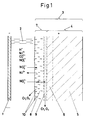
- 1 shows a schematic cross section through the active part of an electrolytic cell for carrying out the method.
- 1 is the cathode (usually a sheet made of corrosion-resistant Cr / Ni steel), 2 the electrolyte (indicated by horizontal lines), 3 the anode consisting of the base body and surface protection layer.
- the base body (substrate) 4 consists of a nickel or cobalt-based superalloy, which is usually present as an unchanged part 5 (core material).
- a diffusion zone 6 is located in the base body 4 at the boundary with the surface protective layer 7.
- the surface protection layer 7 in turn is composed of an originally unchanged part 8 and a diffusion zone 9.
- the latter generally forms after the protective layer 7 has been applied by diffusion annealing in production, but at the latest when the high temperatures in operation are reached. It is usually characterized by a depletion of chromium and an enrichment in nickel.
- the main ions present in the present example H+; Ni2+; Co2+, NO 2nd 3rd ⁇
- the electrochemical attack is first carried out on the surface of the protective layer 7 by NO 2nd 3rd ⁇ Ions, which mainly release the nickel (through with NO 2nd 3rd ⁇ And Ni2+ marked arrows). This loosens the protective layer 7, which is indicated by the formation of the pores 10.
- the attack of the electrolyte can be carried forward deeper inside the protective layer 7.
- the chromium is mainly oxidized by the oxidizing attack and has a passivating effect.
- the Cr2O3 particles formed fall out successively mechanically from the loosened dressing (indicated by an arrow).
- the chromium-depleted and nickel-enriched diffusion zone 9 of the surface protection layer 7, which is electrochemically negative compared to the neighboring regions, is preferably attacked by oxidizing the chromium and mechanically falling out as Cr2O3 (indicated by the arrow).
- the diffusion zone 9 of the surface protective layer 7 sets itself electronegatively with respect to the regions adjacent to it (indicated by -).
- Curve “a” shows the course of the chromium content
- curve “b” that of the nickel content as a function of depth x.
- the values are highly schematic mean values of numerous samples. The course can assume other values quantitatively, but always shows the same picture of the Cr depletion and the Ni enrichment in the diffusion zone 9.
- FIG. 3 shows a flow diagram in the form of a block diagram of a possible embodiment of the method.
- the diagram is self-explanatory and requires no further explanation.
- Electrolytic separation processes are based on the difference in the separation or dissolution potential of the components and / or phases involved.
- the potentials of the base body (substrate) 4 and the surface protective layer 7 are normally close together, since they are each nickel alloys with chromium contents that do not differ significantly from one another.
- the protective layer 7 can be detached without simultaneously attacking the base body 4, since the ions are the same.
- the thermal treatment of coated components even with very related alloys for the protective layer and base body, causes significant differences in concentration and potential due to diffusion. Interdiffusion forms an intermediate layer (diffusion zone 9) which (in an oxidizing electrolysis bath) assumes a negative electrochemical potential with respect to its surroundings and is therefore more easily attacked and detached.
- the core material of the gas turbine blade consisted of a nickel-based wrought superalloy with the trade name Nimonic 80A with the following composition: Cr 19.5% by weight Al 1.4% by weight Ti 2.4% by weight Zr 0.06% by weight Mn 0.30% by weight Si 0.30% by weight B 0.003% by weight C. 0.06% by weight Ni rest
- the surface protective layer with a thickness of 100 to 150 ⁇ m had been applied to the core material by plasma spraying and had the following composition: Cr 17% by weight Si 4.5% by weight Fe 4.5% by weight B 3.5% by weight Ni rest
- the gas turbine blade was cleaned by placing it in a solution of 20% NaOH at a temperature of 100 ° C. for 2 hours, rinsing it and treating it again in concentrated HCl. Then the shovel was brushed with a steel brush.
- the bucket was activated. For this purpose, it was again placed in 20% NaOH and then placed in concentrated HCl for 2 h.
- a sheet made of corrosion-resistant 18 Cr / 8 Ni steel served as the cathode.
- Electrolysis was then carried out under a cell voltage of 1000 mV at an anodic current density of 0.2 A / dm 2 for a period of 144 h.
- the bath temperature was 25 ° C.
- the scoop was removed from the bath, rinsed, brushed and dried.
- the core material had the trade name IN 939 from INCO, was a nickel-based casting superalloy and had the following composition: Cr 22.4% by weight Co 19.0% by weight Ta 1.4% by weight Nb 1.0% by weight Al 1.9% by weight Ti 3.7% by weight Zr 0.1% by weight C. 0.15% by weight Ni rest
- the approx. 120 ⁇ m average surface protection layer had the following composition: Cr 49% by weight Si 6% by weight Fe 2% by weight Ni rest
- a sheet made of corrosion-resistant Cr-Ni steel served as the cathode.
- the electrolytic detachment of the surface protective layer was carried out under a cell voltage of 1100 mV at an anodic current density of 0.2 A / dm 2 for 120 h.
- the bath temperature was 20 ° C.
- the dimensions of the airfoil were the same as in example 1.
- the core material of the airfoil consisted of a nickel-based casting superalloy with the trade name IN 738 from INCO with the following composition: Cr 16.0% by weight Co 8.5% by weight Mon 1.75% by weight W 2.6% by weight Ta 1.75% by weight Nb 0.9% by weight Al 3.4% by weight Ti 3.4% by weight Zr 0.1% by weight B 0.01% by weight C. 0.11% by weight Ni rest
- the protective layer had an average thickness of 100 ⁇ m and had the following composition: Cr 20% by weight Fe 2% by weight B 3% by weight Ni rest
- Example 2 As in Example 1, a sheet made of corrosion-resistant 18/8 steel was used as the cathode.
- the cell voltage was 1050 mV, the current density at the anode was 0.2 A / dm2. Electrolysis was carried out at a bath temperature of 22 ° C. for 140 h.
- the core material of a gas turbine blade with the blade dimensions according to Example 2 consisted of a nickel-based wrought superalloy with the trade name IN 105 from INCO with the following composition: Cr 13.5% by weight Co 18% by weight Al 4.2% by weight Mon 4.5% by weight Ti 0.9% by weight Mn 1% by weight Si 1% by weight C. 0.2% by weight Ni rest
- the protective layer had an average thickness of 140 ⁇ m and had the following composition: Cr 10% by weight Si 6% by weight Fe 4% by weight Co 20% by weight Ni rest
- a sheet made of corrosion-resistant 18 Cr / 8 Ni steel served as the cathode. It was electrolyzed under a cell voltage of 1100 mV with an anodic current density of 0.18 A / dm2 for 150 h. Bath temperature 24 ° C. After the treatment, the component was rinsed, brushed and dried in the usual way.
- a sheet of corrosion-resistant 18/8 steel served as the cathode.
- the invention is not restricted to the exemplary embodiments.
- the method relates specifically to the electrolytic detachment of surface protective layers with a high Cr content and with a high Ni or Co content or at the same time a high Ni and Co content. It is therefore a matter of high-chromium nickel or cobalt-based alloys or those based on a nickel / cobalt mixture.
- Activation is carried out by 20% NaOH and subsequent immersion in concentrated HCl for 2 h at 40 ° C.
- the component is then placed as an anode in an electrolyte that contains oxygen-releasing, oxidizing components. There it is subjected to electrolysis until the surface protective layer has completely dissolved and fallen off.
- the surface protective layer is optionally pretreated by grinding and / or sand or shot peening before electrolysis. In stubborn cases, pulsed cell voltage is used.
- the stationary cell voltage is intermittent at intervals of 10 to 30 min. over a period of 5 to 10 seconds, an additional overvoltage of 1500 to 2000 mV is superimposed on the cell voltage.
Landscapes
- Chemical & Material Sciences (AREA)
- Chemical Kinetics & Catalysis (AREA)
- Engineering & Computer Science (AREA)
- Materials Engineering (AREA)
- Metallurgy (AREA)
- Organic Chemistry (AREA)
- General Chemical & Material Sciences (AREA)
- Mechanical Engineering (AREA)
- Electrochemistry (AREA)
- Electroplating And Plating Baths Therefor (AREA)
Claims (7)
- Procédé pour la dissolution électrolytique d'un film protecteur formant couche superficielle (7) présentant un contenu élevé de Cr et Ni et/ou Co, d'une substance de base (4) d'un élément composé d'un super-alliage à base de nickel ou de cobalt, caractérisé en ce que l'élément recouvert d'un film protecteur (7) est d'abord plongé, pour activation, dans une solution de NaOH à 20% et ensuite à 40 °C, pendant 2 heures, dans une solution de HCl concentré, et en ce que l'élément est placé, avec son film protecteur activé (7), en tant qu'anode dans un électrolyte aqueux (2), qui contient en outre un acide oxygéné oxydant et le cas échéant des sels d'un tel acide et est soumis a électrolyse jusqu'à totale dissolution et complète séparation du film protecteur (7).
- Procédé selon la revendication 1, caractérisé en ce que l'électrolyte (2) a la composition suivante :
30 parties de HNO₃ concentré
2 parties de Ni(NO₃)₂
1 partie de Co(NO₃)₂
70 parties de H₂O. - Procédé selon la revendication 1, caractérisé en ce que le film protecteur (7) est préalablement traité par ponçage et/ou jets de sable ou de billes avec d'être plongé dans l'électrolyte (2) et que ce dernier a la composition suivante :
10 parties de HNO₃ concentré
5 parties de AgNO₃
90 parties de H₂O. - Procédé selon la revendication 1, caractérisé en ce que l'électrolyte (2) a la composition suivante :
20 parties de CrO₃
80 parties de H₂O. - Procédé selon la revendication 1, caractérisé en ce que l'électrolyte (2) a la composition suivante :
10 parties de H₂SO₄
10 parties de Na₂S₂O₈
80 parties de H₂O. - Procédé selon la revendication 1, caractérisé en ce que l'électrolyte (2) a la composition suivante :
30 parties de HNO₃
70 parties de H₂O
10 g/l de AgNO₃
20 g/l de NH₄HF₂. - Procédé selon la revendication 1, caractérisé en ce que pendant le processus d'électrolyse, on superpose une surtension additionnelle à la tension cellulaire stationnaire, de façon intermittente à des intervalles de 10 à 30 min et pendant une durée de chaque fois 5 à 10 sec.
Applications Claiming Priority (2)
| Application Number | Priority Date | Filing Date | Title |
|---|---|---|---|
| CH4673/87 | 1987-12-01 | ||
| CH467387 | 1987-12-01 |
Publications (2)
| Publication Number | Publication Date |
|---|---|
| EP0318886A1 EP0318886A1 (fr) | 1989-06-07 |
| EP0318886B1 true EP0318886B1 (fr) | 1992-07-22 |
Family
ID=4280482
Family Applications (1)
| Application Number | Title | Priority Date | Filing Date |
|---|---|---|---|
| EP88119777A Expired - Lifetime EP0318886B1 (fr) | 1987-12-01 | 1988-11-28 | Procédé de décapage électrolytique d'une couche protectrice, ayant une haute teneur en chromium et nickel et/ou cobalt, recouvrant un substrat d'un objet fait en superalliage |
Country Status (3)
| Country | Link |
|---|---|
| US (1) | US4894130A (fr) |
| EP (1) | EP0318886B1 (fr) |
| DE (1) | DE3873038D1 (fr) |
Cited By (1)
| Publication number | Priority date | Publication date | Assignee | Title |
|---|---|---|---|---|
| US6969457B2 (en) | 2002-10-21 | 2005-11-29 | General Electric Company | Method for partially stripping a coating from the surface of a substrate, and related articles and compositions |
Families Citing this family (17)
| Publication number | Priority date | Publication date | Assignee | Title |
|---|---|---|---|---|
| GB9700819D0 (en) * | 1997-01-16 | 1997-03-05 | Gkn Westland Helicopters Ltd | Method of and apparatus for removing a metallic component from attachmet to a helicopter blade |
| US6176999B1 (en) * | 1998-12-18 | 2001-01-23 | United Technologies Corporation | Feedback controlled stripping of airfoils |
| US6352636B1 (en) * | 1999-10-18 | 2002-03-05 | General Electric Company | Electrochemical system and process for stripping metallic coatings |
| US6428683B1 (en) * | 2000-12-15 | 2002-08-06 | United Technologies Corporation | Feedback controlled airfoil stripping system with integrated water management and acid recycling system |
| US6497968B2 (en) * | 2001-02-26 | 2002-12-24 | General Electric Company | Oxidation resistant coatings for molybdenum silicide-based composite articles |
| DE10259363A1 (de) * | 2002-12-18 | 2004-07-08 | Siemens Ag | Verfahren zum Entfernen von zumindest einem Oberflächenbereich eines Bauteils |
| DE10259364A1 (de) * | 2002-12-18 | 2004-07-08 | Siemens Ag | Verfahren zum Entfernen von zumindest einem Oberflächenbereich eines Beuteils |
| DE102004002763A1 (de) * | 2004-01-20 | 2005-08-04 | Mtu Aero Engines Gmbh | Verfahren zum elektrochemischen Entschichten von Bauteilen |
| EP1870497A1 (fr) * | 2006-06-23 | 2007-12-26 | Siemens Aktiengesellschaft | Procédé d'enlèvement électrochimique d'un revêtement métallique d'un substrat |
| EP1890004A1 (fr) | 2006-08-08 | 2008-02-20 | Siemens Aktiengesellschaft | Procédé pour la production d'un revêtement à partir du matériau d'un revêtement recyclé |
| DE102006044416A1 (de) * | 2006-09-18 | 2008-03-27 | Siemens Ag | Verfahren zum elektrochemischen Be- oder Entschichten von Bauteilen |
| EP2053145A1 (fr) * | 2007-10-19 | 2009-04-29 | Siemens Aktiengesellschaft | Procédé d'enlèvement d'une couche métallique à l'aide de FIC dans une étape intermédiaire |
| US7875200B2 (en) * | 2008-05-20 | 2011-01-25 | United Technologies Corporation | Method for a repair process |
| EP2166125A1 (fr) * | 2008-09-19 | 2010-03-24 | ALSTOM Technology Ltd | Procédé pour la configuration des services d'un réseau personnel |
| CN110670115B (zh) * | 2019-09-30 | 2021-11-30 | 飞而康快速制造科技有限责任公司 | 一种适用于沉积态gh3536合金的腐蚀剂及其腐蚀方法 |
| CN114075690B (zh) * | 2020-08-14 | 2022-11-22 | 中国科学院金属研究所 | 一种电化学退除MCrAlY涂层的方法 |
| CN115573023A (zh) * | 2022-09-23 | 2023-01-06 | 中国航发哈尔滨东安发动机有限公司 | 一种铝合金表面铬层去除方法 |
Family Cites Families (7)
| Publication number | Priority date | Publication date | Assignee | Title |
|---|---|---|---|---|
| US2588734A (en) * | 1948-05-14 | 1952-03-11 | Atomic Energy Commission | Pretreatment of beryllium prior to coating |
| FR1114198A (fr) * | 1954-11-30 | 1956-04-09 | Renault | Procédé pour l'enlèvement des dépôts de chrome |
| DE1096709B (de) * | 1957-11-25 | 1961-01-05 | William Hill Fletcher Tickle | Verfahren zum Vorbereiten von Eisengegenstaenden zur Verbesserung der Haftfaehigkeit eines Emailueberzuges |
| US3015630A (en) * | 1959-08-24 | 1962-01-02 | Gen Electric | Aqueous solution for stripping nickel |
| US3819494A (en) * | 1973-03-29 | 1974-06-25 | Fountain Plating Co Inc | Method of removing braze |
| US4234397A (en) * | 1978-08-15 | 1980-11-18 | United Technologies Corporation | Nondestructive metallographic examination of gas turbine components |
| US4324626A (en) * | 1979-11-13 | 1982-04-13 | United Technologies Corporation | Selective removal of nickel-based braze alloy from nickel-based metals |
-
1988
- 1988-11-28 DE DE8888119777T patent/DE3873038D1/de not_active Expired - Lifetime
- 1988-11-28 EP EP88119777A patent/EP0318886B1/fr not_active Expired - Lifetime
- 1988-12-01 US US07/278,467 patent/US4894130A/en not_active Expired - Fee Related
Cited By (1)
| Publication number | Priority date | Publication date | Assignee | Title |
|---|---|---|---|---|
| US6969457B2 (en) | 2002-10-21 | 2005-11-29 | General Electric Company | Method for partially stripping a coating from the surface of a substrate, and related articles and compositions |
Also Published As
| Publication number | Publication date |
|---|---|
| EP0318886A1 (fr) | 1989-06-07 |
| DE3873038D1 (de) | 1992-08-27 |
| US4894130A (en) | 1990-01-16 |
Similar Documents
| Publication | Publication Date | Title |
|---|---|---|
| EP0318886A1 (fr) | Procédé de décapage électrolytique d'une couche protectrice, ayant une haute teneur en chromium et nickel et/ou cobalt, recouvrant un substrat d'un objet fait en superalliage | |
| DE2907875C2 (de) | Verfahren zum elektrolytischen Abtragen von Wolframcarbid-Überzügen auf Werkstücken aus Titan oder Titan-Legierungen | |
| EP0318724B1 (fr) | Procédé pour enlever par voie chimique des revêtements de surface protecteurs à base de chrome à partir de pièces en superalliages à base de nickel ou de cobalt | |
| DE2157511B2 (de) | Verfahren zum erneuten Aufbringen von Überzügen aufgebrauchte, dimensionsstabile Elektroden | |
| DE69700420T2 (de) | Verfahren zur Bearbeitung der aus Kupfer oder Kupferlegierung hergestellten Aussenoberfläche einer Stranggusskokille welches aus einer Nickelplattierungstufe und einer Nickelentfernungstufe besteht | |
| DE3706711A1 (de) | Verfahren zum reinigen von oberflaechen eines aluminiumgegenstandes | |
| DE2742718A1 (de) | Verfahren und vorrichtung zur regenerierung eines elektrolyten, insbesondere eines verzinnungselektrolyten | |
| DE69702064T2 (de) | Stranggusskokilleteil mit einer metalbeschichter, gekühlter wand aus kupfer oder kupferlegierung und verfahren zu seiner herstellung | |
| DE1909757B2 (de) | Verfahren zur reinigung von anoden fuer elektrolytische prozesse, die aus einer unterlage eines filmbildenden metalls und einem ueberzug aus edelmetallen, edelmetalloiden oder edelmetalloxide enthaltenden mischoxiden bestehen | |
| DE2232903C3 (de) | Verfahren zur elektrolytischen Raffination von Kupfer unter Verwendung von Titanelektroden | |
| DE1944388A1 (de) | Verfahren zum Entzundern und Beizen eines Gegenstandes aus Titan oder einer Titanlegierung | |
| DE2741397A1 (de) | Verfahren zur praeparierung eines nickellegierungs-werkstuecks fuer die plattierung | |
| DE2940741C2 (fr) | ||
| EP1913181B1 (fr) | Procede d'electropolissage | |
| DE19624436A1 (de) | Verfahren zur Oberflächenbehandlung von aus Edelstahl bestehendem Behandlungsgut | |
| DE4131793A1 (de) | Verfahren und vorrichtung zur regeneration von altbeizen | |
| DE2728650C2 (de) | Verfahren zur Vorbehandlung von Stahloberflächen für das nachfolgende Überziehen | |
| DE512913C (de) | Aus nichtleitendem Material bestehende Leisten zum Abdecken von zur elektrolytischenAbscheidung von Metallen dienenden Kathoden an solchen Teilen ihrer Oberflaeche, an denen eine Metallabscheidung nicht stattfinden soll | |
| DE673710C (de) | Verfahren zur Herstellung von Schutzueberzuegen auf Gegenstaenden aus Eisen oder Kupfer bzw. deren Legierungen | |
| EP1533398A1 (fr) | Procédé pour la production d'un électrolyte prêt à utilisation à partir de déchets contenant des ions métalliques | |
| DE843488C (de) | Verfahren zur Trennung oder Entfettung und Trennung von Maschinenteilen, die infolge Korrosion festsitzen | |
| DE3032480C2 (de) | Verfahren zur Abtragung elektrokatalytisch wirksamer Schutzüberzüge von Elektroden mit Metallkern und Anwendung des Verfahrens | |
| DE10014260B4 (de) | Verfahren zur galvanotechnischen Beschichtung von Gegenständen | |
| DE714056C (de) | Verfahren zur Entfernung festhaftender Oxydschichten von mittel- und hochlegierten Stahlsorten | |
| WO2011110323A1 (fr) | Procédé d'enlèvement de revêtement par voie électrochimique pour éléments structuraux de turbine à gaz |
Legal Events
| Date | Code | Title | Description |
|---|---|---|---|
| PUAI | Public reference made under article 153(3) epc to a published international application that has entered the european phase |
Free format text: ORIGINAL CODE: 0009012 |
|
| AK | Designated contracting states |
Kind code of ref document: A1 Designated state(s): CH DE LI NL |
|
| 17P | Request for examination filed |
Effective date: 19891116 |
|
| 17Q | First examination report despatched |
Effective date: 19910626 |
|
| GRAA | (expected) grant |
Free format text: ORIGINAL CODE: 0009210 |
|
| AK | Designated contracting states |
Kind code of ref document: B1 Designated state(s): CH DE LI NL |
|
| REF | Corresponds to: |
Ref document number: 3873038 Country of ref document: DE Date of ref document: 19920827 |
|
| PLBE | No opposition filed within time limit |
Free format text: ORIGINAL CODE: 0009261 |
|
| STAA | Information on the status of an ep patent application or granted ep patent |
Free format text: STATUS: NO OPPOSITION FILED WITHIN TIME LIMIT |
|
| 26N | No opposition filed | ||
| PGFP | Annual fee paid to national office [announced via postgrant information from national office to epo] |
Ref country code: NL Payment date: 19961024 Year of fee payment: 9 |
|
| PGFP | Annual fee paid to national office [announced via postgrant information from national office to epo] |
Ref country code: DE Payment date: 19961122 Year of fee payment: 9 |
|
| PGFP | Annual fee paid to national office [announced via postgrant information from national office to epo] |
Ref country code: CH Payment date: 19961128 Year of fee payment: 9 |
|
| PG25 | Lapsed in a contracting state [announced via postgrant information from national office to epo] |
Ref country code: LI Free format text: LAPSE BECAUSE OF NON-PAYMENT OF DUE FEES Effective date: 19971130 Ref country code: CH Free format text: LAPSE BECAUSE OF NON-PAYMENT OF DUE FEES Effective date: 19971130 |
|
| PG25 | Lapsed in a contracting state [announced via postgrant information from national office to epo] |
Ref country code: NL Free format text: LAPSE BECAUSE OF NON-PAYMENT OF DUE FEES Effective date: 19980601 |
|
| REG | Reference to a national code |
Ref country code: CH Ref legal event code: PL |
|
| PG25 | Lapsed in a contracting state [announced via postgrant information from national office to epo] |
Ref country code: DE Free format text: LAPSE BECAUSE OF NON-PAYMENT OF DUE FEES Effective date: 19980801 |
|
| NLV4 | Nl: lapsed or anulled due to non-payment of the annual fee |
Effective date: 19980601 |